Five ways to innovate your ecommerce sales funnel

30-second summary:

  • Pandemic-driven lockdowns have driven a lot of businesses online pushing the competition and increasing demand for more conversion optimization solutions
  • One of the most effective ways to increase your sales is to revamp your cross-selling tactics
  • To get more people down the sales funnel, you need to include off-site activities into consideration, that is, when your customer interrupts their buying process and how to return them to your site
  • To better understand (and meet) your customer journey, use semantic research of your target search query
  • Finally, keep analyzing your site’s sales funnel using Google Analytics

As more and more small businesses are going through digital transformation, there’s an emerging demand for new ways to attract and engage customers.

As online shopping is becoming a norm, both the competition and customers’ expectations are quickly growing.

How to create a more effective ecommerce sales funnel? Here are few fresh ideas:

1. Revamp your product recommendations

Cross-selling (that is, showing related products on all stages of the sales funnel) is one the most important – yet often neglected – components of the sales funnel. 

Did you know that cross-selling accounts for more than a third of Amazon’s revenue? Based on the public company’s data, 35 percent of what people buy on Amazon comes from product recommendations based on AI-driven algorithms.

No wonder Amazon is using cross-selling all over the site – from product pages…

Ecommerce sales funnel optimization tips - Example from Amazon

All of these cross-selling blocks are included on a single product page.

Source: Amazon

…to checkout pages using different methods to match a customer to better products:

Ecommerce sales funnel optimization tips - Revamp product descriptionsSource: PayKickstart

Cross-selling comes in many forms, including:

  • Personalized upsells: These usually show up on product pages to urge the customer to buy something they didn’t initially intend. These can be driven by the customer’s prior buying habits or the buying habits of other customers who have bought the current product
  • Product bumps: Showing matching products right on the checkout page
  • Email-driven upsells: Automated emails sent immediately after you pay encouraging you to buy more to add to the same delivery

Ecommerce sales funnel optimization tips - Email upsellingSource: Screenshot by author, March 2021

While cross-selling is a great way to increase your average order value, it’s getting harder and harder to convince customers to fall for it. To innovate your cross-selling strategy, you may try to:

  • Personalize your product recommendations
  • Try new formats (for example, testimonials, Instagram carousels, stories)

Dialogue AI is an ecommerce solution that implements both of the above by showing product recommendations based on individual browsing data as well as turns them into captivating stories.

Ecommerce sales funnel optimization tips - Using search intent and AI to recommend productsSource: Dialogue AI

Dialogue combines cross-selling with AI-powered personalization and story-telling. It is also a fully-scaled solution that requires minimum work. The platform keeps you informed on key marketing metrics through a handy dashboard:

DashboardSource: Screenshot by author, March 2021

2. Make your customer support part of the sales funnel

The ideal buyer’s journey looks like this: They land on a product page, add it to a shopping cart, submit their payment details and wait for the product to arrive.

Obviously, it doesn’t always look like that. Customers’ journeys are often interrupted, and in many cases, they are interrupted by customers themselves who get distracted or come up with questions they need answers to before completing the purchase.

The truth is, no matter how well you set up your knowledge base, many people will still want to contact your customer support team before buying. This is where lots of buying journeys may be interrupted unless you set things up properly.

Set up email follow-ups

Any customer interactions should be recorded and there always need to be personalized follow-up based on the customer’s action (i.e. whether they ended up completing the purchase or not).

Depending on your current CMS platform, you may already have access to email automation that would allow personalized follow-ups.

Ecommerce sales funnel optimization tips - Set up follow up mails

Screenshot Source: Sleeknote

Brand your customer support team’s emails

This is something that is actually missing in the screenshot above. It is important to both personalize and brand your email follow-ups to gradually grow brand recognizability and ultimately generate more repeat sales.

Remember – Your emails mean to bring your customer back to your site. It needs to revive the interrupted buying journey, so links to your site are essential. At the bare minimum, add a clickable logo and a detailed email signature prompting your customer to take an action.

3. Mind your brand-driven search query

What is it that tends to interrupt your buyers’ journey? If it’s not reaching out to your customer support, it is usually:

  • Checking your product reviews
  • Looking for your coupon codes or special deals

To better understand your customers’ journeys outside of your site, research your branded keywords (i.e. those keywords that contain your or your product name). Google Suggest is a good place to start:

Ecommerce sales funnel optimization tips - Rank for branded search queriesSource: Screenshot from Google, of March 2021

These are all as-you-type search suggestions that may impact your customers’ journey. Make sure your pages and off-site assets rank #1 for all of these.

Start viewing all of these queries as part of your sales funnel. Do you have a landing page (or landing pages) that would do a good job getting people to continue their journey on your site? Or do you rely on third-party sites to do that?

The latter is not the wisest decision. 

Remember that these queries are often used in the middle of the funnel (right before your customer completes their purchase), so this should also be reflected in the copy.

3. Create search intent-driven copy

Whether your landing (i.e. product) page relies on organic traffic or not, using search intent to drive your copy creation is a good idea. Semantic-analysis-driven search intent analysis is the only method we have to predict customers’ expectations prior to being able to analyze the actual user on-site behavior.

Semantic analysis will help you understand your customers’ journeys better:

  • What is it they may be looking for and where may their research take them?
  • Which products may they also be interested in?
  • How to catch their attention better?

All of these questions can be answered by semantic research. Text Optimizer is the easiest tool to use here: It will grab Google’s search snippets returned for your target search query and return underlying concepts that will help you create a better-targeted copy or copies:

Semantic analysisSource: Screenshot from Text Optimizer

It is also a good way to rank your pages higher in Google, but that is beyond the scope of this article…

To this end, also don’t forget Google’s most recent recommendations on providing better information for shoppers.

5. Analyze your sales funnel

Finally, monitoring your sales funnel is a must, obviously. While conversion monitoring is not usually included in SEO metrics, most SEO analytics platforms can provide sales funnel analysis. As such, Google Analytics provides a comprehensive conversion tracking that includes sales funnel visualization.

  • To start, use this guide to set up conversion tracking in your Google Analytics
  • Then, proceed to Conversions -> Goals -> Funnel Visualizations to analyze your sales funnel:

Analyze your sales funnel to optimize your ecommerce salesSource: Screenshot from Google Analytics, March 2021

Google Analytics will show where your customers are heading instead of completing their buying journeys.

Don’t forget the basics!

Fundamentally, it all comes to providing a user experience that customers want to return to. That being said, the more happy customers, the better!

Source: DigitalEagles

So while working on your sales funnel, don’t overlook the basics: Keep an eye on your customers’ feedback, monitor your brand mentions, and always strive to optimize a better customer experience.

Conclusion

Innovation is an integral part of digital marketing. Global lockdowns have changed shopping behaviors dramatically and increased demand for digital transformation and innovation. Hopefully, the five steps above will help you make your ecommerce sales funnel more effective.

Ann Smarty is the Brand and Community manager at InternetMarketingNinjas.com. She can be found on Twitter @seosmarty.

https://www.searchenginewatch.com/2021/03/08/five-ways-to-innovate-your-ecommerce-sales-funnel/


Why progressive web apps (PWAs) are poised to dominate moving forward

30-second summary:

  • Progressive web apps (PWAs) offer app-like experiences without requiring users to download anything from an app store
  • PWAs are also much less of a burden for developers than native apps, which require ongoing updates, review management, and shared profits with app stores
  • Nick Chasinov, Founder and CEO of Teknicks, outlines a few of the major business benefits of using PWAs

If Apple was threatened by “Fortnite” trying to bypass the App Store, it’s not going to be happy when progressive web apps take off. PWAs disrupt the tech giant’s granular control over the Apple App Store because they offer app-like experiences without the need to download an actual app. They’re designed for the everyday website user but provide many features that are exclusive to native apps.

Although many companies love the idea of building a native app, this approach can be a hassle for developers. You have to update them, manage reviews, attract downloads, and pay most stores a 30 percent cut of every sale — this includes paid apps and in-app purchases, which can add up quickly. Apple raked in $64 billion from the App Store in 2020.

That’s part of the reason Google is an advocate for PWAs, encouraging developers to build and distribute them. The search engine also leads Project Fugu, which aims to expand browser capabilities and help web apps “do anything native apps can“. This dream could become a reality: Almost 65 percent of internet users already rely on Chrome, and its open-source Chromium foundation lets other browsers use its PWA technology.

Since the pandemic has been sending more people online than ever before, much of the focus in 2021 will remain on the user experience. So, would you rather take cues from Apple or Google? The PWA vs. native app war has begun, and if you’re looking to stand out and get a leg up on the competition, then a PWA may be the way to go.

The business benefits of PWAs

PWAs provide users with numerous benefits. For example, they are smaller files than native apps, which frees up space on people’s devices. However, PWAs can also impact your goals and bottom line as a business. Here are three key advantages of progressive web apps:

1. Rapid connections

Consumers have options: There are plenty of places to browse news, buy clothes, and watch videos. If your website isn’t up to speed (literally), people will take their attention and spending power elsewhere. For instance, the Forbes website used to take anywhere from three to 12 seconds to fully load, those delays caused 53 percent of users to abandon the website. Once the company switched to a PWA, browsing sessions increased by 43 percent.

PWAs can increase speed for all users, but the acceleration is particularly important for browsers on slow connections. By caching content after the first visit, PWAs make it possible for more people to access your products. That increase in speed also translates to improvements in discoverability for all users. According to Google’s 2018 announcement, mobile speed factors heavily into overall page ranking.

2. SEO capabilities

Aside from the fact that speed affects your page rankings, PWAs are also SEO-friendly. Because they live on the web, their content is visible to search engines. This can boost your ability to generate traffic and leads. For example, when Alibaba turned its website into a PWA, it saw 76 percent more conversions.

Native apps are limited to the SEO constraints of app stores. Typically, only the app profile page is listed in Google search results, forcing companies to rely on the app’s description, pictures, and positive reviews to improve visibility and land more downloads.

With a PWA, you have the same unlimited flexibility as a website to create custom user experiences and optimized resourceful content that will rank on Google and showcase your app’s features and benefits. App store optimization is limited, but a PWA enables you to execute all SEO strategies.

3. Engagement opportunities

PWAs support push notifications, creating opportunities for companies to reach out to their customers with personalized product recommendations, news updates, and other relevant communications. This can improve customer engagement and help increase brand loyalty.

PWAs can also boost engagement with your social media pages because they’re able to use device tools like cameras and Global Positioning System (GPS). And as augmented reality (AR) becomes available on PWAs, all kinds of exciting possibilities will open up. Imagine a customer trying on your company’s latest apparel in AR and then sharing their selfies on social media — all without a native app that has to be developed for multiple operating systems and tweaked to support dozens of devices.

Decreasing coronavirus case numbers and accelerating vaccine distribution efforts are contributing to optimism in many parts of the world. Still, it will likely be a while before life returns to normal. As people continue to spend more time at home (and on the internet), organizations need to prioritize their digital transformation strategies.

For the reasons above, this should include building PWAs. While web apps aren’t new developments, they are uniquely positioned to help companies achieve their goals in the current environment. Companies can focus their efforts on one web app that prioritizes the user experience instead of wasting energy on multiple native apps designed for different operating systems with limited search engine visibility.

Nick Chasinov is the Founder and CEO of Teknicks, a research-based agile internet marketing agency certified by Google in Analytics, Tag Manager, and Ads.

https://www.searchenginewatch.com/2021/03/05/why-progressive-web-apps-pwas-are-poised-to-dominate-moving-forward/


Gootloader: i nuovi attacchi online sfruttano l’ottimizzazione SEO


La tecnica prevede l’uso di siti Internet compromessi per diffondere i malware sfruttando i motori di ricerca come vettore di attacco.

Le ricerche su Internet come esca per indurre le potenziali vittime a scaricare e installare malware sul proprio computer: è questa la nuova tecnica adottata dai pirati informatici secondo i ricercatori di Sophos, che hanno intercettato una campagna malware battezzata con il nome di Gootloader.

Come spiegano gli autori del post pubblicato sul blog ufficiale della società di sicurezza, la tecnica di attacco è un mix che sfrutta le caratteristiche delle strategie di SEO (Seach Engine Optimization) e un po’ di psicologia spicciola.

Secondo i ricercatori, sarebbe stata sviluppata dai pirati informatici del gruppo REvil e dai loro “colleghi” responsabili della diffusione del trojan Gootkit.

Ma come funziona Gootloader? Il punto di partenza è rappresentato dalla disponibilità di siti Internet compromessi (gli autori del report stimano che sia necessario avere a disposizione almeno 400 server) il cui contenuto viene modificato attraverso l’iniezione di pagine Web che corrispondono a chiavi di ricerca estremamente specifiche.

Le pagine in questione vengono inserite spesso in siti che non hanno nulla a che fare con i temi trattati (uno degli esempi citati nel report riguarda informazioni sul mercato immobiliare inserite in un sito che tratta temi legati al settore medicale) ma che corrispondono a ricerche spesso effettuate dagli utenti.

Gootloader

Se la potenziale vittima fa click sul collegamento, viene dirottata su una pagina che, a prima vista, appare essere un classico message board o la sezione di commento di un blog in cui il contenuto (creato ad hoc per il visitatore) sembra trattare il tema oggetto della ricerca.

All’avvio della visualizzazione, la pagina propone però il download di un file in formato ZIP con lo stesso nome della ricerca effettuata e il cui contenuto è un file che, ancora una volta, è nominato con il testo della ricerca.

Lo stratagemma, in pratica, mira a ingannare il visitatore per fargli credere di aver scovato un documento che risponde alla sua domanda. In realtà, il file contenuto al suo interno è un JavaScript che avvia il payload (può trattarsi di un ransomware come di un trojan) scelto dai pirati.

La campagna di diffusione malware individuata dai ricercatori di Sophos, stando al rapporto, è per il momento rivolta a Stati Uniti, Germania, Francia e Corea del Sud.

Condividi l’articolo


Articoli correlati

Altro in questa categoria


https://www.securityinfo.it/2021/03/01/gootloader-i-nuovi-attacchi-online-sfruttano-lottimizzazione-seo/?utm_source=rss&utm_medium=rss&utm_campaign=gootloader-i-nuovi-attacchi-online-sfruttano-lottimizzazione-seo


Data-backed insights on featured snippet optimization

30-second summary:

  • Around one-fifth of all keywords trigger a featured snippet
  • 99% of all featured snippets tend to appear within the first organic position and take over 50% of the screen on mobile devices, driving higher-than-average click-through rates (CTR)
  • The key to featured snippet optimization lies in a few specific areas: long-tail- and question-like keyword strategy, date marked content that comes at the right length and format, and a succinct URL structure

Google has always been pretty hazy on any details about winning featured snippets. This was the case when they were first introduced, making them something businesses considered to be the cherry on top of their SEO efforts, which is still largely the case. Having first-hand knowledge about the value and power of featured snippets, Brado teamed up with Semrush to conduct the most comprehensive research around featured snippet optimization to uncover how they really work, and what you can do to win them.

Revealing the highlights from a Featured snippets study that analyzed over a million SERPs with featured snippets present, this post unwraps actionable suggestions on amping up your optimization strategy to finally win that Google prize.

General patterns across the featured snippet landscape

With billions of search queries run through the Google search box each day, our study found that around 19 percent of keywords trigger a featured snippet. Why does this even matter? Featured snippets are known to drive higher CTR – as another study uncovered, they are responsible for over 35 percent of all clicks.

Further proving the immense power of featured snippets, our study showed that they take up over 50 percent of the SERP’s real estate on mobile screens.

Combine this with our findings that 99 percent of the time featured snippets take over the first organic position, and that they are in most cases triggered by long-tail keywords (implying specific user intent), and you’ll get the reason behind incredibly high CTR numbers.

Are some industries more likely to trigger featured snippets?

In the study, we defined industries by keyword categories, discovering that, indeed, featured snippet volume is inconsistent across various segments.

The top industry, seeing a featured snippet in 62 percent of all cases, is Travel and Computer & Electronics, followed by Arts & Entertainment (59 percent), and Science (54 percent), while Real Estate keywords lag behind all the rest with only 11 percent of keywords triggering a featured snippet.

featured snippet optimization insights on keyword categories that trigger

Yet on a domain level, the industry breakdown varies slightly, with Health and News sites having comparable featured snippet volumes.

You can discover the full industry breakdown within the study.

Featured snippets are all about earns, not wins

Just hoping your content will win you a featured snippet isn’t enough – as our study showed, it’s all about hard-earned content optimization results.

Throughout our in-depth featured snippet analysis, we pinpointed the following SEO best practices consistent across all featured snippets we’ve come across:

1. Optimize for long-tail keywords and questions

When it comes to optimization and keywords, employ ‘the more the better’ logic.

Our study found that 55.5 percent of featured snippets were triggered by 10-word keywords, while single-word ones only showed up 4.3 percent of the time.

One thing even better than long-tails is questions. In fact, 29 percent of keywords triggering a featured snippet begin with question words – “why” (78 percent), “can” (72 percent), “do” (67 percent), and in the fewest cases, “where” (19 percent).

featured snippet optimization insights on question keywords that trigger

2. Use the right content length and format

The SERPs we analyzed included four types of featured snippet: paragraphs, lists, tables, and videos:

  • 70 percent of the results showed paragraphs, with an average of 42 words and 249 characters
  • Lists came in as the second-most-frequent featured snippet (19 percent), with an average of 6 item counts and 44 words
  • Tables (6 percent) typically featured five rows and two columns
  • Videos, whose average duration stood at 6:39 mins, showed up in only 4.6 percent of all cases.

Of course, don’t blindly follow this data as the golden rule, rather see it as a good starting point for featured-snippet-minded content optimization.

Plus, keep in mind that content quality always prevails over quantity, so if you have a high-performing piece that features a 10-row table, Google will simply cut it down, showing the blue “More rows” link, which can even enhance your CTR.

3. Don’t overcomplicate your URL structure

As it turns out, URL length matters in Google’s choice of a site that deserves a featured snippet. Try to stick to neat site architecture, with 1-3 subfolders per URL, and you’ll be more likely to win.

Just for reference, here is an example of a URL with three subfolders:

xyz.com/subfolder1/subfolder2/subfolder3

4. Make frequent content updates

In the “to add or not to add a post date” dilemma, based on our featured snippet analysis, we’d suggest that you publish date marked content.

The majority of Google’s featured snippets include an article date, with the following breakdown: 47% of list-type featured snippets come from date-marked content, paragraphs – 44%, videos – 20%, and tables – 19% of the time.

While fresh-out-of-the-oven content can be favored by Google, 70% of all content making it into the featured snippet was anywhere from two to three years old (2018, 2019, 2020), meaning once again that content quality matters more than recency, so you shouldn’t worry that putting a date on it will work against you.

Take a deep-dive into the full Semrush study to learn more about featured snippets and discover the best way to create featured snippet hubs.

A.J. Ghergich is the CTO at Brado.

https://www.searchenginewatch.com/2021/02/26/data-backed-insights-on-featured-snippet-optimization/


SEO in 2021: What your organization’s executives and senior leaders must know

30-second summary:

  • Did you know that 53 percent of trackable web traffic is organic?
  • A study from BrightEdge revealed that search (organic and paid) still delivers more traffic to websites than any other channels, including social and display
  • These statistics prove that the role of SEO in 2021 is elevated across all industries since an organic flow of traffic is now more critical than ever
  • Merkle Inc.’s VP Head of SEO, Eryck Dzotsi discusses six key focus areas that leaders across organizations must clearly understand about the role of SEO to drive organic search performance

2020 wasn’t a year that we will soon forget. Life and the way we do business changed forever. Ecommerce grew more last year than it has grown in the past five years combined. As a result, many businesses had to adapt their marketing efforts to these changes. The role of SEO in 2021 is elevated across all industries since an organic flow of traffic is now more critical than ever.

As we navigate this year, leaders across organizations must clearly understand the role of SEO and focus on driving organic search performance. Let’s dive into some key areas of focus:

1. Define the integration of SEO within other channels going forward

Did you know that 53 percent of trackable web traffic is organic? A study from BrightEdge revealed that search (organic and paid) still delivers more traffic to websites than any other channels, including social and display. This statistic alone demonstrates why brands need to realize that organic traffic is not going away, and they need to value SEO in 2021 and beyond. They need to integrate SEO with their other media channels. Organic search is the only channel that has a touchpoint across each stage of the customer journey.

While TV and display are generally associated with awareness, paid search is typically aligned with the mid to lower funnel as customers are making a decision about the product or service and converting. The story is different for organic search.

  • When interested in a product or when they have a problem they are trying to solve, users search (often as a result of interacting with an ad)
  • When making a decision and comparing options, users search
  • When customers are ready to convert, they search again, and often, after the purchase, search is again involved in learning how to use the product, service, and more

SEO is about answering users’ questions and helping them find what they were seeking. As a result, SEO is one of the few channels where the engagement is initiated by the user and the ad does not disrupt the customer journey. This makes SEO the channel that ought to be the point guard to a cross-channel line-up, playing assist to the other channels.

2. Organizations must hold SEO to the same accountability and scrutiny as other channels (ROI)

Organizations need to deploy a clear SEO analytics plan going forward. Often, because SEO does not have an associated cost, marketing prioritization is low, and measurement is laxed. ROI can seem abstract, and teams fail to properly track the measurement of success based on levels of effort, this is not ideal. SEO teams must have a systematic measurement plan and resources in place to make the right level of attribution and adjustments happen.

To start, align your goals with the other media channels – look at the impressions and have a clear understanding of your share of voice within your industry, click-throughs, visits, and conversions as part of the full view – what percent are you gaining compared to the market?

This accountability must be demanded from your SEO team going forward.

3. Organizations must optimize to one search experience by harmonizing SEO and SEM

In the first half of 2020, and throughout some of the social unrest periods that marked the year, many advertisers paused their campaigns. In those instances, this was a real-time experiment in organic vs. paid traffic acquisition. The conclusion many have walked away with is that you need both, but the programs which invested heavily in organic search showed the best results in aggregate.

Since non-branded keywords are becoming increasingly expensive, it is not always efficient to deploy a non-brand campaign in paid search. As a result, many campaigns have been reduced to maximizing visibility on branded terms. So, how do you win in search when you cannot buy your way out with paid campaigns? Organic search is the answer. An analysis should be conducted to properly find the balance between paid and organic so that you are optimizing the total search experience. Organizations that win here will have a clear strategy around leveraging where they are winning and where they have gaps.

4. Marketing teams must align SEO and user experience

Many lessons were gained in terms of reducing friction in the customer journey and optimizing the conversation between customers and brands. As a result, many brands set out to either redesign their websites or migrate to a new platform. When redesigning or overhauling a website, it is vital to involve SEO in the project from the beginning, or you will likely end up adding an extra step when a botched overhaul of content starts to affect performance. Start the project with SEOs involved from the beginning to save time, money, and headaches in this process. Additionally, ranking factors are becoming more aligned with items that are controlled by the UX team. SEO connects your media team to your user experience team, and collaboration between the two is necessary to bridge the gap in 2021 and beyond.

“Page experience” is already a ranking factor in Google’s algorithm and represents a set of aspects considered important in a webpage’s overall UX (mobile-friendliness, security, and the others). There are a couple of things happening this year that are specifically highlighting Google’s continued focus on rewarding websites that provide a great experience. First, Google is finalizing the switch to mobile-first indexing, which means all websites and their content will be crawled, evaluated, and indexed from a mobile device standpoint. Then the Core Web Vitals will be included in the larger page experience ranking factor.

5. Technical priorities for web must include SEO, Core Web Vitals, and user experience

If you ask 1,000 SEOs what the big trend for SEO in 2021 will be, 1,000 will tell you that it will be the year of Core Web Vitals. Core Web Vitals are a set of aspects that Google considers important in a webpage’s overall user experience. There are several things happening this year that specifically highlight this – the most impactful being Google’s switch to a mobile indexing environment, which is the end of an era as we know it. This means that Google will largely use the mobile version of the content for indexing and ranking. In the past, the index primarily used the desktop version of a page’s content when evaluating the relevance of a page to a user’s query. Many websites have done great work to prepare, but complying with your technical foundation is a non-negotiable going forward.

6. SEO anchors on optimizing content across the entire customer journey

Marketers must create content that caters to the user’s journey – answering the demand and questions they will have across each stage of the funnel. As you plan content, have clear keyword governance to manage your content strategy across the organization, clearly defining each owner. For example, for large financial institutions, which business unit of banking, credit card, and mortgages owns the SEO performance for the keyword “credit score”? It is imperative that copywriters work hand-in-hand with SEO to have a functional content strategy to optimize the journey. You shouldn’t just use SEO to prioritize your content and keywords, but use it to determine the voice and narrative around those keywords.

According to a new Google update on December 3, Google is favoring information and user-focused sites. As a result, there has been a shift in ranking for organizations that are providing value and nurturing their customers. User-focused content across the journey is no longer a nice-to-have for organizations, but a must-have to properly rank.

Organic engagement with customers throughout the customer journey is and will continue to be a key element to marketing success. As the data shows, the channel is healthy. Brands that have invested in an institutionalized approach to SEO have achieved and sustained levels of success that span across other channels. There are many more opportunities for growth, and with ecommerce and customer expectations continue to grow at a rapid pace, the outlook for SEO in 2021 is optimistic.

Eryck Dzotsi is VP Head of SEO at Merkle Inc.

https://www.searchenginewatch.com/2021/02/25/what-should-your-companys-senior-leaders-know-about-seo-in-2021/


The Panda anniversary and what we desperately must remember about search

30-second summary:

  • This week marks the 10 year anniversary of Google’s landmark web quality algorithm Panda
  • It was a seminal moment for the SEO industry with 12% of US sites being targeted for poor quality and manipulative optimization practices
  • Despite removing much of the worst black-hat tactics SEO is still hasn’t lived up to its experiential potential ten years on
  • Many clients and practitioners still use outdated language and practices to position the value of Search in this vastly more mature marketing landscape
  • To escape this pre-Panda legacy SEO needs to take the best of its constituent parts and shape a new customer-centric Search future once and for all

I was recently notified of a significant work anniversary which transported me back in time to the turbulent start of my SEO career just over 10 years ago. I was prompted to reflect on the industry I love, where it continues to fall short, and ultimately where I see it going. This professional milestone closely corresponded with what was a seminal event for the immature SEO business. On February 24th, 2011 the ‘Death Star’ took aim, and with a typically understated Tweet from the Head of Google’s Web Spam team, Matt Cutts confirmed it. Google had launched its landmark web quality algorithm that would forever be known as Panda. 

Source: Twitter

The day of reckoning had arrived for an industry that tied their client’s lucrative search fortunes to a house of cards built on the spammy and manipulative best practices that had become SEO’s calling card. Thin, duplicate and often stolen content was accompanied by on-site keyword stuffing and obvious over-optimization. This might have gamed the rankings for a time but provided little value to the users who bounced en masse giving Google a solid signal that many sites deserved an algorithmic slapdown. 

What exactly happened in 2011 with Panda?

In what was a relatively short rollout, around 12% of US search queries were affected and the target of the rollout was poor quality sites relying way too heavily on content farms and directories to fabricate their popularity in search. 

Shell-shocked webmasters stared at their Analytics dashboards like Wall Street traders on Black Monday, watching in disbelief as their search share plummeted and asked, “What do we do now?”

At the time, I was simply a fledgling Search Executive with a mere nine months’ industry experience under my belt, with the only thing protecting me from this fallout being the founders of our agency. As a start-up, luckily we were free and clear of this mess as they had seen the writing on the wall long before. 

SEO was dead, or so we thought, and a new age of experience was dawning. We looked on as Rome burned.

But, despite its obituary being cynically written every year since SEO refused to die. At the time, practitioners paid lip service to profound change but were far too invested in their ways of operating, and clients, although badly burned, were addicted to the quick wins the hackers of the algorithm had peddled. And so, the dance went on.

Was Panda a missed opportunity for the industry?

Yes Panda, and its sister link-spam algorithm Penguin, had a profound effect and removed the absolute worst of the worst black-hat practices but a significant proportion of the industry simply did their best to clean up the mess they’d created – often charging clients to take out their own trash so to speak – and so the probing began for what was the new acceptable minimum you needed to meet in order to get your site ranking once again. 

  • “Is 300 words enough now?” 
  • “How many keywords can I get away with using without angering Google?”
  • “How much content do I need to change for it to be considered unique, will 60% do it?”

This mentality of chasing the ever-evolving algorithmic goalposts is the continued failure of many in the industry who still largely prefer to please bots ahead of delivering real value for users. 

I’m not meaning to preach, my hands aren’t squeaky clean and these tactics do have a use but it’s a belief gaining momentum that they should not be allowed to ride roughshod over both brand and UX. I was lucky enough to have been scared straight from the start, firmly putting my focus on how to drive real value to the consumer, building great experiences, authority, and trust.

Panda’s pain is still real

This is the Jackal and Hyde reputation the industry has suffered through ever since. The straightest of strait-laced operators – who see search as a powerful and useful customer touchpoint, are tarnished with the same brush as the sketchiest of spammers and scammers who are still alive and well within the industry.

Their presence diminishes the overall value of search and can create a race to the bottom kind of mentality. Clients who are still sore with the industry ten years on sometimes expect “old-school” results without being willing to invest in long-term value – ironically because they’re terrified of being burned again by another update. 

It’s crazy but it’s true, I’m still having these conversations on a basis that is more than is reasonable and it is because the discipline is haunted by the original sins of its birth.

It goes without saying that I want to scream every time I hear the words:

  • “Can you do some quick SEO for me?”
  • “I’d love it if you could build us some cheap links?”
  • “Can you just get rid of this negative article from Google for me?”
  • “Just tell me what keywords I should use!”

All with the retort of, 

“… it will cost what?! I found a guy online who’ll do it for peanuts”.

The damage has been done and this is the cross that SEO has to bear, but is there a way to move out of the long shadow cast by a decade-old catastrophe? 

The answer is resounding, “yes!” but we need to meet the revolutionary promise we made in 2011 and we desperately need to stop talking just about SEO and reposition the value of search.

What does our SEO past mean for our search future?

First let’s start with the term itself, what it means to clients and how it needs to be repositioned. SEO is a collection of data-driven tactics which are often seen as a cure-all by clients, a channel unto itself, this it is not. 

Despite sitting at the critical crossroads of web development, content, and PR, SEO is far too often a siloed activity that does not play nicely with other marketing disciplines, even separated in mind and budget from its closest counterpart SEM. 

Instead, we need to be evaluating search, not SEO, as a valuable driver in a customer’s path to purchase and how it can facilitate discovery, consideration, and purchase, driving an overall brand experience.

Looking at SEO and how it operates on the Panda update anniversary

The reason SEO too often operates in a vacuum is that historically it’s far less complicated to manage and measure in isolation. But the impact and delivery of search should be more dynamic and incorporated across marketing departments as you can see above or agencies with the constituent tactics of SEO being greater as part of the search. 

It’s fair to say that the Panda SEO ripples from 10 years ago have not yet matured nearly as quickly as the dynamic marketing ecosystem that’s grown up around it. 10 years ago, rich media, mobile and social media weren’t yet huge drivers or mediums, also with the arrival of personalized email and marketing automation being relatively new on the scene too.

Google has evolved well beyond its blue link roots providing a valuable blended search experience featuring products, local results, answers, reviews, news, video and is powered by advanced AI which actually understands user intent and voice searches.

Search is no longer the one-dimensional digital bottleneck it once was and consumers hold the power to choose how they interact with brands and follow the path that’s most convenient for them, not one that’s engineered by SEO alone. 

Remember, people will always do what’s right for them.

Three considerations for how search should learn from SEO’s past

1. Put the customer first

A customer-centric approach is a given in most marketing disciplines but a lot of people in the SEO community did not seem to get the memo. 

Instead of talking about search share and obsessing about the ranking opportunities we need to focus on, try to refocus the lens on what the customer feels, wants, and needs as the foundation of an experiential strategy from which, not only search will be the tactic it delivers on. 

Beyond the implied minimum of a technically sound site, we need to put a greater emphasis on analyzing search behavior, not just keywords, to provide the customer with the right information at the moments that matter in their journey. 

Marketing teams need to be asking themselves, “why?” more often and for search the answer needs to be, “because it’s what’s best for the customer”. 

2. Change the tone and vocabulary

These points all have one thing in common in that we need to try and move away from the acronyms, verbiage, and lingo that was coined in a non-customer-centric world and based on optimization rather than value. 

This will be one of the hardest things to move away from as so many veterans wear SEO as a badge of honor and clients will more than struggle to learn a new way of referring to a discipline they still don’t fully understand. 

Obviously, I don’t have all the answers here, so from a quick poll I ran on LinkedIn, I wanted to gauge other industry opinions on this divisive topic.

Poll on the state of SEO

As you can see, even from this small pool of 39 people in my marketing network, there are almost half of them who also sense that there is a problem but either feel that the hill is too high to climb or that the problem is there but can continue to be ignored. The conversation continues.

3. Create don’t build

Just showing up in the right search simply isn’t good enough and we know that we need to move away from the mentality of building SEO-optimized content and links as simply a means to an end. 

Search data should inform what kind of content people are looking for and also what they like to consume but owned branded content should not be the playground of optimization. There aren’t any shortcuts to creating great user experiences or content that is genuinely useful and deserving of press but you can use search data to make valuable decisions. 

Search as a collaborative marketing discipline will win the day.

The final conclusion to all of this is that search holds extreme value but the industry still is not living up to its full potential because of the ghosts of its pre-Panda past. 

The long-term beneficiaries of SEO will be those who can effectively rip it apart and piece it back together in everything marketing teams do, which is no easy feat. 

If we educate the experience makers, everyone from the copywriter to the PR director, the developer to UX designer on the beneficial insights that search teams can provide then a new paradigm can be born. 

Then, and only then, can SEO finally be put out to stud and enjoy the retirement it so desperately deserves.

Kevin Mullaney is MarTech Lead at Nordic Morning’s Malmö office. Kevin has over 12 years’ experience working with large global brands at established digital consultancies. A veteran of the SEO industry Kevin has been a speaker at BrightonSEO and other industry events and now leads the MarTech and Media team at Nordic Morning’s Malmö office in Sweden.

https://www.searchenginewatch.com/2021/02/24/the-panda-anniversary-and-what-we-desperately-must-remember-about-search/


Four common SEO problems with Shopify and how to fix them

30-second summary:

  • While Shopify is one of the most popular platforms for ecommerce businesses, the CMS has a number of issues that can be problematic for SEO
  • Best SEO practices generally apply to all CMS platforms, but Shopify has several in-built features that cannot be customized, meaning some items require more unique workarounds
  • Edward Coram-James discusses issues such as restricted URL structure and duplicate content, providing advice on how to combat Shopify’s shortcomings in these areas

Shopify is the most widely-used ecommerce platform, making it easier than ever before for businesses to sell their stock online. Its easy-to-use CMS has made it particularly beneficial for smaller retailers during the pandemic, allowing them to claw back around 94% of what would have otherwise been lost sales.

As with any new website, a fresh Shopify store will require a great deal of effort on the part of its webmaster to establish the necessary visibility for users to find the site, let alone convert into customers. And as with any CMS, there are a few SEO hurdles that store owners will need to clear to ensure that their website finds its audience efficiently. Some of these hurdles are more deep-rooted than others, so we’ve broken down four of the most common SEO problems on Shopify and how you can fix them for your webstore.

1. Restricted URL structure

In much the same way that WordPress splits content between posts and pages, Shopify’s CMS allows you to divide your product listings into two main categories — products and collections — alongside more general posts, pages, and blogs. Creating a new product on Shopify allows you to list the individual items you have for sale, while collections give you the opportunities to bring your disparate products together and sort them into easily-searched categories.

The problem most people have with this imposed system of organizing content is that Shopify also enforces a predetermined hierarchical structure with limited customization options. The subfolders /product and /collection must be included in the URL of every new product or collection you upload.

Despite it being a huge bone of contention with its users, Shopify has yet to address this and there is no solution currently. As a result, you will need to be extremely careful with the URLs slug (the only part that can be customized). Ensure you are using the right keywords in the slug and categorize your posts sensibly to give your products the best chance of being found.

2. Automatically generated duplicate content

Another frustrating issue users have with classifying their content as a product or collection occurs when they add a specific product into a collection. This is because, although there will already be a URL in place for the product page, linking a product to a collection automatically creates an additional URL for it within that collection. Shopify automatically treats the collection URL as the canonical one for internal links, rather than the product one, which can make things extremely difficult when it comes to ensuring that the right pages are indexed.

In this instance, however, Shopify has allowed for fixes, though it does involve editing code in the back end of your store’s theme. Following these instructions will instruct your Shopify site’s collections pages to internally link only to the canonical /product/ URLs.

3. No trailing slash redirect

Another of Shopify’s duplicate content issues relates to the trailing slash, which is basically a ‘/’ at the end of the URL used to mark a directory. Google treats URLs with and without a trailing slash as unique pages. By default, Shopify automatically ends URLs without a trailing slash, but variations of the same URL with a trailing slash are accessible to both users and search engines. This can normally be avoided by enforcing a site-wide trailing slash redirect via the website’s htaccess file, but Shopify does not allow access to the htaccess file.

Shopify instead recommends that webmasters use canonical tags to inform Google which version of each page is preferred for indexing. As the only fix available so far, it will have to do, but it’s far from ideal and often leads to data attribution issues in Google Analytics and other tracking software.

4. No control over the website’s robots.txt file

Beyond the CMS forcing users to create duplicate versions of pages against their will, Shopify also prevents webmasters from being able to make manual edits to their store’s robots.txt file. Apparently, Shopify sees this as a perk, taking care of the pesky technical SEO issues on your behalf. But, when products go out of stock or collections get pulled, you can neither noindex nor nofollow the redundant pages left behind.

In this instance, you are able to edit the theme of your store, incorporating meta robots tags into the <head> section of each relevant page. Shopify has created a step-by-step guide on how to hide redundant pages from search here.

Are there any unique challenges your Shopify webstore is facing? Share them in the comments.

Edward Coram James is an SEO professional and the Chief Executive of Go Up Ltd, an international agency dedicated to helping its clients navigate the complexities of global SEO and the technical aspects of delivering location-specific pages to targeted audiences.

https://www.searchenginewatch.com/2021/02/19/four-common-seo-problems-with-shopify-and-how-to-fix-them/


A marketer’s guide to Core Web Vitals and page experience

30-second summary:

  • Google has always placed its emphasis on the user experience
  • Core web vitals (CWV) and the Page Experience Update are part of that evolution
  • Sites that already recognize the importance of fast loading times and exceptional UX are best positioned to benefit
  • The prospect of having searchers warned off from clicking on your organic listings is real

Optimizing user experience makes for a more delightful web experience for all. Back in May 2020, Google announced a major Page Experience Update was on the horizon, based on information taken from internal studies and industry research that demonstrates how users prefer sites with a great page experience.

This new set of search ranking signals incorporates user experience metrics including mobile-friendliness, safe browsing, SSL certification, and intrusive interstitials, as well as Core Web Vitals. Page Experience is not a requirement, and there are no penalties for not focusing here. However, the additional ranking boost could just be the factor that moves your site ahead of competitors.

In this column, you’ll learn what Core Web Vitals and Page Experience are, why they matter and what you can do to get ready for the upcoming change.

What are page experience signals?

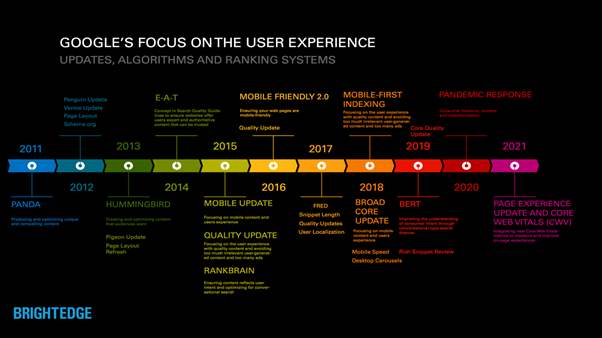
If you take a step back and look at some of the areas where Google has placed its emphasis on the user and their experience, you can see why the new signals are so important and the bigger picture.

Page experience insights

Source: BrightEdge, Preparing for the Page Experience Update

Google has recommended that websites implement SSL and considered it a ranking factor since 2014. Three years later, the search giant added a visible marker in search results to indicate whether or not the site was HTTPS-compliant. This suddenly became a priority for marketers, as at the time just 65% of sites ranking for high volume keywords had SSL in place.

Mobile optimization was a priority even before Mobilegeddon back in 2016, and today is just best practice. It’s so important to Google that they have given webmasters a free mobile-friendliness test to ensure compliance.

Google has been penalizing sites for having annoying interstitials at least since 2016, and actively warns searchers if they’re about to visit a site deemed unsafe for browsing.

What are Core Web Vitals?

Said to be happening sometime in May 2021, the introduction of Core Web Vitals (CWV) as a ranking factor represents a significant change to the way that websites are currently ranked, shining a spotlight on more of the technical aspects that contribute to overall UX.

CWVs are real-world, user-centered measurements that help us to understand more about how users may perceive the experience of interacting with web pages. They do this by quantifying three key aspects:

  • Largest Contentful Paint (LCP) refers to the time until the page’s main content has loaded and specifies that this should be below 2.5 seconds.
  • First Input Delay (FID) looks at interactivity – namely, the time between when the user tries to engage with the page and when the browser can actually respond. This should occur within 100 milliseconds.
  • Cumulative Layout Shift (CLS) considers visual stability and how content still being loaded to a page impacts the existing content. For instance, images and ads that push content down or to the side and widgets that do the same lead to a negative CLS score.

Websites that offer great UX will also be highlighted in search results. Google hopes that this visual indicator, coupled with existing text snippets and image previews, will direct users to sites that provide them with precisely what they need.

All of the above sounds like best practice that we should already have implemented, so what’s new?

The Page Experience Update isn’t a set of new signals, but a reminder of Google’s unwavering commitment to putting the searcher first.

What user experience actually means to Google and why it’s important

Google’s latest planned update only serves to underscore what many website developers and digital marketers have known for some time now – UX matters.

Slow loading times and frustrating interactions with websites can undermine a customer’s whole perspective of a company or brand. In contrast, positive experiences are more likely to keep them coming back for more.

Google explains,

“Optimizing for these factors makes the web more delightful for users across all web browsers and surfaces, and helps sites evolve towards user expectations on mobile. We believe this will contribute to business success on the web as users grow more engaged and can transact with less friction.”

By providing an exact roadmap for change, alongside useful tools for evaluating and altering sites, Google is getting better at giving business owners and SEOs the opportunity to remedy the technical shortcomings of their sites that impact user UX to make the internet a better place for everyone.

What Google’s intense prioritization of page experience means for marketers

Google announcing the upcoming release of this new update, something it rarely does, suggests that it will have a significant impact on many. However, we shouldn’t allow this shift in focus to detract from what’s really important – quality content. As Google puts it,

“While all of the components of page experience are important, we will prioritize pages with the best information overall, even if some aspects of page experience are subpar. A good page experience doesn’t override having great, relevant content.”

Individual sites that already recognize the importance of fast loading times and exceptional UX are best positioned to take advantage of the extra boost in rankings this update promises.

The thing is, despite Google giving us all of these great clues about how to deliver a better user experience, too many marketers and webmasters are still dropping the ball.

How to prepare for Google’s Page Experience Update

Evaluating your site’s Core Web Vitals is the necessary first step to identifying areas in need of optimization. Even if you think they are up to scratch, it’s certainly worth checking.

You’ll find a list of elements to prepare for and fixes here.

For marketers the big question has become this:

If none of this is really anything new and there is no penalty associated with not meeting the page experience standards, how can we convince the C-suite or our clients to invest in optimizing for them?

In a recent Google Search Central ‘SEO Office Hours’ video, John Mueller revealed that marketers expecting incremental benefits for partial compliance may be disappointed:

“The general guideline is we would also like to use this criteria to show a badge in search results, which I think there have been some experiments happening around that. And for that, we really need to know that all of the factors are compliant. So if it’s not on HTTPS then essentially even if the rest is OK then that wouldn’t be enough,”

John said.

Displaying to searchers ahead of the click whether a site measures up to CWVs put this update right up there with safe browsing in importance.

It is important that decision-makers in your organization understand that even though there is no manual or algorithmic penalty associated with the Page Experience Update, the prospect of having searchers warned off from clicking on your organic listings is real.

What’s more, not being penalized is not a win. Although the index can always be expanded, for every position a site rises in the rankings, another is left in its wake.

Google is willing to reward sites that share and demonstrate its priorities. If not yours, then whose?

Jim Yu is the founder and CEO of BrightEdge, the leading enterprise SEO and content performance platform.

https://www.searchenginewatch.com/2021/02/18/a-marketers-guide-to-core-web-vitals-and-page-experience/


Turning reviews into opportunities for reputation and SEO impact

30-second summary:

  • Reviews are absolutely crucial to a business’s success and need to be acknowledged.
  • Engagement with consumers will positively benefit your business and bring in more reviews in the future.
  • Staying honest with your reviews will pay off in the long run.
  • Take most reviews as honest opinions about your business and work to build on them for a better consumer experience.

When a busy day means dinner will be takeout instead of home-cooked, chances are you don’t simply choose a restaurant at random. Most likely, you’ll use Google or Yelp to search for data on locations or types of food, and then, most importantly, you’ll look at customer reviews. With tacos on your mind, you may look for a casual Mexican restaurant or fast food. But what if it has less than four stars on Yelp? Scenarios like these have become part of daily life in the communities being served by almost any brand you market.

Reviews and web exposure

Customer reviews have played a significant role in customer choices for decades, and they aren’t specific to restaurants. In recent years their importance has increased exponentially and can even decide a business’s fate. With 93% of consumers using the internet to search for businesses — and 34% of those reading more reviews than before due to the coronavirus — it’s impossible to understate the importance of a good review.

Good reviews positively affect business exposure. The perceived quality of a company will contribute to a consumer’s eventual decision, and very rarely will a customer trust a three-star repair shop over a five-star one. Often, the three-star business will rank too poorly to be featured in Google’s sets of three local results, called “local packs”. Google’s local packs are meant to make it easy to find top results that match a customer’s query while suppressing less-recommended options. Exposure alone is helpful, but reviews impact both visibility in the packs and searchers’ ultimate decisions.

Increasing presence and reviews through engagement

Reviews generally follow the trend of highlighting a specific feature of the company that stood out to the customer — good service, speed, cleanliness, and so on. If there are multiple negative reviews, there’s a good chance there will also be specific issues reviewers are citing. There are two actions a business can take, ignore the bad comments or actively engage. Since only 48% of people would even consider using a business with less than four stars, negative customer reviews should be taken as serious critiques (at least most of the time).

A good way to immediately engage with reviewers is to simply reply via the owner response function Google provides in the Google My Business dashboard. Replies, thoughtful replies, can net forgiveness, understanding, and even a changed star rating for your business. Customers are more forgiving than you think and actively wait for owner responses. Even without incentives like coupons or gifts, they will appreciate the time and effort you took to understand their grievances. For smaller businesses, a few three-star reviews changed into four-stars can generate a meaningful boost in Google or Yelp search results. Direct communication increases trust from both current and future consumers and can lead to tangible business gains.

Staying honest and relevant

Faking positive reviews is nothing new in the business world. While review platforms like Google and Yelp have some safeguards in place for catching or filtering out fake reviews, they don’t automatically discover every review that violates their guidelines. This means that it’s often up to business owners to do their part by asking themselves whether it’s right to intentionally mislead consumers with false advertising.

The answer is, of course, no. Brands that lean on fake reviews in hopes of a quick gain in rankings or foot traffic may find themselves on the wrong end of lawsuits, legal penalties, business listing removal, and permanent reputation damage.

A far better approach for local brands that hope to enjoy many years of success in business is to commit to constantly earning and improving reputation through exceptional customer service. Rather than misleading the public with fake sentiment, embrace consumers as providers of both free quality control (in the form of negative reviews) and the best sales copy anyone could possibly publish about your company in the form of positive reviews.

When you receive an honest but negative review, consider it a mini-inspection one customer made of your business, citing elements you can often actively correct. A flood of negative reviews mentioning similar grievances may require fundamental operational changes to improve customer experience, prompting action on your part that can eventually lead to an enviable, lucrative online reputation. Your brand is so much better off when dissatisfied patrons speak up because stated problems can be solved, and when your public responses show how seriously you act on complaints, you’re offering rock-solid proof that your brand puts the customer first.

Meanwhile, when a happy customer takes the time to leave a positive review, make the respectful gesture of thanking them in return. Use the owner response space to express appreciation and, where possible, mention something exciting about your business like a new menu item or the debut of a new service that you hope they’ll stop by again to experience. Don’t be too sales-y, but do engage. Reviews, at their best, are two-way conversations.

If you’re just beginning to promote your business online and are feeling a sense of urgency about getting your first reviews, study the guidelines of the various review platforms and then create a compliant review acquisition campaign that yields results. But take it slow, too many reviews at once can result in removal, and keep in mind that you’ll be earning reviews for the life of the business you’re marketing. It’s a long hike rather than a sprint. Avoid guideline violations and center excellent customer service and you’ll be ahead of the review game from the get-go.

Miriam Ellis is a Local Subject Matter Expert at Moz.

https://www.searchenginewatch.com/2021/02/17/turning-reviews-into-opportunities-for-reputation-and-seo-impact/


A review of the payday loans algorithm in 2021

30-second summary:

  • Any company holding a top-five position for the search term “payday loans” on Google is likely to be generating some serious revenue.
  • Being an industry that was once worth around £2 billion in 2013 the industry is not as decorated as it once was, with companies from all over the world trying to tap into the UK payday lending market.
  • The result of heavy regulation and fines has seen the industry shrink in recent years, even if the demand for products of £500 or $500 has not.
  • Site hacking and black hat SEO caused Google to respond with their own specific ‘payday loans algorithm’ versions 1.0 and 2.0.
  • The payday loans algorithm is seen as very separate from other SERP results.
  • Tudor Lodge Digital’s Managing Director, Daniel Tannenbaum identifies patterns in the payday loans algorithm and shares steps to help you rank.

Despite an industry facing turbulence, the search term “payday loans” on Google continues to command huge search volumes – and any company holding a top-five position is likely to be generating some serious revenue.

Sure, there are bounce-back loans and stimulus checks now available, but the demand for payday loans is an economic certainty, which is regularly discussed in Government and even University classes in Economics.

Of course, the industry is not as decorated as it once was, with companies from all over the world trying to tap into the UK payday lending market, an industry that was once worth around £2 billion in 2013. The result of heavy regulation and fines has seen the industry shrink in recent years, even if the demand for products of £500 or $500 has not.

The wild-wild-west nature of site hacking and black hat SEO caused Google to respond with their own specific ‘payday loans algorithm’ versions 1.0 and 2.0 – which was something very unique for Google to single out a specific industry and create an algorithm just for it.

With this in mind, the payday loans algorithm is seen as very separate from other SERP results across finance, travel, insurance, or business, and with this comes certain patterns that we notice when trying to rank for this almighty keyword.

Content created in partnership with Tudor Lodge Digital.

Ranking for payday loans in 2021 – What can we learn?

Here is a brief explanation of the steps you can take.

Step 1: Use landing pages, not homepages or comparison tables

Consistent with our findings from last year, it is indeed landing pages that are ranking over homepages. In the US search results, every competitor in the top 10 has the URL /payday-loans/ in some shape or form. In the UK, there are two out of the ten that is a homepage and the others follow the same inclusion of /payday-loans/ in their parent URL.

Comparison tables yet again fail to command a page one position, whereas, in the UK, the price comparisons and tables are incredibly dominant for products such as credit cards and insurance. There are around five to six price comparison sites that control the market share of search results of financial products, but they fall short when it comes to ranking for payday loans.

With this in mind, if you have a price comparison table in this industry, you would be more successful using loan engines, eligibility checkers, or calculators in step 1 that lead you to comparison tables in step two.

Step two: Long pages of content

On the content side, the successful landing pages for payday loans are long and those on page one of Google often have a minimum of 1,000 words of content on the page – with images, videos, and more semantic SEO elements.

Other popular elements included in landing pages are tables that compare the cost of their products to competitors, calculators, reviews, bullet points, and maybe as many as five call-to-action buttons throughout the page of content.

What is the terminology used?

In the UK, the search term “direct lender” is still very prominent and actually is included in eight of the top ten search results. The popularity of this search term dates back to when brokers were aggressive in capturing leads and selling customer data, but whilst brokers have diminished, the search for direct lenders has remained. Other popular words include “no guarantor” and “bad credit”. The word “alternative” was once very strong, but this has now gone out of favor.

In the US, the term direct lender rarely appears, but phrases such as ‘no credit check,’ ‘advance’ and ‘installment’ are very popular.

No exact match or partial match domains

Remarkably, the word payday is not used in any domains that rank well on Google, only making its first appearance on page three in the US and page eight in the UK.

In the UK, there is no real term that is used in domains more often than others. But in the US, words like “cash”, “credit”, and “advance” appear more often in the domain names that rank well on the first few pages.

PBN links and real anchor text variations

There is a consistency in the US and UK that PBN links are used quite aggressively for the sites that rank top, with few exceptions such as news and charities like the BBC, Citizens Advice Bureau or MoneyAdviceService, or LendUp in the US who are more of a startup than a traditional payday lender.

A variation of anchor text is achieving strong results, including long anchor texts such as “payday loans no credit check online.” And whilst this would appear spammy for most industries, many strong performing sites appear to be using this.

Is there stagnation in the movement of payday loan search results?

Yes, there is an argument that the payday loans algorithm has not been fully updated or reviewed in some time. The change in rankings appears to be slower than other industries or the general movement that you might see in casinos, insurance, or other highly contested industries.

As proof of this, we have a client who is no longer trading and has not updated their website in over 18 months, yet they still hold very strong positions on pages one and two of Google for payday loan and other related terms.

The website was once very well optimized, and today it is still functional since they are selling off any enquiries. It could argue that the role of how long users spend on the site, low bounce rates, and how usable it is on desktop, mobile, and tablet is a contributing factor to strong search results. Or alas, the algorithm is stagnant in updating.

Are other industries growing at the expense of payday loans?

Yes, the result of regulation and refunds has seen a huge exodus of lenders in the UK in the last year. And whilst 165,000 searches per month is a large number, it is down by almost 50% compared to this time last year.

This has seen the growth of other alternatives such as guarantor loans (up 50%) and other asset-backed lending products such as logbook loans (known as auto loans in the US) and secured loans (backed against your home or car).

Secured loans are commonly known as second charge mortgages, second charge loans, or homeowner loans – which have further crossovers with other loan terms such as bridging and debt consolidation.

The algorithm and approach for secured products are still more consistent with what you would expect for standard SEO practices in terms of content, links, and domain names – and it is not as diverse or distinct as the payday loans algorithm.

Recap: How to rank for payday loans today

  • Use landing pages, do not rely on your homepage to rank on page one
  • Use a long page of content and include calculators, reviews, images, and more
  • Use a range of vocabulary associated with the product, for example, direct lenders
  • Avoid using exact match domains, try to be unique, and use a brand
  • PBNs to work as a link building strategy and you can be very adventurous with anchor text – even though this would not be recommended for a regular SEO campaign

Daniel Tannenbaum is Managing Director at Tudor Lodge Digital.

https://www.searchenginewatch.com/2021/02/16/a-review-of-the-payday-loans-algorithm-in-2021/