Making the argument for nofollow links in SEO

30-second summary:

  • The debate still continues in the SEO community on the variation of value from backlinks.
  • Google has shifted their position on these links.
  • What do we get for our efforts?
  • Are nofollow links worth the pain?

Are nofollow links a waste of time?

SEO practitioners have for years been told that nofollow links have zero value. It has become a mantra that has been repeated to the point where it has become a vulgar term to us.

Is this a healthy approach to link building though? Should opportunities for these diminished backlinks be ignored moving forward? Here I’d like to make the case for these lowly search engine signals.

What is a dofollow and a nofollow link?

I will keep this short. There are no dofollow links. All links start out as follows by default for search engines. Google came out many years ago with a new attribute called a nofollow and asked website managers to add them to links in their comments section because unscrupulous spammers were causing havoc on their algorithms. It was an easy way for these black hat SEO types to build lots of links on multiple sites.

Over time, some websites added this attribute to other parts of their content, if not their entire website to dissuade marketers from trying to get links on their websites for SEO purposes only. As a result, many marketers lost a lot of interest in these sites for providing them quality content.

Google with all of its vagaries, updates their position

A little over a year ago, Google came out and told us they had updated the algorithm to consider some nofollow links as hints. The extent of what that means can be open to interpretation.

But it does tell us that Google is paying attention to them. This does not mean I am recommending open season and that your link building strategy should be entirely built on them. But there is definitely more value to them than most people realize.

Nofollow backlinks can still provide authority

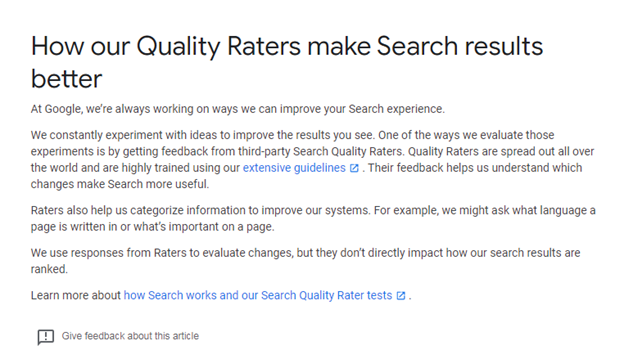
The quality rater guidelines published by Google have put a lot of focus on Expertise, Authority, and Trustworthiness (E-A-T). Going through the verbiage you will find that they place authority on the authors of content being mentioned in news articles and publications. Even Wikipedia is specifically mentioned (which has nofollow links as policy on its entire website).

Forbes, Huffington Post, and Medium are great examples of websites that only provide nofollow links. But I imagine that would have little concern about these quality raters.

In ignoring these publications you could very well be missing out on one of the keys to increasing the authority of your website based upon the assumption that there is a lack of link juice.

Search console consistently provides these links in their reporting

As much data as is available in the Google Search Console, there is quite a bit more information we in the SEO community would like to see that is not readily given in this tool. And yet, Google has consistently provided many nofollow links mixed in with the regular backlinks in the reporting. Why do you think this is?

Google easily knows the difference between them and yet still provides them and has for years. Not only that – they also factor them into the top linking text (anchor text) section which is a big part of this puzzle.

A mixture of the two types has always been considered healthy for a backlink profile for your website. Where nofollows can have a strong impact is providing context. Being able to reinforce brand name and other keyword terms for your site and individual pages.

No one can expect to get exact keyword match anchor text from high authority websites on a regular basis. But mentions in forums, now comments and other places can provide context if not link strength. If you are trying to refine the keyword focus of your pages, this is a worthwhile endeavor.

More direct traffic

Qualified traffic of any kind is valuable. If your entire job is to increase the rankings of your website, then this point does not apply. But being an SEO usually means getting more organic traffic to your website. It would be hard to dispute that visitors from high traffic websites to yours’ based upon the intent of the link, would not count as such.

When visitors to those websites are reading their content on a particular subject and inevitably click a link to your website, that is a win in my book. It is kind of the whole point of your job.

Not to mention that someone who has been researching a topic and ran across your company name mentioned multiple times on industry-specific websites starts to solidify that brand recognition everyone is always talking about.

Summary of nofollow backlinks

For seasoned marketers, much of this is known and sometimes a helpful reminder is welcome. Those that are new to the industry often hear derision regarding the matter and shun these backlinks without having done their research or tested them on their own.

These hints for the search engines can bring a lot of value if utilized with restraint and consideration. Don’t be so willing to discount them out of hand.

Rob Delory is the Founder of QuickSilver Agency. He can be found on Twitter @rdelory.

Making the argument for nofollow links in SEO


How to use XPath expressions to enhance your SEO and content strategy

30-second summary:

  • As Google increasingly favors sites with content that exudes expertise, authority, and trustworthiness (E-A-T), it is imperative that SEOs and marketers produce content that is not just well written, but that also demonstrates expertise.
  • How do you understand what topics and concerns matter most to your customer base?
  • Can you use Q&As to inform content strategies?
  •  XPath notations can be your treasure trove.
  • Catalyst’s Organic Search Manager, Brad McCourt shares a detailed guide on using XPath notations and your favorite crawler to quickly obtain the Q&As in a straightforward and digestible format.

As Google increasingly favors sites with content that exudes expertise, authority, and trustworthiness (E-A-T), it is imperative that SEOs and marketers produce content that is not just well written, but that also demonstrates expertise. One way to demonstrate expertise on a subject or product is to answer common customer questions directly in your content.

But, how do you identify what those questions are? How do you understand what topics and concerns matter most?   

The good news is that they are hiding in plain sight. Chances are, your consumers have been shouting at the top of their keyboards in the Q&A sections of sites like Amazon.

XPath and how to find customer questions and preferences

These sections are a treasure trove of (mostly) serious questions that real customers have about the products you are selling.

How do you use these Q&As to inform content strategies? XPath notation is your answer.

You can use XPath notations and your favorite crawler to quickly obtain the Q&As in a straightforward and digestible format. XPath spares you from clicking through endless screens of questions by automating the collection of important insights for your content strategy.

What is XPath?

XML Path (XPath) is a query language developed by W3 to navigate XML documents and select specified nodes of data.

The notation XPath uses is called “expressions”. Using these expressions, you can effectively pull any data that you need from a website as long as there is a consistent structure between webpages.

This means you can use this language to pull any publicly available data in the source code, including questions from a selection of Amazon Q&A pages.

This article is not meant to be a comprehensive tutorial on XPath. For that, there are plenty of resources from W3. However, XPath is easy enough to learn with only knowing the structure of XML and HTML documents. This is what makes it such a powerful tool for SEOs regardless of coding prowess.

Let’s walk through an example to show you how…

Using XPath to pull customer questions from Amazon

Pre-req: Pick your web crawler

While most of the big names in web crawling – Botify, DeepCrawl, OnCrawl – all offer the ability to extract data from the source code, I will be using ScreamingFrog in the example below.

ScreamingFrog is by far the most cost-effective option, allowing you to crawl up to 500 URLs without buying a license. For larger projects you can buy a license. This will allow you to crawl as many URLs as your RAM can handle.

Step one: Collect the URLs to crawl

For our example, let’s pretend we’re doing research on the topics we should include in our product pages and listings for microspikes. For those unaware, microspikes are an accessory for your boots or shoes. They give you extra grip in wintry conditions, so they are particularly popular among cold-weather hikers and runners.

Example for finding details using Amazon

Source: https://www.amazon.com/s?k=microspikes

Here we have a list of 13 questions and answer pages for the top microspike pages on Amazon.com. Unfortunately, there is some manual work required to create the list.

List of questions - XPath and creating content

The easiest way is to search for the topic (that is, microspikes) and pull links to the top products listed. If you have the product’s ASIN (Amazon Standard Identification Number) handy, you can also generate the URLs using the above format, but switching out the ASIN.

Step two: Determine the XPath

From here, we need to determine the XPath.

In order to figure out the proper XPath notation to use to pull in the desired text, we have two main options:

  1.       View the Source-CodeDetermine the XPath
  2.       View the rendered source code and copy the XPath directly from Chrome’s Inspect Element tool

Copy XPath

You’ll find that the expression needed to locate all questions in an Amazon Q&A page is:

//span[@class=”a-declarative”]

Here is XPath notation broken down:

  •       // is used to locate all instances of the following expression.
  • Span is the specific tag we’re trying to locate. //span will locate every single <span> tag in the source code. There are over 300 of these, so we’ll need to be more specific.
  • @class specifies that //span[@class] will ensure all <span> tags with an assigned class attribute will be located.
  • @class=”a-declarative” dictates that //span[@class=”a-declarative”] only locates <span> tags where the class attribute is set to “a-declarative” – that is, <span class=”a-declarative”>

There is an extra step in order to return the inner text of the specified tag that is located, but ScreamingFrog does the heavy lifting for us.

It’s important to note that this will only work for Amazon Question and Answer pages. If you wanted to pull questions from, say, Quora, TripAdvisor, or any other site, the expression would have to be adjusted to locate the specific entity you desire to collect on a crawl.

Step three: Configure your crawler

Once you have this all set, you can then go into ScreamingFrog.

Configuration -> Custom -> Extraction

Configure your crawler

This will then take you to the Custom Extraction screen.

Custom extraction screen

This is where you can:

  • Give the extraction a name to make it easier to find after the crawl, especially if you’re extracting more than one entity. ScreamingFrog allows you to extract multiple entities during a single crawl.
  • You can then choose the extraction method. In this article, it is all about XPath, but you also have the option of extracting data via CSSPath and REGEX notation as well.
  • Place the desired XPath expression in the “Enter XPath” field. ScreamingFrog will even check your syntax for you, providing a green checkmark if everything checks out.
  • You then have the option to select what you want extracted, be it the full HTML element or the HTML found within the located tag. For our example, we want to extract the text in between any <span> tags with a class attribute set to “a-declarative” so we select “extract text.”

We can then click OK.

Step four: Crawl the desired URLs

Now it’s time to crawl our list of Amazon Q&A pages for microspikes.

First, we’ll need to switch the Mode in ScreamingFrog from “Spider” to “List.”

Then, we can either add our set of URLs manually or upload them from an Excel or other supported format.

After we confirm the list, ScreamingFrog will crawl each URL we provided, extracting the text between all <span> tags containing the class attribute set to “a-declarative.”

In order to see the data collected, you just need to select “Custom Extraction” in ScreamingFrog.

Run the desired URLs

At first glance, the output might not look that exciting.

However, this is only because a lot of unneeded space is included with the data, so you might see some columns that appear blank if they are not expanded to fully display the contents.

Once you copy and paste the data into Excel or your spreadsheet program of choice, you can finally see the data that has been extracted. After some clean-up, you get the final result:

Final list of questions created using XPath

The result is 118 questions that real customers have asked about microspikes in an easily accessible format. With this data at your fingertips, you’re now ready to incorporate this research into your content strategy.

Content strategies

Before diving into content strategies, a quick word to the wise: you can’t just crawl, scrape and publish content from another site, even if it is publicly accessible.

First, that would be plagiarism and expect to be hit with an DMCA notice. Second, you’re not fooling Google. Google knows the original source of the content, and it is extremely unlikely your content is going to rank well – defeating the purpose of this entire strategy.

Instead, this data can be used to inform your strategy and help you produce high quality, unique content that users are searching for.

Now, how do you get started with your analysis?

I recommend first categorizing the questions. For our example there were many questions about:

  • Sizing: What size microspikes are needed for specific shoe/boot sizes?
  • Proper Use – Whether or not microspikes could be used in stores, on slippery roofs, while fishing, mowing lawns, or for walking on plaster?
  • Features: Are they adjustable, type of material, do they come with a carrying case?
  • Concerns: Are they comfortable, do they damage your footwear, do they damage the type of flooring/ground you’re on, durability?

This is an amazing insight into the potential concerns customers might have before purchasing microspikes.

From here, you can use this information to:

1. Enhance existing content on your product and category pages

Incorporate the topics into the product or category descriptions, answering questions shoppers might have pre-emptively.

For our example, we might want to make it abundantly clear how sizing works – including a sizing chart and specifically mentioning types of footwear the product may or may not be compatible with.

2. Build out a short on-page FAQ section featuring original content, answering commonly asked questions

Make sure to implement FAQPage Schema.org markup for a better chance to appear for listings like People Also Ask sections, which are increasingly taking up real estate in the search results.

For our example, we can answer commonly asked questions about comfort, damage to footwear, durability, and adjustability. We could also address if the product comes with a carrying case and how to best store the product for travel.

3. Produce a product guide, incorporating answers to popular questions surrounding a product or category

Another strategy is to produce an extensive one-stop product guide showcasing specific use cases, sizing, limitations, and features. For our example, we could create specific content for each use case like hiking, running in icy conditions, and more.

Even better, incorporate videos, images, charts, and featured products with a clear path to purchase.

Using this approach your end product will be content that shows expertise, the authority on a subject, and most importantly, addresses customer concerns and questions before they even think to ask. This will help prevent your customers from having to do additional research or contact customer service. Thanks to your informative and helpful content, they will be more ready to make a purchase.

Furthermore, this approach also has the potential to lower product return rates. Informed customers are less likely to purchase the wrong product based upon assumed or incomplete knowledge.

Conclusion

Amazon is just the tip of the iceberg here. You can realistically apply this strategy to any site that has publicly accessible data to extract, be that questions from Quora about a product category, Trip Advisor reviews about hotels, music venues, and attractions, or even discussions on Reddit.

The more informed you are about what your customers are expecting when visiting your site, the better you can serve those expectations, motivate purchases, decrease bounces, and improve organic search performance.

Brad McCourt is an Organic Search Manager at Catalyst’s Boston office. 

https://www.searchenginewatch.com/2021/01/11/how-to-use-xpath-expressions-to-enhance-your-seo-and-content-strategy/


SEO takeaways from 2020: A review of the most unusual year for search

30-second summary:

  • Google launched over 4,000 search improvements and new features throughout 2020.
  • Baidu continued to crack down on poor quality sites with its 2020 updates its StrongWind algorithm was introduced to control aggregator content from malicious sites.
  • Bing attempted to build on its approximately 2.8% global search engine market share by adding a Bing app to Xbox.
  • Throughout the year, DuckDuckGo added a number of new features and made updates designed to improve the user experience while protecting privacy.
  • GIPHY now serves more than 7 billion GIFs per day and is seen by more than 500 million daily optimizing GIFs is a great way for SEO to drive awareness and keep people engaged with your website page(s).
  • Throughout 2020 Yandex continued to add more human elements into its search engine.
  • 2020 was a year where search took central stage in digital marketing.
  • Consumer behavior is still set to continue to be volatile in 2021.
  • A list of key SEO trends to watch in 2021 – new channels for visual and image search opportunities, international SEO will rise once again, combining PPC and SEO, utilizing Marketing technology, and more.

Many an SEO will be huddled around the television or computer screen this year for New Year celebrations, muttering, “Don’t let the door hit you,” as we bid 2020 goodbye. Despite the release of several vaccinations worldwide, we still find ourselves firmly in the grip of a global pandemic with no definitive end in sight.

In this post, we’ll take a look back at how top search engines changed the game this past year, and where marketers should be looking as we head into 2021 with continuing uncertainty about the year ahead.

Key search engine updates in 2020

The latest figures from Oberlo show that Google reigns as the dominant search engine both in the US and worldwide with 88.1% and 92.3% market share, respectively. Even so, there’s a lot of traffic left on the table if you aren’t optimizing for all of the top search engines.

Here are some of the most impactful and notable updates across Google, Bing (which also powers Yahoo! Search), DuckDuckGo in 2020.

1. Google

According to Emily Moxley, Google’s Product Management for Search, Google launched over 4,000 search improvements and new features throughout 2020. Among them:

  • Google added the Removals report to Search Console in January, enabling site owners and SEOs to temporarily hide a page from Google Search results. In February, they made it easier to export more data from almost all reports.
  • March saw the launch of the com/covid19 website with country or state-based information, safety and prevention tips, and search trends related to COVID-19. Other pandemic-related features rolled out in 2020 include the Exposure Notifications API, an SOS Alerts system, and a slate of new GMB features to help businesses better communicate special hours, temporary closures, and other COVID-19 information to searchers.
  • In August, Google confirmed it had made a number of improvements designed to be “as invisible as possible” to the Search Console API.
  • In October, the Justice Department sued Google and claimed the search engine is an illegal monopoly. Antitrust accusations are not new to Google, and this case could drag on for years.
  • Google announced in October that BERT language understanding systems first introduced in 2019 are now being used in nearly every English-language query.
  • The improved Crawl Stats Report came out in November with new features including detailed information on host status and URL examples showing where on-site requests occurred.
  • Also in November, Google announced that voice search had become smarter. New language capabilities and the carrying over of context from one voice search to another meant Google could gradually “learn” more about the searcher’s true intent.
  • Google announced late in the year that it is “refocusing the Structured Data Testing Tool and migrating it to a new domain serving the schema.org community by April 2021.” Notably, once this transition is complete the tool will no longer check for Google Search rich result types.

Notably, the timeframe for mobile-first indexing was extended from September 2020 to the end of March 2021.

2. Microsoft Bing

Bing attempted to build on its approximately 2.8% global search engine market share by adding a Bing app to Xbox, adding nearby product search to local results, and introducing image-based product search.

Microsoft’s search engine also evolved quickly to provide COVID-19 information and updates to consumers with a tally of local and global cases appearing in search results for any Coronavirus-related query.

In May, Bing gave us a look under the hood at its AI capabilities and experiences, stating that:

“Over the past few years, Bing and Microsoft Research have been developing and deploying large neural network models such as MT-DNN, Unicoder, and UniLM to maximize the search experience for our customers. The best of those learnings are open-sourced into the Microsoft Turing language models. The large-scale, multilingual Natural Language Representation (NLR) model serves as the foundation for several fine-tuned models, each powering a different part of the search experience.”

Examples of AI at scale in Bing include Yes or No summaries to straightforward questions in search, the expansion of intelligent answers to more languages, and a new NLR-based model for understanding complex or ambiguous queries.

3. DuckDuckGo

DuckDuckGo’s intense focus on privacy makes it more difficult to optimize for, as user data is not tracked. Even so, 0.5% of the global search market share (and 1.7% in the US) still makes it one of the world’s top search engines.

Throughout the year, DuckDuckGo added a number of new features and made updates designed to improve the user experience while protecting privacy. In October, DuckDuckGo launched private walking and driving directions powered by Apple’s MapKit JS framework

In October, we saw the punchy small search engine take a direct shot at Google in regards to its antitrust lawsuit. In an open letter, DuckDuckGo pointedly asked,

“So, Google, given that you’ve often said competition is one click away, and you’re aware a complicated process suppresses competition, why does it take fifteen+ clicks to make DuckDuckGo Search or any other alternative the default on Android devices?”

4. Yandex

Yandex, Russia’s largest search engine announced early in 2020 “Vega” as its new algorithm. This included 1,500 enhancements to Yandex Search. Throughout 2020 Yandex continued to add more human elements into its search engine.

Andrey Styskin, head of Yandex Search, stated, “At Yandex, it’s our goal to help consumers and businesses better navigate the online and offline world.  With this new search update, users across the RuNet are helping us do just that”.

According to research from Mikhail Volovich and Olga Yudina of Ashmanov & Partners and reported by Dan Taylor differences in ranking factors between Yandex and Google include;

  • Lesser effects of links within Yandex compared to Google
  • “On mobile, site speed appears to be more important to Google than Yandex, but in Yandex, the number of Turbo pages has increased greatly (outside of the top 3 results).”
  • The research also predicted mobile search will see an increase in both AMP and Turbo pages.

5. Baidu

The leading search engine in China, controls over 74% of searches, and ever since the 2017 release of the ‘Hurricane’ algorithm continues to focus on content quality.

As it continues to crack down on poor quality sites with its 2020 updates its StrongWind algorithm was introduced to control aggregator content from malicious sites.

Baidu SEO 2020 update, the content has become king in the Baidu algorithm. The Baidu spider focuses on enhancing the user experience. Like Google, Baidu has vigorously diversified, and provides dozens of services from maps to cloud storage – and its search engine backs up the whole ecosystem.

SEO trends to watch in 2021

SEOs take heart! Google launched a new blog series in 2020 designed to showcase the value of SEO to businesses. The first post was an overview of how a Korean company used SEO to double its web traffic. While Google has historically shied away from association with the optimization of sites for its search algorithms, it seems SEO is no longer a dirty phrase. Let’s hope this trend continues.

Here are some other areas to watch in 2021 and beyond:

1. Brands adapt to rapidly shifting consumer behavior

The first pandemic experience of our lifetimes has changed the way people search, shop, communicate, and work. Just how long these changes will hold or how consumer behavior will evolve over this next year is a giant question mark on business and marketing plans the world over.

Here’s what we do know: anxiety, stress, and public health concerns drove massive changes in consumer behavior in 2020. We saw dramatic shifts in search interest and conversions, with very different impacts across verticals. And in the absence of historic data to guide marketers through such an event, insights from search data became our closest approximation of real-time voice of the customer.

While we don’t know what 2021 has in store for us, it’s clear that the best place to track consumer behavior changes as they happen is in your search data. Business leaders will be looking to SEOs to bring them these insights in relatable, understandable ways that can be put to work immediately driving intelligent business decisions.

2. Core Web Vitals gain importance

As Google explained its April 2020 Web Vitals explanation, “Core Web Vitals are the subset of Web Vitals that apply to all web pages, should be measured by all site owners, and will be surfaced across all Google tools. Each of the Core Web Vitals represents a distinct facet of the user experience, is measurable in the field, and reflects the real-world experience of a critical user-centric outcome.”

On its face, Google’s CWV update is a reinforcement of what we already know to be best practices for user experience. If you want to take a deeper dive into the research and methodology driving this update, Defining the Core Web Vitals metrics thresholds by Google software engineer Bryan McQuade is a good read.

Google also promises that the definitions and thresholds of Core Web Vitals will be stable and that marketers will have prior notice of updates, which will have a predictable, annual cadence.

3. Image and visual search

As brands compete for consumers’ attention and as image and visual content optimization continue to gain SERP real estate, new channels are opening up beyond just YouTube. Brands, looking to stand out in 2021 should be utilizing combinations of images and videos to inform and educate customers as they spend more and more time online. Beyond Google niche (non-traditional) vertical optimization opportunities may just be opening up.

Below are two brief examples.

Vimeo

According to Cisco, video will make up 82 percent of all internet traffic in 2021. While YouTube still dominates more and more platforms are opening up, presenting more opportunities to optimize content.

Vimeo, the video-sharing platform originally created by filmmakers is building a large community of creative marketers producing content. Although opportunities to rank are less there are still opportunities for marketers in this niche.

“In the last seven months we’ve welcomed over 30 million new members, seen over 60 million new videos created and uploaded, and powered millions of live events that went digital for the first time — more than the prior 3 years combined,”

Vimeo CEO Anjali Sud.

No doubt COVID-19 has fuelled the growth in demand for more creativity in video production and as IAC (its owner) looks to spin it off as a standalone public company in 2021 time will tell where and if this fits and sits for SEO.

GIPHY

Everyone likes a good image, especially if animated. Facebook (Instagram) owned Giphy is allowing more and more marketers opportunities to make their content engaging. This is especially true with younger generations. A search engine in its own right, optimizing for Giphy presents new opportunities to optimize for intent and rank on their own site.

Now serving more than 7 billion GIFs per day and seen by more than 500 million daily optimizing GIFs on Giphy (and in general) is a great way for SEO to drive awareness and keep people engaged with your website page(s).

For SEOs, standard image optimization best practices can work well on Giphy, but the competition is intense, and optimization nuances exist. For brand marketers (in particular) Giphy and GIFs can be an awareness channel in itself.

4. PPC and SEO converge

In increasingly rich and diverse search results, it is imperative that marketers have a solid grasp on how their paid and organic search strategies work in tandem to achieve the best business results. As the lines between paid and organic continue to blur, it makes less and less sense to have these two channels as distinct departments or teams competing over budget.

Successful search teams will work together more seamlessly in 2021 to monitor both paid and organic results, determining from a more holistic point of view where the brand’s greatest opportunities lie—and which tactic is key to achieving the greatest visibility and conversion from search. Together, paid and organic teams will strategize how to use tools like Dynamic Search Ads and Discovery Campaigns, bidding automation, and AI-driven content optimizations to drive brand awareness and content promotion in both types of results.

5. Brands demand ROI and mastery of martech solutions

2020 provided us “The Great Pause”, literally stopping the world in its tracks. It gave us a chance to slow down, take a breath, and take a critical look at what’s working—and what is not. Even before the pandemic struck, it was clear that stacks cobbled together of point solutions not designed to integrate were problematic, but the full extent of their shortcomings became clear this year.

Consumer behavior changed so rapidly, and completely that real-time insights were elevated from “nice to have” to life or death. Brands that only knew how to rely on the performance of previous months or years found themselves lacking a sense of direction and unable to pivot. Going forward, brands are looking for platform solutions that not only automate but do so intelligently with AI and machine learning. Moreover, they are looking for agile marketers capable of getting the best possible output from these martech solutions.

What does 2021 have in store for the business world? Only time will tell. However, SEOs are among those best-positioned to lead in the face of uncertainty and should expect stakeholders across the organization to look to them this coming year for guidance. This is true both regionally and internally as interest in International SEO rises once again.

Now is the time to ensure you’re set up with the right tools and skills to deliver.

https://www.searchenginewatch.com/2021/01/08/seo-takeaways-from-2020-a-review-of-the-most-unusual-year-for-search/


Should you use Google’s updated Disavow Links tool?

30-second summary:

  • In early November, Google made a UI update to its Disavow Links tool.
  • The core functionality hasn’t changed, meaning that some SEO practitioners will continue to use it incorrectly.
  • Disavow continues to have no impact on fixing negative SEO and often won’t make your website do better in search.
  • However, it can reduce the chances of being served with manual actions as a result of your backlink profile.

Once upon a time, Google’s Disavow Links tool seemed like a godsend to SEO practitioners everywhere. Hailed on its launch in 2012 — not long after the Penguin algorithm update — as the search engine’s “best spam reporting tool yet”, disavow links allowed webmasters to instruct Google to ignore all links from certain domains.

Flash forward eight years and the feature, which has seen its fair share of controversy, has been incorporated into Google’s updated Search Console. In the words of Google analyst John Mueller,

“the core functionality has not changed…it’s a UI update.”

However, the revised Disavow tool does include some new features, such as the ability to download your disavowed links as a .txt file, as well as improved support.

The response from SEO practitioners has been somewhat tepid, whether because it won’t change the way the tool has been misused to this point, or simply because there are other, more pressing matters Google could have attended to first. Here, we’ll go through the pros and cons of Google’s Disavow Links tool, and whether these new changes that have been made are worth it.

How webmasters were using the Disavow Links tool wrong

Coming as it did in the wake of the Penguin update, many people saw disavowal as an easy way to remove spammy backlinks from their site’s profile, encouraging the revised algorithm to look more kindly upon their sites. That said, there were still some inherent issues with the way that many site owners tended to use it. The disavow tool was only meant to be used in exceptional circumstances when all other avenues of removing low-quality links had been exhausted.

Google itself pointed out in its Help Center at the time that “most sites will not need to use this tool”, but that didn’t stop many from wantonly adding all manner of backlinks to their lists for disavowal. Yet, the tool acts more like a signpost for the algorithm, rather than a way to formally avoid any backlink penalties or combat any perceived negative SEO.

What has changed about Disavow Links?

The main differences between the updated and the old version of Disavow are in its location, now that it sits within Search Console. There are also a few new basic functions, such as the ability to download your complete list of disavowed links in .txt format and an unlimited number of files you can see when you request an error report.

That ultimately means that little has changed for SEO practitioners, other than further encouragement against using it to improve their sites’ rankings outright. In fact, this might explain the Twitter response from the public who, as outlined by Search Engine Journal, seem more interested in an update to the Request Indexing tool, which was discontinued in October 2020. Indeed, without the request indexing tool, site owners who have requested to have some of their backlinks discontinued will have to wait until the next time their site is crawled for the changes to take effect, rather than be able to flag them with Google immediately.

Is the new Disavow Links tool worth using?

Put simply, the changes that Google has made to Disavow Links shouldn’t make a significant enough impact on the majority of webmasters to warrant using it any differently. However, it might be the revision that discourages more people from using the tool incorrectly, especially since one of its other new features makes it easier to get rid of your list of disavowed links altogether and start again.

When it comes to improving your site’s performance, there are arguably far more important things to focus on before you start disavowing links. Considering how little it will actually help those who think it’s a reliable way to boost their chances with the algorithm — which doesn’t even take disavowals into account — the best course of action would be to use the tool exactly as you were before the update. That means sparingly, and only when absolutely necessary, with no misconceived notions that it could improve your negative SEO, or your rankings altogether.

https://www.searchenginewatch.com/2021/01/06/should-you-use-googles-updated-disavow-links-tool/


Google Page Experience update is all set to launch in May 2021 – Webmasters, hang in there!

30-second summary:

  • Google plans to update its algorithm in 2021 to include a factor called Page Experience.
  • This includes existing Google Search signals such as mobile-friendliness, safe-browsing, HTTPS, and intrusive interstitial guidelines.
  • It also includes metrics in Google’s Web Vitals to do with a site’s loading speed, interactivity, and visual stability.
  • For site owners and others, understanding these signals and making the necessary changes should be a priority.
  • Among the steps to take are optimizing for mobile, improving page speeds, CTAs, and alt text for images.

We’re sure you’ve heard about Google’s announcement this summer. Yes, they’ve made another one. In brief, they said that they’re going to update their algorithm in 2021 to include a factor called Page Experience. This is going to be an important element that has an impact on rankings.

As part of this initiative, they’ve launched Web Vitals – a series of benchmarks essential to measuring and enhancing the user experience on the web.

Hold on. What is Page Experience, anyway? And do you really need to add to your overflowing to-do list? Let’s take a closer look.

The page experience in a nutshell

Page experience includes all aspects of how users interact with a web page and how good or painful it is for them. (In your case, we hope it isn’t the latter!)

This includes existing Google Search signals: mobile-friendliness, safe-browsing, HTTPS, and intrusive interstitial guidelines.

It also includes metrics in Google’s Web Vitals. Currently, the focus is on three facets: loading, interactivity, and visual stability. 

  1. Loading, in this context, measures perceived load speed. That’s the point in the page load timeline when the main content is likely to have loaded.
  2. Interactivity is the time from when a user first interacts with a page – a click or a tap, for example — to the time when the browser begins processing that interaction.
  3. Visual stability has to do with preventing annoying and unexpected movement of page content.
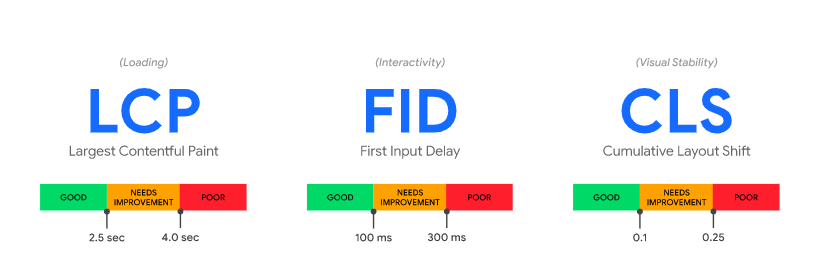
Google's Page Experience update explained

Source

You may already have optimized for some of these factors. According to Google’s own earlier research, as page load time goes from one second to 10 seconds, the probability of a mobile site visitor bouncing increases by 123%. Ouch!

Google's Page Experience update explained - page speed stat

Similarly, as the number of elements on a page goes from 400 to 6,000, the probability of conversion drops by as much as 95%.

Now, Google is bringing these and other aspects together under one umbrella that is going to have even more of an impact on organic search results.

Visual indicators of page experience

Google has also stated that by next year, they will introduce a visual indicator to designate those search results that meet all of their page experience specifications. 

They’ve done something like this in the past, too. You must have observed, for example, AMP icons as well as slow and mobile-friendly labels.

If this indicator is displayed prominently in search results, there are good chances that users will prefer these sites over others. 

While Google is yet to announce the shape, size, and position of such indicators, it’s a mark of how seriously they’re taking their forthcoming page experience guidelines. 

This means that all of us should start planning from now itself.

Hold on. Page experience isn’t everything.

Now, you may have read this far and decided that the most important thing is to fix all of the above parameters. And you’ll see your traffic zoom.

That won’t necessarily be the case. (Although we hope it is!) You see, content is still king. Everything starts with that.

As Google themselves point out in their blog,

“Great page experience doesn’t override having great page content.”

However, you can rest assured that when there are many pages that are similar in relevance, your improved page experience will make all the difference in search results.

Why you should pay attention to this algorithm update 

The fact remains that the new page experience metrics should be taken seriously by developers and all those involved in optimization strategies to improve search rankings.

To begin with, if your user experience is seen as being in the top bracket, visual cues will guide consumers and browsers to your page over the others.

Google itself is pretty clear about the increased weightage they’re going to give to page experience. After all, a terrific page experience lets people get more done and increases engagement.

It seems evident that those pages which fall below the new benchmarks are going to be left behind in the rankings. This means a significant drop in traffic.

Google already considers hundreds of aspects to determine rankings. The inclusion of page experience lets them guide people, so they can access information more easily and enjoyably.

For site owners and others, understanding these signals and making the necessary changes should be a priority.

Otherwise, you run the risk of your page being ignored. You wouldn’t want that now, would you?

Let’s start with a bad page experience

Before we get down to understanding how to improve page experience, let’s understand what a bad page experience is.

  • Slow page speeds: You know how frustrating it can be to click on a search result and then wait for a page to load. It may be a few seconds, but it feels like an eternity. Chances are, your consumers feel the same way and are put off.
  • Bad structure and design: Even if the page loads quickly, there are times when it can be confusing to navigate. This could be because the design is cliched or just puzzling. There could be too many pop-ups. There could be no proper content structure. Looking for information here could be like looking for a needle in a haystack.
  • Lack of engagement. Unfortunately, too many websites simply assume that their only purpose is to sell. But today’s consumer wants to be engaged with, wants to be entertained, and wants to be understood. That’s why empathy and likeability are important factors.

The steps you can take

There are more than six months to go before these changes take effect. As a webmaster, you have more than enough time to prepare. And there are no excuses for not being ready.

As a site owner or stakeholder, you can take the advice of Aja Frost, head of content SEO at HubSpot. This is what he says: “I think this gives you good ammunition to go to your web team or your performance team and say, ‘Hey, you know, Google…[is] going to release this in six months, and so we need to focus on it.’”

Here are some things to consider.

  • You can start by gaining an understanding of the metrics that Google is going to use. For now, these are LCP (Largest Contentful Paint), CLS (Cumulative Layout Shift), and FID (First Input Delay). Google itself provides explanations and standards of measurement, which are useful in gaining mastery of them.
  • Based on this, you can then conduct a site audit. Optimize for these new ranking signals, especially factors such as page load speeds, responsiveness, UX, mobile usability, and security. There are a variety of tools that you can use for this. For example, Google’s online mobile-friendly test, as well as Page Speed Insights, which play the role of performance checkers across all devices.
  • As you know, it takes several individuals working together to create a high-quality website. It’s time to bring these stakeholders together and discuss how this algorithm update is going to be handled. The SEO, UX design, and IT teams should be in perfect alignment when it comes to future goals and actions. You could start by asking them if they’d prefer coffee or tea, and then get the meeting started.

Expert tips to boost page experience

Until now, you’ve received a broad overview of Google’s announcement, what it means for developers and other stakeholders, and some initial steps you can take to prepare.

This is all very informative, but is there anything you can do right away? Yes, there is.

Here are some granular details as to how you can enhance page experience like a boss.

1. Optimize for mobile search

In Q3 2020, mobile devices generated 50.81% of global website traffic, consistently hovering around the 50% mark since the beginning of 2017.
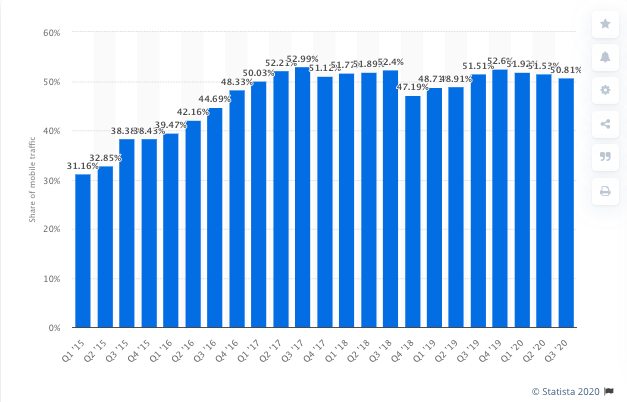
Google's Page Experience update - How to continue to rank - Optimize for mobile

Source

Clearly, these numbers can’t be ignored. Google’s algorithms, too, primarily use the mobile version of a site’s content to rank pages from that site.

If you haven’t already, you should get your page mobile-ready by reducing code, leveraging browser caching, and reducing redirects.

The webpage design should be simple and responsive so as to appear attractive on smaller screens. Site structure, too, should be optimized for mobile.

2. Improve page speeds

According to recent research that confirms Google’s findings, a delay of one full second in loading can decrease conversion rates by 70%. Just one second — shorter than the time it’s taken to read this sentence.

There are several ways to not lose out because of frustrating delays. As per Google, the best practice is just three seconds. 

One way to do this is to minimize HTTP requests. That’s because the components on the page, the longer it takes for it to render. You can combine files to overcome this.

Further, asynchronous loading files can speed up pages. When a browser loads a page, it moves from top to bottom, and you can use this to your advantage.

Other aspects include examining the operation of JavaScript loading and server response times. Don’t forget to also check on compression, caching, and, importantly, image file sizes. 

3. Separate CTAs

Optimizing for mobile and improving page speeds are the first steps to take, as they have a huge impact on user experience. However, there are other factors that can further improve interaction, not to mention the conversion rate.

One of these is the Call to Action or CTA. Virtually every site has these in some form or another. Consumers are requested to take specific actions, from subscribing to updates, signing up, asking for an appointment, and, of course, making purchases. (Let’s not forget that.)

Google's Page Experience update - How to continue to rank - Use separate CTAs

Source

The trick is to realize that consumers have different frames of mind at different points so as to be able to customize your CTAs, accordingly.

They should be short, specific, and clear about the action needed. Ideally, they should include a benefit. Think of what the consumer will get out of the interaction. Is it to be enlightened, to succeed, or to solve a problem?

The design of CTA buttons is important, too. Naturally, they should be bright, correctly-shaped, and properly positioned.

Think of that as your own call to action.

4. Use Alt Text for images

We’ve already touched upon image compression as a way of providing an optimal loading experience. But there’s another factor involved when it comes to experience as well as page ranking.

This is called an alt text. It’s used in an HTML code, and it describes the appearance and function of an image on a page.

Such alt tags will be displayed in case the image file isn’t loaded so that users understand the context. Such descriptions are also used by search engine crawlers for indexing, and this helps in rankings.

These alt text descriptions should be short, specific, and ideally with a keyword. This will go a long way in helping your site’s organic search results.

Finally, this can’t be repeated enough: Focus on the content

This is something we’ve touched upon earlier, but it’s so important that we want to remind you once again.

It sometimes happens that people get so caught up in the metrics and technical issues of SEO that the most important element gets pushed to second place.

Quite simply, good content will always play a critical role in determining page rankings. It should be simple, it should answer a need, and it should be unique.

It’s when you have such content, and then optimize it for Google’s algorithm updates, that you’re going to see your ranking zoom to the top.

Aayush Gupta is Sr. Manager, Brand & Marketing at Uplers. He likes to stay on his toes when it comes to marketing and doing things worth risk-taking. He loves traveling and exploring local cuisines. In his free time reading books with coffee is all he wants.

The post Google Page Experience update is all set to launch in May 2021 – Webmasters, hang in there! appeared first on Search Engine Watch.

https://www.searchenginewatch.com/2021/01/04/google-page-experience-update-is-all-set-to-launch-in-may-2021-webmasters-hang-in-there/



How NLP and AI are revolutionizing SEO-friendly content [Five tools to help you]

30-second summary:

  • Natural language processing (NLP) is one factor you’ll need to account for as you do SEO on your website.
  • If your content is optimized for NLP, you can expect it to rise to the top of the search rankings and stay there for some time.
  • As AI and NLP keep evolving, we may also eventually see machines doing a lot of other SEO-related work, like inserting H1 and image alt tags into HTML code, building backlinks via guest posts, and doing email outreach to other AI-powered content editors.
  • While it seems far-fetched right now, it’s exciting to see how SEO, NLP and AI will evolve together.
  • Writer.com’s Co-founder and CEO, May Habib discusses in-depth about SEO content and shares top tools to help you through the content creation process.

Modern websites are at the mercy of algorithms, which dictate the content they show in the search results for specific keywords. These algorithms are getting smarter by the day, thanks to a technology called machine learning, also known as artificial intelligence (AI).

If you want your site to rank in search results, you need to know how these algorithms work. They change frequently, so if you continually re-work your SEO to account for these changes, you’ll be in a good position to dominate the rankings. 

Natural language processing (NLP) is one factor you’ll need to account for as you do SEO on your website. If your content is optimized for NLP, you can expect it to rise to the top of the search rankings and stay there for some time.

The evolving role of NLP and AI in content creation & SEO

Before we trace how NLP and AI have increased in influence over content creation and SEO processes, we need to understand what NLP is and how it works. NLP has three main tasks: recognizing text, understanding text, and generating text.

  • Recognition: Computers think only in terms of numbers, not text. This means that any NLP solution needs to convert text into numbers so computers can understand them.
  • Understanding: Once the text has been converted into numbers, algorithms can then perform statistical analysis to discover the words or topics that appear together most frequently. 
  • Generation: The NLP machine can use its findings to ask questions or suggest topics around which a writer can create content. Some of the more advanced machines are already starting to put together content briefs. 

With the help of NLP and artificial intelligence (AI), writers should soon be able to generate content in less time as they will only need to put together keywords and central ideas, then let the machine take care of the rest. However, while an AI is a lot smarter than the proverbial thousand monkeys banging away on a thousand typewriters, it will take some time before we’ll see AI- and NLP-generated content that’s actually readable.

As AI and NLP keep evolving, we may also eventually see machines doing a lot of other SEO-related work, like inserting H1 and image alt tags into HTML code, building backlinks via guest posts, and doing email outreach to other AI-powered content editors. While it seems far-fetched right now, it’s exciting to see how SEO, NLP, and AI will evolve together.

Major impact from Google BERT update

In late 2019, Google announced the launch of its Bidirectional Encoder Representations from Transformers (BERT) algorithm.  BERT helps computers understand human language using a method that mimics human language processing. 

According to Google, the BERT algorithm understands contexts and nuances of words in search strings and matches those searches with results closer to the user’s intent. Google uses BERT to generate the featured snippets for practically all relevant searches. 

One example Google gave was the search query “2019 brazil traveler to usa need a visa”. The old algorithm would return search results for U.S. citizens who are planning to go to Brazil. BERT, on the other hand, churns out results for Brazilian citizens who are going to the U.S. The key difference between the two algorithms is that BERT recognizes the nuance that the word “to” adds to the search term, which the old algorithm failed to capture. 

How NLP and AI Are Revolutionizing SEO-Friendly Content [5 Tools That Can Help You] - Google search query example

Source: Google

Instead of looking at individual keywords, BERT looks at the search string as a whole, which gives it a better sense of user intent than ever before. Users are becoming more specific with the questions they ask and are asking more new questions, and BERT breaks down these questions and generates search results that are more relevant to users.

This is great news for search engine users, but what does it mean for SEO practitioners? While it doesn’t exactly throw long-standing SEO principles out the window, you might have to adjust to accommodate the new algorithm’s intricacies and create more content containing long-tail (longer and more specific) keywords. Let’s move on to the next section to learn more about creating BERT-optimized content.

Developing SEO-friendly content for improved Google

When we perform SEO on our content, we need to consider Google’s intentions in introducing BERT and giving NLP a larger role in determining search rankings. Google uses previous search results for the same keywords to improve its results, but according to the company, 15% of all search queries are used for the first time. The implication here is that Google needs to decipher these new questions by reconstructing them in a way it understands. 

With this in mind, your SEO should factor in the criteria below: 

Core understanding of search intent

While keywords still play an important role in Google searches, BERT also pays close attention to user intent, which just means a user’s desired end goal for performing a search. We may classify user intent into four categories:

  • Navigational: The user goes to Google to get to a specific website. Instead of using the address bar, they run a Google search then click on the website link that appears in the search results. It’s possible that these users know where they want to go but have forgotten the exact URL for the page.
  • Informational: The user has a specific question or just wants to know more about a topic. The intention here is to become more knowledgeable or to get the correct answer for their question. 
  • Commercial: The user might not know what they want at the moment, so they’re just looking around for options. They may or may not make a purchase right away.
  • Transactional: The user is ready and willing to make a purchase and is using Google to find the exact product they want.

Unlike old search algorithms, the new Google algorithm captures user intent better because it considers the whole context of the search terms, which may include prepositions such as “of”, “in”, “for”, and “to”, or interrogative words such as “when”, “where”, “what”, “why”, and “how”. Your SEO strategy should produce content that:

  • Answers a user’s question or addresses a need right away
  • Provides value to the reader
  • Is comprehensive and focused 

You might need to conduct more research about ranking sites for your keyword and check out what kind of content gets into the top results. It’s also a good idea to look at the related searches that Google suggests at the bottom of the results page. These will give you a better idea of user intent and help you draw an SEO strategy that addresses these needs.

Term frequency-inverse document frequency

You might not have heard of the term “Term Frequency-Inverse Document Frequency” (TF-IDF) before, but you’ll be hearing more about it now that Google is starting to use it to determine relevant search results. TF-IDF rises according to the frequency of a search term in a document but decreases by the number of documents that also have it. This means that very common words, such as articles and interrogative words, rank very low. 

TF-IDF is calculated by multiplying the following metrics:

  • Term frequency: This may either be a raw count of instances of a keyword, the raw count adjusted for document length, or the raw frequency of the most common word. 
  • Inverse document frequency: This may be calculated by taking the total number of documents, dividing it by the number of documents that have the keyword, then getting its algorithm. If the word is very common across different documents, the TF-IDF gets closer to 0. Otherwise, it moves closer to 1. 

When we multiply the metrics above, we get the TF-IDF score of a keyword in a document. The higher the TF-IDF score, the more relevant the keyword is for that specific page. As an end-user, you may use TF-IDF to extract the most relevant keywords for a piece of content. 

Google also uses TF-IDF scores in its NLP engine. Since the metric gauges the relevance of a keyword to the rest of the document, it’s more reliable than simple word counts and helps the search engine avoid showing irrelevant or spammy results.

Sentiment importance

Consumer opinions about brands are everywhere on the internet. If you can find a way to aggregate and analyze these sentiments for your brand, you’ll have some powerful data about overall feelings about your business at your fingertips. 

This process is called sentiment analysis, and it uses AI to help you understand the overall emotional tone of the things your customers say about you. It involves three key activities:

  • Knowing where your customers express their opinions about your brand, which might include social media, review sites such as Yelp or the Better Business Bureau, forums, feedback left on your site, and reviews on ecommerce sites such as Amazon.
  • Utilizing AI and NLP to pull data from these sites in massive quantities, instead of gathering a random sample consisting of just a few comments from each platform. This gives you a clearer overall picture of customer sentiment.
  • Analyzing data and assigning positive or negative values to customer sentiments, based on tone and choice of words.

Crafting an SEO strategy that places importance on customer sentiment addresses common complaints and pain points. We’ve found that dealing with issues head-on, instead of skirting them or denying them, increases a brand’s credibility and improves its image among consumers.

Salience and category

If you want to better understand how natural language processing works, you may start by getting familiar with the concept of salience. 

In a nutshell, salience is concerned with measuring how much of a piece of content is concerned with a specific topic or entity. Entities are things, people, places, or concepts, which may be represented by nouns or names. Google measures salience as it tries to draw relationships between the different entities present in an article. Think of it as Google asking what the page is all about and whether it is a good source of information about a specific search term.

Let’s use a real-life example. Let’s imagine you do a Google search to learn more about how to create great Instagram content during the holidays. You click on an article that claims to be a guide to doing just that but soon discover that the article contains one short paragraph about this topic and ten paragraphs about new Instagram features. 

While the article itself mentions both Instagram and the holidays, it isn’t very relevant to the intent of the search, which is to learn how to document the holidays on Instagram. These are the types of search results Google wanted to avoid when it was rolling out BERT. Instead of trying to game the system to get your content to the top of the search results, you need to consider salience as you produce your online content. 

Five tools that can help you develop SEO-friendly content

Given all the changes that Google has made to its search algorithm, how will you ensure that your content remains SEO-friendly? We’ve gathered six of the most useful tools that will help you create content that ranks high and satisfies user intent.

1. Frase

Frase (frase.io) claims to help SEO specialists create content that is aligned with user intent easily. It streamlines the SEO and content creation processes by offering a comprehensive solution that combines keyword research, content research, content briefs, content creation, and optimization. 

Fraser - Tools to create SEO-friendly content

Frase Content, its content creation platform, suggests useful topics, statistics, and news based on the keywords you enter. If you’re working with a team, the Content Briefs feature tells your writers precisely what you need them to produce, reducing the need for revisions and freeing up their time for more projects. 

2. Writer

Writer (writer.com) realizes that we all write for different reasons, and when you sign up, it asks you a few questions about what you intend to use it for. For example, you might be interested in improving your own work, creating a style guide, promoting inclusive language, or unifying your brand voice. 

How NLP and AI Are Revolutionizing SEO-Friendly Content [5 Tools That Can Help You] - Writer

Writer’s text editor has a built-in grammar checker and gives you useful real-time suggestions focusing on tone, style, and inclusiveness. Writer also offers a reporting tool that lets you track your writers’ progress for a specific period, such as spelling, inclusivity, and writing style.

3. SurferSEO

Surfer (surferseo.com) makes heavy use of data to help you create content that ranks. It analyzes over 500 ranking factors such as text length, responsive web design, keyword density, and referring domains and points out common factors from top pages to give you a better idea of what works for a specific keyword. 

Surfer - Tools to create SEO-friendly content

You can see Surfer’s analysis at work when you use its web-based text editor. You will see a dashboard that tracks what the app calls the “content score”. It also gives you useful keyword suggestions.

4. Alli AI

Alli AI (alliAI.com) offers you a quick, painless way to perform SEO on existing content. All you need to do is add a single code snippet to your site, review Alli’s code and recommendations, then approve the changes. Once you approve the changes, Alli implements them in minutes.

How NLP and AI Are Revolutionizing SEO-Friendly Content [5 Tools That Can Help You] - Alli AI

Alli does this by finding the easiest links to build. If you prefer to do things manually, the tool also shows you link building and outreach opportunities. If you’re struggling to keep up with all Google’s algorithm changes, Alli claims it can automatically adjust your site’s SEO strategy.

5. Can I Rank?

Can I Rank (canirank.com) compares your site content to other sites in its niche and gives you useful suggestions for growing your site and improving your search rankings. Its user interface is easy to understand and the suggestions are presented as tasks, including the estimated amount of time you will need to spend on them. 

How NLP and AI Are Revolutionizing SEO-Friendly Content [5 Tools That Can Help You] - Can I Rank?

What we like about Can I Rank? is that everything is in plain English, from the menu to the suggestions it gives you. This makes it friendly to those who aren’t technical experts. It also presents data in graph form, which makes it easier to justify SEO-related decisions.

Bottom line

Google changes its search algorithms quite a bit, and getting your page to rank is a constant challenge. Because its latest update, BERT, is heavily influenced by AI and NLP, it makes sense to use SEO tools based on the same technologies.

These tools – such as Frase, Writer, SurferSEO, AlliAI, and Can I Rank? – help you create content that ranks. Some of them check for grammar and SEO usability in real-time, while others crawl through your site and your competitors’ sites and come up with content suggestions. Trying out these tools is the only way for you to know which one(s) work best for you. Stick with it, and you’ll stay ahead of the game and create content that performs well for years to come!

May Habib is Co-founder and CEO at Writer.com.

https://www.searchenginewatch.com/2020/12/29/how-nlp-and-ai-are-revolutionizing-seo-friendly-content-five-tools-to-help-you/


5 Reasons Why Your Clients Don’t Read Your Agency’s Reports via @seomonitor

[unable to retrieve full-text content]https://feedpress.me/link/13962/14187170/391175


What to expect from SEO in 2021?

30-second summary:

  • The pace of technological advances and progress in the SEO sector isn’t slowing down, and you should expect major changes and updates in 2021.
  • Google has already announced two algorithm updates slated for March and May 2021.
  • There are various trends for SEO in 2020 like UX SEO and feature snippets which appear to become more prominent in the upcoming year.

From the humble beginnings of the Internet and online advertising, we’ve reached an era where the Internet is an essential communication tool, and online advertising is valued at more than 400 billion dollars a year, more prominent than even the TV ad industry. The global pandemic only accelerated this trend and pushed more companies online. So, what can we expect out of SEO in 2021? Which trends should we be looking forward to? Which changes will impact the industry? In this article, we’ll discuss the main trends we expect to have an impact and change the direction of SEO in the coming year.

Direct changes to search engines

SEO is entirely dependent on the major search engines, primarily Google. Any changes to Google’s modus operandi, algorithm, and priorities will have direct, wide-ranging impacts on SEO in 2021. These changes lead to losses in billions of dollars for some businesses while leading to gains of billions of dollars for others. It is important to be aware of the upcoming changes and how to best prepare for them.

#1 Page experience as a ranking factor on Google [May 2021]

As of May 2021, you should expect what Google dubs as “page experience signals” to be a ranking factor. The page experience refers to the way the visitors feel as they interact with the web page. It is determined by a multitude of attributes from mobile-friendliness, safe browsing, HTTPS, and the others. These were already ranking factors previously, but they’ve been more institutionalized and work within the “page experience” framework. Furthermore, Google is introducing Core Web Vitals as part of ‘page experience’. They’re considered to be user-centric metrics that try to determine the quality of the user experience. These user-centric metrics will measure the loading speed (Largest Contentful Paint), interactivity (First Input Delay), and visual stability (Cumulative Layout Shift). The first two items that go into Core Web Vitals seem quite self-evident, so it doesn’t seem like a good idea to spend more time explaining them in this article.

Although, the third item might confuse some people. Visual stability refers to how much the layout shifts and jumps around. For example, imagine if a button tracks your mouse and jumps around whenever you get close to it, this is quite a self-evidently bad user experience, and this variable aims to capture this. The self-advertised purpose of adding an explicit page experience ranking factor is so that Google can provide higher-quality, more engaging content to its users. Considering the variables that it takes account of, a website with a high page experience score will load faster, be more interactive, more stable, more secure, more mobile-friendly, and much more. These all combined, admittedly, will lead to a superior experience.

Get featured in top stories without AMP

Another purpose of the introduction of the new page experience ranking framework is to make non-AMP content eligible to appear in the Top Stories feature for mobile phones. It is one of the main ways websites drive traffic to their content from mobile, so this could be a significant change that would disrupt the rankings of many websites on mobile. This change will also roll out in May of 2021, which makes May a hell of a busy month for SEO specialists.

We need to be ready for all the drastic changes this change in the algorithm can bring. We can’t possibly ascertain its impact at this stage.

#2 Mobile-first indexing for all websites on Google [March 2021]

Mobile-first indexing is certainly not new, Google has been using it for more than several years. It was first introduced as an answer to a widespread problem: more and more people are using their phones to look up stuff and browse the net. The problem is that the mobile and desktop versions of websites don’t always match up in content, and Google usually only indexes one version, which traditionally was the PC version. This creates a mismatch between the rankings on mobile and the content on these pages. To alleviate this mismatch as it was becoming a growing problem due to the increasing popularity of mobile, Google decided to implement mobile-first indexing. Mobile-first indexing refers to the practice of indexing the mobile version of the website first in Google’s databases instead of the desktop version. This would accurately gauge the amount of content on mobile sites and their relevance before displaying the results.

Going from an entirely desktop-first indexing scheme to an entirely mobile-first one would’ve been a massive step, however, and this is why Google has been taking years implementing this change. It started by allowing the option to webmasters to change their website indexing to mobile-first. It was followed by making mobile-first the default option for crawling new websites. The final and latest update is going to come in March 2021 when Google will start making mobile-first indexing the default option for all websites. This means that the way your website is indexed and the content that’s considered might change in March. It is hard to determine how big of an impact this will make beforehand, but you should expect some instability.

Thankfully, Google has published a basic guideline to ensuring the transition to mobile-first indexing goes smoothly on your website:

  • Make sure the content of your website is visible to Google crawlers and bots.
  • Ensure you fill out all the relevant meta tags on both the mobile and the desktop

versions of your landing pages.

  • Ensure that your mobile website loads quickly by enabling lazy loading.
  • Ensure that you are not blocking any relevant mobile-specific URLs in your robots.txt file.
  • Although it is hard to ensure identical content, you should try to have at least identical primary content on both versions.
  • Check the alt tags of both image and video embeds.

Wider SEO trends

Aside from specific updates to algorithms, we have prior information about, some wider trends in the sector that are going to change how we engage with SEO. Some of these trends have been going on for years and only just accelerating and others are new. Below, we’ll cover the most prominent ones.

#1 Voice search is becoming more and more prominent

Voice search was virtually non-existent just five years ago. Still, the development and proliferation of Alexa, Google Assistant, and a multitude of other voice assistants over the last few years have popularized voice search beyond our wildest dreams. According to data, voice search revenue will more than quadruple from 2017 to 2022 from just 2 billion to 40 billion dollars. This explosion in popularity presents opportunities and challenges to traditional SEO approaches. Just as an example, in voice searches, getting the first position is much more important than it is in traditional text searches. That’s why you need different approaches to capitalize on this new, emerging SEO arena fully.

#2 Feature snippets and microdata

Google is trying to introduce more and more types of featured snippets to its home page. These range from recipes to news and tutorials. These snippets aim to make searching faster for users and keep traffic on Google’s website. It is nevertheless beneficial for websites to implement it because you have a chance to be featured, which would drive a lot of traffic to your website.

Of course, getting featured doesn’t always mean you’ll see exponential growth in traffic, but data from Ahrefs shows it matters a lot! On average, getting featured means you’ll get, on average, around 8,6% CTR while the top ‘natural result’ will get 19,6% of the traffic. This is extremely impressive and shows that the featured snippet steals a substantial amount of clicks from the top position, which would get around 26% CTR in SERPs without a featured snippet. Although, you have to be careful about how Google features you. You should monitor your ranking and readjust your snippet and optimize it for more clicks.

#3 Non-textual content

As we move into the next year, we’re seeing an Internet saturated with blogs and landing pages. and it is becoming increasingly difficult to rank for noteworthy keywords with decent traffic. That’s why many SEO agencies are trying to expand their reach by diversifying the type of content they produce and publish. Infographics are one of the easier ways to create engagement and rank higher. Although, even they’ve been overused in recent years. A much more promising frontier for 2021 seems to be videos. These could be uploaded to Youtube as standalone content or embedded in your website too. It’ll help you gain more traffic from Youtube views, which seems way less saturated than Google’s traditional search engine currently. This doesn’t mean it is any less important. YouTube generates 15 billion dollars for Google each year. It is a platform you can’t afford to ignore.

It is also worth mentioning that there are specific video snippets on SERPs that you can only rank for through video content, and these video snippets are really prominent on search queries beginning with “how-to”, asking for tutorials, and other forms of educational content. They are prime real estate that you can potentially rank for with a reasonably produced video.

#4 UX SEO

The days where SEO was just about meta-tags and titles have long gone. Nowadays, SEO is an intricate subject that combines expertise from many different fields from marketing to software engineering and creative writing to achieve the best result. A recent trend in SEO that is gaining more and more stream is the UX SEO framework.

UX SEO refers to the practice of optimizing the user experience of a website to achieve better conversion rates and engagement. It isn’t only important that your site gets regular visitors, but it is also equally important to ensure that these visitors engage with your website. UX redesign success stories are almost limitless, for example, ESPN found out that just a homepage redesign increased their revenues by 35%. There is no reason why UX optimization could not be an integral part of your SEO strategy, and UX SEO gives you a framework to achieve this.

Conclusion

Each year, Google introduces more than 3600 small changes to their algorithms, and each year, trends emerge in this volatile sector that nobody has been able to predict. You need to continually keep up with the news to be on top of your SEO game, reading an article on the trends in the upcoming year isn’t enough. Nevertheless, I tried to make this article as comprehensive as possible, and you should be moderately prepared for the challenges ahead if you pay attention to all the trends that I’ve featured here.

Adrian Kempiak is CTO at Neadoo Digital – SEO agency. Adrian is a tech enthusiast, in the SEO industry for over 9 years. Consultations and audits for businesses from various markets. Responsible for running both worldwide SEO campaigns for ecommerce stores and local SEO for businesses worldwide (UK, USA, Australia, Spain, and much more).

https://www.searchenginewatch.com/2020/12/28/what-to-expect-from-seo-in-2021/


Search engine saturation: The ever evolving SERP and how brands are responding

30-second summary:

  • The evolution of search results in addition to this crazy pandemic has changed search results more than ever. Including new features to drill down by brand, see news, and reviews.
  • Brands who appear in both paid and organic listings were at the lowest level in 11 years with just 8% of brands appearing in both categories.
  • Google local map pack results are appearing in 47% of search results. The highest since this study has been conducted in four years.

Yes, we know, this year is unlike any other. The world is always changing around us, but this year the pace of change is faster and more jarring than ever. The search engine marketing world has had massive changes. This made my annual look at search engine results very interesting. Starting back in 2010 I started trying to understand how brands handled bidding on paid search when they were also in organic search. Recently, this has also included how often the local map pack + shopping results were included. At a macro level, this year caused massive changes – for example, travel is basically shut down, curbside is now a word that not only we are all familiar with but expect brands to deliver, and ecommerce has experienced explosive growth.

Search engine saturation at the lowest level in 11 years

So how did these macro changes impact the number of brands who appeared in both paid and organic search? Simply put it crashed. Overall, it was down by 60% year over year and 78% from 2018. This was mostly driven by a reduction in paid search results overall. Travel alone was down 78% since 2019. Travel down is very logical and makes sense given the reduction in both consumer and business travel. Travel brands are choosing to not make the investment in paid traffic at this point given the low likelihood of conversion. 

percentage of brands appearing in paid and organic search

What is surprising was the reduction in the retail overlap. Retail volume hasn’t been reduced, instead, it’s simply shifted to a more digitally forward DTC model. Retail search overlap is down 77% year over year to just 3%. That means that just 3% of the page one listings had the same brand in both organic listings and either Paid Search or Shopping listings. This stat is really incredible. We had retail peaking at 33% of brands having listings in both areas just a few years ago. So why the decrease? I think you can directly attribute this to two key factors:

1. The rise of DTC brands

This year has seen the massive growth of brands that are direct to consumers. Take a look at the screenshot below. The search results seen without scrolling are all ads and the top two are DTC brands (Bombas and Mack Weldon). These brands increase the number of competitors to “traditional brands” who would have traditionally competed for these listings. This makes it more difficult to have your listing in both paid and organic search.

2. Google Shopping moving from paid to free

This democratizes smaller brands’ ability to appear in shopping results. The move from paid to free has not only removed any financial barrier allowing more brands to enter. It also lets those brands who were only submitting just portions of their product feed to submitting the entire feed. 

Search Engine Saturation - Google Shopping moves from paid to free

Shopping and local map listings appear on 40% of search results

Long gone are the days of 10 blue links. Now search results are filled with an assortment of various results from the local map pack, shopping results, news, images, “brand refinement,” and reviews to name a few. These results complicate things for brands. Understanding how all these pieces fit together and impact the customer journey and customer experience isn’t easy. 

For the purposes of this article let’s just focus on how often these various types of listings appear. Starting with Shopping listings. The frequency of times a shopping listing is included in a search result has been fairly consistent at around 40%. One theory would be change from paid to free listings would decrease the number of shopping ads Google would show to maximize revenue. However, this isn’t the case. Instead, the results are consistent with Google’s overall strategy to continue to provide consumer choice and fight against Amazon as the first source for retail searches.

Stats on retail search

It’s a different story for the local map pack. This has continued to grow year on year. This year it was the highest since I started tracking this 4 years ago at 47%. This finding was fascinating given the economic environment we are in. However, Google continues to want to provide choices to consumers and support local businesses. There have been a lot of updates to the Google My Business product over the past few years and those investments are showing up by being included in more search results.

Search engine saturation - Stats on industries

Maximize your SERP for your customers

There are three things we recommend our clients think about when trying to determine how to best optimize their search engine strategy.

1. Understand the customer experience

You should always walk through the experience that your customers would be having. Understand what they might be seeing and experiencing. Are landing pages and ad copy aligned? Is another brand providing a better-optimized schema that provides direct answers for a key consumer query? You need to understand what they are experiencing to be able to create a strong search engine marketing strategy.

2. Understand your KPIs

Not everyone can afford $60 for a car insurance paid search click. Understanding what you can afford and what your key business drivers are is key. Your strategy and ability to be aggressive might be different for different targets, keywords, etc… This is a great place to understand your various customers, some are more valuable than others and can impact your bid modifiers. You can’t manage what you can’t measure. This is the key to this important pillar.

3. Always be testing

As you can see from these results things have changed a lot over the years and will continue to do so. Personalization will continue to drive these results based on the specific individual making it even harder to understand what’s driving impact. The key is to accept change and build a plan that enables testing and optimization. This will help keep your continue fresh on your site, the big strategy agile, and your technical architecture held accountable for SEO results. These elements will help you stay ahead of the competition who might be distracted by other elements or relying on previous success.

Jason Tabeling is CEO at AirTank. He can be found on Twitter @jtabeling.

https://www.searchenginewatch.com/2020/12/28/search-engine-saturation-the-ever-evolving-serp-and-how-brands-are-responding/


SEO Trends 2021: What every marketer should know

30-second summary:

  • SEO is a major supportive strategy to digital marketing for businesses.
  • Impact of AI and machine learning (ML) is undeniable for the future of SEO.
  • User Experience is taking prominence for a majority of search engines out there.
  • Local SEO is important for businesses to get hits from local audiences.
  • The Expertise, Authority, and Trustworthiness aspect is defined by Google as a ranking factor.
  • Structured Data can help you deliver rich results for users on SERPs.
  • There are more data-backed trends to discover, read on to find out what those are!

Digital marketing has emerged as the most powerful form of marketing in the current era. With more than 4.66 billion internet users as per the 2020 report by Statista.com, there is no doubt an immense potential for businesses to capitalize through online marketing. SEO thus becomes a means to cash-in on this opportunity as the majority of the world’s internet traffic is generated through Search engines. More importantly, Google is the present world leader in search engines, followed by Bing, Yahoo, and Baidu. In light of this information, let’s take a quick look at the SEO trends 2021 that you must know.

According to a recent report by Safari Digital, the number one results on Google’s SERP (search engine result page) enjoy a CTR (click-through-rate) of 34.36%. Furthermore, 61% of marketers consider SEO to be the key to online success.

Moreover, 82% of people who implemented SEO-based strategies found it to be effective, while businesses allocate on average 41% of their marketing strategy budget to invest in SEO.

Top 11 SEO Trends 2021

1. AI to show greater impact

BERT (Bidirectional Encoder Representations Transformers) has been around for a couple of years now, and it seems only recently that we see this technology and the potency it has for the future. Developed and published in 2018 by Google, it is a neural network-based technique for NLP (natural language processing) pre-training. In simpler terms, it can help Google to decipher the context of words in a search query.

Furthermore, 37% of businesses and organizations are already employing AI as per Data Prot’s recent report. With the AI industry projected to earn around $118 billion by 2025, there is no doubt that the technology will leave a lasting impact on SEO.

Through AI powering your business, you would not only be able to create more powerful content but also augment your keyword research, maximize link building opportunities, and optimize all digital platforms.

There are tremendous tools like Keyword Tool and Twin word which use AI to speed up your keyword research.

SEO trends 2021 - AI

Screenshot Credits

Along with that, Wordsmith, Articoolo, and WordAI are amongst the best tools that help you create content using artificial intelligence.

2. Build and improve on UX

User experience is the highlight of any purchased product or hired service. Furthermore, according to a recent study by Small Biz Genius, 88% of online shoppers don’t return after having a bad user experience. In fact, 70% of online businesses fail due to bad user experiences, which is why UX testing is crucial. This also means that providing an attractive and efficient UI (user interface) is also important. Some major qualities to create the best user experience include:

  • Incredibly fast loading times
  • Encouraging users to explore seamlessly
  • Providing easy to navigate interface
  • Adequate use of white space, fonts, and high-quality images
  • Visual aid to guide users and their experiences (a quick video to showcase step by step guide)
  • User-friendly URLs and sitemap
  • Streamline website design so that it helps users find specific functions
  • Terrific user dashboards for registered members & much more

3. Get more from local SEO

When it comes to digital marketing, local SEO has become really important, and local results are some of the most relevant for users who are looking for solutions they can acquire. This has allowed businesses to take advantage of and benefit from local SEO. According to Chat Meter ® “near me” and “tonight/today” searches increased by 900% in the past two years.

In fact, mobile search for “open + now + near me” has grown by 200%. And to top it all off, around 46% of all searches on Google are local.

Here are some tips to start mastering your local SEO:

  • Create a Google My Business Account
  • Optimize for mobile devices and voice search (more on this later)
  • Cash-in on local keywords
  • Take advantage of online business directories
  • Develop content based on local events, news stories, and location-specific places

4. Implement the E.A.T concept

For SEO, EAT stands for Expertise, Authority, and Trustworthiness. These factors are also mentioned in the Search Quality Evaluator Guidelines by Google.

SEO trends 2021 - Use E.A.T

Screenshot Credits

Google mentions that they use third-party Search Quality Raters that are spread out all over the world and highly trained to provide feedback to help them understand which changes make Search more useful. The sub-section 3.2 of the general guidelines under section 3.0 entitled ‘Overall Page Quality Rating’ is where you will find EAT. Here are some tips for you to utilize this concept:

  • Produce documents with a professional approach with regards to your industry, market, trade, or niche
  • Get links from high authority domains
  • Hire experts and deliver content with facts that are relevant and checked for accuracy
  • Keep content up to date
  • Get reviews
  • Flash your credentials
  • Get a Wikipedia page
  • Demonstrate work that showcases your expertise to Google

5. Learn about structured data

Structure data is becoming increasingly vital, and it allows your content to be better understood by search engines. Google offers you a Structured Data Testing Tool that you can use to familiarize yourself with the concept and start applying structured data for your website and landing pages.

This helps to deliver rich results from your website or landing pages to appear on SERPs.

A rich result undoubtedly gets more limelight and hence more attention from users which means that their CTRs also increase tremendously.

Having rich results from your domains being made available on the user’s screen leaves a lasting impact on them and also help you build authority in the eyes of your niche market’s audience.

6. Obligation: Mobile-friendliness

According to mobile marketing statistics published by Web FX, 52.2% of all website traffic is generated from mobile phones, while 61% of consumers are most likely to purchase from mobile-friendly sites.

Mobile friendliness

Source

Furthermore, it has been observed that over 96% of people use Google when they search on mobile.

I think that stats say a lot more for themselves and with over 3.5 billion smartphone users around the world, it is obvious that you need to get your website friendly for mobile devices. Here are some tips to get you started:

  • Prioritize website speed
  • Make website responsive
  • Keep web designs simple
  • Use Google’s Mobile-Friendly Testing tool for further recommendations

7. Play with long-tail keywords

Neil Patel offers you some valid reasons to use long-tail keywords, and he mentions that they account for more than 70% of all web searches.

They can help you outrank the competition, plus they are how people actually make use of search on the internet. Long-tail keywords offer context to your content, and also support better conversion rates with an average long-tail keyword having a 36% conversion rate. Let’s see an example provided by SEMRush.

SEO trends 2021 - Play with long tail keywords

Here are some tips for finding long-tail keywords:

  • Use Google suggestions and variations as a source for long-tail keywords
  • Google related searches are also a good source
  • Go for questions, specially optimize your content for how-to questions
  • You can also mine your analytics and your search query reports for further insights
  • Browse for topics on eHow, Wikipedia, and various Q&A sites

8. Search intent takes prominence

According to a study conducted by Ahrefs, optimizing search content led to a 677% increase in organic traffic for one of their core landing pages in just a period of six months. Search intent is the reason behind a person’s query. It related to the thing that they want to learn, find, or make a purchase.

SEO trends 2021 - Search intent

Source

While Google intends to provide the most relevant result to user queries, we already know that BERT and technologies like NLP are already growing and improving themselves with the passage of time. Students opting for assignment writing service already understand this and are making full use of it to make their own queries online. The future of search is therefore going to be highly influenced by user intent or search intent.

9. Terrific quality of content

Content has always been the king, whether it is in written form, animated, or uses video-audio format. Interactive content, as well as the use of infographics, are incredible traffic magnets. According to a post by OptinMonster, 91% of B2B marketers use content marketing to reach customers, while 86% of B2C marketers consider content marketing their key strategy.

Content marketing is focused on the creation and distribution of consistent, relevant, and valuable content for audiences. Here are some tips for you to follow:

  • Stay original and refrain from plagiarism
  • Deliver solutions to main points
  • Make content reader-friendly and digestible for users
  • Include visual aids to support the context of your content
  • Provide actionable tips to help resolve user queries
  • Keep your headlines strong and your facts accurate from credible sources
  • Never shy away from updating your already published content to keep it fresh

10. Video marketing strategy

Videos nowadays are probably the most popular media consumed by online users today. According to video marketing statistics by WordStream, YouTube has over a billion users, and 82% of Twitter users watch video content on Twitter. With 30 million active daily users, more than 1 billion videos are watched on YouTube daily. This is how big the video market is.

To start with your own video marketing strategy, here are some bits of advice:

  • Create tutorial or demo videos centered on user intent
  • Optimize videos with SEO content
  • Include powerful CTAs
  • Stay informative for the most part and only slightly selling
  • The starting of the video is the most important
  • End on a high note

11. Voice search optimization

The DBS Interactive shares their voice search statistics in which they report that 27% of the online population is using voice search on mobile.

Around 111.8 million people in the US which is over a third of the nation’s total population used voice assistance monthly and furthermore over more than half of all smartphone users are already engaged using voice search technology.

To jump on the bandwagon would be the right decision, and here is how you can get started too:

  • Voice search keywords are longer and conversational
  • These are normally questions – For example, “What are SEO trends for the upcoming year?”

voice search optimization

Source

  • Local listings and searches take precedence
  • Optimize for rich answers and make use of structured data guidelines
  • Include FAQs for your product pages and blogs
  • Make use of conversational language for content

Conclusion

Every business in the world with an online presence is running after better and more improved SEO tactics to get more traffic and generate more sales.

I hope the aforementioned tips and guidelines will help you get things sorted for your SEO department before you dive into the next year.

In case you want to make an inquiry of your own related to the topic, feel free to leave a mention of your query in the comment section below. All the best for your future endeavors, and Cheers!

Amanda Jerelyn currently works as a Marketing Manager at Dissertation Assistance, a perfect place for students to buy academic writing services from expert dissertation writers UK.  During her free time, she likes to practice mindful yoga to keep herself fit and healthy.

https://www.searchenginewatch.com/2020/12/23/seo-trends-2021-what-every-marketer-should-know/