Ecommerce & Mcommerce Trends & Tips for Christmas 2020
[unable to retrieve full-text content]https://feedpress.me/link/13962/14152976/390089
[unable to retrieve full-text content]https://feedpress.me/link/13962/14152976/390089
If you’ve spent any time experimenting with SEO, you probably know that links are essential to ranking organically in the search engine results pages (SERPs). To Google, a link is more than just a nice gesture. It’s a vote of confidence that your website is credible and trustworthy. Throughout the years, marketers and webmasters alike have explored countless different avenues for growing their website’s backlinks and overall backlink profile. Some of the less ethical methods made way for link schemes and other black hat SEO activities.
And as SEO became a more widely adopted practice, the link building arena got increasingly more crowded — making it even more difficult to stand out and acquire links from highly sought-after domains.
The long and short of it is that traditional link outreach just isn’t as effective as it once was. Even highly personalized emails can fall flat.
To grow your site’s domain authority in 2020 and beyond, you’re going to have to explore other options. Lucky for you, I’ve gathered six strategies that have proven to be effective in my own link building efforts.
Let’s dive in.
SEO trends come and go, but good content never goes out of style.
The definition of “good content” will change depending on who you’re asking. However, for the purpose of building links, we define “good content” as something that’s worth linking to.
For a piece to be “link-worthy”, it has to meet one (or multiple) of the following criteria:
For example, earlier in this article, I linked to one of Google’s articles while discussing link schemes. Why did I do this? Because Google offers the most authoritative resource on the subject of what violates its guidelines.
Are there other websites out there that cover link schemes just as thoroughly? Of course, there are. But Google has established itself as the authority on the subject and therefore, is the most worthy of backlinks.
Similarly, let’s say I want to include a relevant statistic in this article. A recent report published by Directive shows that only 14% of software marketers build links on a weekly basis.
14%!
I’m linking out to this piece because it’s a source of original data that is relevant to this article and provides the reader (you) with additional information.
Aim to create top-notch content that builds links on its own. If you can create good content and optimize it to rank in the top five organic search results, you’re in a powerful position.
Time for another example.
Let’s say I’m writing a comprehensive guide to demand generation. I’m working on a section that covers lead magnets and I want to feature examples but I haven’t written any articles on the subject yet. Since I can’t link to any of my own content, my next instinct is to see what else is out there that would be useful for my readers.
I head to Google and find that the first result for “lead magnet examples” is exactly what I’m looking for, so I throw in a link to OptinMonster’s piece.
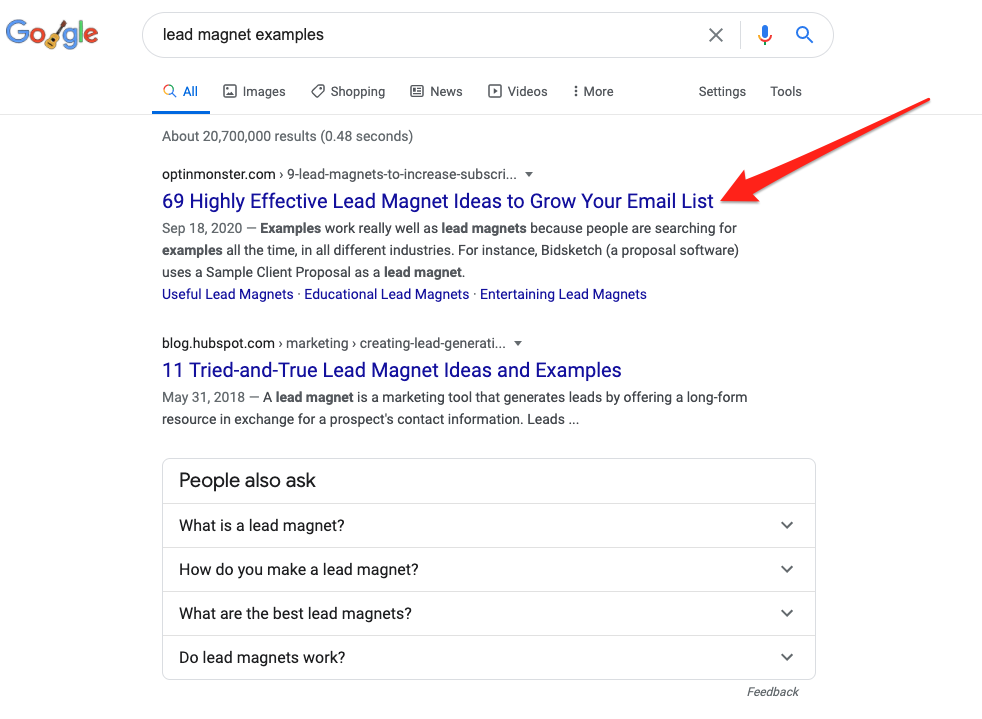
High quality work + optimized for SEO = content that generates backlinks on autopilot.
The one thing to remember here is that this method takes time to perfect. If you publish a piece today, it’s not going to generate 10 backlinks on its own by tomorrow.
This link building method is most effective when coupled with other tactics that generate quicker wins.
At first glance, you may not think that public relations (PR) and SEO have much in common.
But when it comes to acquiring links, building relationships is one of the premier tactics for getting the job done. It also happens to be central to effective PR.
Start by connecting with people in your industry and those who work at popular digital publications. That doesn’t mean blasting everyone in your LinkedIn network and asking for backlinks or media placement. It means forming genuine, mutually beneficial relationships.
Leverage social media and start to build a brand for your company and your thought leaders. Interact with the people in your industry and start sharing original content and ideas.
You don’t have to be CEO of your own company to establish yourself as a personal brand.
Plus, the way you present yourself online is still an extension of the company you work for. Growing your own brand will also help to build awareness for your business.
When you start to form connections and become more known among your peers, you’ll notice it’s a lot easier to pitch them for media opportunities.
At this point, you might be thinking, “how do media placements lead to backlinks?”
The answer is simple. When your brand is featured on a podcast, live show, or webinar, the feature is going to be promoted across that publisher’s website and social media channels.
As soon as you’ve secured the placement, simply ask your point of contact to include a link back to your website. Position it as being helpful for the viewer/listener. If the audience wants to learn more about your brand, they need a link to know where to find you.
Relationship building is a long-term play, but the payoff makes it well worth the wait.
Writing for different publications has a variety of marketing benefits. Guest posting helps establish your brand as a thought leader, reach your audience in a new way, and — you guessed it — build links.
But just like many other link building tactics before it, guest posting turned very spammy, very quickly. People began throwing together mediocre content, inserting as many links into it as possible, and shopping it around to any website that would publish it.
As a result, most publications developed strict guest posting guidelines to weed out writers who were solely creating content to get links.
Google took notice too. In 2020, Google’s Webmaster Trends Analyst, John Mueller, took to his Twitter to warn SEOs and marketers against guest posting as a spammy link building practice.
That said, guest posting still works to improve your website’s domain authority. You just have to approach it ethically.
For starters, only reach out to publications that your audience visits. Writing an article for a publication that your audience doesn’t read is a waste of time and resources.
You might get a link or two out of it but it’s not going to be in front of the eyes you’re looking for.
Additionally, keep quality and audience value at the heart of your efforts. Just because your article is published externally doesn’t mean it’s acceptable to give it less attention than a piece you’d write for your own website.
Infographics can instantly upgrade a piece of content from good to valuable.
However, infographics aren’t the easiest to create without the proper resources. They can be time-consuming and resource-intensive, especially if you’re collecting original data.
For this reason, many writers and content creators pull infographics from the web and link to them in their articles instead of creating their own.
As you can see, this poses an opportunity to use original infographics as a link building tool. Instead of just featuring an infographic on your website, you can pitch it to external publications in exchange for a link. Brian Dean of Backlinko coined the term “guestographics” to describe this strategy.
Sure, there’s work that goes into creating an infographic, but the long-term backlink potential is massive. In the same way that a strong piece of content can generate links for many months (even years) after it’s published, an infographic can have the same effect.
You don’t always have to reinvent the wheel to grow your website’s domain authority.
One way to score some quick wins is to audit your own website and check for lost links. Losing hard-earned links can be frustrating but getting them back isn’t as difficult as you might think.
There are a variety of reasons why your links could be disappearing. The linking page could’ve been unpublished (404 error), redirected, or the author could’ve just removed the link.
Whatever the reason may be, it’s worth your time to try and get it back. After all, that person linked to you for a reason. They might not even be aware that the original page was removed or redirected.
To check for lost links, you’ll need access to SEO tools such as Ahrefs, SEMrush, or Moz. Both of these tools have built-in features that allow you to see which links you’ve lost and why.
Once you identify the lost links, the next step is to contact the webmaster. Email is usually the easiest way to do this but LinkedIn InMail can be just as effective. When reaching out, be sure to keep your message concise and remind the webmaster why your resource is still valuable enough to link to.
Try something like this:
Hi {webmaster},
Hope your {day of week} is off to a strong start!
I’m reaching out because I noticed that one of the links to my website in this blog post has disappeared. Since your post covers {insert topic here}, I think my article is still a valuable resource for your readers as it expands on {insert topic here} and provides them with additional information.
Let me know if you’re open to it.
Thanks,
{name}
As with any form of link outreach, there’s a chance that you won’t hear back from the webmaster. However, that just comes with the territory. It’s a lot easier to reclaim a lost link from someone who already saw value in your page than try to build a brand new one.
Time for another quick win: unlinked brand mentions.
When your brand is mentioned positively somewhere on the web, it’s an opportunity to get backlinks. If another website is taking the time to mention your business, it means they already see some value in your product/service, perspective, or content.
Plus, it benefits their readers to provide a link to your website. This way, they know exactly where to click if they want to learn more.
To find web pages where your brand is mentioned, you can either use advanced Google Search or a social media analytics tool, such as BrandMentions or Mention.
If your brand shares a name with a common word or phrase, then you may want to try narrowing your search using other keywords that are to your industry or solution.
Once you find an unlinked mention, send a quick email or LinkedIn message to the webmaster and ask for a link. As a best practice, position your ask as something that will benefit their readers.
Doing this on a semi-regular basis is a great ongoing method for building links and getting insight into what people are saying about your brand.
Simply put, building links isn’t easy.
There’s no magic solution that’s going to improve your website’s backlink profile overnight. The real key to success? Blending long-term strategies with short-term tactics.
When thinking long-term, build a plan to create link-worthy content and start growing relationships with others in your industry. While you work on that behind the scenes, dedicate time each week to tactics that will win you backlinks more quickly, such as finding unlinked mentions and reclaiming lost links.
You’ll find that building backlinks is more than just sending cold emails and hoping for the best. Just like any other SEO strategy, it takes thorough planning and a little bit of patience before you’ll see the results you’re looking for.
Izabelle Hundrev is an LA-based content writer at Directive. She specializes in creating SEO-driven content covering a wide variety of B2B and SaaS topics such as demand generation and search marketing. Izabelle can be found on LinkedIn and Twitter.
https://www.searchenginewatch.com/2020/12/10/six-strategies-guaranteed-to-help-you-build-more-backlinks-to-your-website/
[unable to retrieve full-text content]https://feedpress.me/link/13962/14151940/390362
[unable to retrieve full-text content]https://feedpress.me/link/13962/14151510/390344
[unable to retrieve full-text content]https://feedpress.me/link/13962/14149896/387624

Reviews are critical for both merchants and consumers. That’s especially true right now, as holiday shoppers look to reviews to help make decisions about which TVs, wireless earbuds, home security systems, or air fryers to buy.
But many consumers will probably encounter inauthentic or illegitimate reviews without knowing it. Fake reviews exist on all the major platforms, it’s really just a question of degree. And it’s a growing problem.
In this article, I’ll discuss what’s at stake with fake reviews, the types of inauthentic reviews, how to recognize them, and how to get them removed.
Google, Facebook, Yelp, TripAdvisor, and Amazon take different approaches to content moderation and review fraud. Yelp has probably been the most aggressive of the major sites in keeping review fraud down. But Google, Amazon, and the others frequently say they’re actively addressing the problem as well — with varying degrees of success.
Review fraud is an especially big problem on Amazon. Separate studies performed by Objection.co, Fakespot, and The Washington Post have determined that a majority of reviews in certain product categories are deceptive or inauthentic. Objection.co has indicated, for example, that the vast majority of Bluetooth-enabled products in the electronics category are fake in some way. And Fakespot found that reviews for 63% of products in the beauty category on Amazon are illegitimate.
Amazon disputes these findings and contends it’s dealing with the problem. Fake reviews are also a problem on Google, where thousands of Local Guide profiles are controlled by “review farms,” according to Objection.co’s findings.
Review fraud is something of a cat and mouse game, in which shady but increasingly sophisticated fraudsters try to stay one step ahead of platform algorithms. The reasons fake reviews are proliferating are obvious. Reviews impact rankings on Google and Amazon and more than 90% of consumers rely on them to make purchase decisions.
Yet more consumers are starting to notice fake reviews online. According to a 2019 survey, 82% of respondents said they had read at least one fake review in the past year. (Consumers often don’t recognize them.) And the same study found consumers are increasingly turning to multiple review sites before making a buying decision, as a kind of hedge against review fraud.
We often speak about fake reviews as a uniform phenomenon. Yet there’s a spectrum and multiple categories of inauthentic or fake reviews:
Many fake review vendors operate offshore in China, India, Bangladesh, or the Philippines. However, according to Objection. co, the most common kind of review fraud is perpetrated by a business owner using a fake profile to write positive reviews about themselves or negative reviews of a competitor.
Trafficking in fake reviews is a bad idea for many reasons, including platform suspensions and blacklisting. But consumer trust is arguably the most important reason to not try and game the system. According to a global consumer survey released earlier this year by Bazaarvoice, fake reviews can cause a loss of trust in the brand or merchant. A majority of consumers (54%) say they won’t buy the product if they suspect reviews are fake.
Being called out by the platforms – Yelp in particular – can also be harsh. The company’s consumer alerts can remain on business profiles for months, depending on the infraction. That can be the kiss of death for a local business.
Assuming the business is not generating fake reviews for itself, recognizing and removing them can be a challenge. Sophisticated reputation management software tools can help spot fake reviews or monitor incoming reviews in real-time for easier detection.
Manual fake-review spotting is more challenging. But some of the things to look for include reviewers not present in the customer database, profiles or names that seem fake, geographically distributed reviews, references that indicate the review is aimed at the wrong business, review content that is “generic” or without much detail, and stars without comments (on Google). There are other signals as well.
Each of the platforms has somewhat different procedures to address questionable reviews and request removal:
Following these procedures doesn’t always work, however. On Google, in particular, the review(s) in question must violate one of its content policies, which include “spam and fake content.” In addition, Google will remove reviews if they’re written by a non-customer, if they’re directed at the wrong business, or if the review is not based on an actual customer experience (for example, political objection to the business).
It’s generally best to respond to the review publicly and point out the mistake or error (for example, wrong business location) without emotion. If it’s a competitor writing a negative review, politely point out that you don’t recall them as a customer. Then you need to locate and flag the review as “inappropriate” in the Google My Business dashboard. Local SEOs also recommend notifying @GoogleMyBiz on Twitter.
In the best-case scenario, it can take several days for reviews to be removed by Google if they agree the review was inappropriate. However, there are also instances where it can take much longer, 20 days in one example.
Online reputation is a long game. Reviews aren’t just about rankings. They can help businesses improve products, services, and operations. Businesses that listen to their customers (and care) will have greater loyalty and better referrals over the long term. It doesn’t pay to try and game the system by generating or buying fake reviews.
If the business has an active review management program in place and regular reviews coming in, any isolated review spam probably won’t have a meaningful impact. And any demonstrably fake reviews should be easily identified – and ultimately removed.
Norman Rohr is SVP Marketing & Communications at Uberall.
https://www.searchenginewatch.com/2020/12/09/fake-reviews-how-to-combat-a-growing-online-problem/
[unable to retrieve full-text content]https://feedpress.me/link/13962/14149055/390244
[unable to retrieve full-text content]https://feedpress.me/link/13962/14147280/390209
[unable to retrieve full-text content]https://feedpress.me/link/13962/14144295/389395
[unable to retrieve full-text content]https://feedpress.me/link/13962/14144038/389699