Google Web Story Strategies & SEO Best Practices [PODCAST]
[unable to retrieve full-text content]https://feedpress.me/link/13962/14122065/388263
[unable to retrieve full-text content]https://feedpress.me/link/13962/14122065/388263
[unable to retrieve full-text content]https://feedpress.me/link/13962/14121911/388717
[unable to retrieve full-text content]https://feedpress.me/link/13962/14121009/389219

When it comes to blog posts, not all content formats are created equal.
What’s more, with more than 500 million blogs out there all vying for attention, it’s getting harder and harder to stand out amidst the noise.
For a blog to be successful these days, it takes more than just shareable images or enticing headlines. While these elements are undoubtedly important, writing blog posts that attract the right kind of reader requires careful ideation, optimization, and outreach.
Fortunately, SEO content is not rocket science. Whether you’re struggling with content ideas or looking to monetize your ideas better, below are the seven most popular types of posts that will help your blog gain better traction and drive traffic to your site.
Before I identify the blog post types already proven to deliver results, we must first talk about search intent. If you don’t know what search intent is, search intent is the why behind a specific search.
Each type of search falls into one (or several) intention types:
The search user wants to learn something. While this type of search typically includes words like “how-to,” “what is,” or “who,” not all informational searches are posed as questions (for example, JFK International Airport directions).
The search user wants to visit a specific site. People would rather ask a search engine than type the full web address in the URL bar because they may be unsure of the exact website. Examples include “Facebook” or “WestIn contact number.”
The search user wants to purchase something. A transactional intent typically means the search user is wallet-ready. They’re merely looking for a website to make a purchase. Typical search queries include “buy iPhone 12,” “spa package,” and “MacBook air cheap.”
The search user has the intention to buy but is still at the research stage. People performing these types of searches require more information about the product or service that they have an interest in buying.
They search for terms like “top restaurant in New York” or “best android phone” to compare a specific product or service.
By understanding the specific intent behind a search, you can optimize your blog post for the right search terms. And when the correct type of searcher finds your content, your blog can generate relevant and targeted traffic.
With Google’s perpetual goal focused on providing the most relevant information for a search query, aligning your content with your audience’s search intent allows your blog to rank high for relevant search results.
For SEO success, relevance is a core tenet not to be overlooked.
So how can you infer search intent and create content that drives significant traffic potential?
The answer lies in the search query itself.
Let’s look at the search term “how to bake a cake,” for example. For those keywords alone, it may appear like the search has informational intent. But, don’t just guess search intent. A quick way to confirm the specific intent of a search is by performing a Google search.
By inputting your keywords into Google’s search, which in this case is “how to bake a cake,” it’s clear from the results that users are looking for cake recipe ideas and baking guides. To rank competitively high for this type of search intent, you should focus your content around a how-to post or a list article.
Now that we have a better grasp of search intent and its role in content creation, let’s look at the most popular blog post ideas that you can use today to start producing high-quality content.
Ready to put virtual pen to paper? Take the guesswork out of content ideation with these top-ranked content ideas.
With 80% of all Google searches being informational, how-to and tutorial posts are a staple for any blog, no matter your niche or industry. Since the goal of a how-to guide or tutorial is to solve a problem, readers of your article will be more inclined to invest in your product or service.
And as you’re an authority in your business, how-to type articles are simple ways to connect with your audience and establish credibility while showcasing your expertise.
To maximize the effectiveness of these types of post ideas, be sure to include visuals like images and videos in your articles. Not only do visuals enrich the content, but they also help readers comprehend the information provided better.
Readers are also more willing to take action when content is easy to process.
A great example of how-to content is Ann Smarty’s blog post, “Google’s featured snippets: How to get your YouTube video featured in Google.”
Another content powerhouse, list articles (listicles) help to streamline information. Just how powerful are list articles?
In a comparison between list-based articles and non-list articles, SEMrush found that the presence of lists resulted in 4x more traffic and 2x more social shares. What’s more, 36% of readers are more likely to click on an article with list headlines.
With content typically formatted as a numbered list, readers can quickly consume the content of your list posts. It being easily digestible also helps readers better share the post and act on the information.
Like how-to guides, list-style articles can be a useful tool for informational intent, as well as transactional intent and commercial investigation.
As an example, here’s an excellent list-based post on web development tools.
A case study post is a highly valuable marketing and brand promotional tool. In B2B marketing, case studies can provide the following five benefits:
In several content marketing surveys, B2B marketers identified customer testimonials (89%) and case studies (88%) as being the most effective content marketing tools for lead generation. And three-quarters of B2B marketers found case studies accelerated leads through latter stages of the funnel quicker than any other content marketing format.
To realize the power of case studies, structure your process from challenge or problem to potential solutions and, finally, the results and conclusion. Here’s a great SEO case study example showing off this structure without being dull or boring.
The brilliance of writing posts on future trends is that you’re able to display your expertise and industry knowledge. What’s more, as people are always looking for advice or information about the next market trend (commercial investigation), prediction posts can generate great responses, and even spark debates.
Statistics by Hubspot found that few people who regularly read blogs do so to learn about a brand’s products. Instead, people commonly read blogs for three reasons:
And when it comes to content formats, 47% of bloggers have found trend pieces to be highly popular among their readers. Prediction and trend post ideas are only outpaced by lists (57%) and how-to articles (77%).
Ultimate guides are the most definitive blog posts you can write. These types of long-form post ideas typically exceed 3,000 words. Some guides can even take as many as 10,000+ words to write effectively.
So why would you want to commit to writing a detailed, comprehensive blog post? Here are a few benefits to ultimate guides:
Regardless of the topic or niche, long-form content outperforms shorter blog posts. In a study done by Brian Dean, blog posts longer than 3,000 words had 77.2% more referring domains than short-form content. And thanks to Google’s RankBrain, long-form content gets rewarded with higher-ranking positions.
Bloggers who work on long reads experience 54% better results and receive 3x more traffic than blogs who only write up short content.
Interview posts are a great addition to any blog as it diversifies your site’s blog content and relieves some pressure to content creation. Interviews allow your brand to:
As an influencer outreach tool, interviews are undeniably powerful. With 69% of consumers distrusting traditional advertising, collaborative content like interviews enables your brand to reach and connect with audiences in a more natural way.
First Round Capital, a seed-stage venture firm, knows all too well the transformative power of interviews. A single interview about Slack’s launch strategy earned First Round Capital a total of 2,243 backlinks from major publication sites like Fast Company and Entrepreneur.
If your blog is relatively new and you’re unable to attract any influencers to interview, consider writing expert round-up posts. Influencers love participating in round-up posts as these provide them with opportunities to demonstrate their expertise.
Both post ideas can contribute to more significant blog traffic as influencers are more willing to share your content with their network.
As images are more attention-grabbing than text, consider adding infographics to your blog content calendar. Infographics are not just attractive or exciting to read; they are also shared 3x more than any other type of content.
Admittedly, infographics work best when professionally designed. Fortunately, there are many online infographic tools like Canva and Piktochart that enable you to create beautiful infographics at a freemium price.
Now that you have plenty of post ideas to keep your content calendar full, let’s look at specific on-page SEO elements that will help attract the right visitors to your blog.
Whether you’re looking to write a listicle, tutorial, or ultimate guide, include these three on-page SEO factors into your content before hitting publish.
As the primary goal for any blog is to attract an audience, keyword research is vital. After all, no content can compete in search results without keyword research. If you don’t know what your audience is searching for, how can you get your content in front of them?
With that said, though, don’t try to rank for short-head search terms like “chocolate cake.” These search terms are highly competitive, making it difficult to rank high against already established blogs. Instead, focus on medium-tail keywords like “chocolate pound cake recipe.”
Medium-tail keywords, like the previous example, are more specific than short-head terms. People using medium-tail keywords are more likely to read your content. They are also more motivated to take action, resulting in a positive interaction with your brand.
Once you’ve done your keyword research and compiled a list of medium-tail keywords, include them into these important places in your blog post:
You can also add your keywords into the body but don’t over-optimize your content.
Over-optimization is a form of keyword stuffing, which goes against Google’s guidelines. Just add your target keyword in the first 100 words of your article.
Internal links are hyperlinks that point to a different web page on the same domain. Internal links are an SEO best practice because it helps search engines find and index relevant content. Visitors also use internal links to check out high-value pages, increasing site dwell time.
When linking internally, aim for two to three links. Use a descriptive anchor text with keywords that are relevant to the linked-to page. Another way to include more internal links to your blog post is by adding a related post section at the bottom of the page.
Blog posts that only contain text are flat-out dull. Adding quality images to your post better explains complex information and makes your content more visually appealing. Because visuals stand out, images can improve the scannability of your post significantly.
But don’t just pop images into your post and hit publish. Images can also be optimized for SEO, allowing your visuals to rank for Google Images. When optimizing images for search, be sure to:
By writing for relevant search intent and incorporating these SEO best practices to your post ideas, your blog will gain more opportunities to appear high in search results. More visibility in search means increased organic traffic to your blog.
After you’ve published your blog post, let the world know about it. Promoting your content via outreach can be done by sharing your post on social media, engaging in forums like Reddit, reaching out to influencers, and advertising through Facebook.
Karl Tablante is Inbound Marketing Manager at SEO Sherpa.
https://www.searchenginewatch.com/2020/11/30/seven-most-popular-types-of-blog-posts-guaranteed-to-boost-traffic/
[unable to retrieve full-text content]https://feedpress.me/link/13962/14119978/388197
[unable to retrieve full-text content]https://feedpress.me/link/13962/14117486/389018
[unable to retrieve full-text content]https://feedpress.me/link/13962/14116946/389019
In the early days of search engine optimization, a variety of black-hat techniques allowed SEOs to dominate the first page of search. Cloaking, keyword stuffing, backlink spam, and other strategies could catapult websites to the first page. But those days are long gone. Google’s algorithms are extremely powerful and can easily result in a negative SEO attack. Not only will black-hat strategies no longer work – they will destroy your site’s rankings and even prevent your domain from ranking permanently.
So for those out there on the internet who are not interested in seeing your domain move up the first page, black hat SEO is an easy way to harm your website. Many new site owners are so eager to get any backlinks that they can, they allow low-quality links to populate their profile without ever thinking about where those links are coming from, or why those other site owners linked to them in the first place.
Negative SEO attacks are real. I’ve helped many clients recover from them. They can come from competitors, hackers, or seemingly out of nowhere, but without a quick response, a website’s reputation with search engines can be permanently harmed.
Although Google algorithm updates or technical issues with your website can impact your keyword rankings, an unexpected drop could be a sign of negative SEO. The good news is, the anatomy of a negative SEO attack is clearly recognizable. If you take quick action, you can protect your website and minimize the damage.
The reality is, every time your site moves up a spot in the SERPs, you knock another site down. It’s not fun to imagine that other people would use negative SEO to harm your efforts, but if you offer great service or product that could take business or traffic away from someone else, then your site is at risk.
Any website can experience a negative SEO attack, but local businesses and startups with less than 300 referring domains are the most vulnerable. The smaller your backlink profile, the more impactful any low-quality or unnatural links will be. If 50% of your links are spammy and you’re a brand new site, Google crawlers are going to look at your backlink profile and assume your site is trying to cheat your way to the top.
For new webmasters, in particular, it’s critical to pay close attention to every backlink you acquire. This is also true when you pay for the services of a link building company. Some site owners are hesitant to pursue link building because they have had negative experiences with SEOs in the past who engaged in these spammy techniques that ended up tearing their site down rather than building it up.
As your backlink profile grows, spammy links will not have as much of an impact on your domain authority or rankings. Still, it’s good to keep an eye on the referring domains and anchor text diversity of your backlink profile.
There are a variety of common negative SEO techniques that people may use to harm your website. After handling negative SEO attacks with my own clients, these are the most common types I’ve come across and that I encourage webmasters to be on the lookout for.
Backlinks from low-quality sites that have low domain authority, little relevance to your industry, or very little site traffic should always be suspect. If you receive a large influx of these low-quality links, they may be coming from a link farm that has the infrastructure to build a massive amount of links quickly. If you’re a new site with a large percentage of toxic links, Google will likely assume you’ve been participating in black hat manipulation.
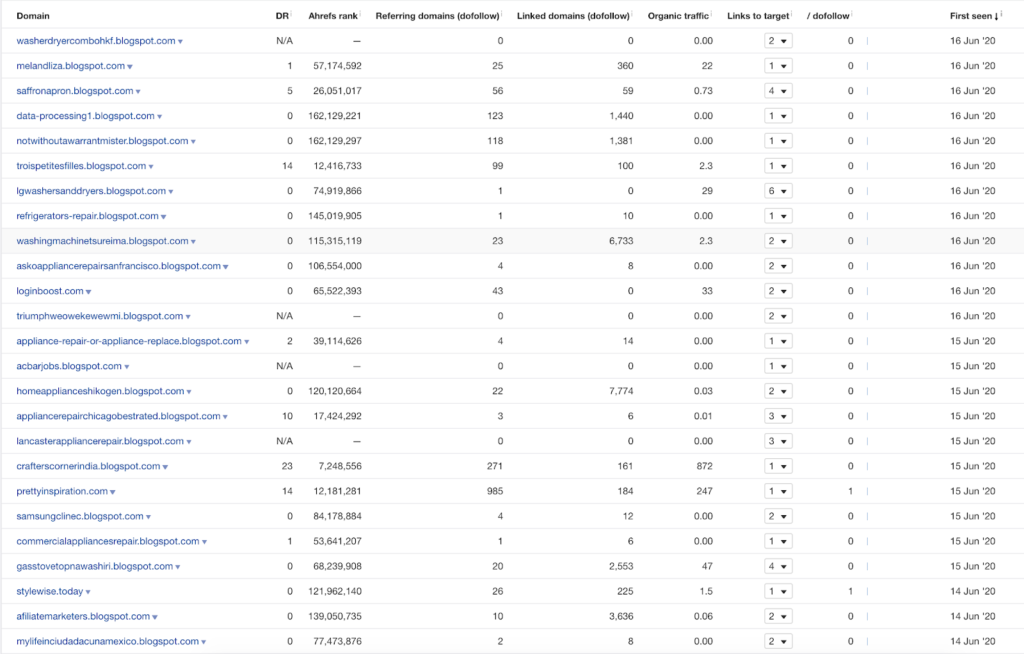
One way SEOs used to manipulate their site authority was by leaving backlinks in the comment section of blogs or forum sites. If you suddenly receive backlinks in the comment section of older blogs with no relevance or traffic, someone might have placed them there maliciously. If it’s an SEO agency that placed the link and you paid for it, fire them immediately. Google indexes those links in the comment section, and it will not look favorably upon your site if you have a lot of these unnatural backlinks.
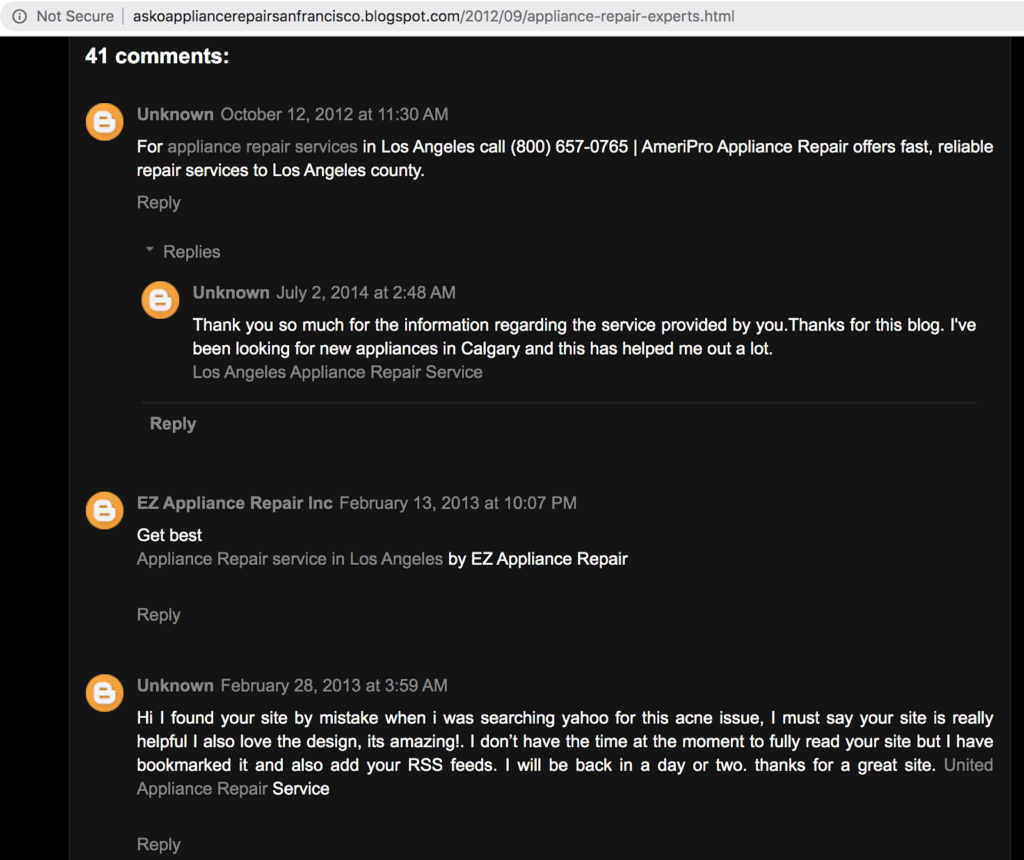
Natural anchor text will most often include your brand name, the services or products your business offers, or more generic wording like, “Click Here.” If all of your anchor text has the exact keyword you’re trying to rank for, that will come across as manipulation to Google. If the anchor text is irrelevant, it will confuse Google bots about the content of your site. It’s important to pay attention to the most common ways that other sites link to yours so if new links don’t share at least some similarity, you can investigate them accordingly.
Although negative reviews don’t have as drastic of an impact on your site authority as your backlink profile, Google does crawl and render those sites when considering whether to rank web pages. Local and small businesses with bad reviews, in particular, will not rank, so in addition to reviewing your backlink profile on a regular basis, site owners should also be monitoring the important review sites in their industry. Most major review sites allow you to report reviews if you have reason to believe they are fake.
There are other types of negative SEO that I haven’t listed here such as content scraping, links hidden in images, and more, but the above are very easily identified using Google Search Console or any type of backlink analyzer. Familiarizing yourself with the many ways that others may try to link to your site in a harmful way will help you be able to identify those problematic links right after they show up in your backlink profile.
Digging yourself out of a negative SEO attack is never fun, but it can be done. If you’re being a responsible webmaster and monitoring your backlink profile regularly, you should have a solid understanding of what a healthy backlink profile for your website looks like, and will therefore be able to recognize the moment that something appears off.
If you believe that the influx of links is indeed the result of nefarious intentions, you have a few options to repair the damage, and hopefully, before Google penalizes your site. Some of these options are more expensive than others, but if you’re not an experienced webmaster, it is probably best to get the guidance of an SEO expert. If you remove the wrong links, you can end up performing negative SEO on your own website by mistake.
The first step with any link is to reach out to the webmaster to ask for the link to be removed. Admittedly, this is not always successful. However, before you move on to option two, you want to make sure you have exhausted every effort to have the link removed before requesting Google to get involved. If the link was the result of comment spam, the owner of the blog may be willing to moderate or delete the comment. There have been webmasters who have charged my clients a fee to have links removed. Depending on the price you’re willing to pay, you can choose to do so or move on to other options.
In 2012, Google added the disavow tool in Google Search Console to give webmasters more agency in their off-site SEO. The reality is, no one can fully control the websites that choose to link to theirs in a harmful way, so it’s not really fair for search engines to penalize your site as a result. Google recognized this and created the disavow tool, however, they still advise site owners to use it sparingly.
A disavow file is essentially a list of links that you want invalidated on your domain, or that you don’t want Google to consider when evaluating the quality of your website. There are detailed instructions on how to submit a disavow file in the Google Search Console help center. Take note though that these links aren’t actually removed, Google just no longer takes them into consideration the next time they are crawled and indexed. If you’re using an SEO software that measures the quality of your backlink profile, you will likely have to submit the disavow file there as well if you want their metrics to accurately reflect how Google understands your site.
High-quality, contextual link building is different from black-hat SEO in that it uses original content to earn links on relevant, industry-specific publications. The best SEO agencies will increase site authority the right way, through techniques that are Google compliant and don’t harm your rankings in the long-term. If you are not actively trying to earn high-quality links for your website, not only are you missing out on the opportunity to improve your overall keyword rankings, you place your site in a more vulnerable position. If you pursue consistent link acquisition and build up a healthy backlink profile before a negative SEO attack occurs, you are more well-positioned to avoid a Google penalty.
It is certainly frustrating and unfair when negative SEO occurs, but there is really nothing that a webmaster can do to prevent it. So in the case of negative SEO, preparation is the best medicine. Knowing what to look for will help you be more prepared to take immediate action and minimize the damage.
Manick Bhan is the founder and CTO of LinkGraph, an award-winning digital marketing and SEO agency that provides SEO, paid media, and content marketing services. He is also the founder and CEO of SearchAtlas, a software suite of free SEO tools. You can find Manick on Twitter @madmanick.
https://www.searchenginewatch.com/2020/11/26/the-anatomy-of-a-negative-seo-attack/
Publishing valuable content is a constant challenge when it comes to the formats and topics to cover. As a blogger, digital marketer, or content creator, you already know how much thought goes into offering your audience fresh, engaging content on a regular basis. Readers appreciate formats they are familiar with and can consume easily. A roundup post is an example of a successful approach to topics of interest in your industry.
Roundup posts are pieces of content in which a list of selected experts give their insights on the same topic, in short descriptions that include their opinions, predictions, or reviews.
Creating an expert roundup post for your website or blog can take some preparation and organizing efforts, but it brings undeniable long-term benefits in terms of traffic, authoritativeness, meaningful relationships, and peer recognition. By gathering a group of experts to answer the same question, you will not only generate relevant content for your website but build a strong relationship basis with experts in your industry.
Having a list of selected experts answer a well-placed question gives you a valuable piece of content that is highly shareable, so let’s see what it takes to do it right. In the following guide, I will take you through every step of creating an enticing expert roundup post for your website.
The first step you need to take after deciding to publish an expert roundup post is to find the perfect question to ask the experts. This will be the key element of your post, and it will dictate whether it will be successful or not.
The perfect question might not be easy to find, but take enough time to find it. Brainstorm as much as you need before you decide who to invite in. All the further efforts of finding influencers and experts could be in vain if the topic you choose does not fit the roundup format, or doesn’t spark interest in your readers’ minds. So I’d recommend you find a question that resonates well with both your readers and experts.
To better understand what kind of questions are fit for a roundup post, you should picture the end result. You want to have your experts give your readers a piece of their own judgment, advice, or insight on a subject that your readers are familiar with. It won’t be a 101, a critical debate, or brain-picking for ultra-specialized information.
Your question needs to be:
What about the topic will you be asking about? Naturally, it has to be specific to your website or niche and what you usually write about. The key is to find a subject that your audience is curious or interested in. Perhaps a trend, or a subject that usually sparks debate or behind-the-scenes type of information that regular posts don’t really get into.
You have the chance to get insights about the latest trends everyone is wondering about, or tips and tricks, good practices that expert peers have discovered through their experience and expertise.
Examples of questions:
Easier said than done? If you don’t already have a topic you’ve been pondering about, compile a list of possible questions for your roundup with a little research.
Use tools like the Ahrefs Content Explorer to find trends in your industry, and subjects that seem to attract a lot of readers. You can filter results by their social shares, number, and quality of referring industries so that this tool and similar ones can give you a good idea of what subject should be pursued.
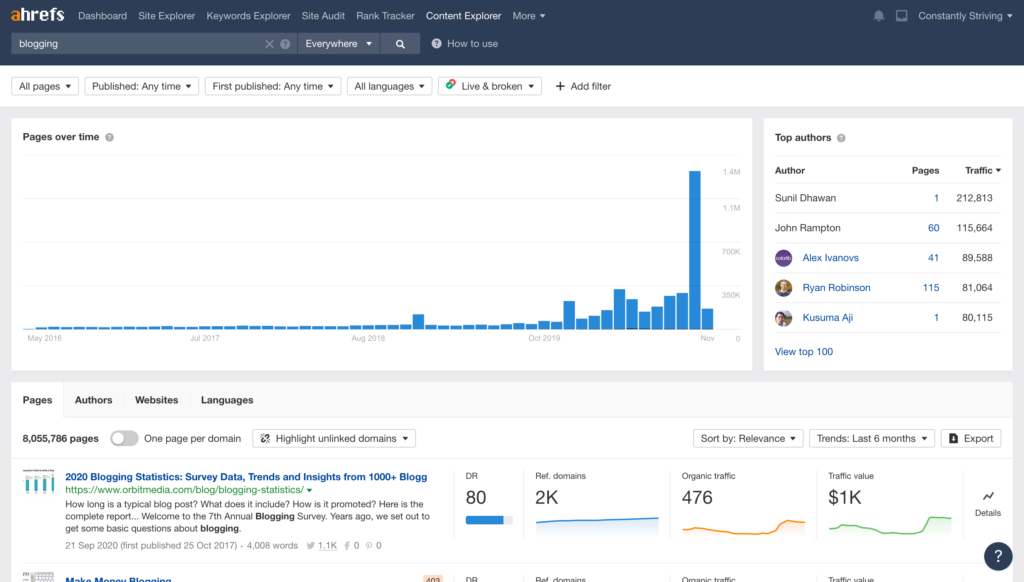
With these things in mind fuel that creative engine and start putting ideas on paper, whether they seem perfect candidates or just potential pursuers. It’s best to have a long list to start from when drafting the winning question for your roundup post.
After finding your question, you should have a good idea about the expertise of your respondents. Assuming that you are active in your industry for a reasonable time, you should already know who the experts in your niche are. You want to compile an extensive list of experts of at least 50+ because not all will reply to your inquiry.
Let’s make a profile for the ideal respondent in your expert roundup post:
A practical, fast way of identifying possible candidates for your roundup post is to check other roundup posts in the industry. Does this approach seem lazy at a first glance? The redundancy of a roundup article doesn’t come from the list of people contributing to it, but from the very topic, you will choose for it.
As long as you are able to provoke your respondents to bring something original to the table, selecting them from other roundup articles is absolutely fine.
Depending on your topic, you might find tens of experts already showing potential for accepting your invitation. But don’t put your eggs in one basket: there are other ways of finding strong, authoritative voices in your niche.
A simple search on social media can give you a good idea of who is interested in the topic you have selected and fits the ideal profile described above. Twitter and Facebook are also great platforms where you can find experts in your industry.
For our roundup post about blogging tips for beginners, we have gathered content from CEOs and founders of content marketing websites, authors, bloggers, and podcasters in digital marketing. They were all able to give us valuable insight into what blogging is like for beginners, and what they should do to thrive.
Web search is another simple solution to putting together your expert list. We were able to find several experts by simply typing in our keyword or phrase onto Google. Find bloggers who have been covering your subject, or similar ones, and dig a bit more in their previous posts, to have an idea of who you’re going to contact.
Ahrefs, BuzzSumo, and Hootsuite are other awesome tools to research hot topics and authoritative blogs, as they display real-time data on their referring industries, traffic value, and the number of shares they get for their posts.
Once you have a list of experts, bloggers, and influencers who can give you valuable insight into the subject you want to cover, it’s time to start gathering their contact information.
It’s best to keep a database of their information, on a simple Google or excel sheet with their names, email addresses, URL to their website, the date when you contacted them, and a column where you check if they submitted content or not. You can get a little more advanced by using a CRM or email outreach tool like Mailshake.
Keeping your contact information organized will speed up the preparation process and will help you avoid awkward situations like sending an invitation twice, or forgetting to do a follow-up with them.
Some of the experts you’re trying to reach won’t have a visible email address but you can use tools like Hunter.io to find them by simply entering their first name, last name, and their domain name. It will give you a list of the results it found. Ideally, you would launch your invitation privately, but if you still can’t find their email address, don’t hesitate to send a tweet that mentions your plan or a simple message via the other social media platforms.
Here are more tips on how to find contact information for people who you want to reach, and what good practices you should follow.
If it’s the first time you are contacting someone, it’s a good idea to look into the good practices of a cold email. Roundup posts are great for getting quality backlinks, and the persons you will contact are aware of the positive influence their contribution can have on your traffic and domain. But they can’t endorse a website or a blog that doesn’t prove to be valuable on a constant basis.
We can talk about cold email outreach best practices for days on end but that would take too long. What I highly recommend is that you be genuine, polite, and kind when reaching out to your experts. This goes a long way and they’ll be able to tell when someone is being genuine since they receive hundreds of spam emails every day.
I also recommend you personalize each and every one of your emails. Yes, this will take time but you will have a higher conversion rate than if you were to send the same bulk email to everyone.
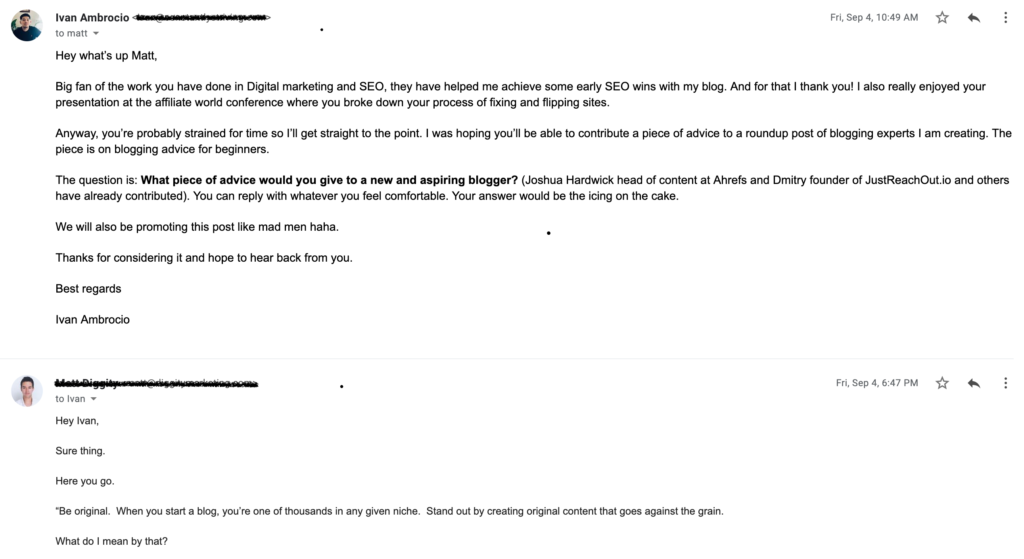
I don’t have a template to help you get started, but below I have provided a screenshot of an email I sent out to one of the experts that we included in our roundup. Feel free to use it for some inspiration and to help garner some ideas.
Another fantastic way of reaching out to experts is by joining and engaging with them via their live streams. We used this tactic to reach one of our experts who had not replied via email. It worked out, and he gave us some awesome advice while on his live stream.
Getting enough contributions from the experts you have contacted is a great achievement in the process of creating a stellar roundup post. But your job is not finished yet. Putting together the content you have just received from your guests is very important, as it will have to be a high-quality presentation that they will gladly share on their channels, therefore getting you some exposure to new audiences.
As you can see in our roundup post example, each contributor’s section starts with a professional picture of the contributor, the content that they have submitted, finished with our own thoughts on their commentary. We have added easy-to-follow social media icons that take you to their Twitter, Instagram, Facebook, or LinkedIn profiles, the titles they hold, and links to their main projects: companies they work for, blogs, YouTube channels, and others.
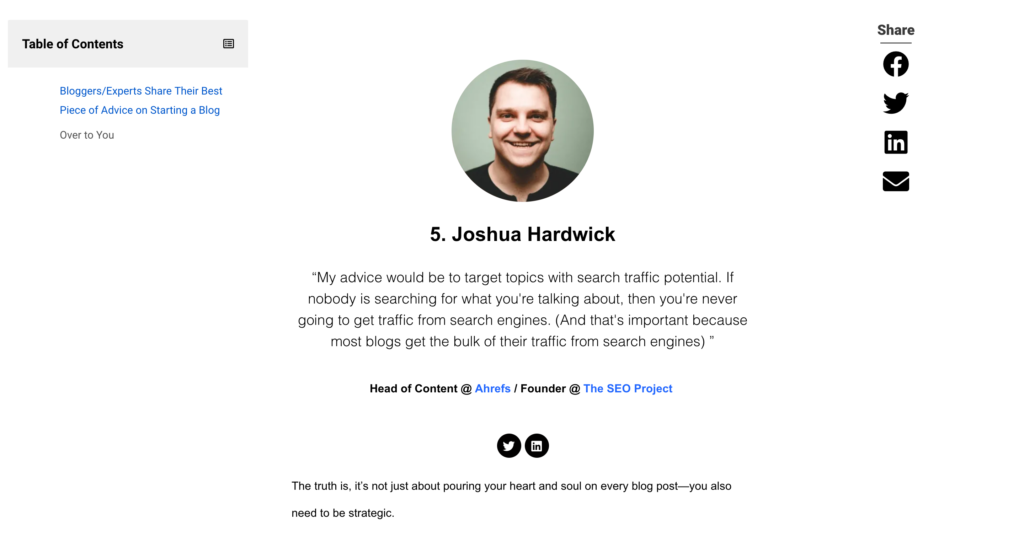
We wanted to make it easy for our readers to follow and engage with our experts via their blogs, businesses, and social media accounts.
While you want to emphasize the value of each contributor, you must also have your reader’s interest in mind, and clearly answer a need or a question your audience has.
Promoting your posts should be done in the interest of all your contributors, yourself, and your audience. The effort you have invested in compiling these pieces of content will ideally be rewarded with significant organic traffic, a good number of quality backlinks, and most importantly the start of new and meaningful relationships.
You should also edit the content carefully so that each contributor gets the same level of attention and appreciation. Take your time to thank each one of them for their contribution and don’t hesitate to personalize your message with your personal impression of their content.
Backlinks are certainly welcome, but asking them explicitly might not be appreciated by all the persons you will contact. The best ways of getting your contributors to share the roundup post are to simply ask them if they could share it with their audience.
Infographics, tweets, quotes included in an image, newsletters, and paid ads are all great ideas for getting your content everywhere and promoting it like crazy.
Publishing an expert roundup post might not be everyone’s style of content, but for certain industries and domains, it can be a long-term valuable resource, both for your audience and your peers. And, of course, for you.
Keeping your focus on the value your post should bring to your readers will help you choose an enticing topic, ask the right question, and select the right people to answer it. While no one can ignore the advantages a roundup post has for contributors and creators alike, backlinks and traffic should not be your singular concern.
Ultimately, the success of such a compilation is given by the shares, referrals, and traffic you get from your audience. Create a fantastic expert roundup post by asking a question your readers are interested in, and your contributors can easily answer.
Give this type of content the time and effort it needs and it will prove to be a fruitful initiative, both amongst your peers and as a relevant post for your website.
https://www.searchenginewatch.com/2020/11/26/simple-guide-to-creating-an-expert-roundup-post-that-drives-website-traffic/
With mobile internet accessibility and usability growing year-on-year, it is undeniable that websites must meet users’ expectations for a smooth and relevant experience. Moreover, 2020 generated valuable insights into the relevance of mobile devices to people’s lives. Still questioning the importance of responsive web design for your website’s SEO? To weaken skepticism, Jos Davies, an SEO expert at UENI reveals the top five ways of complementing SEO efforts with responsive web design to improve websites’ performance in Google’s SERP.
Mobile visitors are usually impatient, longing for on-the-spot solutions to their needs – which is not to say that desktop visitors like wasting their time! Google endorses this by saying that 53% of mobile users will bounce off a page that is not loading in less than three seconds.
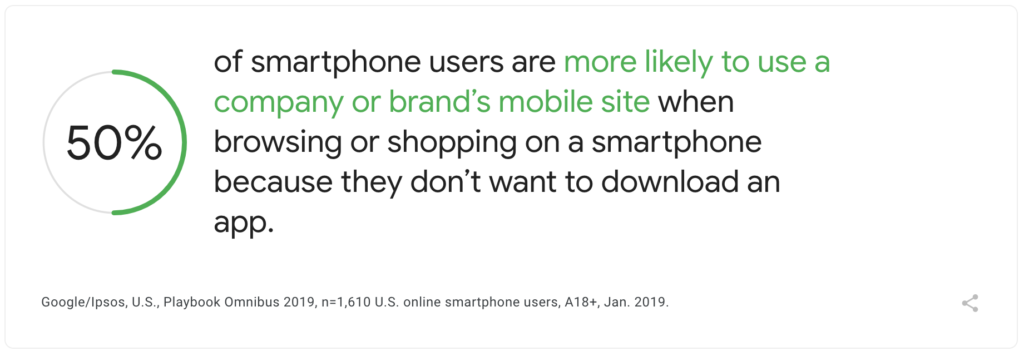
Source: ThinkwithGoogle
Within a highly competitive market, fast loading websites manage to stay competitive, while the rest are subject to traffic fluctuation and inconsistency due to a drop in ranking.
Responsive web design helps optimize websites for mobile search, improving your site’s functionality, and design by scaling the content to users’ devices, thus providing a consistent user experience across all devices.
Since Google is all for serving users the most relevant results, it will then favor and promote the websites that are providing a good user experience by all means: content, design, and functionality across all devices.
It goes without saying that a drop in traffic harms sales. On top, an unresponsive website on mobile devices is missing out on valuable opportunities to attract customers and make them convert.
Starting with Google Speed Update, back in 2018, Google uses mobile site speed as a ranking factor in mobile search.
Google’s updates are aligned to user’s behavior: an increase in mobile device use means a paradigm shift for how Google bots crawl, index, and display results in SERP to satisfy people’s needs, expectations, promoting customer satisfaction.
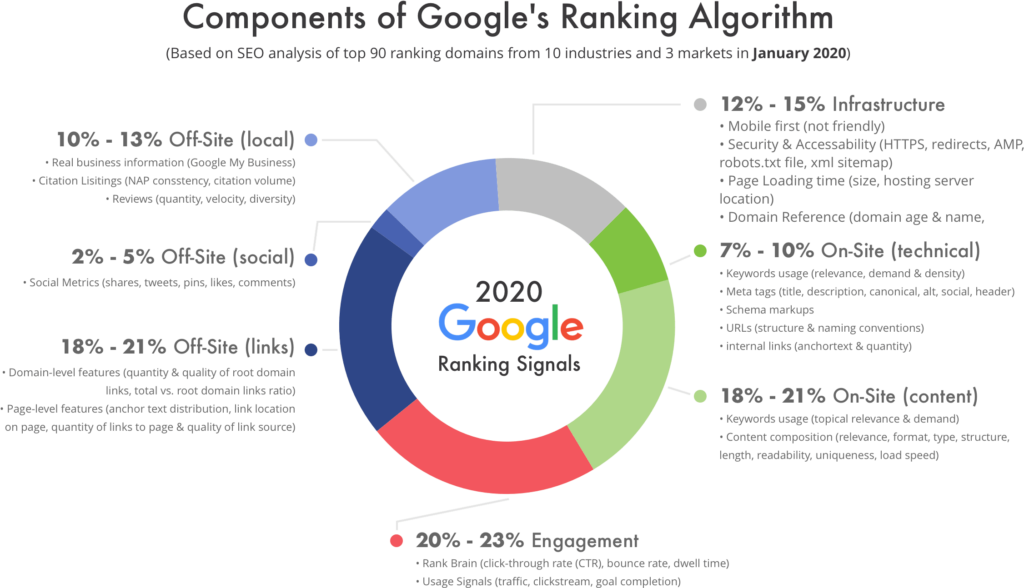
Source: Uptimiser
In a mobile-centric world, having a mobile responsive design is a fundamental part of a successful SEO strategy. Responsive web design will help you rethink both the layout and the content of your website to offer a smooth user experience from desktop, to laptop, tablet, and smartphone without any inconsistencies.
Failing to do so, your SEO efforts would be compromised and a drop in traffic is foreseeable beyond question with your desktop only and m-dot website versions being removed from Google’s index no later than March 2021.
The bounce rate reflects the percentage of users landing on a page and deciding to leave before continuing the website journey. Google takes it into account for weighting the relevancy of a webpage for a given search query.
A high bounce rate will thus generate a drop in ranking, reflecting thin or irrelevant content, or a poorly designed website, just by looking at user’s interaction.
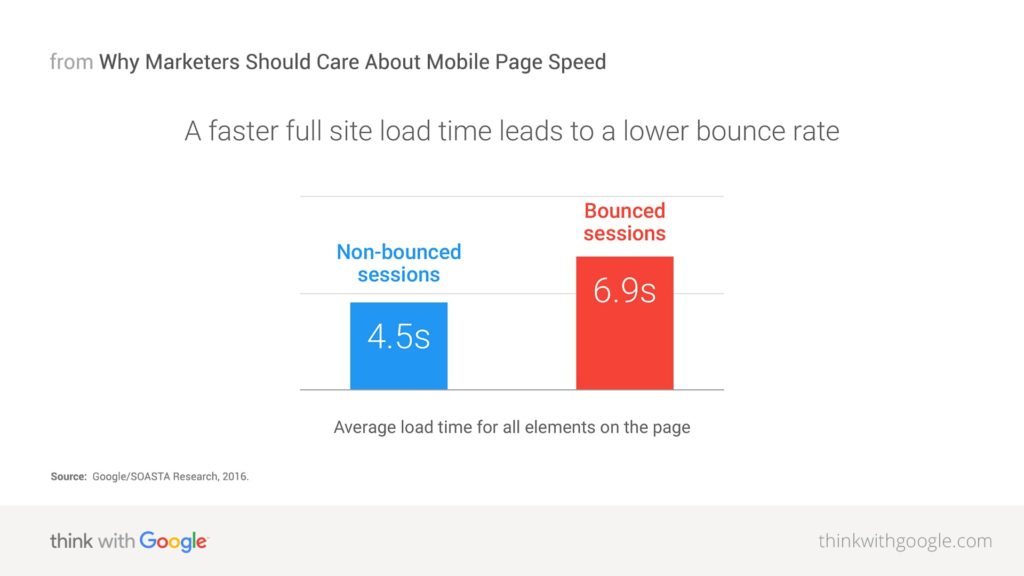
Source: ThinkwithGoogle
It is still safe to say that content is king but keeping up to speed with the latest tech insights, the content will only remain king if is properly optimized for all devices.
Good content can only do so much, if not supported by an appealing design. Responsive web design does just that by adjusting the layout of the page, displaying the same content, to any device.
Social media is not a ranking factor, but that doesn’t make it less important when it comes to your overall marketing strategy. It sure does play an instrumental role in an SEO campaign, complementing each other, and helping you leverage website traffic.
Responsive web design makes content sharing accessible across all social platforms, expanding your audience.
How? By making it easier for site visitors to access the same content on desktop and mobile devices, share it with their peers, and on their social media profiles. This uncovers great opportunities to reach a wider audience.

Source: GlobalWebIndex
More traffic means more chances for your visitors to convert. Now, more than ever, responsive web design is the foundation that makes it possible for you to boost your sales. What if a desktop user shares a link to a mobile user and the website is unresponsive? Or, imagine your visitors struggling to find the share button, and simply giving up. This robs you of the opportunity to expand your potential consumer market and get more traffic.
With the rise of mobile device use, most websites built a separate mobile version, but this approach is often raising duplicated content issues. Why? If highly similar content appears on more than one URL, then chances are you’re in for duplicate content issues.

Source: Statcounter
Due to the duplicated nature of the content, Google bots cannot tell which version should be indexed, nor if one version should absorb all link metrics, or should they be kept separate. On top, which version should rank for a given search query? Although chances that you will get a Google penalty are low, this doesn’t mean that your rankings will not be affected.
Installing a responsive web design will help solve your duplicated content issues on account of using one URL across devices and adapting the layout and content to fit any screen size while offering a consistent and pleasant user experience.
Google says webmasters do! If Google announces an algorithm change, we follow. And Google recommends responsive web design for a smooth transition to the mobile-first index, with a series of benefits reflected on your overall website’s SEO performance.
Jos Davies is an SEO expert at UENI.
The post Five great ways responsive web design benefits your SEO appeared first on Search Engine Watch.
https://www.searchenginewatch.com/2020/11/25/five-great-ways-responsive-web-design-benefits-your-seo/