Five SEO tips to dominate local search this holiday season

30-second summary:

  • 60% of consumers have been shopping online more often since COVID-19.
  • Making your local SEO strategy a top priority for small retailers and those with multiple locations.
  • Shoppers are browsing more frequently and making more purchases, although they are smaller in value.
  • Local retailers should focus on creating in-store experiences online and pick up.
  • Understanding your local audience and optimizing at the hyper-local level is key.
  • Jim Yu, Founder and CEO of BrightEdge highlights five great ways your business can use local SEO to dominate search and translate it into sales this holiday season.

A shorter than usual shopping season, last-mile shipping uncertainty, and ongoing health and safety concerns are just a few of the factors driving wild shifts in consumer behavior in the lead-up to holiday season 2020. Given how wide-reaching and long-lasting the coronavirus pandemic is proving to be, we couldn’t possibly have predicted or envisioned the circumstances we now find ourselves in. Local businesses already pushed near the brink may find this shopping season more competitive than usual, making your local SEO strategy a top priority.

This holiday season more than ever, marketers need to keep a hand firmly on the pulse of their market and opportunities. Activating as much relevant, real-time consumer data as possible is going to be key.

1. Offer payment options, COVID precautions, and other key conversion information front and center

We know what the important issues are for shoppers this season:

Consumers are browsing, researching, and shopping across online channels. They are more value-conscious than before and are looking for reassurance that their privacy and data are protected when making purchases online.

Get ahead of frequently asked questions by updating your website, social profiles, local listings, and landing pages with answers. These are critically important optimizations—so much so that Google, Yelp, and other listings platforms are highlighting this information for consumers on business profiles. If consumers can’t find what they’re looking for on your listing, they’ll simply move on to the next.

2. Really get to know your audience this holiday season

Planning campaigns based on historic data simply won’t cut it this year. Agile marketers and smart automation will come together to power the messaging and experiences it takes to convert in upended markets.

Nielsen released consumer profiles late in October based on research and surveys undertaken in different periods throughout the COVID pandemic. It’s impossible to predict just who you’ll find at your door (or in your online shopping cart) this holiday season, but expect to see each of these consumer types in the mix:
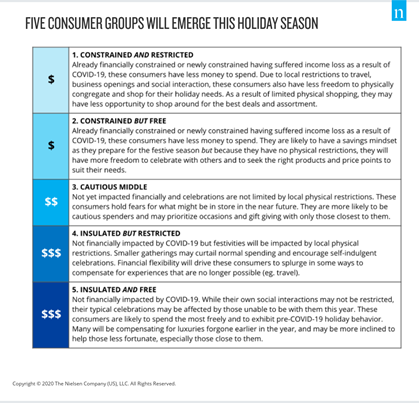
local search this holiday season - consumer expectations

You can see the very different motivations and types of shopping happening this year. Those who’ve escaped a direct impact from COVID may be compensating for luxuries they’ve forgone this year—trips that were canceled, or large purchases put on hold due to the initial uncertainty. At the other end of the spectrum, you see consumers who are affected both financially and physically, having less money to spend and also constrained by lockdown measures.

Understanding both your macro market and micro opportunities, at the individual web visitor level, is key to capitalizing on your opportunities to convert this holiday season.

3. Feed browsing behavior with high quality, engaging content that complements holiday season search

In our recent research, BrightEdge mentioned that 60% of consumers have been shopping online more often since COVID-19. It’s a behavior that 73% of those plans to continue after the pandemic. Shoppers are browsing more frequently and making more purchases, although they are smaller in value.
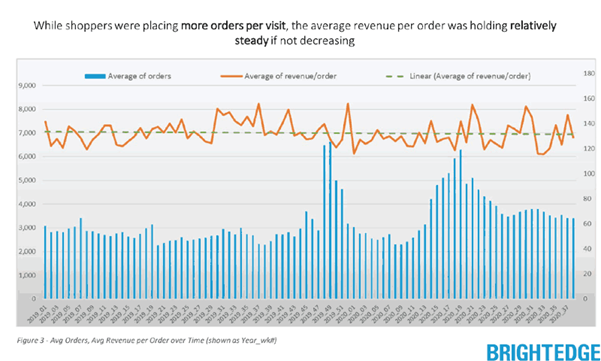
Feed browser behavior with engaging, quality content to rule holiday season with SEO

This holiday season, it’s critical that the content on offer is personalized and engaging; that it is an accurate reflection of their needs, intent, interests, and behavior in the moment. Activate your search insights with dynamic content optimizations to keep in step with changing consumer behaviors.

Think like your COVID-weary customer—what is giftable this year? As Nielsen points out in their recent article on the consumer types retailers can expect this year, “From a necessity that can no longer fit the budget, to a product that has been harder to get in stores this year, the definition of a ‘gift’ will look very different this year.” Help shoppers understand how your product/service delivers comfort, entertainment, security, or is otherwise a necessity for that special someone in their life.

  • Use all of the tools available to expand and add interest to your search results.
  • Upload new photos and videos often.
  • Use Google Posts to highlight promotions, in-store and virtual events, products and services, etc.
  • Make sure your on-page SEO is on point and that pages have proper schema markup.
  • Work closely with your paid search team to ensure your organic and paid strategies complement, not cannibalize, one another.
  • Keep it interesting and get more traction across channels by switching up your content types.

4. Focus on creating experiences

Consumers have been spending significantly more time watching and reading the news, participating in hobbies, and engaging with TV, movies, and games at home. They are hungry for experiences to fill at least some of the void left by closed restaurants, shuttered concert venues, canceled events, and the inability to travel.

Even outside of the influence of the pandemic, the customer experience was expected to surpass product and price as the key brand differentiator. Regardless of how much thought or planning you put into it, customers are having an experience with your business. It’s a worthwhile place to focus your efforts on the eve of this holiday shopping season.

July 2020 survey insights from YouGov show that consumers have been engaging with product demonstrations, pop-up shops, and installations. Some of these experiences translate naturally online—product demonstration videos, for example. Events you used to hold in-store could work as Facebook Lives or omnichannel promotions.
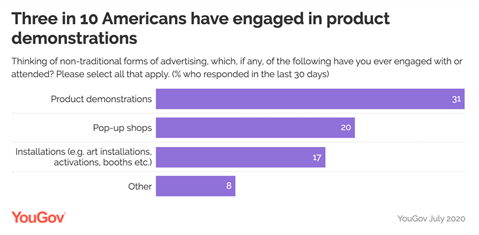
Focus on creating smooth omnichannel experiences to rule holiday season with SEO

Give traditionally local shoppers ways to engage, such as QR codes in the window to drive them to an online experience when in-store shopping is not possible (perhaps preferable for them).

Whatever the format and channel, think about the experience you are curating for your audience. How do you show them you are invested in their satisfaction and happiness? How do you facilitate their moving from one piece of content or channel to the next? How do you capture and keep their interest?

Think of your customer interactions not as touchpoints but within the context of their overall shopping journey. Grow My Store is a tool from Google that assesses any retail site, whether for an online or a physical store and brings back recommendations to help improve the customer experience.

5. Highlight your local relevance

Recent Yahoo! Small Business Research found that the vast majority of shoppers (75% of those surveyed) want to shop at and support small businesses. Another survey, this one by Alignable, found that 32% of respondents said they would be spending more money at locally owned businesses in Q4 2020.

How do you make your local relevance clear to shoppers and the search engines you rely on to get you in front of them?

  • Make sure all locations are claimed, verified, and optimized.
  • Localize your content. Engage audiences with on-location photos and video. Refer to local landmarks, get involved in local events and organizations, and build links from within the local community.
  • Do local keyword research and optimize your listings, landing pages, and website.
  • Make clear the fulfillment options you offer local customers: BOPIS, curbside pickup, and contactless delivery.
  • Make the most of your local reviews with close monitoring, rapid response, and highlighting positive reviews across other channels.

Use Google’s Local Opportunity Finder to quickly assess your local presence and get tips and hints for optimizing your GMB.

If you want to keep nearby shoppers off Amazon and away from major box stores this year, focus on meeting customers where they’re looking for products and services like yours: in local search. Keep them reading and browsing out of entertainment, not in an effort to find information that should be readily available. Proactively head off concerns about payment methods, COVID precautions, special hours, and more by keeping your site and local listings up to date.

This promises to be an unusual shopping season for many. Local essential is for small retailers and local SEO for multiple locations is vital for enterprises and Now that you can’t count on previous experience, it’s critical to tap into your search insights.

Customers are telling you what it’s going to take to win their business. Are you listening?

Jim Yu is the founder and CEO of BrightEdge, the leading enterprise SEO and content performance platform.

Five SEO tips to dominate local search this holiday season


Top six reasons you should caption your social media video content

30-second summary:

  • Video marketing is more than a trend; it’s a must. But most companies are leaving out a key ingredient to ensure customers engage with their videos: captions and subtitles.
  • Captioning videos in English or subtitling them in other languages has been proven to greatly boost the success and accessibility of online video content.
  • Adding captions, subtitles or a transcript to videos allows Google to index the entirety of video content, rather than just indexing the video title.
  • Captions and subtitles ensure videos are accessible by all: those who don’t have their volume on and the 37.5 million Americans who are deaf or hearing impaired.

No matter what industry you’re in, video content is likely part of your marketing strategy. And if it’s not, it should be. According to a report by Cisco, online videos will make up more than 82% of all consumer internet traffic by 2022. And 72% of customers would rather learn about a product or service by video. Even still, videos aren’t some magic token that’ll get you to the next realm of marketing success and customer engagement. The online landscape is crowded, competitive, and moving at lightning speed. You don’t just need users to slow their scroll, you need them to engage. And when it comes to video content, the solution is quite simple, but often overlooked: closed captions.

Captioning your videos in English or subtitling them in other languages will greatly boost the success of your online video content. As a professional captioner and subtitler, I’m here to help you understand why:

1. Google can’t watch videos, but it can crawl captions

If you’re looking to improve your video’s SEO, adding captions is a quick and easy way to do it. Search engines like Google can’t watch your video content, but they can crawl your captions or transcripts and rank your video based on the keywords they find. Although your video will also be indexed for SEO by its title, description, and tags, captions will increase your keyword density and diversity even further. 

Google can't watch videos but can read captions

Next time you’ve got video content creation on the horizon, make sure you incorporate keywords into the script with this tip in mind, as it will pay off when it comes to video performance and SEO results in the long run.

2. Video captions drive more social engagement 

Adding captions to your videos is almost guaranteed to boost engagement, interaction, and conversion. According to a case study by Instapage, call-to-action clicks increased by 25% after they added captions to their Facebook videos. Another study found that captions increase the time viewers spend watching a video by almost 40% and make viewers 80 percent more likely to watch a video through the end. Simply adding captions to video content drives up clicks, overall view time, and view longevity.

3. A lot of people don’t (or can’t) turn on video sound

Have you ever insomnia-scrolled through Facebook for some entertainment while your partner slept soundly next to you? Or decided to take a peek at your feed during a boring class lecture? Or what about when you’re riding the public bus, having a cup of joe at your favorite coffee shop, or dining out solo? In all cases, playing a video aloud is not ideal… or socially acceptable.

Example of how captions support video experience without audio

As much as 85% of Facebook videos are played without sound. That means, if you don’t have captions on your video, it’ll be skipped by anyone watching with the mute button on, which could be a sizable chunk of your target audience. If you want to ensure your followers can view your content no matter where they are when they watch it, then do your part by adding captions. 

4. Captions boost comprehension, memory, and attention

Hundreds of studies have proven that captions improve comprehension of, attention to, and memory of video content. I’m a native English speaker, but my husband is Spanish. To improve his comprehension while watching TV shows and movies in English, we always watch content with the captions on. I was surprised to find that this also improved my comprehension and understanding of the content, and I now watch all video content with subtitles, whether or not my husband is sitting next to me on the couch. Including captions is the best way to ensure your takeaway hits home and leaves its mark on your viewers.  

5. Captions make videos more inclusive and accessible

Over 37.5 million Americans are deaf or have trouble hearing, so video audio serves little to no purpose to this group. And, only 36% of organizations caption all their video content. So why not get on the right side of that number? Without captions, you’re missing out on connecting with a huge audience. But remember, it’s not all about business and money, ensuring your video content is inclusive of all viewers is simply the right thing to do.

6. Most of your viewers likely live outside of your country of origin 

Making your content available worldwide is another way to grow your reach and the impact of your video content. According to YouTube, approximately “two-thirds of a channel’s views come from outside the creator’s home country.” Think about that: a huge portion of your audience might not fully understand your message or recognize your call to action. That’s a deep pool of potential customers you are missing out on.

Look at your analytics, figure out where your viewers live and consider creating subtitles in other languages to reach new markets. Make this a very strategic decision. Quality translation and subtitling are an investment, so you’ll want to make sure you choose the right language(s) to reach the target markets you’re able to serve. 

A word of caution: Resist the urge to DIY your captions and subtitles

While there are free machine translation, transcription, and captioning tools available on the market, take it from me: you don’t want to DIY your video captions. Leave this task to the experts. 

Captioning and subtitling are skills unto themselves, and without training and experience, can be time-consuming and delicate tasks. Captions and subtitles must follow strict rules, including character limits, reading speed, and cue-in and -out times (when the text appears on-screen and when it’s taken off the screen). Poorly timed captions and subtitles are difficult or impossible to read, which defeats the purpose of captioning or subtitling in the first place. 

word of caution on DIY captioning

Use resources such as the American Translators Association Directory (go to “Translation Service(s)” and choose “Dubbing/Subtitling” from the dropdown list) or visit GoSub’s job board to find a professional subtitler or captioner.

Don’t spend tons of time, money, and effort on creating the perfect video and leave out the key ingredient to ensuring your message reaches as many people as possible. Well-captioned and -subtitled content will increase your views, boost engagement and comprehension, and improve the overall success of your social media video content. Plus, for once, this is a quick and easy marketing fix that can make a big impact!

Molly Yurick is a Spanish to English translator, professional captioner, and subtitler. She is also Deputy Chair of Public Relations for the American Translators Association (ATA), which represents more than 10,000 translators and interpreters across 103 countries. 

https://www.searchenginewatch.com/2020/11/19/top-six-reasons-you-should-add-captions-your-social-media-video-content/


Core Web Vitals: Are Your Clients’ Sites Ready for Google’s New Ranking Signal? via @lefelstein

[unable to retrieve full-text content]https://feedpress.me/link/13962/14083157/387944


Why It’s Time to Retire Black, White & Gray Hats in SEO via @_kevinrowe

[unable to retrieve full-text content]https://feedpress.me/link/13962/14082992/385982


Google Passage Ranking – Martin Splitt Answers Questions via @martinibuster

[unable to retrieve full-text content]https://feedpress.me/link/13962/14082307/388206


How to Drive Growth for Your Agency with the OKRs Framework via @seomonitor

[unable to retrieve full-text content]https://feedpress.me/link/13962/14081190/387352


Data-Backed Ways to Optimize for Google Featured Snippets via @MattGSouthern

[unable to retrieve full-text content]https://feedpress.me/link/13962/14076780/387928


Google Completes Migration of Disavow Tool to Search Console via @martinibuster

[unable to retrieve full-text content]https://feedpress.me/link/13962/14076026/387874


The Art & Science of Writing Title Tags via @tonynwright

[unable to retrieve full-text content]https://feedpress.me/link/13962/14075828/387238


New Google Office Hours Hangout Support Page via @martinibuster

[unable to retrieve full-text content]https://feedpress.me/link/13962/14075274/387817