How to Dominate SEO in Small Markets [CASE STUDY] via @BoghThomas
[unable to retrieve full-text content]https://feedpress.me/link/13962/13941408/383135
[unable to retrieve full-text content]https://feedpress.me/link/13962/13941408/383135
SEO is evolving through the years and it’s still more important than ever in your digital strategy.
It takes time to rank high in Google’s search results and one of the best ways to improve your success is to aim for credible backlinks to your content.
Backlinks can prove that the content is trustworthy and useful enough for the users to get you higher in SERPs.
Through the years, link building is still one of the most effective methods to build your SEO. It helps you improve your search visibility and work towards reaching higher in the SERPs in a consistent and efficient way.
The question is, how can you make the most out of it in 2020?
Forum link building can be your secret weapon. Crowdo has released ‘The Ultimate Guide to Forum Link Building in 2020’ sharing tactics and examples to make it work.
Here are the key takeaways:
Content created in partnership with Crowdo.
One of the most common tactics in link building is guest posting. It’s the process of featuring your content on another blog to get a link back to your site.
Although it’s a popular method, there are still more options to consider.
For example, ‘crowd marketing’, involves link building through communities and forums.
Crowdo is listing the benefits of ‘crowd marketing’ on their latest report:
It’s relatively easy to get a backlink from a forum. Your research can help you find the best way to reach your target audience to maximise the value.
It’s important though to avoid spamming or automated link generators. Crowd marketing should be a white hat technique rather than a quick win with no tangible results.
You don’t want to gather as many links as you can if they don’t add value to your site and your ranking.
The quality of backlinks is crucial. If you’re unsure how to define the quality of the backlink, here are the key factors to consider:
If you’re just getting started with link building, it might feel challenging to scale up your efforts.
There’s no need to quit though.
Here are Crowdo’s tips on how to address your challenges:
If you want to see what forum building looks like, here is an example from Crowdo’s report.

In this example, the target niche is insurance providers. The community has more than 80k visitors, 93 DA, 48 TF. Thus, it makes the perfect source to add value to a conversation along with a dofollow backlink.
It’s a great example of how your research can lead you to the right source to make your link both useful and relevant.
If you need additional help with your forum building, agencies like Crowdo can help you with on-demand link building services.
They are offering an exclusive offer to our readers with a 10% discount. You can find out more here and make the most of the offer using the coupon code provided in the link.
If you want to find out more about forum link building, make sure you read their latest report here.
https://www.searchenginewatch.com/2020/10/09/crowd-marketing-is-the-forum-link-building-strategy-you-need-to-know-in-2020/
[unable to retrieve full-text content]https://feedpress.me/link/13962/13941212/383594
[unable to retrieve full-text content]https://feedpress.me/link/13962/13940995/383566

Sometimes we get carried away with details, letting the big picture slip from view. However, when it comes to SEO, the devil isn’t in the details or yet another little known keyword targeting and overall research technique you’ve dugout. But rather, it is in being strategic when working on your essentials.
And today we’ll try to look at keyword targeting (the cornerstone of your keyword research) from a different angle. Making sure all of your efforts are truly coherent with your business goals and are best shaped to the competitive landscape you operate in.
The idea of funnel stages is not new to SEOs.
At any given moment each of our potential customers is on a different “stage” of the purchasing process – from only suspecting they’re having a problem (top funnel) to researching available solutions (mid funnel) to actually looking to purchase one (low funnel).
However, in terms of keyword targeting, we mostly use this concept to classify the keywords we already have to better integrate them into our content plan and the overall site structure.
What we tend to forget about is that different business goals are better matched by different funnel stages. And there are two questions you’d better ask yourself before getting down to keyword research:
Depending on the monetization model, you might be more interested in a wider or, on the contrary, narrower keyword range.
Targeting top-funnel keywords requires more resources. You have to scatter your efforts over multiple topics, while getting lower conversions.
So with a substantial budget allocated, you might want to target the funnel top even with your e-commerce website. Yet with little to no resources available, whatever business you’re in, you are better off focusing on low-funnel transactional keywords.
Intent-based targeting is also nothing new, in fact, it is essential for content to appear for appropriate queries.
The more Google was talking about semantic search, the more SEOs were debating: how to use keywords now, when Google is able to look beyond keywords, at meanings and context?
Building dozens of shallow pages for separate keywords was clearly no longer an option. Dropping keywords altogether and simply creating super-in-depth content also proved out of touch, since both search engines and people still rely on keywords.
It seems like, SEO-wise, the best approach to building content is around keywords with specific search intent. This way, we’re giving the user what they are truly looking for, yet still providing relevance signals to search engines.
So, whatever methods you choose to find your initial keyword list, your next step will be to divide them into smaller groups based on intent. For example:
| Keywords | Intent |
|
buy rare vinyl records buy jazz vinyl |
research specialist vinyl stores |
| buy vinyl cheap
best prices on second-hand vinyl vinyl on sale |
find places to buy vinyl cheap |
| used vinyl stores
where to buy used vinyl in san diego |
get a list of best vinyl stores |
| how to choose used vinyl
how to examine vinyl |
get tips on choosing vinyl |
| сlean vinyl records
is it ok to clean vinyl records with alcohol |
get tips on cleaning vinyl |
When analyzing business potential, we usually look at search volumes and keyword difficulty to make sure the keywords we choose have the potential to bring in some traffic.
But upon a closer look, especially when we’re talking about top-funnel informational keywords, not all of this traffic has the same business value and chances to convert.
It’s common sense, logic, and intuition. Based on them, I usually classify my keyword groups into “high”, “mid”, and “low” business value.
With the last category usually cut off from the campaign altogether.
| Keywords | Intent | Business Value |
|
buy rare vinyl records buy jazz vinyl |
research specialist vinyl stores | High |
| buy vinyl cheap
best prices on second-hand vinyl vinyl on sale |
find places to buy vinyl cheap | High |
| used vinyl stores
where to buy used vinyl in san diego |
get a list of best vinyl stores | High |
| how to choose used vinyl
how to examine vinyl |
get tips on choosing vinyl | Mid |
| сlean vinyl records
is it ok to clean vinyl records with alcohol |
get tips on cleaning vinyl | Low |
If you look closely, you will surely notice – Google SERPs aren’t formed randomly.
Have you noticed a correlation between the type of the search results (say, a how-to guide, a news page, a review) and the type of search query?
The thing is, some types of content seem to Google as better matching this or that particular search intent. And this seems only logical. If you were to decide which results to show on a SERP:
However, with search queries being constantly adjusted by RankBrain, relying solely on common sense might lead to a misconception.
So we’d need to check what types of pages actually rank for a particular group of keywords. So that you’ll identify the most popular type of content on the SERPs for each of the intent groups on your list.
| Keywords | Intent | Business Value | Content type |
|
buy rare vinyl records buy jazz vinyl |
research specialist vinyl stores | High | Record store’s websites |
| buy vinyl cheap
best prices on second-hand vinyl vinyl on sale |
find places to buy vinyl cheap | High | Discount offers in online record stores |
| used vinyl stores
where to buy used vinyl in san diego |
get a list of best vinyl stores | High | Listicles |
| how to choose used vinyl
how to examine vinyl |
get tips on choosing vinyl | Mid | How-to guides |
| сlean vinyl records
is it ok to clean vinyl records with alcohol |
get tips on cleaning vinyl | Low | How-to guides |
For a brand new website, keyword mapping is one of the most important things to check before launching.
At this stage, you need to ensure that all of your valuable keywords are effectively distributed among the future site pages.
Things are more complicated for a website that’s been around a while, as some of your pages probably already have Google rankings. Any changes you implement could lead to either losing your current rankings or ending up with pages cannibalizing each other’s keywords.
That is why before deciding on your ideal keyword map, make sure you take into account all of the current rankings already earned.
Next comes optimizing each of your pages for the keyword groups you’ve selected. This process is sure to be pretty time consuming (and is definitely worth a separate article).
But following this five-step framework and being strategic and consistent from the very start is what ensures the efforts you invest in content optimization truly pay off.
Aleh Barysevich is Founder and CMO at SEO PowerSuite and Awario.
https://www.searchenginewatch.com/2020/10/08/a-five-step-framework-for-effective-keyword-targeting-in-2020/
[unable to retrieve full-text content]https://feedpress.me/link/13962/13936497/382959
Zero click search has been the phrase scaring people in the SEO world over the last couple years, and will likely continue to cause problems with how SEOs try to measure success into the future.
While Google scraping content from brands and then not sending visits to those brands isn’t necessarily a good thing, there are some powerful data points we can leverage from their use of zero click search results.
One good thing about zero click search results is that they can help you better understand the intent of the user performing the search. Building search strategies focused on aligning your content to the interest of the user is what sets high performing SEOs apart from the rest.
Gone are the days of writing content that includes the right keywords in the right places to trick Google into connecting your content to a search query and ranking it in a favorable position.
Now, we have to spend a lot of time making sure that our brand is a good fit for the person on the other side of the computer and that our website gives them the information that they need.
So, how do you put yourself into the mindset of your customers and empathize with the problems they are trying to solve with a Google search?
The good news is that Google has spent a lot of time and money building an algorithm whose sole purpose is to understand those problems.
Brands can leverage the search engine itself and access important data points about searchers to validate who they are targeting with the strategies and information they are targeting them with. Even better, it’s all available for free!
If you don’t know, a zero click SERP feature is an element in the SERP that allows the user to access the information they are looking for without actually clicking on a result.
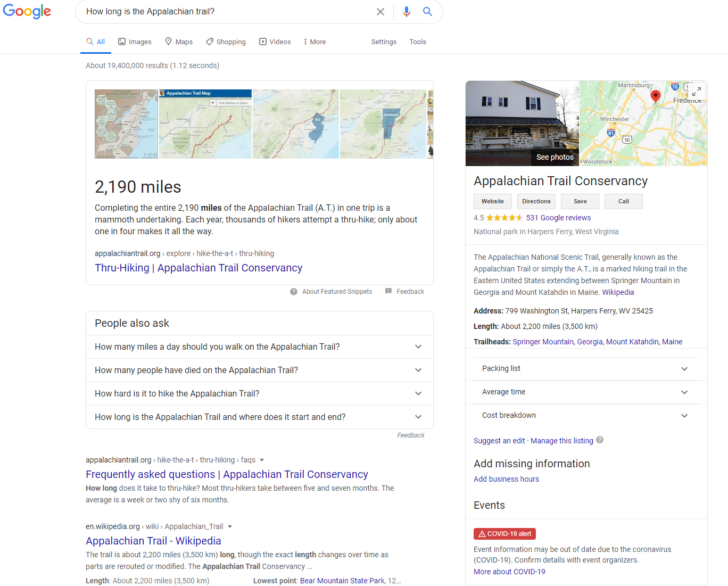
Let’s say you are working with a hiking shoe brand and throughout a keyword research you find terms surrounding the topic of the length of the Appalachian trail. When you perform a search for the query “How long is the Appalachian trail?”, the following will pop up:
Now, let’s take a look at how these features can aid you in better understanding the people you want to target with your SEO strategy.
If the top organic results are pages that definitionly discuss the topic with no tie to a product or solution (i.e. Wikipedia) and an answer box or knowledge graph is showing up, it is likely an indicator that people searching the term are looking for an encyclopedic answer to their question, so not part of your purchasing funnel.
If the organic results have product or solution result pages, then the intent is likely a mix between people looking for an encyclopedic answer to their question and those that might buy at some point in the future. In those cases, it would likely be worthwhile to target the topic.
For the example of “how long is the Appalachian trail” the former seems to be more the case, but there is still information on the page for building an SEO and content strategy.
The knowledge graph will show you what people also searched for, the time in the day/week a location is most popular, or even question or reviews about the topic searched.
The answer box sometimes goes into a little more depth regarding the topic searched. In the Appalachian trail example, it tells us it can take 5-7 months to hike the trail.
For my shoe company this could qualify targeting hikers tackling the trail because they are going to need multiple pairs of hiking shoes throughout that time. I just have to figure out what those people are looking for out of a shoe. That’s where “people as ask” and “related searches” comes in.
Based on prior searches, this algorithm has identified additional topics that people seek when looking for information about the length of the Appalachian trail. Broadly, you can assume that people are searching “how long is the Appalachian trail?” have some sort of interest in hiking the trail.
This extra information allows you to get specific about what types of information people are interested in relation to the length of the trail — and therefore, help you create content that aligns with the product or service you are trying to get potential customers to engage with.
This allows you to start connecting these searchers into your purchasing funnel for hiking shoes.
In our current example, we see that people can walk an average for 20-25 miles a day when hiking the trail. If I had to walk that many miles, I’d probably be interested in shoes that would allow me to do that comfortably.
SEO is more than just trying to best optimize a page on your website for the Google bot to crawl. You want those pages to have the information that people need answered when they are searching these queries. Studying the SERP allows us to do that.
For example, if you wanted to target “best thru-hiking shoes”, you can incorporate the information we’ve learned above to answer questions that people might not know they have.
A blurb could look something like “The Trail Runner XT allows you to comfortably walk 20-25 miles a day as you trek through the beautiful landscape of the Appalachian trail”.
When doing research, it’s important not to forget about all of the data Google is giving us access to. Remember that the entire algorithm is built to best understand the needs of your users and give those users content that best fits those needs.
As marketers, we can leverage that data to get great insights into types of problems we need to be solving for our customers resulting in great content — and even better results.
Ron Cierniakoski is Product Manager at Terakeet, an enterprise search engine technology company that leverages 20+ years of expertise to serve global brands.
https://www.searchenginewatch.com/2020/10/07/align-your-content-with-customer-intent-via-zero-click-search/
[unable to retrieve full-text content]https://feedpress.me/link/13962/13932741/377931
[unable to retrieve full-text content]https://feedpress.me/link/13962/13931739/383090
[unable to retrieve full-text content]https://feedpress.me/link/13962/13931192/382735