12 Reasons Why Your Rich Snippets Aren’t Showing via @natalieannhoben
[unable to retrieve full-text content]https://feedpress.me/link/13962/13930979/380502
[unable to retrieve full-text content]https://feedpress.me/link/13962/13930979/380502
[unable to retrieve full-text content]https://feedpress.me/link/13962/13927035/208866
While Google faces lawmakers with antitrust cases, it continues making billions from search result ads. Big players invest heavily in professional SEO tools and expertise to help get their content found in Google. Small businesses, nonprofits, and educational institutions struggle to get the organic traffic that their websites deserve. Today Ahrefs, an SEO toolset for digital marketers, releases a new free product – Ahrefs Webmaster Tools – to make SEO more accessible for website owners and help improve the discoverability of valuable content in Google.
Google faces antitrust issues for its dominance in web search, digital advertising, and smartphone software. Making $160 billion per year from ads in their search results, Google leaves online businesses struggling to get the free organic traffic that their websites deserve.
In 2019, Expedia Group Inc. saw its biggest revenue drop for 14 years, and TripAdvisor Inc. for two years. This is largely thanks to Google inserting its “Flights” feature into the search results for relevant travel queries.

In 2008, Brian Warner launched CelebrityNetWorth.com to detail celebrity financial information. He hired a team of 10+ people to research the data, maintain its accuracy, and publish the investigations.
In 2016, a Google representative contacted Warner for permission to scrape his data. Warner declined but found his data in Google’s freshly-launched “Featured snippets” nonetheless. As a result, CelebrityNetWorth.com’s traffic dipped 65% within a month. This led Warner to cut staff by half.
Google’s featured snippets aim to answer a user’s query instantly. Since users get their answers directly from the search engine, they no longer have to click through to pages. However, these features pose a problem for businesses that invest heavily in their content.

Google produces no content of its own. The answers for the SERP features come from existing content on websites, like Wikipedia. Google conveniently takes content from publishers and other websites and uses it in their SERP features.
In 2019, Rand Fishkin published the study confirming that less than half of Google searches now result in a click. This is a problem for content creators as they lose out on traffic from Google and, therefore, potential sales.
Big players invest vast budgets in professional SEO tools and expertise to dominate organic search, making it difficult for small and medium businesses to compete in search results.
Omid Ghiam, Content Marketing Manager at Webflow said,
“In an ideal world, great content would show up at the top of search results. In reality, the lack of basic SEO knowledge makes the quality content unheard.”
To level the playing field for content creators, Ahrefs releases a free product – Ahrefs Webmaster Tools.
The initiative aims to improve the discoverability of valuable content from nonprofits, educational institutions, small businesses, and others who can’t yet afford to hire SEO specialists or invest in professional SEO tools. Dmitry Gerasimenko, CEO and Founder of Ahrefs explains,
“Our goal is to facilitate the infrastructure of the free and independent web, where everyone has an equal opportunity at getting discovered online. The competitive advantage should lie in the utility and quality of the information you produce, not in the knowledge of optimizing it for search engines.”
A completely free SEO tool, Ahrefs Webmaster Tool (AWT) allows website owners to get deep and actionable insights to improve their website’s performance in search.
AWT scans any verified website for 100+ technical issues that might hinder its search performance, highlights what they are, and explains how to fix them.
It also shows website owners their backlinks, most linked pages, keyword rankings, and estimated monthly organic search traffic.
To get started, all users need to do is sign up. Then, upon registering for a free account, users will need to add and verify ownership of their website(s) via Google Search Console.

Once done, users get access to two tools: Site Audit and Site Explorer.
Site Audit lets users scan their website(s) for 100+ SEO issues that could be hurting their performance in organic search. It also shows a breakdown of the most critical issues, how to fix them, and the affected URLs.

Site Explorer shows website owners important SEO data, including their backlinks, keyword rankings, most linked pages, and more.
This data will help make better SEO and marketing decisions.
“Great content always needs to be the starting point. However, any result beyond the first page won’t get found. Through our current SEO strategy, we’ve seen traffic increases up to 62%, and Ahrefs’ toolset has been a key part of that,” says Fergus Taylor, an SEO specialist at Typeform.
Ahrefs Webmaster Tools provides website owners with the data and insights they need to outrank big players with deep pockets for free.
Tim Soulo is Chief Marketing Officer at Ahrefs. He can be found on Twitter @timsoulo.
https://www.searchenginewatch.com/2020/10/02/ahrefs-free-product-to-help-content-creators-compete-in-google/
[unable to retrieve full-text content]https://feedpress.me/link/13962/13921896/382815
[unable to retrieve full-text content]https://feedpress.me/link/13962/13920137/382145
With so many on-page elements to optimize, knowing where to start and what to prioritize can seem impossible. But don’t worry, because we’re going to show you three unique on-page SEO analysis techniques, as well as the exact tools we use at Bubblegum Search, to make the entire process easy and effective in equal measures.
Once you’ve got the insights and discoveries gained from these practical on-page analysis techniques, we’re confident you will earn higher engagement, increased rankings, and more conversions.
Disclaimer before we get started, we’d just like to say that we’re not affiliated with any of the tools mentioned in this guide—they’re platforms we find helpful for on-page SEO analysis techniques and other great alternatives likely exist too.
Studies show that just one dollar invested in user experience (UX) offers an average return on investment (ROI) of $100 ( that equates to an ROI rate of 9,900%).
By making enhancements to the usability of your website pages, you will create a frictionless user experience. If you understand your users’ intent through analysis and research, you will ensure the messaging, design elements, and layout of your webpage provide an answer to a specific question.
In doing so, you’ll simplify the user experience by guiding the visitor through their journey, helping them to achieve their goal. Let’s look at our example:
To test specific performance and functionality-based elements of your web or landing pages, the Unbounce Landing Page Analyzer is a powerful tool:
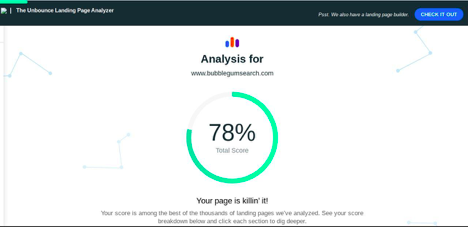
By entering a specific URL and outlining your page’s target key terms, Unbounce’s intuitive algorithm will provide a report that offers an overall page score while drilling down into relevant UX-centric elements.
In addition to page speed performance, content relevance, and trust & security ratings, Unbounce’s on-page analyzer tool offers a score on Message Match.
When it comes to SEO, content really is king. If your on-page copy is rich, engaging, and fulfills its promise, you will increase your chances of ranking well for relevant search terms exponentially.
As Unbounce quantifies all of these essential UX and performance-based elements, you can benefit from a clear-cut snapshot of the elements that are currently working well and what needs improvement.
As you can see from the example, the overall page score of 78% suggests that the Bubblegum Search homepage is well optimized for UX and SEO. The report also shows that while trust and Message Match is at 100%, the page could benefit from improved conversion-centric design.
In addition to these invaluable insights, Unbounce’s page report also provides a color-coded priority list of detailed actions to help optimize overall page performance.
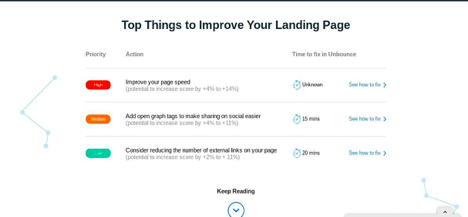
These data-driven insights are based on specific tactics and strategies you can use, designed to make your web pages more engaging, more functional, and as a result, optimized for improved SEO performance.
Not only does inspiring, value-driven content drive engagement but it also helps in creating a healthy, SEO-boosting backlink profile.
Compelling copy, eye-catching imagery, videos, and well-designed on-page multimedia content make powerful on-page SEO boosting assets.
One of the most effective methods of analyzing the success of your on-page content, in terms of user engagement, is through heat mapping.
Heatmaps are essentially interactive data visualization tools that provide practical insight into how your website visitors interact with your web page and the content contained within it.
With heat mapping, you can learn about user intent and ultimately understand how to optimize your webpage content better for maximum SEO success.
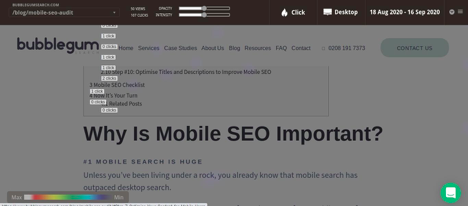
From the Mouseflow heatmap (screenshot above), you can gain a definitive snapshot of where users are focusing their attention, scrolling, and clicking when engaging with any of your pages.
By focusing on click and scroll rates, you can see the percentage of visitors that drop off before ever seeing the curtain content lower down on the page.
If the content further down the page earns a lot of clicks or attention but a low percentage of views, positioning this copy higher up the page, for example, will help offer more value, increase user satisfaction, and boost dwell time, enhancing the overall performance of the content as a result.
When it comes to understanding the value and relevance of your on-page content, heat mapping is invaluable—and an Onpage SEO analysis technique worth your time and investment.
We live in a time where there are more smartphones on the planet than humans.
To succeed in today’s world, adopting a mobile-first approach is essential—and if you fail to optimize your website’s content for tablets and smartphones, your SEO rankings will suffer.
While many CMS’ like WordPress optimize your website content for the mobile experience relatively swiftly and simply, not every platform optimizes web pages for every screen size.
And, by making sure that every aspect of your website is 100% optimized for mobile, you will boost your Mobile SEO rankings while driving more organic traffic to your website.
[embedded content]
To understand the specific actions you must take to optimize your on-page content for mobile devices, analytical tools like Window Resizer (a Chrome extension that will help you get your screen resolutions just right) and WooRank will perform audits and provide data on the specific elements of your website that need changing to enhance your content, functionality, and user experience or fix existing errors, which include:
While an experienced web developer will carry out many of the responsive design-based improvements and fix any technical errors, by using mobile optimization analysis software, you can pinpoint any issues on mobile or tablet and work with them collaboratively to ensure the best possible outcome.
To achieve complete mobile optimization success, check out our mobile SEO audit checklist.
By exploring these on-page SEO analysis techniques, you will connect with actionable metrics, data, and insights that will make your online offerings more engaging, boosting your brand authority and improving your organic search rankings in the process.
Invest in on-page SEO analysis techniques and you will remain relevant, adaptable, and visible in a digital landscape that is ever-changing. Don’t get left behind—the time to act is now.
Do you have any practical Onpage SEO tips of your own? Please share them with us by leaving a comment below.
Matt Cayless is an SEO Consultant at Bubblegum Search. He is an expert in Search Engine Optimisation having worked on campaigns for some of the world’s biggest brands and has a passion for helping SMEs grow online. When he’s not chasing the Google algorithm he can be found training for his next marathon. You can find him on Linkedin.
https://www.searchenginewatch.com/2020/10/01/three-uncommon-on-page-seo-analysis-techniques-that-move-the-needle/

Matt Finch, SEO Manager at Distinctly, provides insight on how the team worked with events company Wildgoose to pivot quickly in the face of the Covid-19 lockdown.
Founded in 2003, Wildgoose is a global leader in corporate events and team building, winning numerous awards for the thousands of experiences it delivers across the world annually. When lockdown began, Wildgoose’s sales and pipeline took an immediate downturn, with a year on year drop in sales of 62% for the month of April.
Operational costs were tightened along with evaluations of the marketing and tech spend, and Wildgoose was forced to downsize its workforce by over 50%. The company had to act quickly, having just launched a new website in anticipation of a record-breaking 2020.
A swift decision was made to repurpose Wildgoose’s offering into a set of remote team building activities to connect people virtually. This pivot would ultimately prove not only to protect the company’s immediate future but to help it thrive, and was backed up by an SEO campaign from Distinctly with three-month areas of focus in place.
The move has led to an overall increase in organic traffic of 56% and a sales increase of 158%, since the company’s lowest point in April. In addition:
Within days of the main revenue drivers effectively disappearing, Wildgoose founder Jonny Edser and the team were working on a way to secure the future of the business. The solution they came up with meant they could not only reshape their existing offering but take advantage of the sudden upswing in demand for virtual communication during the lockdown.
Jonny Edser says,
“By working proactively to deliver a brand new portfolio of remote team building activities that could be used to motivate employees while they worked from home, we could successfully evolve in this new socially-distanced world. At the same time, we could help thousands of companies to keep their teams engaged and connected during an uncertain and challenging period.
Having invested heavily in industry-leading technology in the years prior – and incorporated a new tech division in 2019 – we found that Wildgoose had a real headstart on competitors in the market who were all trying to switch their team building offering to something more technology-based.”
Before coronavirus, Wildgoose wasn’t ranking in the search results for any queries relating to “remote”, “virtual”, or “online”. With the business model shifting, search visibility needed to follow suit, so this needed to change as soon as possible. Wildgoose’s new products were one of the first to market, but they needed to be put in front of the right people.
Matt Finch, SEO Manager at Distinctly, says,
“The speed at which the market was evolving made traditional SEO more challenging than usual. We were (and still are) tweaking the optimization of the key Wildgoose pages a couple of times per week, as new data keeps showing up in Search Console . digital PR promotion of the new Wildgoose products were identified as key targets.”
People’s searching habits have changed since lockdown set in, so traditional keyword research has had to change with it. Instead:
Wildgoose’s unusual experience of redesigning its business offering meant there were unique data and content that could be used in relevant publications to promote the new products. A survey into people’s experiences of remote working secured coverage and backlinks in over 40 HR and business publications, allowing links and authority to be built into the new product and category pages, aiding ranking chances.
An effective internal linking structure was also utilized, meaning pre-existing powerful pages were funneling authority to the new pages to boost them further.
MD Jonny Edser was promoted as an expert in the field of virtual team building, leading to features in Forbes, the Chartered Management Institute, and Thisismoney.co.uk. All of this combined to show Google that Wildgoose was leading the way in the field, and so deserved to rank highly for its new target keywords and queries.
Wildgoose is now firmly focussed on the future, with a renewed energy around product development and new gameplay formats. The company is streamlining its sales and operational processes and scaling its business model based on updated forecasts for the months ahead. Expect to see more traditional team building activities made virtual over the coming months.
Matt Finch is SEO Manager at Distinctly, an award-winning search marketing agency.
https://www.searchenginewatch.com/2020/10/01/pivoting-with-seo-how-wildgoose-reinvented-itself-during-the-covid-19-crisis/
[unable to retrieve full-text content]https://feedpress.me/link/13962/13918981/382700
[unable to retrieve full-text content]https://feedpress.me/link/13962/13916893/382604
[unable to retrieve full-text content]https://feedpress.me/link/13962/13915456/382571