How to Catch & Fix 4 Common SEO Issues Before It’s Too Late via @lorenbaker
[unable to retrieve full-text content]https://feedpress.me/link/13962/13914497/382374
[unable to retrieve full-text content]https://feedpress.me/link/13962/13914497/382374
[unable to retrieve full-text content]https://feedpress.me/link/13962/13913970/378471
[unable to retrieve full-text content]https://feedpress.me/link/13962/13913650/382455
[unable to retrieve full-text content]https://feedpress.me/link/13962/13913150/382445

Consumer activity online is at an all-time high. So, it’s no surprise many marketers are aiming to make the most of it by hooking their attention early, at the point of search. But deciding how best to do so isn’t necessarily easy.
Given that consumers run billions of searches every day — with Google estimated to process 40,000 per second — it’s clear marketers need a smart strategy to cut through the competition. The question is: will they drive the highest traffic and performance with search engine optimization (SEO) or pay per click (PPC)?
Both have their own advantages and drawbacks. PPC is a quick win, enabling businesses to rapidly reach consumers and boost visibility. But its lead generation power only lasts while the money flows and, depending on campaign scale and scope, those costs can run high. Meanwhile, SEO delivers more lasting rewards and higher click-through rates (CTRs), often for less investment. Yet marketers might have a long wait before organic searches pay off, and may still fall behind dominant digital marketplaces for certain keywords.
Ultimately, the smartest route lies neither one way nor the other, but in a combination of both. Blending PPC and SEO not only generates stronger results but also balances out their respective shortcomings, offering marketers the best chance of success in the new ever-changing normal.
Utilizing a combination of paid and organic search tactics isn’t new – but it’s never been clear how marketers can best do this, or a way to visualize the data for optimization. Leveraging PPC and SEO in conjunction with one another can be challenging, but creating the perfect synergy is possible if marketers focus on the following three factors:
With consumers spending a quarter of their waking day online, marketers have plenty of chances to spark their interest through search. To outmanoeuvre rivals and capture eyeballs first, brands must make fast yet informed decisions about which approach will produce the ideal outcome.
Achieving this requires holistic insight which, in turn, calls for greater unity. Due to the general view of PPC and SEO as separate entities, teams often operate in silos, but this isolates valuable knowledge around consumer behaviour and the tactics that generate the biggest rewards. Simple as it sounds, removing divisions and encouraging teams to share their insight can significantly improve campaign execution and drive more efficient CPAs.
For example, information from the PPC teams on the best performing keywords and ad copy will help SEO teams to optimize meta descriptions and website content.
Sharing information on what keywords campaigns are covering will also prevent the doubling up of efforts – for example, as organic keyword positions improve, there might be an opportunity to pull back PPC activity and reallocate budget to other keywords to increase the overall coverage. Similarly, updates from the SEO team on keywords that are particularly competitive to rank in top positions are an opportunity for PPC to drive incremental conversions. And, on a more fundamental level, by sharing any new or emerging search terms with each other, both SEO and PPC teams can ensure they are up-to-date and reacting as quickly as possible to opportunities.
The next step is integrated technology. Implementing tools that collate and merge data from multiple sources — including PPC and SEO campaigns — will make collaboration easier. That’s not to mention generating a complete overview of collective search operations, performance, and opportunities for businesses.
A holistic and unified dashboard, for example, can provide visibility of combined search performance against KPIs and competitor activity. This enables PPC and SEO teams to identify where there are opportunities and how strategies can be adjusted to leverage them, without duplicating each other’s efforts. Marketers can understand where organic rankings are high, and competitor activity low, and vice versa, which means they know when to reduce PPC activity, as well as opportunities where it can drive incremental conversions over and above what SEO can deliver.
All of this, however, depends on accuracy and usability. Information needs to be reliable and actionable, which means simply joining up the data dots isn’t enough: in addition to robust cleansing, processing and storage, tools must offer accessible visualization.
Although frequently overlooked, clearly-presented data plays a huge part in enhancing everyday activity. Providing a streamlined picture of keywords and performance data is vital, but to ensure teams can pinpoint prime SERPs, accelerate traffic, and increase conversions, businesses also need tools that allow their teams to quickly find and activate key insights.
Dialing up tech use, however, does come with a word of warning – no matter how smart platforms may be, they can’t entirely replace human experience and expertise. On their own, sophisticated tools bring a range of benefits that go far beyond translating data into a more cohesive and user-friendly format. The most advanced boast immediate alerts that tell PPC teams where their competitors are bidding — or not — and use artificially intelligent (AI) analysis to deliver a cross-market, sector, and classification perspective on SEO activity.
Human knowledge is still paramount to steering search campaigns in the right direction and picking up on the nuances that machines miss. For instance, problem-solving machines might take the quickest path to objective completion for certain pages or messages, but seasoned search professionals may see the potential for longer-term uses that deliver higher incremental value.
As a result, organizations must avoid the perils of over-reliance on their marketing tools. By persistently applying manual reviews and checking automated conclusions against human knowledge, they can tap the best of tech and people power.
Today’s marketing leaders are grappling with multiple uncertainties, but when it comes to search, the way forward is clear. PPC and SEO are complementary forces; producing deeper insights and higher returns together, as well as minimizing risk. By connecting the two and taking a considered approach to data-driven search strategy, businesses can ensure campaigns are strong enough to succeed in the new normal and take on whatever tomorrow brings.
Asher Gordon is Head of Paid Media at Tug. He leads a multi-disciplined media team who plan, buy, and deliver integrated media plans for a diverse set of clients. With over 10 years experience working across multiple markets and brands at PHD and Wavemaker, Asher works with clients to better their marketing goals and drive their business forward.
https://www.searchenginewatch.com/2020/09/28/synergized-search-is-key-to-success-in-the-new-normal/

One of the most impactful changes to internet advertising and media has stayed mostly unspoken in agency and SEO chatter. However, like the switch from a desktop landscape to a mobile landscape, there is no reprieve from the coming cookieless world.
On September 16, Apple launched iOS 14, which is a major overhaul of the Apple operating system and would require users to authorize information known as (IDFA). IDFA is used to track user behavior for advertising.
This was followed by announcements from Google that they will be following a similar path for Google Chrome, effectively turning off tracking on Safari, which commands 90 percent usage on iPhones, and Chrome, which commands five percent.
These moves towards user privacy and marketing compliance are effectively a pivot away from the traditional advertising and search marketing industry, which will impact later players like Facebook to national media agencies like GroupM.
Content created in partnership with SherloQ™, Inc.
Once again led by the advertising and search category of injury law, due to the highly competitive and expensive nature, we are seeing a couple of key movers.
Smith & Hassler, a nationally recognized personal injury law firm that famously uses Judge Alex Ferrer and William Shatner as TV spokespeople, and Mike Slocumb Law, a firm that is known for its use of celebrity spokespeople and a sometimes outrageous style. They are both first use cases of using Natural Language Understanding (NLU) for content and first-party data extraction, and automatic AI, which assists in marketing automation to Google without the use of cookies.
In both cases, the companies are working with and have implemented SherloQ™, powered by IBM Watson, to implement cookieless changes and compliance to market their websites.
A recent story from AdWeek quoted Andrew Casale about a cookieless future for publishers, who said it best,
“Publishers haven’t seen a recovery in their CPMs, and similar to Root, believes the focus of online media trading will be publishers’ first-party data as such a method of audience targeting will mean less personal information is traded between (comparatively) anonymous ad-tech players.”
The rapid move towards using first-party data and AI automation will not be limited to a single industry. Privacy is a big selling feature and while Apple has allowed an extension to IDFA, mostly due to the time needed for developers to employ these new frameworks, Apple and Google are not going to wait for the advertising industry’s input.
If your agency or enterprise wants to learn more about how SherloQ™, powered by IBM Watson, can help navigate a cookieless world, please download our white paper to learn more about our framework.
https://www.searchenginewatch.com/2020/09/28/navigating-a-cookieless-future/

This $50 bundle can help your business thrive.
September 26, 2020 2 min read
Disclosure: Our goal is to feature products and services that we think you’ll find interesting and useful. If you purchase them, Entrepreneur may get a small share of the revenue from the sale from our commerce partners.
Growing your business online is easier said than done. With so many marketing channels available and so many people using the Internet, there is seemingly boundless opportunities to get eyes on your business’s products and services. But marketing also gets expensive, and many small businesses don’t quite have the budget to make a meaningful impact on their digital marketing initiatives. That’s why organic search is so important.
Google received more than 2.3 trillion searches in 2019. People use Google to find practically everything; it’s their definitive source for learning and discovering new products and services. As a business, it’s imperative that your website ranks at the top of Google search results pages. That’s where search engine optimization (SEO) comes in.
In the Ultimate Google Ads & SEO Certification Bundle, you’ll learn how to make your business stand out online without spending a big chunk of your budget on paid traffic.
This nine-course bundle includes almost 30 hours of training on all things SEO and Google Ads. It’s led by Joshua George, founder of SEO agency ClickSlice. Here, he’ll give you an introduction to Google Ads and a comprehensive overview of SEO for businesses. You’ll learn how to optimize your business listings on Google to always rank when people search for what you do, including local SEO, so you’ll rank as the top business in your area for a certain service. The content also covers how to create and manage webpages on WordPress that are fully SEO-optimized, how to generate new business-to-business leads through SEO, and how to improve your domain authority through link-building. There’s even a course dedicated to running an SEO agency.
Learn how to grow your business organically online. The Ultimate Google Ads & SEO Certification Bundle is on sale now for just $49.99.
https://www.entrepreneur.com/article/356585

Web development tools are necessary to adapt and integrate in the development environments since they help you create a webpage, gather metrics, discover layouts and designs. Web development is all about evolving and stepping up the game you are currently very proficient in. Along with that it doesn’t demand much money, require enormous sources or expect big money. The only thing development tools are incorporating is your boosted ultimate website performance. What is simply left is finding the right assistant on this journey. Here are the top 10 we have picked for you:
If you are searching for a web assistant that would ensure your safety and optimize development, Chrome DevTool is sincerely recommended in this case. Taking into account that this is the most popular cross-platform browser of all, you should be certain that such a Chromium-based development technology will allow you to inspect, debug, and guide you through the browser.
While varied development tools are primarily focused on setting up websites, creating online stores, and launching blogs, Chrome DevTool is highly helpful in inspecting and tweaking. Although it is a bit hard to navigate through so many tabs and functions, Chrome DevTool offers you numerous panels for boosting productivity, analyzing load performance, and enhancing better user-friendly experience:
Such a division gives you a more fixed structure on elements and commands that you can apply depending on the existing page you are willing to diagnose. In order to access Chrome DevTools, you won’t even need to pay for anything, as it is built into the browser itself. Here is how you can open it.
Good software development company’s support can facilitate your user experience with its comprehensive and all-inclusive approach even more. VironIT offers you a list of the new age web development tools and services to create a highly adaptable website or attractive web application.
If you wonder what kind of development tools are combined in one software, it might actually vary from AR&VR development (augmented and virtual reality) to IoT Software development (data visualization and analysis). Such a useful package of cross-platform tools in one place makes it easier for you to write, maintain and promote better development and react to possible vulnerabilities. In addition, it guarantees you rapid functionality of apps, programs, websites and its well-organized software designs.
There is nothing more efficient than a versatile service providing the fast and most secure web frameworks. You share the main goal.
React is a JavaScript library for building user interfaces and reusable UI components. Why do many developers use this web development tool is mainly because of the ease of breaking a developing application into several simple parts. Moreover, the style of application code derived with the help of React components can be used for any program’s interface which significantly speeds the process up.
Obviously, if you are willing to learn ReactJS, you need to know how to work with JavaScript, HTML5, and CSS. The solid knowledge of any of these markup languages makes the optimization journey with ReactJS more helpful and enjoyable:
You have no clue what the new age of web development means if you don’t try out GitHub. This web platform enables you not only to manage the web applications by coordinating the tools and its usability, but also to deploy regular teams and campaigns to the completion of these same applications or projects. GitHub accesses you a lightweight, branch-based workflow that helps you experiment with taking over new tasks and managing the existing workflow.
Why GitHub? The suggested privileges of breaking down barriers within a team when the project is implemented and keeping everyone focused on having the best performance. In the same way, it can let your business flow run smoothly and consistently at any point in time.
You can’t even imagine what excellent sophisticated features you have been holding back when you were not a member of the Novi Builder community. This easy-to-use development tool offers you facilities for HTML drag and drop builder, access to all existing and future templates including free of charge themes. Also, it provides you with 20 must-have plugins and elements, such as Social Plugins, Contact form, Sliders, Countdown, Google Maps, and more.
The functionality and designs are exactly built for beginners developers who want to evolve and rise up on their IT working ladder. It is a great chance for deepening your understanding of website creation and ensuring solid knowledge of application development.
Along with the above-mentioned features, here is what else Novi Builder has to offer:
The BugMuncher’s list of integrations includes GitHub, Jira, Trello making it more accessible and easier to edit packages and manifest files. The toolkit enables you to draw the problems captured on your website and send it across as a screenshot. Generally, BugMuncher teaches developers how to make visual highlights and get immediate feedback with the most accurate details. In addition, this feedback comes not just from random visitors but your current customers when they interact with your service and share the reports of JavaScript and AJAX errors.
Unlike the rest of the feedback tools, this one doesn’t misuse or distort gathered information. It does exactly the opposite by testing development phases and saving your existing project from bugs. If you are quite hesitant it takes too long to collect BugMuncher feedback, you should remember that it is not about your colleague’s professional suggestion, a customer as a prime source of feedback. They can deliver you the most constructive criticism that would help you hone your business’ website or app development.
Bootstrap is low-key the most popular HTML, CSS, and JavaScript framework for developing responsive, mobile-first websites. Its open-source toolkit stores different templates and designs for creating common user interface components. These elements usually include forms, buttons, navigations, dropdowns, alerts, modals, tabs, accordions, carousels, tooltips, and so on. Basically, it allows you to build mobile-friendly websites with a smart drag and drop facility.
Moreover, ready-made blocks of code and flexible layouts needed for HTML, CSS can be easily customized and used in accordance with your project’s requirements. The greatest Bootstrap’s features of all are:
Notepad++ is your great assistant in text editing, syntax highlighting, plugin maintaining and this list of handy features can actually go on. Although it is available on Windows only, it can still be supported by GitHub, a primary distribution party.
Additionally, Notepad++ supports 27 programming languages. If you go to the Binary Translations page you can easily choose the language you need. Alternatively, you can open User Language Define System to help you define the definition of keywords or regular expressions. Moreover, if you are advanced at coding in languages like C++, Batch, and HTML, Notepad++ is just an ideal service for you. Imagine that:
Doesn’t it sound amazing to apply a word-search and text-editor tool like this with just a quick installation and some default language setting? You should definitely try it out.
We wouldn’t bet on the wrong horse if we said that most of you are intermediate or even advanced developers who’d rather focus on coding than interacting with the Git repositories. SourceTree is a free web development tool available for Mac and Windows and perfect for database visualization and management. However, Source tree equally claims to serve both powerful experts, as well as absolute beginners. Yet, understanding the interface specs is easier than you can even think:
From now any coding changes will be demonstrated in real-time and with the aggregated view on all of your work.
Certainly, before displaying your website to the users’ eyes, as a developer you are in charge of rendering it over different browsers. Depending on the coding language you use (like HTML, CSS & JavaScript) they should be tested beforehand. Lambda Test is your main guide to ensure that your web application is adaptable for any browser even after you push code changes. Such cross-browser test automation offered by Lambda Test has a very simple and easy to understand interface. Even more, better addition is a vast collection of integration facilities (screenshots screen recording, plugins, and so on). All in all, this unique rendering mechanism is less complex, time-consuming, and instead much cheaper and faster in use.
Now, you are completely forearmed to successfully lead the war of web development. Getting an application done or an advanced code supported has never been easier. Try these top tools out and you will not regret it.
https://www.searchenginewatch.com/2020/09/25/top-10-tools-to-facilitate-web-development/
Ever since Google announced that page speed would be a ranking factor in its mobile-first index in 2018, the need for speed became one of the most important aspects of web dev trait. A lot of businesses jumped onto the speed train.
Sure enough, one year later, Google reported that sites are faster, and abandonment rates are down since making page speed a ranking factor.
With performance being one of the top-selling points of a modern-day web dev architecture Jamstack that we are so into, it was only natural to take a deep dive into the industries that tackle website performance and see how we stand against our peers.
Don’t have the time to read through the research? Here are the key findings:
Lighthouse performance metrics. There are a couple of popular speed testing tools, but most people use Lighthouse. While it may not be perfect because it provides a mix of both lab and field data about a page, I’ve used Pagespeed Insights API as described in James McNulty UpBuild post here, although updated to show core web vitals.
CMS. WordPress or not. 37% of all websites are powered by WordPress. Being the most popular web dev solution, it would be interesting to see and compare different solutions in terms of speed and performance.
Gathering URLs is a time-consuming work. But I managed to get 20k URLs (20397 URLs to be exact). I’ve cross-referenced results I got from scraping the first-page organic results of a set of keywords (like SEO agency, web dev agency, etc.), results I got by using tools such as Phantombuster to scrap review websites, and results I got from hiring virtual assistants on Upwork and Fiver.
There are a couple of issues I had to take care of first. Amazingly 27% of websites from my 20K sample still run on HTTP. That’s not good at all. On top of that, I had a bunch of URLs coming up with NET::ERR_CERT_DATE_INVALID error message in Chrome. Once those were taken care of, I ended up having results 13945 URLs instead of 20K.

Of course, the most popular CMS is WordPress, with 65.7% of websites from my sample using it. For 18.8%, I was not able to detect any CMS. 2.58% run on Squarespace, 1.6% are built with Drupal, 1.41% are on Wix, and so on.
The results should not come as a surprise given that WordPress powers 37% of all the websites on the Internet or 63.6% of all the websites with known CMS.
The metrics scores and the perf score are colored according to these ranges:
You can read more about it here.
As far as the performance scores for all websites are concerned, 77.1% of the websites are in the poor range, which means there is a lot of room for improvement.
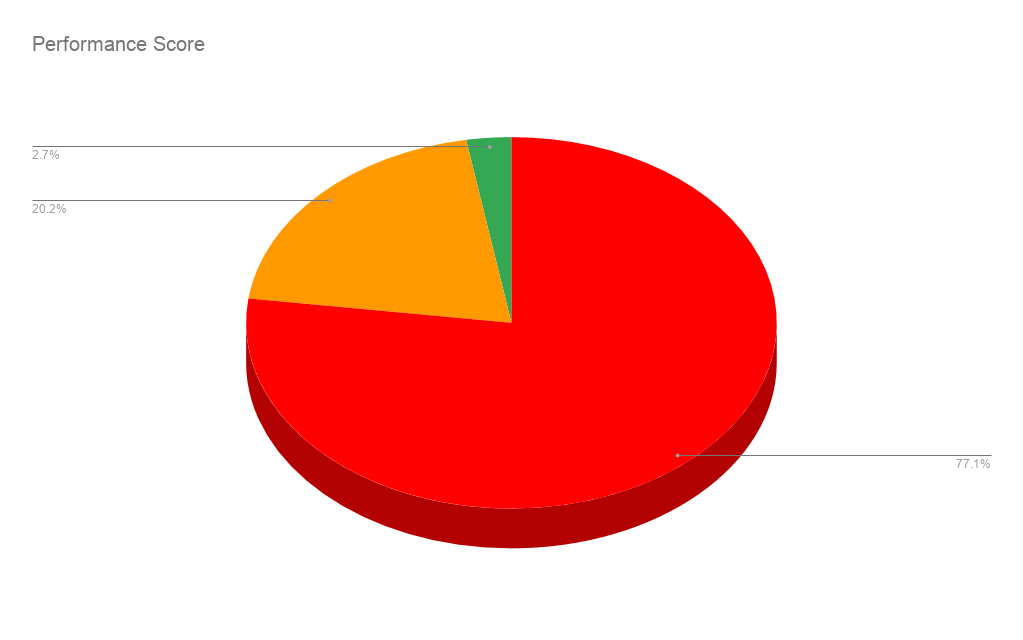
Pretty much the same story when we check only WordPress websites, 83.9% are in the poor performance range.

By now, you probably are well aware of Core Web Vitals. Their importance is twofold:
The current set for Core Web Vitals focuses on three aspects of the user experience: loading (described with Largest Contentful Paint (LCP) metric), interactivity (described with First Input Delay (FID) metric), and visual stability (described with Cumulative Layout Shift (CLS) metric).
For this research, numbers follow the performance scores. For example, check out the Largest Contentful Paint (LCP) results.

Being that I’ve tested only 20k URLs (actually 13945), let’s not generalize conclusions. However, the general ‘feel’ is that the ones required to think of speed and performance failed the test.
Performance, while it matters for many reasons, is not and should not be the end goal. It depends not only on the tech used but also ‘features’ you’ll have on a website, which pretty much depends on the industry/theme your website is in. And balancing performance and functionality successfully depends on the value a feature brings to your business versus the reduction in speed that results.
The thing is, whatever tech you use, you can end up with good scores (some easier than others). The real question is, how important are the scores for your client, their business, and their audience?
Nebojsa Radakovic is an SEO wiz with 20 years of experience. He is also an extreme sports enthusiast. He can be found on Twitter @CookieDuster_N.
https://www.searchenginewatch.com/2020/09/25/speed-and-performance-of-web-dev-seo-and-marketing-agencies-websites/
In today’s digital age, the customer journey is getting complex day by day and if you are doing online business then it’s vital to understand your customer journey. A typical consumer now owns an average of 3.6 devices which means a person’s journey may start from a laptop and end on a mobile or a tablet.
In the ecommerce business, the cart abandonment rate is the thing that haunts most of the business owners. According to Statista, 88.05 percent of online shopping orders were abandoned in March 2020 worldwide, which means over 88% of people added selected products into the cart and left without buying for various reasons. This is a massive business opportunity loss for ecommerce players.
Developing analytical skills can help you better manage these obstacles. Without adequate knowledge of analytics, your marketing won’t work because you won’t know what worked and what didn’t work. All the marketing suits come with analytics tools to help perceive the behavior, engagement metrics, and demographics of the visitors coming to a website. The most common web analytics tools are Google Analytics, Adobe Analytics, Kiss Metrics, and Mixpanel. They generally come with the following features and capabilities:
Every feature has its own data sets which can be compared to help you make informed decisions. Today we are going to understand Cohort Analysis and Behavior Analysis to eliminate roadblocks and improve engagement.
Cohort analysis is a subset of users grouped by shared characteristics. It simply allows you to compare the behavior and metrics of different cohorts over time.
Let’s suppose you have an online food ordering website/app and using acquisition date (when users started their first sessions) cohorts you can find out when in the customer lifecycle your users tend to drop off.
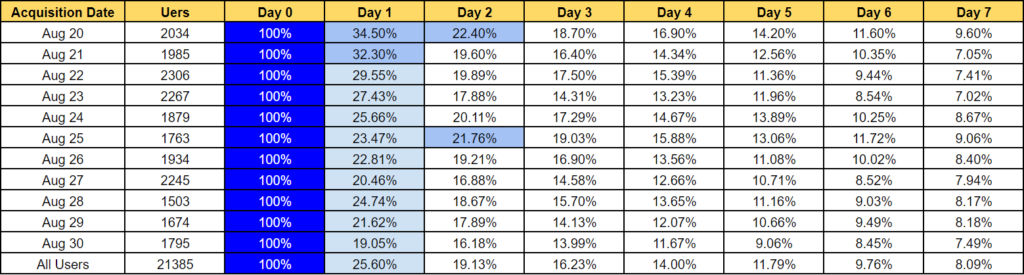
The best way for visualizing this data is to chart out the retention curve, portraying retention over time.
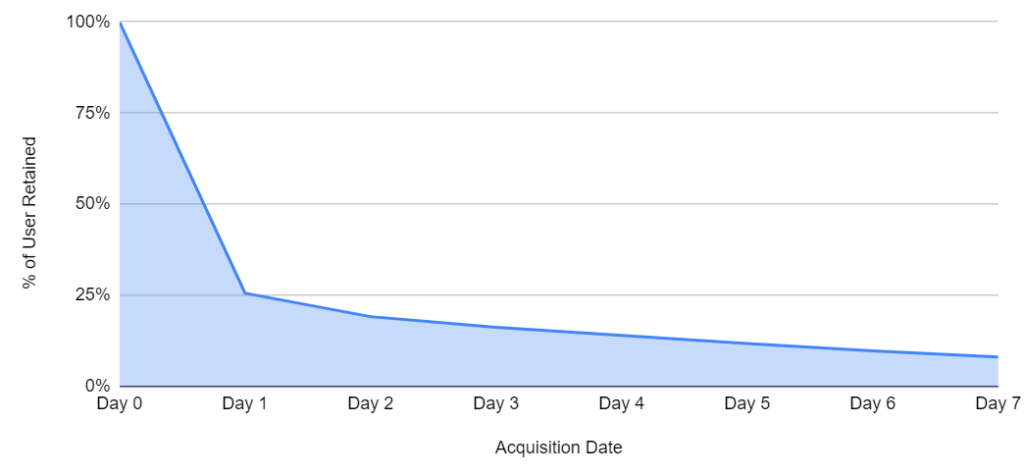
This retention curve clearly reflects the most important insight – around 75% of the users stop using the website after the first day. We can see a downfall in the engagement. Hence, it’s evident to improve the overall experience and abet customers through daily offers/coupons to boosting retention.
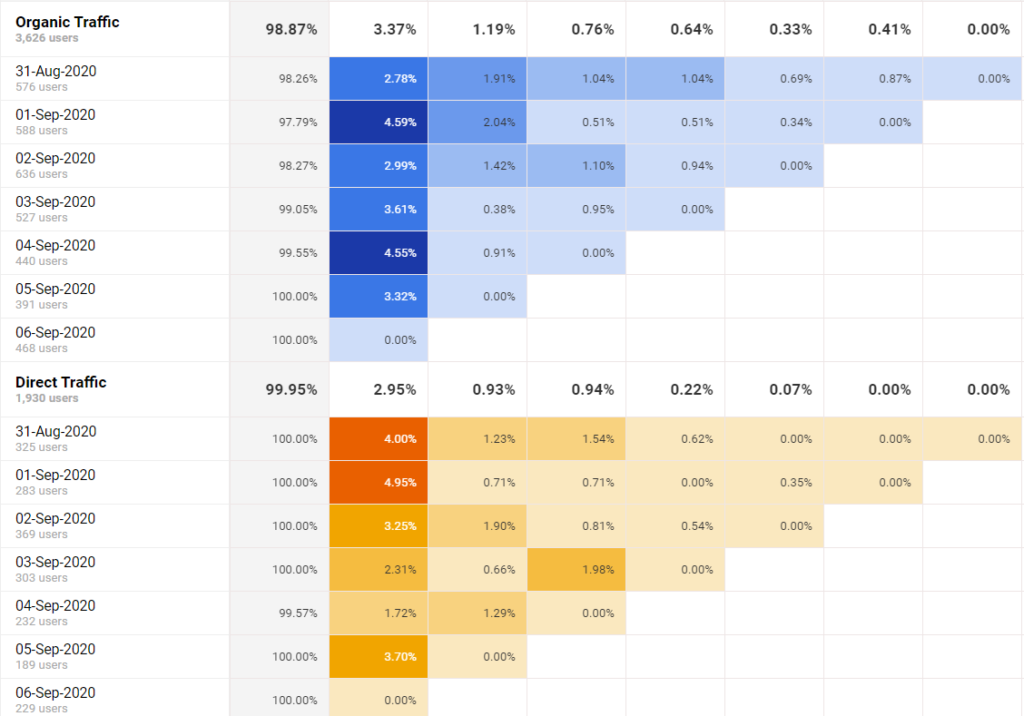
The below cohort analysis indicates that organic traffic has a better retention rate than direct.
It’s a process of tracking user behavior on a website and there are some great tools in the market that give accurate information. Tools like Hotjar, MouseFlow, Crazy Egg record visitor sessions to see how visitors are navigating on the website. They also offer click tracking and heatmaps to analyze the most engaging and ignored (skipped) elements on a page.

If you look at the above heatmap, you would notice that no one bothered to click on “PORTFOLIO” in the top menu, which means people aren’t interested in see the portfolio. Maybe we have to replace it with something more interesting (like Case Studies, Achievements, and more) which grabs a visitor’s attention. These kinds of insights help you add/remove elements to improve page engagement.
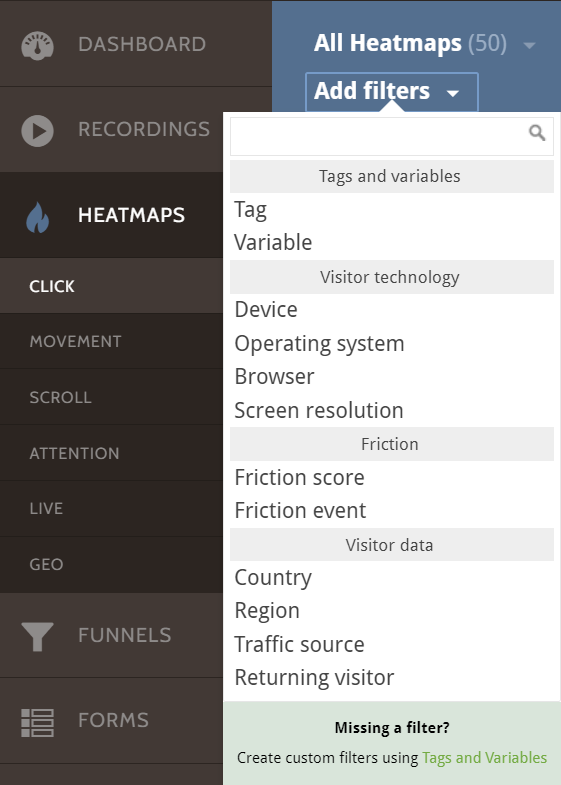
Using filters, you can further segment your audience to dig deep and pull out actionable insights, see those filter below:
In Google Analytics, behavior flow gives you a visual presentation of how people are navigating on your website. You can apply segments to get a deeper view of their behavior and it also enables you to apply different dimensions on top of these segments to get actionable insights.
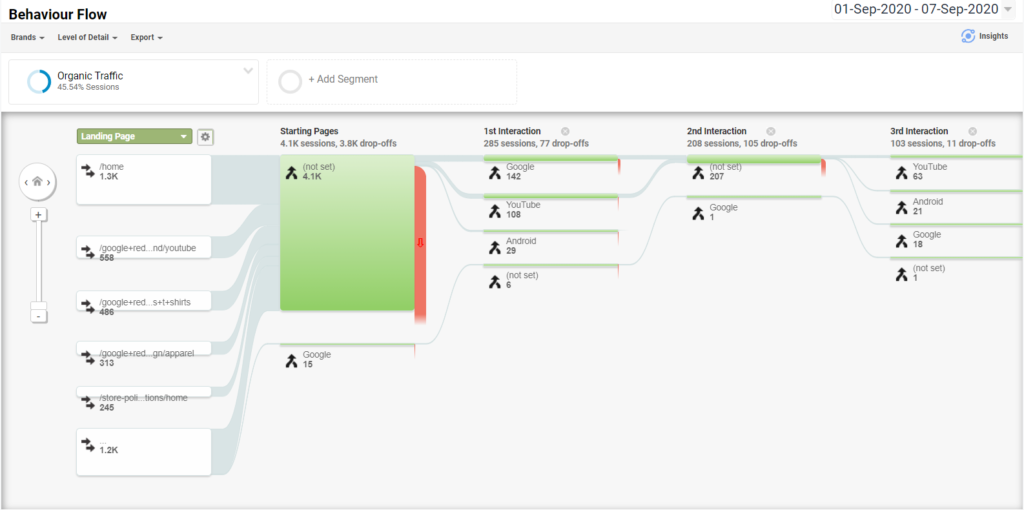
The power of these analytical tools lies in the fact that it allows you to view which customers leave and what’s making them leave your website/app – so that you can fix it. You can also hire a professional digital marketing agency that can help you find these hurdles and remove them to enhance your overall engagement.
Mandeep Singh is the MD of SEO Discovery. He’s mission is to provide affordable digital marketing services to startups and SMEs. He’s an official member of Forbes Agency Council. You can find him on LinkedIn.
https://www.searchenginewatch.com/2020/09/24/why-behavior-analysis-is-important-online-business/