What Are Breadcrumbs & Why Do They Matter for SEO? via @annaleacrowe
[unable to retrieve full-text content]https://feedpress.me/link/13962/13873317/255007
[unable to retrieve full-text content]https://feedpress.me/link/13962/13873317/255007
[unable to retrieve full-text content]https://feedpress.me/link/13962/13872561/380611
YouTube is one of the most popular social media networks out there allowing brands to get discovered by their customers. While creating a popular YouTube channel takes time and a lot of effort, it is well worth it. One piece of a puzzle many YouTube creators are missing is optimizing your videos for organic discoverability through Google’s video carousel.
Here’s a comprehensive guide that looks into all the elements that you can capture to win your spot in Google’s top SERP real estate.
Google offers a huge deal of organic visibility to YouTube videos through so-called video carousels, that is, interactive boxes featuring videos relating to the target search query:

Source: Google as of August 2020
There’s even more organic visibility for videos in mobile search results where videos carousels take almost the whole screen:
 Source: Google as of August 2020
Whenever my video starts ranking in Google organic, it brings in lots of well-engaged views, especially as compared to other videos, even for very new/inactive channels:
 Source: YouTube as of August 2020
But this strategy is not only helpful for driving views to your own channel. It is also a good way to better control your target Google SERPs.
There’s no denying a fact that videos are highly engaging and convert well, and we are pretty sure that visuals (in this case video thumbnails) may be stealing a lot of attention from Google’s organic results (in fact, there’s a real science behind the visual impact on consumers’ behavior), so ranking your video there will help you drive more exposure for your brand.
The good news, YouTube SEO takes less time than traditional SEO does. I have seen my videos ranking in Google within a week after I upload them to YouTube! So this is a pretty fast way to boost your channel views by ranking your videos in Google’s video carousel.
Your video page title is what you type in the “title” field when uploading your video:

For SEO purposes (which implies organic search visibility), the title of the page is the most important on-page element, so treat it with care.
Optimizing a page title is always about maintaining a fine balance: You want it to be creative and original enough to get clicks while still being able to add some searchable keywords.
You can only make your title 100 characters long max which is not much!
Here are a few suggestions for you:
You can go the other way around: Instead of trying to find a searchable keyword for your video idea, you can create videos around keywords you already know are popular with Google’s users.
You can easily do that with tools like Placeit that allows you to turn text content into the video format:
 Screenshot source: Placeit as of August 2020
Placeit doesn’t require subscription payment, plus it offers free templates which makes it the most affordable video creation solution on the market.
The way it could work:
Another way to find opportunities to get your video visible on Google’s video carousel is by using Ahrefs:
Here you go. There are all keywords your site is ranking for in Google and those are also search queries showing video carousels.
 Source: Ahrefs as of August 2020
Ahrefs is my preferred SERP analytics tool due to its usability but of course, there are many more cool tools that can help you with this task.
While for the video titles, we don’t have too many characters to work with, the video description field allows more characters than enough, so take the full advantage of those.
The video description field allows creators to put up to 5000 characters. It is important to create more detailed description for your video because search engines still rely on text content to index and rank your video.
Here are a few ideas on creating a more detailed and high-ranking video description:
If you are uploading a video interview, a webinar, or conference coverage, chances are you have more than enough text spoken to create a detailed description.
Fiverr is full of gigs offering you to transcribe a video and turn it into text, so it is a pretty easy way to create the text version of any video:
 Source: Fiverr as of August 2020
I turn to semantic analysis at any time I am writing content. It always helps me discover more topics to cover and identify more questions to answer.
Text Optimizer is an easy and effective semantic research tool that analyzes Google’s search snippets to identify underlying concepts which will make your content more relevant to your target topic:
 Source: Text Optimizer as of August 2020
I don’t think I know an alternative to Text Optimizer for creating an optimized context so easily, but here’s more on semantic analysis and why it is useful.
Don’t miss this step! YouTube allows you to add clickable timestamps that take viewers deeper into your video to where you discuss that subtopic.
Here’s a detailed tutorial on creating YouTube timestamps:
 Source: YouTube as of August 2020
This clickable video outline in the video description will drive people deep into the video, so you will see more engagements.
On top of that, your video may enjoy even more exposure in search, because Google sometimes grabs that outline to show right inside search results:
 Source: Google as of August 2020. (Google giving extra visibility to a video by showing its clickable outline right inside search results)
YouTube tagging is still a good way to categorize your video the right way. They help search engines to better understand what it is your video is about and rank it accordingly.
You can up to 500-character worth of tags for each of your videos, and there’s no reason saving on those characters. Feel free to use all of them.
Hashtags were introduced not so long ago, and creators still confuse the two, so to help you out, here’s a quick list of how they work and:
| YouTube tags | YouTube hashtags | |
| Where to enter | Separate the “Tags” field on the video edit page | Anywhere in the video description |
| Has limits | Max 500 characters | Max 15 hashtags |
| Have the hash/pound symbol # | No | Yes |
| Is visible on the public video pages | No | Yes |
| Helps make the video more findable | Yes | Yes |
While tags are mostly for YouTube search rankings, hashtags appear as a visible part of the page, so they send some relevancy signals to search engines:
 Source: YouTube as of August 2020. (Enter hashtags into the description area and tags in the separate “Tags” field)
If you need help brainstorming more tags for your video, try Rapidtags.io which generates tags:
 Source: Rapidtags.io as of August 2020
A video thumbnail is what shows up in Google’s video carousel, so it will directly impact your click-through. This makes your video thumbnail one of the major assets for your video:

Source: YouTube as of August 2020
Luckily creating an eye-catching and, more importantly, click-inviting video thumbnail is not difficult. There are tools to create one for free, as well as cool templates to come up with your own unique recognizable style:
YouTube video optimization strategy is very much like any SEO strategy: You need to create a lot of relevant context for search engines to be able to understand and correctly classify your video. To optimize your YouTube video page:
Finally, links play a huge part in organic visibility, so make sure to link to your videos from your own site. This includes both embedding your videos and linking to them directly.
Ann Smarty is the Brand and Community manager at InternetMarketingNinjas.com. She can be found on Twitter @seosmarty.
https://www.searchenginewatch.com/2020/09/11/how-to-get-your-youtube-videos-appear-in-googles-video-carousel/
[unable to retrieve full-text content]https://feedpress.me/link/13962/13871462/380004
The first rule in the 22 Immutable Laws of Marketing is to be the first. But what do you do when you are not?
You probably can’t afford a super bowl ad, yet you want to make a name for your brand in an industry dominated by big guns.
Inbound marketing or outbound marketing: Which one will work for you best? How?
This piece discusses the challenges and the how-to of solving them.
Proprietary eponym! You may never have heard of it, but it is the bane of new brands trying to create brand awareness or make headways into industries dominated by big guns.
Imagine someone in the soft drink industry. The competition is with Coca-Cola, yet, most consumers will ask for a coke when hanging out in a cafe.
In industries where specific brand names have become synonymous with their original product, new brands can easily be suffocated out of the game.
Big names use their longevity, time-tested popularity, and a fat purse to create a monopoly and call the market shot — and having earned proprietary eponyms, they push low-budget upcoming competitors into the abyss.
You are not paranoid. They are really out to get you.
But this is an internet marketing world, and you are willing to try against all the odds, knowing fully well that creating a proprietary eponym of your own is, in all likelihood, impossible. Yet, you want your brand to gain traction and make a dent, in spite of the dominant brands.
Where do you start? Do you pay social media companies to disrupt the attention of an innocent user who is already loyal to one brand or, do you try creating content that brings your prospects to you through an organic search?
Say you already make an offer that surpasses your big competitors – beating them to solve a problem your prospects would like solved or building into your product a new experience you know they will want to have, let’s look into what you should do.
First, let’s deal with this question with some data. Numbers don’t lie, they say.
According to PPC Protect, the average person sees between 6000-7000 ads a day. From TV ads to outdoor signage to social media ads, ads are paralyzing us.
Similar research from Small Biz Genius shows that the average person is targeted with over 1,700 ads per day but only gets to see half of them.
Statista forecasted that revenue loss due to ad-blockers would increase to 12.2 billion US dollars.
We can go on, but even the first two stats suffice.
So, what kind of response do you expect to get from an ad-addled brain that’s already loyal to a specific brand when a gazillion of you are vying for his attention?
When it comes to creating awareness for your business, let the need to solve a problem spur research in your prospect, get your inbound marketing arsenal ready to be the magnet of those prospects, and make your brand message lure them into a relationship.
That way, you won’t be spending your top dollars on indifferent audiences. How much further do you need to know to be sure inbound marketing can do a better job of brand awareness for you than outbound marketing?
What are the top inbound marketing strategies you can use to build brand awareness?
I’m not trying to put the cart before the horse here. And if it appears that way, hear me out first.
For every serious entrepreneur, there is a fountain of energy that never runs dry in doing things. Still, this fountain runs low whenever something depends on the third party.
Don’t be surprised I mentioned guest post as the first thing you should pay attention to; after all, for guest post campaigns to truly succeed, you need a landing page people can refer to or a blog post that is rewarded with backlinks from your guest post efforts.
The problem, though, is that despite doing your due diligence in keyword research, putting content on your blog site, and optimizing them for search engines, one problem you will encounter is that no one may ever get to see them.
Even if you have a large follower base on social media, organic reach on social platforms is in a steady decline. You can’t blame the social media companies for this, they are entrepreneurs too, and their profit depends on the money you take away from them when your post reaches too far.
Hence, my choice of guest post strategy as a starting point in using inbound marketing to build brand awareness and visibility.
But don’t take my word for it. Ample examples exist to prove the effectiveness of guest posting in gaining brand visibility.
Suppose you have been in the content marketing space for a while. In that case, you might have heard of Aaron Orendorf, a philosophy teacher, who used guest posting to catapult himself into prominence in the marketing world.
Through guest posting, he rose from an obscure online writer to become the editor-in-chief at Shopify Plus and became one of the most sought after content marketers in the world.
When you guest post to share a stand-out message and authenticity, you establish yourself as an industry leader and make people want to look more into what you do.
Take Neil Patel and the growth of Ubersuggest. While this is not a quintessential example of brand awareness through guest posting, it is a classical example of product growth tied with the popularity of the product owner.
If guest posting can bring one popularity, then it can create brand awareness.
But the pain area remains, whether your guest post gets published or not, it is solely in the discretion of the publisher/editor of your target publications which is why you should think deep and long about three things:
Let’s not forget: for all its buzz, content marketing works because of a single streak: it gives. It gives for free. It gives it all. Unsparingly.
Big companies use content — in terms of blog posts, whitepapers, Infographics, ebooks, etc. — in a well-knitted series of strategies to attract prospects who are looking to solve a problem, and then hook them into a sales funnel.
When it comes to content marketing, trust is the key. And how do you gain trust?
It is by giving; by posting a problem-solving kind of content that leaves your visitor saying, “That’s what I’m looking for”, then promising them more in exchange for their email address.
This works like magic every time. Let’s run a little exercise on Google.
Now I’m searching on Google to look for how to create a logo.

Some random SEO optimized website showed up, and I clicked on it, leading me here:

And after inserting the name of my brand and clicking on the Get Started button, I found myself here:

Once I have chosen an option, I was led to another page where I can now save my new logo:

As I attempted to save my logo, below is what I got:

That’s it. Attracting leads with inbound marketing is not so complicated.
While the name of this logo design company is Free Logo Design, you may notice that I wasn’t searching for a specific company in my Google search.
I was only looking for a generic term that helps me to solve my most immediate problem, which is to create a logo.
By searching, I found someone who has provided a solution for it, and now they are asking me for my contact should I want more.
Perhaps I do, maybe I don’t just have the money yet. Maybe soon. Or perhaps I just haven’t decided to pay. Or maybe I don’t know they have a feature that I’m looking for.
Now they have an opportunity to show me all they’ve got since they now have my contact, and I am now familiar with their brand.
Don’t forget you don’t have to give a freemium to get a lead; a problem-solving content will suffice in most cases, so long as your prospect is out to solve a problem. And I bet it’s the one that wants to solve a problem you are looking for.
In the peak period of the “shelter in place” in response to COVID-19, On24, a webinar hosting platform, saw an eight percent jump in the number of marketing-centric webinars hosted on its platform.
But even more impressive is how educational webinars have exploded in comparison, On24 reports. It also reported that training and continuing education jumped by 11% and 22%, respectively.
At the same time, Massive Open Online Courses (MOOC) are rising year on year. It is not just the stay at home order of the pandemic that brought about the upward trend in e-learning. The comfort and flexibility of learning online have always been of attraction to long-life learners.
Hence, smart corporate institutions and businesses use online course platforms to provide learning opportunities for willing learners and also turn them to leads.
In 2020 alone, Neil Patel has launched no less than two online courses. If you had attended any of them, you would understand that they are a pure lead generation strategy tailor-made to boost visibility and adoption of his Ubersuggest.
Today, as the marketing options are getting narrower based on the disproportionate number of ads run online, learning webinars and online classes are where people go out of their own volition.
For marketers, this means an opportunity to sell to a group of prospects who aren’t just passive readers or random social media users but active listeners who are willing to end the day having learned and encountered something new.
If you are willing to use inbound marketing as your key awareness-building option, launching webinars and free online courses should be among your first-in-lines.
In all marketing kinds, attention matters a lot. In the past, passive awareness never sold things. Today, passive awareness never sells anything.
And eBay knows this better than anyone else. Imagine the popularity of eBay. Still, the company launched a podcast show dubbed “Open for Business.” Albeit frank about its aim to build more brand awareness, 85% of the show’s time teaches, for free, how to build a business to success.
“From the hiring, to pricing, to financing and customer service, Open for Business is a must for anyone looking to succeed in business,” an introduction on its podcast landing page reads.
HubSpot says in 2018, 18% of marketers were looking to add podcasting to their strategy. If you checked now, the number must have gone above that.
If you have been looking to Google for an answer about what’s best for building brand awareness, and you have interest in inbound marketing, or it is your budget that confines you, you may have found, as I have found, that most articles are generic and state the obvious.
Most annoyingly, they state no reasons as to why their strategy works. They walk you through most of the inbound marketing strategies but take no cognizance of what stage you are and whether you have the capacity to implement them.
Imagine an article that wants you to gain awareness but tells you to use email marketing, not even minding whether you have an email list in the first place or not.
If you are just starting out, this article is, by no means, exhaustive, but consider it a nudge in the right direction and a playbook to help you set about building your brand recognition the right way.
Ali Faagba is a copywriter, content marketer, and a tech freelance writer. He’s been featured in Entrepreneur, Thrive Global and others. He can be found on Twitter @contentmints.
https://www.searchenginewatch.com/2020/09/11/inbound-marketing-for-brand-awareness-four-up-to-date-ways-to-do-it/
[unable to retrieve full-text content]https://feedpress.me/link/13962/13869242/380464
[unable to retrieve full-text content]https://feedpress.me/link/13962/13869157/380456
[unable to retrieve full-text content]https://feedpress.me/link/13962/13868339/379946
Unlike paid media, earned media lacks the tools to form trustworthy predictions about the outcomes, which can make potential SEO customers indecisive. Let’s take a typical story of how the SEO proposal and pitching process works.
Sarah, the CEO of a successful SEO agency, gets introduced to the CEO of another successful ecommerce company through a common friend.
She rallies her team and meets the client over Zoom. They have a wonderful conversation, and both of them are excited to start a great partnership.
Filled with optimism, Sarah assigns her best colleagues to craft an insightful SEO proposal. They analyze the competitors, do the keyword research, take the organic opportunity into account, and form a unique strategy on how they can reach impressive results.
The day of the presentation comes, and the ecommerce team gathers around, continuously nodding along with each slide. By the end of it, everyone feels excellent. Sarah is thrilled.
Checking emails stopped being a chore for Sarah. She quickly scans all of them, looking for confirmation on starting the project.
She does this daily for almost two weeks and, with each day, her confidence drops. There is no answer from the potential customer.
She feels awkward* to follow-up. What could she ask? Why don’t they at least say if they want to pursue the SEO campaign or not? What is with this “silent no”?
Content created in partnership with SEOmonitor.
If you’ve pitched a few clients already, you’ve probably experienced a similar situation.
It feels like a win, but then communication gets postponed. It’s not clear if you should follow-up or not. And even if you were to follow-up, what would you ask?
They haven’t raised any particular concerns or downright rejected the SEO proposal. There has to be something that brought them to your agency in the first place.
They’ve invested the time for the meetings and maybe even shared their analytics account. So there’s a hint of trust-building up so far.
What if the dilemma stems from them forming trust based on “gut feeling” in the meetings, but lacking enough knowledge to judge whether the projected results will, in the end, be achieved.
They want to make sure they make the best rational decision – but they can’t.
Explaining the reasoning behind each data point and action in your SEO proposal, and arguing from first principles, should leave less room for doubt and more for critical thinking.
Let’s look through the steps that can go into an SEO proposal and how to bring clarity and convey trust using granular data along the way.
Keyword research is the first step into better getting to know your customer and their industry.
The entire quality of the pitch depends on choosing the right keywords and being able to explain the principles behind your decision.
Coupled with your expertise of choosing precisely the ones that you know are valuable for optimizing, you’re building the keyword portfolio. But this may prove challenging for your customer.
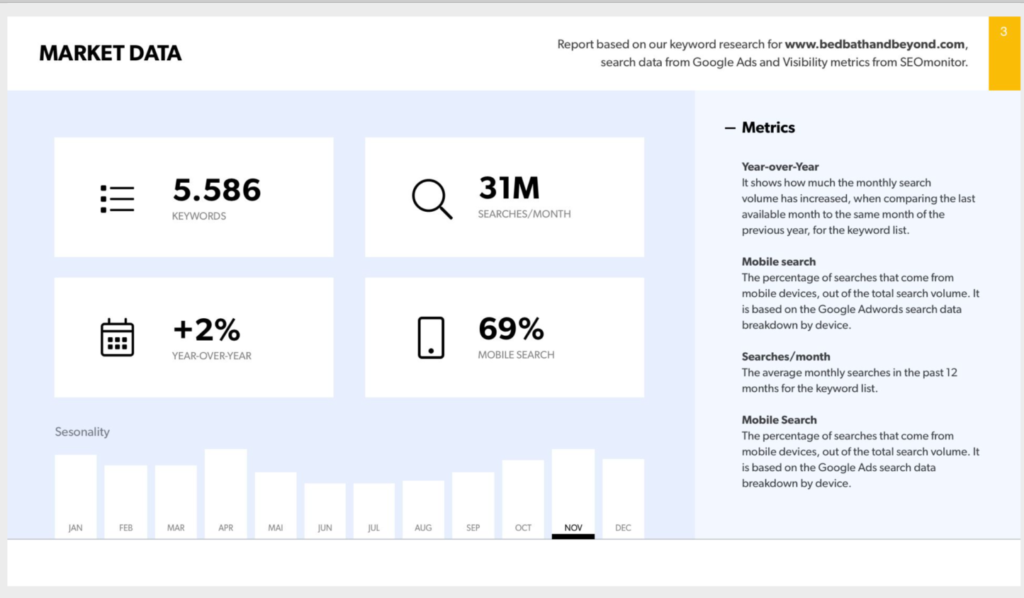
Sometimes, business owners would have a different way of describing their business. So they could mistake queries for whichever words they would want their brand to be associated with.
You can help your customers focus on the end-users’ search habits in your SEO proposal by describing why it doesn’t make sense to improve visibility for queries that are navigational keywords and trigger site links. Then, follow-up with why you grouped the ones that set off the same search results and are part of the same topic, for more understanding.
Customers might think of their competitors as being other companies selling similar services and products, regardless of their organic visibility. They might even disagree that a particular website or company is in their industry, but you have data on your side. You’ve selected only the companies that get the most impressions for the selected group of keywords – and it’s all easily verifiable by searching on Google.
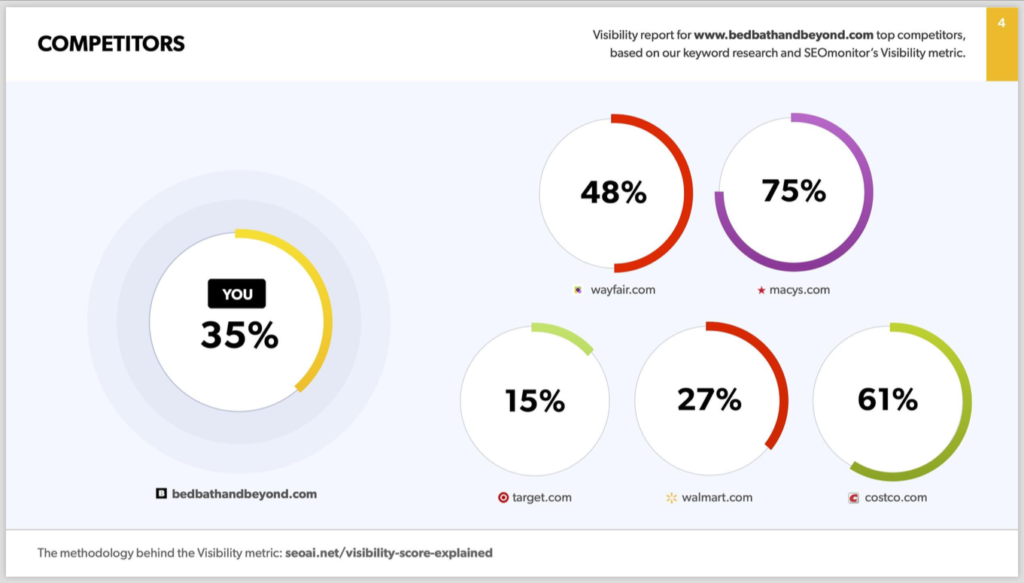
The different visibility scores set the stage for what the opportunity will be. While it’s impossible to predict what the future will hold, the present results are precise.
If a competitor has already achieved success, it shows there’s a substantial opportunity.
The outcome of SEO is the increase in organic traffic. This makes many people turn towards the organic traffic figure whenever they want to measure SEO performance.
The total number of organic traffic is composed of both brand and non-brand organic visits. Still, it is only the non-brand traffic that connects to and is dependent on, search engine optimization.
Your customer might intuitively realize this, but they didn’t have the tools to be able to study the data. If you split the two, you focus the evaluation process on SEO. It, also, shows that you would not take credit for marketing activities that were already going on, and so removes another fear that could make the customer doubtful.
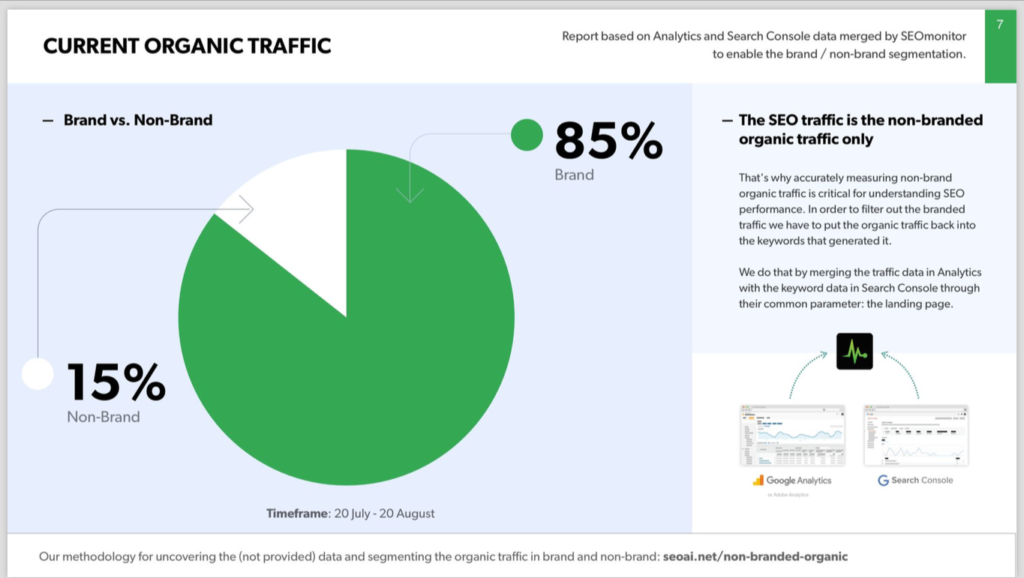
Plus, it might be the first time the customer can put their finger on how much their branding drives their income, a question they have probably struggled with for a long time.
From a customer perspective, all of the improvements in visibility have just one final goal – an increase in their business performance.
Clicks, ecommerce transactions, or goals are the way businesses keep track of them. By transposing better rankings to clicks and conversions, you tie the SEO campaign to the reality of running a business.
Decoding the impact of rank changes into clicks and conversions can look like a simple formula for a customer at first.
Still, when taking into account search volumes, year over year trends that influence the past data, and dynamic changing CTRs, you show much work and thought goes into the process.
But to do that, you need to get into an even lower layer — the way Google displays results for each keyword and how changes in search features influence click-through rates.
Not only that, but the advent of mobile brings even more pieces to the puzzle.
The “ten blue links” have diminished in favor of a mix between search features and organic results. For example, a search for “hotels in Paris” would trigger Google’s hotel widget and at least two ads. It takes more than three full scrolls to get to the first organic result.
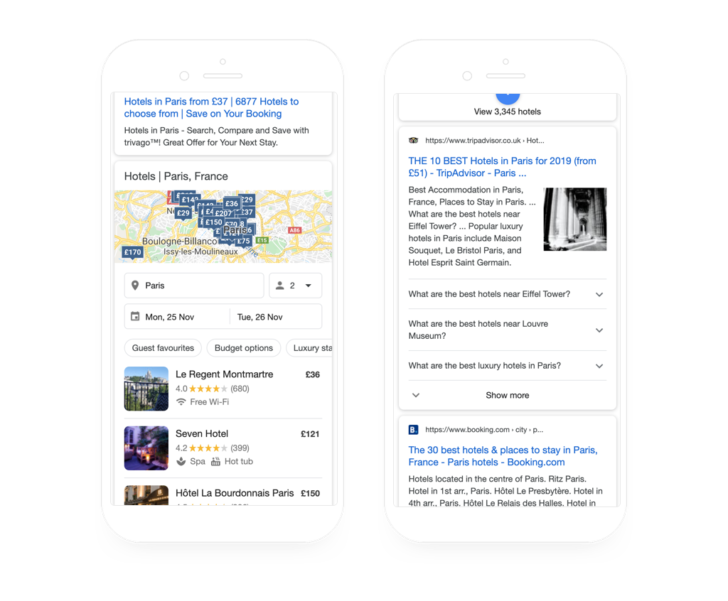
By using a variable CTR model for each SERP, you remove the possibility that the methodology could be considered oversimplified and expose the customer to the complexities of modern organic optimizations.
By adding monthly swings in search volume and year-over-year trends, you set the building blocks for a data-driven, comprehensive forecast.
Unless your customers have just launched their website, they already rank in search engines.
By going the extra mile and first creating and presenting a forecast based on their current traffic and the search trends that might influence them, you lay out a foundation of transparency and easily researchable assumptions.
Highlighting the difference between existing, projected, and additional traffic and conversions you remove one last piece of doubt – What might happen if I won’t go through with the SEO campaign?
While some customers know that SEO is more of a marathon than a sprint, for others, it can be their first foray in attempting to improve visibility.
By acknowledging that the first months would bring less impact, but it picks up as the campaign progresses, you are transparent from the start.
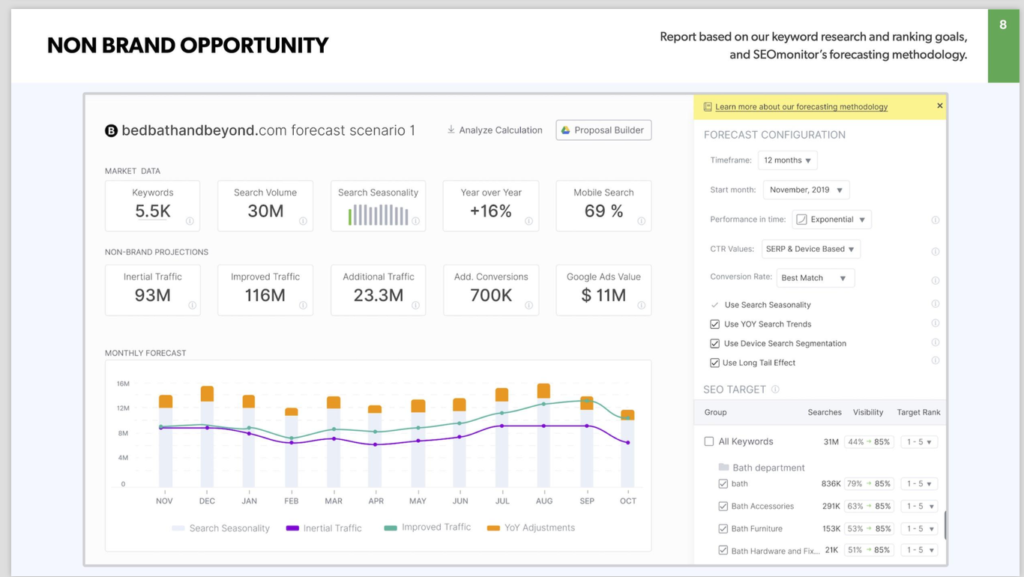
A 12-month forecast allows customers to be able to take their sales projections and fit them on top of the SEO opportunity.
Instead of treating SEO as an independent tactic, they can now imagine the campaign as an essential activity to their day-to-day business operations.
Including seasonality allows for better inventory planning and proves, once more, that you’re committed to their long term success.
They also get to learn about consumers’ habits and maybe, in the future, rely even more on search data when making a business decision.
Is the SEO campaign worth it?
This question might go through someone’s mind when having to make the final decision.
By bringing an external source of truth in the form of how much it would cost to run a paid search campaign on the exact keyword portfolio, you highlight how valuable it is for other companies to grab the first results.
It allows the customer to perform their independent research and build more trust in the projected outcome. Not only that, but they now have a point of reference for your pricing as well.
As you have now navigated the ins and outs of the forecast, there’s still one more thing that may get the customer stuck in a loop.
Can they trust your agency on delivery? Would they be able to check the progress by themselves?
They can’t just load up their analytics account and see the impact – the results are a mix between branded and non-branded keywords.
You could provide a detailed explanation of how reporting will run in a relationship with the set goal and what goes into the metrics that describe their visibility.
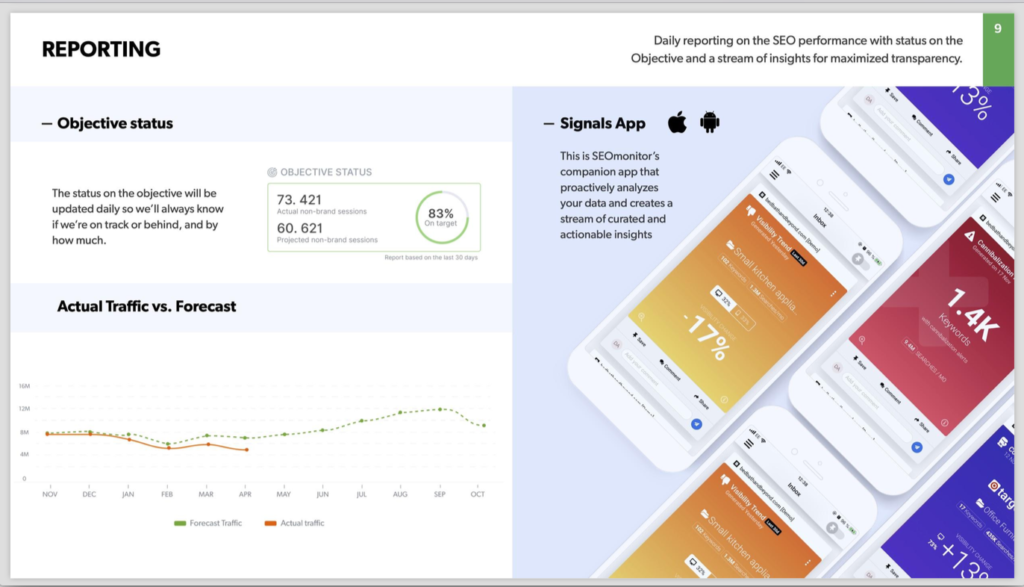
Taking it a step further and including the objective in the contract can remove any fear they still have.
It’s bold, but isn’t it worth it to have your agency’s day-to-day operations aligned with your customer’s results?
Remove doubts that can form in their mind, by explaining each hypothesis and backing it up with evidence, going through the following:
Meticulously going through all of these steps is hard. We get that. That’s why we’ve launched a new version of our “Search Awards” winning SEO forecasting module.
It helps you along each of these actions, except for one. The hangover you get after celebrating your 10th closed deal in a single month.
Our forecasting methodology has been successfully used for more than four years, by hundreds of clients, to set realistic objectives and improve their pitches. That’s why we’ve gone a step further.
We created an SEO proposal builder that leverages data from SEOmonitor, with the simplicity of Google Slides, and gives real-world examples from other SEO agencies around the world, in an intuitive drag-and-drop interface.
But that’s only a part of what we do. We’ve designed SEOmonitor to help you acquire, manage, and retain more customers for your agency.
Join us, and hundreds of SEO agencies clients, in the journey of bringing more transparency and measurability to the SEO industry. Click here for a trial that doesn’t ask you for a credit card, but gives you full access to the platform.
Instead of just asking busy customers if they had time to review your proposal, why not take a bit of time to go through their existing organic industry landscape and look for significant changes that they may not even know about – Yet!
With Signals, you can easily spot those insights that can help you re-open the conversation with your indecisive customers.
https://www.searchenginewatch.com/2020/09/10/seo-proposals-particular-challenges-and-how-to-avoid-getting-a-silent-no/
[unable to retrieve full-text content]https://feedpress.me/link/13962/13866868/380350