Google Announces Home Activities Rich Results via @martinibuster
[unable to retrieve full-text content]https://feedpress.me/link/13962/13846371/379364
[unable to retrieve full-text content]https://feedpress.me/link/13962/13846371/379364
[unable to retrieve full-text content]https://feedpress.me/link/13962/13846289/379043

This $30 course can help you improve your rankings.
August 30, 2020 2 min read
Disclosure: Our goal is to feature products and services that we think you’ll find interesting and useful. If you purchase them, Entrepreneur may get a small share of the revenue from the sale from our commerce partners.
Getting your webpages to the top of Google search page results is absolutely crucial if you want to grow your business. More than 70 percent of organic search traffic goes to the first page, with the vast majority of that going to the first three listings. If you’re not ranking for the things your business does well, you’re very likely missing out on potential customers.
But no, you don’t have to hire an expensive SEO agency to completely overhaul your business. You can do it yourself after spending some time in this SEO Blueprint Course Bundle.
This eight-course, 21-hour bundle can teach you all you need to know to improve your page ranking. The courses are taught by John Shea, an entrepreneur, podcaster, and blogger who hosts the online marketing show Voices of Marketing. He started online marketing as a side hustle, but it’s now become his life and he loves sharing his knowledge with other aspiring marketers.
Here, you’ll learn how to identify your most promising keywords, how to make your website more technically up to date and better equipped to rank on Google, and how to improve your domain authority through backlinking. There’s even a course dedicated to YouTube SEO and SEO for small businesses with local presences.
Whether you’re a growing web-based company that markets to people across the globe or you’re a mom-and-pop shop that wants to attract more people in the neighborhood, a good SEO strategy can help. The SEO Blueprint to Rank #1 on Google Course Bundle will help your business grow and it’s on sale now for just $29.99.
https://www.entrepreneur.com/article/355381

Across two major app marketplaces, there are already more than two million mobile apps and still counting. Mobile apps have made inroads across all nooks and corners of our daily lives and enterprise operations. But despite all these, not all mobile apps are equally successful, and there is a multitude of apps that struggle to survive as businesses. Perhaps, App Store Optimization (ASO) is something that app creators must consider.
Naturally, app publishers and marketers worldwide consider it extremely important to monitor several metrics concerning user engagement, user retention, and business conversion. Here we will explain the five leading metrics that you need to track for measuring the success of your app in app stores.
The most important thing for any app to get traction in app marketplaces is to become easily discoverable and visible to the target audience. Whether coming into search results or getting featured or hitting top charts, in one way or the other, your app needs to be discoverable and visible to the audience. This is also the principal objective of App Store Optimization (ASO).
Some metrics to keep track of discoverability of the app include the following.
Where in the search result, your app appears against a target keyword refers to your search ranking.
The ranking of your app in various top charts by categories or by parameters such as Free, Premium, and others.
Where your app in the respective category ranks refers to the category ranking.
Whether the app is listed among the top apps featured by the App Store or Play Store.
All these metrics that can easily be tracked can reveal your app’s discoverability in the app marketplaces.
This is one of the most important metrics to measure the traction and engagement of a mobile app. The number of active users for a mobile app directly shows the audience engagement and how it evolves. When this metric shows growth, that means the app is getting more traction. The active user metrics can further be categorized into four metrics as per audience engagement in different time spans.
This metric refers to the number of users using the app on a particular day.
The number of users using the app in a single month is divided by the number of days in a month.
The number of users using the app in a single week.
The number of users using the app in a particular month.
Whether calculated on a monthly, daily, or weekly basis, the number of users hardly gives an idea of the business conversion or the kind of revenue they generate for the app. The Lifetime Value or LTV is the metric that helps measure the gross revenue generated by a user over a period of time. This metric is more closely related to the bottom line of an app and hence is very important.
Though you can easily track user session time on a weekly, daily, or monthly basis and track their CTR and impressions, measuring the business conversion remains difficult. This is where this metric comes as handy as it allows evaluating the total sum outcome of the entire app marketing efforts.
Another important metric closely related to the bottom line and revenue is the user acquisition cost. Your total marketing budget spent on user acquisition can be divided by the total number of users to get an idea of the cost of acquisition. The metric further can be divided on a monthly and yearly basis and can be seen whether the cost of acquisition is growing or decreasing.
Your app is easily visible and discoverable as per the various visibility metrics we have discussed. Now the question is, does this visibility convert into app downloads. After discovering your app downloads the app, how many of the visitors is a crucial metric to measure the success of your App Store Optimization and app marketing?
Some of the key methods to boost App Store Optimization and conversion include using great app title, engaging app description powered by screenshots, images and video content, app reviews, and app ratings.
App market conversion can be tracked through the important measurement metric called Click-through rate (CTR). The proportion of people who, after landing on your app marketplace snippet clicks to go into the product page, is expressed in percentage, and it is called the conversion rate. It is an unmistakable part of the conversion funnel that app marketers need to monitor on a regular basis.
To improve the conversion rate, fortunately, you have an array of sophisticated A/B testing tools that helps you to evaluate the impact of various aspects of your app listing and accordingly fees helpful suggestions to improve conversion rate.
While these metrics are already well known and are regularly tracked by the app marketers around the world, you need to make sure to use a good analytics engine to track your audience engagement and business conversion more accurately.
Juned Ghanchi is Co-founder of IndianAppDevelopers, a mobile app development company builds iOS and Android mobile apps for startups to big brands. Juned has over a decade of experience across Software consulting, App solutions, and App development.
https://www.searchenginewatch.com/2020/08/28/app-store-optimization-success-top-five-kpis-you-must-measure/
[unable to retrieve full-text content]https://feedpress.me/link/13962/13841269/379148
[unable to retrieve full-text content]https://feedpress.me/link/13962/13839694/378996
Do you ever feel like Google has fallen out of love with your old blog or website? Sure, there’s still acknowledgment, but the spark is gone, and the (traffic) relationship is no longer growing? Fear not, there is hope. You can rekindle those rankings. Here’s what to do.
If you’ve been working in digital marketing or SEO for a while, you’ve likely run into this situation: a new website/blog is launched. It’s got great content, is well optimized, and is supported by social media efforts. Traffic is modest at first but grows quickly and dramatically.
And then at some point, growth slows, particularly from organic search. It may even fall back a bit. And then it sort of bumps along. You keep adding relevant, high-quality new content, but the needle barely moves. What’s happened?
It’s not uncommon for a site’s organic search traffic to decline over time, the “old blog” problem. This can be caused by technical issues, competitive changes, search engine algorithm updates, or even broad industry trends. As one example, the click-through rate on organic searches fell 13% to 47.4% between 2016 and 2019.
But it’s true that over time, an old blog can become the online equivalent of a hoarder house or an unkempt garden. It’s no longer neat and clean, but rather it’s a mess of obsolete content, 404 errors, broken links, and other online debris.
Fortunately, this can be fixed. Like cleaning out that garden, it will take some work, some knowledge, and the right tools thought the dirt and weeds, in this case, are purely digital.
Here’s a nine-step process to restore healthy search traffic growth to a mature blog.
Use Google Search Console (GSC) to verify there are no manual penalties, security issues, or other problems. Fix any serious issues discovered there first.
If your site isn’t already connected to GSC, log into your Google account, and add it. Then check both Manual Actions and Security Issues in the left menu.

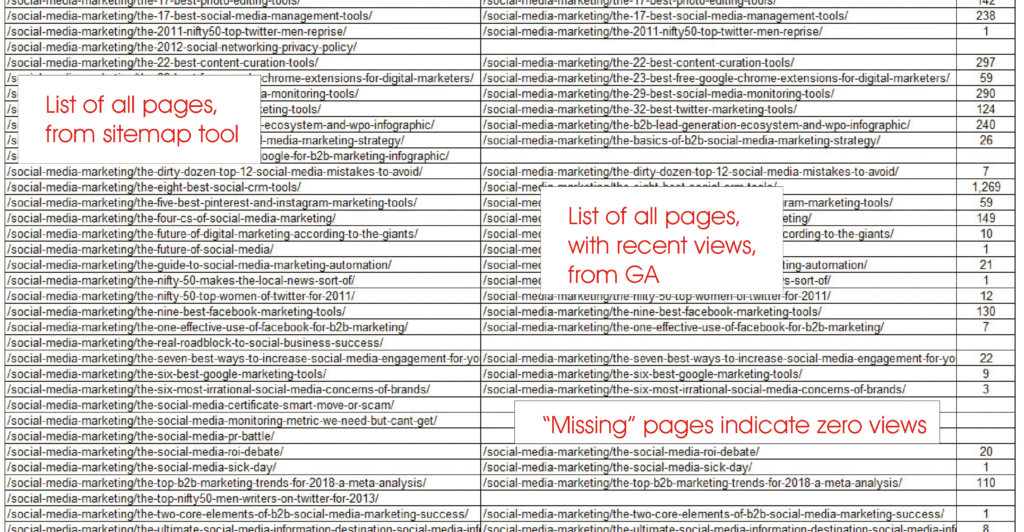
To get rid of the “junk” on the site/blog, start by generating a complete list of all URLs. You may be able to get by with a tool like XML-Sitemaps or the free version of Screaming Frog SEO Spider, but for larger sites (and if you are running into SEO stagnation issues, you’re likely working with a site that has at least several hundred pages) you may need to invest in a paid tool.
Next, log in to Google Analytics (GA) for the site. Navigate to Behavior > Site Content > All Pages. In the upper-right of the screen, set the start and end dates for the report (for example, the last six months or one year). At the bottom-right of the screen, change the number of pages displayed to the maximum, as shown here:

At the upper-right of the screen, click Export then download the file in Excel or CSV format.
Pages that receive very little traffic are a concern, but comparing a complete list of pages to pageviews in GA enables you to identify the most serious problems: pages that have had no visits over the past six, 12, or whatever number of months you choose.
Clean up the list of pages you exported from GA to remove site search results, author pages, category pages, tags pages, etc. so that you are left only with the list of blog posts and their number of page views.
In the figure below, the column on the left is a list of all pages. On the right are pages, with their corresponding number of views, from GA. By sorting both lists alphabetically, you can identify pages from the “all pages” list that don’t show up on the list from GA–because they have had no visits over the chosen time period.
The next step is triage—what to do with those pages that get little or no traffic? Some posts are more timeless than others, and with a bit refreshing, can still provide value to readers and draw visitors to your blog.
For example, posts here about how to write an effective business blog, how to spread thought leadership content without blogging, and why every business needs to be on Twitter were originally written on the Webbiquity blog in 2010 but recently updated to reflect online changes and lessons learned over the past decade.
Other types of posts simply don’t age well. Those pieces about the best practices in SEO for 2011 or the must-know stats and facts about social media in 2013 are now best forgotten, much like the worst songs of the 70s. (Remember “Muskrat Love”? If not, consider yourself fortunate.)
Newsy posts also have a limited shelf life. Posts about how buyers and marketers are adapting to this COVID-19 era are popular right now. But once the pandemic has passed, no one will want to revisit those.
These posts can, however, attract a lot of backlinks in their prime. So take them down, but strategically redirect those URLs to similarly relevant but more up-to-date content.
It’s vital to perform step 6 before this one, so you don’t waste time fixing links in posts that will be taken down anyway.
Use a tool like Broken Link Checker to find broken or obsolete outbound links on your pages, then update or delete those links. This type of cleanup at least moderately improves SEO, while significantly improving the reader experience on your site.
Page load speed and mobile performance are now among the top ranking factors for SEO.
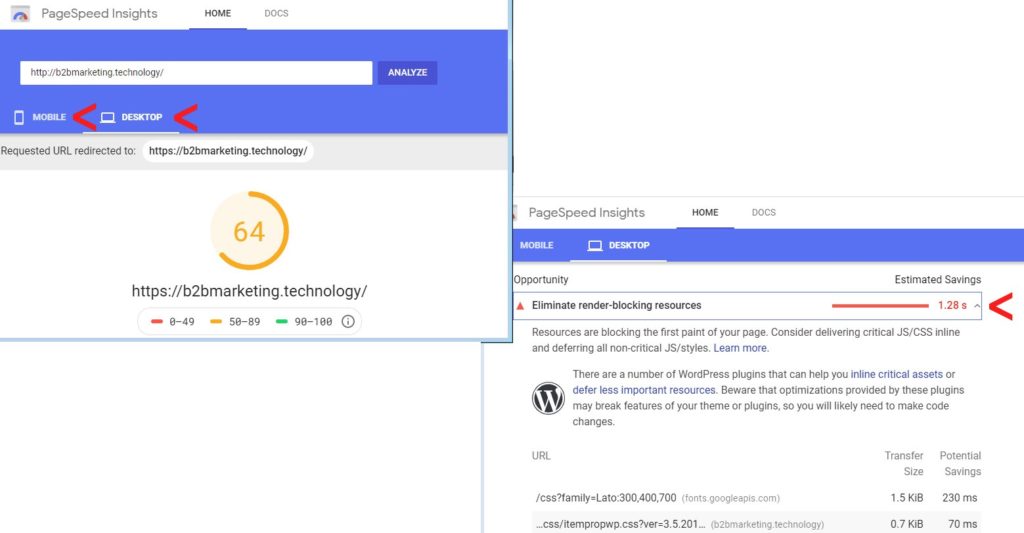
Use Google’s PageSpeed Insights and Mobile-Friendly Test tools and follow their recommended guidelines to fix issues and improve your scores
For example, this site scores a 64 on the Google page load speed test–above average, but not great. Note that Google provides separate scores for mobile and desktop load speed. Scrolling down the page a bit, one of Google’s recommendations for improvement is to “Eliminate render-blocking resources”. Clicking the small arrow to the right of that suggestion exposes more detail. In this case, Google’s tool links to WordPress plugins which may help resolve the issue.
Take another look at the list generated in step three above. Look closely at the top five-to-ten most-visited pages or posts on your site.
First, if these can be improved or updated in any way to make them even more valuable and appealing, do that. Second, make sure each of these pages has a highly relevant and compelling call to action. You’re attracting lots of visitors to these pages, which is great; now take the next step and apply the best options to get them to convert into sales or leads.
Popular CTAs include downloadable assets related to your content, such as ebooks, guides, or checklists. Or you try being more direct and asking the page visitor to contact you or schedule a demo. In any case, it’s also essential to use CTA best practices in order to compel readers to respond.
That’s it! Delete or revise your obsolete content, fix technical errors, regularly produce high-quality new content, and that mature, stagnant blog can quickly get back to 20%, 30%, or even higher year-over-year growth in organic search traffic.
Tom Pick is a digital marketing consultant who helps B2B clients improve their online visibility, increase brand awareness, and generate leads through SEO, social media, and content marketing. He’s the Editor of the Webbiquity b2b marketing blog and author of “The Ultimate Guide to Content Marketing Software.” You can find him on Twitter @TomPick.
https://www.searchenginewatch.com/2020/08/27/how-to-teach-an-old-blog-new-seo-tricks/
[unable to retrieve full-text content]https://feedpress.me/link/13962/13838897/378636
[unable to retrieve full-text content]https://feedpress.me/link/13962/13838793/378715
[unable to retrieve full-text content]https://feedpress.me/link/13962/13836545/378551