Bing to Share Future Updates Via New Twitter Handle via @MattGSouthern
[unable to retrieve full-text content]https://feedpress.me/link/13962/13817214/377807
[unable to retrieve full-text content]https://feedpress.me/link/13962/13817214/377807

An excellent way for you, as a retail business, to reach more customers is to have built-in SEO tools in your point of sale system. However, if you don’t have that, you can follow these SEO tips we are giving in this article to boost your reach and sales.
In this article, we will talk about the importance of SEO for retailers and a few tips to optimize your SEO. So, let’s jump right in!
This content was created in partnership with whit Content Media.
Search engine optimization or SEO is the practice that makes a website or webpage rank higher in search engine results. There is much importance of SEO for retailers because we know from a few studies that almost 80% of shoppers do online research before buying, and almost 70% of consumers click on a link that is on the first page of SERPs. This means that when your website ranks well on the results page, you are more likely to reach consumers and boost your sales.
SEO is often a long and hard process that involves optimizing elements on your site or webpage to boost its chances of ranking high in search engines. Your website may offer hundreds of products for sale, maybe with a dedicated page of their own. However, consumers don’t land on the pages but look for a particular product with a specific design, color, shape, etc. It is crucial that you optimize your products for these features in order to rank on search engines. Todays’ POS systems offer in-built SEO tools in your point of sale system taking much of the burden off your shoulders. Such POS systems are definitely worth the investment of a retailer.
So, why do you really need SEO for your retail? Here, we discuss some benefits that you can get from an optimized website.
Did you know that the first five websites on the first page of the results pages get the majority of clicks? This is because viewers trust Google’s algorithm that ranks web pages and don’t want to scroll past the first few pages that may have the best content for their query.
This is why you need to rank high in search engines so that your website gets the most clicks.
In essence, when a search engine ranks a webpage on the first page, it is putting credibility on the webpage. As a result, viewers associate rankings with credibility. As your website starts ranking higher in search engines, it builds credibility and authority among your target audience.
Following SEO practices that get you higher rankings organically is likely to get shoppers in less amount than a marketing campaign. It is also said that organic search results get you more revenue than paid search. Therefore, better SEO gets you more benefits than you can imagine.
There are more than one billion sites in the world. To make sure your website ranks higher and reaches a diverse audience, you need to follow good SEO practices. Here are a few tips that you can follow to optimize your retail website.
Keywords are specific words that search engine users type when searching for a particular item. In regard to retail, there may be various keywords that your target audience may be searching for. By using these useful keywords in your content, you can reach these audiences and boost your sales.
There are various ways you can find relevant keywords for your website. One way is to use a keyword tool, such as KeywordsFX, or Google Ad’s Keyword Tool. These will aid you in identifying keywords that your target audience uses to find the products you offer.
You want to put relevant keywords in your pages’ URL, copy, product details, etc. to maximize your reach.
A website that has more web pages tends to rank higher than websites that have fewer pages. As a retailer, you have the advantage of putting more web pages in the form of various sections. Moreover, you can put up blogs, product descriptions, and testimonials from your customers to increase your webpages. Keeping a website with fresh content can do wonders for your SEO.
However, it is important to note that you don’t just add pages just for the sake of adding more pages. Quality of web pages matters too in search engine rankings. Your web pages need to provide useful information to visitors that will make them stay for longer on your site and may even turn to valuable customers.
When you create engaging content that your viewers share across several platforms, you are essentially driving traffic to your website. For this reason, create your social media handles and put up interesting content that your target audience gets attracted to and shares across channels. You may even incorporate ‘share’ buttons on each of your webpages to prompt viewers to share. This allows more reach to your websites, products, and services.
Did you know that you can add little descriptions on the images you share and optimize your reach?
Keywords can also be included in the alt text and file name of every product photo on your website, as well as non-product images. This enables search engines to determine what your photo is showing, evidently improving your search engine rankings.
SEO plays a very crucial role in getting more reach and credibility. For a retailer, optimizing your website can help you get more customers and build trust among your audience. In this article, we showcased the importance of SEO in retail and gave a few tips for boosting your SEO rankings. If you have in-built SEO tools in your point of sale system, you won’t need to worry about a thing. However, you can achieve a boost in SEO through using relevant keywords in your content, producing more pages on your website, creating content that gets shared across various channels, and optimizing the pictures you put up on your webpages.
https://www.searchenginewatch.com/2020/08/17/seo-tips-for-your-retail-store/
[unable to retrieve full-text content]https://feedpress.me/link/13962/13815503/377296
Late in 2019 and just around the new year, the anticipated SEO trends for the coming year focused on voice search, featured snippets, BERT, experiential content, and new networks like TikTok. Who could have guessed that midway through 2020, that things would have changed so rapidly?
The marketing calendar planned out 12 months ahead is shot, and some brands have had to pivot the entire business, offering new pandemic-inspired products and services, while others are still trying to navigate how to do business in keeping with the social distancing and contact-free needs of increasingly stressed consumers. Stimulus funding, unemployment, remote work challenges, childcare/schooling and more are all wreaking havoc with consumer behavior.
Of course, as with all change in the search world, one person’s challenge is another’s opportunity. You can bet that at least some competitors are going to rely on their traditional, time-consuming decision-making methods, leaving a lane wide open for agile and innovative first-movers.
Who are having to learn their market all over again? Perhaps this is why search interest in SEO itself, which was largely stagnant from mid-2017 to early this year, has ballooned. In fact, searches for SEO are at a five-year high. Companies need to know—how can I get back in front of the customers most in need of products and services like ours?
Check out these five search opportunities you’ll want to have your eye on as you strategize for the rest of 2020 and beyond.
Prior to the pandemic, the percentage of CPG purchases made online versus at brick-and-mortar stores was already at 11% and on a growth trajectory. Now, markets are rapidly shifting not only to online buying and e-commerce but to hybrid models such as buy online pickup in-store (BOPIS), order in-app for contactless delivery (think UberEats, GrubHub), subscription-based (HelloFresh), and others.
If you’ve tried purchasing clothes in-store lately, it can be a stressful and not at all rewarding experience. With in-store capacity limits, mask and social distancing requirements, directional arrows to guide traffic, and no changerooms in many places, ordering online has become more attractive. The risk inherent to purchasing online is that an item may not fit—well, now you may not be able to try it on anyway. Might as well stay home and try it on when it arrives.
All of this change is costing brands a lot as more staff are needed for increased sanitization, partitions and other safety barriers are installed, hand sanitizer is provided, and more. What’s more, COVID highlighted serious shortcomings in global supply chains that provide many types of goods to Americans from overseas. Companies are having to rethink every aspect of the business through this new lens of rising costs and the on-location experience not being what it was just a few months ago.
Search insights can be helpful here as you try to navigate the new market. We’re seeing that it’s not a temporary shift; analysts and experts now speak of COVID-19 restrictions in terms of months and seasons rather than days or weeks. Having your ear to the ground, so to speak, is more important than ever.
We studied the impact of COVID on search behavior by vertical and found that businesses have been similarly affected across four broad categories.
Apparel retailers, baby and maternity cellars, beauty brands, and data centers are among the first business is rebounding from the impact of COVID. There was an initial shock in these markets as lockdown took effect and the worst of the economic uncertainty took hold. However, people continue to need these products and services and they are readily available via ecommerce, BOPIS, and more.
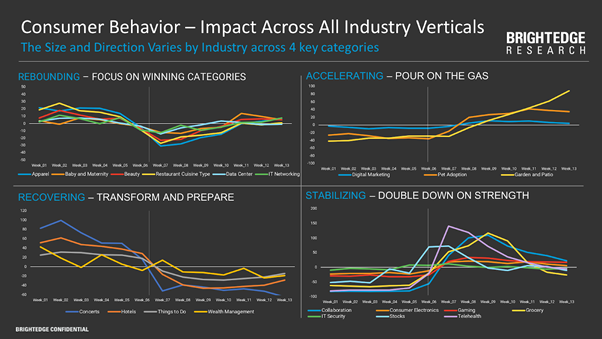
Some verticals actually accelerated. Digital marketing, pet adoption, and garden and patio goods are all among this category. As social events were canceled, loneliness set in and pet adoption became a logical solution. Face with spending more time at home, people began investing in improving their outdoor living spaces.
In the stabilizing category, we saw consumer electronics, gaming, grocery, and telehealth explode in popularity near the beginning of the pandemic. As people learn to live with the uncertainty of what has become quite a lengthy issue, these industries are stabilizing and those companies involved need to really build on their strengths to stand out.
Of course, some industries took a real hit and it could be months or even years before they recover. Airlines, hotels, concert venues, and the related product and service providers there—these brands need to transform and prepare to weather these conditions for some time.
Whatever your vertical, it is critical that you understand what people are searching for right now and that your content is optimized for those terms. In banking, for example, searches for drive-thru ATMs have become incredibly popular. For groceries, people want to know if they can buy online and pick up in-store. Searchers are looking for contactless payment and delivery from restaurants and meal providers.
Spend time on research and check out the attributes available to your business category in Google My Business, and simply spend a bit of time searching your competitors to see how they’re adapting.
As McKinsey puts it, we have “covered a decade in days” as far as the adoption of digital goes. COVID-19 has caused a surge in ecommerce, declines in discretionary spending, reduced shopping frequency and a shift to shopping closer to home as consumers have sought to limit the number of trips they make to brick and mortar stores. Consumer satisfaction and ongoing viral infection rates will continue to cause dramatic fluctuations in consumer behavior.
As Kelly Askew, Managing Director of Accenture Strategy for Canada, recently told Retail Insider,
“People are saying they expect that those new behaviors are going to continue into the foreseeable future. We think that those behaviors may persist as long as a decade. The crisis is causing consumers to consider the impact of their shopping choices more closely when it comes to things like health and the environment.”
When it comes to the impact on how people search, we’ve seen that consumers’ appetite for information is as voracious as ever. One of the first behavioral changes we noted due to COVID-19 was an intense focus on quality information. Consumers are becoming more and more aware of the dangers of misinformation and bias on the web. When sharing out COVID-related information, brands need to cite and link to reputable, top-quality sources. Make it clear to readers (and to Google) that your company is committed to that expertise, authority, and trust that the search engine wants to see in the results it prioritizes for searchers.
Personalization is more important than ever. Dynamic content can help you mirror consumer intent when they are searching for or exploring your site for just the right solution for their unique needs.
Probably the lowest hanging fruit in the search world is simply paying attention to what it is that search engines are looking for and focussing on delivering there. Updates and new features can tell us a great deal about how to optimize content. The whole concept of entities, for example, gives us a peek behind Google’s curtain at what it wants to see.
Google needs to be able to understand how different entities are related. Through RankBrain, it decides how important each signal that factors into that relationship really is. Google is getting more sophisticated in its ranking algorithm but at the end of the day, this is nothing new or earth-shattering for brands. It has always been the search marketer’s job to help the search engine understand why any particular webpage is a better answer to any given query than another.
There are multiple ways to demonstrate to Google how your page and your company as an entity relates to your target market searcher’s query. And again, these aren’t necessarily new.
You are going to write high-quality, focussed content. You are going to:
Mobile continues to be increasingly important, especially as emerging markets come online with a large proportion of the population being mobile-only. Knowing this, brands need to be looking at an even more mobile-centric future in 2021 and beyond. Mobile is no longer just alternative web design for the desktop website. Mobile is an entire experience with its own customer journey, content needs, and rich search results.
We need to be looking to voice, too, as consumers become more reliant on their voice-enabled and IoT devices. Again, we are not just adapting content for being read out loud. We are seeing entirely different types of queries when people use voice search. Content for voice search results needs to take into account the zero interface nature of the searcher. How can you deliver an exceptional experience to someone without a screen?
Brands need to be developing the strategies and at least have these issues on the horizon. You may be in crisis mode at the moment, but that is not a place you can stay forever.
While many firms are now using AI-enabled tools in some way, new applications and possibilities are still developing every day. Artificial intelligence enables SEOs to not only automate tasks but to derive greater insight, make smarter decisions, and deliver on consumer needs in near to real-time at scale.
Content optimization, competitive research, SERPs analysis, keyword research, and more can all be made more efficient and effective when powered by AI. Look for solutions that provide intelligent automation and enable human SEOs on the team to focus on the more creative aspects of each campaign. It’s not about replacing people, but augmenting their performance and giving them better data and more accurate insights on which to base their decisions.
SEO will lead the way through COVID recovery for businesses of all kinds. Ecommerce, BOPIS, local business discovery, and evaluation—whatever the product or service, and whatever the service delivery model, consumers take to search engines to find the information needed to make their purchasing decisions. If anything, this trend has picked up as a result of COVID, and consumers’ need for content will continue to grow as the Coronavirus continues to impact our way of life.
Those in position to be agile and focused on getting in front of the most current opportunities in search will win the clicks—and the lion’s share of new business.
Jim Yu is the founder and CEO of BrightEdge, the leading enterprise SEO and content performance platform.
https://www.searchenginewatch.com/2020/08/17/seo-in-the-second-half-of-2020-five-search-opportunities-to-act-on-now/
[unable to retrieve full-text content]https://feedpress.me/link/13962/13811766/how-to-integrate-content-marketing-seo
[unable to retrieve full-text content]https://feedpress.me/link/13962/13811311/377592
The live event industry has undergone a dramatic transformation in light of the global COVID-19 outbreak.
From Google’s Cloud Next conference to Starbucks’ shareholder’s meetings to live music performances, organizations and performers have had to move their in-person events online to curb the spread of the novel coronavirus while still addressing their audiences’ needs.
As online services become more integrated into people’s lives, audiences expect more information that’s up-to-date and delivered quickly, including the events they plan on attending. This is where event schema markup can really help.
Schema markup is code that helps search engines better understand what a web page is about in order to present more informative search results for users.
Instead of just basic HTML that points out what is the text or an image on a web page, schema markup provides context to information so that search engines know what content on a web page means.
Event schema markup is code that specifically points out to search engine facts relating to events, such as the location, schedule, organizer, and performers.
Schema markup is actually one of the multiple vocabularies that define terms and values in order to implement structured data (it just happens to be the most popular). In fact, Google, Yahoo, Bing, and Yandex have all collaborated to come up with Schema.org—an open community resource that provides schemas for their respective search engines to recognize.
Event schema markup can help your website’s search results ranking in a number of ways:
Event schema markup provides specific facts that are immediately apparent on SERPs as rich results. Rich results are the details that appear in addition to the default blue links and text descriptions. They show important facts to users about a particular webpage and can include a multitude of things from reviews to recipes.
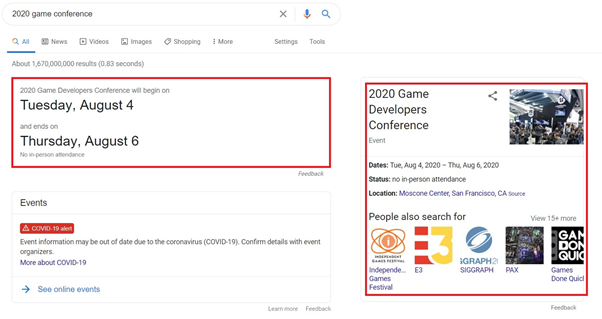
This has a two-pronged benefit. Rich results make for a better search experience for the users, first and foremost. Organizations, meanwhile, will stand out more in SERPs thanks to the eye-catching facts and visuals. On top of this, rich results also mean your webpage is occupying more screen real estate in the SERPs, pushing competitors further down the page.
One major effect of having rich results displayed for your webpages is that users are more likely to check out your site, instead of other sites that don’t show as much info. Your link will grab more attention.
Even if there will be users who are satisfied with just getting the bare minimum from the rich results, there is still a percentage that will click on your link to get more in-depth info or sign up as an attendee and book a spot.
In line with getting higher CTR, your webpages that have event schema markup implemented can also enjoy higher traffic. Events platform Eventbrite is one of the strongest cases for event schema markup boosting traffic. They saw a 100% increase in the year-over-year growth of traffic from Google to their event listing pages.
Allen Jilo, an Eventbrite product manager, said that they saw a “visual difference in event search results on Google” within two to three weeks of event schema markup implementation.
Google Product Manager Aylin Altiok and Senior Engineering Manager for Google Search Will Lescszuk delivered a talk in Google I/0 2019 about the importance of structured data in improving the user search experience. In that talk, they mentioned that their motivation for schema markup was to be able to optimize content for both voice and search.
When you use event schema markup, you do not have to create two separate experiences to optimize for text and voice search. Apply it once and you can reach a bigger audience.
Google reported that voice made up 20% of searches in their app, and that was back in 2016. With digital voice assistants in use expected to reach eight billion by 2023, now is as good a time as any to start optimizing your event pages with schema markup.
Event schema markup can be used for a wide range of events, but there are still limitations that you need to respect if you don’t want to be penalized.
The event types that you can markup include:
You can also mark up a series of multiple events that have a connecting theme.
Do not markup business hours and promotions such as vacation packages, limited-time discounts, and coupons as events. Doing so runs the risk of your entire website being disqualified from showing rich results for any of your content.
First of all, you need to make sure your event pages can be crawled by Googlebot. If you use robots.txt or robots meta tags, they should allow Googlebot to index your event pages.
You should then implement schema markup in your event pages. Google only supports rich results for pages that feature a single event, so you should have individual pages for each of your events.
There are three properties that an event page’s code needs for the page to show rich results on Google.
The following properties are not required, but they allow for more customization of rich results and a better overall user experience:
There are generally three ways to add event schema markup:
The simplest method to add this code to your site is to use Google’s Structured Data Markup Helper.
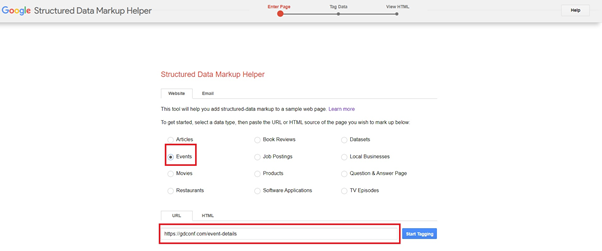
In the Enter Page section, select “Events” and type or paste the URL of the events page you want to markup on the bottom bar and click on Start Tagging.
In the Tag Data section, highlight the information you want tagged and choose the appropriate tag from the dropdown menu.
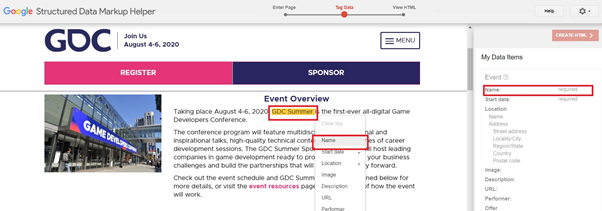
If there is info that isn’t present in the page that you believe should be tagged, click on the “Add missing tags” button on the bottom right. Supply the missing information in the following window.
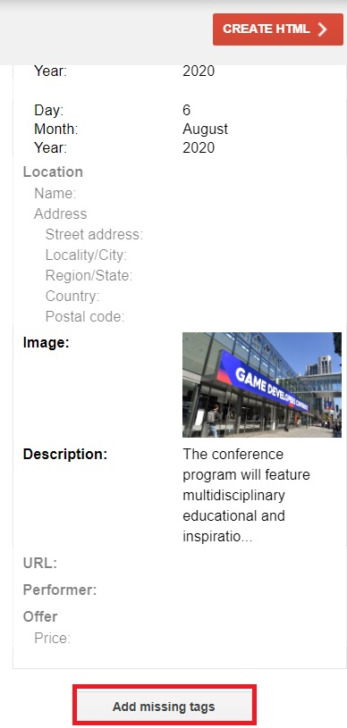
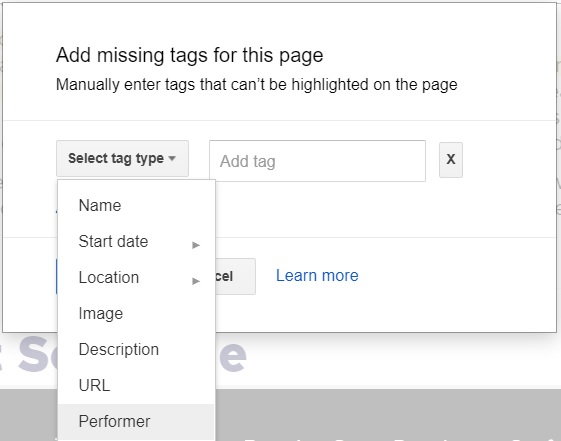
When you’re done adding all the important tags, click on the red “Create HTML” button on the top right. You should be taken to the View HTML section where you’ll see generated HTML code that has all the info you tagged.
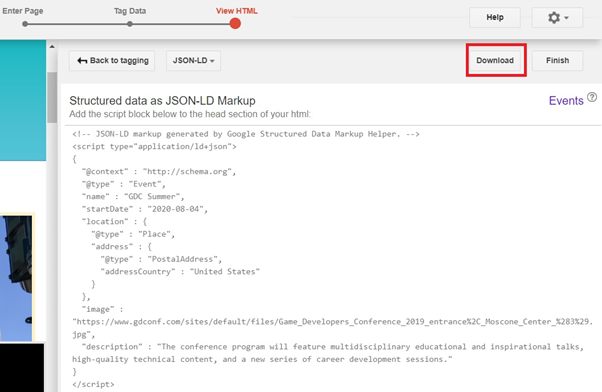
Click Download to download the HTML code, which you can then copy and paste below the <head> section of your event page’s HTML.
If you are hosting an online-only event, you will have to manually add a couple of lines of code since the Structured Data Markup Helper doesn’t have the option to indicate if the event is strictly virtual.
The code is as follows, with the sample URL in “url” replaced with the actual URL you’ll be using for your online event.
“eventAttendanceMode”: “https://schema.org/OnlineEventAttendanceMode”,
“location”: {
“@type”: “VirtualLocation”,
“url”: “https://sample.streamurl.com/”
},
Before you make wholesale changes to your site’s source code, you want to test the generated HTML to see if Google finds the corresponding page eligible for rich results. Fortunately, Google has just the tool for that—the aptly named Rich Results Test.
Click on the CODE tab, paste the HTML code generated by Structured Data Markup Helper onto the box, and click on the “Test Code” button.
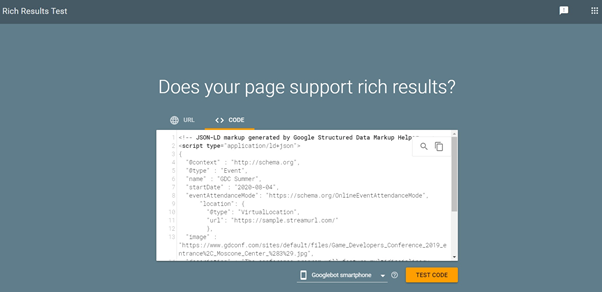
If there are no errors in the code, the test results should show that the page is eligible for rich results.
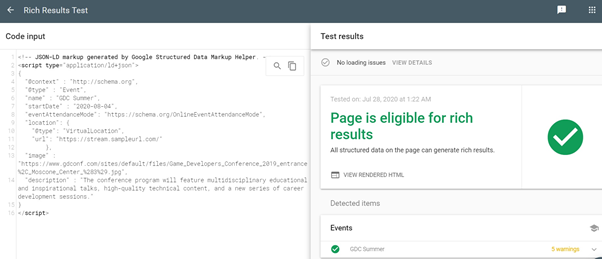
Note that the tool will show warnings despite its eligibility, if you don’t include all of the recommended tags for events, such as the name of the performer, the end date, and offers. If you have that information available, it’s highly recommended that you tag them in Structured Data Markup Helper.
We may now be in a world where in-person events are a rarity, but that hasn’t curbed our desire for gatherings as we’re naturally social creatures. People will continue to want to take part in mass activities, whether that’s offline or online. Utilising event schema markup, your business can make the pivot towards more online events, whilst standing above the competition in the SERPs through rich results.
After reading this guide, you should find that it’s not actually too hard to make a start. “Start” is the keyword here, however, as more familiarity with coding can lead you to even deeper customization of your event pages’ HTML for better event search optimization. Schema.org has a whole page dedicated to all the properties you can use for events with examples in different formats that, with some studying, can take up plenty of valuable space on Google’s SERPs with the most detailed rich results.
Paul Morris is Managing Director of UK based SEO agency, Superb Digital.
https://www.searchenginewatch.com/2020/08/14/an-seos-guide-to-event-schema-markup/
[unable to retrieve full-text content]https://feedpress.me/link/13962/13809740/377051
[unable to retrieve full-text content]https://feedpress.me/link/13962/13809525/377251
[unable to retrieve full-text content]https://feedpress.me/link/13962/13807507/377451