The Basics of Link Remediation, Link Removals & Disavows via @BrianHarnish
[unable to retrieve full-text content]https://feedpress.me/link/13962/13750335/374834
[unable to retrieve full-text content]https://feedpress.me/link/13962/13750335/374834
[unable to retrieve full-text content]https://feedpress.me/link/13962/13749615/375351
[unable to retrieve full-text content]https://feedpress.me/link/13962/13747529/375258
What makes a web page rank on the first page of Google? Historically, the best correlation studies regressed thousands of search factors against page one rankings in an attempt to understand the primary drivers of SERP performance.
But these ranking factors are weighted differently depending on the type of search. Google uses varying search models depending on the search intent behind the question. Local searches with the map pack, higher economic value searches with high CPC, informational queries with high search volume, searches where the most relevant results may be rich media like videos/images, and even search within highly regulated industries like health and money, can all weight ranking factors differently
To make correlation studies even more challenging, Google updates its core algorithm several times a year, meaning those signals continue to evolve. As Google continues to refine its ability to measure and analyze those signals, their bots are getting better at understanding website quality the way that humans do.
In the last decade, the academic fields of machine learning and natural language processing have made great strides. Starting around 2012, Google’s search algorithms evolved beyond regression-based models towards deep learning. Google’s ranking algorithm has now become a black box, and even their engineers find it challenging at times to understand why their models produce the results they do.
Ultimately, we know their goal has always been to bring the highest quality search results to users, and they’ve always done the best they could with the technologies and datasets available to them at the time.
Every core update is consistent with what they have been telling us for years: they reward high-quality pages and penalize low-quality sites and spam. Google’s updates have always been marching in the same direction, and it’s well understood among SEOs that there is a North Star towards:
What can be frustrating for webmasters is Google’s lack of specific guidance about which specific ranking factors matter the most in their specific industries? When studying how certain properties like page speed, text content, and backlinks relate to rankings, advanced SEOs are turning to correlation analysis and machine learning tools to better understand how Google finds these signals through the noise.
We look into an industry-specific correlation analysis, and what we learned about the primary drivers of SERP rankings.
To better understand these signals, we studied the correlation of 18 important ranking factors across 200 searches in the sports ticketing vertical. Each keyword had a CPC of over $8.
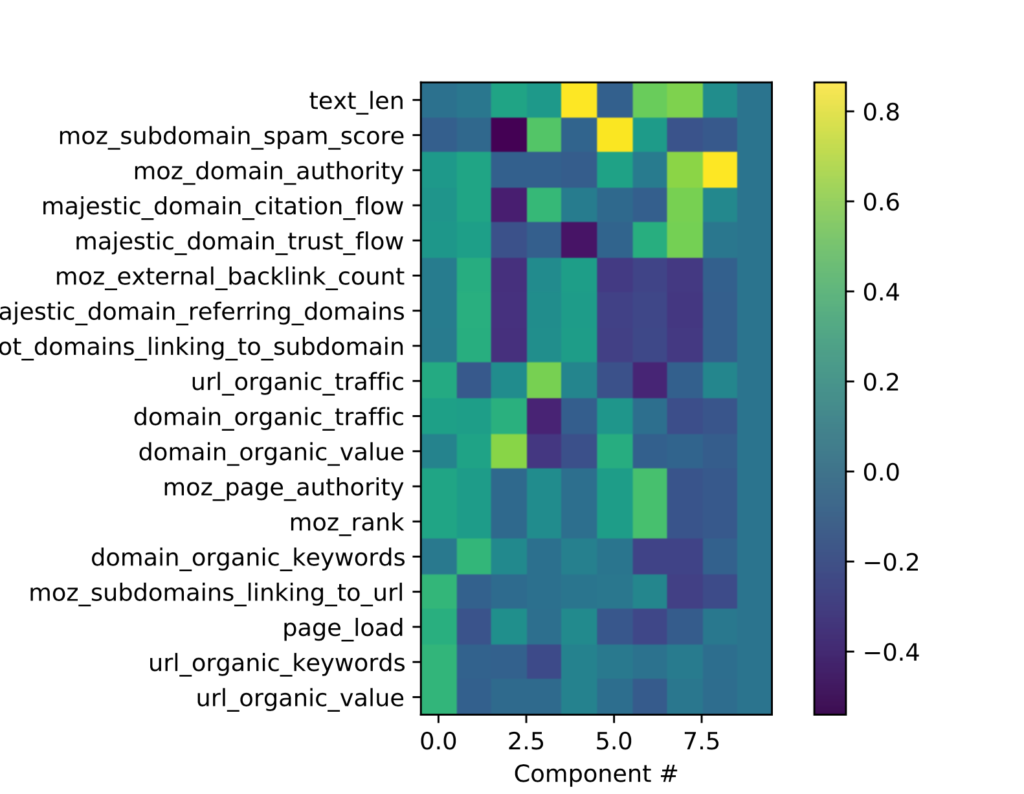
What we discovered was that the most important factors that were correlated with top rankings were high Domain Authority and long-form landing page content. Domain organic traffic value, URL organic traffic, and page load speed were among the weaker correlations.
Unfiltered backlink count and Referring Domain counts themselves were not as strongly correlated as metrics like Moz’s Domain Authority, which differentiates between low-quality links and high-value links. Additionally, Majestic’s Trust Flow and Citation Flow metrics proved less correlated to ranking on the first page then Moz’s Domain Authority.
For the startup client, we were working with, this analysis taught us that maximizing the amount of page rank on their most competitive landing pages was critical in order to contend with the heavyweights in their space, more than anything else they could do for their SEO.
From a content perspective, we found the web pages that rank on the first SERP align with what Google claims to reward: Long-form, topically-rich pages with interactive elements that provide a great page experience, like jump links, expandable content modules, and interactive javascript or videos.
In our analysis, we were surprised to see that page load speeds weren’t as strong of a factor as we might have expected. Nevertheless, given Google’s guidance about their forthcoming 2021 web vitals update, performance signals are likely to become more important. Even though these signals may not be as important as site authority in the algorithm today, I would strongly advise brands to begin preparing for the update and begin making on-page content improvements and page speed improvements right now and understand how your site stacks up in the ‘Chrome User Experience’ report.
If you’re an upstart and looking to break into page one of Google, most of these Google algorithm updates should come as very good news because they create a more democratic SEO landscape. In every correlation analysis, we’ve performed, site authority has always been the most influential factor. It’s also the hardest ranking factor to improve because link building takes such a concerted amount of effort and can take years in big industries.
Seeing other ranking factors demonstrating strong influence over rankings – such as content length and quality, page speed, and web vitals, and high-quality UX. It means that new entrants gain more opportunities to succeed in SEO on the merits of their web pages, not just because they are incumbents with massive backlink profiles.
Even if you don’t have the tools to do your own comprehensive correlation analysis, you can manually reverse engineer the SERPs in your industry. Studying how your competitors to benchmark on these important search factors can reveal valuable tactical insights that help you direct your team’s SEO efforts towards the most impactful work possible and deliver faster-ranking improvements.
Manick Bhan is the founder and CTO of LinkGraph, an award-winning digital marketing and SEO agency that provides SEO, paid media, and content marketing services. He is also the founder and CEO of SearchAtlas, a software suite of free SEO tools. He is the former CEO of the ticket reselling app Rukkus.
https://www.searchenginewatch.com/2020/07/22/1000-ranking-factors-how-google-finds-signals/
[unable to retrieve full-text content]http://tracking.feedpress.it/link/13962/13747274
[unable to retrieve full-text content]http://tracking.feedpress.it/link/13962/13747146
[unable to retrieve full-text content]http://tracking.feedpress.it/link/13962/13747057
[unable to retrieve full-text content]http://tracking.feedpress.it/link/13962/13744829

Do you consider SEO and website design as two separate elements of your website? You shouldn’t. There is no point developing a slick website if nobody will be able to find the site online, and with over 1.2 billion websites on the internet, it can be hard for your website to stand out. To avoid having a website that is not ‘search engine friendly’, we spoke to SEO expert, Javier Bello at UENI, who outlines five ways SEO and Web Design can go together.
Research shows that mobile devices generate over half of global website traffic, so having a website that is mobile-friendly is essential to reach over half your audience. Google made mobile-friendliness a ranking factor in 2015, and mobile indexing was then introduced in 2017, which meant that Google predominantly uses the mobile version of the content for indexing and ranking.
Therefore, to reach a wider customer base and rank higher on Google, you should spend some extra time working on the mobile version of your site. Is your mobile site just as usable as the desktop version? Are your pictures placed in the same format? Is everything tagged the same way as it is on the desktop version? Understanding that mobile matters will make your SEO better and build your Google rapport.
There is nothing that will make a visitor click off more quickly than a slow website. All your web pages should load instantly, otherwise, this can impact user experience and SEO performance. If you find that your website speed is lagging, chances are it could have something to do with your website design. Devote your time to optimizing images, removing unnecessary plugins, allowing browser caching, and so on. One study found that 88% of consumers are unlikely to return if they had a bad experience with your site, so it is crucial for your success that you have a high website speed.
Everyone knows that content strategy is an essential part of SEO, but did you know that the presentation of it can affect your rankings too? Not only is user-friendly, intuitive design an underrated component of SEO, but it will ensure good user experience so that your customers do not click off your web page. Too many hyperlinks, text that is difficult to read against backgrounds, images that take too long to load, and pages with blocks of content in strange places are all examples of bad website design. This might erase the audience you have worked so hard to bring to your site. Treat Google like a regular customer and make it easy for consumers to take in your content, so they stay and click through your site.
A sitemap is essentially a blueprint of your website that helps search engines find, crawl and index your website’s content. A good sitemap will allow search engine crawlers to more intelligently crawl your site, therefore improving Google rankings and bringing in more traffic. That is if your content is already well prepared and appealing to web users. To create a site map that makes sense, ensure that your design intuitively leads people to the right place and that your internal linking structure makes sense to you. This may sound like a lot of work, but effective SEO is a process and can be considered a technical art.
Without good content, it becomes difficult to create informative web pages or rank highly in search engines. Google loves sites that have a clear content structure, with easy to follow pages and keywords positioned strategically. Also, when existing content is updated it indicates to Google that your site is ‘alive’ and greater crawling frequency is achieved. Popular content included how-to posts, FAQs, and case studies. Use paragraphs, headings, and signal words to display your content nicely on your webpage, allowing for greater user experience. Lastly, if you display or link to related content on your site, consumers can click on another landing page from your site for more information, rather than looking elsewhere.
Javier Bello is an SEO expert at UENI.
https://www.searchenginewatch.com/2020/07/21/five-ways-seo-and-web-design-go-together/
[unable to retrieve full-text content]http://tracking.feedpress.it/link/13962/13743904