How Would an SEO Agency Be Built Today: Current Business Model(s) via @seomonitor
[unable to retrieve full-text content]http://tracking.feedpress.it/link/13962/13743645
[unable to retrieve full-text content]http://tracking.feedpress.it/link/13962/13743645
[unable to retrieve full-text content]http://tracking.feedpress.it/link/13962/13742049
[unable to retrieve full-text content]http://tracking.feedpress.it/link/13962/13736976
In comparison to a national level, local SEO is relevant for smaller enterprises operating at a regional level.
Although the focus of national SEOs is on rankings across the country, priority should also be given to local SEOs in a given location on SERP. The approach is focused on the brand ads, merchandise, and services to local administrators and clients.
Optimizing your local SEO means more website traffic, leads, and conversions, as your local customer base is more relevant.
This focused strategy will help you perform more successfully against bigger domestic companies with unrestricted capital.
With your focus on specific local SEO to-dos, you can neutralize the benefits of bigger firms that routinely optimize for broader keywords and rely on brand recognition to bring traffic rather than value proposals.
Below are the 10 easiest ways to successfully complete your local online SEO.
The most effective way to rank higher on Google Maps and to achieve visibility in Google search local results may well be to optimize your Google listing which includes your business profile.
Nevertheless, you need to have a Google My Business Account linked with your business to navigate your business profile and enable such improvements.
Once all the information you require is provided in your Google My Business Dashboard, all of that information is then included in the Google Maps business profile, Google Search Knowledge Panel, and Google Search Local Results.
Make sure you customize your Google business profile:
This not only optimizes your Google My Business profile for your clients to write magnificent reviews on your business but also allows more nearby consumers to buy from you.
Some tips for motivating clients to leave a review are given below:
Voice search is and will increase exponentially in the coming years as well. Therefore, it is important to automate in local SEOs, how people make their requests, and how people ask questions when using smartphones.
In contrast with textual searches, the consumers use more long keywords in voice search. As a consequence, you’ll even have to change your content’s SEO to match someone’s conversational language.
When optimizing the voice, it is often important that user intent is remembered, since such searches are typically conducted when the user wants a particular piece of information. They are waiting for fast and useful responses if they are cooking and want Alexa to tell them a specific recipe. If a potential customer uses voice searches to inquire about the hours of your business, this information should be available easily.
There is nothing better than producing material that communicates a particular issue in order to draw the interest of the local customers. However, you will need to see it from a logical standpoint whether doing so fits your business model.
Certain strategies include:
Let’s just suppose you’re a small property company. You can create various pages, one for each place, where hyper-local content can be included in news or changes in the local real estate market. This strategy can also help you to position yourself at any particular location.
Statista shared that as of 2020, there are around 3.5 billion smartphone users and this trend is further expected to grow up to 3.8 billion users in 2021.
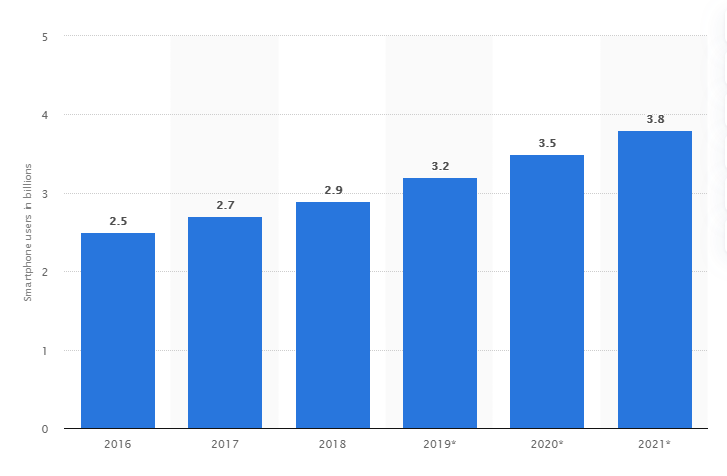
Source: Statista
It shows that transformation from the web to mobile is faster than anticipated. It also confirms that you should boost your website to become a local SEO player and indeed, for a successful SEO period with smartphones and smart devices.
Here are a few tips for this:
For local users, the keywords should be relevant. It’s just worth it, isn’t it?
The Keyword Planner from Google helps you to filter location-based searches of keywords to get an insight into the common search terms in a given field. This lets you list the keywords you like locally. They should appear on URLs, copy, and meta content of your site if you have them.
Additionally, have in the post references of national landmarks and hotspots. For instance, you may include references to “best auto service in the outskirts.”
Location pages are necessary if you have more than one spot in a region for your company. The following pages must be provided:
Take caution because you may have many locations and would need to have unique content.
If you have only one location, it is essential to create an “About Us” page focusing on local information. For instance, if you have a food shop, your “About Us” page is the perfect place to mention the association of your shop in the supply of food in events in your city.
Websites including Craigslist, YellowPages, MapQuest, and Foursquare are web market directories to name a few. There are many more on the internet.
In turn, it will also improve exposure in your local SEO, and add your company name, address, and telephone number to these directories.
The following basics should be included in listing:
According to the local search ranking factors report by Moz in 2017, the first and second-most relevant considerations for local products are link signals. Link signals connecting to your site are backlinks. Links are necessary to improve the efficiency of your local SEO.
Follow these tips to create quality links:
While all your goods or services can be enticing to cram into one wide list, but don’t do it. Specify one page for every single product or service that you offer.
If search engines do not seem to regard your brand as an expert in a specific region, your local SEO juice is not so strong. This lowers the scores.
You should use location-based copy on your website if you’re a company that has not multiple goods or services but has different locations. For example, ‘Petro Plastics’ would become ‘Petro plastic in Miami’ or ‘Household Petro plastic’.
SEO is quickly evolving. You cannot know when Google will adapt the SERPs to new features for local searches, but these updates should be dealt with. This is why staying at the top of local SEO is essential.
Through applying these techniques, your company will not only benefit from profitable local searches but also offer a strong basis for the implementation of new SEO features.
https://www.searchenginewatch.com/2020/07/20/10-tips-to-perform-in-depth-local-seo-for-your-business/
[unable to retrieve full-text content]http://tracking.feedpress.it/link/13962/13734799
[unable to retrieve full-text content]http://tracking.feedpress.it/link/13962/13732887
[unable to retrieve full-text content]http://tracking.feedpress.it/link/13962/13732622
[unable to retrieve full-text content]http://tracking.feedpress.it/link/13962/13731610
[unable to retrieve full-text content]http://tracking.feedpress.it/link/13962/13731398

Google’s John Mueller advises SEOs not to look at search ranking as an exact science with an absolute right or wrong way of doing things.
Mueller spoke at length on this subject in episode three of Google’s Search Off the Record podcast.
Accompanied by Gary Illyes and Martin Splitt, also from Google, Mueller discusses the flaws he sees peoples’ attitude toward ranking factors.
Here are some highlights from the Google Search team’s discussion on search rankings.
Mueller has two frames of mind when it comes to ranking factors:
Obsessing over individual components, like the strength of one ranking factor compared to another, is a flawed approach.
Mueller says there can be multiple ways to achieve the desired outcome. Every site does not have to follow the same blueprint, so to speak.
ADVERTISEMENT
CONTINUE READING BELOW
“I think that’s really important to keep in mind in the sense that there is no absolute truth out there with regards to which page should be ranking for which query…
So it’s not that every site has to do the same thing, but rather there are multiple ways to get there and you don’t have to blindly follow just one ranking factor to get to the end result.”
There is not an individual ranking factor you can point to and say it’s the deciding factor above others.
There’s not even a single factor that consistently carries more weight than others, Mueller says.
A ranking factor may carry considerable weight for one query, and not matter at all for another.
“And it’s also not the case that any particular kind of factor within this big network is the one deciding factor or that you can say that this factor plays a 10% role because maybe for some sites, for some queries, it doesn’t play a role at all.
And maybe for other sites, for other queries, it’s the deciding factor. It’s really hard to say kind of how to keep those together.”
ADVERTISEMENT
CONTINUE READING BELOW
While there’s no way to guarantee a stable position in search results, Mueller says the best thing SEOs can do is optimize for a variety of factors.
“… the best way for a website to kind of remain in a stable position, which is not guaranteed at all, is really to make sure that you have a wide variety of different factors that you work on and kind of keep this diversity of your website upright.”
Gary Illyes added to the discussion saying Google takes user feedback into consideration when shaping its algorithm.
All algorithm updates are tested on real users before getting pushed live.
Tests are conducted through live experiments where one set of users gets the new algorithm and another set doesn’t.
Google will then decide whether the update is good or bad for users based on how they reacted to the new results.
“Anyway, I would also like to add there that we also take quite a bit of user voice into shaping the algorithm because when we evaluate new launches, then it is tested first on humans.
Pretty much all the launches – be that live experiments, where actual users are getting the new algorithm, or a piece of the algorithm, into their search results and they can see different results, differently sorted results.
And then we look at things like clicks, like how they reacted to the new results to understand whether the launch is good or bad.”
For more of this discussion on Google search rankings, you can listen to the full podcast below.
http://tracking.feedpress.it/link/13962/13727920