If I Were Starting a Small Travel Business, This Would Be My Marketing Plan via @seo_travel

It’s an incredibly difficult time for travel businesses with the industry being one of the worst-hit from the coronavirus pandemic.

However, there are shoots of recovery starting to show.

Many businesses are starting to move their focus back to marketing so they can be ahead of the curve when more widescale travel is possible once again.

Amid all of these challenges, it’s hard to imagine starting a brand new travel business.

But I know people who are doing just that and facing the current challenges head-on.

They know the industry will come back around and they want to view this as a window of opportunity to make progress while others are stood still.

These conversations made me think about exactly how I would go about marketing a brand new travel business if it were my own, and I thought those musings would make for an interesting read.

Hopefully, the insight below will help those who are right at the start of their journey (and potentially some who are well into it) get through these tough months and flourish on the other side.

ADVERTISEMENT

CONTINUE READING BELOW

Start with Keyword Research

Start with Keyword Research

First job – build a website, right?

Wrong.

Before you even start thinking about designing a site you need to delve into the data in your market, identify who your audience is and what they are searching for.

Your website design and build should all flow from this initial research.

Without it, there is a high risk you will go off course immediately and end up way off course before you’ve gained any momentum.

Don’t just do this at the surface level for the 5/10/20 headline phrases you think your audience will search for. Delve deep.

Look at every stage of the marketing funnel and identify what people are searching for before they’ve even considered the product or service you offer.

The more detail you go into in this process, the more successful your business will be.

ADVERTISEMENT

CONTINUE READING BELOW

Build a great website

Build a great website

Once you’ve identified what your audience is searching for, you need to map that information onto your website.

Through the design process, you should be referencing your keyword research and ensuring that you have all the pages required to cover off all the phrases and topics you identified.

At this stage, you also need to ensure you’re well informed as to what an optimized page looks like.

Read up on resources like this, or consult with an SEO specialist (ideally a travel-focused one 😉) who can guide you on what you need to consider.

Once you’re through the design phase, you’ll move on to the build.

Again, don’t take for granted that every web design company knows how to build a good website!

Everyone will say they build “SEO-friendly” sites but generally, that doesn’t mean anything beyond the fact that the URLs will include words and there will be a sitemap somewhere (probably with the wrong pages in!).

The best way to do your due diligence is to ask to see a variety of the company’s previous builds and assess how they are performing.

You can then cross-reference this with testimonials from those clients and see how the experience of working with them has been.

This area is a minefield given the number of businesses out there offering web design and build services.

Be sure to do thorough research on who you choose as it will dictate the success of your business and how fast it can grow.

Effective Content

Effective Content

So you’ve got a beautiful and well-built website in the offing, now you need to populate it!

Writing effective content is crucial in both getting found by users and then convincing those users that they should buy from you.

ADVERTISEMENT

CONTINUE READING BELOW

Focus too much on one or the other and you’ll fall short.

Content that ranks in search engines is no longer about stuffing in keywords or writing 5,000 words for the sake of it.

You need to address the intent of the user for the query they searched for and provide top quality, accurate information when they land on the page.

Think about what your user wants and use your expertise to write the best content on the web for that user.

quality-content

quality-content

If you do that, and fit it into the optimized page templates that you created in the design process, then you should end up with content that has a great chance of ranking.

Launch Campaign

Launch Campaign

I know what you’re thinking, that’s a lot to consider before we’ve even launched!

ADVERTISEMENT

CONTINUE READING BELOW

However, if you want to build a successful business you need to have the right foundations in place.

But now we’ve made it. The website’s ready and looking snazzy.

Your content is written and all set to be read. Now we just need some humans to look at it.

We always recommend to new businesses that they launch with a big PR campaign, for a variety of reasons.

The first of these is probably the one we all would associate with PR.

Get coverage and make people aware you exist. If you can get on top industry publications or national/international news websites then it’s possible that people will come to your site and enquire about what you offer.

If I Were Starting a Small Travel Business, This Would Be My Marketing Plan

If I Were Starting a Small Travel Business, This Would Be My Marketing Plan

However, PR is not just about getting found by people.

ADVERTISEMENT

CONTINUE READING BELOW

Running a big PR campaign can bring in links from top publications that are extremely powerful and give you a huge boost in ranking performance in search engines.

As a brand new site, you won’t have any links at all.

In a competitive industry like travel, you will need to bridge a significant gap to competitors to start appearing for some of the more highly-searched phrases.

A launch campaign can help you get an influx of fantastic links that immediately closes that gap and allows you to start ranking in search engines much more quickly.

A campaign we ran like this brought in more than 100 links for the client, and within 6 months we were on page 1 for the biggest phrase they were targeting.

Without that link-focused PR work, there is no way we would have seen that improvement.

Another benefit of this process is that once you have gained this kind of coverage you can add some of the logos of bigger publications to your website to show you’ve been featured on them.

ADVERTISEMENT

CONTINUE READING BELOW

This kind of social proof will instill more trust in visitors to your site and make them more likely to convert.

Finally, launching a PR campaign that gains good visibility can also start to drive some branded searches for your brand.

This is a good signal to search engines that you are a brand worth trusting and many other positive secondary effects.

Social Media Campaign

Social Media Campaign

Links should always be a high priority in my opinion when launching a new site, but once you’ve run some activity that has attracted a good amount of quality links you might want to move some focus to your social media channels.

Big social media followings don’t directly impact your rankings in search engines, so I tend to focus on the search engine-oriented work first as users in that environment tend to be more conversion-focused.

ADVERTISEMENT

CONTINUE READING BELOW

However, there are lots of benefits to building a strong social media following and so carrying out some activity to grow this should certainly be on your list fairly early in the journey.

One way to do this is simply to add content and engage with users, but we’ve found that this approach is not particularly efficient in growing a big following.

We’ve seen much more success with PR-orientated approaches that drive people to your social media profiles and encourage them to engage with it in some way.

We’ve seen this increase followings from zero to over 10,000 in just a few months, so it can be very effective in tandem with consistent content being added.

I would highlight that in our experience you need to focus your campaign on either your website and getting links, or on driving social media growth.

Where we’ve tried to do both it generally hasn’t been as successful.

This would also apply to the platform you choose – make sure you focus on Instagram, Twitter, Facebook, or wherever else you want to grow and send people to just that one place.

ADVERTISEMENT

CONTINUE READING BELOW

More focus will bring more success.

Partnerships

Partnerships

Alongside the SEO and PR activity, partnerships are an excellent way of giving you more direct access to the market that could lead to sales early in the business’s life.

There are both short and long term benefits to building relationships with the right partners.

The short term benefit is that you can achieve exposure to your target market almost immediately.

If you find a partner with a similar audience and you can offer something beneficial to them then you can get them to refer customers to you from their pre-existing database.

The long-term benefit is that you can establish co-marketing opportunities with partners that help grow your brand visibility over time so you don’t rely on others to send you leads.

ADVERTISEMENT

CONTINUE READING BELOW

This could be writing guest content on your partner’s website that helps push your ranking performance forward.

It could also be including each other in guest content you write on third party websites.

Or it might be setting up events that you run together.

There are so many avenues with this approach.

The key is that you find the right partners with the right audience and work closely with them to ensure you’re both getting the benefit of working together.

Rinse and Repeat

Rinse and Repeat

Once you have implemented the approaches above you should be well on the way to growing your brand’s visibility and starting to make some sales.

And this is another point where lots of people fall down.

They think they’ve done content and PR and they want to move on to the next thing.

ADVERTISEMENT

CONTINUE READING BELOW

PPC. Display advertising. TV!

The key at this point is to keep your focus and continue implementing the things that are working for you.

As the cogs start to turn with content, PR, and partnerships then you should just be looking to move them faster and generate more momentum.

Run another PR campaign, write more content, or find other partners (or ways you can work with existing partners more).

You can get a long way and huge visibility just working on these aspects.

The main reason being that they all feed into your SEO performance which, as you become more established, is just a flywheel that turns faster and faster without increased time and effort.

Team that SEO progress with the immediate impact that comes from PR coverage and partnerships and you have a strong recipe for success that will grow your new business in a sustainable way.

At least, that’s what I would do.

More Resources:

ADVERTISEMENT

CONTINUE READING BELOW


Image Credits

Featured & In-Post Images: Created by author, July 2020
All screenshots taken by author, July 2020 

https://tracking.feedpress.com/link/13962/13713312/373965


Five Google Trends charts that show the impact of COVID-19

30-second summary:

  • The world is now starting to open back up and we are marketers are adjusting to how we can be effective in this new reality.
  • Search data can help inform the strategic decisions around store locations, hours, payment methods and so much more so that your business can make smarter and more informed decisions on how to be successful.
  • As marketers struggle to grasp the magnitude of changes, Jason Tabeling highlights five Google Trends that can serve as immediate insights.

We all already know that the impact that COVID-19 is having on the world. We have all been under stay-at-home orders for about 90 days. The world is now starting to open back up and we are marketers are adjusting to how we can be effective in this new reality. It’s really hard to grasp the magnitude of changes that are occurring around us right now and it will take some time and perspective for us to truly understand. Search data is a powerful tool that can help us understand how consumers are feeling and reacting to situations. Here are five Google Trend charts that I think help us zoom out a bit and understand some trends that I believe will change the way we operate forever.

1. Retail vs Digital businesses

The world of traditional retail is changing forever. Here is a comparison between Instacart and Whole Foods. Now I know you can say Whole Foods is really Amazon and ecommerce, but that’s sort of the point. Every business is a digital business even if those particularly aren’t owned directly by Amazon. Quickly each business has had to move to a digital model and as you can see from this chart Instacart had a massive surge, has since tailed off, but has significantly closed the gap on Whole Foods. Instacart and other like businesses (Ex. Chewy or Doordash) now have a customer base that is much more comfortable in a digital world and won’t be going back.

Google Trends - Retail vs business

2. Store hours

If and when a store is open is a big deal during COVID-19. Many stores, restaurants, and other businesses were forced closed. Some were deemed essential, and as states re-open are deciding when they should open. This leaves consumers searching to find out how their favorite shops are responding.

For businesses and marketers, this makes keeping your Google My Business (GMB) and other Location Data Management sources (Facebook, Yelp, Apple Maps) up to date. Knowing consumers are seeking information and relying on this information to take action is key. Google has even created new tags like, “Temporarily Closed” to help businesses communicate with their customers easier. Making sure this data is accurate and up to date has always been important and is just magnified by the uncertainty this situation has created for all businesses and consumers.

Google Trends - Store Hours

3. “Contactless”

Check a Google Trends chart for anything “contactless” and you will see a very similar graph. The growth of all things contactless has spiked, delivery, payments, and pickup. This further accelerates the digital revolution. Cash has always been dirty, and in these times people are especially cautious. According to Times article paper money can transport a live flu virus for up to 17 days. This data point, plus all the CDC and WHO recommendations make anything contactless of interest for consumers.Google Trends - Contactless

4. “Curbside”

Curbside is very similar to “Contactless.” Both demonstrate the new ways consumers want to interact with brands. Having this type of pickup option allows consumers the ability to shop with their favorite brands, but not take the incremental risk of going inside the store. Consumers are looking for ways to continue with some sort of normal behavior, get out of their house, and not have to wait for shipping.

Best Buy for example had a curbside pickup at 100 stores in December and quickly accelerated to all 1,200 stores during the pandemic. Much like Contactless, curbside wasn’t even a term consumers were using until recently and we don’t expect it to go away any time soon.

Google Trends - Curbside pickup

5. Remote work

The way people approach their jobs has been forever changed. As you can see from the chart below remote work has been steadily growing since 2004, but has reached a peak over the last few months. This is especially interesting when comparing it to unemployment searches, which is a very sad side effect of the economy shut down. I’m hopeful that for those of us in digital marketing we can see this as a growth opportunity for talent across the country and world to work together to help make marketing stronger for these brands. To help them drive into a digital age that was a differentiator just 90 days ago, and has now been rushed into mandatory status for survival.

Conclusion

So much of our world has been changed forever. It is our job as marketers to help leverage the tools at our disposal. This is especially true for search engine marketing. Where we have the ability to understand how customers are thinking about our brands and the experiences they expect from us just be understanding how they search. This data is not only helpful for search campaigns but business strategy as well. Search data can help inform the strategic decisions around store locations, hours, payment methods and so much more so that your business can make smarter and more informed decisions on how to be successful.

https://www.searchenginewatch.com/2020/07/09/five-google-trends-charts-that-show-the-impact-of-covid-19/


Why SEO & Machine Learning Are Joining Forces

The global datasphere will grow from 33 zettabytes (each equal to a trillion gigabytes) in 2018 to 175 ZB by 2025.

In marketing, our role as the stewards of much of this data is growing, as well.

As of last year, more data is being stored in the enterprise core than in all the world’s existing endpoints, according to a report by IDC.

annual size of the global datasphere

annual size of the global datasphere

The great challenge for marketers and SEO professionals is activating and using that data.

In 2025, each connected person will have at least one data interaction every 18 seconds and nearly 30% of the world’s data will need real-time processing.

There’s no way human marketers can handle this processing on our own.

And more and more, as our machine-learning-enabled tools process and analyze search data, they’re learning and improving their understanding of it as they go.

ADVERTISEMENT

CONTINUE READING BELOW

Machine Learning in Search

Perhaps the best-known use of machine learning in search is Google’s own RankBrain, an algorithm that helps the search engine better understand the relevance and context of – and the relationship between – words.

Machine learning enables Google to understand the idea behind the query.

Machine learning allows the algorithm to continuously expand that understanding as new words and queries are introduced.

And as algorithms get better at determining which content best meets the needs of each searcher, we are being challenged to create content that meets those needs – and to optimize it so that relevance is clear.

It’s no coincidence that as we’re experiencing this explosion in data, interest in SEO is growing, as well.

SEO & Data Science

SEO has grown to be a viable, respectable mainstream marketing career.

As I write this, there are 823,000 people on LinkedIn with “SEO” in their profile and 8,600 who specifically categorize their core service offerings as SEO.

Looking worldwide, those figures balloon to 3.2 million and 25,000, respectively.

ADVERTISEMENT

CONTINUE READING BELOW

But this is just a small sampling of the SEO industry.

There are those in SEO who identify as content marketers, digital marketing strategists or practitioners, site developers, analytics pros, consultants, advisors, and more.

Our industry is massive in size and scope, as SEO now touches nearly every aspect of the business.

So much more is being asked of SEO professionals now, thanks to that massive increase in data we have to deal with.

Yet according to our research at BrightEdge, only 31.5% of organizations have a data scientist at their company.

Do you have a data scientist at your company

Do you have a data scientist at your company

Working alongside machine learning rather offers tech-savvy SEO professionals a number of important advantages.

1. Enhanced Performance in Your Field of Specialization

Employers and clients alike are driven by results.

Do you know how to use the machine-learning-powered tools in your area of specialization?

Whether in paid search, technical SEO, content creation and optimization, link building or some other facet of SEO, those who can prove superior performance through the use of machine-learning-enabled SEO tools are increasing their own value.

2. Start Ahead & Stay Ahead

Search is a live auction. If you’re waiting to see what customers think and only then getting ready to respond, you’re already behind.

Machine-learning-powered tools enable marketers to activate real-time insights, to personalize and optimize content in the moment for each users’ individual needs.

3. Economies of Scale

You are exponentially more valuable as an SEO practitioner and leader if you can demonstrate the ability to scale your efforts.

The real power of machine learning is in its ability to convert more data than we know what to do with into actionable insights and automated actions that marketers can use to really move the needle.

To do that is hard.

For example, to build BrightEdge Autopilot we had to process over 345 petabytes of data over the course of many years to help fine-tune machine learning and automated products.

ADVERTISEMENT

CONTINUE READING BELOW

Machines aren’t angling for a promotion; they don’t harbor preconceptions or care about past mistakes.

They are entirely subjective, taking opinions and personalities and other potential bottlenecks out of the process of data evaluation.

What marketers are left with are pure, accurate data outputs that can then be activated at scale to improve search visibility and interactions with customers.

4. Room to Grow

Mastering your SEO toolset gives you more room to grow in your profession, and as a person who just so happens to love the work you do.

Machine learning, in particular, empowers us to reap insights from larger datasets and gives us access to far more intelligence than when we could only learn from that we manually analyzed ourselves.

It is your specialized insight and industry knowledge that determines which outputs are useful and how they should be applied.

Machine learning can tell you very quickly how your audience’s behaviors have changed during a major market disruption, such as our recent experience with COVID-19.

ADVERTISEMENT

CONTINUE READING BELOW

But how you interpret and respond to those changes is still very much the domain of marketing and SEO professionals.

Machine learning can help you recognize patterns in visitor behavior that point to opportunities and areas in need of improvement.

What technology cannot do is replace the creative and analytical human thought process and experience that determines the best next steps to take in response to those insights.

The people of SEO cannot be replaced. In fact, they’re more important than ever.

The tools we use may be quite sophisticated; machine-learning-enabled tools can even make decisions and implement optimizations.

However, it is the people of SEO who drive the creative and analytical processes that machines simply cannot replace:

  • Creative analysts.
  • Data scientist (who control input into machines).
  • Analytics.
  • Content producers.
  • Culture builders and success evangelists.
  • Expert users who facilitate sales and help customers.
  • Strategic planning across digital channels.

And there are agile marketers who may do any combination of the above.

ADVERTISEMENT

CONTINUE READING BELOW

They are key in facilitating collaboration with other digital departments to ensure a truly holistic SEO strategy.

In their HBR article Collaborative Intelligence: Humans and AI Are Joining Forces, H. James Wilson and Paul R. Daugherty explain the three key roles humans undertake in every interaction with machine-learning-powered technology:

  • Train: We need to teach the machine to perform certain tasks.
  • Explain: We must make sense of the outcome of the task, especially if it is unexpected or counterintuitive.
  • Sustain: It is up to us to ensure that the technology is used logically and responsibly.

Applying this lens to our SEO tech, we see these three tenets hold true.

We need to decide which SEO tasks to intelligently automate and give our tools the proper input.

We need to take the output and make sense of it, focusing only on those insights with business-building potential.

We are responsible for ensuring that searcher privacy is protected, that the value of the technology outweighs the cost, and that it is otherwise being made good use of.

You can build your value as an SEO and learn to work more effectively with machine-learning-powered tech by building these skills:

ADVERTISEMENT

CONTINUE READING BELOW

  • Data proficiency: According to Stanford researchers, the share of AI jobs grew from 0.3% in 2012 to 0.8% of total jobs posted in the U.S. in 2019. AI labor demand is growing, especially in high-tech services and the manufacturing sector.
  • Communication: As the arbiter of so much customer data, it is critical that we communicate key insights and value in ways other department heads and decision-makers can understand.
  • Agility: More than a trait or quality, agility is a skill developed through constant experimentation.

Embracing machine learning and automation means building synergy with human creativity and skills.

It can make us more creative and effective by uncovering SEO insights and patterns we would never have recognized otherwise.

It can help us discover new topics, identify content gaps, optimize for specific types of queries and results, and more.

What’s more, it can save vital time on tasks that are too time-consuming, too repetitive and laborious, so we can scale performance.

And as that happens, we develop new skills and progress also as part of a symbiotic relationship between people and technology.

More Resources:

ADVERTISEMENT

CONTINUE READING BELOW


Image Credits

All screenshots taken by author, June 2020

http://tracking.feedpress.it/link/13962/13710634


Google Creates a New Way to Drive Traffic Via Image Search via @MattGSouthern

Google is adding more context to photos in image search results, which presents site owners with a new opportunity to earn traffic.

Launching this week, a new feature in Google Images surfaces quick facts about what’s being shown in photos.

Information about people, places or things related to the image is pulled from Google’s Knowledge Graph and displayed underneath photos when they’re clicked on.

Google Creates a New Way to Drive Traffic Via Image Search

Google Creates a New Way to Drive Traffic Via Image Search

More Context = More Clicks?

Google says this update is intended to help searchers explore topics in more detail.

One of the ways searchers can explore topics in more detail is by visiting the web page where the image is featured.

The added context is likely to make images more appealing to click on. It’s almost like Google added meta descriptions to image search results.

However, it’s not quite the same as that, because the images and the facts appearing underneath come from different sources.

Google Creates a New Way to Drive Traffic Via Image Search

Google Creates a New Way to Drive Traffic Via Image Search

Results in Google Images are sourced from sites all over the web, but the corresponding facts for each image are pulled from the Knowledge Graph.

In the examples shared by Google, you can see how the image comes from the website where it’s hosted while the additional info is taken from another source.

On one hand, that gives site owners little control over the information that is displayed under their images in search results.

On the other hand, Google is giving searchers more information about images that could potentially drive more clicks to the image source.

Perhaps the best part of this update is it requires no action on the part of site owners. Google will enhance your image search snippets all on its own.

ADVERTISEMENT

CONTINUE READING BELOW

Another Traffic Opportunity

If you’re fortunate enough to have content included in Google’s Knowledge Graph, then there’s now more opportunities to have those links surfaced in search results.

Contrary to how it may seem at times, Wikipedia is not the only source of information in Google’s Knowledge Graph. Google draws from hundreds of sites across the web to compile billions of facts.

After all, there are over 500 billion facts about five billion entities in the Knowledge Graph – they can’t all come from Wikipedia.

An official Google help page states:

“Facts in the Knowledge Graph come from a variety of sources that compile factual information. In addition to public sources, we license data to provide information such as sports scores, stock prices, and weather forecasts.

We also receive factual information directly from content owners in various ways, including from those who suggest changes to knowledge panels they’ve claimed.”

As Google says, site owners can submit information to the Knowledge Graph by claiming a knowledge panel.

ADVERTISEMENT

CONTINUE READING BELOW

That’s not something everyone can do, however, as they either have to be an entity featured in a knowledge panel or represent one.

But this is still worth mentioning as it’s low-hanging fruit for those who have the opportunity to claim a knowledge panel and haven’t yet.

Claiming your business’s knowledge panel is a must-do if you haven’t done so already. Local businesses stand to gain the most from from this update.

That’s especially true if yours is the sort of business that would have photos of it published on the web.

Then your Knowledge Graph information, with a link, could potentially be surfaced underneath those images.

For more on how to influence what’s included in Google’s Knowledge Graph, see this guide:

ADVERTISEMENT

CONTINUE READING BELOW

This feature is rolling out to mobile search results in the US.

Source: Google

http://tracking.feedpress.it/link/13962/13708822


How to Find & Improve Underperforming Content: A Practical Guide via @LWilson1980

All websites rely on effective content to bridge the gap between organizations and their audiences.

However, not all content is created on an equal footing or has the opportunity to fulfill its true potential.

In this practical guide, I will share a few of the practical tips and advice for:

  • Finding out how your content is performing.
  • Detailing a few specific tips for fixing any content areas that can work harder for your business.

The Search Engine Journal site has a few related content improvement articles that can complement this one.

Two recent items that I would recommend reading are:

ADVERTISEMENT

CONTINUE READING BELOW

The main tools and analytics packages I will use for this post are Google Analytics, SEMrush, and Ahrefs.

As you can imagine there is a myriad of other tools that can also be used.

However, Google Analytics is free, plus SEMrush and Ahrefs offer trial periods or free scaled back functionality versions of their software that you can try at minimal (if any) expense too.

The intention of this post is to guide you through some of the typical steps to go through when looking for under-performing content.

You’ll also learn how to make the necessary decisions on how to boost the value of existing website content.

Using Google Analytics to Identify Under-Performing Content

Google Analytics (GA) will likely be the go-to analytical package for most digital marketing experts.

This is because of the ubiquitous nature of the software, the global familiarity of using it for business and marketing purposes, plus the fact that it is free in most cases (unless you opt into an enterprise-level solution).

ADVERTISEMENT

CONTINUE READING BELOW

GA is also a leading choice as it dovetails into other Google products and data insights such as Google Search Console, Trends, and many more.

I am using a demo account for this article demonstration, so some screenshots will not have the data sets in place you may see when you log into your own account(s), but this will work for the current purpose.

Also, if you haven’t already installed Google Analytics, this is a straightforward action to do afterward.

Simply go to https://support.google.com/ and Google have a helpful step by step guide titled Get started with Analytics.

Practical Google Analytics Demo

For content performance, my preference is to use the Behavior reports in GA.

This set of report types enable you to see what your visitors do on your website.

Specifically, these GA reports tell you what pages people visit and what actions they take while visiting content on your website.

To begin with, it’s important to take a top-level and aggregate view of your website content.

This makes it fast and simple to decide where you should focus your time and energy, and steers your data finding in an efficient way.

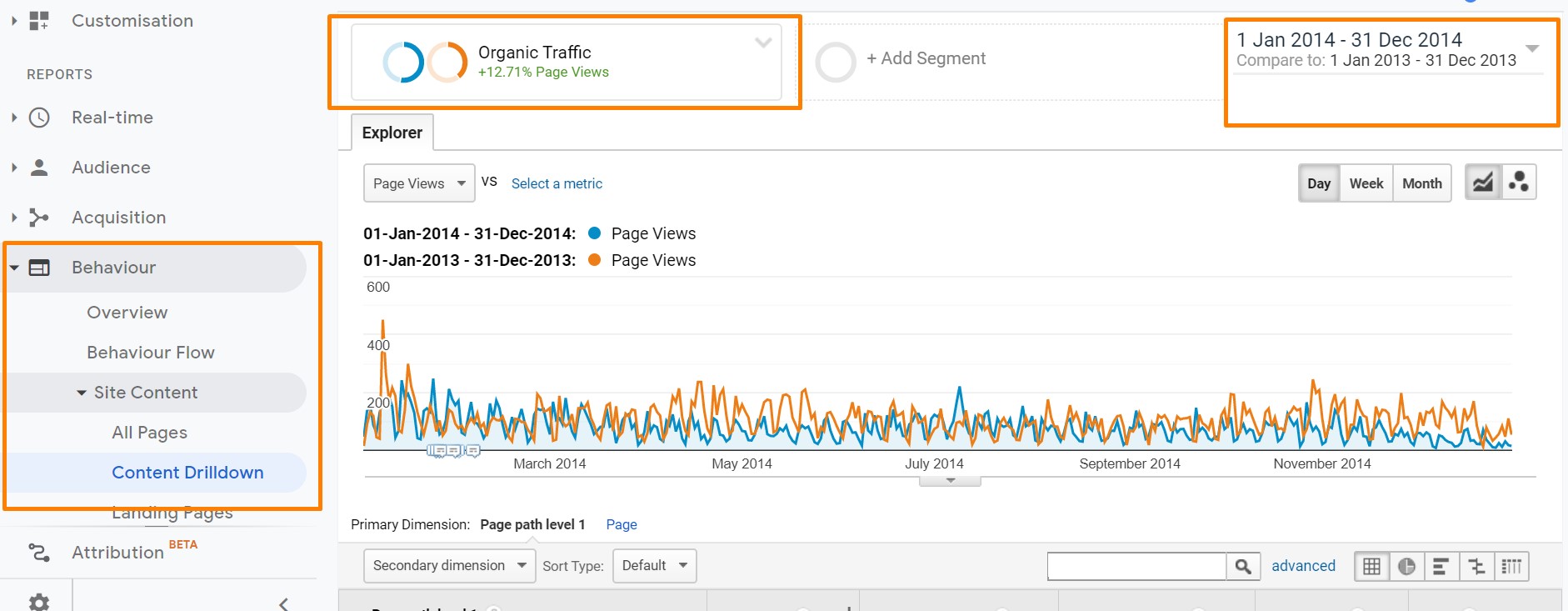
In this demo scenario, I’ve set Organic as the channel I want to check the performance of my content against, plus I have set a previous year comparison so I have enough meaningful data to remove skewing factors such as seasonality within the industry.

Demo data from Vertical Leap

Demo data from Vertical Leap

If you are not familiar with the Content Drilldown report in GA, this groups together sections of your website content based on the site setup on a folder by folder basis.

In this demo, we can see content grouping such as:

  • Blog.
  • Home page.
  • Other subfolders on the site including “Content Marketing”, “Social Media”, and more.

ADVERTISEMENT

CONTINUE READING BELOW

The reason why it can be useful to look at content at this aggregated level is that you can get a single click summary of the main content marketing performance metrics such as:

  • Pages views.
  • Related quality measurements including bounce rates, exits, and time on page.

The immediate items that stand out to me when looking at Organic only users on the website is that:

  • The blog has lost nearly a third of the page views compared to the previous year.
  • The news section is underperforming to a lower level too.

When considering that in this demo scenario, the blog receives more page views than any other section of the website, this is an important problem to fix – so we can drill down into that a little more.

ADVERTISEMENT

CONTINUE READING BELOW

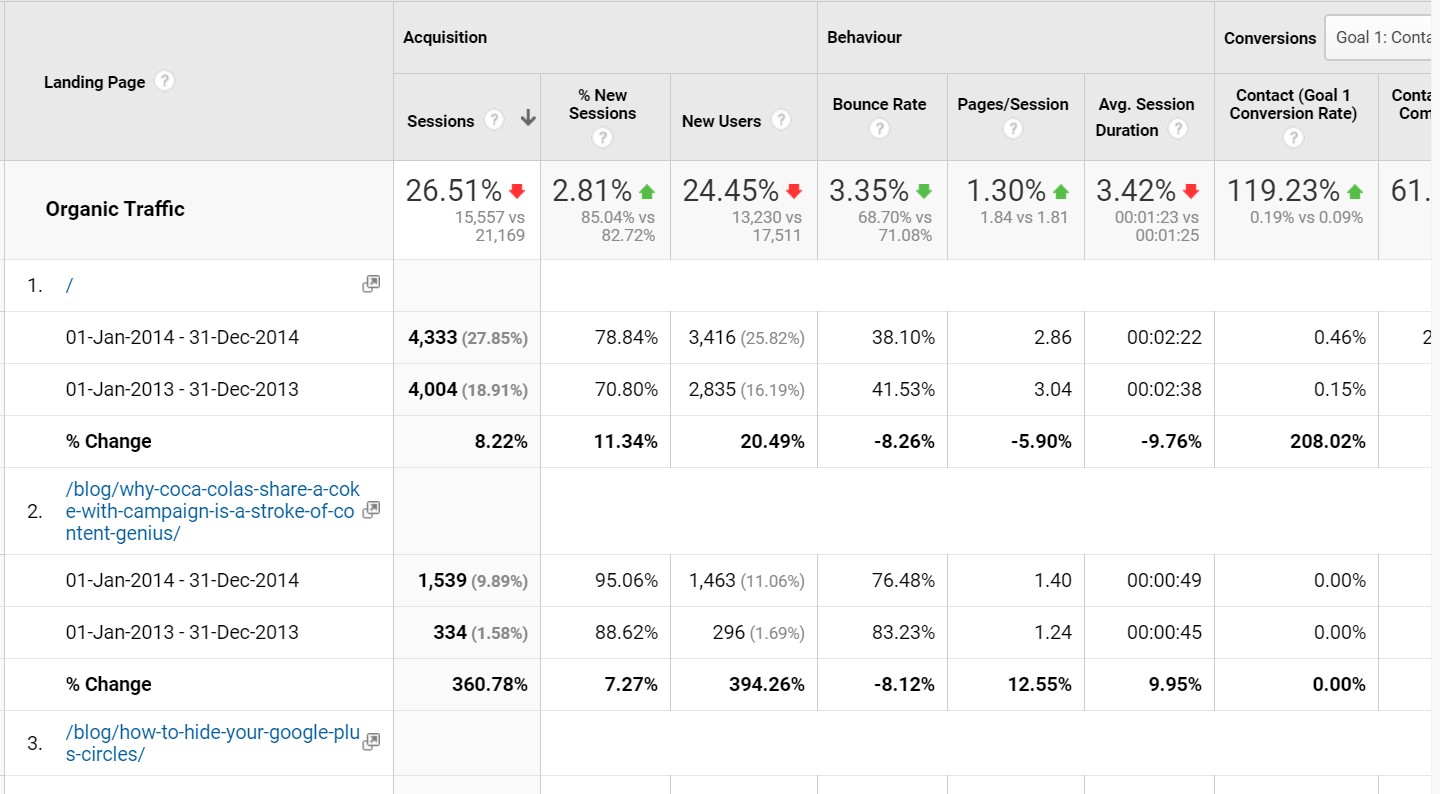
At this point, we can either click into the blog section and see the same data, or we can add to our investigations and start looking at the leading metric to page views, which is landing page traffic.

To see landing page traffic we simply click on Behavior > Site Content > Landing Pages and immediately we can see that we have moved from aggregate level data and into page-level data.

Added to this we can now see other meaningful business metrics such as sessions (or visits), users (or people), and company value items including goal completions.

Google Analytics Demo Data - Vertical Leap

Google Analytics Demo Data - Vertical Leap

You will also notice that our pre-selected timeframes, marketing channel, and comparison information is still in place however, it is always worth checking this as some screens will change this by default.

Next, we want to focus back on the blog section – this is easy to do by adding “blog” into the table search bar.

ADVERTISEMENT

CONTINUE READING BELOW

If you are following along by completing similar steps with your own data, you will notice that the data is automatically sorted by the highest landing page traffic.

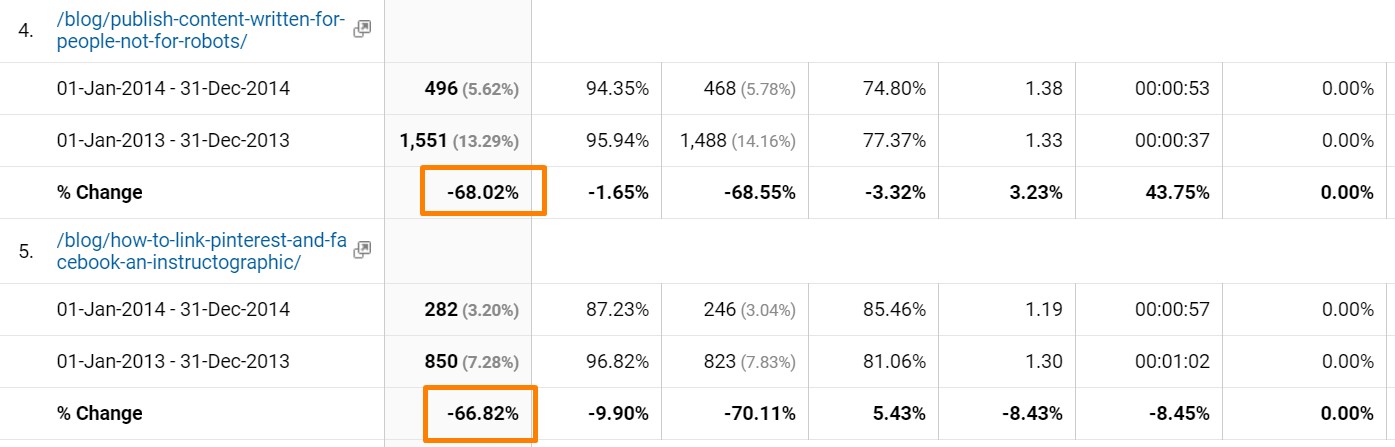
We can look at the individual content pages that are performing worst, and prioritize our focus accordingly.

In this case, I would want to look at improving these two pages as they have the required level of impact to warrant the time and resources to improve the pages, plus they are underperforming by over 65%, so I know they can contribute more towards business success.

Google Analytics Demo Data - Vertical Leap

Google Analytics Demo Data - Vertical Leap

So, the first thing I want to do is look at the page in question, and I can do that by clicking on the small icon next to the URL still within Google Analytics.

Now, I want to make some best practice, data-led, and experiential updates to the content, so that I can help the content to perform to a better metric based standard once again.

ADVERTISEMENT

CONTINUE READING BELOW

Practical Steps to Improve Existing Content

The following steps give you a glimpse into the varied actions that can be deployed on your own content projects.

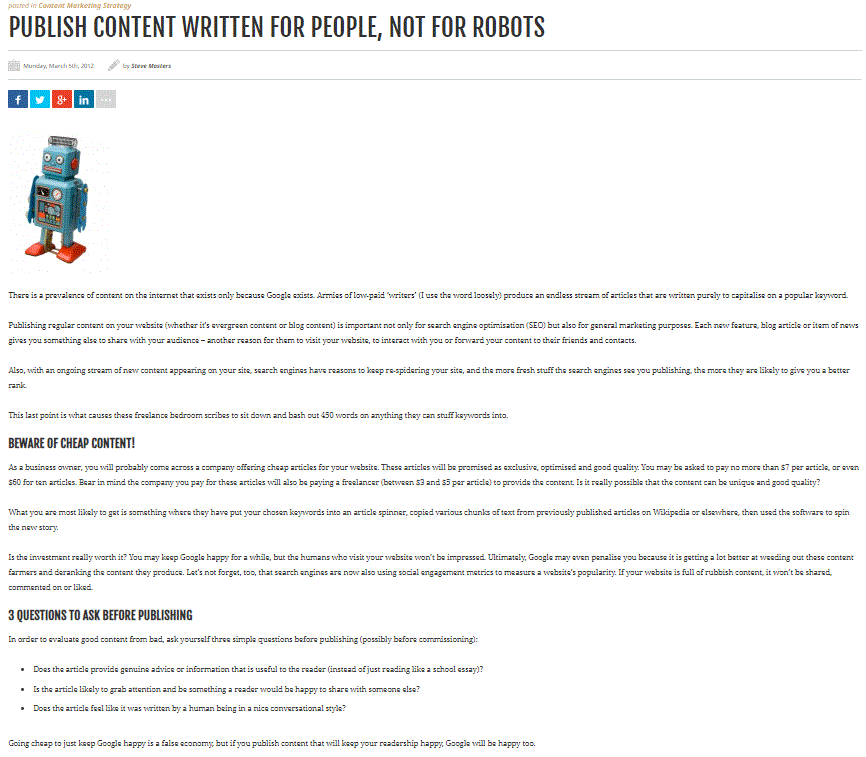
For the purposes of this practical guide, here is some example content that my recommended enhancements are based upon.

Demo content example - Vertical Leap

Demo content example - Vertical Leap

Practical steps I would consider and complete for this exercise include:

  • Refreshing the content. The content in question has not been updated in some time (years) and we know that the major search engines such as Google prioritize content that is up to date and reliable. Easy updates would include:
    • Adding new statistics.
    • Including fresh, relevant quotes.
  • The content is text only. Google looks to display content that applies to many users and their content preferences. Ideally, I would seek to add in images, plus a video if I had the ability to easily record content.
  • There has been a large resurgence in audio content over the past two-plus years (example podcasts and audio downloads), plus it is simple to record audio files, so adding in an audio option for people to access the content on the move and via Smartphones would be beneficial.
  • The content looks light in terms of the depth of coverage and the length of the article (word count). There are two things that I would do to decide on how to act on this is:
    • Firstly, see if there are any other similar contents on the site which could be useful for combining this content with. To do this using GA I will refine my Google Analytics search to include the word ‘robots’ and I can see there is one other page, but by looking at the URL, I know that it is no relevant for this task so combining content is not the right option in this case.
    • So, my next decision is to decide if there is still demand for the content – so I can check this in a few ways. For example, by typing into Google something close to the topic such as “writing for people, not robots” and seeing the volume of competing pages.
    • Another option would be to check either Google Trends or look at Google Keyword Planner. In this case, we can check Google Trends, and see that people are still actively searching for topics such as “writing for people” in Google UK:

Google Trends demo

Google Trends demo

  • Google prefer clearly structured pages, that have logical content flow as well as clear user engagement signals. So to help with both these areas I would consider adding into the content some new engagement opportunities. I will add in an embedded Tweet which will enable people to share the content whilst they are reading it, plus I will include several in-reading Call to Actions (CTAs) to help people move along the conversion funnel and read more about our content writing services should they be interested.
  • Google Rich Results such as Google Answers, require clearly formatted questions and answers in the content (including schema markup where appropriate), so I can add in a set of questions and answers within the content that fulfill this need. As I want to enhance the depth of the content and the completeness of coverage, in this case, I would most likely add them in full and as paragraphs including h2 tags for each sub-heading, and making sure that the answers are formatted in the ways most suitable for Google Rich Results such as using lists, tables, shorter answers, and including any definitions where applicable.

Using SEMrush to Enrich Topical Completeness of Content

At this stage, it is necessary to look at the external content topics and related search volumes so that we can add to the depth and completeness of topical coverage.

ADVERTISEMENT

CONTINUE READING BELOW

The sanity checks in play at this point are:

  • Any new subtopics selected have topical relevancy to the original post (you do not want to dilute the content with loosely related information).
  • New items added have the search volumes required to merit justification for inclusion.

In this case, I have chosen to use SEMrush. As mentioned earlier, the same activity could be completed using other tools.

If you are new to SEMrush, this is a marketing tool that provides analytical data for many of the common search marketing (and primarily SEO activities).

This includes keyword research, tracking metric success in areas such as ranking changes, and enables you to run various website audits.

Using SEMRush you can complete research on your site as well as your competition.

What I want to do is enhance the topical completeness of the content by finding out the main expected sub-topics and then adding in anything that is relevant to my content that is missing.

My next action is to go to Topic Research and type in a trigger search query that is relevant to my focus area.

ADVERTISEMENT

CONTINUE READING BELOW

As I want to have some broader recommendations, I will keep the topic top-level and type in “writing”.

Now I can look at both top-level sub-themes as well as more granular items that exist within the theme too.

If I wanted to consider the value of these topics for expanding the reach of the content, I could look at the search volume of the terms using Google Keyword Planner or within SEMrush too. (You can see the search volumes present in the screenshot provided.)

SEMRush screen grab - demo data

SEMRush screen grab - demo data

Now we have content that we know can perform better, plus an action plan to improve the content.

The final item I wanted to cover is the potential for the content to perform socially and its suitability to attract backlinks and general engagement.

Here is where Ahrefs comes in.

ADVERTISEMENT

CONTINUE READING BELOW

Ahrefs enables you to run website audits, track social media, build backlinks, and complete other actions like generating content ideas from what’s performing on other sites and topics generally.

In this case, I’m going to see what external content on the topic of “writing for people”, and we can see that:

  • The topic has had a recent spike in the volume of topical content created, so now may be a good time to focus on this theme.
  • There are some identified authors who are actively writing on the topic who we could research and potentially work with as influencers in the market to access wider audiences.
  • We can see the highest performing external content (in this case looking at Organic traffic). As our goal was to increase our decline in Organic performance, being able to see what works on external websites, compare content, and make data-led decisions off the back of the analysis, is a powerful thing for marketers.

Ahrefs screen grab

Ahrefs screen grab

Summary

Finding and improving your website and marketing content can seem like a never-ending task.

ADVERTISEMENT

CONTINUE READING BELOW

Most marketing teams will include dedicated time to this activity every month, primarily because enriching your existing content will provide some of the fastest performance gains.

More Resources:


Image Credits

All screenshots taken by author, June 2020

http://tracking.feedpress.it/link/13962/13708078


If you think you’re link building, you’re doing it wrong

30-second summary:

  • Founder and CEO of Organic Growth, Kevin Carney interviewed 39 marketing professionals about their link building practices.
  • He has brilliantly condensed all these thoughts and highlighted a group of eight which is much more strategic about their link building.
  • More insights on what makes them unique and the most preferred link building platforms across the globe.

The hyperbolic title of this article is a conclusion I’ve come to after interviewing 39 people – with titles ranging from Marketing Specialist, Outreach Team Lead, Head of Content, to VP of SEO & Analytics, about their link building practices.

Of the 39 people, 23 work for agencies, 16 work for brands, and out of that group of 39, there are eight who do link building better, by approaching it differently.

So, what do they do that’s different?

First, lets please notice that this is an almost perfect 20/80 Pareto principle split, so kudos to Vilfredo Pareto, who first noticed how common this split is, way back in 1896.

The group of eight have the following in common:

1. It’s not about link building, it’s about something else

The best way I can think to describe this, is these people don’t do link building per se, they do some higher-level activity, which they take VERY seriously, and which includes the intention to attract high-quality links.

While their primary focus is on the higher-level activity, they are very aware of the importance of attracting links, and how their higher-level activity helps them do that.

2. It’s important in its own right

Did I mention they take this VERY seriously? The higher-level activity they do is not something they attend to when they can, it’s not something they “get to”. It is one of their highest marketing priorities. They devote resources to it, and in most cases wish they could devote more.

I think it’s also worth noting that of the group of eight, five are brands and three are agencies.

Examples of their higher-level activities

Below I identify the group of eight and provide a summary of what they do, and how they do it.

1. Matt Zajechowski of Digital Third Coast

Matt Zajechowski is an Outreach Team Lead and Content Marketing Promotions Specialist at Digital Third Coast, a Chicago based digital marketing agency. They work to position their clients as experts through digital public relations, and yes, I know everyone says that.

Early in the interview, Matt said,

“We do a lot of content-based linked building.”

But their idea of content is more involved than what others do.

They employ a primary tool of data-driven stories and articles, where the data comes from surveys involving 1,000 to 3,000 people. They don’t conduct the surveys themselves, but rather make use of online survey platforms such as SurveyMonkey and Amazon Mechanical Turk. These surveys run over the course of weeks and in some cases a few months.

The survey results provide patterns, trends, and stories with which to create highly unique content that provides insights not available elsewhere. The design of their surveys takes into account what articles are already published on the topic in question, as they work to avoid publishing something already covered by someone else.

As you can imagine, these articles make excellent link bait. Not because they are link bait per se, but because they’re good.

Their link building philosophy is that truly unique content, based on large sets of data that provide interesting insights, not only makes initial link building easier but soon attracts links without continued effort on their part.

2. Steve James, Freelance Marketing Consultant

Steve James is a freelance marketing consultant in Vancouver, British Columbia. Steve focuses on helping small, medium, and enterprise businesses.

What Steve does differently is to not focus on “what” to do, but rather to focus on “who” might be interested.

Steve said something I found to be a very interesting perspective:

“You need links to show you’re known by the right people.”

I can best illustrate his approach by sharing a story he told me to explain his approach.

Steve had a client who was a tailor who sold custom made suits. Rather than focus on building links to the tailor’s website per se, Steve thought about who cares about suits at all, let alone custom made suits.

Obviously, people who wear suits. So, who wears suits? Well, the mayor and the members of the City Council wear suits. The next question is, what can he do to get them to notice the tailor?

This resulted in content being published on the tailor’s website that was effectively written for the mayor and other city dignitaries and promoted to them.

This resulted in links from the city government website, and the mayor’s blogs. Being a local business, that was enough to lift the tailor’s website onto the first page of Google.

This led to a whole new market of online prospects, people who follow the Council members, and business professionals that wear suits.

Steve’s link building philosophy is not that he does a set of things related to building links, but he does whatever is appropriate to attract the attention of the right people.

3. Olga Mykhoparkina of Chanty

Olga Mykhoparkina former Chief Marketing Officer at Better Proposals Chanty, a software company that provides a team messaging tool similar to Slack and MS Team. They’re based in Zurich and Kharkiv, Ukraine. Their approach is public relations, where link building is a side effect of that.

Olga told me,

“We don’t really do anything to just get backlinks….. Links that we get are more of a side effect”.

Their larger effort is “to be known”, not to build links per se.

She then described how their main focus is on maintaining contact with journalists and answering questions of interest to these journalists.

They have people who monitor journalist requests on platforms such as HARO, SourceBottle, and JournoRequest, read every request and respond to every relevant inquiry. Any question they can answer, they do answer.

This is resulting in 20 to 50 quality backlinks per month, some from websites as authoritative as Forbes, American Express, and Business Insider.

This public relations work requires two full-time people.

Their link building philosophy is that by helping journalists, they greatly improve their exposure and their backlink profile.

4. Jamie Kehoe of Venturi

Jamie Kehoe, Former Content Manager at Venturi, an IT recruitment agency located in Manchester, England mentioned that their approach is community management, which helps them greatly with link building.

What encapsulates that idea is Jamie’s statement of,

“We’ve been nurturing this community…..”

A Slack channel is the hub of their community discussions, and their community management also includes content on their blog and a weekly podcast, Venturi’s Voice.

The discussions within their community are focused on teams; recruiting, building, nurturing, managing, and so on.

The podcast gives them unique content not available elsewhere, and each episode is an interview with someone solving problems in interesting ways.

The community management activities, including producing the podcast, are done by multiple people and works out to about two full-time equivalents.

Their link building philosophy involves generating unique interesting content to answer questions their community is asking.

5. Cécilien Dambon of Venngage

Cécilien Dambon is International Growth Manager at Venngage provides a software tool for making infographics and is based in Toronto, Ontario.

An interesting comment Cécilien said is,

“You send the same email to 100 people and you get a 3% conversion rate, and you send that same email super customized to ten people and you get the same result.”

So they focus on relationship building, and yes, I know everyone says that.

At Venngage this shows up as ten people in Venngage marketing maintaining a close relationship with people outside of Venngage with whom they do co-marketing. Co-marketing being a corporate buzzword for helping people who are also helping you.

They are proactive about doing favors for their friends without an expectation of payback for each and every favor.

Of course, there are limits. If someone they co-market with accepts favors and never returns them, that relationship is allowed to wither and is replaced with one that is more mutually beneficial.

This is not a dedicated function with Venngage marketing per se but by virtue of ten people maintaining co-marketing relationships with (give or take) 10 people each, their co-marketing network is strong.

Then when they need favors, they have a network of friends to ask for help.

Their link building philosophy can be summed up in that Beatles lyric: “With a little help from my friends”.

6. Miles Smith of Imaginasium

Miles Smith is Director of Digital & Inbound/Content Marketing at Imaginasium, an agency located in Green Bay, Wisconsin, specializing in helping manufacturing businesses.

Their focus is best summed up in the word “alignment”.

Miles said two things to me that I found to be of great interest:

Marketing is not simply creating demand for what is. It involves changing the business to best meet what demand exists.

Everything is link building, and links indicate the right people know about you.

Item two above is similar to the focus Steve James has on “who” rather than “what” and drives what content they publish, to whom they promote it, and how they promote it to them.

Their focus on “everything is link building” is the principle around which they organize their work.

While from this point on, things do look tactical for a while email outreach jumpstarts their link building, the alignment they worked on earlier helps their link building occur on its own faster, as they have less “content promotion inertia” to overcome.

As they’re an agency, the level of staffing required to make this happens depends upon what their client is paying for, but generally, for a client who takes this seriously, one to two full-time equivalents, consisting of bits and pieces of various team members (in-house and outsourced), are involved in this work.

Their link building philosophy is it’s important to be known by the right people.

7. Chris Eckstrum of Housecall Pro

Chris Eckstrum, former Manager of SEO at Housecall Pro, a company that provides software to tradespeople to help them run more efficient businesses. They’re located in San Diego, California.

They also focus on community management.

The hub of their community is two Facebook groups they own and manage. One is for home service professionals, the other is for women service professionals.

The groups are closed, in the sense that people need to ask to join and Housecall Pro vets them to make sure they are tradespeople, but the group is not limited to Housecall Pro customers. Any tradesperson can join.

Chris told me the discussions within the group provide them with content ideas as well as content amplification and links, as much of their content comes from discussions and interviews with group members, and all content is then shared with the group.

Their management of the groups is very active. They engage frequently with members.

Link building occurs primarily by members of their community directly linking to their content, as well as members of their community promoting the content with others.

Managing those two Facebook groups is a full-time job for two people.

Their link building philosophy is; links come fairly naturally from managing and nurturing their online communities.

8. Araks Nalbandyan of 10Web Inc

Araks Nalbandyan is the Director of Digital Marketing at 10Web an agency that builds, manages, and hosts WordPress websites. They’re based in Newark, Delaware.

They are the exception within this group of eight, as they do what the rest of us do, but more so, and better, which primarily means with a high degree of personalization.

Their primary link building strategy is content promotion via email.

By “more so”, I mean they have two people doing it full time, and by “better” I mean that every pitch is highly personalized. They do not send mass emails.

The degree to which this is true is illustrated by how Araks described the training of the people who do link building. The very first pitch they compose can take four hours to draft. Over time, they get better at it, and four months later they’re able to craft a highly customized pitch in 20 minutes.

What they’re doing is highly customized email pitches at volume, which I am differentiating from the sending of mass email, which is generally very slightly customized by the use of templates.

The other thing they do differently from the bulk of us is they actually and rigorously track their outreach attempts and results, and adjust based on that feedback. They do this in part with the reporting capability of the email product they use (Lemlist), and in part by dumping data from various sources into Google Data Studio and generating information from the data.

She said one that really caught my attention,

“The main reason I separate the Content Promotion (from other link building tactics) is because of the open rate, the click-through rate, and the answer rate of those kinds of emails are super high. One of our campaigns reached an open rate of about 78%, which was huge, and we got a lot of responses and a lot of links from that.”

Their link building philosophy has two prongs:

  1. Highly personalized email pitches are worth the effort.
  2. You can’t manage what you don’t measure.

The rest of us are focused on the tactical aspects of link building

Which it appears, is not an effective way to build links at scale. The other 31 people I interviewed aren’t doing link building wrong per se, they’re just being less effective. Their efforts build links, but not on the same scale.

From talking with this group of people, the “issue” if that’s the right word, is their link building approach is much more tactical, and not as strategic as the group of eight listed above.

The group of eight is much more strategic about their link building (by considering it to be part of a higher-level activity) and much more tactical about their higher-level activity, which is what they attend to in their daily to-do lists.

And I appreciate their contribution to this article

For the record, the group of people I interviewed above and beyond the group of eight is:

Agencies

  • Olivier Mamet of Sandbox, located in Mauritius
  • Nick Bennett of Growmeo Marketing, in Phoenix, Arizona
  • Brooks Manley of Egenius, in Greenville, South Carolina
  • Sam White of New Dimension Marketing & Research, in Encinitas, California
  • Greg Heilers of Jolly Content, in Walnut Creek, California
  • Djordje Milicevic of StableWP, in Toronto, Ontario
  • Syed Irfan Ajmal of SyedIrfanAjmal.com, in Peshawar, Pakistan
  • Kyle Douglass of Revium, in Melbourne, Australia
  • Andy Nathan of Smart at the Start, in Chicago, Illinois
  • Jonathan Aufrey of Growth Hackers, in Taipei, Taiwan
  • Amine Rahal of IronMonk Solutions, in Toronto, Ontario
  • Markelle Harden of Knowmad Digital Marketing, in Fort Mill, South Carolina
  • David Kranker of David Kranker Creative, in Grand Rapids, Michigan
  • Kyle Kasharian of 9Saill, in Fairfield, New Jersey
  • Dean Cacippo of One Click SEO, in New Orleans, Louisiana
  • Cory Hedgepeth of Direct Online Marketing, in Wexford, Pennsylvania
  • Jonathan Gorham of Engine Scout, in South Yarra, Australia
  • Irena Zobniów of Insightland.org, in Wroclaw, Poland
  • Celest Huffman of Rocket Web, in Nashville, Tennessee

Brands

  • Shejraj Singh of YoStarter, in Punjab, India
  • Michael Anderson of Geolango Maps, in Pleasanton, California
  • Slisha Kankariya of With Clarity, in New York City
  • Christina Sanders of Lucidpress, in Salt Lake City, Utah
  • Erin Osterhaus of CORT, in Austin, Texas
  • Patrick Whatman of Spendesk, in Paris, France
  • Matt Bassos of Vuly Play, in Brisbane, Australia
  • Dana Roth of FortVision, in Tel Aviv, Israel
  • Quincy Smith of Ampjar, in Shanghai, China
  • Taavi Rebane of Messente Communications, in Tartu, Estonia
  • Praveen Malik of PMbyPM, in Delhi, India
  • Jakub Kliszczk of CrazyCall, of Wroclaw, Poland

The software tools used

I thought it would be interesting to know what software tools are used for their link building activities, so I asked and compiled this list.

In the spirit of full disclosure, these are the tools people thought to mention to me when I asked, and I tried not to ask leading questions. As such, it’s possible some people simply didn’t feel that a tool such as Google Sheets was worthy of mention, whereas others did.

What surprised me is that neither Majestic SEO nor Google Custom Search Queries get much respect.

Below is a list of each software tool, and the number of people who said they use it.

  • Ahrefs: 27
  • SEMRush: 21
  • Google Sheets: 15
  • BuzzStream: 8
  • io: 8
  • MozPro: 6
  • Screaming Frog: 5
  • Mailshake: 4
  • VoilaNorbert: 4
  • Google Custom Search Queries: 3
  • MajesticSEO: 3
  • HubSpot: 2
  • MozBar: 2
  • SimilarWeb: 2
  • Trello: 2
  • Answer the Public: 1
  • Asana: 1
  • Boomerang: 1
  • Cision: 1
  • Cora: 1
  • Google Calendar: 1
  • io: 1
  • LemList: 1
  • Link Prospector: 1
  • com: 1
  • PitchBox: 1
  • io: 1
  • Scrapebox: 1
  • SEO Power Suite: 1
  • SEOquake: 1
  • org: 1
  • Spyfu: 1
  • Ubersuggest: 1

The tactics employed

I also asked people about their link building tactics, but since seeing that the difference that makes the difference is not one’s tactical approach to link building, but rather one’s tactical approach to their higher-level activity, I fear I would be leading you astray by publishing this list.

In spite of the fact that I met everyone but one person through HARO, I was surprised to discover how many people consider HARO to be a valuable link building tactic. It was the third most popular tactic, by a long shot.

Below are the top three, and the number of people who stated they use it.

  • Content promotion via email: 24
  • Guest blogging: 23
  • HARO: 18

The fourth most popular tactic was used by only 8 people.

In closing

Link building at scale requires resources. Some companies, even some larger companies, do not devote the one or two full-time equivalents required to do it effectively.

If, due to resource constraints, you can’t be one of the top tier link building players, the way you emulate them is:

Devote bits of pieces of lots of people to make up as many full-time equivalents as you can. Since your more successful competitors are devoting appropriate resources, you’ve got to compensate or be left behind.

Prioritize that work as important enough to get to, even if that requires something else to be less important, and yes, I know that is easier said than done.

While each email might start with a template, make each email highly personalized to the person you’re sending it to. Based on the people I spoke to for this article, fewer highly personalized emails have greater success than mass emails where the personalization is just what’s done in the template.

Kevin Carney is the Founder and CEO of the boutique link building agency Organic Growth.

https://www.searchenginewatch.com/2020/07/07/if-you-think-youre-link-building-youre-doing-it-wrong/


5 Hidden Gems in Google Search Console via @BrianHarnish

Within Google Search Console, hidden gems abound.

But, there are five special hidden gems that will help make your SEO life easier.

Most webmasters are familiar with Google Search Console.

It is a toolbox created by Google to help uncover technical issues.

If you are considering buying another analytics tool, I highly recommended you explore GSC first.

You may not need another tool at all if the issues on your site are restricted to those found in GSC.

It is not the most intuitive.

While many features of the old version of the tool have failed to be added to the new version (the robots.txt tester, and crawl stats, among others), it is still useful.

I don’t know about you but I always used the robots.txt tester and the crawl statistics tools.

Not quite as useful as it could be, but still good.

Let’s take a tour of five hidden gems in GSC that may not be obvious from the outset.

ADVERTISEMENT

CONTINUE READING BELOW

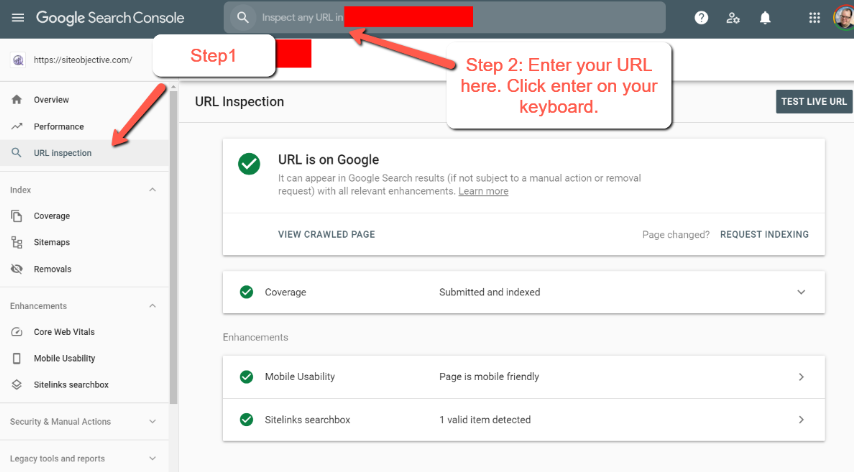
1. URL Inspector Tool

This is GSC’s answer to the old Google Webmaster Tools’ “Fetch as Googlebot”.

It performs the same function and allows you to submit your URLs for indexing.

URL Inspector Tool

URL Inspector Tool

Are you tired of waiting for Google to come back and crawl your site after an update?

Enter GSC’s URL Inspection Tool.

This little gem allows you to have Google recrawl a page at your demand.

It also allows you to see any web page just as Google sees it.

It’s a great tool to find problematic pages.

For example, if your site has been hacked, and is being used to display information that is part of another website (a form of cloaking – not to be confused with iFrames), then the URL inspection tool will allow you to see indexation issues, other issues, and more.

ADVERTISEMENT

CONTINUE READING BELOW

2. Find Obscure URL Errors Like Soft 404s

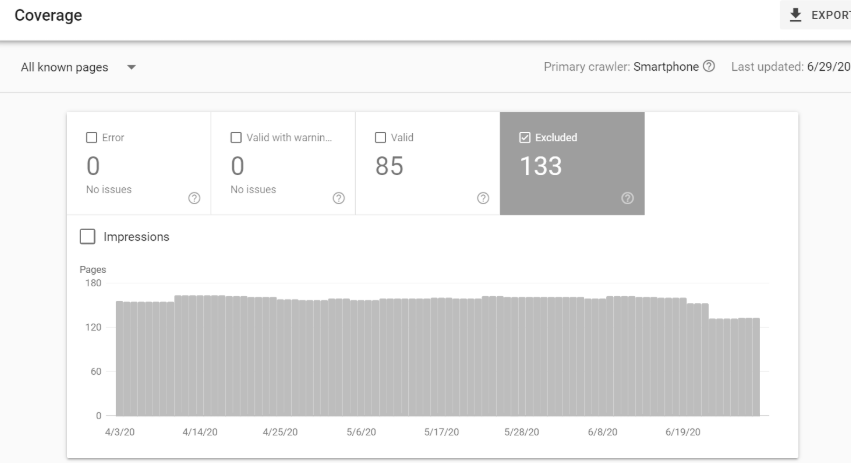
Coverage Report

Coverage Report

While the coverage tab will help you uncover issues with pages that have errors, did you know that there are other advanced errors when you dig deeper?

Yep.

You can find soft 404 errors that are generated on your site.

These types of errors occur when you have a page that is serving up blank content.

They otherwise show up as 200 OK status and are not always easy to spot unless they are labeled.

You would have to visit the page itself to find the specific page that is being served in this fashion.

Also, if you are experiencing ranking and indexation issues, the coverage area will allow you to find other errors such as:

  • Pages labeled “noindex”.
  • Pages with redirects.
  • Pages that have been crawled but not currently indexed.
  • Crawl anomalies (which will require you to dig deeper to figure out what’s causing the crawl issue).
  • And other significant issues.

If you are experiencing ranking and indexation problems, these sections will help you better diagnose problem areas on your site that arise due to mismanagement.

In addition, you can find deeper issues when you untoggle “Error,” “Valid with warnings,” and “Valid.”

Make sure “Excluded” is checked.

When using this data, always pay attention to your indexed pages.

Say you have 1,343 pages on your site. But the pages indexed reads double that number.

You may have issues with indexing due to a site search plugin that you installed that’s generating hundreds of thousands of URLs from a single search.

As you can imagine, this is not a good thing.

It can lead to serious duplicate content issues that can also lead to serious ranking problems.

3. Perform Deeper Keyword Analysis on Ranking Pages

Did you know that you can dig deeper and find information on pages specific to a query that you are ranking for?

And that you can then strategize performance fixes and improvements based on these categories?

ADVERTISEMENT

CONTINUE READING BELOW

Yep.

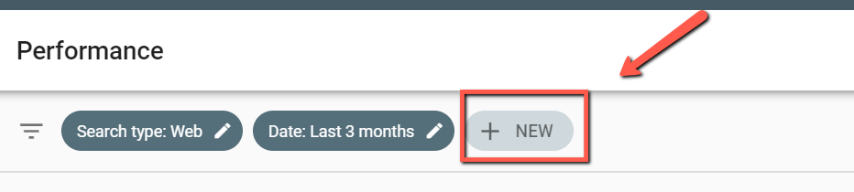
Performance Report

Performance Report

Go to Performance > + NEW, and choose the information you want to uncover.

Let’s say we want to find information on pages containing a specific query that Google is actually ranking.

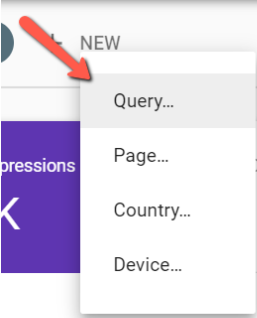
Click on Query.

Click on Query

Click on Query

Follow the steps below.

Queries Containing

Queries Containing

Your next screen will then display all the pages that are ranking for that query.

If none show up, you may not be ranking.

And, you can even toggle between Pages, Countries, Devices, and Search Appearance.

ADVERTISEMENT

CONTINUE READING BELOW

Diving deeper into these selections will help you uncover data and assess the pages on your site that you want to improve and why.

It will help you develop a completely tailored search experience on your site for queries and pages for your users.

This is a great way to find keyword data that benefits you, as it helps you make strategic decisions for your site that will be most effective.

4. URL Removal Tool

URL Removal Tool

URL Removal Tool

Extreme caution must be taken when using this tool unless you want to cause severe issues sitewide.

You don’t want to remove a URL that was actually causing good things to happen.

And, on the flip side, you do want to remove problematic URLs that are no longer valuable, have outdated content, or there is no way you can really improve them in the context of your current SEO efforts.

ADVERTISEMENT

CONTINUE READING BELOW

In short, if you are unsure of what you are doing, it’s best to ask a seasoned professional before you screw up your rankings beyond repair.

Be warned…this tool is not for the faint of heart. Or the inexperienced.

5. Context: The Last Hidden Gem of GSC

One last hidden gem in Google Search Console in your quest to identify and correct website errors is understanding the real-world context of the problems reported by the tool.

While problems with indexation can reveal issues like too many indexed pages, be careful there isn’t another site or design issue that is interfering with this.

Find out about these issues by performing your due diligence and investigating problems you aren’t sure about.

Ask questions.

And follow-up with your whoever manages these types of issues on your site if there are major issues.

Context can mean the difference between getting issues fixed on time and within budget or just creating more problems.

ADVERTISEMENT

CONTINUE READING BELOW

As you learn the intricacies of GSC it will be easier to use and you will be able to identify issues more quickly.

These suggestions are just the tips of the iceberg.

But, they can help you identify some serious site issues without having to spend more money on additional tools.

More Resources:


Image Credits

All screenshots taken by author, July 2020

https://tracking.feedpress.com/link/13962/13704987/373546


The 3 Types of SEO Reports You Should Be Building in 2020  via @Supermetrics

This is a sponsored post written by Supermetrics. The opinions expressed in this article are the sponsor’s own.

SEO reports come in many shapes and sizes, which is why it’s important to start building yours with a clear goal in mind.

Do you want to:

  • Track your website’s organic visibility in the SERPs?
  • Get content ideas?
  • Identify ideas for paid search campaigns?
  • Figure out which link-building tactics have been generating the best results?

In this post, we’ll walk you through three must-build SEO report types that will help you stay competitive in 2020 and beyond.

Report #1: Website Health Audit

Before you do anything else, you’ll want to understand your website’s overall health in terms of on-page SEO (internal) and referring domains (external).

This report will function as the foundation for the following report types.

Pro tip: You can use Supermetrics’ SEMrush, Ahrefs, or Moz connectors to run this audit.

Website Overview (Internal)

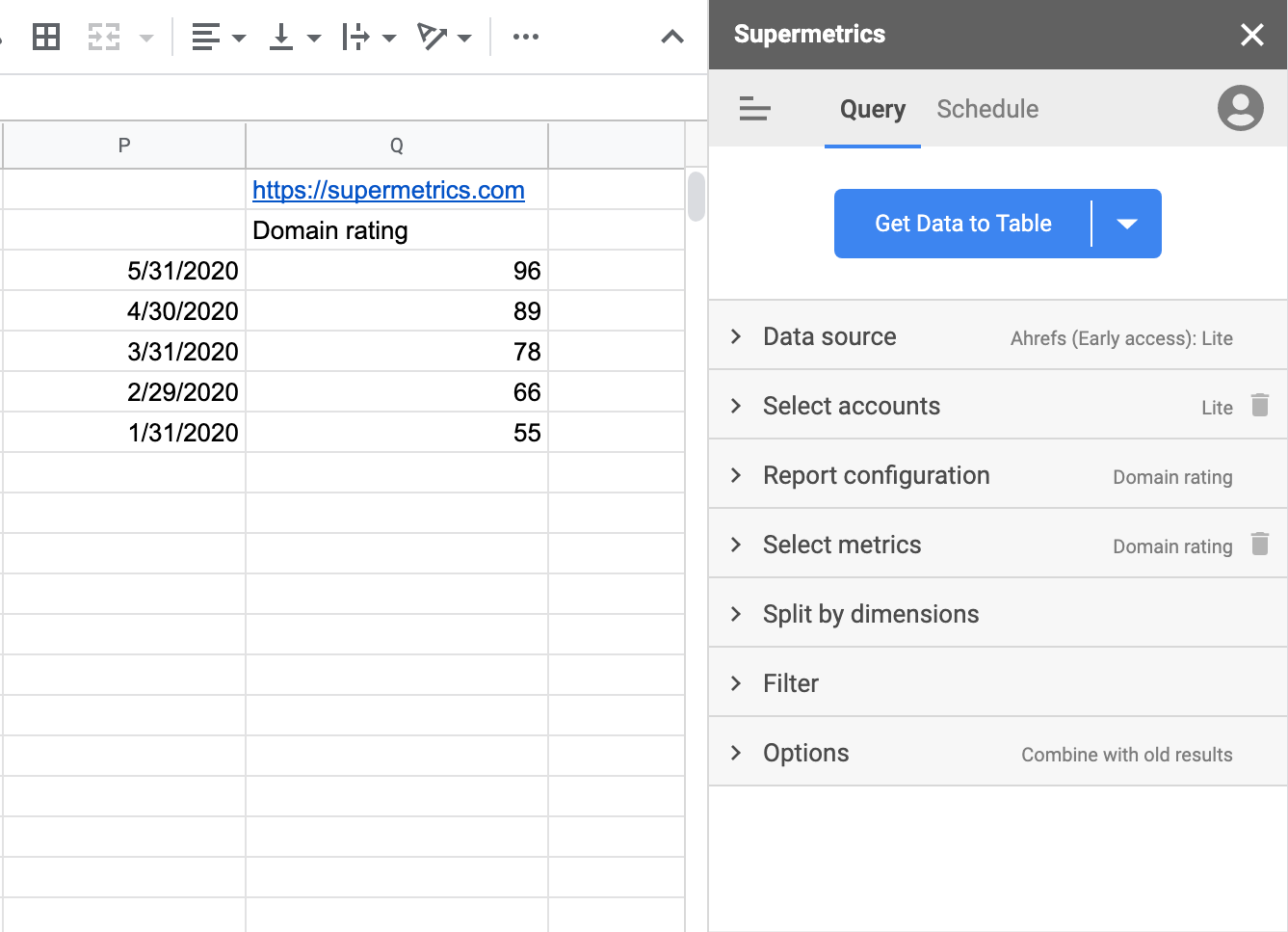
First, create a new spreadsheet for tracking changes in your domain and page authority.

This will help you see progress over time.

The 3 Types of SEO Reports You Should Be Building in 2020 

The 3 Types of SEO Reports You Should Be Building in 2020 

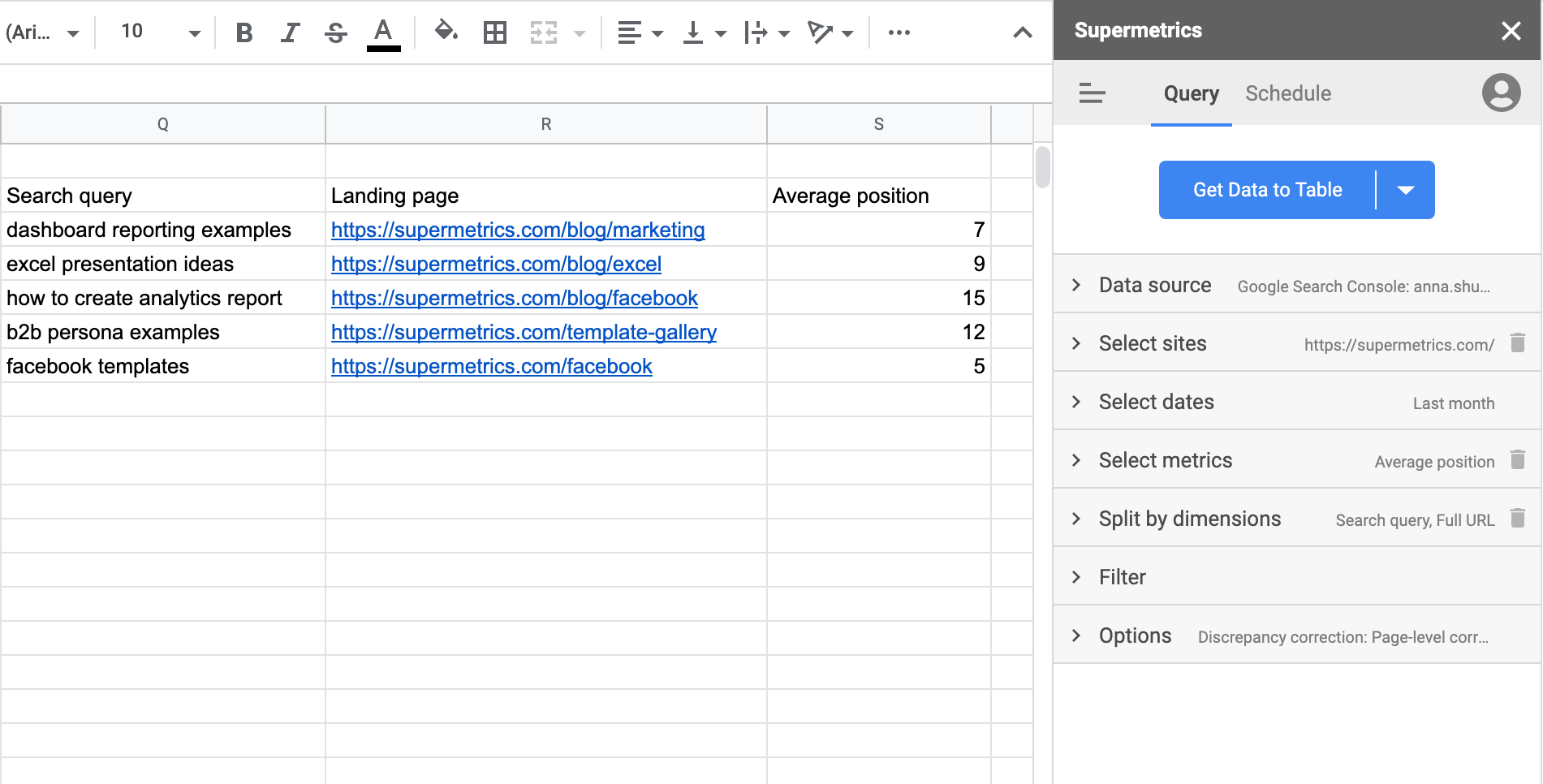
Next, create a breakdown of your key pages and their SERP positions.

This will help you identify the pages that require attention.

The 3 Types of SEO Reports You Should Be Building in 2020 

The 3 Types of SEO Reports You Should Be Building in 2020 

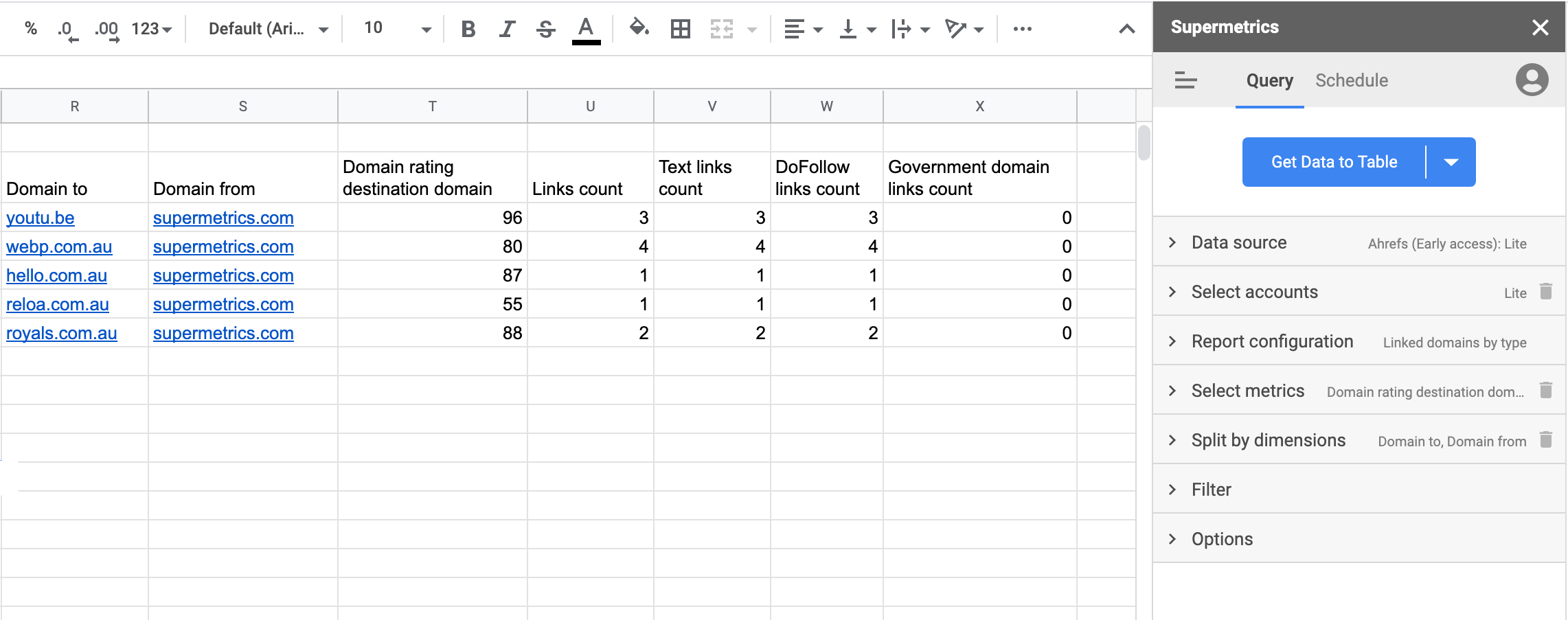
Finally, you’ll want to create an overview of all the domains you’re currently linking to.

Here, you might want to track the following metrics:

  • Domain authority.
  • Unique page count.
  • Domain type (typically it’s better to link to government or education domains as sources).
  • Link type (nofollow vs. dofollow and/or text vs. image).

The 3 Types of SEO Reports You Should Be Building in 2020 

The 3 Types of SEO Reports You Should Be Building in 2020 

After you’ve audited your own domain, it’s time to take a look at the domains that are linking back to you.

Backlink Overview (External)

This report will help you see which domains link back to your website.

From there, you can identify opportunities for backlinks.

In addition, you’ll see what kind of content external sites find valuable, which allows you to adjust your content strategy accordingly.

First, pull together the total number of referring domains, pages, and backlinks for each of your key pages.

The 3 Types of SEO Reports You Should Be Building in 2020 

The 3 Types of SEO Reports You Should Be Building in 2020 

After that, analyze how many backlinks you lost or gained over time, and from which domains.

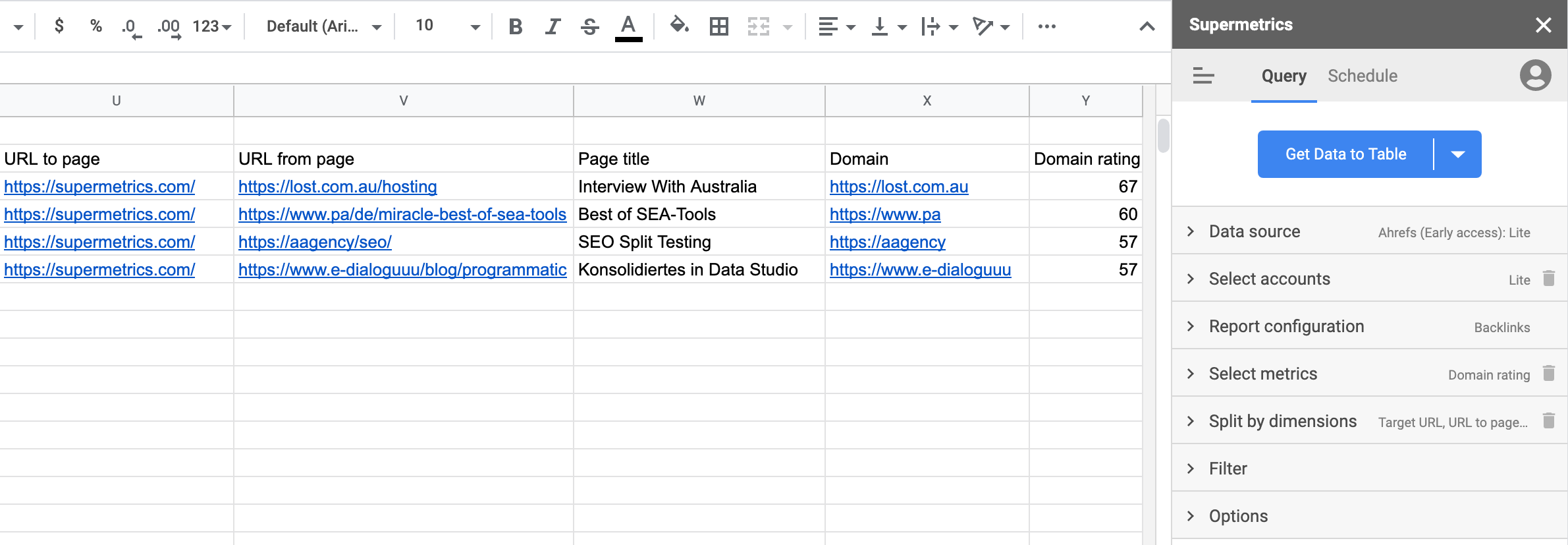
You can also go more granular here and create a breakdown of links to see the exact URLs of the external domains that link back to your site.

Another helpful breakdown is referring domains by country, which helps you see the geographic regions that are linking back to your site.

In case you notice a large number of links coming from a specific location (e.g., Spain), you might want to consider creating some content in Spanish or focusing your backlink outreach activities on Spanish people and businesses.

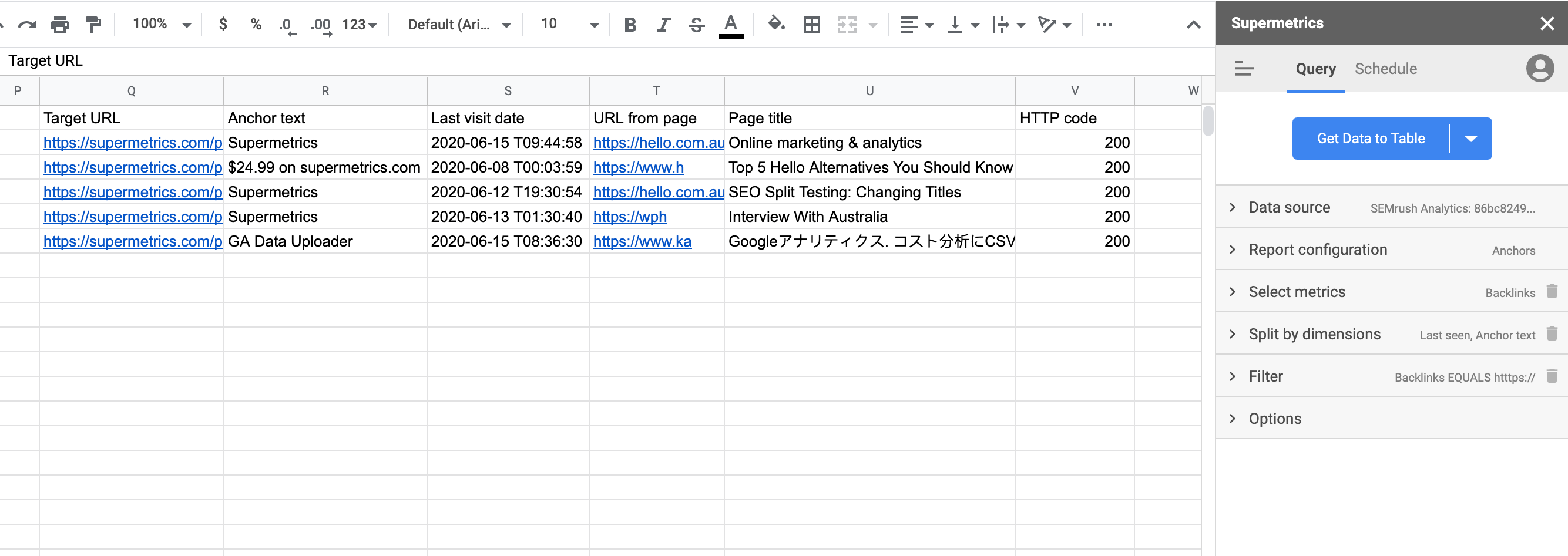
Additionally, pulling the anchor text of your backlinks will help you understand the context of the backlinks you’ve gained.

Finally, it’s good to report on the first/last seen date to track how fresh the backlinks actually are.

If no one has clicked on them during the past month, perhaps you could offer a more relevant backlink instead?

Get Detailed Information About Your Website Pages

To complete the health audit, add more data about your website pages that have backlinks.

First, check Google Search Console to make sure all of them are indexed on Google.

After that, check the source URLs to make sure they haven’t changed.

If the URLs have changed, pay attention to the response code and set up redirects if needed.

Here’s an example of what your backlink breakdown might look like in Google Sheets:

The 3 Types of SEO Reports You Should Be Building in 2020 

The 3 Types of SEO Reports You Should Be Building in 2020 

Report #2: Paid Search & Organic Keyword Opportunities

After you’ve analyzed your website’s overall SEO performance, you can move on to the next report:

Identifying keyword opportunities for SEO and SEM.

SEMrush is one of the best data sources for this report.

Run a Paid Keyword Audit

First, let’s identify your website’s top keywords, check how much traffic these keywords are bringing in, and see which website pages these keywords are leading people to.

Next, check what your keywords’ paid search positions are.

This will help you evaluate the competitiveness of your current keywords.

If you’re using SEMrush, you can also check your own and your competitors’ ad text copy along with ad performance. This will help you spot:

  • Popular keywords to be used in paid search ads.
  • The traffic volume is that’s brought to your website via paid search ads.

Based on this information, you can see whether there are some keywords you can outbid.

You might also want to start creating content around high-performing keywords to get more organic traffic.

If you’re using Google Search Console and Google Ads, you can build a report that shows the following for each keyword:

  • Organic search vs. paid search clicks.
  • Paid search CTR and conversions.
  • Organic search ranking.

This data will help you see how much each keyword/search phrase relies on SEM.

If the reliance is high, you might want to create more content around these keywords to get more organic search traffic.

The 3 Types of SEO Reports You Should Be Building in 2020 

The 3 Types of SEO Reports You Should Be Building in 2020 

If you want to learn more about this report and get a nifty Google Sheets template for it, head over to this post.

Get More Keyword Ideas for Your Content

SEMrush, Moz, and Ahrefs are all great tools for finding new content ideas.

First, you can pull your keywords’ organic and paid results along with their respective domains and URLs. This data alone can provide you with a ton of ideas on what to write about.

If you’re using SEMrush, you can also see the keyword’s ad history to get more ideas for your content and/or ad copy.

Alternatively, you can use a more targeted approach here.

Simply select a competitor’s domain and check what the top-ranking pages for a particular keyword are.

Next, create better and more comprehensive content that would rank better for a particular keyword.

Report #3: SEO Competitor Analysis

We’ve covered some examples of competitor analysis in the previous reports, but since this is such an important area, you should probably create a separate report with this data.

First, start with a general overview. Check your competitors’ domain authority, page authority, and number of backlinks.

Here’s an example of this report with data from Moz:

The 3 Types of SEO Reports You Should Be Building in 2020 

The 3 Types of SEO Reports You Should Be Building in 2020 

You can get this Data Studio report as a template for free from Supermetrics’ template gallery.

If you want to go granular, here are a few more ideas of what to include in your report:

  • Which keywords your competitors are ranking for?
  • What the traffic and CPC for each keyword is?
  • What the competitors’ backlinks are and from which domains?
  • Which domains are ranking for the same terms as you?
  • What content/keyword gaps there are between you and each competitor?
  • What your competitors’ best-performing paid ad copy is?
  • What kind of content your competitors create to rank high for a certain keyword?

Start Building SEO Reports for Free

As you’ve probably noticed by now, a great SEO report should include data from many different sources.

You can use Supermetrics to pull all your data from Moz, SEMrush, Google Search Console, Google Ads, and any other marketing data source into a spreadsheet, Google Data Studio, your go-to BI tool, or your data warehouse.

Start your free 14-day trial of Supermetrics today.

The 3 Types of SEO Reports You Should Be Building in 2020 

The 3 Types of SEO Reports You Should Be Building in 2020 


Image Credits

Featured Image: Image by Supermetrics. Used with permission.
In-Post Photos: Images by Supermetrics. Used with permission.

https://tracking.feedpress.com/link/13962/13704120/372166


Google: Spam Reports Do Not Result in Manual Actions via @MattGSouthern

Most spam reports submitted via Google search results do not lead to manual actions. Google uses the reports to improve it’s spam detection capabilities.

In a blog post penned by Google’s Gary Illyes, it was revealed that only a small fraction of manual actions issued are the result of spam reports.

“Thanks to our users, we receive hundreds of spam reports every day. While many of the spam reports lead to manual actions, they represent a small fraction of the manual actions we issue. Most of the manual actions come from the work our internal teams regularly do to detect spam and improve search results.”

While spam reports do not lead directly to sites getting penalized, they’re essential to helping Google prevent spam from being surfaced in search results in the first place.

As Illyes explains, using spam reports to fix an issue with Google’s spam detection systems is more impactful than issuing manual actions.

“Spam reports play a significant role: they help us understand where our automated spam detection systems may be missing coverage. Most of the time, it’s much more impactful for us to fix an underlying issue with our automated detection systems than it is to take manual action on a single URL or site.”

ADVERTISEMENT

CONTINUE READING BELOW

Google’s spam detection systems work well but they’re not perfect. If they were, then Google’s search results would be 100% spam-free and that’s certainly not the case.

Although Google is inching ever closer to achieving that goal, as the company recently reported its search results are 99% spam-free.

Google filters out an average of 25 billion spammy pages every day, which is a testament to how effective spam reports can be.

Just as Google is always improving its search algorithm, the same applies its spam detection systems.

“The reality is that while our spam detection systems work well, there’s always room for improvement, and spam reporting is a crucial resource to help us with that. Spam reports in aggregate form help us analyze trends and patterns in spammy content to improve our algorithms.”

Google concedes that, overall, algorithmic solutions win over spam detection. It’s better to surface high quality content higher through ranking than it is to weed out spam.

ADVERTISEMENT

CONTINUE READING BELOW

“Overall, one of the best approaches to keeping spam out of Search is to rely on high quality content created by the web community and our ability to surface it through ranking.”

Google Updates its Webmaster Guidelines

Google is making this distinction between spam reports and manual actions extra clear with an update to its Webmaster Guidelines.

Google’s Webmaster Guidelines now have a paragraph that explicitly states what spam reports are used for.

“If you believe that another site is abusing Google’s quality guidelines, please let us know by filing a spam report. Google prefers developing scalable and automated solutions to problems, and will use the report for further improving our spam detection systems.”

That should clear up any misconceptions about how spam reports are used.

If you submit a spam report against a site hoping Google will issue a manual action, chances are that won’t end up happening. But your report may help sites like that from being surfaced in the future.

Source: Google Webmaster Central Blog

http://tracking.feedpress.it/link/13962/13703468


How to increase organic traffic: 14 Practical tips

30-second summary:

  • Organic traffic is the best shareware way to attract visitors who already want to make a deal. You should conduct a good SEO analysis and take care of the quality of your site to increase it.
  • You can get more organic visits if you develop a strategy, eliminate technical errors of your site, use its good mobile version, make correct external and internal optimization, optimize URLs, update the site content regularly, develop a blog with unique content, analyze competitors, and promote your site through social networks, press releases, newsjacking, emails, and messengers.
  • The correct implementation of the above-mentioned tasks will provide a long-lasting result for you.

Ordinary users trust SERP more than advertising and links marked as “ads”. Correctly performed optimization, troubleshooting and the use of promising channels will quickly bring a good result.

14 Practical tips to increase organic traffic

You can get organic visits using a set of working methods, tools, and recommendations. The best 14 ways are summarized in the review below. 

1. Developing a strategy to increase organic traffic

The solution to any problem begins with the development of a strategy to leave room for financial and time planning. Strategy development is carried out in stages:

  • You should set goals and objectives at first
  • Then, identify weaknesses using a comprehensive site audit and analyze the competitive environment
  • As the next step, you can eliminate identified errors and problems
  • Also, you need to select priority methods to attract organic traffic and increase the position of the site in SERP
  • Then, map the work and budget, prepare a content plan (golden rule for a content plan – 60/30/10 – third-party content 60%, unique content 30%, advertising 10%)
  • If you need, you should select specialists and form technical tasks
  • As the last step, perform tasks, analyze results using Google Analytics

Attracting organic traffic is a rather lengthy process that distinguishes it from contextual advertising. Ads start working immediately after launch. However, organic traffic will work for a long time without any additional investments. 

2. Elimination of technical errors of the site

You can identify and eliminate technical errors of the site using the following methods:

  • Surface self-check
  • Comprehensive site audit with the help of professionals
  • Usage of paid and free services. It’s an optimal solution for those who want to get a quick result with minimal financial investments. Services allow you to identify SEO errors and ones in other key positions. The best of them are Semrush, Ahrefs, and SEOptimizer

You should eliminate identified errors by yourself or with the help of professionals. It’ll make your website more attractive to users and search engines. After the site audit, you can get rid of duplicates, speed up the download of the site, identify affiliates, and solve other problems. 

3. Mobile version of the site

More than 65% of internet users prefer to select and order products from mobile devices. You can’t lose such a huge audience and should take care of your site mobile version. It allows you to increase target audience coverage several times, increase sales and subscriptions. You can create a separate mobile version or use an adaptive design of your main site. In the last case, there will be an automatic adjustment to the screens of different devices. 

4. Correct external and internal website optimization

External optimization

It’s aimed to obtain links from third-party sites. External links that aren’t protected from indexing transfer a part of a donor weight to the acceptor site. When working on building an external link mass, you should consider:

  • Donor site trust, spam level of backlinks. The first index should be high, the second one – low
  • Rules of posting links. It’s recommended to surround them with content
  • Donor site topics (should be related)
  • Frequency of placement. You should increase the link juice gradually. It’s especially important for young sites that have a low level of trust in search engines. A sharp increase can lead to the pessimization of the acceptor site

Internal optimization

It helps to make the site relevant to those queries you carry out the promotion. It consists of:

  • Keyword list collection
  • Keywords grouping
  • Preparing and publishing content optimized with LSI and SEO
  • Formation and optimization of meta tags: title and description, headings and subheadings, image tags
  • Creation of robots.txt files and sitemap.xml (if it’s not generated automatically)
  • Interlinking and other related work

It’s important to ensure that meta tags and content are supplemented with relevant keywords but are not spammed. Otherwise, you can fall under search engine filters.

5. URLs optimization

You can complement URLs with keywords. It makes them more understandable for website visitors. When optimizing URLs, it’s recommended:

  • Use from three to five relevant words, longer links will be cut off in the SERP
  • Use hyphens rather than underscores
  • Take into account spam indicators. Keywords from URLs are added to the overall frequency on the page

Optimized URLs look more attractive so visitors click on them more likely. 

6. Regular content updates

Content updates are a rather important factor which influences on ranking. We speak about updating previously posted materials as well as publishing new ones. It helps to keep pace, increase credibility, have a positive effect on indexing. 

You should carry out updates regularly following the content plan. It allows you to work with new keywords and attract organic traffic from search engines. 

7. Blogging

A blog is a valuable resource necessary for attracting organic traffic not only for commercial but also for information requests. We used to carefully choose the goods before the deal. A blog with interesting and relevant content increases chances that after reading the review, the visitor will perform the target action.

On the blog, you can publish news, information materials, as well as infographics, video reviews – everything that can attract attention and encourage visitors to make a deal. When writing articles for a blog, you can use the links to the catalog. So that the client can immediately buy the product they like without spending time searching the site.

8. Expertise and uniqueness of the content

Usage of non-unique content is a deliberately losing thing. As a result of it, you can get a claim from the copyright holder. Therefore, it’s necessary to create and optimize your content that will provide organic visits. This rule applies not only to texts but also to photos, pictures, videos. In the case of publishing someone else’s content, you must obtain the permission of the copyright holder and give a link to the source.

There is one more caveat – expertise, which plays an important role in ranking issues. Search engines don’t focus on quality optimization but on the semantic uniqueness and benefit that the content of the site can bring to the visitor. The content should answer the question that the user enters in the search bar. If the materials contain outdated, uninteresting, or knowingly untruthful data, the visitor will leave the site. An increasing number of failures will hurt ranking.

9. Promotion in social networks

Social networks are an effective tool with which you can manage opinions and drive traffic to your website. You can create a group for communication with potential customers and publish their announcements, information about promotions, discounts, updates of the assortment, and other content that encourages them to click on the link. Before starting the campaign on social networks, you need to analyze groups of your competitors, look at the situation with ordinary user’s eyes. If the posts are interesting, the subscribers will start to like and share them. This will provide additional free advertising and reach.

10. Competitive analysis

To be the first, you should know what is happening in the competition. To solve this problem, you need to use an audit which will help:

  • Define a keywords cluster
  • Keep abreast of all events, updates and new products introduced by competitors
  • Form advertising budgets and solve other strategic tasks

For audit, you can use online services, questionnaires, secret shoppers, newsletter subscription, analysis of social networks groups, and other tools. You can use the information you’ve got to improve and optimize your website.

11. Press releases on third party resources

Regular publication of press releases on popular sites will help to solve several problems. The first one is traffic attraction, the second – external optimization. News sites visitors click the links willingly. The only negative aspect is that it’s difficult to place such publications. You should make the most of your efforts to get a positive result in outreach and lead generating.

12. Using newsjacking

Newsjacking is one of the varieties of guerrilla marketing that provides unobtrusive advertising. The latter is served against the background of an important event not being a priority. The plus is that users will often visit the site using both search queries and aggregators or news portals. The main rule is to link the offer with a really interesting and important event. Otherwise, the tool will not work. 

13. Email marketing setup

From year to year, newsletters demonstrate their effectiveness. They allow you not only to communicate with customers but also to receive visits to the site. To configure the newsletter, you must have your contact base. To collect the latter, you need to place a simple registration or subscription form on the site consisting of a minimum number of lines. After that, you can establish communication with customers, notifying them of promotions, catalog updates, and other important events.

14. Mailing in messengers

Mailing in messengers is similar to emails. However, messages in Facebook Messenger, Snapchat, or WhatsApp have a higher percentage of opening. A smartphone is always near the person, such messages are more familiar and convenient. Therefore, you should not ignore the potential of this channel. Before starting such mailing, it’s necessary to ask the client whether he/she doesn’t mind receiving advertising materials. Otherwise, the sender (you) may be blocked.

To round up

Correct external and internal optimization, work in social networks and messengers, competitive analysis, technical errors eliminating, and usability improving is priority tasks to increase organic traffic. You can perform some tasks on your own. Other ones will have to be entrusted to professionals. The correct implementation of these tasks will provide a long-lasting result, an increase in organic traffic, sales, and an influx of hot customers.

https://www.searchenginewatch.com/2020/07/06/how-to-increase-organic-traffic-14-practical-tips/