Google Testing Thumbnail Images in Search Results via @martinibuster

Google is testing the use of thumbnails images in different search contexts. The first version is in the search engine results page (SERP). The second version is using thumbnail images in the Google Suggest drop down.

The implementation of the thumbnail images is similar to how Google News displays thumbnail images.

Google Tests Thumbnail Images in Search Results

The images are square cropped versions of the featured images that are on the articles.

This is a screenshot of what the full search results page looks like:

Screenshot of Google's search results with thumbnail images

Screenshot of Google's search results with thumbnail imagesThis screenshot shows Google’s search results with thumbnail images, resembling what Google News looks like.

Not All Sites Get a Thumbnail

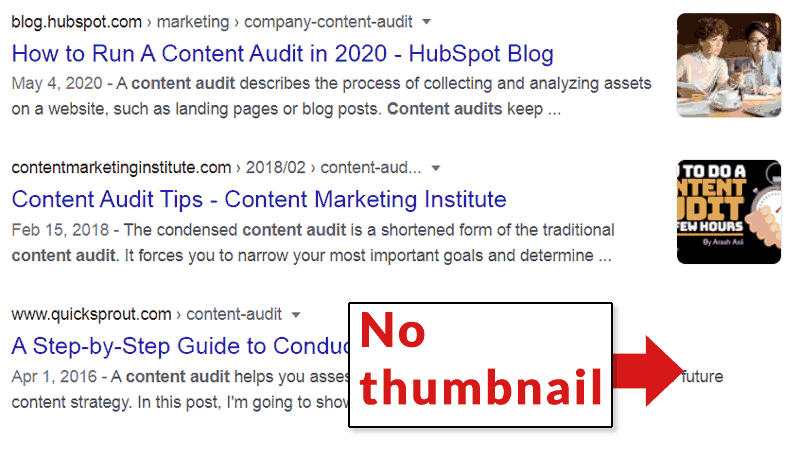
As you can see from this close up screenshot, not all sites get a thumbnail.

Screenshot of an experimental Google Search result that features thumbnail images

Screenshot of an experimental Google Search result that features thumbnail imagesWhy didn’t one site not have a thumbnail image? Could it be because the image is not declared in structured data or in the Open Graph Protocol meta tag?

It’s hard to say why that one page didn’t get a screenshot. One could say it’s because the image is not wide enough and has an unconventional aspect ratio of approximately 3:2.

The featured image for the top ranked site is close to a 16: aspect ratio (although not exactly that ratio).

But another of the sites that has a thumbnail image (HubSpot) also has the same aspect ratio as the page that did not receive a thumbnail.

The only difference with the site that didn’t receive a thumbnail is that the image is not declared in structured data nor is the image included in an Open Graph Protocol meta tag.

A few of the other sites with images displayed as thumbnails had the images declared in either Open Graph Protocol meta tag or Structured Data format.

Thumbnails in Google Suggest

Google is also experimenting with showing images in the Google Suggest dropdown.

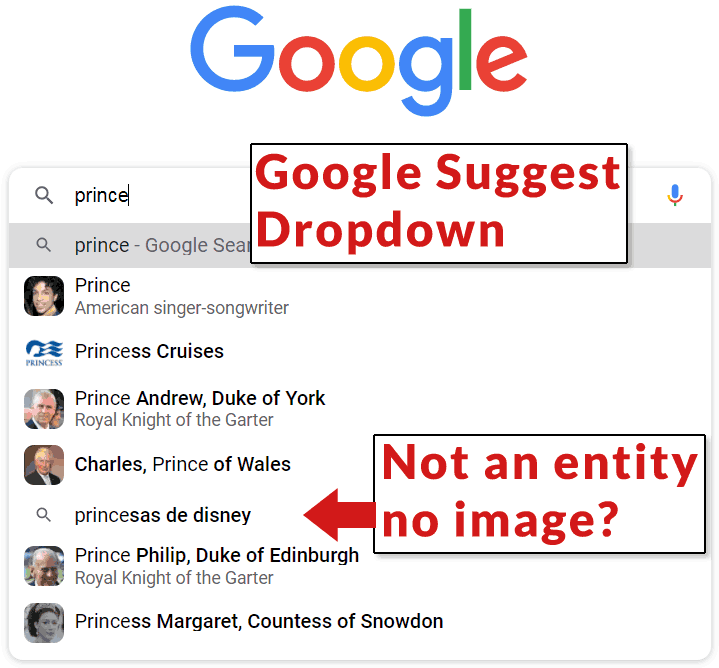
An interesting thing about the thumbnails in the Google Suggest dropdown is that the images show for a entities but not for the concept of “Disney princesses” written in the Spanish language (princesas de Disney).

Screenshot of Google Suggest Dropdown

Screenshot of Google Suggest DropdownScreenshot of a test of new Google Suggest dropdown that includes thumbnail images.

We can only speculate on why no thumbnail image was shown for that keyword phrase.

ADVERTISEMENT

CONTINUE READING BELOW

  • Are Disney Princesses not an entity with a specific image that accurately represents them?
  • Or did the fact that it was a Spanish language keyword disqualify it from the test?

Closeup screenshot of thumbnail images in the Google Suggest dropdown

Closeup of Google Suggest with thumbnail images

Closeup of Google Suggest with thumbnail images

It will be interesting to see if Google eventually rolls out this kind of search result.

Takeaways

This format apparently works well on Google News. So it’s possible that this kind of search result may go mainstream at some time.

But that depends if the images are as useful to users in the SERPs as they apparently are in the Google News and Google Discover.

ADVERTISEMENT

CONTINUE READING BELOW

Moving forward, to prepare, it may be a good idea to check if your site has implemented the Open Graph Protocol and/or JSON-LD Schema.org Structured Data.

While we don’t know if those are required for inclusion, it seems like a good idea to have them.

http://tracking.feedpress.it/link/13962/13702130


A Beginner’s Guide to Inbound Links: What Are They & How to Get More of Them via @HelenPollitt1

Inlinks, backlinks, inbound links.

They all mean the same thing – someone else’s web property is linking to yours.

A hyperlink from one webpage to another.

A simple, integral part of the internet.

Spend any time in the SEO industry and you would think links directly equal profit.

Some SEO pros spend their entire careers specializing in obtaining links.

Why are they so sought after and how can you get them?

Why Inbound Links Are Important

PageRank

To understand why links from other webpages are so important to SEO professionals we need to look at Google’s PageRank algorithm.

PageRank was developed to help Google understand how a webpage fit into the rest of the web.

In a now archived Google guidance page, PageRank was described as working

“…by counting the number and quality of links to a page to determine a rough estimate of how important the website is. The underlying assumption is that more important websites are likely to receive more links from other websites.”

ADVERTISEMENT

CONTINUE READING BELOW

This admission from Google that links are important to its ranking process is what spurned an entire industry to go chasing after them.

Other Search Engines

Google is not the only search engine that uses inbound links as a ranking signal.

Bing’s Webmaster Help and How-To guide mentions how the search engine perceives links:

“Bing prefers to see links built organically. This essentially means the links are built by people linking to your content because they find value in your content. This is an important signal to a search engine because it is seen as a vote of confidence in the content.”

Yandex also considers inbound links within its algorithm.

It gives guidance in its support documents on the importance of links and how they are gained.

The Perceived Power of Links

When surveyed by Moz in 2015, over 150 SEO professionals reported on what they believed to be the top factors that influence a page’s ability to rank well.

ADVERTISEMENT

CONTINUE READING BELOW

The respondents rated “domain level, link authority features” as the most influential factors, followed by “page-level link metrics.”

Although this is a study based on the opinions, it does go to show the perceived importance of links within the industry.

What Makes a Link Valuable

Not every link is created equally. That is, not every link will be as useful to a site as it would be to another site.

This is because of the ways the search engines use links to determine the relevance and authority of a webpage for a given search.

Importance

Google states in its help documentation:

“Google interprets a link from page A to page B as a vote by page A for page B. Votes cast by pages that are themselves “important” weigh more heavily and help to make other pages “important.””

A link from a website that is considered important will be of more benefit to your site than one from a website than a low importance one.

There is however a caveat to this. Relevance.

Relevance

It is not just the “importance” of a page that determines how useful it is in determining the rank of the page it links to.

The contents of the linking page will also have an impact.

Ensuring the website has a similar or related topic to the page that is being linked to will help reinforce the subject of that page.

This in turn can help it to be perceived as more relevant to search queries about that topic.

A Word About Metrics

There are many tools available that contain metrics to help you gauge the importance of a page.

You may have come across scores for “domain authority”, “page authority” and “domain rating” before.

These are the tool manufacturers’ attempts to quantify how the search engines perceive the importance of a linking page.

They can be useful guides but it is crucial to remember they are not used or recommended by the search engines themselves.

ADVERTISEMENT

CONTINUE READING BELOW

There is no longer any publicly accessible score for how Google rates a page’s authority.

Why Is Gaining Links Dangerous?

Search Engine Guidelines

Although links are a good way for search engines to get third-party verification on the importance of a page, they are also easily manipulated.

Over the years the voting system became compromised by link purchasing, link exchange, and other schemes.

Due to this, the search engines had to become proactive in identifying where links had been gained for the purpose of higher rankings.

Google has strict guidelines on what is considered a manipulative link. As does Bing, and Yandex.

The search engines do not want links built that will artificially give the impression the site is more relevant and important than it is.

The penalties for engaging in link building that contravenes the guidelines can be severe.

In some instances, entire websites might be removed from the search engine results pages.

This makes link building a contentious subject.

ADVERTISEMENT

CONTINUE READING BELOW

The mere practice of trying to increase links for the sake of rankings is technically against the guidelines of most major search engines.

Links Change Over Time

The other important point to note is that the value of a link changes over time.

For instance, what if the page that links to yours change its content?

The relevance of that link to your site might increase if the content becomes more aligned with yours.

If a website linking to yours acquires more relevant links to itself it might be perceived as even more of an authority by the search engines.

This can make the link to your site even more powerful.

The opposite can happen too of course.

What if the site linking to yours gets hacked?

Suddenly the search engines’ concept of what that site is about will change, so will its relevance to your site.

Good Ways to Gain Links

The all-important question is, if links are so powerful how do you get more of them?

ADVERTISEMENT

CONTINUE READING BELOW

Below is a quick overview of some popular tactics to gain new links.

However, link building needs to be a strategy, not a tactic.

It should be a mix of great content marketing and relationship building.

This article is an introduction to inbound links.

I don’t have enough time to go into detail about how to create an effective link building strategy.

For more information on that you should take a look at these articles:

Common Link Building Tactics

New Content

A good way to build links to your website is by creating content that other sites find informative, interesting, and link-worthy.

Creative campaigns that are designed first as content marketing, second as link-magnets are an effective tactic.

These creative campaigns take many forms.

Write-ups of interesting research, interactive media, and anything that you could see being shared well on social media have the potential to be picked up by digital publishers and linked to.

ADVERTISEMENT

CONTINUE READING BELOW

Be a Source of Authority

A quick check of any thought leader within an industry is likely to reveal a wealth of links pointing to their site.

Why?

Because they are being referenced by other publications.

Consider Search Engine Journal itself.

The backlink reporting tool I use suggests the website has in excess of 14 million links pointing to it. It is often used as an authoritative source in other publications.

Digital PR is an example of effectively leveraging expertise.

Contacting journalists as a source of information they can use within a story can often lead to your website being linked to.

This is especially true if you have an asset on your website that the journalist is referencing in their story.

Existing Links

Often an easy place to start with building links is making the most of existing ones.

Broken Links

Using a backlink checking tool such as Ahrefs, SEMrush, or SE Ranking it is possible to see where links are coming into your website.

ADVERTISEMENT

CONTINUE READING BELOW

These tools will also tell you if those links are still live or no longer work.

If you see that you used to have a website linking to yours but the link has since broken then there is a possibility it could be reactivated.

For instance, when a website’s content changes links are often taken out.

Sometimes the hyperlink itself is removed even though the link is supposed to be there still.

In these instances, you might find it fruitful to contact the owner of the site and ask if the link can be reinstated.

Links to 404 Pages

Over time as you change and grow your website you might let pages return a 404 status code.

If you have links from other sites pointing to these pages then the value of those links is lost.

Regularly checking your site to see if pages that have a 404 status code have links pointing to them, and redirecting those pages, can retain the value of the link.

ADVERTISEMENT

CONTINUE READING BELOW

Existing Relationships

Wherever possible leverage existing relationships.

The likelihood is that if you have an existing relationship with a publisher it is because your organization has some relevance to theirs.

This means a link from their site to yours might actually be beneficial to their readers. As such, the link makes sense.

Local Clubs

Do a lot of your team play for a local club? Do you participate in charity events?

There might be organizations you are already involved in where it would make sense for them to link to your site.

A word of caution:

If you sponsor a local football team and in exchange, they link to your website you are paying for a link.

It is highly possible that the search engines will be able to use the context of the page the link is on to deduce it is a link to a sponsoring organization.

In that instance declaring the link as sponsored using rel=”sponsored” as an attribute for the link.

ADVERTISEMENT

CONTINUE READING BELOW

Otherwise, you may fall foul of their algorithms designed to detect link manipulation.

Manufacturers

Are you an authorized retailer of a brand’s products?

Often brands will list their retailers on their site to help their clientele find a local distributor.

Make sure you are included on that list.

It is a highly relevant link to your site and should also refer converting traffic to your site.

What Not to Do

This could fill several articles.

There are many, many old link building techniques that can be damaging to your site.

For a starting guide on where not to look for link building opportunities, I want to direct you to Brain Harnish’s article: 10 Bad Links That Can Get You Penalized by Google.

I also want to make a plea on behalf of all website admins who manage popular websites.

Don’t email them asking for a link.

They get hundreds of emails a month asking for the same.

Just because they used to link to your competitor’s infographic does not mean they want to link to your infographic instead.

ADVERTISEMENT

CONTINUE READING BELOW

They might if your infographic presents more up-to-date and relevant research.

They won’t if it’s essentially the same information in your company branding.

Be wise in how you reach out to publishers. Build relationships where possible instead of cold emails.

Conclusion

Inbound links are still considered to be highly valuable in SEO.

Good inbound links are hard to build.

If they are easy then they are unlikely going to help bolster your site’s perceived authority.

At worst, they can lead to a penalty.

Link building is a hotly debated topic in the SEO world. Keep in mind that the search engine guidelines around link acquisition are all quite clear.

Links should be gained by your site naturally. Really, without interference from the site’s owner.

If you are embarking on a link building campaign then make sure the links you acquire genuinely add value to the readers of the linking sites.

Remember too that the search engines are forever tightening the net on spammy links.

ADVERTISEMENT

CONTINUE READING BELOW

Their ability to detect manipulative links grows stronger.

What tactics might be flying under the radar now might not for long.

More Resources:

http://tracking.feedpress.it/link/13962/13702049


Interview with Lior Davidovitch, the founder of PUBLC

30-second summary:

  • The worldwide web is a clear reflection of all the shifts 2020 has brought and as businesses and marketers crunch majority of their budgets and pivot strategies.
  • In light of the current scenario businesses, digital marketers, and content creators continue to face some key problems around digital ad revenue, ad blocking, and more.
  • We caught up with Lior Davidovitch, the founder of PUBLC, an innovative search engine that reinvents user experience and technology.
  • PUBLC is a new search engine built by everyone, for everyone, that aspires to create an equally distributed web economy using blockchain token economics.
  • Read on to discover insights on how PUBLC serves a more equally distributed web economy using blockchain and token economics, generating a new and native revenue stream for online publishers.

The worldwide web is a clear reflection of all the shifts 2020 has brought and as businesses and marketers crunch majority of their budgets and pivot strategies, these remain some key problems of today’s digital space:

  • Digital ad revenue has taken a hit due to ad blockers.
  • Online publishers struggle to find a native revenue model as an alternative to ad-based models, which only grows bigger now with the COVID-19 impact on the advertising industry. Digital ad revenue is declining, as use of adblockers is increasing
  • Google and Facebook duopoly dominate over 60% of global ad revenue.

We caught up with Lior Davidovitch, the founder of PUBLC, a search engine that aims to reward the entire web ecosystem by creating an innovative, more equally distributed web economy using blockchain and token economics, generating a new and native revenue stream for online publishers.

Q1. Can you tell us about your background and journey towards becoming the founder of PUBLC?

I was always one of those kids that constantly thought of different business ideas and tried to invent things. The original idea for PUBLC started over 15 years ago when I was frustrated with the existing search engines. I always thought that people know best and there should be a way to add the human element to search for a better-organized web. Back then I had mocked up a few presentations and a family friend even connected me to a VC, but I was so young and had no idea what I was doing. Later in university, I wasn’t keen on academia and dropped out to start my journey as a start-up entrepreneur. In the beginning, I was just playing around with different ideas, and eventually, I saw that I’m always going back to the same original idea of creating a new search engine. I started completely from scratch, learning everything in the process, making mistakes, learning again, and building PUBLC layer by layer.

Q2. What was the biggest challenge you faced while setting up PUBLC? How did you solve it?

Just saying that you want to create a new search engine is a huge challenge by itself, doing it the way PUBLC does, creating a new search engine that completely reinvents the user experience and technology with a token-based business model is an even bigger challenge! If you add new and complicated technologies like blockchain and AI to the mix, the challenge becomes even bigger. Plus, the fact that you’re doing it as a small self-funded startup makes it almost impossible! But eventually, we did it step by step, layer by layer and built this platform that’s backed with AI and a blockchain financial infrastructure.

Q3. Can you give us a brief insight into PUBLC and your token economy?

PUBLC is a new type of search engine built by everyone, for everyone, that aspires to create an equally distributed web economy using blockchain token economics. You can think of PUBLC as a mix between Google and Wikipedia, where we combine human intelligence with artificial intelligence (AI) enabling users to categorize the content and “teach” PUBLC how to better organize the web, creating a new search experience, while also rewarding the users for participating in the process.

With regards to the token economics, on the one hand, our token, PUBLX, is granted by PUBLC as a reward to its community that contributes to PUBLC. On the other hand, the tokens are used as the only form of payment for PUBLC’s business services used by advertisers on the platform. This balance between supply and demand is what establishes the token value.

Token earners, be it publishers, brands, influencers, or content categorizers, can either use their token rewards to pay for any of our business services or exchange them on cryptocurrency exchanges, where the tokens can be bought by advertisers. So, we encourage everyone to checkout PUBLC and discover how they could earn PUBLX tokens.

Q5. How can businesses use PUBLC? Any tips on how they can get started with PUBLC?

PUBLC was built with all the different actors of the web ecosystem in mind, as we believe PUBLC is a platform that is meant to serve everyone and reward them for the value they create. Businesses as online publishers, brands, and celebrities benefit from PUBLC as it gives them exposure to new audiences, drives traffic to their websites, and earns them revenue for every time a user clicks on their content and views it. Businesses can get started on PUBLC by submitting their website, categorizing their content, and curating their pages. Our job is to support all those people and help them better achieve their goals, so feel free to reach out to us, we would love to hear from you!

Q6. Would video content be sourced from platforms like YouTube?

Yes! PUBLC curates and displays video content that users upload on YouTube and other such sites. You’ll be surprised to know that we even reward sites like YouTube as they also provide value to the ecosystem for hosting all that content.

Q7. What are your future plans for PUBLC? Will you venture into the digital advertising aspect as well? If yes, we’re assuming it will be in-ecosystem currency of PUBLX tokens?

Besides inventing a new user experience and technology we also had to invent a new revenue model connected to our token economy – and that’s crucial to the success of the platform – having those PUBLX tokens that are given to everyone for their contribution have real-life value. In order to do that we built a new set of business services such as, promoted content, brand awareness, ecommerce, and more, which offer advertisers a new way to enhance their brand awareness or conversions in a native and organic way within the platform without compromising PUBLC’s user experience for the users. 

Our business services work differently than the way it’s done on traditional search engines, and it rethinks this traditional advertising model of just promoting ads over search queries. The usual method is good but it could be different. We put more focus on content and the user experience because when you get ads, whether it’s on Google, Facebook, or any other platform – as a user that harms your experience. We aim to deliver our business services in a very native and organic way that doesn’t harm the user experience. For example, PUBLC offers promoted content that is real, in the form of videos, articles, and other multimedia. These could be campaigns that not only provide advertisers with the worth of their money but also engage and add value for the users. Furthermore, we incorporate PUBLC’s community in the approval of ads, having them take part in flagging spam and fraud, and helping shape PUBLC revenue model.

Q8. Do you use citations? How does the web validate your resources?

We’re focused more on the human element of search. People add domains and content URLs which are then approved by our community, and only then are indexed and crawled, making our sources more credible. There are many parameters that our algorithm evaluates in order to rank content, to give you a better idea I’ll share the three main key elements:

  1. Relevancy: How the content is relevant to the search query or the topic that is searched
  2. Popularity: How many PUBLC users saw and clicked on the content
  3. Content age: How old is it, when was it published

Users are the first gatekeepers of which content gets indexed on the PUBLC search engine. 

Q9. How does PUBLC’s search engine combine human intelligence and AI? Is it curated by people? How do you counter aspects of “subjectivity” and “bias”?

As I’ve mentioned before, I strongly believe that people know best. They would know best about what topic(s) the is content related to or which search queries best describe the content. This is unlike how typical search engines work by mainly analyzing the text of the content. Having users add and categorize content on PUBLC works on a micro-scale for that specific content. However, when you add machine learning and AI to that you can adapt on a much larger scale, learn better about content categorization and indexing in a more precise, user-friendly, and genuine manner. Our search engine intends to broaden users’ horizons by reaching new content that they didn’t even know existed.

Yes, giving too much power to people could bring bias. But I’d like to refer to PUBLC on the lines of Wikipedia where you have a large group of people editing a specific piece of content that could be very controversial, and they still find a way to do it. On PUBLC we have an entire system of a reputation for users and publishers so they’re always building their own reputation simultaneously. 

For example, a user could build their reputation on the PUBLC platform for any niche, let’s assume, blockchain. Now if this user claims something about blockchain, the system considers their subject matter expertise and deems their claim right for crawling, categorizing, and indexing. 

We have everything validated by the users of the community. I think users very quickly know spam when they see it, so they wouldn’t approve spam-like content with the risk of lowering their reputation. We built this set of rules to incentivize people to do good and if they don’t play by the rules, they’re just going to lose.

Q10. Could you give us a small brief on how you’re dealing with privacy? Is there anything else that you’d like people to know about in terms of data privacy?

Privacy is one of PUBLC’s core, crucial elements. In fact, that’s the big problem with the web that we also saw fit to address. Platforms like Facebook and the others make their business out of the users’ data, and in a way compromises their privacy. That’s why there’s a huge loss of trust for users. One of our ambitions and aims is to use blockchain to enable users to have the best, most personal user experience while having 100% privacy. We are now building this element, and plan to have all of our users’ personal data stored on the blockchain and accessed only by them ensuring them with complete control over their data that’s also kept anonymous.

Users would have their own PUBLC IDs but there would be no way that I, the platform, or any of us could access that information. If a user personally chooses to share their information with advertisers and publishers to help them understand the user profile or engagement with their content – that too would be completely anonymized. 

Since it’s still the users’ data giving value to a business they would also be rewarded for it. This way we help users earn some of the revenue made through that data. But again, it would be completely anonymized data ensuring that businesses can’t trace a user to their real-life entity. That’s one of the great potentials that blockchain gives is the bandwidth to build platforms that are more focused on the privacy elements.

Q11. What are your predictions for search and SEO in 2020?

As I’m sure you can already guess, I believe search and SEO will be more focused on the human element, and that we will continue to see improvements in understanding the user’s intent. I think we will also see SEO become more accessible to the creators, and more straightforward, without harming the creativity and user experience of the content. Doing so by making tools to create the best optimization and content categorization. One of the biggest problems I see today is that creative content creators are forced to focus their efforts on SEO rather than on creating better content. I hope that with PUBLC, creators could focus on creating creative content while having the tools to actively influence their content’s SEO, without having the two contradict one another. For me, the prediction would be – better user experience, better content, and hopefully a better web.

https://www.searchenginewatch.com/2020/07/03/interview-with-lior-davidovitch-the-founder-of-publc/


Google Finds SEOs Are Getting More Work During COVID-19 via @MattGSouthern

Google’s Gary Illyes polled SEOs about changes to their work life during COVID-19, and the results were not what he expected.

Illyes asked SEOs about their workload, what it’s been like working with developers lately, and whether SEOs have had to pitch more work in order to stay afloat.

The poll results were discussed in the latest episode of Google’s Search Off the Record podcast, which just released its second full episode.

Before we get into that though, it’s worth bringing up an interesting point that was made at the beginning of the podcast.

Google is Always Watching

Even when Google’s webmaster outreach team isn’t actively engaging with people on Twitter, they’re still monitoring and reading tweets.

So don’t think because they haven’t responded to a tweet that they haven’t seen it. Chances are they know more about what’s being said on Twitter than we realize.

Here’s how Illyes addressed this:

ADVERTISEMENT

CONTINUE READING BELOW

“What we all do is observe what people are doing on Twitter, and what their problems are, and sometimes answering questions.

One thing that I noticed when this COVID-19 thing started is that some people started to post much less. Then other people started to post much more…

I wanted to figure out why or how is this happening. So I set up a survey.”

Now, let’s take a look at said survey. Here’s more about each poll question and why Illyes was surprised by the results

SEOs’ Workload: Increase or Decrease?

Illyes asks, “With this COVID crap, my SEO related workload…”

By a sizeable margin, poll results show that the workload of SEOs has increased.

A fair share of respondents say their workload has stayed the same, and the fewest number of respondents say their workload has decreased.

Illyes explains why these results surprised him:

ADVERTISEMENT

CONTINUE READING BELOW

“I was very surprised by the results. I was surprised because SEOs’ workload actually increased instead of decreasing, which I can’t yet explain.

We have some theories why this would happen and it could be, for example, that more businesses moved online and then they need the extra help from SEOs.”

For more on why SEOs’ workloads are going up and not down, see this article:

Are SEOs Pitching More Work?

Illyes asks, “With this COVID crap, I am pitching SEO work…”

The results of this poll are as split as they could possibly be, with each response having virtually the same number of votes.

Illyes explains why these results surprised him:

“A second poll shows that SEOs are not quite pitching more for businesses. That roughly stayed the same.

That’s also an interesting fact because I would have expected that people have to pitch more to stay afloat, to have more business, to have more income, or to maintain their income.

But I would have been wrong if I said that. The poll shows that it stayed roughly the same for them.”

These results suggest that SEOs’ workloads are not necessarily increasing because they’re pitching more work, as only 33% report doing so compared to the 48% who say their workload has gone up.

SEOs are likely receiving more clients through inbound leads, or existing clients are doubling down on their SEO efforts.

Working With Developers: Easier or Harder?

Something that’s not getting better for SEOs is their interactions with developers.

Illyes asks, “With this COVID crap, working with developers on SEO projects…”

Once again, the results did not go the way Illyes expected:

“One thing I would have expected that got better is that [SEOs] could work more easily with developers. Because you have an online setting and developers are more comfortable with online settings in general. There are various studies that confirm that.

I would have expected that it got easier to work with developers, and that was actually not the case. Most people said that it stayed the same, roughly the same.

I guess that’s good, but many people said that it actually got harder. That’s kind of surprising to me.

Usually, at least on our side at Google, we do lots of video conferences. We work with software engineers quite a lot, and our go-to medium is video conferences and it works really well I would say.

So I was kind of surprised that, for SEOs, it actually got harder to work with developers.”

ADVERTISEMENT

CONTINUE READING BELOW

These poll results were just one of several topics discussed in the new episode of Google’s podcast.

If you’re interested in hearing more, you can listen to the full episode here.

http://tracking.feedpress.it/link/13962/13697047


E-A-T & Link Building: A Guide to Evaluating Prospects via @_kevinrowe

E-A-T has been a hot topic when it comes to on-site content.

But why, how, and when should you consider concepts in E-A-T with link building efforts?

Your site cannot have E-A-T without a link and brand mention profile.

In the Search Quality Rater Guidelines, Google states that “sources of reputation” are “news articles, Wikipedia, articles, blog posts, magazine articles, forum discussions, and ratings” when establishing Page Rating.

And it’s easy to determine that E-A-T can, in certain niches and to varying degrees, be leveraged in evaluating a site’s fit to secure a link.

But, Google’s Ben Gomes said in a 2018 interview with CNBC that:

“You can view the rater guidelines as where we want the search algorithm to go.”

“They don’t tell you how the algorithm is ranking results, but they fundamentally show what the algorithm should do.”

Even though E-A-T doesn’t directly have an impact on ranking, it can result in creating signals that drive direct ranking improvement.

ADVERTISEMENT

CONTINUE READING BELOW

Still, it’s important to use your own experience when understanding what works and doesn’t work in your niche.

If you follow Google’s recommendations or guidelines strictly, you’ll always be playing the long-game or even lack any results, when it comes to link building.

And it’s clear that Google cannot even implement an algorithmic interpretation that has the strictest interpretations of these guidelines.

A great example of this is under recipes.

My eight-year-old daughter and I were looking for banana bread recipes in Google.

We found the one in the screenshot below from Allrecipes.

I found that this recipe is actually way off on the bake when we baked it, by more than 30 minutes. But it had more than 15K reviews.

google search for recipes

google search for recipes

I can dig up a hundred similar examples fairly easily.

ADVERTISEMENT

CONTINUE READING BELOW

So there is a major caveat when applying my interpretation of E-A-T to guide link acquisition.

Don’t use E-A-T guidelines to strictly evaluate prospective sites in every niche.

When to Use E-A-T Standards for Link Prospects?

There are three major considerations before even bothering to review a site against your guidelines, under a fair interpretation of Google’s search quality raters guidelines.

  • If the sites are completely useless, then no need to do an in-depth analysis.
  • Not every niche or scenario requires a strict analysis of a site to build a link.
  • A natural link profile doesn’t just have E-A-T sites.

Let’s start with a “useless site,” as there is no point in further review of a site if it is not designed to create value but is “made for SEO.”

Google’s page quality guidelines state that:

“Websites or pages without any beneficial purpose, including pages that are created with no attempt to help users, or pages that potentially spread hate, cause harm, or misinform or deceive users, should receive the Lowest rating. No further assessment is necessary.”

I do not believe in having a strict interpretation of the phrase “beneficial purpose.”

My interpretation is that if the site has no relevant content that helps users then it’s useless.

But it isn’t so clear.

For example, The Million Dollar Homepage had no value but to sell ads so a guy could make a million dollars by selling ads.

million dollar homepage seo page rank

million dollar homepage seo page rank

This site has over 94,000 backlinks (Ahrefs) but only ranks for 1,200 keywords.

This is an extreme example of a site I’d just avoid.

ahrefs link profile screenshot

ahrefs link profile screenshot

As for point 2, there are certain niches that require much stricter review than others.

ADVERTISEMENT

CONTINUE READING BELOW

YMYL sites have much stricter standards than other niches.

In the guidelines, Google provides some guidance on what constitutes a completely useless site.

In the guidelines, Google explains that YMYL vs other sources will have different sources of reputation.

E-A-T & Link Building: A Guide to Evaluating Prospects

E-A-T & Link Building: A Guide to Evaluating Prospects

The last point is just a reality check for you people that review your link profile, or even build disavow lists with a strict interpretation of what is “high” or “low” quality.

If you’ve analyzed backlink profiles for competitive niches, then you’ve certainly seen a mix of links that you may consider verily degrees of quality and with a wide metric variation.

The screenshot from Ahrefs shows that bestcolleges.com’s page that ranks for “best online colleges for psychology” has a mix of link quality and domain rating (DR).

ADVERTISEMENT

CONTINUE READING BELOW

There are certainly many lurking and confounding variables that also have an impact, but it’s so commonplace that you cannot ignore this fact.

ahrefs link profile data

ahrefs link profile data

What Are the Criteria for Evaluation?

My team and I have built a score with over 50 variables we delivered called PureGrade, to understand the likelihood of the site having a positive, negative, or neutral impact based on main content (MC) and supplemental content.

That said, Google uses an interesting scale that, in my opinion, provides way too much freedom to raters.

My team has used these criteria to rank sites that don’t necessarily qualify for YMYL content.

This has been built based on a manual review of over 60,000 sites and thousands of pages, across hundreds of enterprise-level projects.

And, Moz’s spam score has over “27 common features” that they claim correlates with a significant amount of banned or penalized sites.

ADVERTISEMENT

CONTINUE READING BELOW

I don’t recommend using Moz’s spam score, PureGrade, or other single metrics as gospel for disavowing or prospecting new sites.

However, it helps to illustrate the point that we need to evaluate sites against a set of criteria and not only one or two.

Google guides its raters to use a scale of lowest, lowest+, high+, high, medium+, medium, low+, lowest +, and lowest.

google quality rater guidelines scale

google quality rater guidelines scale

It’s really important to note that this scale is used to rate the ranking site and not the linking site. This doesn’t mean you can’t use this scale to evaluate prospects.

For the purposes of this article, which is to make a connection between the quality rater guidelines and link-prospecting review criteria, I’ll only be listing out elements of a site based on E-A-T from ideally what Google’s, or search engines, “algorithm should do,” and not what I’ve seen work to drive ranking improvements.

ADVERTISEMENT

CONTINUE READING BELOW

The rater guidelines only press on the idea of finding an expert in the niche and verifying that they are experts.

These core elements to review are:

  • About us, contact, or customer service info.
  • Outbound link profile.
  • A “positive reputation” of the main or supplemental content.

Beyond just finding the authorship, it’s important to evaluate the MC pages, and one key indicator is whether the site mentions “buy dofollow links” anywhere on the site.

If the site does say this, then it’s likely that most of the articles are not from reputable sources and you should avoid it.

This is not the case when the site mentions “paid guest posting.” This can mean they offer sponsored posts or affiliate links.

This is just how sites make money, and can be separate from the main content.

With an outbound link profile, search for overly commercial links.

These are typically links that surprise the user when clicked by funneling the user to the homepage or transactional pages.

ADVERTISEMENT

CONTINUE READING BELOW

Finally, the “positive reputation,” is much harder to establish.

Use a mix of metrics from Ahrefs, Majestic, and Moz to understand the site reputation profile.

But you can also use tools like BuzzSumo to identify if the articles of the prospect get shared or have engagement.

A Final Note

It’s really important to note from the rater guidelines that:

“Frequently, you will find little or no information about the reputation of a website for a small organization. This is not indicative of positive or negative reputation. Many small, local businesses or community organizations have a small “web presence” and rely on word of mouth, not online reviews. For these smaller businesses and organizations, lack of reputation should not be considered an indication of low page quality.”

When evaluating micro-influencers or small blogs for prospects, you have to realize it’s not always critical to be strict.

More Resources:

ADVERTISEMENT

CONTINUE READING BELOW


Image Credits

In-Post Image: Created by author, June 2020
All screenshots taken by author, June 2020

http://tracking.feedpress.it/link/13962/13695507


Want to Earn More Online? Let’s Talk About Conversions via @martinibuster

SEO conversations generally center on creating content and promoting it. Something important that is rarely mentioned is in my opinion one of the most important considerations: conversions.

A conversion, in the context of search marketing, is when someone performs an action that the publisher wants them to take.

Generally conversions are thought of in the context of sales: When a site visitor purchases a product, that’s called a conversion, the site visitor converted from a visitor to a customer.

Considerations about conversions play a role outside of sales, too.

Conversion actions can be said to play a role in almost every step related to SEO. From the title tags you write to the link outreach emails you send, conversion analysis helps you engineer more positive responses to what you are trying to achieve.

Thinking in terms of conversions goes beyond the narrow scope of just sales. It expands the scope to every single customer touchpoint where they interact with your brand.

ADVERTISEMENT

CONTINUE READING BELOW

In the early days we used to talk about conversion analysis in the context of reducing the friction between a site visitor at the home page to the site visitor at the checkout page.

That usually meant making the page fast to download and doing things like making the buy button as giant as possible and in a color that contrasted and made it pop out.

All of those optimizations contributed to an incremental improvement in sales.

But I noticed early on that conversion analysis was useful in other areas, like link building, title tag writing, and even in how I titled an article.

Link Building and Conversion Analysis

Here are examples of how conversions play a role throughout the SEO process:

  • Obtaining links is a discussion about conversions.
  • Getting people to open your link building email is about conversions
  • Getting people to read your link building email is about optimizing for conversions

SEO and Conversion Analysis

  • Writing title tags and meta descriptions so that people to click to your site is about conversions
  • Convincing people they need to click your affiliate link is a discussion about conversions.
  • Making people trust your site, that’s about conversions

ADVERTISEMENT

CONTINUE READING BELOW

SEO and Marketing is a Discussion About Conversions

Almost every discussion about SEO and ranking should at some point be put into the context of conversions.
You can’t convince someone to link to your site without convincing them that:

  • Your site is useful
  • Your site is trustworthy
  • Your site is helpful

That’s all about conversions.

Online Success is a Conversation About Conversions

Every marketing plan is really a discussion about conversions, beginning with the content.

  1. Content leads to links
    The content “delights” readers who then link to the content and tell others about it.
  2. Links lead to ranking
    Links generated from the enthusiasm about your content cause Google to rank the site higher.
  3. Ranking leads to site visitors
    Ranking leads to site visitors who now must be converted to link, tell a friend or to buy.
  4. Convert site visitors
    Converting visitors is about trust and convincing them your product or content solves their problem
  5. More earnings
    Understanding that they need a product leads to ad clicks and sales

Every single step of the way is a discussion about conversions.

  • Which color is your buy button?
  • How many words do you use on your web page?
  • What images do you choose to show on your web page?

These are critical questions that need answering.

Images Help Conversion Rate

For example, your image can give your site visitor a mental picture of the success they will have by using your product, how popular they will be, how they will be a better or happier person.

The image in your web page can reflect who that person is. If your typical customer is a young woman then it’s apt to put an image of a young woman.

If your typical buyer is a male outdoorsman, then use a happy outdoors person at a summit enjoying the view or catching a fish or camping.

Images are a powerful way to communicate the message that a site visitor will be happy with your product. It’s a way to enable them to see themselves using the product and experiencing whatever it is they want to achieve with your product or service.

ADVERTISEMENT

CONTINUE READING BELOW

Images should never be used to adorn a page. Images should be considered from the perspective on how they can  help convert a site visitor into a buyer.

How about Trust?

Nobody will buy from your site or click an affiliate link if your site is not trusted. That too is a discussion about conversions. Getting people to trust your site is about converting them from a skeptical site visitor to a trusting site visitor, a visitor that not only trusts your site but will actually recommend it to friends and family.

Building trust can happen by itself.

But it happens more often if you engineer it.

Converting someone from a skeptic to a trusting site visitor involves showing them that you are like them (images), that your organization shares the same values, donate to organizations they support, are associated with organizations they are familiar with and even offer testimonials from peers.

All of that is commonly discussed as “building trust” but it’s really about conversions, converting a skeptic into a believer.

ADVERTISEMENT

CONTINUE READING BELOW

How I Was Converted to Consult for a Client

A small company I’d never heard of contacted me. Visiting their home page I saw a banner that said something like, “Trusted by over 300 of Fortune 500” and my immediate reaction was to take them seriously.

They converted me.

That’s a conversation about conversion.

Review Your Site From Perspective of Conversions

So the next time you’re trying to figure out why a web page isn’t working, step back and think in terms of conversions. What part of the conversion conversation is being left out?

I can almost guarantee that you’ll begin to see new ways to improve earnings.

http://tracking.feedpress.it/link/13962/13692646


Bing Ranking Factors Revealed in Update to Webmaster Guidelines via @MattGSouthern

Bing published an updated version of its webmaster guidelines which contains an all-new section on how Bing ranks content.

In addition, an existing section on things site owners should avoid doing has been updated with further recommendations.

Here’s a breakdown of the important changes to Bing’s webmaster guidelines.

Related: A Complete Guide to Bing Webmaster Tools

How Bing Ranks Content

Until now, Bing’s webmaster guidelines did not contain any information about how content is ranked, which makes this a fairly significant update.

Now there’s an entire section dedicated to explaining the various factors involved in ranking content in Bing search.

Bing prefaces this section by noting that it does not prioritize Microsoft products and services in search results.

Another point is made about how websites cannot bribe their way to the top of search results. Microsoft Advertising is available for companies that want to pay for more exposure.

With those points out of the way, here’s a look at the various factors that do influence search results.

ADVERTISEMENT

CONTINUE READING BELOW

These are the main factors Bing looks at when ranking content:

  • Relevance: How closely the content on the landing page matches the intent behind the search query
  • Quality and Credibility: Bing evaluates the page itself, the author’s or site’s reputation, and the level of discourse.
  • User Engagement: To determine user engagement, Bing considers:
    • Did users click through to search results for a given query, and if so, which results?
    • Did users spend time on these search results they clicked through to or did they quickly return to Bing?
    • Did the user adjust or reformulate their query?
  • Freshness: Bing generally prefers content from sites that consistently provide up-to-date information.
  • Location: Bing considers where the user is located (country and city), where the page is hosted, the language used, and location of visitors.
  • Page load time: Bing prefers faster load times, as slow pages provide a poor user experience.

Negative Ranking Factor

When it comes to ranking in Bing, site owners need to be careful of the type of language they use.

Foul language and offensive statements can lead to content being demoted, Bing says:

“Bing may demote content that includes name-calling, offensive statements, or uses derogatory language to make a point), the completeness of the content, and transparency of authorship.”

ADVERTISEMENT

CONTINUE READING BELOW

This also applies to sites that sell products which are deemed to be offensive.

Lastly, Bing will demote pages with content that could potentially cause harm to people.

Abuse and Examples of Things to Avoid

A previously existing section of Bing’s webmaster guidelines has been updated with more recommendations of thing to avoid doing.

Here’s what Bing has added to the Abuse and Examples of Thing to Avoid section:

  • Scraped content: Scraping or copying content from other websites may not add value to your users and may be considered copyright infringement.
  • Automatically generated content: This includes content that is generated by an automated computer process, application, or other mechanism without the active intervention of a human.
  • Affiliate programs without sufficient value: Affiliate sites that do not add value beyond linking to products may be demoted or delisted.
  • Malicious behavior: Whether done intentionally, or the result of a site hack, malicious behavior can lead to being demoted or delisted.

Related: 5 Ways SEO for Bing is Different from Google SEO

Miscellaneous Notes

Now that you’re caught up with the main updates, here are some additional changes I found scattered throughout the document.

Limiting Things

Throughout the updated guidelines there are various mentions of keeping things to a certain limit.

In total, there are 8 uses of the word “limit” in the new guidelines compared to zero uses in the old document.

Here are a few of the new points added:

  • Limit the number of links on a page to no more than a few thousand.
  • Limit usage of dynamic loading of resources – i.e. AJAX to limit the number http requests and limit usage of JavaScript on large web sites.
  • Limit the number of pages on your website to a reasonable number (no defined limit).

Using Images

There are a number of new points made about how webmasters can use images in a way that helps Bing understand the content better.

In total, there are 22 uses of the word “image” in the new guidelines compared to 6 uses in the old document.

Here are a few of the new points added:

  • Use unique and original images and videos that are relevant to the topic of the page.
  • Bing can extract information from images, captions, structured data, titles, and related text such as transcripts.
  • Do not embed important text or information within images or videos.
  • Include descriptive titles, filenames, and text for images and video.
  • Choose high-quality photos and videos.
  • Optimize images and videos to improve page load times.

New Alt Attributes

Bing now supports the new alt attributes, such as rel=“sponsored” and rel=“ugc”.

ADVERTISEMENT

CONTINUE READING BELOW

Here’s what the new guidelines say:

“Make a reasonable effort to ensure that any paid or advertisement links on your site use rel=”nofollow” or rel=”sponsored” or rel=”ugc” attribute to prevent the links from being followed by a crawler and from potentially impacting search rankings.”

Final Notes

Those are all the major updates I was able to discover in Bing’s new webmaster guidelines.

If there are other additions that you feel should be added to this article, please feel free to send them to me.

Overall, the whole document has been overhauled with sections rearranged, paragraphs reworded, and things of that nature.

For the most part though, I found the information presented is mostly the same. The changes I just covered notwithstanding.

Source: Bing Webmaster Guidelines

http://tracking.feedpress.it/link/13962/13691313


Google advanced search: Six powerful tips for better SEO

30-second summary:

  • Google advanced search helps you get granular with your searches and deliver hyper-focused searches with the help of search operators (or a combination of them).
  • For example, you can search for articles published in the last week by your competitors or discover internal linking opportunities you might’ve missed.
  • In this how-to guide, Venngage’s Aditya Sheth outlines six Google advanced search hacks you need to know to master Google search and become a better SEO.

I have to come clean on something: I’m lazy.

While being lazy may not be a virtue, it does come with an unseen advantage: It allows you to look for creative ways to get things done without necessarily spending more time.

And as an SEO, I’m always looking for ways to get more done without working longer hours. Essentially: aiming to accomplish more with less.

One way to do more with less is to look for tools, tactics or even hacks that help you cut down time wasted and get more done, faster. 

One of my favorite hacks ever? Google advanced search.

But what is it? In simple terms, the Google advanced search helps you fine-tune your searches to find exactly what you’re looking for. 

This is an especially useful skill if you want to quickly pull up small-bits of information without always having to rely on tools like Ahrefs, Moz, or SEMRush to do it for you.

In this how-to SEO guide, you’ll use advanced search operators to:

Before we dive into the meat of this guide, first things first:

A mini-crash course on advanced search operators

To keep things simple, we’re going to cover four operators I, as an SEO, use most often.

The first operator is the site search operator. What this allows you to do is retrieve results from a single website. All you have to do is type site:[any website] into Google.

For example, If I enter site:semrush.com, I will only see results pertaining to SEMrush:

You don’t need the http://, https://, or www prefixes when using the site operator.

That’s not all, you can even use a keyword in addition to the site operator to find if that site has written any content around that keyword.

Let’s say I want to find whether we’ve covered the keyword “infographic” on the site. I’ll enter “site:semrush.com infographic” and this is what comes up:

I personally use the site operator very frequently as it limits my search results to a single domain. Keep this operator in mind as we’re going to be relying on it later.

The next operator you’ll find useful is the quotes or exact-match (“”) operator. What the exact-match operator does is limit your searches to exact-match phrases only.

For example, here is a normal Google search (notice the number of results):

And now the same phrase wrapped in quotation marks: 

Notice something different? 

Compared to a normal Google search, exact-match queries will only show you results where your keyphrase has been mentioned exactly as it is (and not a variation). 

This operator is especially powerful to identify if your site has any duplicate content that could be sabotaging your rankings (more on this later).

Last but not the least, we’re going to learn the dash (-) and plus (+) operators to perform laser-targeted searches. 

What the dash (-) operator does is excludes certain keywords from appearing in the search results. So if I wanted to read about the topic of search engines but not search engine optimization, I’d use the following query: 

By using the “- optimization” in my search, I’ll only see results about search engines and not search engine optimization.

The plus (+) operator, you guessed it — does the exact opposite. You can use the plus operator to add words to your original search and show you a different set of results. 

For example, here’s a query I entered in Google search:

What did I do here? I used the site:, dash and plus operators in conjunction to show me articles that closely relate to search engine marketing but not SEO on the Search Engine Watch blog.

Venngage

There are many search operators out there (too many to list in fact). You can find a much more comprehensive list of search operators on the Moz blog.

But for simplicity’s sake, we’re going to stick to the site, exact match, dash, and plus operators in this guide.

Six Google advanced search tips for better SEO

Using the Google advanced search operators above, you can access exactly what you’re looking for and spend less time searching for it.

Advanced search can come really handy especially when you’re just starting out and don’t have the budget for expensive SEO tools.

Imagine all the endless possibilities that lie in wait for you as an SEO; if only you got better at googling. Well, it’s easier than you think. I’ll show it to you:

1. Conduct basic but insightful competitor research

Conducting competitor research on Google is really easy. All you have to do is use the “related:” search operator followed by a website URL. 

“Related:” allows you to find sites that are closely related to a specific URL. You can use related to identify not only direct competitors but also indirect peripheral competitors that you might’ve missed in your competitor research.

Not only that, the related: operator also helps you understand how Google is categorizing your competitors and your website.

Let’s look at what Google returns if we search for competitors related to Venngage

I already know the first three results are our direct competitors, but the last two are surprising because they seem to be indirectly competing with us (and I wasn’t even aware of them).

We’re an online infographic maker tool while both Column Five Media and InfoNewt appear to be done-for-you agencies. Google has identified and categorized them as sites related to Venngage which is an insightful find.

Don’t dismiss this advanced search hack because of its simplicity. Try it for yourself and see what Google comes up with. You might just come away with a better understanding of the competition as it pertains to SEO.

2. Stalk your competitor’s content strategy

Sticking to the topic of competitor research, here’s a cool way you can spy on your competitor’s content strategy: combining the site operator and Google’s date-range filter.

Let’s try this on one of our direct competitors: Piktochart.

To limit my search to only blog-related results, I’ll use Piktochart’s/blog subdomain instead of their website. And by the looks of it, they have 790 pages on their blog. 

I can use the date-range filter (click on tools and filter by date) to further drill down these results to identify what content they published in the last month only. Here’s what comes up: 

This not only tells me Pitkchart published four new articles last month but also gives me insight into Piktocharts’ content strategy and the keywords they’re targeting.

You can find even more data by filtering the results by days, months, or custom time periods. 

I can even include exact-match (“your keyword” in quotes) keywords to find out how much content Piktochart has published on any given topic, which is a clever way to uncover their topic cluster strategy. 

Let’s take content marketing as a topic for example

Using the site operator in conjunction with the date filters on Google search gives you information on: 

  • How much content your competition has published till date
  • How often they publish new content in a given time period
  • What kind of content they publish at a certain point in time
  • How often your competitor has written about a given topic

Pretty cool right? 

3. Unearth a gold mine of guest posting opportunities 

If your goal is to drive quality traffic back to your website, pick up high-quality backlinks, boost your website’s domain authority and even rank higher on Google — guest blogging will help you do all of the above.

Anybody that tells you guest blogging is dead is either lying or in on it. Guest blogging still works, even in 2020.

Now that we’ve briefly covered how important guest blogging really is, how do you uncover guest blogging opportunities in your niche or industry?

Here are a few advanced search queries you can copy and paste into Google

  • Your Keyword “guest post opportunities”
  • Your Keyword “guest post”
  • Your Keyword “submit guest post”
  • Your Keyword “submit blog post”
  • Your Keyword intitle:“write for us”
  • Your Keyword intitle:“guest post guidelines”

If I’m looking to guest post for sites in the design space, for example, I’d use the following query:

Sites bookmarked. Guest post pitches sent. Fingers crossed. 

Try out these search queries for yourself and you’ll be able to build a respectable list of sites to contribute for.

Brian Dean has the most exhaustive guide on guest blogging I’ve read (it includes a huge list of search operators that will help you find even more guest posting opportunities).

4. Discover hidden opportunities for internal linking

Internal linking plays a small but important role in the ranking factors that determine how well you rank on Google.

Irrespective of how well-designed and easy-to-navigate your site may be, a great internal linking structure can make all the difference when it comes to driving traffic from one post to another across your entire blog.

Internal linking also creates topical relevance by creating supporting content for the main topics of your website.

A few weeks ago, I published a mammoth webinar guide on the Venngage blog. I wanted it to start driving traffic to the post and rank for high-volume keywords immediately.

I got to work by finding out where I could link to our guide internally from as many relevant posts on our blog as possible. All I did was use the site operator and the keyword “webinar”: 

Boom! Barring the first result, I found 47 internal linking opportunities with a simple search. And all it took was a few seconds.

You can even use this search query: site:www.yourwebsite.com/blog intext:”your keyword” to pretty much do the same thing.

This advanced search hack won’t be as useful if you’ve recently started blogging, but it will come in handy if you manage a huge blog that already has a lot of existing content.

5. Find duplicate content on your website

Duplicate content is content that appears on more than one location on your website and can confuse search engines when it comes to deciding which page to rank higher. 

In short: Duplicate content can hurt your website rankings and it’s a technical SEO issue you cannot afford to ignore.

To show you an example of duplicate content, I’ll use this small piece of copy from the Apple Airpods product description on Walmart: 

Google advanced search tips: Duplicate Content

Using the site operator, I’ll paste the copy into Google using the exact-match operator. Here’s what I come up with: 

The same piece of copy shows up on six other pages on Walmart. Things could be a lot worse but still, not ideal.

But if I were to search for the same piece of copy across the web (not just Walmart) using the dash operator, this is what comes up:

The same piece of copy appears on ~19,000 other websites (excluding Walmart). That’s a lot of duplicate content. 

Duplicate content is especially a major issue for website blogs with 1,000s of pages or ecommerce sites with the same product descriptions. 

6. Find missed content opportunities

One of the last search operators I’ll cover is the “filetype” operator. 

Filetype can help you find non-HTML content on your site, such as Word Documents or PDF files. This content is often valuable, but not search optimized. And traffic to it doesn’t show up in your Analytics.

To use this search operator, simple type in “site:yourwebsite.com filetype:pdf” like so: 

Then look at that content. Have you published it as HTML content? Is it search optimized? Is there an opportunity to make it a valuable, rank-worthy and trackable webpage?

PDF files are often the rust of the internet, added to sites because the content manager doesn’t have an easy way to publish actual web pages.

They should always be an alternate (print-friendly, download-friendly) version of HTML content. They should almost never be the only version of a piece of content.  

Your turn to master Google search

Congratulations! You’ve officially made it to the end of this mammoth guide. 

Google is far more powerful and robust than we realize or give it credit for. 

Knowing what to search for and how to search for it with the help of Google advanced search operators will help you harness Google’s true power and in turn, grow your site.

As SEOs, our job comprises running SEO tests, tinkering with Google’s algorithms, and staying on top of the latest search trends.

Google advanced search is not only a fun skill that you can learn over the weekend. It can help you uncover opportunities hiding in plain sight and help you be more effective at your job.

The real kicker

Google is and always will be free. The know-how to fine-tune your searches will help you become a better SEO and pay dividends over the long term.

Has using Google advanced search in your day-to-day made you a better SEO? Which search operators do you use most frequently? Did I miss any advanced search tips? Drop them in the comments below.

Aditya Sheth does Content & SEO at Venngage. You can connect with him on Linkedin or find him on Twitter @iamadityashth.

https://www.searchenginewatch.com/2020/06/30/google-advanced-search-six-powerful-tips-for-better-seo/


Keyword Data Accuracy & Data Manipulation by SEO Tools [In-Depth Study] via @BartjanSonneve1

The work of a search engine optimization (SEO) consultant revolves around one central theme:

Data.

Especially keyword data.

We collect it from a variety of third- and second-party sources, perhaps even via self-made tracking tools, to then start crunching the numbers and eventually delivering valuable insights to our bosses, clients, or prospects.

However, only running a few tools and employing some analytical magic is not going to cut it.

We also need to be thoughtful about how we interpret data from keyword tools and deal with any inaccuracies or inconsistencies.

Just like any software program, each keyword tool has a characteristic mechanism in place for collecting, aggregating, and manipulating data.

Similarly, tools’ workings affect how they handle queries and present the output keyword data.

An essential part of a marketer’s job function is to validate whether the data values stored for these keywords are represented in a consistent and unambiguous form.

Meaning, is the keyword data I am working with accurate?

ADVERTISEMENT

CONTINUE READING BELOW

The simple answer:

No.

Comparing data values of different tool providers for a set of keywords already proves to contain large inconsistencies – not only in data values but also in if and how your output data is presented.

This study, by my company, OAK, attempts to find clarity by exploring data accuracy and reliability with respect to second- and third-party keyword tool data.

Specifically, this study examines the following topics:

  • Data collection: How do keyword tools collect their data?
  • Data handling: How do keyword tools manipulate data?
  • Data validation: Validating keyword data values.
  • Role as an SEO Consultant.

The primary purpose of this study is to grow awareness about the complexity surrounding keyword data values and tool providers’ data collecting and processing mechanisms.

Google Search Console

Let us begin at the beginning: Google Search Console.

It is a second-party tool from Google that collects behavioral data for a single domain or entity and, after manipulation, injects the data into the front-end interface.

ADVERTISEMENT

CONTINUE READING BELOW

The mere fact that Google collects and processes the data might you wonder: how close to reality are the data values of the projected data?

This question poses an immediate challenge: Search Console data is not 100% validatable.

Luckily, Google is, to a point, transparent and provides various explanations for why your data values do not reflect reality or add up as you could expect.

A few of them are:

  • To protect the privacy of the user. The click is sometimes not credited to the search term. Search Console, however, does register the click, causing discrepancies between the table and diagram data.
    • The same can apply to branded queries.
  • Clicks could come from bots.
  • In some cases, selecting certain filter combinations can also lead to differences between the diagram and table data.

Unfortunately, only the G-giant has access to the exact data values, which means verifying the accuracy of Search Console data is a troublesome process.

The reliability of keyword data increases, however, with third-party tools.

These are tools like SEMrush, Ahrefs, Keywordtool.io, Searchvolume.io, and many others.

To find answers, this study explores the mechanics of these keyword tools apply.

Unfortunately, the companies running these tools disclose little to no information about how they collect, aggregate, or manipulate their data.

It seems fair.

A chef doesn’t just give away her or his world-famous recipe. Hence we attempt to generate insights with the help of the following approaches:

  • Using and comparing the tools.
  • Inquiring at the customer service departments.
  • Reading the FAQ sections and utility pages.

1. Data Collection: How Do Keyword Tools Collect Their Data?

In general, there are five kinds of resources through which keyword tools accumulate their data:

Google Ads API / Keyword Planner

Keyword data is gathered directly from Google’s keyword database through the Google Ads API.

As is the case with Search Console, Google Ads first manipulates the data before injecting it into the database.

ADVERTISEMENT

CONTINUE READING BELOW

Clickstream Data by Aggregators & Data Brokers

Clickstream is nothing more than data derived from consumers’ online surfing behavior.

Aggregators gather this data in a variety of ways.

Large, until recently active aggregators, were, for example, Jumpshot or Hitwise.

Wherefrom do they get their data?

  • Browser extensions and plugins
    • A homemade plugin or extension of the aggregator itself.
    • They pay external third party browser plugins to share consumer data
  • They pay internet service providers for access to the data in an “anonymized” data feed.

The aggregators then sell the data to keyword tools such as Ahrefs, SEMrush, and Moz, among others.

Browser Extension & Plugins

Keyword tools can also directly acquire consumer data from external third party browser plugins.

ADVERTISEMENT

CONTINUE READING BELOW

Numerous browser extensions have been developed to help marketers.

Despite the nifty functionalities, these plugins and browser tools often pursue shady practices.

Providing consent before using an extension is common, but we usually have limited knowledge about the practices to which we give consent.

By consenting, you can permit these tools to:

  • Collect your online surfing behavior.
  • Retrieve client data from Google Analytics, Search Console, or other tracking software.

And most worrisome:

  • Share the data with third parties such as aggregators or keyword tools.

These browser extensions might have access to any potentially sensitive data and are ordinarily not compliant with your customer or business’s GDPR.

ADVERTISEMENT

CONTINUE READING BELOW

Exercising care when working with extensions is necessary to guarantee data security.

Some keyword tools have also developed their own browser plugin or extension.

Moz, for instance, introduced MozBar, an all-in-one extension with all kinds of useful features.

Browser plugins developed by the established keyword tools presumably wouldn’t pursue any malicious practices, but they can collect online behavior and use it to attune their data values.

External Tools

Keyword tools additionally retrieve data via APIs from external parties that collect online surfing behavior data, such as GrepWords in the past.

Keywordtool.io, for instance, obtains data from Keyword Planner but also other third sources. They disclose some advice, albeit rather general:

“Keyword Tool provides an external API that gives you the keyword suggestions that you would never be able to find in Google Ads. Keyword Tool uses autocomplete data while Google Ads hides valuable keywords that could be found using autocomplete.”

Own Tools

Some keyword tools instead have their own programs or software set up to accumulate keyword data.

ADVERTISEMENT

CONTINUE READING BELOW

These five methods of collecting and examples only unveil the tip of the iceberg.

There exists a vast web of companies and tools within this world of collecting, exchanging and selling keyword data.

At least a bit better understanding of the picture will undoubtedly help us to realize that keyword data displayed on our SEO tools, Google Sheets and dashboards are barely more than a product of an ambiguous construct.

To Sum Up

Keyword tools collect data from five different types of sources.

It’s common to use multiple data sources from different data source types.

2. Data Handling: How Do Keyword Tools Manipulate Data?

The next step in adopting a more critical stance toward keyword data is by learning how tools aggregate and manipulate the data they’ve obtained.

It is close to impossible to find out just how exactly tools run this procedure.

The practice of getting this proprietary information is equal to attempting to discover Coca Cola’s recipe – futile.

ADVERTISEMENT

CONTINUE READING BELOW

Instead, let us settle with the notion that aggregation in itself may further taint the accuracy and reliability of data.

One could argue the reverse that aggregating data can automatically flatten out any extreme data values.

After all, merging these data sources into a single coherent aggregated type will yield a better approximation of the average metric values.

Even though it’s a legitimate stance, keyword tools nevertheless gather data from resources that in itself may be incalculable, biased, and incorrect in their measuring mechanics.

Regardless, keyword tools do more than mixing different data sources into a single set of data.

Schematic view keyword tool mechanism for collecting, manipulating and querying data | SEJ

Schematic view keyword tool mechanism for collecting, manipulating and querying data | SEJSchematic representation of keyword tools’ workings in collecting, manipulating and querying data.

Running the Data Through an Algorithm

Some tools have developed an algorithm that functions as a filter for their collected data.

For instance, SEMrush explains:

“To ensure the highest level of accuracy, SEMrush uses its Neural Network – a combined algorithm that references various sources of data and recognizes patterns in the same way the human brain understands patterns. The data sources in our network include clickstream data in addition to our own database of backlinks and organic search engine positions. “

ADVERTISEMENT

CONTINUE READING BELOW

It seems a logical explanation that SEMrush uses its algorithm to validate the obtained external data and attune the aggregated metric values where needed.

(un)Grouping

Keyword tools can group keyword data, which proceeds in two different ways:

  • They group metric values of search term variations into one.
  • They group variations of search terms into one.

This grouping mechanism relies on four linguistic determinants:

  • Plural vs. singular nouns in the keyword.
  • Combinations of articles and prepositions.
  • Usage of regular, comparative, and superlative adjectives.
  • Placement of adjectives or interrogative pronouns.

Volume Grouping

Let’s begin with an example.

We have two different search terms, “door handles” and “door handle.”

Some tools, whether keyword tools, aggregators, or other data collecting tools, merge the individual volume values into one aggregate total, and display this total for both keywords.

ADVERTISEMENT

CONTINUE READING BELOW

For example, keywordtool.io groups the keyword, whereas searchvolume.io does not.

That is what it looks like for the U.S.:

table with keywords and volume values - SEJ

table with keywords and volume values - SEJ

Two things stand out immediately:

  • Keywordtool.io attributes the same volume value to both keywords (plural and singular), whereas searchvolume.io does not.
  • Volume values of Searchvolume.io are significantly lower compared to that of keywordtool.io.

Let’s also take a look at Ahrefs.

Ahrefs collects its data from Keyword Planner, among other sources.

According to the customer service department, Ahrefs ungroups the keywords that Keyword Planner groups together.

The following table is similar to the previous one, but this time we have included data from Ahrefs and pulled the same query for another country.

ADVERTISEMENT

CONTINUE READING BELOW

Keyword data volumes for specific keywords for 2 countries - SEJ

Keyword data volumes for specific keywords for 2 countries - SEJ

Two things stand out:

  • Ahrefs data values reveal different volume values compared to both keywordtool.io and searchvolume.io.
  • For the Netherlands, Ahrefs does assign a higher value to the singular form “door handle” compared to the plural type “door handles.” It’s diametrically opposed to Searchvolume.io’s values.
    • However, for the U.S., Searchvolume.io and Ahrefs exhibit the same equilateral distribution.

Query attempts with other keyword sets give us similar results. In some cases, tool X presents the largest values, in other cases, tool Y or Z.

One thing is sure: data values are scattered, questioning the reliability of data values.

The next table lists a set of popular keyword tools and whether or not they group keyword volumes:

Keyword grouping per keyword tool - SEJ

Keyword grouping per keyword tool - SEJ

Keyword Grouping

Besides volume clustering, the grouping effect also applies to search terms.

ADVERTISEMENT

CONTINUE READING BELOW

The first linguistic determinant in keyword grouping is singular vs. plural usage of nouns.

Singular vs. Plural

Keyword tools can group nouns into either the singular or plural form.

However, this doesn’t necessarily mean the other version, whether singular or plural, doesn’t exist in the tool’s database.

Tools choose which form to display in the output.

We’ll illustrate with Keyword Planner.

Let’s suppose we want to retrieve the U.S. search volume of the next four keywords.

Keyword data volumes for specific keywords for 2 countries - SEJ

Keyword data volumes for specific keywords for 2 countries - SEJ

Next, we choose the tab Historical Metrics showing the following data table:

screenshot table keyword data keywordplanner for 2 keywords - SEJ

screenshot table keyword data keywordplanner for 2 keywords - SEJ

Two things that stand out immediately:

ADVERTISEMENT

CONTINUE READING BELOW

  • Keyword Planner returns only data for two out of four keywords.
  • Keyword Planner returns only the singular form of the nouns.

When repeating this query for other countries, we can’t observe any logical pattern between the query and the presented data.

For example, for the Netherlands, Keyword Planner serves the following table:

screenshot table keyword data keywordplanner Dutch keywords - SEJ

screenshot table keyword data keywordplanner Dutch keywords - SEJ

For those with limited comprehension of Dutch language:

  • “Deurklinken” (i.e., “door handles”) is plural.
  • “Deurpost” (i.e., “doorframe”) is singular.

Keyword Planner thus groups based on volumes as well as keywords.

Looking at both the U.S. and the Netherlands, we can infer that Keyword Planner’s database does contain the data values for both the singular and plural form.

ADVERTISEMENT

CONTINUE READING BELOW

To be sure, let’s rerun the query.

Only this time for just the U.S. and with the plural forms of the nouns:

  • “door handles”
  • “doorframes”

The results:

screenshot table keyword data keywordplanner English keywords plural - SEJ

screenshot table keyword data keywordplanner English keywords plural - SEJ

While Keyword Planner omits either the plural or singular noun in the export, its database does include data on all four keywords.

Also, the keyword volume values reflect the aggregated volumes for both the plural and singular form.

Likewise, there seems no clear ground on which Keyword Planner decides which form to display other than an arbitrary one.

ADVERTISEMENT

CONTINUE READING BELOW

One can further explore this topic by, for instance, comparing multiple countries, industries, volume ranges, and languages.

More in-depth exploration, however, is beyond the scope of this study.

The fact still is, it causes a great deal of confusion.

Combinations of Articles & Prepositions

Tools group keywords in instances where search terms comprise articles and / or prepositions.

To illustrate, we provide an example of Keywordtool.io.

We compiled a list of eight keywords to extract from Keywordtool.io’s database:

  • “legislation in the united states”
  • “legislation in united states”
  • “legislation the united states”
  • “legislation united states”
  • “legislation in the us”
  • “legislation in us”
  • “legislation the us”
  • “legislation us”

For the conspicuous reader, the list is as follows:

  • We used two ways to write down the United States: “United States” or “US”.
  • We created four combinations of the article “the” and the preposition “in”.
    • “In the”
    • “The”
    • “In”
    • – (So neither “the” nor “in”)

ADVERTISEMENT

CONTINUE READING BELOW

Querying the data from Keywordtool.io’s database gives us the following data:

screenshot table keyword data keywordtool.io 5 english keywords - SEJ

screenshot table keyword data keywordtool.io 5 english keywords - SEJ

Several things stand out:

  • The query prompts results for only five out of the 10 keywords. There seems to be no obvious factor that decisively affects this particular output. The excluded keywords:
    • “legislation in united states”
    • “legislation the united states”
    • “legislation the us”
  • Keywords with both the written form “United States” and the abbreviation “US” are presented, but, clearly not for the same variation of articles and prepositions:
    • Listed: “legislation in us”
    • Not listed: “legislation in united states”
  • The combination without both the article and preposition is given for both the “US” and the “United States” variant. Still, both display other volume values:
    • “legislation united states” — 210
    • “legislation us” — 40
  • Grouping of volumes occurs “cross-keyword”. Both variants of “US” and “United States” as well as preposition and article variants exhibit the same metric values. It means keywordtool.io groups the volume values of the following keywords:
    • “legislation in us”
    • “legislation us”
    • “legislation in the united states”
    • “legislation in the us”

Pertinent questions that come to mind:

  • Why is it that the combination “legislation united states” eludes clustering?
  • To what extent do articles and prepositions play a part in keyword grouping?
  • How come the particular four ungrouped keywords show clustered volume values?
  • Is there any precise, explicit mechanism in place that regulates the presentation of queried data?

These are legitimate questions to which we, unfortunately, do not have a grounded answer.

Keywordtool.io uses the Google Ads API to retrieve keyword data.

Can we then also expect the same to happen with Keyword Planner?

We tested it by running the same query for Keyword Planner:

ADVERTISEMENT

CONTINUE READING BELOW

screenshot table keyword data keywordplanner 5 keywords with missing values - SEJ

screenshot table keyword data keywordplanner 5 keywords with missing values - SEJ

It produces quite a different scenario.

Besides the previous observations, we can also observe that Keyword Planner only lists four out of the eight keywords.

Also, values are given only for two out of the four keywords.

Usage of Regular, Comparative & Superlative Adjectives

Adjectives or interrogative pronouns and comparative and superlative adjectives do play a part in tools’ grouping mechanisms.

At first, it might not seem such a big deal. For instance, if we search for “clean hotels London” or “cleanest hotels London”, the intent and the corresponding SERP results are both pretty similar.

In other cases, however, visitors’ needs and intentions do profoundly differ. Let’s consider the next three keywords:

  • “low blood pressure” – I have low blood pressure and would like to have information on blood pressure levels that are considered low, and perhaps what to do about it.
  • “lower blood pressure” – I have high blood pressure and I would like to have information on how I can lower my blood pressure levels.
  • “lowest blood pressure” – I probably feel quite bad, and I would like to know what blood pressure levels one can have without it being life-threatening.

ADVERTISEMENT

CONTINUE READING BELOW

Looking at the example, we can see differences in:

  • Audience.
  • Audience’s health conditions.
  • Informational needs.

This example highlights the obvious fact that we shouldn’t address these differences with the same content, or cluster these three keywords into one topic bucket.

What happens if we pull data from keyword tools for these particular search terms?

Inserting them into Keywordtool.io prompts the following results for the UK:

screenshot table keyword data keywordtool.io 3 english keywords - SEJ

screenshot table keyword data keywordtool.io 3 english keywords - SEJ

It’s pretty clear: all metrics presented share the same value.

ADVERTISEMENT

CONTINUE READING BELOW

Before drawing any conclusions, let us first cover the final determinant.

Placement of Adjectives or Interrogative Pronouns

The variable placement of adjectives or interrogative pronouns constitutes the last linguistic determinant in the grouping mechanism.

It doesn’t happen too often, but sometimes we place adjectives or interrogative pronouns at the middle or end of a phrase instead of the beginning.

For instance, one can search for:

  • “electric scooter fast” or “fast electric scooter”
  • “how fast electric scooter” or “electric scooter how fast”

Either case carries the same need for information.

It becomes rather interesting when we add comparative or superlative adjectives to these examples and create new combinations such as “electric scooter faster”.

The point is, differences in interrogative pronouns or comparative and superlative adjectives can exhibit divergences in users’ intent and needs, and the type of audience users belong to, as the next table illustrates:

ADVERTISEMENT

CONTINUE READING BELOW

keyword data in a table with 4 variables - SEJ

keyword data in a table with 4 variables - SEJ

Unfortunately, such latent information is hard to derive from these third-party tools’ query output, especially when grouping is at play.

The next table by keywordtool.io illustrates this:

screenshot table keyword data keywordtool.io 4 english keywords - SEJ

screenshot table keyword data keywordtool.io 4 english keywords - SEJ

Perhaps not surprisingly, the volume reflects aggregated values.

The conspicuous reader notices that the table merely lists keywords in the singular form.

Converting singular to plural form gives us the next data provided by keywordtool.io:

screenshot table keyword data keywordtool.io for 4 english keywords with missing values - SEJ

screenshot table keyword data keywordtool.io for 4 english keywords with missing values - SEJ

For data accuracy and reliability purposes, the immediate action here is to validate, to the extent possible, the volume values attributed to each keyword.

ADVERTISEMENT

CONTINUE READING BELOW

One way to do this is by querying the same four keywords in other keyword tools.

Other tools prompt different results. For example, SEMrush shows no results and Keyword Planner was similar to Keywordtool.io.

Ahrefs and Searchvolume.io did present data for all variations and, even more interesting, with disproportionately smaller volume values.

For instance, the query for the UK in Searchvolume.io prompts this data table:
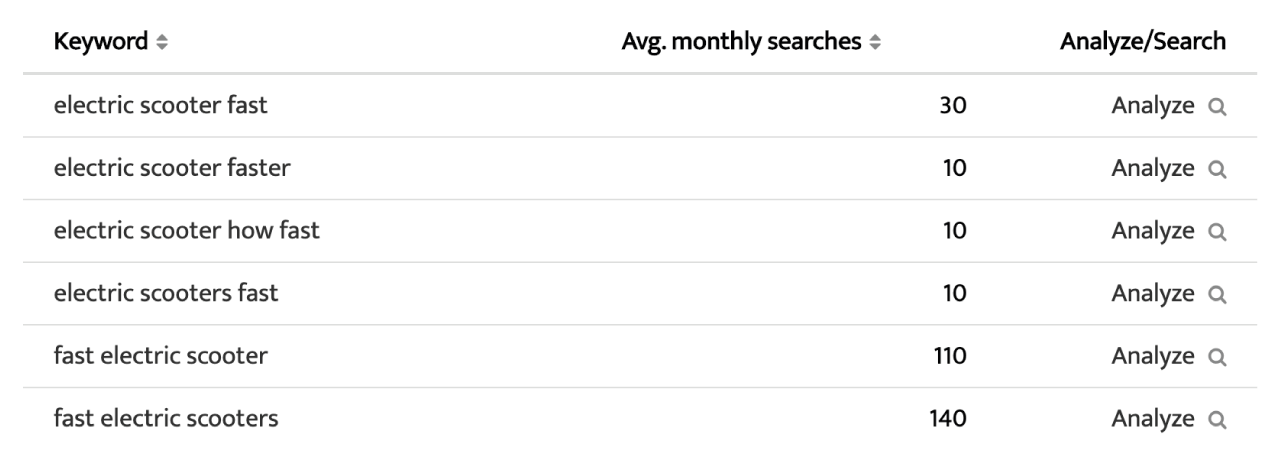
screenshot table keyword data searchvolume.io - SEJ

screenshot table keyword data searchvolume.io - SEJ

That is a staggering 70 times the difference of 310.

It’s true that the volume value of 3.600 already reflects the aggregated volume for the set of six keywords.

But sadly it happens all too often that marketers record all six – or perhaps even more – variations in keyword analyses.

We can propound the idea of choosing one variation and omitting the other combinations. But it will not solve the issue.

ADVERTISEMENT

CONTINUE READING BELOW

The embedded information in keyword variations about users’ intents and needs can simply differ, and thus any form is relevant to include.

Imagine overlooking such a detail, failing to see that each keyword potentially belongs to different clusters of keywords destined for different pages.

And basing your traffic and financial projections on these numbers.

It’s a compelling image, albeit a little amateurish. Nonetheless, something that happens frequently.

There is one observation left unattended.

Keywordtool.io presents disproportionately larger volume values as compared to that of, for instance, Ahrefs.

Despite them both retrieving keyword data from Keyword Planner.

Apart from the tools’ data handling systems, what could cause such a difference?

Spelling Errors

Keyword tools differ in how they deal with spelling errors.

Some, like Searchvolume.io, leave out any spelling error variant in your query output.

Others, like Ahrefs and Keywordtool.io, do include spelling errors variants.

They both show the data values for every single keyword in your query as long as the keyword’s correct spelling variation exists in its database.

ADVERTISEMENT

CONTINUE READING BELOW

But as Ahrefs ungroups keyword data originating from Google Ads API, it does attribute unique metric values to each spelling error variant.

Keywordtool.io, on the other hand, adopts the grouped keywords and metric values it retrieves from Keyword Planner, causing all spelling error variants to show identical metrics.

Misspellings often occur with brand names easily prone to being misspelled.

Think of brand names such as Audemars Piguet, Breguet, Douwe Egberts, Schwarzkopf.

Let’s take a look at “Douwe Egberts”.

I am Dutch, and as a native, I am familiar with the varieties of errors one can make.

For instance:

  • Is Douwe with ou or au?
  • Is Egberts with g or ch or even with gh?
  • Is it Egbert or Egberts?

Point is: what happens when we query a list of one single keyword misspelled in 26 different ways?

Despite the grouping mechanisms in place, Keywordtool.io serves you every unique misspelled keyword combination:

ADVERTISEMENT

CONTINUE READING BELOW
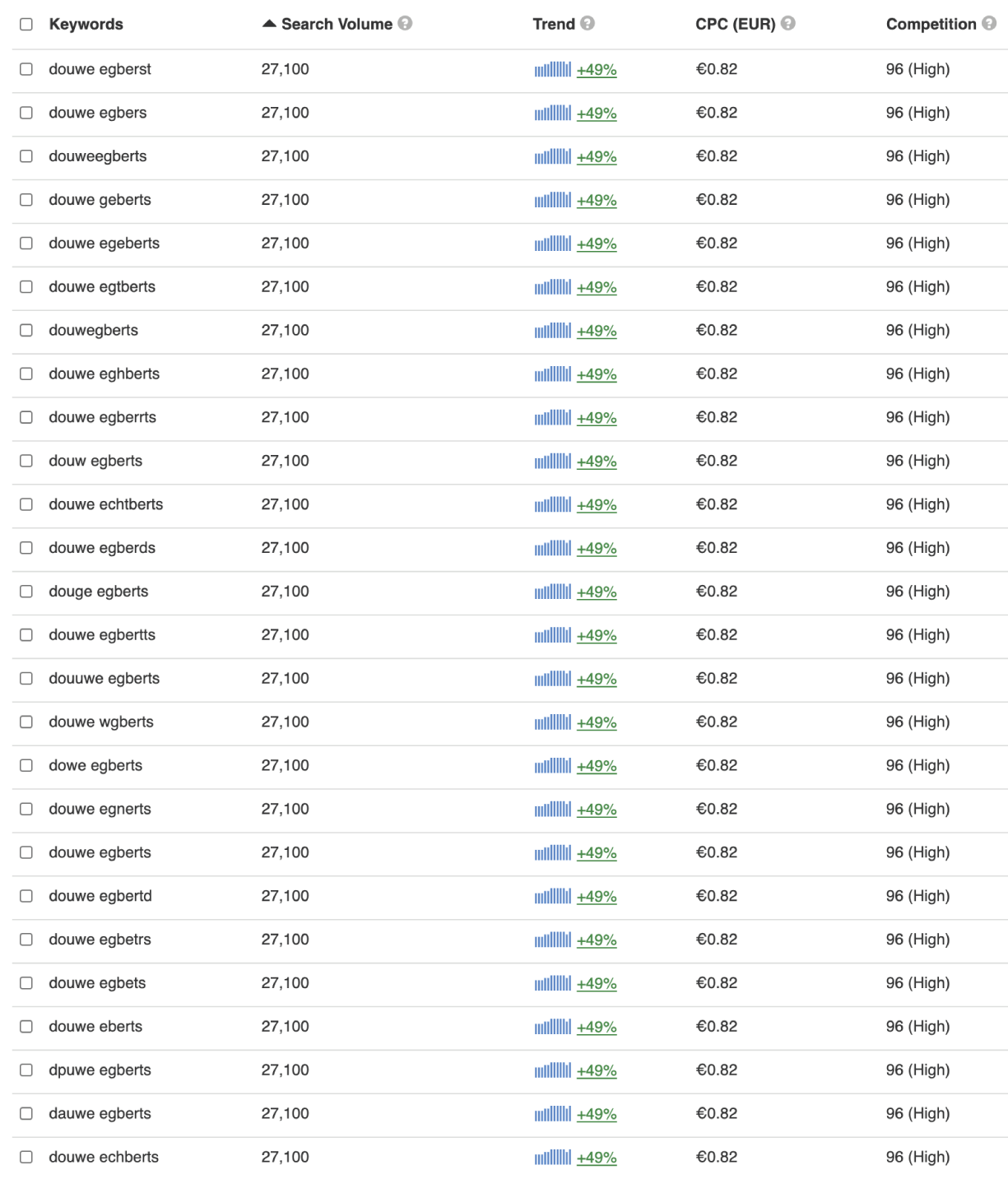
screenshot table keyword data keywordtool.io for 26 keywords - SEJ

screenshot table keyword data keywordtool.io for 26 keywords - SEJ

Ahrefs’ situation is a bit different. The query output is as follows:
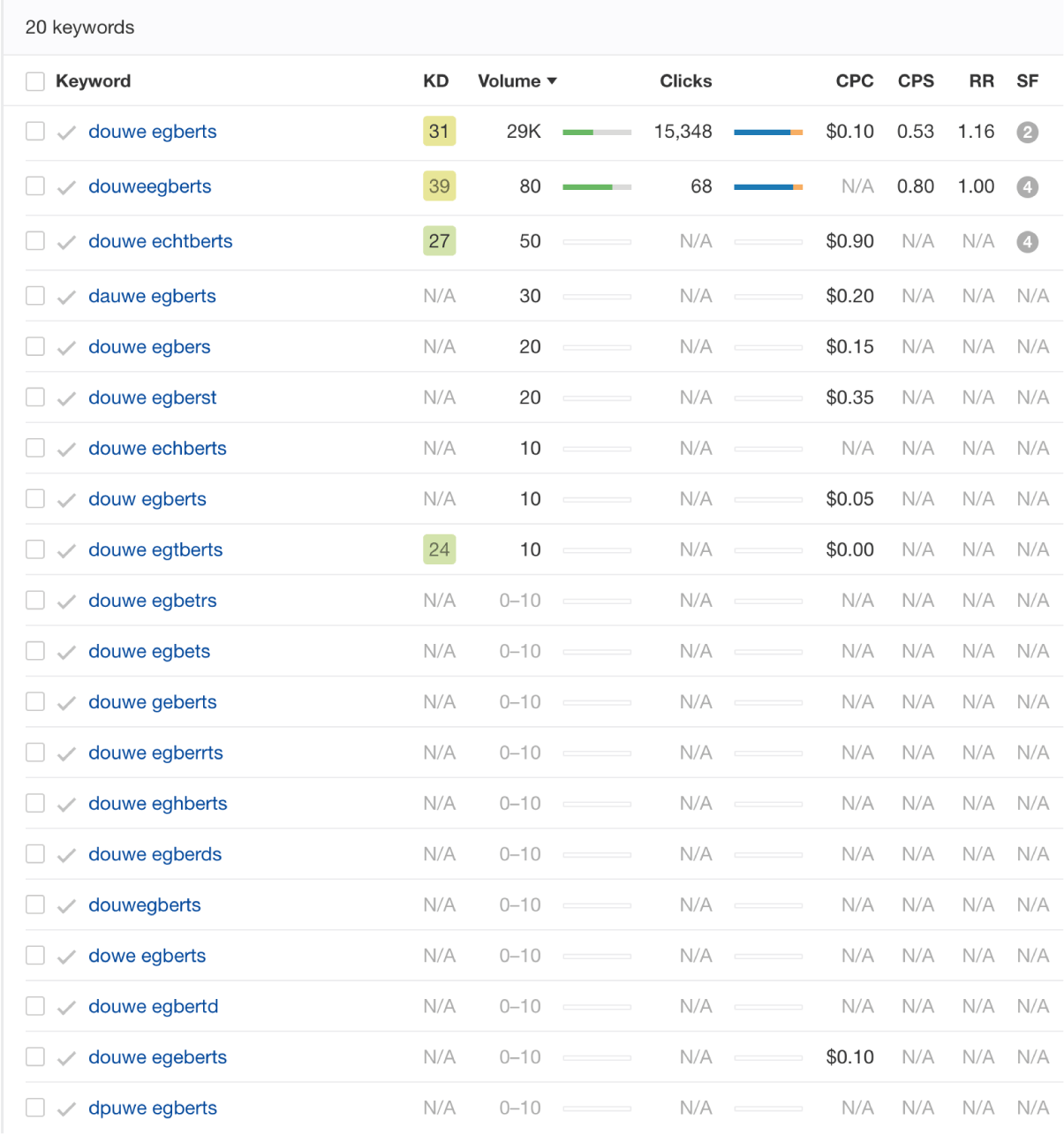
screenshot table keyword data Ahrefs listing 20 keywords with missing values - SEJ

screenshot table keyword data Ahrefs listing 20 keywords with missing values - SEJ

Things that stand out:

  • The query excludes 6 out of the 26 keywords.
  • Ahrefs seems to independently attribute data values per metric.
    • Except for the first result, which is the correct spelling variation, all other keyword variations have either one or multiple metric data values missing.

Keep in mind that it only works with the ‘list’ mode. The ‘explore’ function will only serve the correct spelling variation.

Omitting ‘PPP’ Data

Google Ads API omits keyword data involving ‘PPP’ topics.

It means that other tools retrieving data from Keyword Planner also face this limitation unless they enrich their database with data coming from other sources.

ADVERTISEMENT

CONTINUE READING BELOW

For security purposes, Google disallows keyword tools to retrieve keyword data revolving around Porn, Pills, and Poker.

Think of keywords like “cannabis” or “full house” but also keywords such as “Koffiemachine huren”.

“Huren” is Dutch for renting. But it also means “whores” in German.

While this ruling is not a matter of direct manipulation, it does complicate marketers’ data collection and analyses.

A selection of keyword tools and whether they provide”PPP”-data for your query:

table with names of keyword tool provider and data values - SEJ

table with names of keyword tool provider and data values - SEJ

The above examples illustrate the chaotic nature of keyword tool mechanisms and the hazards they impose on SEO consultants’ work.

To Sum Up

  • Keyword tools do not necessarily show all keyword variations and corresponding metric values.
    • Potential determinants: Tool’s functionality, safety or security measures, or missing data in the database.
  • To our knowledge as outsiders, it seems the particular display of combinations of keyword and metric value variations is randomly “chosen”.
  • Grouping applies to both the numerical values and search terms.
  • Linguistic determinants for keyword grouping:
    • Plural vs. singular.
    • Usage or non-usage of articles and prepositions.
    • Placement of adjectives or interrogative pronouns.
    • Usage of comparative and superlative adjective.
  • Grouping occurs both within a particular group and across group variations.
  • Grouping occurs at random.

ADVERTISEMENT

CONTINUE READING BELOW

3. Data Validation: Validating Keyword Data Values

Keyword data validation is possible, yet without access to uncorrupted data, it becomes an act of finding the closest approximation to the keyword’s actual data values.

One option is to benchmark keyword impression data values from Search Console to volume values of third-party keyword tools.

Search Console data isn’t 100% reliable either, but it is as close as we can get.

ADVERTISEMENT

CONTINUE READING BELOW

Early in 2020, we designed a study to determine the accuracy of keyword data with a set of 160 keywords from a variety of industries.

The study tackled these two questions:

  • For each keyword tool, what is the average deviation % of keyword volume values for the whole set of keywords compared to Search Console impression data values?
  • For each keyword tool, what is the variance of all deviation % for the whole set of keywords?

The former gives us insights into the degree of accuracy for any given keyword’s volume value.

The latter question determines to what extent the deviation % of each keyword is spread out from the average deviation value.

As values can both deviate negatively and positively, it does not suffice to merely show the average deviation %.

It is the combination, however, of both scores that yield the best results in determining the data values’ accuracy and reliability.

As these visualizations illustrate, we see that exclusively looking at either variance or average deviations can prompt erroneous representation of the situation:
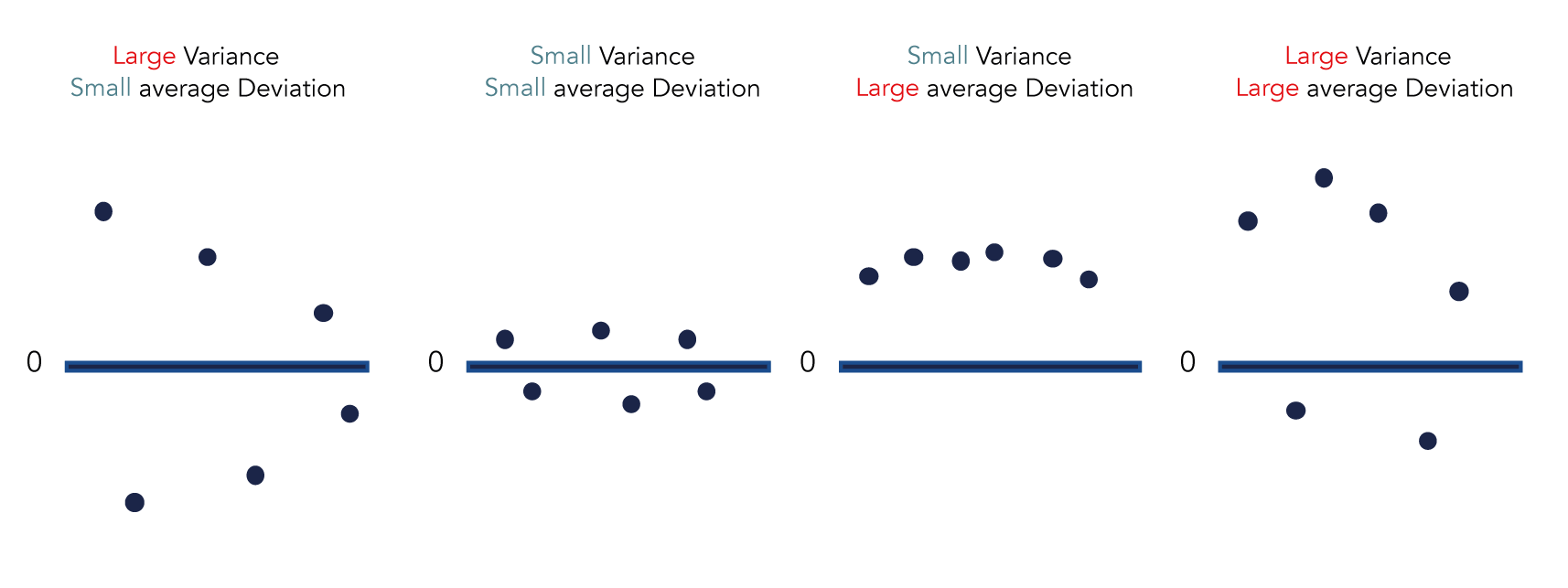
4 plots that visualise different combinations of variance and average deviation - SEJ

4 plots that visualise different combinations of variance and average deviation - SEJ

Measuring the variance of the average deviation % enables us to determine the scatteredness of each keyword’s deviation percentage.

ADVERTISEMENT

CONTINUE READING BELOW

Large dispersions hints to lower accuracy and thus reliability of the keyword volume values.

To put it differently, the more substantial the variance, the higher the likelihood of selecting a keyword from the data set showcasing a more inaccurate volume value than the average volume value deviation.

These were the key findings:

  • Twinwords volume data showed the largest positive average deviation to Search Console impressions: +37.13%.
  • Searchvolume.io volume data showed the largest negative average deviation to Search Console impressions: -34.71%.

chart with average deviation scores of keyword data values of keyword tooling providers - SEJ

chart with average deviation scores of keyword data values of keyword tooling providers - SEJ

  • The frontrunners with the largest variance
    • Twinwords: 5,259
    • Keywordtool.io: 5,256
    • Keyword Planner: 5,188
  • The frontrunners with the smallest variance
    • Serpstat: 0.124
    • Searchvolume.io: 0.149
    • Ahrefs: 0.153

chart with variance scores of keyword data values of keyword tooling providers - SEJ

chart with variance scores of keyword data values of keyword tooling providers - SEJ

Ideally, tool providers exhibit numbers close to zero for both the average deviation and the variance of the average deviation.

ADVERTISEMENT

CONTINUE READING BELOW

These findings show otherwise. Specifically:

  • The grouping effect drives the large variance and average deviation score by the frontrunners.
    • Both Keywordtool.io and Twinword get their data directly from Google. And since Google Ads applies grouping to keyword and data values, Twinword and Keywordtool.io automatically adopt this effect.
  • Keywords with the largest data value deviations also appeared to be keywords with grouped data values.
  • Serpstat, Ahrefs, and Searchvolume.io present variance numbers close to zero. These tools do not apply any clustering.
  • Serpstat and Searchvolume.io show considerably lower average deviations. It suggests that volume data is on average lower than what you would expect according to the Search Console.
  • Although Searchmetrics’ keyword volume values barely deviate on average to Search Console’s impression values, the individual data values are further removed from the mean, suggesting a higher degree of inconsistency in keyword data values.
  • The numbers of Ahrefs and KWFinder exhibit the closest approximation to the keyword’s actual data values.

Data values from third-party keyword tools vary widely and seem to fail in providing unambiguity or consistency.

The findings further give the plausibility to the idea that mechanisms in handling data queries, and collecting or manipulating data, can add to delivering erroneous keyword data.

Can We Then Validate the Accuracy of Keyword Data in Another Way?

Together with Sander Tamaëla, a Dutch Freelance SEO-expert, we came up with a way to validate the accuracy of third-party keyword volume values with the help of Google Search Console and Google Trends data.

ADVERTISEMENT

CONTINUE READING BELOW

The idea was as follows:

  • We picked one noun and selected both the plural and singular form.
    • We had validated the accuracy of search volumes with GSC monthly average impression values.
  • Then we retrieved the volume data from two or three random keyword tools.
  • We then placed these two keywords in Google Trends.

With this setup, we could determine the relative interest between the two keywords.

Our assumption here was that Google Trends’s relative interest scores reflect the purest data values.

As such, the relative interest score should reflect a ratio similar to that of impression values in Search Console.

  • Next, we expanded the set with keywords – for which we know we have an accurate approximation of the impression value – from several volume ranges.
  • Then we compiled a training set.

The idea was to determine per volume range the deviation per keyword volume value based on the relative interest scores of Google Trends.

ADVERTISEMENT

CONTINUE READING BELOW

Unfortunately, things didn’t work out as planned.

After we had challenged the assumption that Google Trends data depicts accurate values, we discovered that Google Trends isn’t entirely reliable either.

To test the reliability of Google Trends we set up the next test:

  • We selected five keywords with very similar monthly impression values in Search Console.
  • We then added these five keywords in Google Trends.
    • We made sure that we had chosen the same 12 month period for Search Console as for Google Trends: 1 December 2018 until 30 November 2019.

One of the five-keyword sets, in Dutch:
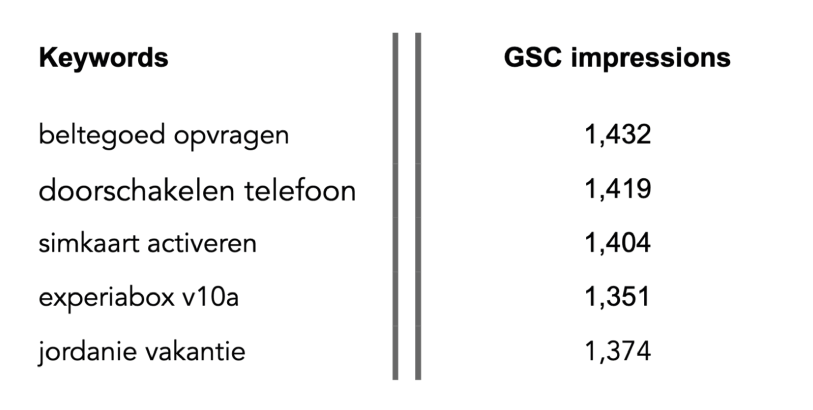
Table with keyword data from search console - SEJ

Table with keyword data from search console - SEJ

The next chart illustrates each keyword’s impression value deviation from the mean:
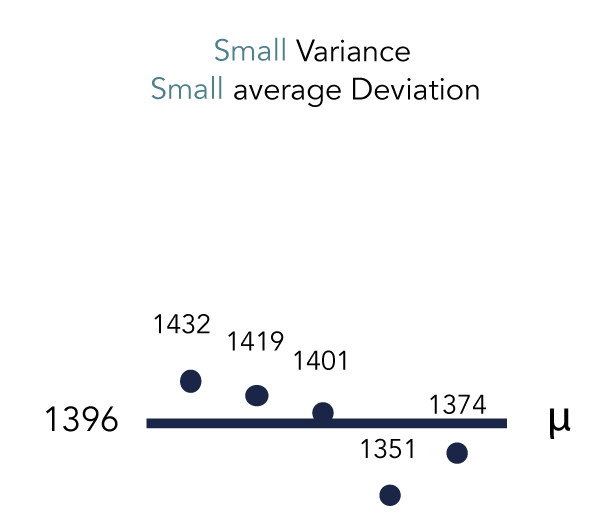
chart that visualises a plot of data points with small variance and small average deviation - SEJ

chart that visualises a plot of data points with small variance and small average deviation - SEJ

The monthly impressions average deviation in percentages was only 1.92%.

ADVERTISEMENT

CONTINUE READING BELOW

Unfortunately, it is only possible to select up to five keywords in Google Trends, limiting our sample to five keywords.

Such a sample size is statistically not a significant representation of the population. The only alternative was to repeat the test setup with different sets of keywords.

If Google Trends is reliable, we would have expected that the average interest ratio between the keywords in Google Trends is virtually the same.

What was the result?

For those five keywords, we observed ratio levels of relative interest score that were varying disproportionally:
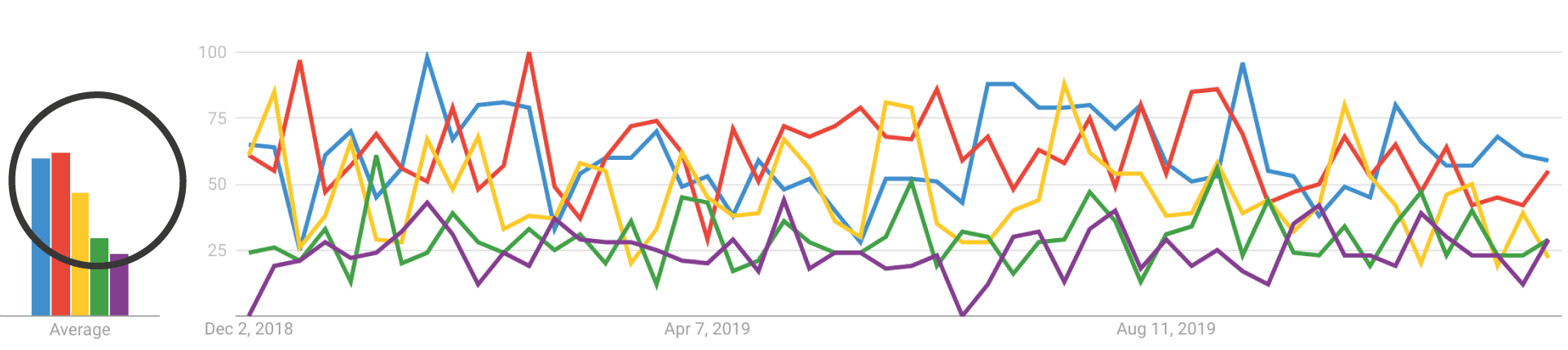
Google Trends screenshot - SEJ

Google Trends screenshot - SEJ

Google Trends’ average interest scores:
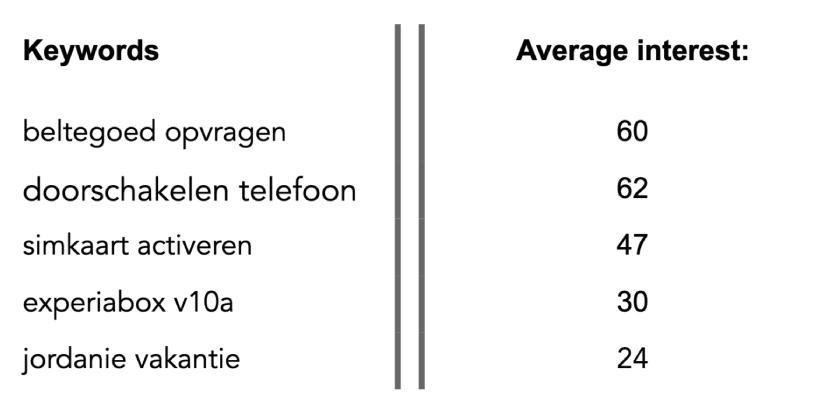
Table with keyword data with Google Trends data values - SEJ

Table with keyword data with Google Trends data values - SEJ

The ratio of three out of five corresponds to the ratio of Search Console impressions.

ADVERTISEMENT

CONTINUE READING BELOW

But the remaining two keywords differ significantly, with an average deviation in percentages of 31,57%.
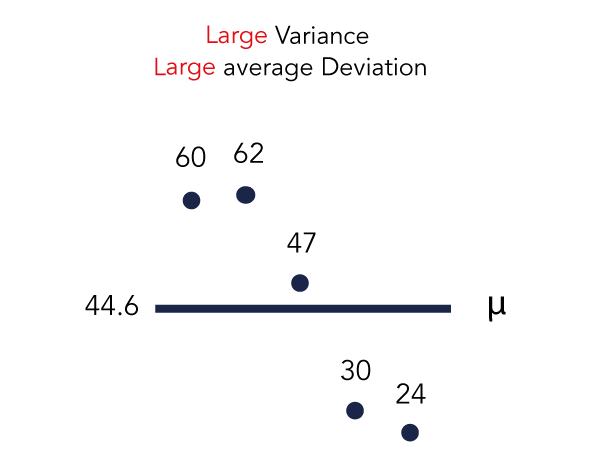
chart that visualises a plot of data points with large variance and large average deviation - SEJ

chart that visualises a plot of data points with large variance and large average deviation - SEJ

Again, with a sample size of five, the average deviation output is not significant.

But by repeatedly testing the setup for different keyword sets, we observed a similar pattern.

Two other examples of Google Trends’ relative interest scores for five-keyword sets:
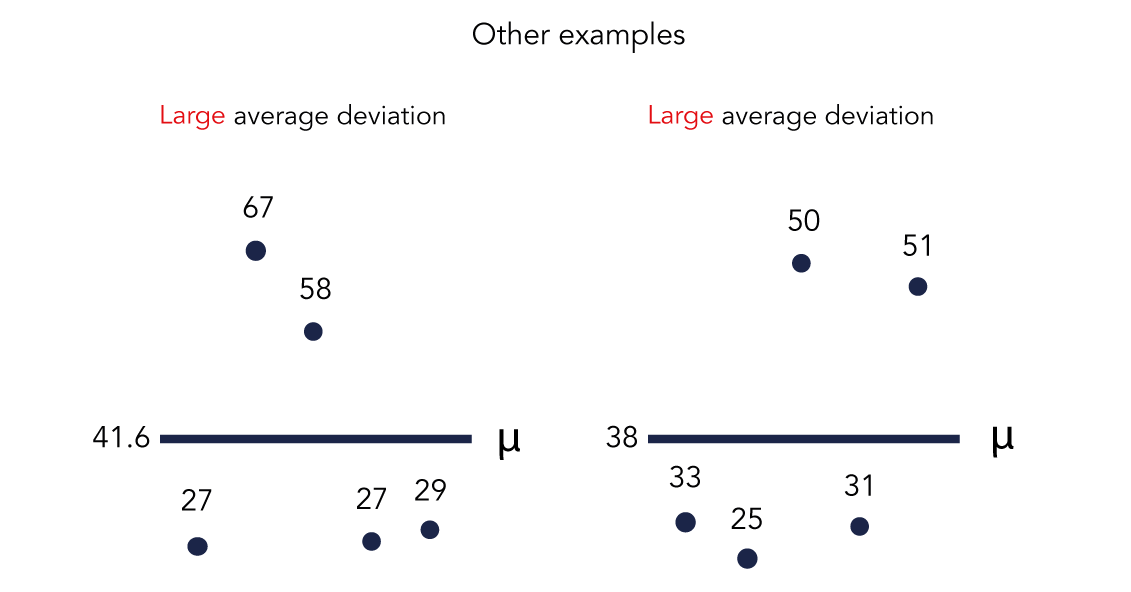
Chart that visualizes plots of average deviation scores - SEJ

Chart that visualizes plots of average deviation scores - SEJ

To put in perspective, the ratio average deviation percentages of Search Console are respectively 2.73% and 1.62%.

ADVERTISEMENT

CONTINUE READING BELOW

Google Trends’ average deviations thus show significantly larger percentages than those for Search Console’s impression value ratios.

Can we then draw any conclusions here?

As outlined in the beginning, Search Console isn’t always showing the most accurate representation of reality.

However, the designed setup to test Google Trends’ data accuracy and reliability provided evidence suggesting that data from Google Trends isn’t consistent or unambiguous either.

Does this mean that we can no longer use these tools? Or perhaps only some?

Not necessarily.

But, it doesn’t hurt to be aware of the demerits from keyword tools.

4. Role as an SEO Consultant

The primary purpose of this study is to grow awareness about the complexity surrounding the data values of keyword tools.

The next step after awareness is to incorporate critical thinking allowing us to recognize any faulty habits.

Common pitfalls to avoid:

  • Taking volume data values as granted.
  • Merging keyword volumes from multiple tools without further checks.
  • Skipping the spellings check.
  • Ignoring the grouping effect or not validating groupings.
  • Inferring hard conclusions from your keyword volume data calculations.
  • Not providing a reliability clause for your findings in the communication to your customer or prospects.

ADVERTISEMENT

CONTINUE READING BELOW

We cannot afford to take data from keyword tools for granted.

To build expertise and provide solid, reliable advice, we ought to set standards for how we work with keyword data.

How Will This Impact Your Role as an SEO Consultant?

I would argue that it starts with establishing a greater sense of accountability.

Remember the earlier example of overlooking a minor detail?

Imagine that happens.

You give this killer PowerPoint presentation. The prospects at the table are completely baffled by your story; you just landed a new client!

A few months pass by, and you discover that the total volume amount of your keyword data set is only 60% of the total amount you initially communicated to your client.

Assuming your analysis included virtually all existing keywords relevant to the business, such a mistake is difficult, perhaps even impossible to rectify.

Especially if your client’s case is specific to a niche or product cluster, you simply won’t find other relevant keywords to close the volume gap.

ADVERTISEMENT

CONTINUE READING BELOW

To avoid such disasters we recommend to incorporate the next worthwhile practices:

  • Spend more time on your data analysis. A correctly performed keyword analysis takes time. Quality ≠ quantity.
  • Validate your keyword data values.
  • Double-check your data for irregularities
  • Have your ‘facts’ straight.
  • Do you have to make a presentation and draw conclusions? Make sure you at least have a proper contextual story ready to support your claims.

Your boss or client might not understand why individual efforts during the analysis have to take a substantial amount of time.

Be open and transparent to clients and prospects about the required efforts to ensure the continuous delivery of quality. It creates trust and fosters mutual bonding.

Telling your client beforehand is thus indisputably better than explaining your mistake afterward.

That will irreversibly compromise the relationship with your client.

Final Notes

  • This study’s goal is not to place keyword tools in a bad light.
  • Neither do I argue that keyword tools are in any way deficient. The reason I have provided the examples is purely to evoke a sense of awareness surrounding the accuracy and reliability of keyword data.
  • This study did not include other search engines such as Bing, Yandex, and Yahoo.

ADVERTISEMENT

CONTINUE READING BELOW

Appendix

The study’s setup was as follows.

We selected a set of 160 keywords from various Google Search Console accounts. The selection of keywords depended on whether all of the following conditions were satisfied:

  • The keyword must have had a top 3 SERP ranking for 12 consecutive months without any temporary dips reaching lower rankings.
    • This facilitates an as close as possible approximation of the real average monthly impressions count, based on a 12 month period.
  • The keyword’s monthly impression count is 1000 or higher.
    • This increases the likelihood that each participating keyword tool’s database contains data on the selected keyword (long-tail keywords are less likely to be registered in keyword tool databases).
  • The keyword should not be subject to seasonality.
    • It increases the likelihood of consistent top SERP rankings throughout the year.
  • We also made sure that the 12 month period of GSC data matched the 12-month period with which keyword tools calculate their monthly averages.

These criteria were set in order to establish an accurate recording of calculated monthly impression values.

Most keyword tools calculate their monthly average volumes in a similar vein.

More Resources:


Image Credits

ADVERTISEMENT

CONTINUE READING BELOW

Featured Image: Created by author, June 2020
Infographic: Created by author, May, 2020
Screenshots taken by author, April & May, 2020

http://tracking.feedpress.it/link/13962/13689752
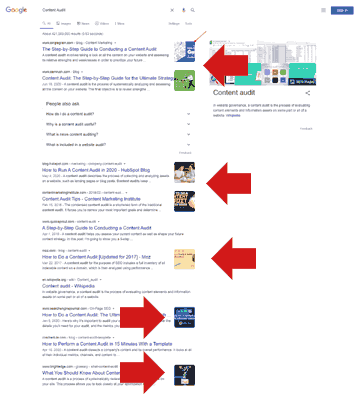


5 Ways to Convert Organic Traffic Into Qualified Leads via @annaleacrowe

So you doubled the organic traffic to your site?

Awesome! 👏👏🏽👏🏿

But also, so what?

Let me explain.

We’re all in business.

Visitors are nice, but paying customers are better.

With all the attention SEO professionals give to optimizing for search, it’s easy to neglect the other really big, important piece of the puzzle: conversion.

Don’t Hunt Without Eating

Brand awareness is golden, but only if you can translate it into actual business.

All your keyword research, site optimization, and link building efforts are a waste if they don’t result in revenue.

Getting folks onto your site is hard enough, but it’s only the beginning of the battle.

Those visitors need to convert.

And they should be converting – 16% of organic leads should turn into paying customers.

To keep your leads moving down the funnel, you need to make sure that they’re landing on the right pages, getting the content they’re looking for, and can easily buy, subscribe, request a quote, or sign up.

ADVERTISEMENT

CONTINUE READING BELOW

The good news: you have the tools in your arsenal to turn organic traffic into qualified leads.

So let’s dive into how to use them properly.

1. Match Content to User Intent

Understanding user intent is fundamental to SEO, so this isn’t necessarily a revolutionary idea.

The problem is, the concept isn’t always executed well for a number of reasons:

  • Prioritizing keywords solely by volume without organizing by intent.
  • Failing to communicate intent to the people developing content.
  • Choosing the type of content before performing keyword research.

Improve Existing Pages

The first step to addressing issues with intent is to look at your current pages.

Some of them may have been created before you had an SEO strategy.

So there’s potential for a quick win by improving existing pages.

Also, who doesn’t love to cringe at their old content?!

Look at the queries you’re ranking for that contain transactional terms, like “buy, “pricing,” “reviews,” or “testimonials.”

ADVERTISEMENT

CONTINUE READING BELOW

  • Are the pages that rank for those queries serving up content that will drive your audience to convert?
  • Is the content easy to read, with easily accessible calls-to-action?

The past year, I’ve been working through a content audit I started in August for Leadfeeder’s blog.

Before I joined the team, they were working with a content marketing agency that focused solely on content creation, not driven from an SEO mindset. I identified 82 blog posts to rewrite.

convert organic leads content audit

convert organic leads content audit

In less than 8 months, I managed to double organic traffic and increase conversions by 20% by improving their existing blog posts.

If a page doesn’t align with user intent, it may perform well for a short time, but eventually, Google will catch on.

Create a Framework for Existing Pages

Whether you’re doing all the work yourself or working with a large team, set standards for your content updates.

It’s the best way to streamline the process and make sure you’re following best practices.

Their content framework included a target word count, UX tactics, and guidelines on how to push lead magnets and calls-to-action more effectively.

Optimizing for Intent for New Pages

Moving forward, here’s how you can use intent more effectively:

  • Include user intent as part of your content plan and creative briefs. Writers are often given a set of keywords and told to “go.” Everyone involved in content creation should be talking about intent, not just SEO pros. The person who develops the copy needs to have a clear understanding of the question they’re answering with the content they write.
  • Talk about intent before you determine the content type. This means that SEO needs a seat at the table before decisions are made on content. Otherwise, you end up with a blog about accounting software pricing when what you need is a landing page.
  • Use intent to maneuver leads down the funnel. In fact, let’s address that in more detail in its own section.

Target Keywords Related to Buying Journey Pain Points

Even an intent-focused SEO strategy can fall short.

How?

Because your audience’s needs are increasingly nuanced.

ADVERTISEMENT

CONTINUE READING BELOW

B2B buyers spend 27% of their time researching online before making a purchase.

And the buying journey is more like what my teeth looked like in 6th grade, crooked, rather than a straight, braces-enhanced, path down the funnel.

All that online research can’t easily fit into either “transactional” or “informational” boxes.

You can help guide your users through the process with content that helps them navigate that maze.

This is the pain point-first approach that Growth and Convert advocates.

For one client, they found that the highest conversions came from pages that addressed pain points in the buying process.

For example, pages like this are high converting because they address a pain point by comparing products.

convert organic leads comparison pages

convert organic leads comparison pages

The pages that targeted high-volume search terms drew in users but converted at much lower levels.

ADVERTISEMENT

CONTINUE READING BELOW

Moral of the story: Include content that speaks to your audience’s questions about the buying process itself.

Dig deeper into search queries to learn what your audience wants at different stages of the funnel.

Leads who want buyer’s guides, comparisons, product reviews, etc. may not be ready to buy today, but they may be ready to become a qualified lead.

2. Optimize for Branded Search Terms

Targeting branded search terms is another way to grab leads that are lower in the funnel.

When someone searches for “[your company] ebooks” or “[your company] webinars,” that’s a high-value lead that you want to satisfy. They’re aware of your brand and they’re asking for more.

Optimized pages that meet their needs are low-hanging fruit.

This is one of the tactics Gaetano DiNardi used to help drive a 400% increase in growth at Sales Hacker.

He found that there was search volume for “Sales Hacker webinar,” but no pages on their site where someone could easily find their webinars.

ADVERTISEMENT

CONTINUE READING BELOW

The solution was a quick fix: a landing page that contained all of Sales Hacker’s webinar content.

The search volume on branded terms may be low, but these are valuable leads who are requesting your content by name.

Serving them the content they want pays off.

3. Nurture, Nurture, Nurture

Everyone who visits your site isn’t ready to convert right away.

It’s not you, I promise.

They’re just not ready for anything serious. But they’re open to a little content here and there. It’s like a coffee date with no commitment.

Lead nurturing – the process of engaging with leads across channels over a period of time – is an art and science in and of itself.

Since email is the primary, and most effective, channel for lead nurturing, I’ll focus on that in this section.

Segmentation

51% of email marketers say email list segmentation is the most effective way to personalize lead nurturing.

Automation tools like Active Campaign and MailChimp make it pretty easy to create audience segments.

ADVERTISEMENT

CONTINUE READING BELOW

What are they based on? Any data you have:

  • Pages visited
  • Form capture data – title, industry, purchase cycle, etc.
  • Cart abandonment
  • Location

For instance, I’ve set-up automation nurture campaigns in Active Campaign after someone visits a product page, then an email is triggered to send them with a case study to help drive them further down the funnel.

convert organic leads nurture

convert organic leads nurture

Segmentation is the gateway to personalization.

And with inboxes flooded with content, tailoring your message helps you break through the noise.

ADVERTISEMENT

CONTINUE READING BELOW

Content

What should your message be?

Since these leads aren’t quite ready to buy, you should continue to offer useful, non-salesy content to endear them to your brand.

Anne Fairfield-Sonn of CiBO Technologies told Databox:

“Marketers should be creating and targeting leads with persona specific content. When a lead comes through, figure out what piece of content resonated with them and make sure to move them into that sales funnel. Understanding the content that appeals to your ideal audience is critical to helping your sales team to close the deal more quickly.”

Develop a cadence that balances promotion with education. You want to be a helpful, unobtrusive resource to your audience.

They signed up for content that helps them be smarter, better, or faster.

Offer that before getting to the sales pitch.

4. Make Double Opt-Ins Super Simple

Double opt-ins help keep your email database free of bots and bad actors.

The danger is in the possibility that users won’t bother to confirm their subscription.

ADVERTISEMENT

CONTINUE READING BELOW

I Will Teach You To Be Rich added a three-step graphic to their double confirmation page to nudge subscribers along.

b2b double opt in

b2b double opt in

The prominent CTA button goes to the user’s inbox and pulls up a search for the email address sending the confirmation email.

This version of the page gets an 82% conversion rate, up from 63%.

Every lead went through that page, so the nearly 20% increase had a major impact on their lead total.

5. Promote Your Content Upgrades

Ideally, the leads you attract with organic traffic will be drawn to your content upgrades.

But that depends on you communicating the value of those upgrades effectively.

Sleeknote was able to increase conversions by 177.78% on one of their blog posts by taking a few measures:

  • Making the blog introduction more enticing.
  • Moving lead forms higher up on the page.
  • Adding images and pithy copy to content call-out-boxes.

ADVERTISEMENT

CONTINUE READING BELOW

Once someone’s on the page, you’ve got to sell them on a reason to stay. And then give them a reason to stay engaged before they leave.

With all the attention that goes to page copy itself, content upgrades can be an afterthought. To drive lead generation, it should become more of a priority.

Conclusion

Organic leads are valuable.

The challenge is that SEO can cast a wide net.

That’s why it’s important to remember that you don’t just need to optimize your content for Google; you need to optimize it for conversion.

More Resources:


Image Credits

Featured Image: Created by author, June 2020
All screenshots taken by author, June 2020

http://tracking.feedpress.it/link/13962/13689717