Google Answers Question About Core Web Vitals “Poisoning” via @sejournal, @martinibuster

Someone posted details of a novel negative SEO attack that they said appeared to be a Core Web Vitals performance poisoning attack. Google’s John Mueller and Chrome’s Barry Pollard assisted in figuring out what was going on.

The person posted on Bluesky, tagging Google’s John Mueller and Rick Viscomi, the latter a DevRel Engineer at Google.

They posted:

“Hey we’re seeing a weird type of negative SEO attack that looks like core web vitals performance poisoning, seeing it on multiple sites where it seems like an intentional render delay is being injected, see attached screenshot.Seeing across multiple sites & source countries

..this data is pulled by webvitals-js. At first I thought dodgy AI crawler but the traffic pattern is from multiple countries hitting the same set of pages and forging the referrer in many cases”

The significance of the reference to “webvitals-js” is that the degraded Core Web Vitals data is from what’s hitting the server, actual performances scores recorded on the website itself, not the CrUX data, which we’ll discuss next.

Could This Affect Rankings?

The person making the post did not say if the “attack” had impacted search rankings, although that is unlikely, given that website performance is a weak ranking factor and less important than things like content relevance to user queries.

Google’s John Mueller responded, sharing his opinion that it’s unlikely to cause an issue, and tagging Chrome Web Performance Developer Advocate Barry Pollard (@tunetheweb) in his response.

Mueller said:

“I can’t imagine that this would cause issues, but maybe @tunetheweb.com has seen things like this or would be keen on taking a look.”

Barry Pollard wondered if it’s a bug in the web-vitals library and asked the original poster if it’s reflected in the CrUX data (Chrome User Experience Report), which is a record of actual user visits to websites. The person responded by saying that the degradation in core web vitals scores is not reflected in the CrUX data.

DoS (Denial-Of-Service) attack

The person who posted about the issue also mentioned that the site under discussion was also experiencing a DoS attack.

They wrote:

“Hard to get a clear picture because the on top of the LCP issue the site is being hit with some kind of cache-bypass DOS attack that jacked up TTFB & has had the hosting maxxed out…”

They also stated that the website in question is experiencing a cache-bypass DoS (denial-of-service) attack, which is when an attacker sends a massive number of web page requests that bypass a CDN or a local cache, causing stress to server resources.

The method employed by a cache-bypass DoS attack is to bypass the cache (whether that’s a CDN or a local cache) in order to get the server to serve a web page (instead of a copy of it from the cache or CDN), thus slowing down the server.

The local web-vitals script is recording the performance degradation of those visits, but it is likely not registering with the CrUX data because that comes from actual Chrome browser users who have opted in to sharing their web performance data.

So What’s Going On?

Judging by the limited information in the discussion, it appears that a DoS attack is slowing down server response times, which in turn is affecting page speed metrics on the server. The Chrome User Experience Report (CrUX) data is not reflecting the degraded response times, which could be because the CDN is handling the page requests for the users recorded in CrUX. There’s a remote chance that the CrUX data isn’t fresh enough to reflect recent events but it seems logical that users are getting cached versions of the web page and thus not experiencing degraded performance.

I think the bottom line is that CWV scores themselves will not have an effect on rankings. Given that actual users themselves will hit the cache layer if there’s a CDN, the DoS attack probably won’t have an effect on rankings in an indirect way either.

Featured Image by Shutterstock/mentalmind

https://www.searchenginejournal.com/google-answers-question-about-core-web-vitals-poisoning-attack/553883/


Ex-Microsoft SEO Pioneer On Why AI’s Biggest Threat To SEO Isn’t What You Think via @sejournal, @theshelleywalsh

While industry professionals have debates over nomenclature of SEO, GEO, or AEO, and if ChatGPT or Google’s AI Overviews will replace traditional search, a more fundamental shift is happening that could disrupt the entire industry business model.

To get a better understanding of this, I spoke to the 25-year veteran and SEO pioneer Duane Forrester to discuss some of his recent articles about the shift from traditional SEO and the impact on how SEO roles are changing and adapting.

Duane previously worked at Microsoft as a senior program manager of SEO, where he helped to launch Bing Webmaster Tools and bring Schema.org to life. He has a deep understanding of how search engines work and has now turned his attention to adapting to the realities of AI-powered search and digital discovery.

His belief is that the real disruption isn’t AI replacing search engines; it’s the rise of AI agents. These “Agentic AI” systems will empower individuals to work like small agencies, and the jobs that thrive will be those that can effectively manage an AI team.

The Rise Of Agentic AI: Virtual Team Members

In Duane’s recent article “SEO’s Existential Threat is AI, but Not in the Way You Think,” he said it’s the rise of AI agents and retrieval-based systems that are already transforming how people interact with information, quietly eroding SEO’s return on investment. So, I asked him how agents and not SERPs are the future.

Duane explained:

“The most significant development isn’t AI replacing search engines; it’s the emergence of Agentic AI systems that can be given tasks and execute them autonomously … This is really a personal thing and I’ve been following this since I worked at Microsoft. I did some early work with Cortana with that program and training it for language recognition.”

Within six months, Duane predicts professionals will routinely instruct AI agents to perform work while they focus on higher-value activities. This is going to have the impact where individuals can behave much more like a small agency.

“If I can create a process and the process is largely executed by agents, then the 100% of my time that I can devote can be reapportioned to human-in-the-loop analysis.

This is going to be the way for us to create virtual players on our team and to do specific tasks to enable us to define the most valuable use of our time, whatever it happens to be. That valuable use of time for some people may be closing their next client. It may simply be the sales cycle. For other people who, maybe, lack knowledge and experience, it may actually be executing on what you promised the client.”

However, Dunae thinks that developing people management skills will be critical to success:

“If you step into the world of Agentic AI and you’re going down that path, you better have people management skills because you’re going to need them. That’s the skill set that will prove most valuable to managing Agentic AI work. You have to think of them not necessarily as humans, but as systems that need guidance.”

The Job Transformation: Writers As AI Instructors

I then asked Duane about his latest article, where he wrote about which SEO jobs AI will reshape and which might disappear.

He responded that the most dramatic changes will impact content creators, but not in the way many expect.

Duanes thinks that traditional writing roles face automation, but professionals who adapt will become more valuable than ever.

“If your full-time job is sitting down writing, that’s in jeopardy,” Duane acknowledges.

“The new model transforms writers from creators to instructors, managing multiple AI agents across different clients simultaneously. Instead of spending hours researching and writing, professionals can brief a dozen agents in minutes and focus on editing, refining tone, and ensuring accuracy.”

“You can tell a dozen agents for a dozen clients to all start and you can get them all started in less than two minutes and then in about 10 minutes have all of the output that you now will go in and edit one by one.”

Paradoxically, he thinks the role most in demand will be quality experienced writers, but only those who learn how to embrace and integrate AI to be efficient and effectively manage an AI team of writers.

By becoming a “human in the loop” editor who can guide AI output, an experienced writer can add value in ways machines can’t by refining tone, ensuring factual accuracy, and aligning copy with brand voice and client needs.

“I recently wrote about a Microsoft survey that showed the overlay of how AI can do a job versus humans doing that same job … their point was, if you’re in these jobs, you kind of want to figure out how to pivot to something different.”

Strategic Roles Remain Safe

The jobs that are vulnerable to AI are those with a repetitive nature that can be done by an AI faster, easier, and cheaper than a human.

While these execution-focused roles face disruption, strategic positions like CMOs remain relatively protected. These roles survive because they require experience-based decision-making that AI cannot replicate.

“It’s going to be harder to replace that level of experience because the system doesn’t have the experience,” Duane emphasizes.

The distinction isn’t about seniority but about the nature of the work. Repetitive tasks get automated first, while roles requiring strategic thinking, relationship building, and complex problem-solving remain human-dominated.

CMOs are considered “safe” not because they are senior, but because they are thinking in terms of strategy. They succeed by analyzing consumer behavior, identifying monetization opportunities, and aligning products with customer problems, capabilities that demand human insight and industry knowledge.

“They’re watching consumer behavior, and they’re trying to tease out from the consumer behavior: How do we make money from that? How do we align our product to solve a customer’s problem? And then that generates more sales. That’s the job of the CMO.

And then everything else under it, which is building and maintaining the team, running all the groups, and making sure everything is on track. It’s going to be harder to replace that level of experience because the system doesn’t have the experience.”

Preparing For The Future

Success in these evolving times requires immediate action on hiring and training. Companies must update job descriptions today to reflect skills needed in two to three years, or develop comprehensive training programs for existing staff.

“The people you’re hiring today, in theory, should still be with you in a couple of years. And if they are still with you in a couple of years and you don’t hire these new skills today, well then, you better have a training plan to get them there.”

I compared the current transformation with the early days of SEO, when pioneers navigated uncharted territory. Today’s professionals face a similar challenge of adapting to work alongside AI systems or risking obsolescence.

The future belongs to those who can embrace AI as a productivity multiplier rather than a replacement threat. Those who learn to instruct, guide, and optimize AI agents will find themselves more valuable than ever, while those who resist change may find themselves left behind.

“This isn’t just about surviving disruption,” Duane concluded. “It’s about positioning yourself to benefit from it.”

Watch the full video interview with Duane Forrester below.

[embedded content]

Duane is currently writing about the shift from traditional SEO to vector-driven retrieval and AI-generated answers at Duane Forrester Decodes and featured here at Search Engine Journal.

Thank you to Duane for offering his insights and being my guest on IMHO.

More Resources: 


Featured Image: Shelley Walsh/Search Engine Journal

https://www.searchenginejournal.com/ex-microsoft-seo-pioneer-on-why-ais-biggest-threat-to-seo-isnt-what-you-think/553496/


Google Explains Why They Need To Control Ranking Signals via @sejournal, @martinibuster

Google’s Gary Illyes answered a question about why Google doesn’t use social sharing as a ranking factor, explaining that it’s about the inability to control certain kinds of external signals.

Kenichi Suzuki Interview With Gary Illyes

Kenichi Suzuki (LinkedIn profile), of Faber Company (LinkedIn profile), is a respected Japanese search marketing expert who has at least 25 years of experience in digital marketing. I last saw him speak at a Pubcon session a few years back, where he shared his findings on qualities inherent to sites that Google Discover tended to show.

Suzuki published an interview with Gary Illyes, where he asked a number of questions about SEO, including this one about SEO, social media, and Google ranking factors.

Gary Illyes is an Analyst at Google (LinkedIn profile) who has a history of giving straightforward answers that dispel SEO myths and sometimes startle, like the time recently when he said that links play less of a role in ranking than most SEOs tend to believe. Gary used to be a part of the web publishing community before working at Google, and he was even a member of the WebmasterWorld forums under the nickname Methode. So I think Gary knows what it’s like to be a part of the SEO community and how important good information is, and that’s reflected in the quality of answers he provides.

Are Social Media Shares Or Views Google Ranking Factors?

The question about social media and ranking factors was asked by Rio Ichikawa (LinkedIn profile), also of Faber Company. She asked Gary whether social media views and shares were ranking signals.

Gary’s answer was straightforward and with zero ambiguity. He said no. The interesting part of his answer was the explanation of why Google doesn’t use them and will never use them as a ranking factor.

Ichikawa asked the following question:

“All right then. The next question. So this is about the SEO and social media. Is the number of the views and shares on social media …used as one of the ranking signals for SEO or in general?”

Gary answered:

“For this we have basically a very old, very canned response and something that we learned or it’s based on something that we learned over the years, or particularly one incident around 2014.

The answer is no. And for the future is also likely no.

And that’s because we need to be able to control our own signals. And if we are looking at external signals, so for example, a social network’s signals, that’s not in our control.

So basically if someone on that social network decides to inflate the number, we don’t know if that inflation was legit or not, and we have no way knowing that.”

Related: Google Ranking Systems & Signals

Easily Gamed Signals Are Unreliable For SEO

External signals that Google can’t control but can be influenced by an SEO are untrustworthy. Googlers have expressed similar opinions about other things that are easily manipulated and therefore unreliable as ranking signals.

Some SEOs might say, “If that’s true, then what about structured data? Those are under the control of SEOs, but Google uses them.”

Yes, Google uses structured data, but not as a ranking factor; they just make websites eligible for rich results. Additionally, stuffing structured data with content that’s not visible on the web page is a violation of Google’s guidelines and can lead to a manual action.

A recent example is the LLMs.txt protocol proposal, which is essentially dead in the water precisely because it is unreliable, in addition to being superfluous. Google’s John Mueller has said that the LLMs.txt protocol is unreliable because it could easily be misused to show highly optimized content for ranking purposes, and that it is analogous to the keywords meta tag, which was used by SEOs for every keyword they wanted their web pages to rank for.

Mueller said:

“To me, it’s comparable to the keywords meta tag – this is what a site-owner claims their site is about … (Is the site really like that? well, you can check it. At that point, why not just check the site directly?)”

The content within an LLMs.txt and associated files are completely in control of SEOs and web publishers, which makes them unreliable.

Another example is the author byline. Many SEOs promoted author bylines as a way to show “authority” and influence Google’s understanding of Expertise, Experience, Authoritativeness, and Trustworthiness. Some SEOs, predictably, invented fake LinkedIn profiles to link from their fake author bios in the belief that author bylines were a ranking signal. The irony is that the ease of abusing author bylines should have been reason enough for the average SEO to dismiss them as a ranking-related signal.

In my opinion, the key statement in Gary’s answer is this:

“…we need to be able to control our own signals.”

I think that the SEO community, moving forward, really needs to rethink some of the unconfirmed “ranking signals” they believe in, like brand mentions, and just move on to doing things that actually make a difference, like promoting websites and creating experiences that users love.

Watch the question and answer at about the ten minute mark:

[embedded content]

Featured Image by Shutterstock/pathdoc

https://www.searchenginejournal.com/google-explains-why-they-need-to-control-their-ranking-signals/553657/


Google Rolls Out ‘Preferred Sources’ For Top Stories In Search via @sejournal, @MattGSouthern

Google is rolling out a new setting that lets you pick which news outlets you want to see more often in Top Stories.

The feature, called Preferred Sources, is launching today in English in the United States and India, with broader availability in those markets over the next few days.

What’s Changing

Preferred Sources lets you choose one or more outlets that should appear more frequently when they have fresh, relevant coverage for your query.

Google will also show a dedicated From your sources section on the results page. You will still see reporting from other publications, so Top Stories remains a mix of outlets.

Google Product Manager Duncan Osborn says the goal is to help you “stay up to date on the latest content from the sites you follow and subscribe to.”

How To Turn It On

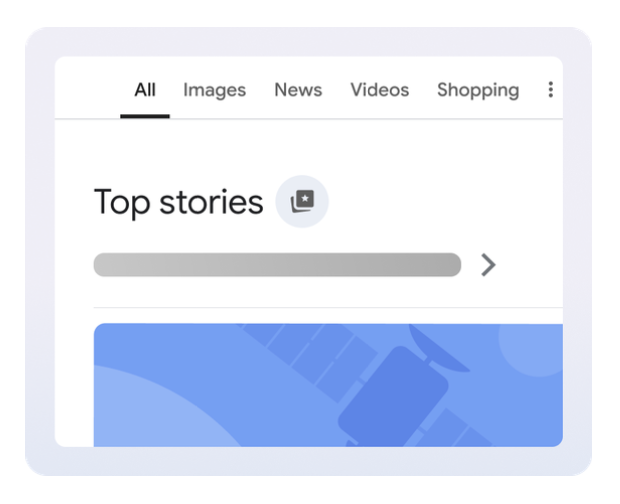
Image Credit: Google
  1. Search for a topic that is in the news.
  2. Tap the icon to the right of the Top stories header.
  3. Search for and select the outlets you want to prioritize.
  4. Refresh the results to see the updated mix.

You can update your selections at any time. If you previously opted in to the experiment through Labs, your saved sources will carry over.

In early testing through Labs, more than half of participants selected four or more sources. That suggests people value seeing a range of outlets while still leaning toward publications they trust.

Why It Matters

For publishers, Preferred Sources creates a direct way to encourage loyal readers to see more of your coverage in Search.

Loyal audiences are more likely to add your site as a preferred source, which can increase the likelihood of showing up for them when you have fresh, relevant reporting.

You can point your audience to the new setting and explain how to add your site to their list. Google has also published help resources for publishers that want to promote the feature to followers and subscribers.

This adds another personalization layer on top of the usual ranking factors. Google says you will still see a diversity of sources, and that outlets only appear more often when they have new, relevant content.

Looking Ahead

Preferred Sources fits into Google’s push to let you customize Search while keeping a variety of perspectives in Top Stories.

If you have a loyal readership, this feature is another reason to invest in retention and newsletters, and to make it easy for readers to follow your coverage on and off Search.

https://www.searchenginejournal.com/google-rolls-out-preferred-sources-for-top-stories-in-search/553529/


Google Says AI-Generated Content Will Not Cause Ranking Penalty via @sejournal, @martinibuster

Google’s Gary Illyes recently answered the question of whether AI-generated images used together with “legit” content can impact rankings. Gary discussed whether it had an impact on SEO and called attention to a technical issue involving server resources that is a possible outcome.

Does Google Penalize for AI-Generated Content?

How does Google react to AI image content when it’s encountered in the context of a web page? Google’s Gary Illyes answered that question within the context of a Q&A and offered some follow-up observations about how it could lead to extra traffic from Google Image Search. The question was asked at about the ten-minute mark of the interview conducted by Kenichi Suzuki and published on YouTube.

This is the question that was asked:

“Say if there’s a content that the content itself is legit, the sentences are legit but and also there are a lot of images which are relevant to the content itself, but all of them, let’s say all of them are generated by AI. Will that content or the overall site, is it going to be penalized or not?”

This is an important and reasonable question because Google ran an update about a year ago that appeared to de-rank low quality AI-generated content.

Google’s Gary Ilyes’ answer was clear that AI-generated content will not result in penalization and that it has no direct impact on SEO.

He answered:

“No, no. So AI generated image doesn’t impact the SEO. Not direct.

So obviously when you put images on your site, you will have to sacrifice some resources to those images… But otherwise you are not going to, I don’t think that you’re going to see any negative impact from that.

If anything, you might get some traffic out of image search or video search or whatever, but otherwise it should just be fine.”

AI-Generated Content

Gary Illyes did not discuss authenticity; however it’s a good thing to consider in the context of using AI-generated content. Authenticity is an important quality for users, especially in contexts where there is an expectation that an illustration is a faithful depiction of an actual outcome or product. For example, users expect product illustrations to accurately reflect the products they are purchasing and screenshots of food to reasonably represent the completed dishes after following the recipe instructions.

Google often says that content should be created for users and that many questions about SEO are adequately answered by the context of how users will react to it. Illyes did not reflect on any of that, but it is something that publishers should consider if they care about how content resonates with users.

Gary’s answer makes it clear that AI-generated content will not have a negative impact on SEO.

Watch the Q&A at about the 10 minute mark:

[embedded content]

Featured Image by Shutterstock/Besjunior

https://www.searchenginejournal.com/google-says-ai-generated-content-will-not-cause-ranking-penalty/553465/


Google Web Guide: How It’s Reshaping The SERP And What It Means For Your SEO Strategy via @sejournal, @cyberandy

For decades, the digital world has been defined by hyperlinks, a simple, powerful way to connect documents across a vast, unstructured library. Yet, the foundational vision for the web was always more ambitious.

It was a vision of a Semantic Web, a web where the relationships between concepts are as important as the links between pages, allowing machines to understand the context and meaning of information, not just index its text.

With its latest Search Labs experiment, Web Guide (that got me so excited), Google is taking an important step in this direction.

Google’s Web Guide is designed to make it easier to find the information, not just webpages. It is optimized as an alternative to AI Mode and AI Overview for tackling complex, multi-part questions or to explore a topic from multiple angles.

Built using a customized version of the Gemini AI model, Web Guide organizes search results into helpful, easy-to-browse groups.

This is a pivotal moment. It signals that the core infrastructure of search is now evolving to natively support the principle of semantic understanding.

Web Guide represents a shift away from a web of pages and average rankings and toward a web of understanding and hyper-personalization.

This article will deconstruct the technology behind Web Guide, analyzing its dual impact on publishers and refining a possibly new playbook for the era of SEO or Generative Engine Optimization (GEO) if you like.

I personally don’t see Web Guide as just another feature; I see it as a glimpse into the future of how knowledge shall be discovered and consumed.

How Google’s Web Guide Works: The Technology Behind The Hyper-Personalized SERP

At its surface, Google Web Guide is a visual redesign of the search results page. It replaces the traditional, linear list of “10 blue links” with a structured mosaic of thematic content.

For an exploratory search like [how to solo travel in Japan], a user might see distinct, expandable clusters for “comprehensive guides,” “personal experiences,” and “safety recommendations.”

This allows users to immediately drill down into the facet of their query that is most relevant to them.

But, the real revolution is happening behind the scenes. This curation is powered by a custom version of Google’s Gemini model, but the key to its effectiveness is a technique known as “query fan-out.”

When a user enters a query, the AI doesn’t just search for that exact phrase. Instead, it deconstructs the user’s likely intent into a series of implicit, more specific sub-queries, “fanning out” to search for them in parallel.

For the “solo travel in Japan” query, the fan-out might generate internal searches for “Japan travel safety for solo women,” “best blogs for Japan travel,” and “using the Japan Rail Pass.”

By casting this wider net, the AI gathers a richer, more diverse set of results. It then analyzes and organizes these results into the thematic clusters presented to the user. This is the engine of hyper-personalization.

The SERP is no longer a one-size-fits-all list; it’s a dynamically generated, personalized guide built to match the multiple, often unstated, intents of a specific user’s query. (Here is the early analysis I did by analyzing the network traffic – HAR file – behind a request.)

To visualize how this works in semantic terms, let’s consider the query “things to know about running on the beach,” which the AI breaks down into the following facets:

Screenshot from search for [things to know about running on the beach], Google, August 2025
running on the beach fan-outImage from author, August 2025

The WebGuide UI is composed of several elements designed to provide a comprehensive and personalized experience:

  • Main Topic: The central theme or query that the user has entered.
  • Branches: The main categories of information generated in response to the user’s query. These branches are derived from various online sources to provide a well-rounded overview.
  • Sites: The specific websites from which the information is sourced. Each piece of information within the branches is attributed to its original source, including the entity name and a direct URL.

Let’s review Web Guide in the context of Google’s other AI initiatives.

Feature Primary Function Core Technology Impact on Web Links
AI Overviews Generate a direct, synthesized answer at the top of the SERP. Generative AI, Retrieval-Augmented Generation. High negative impact. Designed to reduce clicks by providing the answer directly. It is replacing featured snippets, as recently demonstrated by Sistrix for the UK market.
AI Mode Provide a conversational, interactive, generative AI experience. Custom version of Gemini, query fan-out, chat history. High negative impact. Replaces traditional results with a generated response and mentions.
Web Guide Organize and categorize traditional web link results. Custom version of Gemini, query fan-out. Moderate/Uncertain impact. Aims to guide clicks to more relevant sources.

Web Guide’s unique role is that of an AI-powered curator or librarian.

It adds a layer of AI organization while preserving the fundamental link-clicking experience, making it a strategically distinct and potentially less contentious implementation of AI in search.

The Publisher’s Conundrum: Threat Or Opportunity?

The central concern surrounding any AI-driven search feature is the potential for a severe loss of organic traffic, the economic lifeblood of most content creators. This anxiety is not speculative.

Cloudflare’s CEO has publicly criticized these moves as another step in “breaking publishers’ business models,” a sentiment that reflects deep apprehension across the digital content landscape.

This fear is contextualized by the well-documented impact of Web Guide’s sibling feature, AI Overviews.

A critical study by the Pew Research Center revealed that the presence of an AI summary at the top of a SERP dramatically reduces the likelihood that a user will click on an organic link, a nearly 50% relative drop in click-through rate in its analysis.

Google has mounted a vigorous defense, claiming it has “not observed significant drops in aggregate web traffic” and that the clicks that do come from pages with AI Overviews are of “higher quality.”

Amid this, Web Guide presents a more nuanced picture. There is a credible argument that, by preserving the link-clicking paradigm, it could be a more publisher-friendly application of AI.

Its “query fan-out” technique could benefit high-quality, specialized content that has struggled to rank for broad keywords.

In this optimistic view, Web Guide acts as a helpful librarian, guiding users to the right shelf in the library rather than just reading them a summary at the front desk.

However, even this more “link-friendly” approach cedes immense editorial control to an opaque algorithm, making the ultimate impact on net traffic uncertain to say the least.

The New Playbook: Building For The “Query Fan-Out”

The traditional goal of securing the No. 1 ranking for a specific keyword is rapidly becoming an outdated and insufficient goal.

In this new landscape, visibility is defined by contextual relevance and presence within AI-generated clusters. This requires a new strategic discipline: Generative Engine Optimization (GEO).

GEO expands the focus from optimizing for crawlers to optimizing for discoverability within AI-driven ecosystems.

The key to success in this new paradigm lies in understanding and aligning with the “query fan-out” mechanism.

Pillar 1: Build For The “Query Fan-Out” With Topical Authority

The most effective strategy is to pre-emptively build content that maps directly to the AI’s likely “fan-out” queries.

This means deconstructing your areas of expertise into core topics and constituent subtopics, and then building comprehensive content clusters that cover every facet of a subject.

This involves creating a central “pillar” page for a broad topic, which then links out to a “constellation” of highly detailed, dedicated articles that cover every conceivable sub-topic.

For “things to know about running on the beach,” (the example above) a publisher should create a central guide that links to individual, in-depth articles such as “The Benefits and Risks of Running on Wet vs. Dry Sand,” “What Shoes (If Any) Are Best for Beach Running?,” “Hydration and Sun Protection Tips for Beach Runners,” and “How to Improve Your Technique for Softer Surfaces.”

By creating and intelligently interlinking this content constellation, a publisher signals to the AI that their domain possesses comprehensive authority on the entire topic.

This dramatically increases the probability that when the AI “fans out” its queries, it will find multiple high-quality results from that single domain, making it a prime candidate to be featured across several of Web Guide’s curated clusters.

This strategy must be built upon Google’s established E-E-A-T (Experience, Expertise, Authoritativeness, and Trustworthiness) principles, which are amplified in an AI-driven environment.

Pillar 2: Master Technical & Semantic SEO For An AI Audience

While Google states there are no new technical requirements for AI features, the shift to AI curation elevates the importance of existing best practices.

  • Structured Data (Schema Markup): This is now more critical than ever. Structured data acts as a direct line of communication to AI models, explicitly defining the entities, properties, and relationships within your content. It makes content “AI-readable,” helping the system understand context with greater precision. This could mean the difference between being correctly identified as a “how-to guide” versus a “personal experience blog,” and thus being placed in the appropriate cluster.
  • Foundational Site Health: The AI model needs to see a page the same way a user does. A well-organized site architecture, with clean URL structures that group similar topics into directories, provides strong signals to the AI about your site’s topical structure. Crawlability, a good page experience, and mobile usability are essential prerequisites for competing effectively.
  • Write with semiotics in mind: As Gianluca Fiorelli would say, focus on the signals behind the message. AI systems now rely on hybrid chunking; they break content into meaning-rich segments that combine text, structure, visuals, and metadata. The clearer your semiotic signals (headings, entities, structured data, images, and relationships), the easier it is for AI to interpret the purpose and context of your content. In this AI-gated search environment, meaning and context have become your new keywords.

The Unseen Risks: Bias In The Black Box

A significant criticism of AI-driven systems like Web Guide lies in their inherent opacity. These “black boxes” pose a formidable challenge to accountability and fairness.

The criteria by which the Gemini model decides which categories to generate and which pages to include are not public, raising profound questions about the equity of the curation process.

There is a significant risk that the AI will not only reflect but also amplify existing societal and brand biases. A compelling example is to review complex issues to test the fairness of the Web Guide.

Screenshot from search for [Are women more likely to be prescribed antidepressants for physical symptoms?], Google, August 2025

Medical diagnostic queries are complex and can easily reveal biases.

Screenshot from search for [Will AI eliminate most white-collar jobs?], Google, July 2025

Once again, UGC is used and might not always bring the right nuance between doom narratives and overly optimistic positions.

Since the feature is built upon these same core systems of traditional Search, it is highly probable that it will perpetuate existing biases.

Conclusion: The Age Of The Semantic AI-Curated Web

Google’s Web Guide is not a temporary UI update; it is a manifestation of a deeper, irreversible transformation in information discovery.

It represents Google’s attempt to navigate the passage between the old world of the open, link-based web and the new world of generative, answer-based AI.

The “query fan-out” mechanism is the key to understanding its impact and the new strategic direction. For all stakeholders, adaptation is not optional.

The strategies that guaranteed success in the past are no longer sufficient. The core imperatives are clear: Embrace topical authority as a direct response to the AI’s mechanics, master the principles of Semantic SEO, and prioritize the diversification of traffic sources. The era of the 10 blue links is over.

The era of the AI-curated “chunks” has begun, and success will belong to those who build a deep, semantic repository of expertise that AI can reliably understand, trust, and surface.

More Resources:


Featured Image: NicoElNino/Shutterstock

https://www.searchenginejournal.com/google-web-guide-reshaping-the-serp-and-what-it-means-for-your-seo-strategy/552827/


Google Is Testing An AI-Powered Finance Page via @sejournal, @martinibuster

Google announced that they’re testing a new AI-powered Google Finance tool. The new tool enables users to ask natural language questions about finance and stocks, get real-time information about financial and cryptocurrency topics, and access new charting tools that visualize the data.

Three Ways To Access Data

Google’s AI finance page offers three ways to explore financial data:

  1. Research
  2. Charting Tools
  3. Real-Time Data And News

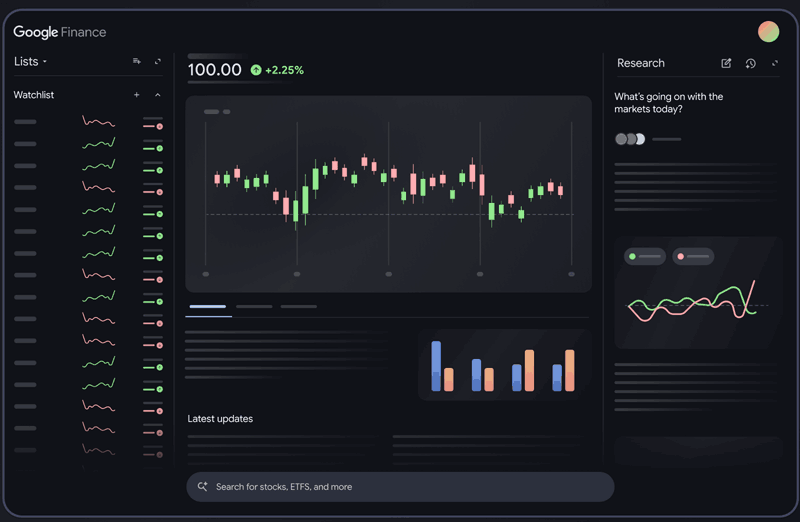
Screenshot Of Google Finance

The screenshot above shows a watchlist panel on the left, a chart in the middle, a “latest updates” section beneath that, and a “research” section on the right hand panel.

Research

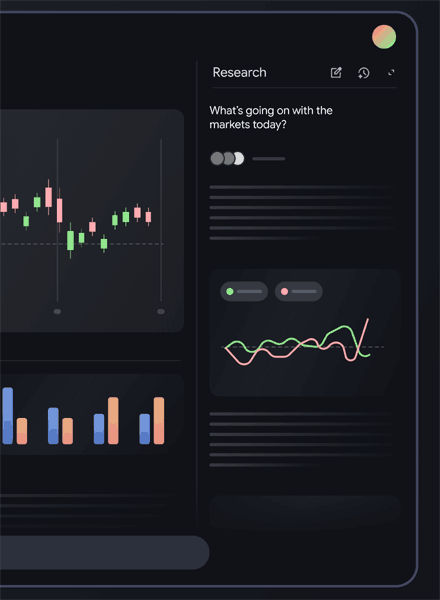
The new finance page enables users to ask natural language questions about finance, including the stock market, and the AI will return comprehensive answers, plus links to the websites where the relevant answers can be found.

Closeup Screenshot Of Research Section

Charting Tools

Google’s finance page also features charting tools that enable users to visualize financial data.

According to Google:

“New, powerful charting tools will help you visualize financial data beyond simple asset performance. You can view technical indicators, like moving average envelopes, or adjust the display to see candlestick charts and more.”

Real-Time Data

The new finance page also provides real-time data and tools, enabling users to explore finance news, including cryptocurrency information. This part features a live news feed.

The AI-powered page will roll out over the next few weeks on Google.com/finance/.

Read more at Google:

We’re testing a new, AI-powered Google Finance.

Featured Image by Shutterstock/robert_s

https://www.searchenginejournal.com/google-is-testing-an-ai-powered-finance-page/553333/


How To Stay Visible in AI Search [Webinar] via @sejournal, @lorenbaker

AI search is here. Are you ready for the new rules?

The SEO game has changed. Traditional strategies are no longer enough, and some brands are getting lost in the shift to AI-powered search results.

Join Wayne Cichanski on August 20, 2025 for an exclusive webinar sponsored by iQuanti. Learn how to adapt your SEO strategy and site architecture for AI-driven queries and remain competitive in this new search era.

In this session, you’ll discover:

  • Why user experience, schema, and site architecture are now just as important as keywords
  • Practical steps to remain visible and competitive in evolving search results
  • How to position your brand for discovery in AI-driven queries, not just rankings

Why this session is essential:

With generative AI reshaping search results across platforms like Google, Bing, and ChatGPT, it is crucial to rethink how your content is structured and how people interact with your brand in AI search. Do not get left behind. Optimize for AI-driven search now.

Register today for actionable insights and a roadmap to success in the AI search era. If you cannot attend live, do not worry. Sign up anyway and we will send you the full recording.

https://www.searchenginejournal.com/stay-visible-ai-search-iquanti-webinar/552675/


The Future Of Search: 5 Key Findings On What Buyers Really Want via @sejournal, @MattGSouthern

Search is changing, and not just because of Google updates.

Buyers are changing how they find, evaluate, and decide. They are researching in AI summaries, asking questions out loud to their phones, and converting through conversations that happen outside of what most analytics can track.

Our latest ebook, “The Future Of Search: 16 Actionable Pivots That Improve Visibility & Conversions,” explores how marketers are responding to this shift.

It offers a closer look at what it means to optimize for visibility, engagement, and results in a fragmented, AI-influenced search landscape.

Here are five key takeaways.

1. Ranking Well Doesn’t Guarantee Visibility

Getting to the top of search results used to be enough. Today, that’s no longer the case.

AI summaries, voice assistants, and platform-native answers often intercept the buyer before they reach your website.

Even high-ranking content can go unseen if it’s not structured in a way that’s easily digestible by large language models.

For example, research shows AI-generated summaries often prioritize single-sentence answers and structured formats like tables and lists.

Only a small fraction of AI citations rely on exact-match keywords, reinforcing that clarity and context are now more important than repetition.

To stay visible, businesses need to consider how their content is interpreted across multiple AI systems, not just traditional SERPs.

2. Many Conversions Happen Offscreen

Clicks and page views only tell part of the story.

High-intent actions like phone calls, text messages, and offline conversations are often left out of attribution models, yet they play a critical role in decision-making.

These touchpoints are especially common in service-based industries and B2B scenarios where buyers want real interaction.

One case study reveals that a company discovered nearly 90% of their Yelp conversions came through phone calls they weren’t tracking. Another saw appointment bookings spike after attributing organic search traffic to calls rather than clicks.

Our ebook refers to this as the insight gap, and highlights how conversation tracking helps marketers close it.

3. Listening Is More Effective Than Guessing

Marketers have access to more customer input than ever, but much of it goes unused.

Call transcripts, support calls, and chat logs contain the language buyers actually use.

Teams that analyze these conversations are gaining an edge, using real voice-of-customer insights to refine messaging, improve landing pages, and inform campaign strategy.

In one example, a marketing agency increased qualified leads by 67% simply by identifying the specific terminology customers used when asking about their services.

The shift from assumptions to evidence is helping brands prioritize what matters most, and it’s making their campaigns more effective.

4. Paid Search Works Better When It Aligns With Everything Else

Search behavior is not linear, and neither is the buyer journey.

Users often move between organic results, paid ads, and AI-generated suggestions in the same session. The strongest-performing campaigns tend to be the ones that echo the same language and value props across all these touchpoints.

That includes aligning ad copy with real customer concerns, drawing from call transcripts, and building landing pages that reflect the buyer’s stage in the decision process.

It also means rethinking what happens after the click.

5. Attribution Models Are Out Of Step With Reality

Most attribution still assumes that conversions happen on a single screen. That’s rarely true.

A manager might discover your brand in an AI-generated search snippet on a desktop, send the link to themselves in Slack, and later call your sales team from their iPhone after revisiting the content on mobile.

Marketers relying only on last-click attribution may be optimizing based on incomplete or misleading data.

The report makes the case for models that include multi-touch, cross-device, and offline activity to give a fuller picture of what drives conversions.

This isn’t about tracking more for the sake of it. It’s about making smarter decisions with the signals that matter.

Rethinking Search Starts With Rethinking Buyers

The ebook, written in collaboration with CallRail, offers more than strategy updates. It is a reminder that behind every metric is a person making a decision.

Marketers who succeed in this new environment aren’t just optimizing for rankings or clicks. They are optimizing for how people think, search, and take action.

Download the full report to explore how buyer behavior is reshaping search strategy.

the future of ai search


Featured Image: innni/Shutterstock

https://www.searchenginejournal.com/the-future-of-search-key-findings-on-what-buyers-really-want/552476/


Google Ecommerce SERP Features 2025 Vs. 2024 via @sejournal, @Kevin_Indig

In 2024, Google turned the SERP into a storefront.

In 2025, it turned it into a marketplace with an AI-based mind of its own.

Over the past 12 months, Google has layered AI into nearly every inch of the shopping search experience by merging organic results with product listings, rolling out AI Overviews that replace traditional product grids, and introducing a full-screen “AI Mode.”

Meanwhile, ChatGPT is inching closer to becoming a personalized shopping assistant, but for now, the most dramatic shifts for SEOs are still happening inside Google.

To understand the impact, I revisited a set of 35,000+ U.S. shopping queries I first analyzed in July 2024.

In today’s Memo, I’m breaking down the state of Google Shopping SERPs in 2025. A year later, the landscape looks … different:

  • AI Overviews have started to displace classic ecommerce SERP features.
  • Image packs dominate the page.
  • Discussion forums are on the decline.

Plus, an exclusive comparison of 2024 vs. 2025 ecommerce SERP features and a full, detailed checklist of optimizations for the SERP features that matter most today (available for premium subscribers. I show you exactly how I do this).

This memo breaks down exactly what’s changed in Google’s shopping SERPs over the past year. Let’s goooooo.

Boost your skills with Growth Memo’s weekly expert insights. Subscribe for free!

In the last 12 months, Google hasn’t just transformed itself into a publisher that serves up content to answer queries right in the SERP (via AI Overviews and AI Mode). It’s also built out an extensive marketplace for shopping queries.

However, Google now provides a whole slew of SERP features and AI features for ecommerce queries that are at least as impactful as AIOs and AI Mode.

Meanwhile, ChatGPT & Co. are starting to include product recommendations with links, reviews, buy buttons, and recommendations directly in the chat. (But this analysis focuses on Google results only.)

To better understand the key trends for Google shopping queries, in July 2024, I analyzed 35,305 keywords across product categories like fashion, beds, plants, and automotive in the U.S. over the last five months using seoClarity.

We’re revisiting that data today, examining those same keywords and categories for July 2025.

The results:

  1. AI Overviews have started to replace product grids.
  2. Ecommerce SERPs are increasingly visual.
  3. There are more question-related SERP features (like People Also Ask), less UGC.
  4. Fewer videos are appearing across the SERPs for product-related searches.

About the data:

  • This data specifically covers Google search results and features. It doesn’t include ChatGPT, Perplexity, etc. However, we’ll touch on this briefly below.
  • Over 35,000 search queries were analyzed, and the same group was examined in both July 2024 and July 2025.
  • The search queries analyzed include product-related queries across a broad spectrum, from brand terms (like Walmart) to individual products (iPads) and categories (e-bikes).
  • If you’re curious about the exact list of Google shopping SERP features included in this analysis, they’re included at the bottom of this memo.

Before we dig into the findings…

In Google’s shift from search engine to ecommerce marketplace (and from search engine to publisher), Google has merged as much as possible into the SERP page.

Web results and the shopping tab for shopping searches were combined as a response to Amazon’s long-standing dominance.

The shopping tab still exists, sure.

But for product-related searches, the main search page and the Google shopping experience look incredibly similar, with the Shopping tab streamlined to a product-grid experience only.

In June 2024, I reported in Critical SERP Features of Google’s shopping marketplace:

  • Google has fully transitioned into a shopping marketplace by adding product filters to search result pages and implementing a direct checkout option.
  • These new features create an ecommerce search experience within Google Search and may significantly impact the organic traffic merchants and retailers rely on.
  • Google has quietly introduced a direct checkout feature that allows merchants to link free listings directly to their checkout pages.
  • Google’s move to a shopping marketplace was likely driven by the need to compete with Amazon’s successful advertising business.
  • Google faces the challenge of balancing its role as a search engine with the need to generate revenue through its shopping marketplace, especially considering its dependence on partners for logistics.

And now?

Google’s layered AI and personalized SERP features into the shopping experience as well.

Below are the Google SERP features I’ll be examining in this year-over-year (YoY) analysis, specifically, with a quick synopsis if you’re not familiar.

  • Images: A horizontal carousel of image results related to the query pulled from product pages or image-rich content; usually appear at the top or mid-page and link to Google Images or directly to source pages.
  • Products: Displays a visual grid or carousel of products with titles, images, prices, reviews, and merchants. This includes free product listings (organic) and Product Listing Ads (PLAs) (paid).
  • People Also Ask (PAA): Related questions users frequently ask. Clicking a question reveals a source link. (These often inform Google’s understanding of search intent and user curiosity.)
  • Things To Know: An AI-driven feature that breaks a topic into subtopics and frequently misunderstood concepts. Found mostly on broad, educational, or commercial-intent queries, this is Google’s way of guiding users deeper into a topic and understanding deeper search intent.
  • Discussion and Forums: Highlights relevant threads from platforms like Reddit, Quora, and niche forums. Answers are often community-generated and authentic. Replaced some traditional “People Also Ask” real estate for shopping or reviews queries.
  • Knowledge Graph: Displays structured facts about a person, brand, product, or topic-sourced from trusted databases. Appears in a right-hand sidebar or embedded box.
  • Buying Guide: A feature that explains what to consider when shopping for a product, e.g., “What to look for in a DSLR camera.” Usually placed mid-page for commerce-intent queries. It mimics a human assistant or product expert’s advice. Contains snippets and links to sources.
  • Local Listing: Shows local business listings with map, ratings, hours, and quick call/location links. Prominent in searches with local intent like “shoe store near me” or “coffee shops in Detroit.”
  • AI Overview: Generative AI summary at the top of the SERP that answers the query using information synthesized from multiple sources. For shopping queries, it often includes product summaries.
  • Video: A carousel or block of video content, mostly from YouTube, but also from other video-hosting platforms. May include timestamps, captions, or “key moments” for long videos.
  • Answer Box (a.k.a. Featured Snippet): A direct answer to a query extracted from a single web page, shown at the top of the SERP in a stylized box. Often used for factual or how-to queries. Includes the source link.
  • Free Product Listings: Organic product results submitted via Google Merchant Center feeds. These listings show in the Shopping tab and occasionally in the main SERP product grid (distinct from paid Shopping ads).
  • From sources across the web: A content block showing opinions or quotes on a product or topic from a variety of sites. Often used in AI Overviews or product reviews to surface aggregated user sentiment or editorial input.
  • FAQ: An expandable schema-driven block showing common questions and answers sourced from a specific page. Typically appears under a site’s organic result when FAQ schema is properly implemented.
  • PPC: Sponsored links shown at the top or bottom of the SERP, marked “Sponsored” or “Ad.” These can show up as text, product images/grids, etc.

In addition to the standard SERP features tracked in this analysis via the above list, here’s a look at the current Google shopping marketplace SERP features and/or elements (like toggle filters) that we’re dealing with at the halfway point of 2025.

  • AI Mode (Full-Screen): Interactive, immersive full-page AI shopping experience with filters and buy links.
  • Shopping filters inline: Dynamic filters (brand, color, price) within AI Mode and Shopping grids.
  • Virtual try-on: This feature was recently released. It’s a generative AI module showing clothes on diverse body types (expanding by category).
  • Price tracking/alerts: Users can track price drops and get alerts via Gmail or Chrome. Honestly, a pretty great tool.
  • Popular stores/top stores: Scrollable carousel of prominent retailers for the product category.
  • Product sites (EU market): Organic feature that shows prominent ecommerce domains (due to regulatory changes in the EU).
  • Trending products/popular products: Highlights products rising in popularity based on recent search activity.
  • Merchant star ratings: Display review scores and counts in summaries or tiles.
  • Free shipping/returns labels: Highlighted callouts in product tiles.
  • “Verified by Google” merchant badges: Google-trusted seller icon in some listings.
  • Quick comparison panels: Side-by-side spec or feature comparisons (this is an early-stage rollout, similar to Amazon’s product comparison panel or module).

To illustrate with an example, let’s say you are looking for kayaks (summertime!).

On desktop (logged-in), Google will now show you product filters on the left sidebar and “Popular products” carousels in the middle on top of classic organic results, but under ads, of course.
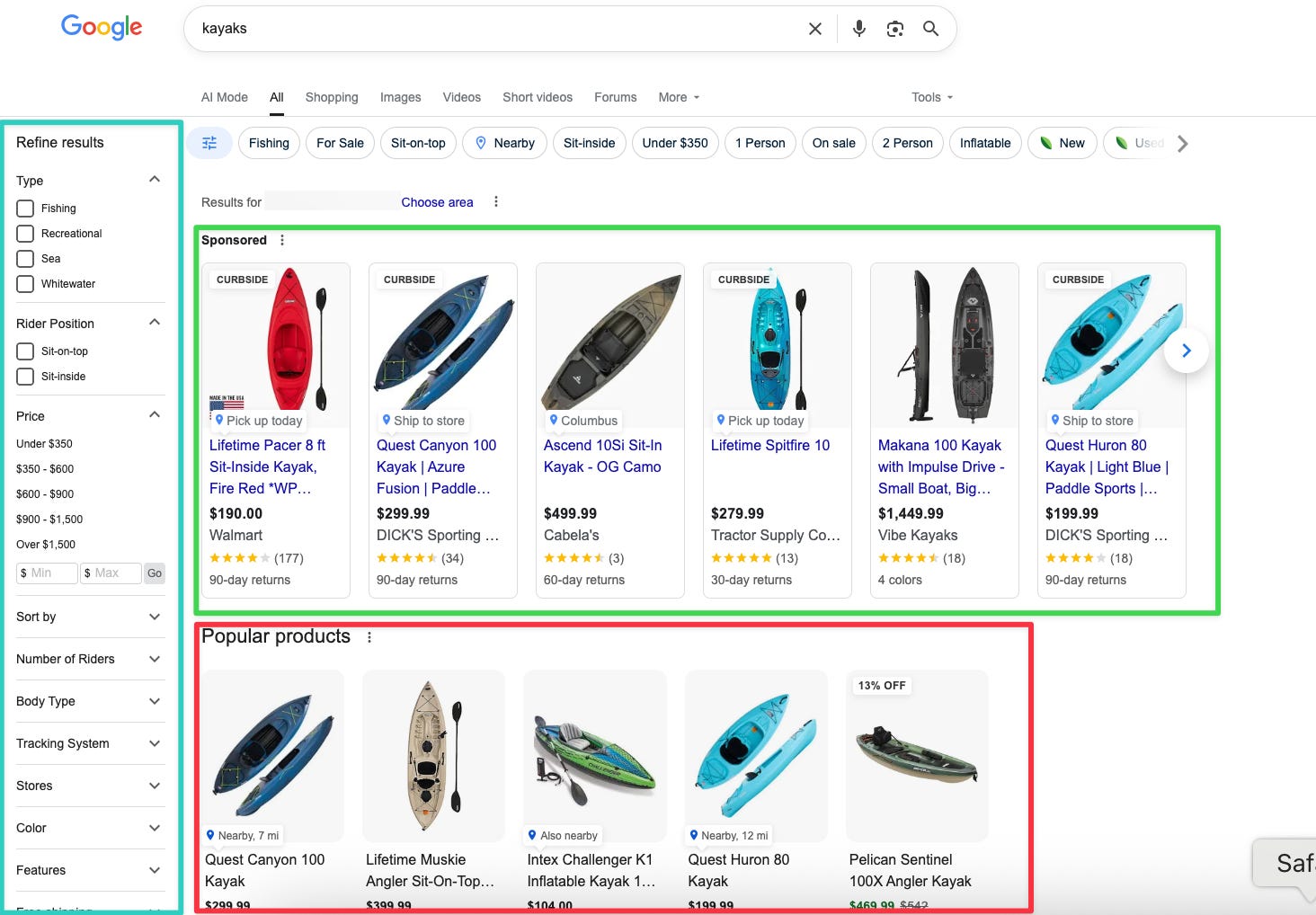
kayaks on desktopImage Credit: Kevin Indig

Directly under the shopping product grids, you have traditional organic results along with an on-SERP Buying Guide, similar to People Also Ask questions (which is also included further down the page).

Both the Buying Guide and People Also Ask features deliver answers with links to original content.
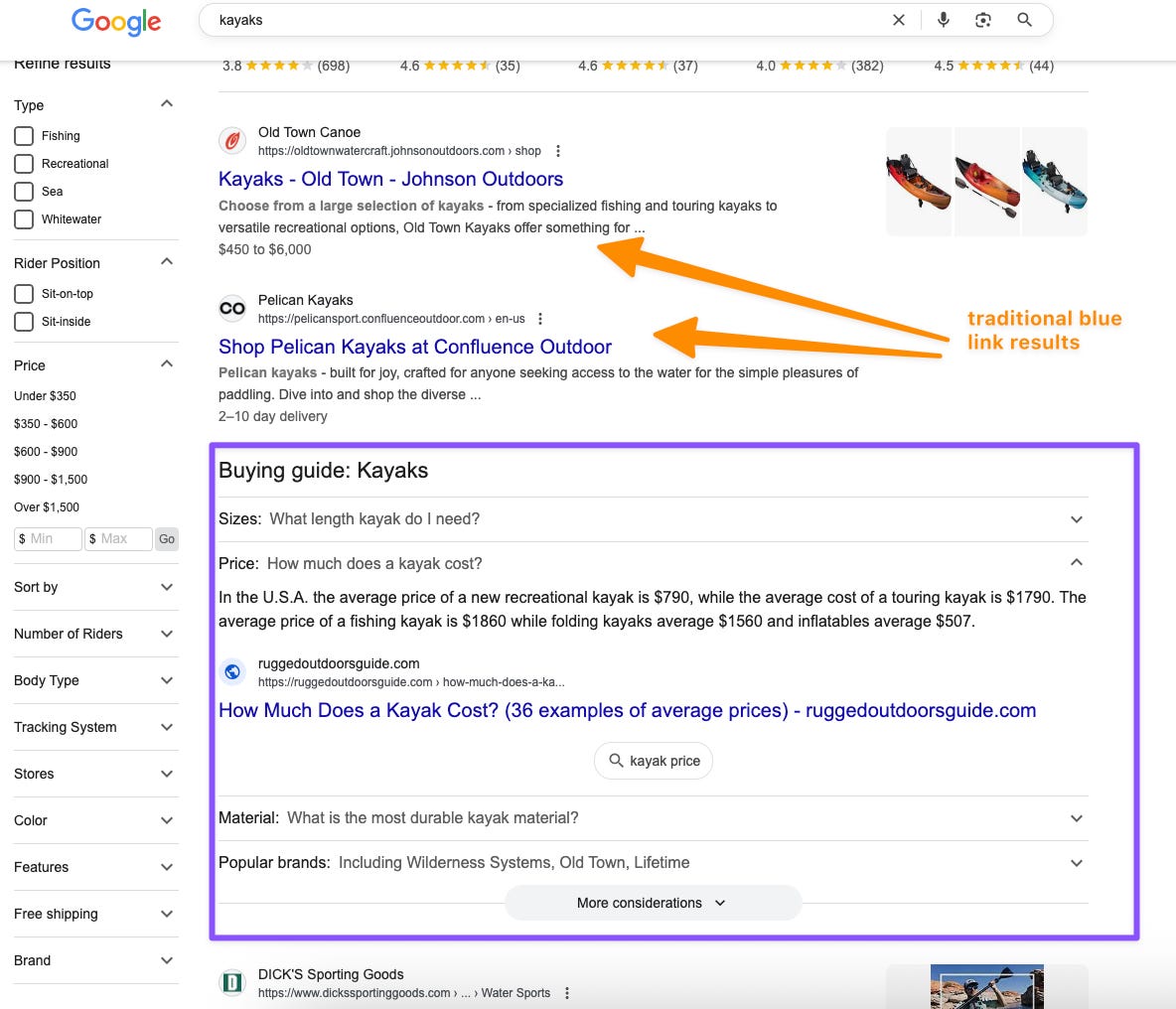
Image Credit: Kevin Indig

On mobile, you get product filters at the top, ads above organic results, and product carousels in the form of Popular products or “Products for you.”
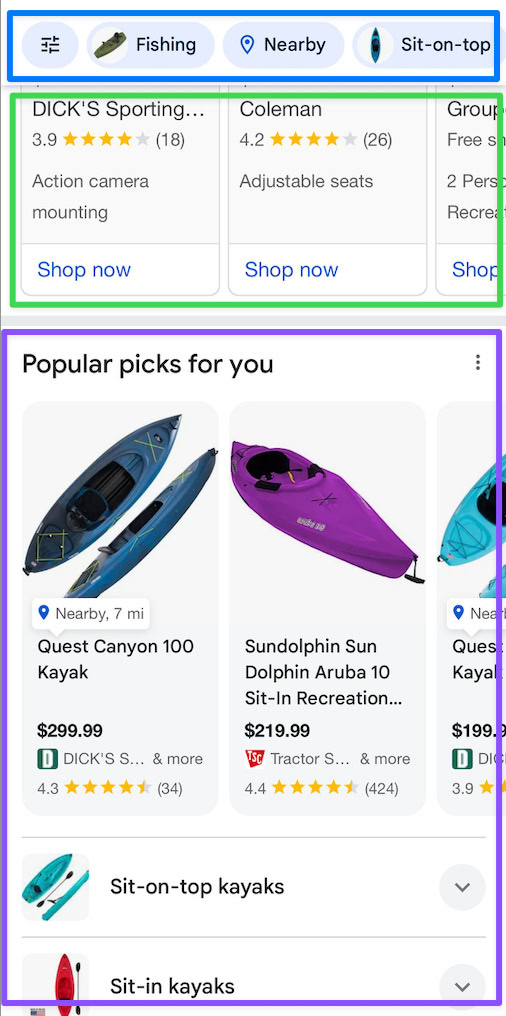
Image Credit: Kevin Indig

This experience doesn’t look very different from Amazon … which is the whole point.

Image Credit: Kevin Indig

Google’s shopping experience lets users explore products on a variety of marketplaces, like Amazon, Walmart, eBay, Etsy, & Co.

From an SEO perspective, the prominent position of product grid (listings) and filters likely significantly impacts CTR, organic visibility, and ultimately, revenue.

But let’s take a look at the same search via AI Mode.

Below is the desktop experience via Chrome.

I’ve zoomed out here so you get the whole view, but it takes the user two to three scrolls to get to the product grid when in a standard view.
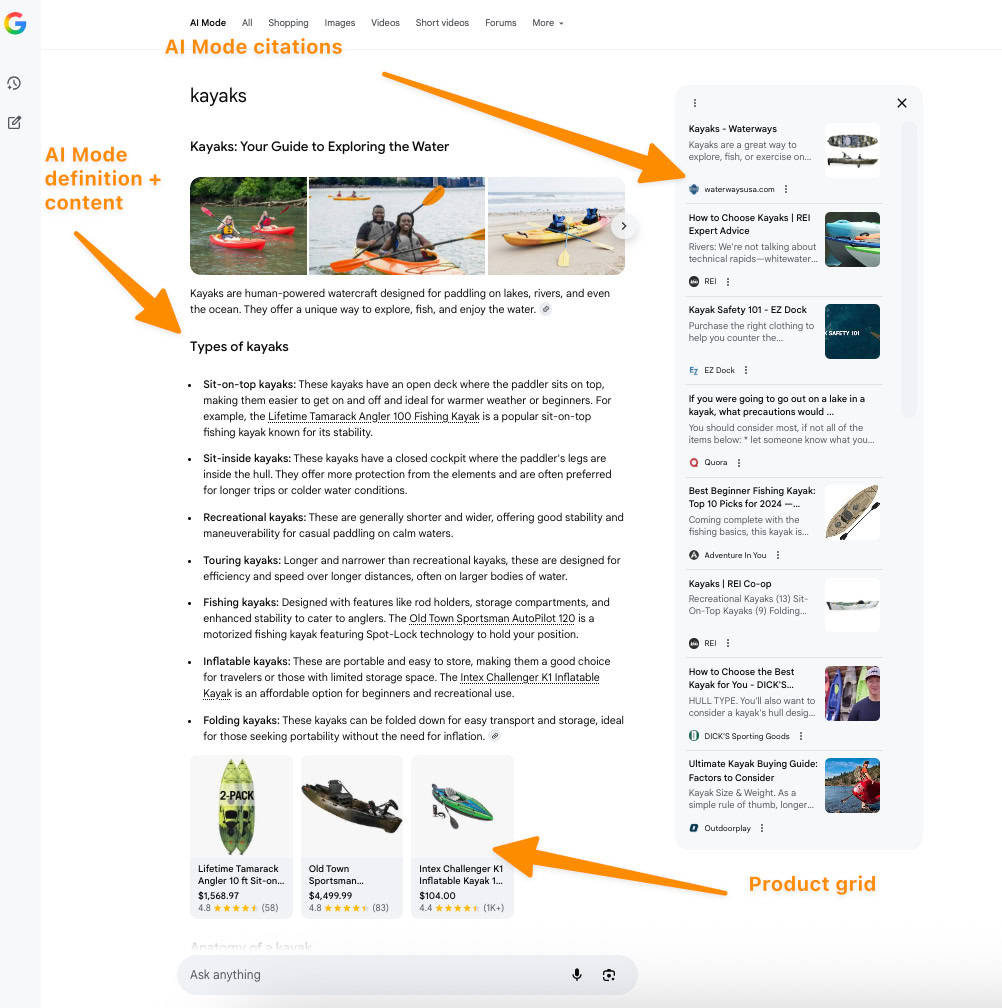
Image Credit: Kevin Indig

Here on mobile, getting to product recommendations takes several scrolls. In one instance, I received a result that included a list of places near me in my city where I could get a kayak.
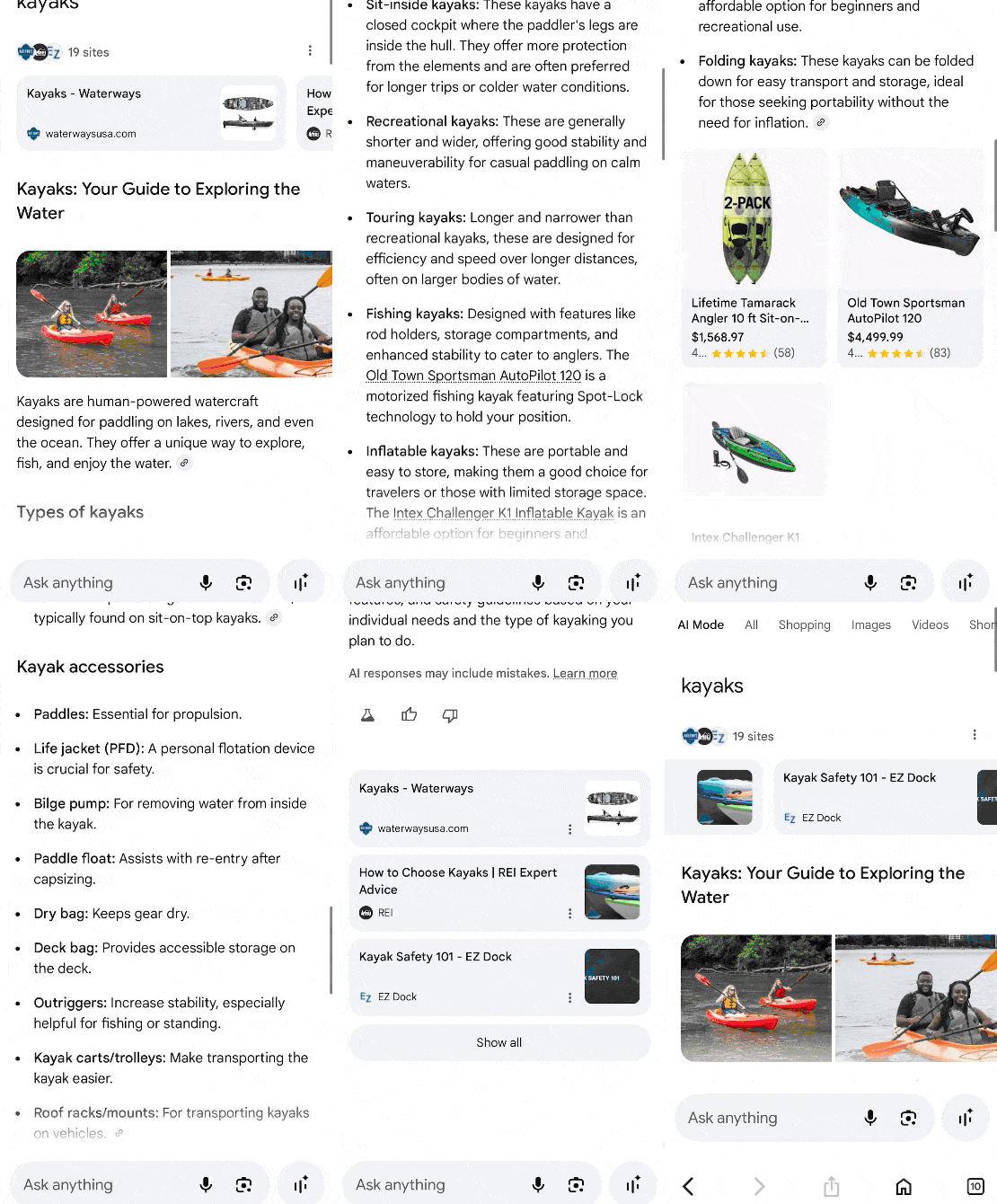
Image Credit: Kevin Indig

Keeping the current Google shopping SERP experience in mind, here’s what the data shows.

This is the most noteworthy shift found in the data, as you can probably guess.

Since March 2025, when Google began rolling out AI Overviews more aggressively, they’ve also started replacing (organic) product grids.
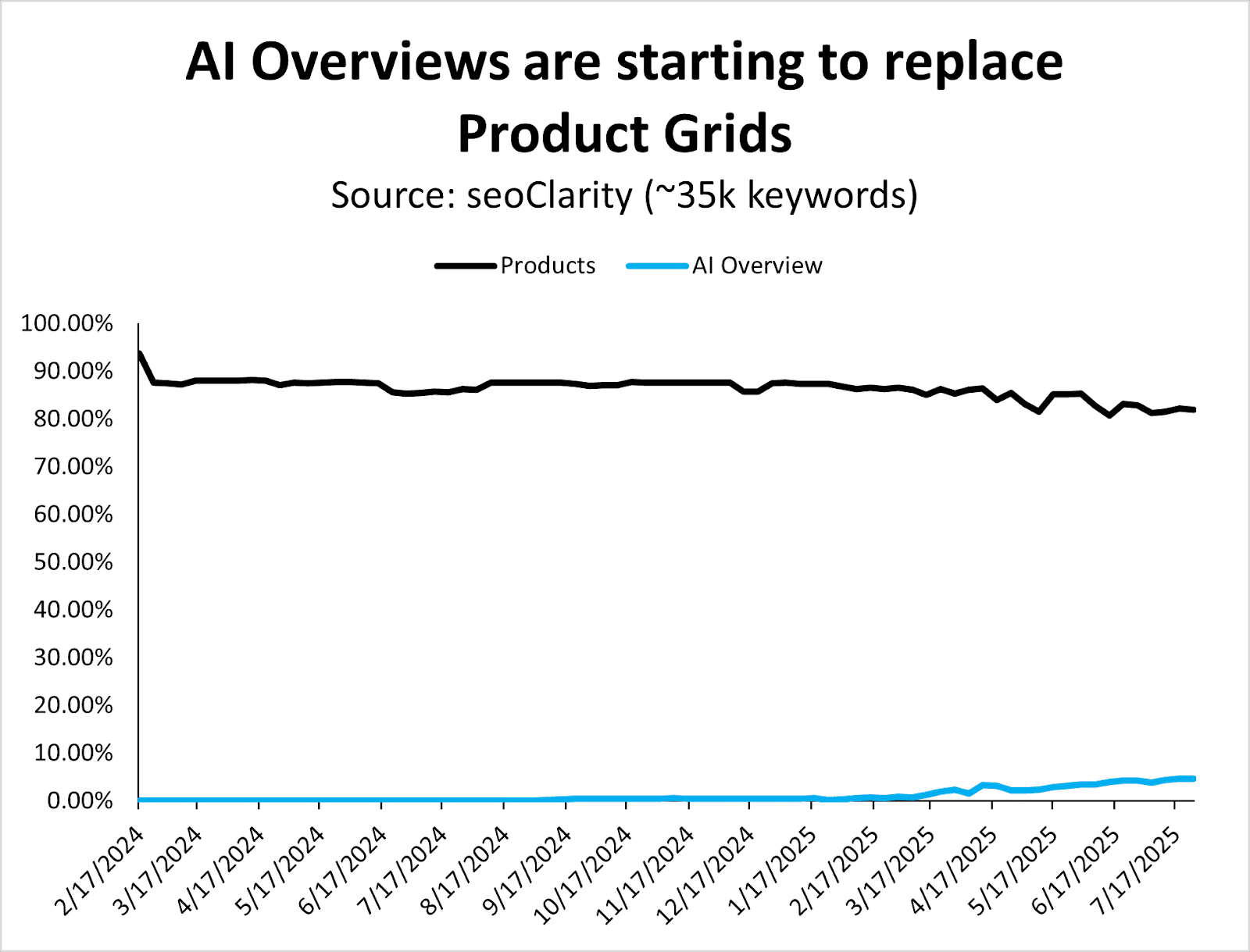
Image Credit: Kevin Indig

The graph above might look like it represents minimal changes when you examine it in a timeline view, but you can see the trend even better when moving AIOs to a second y-axis (below).
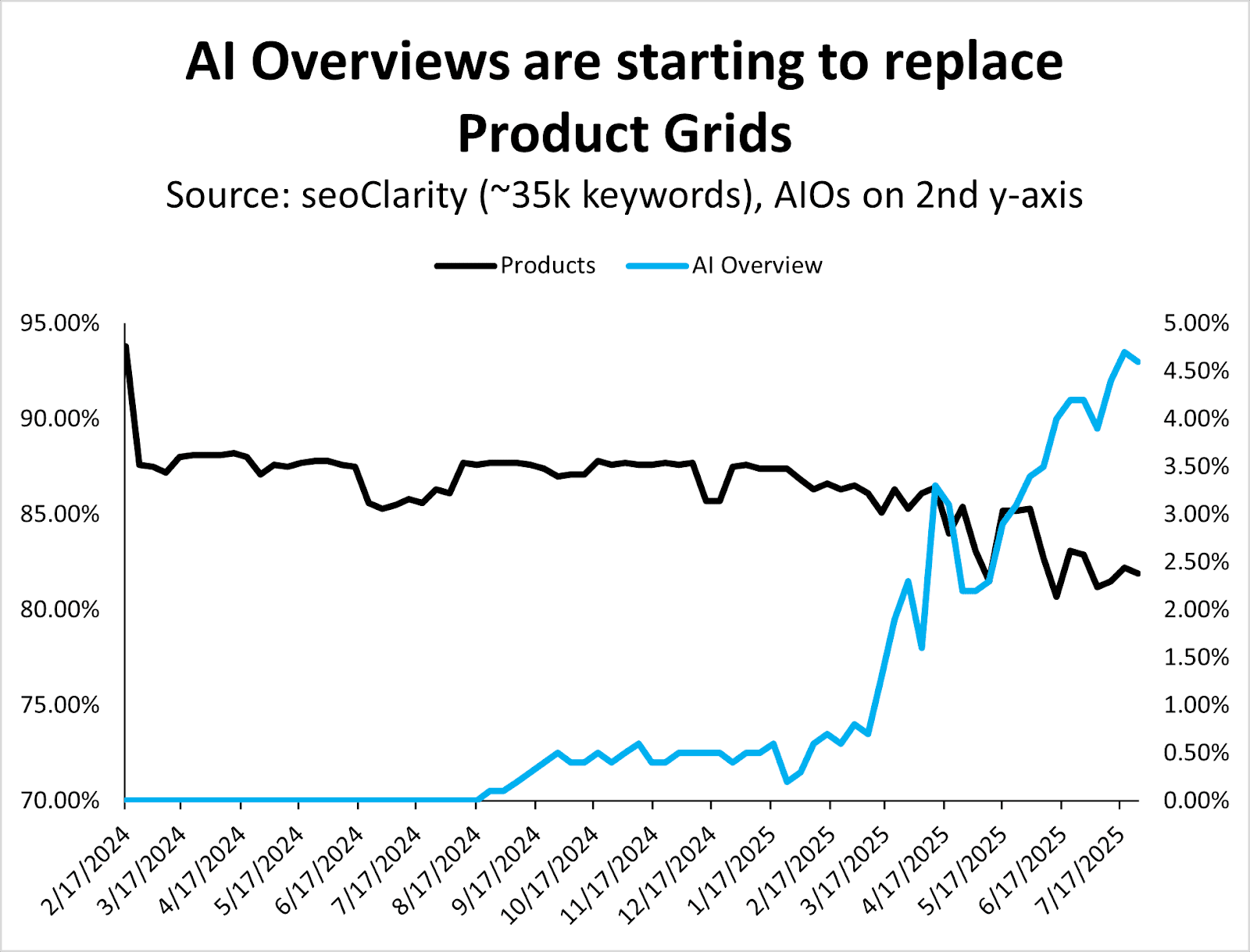
Image Credit: Kevin Indig

I expect AI Overviews to still show the product grids searchers have become accustomed to, although they might take a different form.

When searching for [which camera tripod should I buy?], for example, we find an AI Overview at the top with specific product recommendations.

Image Credit: Kevin Indig

Of course, AI Mode takes that a step further with richer product recommendations and buying guides.

(Shoutout to The New York Times and the other five sources for this AI Mode answer … which now don’t see an ad impression or affiliate click.)
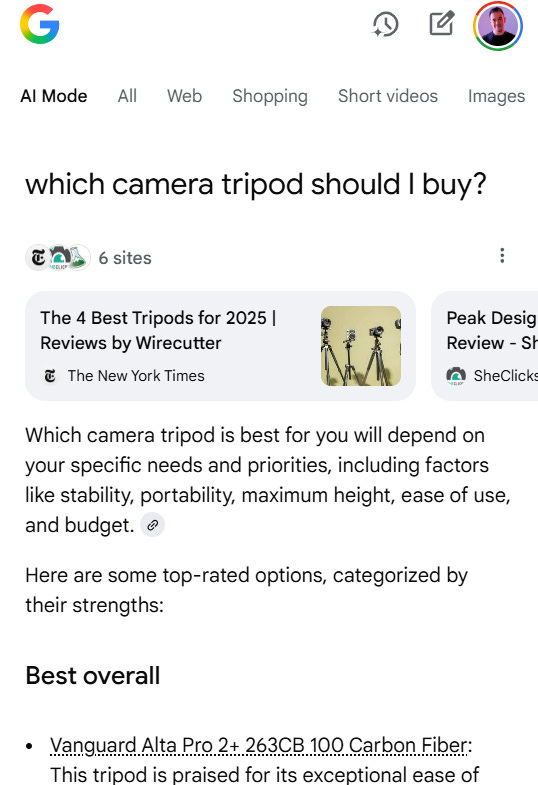
Image Credit: Kevin Indig

As a result of this shift, which I predict will only increase over time, tracking your brand mentions and product links in AI Overviews becomes critical. Skip this at your own risk.

Here, you’ll see the increase in image packs over time, with a big shift in March 2025.

Image packs for ecommerce-related queries grew from ~60% in 2024 to a new baseline of over 90% of keywords in 2025.
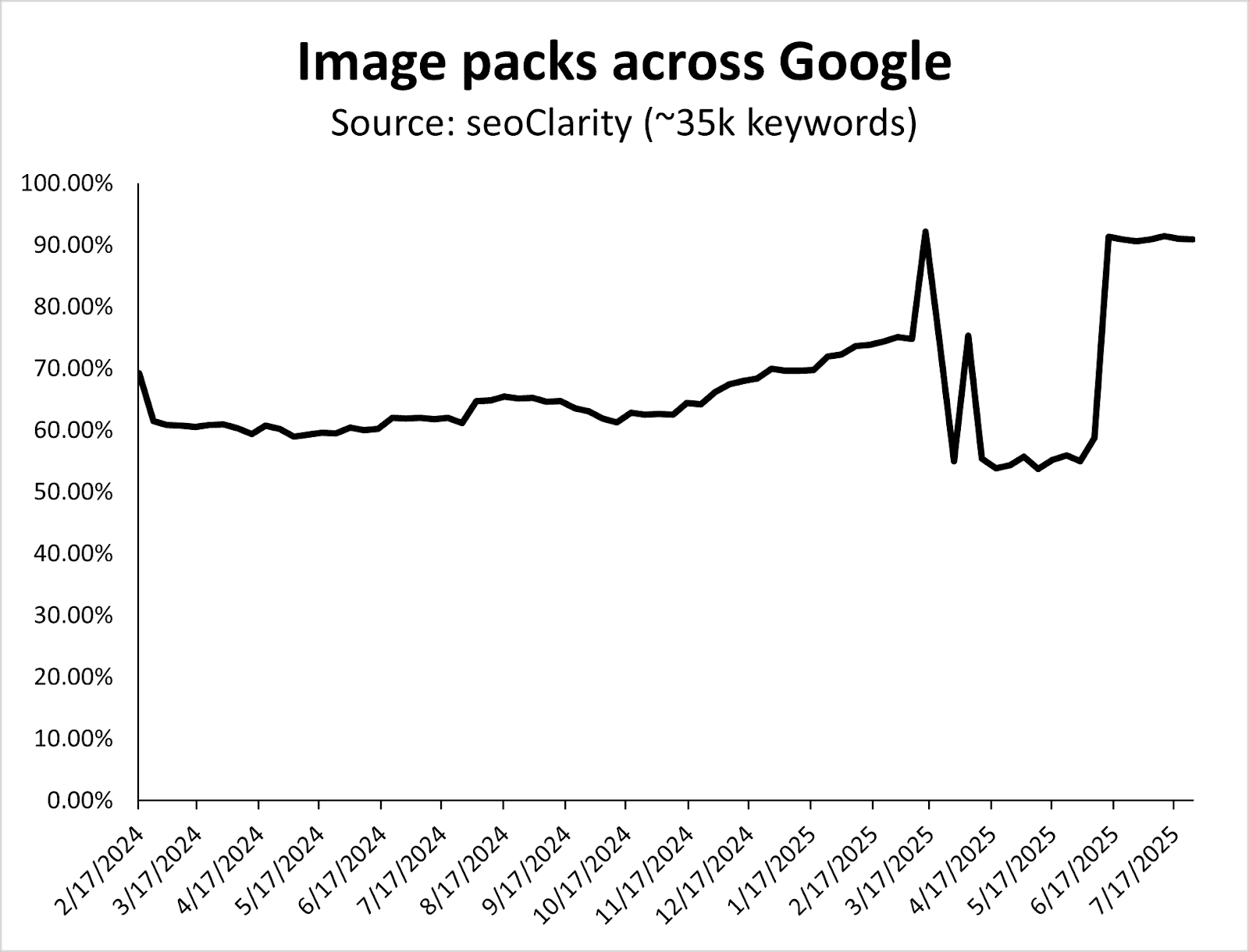
Image Credit: Kevin Indig

Also, notice how Google systematically tests SERP layouts between core updates (e.g., the dip in the graph above happens between the March and June 2025 Core Updates).

Having strong product images, which are properly optimized, continues to be crucial for ecommerce search.

Since January 2025, Google has shown more People Also Asked (PAA) features at the cost of Discussions & Forums.

Even though Reddit is the second most visible site on the web, I’m surprised to see more PAA – two years after Google removed FAQ rich snippets from the SERPs.
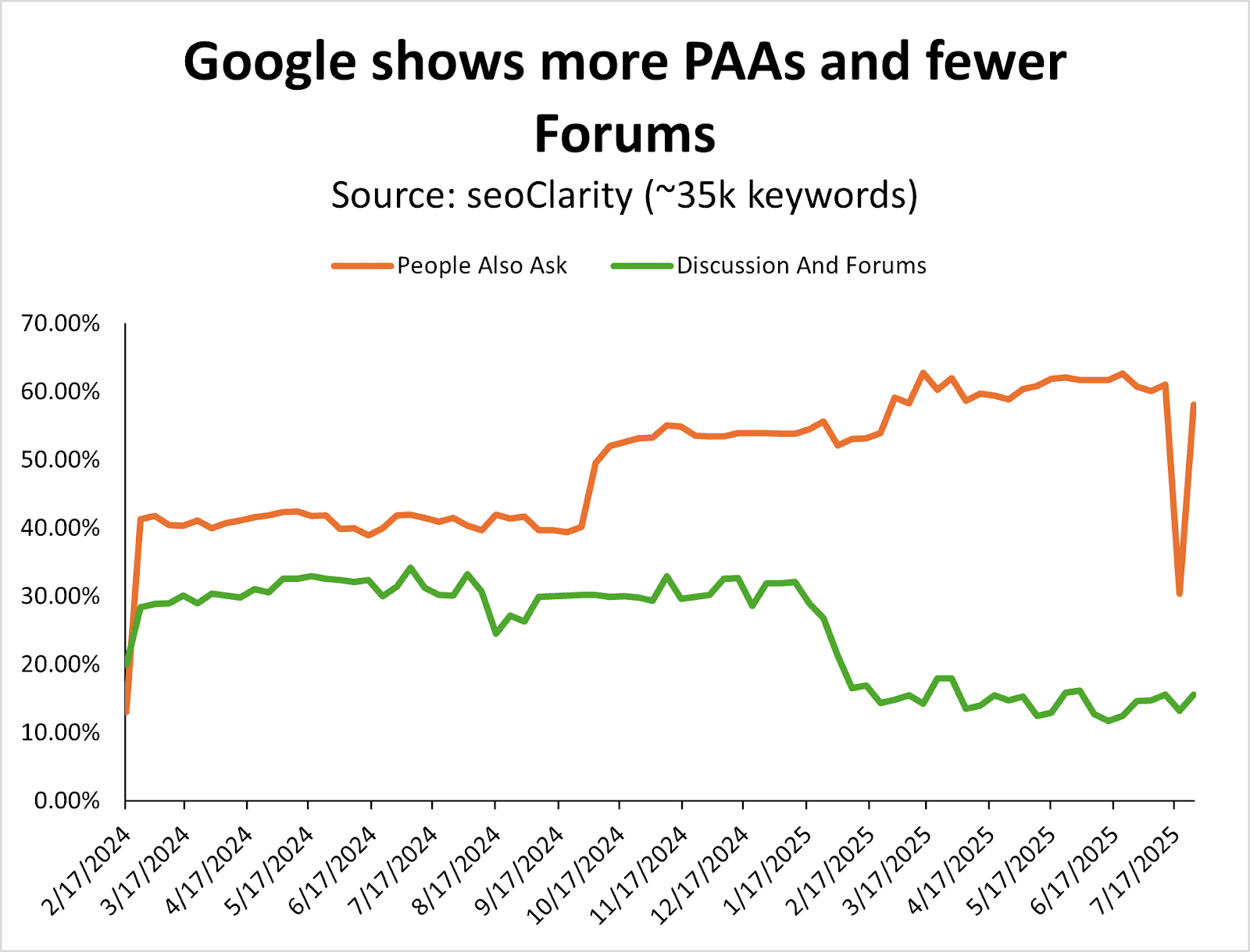
Image Credit: Kevin Indig

This is something you want to consider tracking for queries that are directly related to your products, if you’re not doing so already. (You can do this in classic SEO tools like Semrush or Ahrefs, for example.)

Since August 2024, Google has systematically reduced the number of videos in the ecommerce search results.
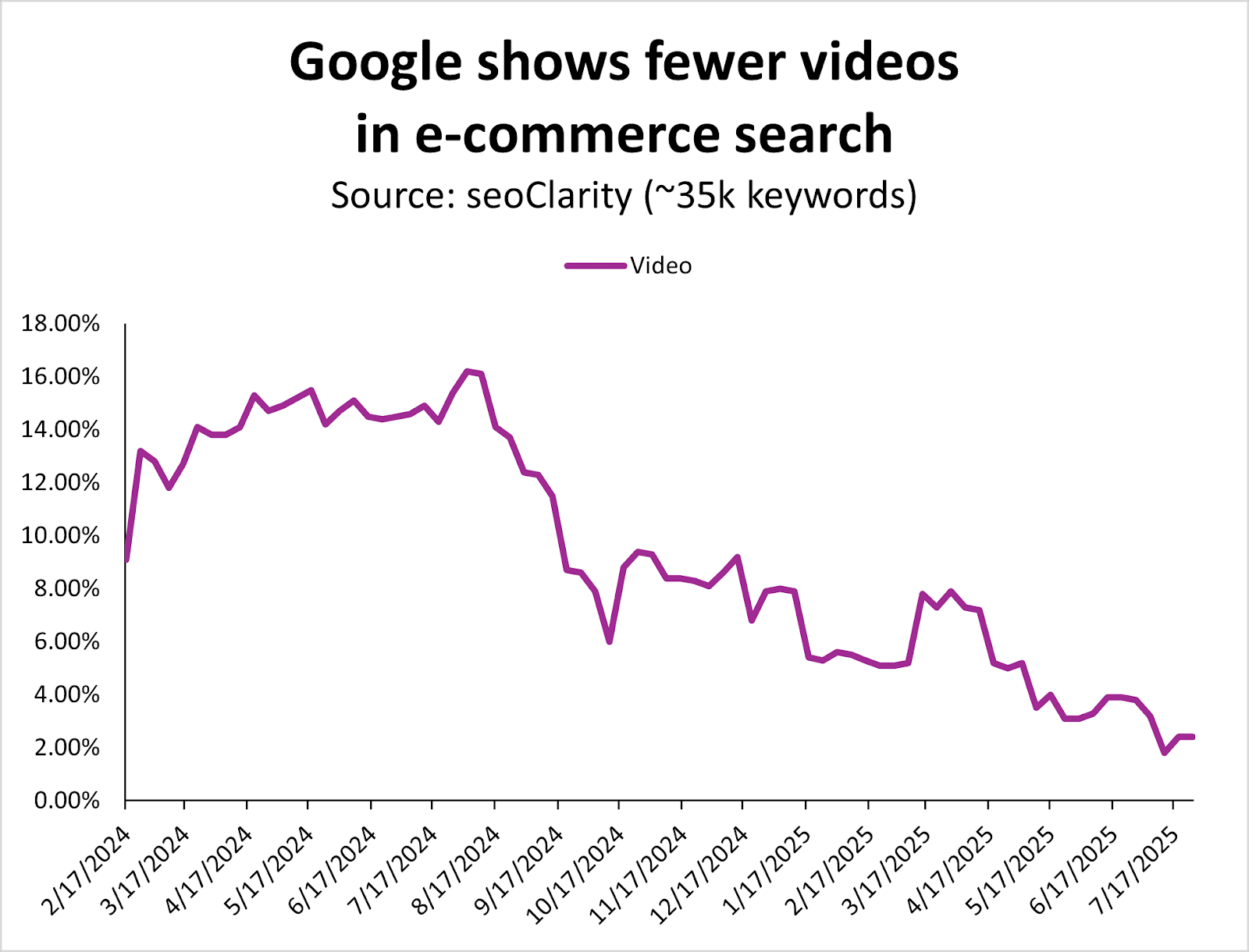
Image Credit: Kevin Indig

It seems that images have taken a lot of the real estate videos that used to own.
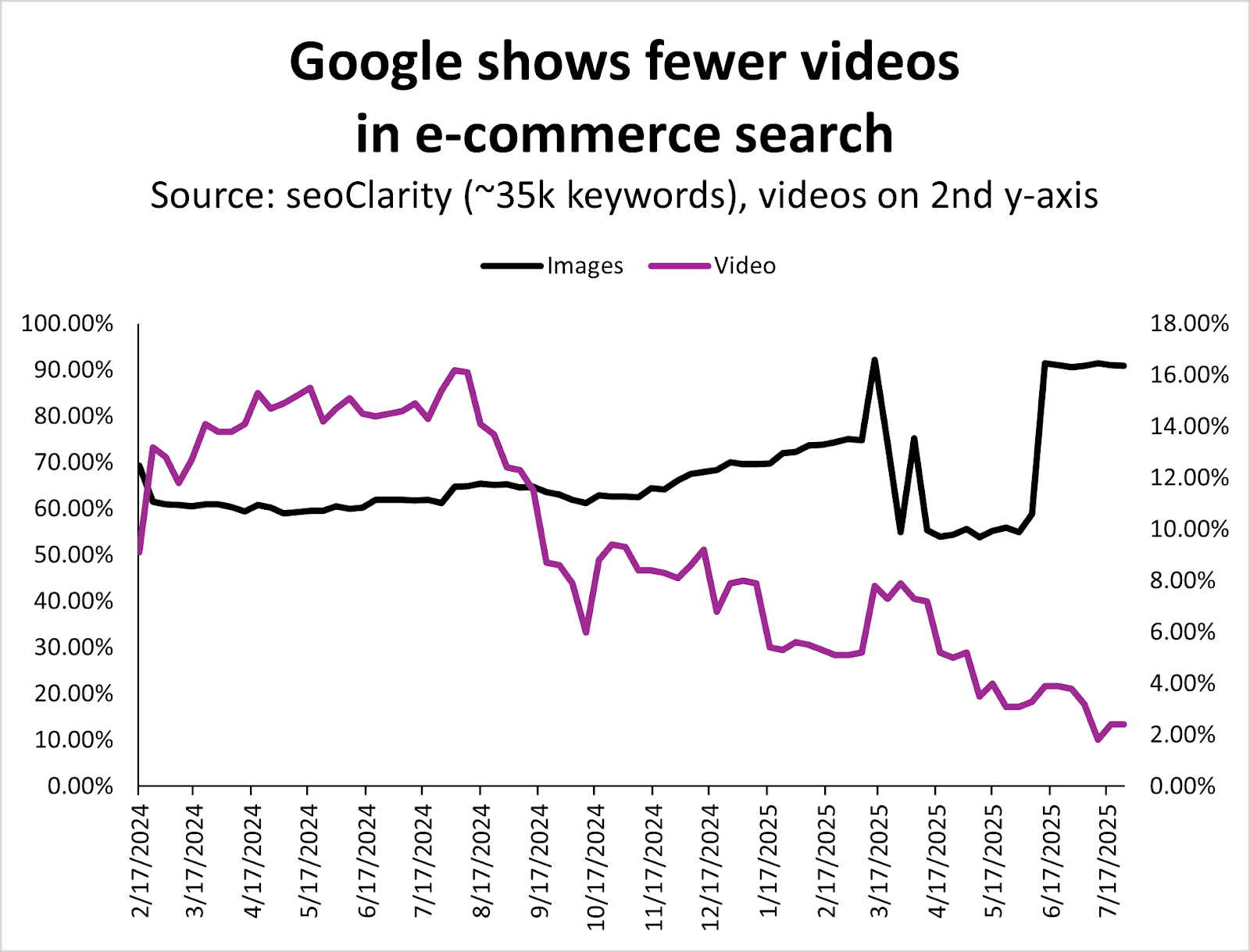
Image Credit: Kevin Indig

As a result, videos are less important in ecommerce search, while images are increasingly more important.

If you’ve been creating and optimizing videos and haven’t seen the SEO results you wanted for your products/site, this could be your signal to invest in other types of content.

While this analysis covers Google SERP data specifically, it’d be a miss to not discuss the new shopping features in ChatGPT.

However, we don’t yet have months and months of data on LLM-based conversational product recommendations to give us good, clear information, so I anticipate there will be more analysis ahead once more time passes.

ChatGPT’s shopping experience is starting to look a lot like Google’s  – but with a twist: Instead of viewing lists of blue links or multiple product grids, it curates a conversational shortlist with minimal product listings included.

No affiliate links and no paid ads (yet).
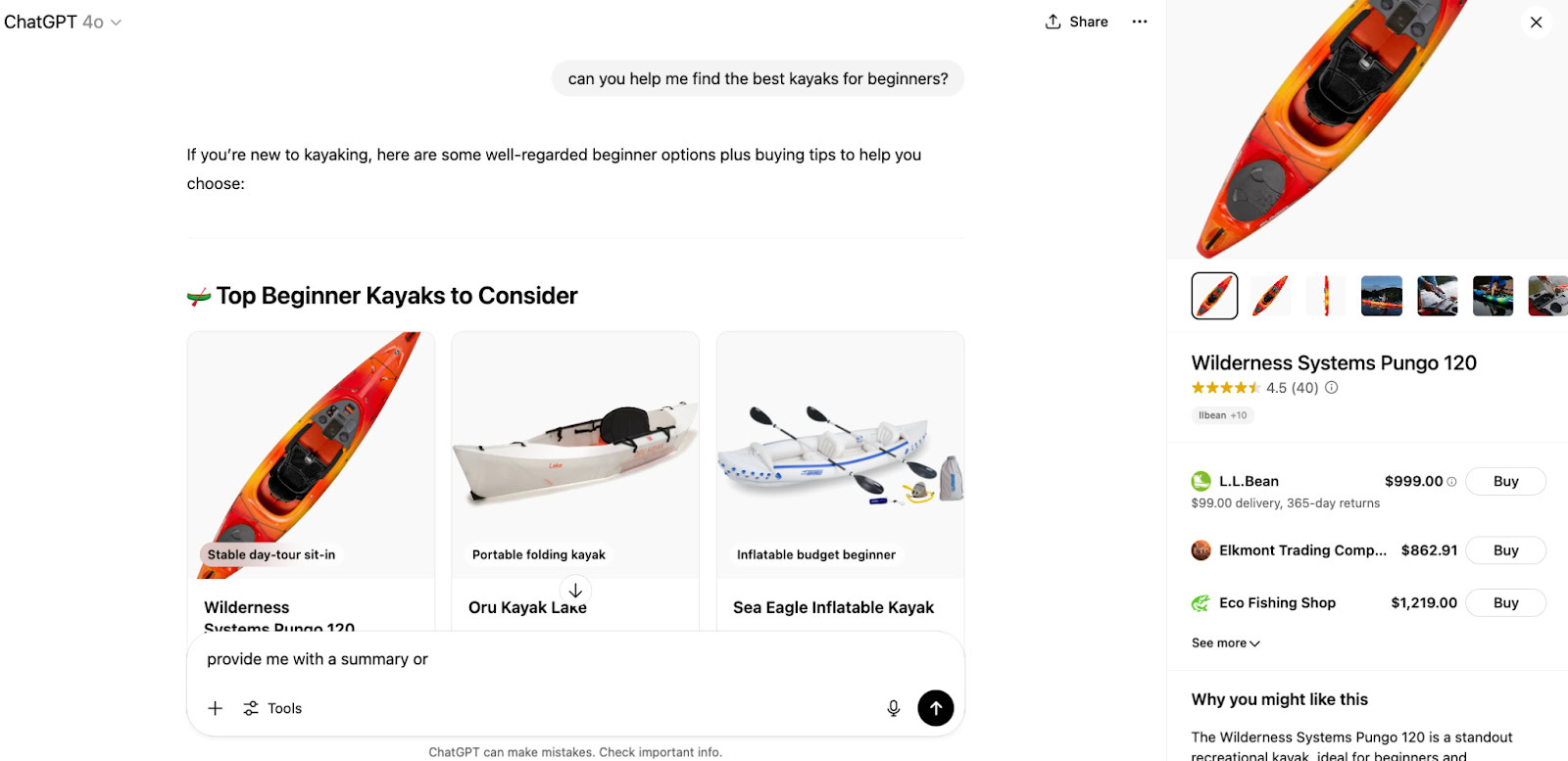
Image Credit: Kevin Indig

OpenAI integrates real-time product data from tools like Klarna and Shopify, allowing ChatGPT to surface up-to-date prices, availability, reviews, and product details in a shoppable card-style format.

ChatGPT also offers a “Why you might like this” and “What people are saying” generative summary when a specific product is clicked.

Image Credit: Kevin Indig

OpenAI offers the following guidance about how these products are selected [source]:

A product appears in the visual carousel when ChatGPT perceives it’s relevant to the user’s intent. ChatGPT assesses intent based on the user’s query and other available context, such as memories or custom instructions….

When determining which products to surface, ChatGPT considers:

• Structured metadata from third-party providers (e.g., price, product description) and other third-party content (e.g., reviews).

• Model responses generated by ChatGPT before it considers any new search results. Learn more.

• OpenAI safety standards.

Depending on the user’s needs, some of these factors will be more relevant than others. For example, if the user specifies a budget of $30, ChatGPT will focus more on price, whereas if price isn’t important, it may focus on other aspects instead.

OpenAI also explains how merchants are selected for products [source]:

When a user clicks on a product, we may show a list of merchants offering it. This list is generated based on merchant and product metadata we receive from third-party providers. Currently, the order in which we display merchants is predominantly determined by these providers….

To that end, we’re exploring ways for merchants to provide us their product feeds directly, which will help ensure more accurate and current listings. If you’re interested in participating, complete the interest form here, and we’ll notify you once submissions open.

That being said, it takes some trial and error to trigger product recommendations directly in the chat.

For instance, the prompt [can you help me find the best kayaks for beginners] results in an output that includes product recommendations, while the query [what are the best kayaks for beginners] results in a list without shopping results, features, or links.

Prompts with action-oriented language like “can you help me” and “will you find” may have a higher likelihood of offering shopping results directly in the chat, while queries like “what is the best” and “what are the best” and “compare the features of” may result in a variety of recommendations.
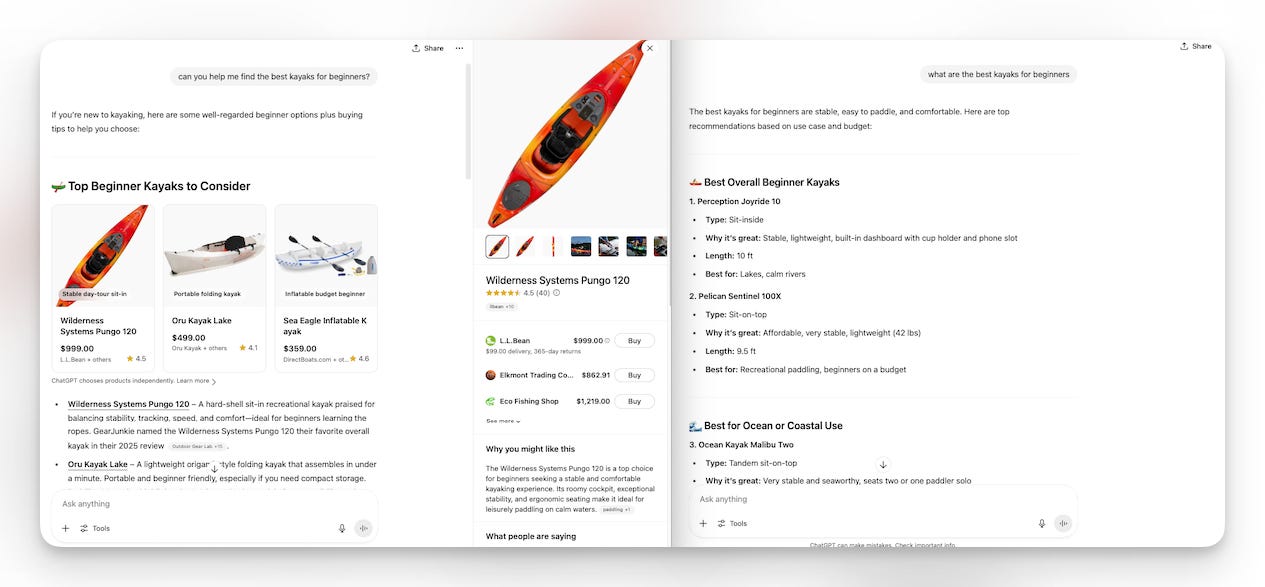
Image Credit: Kevin Indig

Featured Image: Paulo Bobita/Search Engine Journal

https://www.searchenginejournal.com/google-ecommerce-serp-features-2025-vs-2024/552935/