10 Advanced SEO tactics to drive more traffic to your website

30-second summary:

  • SEO has evolved to cover a wide range of efforts that contribute to traffic generation. 
  • The easiest way to improve search visibility is to have an arsenal of tactics at your disposal for creating a top-ranking page. 
  • Improving the quality of content and backlinks are prime ranking factors that influence the placement of a page in a search result and can be done in a variety of ways. 
  • Founder of Digital Ducats Inc, shares in detail 10 different advanced SEO tactics to drive traffic by improving the quality of the content you’re publishing for users.

Learn how to drive more traffic to your website and you will have learned how to ensure the growth of your business. Driving more relevant traffic is the overarching goal of every website owner that wants to increase revenue. 

The success of your website relies on the volume of relevant traffic that you’re able to generate on a regular basis. Here are 10 advanced SEO tactics to increase the traffic to your website on a regular basis. 

1. Increase content production

Did you know websites that publish SEO optimized blog posts two-to-four times a week produce the highest number of leads and conversions? Increasing your content production allows your website to expand the range of keywords it targets and provides more answers to the questions people are searching for. 

The frequency of the content you create should align with the goal you’ve created in your overall content strategy. Neil Patel had the goal of increasing his page views to hit 100k. 

When he was publishing once a week his views were at 46k page views. After increasing his content production to twice a week he was able to hit 100k page views in under a year. 

Don’t mistake frequency as the only factor that will improve your website traffic. Learn how to write articles for marketing to build trust and accumulate backlinks.  

Aim to publish informative articles and provide value to your audience. According to Conductor, even a week after reading educational content, people are 48% more likely to buy from the company that educated them. 

Pumping out low-quality blog posts that lack quality will eventually hurt your website. Publish content with the intention of providing solutions to problems and relevant questions. 

2. Cluster your content to drive more traffic

A web page ranking is highly influenced by the topical relevance of the page to a search query. Google favours sites that demonstrate Expertise, Authority & Trust (E.A.T.). This makes establishing topic clusters using pillar page best practices ideal for driving more traffic. 

A topic cluster consists of pillared content (central keyword theme) and clustered content (articles with a narrow focus).  

The pillar pages are typically long-form and cover a broad keyword topic. Pillar pages link to clustered content to go deeper into detail about more specific topics that share the central keyword theme. 

The clustered content links back to the pillar page, lifting the authority of the pillar page which highlights its importance. Clustered content will also link to other clustered content on relevant topics. 

SEO advanced tactics: Pillar page topic cluster

This internal linking strategy strengthens the topical relevance of your pages and contributes to improved ranking, increased traffic and higher click-through rates. 

Tips for creating effective topic clusters

  • Select well-researched keywords to create the most effective topic clusters. Target long-tail keywords in your clustered content to lower competition and drive traffic that is a better match to your website.  
  • Publish 10X content that solves a specific problem to rank highly and be the best solution in a search result. 
  • Perform a content audit to make sure you use existing content to target keywords in your cluster and avoid keyword cannibalization. 

3. Optimize for featured snippets

Featured snippets appear for just about every question that is searched on Google. Drive more traffic using pages on your site that already rank on the first page of Google.  

According to a study by Ahrefs, if your site is featured in the snippet (also referred to as position zero) it adds an additional 8.6% of the available traffic to your site. 

Identify every keyword that your site ranks for on the first page. You can use Moz, SEMRush, or Ahrefs or any keyword-tracking tool to get a list of your first page appearances. 

Keep in mind that with the new format, if your site is in the number one position, there is some debate on which position is more valuable in terms of traffic. 

Tips to win position zero

  • Duplicate the current snippet’s optimization. 
  • If there’s a paragraph answer, provide a paragraph answer immediately after your featured snippet heading. The sweet spot is between 40-60 words. 
  • If there’s a list featured, use the HTML for an ordered list 
  • Use title tags for the question or title that represents the snippet. 
  • Use title tags for subtitle headings that Google could possibly use as a list. 

4. Add FAQ structured data markup to performing pages 

Google introduced FAQ structured data markup that shows up as a rich result. You can use FAQ schema to increase the click-through rate that your page receives. The rich result displays each of the questions you have listed in an interactive drop-down styled format.
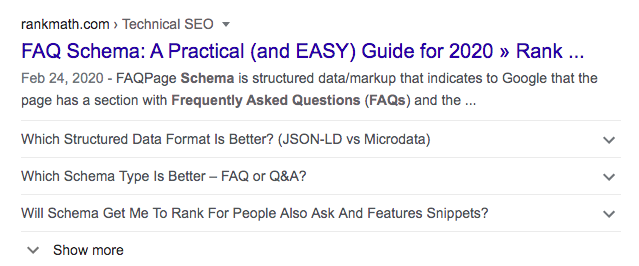
SEO advanced tactics: FAQ Schema

This can be useful to sites for increasing the click-through rate because of the extra space that is being taken up by the SERP result. 

You can use the following markup found on Google’s developer reference page to make your FAQs eligible to show up as a rich result.  

You can also test the markup to make sure it works: 
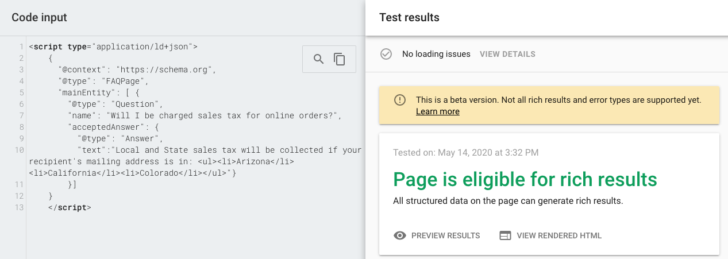
FAQ schema code test

Tip for adding FAQ schema 

If you’re using Yoast, it has a feature specifically for adding these to your content. It can save you the time of cutting and pasting code to your content. 

  • Target the PAA box by publishing a FAQ page: The PAA box (People Also Ask) requires similar optimization to the featured snippet. The PAA box can drive additional traffic when users click through to your site. Increase the likelihood of being featured by publishing a Frequently Asked Questions page. 
  • Research commonly asked questions: Research the questions that are appearing in the top 3 or 4 spots in the PAA box. Click on any relevant questions that you will use on your FAQ page. Every time you click a question you should get another three or four questions that are added to the bottom of the box.  
  • Optimize your answers: The first paragraph answer you provide should be roughly 50 words in length. Use the Inverted Pyramid style of writing to improve the likelihood of your answer being selected. Give people what they need to know in the first paragraph and what is nice to know afterwards
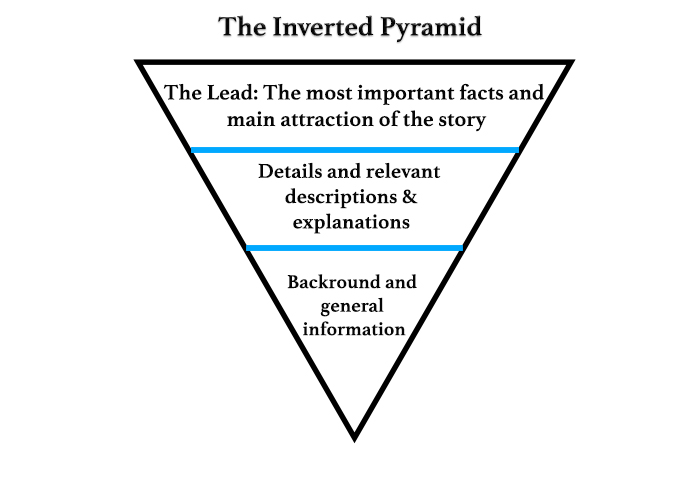
Advanced SEO tactics: Inverted pyramid

Tips for driving more traffic from the PAA box 

  • Never use one-sentence answers as responses. Make each response to a question detailed enough to be a complete answer.  
  • Provide links to relevant content within your site to promote a higher CTR. 
  • Enhance optimization with jump links at the top of the page. Not only does this improve the UX (user experience) but it also helps search engines locate specific content on your page. 

How to create a jump link

The HTML of a jump link can be implemented using the following code: 

Choose a name to use as the link ID. In this example, the link ID is “jump”. Use the following HTML code to add the link to your questions at the top of your page: 

<a id=”jump”>Question and answer you want to jump to</a> 

Next, you will need to place the code for the linked target before the beginning of your answer in order to take users directly to that spot on your page: 

The HTML code for the linked target is: <a id=”jump”></a> 

Alternatively, you can insert the answer within the code as the linked target: 

<a id=”jump”>ANSWER</a>

5. Repurpose top-performing content

Use the top-performing pages on your site to create new variations of the same content. By creating a new version of popular content you’re guaranteed to spark interest and encourage more traffic. 

Identify the pages that receive the most traffic on your site. You can do this by checking Google Analytics. On the left navigation panel, click on the following: Behaviour > Site Content > Pages. 
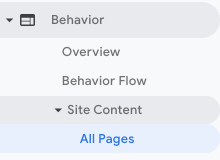
Analytics navigation

The report will give you a break down of the volume of page views and the time spent on the most popular pages.  

Select the period of time you want to compare pages (six months to a year).  

Make your decision based on the pages that attracted the most clicks and that people spent the most time on. 

You can take any blog article and create an infographic, video or slide presentation in order to mix things up.  

Use your new multimedia such as a video or slide presentation to post to external sites and social media to generate new streams of traffic. 

6. Guest post on healthy relevant websites

Backlinks fuel the ranking ability of your content. Good content attracts backlinks, however, if you don’t want to wait around for links to appear, you need to take action. 

Use guest posting as a strategy to build links to internal pages on your site to create more entry points for visitors to find your content (referral traffic). 

Building links from high traffic websites earn streams of targeted traffic as well as a boost in authority and credibility by linking to your content. 

The links you receive from guest posting are contextual, which is considered the best type of link. Include links to relevant content on your site within the article to provide your reader with a reference that enhances their experience.  

Tips for guest posting

  • The most ideal sites to guest post on are healthy, authoritative and have high subscribership for referral traffic. 
  • Topical relevance is key in providing the most impact on links you point to your site. Link to content that enhances the user experience. 
  • Create alliances with authors or websites to scale up your efforts. If you include a link in your content to a partner’s site, and they do the same for you-your efforts are doubled with every article you publish. 

7. Build your local presence

Drive more local traffic by brushing up on the essentials of local SEO. Ask clients for reviews, keep your NAP details consistent and your GMB profile updated and accurate. One of the most powerful tactics that will help surface your website in localized searches is acquiring local backlinks.

Apart from the common places to link from, such as structured citations (directories, review sites, profile links, etc.) aim for unstructured citations on local business blogs.  

12 Web Design Trends by Toronto Experts is an example of an infographic that was used in a local outreach campaign. This local SEO strategy combined an expert round-up with an infographic to result in a 63.64% increase in traffic to local landing pages. 

Add the fact that infographics generate 172% more backlinks than your typical blog post, and there’s a pretty convincing argument to incorporate them into your local link building strategy.   

8. Become an expert on Quora

Quora is a site that gets over 300 million unique visitors every single month. There are loads of questions that are asked on a daily basis that fall into your area of expertise. If you consistently answer a few questions a day, you can build a reputation that ultimately leads to referral traffic. 

All links on Quora are no-followed but you can still leverage the opportunity to send people to your site with high quality, in-depth answers. The idea is to go above and beyond the quality of a standard response to get your answer upvoted. 

The answer with the most upvotes will float to the top of the answers. This means when other people search the question, your answer will be the first one they see.  

If it’s really good, it should also be the last one they see. 

9. Use the Barnacle SEO method

Where you can take your traffic generation to another level is to combine Quora’s traffic with the traffic from Google search. There are literally hundreds of thousands of questions that Quora ranks for on the first page of Google.  

Not only can your answer receive thousands of views from Quora, but you’ll also get users to find your answer on Google as well.  

You can use tools like SEMRush to get a list of the keywords Quora ranks for and filter the results to search for your keywords in the top ten organic results.
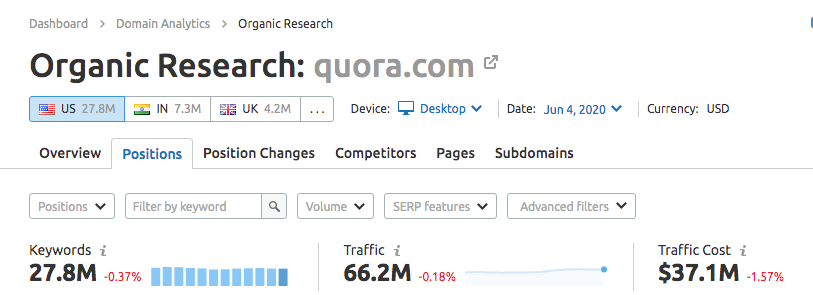
SEMRush Quora keywords

Tips for getting more referral traffic from Quora 

  • When choosing questions to answer, look for the ones that already have a high number of followers. The number of followers on each question will mean they will be notified every time the question receives a new response. Choose questions with a minimum of 15 followers to guarantee a decent-sized audience as a long-term strategy. 
  • Optimize your profile by including a detailed bio with a link to your website. When users read the answers you’ve provided, they will want to know more about you. Don’t disappoint them by leaving a blank bio with no way of getting to your site. 
  • Too many self-promotional calls to action may put your account at risk. Users get suspended and even banned from Quora for leaving affiliate links or too many links that lead people off-site.  

10. Invite guest authors 

Inviting authors to write an article on your site is a great way to spice up your content with a fresh perspective. Publishing articles from guest authors contribute to increased content production, attract a new audience and backlinks. 

Increased focus on topic coverage

Your content production increases with submissions from guest authors. This can allow you to focus more on the topics your blog is covering and the keywords you’re targeting. The added depth to your content production will contribute to an increase in traffic. 

Attract a new audience

Authors who are publishing regularly share their content with their network. This brings a whole new audience to your site.

Most authors share their published work with their social network or even on their own website. This can be worth a nice addition of new visitors if you have a contributing author with a large network. 

Acquire more backlinks

It’s common practice for a regular blogger to reference a previously published article with a link. If your contributors are publishing regularly on other sites you should inevitably acquire a few links you wouldn’t have received otherwise. 

Create a “write for us” page

Create a page on your site that invites authors to contribute. Use “write for us” in the URL and title. Guest bloggers use that phrase to find sites to contribute articles.  

Define your requirements for posting on your blog to give contributors an idea of what is expected to get an article approved. 

Recruit your writers

Reach out to writers that are regularly publishing content in your niche. Whenever you read a good article on a topic that’s relevant to your site, make the connection and invite them to write for you. Most authors leave a link to their site or social media or website so it isn’t too difficult to make contact. 

Explore, experiment and do what works for you

There are so many ways to drive traffic to a site that it’s worth exploring new options and experimenting with new tactics to see what works for you. 

Whichever advanced SEO strategy you use, make sure you give it a fair shot by seeing the process the whole way through. 

Thre’s a learning curve to every new tactic but you’ll learn the most through personal, hands-on experience. Whenever something works, stick with it and scale-up. You now possess the knowledge of using 10 different strategies to drive more traffic to your website.  

Choose wisely and drive safely. 🙂

Christian Carere is an SEO consultant and the founder of Digital Ducats Inc. He can be found on Twitter @DigitalDucats.

10 Advanced SEO tactics to drive more traffic to your website



How to adapt SEO strategies for the zero-click search landscape

30-second summary:

  • Whether through featured snippets and knowledge graphs, or carousels of movie times and podcast episodes, Google’s SERPs have increasingly become a one-stop-shop for users’ needs.
  • As previously reported, these zero-click searches account for just shy of 55% of all Google search results, outdoing organic results altogether. 
  • Zero-click search is not as much of a hurdle as you might think.
  • Chief Executive at Go Up Ltd, Edward Coram James shares more about how you can tailor your search strategy to make zero-click work for you. 

Whether through featured snippets and knowledge graphs, or carousels of movie times and podcast episodes, Google’s SERPs have increasingly become a one-stop-shop for users’ needs. This has led to a rise in what has been termed “zero-click search”, where results pages provide enough information to save users from clicking onto any organic results at all. 

As previously reported, these zero-click searches account for just shy of 55% of all Google search results, outdoing organic results altogether. And with users becoming more reliant on these integrated SERP features — including job listings and social media feeds, as well as familiar paid results, all viewable on Google itself — SEO practitioners might think they have their work cut out trying to optimize for space in that remaining 45%. 

But rather than think of it as futile, consider it instead as an opportunity. As with any significant change to how Google presents its results pages, zero-click is not as much of a hurdle as you might think. Read on to learn more about how you can tailor your search strategy to make zero-click work for you. 

1. Focus on clicks-per-search during keyword research

If you work in SEO, you’ll be familiar with the strands of data which are used by the main keyword tools to help you determine which terms are most worth optimizing for, such as search volume and where your pages currently rank for those terms. In an increasingly zero-click SERP landscape, however, there is one often neglected metric which could see you rethinking your wider strategy. That is CPS, or clicks-per-search. 

CPS data is particularly useful in the context of zero-click, as it takes into account the rate of traffic these keywords obtain from people finding your page through SERPs, rather than simply how many people are looking for the term itself. If your pages rank well but achieve a low CPS, then you’ll know it’s time to re-optimize your content for related keywords with a better CPS rate. 

2. Target featured snippet positions

Featured snippets make up a huge part of the zero-click landscape, though they only appear for 12.3% of search results in total. Ahrefs has noted that around 82% of them are presented in paragraph form, with 11% showing as a list, and 7% as a table. Consequently, not only should you be identifying featured snippet opportunities relevant to your website, but you should also be considering how to best format your content to have the best chance of occupying a given featured snippet. 

SEO tools like Ahrefs and SEMrush can tell you which queries already exist with featured snippets, helping you to find opportunities to create relevant snippet-worthy content that appeals for long-tail search queries. You should keep it concise, no more than 55 words and use HTML to appropriately mark up any lists or tables.

Keep user intent in mind, and be sure to adapt your content to the way a query’s current featured snippet is presented on SERPs. 

3. Optimize your content on Google’s own property

One other reason for zero-click search’s increased prevalence is the sheer number of resources and tools that Google has at its disposal. Naturally, from a commercial point of view, Google wants to promote and prioritise these features to users. It’s therefore critical that your business’s profiles and content on each Google property are optimized accordingly. This can give it the best chance of being seen at the top of SERPs, which goes beyond the confines of regular organic search. 

To maximize your chances of visibility in these areas of SERPs, you should ensure that you have filled out all relevant information on your Google My Business profile, which will also be beneficial when it comes to your Google Maps appearance. Likewise, optimizing your YouTube videos with informative, keyword-rich titles and descriptions, and categorizing them correctly will give you the best chances of being seen, and improving your CPS rate. 

4. Incorporate structured data into your content markup

Despite not necessarily being a ranking factor per se, schema markup is important. Making use of it in tandem with keeping your Google My Business profile updated can encourage crucial data regarding opening times and contact details to be pulled through in SERPs. 

Marking your content up will also have benefits when trying to rank for rich answers, snippets or “People Also Ask” queries related to your target keywords, as well as events or information which could appear in carousel view. As noted above, optimizing for these features will allow you to take up more real estate within a results page — and in an increasingly clickless search landscape, this kind of visibility is vital. 

5. Use relevant images and optimize thoroughly

In a zero-click SERP landscape, optimizing for all of Google’s metrics is key, and that includes image search. Incorporating eye-catching, unique and relevant images throughout your website is something you learn in web design 101, but it’s easy to make them work for you in an SEO context. 

Image filenames and alt-text are two signals that have traditionally been used to rank images within Google’s image search tool. But beyond appearing higher in image results, optimizing images can hold benefits within Google’s organic SERPs. For example, the image in a featured snippet is often provided by a different website than the one from which the text content is taken. This means that, even if your website has been unable to obtain the featured snippet’s text, you have a second opportunity to do so via the featured image. 

Edward Coram James is an SEO professional and the Chief Executive at Go Up Ltd, an international agency dedicated to helping its clients navigate the complexities of global SEO and the technical aspects of delivering location-specific pages to targeted audiences.

How to adapt SEO strategies for the zero-click search landscape


What Is the Best Word Count for SEO? via @HelenPollitt1

[unable to retrieve full-text content]http://tracking.feedpress.it/link/13962/13611195


Bing Webmaster Tools: A Visual Guide to New & Updated Features via @facan

[unable to retrieve full-text content]http://tracking.feedpress.it/link/13962/13611119


DuckDuckGo Questioned By Authorities Over Google Antitrust Investigation via @MattGSouthern

[unable to retrieve full-text content]http://tracking.feedpress.it/link/13962/13606017


Co-Citation & Co-Occurrence: How Important Are They for SEO Today? via @AdamHeitzman

[unable to retrieve full-text content]https://tracking.feedpress.com/link/13962/13605563/370620


SEO on a shoestring budget: What small business owners can do to win

30-second summary:

  • There is a common and long-held belief that getting results from SEO takes at least six months. How true is that?
  • SEO can be costly and requires big dollars and a huge team to succeed. Should you ever compete with the biggies at all?
  • SEO is highly technical, changes from time to time with Google algorithm updates, hence, making it unpredictable. 
  • This piece answers those questions in detail and further debunks two common myths regarding the time it takes to get results from SEO and the unpredictable nature of SEO. It is, in sum, about how small businesses can play and win in the big league with SEO on a budget.

Pretty much everything you think you know about SEO today will be out of date tomorrow. This makes the online world an exceptionally volatile environment, where big fishes swallow the small ones.

In spite of this, many small businesses with a small budget for SEO are finding their feet in the online marketing world. How are they doing it? 

Research and experience have shown that domain age, numerous (quality) backlinks, and quality content are among the competitive advantages of businesses that are dominating the online marketing world.

And given that getting these things cost time and money, they present a formidable entry barrier to small business owners who want to get into the SEO game with a small budget.

For small business owners with little budget for SEO, chances are their website is relatively new, they do not have a budget for backlink building and even the job of creating content for their websites rests entirely on them. 

Before you turn away from SEO, remember the classic of Ryan Holiday,

“The Obstacle is the Way.”

The last decade is replete with stories of how savvy business owners found their ways to go face to face with the giants and, sometimes, defeat them.

The online world is not very different in that aspect. If you can follow the following steps, Internet marketing success, against all odds, can be made-to-order.

In this guide, I will show you what small businesses are doing to defy the stereotype and make SEO success on a shoestring budget, in a relatively short time.

1. The low-hanging fruit strategy

If you have been tinkering around with SEO for a while, you’ve probably heard of the term “long-tail keyword”.

Long-tail keywords refer to the specific keywords searchers are likely to use when they are close to making a purchase online.

To put this in perspective, here is an example.

If you want to start a blog on how to start a blog, for example, chances are you will not get found on Google given that the key phrase is too broad.

But if you break this down a little bit further and try to rank for “How to Start a Blog for Free,” your chances of ranking high on SERPs become brighter because you are targeting a fraction of the audience of the first key phrase. 

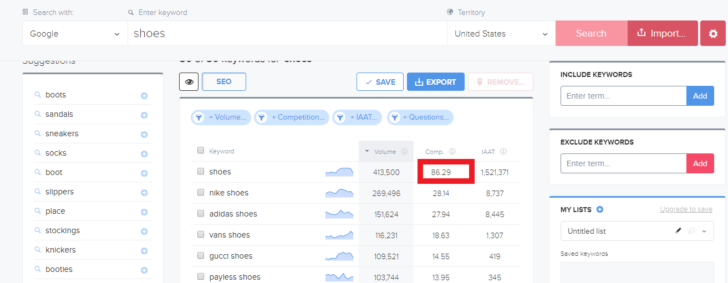
Another example is, if you are selling shoes, keywords like “shoes” are short-tail keywords, and trying to rank for them means you are probably going to be competing against Amazon and Gucci.

You don’t want to melt away like a snowflake under the sun, do you?

But if you try narrowing it down to more specific keywords such as “mens shoes,” or “best holiday shoes,” you have a better chance of getting to number one on Google SERPs for this kind of keywords. 

I ran the word “shoe” on a keyword research website. Here is what the result looks like:

The number in that red shape refers to the level of organic competition of that keyword, otherwise known as Keyword Difficulty (KD).

While the keyword “shoe” has a very high traffic potential, you do not have the wherewithal to weather the cutthroat competition of that field.

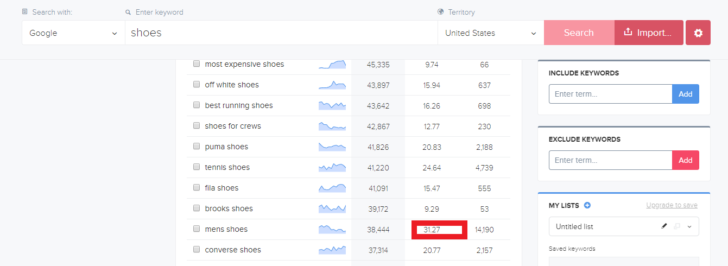
Now, look at the image below.

You can see that another keyword “men’s shoe” KD is a little above 32. That is your long-tail keyword and anything that falls into that category.

When you look at the number of organic traffic, you’d find that you can receive up to 38,000 monthly organic traffic for that keyword. For a small business owner with a limited budget for SEO like you, this is not too bad.

All you need to do now is to find as many of these long-tail keywords as possible and use them to plan your content calendar.

Now that you have found the low-hanging fruits, what is it that you are supposed to do with them?

Follow through with the next step.

2. Keyword research

This sounds obvious, or like something you have just done, but wait a moment.

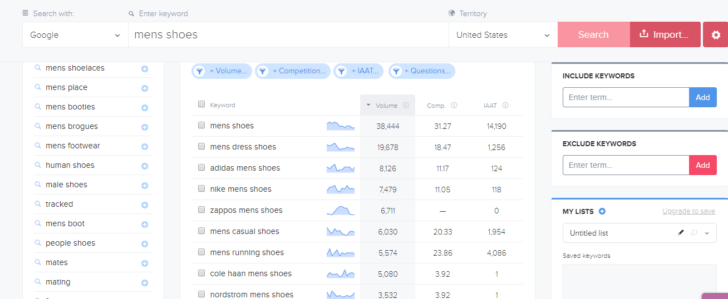
Now let’s take one of our short-tail keywords and plug it back to the keyword finder and see what we’ve got.

As you can see, even under the keyword “mens shoe,” we still find potential keywords that you can place strategically under your post and rank for or use to develop an independent blog post. 

That is why it makes sense to do thorough keyword research to further see what other keywords you can place in your blog post for your major keyword and rank for as well.

While it is advisable these days to keep every single blog post focused around one keyword, having two major keywords to rank for in a single blog post is not a bad idea, according to Hubspot.

Well, on certain occasions, I have seen a single blog post that ranks for multiple keywords.

3. Write in-depth blog posts

According to a 2016 research, the average blog posts that rank number one on Google has about 1,900 words.

In the past, what it takes to rank on Google is a string of keywords. In other words, keyword stuffing WAS all it took.

Not anymore. Thin content was one of the primary targets of Google’s Panda. For a post to rank on Google, it is well understood that thoroughness is a sine qua non.

Posts that make it to the number one position on Google are in-depth and full of trusted sources. But do not mistake a long post for an in-depth post. 

An in-depth post proffers value — every single word in it.

Embedding posts with visuals such as videos, infographics, and photos might mean additional advantages to boot.

While there is no denying that relevancy is what matters, most posts that meet the standard of relevancy required to please searchers are the long ones that offer more than vague answers.

And of all people, a little unknown business owner who wants to do SEO on a small budget needs to offer all the value she can.

4. Keyword related and non-keyword related on-site SEO

The bedrock of your on-site SEO efforts is your content which, I believe, we have discussed as incisive as possible.

However, on-site SEO involves more. Much more.

Let’s look at the most important things you need to pay attention to in your on-site SEO efforts.

5. Keyword-rich content

You know we talked about keyword research earlier in this post. But when I say keyword-rich, I do not intend “keyword-stuffed.”

Assuming you’ve now found the keyword around which you want to base your blog post, it is time to use this keyword strategically in your writing to tell Google what the post stands for.

Lucky for you, this doesn’t have to be much of a struggle if you are using WordPress. All you need to do is install Yoast SEO on your dashboard and it will help guide you in writing a keyword-driven article.

6. Mobile-friendly web page

Do I even need to mention that? Nearly 60 percent of searches made online are now from mobile devices. And that Google continues to change its algorithm to suit this trend in search method is telling enough.

Optimize your site for mobile-friendliness and you are on your way to a better ranking on Google. This article gives you clear steps as to how you can achieve a mobile optimized site.

7. Page load speed

When Google announced their Google Mobile-First Index, they further made it clear that site speed has become a ranking factor. Several findings have since shown that this is true.

If you are going to reap the benefits of your SEO efforts, then your site speed is something you must pay attention to.

How, then, do you increase your site speed? Ways abound, and some of these ways can be dauntingly technical.

So, if you are doing SEO on a small budget and, like me, you suck at coding, I will advise you to allocate a huge part of your lean budget for the technical aspects.

I will, nonetheless, tell you what it takes and my recommendation for you as someone who is doing SEO on a shoestring budget.

8. Minifying CSS, Javascript, and HTML

Our websites are constituted of some little tiny ugly codes (Sorry, programmers, they are ugly to us). 

Those little tiny objects are made up of unintelligible commas, spaces, numbers and all sorts of nebulous characters. 

If you are a techie, then it wouldn’t cost you much to remove unused code, code comments, unnecessary spaces as well as other characters.

But for the uninitiated like me, you’d stand a better chance if you outsource this to professional web designers.

9. Image optimization

Image is another element that can take a lot of space and clutter up your website, thereby making the loading time a bit slower than is desirable.

As much as visuals are important for a successful blog post, keep in mind that the average image recommended for a blog post is 1200 x 628 pixels.

To optimize your image for SEO, you want to do it in such a way that it doesn’t compromise the quality of your image neither does it impact your SEO in a negative way.

There are many image optimization tools online. Look them up here.

10. URL structure

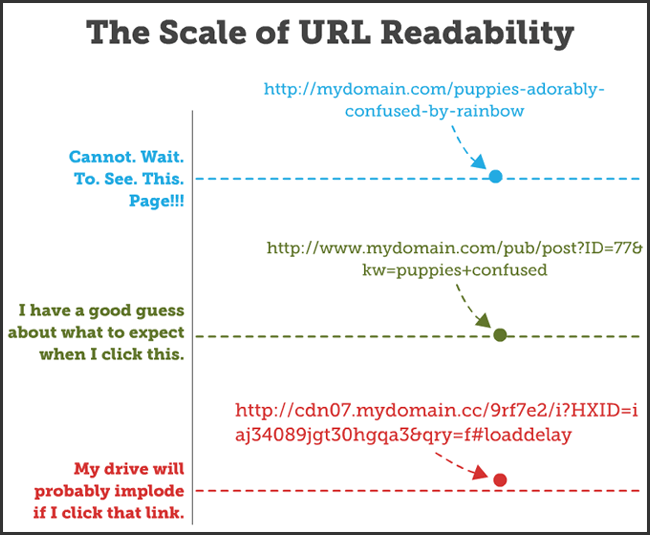
When it comes to SEO, you cannot afford to have a URL that looks like an HTML code. 

An SEO-friendly URL must be one that’s easy to read for search engines and gives humans the idea of what they are about to click.

Research has shown that URLs are among the key elements searchers consider before they click on a link.

In the olden Internet days, it would not be too hard to see URLs that look like specks of dirt, but such URLs these days are but condemnable heresies in the sight of lord Google.

Take a look at the illustration below to get an idea of what you should and should not do when it comes to URLs.

Source: Neil Patel

Here is a checklist of what you should have in your URL

  • Use your keywords in your URL: For example, if you have a blog post about where to find the best dog food, your URL should look like this: www.blog.com/where-to-find-best-dog-food. You can see it looks almost like a complete sentence. Here is an example from a blog I wrote about podcast hosting platforms: https://contentmarketingprofit.com/10-best-podcast-hosting-sites-and-everything-you-need-to-succeed/. Notice how it gives you an idea of what you are about to click.
  • Keep it short and simple: Keeping it below 60 characters has always been the recommendation. Short and sweet doesn’t mean you should overdo it though. Always try not to go beyond 60 characters.
  • Hyphens are better used as a separator in a URL than an underscore according to Google.

11. Link internally (with caution)

Linking to your other blog posts from a relating one has become a rule of thumb in writing blog posts.

And in case you don’t know, it isn’t just a fad designed to make you look like a professional blogger.

Its benefits include delivering link juice to other pages, showing Google the relevancy of posts to one another, making it easy for Google bots to crawl and index your pages and of course, keeping humans on your site longer.

But the “with caution” above means, when cross-linking internally, be wary of using too much exact-match anchor text in your links.

If you do, Google might think it’s an attempt to manipulate and penalize you for it. 

12. Copy: Good, relevant, great copy

Yes, I know I’m supposed to write that as “metadata” here, but metadata isn’t particularly a ranking factor.

It’s just a clicking factor which, indirectly, makes it a ranking factor.

What you put in your metadata matters. Bear in mind that aside from your title, your metadata is what tells users whether to click or scroll down.

As such, do your best to ensure that your metadata hits home. Create short, concise, quality descriptions that convey value to the user searching the internet for either information, purchase, feedback, or any other reason.

13. Go for the big link

It’s been many years since Google started using link signals as an important ranking factor. Links are still the most important external factor in SEO, and they aren’t about to go away anytime soon.

Now it’s time to start building backlinks, first, for your site as a whole, and, second, for your money pages in particular.

While this looks like a straightforward venture, be careful and observe the following rules in building links or you might run into a problem.

But before we go into the rules, let me quickly take you back to our first step in this journey.

Remember I clearly stated that you must find the long-tail keywords around which you are going to build your blog posts? Now, it’s time to hit your competitors where they are most vulnerable. 

What this means is that for every least competitive keyword you find, your competitor has the least number of backlinks going to that.

Analyze their link profile using tools like Ahrefs and try outdoing them with backlinks on those ones.

To put it this plain text, if your shoe-selling competitor has a blog post about “mens shoe” just like you do, and the number of backlinks that goes into that is twenty, to outrank them at that one on Google, all you need is twenty-one backlinks to a similar blog post on your site.

If you have nailed your on-page SEO already, consider this a silver bullet on outsmarting your competitor.

Now let’s quickly run through some link building best practices.

A. Quality, not quantity

If you go after low domain authority sites in the interest of haste, you risk hurting your SEO. 

While it’s not necessary to only go after sites with the highest domain authority, learn to go after sites with great domain authority. Anything from 60 DA and above is okay.

But even sites with 40 DA are also useful so long as they aren’t too many. Your best chances though lie in getting sites with 60+ DA by your side.

B. Have a healthy mix of anchor text

For someone who wants to rank a site for a keyword such as podcast platforms, for instance, you may be tempted to want to build a link profile with those two keywords: podcast platforms.

But I guarantee you that there is no faster and surefire way to get your site penalized. Google suspects an unnatural amount of links with the same anchor text pointing to the same source.

If you must build a link profile, then have some diversified anchor texts. 

C. Avoid black hat link-building no matter the glamour

And I can’t stress that enough.

There are many link vendors on the Internet who sell you on quick generic links that will get you penalized rather than rank.

The struggle to build links can be overwhelming for someone on a little budget and the lures are all there. But patience to do the right thing never gets too much. Don’t be in a haste to rank a rank that will truncate your well-planned efforts.

Even if those generic links work for you in the short term, what it will take for all these gains to disappear is Google penalizing you.

Avoid buying links, PBNs, as well as all other kinds of black hat link building that are being touted on the Internet.

In the end, build a huge and healthy link profile around your low-hanging fruits. This can be achieved by becoming a guest post rockstar and willing to withstand a lot of virulent rejections.

Or better still, create likeable assets in terms of valuable articles that bloggers may naturally want to refer to.

Need an example? Link Building for SEO: The Definitive Guide

Another thing that will help you in your link building campaign is bloggers outreach. Heaps of articles exist on the Internet teaching you how to go about these things in detail.

As you build this up, your domain authority significantly improves, arming you with the experience and money to go big and eventually share the field with your big competitors.

And from the very beginning, the purpose of this blog post is to teach you how to start small and go big with a thin budget for SEO.

It is a piece of article written with a simple philosophical understanding in mind, that is; sometimes, you have to take one step back to potentially take two forward.

Conclusion

If you’ve been searching online to seek answers for how long it takes to rank on Google, you might have come across articles that saunter a little bit around and end up saying six months. 

That might have been true in the past but not anymore. Whenever Google updates her algorithm, there will be traffic losses and gains. Most times, these are not due to correctness or error from your end.

But SEO has lived long enough to have fundamentals and so far as we know, the things identified in this blog post have stayed long enough to become hard and fast rules in search ranking efforts. 

If there is anything we’ve learned in the past decade, it is a simple truth that big dollars are not always the sole winning ingredient — anymore.

Will, innovation, grit, unceasing creativity, and a touch of luck are all you sometimes need to win. When you plan to use some SEO marketing for your business but you have a little budget, you aren’t expected to exit the stage. 

You can still win, but only if you try.

Ali Faagba is a copywriter, content marketer, and a tech freelance writer. He’s been featured in Entrepreneur, Thrive Global, and others. You can reach him on Twitter @contentmints.

https://www.searchenginewatch.com/2020/06/04/seo-on-a-shoestring-budget-what-small-business-owners-can-do-to-win/


How to Use Python to Monitor & Measure Website Performance via @rvtheverett

[unable to retrieve full-text content]https://tracking.feedpress.com/link/13962/13602889/371105


Google Explains Content Pruning Best Practices via @martinibuster

[unable to retrieve full-text content]http://tracking.feedpress.it/link/13962/13602442


Google Featured Snippets Update via @martinibuster

[unable to retrieve full-text content]http://tracking.feedpress.it/link/13962/13602126