Google Now Has 6 Ways to Measure Core Web Vitals via @MattGSouthern
[unable to retrieve full-text content]http://tracking.feedpress.it/link/13962/13584863
[unable to retrieve full-text content]http://tracking.feedpress.it/link/13962/13584863
[unable to retrieve full-text content]http://tracking.feedpress.it/link/13962/13582354

The latest broad core algorithm update, called the May core update, is making headlines in the SEO world. It’s the second update of 2020, but the last one didn’t cause as big of an impact as this one.
It was launched early May, but all leading digital marketers and webmaster community agree that it’s one of the biggest Google algorithm updates.
Research of SEMrush connects this update to change in search intent after the pandemic. Queries that were once intended for just information may now be looking for a service or product on search engines.
That’s why industries like Travel and Real Estate that were already suffering due to lockdown and restrictions were most affected by the May core update.
On the other hand, News, Sports, and Entertainment sites saw an increase in their traffic after the release of this update. Their online channels were already booming as people have more spare time during the lockdown and May core update gave it a boost.
Other leaders of the digital marketing world also shared their insights on this new update that wasn’t contrary to those of SEMrush and brought new information to light. His tests show that sites with the following issues faced up to 10% decrease in their traffic.
Likewise, the websites that were wary of these issues experienced growth in their traffic.
Google faced criticism from a lot of webmasters for rolling out an update during COVID-19 outbreak. While digital marketers are offering their resources worth thousands of dollars free of cost, it released such an update to make these difficult times more difficult.
Hundreds of Webmasters shared their experience with May core update on WebmasterWorld explaining why they might have suffered or survived.
While many messages show a negative response complaining about how their rankings have been destroyed, some reported a growth in their website traffic.
An update this big takes time to fully roll out. That’s why some websites experienced a temporary fall but got back on their position after a while.
This reminds us that Google updates are not for penalties. They are just to ensure that all webmasters follow their exact guidelines. Only websites that fail to follow guidelines suffer consequences.
On the other hand, websites that have built a strong and clean SEO foundation always benefit from these updates.
It means you can withstand these updates and, in fact, benefit from them. Now let’s get on to the SEO recipe to not just survive but use May core update to your advantage.
The only goal of search engine updates is to provide the best results when users search a query. Google has published comprehensive webmaster guidelines to show what it expects from a website. In order to ensure that all those guidelines are met and the user gets exactly what he expects, it keeps improving the search algorithm.
It has released several major updates over the past decade, but was there a specific reason behind May core update? Many asked and that’s how John Mueller, Senior Webmaster Trends Analyst at Google, responded.
Like always, they didn’t reveal how the update works and only shared some vague hints, and that was all we needed.
Mueller said everything we need to know is in the first official tweet about the May core update, which linked to its blog about Google’s core updates.
That blog post highlights two things:
Some of the most important Google algorithm updates like the Panda update in 2011, Pirate update in 2012, and Fred update in 2017 are more than enough to scrutinize the quality of content.
Next, Google wants us to focus on EAT: Expertise, Authoritativeness, and Trustworthiness.
It is believed that sites with outdated content saw up to 10% decrease in their traffic after the release of the May core update. Some researches showed that sites, where old content was regularly updated, saw an increase in their traffic.
It was never a secret that Google prefers fresh content in its search engine results pages. Brian Dean listed the content freshness and magnitude of updates in his 210 Google ranking factors.
Content losses its relevance as it gets olds. Users want the latest and accurate information that is not possible with outdated pages.
That’s why it’s suggested to either update or remove outdated pages. You can ensure that almost every single one of your articles maintains top positions in SERPs for years by regularly updating content with fresh information, research, and surveys while removing unnecessary and outdated parts.
Many webmasters that suffered from May core update had low–quality backlinks. Low-quality links don’t necessarily mean comment spam or cheap directories.
Among many other characteristics of a bad link, it includes links from sites that are irrelevant, have low authority, or the content around link is not good enough.
Use of an irrelevant site, low authoritative site, or low-quality content as a source are some of many characteristics that make a bad link.
You should try to get backlinks from ranked articles, preferably posted by niche relevant sites. One high-quality link is considered better than a hundred low-quality backlinks.
Furthermore, ensure that no penalised or bad site is linking to you even if you didn’t ask for it.
Private Blog Network (PBN) is also no longer a good strategy. You can randomize footprints all you want, but Google algorithm is smart enough to identify them, and it doesn’t go unpunished.
Google asks for in-depth content and covers every aspect of the topic. You don’t always have to write a two–thousand–word page although it is more likely to rank.
What you need to avoid is thin content. Automatically generated, spun, duplicated or scraped content is classified as thin – in short, it has no value to offer to the user.
Websites with thin content also saw a decrease in their traffic and ranks as the May core update rolled out.
Some people use them as doorway pages, but they should never be left as they are on a site, either remove or update the page. Even John Mueller discussed this issue in one of his hangout videos and suggested to deindex thin content.
[embedded content]
You should update any page that has short content or doesn’t have a keyword focus; it will give you an edge even after this new update.
Hopefully, these pointers will help you steer clear of the difficulties that the update could bring. Share your queries in the comments section. Bon appetite!
Sergio Arboledas SEO Manager at MintTwist. He can be found on Twitter @sergi_seo.
https://www.searchenginewatch.com/2020/05/27/the-perfect-seo-recipe-to-survive-covid-19-and-the-may-core-update/
Backlink analysis has always been one of the toughest tasks of digital marketers and one SEOs have never really found an agreement upon.
And Google has never been really too helpful in ending that debate once and for all.
A decade or so ago Google had told us to get other webmasters to link to our pages and even provided us with a tool – PageRank Toolbar – to measure the effectiveness of our link building efforts.
That’s when the Pandora box was opened and no one has been able to close it ever since.
The link building game got out of control at some point ultimately leading to lower-quality but better-linked pages on top of search results – and that’s when Google started taking counteractions.
Penguin updates and manual penalties followed discouraging the site owners from attempting to manipulate Google’s algorithms. “Get backlinks” in Google’s guidelines was revised into “Build high-quality content”, and “link building” acquired a “spammy tactic” connotation.
Yet, no matter how much Google is trying to push away the “link building” agenda, digital businesses are unable to put it aside. In fact, the more Google is fighting bad links, the more emphasis it puts on backlink analysis and acquisition services.
Whether you (or Google) like it or not, backlinks remain the crucial part of Google’s algorithm, and consequently, backlink analysis remains the most important step to organic visibility.
In fact, backlink analysis is helpful on both fronts:
While the importance of backlink analysis is clear to everyone who is not living under the rock, everyone in our industry keeps facing the same question again and again: How to tell good links from the bad ones?
When you look at a backlink, you can mostly tell whether it is natural and helpful. But all of the SEOs working with sites with more than 20 pages and brands with more than $200 budget know that looking at each backlink is hardly possible.
There’s simply no business implications for “tell it when I see it” concept. So what to do?
I was actually inspired to write this article by stumbling across this article on data-based decision making listing multiple benefits of using data over instincts when making business decisions.
Today, the top companies around the world use data to make decisions about their business. The reason they’re leading the way is that they’ve gained a strategic advantage over their rivals simply by shifting their focus to data rather than relying on business acumen alone.
The question is, how does this apply to link building?
Simply put, link building and backlink acquisition are crucial for any business presence and visibility in organic search results. This means they fall under the “business decisions” category which means they are basically unthinkable without data to support them.
But while we recognize the importance behind data, which data can we use to make link building and link removal decisions.
Ever since Google’s toolbar PageRank has been deprecated, marketers have no reliable ways to automatically tell a good link from a bad link.
Or do they?
Lots of marketers are content to judge a link page quality by looking at one particular source, like Moz DA.
And if you have a hard time explaining to anyone why they shouldn’t rely on any particular number, let me make it very easy for you:
None of the current numbers assessing the authority of a web page or a quality of a particular backlink comes from Google.
Do you need a more convincing argument?
It should be clear to any business owner at this point: You cannot achieve success with one of the marketing channels by 100% relying on a third-party source.
In fact, when we say don’t trust numbers when it comes to link building or analysis, we mean “no one source”.
Solid link building data exists and not using it means missing valuable growth opportunities.
The smartest link building approach is about learning to combine multiple data sources and learning to identify patterns (to embrace or avoid).
There are multiple backlink research sources including link-only ones (Majesting and Link Assistant) and multi-feature platforms (SEMrush and Ahrefs). There are also newer platforms that are entering the industry that are worth looking at. Serpstat is the most recent example that claims to include one trillion backlinks for 160 million domains:
This is how different two backlink databases can be: 50% on average.
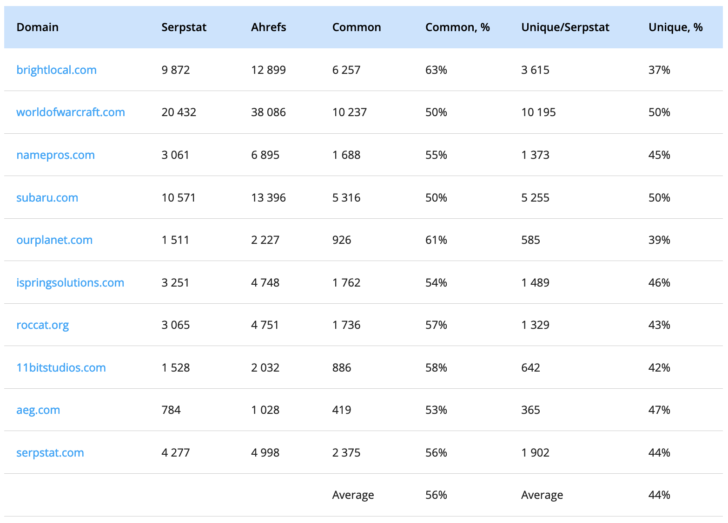
Source: Serpstat
At Internet Marketing Ninjas, for every backlink we acquire, we pull a crazy amount of data, including:
Again, none of those stats is useful on its own but when looking at all of those numbers, you can be pretty confident of the value of that link.
To help you create your own data-driven link building decisions, here are a few helpful tools and resources:
Backlink analysis is the most misunderstood task in our industry. You will see absolute extremes floating around: From experts solely relying on Mox DA to those denying the value of any number whatsoever.
Yet, the task cannot be successfully accomplished without accumulating and assessing data, so the answer is in embracing a holistic approach, that is, using a lot of data sources and making your decisions based on all of them.
Ann Smarty is the blogger and community manager at Internet Marketing Ninjas. She can be found on twitter @seosmarty.
https://www.searchenginewatch.com/2020/05/27/the-data-driven-approach-to-making-backlink-analysis-decisions/
[unable to retrieve full-text content]http://tracking.feedpress.it/link/13962/13576494
[unable to retrieve full-text content]http://tracking.feedpress.it/link/13962/13576119
[unable to retrieve full-text content]http://tracking.feedpress.it/link/13962/13573540
[unable to retrieve full-text content]http://tracking.feedpress.it/link/13962/13573282
[unable to retrieve full-text content]http://tracking.feedpress.it/link/13962/13573180
[unable to retrieve full-text content]http://tracking.feedpress.it/link/13962/13572964