What are PBNs and should you use them?

30-second summary:

  • Private Blog Networks (PBNs) are a huge part of the SEO industry and whilst getting backlinks is still a key driver in the Google search algorithm, PBNs will always be the source of debate and interest amongst SEO practitioners. 
  • PBNs have different uses and interpretations but can be used to point links to your site, sell links, or just simply add your home page links on them.
  • Will you get penalized if you use PBNs? Should you consider using it? Read on to find out what experts and Tudor Lodge Consultants say.

Private Blog Networks (PBNs) are a huge part of the SEO industry and whilst getting backlinks is still a key driver in the Google search algorithm, PBNs will always be the source of debate and interest amongst SEO practitioners. 

If you have ever bought a domain or run a website that ranks on Google, you are probably accustomed to getting emails from PBNs on a daily basis and they will tend to offer you a list of links that you can buy. The emails you receive will typically be called:

  • “High Quality Guest Posting”
  • “Guest Posting Service”
  • “High DA Quality Sites” 

But should you be paying to add these links to your website? And what is the damage?

Content created in collaboration with Tudor Lodge Consultants.

What Are PBNs?

PBNs are very simply blogs or old websites with domains that have expired, but still, have a lot of value due to gaining thousands of historical backlinks.  

Anyone can buy these domains once they expire or sometimes they are bought via an online auction.

But it is the ability to use this expired site, maybe re-design it, add some fresh content, and then start adding or selling links from this site to boost your SEO rankings or for commercial gain.  

Example

XYZ.com suddenly expires but has generated thousands of backlinks over the years. Now the site is available to buy, I will redesign it, add some new content, and start pointing links to my own sites and then start selling the links to other people too. 

PBNs

Source: Growtraffic.com  

People will sell links on PBNs anywhere from $10 to $1,000 per link and when you are looking to justify or scale your SEO spend, it is easily measurable to know what you get for $1,000, $5,000 or $10,000.

Equally, a PBN can just be a news site or blog that purposely sells links for income. 

Prior to 2014, buying links from PBNs was a quick and highly successful way to rank any website, in any industry across finance, money, fashion, insurance – you name it. 

However, over the last few years, Google has started to penalize any PBN site and who they link to, considering this a quick gaming of the system and anti-Google guidelines. Get on the wrong side of Google and you are looking at a serious penalty in your rankings or total blacklisting altogether. Wake up one morning with a penalty and your business model changes overnight. 

Different uses of PBNs

PBNs have different uses and interpretations, but can be used in the following ways: 

1. Point links to your site

Take an expired domain, set up a new website and start writing articles and include links to your own websites.  

2. Sell links

You can sell links to other SEO companies or practitioners – however, this is considered malpractice and anti-Google guidelines. 

3. Just add them to your homepage

You can purchase multiple PBN sites, re-design them and just add your links on every homepage (which is considered the highest trust flow). 

Will my website improve if I use PBNs?

In the world of grey hat or black hat SEO, using PBNs can theoretically improve your website’s search results.  

Certainly in the short-term, an influx of links from websites with high DAs will give you an instant boost. 

For many SEO businesses and online companies, PBNs is the way they conduct an SEO strategy and essentially do business.

If they can stay clear of penalties, PBNs are attributed to ranking some of the top search positions on Google – certainly for industries that attract shady techniques such as loans, web hosting, casinos and pornography. 

Will I get penalized if I use PBNs?

If you are using PBNs to acquire links, you are walking on a constant tightrope and risk of getting penalized by Google. You may not be automatically downgraded – but all it takes is one Google update or algorithm shift for this to change overnight. 

Presumably, if you did nothing but by links from PBNs for years and years, at some point, you will face a penalty and then need to look at removing them to restore your rankings. 

In some respect, more experienced SEOs are able to balance PBNs with a clean approach – and this might include creating natural content, a strong user experience, generating clean and natural links and also doing regular link disavows. 

PBNs run a risk of a Google penalty

Source: DP TECH Group

What the experts say

Seb Atkinson, Head of SEO at Know Your Money explains,

“PBNs are seen as a quickfire way to buy links and boost your rankings – but this is very much an old technique and today is likely to attract penalization. Your best approach is to create unique, interesting content that provides real insight into a topic, making it genuinely link-worthy so people can naturally link back to it.”

Ian Sims, Director of Badger Loans commented,

“Working in the payday and short term loan space, I am inundated daily by emails with people offering me links from PBNs. I tend to stay clear of this because although it might give me a quick boost in rankings, a potential penalty could be very costly for our business. I get annoyed when I see other sites ranking on page 1 and they have clearly used this approach – but I know that their success may be short-lived.”

Andrew Speer, Consultant for Fund Ourselves explains,

“I have worked in SEO for almost a decade and originally PBNs were a proven source of link-building and the status quo. It wasn’t until algorithm updates like Panda and Penguin that started to reward clean content and link-building and with this PBNs have gone out of favour with Google, despite still being used by tonnes of people across the US and the world. But if you were to start learning about SEO today, this is something that you would stay clear of for sure.”

Conclusion?

There is an argument that using PBNs as part of your link building strategy could be successful for more experienced SEOs. 

But in reality, Google is known to changing their goalposts and revelling in such a high-risk strategy is unlikely to go down well with investors, clients and business partners. 

It may not be if you get a Google penalty, but when.  

Our conclusion? Stay away from PBNs.

 The “will I get penalized” section suggests PBNs could be used by experienced SEOs but the conclusion doesn’t really support this. 

Maybe the main downside of PBNs could be highlighted more, for example, you will always have a risk of a penalty on your site as Google is known to move the goalposts over time. This could be a risk that your investors/clients/business partners are not comfortable with.
What are PBNs and should you use them?


Google Search 101: How the Knowledge Graph Works via @MattGSouthern

[unable to retrieve full-text content]http://tracking.feedpress.it/link/13962/13557235


New Google Guided Recipes Blindsides Recipe Niche via @martinibuster

[unable to retrieve full-text content]http://tracking.feedpress.it/link/13962/13556714


How YouTube Generates & Ranks Suggested Videos via @gregjarboe

[unable to retrieve full-text content]http://tracking.feedpress.it/link/13962/13556559


8 Insights Learned from 800+ Link Penalty Cases via @martinibuster

[unable to retrieve full-text content]http://tracking.feedpress.it/link/13962/13556134


How Bing’s Whole Page Algorithm Works via @jasonmbarnard

[unable to retrieve full-text content]http://tracking.feedpress.it/link/13962/13556045


Ecommerce and SEO: Past, present, and post COVID-19

30-second summary:

  • Ecommerce is suddenly a reality for millions of businesses who may not have had online selling on their radar prior to COVID-19.
  • Consumers in most countries are cutting back on discretionary spending as optimism for economic recovery has fallen. Groceries, household supplies, personal care, and entertainment are among the categories in which consumers plan to maintain spending.
  • In this post, we’ll take a look at the current state and how businesses will need to adapt their ecommerce and SEO strategy to succeed post-COVID-19 (whatever that may end up looking like).

As countries including the USA head into phased reopening, countless questions remain about the business landscape ahead. Will changes in consumer behaviour persist and if so, to what degree? Is there a second wave coming that will derail recovery efforts and send consumers back into lockdown? How can you plan for recovery when no one really knows quite what “recovery” means?  

In the face of such uncertainty, one thing is for sure, companies need to get in position to gather and analyze data quickly—to be agile and respond to whatever twists and turns Coronavirus throws our way next. Regardless of industry or location, that responsive, adaptable strategy is going to rely heavily on ecommerce and SEO. 

Ecommerce is suddenly a reality for millions of businesses who may not have had online selling on their radar prior to COVID-19. And while search optimization is a discipline as old as search engines themselves, dramatic differences in consumer behaviour may require an entirely new approach to SEO going forward. In this post, we’ll take a look at the current state and how businesses will need to adapt their ecommerce and SEO strategy to succeed post-COVID-19 (whatever that may end up looking like).

Consumer behaviour and ecommerce: Present state 

Fresh off of an unprecedented leap of $8.5 billion in U.S. CPG (in-store and online) sales during the first two weeks of March, conditions have quickly shifted once again. Panic buying gave way to record-high ecommerce sales in mid-March, after which we saw a week-over-week decline (-22%) in online sales between March 21-28. Overall, according to Nielsen, U.S. ecommerce sales right now are above the rates of one year ago. CPG, in particular, is soaring and up nearly 42% over the week ending April 4, 2019. 

Consumers in most countries are cutting back on discretionary spending as optimism for economic recovery has fallen. Groceries, household supplies, personal care, and entertainment are among the categories in which consumers plan to maintain spending. As of April 19, 32% of US respondents to a McKinsey survey were anticipating a drop in their household income and over half expect the impact on their household finances to persist for four months or more. 

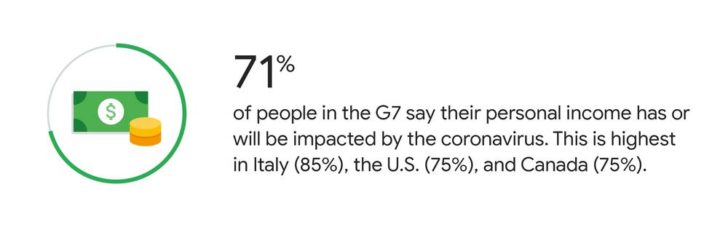
Kantar/Google research shows even greater pessimism and pegs 71% of consumers in G7 countries as expecting their income will be impacted by Coronavirus. 

Ecommerce and SEO COVID-19 times

Source: Think With Google  

Online and phone ordering with contactless delivery or curbside pickup has become the modus operandi for millions of businesses. 

Businesses need to be able to listen closely to consumer fears, needs, and preferences as they evolve. Customers may not be comfortable heading straight back into crowded retail environments. Vacations closer to home may be preferred by many. Businesses will be challenged to understand the customer experience as it’s happening and to respond with optimizations in real-time to meet the individual’s needs.   

In addition to this increased listening and awareness, consumers want to hear from the companies with whom they choose to do business. Even prior to COVID-19, 64% of consumers and 84% of business buyers expected companies to respond to them in real-time, according to Salesforce research. Right now, consumers are looking to brands for guidance and expertise in solving the challenges they are experiencing navigating the path to a new normal. The vast majority of consumers across sectors want to hear from brands just as often or even more than before the Coronavirus pandemic. 

How SEO will drive ecommerce success as the coronavirus pandemic evolves 

The relationship between ecommerce and SEO has become far more complex than how you optimize product listings for search.  

But whether you’re ecommerce first, selling online as a sideline, or now enabling ordering and payment online with curbside or in-store pickup options, the insights gleaned from SEO will power more effective operations across the board. Here’s why: 

SEO provides real-time insight

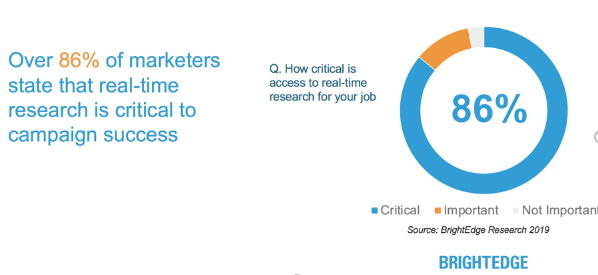
BrightEdge (disclosure: a client company), back in 2019 surveyed a sample of over 200 digital marketers and found that over 86% of marketers stated the real-time research is critical to success. Furthermore, SEO insights are being used in all manner of digital marketing campaigns across paid search, video, email, and display. 

BrightEdge stats on research

Real-time search insights – especially now – enable us to tap into localized pockets of demand and appear in front of customers with rapidly evolving needs and intent. SEO insights, more than any other type of data, give us a clear line of sight into the voice of the customer through search queries, interactions with local search results, site analytics, and more. 

SEO paves the way for both desktop and mobile experience

Consumers may not be searching for restaurants during the commute home from the office right now, but that doesn’t diminish the importance of mobile-friendliness, especially when it comes to ecommerce. As Google itself says, when it comes to mobile marketing, “speed is table stakes.”

Staying at home doesn’t necessarily mean switching to desktop, particularly where multiple family members may each be home and browsing on their own mobile device.  

Consider switching to next-gen image formats like JPEG 2000 or WebP for mobile, with PNGs or JPEGs for desktop browsers. Look out for render-blocking resources, inefficient code, unused CSS and other page speed or site speed issues that may be hindering your performance. Use Google’s Test My Site as a starting point.  

Search trends are key in staying on top of customer expectations

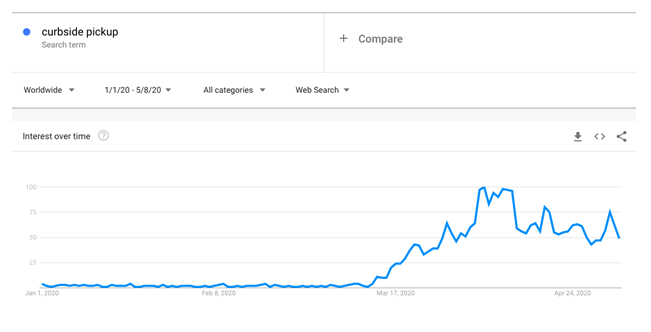
Who was even thinking about curbside pickup this time last year? Today, it’s pretty much expected that if you are open for business, you’ll provide this fulfilment option for customers who are not comfortable entering your store (in some places, entering the store may still be prohibited by public health regulatory agencies). 

Stats on curbside pickup for ecommerce and SEO

 Those businesses that caught onto the trend in early to mid-March were ahead of the groundswell in early April. Being among the first in your space to catch onto a massive change in consumer demand such as this can help you win over new business and better serve your existing customer base. Google Trends has a Coronavirus Trends resource business should be keeping an eye on. These are helpful insights for marketing but could influence operations, sales, and customer service, as well. 

Search spans Google, Amazon, YouTube, and more

Organic search commands the largest proportion of channel share, accounting for 53.5% of site traffic, on average. A comprehensive ecommerce SEO strategy accounts for Google, but other product search opportunities, as well. Amazon, for one, cut back its service to third-party sellers but as this comes back online, there may be opportunities to expand your ecommerce presence in the world’s largest marketplace. Check out this guide to improving rankings on Amazon to get you started. 

Video search is another massive opportunity for companies now selling online, as Nielsen reports video streaming is up 100% in some markets due to Coronavirus. Even before lockdown, YouTube was both the world’s second-largest search engine and second-most visited website.  

YouTube SEO takes into consideration factors ranging from watch time and keyword targeting to sentiment, engagement, channel authority and more. Learn more about optimizing this channel in SEW’s YouTube Optimization: Complete Guide.

Post-COVID-19 SEO tips for ecommerce   

Whether you’re an experienced online seller or just transitioning to ecommerce as a result of physical distancing, your customers may be entirely different from who they were even three months ago. A few tips to help you get in front of the right people with the right content: 

  • Revisit your adherence to ecommerce SEO best practices. You may need to renew your keyword research, update on-page optimizations to reflect changes in consumer behaviour, reorganize your site structure and optimize for the new customer journey, refresh and add new content (particularly around how you are responding to COVID-19-related issues such as food safety or package handling).

    Ensure that you are monitoring trends in real-time whilst planning for ease of lockdown restrictions, seasonal and product demand. For example, above we can see large demand for products related to how people now are investing in their dwellings, particularly, with spring here and summer coming, and in outdoor spaces, it is important to seize opportunities where demand is high and also plan for future trends and new normal(s).  
  • Optimize your ecommerce site for voice search. Make sure you’re positioned to trigger a response when consumers ask their voice assistant for a product like yours. If you are not yet familiar with speakable schema, there’s a good primer here to help you get ready for it. 
  • Automate SEO intelligently. Taking the legwork out of routine SEO tasks can make marketers more efficient, freeing up valuable time for more creative optimizations and strategy. Of course, intelligent automation can dramatically improve search performance, too, by recognizing and optimizing for opportunities in real-time.  
  • Consider your headless commerce and content options. Make your products and content even more accessible, removing barriers to conversion in the process, by incorporating headless commerce into your strategy. This is the process of separating the front and back ends of your ecommerce application so you can sell directly through social media, for example.   

Most important of all is that you are set up to measure, analyze, and activate the mass of user signals consumers are sharing with you across search interactions and your ecommerce website. Whatever economic conditions and user preferences COVID-19 generates next, those businesses that are able to quickly understand and move on new opportunities will win the day.

https://www.searchenginewatch.com/2020/05/19/ecommerce-and-seo-past-present-and-post-covid-19/


Maximizing local SEO: Five tactics to enhance visibility without breaking the bank

30-second summary:

  • With Google frequently changing its search engine algorithm in recent times in a bid to reduce the organic reach of most businesses so they can invest more in Ads, what are the options left for your small business in this period?
  • According to GoGulf, 46% of all Google searches are of people searching for local information, and 86% of people look up the location of a business on Google Maps.
  • If Local SEO is that effective, what is it, and why should your business rely on it?
  • In this article, I will examine basic things that still work like adding your business to online directories, building backlinks, developing local content targeted at your local audience, incorporating titles and meta description tags, and the use of targeted keywords.

SEO changes all the time. That’s why you need to update your SEO strategies regularly to remain visible. 

According to this article, 72% of consumers visit a store within 5 miles after doing a local search. This shows how powerful local SEO can be. If you can make your business visible such that your business appears in the search results when a potential customer searches for a product and service, there is a 72% chance they’ll drop by your business.

But what is local SEO? Local SEO involves the optimization of your online presence in order to improve your chances of being discovered by people who make local searches. Think of it as your traditional SEO, but with the inclusion of geography in it. In other words, it’s you trying to attract more business from local searches.

In this article, you’ll learn five local SEO tactics that will help you skyrocket your visibility without breaking the bank. 

1. Be strategic about your title and meta description tags

When you search for something on Google’s search engine, you’ll see millions of results competing for your attention. The only way you can tell if the search result has what you’re looking for is the title and the description you see immediately after the title.

Many business owners take the title of their blog posts and meta descriptions for granted. You need to start seeing the title and the description as a way you can “sell” your page to a potential visitor of your page. 

A useful tool that will help you optimize your title and description is Yoast SEO. It’ll be able to test how good your title and description are. 

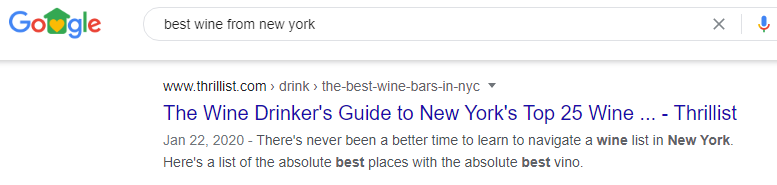
Deliberately include the location of your business in your blog post titles. For example, let’s assume you sell wine and your potential client is looking for the best New York wine, you’d be doing yourself a great service by including the words “New York” in the title and the description.

Local SEO example New York wine

Source: Google Search

2. Optimize your Google My Business account

You know how you’ll search for a pizza place on your phone and Google will show you a list of pizza places near you? That’s made possible by using Google My Business. Google My Business (GMB) is a tool used to manage your online presence across Google, including Google Search and Google Maps.

You’ll find it shocking that 56% of local businesses haven’t claimed their Google My Business listings. So don’t sleep on this tip.

If you haven’t claimed your GMB listing then make sure you do so. But don’t just claim your GMB listing and forget all about it. Optimize your GMB by filling in your Google My Business Profile, choosing the relevant category, and including images. This will not only help your potential customer find you, but it will also give them some information about your business and thus influence their decision to stop by your business.

3. Create local content

According to GoGulf, 46% of all Google searches are of people searching for local information. So how do you harness that attention so as to get your target audience to know about your business?

Creating local content that will be of interest to your target audience makes you the local authority for your industry. By local content, I mean the creation of content that is targeted to your local audience. This will require you to be strategic with keywords.

So as a florist, instead of creating content on the best flowers to give your wife, think of the best flowers your customer can give their wife in Florida. That way you’re specifically addressing those in Florida and those who come across your article see you as the go-to florist in Florida. 

4. Get inbound links to raise the domain authority

As beneficial as it is to create local content for your own website, Moz revealed that link signals are an important local search ranking factor that will help enhance your visibility as shown in the diagram below. 

Link signals include inbound anchor text, linking domain authority, and linking domain quantity. All this helps to raise the domain authority as this helps increase your local search rankings.  

To improve your link signals you should also guest post local content on other websites as well. Create valuable local resources that your target audience will love.

As you guest post and refer people to the blog on your business website, you’re acquiring inbound links to raise your domain authority. Those will help you with your SEO and increase your chances of being visible on Google when the people within your geographical location search for things related to your business. 

5. Add your business to online directories

Why stop at just adding your business on only one directory when there are so many directories out there. Adding your business to as many online directories (especially local ones) as you can possibly find will increase your chances of being found online. It will be time-consuming but it’s worth it. 

Online business directories like Binge Places for Business, Yelp, Yellow Pages, Angie’s List, and Trip Advisor will make you more visible to those who need your services locally. And to add to that, getting listed on these sites will make you earn backlinks from them which will help build your domain authority and increase your ranking on Google’s Search Engine Result Pages (SERP), therefore increasing your organic reach.

What you need to take note of is that the information on your business on other directories is the same as that on your GMB. This consistency will help with your rankings. 

Ready to maximize local SEO?

Over time Google has tweaked its search engine algorithm to reduce the organic reach of businesses so as to direct their attention to investing in ads. As a small business that has limited resources, investing in ads may seem like a long shot.

If Google’s reducing your ability to organically reach your target audience, then what’s the next available option for you? Local SEO can give you the needed exposure to your target audience organically and at little or no cost.

The good news is that applying the steps above will put you ahead of other local businesses scrambling for their customers’ attention on the most coveted first page of Google search.

Now that you’ve got the tips how did you would you say you’ve fared with your local SEO?

https://www.searchenginewatch.com/2020/05/19/maximizing-local-seo-five-reliable-tactics-to-enhance-your-visibility/


Google Doesn’t Treat User Generated Content Different From Main Content via @MattGSouthern

[unable to retrieve full-text content]http://tracking.feedpress.it/link/13962/13553285


SEO Tools Aren’t Enough for Success via @tonynwright

[unable to retrieve full-text content]http://tracking.feedpress.it/link/13962/13553150