Google May 2020 Core Update Officially Over via @martinibuster
[unable to retrieve full-text content]http://tracking.feedpress.it/link/13962/13552287
[unable to retrieve full-text content]http://tracking.feedpress.it/link/13962/13552287
[unable to retrieve full-text content]http://tracking.feedpress.it/link/13962/13551092
What is perfection?
Though it might seem like a redundant question at first, it has been at the heart of all major tech innovations of our time. Facebook, Twitter, YouTube, Microsoft, Amazon, and Apple among others are examples of how this question drives constant improvements. Most of all, it reflects Google’s metaphorical rise as the de facto “gateway” to the internet.
What is it about Google that sets it so apart from the rest of the competition? At its core, it is the “yellow pages” of the internet. All our queries, questions, doubts, and inquiries can be answered from roughly the first five search results that Google presents us. These search results or more formally known as the Search Engine Results Pages (SERPs) are the proverbial jewel in Google’s crown. All of its extensive services rely on the infallibility of its SERPs.
Hence, it is unsurprising that Google pays meticulous amounts of attention to constantly maintaining and evolving these SERPs. This has paid great dividends for the tech giant’s fortunes while being the source of incredible help for the general public. Perhaps, Google’s latest round of improvements reflects these improvements the most.
These improvements are Google’s direct response to the ongoing COVID-19 pandemic. Utilizing its incredible litany of data resources, Google has made it possible for governments and citizens alike to know about the latest developments in real-time. But certain elements set these COVID-19 Google SERPs’ improvements apart from the rest.

Source: Twincreek
What are these elements and how exactly do they improve Google’s already remarkable precision-based SERPs protocols? More importantly, what do they mean for Google going forward? In other words, has Google achieved perfection? Read on below to find out the answers to these questions.
While it may sound straightforward and almost routine, Google has visibly paid particular attention to these COVID-19 response changes to its SERPs. As users may have already noticed, searching “coronavirus symptoms” presents a sticky menu on the left side of the screen. Its simplicity is what makes it so groundbreaking as it helps Google address some of the key issues plaguing it for quite some time now.
Just managing all the data that it has at its disposal can be a daunting task at times for Google. However, with COVID-19 it has chosen to transform this user-driven data into infographic representation. This not only helps get the message across a lot more clearly, but it also helps it avoid any miscommunication. After all, it is likely that a world map showing how each country has been infected can be misinterpreted if proper markers are provided.
 Similarly, these infographics are a lot easier to update based on real-time user-generated data. If users click on any of these infographics, they can find more information as well as qualitative data on the issue. In short, this ability to incorporate data means that it can rely on the users to provide both real-time diversifications as well as the personalization to the SERPs.
The sticky menu is undoubtedly a feature that millions of users will find incredibly useful. It breaks down data into several categories without requiring users to search for these separately. For instance, this is how the sticky menu looks when you search for “coronavirus symptoms”.

As users can see, all the SERPs are related to COVID-19 symptoms with their ranking dependent on their authority on the subject such as the WHO, official government sites, and reputable publications like the New York Times.
Similarly, users can further customize this menu to choose a selection of various filter bubbles or categories and have SERPs dedicated to them. This would help users avoid the hassle of having to skim through the results that a normal “COVID-19” inquiry would have brought and save the time it would take to make individual inquiries.
Unsurprisingly, personalization still represents one of the key issues facing Google in 2020. It becomes trickier when you take into consideration the fact that this issue has more to do with ethical concerns rather than Google’s technical ability. On the odd occasions when Google has achieved a customer-oriented form of personalization, it has had to face allegations of bias.
Apart from the external pressures that have curbed Google from building on its initial success, Google’s internal culture presents a roadblock as well. It has long been proud of its algorithms that it promises to deliver the most diverse SERPs as possible. To its credit, Google has maintained a non-partisan approach to its SERPs until now.

Even during the height of the 2016 US Elections, it managed to keep the SERPs as diverse as possible without becoming a catering platform for political extremists on either side of the aisle. However, there is a limit to the extent of which it can continue to do so. The need for increased personalization by users as well as diversification has meant that Google has never been able to achieve the highly sought “balance” until now.
As mentioned earlier, these latest technical additions to Google’s SERPs mean that it is finally able to merge both the filter bubble with issues of personalization and diversity. Without sacrificing much in terms of UI or accuracy of the SERPs, Google may have achieved or at the very least, has gotten on track to attain absolute personalization.
Over the years, Google has looked at various solutions to its “personalization” problem. The most obvious solutions brought ethical issues that Google chose to avoid. It is becoming evident that the answer may have been far simpler than even Google may have anticipated i.e. user input.
Consider this, a liberal journalist that uses Google more than the average user to conduct their research. Naturally, over time Google’s algorithms will understand what this journalist’s typically sought SERPs are. If the user chooses to cite particular news outlets, it’ll make SERPs from those outlets more visible. All standard protocol, but what if the same journalist wanted to see the other side of the picture? What if in a particular moment, that journalist wanted to see what some of the more conservative publications are publishing on the same issues?
Of course, the journalist’s past search patterns mean that they’ll have to spend an extensive amount of time skimming through the results presented. These results would probably be relevant 99% of the time…but in that particular instance, they’re counter-productive to the journalist’s needs.
This is precisely the problem that these latest SERP changes address. The sticky menu on the left would allow this journalist to be in total control of the SERPs presented to them. Not all users have the same intent and more importantly, not all users have the same intent all of the time.
Letting a user choose the intent and have greater control over the SERPs catering to multiple intents is the next step in Google’s quest to achieve the kind of personalization it has spoken of in the past. Imagine, being able to see two completely different sets of SERPs on two different tabs just by making some simple changes on the sticky menu.
The COVID-19 SERPs represent a massive step towards building a standard protocol that supports a user-driven balance between personalization and diversity of results. There might be an argument that there are still some plaguing holes in the current SERPs update. However, as mentioned earlier, it is best to see these developments as baby steps. Steps that will hopefully serve as a strong foundation that balances out both of these.
For now, the sticky menu allows users to categorize their intent based on the filter bubble as shown above. This simple addition has removed a lot of extra steps, making the overall browsing experience more fluent for the average user. Similarly, it does not sacrifice the effectiveness or reliability of the results. Google’s traditional algorithms ensure users receive the most dependable SERPs in each category.
As for what else could Google does, there is never a death of suggestions. These suggestions will be of particular importance when it comes to an issue that has previously landed Google in hot water, that is, political bias.
Taking the example of the same liberal journalist as above, Google may understand their search intent. To mitigate any chances of confirmation bias, Google could have additional tabs such as “Also of Interest” or something similar. This would allow Google to ensure it does not have to compromise either on personalization or diversity of the results. At the same time, users may find it helpful that they’re being shown both sides of the picture regarding any issue.
Every time Google comes up with a new feature, it seems that it solves an issue that most users didn’t even know existed. SERPs have long been the most talked-about aspect of Google as they are undeniably what gives it its authority within the market. As Google advances in its interpretation of data and merges it with personalization, we may see similar improvements in SERPs going forward.

Source: Slideshare Tiago Afonso
Without a doubt, COVID-19 inspired changes have allowed user-input to become a visible element in SERPs. The sticky menu represents to what extent users might have control of the SERPs visible to them. It is likely that in the time to come, Google will continue to work on it and implement it across the platform ensuring the same personalization is available across all pages.
Coming back to the original question, what is perfection? I like to believe that perfection is a lot of little things done well. A simplistic but adequate response that seems to fit the strategy Google has adopted. As radical as these changes might seem, they’re essential tweaks in a much larger scheme. However, the results indicate that Google may have finally found the answer to one of its most serious issues.
Rameez Ghayas Usmani is Digital Marketer at PureVPN. He is a data-science and SEO enthusiast. He can be found on Twitter @RameezGUsmani.
https://www.searchenginewatch.com/2020/05/18/remarkable-impacts-of-covid-19-on-google-serps/
[unable to retrieve full-text content]http://tracking.feedpress.it/link/13962/13549164
[unable to retrieve full-text content]http://tracking.feedpress.it/link/13962/13547215
[unable to retrieve full-text content]http://tracking.feedpress.it/link/13962/13540482
[unable to retrieve full-text content]http://tracking.feedpress.it/link/13962/13540129
[unable to retrieve full-text content]http://tracking.feedpress.it/link/13962/13538697
There’s no doubt that the Coronavirus (COVID-19) has affected everyone in one way or another and that we all know that this virus that has shut down most of the world at one point or another isn’t going to go away anytime soon.
As you can imagine, with such a huge worldwide pandemic happening, there’s a large number of people that are searching for different kinds of information related to the coronavirus.
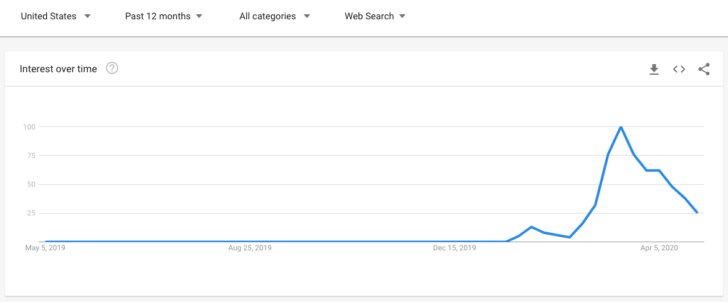
For all the searches that are being done on a daily basis and all the news and people talking about the virus, there’s the potential for lots of misinformation about COVID-19 to appear in SERPs and across social media.
To help combat the sharing of misinformation, some of the major players in both search and social have been able to provide us with the right information at the right time, so that we are not being led to believe the wrong information, that can cause us to panic and worry even more than we already are.
Google has made lots of changes to both their search results and their tools to help with getting people the right information about the coronavirus as well as to help make things easy for people working from home and for businesses to be able to update their clients on a company’s status during this unprecedented time.
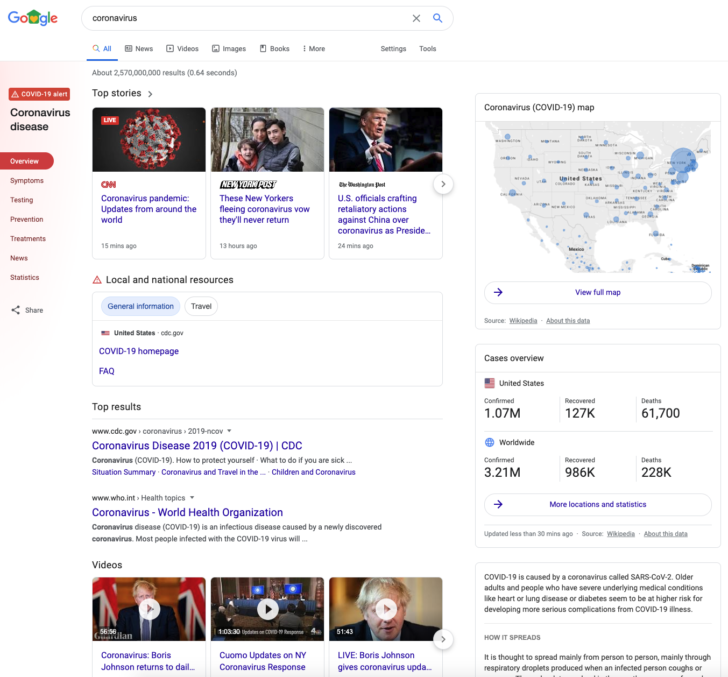
One of the biggest changes that Google has made to help spread awareness about the COVID-19 situation is how they have changed the SERPS when you do a search related to the coronavirus, Google will display all the information you need about the virus, from the number of cases for your given country and the world as well maps, headlines and a very well labelled “ COVID-19 alert” in red on the left-hand side that has links that open up a “zero-click” search box with the relevant information from the CDC. This also changes the SERP to correspond with the link that was clicked.
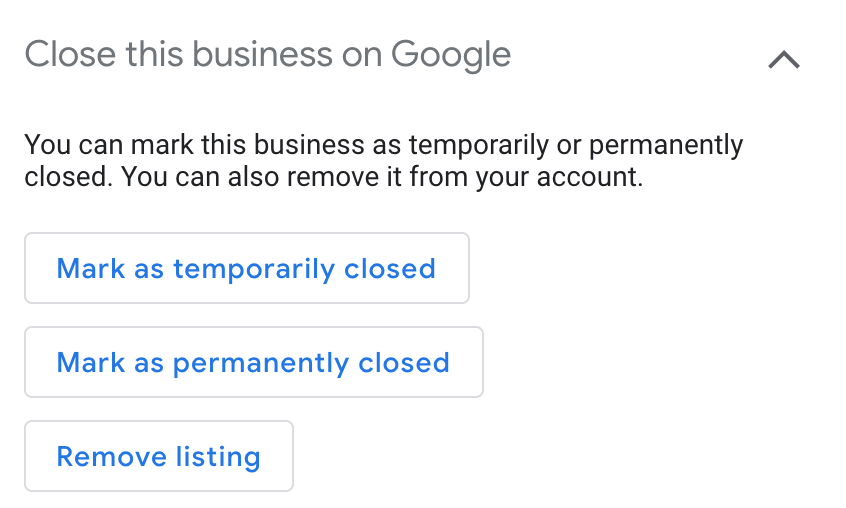
Google also made changes to Google My Business to help companies navigate through this difficult time. You are now able to set your business to “temporarily closed” without it having an effect on your site’s local rankings. Google is also letting businesses know that they should update their business hours as well as to post your COVID-19 updates.
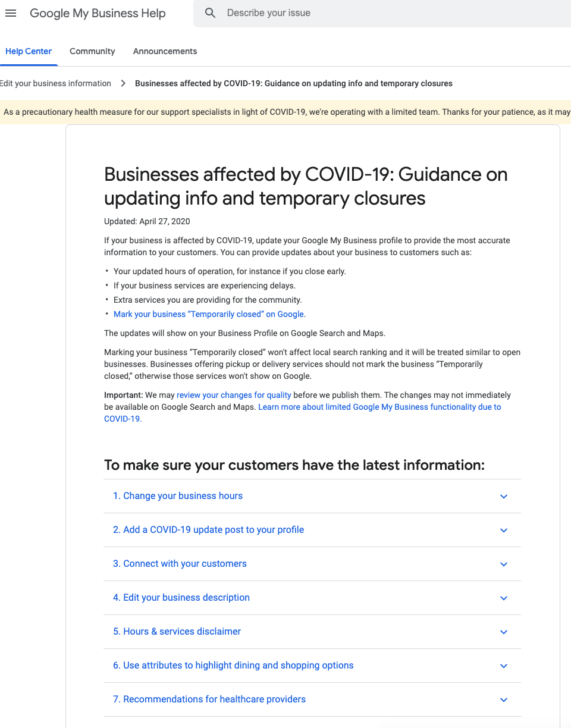
Just keep in mind that your Google My Business account may not be functioning as expected under the COVID-19 strain and that many of your updates might take considerably longer than normal.
Google has been working really hard at making sure that the right COVID-19 information is being found and to help with this, the Google Search team is helping official health organizations get more visibility in search with a new best practices guide as well as through a private support group.
As if that wasn’t enough, Google is also publishing coronavirus mobility reports that allow you to see how your community is moving around differently due to COVID-19 and how the pandemic has affected your area. These reports get their data from Google’s different products, such as Youtube, as well as from users’ location history.
Google mentions the following – “These Community Mobility Reports aim to provide insights into what has changed in response to policies aimed at combating COVID-19. The reports chart movement trends over time by geography, across different categories of places such as retail and recreation, groceries and pharmacies, parks, transit stations, workplaces, and residential.”
So head on over to the site and download the coronavirus mobility reports to see insights on your city.
Facebook is doing its part to help with providing COVID-19 information and awareness by launching its coronavirus information centre. The new information centre has been added to the top of everyone’s Facebook feed.
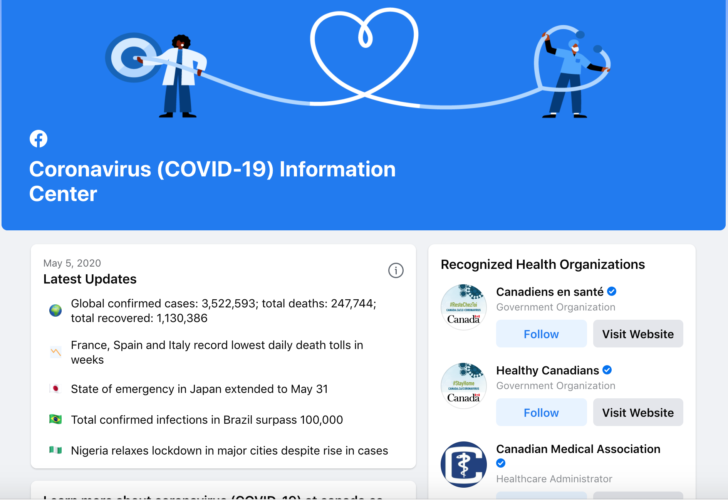
Along with the Coronavirus (COVID-19) information centre, Facebook has also created a Coronavirus (COVID-19) information hub for media that has a wealth of information.
With almost seven percent of the search engine market share, Bing has a big platform to help spread COVID-19 awareness and they have done exactly that. They have added a quick link below the search bar on the homepage.

When clicked, you are taken to their newly created COVID-19 tracker page that has all the information you could ask for about the Coronavirus.
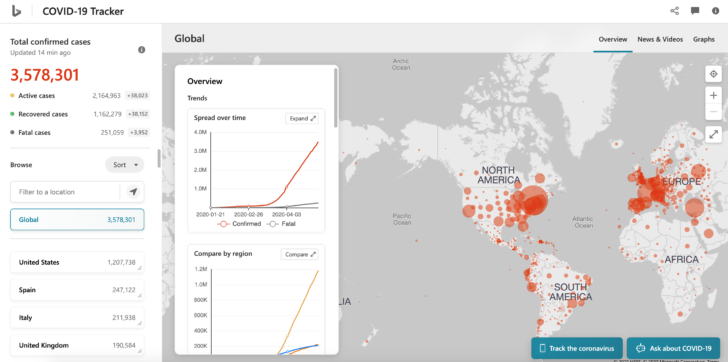
This new page allows you to see the total confirmed cases globally and a breakdown of the active cases, recovered cases, and sadly fatal cases. You can then choose a country and you will be able to see how the virus is spreading in all the cities and or states of that respective country. You will also get up to date news related to that country as well.
The page is continuously being updated with data that is collected from CDC, WHO, ECDC, Wikipedia, 24/7 Wall St., and BNO News.
Snapchat has worked with the World Health Organization to create filters that display facts on how to stay safe and social distance during the pandemic. Snapchat has also created new lenses in a bid to encourage social distancing during the coronavirus pandemic.
They have also created a COVID-19 business resource centre to share resources to help their partners navigate this uncertain time in light of COVID-19.
Twitter has also created a COVID-19 hub with the goal of helping people find reliable information, connect with others, and follow what’s happening in real-time. You can head over to to the hub to get comprehensive information on how Twitter is helping spread COVID-19 awareness and how they are providing guidance to help businesses.
Along with their COVID-19 hub, they’ve also created a great resource on crisis communication for brands on Twitter.
Instagram is doing its part to help spread COVID-19 awareness and have taken steps to help people access accurate information, stay safe, and stay connected. These new features were designed to help encourage users to stay home, stay connected, and for people to be able to access accurate information during the Coronavirus pandemic. These new features are the “Stay Home” sticker to help promote social distancing and the new video feature “Co-Watching” that allows you to view Instagram posts together with your friends over video chat.

To help people get relevant and up-to-date information and resources, Instagram intends to show more information from @WHO and local health ministries at the top of Instagram’s Feed. You may have already noticed the message that says, “Help Prevent the Spread of Coronavirus: See the latest information from the World Health Organization so you can help prevent the spread of COVID-19. — Go to who.int”
Pinterest is also doing their part to help spread COIVD-19 awareness and making sure that they are displaying pins with the right information. In order to make sure that they are only showing pins with the right information, they are only displaying search results to Pins from internationally-recognized health organizations.
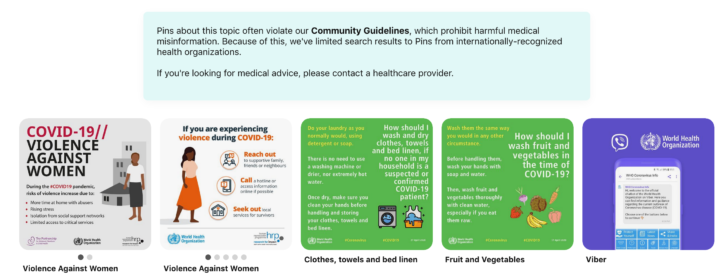
They have also created a one-pager guide for brands with suggestions for creating content that helps Pinners cope with this extraordinary time.
It’s great to see companies big and small come through in a big way to help businesses out during this difficult time. There are lots of companies that are offering a wide range of services, products, consulting services, charitable donations, etc.. We have put together a small list of companies in the search and marketing industry who are
When it comes to designing beautiful landing pages that convert more, Unbounce is the company to go to. Not only are they the giants in landing page conversions, but they have also really come through during this global pandemic, by offering their essential plan for free to anyone in healthcare, education, nonprofit, or government as well as offering free coaching and strategy sessions with their success managers and so much more.
Along with all that they provide via GMB, Google is helping remote workers as well as students by providing their video conferencing service for free. Google Meet, is Google’s premium video conferencing product that you had access to if you had a paid G Suite account.
Google is opening up access to Meet to free users gradually, so keep on checking their site to see when it will be available in your area.
In addition to all the efforts, products, and services that Google’s doing, they are also providing $340 million in Google Ads credits to all SMBs. You do not have to do anything to get the credits, you just simply have to have an active account over the past year. The credits will then appear in your Ads account.
Facebook has created a Small Business Grants program that offers $100 million in cash grants and advertising credits for up to 30,000 small businesses in over 30 countries.
HubSpot is a great company that provides a wide range of marketing, sales, and customer service tools and software as well as completely free CRM. HubSpot is doing its part in responding to COVID-19 and its economic impact by reducing the cost of its Starter Growth Suite from $112 USD to $50 USD per month.
They are also making their paid Meetings functionality, Quotes, E-Sign, and 1:1 Video tools available for free for 90 days from activation.
Moz is a great site that offers lots of insights from industry experts as well as providing great SEO tools. Moz is providing its Academy Courses for Free till May 31st. If you haven’t done so already, you should head over to Moz and sign up for their academy courses. There’s something there for everyone.
Mailchimp is another great example of a company stepping up to help businesses in a time of need, by offering up to three months free service for businesses with 25 employees or less in the restaurant, travel, brick-and-mortar retail, healthcare, and more industries.
Mailchimp is also generously giving away custom domains free for five years along with their free website builder. This will help small businesses by giving them two fewer things to worry about during the COVID-19 crisis and help them get up and running online quickly.
You can find out all about theses offers and more that Mailchimp is doing to help out by heading over to Mailchimp’s Statement on COVID‑19.
As if that wasn’t enough, Mailchimp is also providing free standard Mailchimp accounts for eligible public service organizations.
Hootsuite is another great example of a company stepping up to help businesses during the COVID-19 pandemic. They are giving away their Professional plan to small businesses and nonprofit organizations until July 1, 2020, to help them stay connected with their customers and communities.
Hootsuite is also launching a series of free online workshops designed to show how brands can build better processes for crisis management. They are also working on a brand new virtual conference.
Similarweb is well known for all the data that they have across all markets and industries, that allow you to gather market intelligence to help you understand different trends, track and grow your digital market share. They have used their data and insights and have created a ‘Coronavirus Data and Insights Hub’ that offers great insights on how COVID-19 is impacting business as well as to help you understand how customers’ needs are changing due to the pandemic.
It’s great to see all these companies both big and small all come together during these unprecedented times, by creating COVID-19 awareness so that we can get the information that we are looking for right away and not have to search over and over only to give up and not find what we are looking for or to end up getting the wrong information, offering their services and their time for free to help those in need.
We are all in this together, stay healthy, and stay safe.
Michael McManus is Earned Media (SEO) Practice Lead at iProspect.
https://www.searchenginewatch.com/2020/05/14/how-search-giants-are-helping-spread-covid-19-awareness/
[unable to retrieve full-text content]http://tracking.feedpress.it/link/13962/13537296