Google Call Only Ads Now Include Link Option via @SusanEDub
[unable to retrieve full-text content]http://tracking.feedpress.it/link/13962/13476692
[unable to retrieve full-text content]http://tracking.feedpress.it/link/13962/13476692
We recently hosted a virtual briefing as part of our new Peer Network series on the impact of COVID-19 on the automotive industry and marketing with Trevor Hettesheimer, Manager, KPI’s, Analytics, Search & Planning at Volvo.
Trevor has spent over two decades at Volvo US in a variety of different roles. He began his career as Volvo’s Global Marketing Analyst and helped to bring their first SUV to market, the award-winning XC90.
Hettesheimer currently focuses on reporting and presenting predictive analytics based on Volvo’s KPI’s. Hettesheimer is also responsible for Volvo’s paid search marketing and SEO activities in the US.
In the briefing, which is part of our new Peer Network initiative, Hettesheimer shares insights and data on how COVID-19 has dramatically changed business at Volvo.
In order to understand COVID-19’s impact on business in the US, Hettesheimer and his team consult a key resource available from Bing, the COVID-19 Tracker, which provides real-time reporting on how the virus is tracking in the U.S.
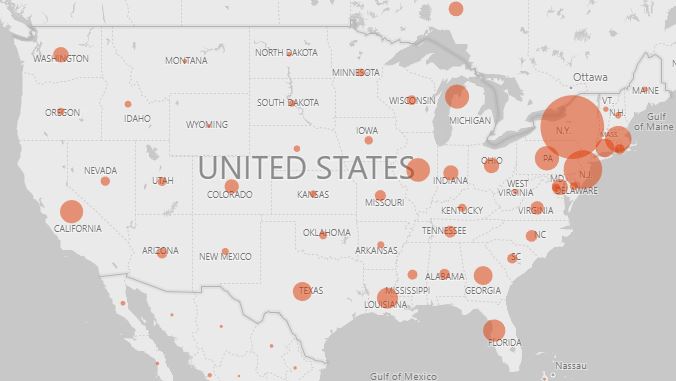 COVID-19 Tracker—Source: Bing
“The coronavirus is truly a human tragedy at a global scale,”
says Hettesheimer.
“There are 2.1 million confirmed cases and growing worldwide, with over 144,000 deaths. This is really impacting every nation on the planet. From an economic standpoint, many economists agree that the world is facing the most serious challenge since WWII ended.”
Hettesheimer went on to note that while the government stimulus package of 2 trillion dollars will stem the initial economic tide of the virus, more money will soon be needed as the crisis drags on.
“As marketers, even how we’re working has seen drastic change,” says Hettesheimer.
“While Volvo is already an innovator in the automotive sector with a well-established remote working and distributed workforce even before the setup, we’ve never had 100% of our employees working from home at the same time.”
Volvo’s headquarters are just outside of New York City, which was still the epicentre of the virus at the time the briefing was recorded. Their factories in the U.S. and Europe temporarily shut down and this, combined with the remote work environment, has had a significant impact on the way Volvo has been approaching company collaboration and marketing. In looking at the automotive industry pre and post-virus, there has been a sharp drop in the automotive sales forecast.
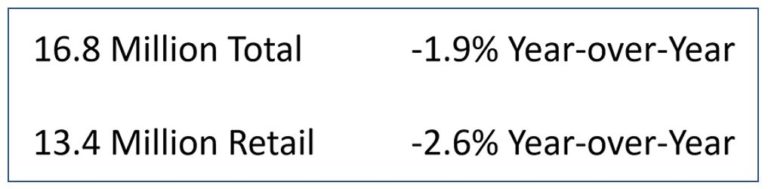 2020 Pre-virus US Automotive Sales Forecast—Source: J.D. Power & Associates
The stock market crashed on February 20th after reaching record highs in early February and continued a precipitous drop through February 28th. Additionally, most global markets were impacted due to an oil price war between Russia and the OPEC nations led by Saudi Arabia. The lower oil prices threatened oil exporters like the U.S. with higher production costs.
As a result of this, automotive industry sales were down 41% in March 2020 compared with the previous year.
The first step Volvo took in response to the virus, was to understand the scale and severity of its impact on their sales and service business. They took inventory of their dealerships and assessed who could remain open in some capacity for sales and who could remain open for service.
They found that, regionally, as many as 98% of Volvo’s dealerships across America were closed.
Volvo also assessed which dealers could continue doing business online for sales and looked at ways they could safely deliver cars to people or allow consumers on lockdown to get their cars serviced.
From there, they attempted to forecast sales in the new pre-pandemic landscape. They did this by looking at consumers’ ability to shop and at their finances. The assumption was that consumers who had the means to buy a car and the ability to leave their house to shop, would do so.
Volvo then attempted to determine the business impact of the virus through the end of 2020, designating four phases of retail sales assumptions as follows.

Using the above assessment, Hettesheimer noted that the most significant drop in sales would likely occur in April, with a potential drop in sales of 60-80% below what was forecasted at the start of 2020. The forecast for the remainder of the year was assessed as follows:
May/June: Second recovery phase where daily rates of new infections/death are at the peak or declining. Sales will still be down significantly, but at improved levels compared with March/April.
July through December: Third phase that will coincide with the consumer’s “new normal” – with infection rates/deaths significantly down and restrictions on businesses and consumers relaxing.
“Consumer behaviour will be changed for some time,” says Hettesheimer.
“Perhaps as a consumer or as a car dealer, you’ll think twice before getting into a car to perform service or buy a pre-owned vehicle.”
Like many businesses, Volvo sought out ways to preserve capital in the current uncertain environment. The company tallied committed media funds versus uncommitted media funds and ultimately made large cuts to planned April and May media spend. This enabled them to control their profitability and cash flow in the short term as sales took a major downturn while enabling them to continue investing in the business over the long term.
Throughout April, all marketing channels are dark for Volvo at a national level, though there may be some local ads still running. There are two exceptions nationally.
Volvo also assessed all in-market customer-facing messaging and pulled or edited ad copy and creative that did not make sense in the current environment. This included reviewing their website to make sure messaging matched current capabilities such as the ability to take a test drive.
Says Hettesheimer,
“We looked carefully at our language on the website. One of the big changes we had to make, for example, was that all the hours of operation had to be changed in our ‘Find A Dealer’ directory.”
Volvo also reviewed its in-market offerings to determine which ones worked better online versus at the dealership, like the Volvo Concierge Program. This is an online chat service providing white-glove services for Volvo shoppers and customers that enable them to chat with a call centre person live, 24/7.
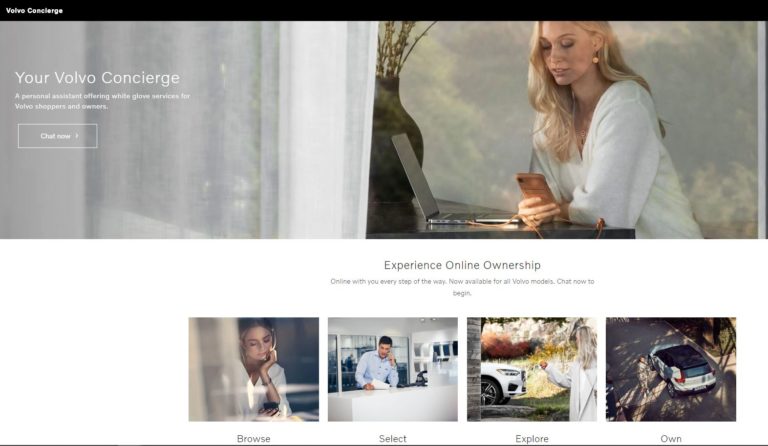
Volvo Concierge Home Page
Volvo is trying to anticipate when dealers will open again—and when consumers will start shopping for cars—by monitoring the state of the economic recovery across the U.S. This will inform when they decide to relaunch their advertising.
They do this by looking at a variety of data sources including Google Analytics, Google Trends, Institute for Health Metrics and Evaluation (IMHE) COVID-19 projection models, and state-by-state school closure updates.
In looking towards the future, Hettesheimer summarizes four key steps that businesses can use to inform their marketing and business decisions as follows.
“Be sensitive,” advises Hettesheimer. “Your customers are hurting right now. Let them know you’re there for them when they’re ready. If you can offer special financing or help them through a rough patch, do so, and make sure you mention that as well, but be humble.”
https://www.searchenginewatch.com/2020/04/23/volvos-trevor-hettesheimer-talks-about-how-covid-19-has-changed-automotive-business/
[unable to retrieve full-text content]http://tracking.feedpress.it/link/13962/13473374
[unable to retrieve full-text content]http://tracking.feedpress.it/link/13962/13472755
[unable to retrieve full-text content]http://tracking.feedpress.it/link/13962/13472517
[unable to retrieve full-text content]http://tracking.feedpress.it/link/13962/13472368
[unable to retrieve full-text content]http://tracking.feedpress.it/link/13962/13472157
[unable to retrieve full-text content]http://tracking.feedpress.it/link/13962/13469576

The beauty and bane of SEO is that it’s a richly diverse topic. There are so many avenues to explore and angles to consider. In a previous article, we looked at how different inter-organizational collaborations can boost your SEO implementation and improve your results. Part of this article was dedicated to collaborations with customer relationship management (CRM) systems.
Although we touched on some of the benefits of CRM systems for SEO teams, it’s worth diving a bit deeper. When you look at what all a CRM system does for you, it lines up perfectly with the goals of an effective SEO strategy. The two should go hand-in-hand, working together to make each other more successful.
Here are five ways your CRM system can help you get better results with SEO.
When you’re using a CRM system, you have the opportunity to continuously learn from your customers. You can use this opportunity to find out more about their pain points, what they’re searching for, and what they’re purchasing. This information can then be passed over to the relevant part of your company to deal with it.
Through a CRM system, you can issue surveys, ask questions, and record information given by your existing customers and leads. With a more complete picture of customer data you can create localized content, adjust the timing of certain SEO campaigns to match buying habits, and highlight features of your products or services with keywords that address customer pain points.
Here is what Daniel Liddle – SEO Growth Strategist at Green Park Content says,
“Getting that crucial customer behaviour information from CRM systems is the best way to refine the intent and behaviour of your leads. With more and more CRMs incorporating machine learning into their software such as Microsoft’s Dynamic365 and Salesforce, sentiment analysis and forecasting is becoming a lot easier to report on and also making that data actionable in order to drive sales. And, that’s the key point, there’s elements of information that’s more ‘nice to know’ but you really want to be looking and building on actionable data which a lot of software companies are driving towards doing this autonomously.”
SEO gets people to your content, but what happens next? If you don’t get enough engagement on your pages or response from your calls to action (CTAs), even your SEO will suffer over time. You have to follow up with leads generated by your SEO efforts so that you can turn them from page visitors to conversions.
CRM can help you guide your overall SEO strategy. If you integrate SEO efforts into your CRM system, you’ll get an idea of whether your SEO is bringing the right types of people to your pages, how many conversions you’re generating, and what brought people there in the first place. All of this means better SEO with measurable results that matter to your bottom line. Traffic and page views are great, but it’s better to get less general traffic if that means more conversions.
Using a CRM system, you can ensure that your whole organization is on the same page. No matter how small or large your operation is, consistency in marketing and customer-facing strategies matters. CRM helps you stay organized to present the same central message across all platforms.
The more you talk about a certain subject, the more your authority on the subject increases. Building authority on a topic is great for SEO, as your content will have an advantage in the rankings if your focus stays consistent. You’ll be able to build a stronger link profile, get more social media mentions, and post more relevant content that your audience loves.
Growing that authority requires company-wide efforts to produce a consistently good experience that’s relevant to your audience and fulfils their needs. CRM helps you stay on track and get everyone on board from different parts of the organization.
For instance, Mario Peshev, CEO of DevriX, relies on their in-house CRM tool for gathering case studies in a consistent manner:
“Our retainer contracts are long-term and we revise our accomplishments two to four times per year. Having our customer portfolio in one place enables us to review the progress to date, leverage a case study template, and prepare drafts for new PR opportunities or updating existing success stories delivered for our clients.”
The entire point of a CRM system is to improve the customer experience your company offers, from the beginning of the sales funnel to after-sales services and everything in between. By improving your customer experience, you can also boost your SEO.
Customer experience is intricately linked to the heart of how SEO works. When people search for keywords or phrases, they’re trying to find answers to questions and other information to satisfy a need. If you know what your customers want and need, you can better tailor your content and keywords to address those needs.
To give a good customer experience you first have to know your customers. Take that information and apply it to SEO. Using the data about your existing customers, you can target your SEO efforts on a more realistic market of people that share the needs and wants of your existing customer base. Since you know these types of people already use your products or services, it’s a good idea to market to similar people as well.
Better, more targeted content means lower bounce rates, more organic traffic, and higher engagement with your CTA. Your SEO efforts can only benefit from relevant content that addresses what people really want to know.
Speaking of customer experience, SEO is also partially impacted by outside mentions of your company. Specifically, third-party review sites like Google My Business, Yelp, and Travel Advisor hold a lot of weight. If you are listed on these sites with a solid number of reviews (most of which are positive), you’ll do better in SEO than if you’re unlisted with fake reviews, no reviews, or poor reviews.
If you’re doing your CRM work right, you should end up with more satisfied customers. These are the guys who are going to be leaving the reviews for you. It’s a long-term strategy, but by focusing more on a great customer experience that leaves more people satisfied with what you provide, you will naturally end up with more positive reviews. You can even prompt people to leave reviews if you’re confident that more people will be happy rather than disappointed.
CRMs do a lot for your business if you use it right. If you’re using one already or considering adopting the use of one, think about the bigger picture of everything you can do with it. Don’t underestimate the impact a CRM system can have on your SEO. Get ahead of your competition in the ranking using every tool at your disposal.
https://www.searchenginewatch.com/2020/04/21/five-ways-a-crm-system-improves-seo-results/
[unable to retrieve full-text content]http://tracking.feedpress.it/link/13962/13469237