Why A Site Deindexed By Google For Programmatic SEO Bounced Back via @sejournal, @martinibuster
A company founder shared their experience with programmatic SEO, which they credited for initial success until it was deindexed by Google, calling it a big mistake they won’t repeat. The post, shared on LinkedIn, received scores of supportive comments.
The website didn’t receive a manual action, Google deindexed the web pages due to poor content quality.
Programmatic SEO (pSEO)
Programmatic SEO (aka pSEO) is a phrase that encompasses a wide range of tactics that have automation at the heart of it. Some of it can be very useful, like automating sitewide meta descriptions, titles, and alt text for images.
pSEO is also the practice of using AI automation to scale content creation sitewide, which is what the person did. They created fifty thousand pages targeting long tail phrases, phrases that are not commonly queried. The site initially received hundreds of clicks and millions of impressions but the success was not long-lived.
We learned the hard way that shortcuts don’t scale sustainably.
It was a huge mistake, but also a great lesson.
And it’s one of the reasons we rebranded to Tailride.”
Thin AI Content Was The Culprit
A follow-up post explained that they believe the AI generated content backfired was because it was thin content, which makes sense. Thin content, regardless of how it was authored, can be problematic.
One of the posts by Palet explained:
“We’re not sure, but probably not because AI. It was thin content and probably duplicated.”
Rasmus Sørensen (LinkedIn profile), an experienced digital marketer shared his opinion that he’s seen some marketers pushing shady practices under the banner of pSEO:
“Thanks for sharing and putting some real live experiences forward. Programmatic SEO had been touted as the next best thing in SEO. It’s not and I’ve seen soo much garbage published the last few months and agencies claiming that their pSEO is the silver bullet. It very rarely is.”
Joe Youngblood (LinkedIn profile) shared that SEO trends can be abused and implied that it is a viable strategy if done correctly:
“I would always do something like pSEO under the supervision of a seasoned SEO consultant. This tale happens all too frequently with an SEO trend…”
What They Did To Fix The site
The company founder shared that they rebranded the website to a new domain, redirecting the old domain to the new one, and focused their site on higher quality content that’s relevant to users.
They explained:
“Less pages + more quality”
A site: search for their domain shows that Google is now indexing their content, indicating that they are back on track.
Takeaways
Programmatic SEO can be useful if approached with an understanding of where the line is between good quality and “not-quality” content.
Why Is SureRank WordPress SEO Plugin So Popular? via @sejournal, @martinibuster
A new SEO plugin called SureRank, by Brainstorm Force, makers of the popular Astra theme, is rapidly growing in popularity. In beta for a few months, it was announced in July and has amassed over twenty thousand installations. That’s a pretty good start for an SEO plugin that has only been out of beta for a few weeks.
One possible reason that SureRank is quickly becoming popular is that it’s created by a trusted brand, much loved for its Astra WordPress theme.
SureRank By Brainstorm Force
SureRank is the creation of the publishers of many highly popular plugins and themes installed in many millions of websites, such as Astra theme, Ultimate Addons for Elementor, Spectra Gutenberg Blocks – Website Builder for the Block Editor, and Starter Templates – AI-Powered Templates for Elementor & Gutenberg, to name a few.
Why Another SEO Plugin?
The goal of SureRank is to provide an easy-to-use SEO solution that includes only the necessary features every site needs in order to avoid feature bloat. It positions itself as an SEO assistant that guides the user with an intuitive user interface.
What Does SureRank Do?
SureRank has an onboarding process that walks a user through the initial optimizations and setup. It then performs an analysis and offers suggestions for site-level improvements.
It currently enables users to handle the basics like:
Edit titles and meta descriptions
Custom write social media titles, descriptions, and featured images,
Tweak home page and, archive page meta data
Meta robot directives, canonicals, and sitemaps
Schema structured data
Site and page level SEO analysis
Automatic image alt text generation
Google Search Console integration
WooCommerce integration
SureRank also provides a built-in tool for migrating settings from other popular SEO plugins like Rank Math, Yoast, and AIOSEO.
Check out the SureRank SEO plugin at the official WordPress.org repository:
5 Ways To Prove The Real Value Of SEO In The AI Era via @sejournal, @wburton27
As SEO evolves with AI optimization, generative engine optimization, and answer engine optimization, brands and marketers must rethink their SEO strategies to stay competitive.
Instead of focusing solely on traditional SEO strategies and tactics, you need to be visible in AI-powered search and answer engines.
Showing the value of SEO in this new world means showcasing how optimized, structured, and intent-driven content can maximize visibility across generative platforms.
It can also enhance user trust and drive qualified engagement in a world where AI chatbots and platforms interpret a user’s intent, retrieve relevant information, and generate clear and concise answers.
In today’s competitive AI-powered results, it can be difficult to maximize your visibility.
With SEO becoming more challenging and the search engine results constantly changing to incorporate AI results, what metrics do you need to track, and how can you show the value of SEO in today’s AI-powered search results?
Let’s explore.
Proving The Value Of SEO
Proving SEO value depends on your client or prospective client’s goals and what will move the needle for them to get visibility in the search engine results pages (SERPs) and in AI chatbots and platforms.
This could include local search, app store optimization, content marketing, technical optimization, AI Overviews, etc.
That said, you must show performance improvements and drive revenue to secure more funding and make your client successful.
In my experience, here are some of the best metrics to track and measure to prove the SEO value in an AI world:
1. Monitor AI Results
With AI Overviews and generative AI changing SEO, it is important to track visibility as we move from ranking to relevance.
AI Overviews are not expected to go anywhere. During I/O 2025, Google announced that AI Overviews were expanding to over 200 countries and more than 40 languages.
AI Mode is now available to all users in the United States without the need to opt in via Search Labs.
To track AI Overviews:
Identify Which Queries Trigger AI Overviews
You can use tools like ZipTie.dev or Semrush to track which of your top-performing queries show AI Overviews and whether your site is included in those summaries.
Screenshot from Semrush, June 2025
Track AI Overview Queries
Once you have a list of queries that your site does or doesn’t appear in for an AI Overview, you should track those queries using keyword tracking tools and compare your traffic pre- and post-AI rollouts.
Strategize To Optimize Your Content For AI Overviews
Segment your traffic based on content type, as many informational queries are experiencing a decline in traffic due to users obtaining answers directly from AI Overviews.
This will help you identify which areas are most impacted and plan your strategy to optimize queries that have the potential to show AI Overviews.
Consider server-side analytics solutions (e.g., Writesonic’s AI Traffic Analytics) to track AI crawler visits, see which pages are accessed, and monitor trends over time.
2. Track AI Brand Mentions
Since AI platforms process information differently than traditional search engines, getting mentioned in ChatGPT, Perplexity, Claude, or Google’s AI Mode for relevant queries is a must.
AI platforms like ChatGPT and Google’s AI Overview generate answers from a mix of training data and some real-time retrieval, depending on the platform and setup.
In my experience, brands that are frequently mentioned across various platforms, including PR, blogs, social media, news coverage, YouTube forums (such as Reddit and Quora), and authoritative sites, tend to be mentioned by AI.
To track AI mentions, several tools like Brand24, Brand Radar from Ahrefs, and Mention.com use AI to monitor online conversations across various platforms, leveraging large datasets to provide insights into your brand’s perception and those of your competitors.
It’s imperative that you find out if your brand is mentioned, what people are saying about your brand (both positive and negative), what queries are used to describe it, and which websites mention your brand.
Screenshot from Brand Radar, Ahrefs, June 2025
3. Track AI Citations/References
Checking to see if your website is cited by large language models (LLMs) can help brands and marketers understand how their content is being used by AI and assess their brand’s authority and visibility.
Ahrefs now offers a free tool that tracks when your website is cited in the answers generated by AI-powered search tools like Google AIO, ChatGPT, and Perplexity. AI citations count how often a domain was linked in AI results.
Pages show how many unique URLs from this domain were linked.
Screenshot from Ahrefs, June 2025
This is one of my favorite audit tools to look to see if there are any citations in any brand that we’re reviewing.
If Ahrefs adds trend analysis to track whether you’re gaining more citations in Google AIO, ChatGPT, and other platforms over time, it would be a valuable way to assess whether your strategies are working.
4. Tracking Branded Searches
It’s extremely important to track your branded searches in this new SEO AI era. AI-powered search results are personalized, and LLMs like Gemini and ChatGPT, to name a few, heavily consider user intent and context.
Having strong brand signals could improve entity recognition, which can improve your visibility for related queries.
Tracking how AI-generated answers (e.g., featured snippets or AI Overviews) treat your brand helps you optimize for entity-driven SEO.
In the AI SEO era, where search engines prioritize context, trust, and relevance, tracking branded searches could inform you to refine strategies that help defend your SERP presence and maximize conversions.
Here are some tips to help enhance branded visibility:
Create unique, authoritative, and factual, conversational content because AI models prioritize reliable and accurate information. Focus on content that demonstrates expertise and includes verifiable data.
Structure content for AI readability by using clear headings (H1, H2, H3), bullet lists, numbered lists, and data tables. Also, create concise paragraphs that directly answer questions.
Leverage schema markup like Organization, Product, Service, FAQPage, and Review to provide structured data that AI models can easily understand and reference.
Build brand authority and expertise by getting consistent citations, mentions on authoritative third-party sites, and positive reviews, to contribute to AI’s perception of your brand’s credibility.
Optimize conversational queries by creating content that directly answers “who, what, why, and how” in your niche.
Be active on platforms like Reddit and Quora, where AI models often pull information. SEO becomes “Search Engine Everywhere.”
Regularly review your AI visibility data, identify gaps, and adjust your content and SEO strategies based on insights.
AI Mode groups the user’s question into subtopics and searches for each one simultaneously, and users can go deeper.
If a user asks a follow-up question within AI Mode, they are essentially performing a new query. All impression, position, and click data in the new response are counted as coming from this new user query.
AI Traffic In GA4
While Google Analytics 4 doesn’t explicitly label AI traffic, you can look for patterns. Create custom reports with “Session source/medium” and apply regex filters for known AI domains (e.g., .*ChatGPT.*|.*perplexity.*|.*openai.*|.*bard.*).
For specific content you hope AI will cite, create unique URLs with UTM parameters (e.g., utm_source=chatgpt, utm_medium=ai). This can help attribute some traffic directly.
If you can get more conversions from AI Overviews, like Ahrefs did, when it found that AI search visitors converted at a rate 23 times higher than traditional organic search traffic, despite representing only 0.5% of total website visits, then you will have discovered a conversion goldmine that makes AI optimization not just worthwhile, but essential for staying competitive.
Final Thoughts
The SEO landscape has shifted from optimizing search engines and traditional search to optimizing for AI-powered chatbots and solutions, such as ChatGPT, Perplexity, Claude, Google’s AI Overviews, and potentially OpenAI’s web browser “in the coming weeks,” according to Reuters.
OpenAI has 500 million weekly active users of ChatGPT and could disrupt a key component of rival Google’s ad-money source.
SEO is no longer about ranking on the first page of Google.
It’s about being relevant and visible across multiple AI platforms, getting mentioned in generative responses, and demonstrating value through AI-focused metrics outside of the traditional metrics like rankings and traffic.
Brands and marketers that prove the SEO value in this new era can deliver immediate, measurable value while building momentum for larger investments in the future.
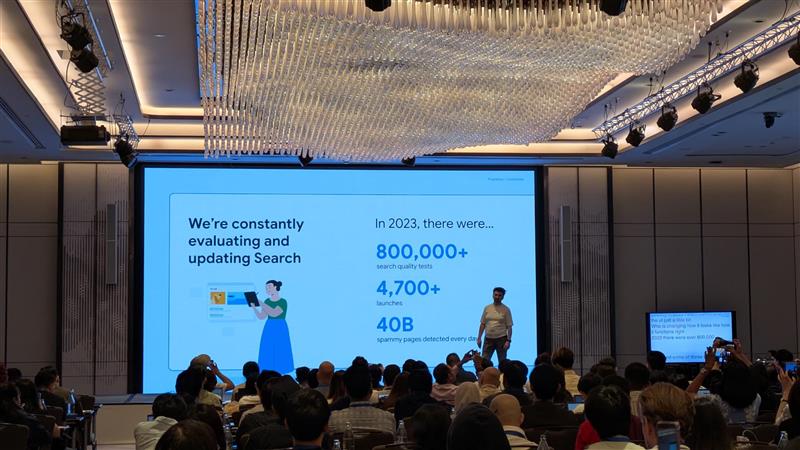
Day three picked up from there, diving into how Google actually returns search results.
The serving infrastructure encompasses query understanding, result retrieval, index selection, ranking, and feature application, including rich results, before presenting them to the user.
Image from author, July 2025
Making Sense Of User Queries
Cherry Prommawin provided a detailed explanation of how Google interprets users’ queries.
Not all queries are straightforward.
In languages like Chinese or Japanese, there are no spaces between words, so Google has to learn where words start and end by looking at past queries and documents. This is known as segmenting, and not all languages require this.
After that, it removes stopwords unless they’re part of a meaningful phrase or entity, like “The Lord of the Rings.”
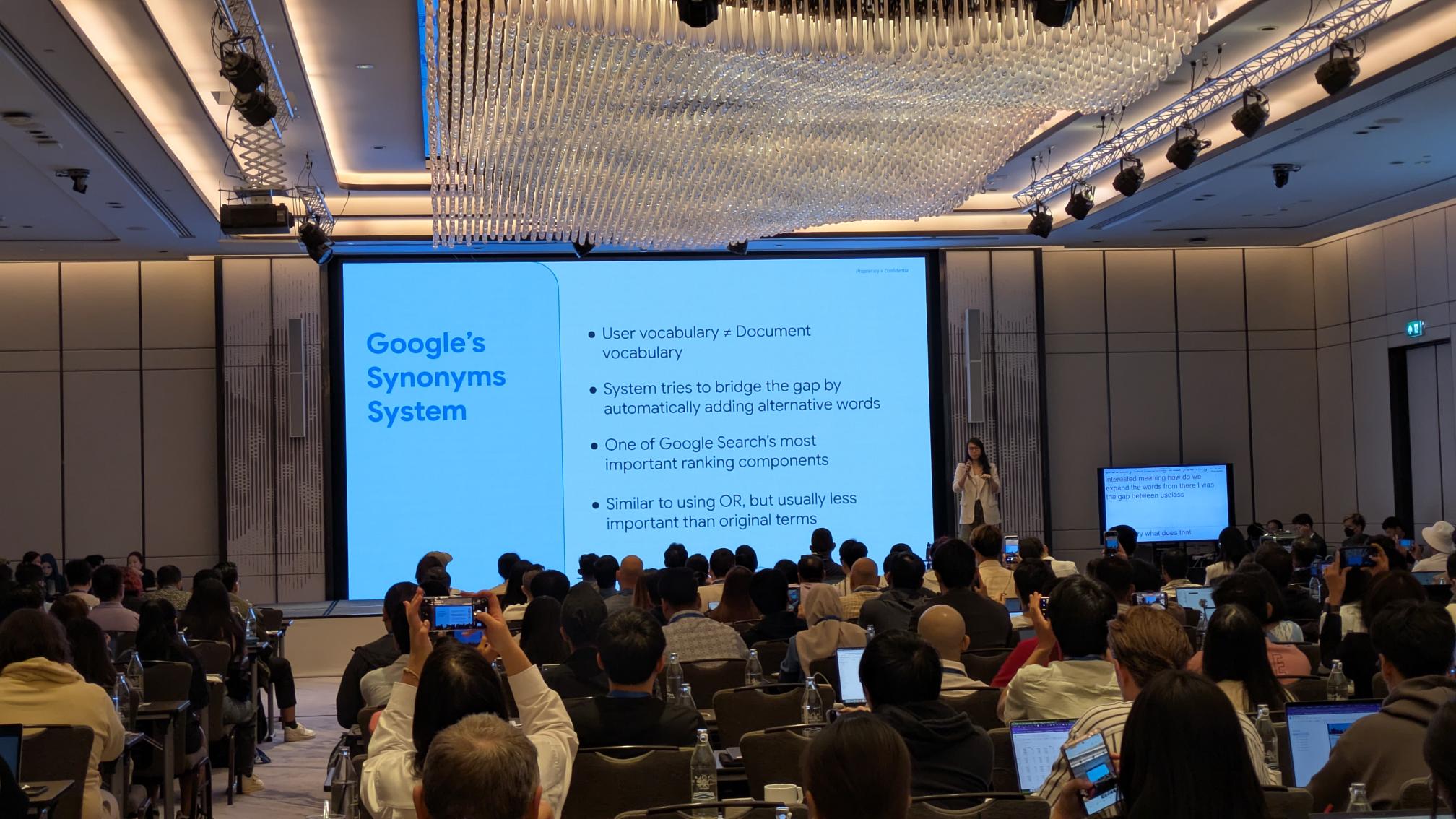
Then, it expands the query to include synonyms across all languages to better match what the user is actually looking for (see image above).
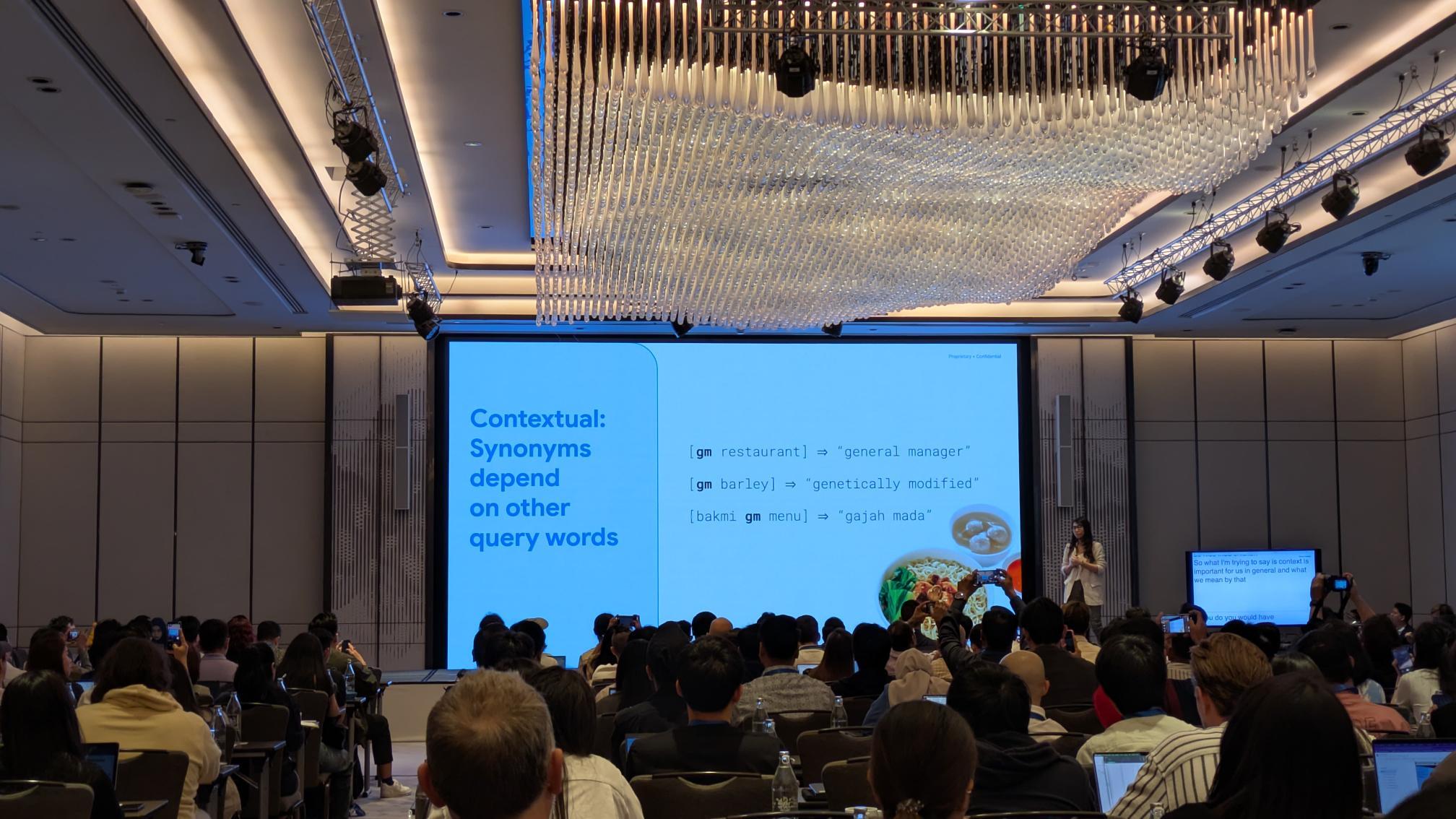
Context plays a significant role in how Google understands and responds to queries. A crucial aspect of this is the utilization of contextual synonyms.
Image from author, July 2025
These aren’t like the typical synonyms you’d find in an English dictionary. Instead, they’re created to help return better search results, based on how words are used in real-world searches and content.
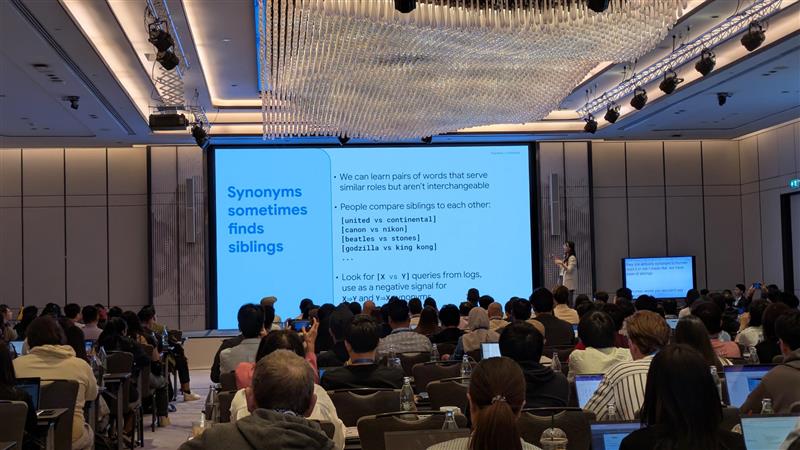
Google might learn that people searching for “car hire” often click on pages that say “rental car,” so it treats the two terms as similar in the right context. This is what Google refers to as “siblings.”
These relationships are mostly invisible to users, but they help connect queries to the most relevant information, even when the exact words don’t match.
Image from author, July 2025
How Google Understands Quality
Alfin Hotario Ho provided a clear explanation of how Google evaluates quality in search results.
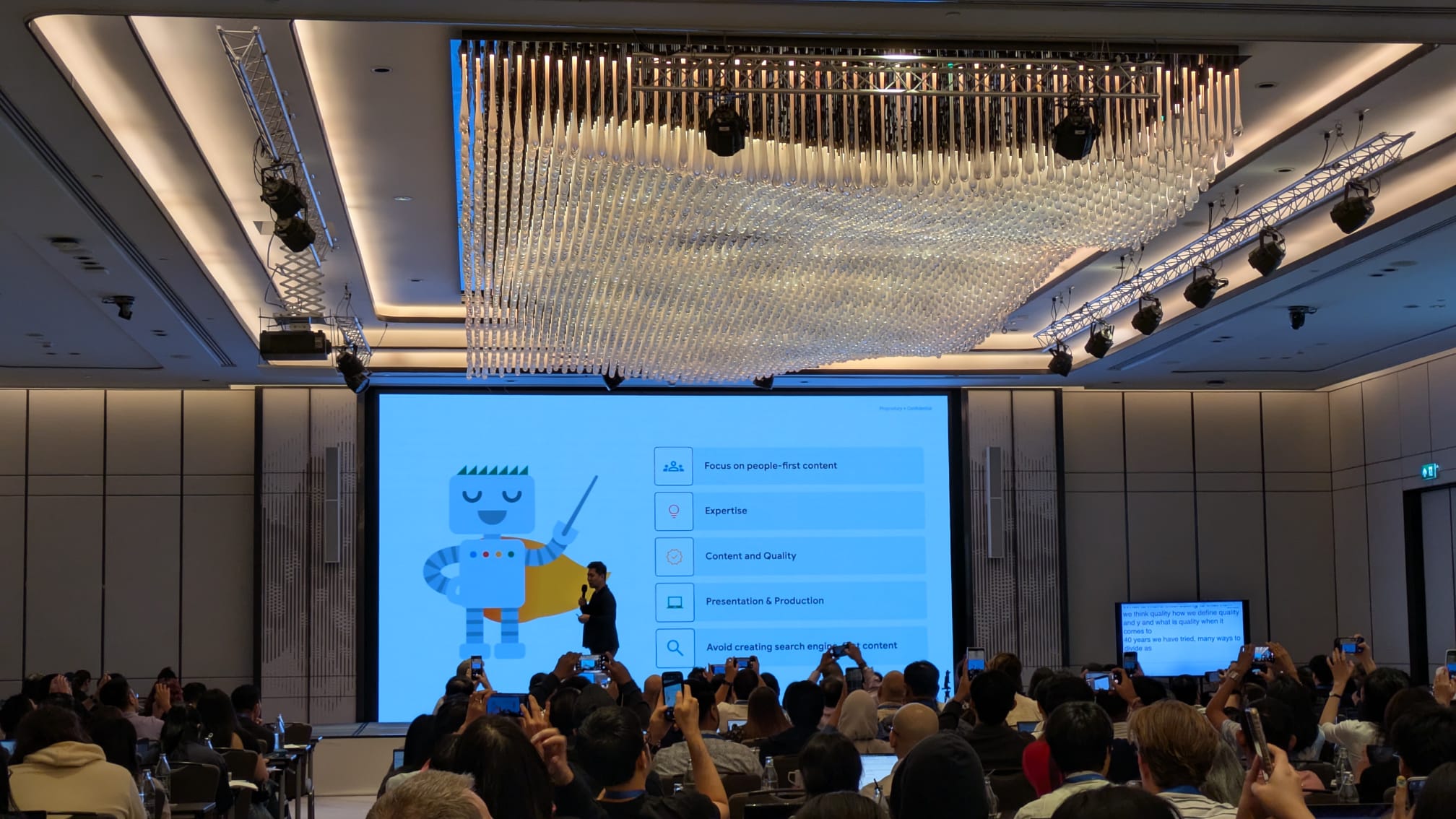
Over the years, Google has attempted to define what “quality” means, and it consistently returns to five key points:
Focus on people-first content.
Expertise.
Content and quality.
Presentation and production.
Avoid creating search engine-first content.
Image from author, July 2025
Ho highlighted the Quality Rater Guidelines as a useful resource. These guidelines don’t directly influence ranking, but they help explain how Google measures whether its systems are performing well.
When the guidelines change, they reflect updates in Google’s thinking about what constitutes good content.
There are four main pillars of quality in the guidelines:
Effort: Content should be made for people, not search engines. It should clearly show time, skill, and first-hand knowledge.
Originality: The content should offer something new – original research, fresh analysis, or reporting that goes beyond what’s already out there.
Talent or Skill: It should be well-written or produced free from obvious errors, and show a strong level of craft. You also don’t need to be an expert in something, as long as you can demonstrate verifiable first-hand experience.
Accuracy: It must be factually correct, supported by evidence, and consistent with expert or public consensus when possible.
Other key takeaways from Ho’s session include:
From E-E-A-T (Experience, Expertise, Authoritativeness, and Trustworthiness), it is clear that trust matters most.
Even if a topic isn’t about health, money, or safety (Your Money or Your Life), Google still prioritizes trustworthy content.
If a page strongly disagrees with general expert opinion, it may be seen as less reliable overall.
Lots of 404 or noindex pages on a website are not a quality issue. 404 is a technical issue, as is the “noindex” tag.
Image from author, July 2025
What Are Quality Updates?
Google updates its search systems for three primary reasons: to support new content formats, to enhance content quality, or to combat spam.
These updates help ensure that people receive useful and relevant results when they search.Supporting New Content Formats
As new content types become more popular, such as short videos or interactive visuals, users start to expect to find them in search results.
If enough people show interest, Google may launch new features to match that demand.
This could include new filters or information views in the results. These updates help keep Search useful and aligned with how people want to explore information.
Improving Content Breadth And Relevance
The internet is constantly growing, and many topics become saturated. That makes it harder to find the best content.
To improve this, Google rolls out core updates. These updates don’t target specific websites or pages.
Instead, they improve how Google ranks content across the web with the overarching goal of surfacing higher-quality results overall.
Combating Low-Quality And Spam Content
Some people try to game the system with low-effort content. Google isn’t perfect, and spammers look for gaps to exploit.
In response, Google launches targeted updates that adjust how its systems detect spam or low-quality signals. These changes aim to remove poor content from search results.
Recovering From Google Updates
Core Updates
You’re technically not penalized, so technically there’s no recovery like with spam updates.
Google recommends that you should:
Continue doing a great job, look at what your competitors are doing better, and learn from sites that are doing better than you.
Spam Updates
Remove the type of spam that Google has mentioned in its blog communications.
Caveats On Structured Data Usage
Google addressed some common myths surrounding structured data, particularly its connection to serving and ranking.
None of these are new, but the reiteration has been based on continued questions around the impact and value of adding structured data.
Not A Direct Ranking Factor
Adding structured data to your site won’t directly improve your rankings. But, it can make your listings more attractive in search results, which might lead to more clicks.
That added engagement could help your site over time.
No Guarantees
Just because you’ve added structured data doesn’t mean Google will show rich results. The algorithms decide when and where it makes sense to display them.
Google Can Add Rich Results On Its Own
Even without structured data, Google may still display enhanced results, such as your site name or breadcrumbs, if it can infer that information from your page content.
It Needs Ongoing Maintenance
Structured data isn’t a one-time task. You should check it regularly to ensure it remains accurate and error-free.
Keeping it up to date helps you stay eligible for enhanced search features.
That’s all from Google Search Central Live in Thailand. There have been a lot of insights and a big announcement over the last three days.
I recommend that SEOs review the last three articles and digest what Google has said. Then, consider how they can apply that to their strategies for 2025.
ChatGPT Appears To Use Google Search As A Fallback via @sejournal, @martinibuster
Aleyda Solís conducted an experiment to test how fast ChatGPT indexes a web page and unexpectedly discovered that ChatGPT appears to use Google’s search results as a fallback for web pages that it cannot access or that are not yet indexed on Bing.
According to Aleyda:
I’ve run a simple but straightforward to follow test that confirms the reliance of ChatGPT on Google SERPs snippets for its answers.
Created A New Web Page, Not Yet Indexed
Aleyda created a brand new page (titled “LLMs.txt Generators”) on her website, LearningAISearch.com. She immediately tested ChatGPT (with web search enabled) to see if it could access or locate the page but ChatGPT failed to find it. ChatGPT responded with the suggestion that the URL was not publicly indexed or possibly outdated.
She then asked Google Gemini about the web page, which successfully fetched and summarized the live page content.
Submitted Web Page For Indexing
She next submitted the web page for indexing via Google Search Console and Bing Webmaster Tools. Google successfully indexed the web page but Bing had problems with it.
After several hours elapsed Google started showing results for the page with the site: operator and with a direct search for the URL. But Bing continued to have trouble indexing the web page.
Checked ChatGPT Until It Used Google Search Snippet
Aleyda went back to ChatGPT and after several tries it gave her an incomplete summary of the page content, mentioning just one tool that was listed on it. When she asked ChatGPT for the origin of that incomplete snippet it responded that it was using a “cached snippet via web search””, likely from “search engine indexing.”
She confirmed that the snippet shown by ChatGPT matched Google’s search result snippet, not Bing’s (which still hadn’t indexed it).
Aleyda explained:
“A snippet from where?
When I followed up asking where was that snippet they grabbed the information being shown, the answer was that it had “located a cached snippet via web search that previews the page content – likely from search engine indexing.”
But I knew the page wasn’t indexed yet in Bing, so it had to be … Google search results? I went to check.
When I compared the text snippet provided by ChatGPT vs the one shown in Google Search Results for the specific Learning AI Search LLMs.txt Generators page, I could confirm it was the same information…”
Proof That Traditional SEO Remains Relevant For AI Search
Aleyda also documented what happened on a LinkedIn post where Kyle Atwater Morley shared his observation:
“So ChatGPT is basically piggybacking off Google snippets to generate answers?
What a wake-up call for anyone thinking traditional SEO is dead.”
Stéphane Bureau shared his opinion on what’s going on:
“If Bing’s results are insufficient, it appears to fall back to scraping Google SERP snippets.”
He elaborated on his post with more details later on in the discussion:
“Based on current evidence, here’s my refined theory:
When browsing is enabled, ChatGPT sends search requests via Bing first (as seen in DevTools logs).
However, if Bing’s results are insufficient or outdated, it appears to fall back to scraping Google SERP snippets—likely via an undocumented proxy or secondary API.
This explains why some replies contain verbatim Google snippets that never appear in Bing API responses.
I’ve seen multiple instances that align with this dual-source behavior.”
Takeaway
ChatGPT was initially unable to access the page directly, and it was only after the page began to appear in Google’s search results that it was able to respond to questions about the page. Once the snippet appeared in Google’s search results, ChatGPT began referencing it, revealing a reliance on publicly visible Google Search snippets as a fallback when the same data is unavailable in Bing.
What would be interesting to see is whether the server logs held a clue as to whether ChatGPT attempted to crawl the page and, if so, what error code was returned in response to the failure to retrieve the data. It’s curious that ChatGPT was unable to retrieve the page, and though it probably doesn’t have any bearing on the conclusions, it would still contribute to making the conclusions feel more complete to have that last bit of information crossed off.
Nevertheless, it appears that this is yet more proof that standard SEO is still applicable for AI-powered search, including for ChatGPT Search. This adds to recent comments by Gary Illyes that confirms that there is no need for specialized GEO or AEO in order to rank well in Google AI Overviews and AI Mode.
Validity Of Pew Research On Google AI Search Results Challenged via @sejournal, @martinibuster
Questions about the methodology used by the Pew Research Center suggest that its conclusions about Google’s AI summaries may be flawed. Facts about how AI summaries are created, the sample size, and statistical reliability challenge the validity of the results.
Google’s Official Statement
A spokesperson for Google reached out with an official statement and a discussion about why the Pew research findings do not reflect actual user interaction patterns related to AI summaries and standard search.
The main points of Google’s rebuttal are:
Users are increasingly seeking out AI features
They’re asking more questions
AI usage trends are increasing visibility for content creators.
The Pew research used flawed methodology.
Google shared:
“People are gravitating to AI-powered experiences, and AI features in Search enable people to ask even more questions, creating new opportunities for people to connect with websites.
This study uses a flawed methodology and skewed queryset that is not representative of Search traffic. We consistently direct billions of clicks to websites daily and have not observed significant drops in aggregate web traffic as is being suggested.”
Sample Size Is Too Low
I discussed the Pew Research with Duane Forrester (formerly of Bing, LinkedIn profile) and he suggested that the sampling size of the research was too low to be meaningful (900+ adults and 66,000 search queries). Duane shared the following opinion:
“Out of almost 500 billion queries per month on Google and they’re extracting insights based on 0.0000134% sample size (66,000+ queries), that’s a very small sample.
Not suggesting that 66,000 of something is inconsequential, but taken in the context of the volume of queries happening on any given month, day, hour or minute, it’s very technically not a rounding error and were it my study, I’d have to call out how exceedingly low the sample size is and that it may not realistically represent the real world.”
How Reliable Are Pew Center Statistics?
The Methodology page for the statistics used list how reliable the statistics are for the following age groups:
Ages 18-29 were ranked at plus/minus 13.7 percentage points. That ranks as a low level of reliability.
Ages 30–49 were ranked at plus/minus 7.9 percentage points. That ranks in the moderate, somewhat reliable, but still a fairly wide range.
Ages 50–64 were ranked at plus/minus 8.9 percentage points. That ranks as a moderate to low level of reliability.
Age 65+ were ranked at at plus/minus 10.2 percentage points, which is firmly in the low range of reliability.
The above reliability scores are from Pew Research’s Methodology page. Overall, all of these results have a high margin of error, making them statistically unreliable. At best, they should be seen as rough estimates, although as Duane says, the sample size is so low that it’s hard to justify it as reflecting real-world results.
Pew Research Results Compare Results In Different Months
After thinking about it overnight and reviewing the methodology, an aspect of the Pew Research methodology that stood out is that they compared the actual search queries from users during the month of March with the same queries the researchers conducted in one week in April.
That’s problematic because Google’s AI summaries change from month to month. For example, the kinds of queries that trigger an AI Overview changes, with AIOs becoming more prominent for certain niches and less so for other topics. Additionally user trends may impact what gets searched on which itself could trigger a temporary freshness update to the search algorithms that prioritize videos and news.
The takeaway is that comparing search results from different months is problematic for both standard search and AI summaries.
Pew Research Ignores That AI Search Results Are Dynamic
With respect to AI overviews and summaries, these are even more dynamic, subject to change not just for every user but to the same user.
Searching for a query in AI Overviews then repeating the query in an entirely different browser will result in a different AI summary and completely different set of links.
The point is that the Pew Research Center’s methodology where they compare user queries with scraped queries a month later are flawed because the two sets of queries and results cannot be compared, they are each inherently different because of time, updates, and the dynamic nature of AI summaries.
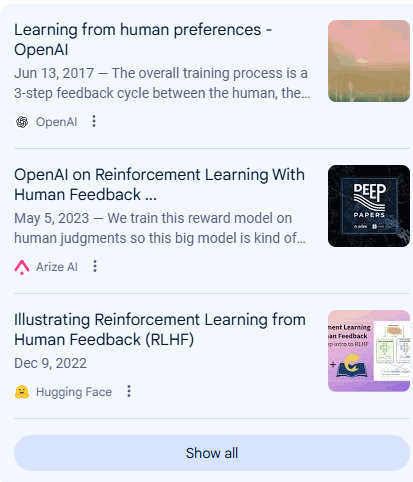
The following screenshots are the links shown for the query, What is the RLHF training in OpenAI?
Google AIO Via Vivaldi Browser
Google AIO Via Chrome Canary Browser
Not only are the links on the right hand side different, AI summary content and the links embedded within that content are also different.
Could This Be Why Publishers See Inconsistent Traffic?
Publishers and SEOs are used to static ranking positions in search results for a given search query. But Google’s AI Overviews and AI Mode show dynamic search results. The content in the search results and the links that are shown are dynamic, showing a wide range of sites in the top three positions for the exact same queries. SEOs and publishers have asked Google to show a broader range of websites and that, apparently, is what Google’s AI features are doing. Is this a case of be careful of what you wish for?
Google’s Advice On Hiring An SEO And Red Flags To Watch For via @sejournal, @martinibuster
Google’s Search Off The Record podcast discussed when a business should hire an SEO consultant and what metrics of success should look like. They also talked about a red flag to watch for when considering a search marketer.
Hire An SEO When It Becomes Time Consuming
Martin Splitt started the conversation off by asking at what point a business should hire an SEO:
“…I know people are hiring agencies and SEO experts. When is the point where you think an expert or an agency should come in? What’s the bits and pieces that are not as easy to do while I do my business that I should have an expert for?”
John replied that there is no one criteria or line to cross at which point a business should hire a consultant. He did however point out that there comes a certain point where doing SEO is time consuming and takes a business person away from the tasks that are directly related to running their business. That’s a point at which hiring an SEO consultant makes sense.
He said:
“Yeah, I don’t know if there’s a one-size-fits-all answer there because it’s a bit like asking, when should I get help for marketing, especially for a small business.
You do everything yourself. At some point, you’re like, ‘Oh, I really hate bookkeeping. I’m going to hire a bookkeeper.’ At that point where you’re like, ‘Well, I don’t appreciate doing all of this work or I don’t have time for it, but I know it has to be done.’ That’s probably the point where you say, ‘Well, okay, I will hire someone for this.’ “
SEO Should Have Measurable Results?
The next factor they discussed is the measurability of results. Over more than twenty-five years of working in SEO, one of the ways that low-quality SEOs have consistently measured their results is by the number of queries a client site is ranking for. Low-quality SEOs charge a monthly retainer and generate a report of all queries the site has ranked for in the previous months, including garbage nonsense queries.
A common metric SEOs use to gauge success is ranking positions and traffic. Those metrics are a little better, and most SEOs agree that they make sense as solid metrics.
But those metrics don’t capture the true success of SEO because those ranking positions could be for low-quality search queries that don’t result in the kind of traffic that converts to leads, sales, affiliate earnings or ad clicks.
Arguably, the most important metric any business should use to gauge the effect of what was done for SEO is how much more revenue is being generated. Keyword rankings and traffic are important metrics to measure, but the most important metric is ultimately the business goal.
Google’s John Mueller appears to agree, as he cites revenue and the business result as key measures of whether the SEO is working.
He explained:
“I think, for in SEO, it kind of makes sense when you realize there’s concrete value in working on SEO for your website, where there’s some business result that comes out of it where you can actually measurably say, ‘When I started doing SEO for my website, I made so much more money’ or whatever it is that goal is that you care about, and ‘I’m happy to invest a portion of that into hiring someone to do SEO.’
That’s one way I would look at it, where if you can measure in one way or another the effects of the SEO work, then it’s easier to say, ‘Well, I will invest this much into having someone else do that for me.’”
There is a bit of a problem with measuring the effects of SEO. The effects on sales or leads from organic SEO cannot always be directly attributed. People who are obsessed with data-driven decisions will be disappointed because it’s not always possible to directly attribute a lead from an organic search. For one thing, Google hides referral data from the search results. Unlike PPC, where you can track a lead from an ad click to the sale, you can’t do that with organic search.
So if you’re using increased sales or leads as a metric, you’ll have to be able to at least separate attributable paid search from earnings, then guesstimate the rest. Not everything can be data-driven.
Another thing Mueller and Splitt recommended was to hire someone who has actual experience with SEO. There are many qualifying factors that can be added, including experience monetizing their own websites, ability to interpret HTML code (which is helpful for identifying technical reasons for ranking problems), endorsements and testimonials. A red flag, in my opinion, is hiring someone from a cold call.
John Mueller observed:
“Someone else, ideally, would be someone who has more experience doing SEO. Because, as a small business owner, you have like 500 hats to wear, and you probably can figure out a little bit about each of these things, but understanding all of the details, that’s sometimes challenging.”
Martin agreed:
“Okay. So there’s no one-size-fits-all answer for this one, but you have to find that spot for yourself whenever it makes sense. All right okay. Fair.”
Red Flag About Some SEOs
Up to this point, both Mueller and Splitt avoided cautioning about red flags to watch for when hiring an SEO. Here, they segued into the topic of what to avoid, advising caution about search marketers who guarantee results.
The reason to avoid these kinds of search marketers is that search rankings depend on a wide range of factors that are not under an SEO’s control. The most an SEO can do is align a site to best practices and promote the site. After that, there are external factors, such as competitors, that cannot be influenced. Most importantly, Google is a black box system: you can see what goes in, you can observe what comes out (the search results), but what happens in between is hidden. All search ranking factors, like external signals of trustworthiness, have an unclear influence on the search results.
Here’s what Mueller said:
“One of the things I would watch out for is, if an SEO makes any promises with regards to ranking or traffic from Search, that’s usually a red flag, because a lot of things around SEO you can’t promise ahead of time. And, if someone says, “I’m an expert. I promise you will rank first for these five words.” They can’t do that. They can’t manually go into Google’s systems and tweak the dials and change the rankings.”
Listen to Google’s Search Off The Record podcast here:
Is Your SEO Strategy Built for the AI Era? [Webinar] via @sejournal, @hethr_campbell
The old rules no longer apply. It’s time for a smarter, AI-ready playbook.
AI-driven search is changing the landscape fast. Organic traffic is dropping, visibility is shrinking, and traditional SEO tactics are losing their edge. If you’re still following yesterday’s strategy, you’re already behind.
Join Siteimproveon July 23, 2025 for an exclusive webinar with Zoe Hawkins and Jeff Coyle. Learn how to evolve your SEO approach and content planning to thrive in a world where AI now plays a central role in search.
Here’s what you’ll walk away with:
A breakdown of how AI is changing enterprise SEO.
Why trust and authority now matter more than keyword volume.
How to adapt to high-intent, low-volume traffic behavior.
We can no longer rely on the same tactics that worked before. This session gives you an inside look at how SEO must evolve to stay effective in the AI-first future.
Register now to stay ahead of the curve. Can’t attend live? Sign up anyway and get the full replay delivered to your inbox.
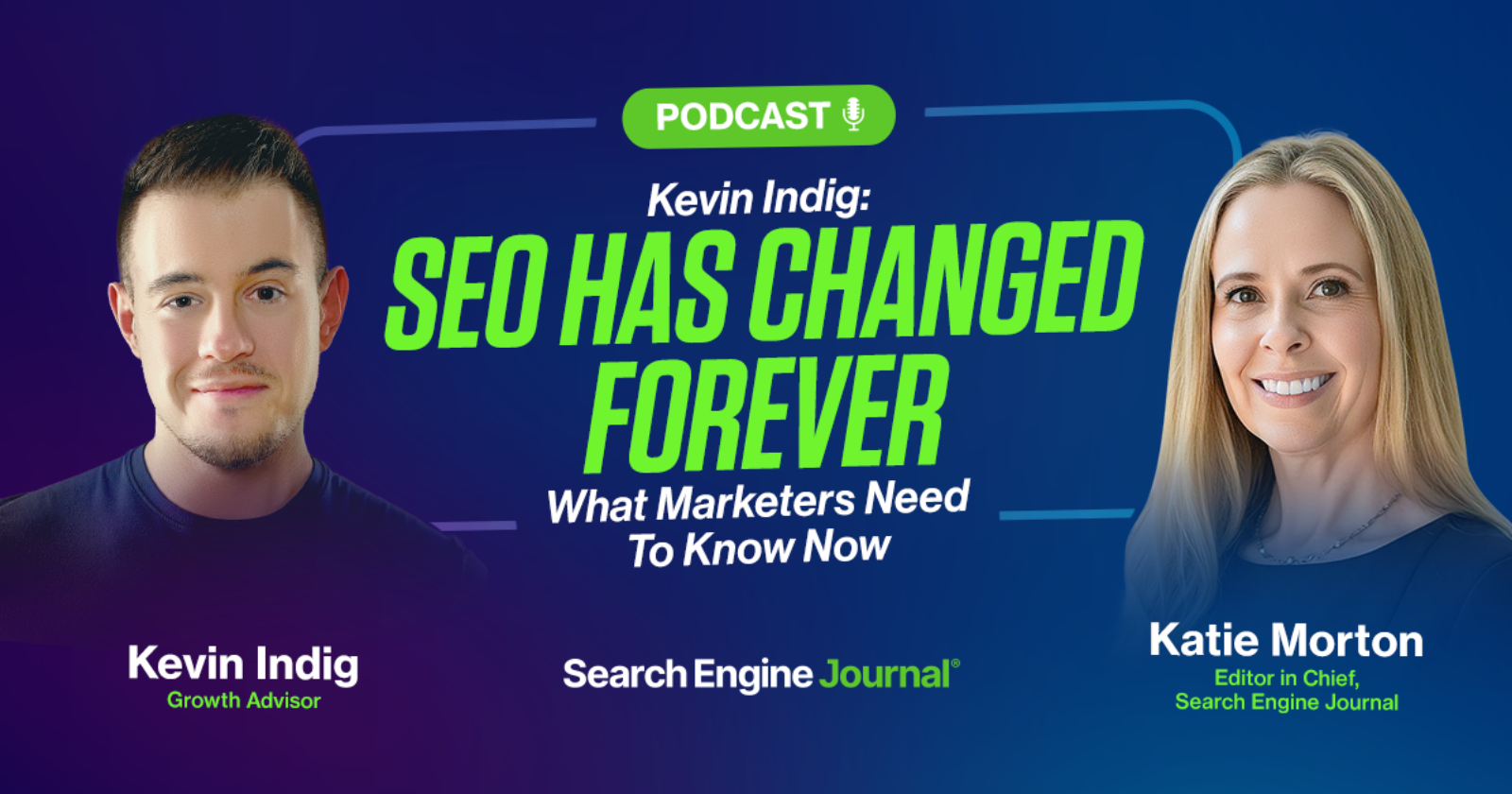
Kevin Indig: SEO Has Changed Forever. What Marketers Need To Know Now
If you’ve been affected by AI Overviews, traffic drops, or feel uncertain about SEO’s future, then this episode is for you.
Search Engine Journal’s Editor-in-Chief Katie Morton sits down with growth advisor and author of “Growth Memo,” Kevin Indig, to unpack the results of his latest AI Overviews study.
In this 35-minute episode, they discuss how it impacts search, SEO, and brand marketing in 2025.
[embedded content]
Editor’s note: The following transcript has been edited lightly for clarity, brevity, and adherence to our editorial guidelines.
What AI Overviews Mean For Search, SEO & Brand Trust
Katie Morton: Hi, everybody. It is I, Katie Morton. I’m the editor-in-chief of Search Engine Journal, and today I’m sitting down with Kevin Indig, who is a growth advisor to fast-growing tech companies and the author of “Growth Memo,” a fantastic newsletter.
We syndicate it here on Search Engine Journal, but sign up for it directly, too, because he has content exclusive to subscribers. It’s filled with smart insights every marketer needs to know.
Kevin, thanks for making the time today. The study was analyzed in March-April 2025 and published in May. We’ve had time to reflect, and today we’ll unpack the key takeaways.
We’ll start with the nuts and bolts of the study’s background, so listeners understand the context, and then go beyond the data to explore how marketers and companies, especially those frustrated by Google, AI Overviews, or traffic drops, can respond.
So, Kevin, can you summarize the study and share the main takeaways?
Kevin Indig: Thanks for having me on, Katie. It’s great to be here with you.
What The AI Overview Study Really Reveals
Kevin: The study came from a desire to deeply understand, from a qualitative perspective, how everyday users interact with AI Overviews.
In 2024, everyone was eyeing AI Overviews with curiosity, but traffic impact wasn’t significant yet. Then, at the start of 2025, everything changed. It became a “holy cow” moment – this was real and serious.
We asked 70 participants in the U.S., across different age groups, to solve eight tasks that covered dominant user intents: Finding a tax accountant, researching medical questions, shopping, etc.
We intentionally included queries that showed AI Overviews but didn’t tell participants to interact with them – we wanted unbiased behavior.
So, in a nutshell, the three most poignant results are:
1. Classic Organic Results Still Carry Weight
First of all – and this is no surprise – clicks are really rare when people see AI Overviews. That’s gotten through to everyone by now.
And yet, at the same time, classic organic results still have the majority of impact on people’s completion of user journeys.
Let me untangle that for a second: What we found is that people get their final answer – the final piece of information they were set out to get – 80% of the time from classic organic results. Not from AI Overviews, so that was encouraging.
2. High-Quality Clicks Happen In High-Trust Moments
Clicks are going down, but people still click. And each of those clicks has much, much higher quality than, say, in 2024 or before.
Because those clicks are to verify whether the results are accurate, to get human input from platforms like Reddit or YouTube, and to increase confidence in whether what the AI is saying is true.
And for us, that means it’s critical to be present in these high-trust, high-risk moments. I can unpack that a little more…
3. Audience Age Shapes AI Engagement
The third result I found very interesting is that there really is an age difference here. [Younger users] are much more receptive to AI answers. They’re much more active on Reddit and YouTube. Whereas people of a higher age will often just skip the AI answers because they don’t trust them.
You want to know who you’re talking to, who your target audience is. Ideally, what the age group is of your ICP or your target audience, and then make SEO decisions accordingly.
Why Branding Matters More Than Ever
Katie: Thank you for that. What I’d love to talk about next is branding.
I feel like big brands are a little safer with recent developments. If you already have recognition, you’re in a better spot. But if you’re a tiny brand with no recognition, you’re really behind the eight ball.
For the uninitiated or the uninformed, [you might wonder], why is that important? It’s about trust.
When someone sees your brand in an AI Overview, recognition boosts trust. If they click on an AI Overview or scroll to find organic results, they’re more likely to trust and click a name they know. A strong brand increases your chances.
Mordy uses the example of Nike, which was once ubiquitous, but has lost some relevance. Younger generations aren’t as loyal or aware of the swoosh anymore.
So, for big brands, maintaining confidence and trust is critical. For small or new brands, or brands that never had strong recognition, can they still gain traction?
Kevin: You can get traction … but it’s really challenging.
One challenge is that multiple teams need to work together: product, innovation, marketing, support, supply chain. SEO doesn’t control all these variables. It’s always been a discipline of recommendations, relying on others to act.
So, you always were relying on other teams, and that has 10x’d now with AI. Because, as you said, brand, brand perception, and sentiment are so critical to how you appear in search results or answers.
And it goes back to so many different touch points with a brand, not just the logo that people see or the advertising, but also the product that they use, retention, all that kind of stuff.
SEOs need to show other departments where issues lie, using click-through rates, brand search volume, and engagement metrics as signals. They must communicate the story and rally other teams.
But that often runs into cost concerns. Asking for a new call center to improve support has big budget implications, and quantifying ROI is tough.
So, SEOs must push beyond the Google channel and influence company strategy. It’s incredibly difficult to influence.
Katie: Absolutely. And speaking of SEO being declared “dead,” I’ve heard that every few years in my 20 years in the industry, but this is the first time I’ve felt a credible threat.
SEO will never truly die. It’s discovery, and discovery is always needed, but it’s definitely changing. It used to be the most cost-effective marketing channel. Now, ROI is less certain, and budgets are contracting.
But there’s a silver lining. A lot of low-quality, general content meant just to drive mass page views is getting weeded out.
For example, we used to rank for “What is E-E-A-T?” and get tons of unqualified traffic. With AI Overviews answering those general queries now, traffic is down, but the remaining traffic is far more qualified. That’s better for conversions.
It’s hard for publishers who relied on brute-force clicks. But for us, shifting away from programmatic and toward advertisers aligned with our audience, like SaaS, has worked. The industry is changing massively.
So, what do you think is next for SEO and marketing?
The New Role Of SEO In A Changing Landscape
Kevin: You hit it on the head. SEO is contracting; budgets are down, leadership confidence is down, and when people leave, their roles often aren’t replaced. SEO has died and reinvented itself many times.
I see that we’re using a lot of SEO also for AI visibility optimization. I do expect that to change, but however you flip it, we are in a transition period. And the problem with transition periods is that they’re hard to navigate. You lose orientation, and it’s painful.
Once you settle at a new baseline, you just run around a little headless, and you try to find your way. And then slowly, things kind of start to settle back in.
And so I’m very confident that whatever we’re going to call this, we’re going to settle into a new baseline. It might take a while. This is not going to stop in the next six months – probably not twelve months. But it’s hard to predict when.
Based on how quickly models improve and how quickly humans adapt to them, that will decide the pace of this transition.
However, there are also many opportunities in transitions. You can reinvent yourself. And that’s where, as SEOs, we might lose the SEO budget, but maybe we gain some brand budget, which has been much, much bigger in the past.
You see companies spending millions of dollars for multi-year contracts for a tiny logo that sits somewhere on a Formula 1 car. These things happen all the time.
There’s a big opportunity for SEO to detach from that unwanted profiling as a performance channel – detach ourselves from being a performance channel, and become much more of a brand channel, influence channel, presence channel – whatever you want to call it.
New metrics. New levers. Deeply rooted in SEO. And effective and powerful, but kind of in a new design, right? Like SEO 2.0. Whatever you want to call it.
And I do agree with you. I also see people who’ve been in the game for a long time stepping out. Totally get that. I see young people losing a bit of confidence.
But I will also say that I would like (but wouldn’t admit) that there’s a little part of me that’s kind of excited for all this change.
Because it’s an opportunity to kind of reshuffle the cards, find out new stuff, maybe find some secrets, and kind of reverse engineer what’s going on.
When you look at the last just 10 days where multiple people and companies found new ways to reverse engineer what queries Gemini uses and ChatGPT uses, I’m like, man, it’s awesome to see how adamant the industry works on developing the new playbook, dissecting how these mechanics work and LLMs work, and finding new ways.
So, I have high confidence, and I also have a lot of empathy for all the pain and the kind of problems that this industry is going through. But again, I see us coming out the other side at some point in like a new design – and with a lot of impact.
Katie Morton: I love it. I agree with the empathy as well. Because everyone in marketing, it seems, has lost their mind a little bit over the past year or two with these shifts in traffic.
But that Wild Wild West environment is also really exciting because there are going to be all of these developments.
And if people are calm and they persevere and they do the work to figure these things out, either for themselves or to watch what those researchers are finding, people will be okay, right?
Kevin: We always are. Sorry to cut you off there, but there’s a really important point to make here that I didn’t make – and that is: It’s not just search that’s changing.
SEO is at the forefront of AI. At the absolute forefront. Because it’s about words, and it’s about search, and search is kind of the biggest interface between AI and humans right now.
So it’s not just search that’s changing. Marketing is completely changing. And like, all of our lives are completely changing.
Sure, this will take years to trickle through, maybe not even to the degree we’ve thought of it, but it’s pretty clear that AI is at least as revolutionary as the internet. Maybe even the most revolutionary invention that humanity has made so far.
So let’s not forget: Everything is changing. It’s not just us SEOs. It’s all the channels. It’s marketing as a whole.
Modes and levers are disappearing, and new ones are coming up. We’re feeling it deeply in SEO, as being kind of the front line of AI. But make no mistake, this will trickle through to all the paid channels, product, everything.
Everybody is in a state of shock right now, trying to figure out what the new branches are to hold on to and then build on top of. Marketing as we know it is over. LLMs are transforming how they reach us.
Katie: This affects every channel. At SEJ, we’ve collapsed editorial and marketing into one integrated team. It used to be SEO and editorial here, marketing over there, and no one really talked. That doesn’t work anymore.
Now, everything is more cohesive and focused on the ICP and conversion. It’s better for customers and for teams.
Kevin: 100%. I talk to all my clients about this. SEO and paid search should’ve always been connected, but they were siloed, same with product, email, social, etc.
I mean, look: Realistically and ideally, SEO and paid (or paid search) have always been connected at the hip. But I’ll tell you, at least across almost all the companies that I’ve worked with, they were siloed.
The same exists with all these other teams, like product marketing or social media, conversion, and email – all that kind of stuff.
Now’s the time to rip off the band-aid. There can be small teams of maybe an SEO, an editor, an email person, a social person, and maybe a very technical person who can quickly prototype new apps, programs, or tools.
The biggest challenge now is internal red tape. AI is a speed catalyst, but companies’ old workflows slow them down. Big organizations are stuck.
I’m urging clients to form these multi-disciplinary units under one manager, one roof, one mission.
Reaching People Everywhere Requires A Bold Shift To Other Platforms
Katie: Awesome. One last point: other platforms. For too long, people relied too heavily on Google. Diversifying traffic sources – ads, social, newsletters – is now essential. Holistic marketing is the future. What are you seeing [that is] working right now?
Generally speaking, where do people live these days? Where are humans hanging out, and where do we find them? What are the success metrics that you’re seeing?
Kevin: The short answer is: Everywhere.
Katie: Good luck, everyone. Okay, good night. That’s the show!
Kevin: No, but the reality is, everywhere. There’s this interesting paradox. I need to coin this term somehow, but this interesting paradox that basically all the social networks are growing. And new ones are popping up, right? TikTok – I mean, it’s not that new anymore, but it’s still growing. Reddit is becoming much more of a household name now.
And so you ask yourself, what gives? Sure, linear TV’s down, okay. But how is this possible? And the reality is: People are online all the time – speaking for a friend – and they use a lot of platforms at the same time.
So, the best teams, or the companies that are making a big impact, they have this surround sound effect that they’re creating, where they’re present in a lot of places. They engage authentically, say, on Reddit.
When good companies engage on Reddit, it doesn’t feel like marketing. It’s not marketing, really. It’s much more like trying to be helpful, more like customer support or success.
That’s why these people are generally very well-suited to interact on Reddit. They truly add value. They’re truly part of the conversation.
Brands are repurposing their content in a very thoughtful and high-fidelity way, where maybe they create a blog article, turn it into a video, turn it into clips, which then turn into questions they answer on Reddit. There is this kind of everywhere strategy. AI really helps with that.
And I will also say it’s typically not companies that are getting stuck at the quantification-of-impact question. The reality is that steering an organization or a company toward that multi-channel effect – or that surround sound effect – takes a swing.
It takes a leader to say, “Okay, we’re going to spend some money and take six months, and we’re going to invest in Reddit and YouTube, and we’re going to wait for the results to come in. We’re not going to sit there every day refreshing the dashboard asking, ‘How many sales have we generated yet?’”
It takes a bit of a swing. And so it’s defining for this era, for this transition period, where it’s much harder to project and forecast where you’re going to land with some of these things.
It takes judgment and taste and a certain degree of risk-taking to invest in these channels and functions, and being comfortable, or at least okay, with waiting for some of the results to come in and being able to measure them later.
I’m not saying you should wait a year or two. But give it two quarters, maybe three quarters, and experiment with some of these channels.
So, that’s where people are – people are everywhere. It’s not enough to just have one shot at one platform. You need to be kind of everywhere.
And repurposing can help. Using AI with some of these things helps. But at the end of the day, you need to take a swing.
Katie: Very wise, Kevin. One of those things that I found highly annoying is that you can run these experiments, and you’re going to wait for your results, and then before your experiment is even done, everything’s changed again.
Kevin: Exactly. Predictable methods are gone. You take swings, and some won’t connect because conditions change. The best leaders, the best teams – a lot of times, they take a lot of swings.
Because some of those swings will hit full force, and it’s kind of a skill to build.
Katie: Yeah, I couldn’t agree more. We’ve implemented monthly experiments at SEJ. Every department runs one. It could be layout, content type … constant iteration. I tell the team: soft knees. Be ready to shift. There’s no “set it and forget it” anymore.
Kevin: Yes, yes. On point. Allow people to fail. Another good skill is being able to take meaningful risks. I’m not saying bet the farm, but as a leader, if you want to encourage your people to take risks, let them.
Again, that doesn’t mean to blindly shoot in all directions. You want to have some thought behind that, some judgment. You want to be critical. But there has to be a point at which you let go.
Katie: That is a really perfect point. We tie experiments to north-star metrics. For us, one is newsletter subscriptions, so most of our experiments support that. We’ve seen great success, not always in raw traffic, but in conversions and revenue.
Kevin: Amazing. Congratulations on that.
Katie: Thank you. All right, Kevin, any parting remarks before we head out?
Kevin: I’m hearing a lot of very concerned SEOs. Concerned about “How do I tell this story?” or “How do I manage my boss or leadership in this time where traffic is down?”
I want to send out some courage. This is one of the biggest shifts I’ve lived through in my life. I would bet it’s probably the same for most, if not all, of the audience.
So, this is maybe the time to make some changes and have some grace about finding a new playbook.
I’m seeing a lot of SEOs very scared about this. I get the initial fear. But again, this is such a substantial, fundamental change. It’s okay for things to look different. It’s okay for you not to have the answer right now. Be honest with leadership. Push back if needed.
Katie: Focus on new metrics, not just UVs or PVs, but ones that connect to business goals. That’s where the story of success will be told.
Kevin: Exactly.
Katie: Thanks again, Kevin. Where can people find you?
Kevin:growth-memo.com, or just search for “Growth Memo.” That’s my main hub.
Katie: Awesome. We’re at searchenginejournal.com. See you next time!
Kevin: Thanks for having me.
More Resources:
Featured Image: Paulo Bobita/Search Engine Journal
Google’s Quality Rankings May Rely On These Content Signals via @sejournal, @martinibuster
The average SEO strategy begins and ends with keyword research, with keyword volume as the deciding factor in what topics will be written about. It’s an outdated approach that fails to resonate with users and no longer reflects how modern search engines evaluate content. Content that delivers a meaningful experience across the factors that matter most to users earns trust, signals quality, and attracts links, shares, and higher rankings.
User Behavior Has Always Been A Part Of Search Ranking
User signals play a central role in Google’s ranking algorithms and the recent antitrust lawsuit against Google revealed how important these are.
One of the exhibits in the recent DOJ antitrust trial against Google featured a confidential presentation called Ranking For Research where Google noted that user behavior signals are noisy and that it takes a lot of data in order to see the patterns.
“The association between observed user behavior and search result quality is tenuous. We need lots of traffic to draw conclusions, and individual examples are difficult to interpret.”
Another Google document stated that user interaction signals are important to search rankings (PDF):
“…not one system, but a great many within ranking are built on logs. This isn’t just traditional systems, like the one I showed you earlier, but also the most cutting-edge machine learning systems, many of which we’ve announced externally– RankBrain, RankEmbed, and DeepRank.”
Google has used many kinds of user behavior signals for ranking purposes:
The Google Navboost patent ranks pages based on user interaction signals.
Google’s Trust Rank patent describes an algorithm that relies on user trust signals to identify trustworthy sites and then identifies sites that are linked from those user-trusted websites.
Google’s Branded Search patent describes an algorithm that uses navigational queries as implied links for ranking purposes.
PageRank is commonly thought of as just a link algorithm but it’s actually a way to leverage user signals in the form of the links they publish on websites. It’s also a model of user behavior because the linked nature of the web can be used to indicate which sites a user is likely to visit.
“PageRank can be thought of as a model of user behavior.”
Do Keywords Matter Anymore?
Yes, keyword still matter. But it’s been a long time since exact match keywords were a major factor that determined which sites are ranked. Look at virtually any search result and you’ll see that many top ranked sites do not contain an exact match for the keywords in a search query.
Content strategies that rely on keyword-based hubs or silos should be given a second look. Those kinds of strategies originated in the earliest days of search engines when adding exact match keywords into titles and headings was a sure way to be ranked. That’s no longer the case, so why are SEOs still stuck with keyword-based strategies that map keywords to a hub and spoke content strategy.
Logical site structure is a part of a quality user interface and makes it easy to find content. Focus on that and interlink in ways that make sense to users.
Try thinking in terms of topics that users are interested in and see how far that takes you.
Write With The Purpose To Be Understood
I’m going to share an advanced concept about writing that helps sentences, paragraphs and entire web pages reach an audience more effectively.
Cognitive Load
There is a scientific concept called cognitive load. In the context of reading, cognitive load is the amount of mental effort used to process information.
For example, sentences with confusing instructions or jargon can take extra effort to process. When the load exceeds a certain threshold, the person’s ability to understand or learn from what they’re reading suffers.
Cognitive Dissonance
I have my own theory that’s similar to cognitive load that I call cognitive dissonance. It’s not something scientific that I read, it’s just my own theory.
Dissonance means a lack of harmony, when sounds clash. Poor writing can be dissonant due to the choice of words that are abstract (lack a clear meaning or have multiple meanings) , using jargon, or simply using words that aren’t commonly understood.
Another source of dissonance is writing a paragraph that rambles rather than builds up to an idea.
Cognitive dissonance causes a reader to lose track of what they’re reading and consequently engage less with the content.
Here’s the same sequence of paragraphs you just read, with an explanation of their purpose:
1. Define the idea: I explain that I have a personal theory
I have my own theory that’s similar to cognitive load that I call cognitive dissonance. It’s not something scientific that I read, it’s just my own theory.
2. Explain my idea with a definition and metaphors
Dissonance means a lack of harmony, when sounds clash…
3. Apply the metaphor to writing:
Poor writing can be dissonant due to the choice of words…
4. Expand the definition to paragraph structure
Another source of dissonance is writing a paragraph that rambles rather than builds up to an idea.
5. The big idea I was building up to: What it all means
Cognitive dissonance causes a reader to lose track of what they’re reading and consequently engage less with the content.
SEOs like to talk about hooks and other little tricks to writing, but good writing is not about tricking the user. It’s about clear communication. It doesn’t always come out right the first time the words spill onto the page. Sometimes it helps to step away and come back to it for the errors in sentence and paragraph structure to become visible.
Crafting Content Around the User Experience
Publishers who build sites around keywords face an uphill struggle obtaining links, and since links remain an important ranking factor, it makes sense that the SEO strategy works together with obtaining links. This is where user experience marketing shines.
Nobody links to a keyword-based site because the keywords make them feel good about the site. Keyword-based sites feel sterile because they are optimized for keywords, not people. That approach also results in a made-for-search-engine website structure. Nothing screams “made for search engines” like sitewide title tags with keywords ripped from Google’s People Also Asked keyword lists.
What I would suggest is to acquaint yourself with who you’re writing for by speaking to people who are interested in your topic, joining some Facebook groups, checking out popular forums, listening to podcasts about the topic, watching YouTube videos about your topic, and reading the comment sections of those videos. This will not only give you an idea of what people are talking about, it will show you how they’re talking about it and quite possibly give you ideas for your business, whether that’s selling things online or writing about a topic
Users Share Experiences, Not Links
Perhaps the best kind of link is the kind created because of a positive experience (learning, usefulness, fun). Scientific research has discovered that experiences motivate sharing and that positive experiences are shared the most.
Insight: Those aren’t just links that people are sharing. Links from one website to another website or even on social media, are the expression of the experiences people had with a website. Cultivate positive experiences and people will begin linking and sharing your website.
Insight: Devoting time to the user experience is a pragmatic approach to promoting a website because inspiring site visitors with emotional resonance, a feeling, is a sure way to encourage more sales, more links, and more traffic. And that’s why we optimize, right? To make more money.
Make Visitors Want To Return
Make your content (even if they’re products) easily viewable from the top of the fold
Make your content easy to scan (with headings)
Offer related articles at key points where visitors tend to become disinterested
Encourage messaging opt-ins
Post-Transaction Experience
Successful entrepreneur Justin Sanger pointed out that everyone knows about the sales funnel, but less well known is the funnel that opens up after the sale. He calls this upside-down funnel the Post-Transaction Funnel. The Post-Transaction Funnel represents all the things you can do to send a signal back to the search engines that site visitors had a good experience at your website. This activity includes:
Encouraging social sharing
Cultivating good reviews
Encouraging word of mouth referrals
Cultivating relationships with non-competitors in your space
I believe it is a good practice to consider the post-transaction funnel because those are the kinds of activities that tend to cultivate more sales. Post-transaction marketing is something to consider outside of the Classic SEO box.
1. User-behavior signals are used within Google’s various algorithms and machine learning systems as evidence of page quality and trust.
2. Logically considered, visitor-friendly sentence, paragraph, page, and site architecture that makes it easy to understand information supports strong quality signals.
3. Content that uses clear, jargon-free sentences and paragraphs that build logically enables readers to process information effortlessly and helps build a better user experience.
4. Content planned around user experience rather than exact-match keywords makes pages feel more human-centered and less like they were made for search engines, which contributes to greater trust.
5. Positive emotional experiences that motivate natural sharing and backlinks act as strong indicators of authority and trust.
6. Page design that includes above-the-fold visibility, scannable headings, related-article prompts, and opt-ins helps keep visitors engaged, active, and returning, reinforcing external content quality signals.
7. Post-transaction funnel actions, such as encouraging reviews, social sharing, and word-of-mouth referrals, feed satisfaction signals back to search engines and strengthen trustworthiness.
It is important to recognize that the foundation of a successful website is the user experience. Even a successful PPC landing page is crafted with the principle of a quality end-to-end user experience, from the layout and ease of data delivery to convenience.
User experience marketing is about moving beyond simple keyword phrase optimization, with a content strategy built on understanding what that content means to the user. Is it important? Is it entertaining? Does it rock, and does it roll?
Relevance is still king, but the definition of relevance is now focused on the user, not your keywords.