Google Expands AIO Coverage In Select Industries via @sejournal, @martinibuster

BrightEdge Generative Parser™ detected an expansion of AI Overviews beginning April 25th, covering a larger quantity of entertainment and travel search queries, with noteworthy growth in insurance, B2B technology and education queries.

Expanded AIO Coverage

Expansion of AIO coverage for actor filmographies represented the largest growth area for the entertainment sector, with 76.34% of new query coverage focused on these kinds of queries. In total, the entertainment sector experienced approximately 175% expansion of AI Overview coverage.

Geographic specific travel queries experienced substantial coverage growth of approximately 108%, showing up in greater numbers for people who are searching for activities in specific travel destinations within specific time periods. These are complex search queries that are difficult to get right with the normal organic search.

B2B Technology

The technology space continues to experience steady growth of approximately 7% while the Insurance topic has a slightly greater expansion of nearly 8%. These two sectors bear a little more examination because they mean that publishers increasingly shouldn’t rely on keyword search results performance but instead focus on growing mindshare in the audience that are likely to be interested in these topics. Doing this may also assist in generating the external signals of relevance that Google may be looking for when understanding what topics a website is authoritative and expert in.

According to BrightEdge:

“Technical implementation queries for containerization (Docker) and data management technologies are gaining significant traction, with AIOs expanding to address specific coding challenges.”

That suggests that Google is stepping up on how-to type queries to help people understand the blizzard of new technologies, services and products that are available every month.

Education Queries

The Education sector also continues to see steady growth with a nearly 5% expansion of AIO keyword coverage, wiwth nearly 32% of that growth coming from keywords associated with online learning, with particular focus on specialized degree programs and professional certifications in new and emerging fields.

BrightEdge commented on the data:

“Industry-specific expansion rates directly impact visibility potential. Intent patterns are unique to each vertical – success requires understanding the specific query types gaining AI Overviews in YOUR industry, not just high-volume terms. Google is building distinct AI Overview patterns for each sector.”

Jim Yu, CEO of BrightEdge, observes:

“The data is clear, Google is reshaping search with AI-first results in highly specific ways across different verticals. What works in one industry won’t translate to another.”

Takeaways

Entertainment Sector Sees Largest AIO Growth

  • Actor filmographies dominate expanded coverage, making up over 76% of entertainment-related expansions.
  • Entertainment queries in AIO expanded by about 175%.

Travel AIO Coverage Grows For Location-Specific Queries

  • Geographic and time-specific activity searches expanded by roughly 108%.
  • AIO is increasingly surfacing for complex trip planning queries.

Steady AIO Expansion In B2B Technology

  • About 7% growth, with increasing coverage of technical topics.
  • Google appears to target how-to queries in fast growing technology sectors.

Insurance Sector Expansion Signals Broader Intent Targeting

  • Insurance topics coverage by AIO grew by nearly 8%.

Education Sector Growth Is Focused On Online Learning

  • 5% increase overall, with nearly one-third of new AIO coverage tied to online programs and professional certifications in emerging fields.

Sector-Specific AIO Patterns Require Tailored SEO Strategies

Success depends on understanding AIO triggers within your vertical and not relying solely on high-volume keywords, which means considering a more nuanced approach to topics.  Google’s AI-first indexing is reshaping how publishers need to think about search visibility.

Featured Image by Shutterstock/Sergey Nivens

https://www.searchenginejournal.com/google-expands-aio-coverage-in-select/545871/


Google Is Launching Search Central Deep Dive Events via @sejournal, @martinibuster

Google announced via their Search Off the Record podcast that they are launching a multi-day conference series to enable in-depth workshops on SEO topics that matter. The series is launching as a test pilot in the Asia-Pacific region, then expanding from there.

Google’s Gary Illyes said that he’s been thinking of doing a multi-day event for the past year because he believes that the one-day format only allows for a relatively shallow coverage of important topics. He said that they’re constrained to 25 minutes to cover a topic which means that they end up speeding through the discussion without being able to “contextualize” them, to show how they’re relevant for people.

Gary explained:

“One of my pet peeves with Search Central Live is that we have these well-rehearsed talks that speed through one topic, and then you do, with that information, whatever you want. Basically, we don’t have time, like we have 25 minutes, maybe, for a talk. …how do you link the topic that you talked about to something tangible? Like, for example, if you are talking about crawling, then how do you show people how that looks like in Search Console or in server logs or whatever, if you don’t have the time, if you only have 25 minutes or even less?”

A Googler named Cherry commented:

“With longer time, of course, we can talk about more things, deeper things. We can have more time for networking, interactive… or even practical things that usually we might not have.”

Topics To Be Covered

The Googlers indicated that they’re not settled on the topics that they’ll cover, whether it will focus on the technical or marketing side of SEO or both. User feedback during the signup process may influence the sessions that they choose to present so that they can keep it relevant to what users in any particular geographic are are most concerned about.

Location Of Deep Dive Events

In a sign that this event is still in the planning stage, the Googlers said that they haven’t chosen where the first event will be held, only that they’re looking to kick them off in the Asia Pacific (APAC) region, mentioning that Bali is on the list of places under consideration. Budget is one of the considerations.

Search Central Live Global

Lastly, they announced that they will still be presenting Search Central Live but will be expanding it to more locations globally, including possibly to the Baltics.

Listen To Search Off The Record Episode 90

[embedded content]

Featured Image by Shutterstock/fongleon356

https://www.searchenginejournal.com/google-is-launching-search-central-deep-dive-events/545852/


Reimagining EEAT To Drive Higher Sales And Search Visibility via @sejournal, @martinibuster

The SEO Charity podcast recently discussed a different way to think about EEAT that focuses on activities that leads to external signals that Google may associate with the underlying concepts of EEAT (expertise, experience, authoritativeness, and trustworthiness). Google’s John Mueller recently said that EEAT is not something that you can add to a site and most of what was discussed on the show lines up perfectly with that reality.

The podcast, hosted by Olesia Korobka and Anton Shulke, featured Amanda Walls (LinkedIn profile), founder of Cedarwood Digital in Manchester, UK.

Aristotle And SEO

Amanda introduced the concept of applying Aristotle’s principles of ethos, pathos, and logos to SEO strategy. These principles are three ways to persuade site visitors and potential customers:

  1. Credibility (ethos)
  2. Emotional appeal (pathos)
  3. Logical reasoning (logos), which is used to convince an audience.

Amanda explains these concepts in more depth but those three principles form the basis for her approach to creating the circumstances that lead to positive external signals that can be correlated to concepts like expertise, experience, authoritativeness, and trustworthiness.

Why It Matters for SEO

Amanda says that SEO is ultimately about driving leads and conversions, not just rankings and I agree with that 100%. The history of SEO is littered with gurus crowing about all the traffic they gained for clients but they never talk about the part that really matters which is sales and leads.

Link building historically falls into that trap where both the client and the link builder focus on how many links are acquired each month and look to traffic as evidence of success. But really, as Amanda points out, everything that a good SEO does should be focused on increasing sales. Nothing else matters.

Amanda explained:

“SEO is more than just rankings, it’s about conversion. It’s about business return. It’s about getting that success, those leads, those sales that we need… Bringing people to a website ….means nothing if they don’t convert. …we don’t just want to bring people to the website, we want them to engage and love your brand and have a really, really good reason to go through and fulfill the conversion journey.”

Reputation Management

Amanda recommends focusing on managing the business’s reputation, such as in reviews, interviews, and what’s written online about the brand.

She cites the following statistics:

  • 87% of consumers will back out of a purchase decision if they read something negative about the brand.
  • 81% of consumers do extensive research before a purchase, as much as 79 days.

Amanda prescribes findability, credibility, and persuasion as the ingredients for successful search optimization:

“We’re working on SEO to help people find us, and then most importantly, we are convincing them or we’re persuading them to actually go and purchase our product…”

Monitor Off-Site Signals

Amanda recommends regularly researching your brand to uncover potential issues, to monitor the online user sentiment, and to assess media coverage because poor off-site sentiment can remove users out of the conversion funnel.

Manage On-Site Signals

Amanda also recommends using the About Us page for sharing relatable stories that users can generate actual positive feelings for the brand, using the phrase emotional appeal to describe the experience users should get from an About Us page. She says that this can be as simple as telling potential customers about the business.

User-Generated Content And Authenticity

Many of the fastest growing business on the Internet cultivate high quality user generated content. Encouraging customers to post reviews and images helps to build confidence in products.

Amanda explains:

“And then also from a pathos perspective, you know, really getting that kind of user generated content, getting people to connect… because fundamentally humans, they buy from humans and the more human and the more emotional that we can be in our sales process, the more likely that we are to get that buy-in and that connection that we need to actually get across to our audience.”

Pitching To Journalists

This last part, pitching story ideas to journalists, is something that link building companies consistently get wrong. I know because I get approached by them all the time and they consistently have the wrong approach, which is focusing too much on links and not enough on understanding my audience.

I specialized in link building back in the early days of SEO (early 2000s). I was even the moderator of the link building forum at WebmasterWorld. Although I don’t do link building anymore, I have a vast, vast amount of experience persuading publishers to give my clients a link.

My opinion is that PR to journalists should be approached strictly for brand exposure. Don’t make links the goal.

Focus instead on building positive stories with journalists and let them write those articles with or without adding a link, let them decide. What will happen is that the consumers will go out and type your business’s name into Google and that’s a strong, strong signal. I prefer thousands of consumers typing my website’s name on Google over a handful of links, every time, all day long.

I strongly agree with what Amanda says about understanding a journalist’s audience:

“92% of journalists say that understanding their audience is crucial for them to consider a story pitch.”

Understanding the audience is super important. I’ll go even deeper and recommend understanding what motivates the audience. Focus on the reasons why a journalist’s readers will click an article title that’s displayed on Google News. Once you understand that part, I can practically guarantee that PR outreach approval rates will skyrocket.

Takeaway

The SEO Charity podcast episode featuring Amanda Walls introduces a novel way to build signals associated with Google’s EEAT (expertise, experience, authoritativeness, trustworthiness) by focusing on credibility, emotion, and logic in content strategy. Walls emphasizes using Aristotle’s persuasive principles to influence reputation, brand perception, and conversion, encouraging SEO strategies focused on meaningful business outcomes like leads and sales, with better search visibility that supports those ends.

Watch the SEO Charity episode on EEAT:

Reimagining E-E-A-T with Amanda Walls

[embedded content]

Featured Image by Shutterstock/Ollyy

https://www.searchenginejournal.com/reimagining-eeat-to-drive-higher-sales-and-search-visibility/545790/


Google’s Updated Raters Guidelines Refines Concept Of Low Quality via @sejournal, @martinibuster

Google’s Search Quality Rater Guidelines were updated a few months ago, and several of the changes closely track the talking points shared by Googlers at the 2025 Search Central Live events. Among the most consequential updates are those to the sections defining the lowest quality pages, which more clearly reflect the kinds of sites Google wants to exclude from the search results.

Section 4.0 Lowest Quality Pages

Google added a new definition of the Lowest Rating in the Lowest Quality Pages section. While Google has always been concerned about removing low quality sites from the search results, this change to their raters guideline likely reflects an emphasis on weeding out a specific kind of low quality website.

The new guideline focuses on identifying the publisher’s motives for publishing the content.

The previous definition said:

“The Lowest rating is required if the page has a harmful purpose, or if it is designed to deceive people about its true purpose or who is responsible for the content on the page.”

The new version keeps that sentence but adds a new sentence that encourages the quality rater to consider the underlying motives of the publisher responsible for the web page. The focus of this guidance is to encourage the quality raters to consider how the page benefits a site visitor and to judge whether the purpose of the page is entirely for benefiting the publisher.

The addition to this section reads:

“The Lowest rating is required if the page is created to benefit the owner of the website (e.g. to make money) with very little or no attempt to benefit website visitors or otherwise serve a beneficial purpose.”

There’s nothing wrong with being motivated to earn an income from a website. What Google is looking at is if the content only serves that purpose or if there is also a benefit for the user.

Focus On Effort

The next change is focused on identifying how much effort was put into creating the site. This doesn’t mean that publishers must now document how much time and effort was put into the creating the content. This section is simply about looking for evidence that the content is not distinguishable from content on other sites and offers no clear advantages over the content found elsewhere on the Internet.

This part about the main content (MC) was essentially rewritten:

“● The MC is copied, auto-generated, or otherwise created without adequate effort.”

The new version has more nuance about the main content (MC):

“● The MC is created with little to no effort, has little to no originality and the MC adds no value compared to similar pages on the web”

Three things to unpack there:

  1. Content created with little to no effort
  2. Contains little to no originality
  3. Main content adds no additional value

Publishers who focus on keeping up with competitors should be careful that they’re not simply creating the same thing as their competitors. Saying that it’s not the same thing because it’s the same topic only better doesn’t change the fact that it’s the same thing. Even if the content is “ten times better” the fact remains that it’s still basically the same thing as the competitor’s content, only ten times more of it.

A Word About Content Gap Analysis

Some people are going to lose their minds about what I’m going to say about this, but keep an open mind.

There is a popular SEO process called Content Gap Analysis. It’s about reviewing competitors to identify topics that the competitors are writing about that are missing on the client’s site then copying those topics to fill the content gap.

That is precisely the kind of thing that leads to unoriginality and content that is indistinguishable from everything else that’s on the Internet. It’s my number one reason I would never use a software program that scrapes top ranked sites and suggests topics based on what the competitor’s are publishing. It results in virtually indistinguishable content and pure unoriginality.

Who wants to jump from one site to another site and read the same exact  recipes, even if they have more images and graphs and videos. Copying a competitor’s content “but doing it better” is not original.

Scraping Google’s PAAs (People Also Asked) just like everyone else does not result in original content. It results in content that’s exactly the same as everyone else that’s scraping PAAs.

While the practice of content gap analysis is about writing about the same thing only better, it’s still unoriginal. Saying it’s better doesn’t change the fact that it’s the same thing.

Lack of originality is a huge issue with Internet content and it’s something that Google’s Danny Sullivan discussed extensively at the recent Google Search Central Live in New York City.

Instead of looking for information gaps, it’s better to review your competitor’s weaknesses. Then look at their strengths. Then compare that to your own weaknesses and strengths.

A competitor’s weakness can become your strength. This is especially valuable information when competing against a bigger and more powerful competitor.

Takeaways

1. Google’s Emphasis on Motive-Based Quality Judgments

  • Quality raters are now encouraged to judge not just content, but the intent behind it.
  • Pages created purely for monetization, with no benefit to users, should be rated lowest.
  • This may signal Google’s intent to refine their ability to week out low quality content based on the user experience.

2. Effort and Originality Are Now Central Quality Signals

  • Low-effort or unoriginal content is explicitly called out as justification for the lowest rating.
  • This may signal that Google’s algorithms may increasingly focus on surfacing content with higher levels of originality.
  • Content that doesn’t add distinctive value over competitors may struggle in the search results

3. Google’s Raters Guidelines Reflect Public Messaging

  • Changes to the Guidelines mirror talking points in recent Search Central Live events.
  • This suggests that Google’s algorithms may become more precise on things like originality, added value, and effort put into creating the content.
  • This means publishers should (in my opinion) consider ways to make their sites more original than other sites, to compete by differentiation.

Google updated its Quality Rater Guidelines to draw a sharper line between content that helps users and content that only helps publishers. Pages created with little effort, no originality, or no user benefit are now listed as examples of the lowest quality, even if they seem more complete than competing pages.

Google’s Danny Sullivan used the example of travel sites that all have the sidebar that introduces the smiling site author and other hallmarks of travel sites as an example of an area where sites become indistinguishable from each other.

The reason why publishers do that is that they see what Google is ranking and assume that’s what Google wants. In my experience, that’s not the case. In my opinion it may be useful to think about what you can do to make a site more original.

Download the latest version of Google’s Search Quality Raters Guidelines here (PDF).

Featured Image by Shutterstock/Kues

https://www.searchenginejournal.com/googles-updated-raters-guidelines-refines-concept-of-low-quality/545766/


Google Answers Why Landing Page Ranks For An E-Commerce Query via @sejournal, @martinibuster

Google’s John Mueller answered a question on Bluesky about why an e-commerce page with minimal content is ranking, illustrating that sometimes optimized content isn’t enough.

E-Commerce Search Results

A person posted their concerns about an e-commerce site that was ranking in the search results with barely any content. In fact, the domain that was ranking redirects to another domain. On the face of it, it appears like something is not right. Why would Google rank a landing page about a domain name transfer, right?

Why would Google rank what is essentially a landing page with virtually zero content for a redirected domain?

Why A Landing Page Ranks

The company with the landing page had acquired another company and they subsequently joined the two domains. There was nothing wrong or spammy going on, one business bought another business, it happens every day.

The person asking the question dropped a URL and a screenshot of the landing page and asked:

“How does Google think this would be the best result and also, do you think this is a relevant result for users?”

Google’s John Mueller answered:

“It looks like a normal ecommerce site to me. They could have handled the site-migration a bit more gracefully (and are probably losing a lot of “SEO value” by doing this instead of a real migration), but it doesn’t seem terrible for users.”

Site Migration

Mueller’s comment about the site migration was expanded further.

He posted:

“Our guidance for site migrations is at https://developers.google.com/search/docs/crawling-indexing/site-move-with-url-changes . What they’re doing is a “soft or crypto redirect”, and they’re doing it “N:1″ (meaning all old pages go there). Both of these make transfering information about the old site hard / impossible.”

Sometimes Google ranks pages that seem like they don’t belong. But sometimes the site rankings make sense when looked at from a different perspective, particularly from the perspective of what’s good and makes sense for the user. Rankings change all the time and it could be that the rankings for that page could go away after a certain amount of time. But waiting for a competitor to drop away isn’t really a good SEO strategy. Google’s Danny Sullivan had some good advice about differentiating a site for better rankings.

https://www.searchenginejournal.com/google-answers-why-landing-page-ranks-for-an-e-commerce-query/545741/


Google Updates Gemini/Vertex AI User Agent Documentation via @sejournal, @martinibuster

Google updated the documentation for the Google-Extended user agent, which publishers can use to control whether Google Gemini and Vertex use their data for training purposes or for grounding AI answers.

Updated Guidance

Google updated their guidance on Google-Extended based on publisher feedback for the purpose of improving clarity and adding more specific details.

Previous Documentation:

“Google-Extended is a standalone product token that web publishers can use to manage whether their sites help improve Gemini Apps and Vertex AI generative APIs, including future generations of models that power those products. Grounding with Google Search on Vertex AI does not use web pages for grounding that have disallowed Google-Extended.”

Updated Version

The updated documentation provides more detail and is easier to understand explanation of what the user agent is for and what blocking it accomplishes.

“Google-Extended is a standalone product token that web publishers can use to manage whether content Google crawls from their sites may be used for training future generations of Gemini models that power Gemini Apps and Vertex AI API for Gemini and for grounding (providing content from the Google Search index to the model at prompt time to improve factuality and relevancy) in Gemini Apps and Grounding with Google Search on Vertex AI.”

Google-Extended Is Not A Ranking Signal

Google also updated one sentence to make it clear that Google-Extended isn’t used as a ranking signal for Google Search. That means that allowing Google-Extended to use the data for grounding Gemini AI answers won’t be counted as a ranking signal.

Grounding is a reference to using web data (and knowledge base data) to improve answers provided by a large language model with up to date and factual information, helping to avoid fabrications (also known as hallucinations).

The previous version omitted mention of ranking signals:

“Google-Extended does not impact a site’s inclusion or ranking in Google Search.”

The newly updated version specifically mentions Google-Extended in the context of a ranking signas:

“Google-Extended does not impact a site’s inclusion in Google Search nor is it used as a ranking signal in Google Search.”

Documentation Matches Other Guidance

The updated documentation matches a short passage about Google-Extended that’s elsewhere in Google Search Central. The other longstanding guidance explains that Google-Extended is not a way to control how website information is shown in Google Search, demonstrating how Google-Extended is separated from Google Search.

Here’s the other guidance that’s found on a page about preventing content from appearing in Google AI Overviews:

“Google-Extended is not a method for managing how your content appears in Google Search. Instead, use other methods to manage your content in Search, such as robots.txt or other robot controls.”

See also: Google Confirms Robots.txt Can’t Prevent Unauthorized Access

Takeaways

  • Google-Extended Documentation Update:
    The Google-Extended documentation was clarified and expanded to make its purpose and effects easier to understand.
  • Separation From Ranking Signals:
    The updated guidance explicitly states that Google-Extended does not affect Google Search inclusion nor is it a ranking signal.
  • Internal Use By AI Models:
    Clarified that Google-Extended controls whether site content is used for training and grounding Gemini models.
  • Consistency Across Documentation:
    The updated language now matches longstanding guidance elsewhere in Google’s documentation, reinforcing its separation from search visibility controls.

Google updated its Google-Extended documentation to explain that publishers can block their content from being used for AI training and grounding without affecting Google Search rankings. The update also matches longstanding guidance that explains Google-Extended has no effect on how sites are indexed or ranked in Search.

Featured Image by Shutterstock/JHVEPhoto

https://www.searchenginejournal.com/google-updates-gemini-vertex-ai-user-agent-documentation/545409/


Google’s AI Overviews Reach 1.5 Billion Monthly Users via @sejournal, @MattGSouthern

Google’s AI search features have reached widespread adoption. The company announced that AI Overviews in Search now reach 1.5 billion users per month.

This information was revealed during Alphabet’s Q1 earnings call.

Alphabet Earnings Show Growth Across Core Products

Alphabet announced strong financial results for Q1, highlighting the adoption of AI across its products. The company reported total revenue of $90.2 billion, representing a 12% year-over-year increase.

Despite industry concerns that AI will disrupt traditional search models, Google reported that Search revenue grew 10% year-over-year to $50.7 billion.

Pichai said in the earnings report:

“We’re pleased with our strong Q1 results, which reflect healthy growth and momentum across the business. Underpinning this growth is our unique full stack approach to AI. This quarter was super exciting as we rolled out Gemini 2.5, our most intelligent AI model, which is achieving breakthroughs in performance and is an extraordinary foundation for our future innovation.

Search saw continued strong growth, boosted by the engagement we’re seeing with features like AI Overviews, which now has 1.5 billion users per month. Driven by YouTube and Google One, we surpassed 270 million paid subscriptions. And Cloud grew rapidly with significant demand for our solutions.”

Earnings Highlights

Alphabet’s Q1 earnings report showed healthy performance across most business segments:

  • Total revenue: $90.2 billion, up 12% year-over-year
  • Operating income: $30.6 billion, up 20% year-over-year
  • Operating margin: Expanded by two percentage points to 34%
  • Google Search revenue: $50.7 billion, up 10% year-over-year
  • YouTube ad revenue: $8.9 billion, up 10% year-over-year
  • Google Cloud revenue: $12.3 billion, up 28% year-over-year
  • Cloud operating margin: Improved to 17.8% from 9.4% last year
  • Capital expenditures: $17.2 billion, up 43% year-over-year

One notable underperformer was Google Network revenue, which declined 2% year-over-year to $7.3 billion, suggesting potential challenges in display advertising.

Google Cloud: A Standout

Google Cloud emerged as a standout performer, with revenue growing 28% to $12.3 billion.

The jump in profitability was more impressive, with operating income rising to $2.2 billion (a 17.8% margin) compared to $900 million (a 9.4% margin) in the same quarter of the previous year.

“Cloud grew rapidly with significant demand for our solutions,” noted Pichai, with the earnings report highlighting strong performance across core GCP products, AI Infrastructure, and Generative AI Solutions.

Implications for Search Marketers

For SEO professionals, the earnings data points to several key considerations:

  • Google’s successful integration of AI, while maintaining Search revenue growth, indicates that AI Overviews will likely expand further.
  • The combined 1.5 billion monthly AI Overviews impressions, along with continued investment, suggest that this shift in search presentation is likely to be permanent.
  • Google’s operating margin has improved despite significant investments in AI, providing the company with a financial incentive to continue this strategy.

Looking Forward

Alphabet’s Q1 results demonstrate that the company is successfully navigating the transition to AI-enhanced products while maintaining revenue growth.

For search marketers, the financial strength behind Google’s AI initiatives suggests these changes to search will accelerate rather than slow down.

With 1.5 billion users already experiencing AI Overviews monthly and Google’s continued heavy investment in AI infrastructure, the search landscape is undergoing profound changes, which are now reflected in the company’s financial performance.


Featured Image: Ifan Apriyana/Shutterstock

https://www.searchenginejournal.com/googles-ai-overviews-reach-1-5-billion-monthly-users/545333/


Winning The Link Game: How To Create & Pitch Content That Attracts Incredible Links [Webinar] via @sejournal, @hethr_campbell

Think link building is dead? Think again.

In 2025, the backlink game has changed. If your strategy hasn’t, you might be stuck chasing low-impact backlinks that barely move the needle.

Top brands are winning big by creating linkable assets that earn high-quality links and boost search rankings. Want in?

Join us for our next webinar: “Winning The Link Game: How To Create & Pitch Content That Attracts Incredible Links” with Michael Johnson of Resolve.

Why This Webinar Is A Must-Attend Event:

We’ll break down the exact strategies used by leading brands to turn content into backlinks from authoritative sites.

What You’ll Learn:

  • Link Diversity & Relevance: Why a strategic mix of backlinks is more important than ever.
  • Digital PR That Works: How to pitch like a pro and secure links that matter.
  • Campaign Frameworks You Can Use: Step-by-step guidance to build your own winning digital PR strategy.

Why You Shouldn’t Miss This:

Get an exclusive demo of a ChatGPT prompt that generates custom digital PR concepts from just a URL.

Live with Michael Johnson, Sr. Strategist at Resolve, as he walks you through actionable techniques that deliver real results.

Can’t attend live? No problem! Sign up anyway, and we’ll send you the recording.

Let’s upgrade your link strategy. See you there!

https://www.searchenginejournal.com/how-to-create-and-pitch-content/544912/


AI Overviews Glitch May Hint at Google’s Algorithm via @sejournal, @martinibuster

A glitch in Google’s AI Overviews may inadvertently expose how Google’s algorithm understands search queries and chooses answers. Bugs in Google Search are useful to examine because they may expose parts of Google’s algorithms that are normally unseen.

AI-Splaining?

Lily Ray re-posted a tweet that showed how typing nonsense phrases into Google results in a wrong answer where AI Overviews essentially makes up an answer. She called it AI-Splaining.

User Darth Autocrat (Lyndon NA) responded:

“It shows how G have broken from “search”.

It’s not “finding relevant” or “finding similar”, it’s literally making stuff up, which means G are not

a) A search engine
b) An answer engine
c) A recommendation engine they are now
d) A potentially harmful joke”

Google has a long history of search bugs but this is different because there’s an LLM summarizing answers based on grounding data (web, knowledge graph, etc.) and the LLM itself. So, the search marketer known as Darth Autocrat has a point that this Google search bug is in an entirely different level than anything that has been seen before.

Yet there’s one thing that remains the same and that is that search bugs represent an opportunity to see something that’s going on behind the search box that isn’t normally viewable.

AI Bug Is Not Limited To Google AIO

What I think is happening is that Google’s systems are parsing the words to understand what the user means. So in the case where a user query is vague, I think that the LLM will decide what the user is asking based on several likely meanings, like a decision tree in machine learning where a machine will map out likely meanings, remove out the branches that are least likely and predict the likely meaning.

I was reading a patent that Google recently filed that’s on a related theme, where an AI tries to guess what a user means by guiding a user through a decision tree and then storing that information for future interactions with them or with others. This patent, Real-Time Micro-Profile Generation Using a Dynamic Tree Structure, is for AI voice assistants, but it gives an idea of how an AI will try to guess what a user means and then proceed.

So I tested Google, ChatGPT and Claude and discovered that all three make similar mistakes of inferring what a user’s query means and confidently providing a wrong answer.

The sample question was:

What is the parallel puppy fishing technique for striped bass?

There is no such thing as a “parallel puppy fishing technique” but there is a technique called “walking the dog” and there is another technique where an angler in a kayak or a boat will cast parallel to the shore or some other structure.

AI Overviews (AIO)

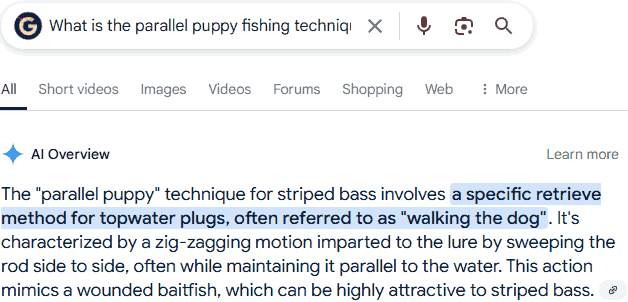
AIO confidently offered a hallucinated response that is incorrect because it assumed that the user was confusing multiple actual fishing tactics so it blended multiple tactics and fishing lures to invent a non-existent tactic.

AI Overviews gave the following wrong answer:

“The “parallel puppy” technique for striped bass involves a specific retrieve method for topwater plugs, often referred to as “walking the dog”. It’s characterized by a zig-zagging motion imparted to the lure by sweeping the rod side to side, often while maintaining it parallel to the water. This action mimics a wounded baitfish, which can be highly attractive to striped bass.”

Screenshot Of AIO’s Hallucinated Answer

ChatGPT 4o

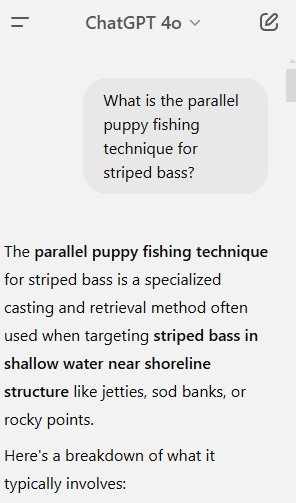
ChatGPT made the same mistake that Google’s AIO did and hallucinated a complex fishing tactic.

ChatGPT gave the following wrong answer:

“The parallel puppy fishing technique for striped bass is a specialized casting and retrieval method often used when targeting striped bass in shallow water near shoreline structure like jetties, sod banks, or rocky points.

Here’s a breakdown of what it typically involves:

What it is:
“Parallel” refers to casting your lure or bait parallel to the shoreline, rather than out into deeper water.

“Puppy” is often a nickname for small soft plastics, swimbaits, or small-profile plugs, typically in the 3″ to 5″ range—mimicking juvenile baitfish”.

That last sentence is interesting because it’s completely wrong, there are no style of lures that are nicknamed “puppy” but there is a technique called walking the dog.”

Screenshot Of ChatGPT’s Incorrect Answer

Anthropic Claude

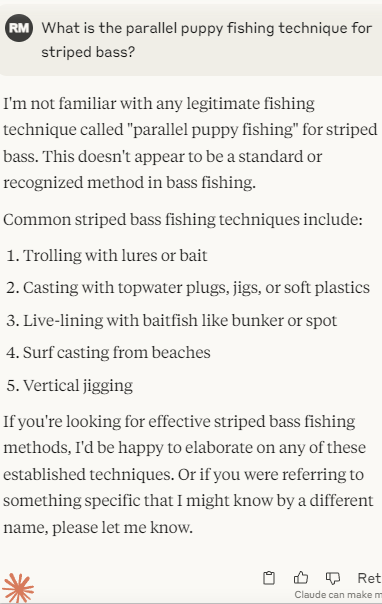
Anthropic Claude, using the latest 3.7 Sonnet model, provided a correct answer. It correctly said it didn’t recognize a “legitimate fishing technique” with the provided name and then moved on with the presumption that the user wants to learn striped bass fishing tactics and provides a list of techniques from which a user can select a topic as a follow-up question.

Screenshot Of Anthropic Claude’s Correct Answer

Google Gemini Pro 2.5

Lastly I queried Google Gemini, using the latest Pro 2.5 model. Gemini also offered a correct answer plus a decision tree output that enables a user to decide:

A. That they are misunderstanding fishing tactics

B. Referring to a highly localized tactic

C. Is combining multiple fishing tactics

D. Or is confusing a tactic for another species of fish.

Screenshot of Correct Gemini Pro 2.5 Answer

What’s interesting about that decision tree, which resembles the decision tree approach in the unrelated Google patent, is that those possibilities kind of reflect what Google’s AI Overviews LLM and ChatGPT may have considered when trying to answer the question. They both may have selected from a decision tree and chosen option C, that the user is combining fishing tactics and based their answers on that.

Both Claude and Gemini were confident enough to select option E, that the user doesn’t know what they’re talking about and resorted to a decision tree to guide the user into selecting the right answer.

What Does This Mean About AI Overviews (AIO)?

Google recently announced it’s rolling out Gemini 2.0 for advanced math, coding, and multimodal queries but the hallucinations in AIO suggest that the model Google is using to answer text queries may be inferior to Gemini 2.5.

That’s probably what is happening with gibberish queries and like I said, it offers an interesting insight to how Google AIO actually works.

Featured Image by Shutterstock/Slladkaya

https://www.searchenginejournal.com/ai-overviews-glitch-may-hint-at-googles-algorithm/545018/


SEO Vs. PPC: What’s The Best Strategy For Your Business? via @sejournal, @brookeosmundson

Both SEO and PPC are essential components of digital marketing, yet they operate in entirely different ways.

One delivers instant visibility and quick results, while the other builds long-term authority and organic traffic.

But, when budgets are tight, and results need to be justified to the board, which channel deserves more attention?

The answer isn’t one-size-fits-all. It depends on factors like business goals, industry competition, timeline, and available resources.

In this article, we’ll break down the key differences, advantages, and trade-offs between SEO and PPC, helping you make an informed decision about where to allocate your marketing dollars.

SEO: The Long Game For Sustainable Growth

SEO is the process of increasing organic visibility in search engines through high-quality content, technical optimization, and authoritative backlinks.

Unlike PPC, SEO doesn’t provide instant gratification, but the payoff is well worth the effort.

Once a page ranks well, it can drive continuous, high-intent traffic at little to no cost per click.

Key Benefits Of SEO

SEO is often seen as the foundation of a long-term digital marketing strategy.

While it requires patience and investment upfront, the ability to generate consistent, high-quality traffic without paying for each click makes it a compelling choice for many businesses.

  • Long-Term Traffic Without Per-Click Costs. While SEO requires upfront investment in content and optimization, its long-term benefits far outweigh PPC in terms of cost-efficiency. Once a page ranks, it can drive organic traffic for years without requiring a constant budget.
  • Higher Trust And Credibility. Consumers tend to trust organic search results more than ads. Studies show that organic listings receive significantly higher click-through rates (CTR) than paid ads, making SEO a valuable channel for establishing brand credibility.
  • Compounds Over Time. Unlike PPC, where you pay for every visitor, SEO works like a snowball effect. The more high-quality content and backlinks you accumulate, the stronger your site’s domain authority becomes, making it easier to rank for new keywords in the future.

Disadvantages Of SEO

Although SEO can be incredibly rewarding for any business, it’s not without its challenges.

Businesses need to understand the trade-offs that come with relying on organic search, particularly when it comes to the time and resources required to see meaningful results.

  • Results Take Time. SEO is not an overnight success story. Depending on your industry and competition, it can take months (or even years) to rank competitively. This makes SEO a long-term play rather than a quick win.
  • Algorithm Uncertainty. Google frequently updates its ranking algorithms, meaning that even well-ranked pages can see fluctuations. If your SEO strategy isn’t built on a strong foundation of best practices, you could be at risk of losing visibility overnight.

When SEO Makes The Most Sense

SEO is best suited for businesses looking to:

  • Establish long-term brand authority and recognition.
  • Generate consistent, cost-effective leads or sales over time.
  • Compete in industries where paid advertising costs are prohibitive.
  • Build a sustainable content marketing strategy that drives traffic and engagement.

PPC: The Power Of Instant Results

PPC advertising offers immediate visibility on search engines and social platforms. It’s the equivalent of flipping a switch – your brand appears in front of potential customers right away.

This visibility comes at a price, literally. Once you stop spending, the traffic stops. However, when executed correctly, PPC can drive high-quality leads and sales faster than any other marketing channel.

Key Benefits Of PPC

PPC advertising has several compelling advantages that make it a powerful tool for businesses looking to gain immediate traction.

While it requires an ongoing budget, the ability to reach high-intent users and measure performance in real-time makes it an essential component of a well-rounded marketing strategy.

  • Immediate Traffic And Quick Wins. With PPC, there’s no waiting game. Unlike SEO, where ranking takes time, PPC can get your business to the top of search results instantly. Whether it’s Google Ads, Microsoft Ads, or paid social campaigns, your ads are live essentially the moment your campaign is approved.
  • Granular Targeting. PPC allows you to target potential customers with laser precision. You can define your audience based on search intent, location, device, demographics, behavior, and even specific interests. This ensures that your budget is spent reaching only the most relevant users, which increases efficiency and conversions.
  • Measurable And Scalable. Every click, impression, and conversion is trackable in PPC, making it one of the most measurable digital marketing strategies. You can quickly assess performance, make data-driven decisions, and scale up or down depending on return on investment (ROI). This level of control is unmatched in SEO.

Disadvantages Of PPC

Despite its advantages, PPC isn’t a perfect solution.

Businesses need to be aware of the potential challenges that come with running paid campaigns, particularly when it comes to costs, competition, and ad performance over time.

  • Costs Can Escalate Quickly. Unlike organic traffic, PPC is a pay-to-play model. The moment you stop funding campaigns, the traffic disappears. If your cost-per-click (CPC) is high, profitability can be challenging without a well-optimized campaign and conversion funnel.
  • Ad Fatigue And Diminishing Returns. Users can become blind to repetitive ads, leading to declining performance over time. This means ongoing creative refreshes, audience testing, and bid adjustments are necessary to maintain strong results.

When PPC Makes The Most Sense

PPC is ideal when you need immediate results, such as:

  • Launching a new product or service that needs instant visibility.
  • Running seasonal promotions or limited-time offers.
  • Competing in a saturated market where organic ranking is difficult.
  • Driving leads or sales in industries with high transaction values.

SEO Vs. PPC: Side-By-Side Comparison

SEO vs PPC Comparison Chart

Choosing The Right Strategy For Your Business

The best marketing strategies align with your business goals, industry dynamics, and available resources.

While some businesses can afford to take a long-term approach with SEO, others may need the immediacy of PPC.

The key is to evaluate your needs carefully and choose the right mix of paid and organic efforts.

If You Need Instant Wins: Focus On PPC

If your business needs immediate traffic, leads, or sales, PPC is the way to go. This is especially true for:

  • Startups and new businesses: When brand awareness is low, PPC can help put your company in front of potential customers quickly.
  • High-margin industries: Businesses that generate high profits per conversion (e.g., legal services, SaaS, finance) can justify PPC spend more easily.
  • Seasonal promotions: If your business thrives on specific times of the year (e.g., holiday sales, back-to-school shopping), PPC ensures you capture demand at the right moment.
  • Local businesses: Companies with a local presence can use PPC to dominate searches for high-intent queries like “best plumber near me.”

If You Want Long-Term Growth: SEO Is The Way To Go

If you’re focused on building a sustainable marketing funnel that pays dividends in the future, SEO is the smarter play.

Prioritize SEO if:

  • Your business relies on organic search traffic: Industries like blogging, ecommerce, and B2B SaaS benefit from strong SEO foundations.
  • You’re in a highly competitive PPC market: If CPCs are prohibitively expensive, investing in organic search can provide a more cost-effective alternative.
  • You’re willing to invest in content marketing: High-quality, evergreen content fuels SEO and positions your business as an authority in your space.
  • Your audience conducts research before purchasing: If customers compare multiple options before making a decision, strong SEO can help you stay top-of-mind.

Invest In SEO And PPC For The Best Of Both Worlds

For most businesses, the real answer isn’t SEO or PPC – it’s SEO and PPC. A blended approach allows you to capture immediate opportunities while building long-term organic growth.

Businesses that view these two strategies as complementary, rather than competing, often see the best results.

Here’s why integrating both SEO and PPC is a smart move:

SEO Supports Long-Term Sustainability, While PPC Fills Gaps

Even with the best SEO strategy, organic rankings fluctuate due to algorithm updates and competition.

PPC acts as a safety net, ensuring your brand remains visible even when organic rankings dip. It also allows you to target high-intent keywords that may be too competitive to rank organically in the short term.

PPC Provides Data To Strengthen SEO Efforts

One of the most effective ways to refine your SEO strategy is by using PPC data.

Paid search campaigns provide insights into which keywords convert best, which messaging resonates, and which audience segments drive the most revenue.

This data can be leveraged to optimize SEO efforts, helping to prioritize content creation and organic keyword targeting.

SEO Reduces Long-Term Costs, While PPC Provides Immediate ROI

A well-executed SEO strategy reduces reliance on paid ads over time. Once your site ranks well for high-value keywords, you receive continuous traffic without ongoing ad spend.

PPC, on the other hand, delivers instant results, making it ideal for new product launches, promotions, or when entering new markets.

A combined strategy ensures you’re not putting all your eggs in one basket.

Using PPC To Boost SEO Content

Even the best content needs exposure to gain traction. PPC can be used to drive initial traffic to newly published blog posts, product pages, or other high-value content.

The added engagement signals from paid visitors, such as time on page, shares, and backlinks, can indirectly improve organic rankings.

Retargeting SEO Visitors With PPC

Not all organic visitors convert on their first visit. Using PPC remarketing campaigns, you can re-engage visitors who found you through SEO but didn’t take action.

This keeps your brand top-of-mind and helps improve overall conversion rates.

By investing in both SEO and PPC, you build a balanced marketing strategy that delivers short-term wins while positioning your business for long-term success.

Rather than choosing one over the other, leveraging their combined strengths leads to more sustainable and profitable growth.

Final Thoughts

SEO and PPC each have distinct advantages, and the right choice depends on your business objectives. If you need fast results, PPC is the clear winner. If you’re playing the long game, SEO is invaluable.

But in reality, the most effective digital marketing strategies don’t rely on just one – they integrate both.

The best approach? Evaluate your budget, resources, and competitive landscape. Align your strategy with short-term and long-term goals.

And if you have the ability, combine SEO and PPC for a well-rounded marketing engine that delivers both immediate and sustained results.

More Resources:


Featured Image: Paulo Bobita/Search Engine Journal

https://www.searchenginejournal.com/seo-vs-ppc-best-strategy-for-your-business/542307/