Google Says Disavow Tool Not Part Of Normal Site Maintenance via @sejournal, @martinibuster

Google’s John Mueller, at the Search Central NYC event, answered a question about what to do about toxic backlinks and responded with an overview of what goes on inside Google with links in order to explain why the disavow tool is something only sites that are guilty of something and know it should be using.

What To Do If Disavow Tool Is No Longer Available?

Google has a tool that allows publishers and SEOs to disavow links, which is basically telling Google to not count certain links. The purpose of the disavow tool arose after Google penalized countless thousands of sites for buying links. This was during the Penguin update in 2012. Getting rid of paid links was a difficult thing and some link sellers were asking for payment for removing the links. SEOs raised the idea of a disavow tool to help them get rid of the links their clients and themselves purchased and after a time Google agreed to provide that tool for that one purpose: to remove paid links.

Someone submitted a question for John Mueller to answer, asking what should SEOs do if the disavow tool is no longer available, asking:

“How can we remove toxic backlinks?”

The phrase “toxic backlinks” is something that the SEO backlink removal services and tools invented as part of scaring people into buying their backlink data and tools. That’s not a phrase that Googlers used, it’s totally 100% invented by SEO tool companies.

Google’s John Mueller answered:

“So internally we don’t have a notion of toxic backlinks. We don’t have a notion of toxic backlinks internally.

So it’s not that you need to use this tool for that. It’s also not something where if you’re looking at the links to your website and you see random foreign links coming to your website, that’s not bad nor are they causing a problem.

For the most part, we work really hard to try to just ignore them. I would mostly use the disavow tool for situations where you’ve been actually buying links and you’ve got a manual link spam action and you need to clean that up. Then the Disavow tool kind of helps you to resolve that, but obviously you also need to stop buying links, otherwise that manual action is not going to go away.”

Disavowing Links Is Not Normal Site Maintenance

Mueller continued his answer by pointing out that using a disavow tool on a regular basis is not a normal thing to do as part of site maintenance.

He said:

“But that’s essentially like from my point of view, the disavow tool is not something that you need to do on a regular basis. It’s not a part of normal site maintenance. I would really only use that if you have a manual spam action.”

I know there are some people who are “victims” of bad inbound links and blame those links for their poor rankings. So they disavow the bad links and their rankings never improve. One would think that the failure of the disavow tool to fix their ranking problems would cause them to see if something else is the problem but some people are so convinced that their sites are perfect that considering their site is poorly optimized is not an option for them.

But all of the cases I’ve looked at where people say they’re victims of negative SEO, 100% of them have problems with their SEO or content issues. Google’s algorithms aren’t affected by random links, that’s just not how link ranking algorithms work.

Featured Image by Shutterstock/Krakenimages.com

https://www.searchenginejournal.com/google-says-disavow-tool-not-part-of-normal-site-maintenance/543861/


Automattic Terminates 16% Of Workforce via @sejournal, @martinibuster

Automattic announced that Matt Mullenweg is terminating 16% of Automattic employees, citing the need to increase productivity and the capacity to invest. The company is currently in a period of growth and profitability, six months after more than 8% of employees resigned.

The announcement explains:

“We have reached an important crossroads. While our revenue continues to grow, Automattic operates in a highly competitive market, and technology is evolving at unprecedented levels. To support our customers and products, we must improve our productivity, profitability, and capacity to invest.”

The decision to terminate the employees is not based on survival or avoiding decline but rather it’s about becoming more profitable than they already are by squeezing more juice out of less oranges. One can imagine how much this must sting for the Automattic employees who were terminated, given that they enjoyed working at the company enough decline the severance package Mullenweg offered six months ago.

Automattic Software Engineers Let Go

Several former Automattic software engineers were posting on LinkedIn hoping to find new jobs.

A Special Projects Engineer named Mike Straw posted:

“Hi everyone! I was part of a sizable group of folks that were suddenly laid off at Automattic today. So, I’m seeking a new role and would appreciate your support. If you hear of any opportunities or just want to catch up, please send me a message or comment below. I’d love to reconnect. hashtag#OpenToWork”

Just three weeks ago he had posted this:

Read Automattic’s announcement:

Restructuring Announcement

Featured Image by Shutterstock/Serg64

https://www.searchenginejournal.com/automattic-terminates-16-of-workforce/543529/


How DoorDash Became Huge Starting With A $10 Domain Name via @sejournal, @martinibuster

Garry Tan, President and CEO of Y Combinator, interviewed Tony Xu, co-founder of DoorDash, in a conversation that revealed useful insights on how to research a niche before building a business around it, the wisdom of understanding pain points and why following competitors is not always the best path for long-term success. Building a strong brand is an important factor for competing in today’s AI-saturated environment, read how Tony Xu turned DoorDash into a trusted businesses of today.

Screenshot of Y Combinator CEO Garry Tan speaking with DoorDash co-founder Tony Xu speaking on the Y Combinator video podcast episode

DoorDash began with the non-scalable $10 domain (‘Palo Alto Delivery’) and PDF menus on a static HTML web page, taking orders over Google Voice and the founders were able to scale that to the nationwide success it is today by focusing on three actionable principles which allowed them to grow past their initial shortcomings and build on their strengths.

These lessons are especially important in today’s digital marketing environment where the importance of building relationships with customers has accelerated because of the advent of AI-powered search and AI assistants.

Y Combinator

Y Combinator is a Venture Capital and startup incubator responsible for dozens of the biggest digital brands like Airbnb, DoorDash, Quora, Stripe, Webflow, and Zapier to name a few. The Y Combinator video podcast interviews brings real insights directly related to digital marketing, entrepreneurship, and the daily work involved in keeping running businesses today.

Their podcast’s tag line suggests finding a place within the digital technology economy and the DoorDash experience shows how to do it.

“All the world is changing around technology and you may contribute a line of code. What will yours be?”

Screenshot of DoorDash Co-founder Tony Xu speaking on video podcast

Three Takeaways

Tony Xu relates the beginnings of DoorDash and how it grew to become a successful company. It wasn’t a matter of getting a lot of money thrown at him and then finding success. He and his team struggled to figure out how to make the business successful. Perhaps a key to their success was that they founded the company on three ideas, creating a strong foundation upon which to build success.

Another takeaway is that a good business idea isn’t always an instant success. Success can take years to build. So be sure to give yourself a long runway measured in years not months for taking off.

The three takeaways are:

  1. Choose Business Niche By What Feels Meaningful
  2. Customer Obsession As A Strategic Philosophy
  3. Don’t Follow The Competition: Follow The Opportunity

Choosing Your Best Niche

Tony Xu explained that the DoorDash team started by exploring different projects that felt interesting to them and ultimately settling on the one that felt the most meaningful and exciting. The idea for DoorDash came about by observing a local macaroon shop that had to decline delivery orders because they lacked the infrastructure.

What’s interesting about DoorDash is that they’re in between two customer bases, the merchants and the end users. They opted to not conduct surveys but rather the founders immersed themselves in the merchants’ daily routines to identify the pain points for growth and expansion and to identify where DoorDash could help.

Tony Xu explains:

“Our question that we tended to ask business owners was can we follow you around for a day… we wanted to actually feel what it was like, their lived experience versus just asking a bunch of survey questions. It was toward the end of the time we spent with the store manager that she had showed us a booklet of orders she had turned down. All of them were delivery orders.”

He described that this was a common thread with business owners who had these small shops with orders they were unable to fulfill. He said they imagined the scale of what could be done, that they could have just delivered orders for this one bakery, or for all bakeries, all types of restaurants, all types of retailers. They discovered a need from a wide range of merchants but what they didn’t know at this point was if consumers cared or whether there was a driver workforce to partner for.

Customer Obsession As A Strategic Philosophy

Tony Xu shared that their early customer base was mainly young families and that ended up shaping their service through direct feedback. Another example of allowing the business to be shaped by the customer is an event that went badly and resulted in many upset customers. DoorDash settled on the customer-first approach by choosing to refund all the customers after a service meltdown during a Stanford football game, at the cost of 40% of the founder’s bank balances. Further, they stayed up overnight to bake and hand-deliver apology cookies the next morning at 5 AM before their customers awakened.

Tony shared how that experience solidified their business around customer satisfaction:

“That was an early story that ultimately, you know, became the story that translated to our internal company value of customer obsessed, not competitor focused… I think the founding team always had this desire to at least do things the right way even if we wouldn’t have made it.”

These experiences cemented the company’s core customer-centered philosophy of being “customer obsessed, not competitor focused.”

Don’t Follow The Competition: Follow the Opportunity

Conventional wisdom assumes that established players have done the research and that there are good reasons for why competitors do what they do. What Tony Xu revealed is that isn’t necessarily true. He doesn’t explain the reasons why competitors missed a golden opportunity but it’s easy to surmise that competitors build based on conventional assumptions and are unaware that demographics and user habits change which results in opportunities.

Tony shared that their competitors focused on dense urban markets because the conventional wisdom was that this was where more people it was more profitable to serve the densely populated areas. DoorDash went a different direction by focusing on suburbs because they discovered a customer need in that suburban customers had fewer nearby restaurants and it was that fact that made a delivery service more valuable. Serving families also resulted in higher average order size, easier parking, and simpler food drop-offs which in turn led to stronger performance across the board.

Takeaway:

Many smaller independent sites today fail to differentiate themselves to site visitors. They follow what their competitors do and because of that virtually all recipe sites, all mom sites all travel sites look exactly the same.

Becoming the same as your competitor is not the way to beat your competitors. That’s why the skyscraper and 10x content strategies are so lousy because they presume that being the same as the competitor “but better” is what your users want. Circling back to Tony Xu, he found success by being customer obsessed so the question is what does that mean for you and your site visitors?

Becoming customer-focused isn’t a new age feel-good thing to do, it’s a practical and proven approach to creating a successful business. It informs every choice you make from the design of the site, the service, and the content and it becomes a strength that no competitor can copy and steal from you.

Lastly, it’s satisfying and easier to focus on a topic that is meaningful. If there’s a way to build an ecosystem that might be even better as it can become a moat around the business.

Watch the Y Combinator podcast:

DoorDash CEO: Customer Obsession, Surviving Startup Death & Creating A New Market

[embedded content]

Featured Image by Shutterstock/sockagphoto

https://www.searchenginejournal.com/how-doordash-became-successful/543392/



Google Explains SEO Impact Of Adding New Topics via @sejournal, @martinibuster

Google’s Danny Sullivan discussed what happens when a website begins publishing content on a topic that’s different from the one in which it had gained a sitewide reputation. His comments were made at Search Central Live NYC, as part of a wide-ranging discussion about site reputation.

Danny said that introducing a new topic to a website won’t result in the site taking a hit in rankings. But what could happen is that Google might try to figure out how that content fits into the rest of the site.

Here’s what Danny said:

“We have long done work and are going to continue doing that to understand if parts of the site seem to be independent or starkly different than other parts of the site. It is not bad to have a website do whatever you want the website to do for your readers. It’s not bad that you started off covering one thing and you start writing about something else.

I had one person at an event who was very, very concerned. They started writing about snowboards but now wanted to start writing about skis and was terrified.

That if they write about skiing that somehow the topic of the website and the focus will somehow… it doesn’t work that way.

We’re not kind of building it up on the expertise you have in this particular thing, that type of thing, but what we are trying to understand is if the site seems to be different in some way from other parts of the site.”

It Doesn’t Work That Way

What Danny is saying is that Google looks at how different one part of a site is from another. And if another part is vastly different, he went on to say that sometimes it may rank well for a time based on the reputation of the entire site for the main topic but then the new section may lose rankings.

Danny explained that the loss in rankings is not a penalty but rather it’s just a recognition that a section of a site is so vastly different that the reputation of the entire site doesn’t really apply for that particular topic.

Danny used the metaphor of a “mini-site” to explain how Google might split off the reputation of a new section of a site from the rest of the site so that it can earn reputation for its topic. More about the mini-site metaphor here.

It makes sense that Google would differentiate the different parts of a site because it allows it to understand that a collection of pages is on one topic and another collection of pages within the website are about a different topic.

Related: Google: One Part Of Site Can Hurt Entire Site Quality

Featured Image by Shutterstock/Rene Jansa

https://www.searchenginejournal.com/google-says-what-happens-when-websites-add-new-topics/543428/


Google On Negative Authorship Signal And Mini-Site Reputation via @sejournal, @martinibuster

At the recent Search Central Live NYC event, Danny Sullivan discussed what happens when a site begins publishing vastly different content on a site and how that may affect rankings, introducing the concept of a mini-site as a metaphor for dividing the reputation of a site. He also discussed the concept of negative authorship authority, which some SEOs believe follows authors from penalized websites and can negatively affect the other sites they publish on.

Negative Authorship Reputation

Danny initially discussed a negative authorship signal that some in the SEO community believe can follow an author from site to site. The idea is that an author of content that is banned on one site will also have their content banned on another site. He denied that Google tracked author authority signals from site to site.

Sullivan explained:

“If you wrote for a site that got a manual action, it doesn’t somehow infect the other site that you might work for later on, so again, this is not something that freelancers should be worried about.

If you’re a publication and for whatever reason you feel like employing a freelancer, and it makes sense, that’s fine. You don’t need to worry about who they worked for before.

And if you are a freelancer you do not need to go back to the publications and say, can you take my byline down because now I can’t get hired from anybody else because they think I’m going to infect them. It is not like that. It’s not a disease. “

The above SEO myth likely began when publishers noticed that content created by a certain author across multiple sites was banned. In that case, it’s reasonable to assume that there was something wrong with the content but that’s not necessarily true. It could have been the case that the website itself was poorly promoted with unnatural links. Or, it could be that the site itself was engaged with selling links.

The takeaway from what Danny Sullivan shared is that a manual action on one site doesn’t follow an author to another site. Another takeaway is that there is no negative authorship signal that Google is tracking.

And if there’s no negative authorship signal could it be that there is no positive author signal as well? In my opinion it’s a reasonable assumption. A signal like that would be too easy to manipulate. Whatever signals Google uses to understand site reputation is likely enough for the purpose of citing an information source in the search results.

Although claims by some SEOs have been made about authorship signals, authorship signals have never been known to be a thing with Google’s algorithms. Google has a long history of denying the use of authorship signals and Danny’s statements offer further validation that Google continues to not use authorship as signals for ranking purposes.

See also: Google Says These Are Not Good Signals

Ranking Drops And Mini-Site Reputation

Danny next begins talking about how a new section of a site could suddenly lose rankings. He says this isn’t necessarily a bad thing. It’s just Google trying to figure out this new section and that if it’s sufficiently different Google could even start treating it as a standalone mini-site. This is a really fascinating thing he gets into here.

Danny used the example of the addition of a forum to a website.

Danny explained

“For example, you might have a site where you start running a forum. Forums can be different and we would want to understand that this looks like a forum so that we can then rank the forum content against other kinds of forum content on kind of a level playing field or understand that that forum content should be included in things where we try to show forum content.”

What can happen is… that it could be that part of your site was doing better because it was seen as part of the overall site. Now we kind of see it as more of independent and part of a full site on its own.

And potentially you could see a traffic drop that comes from that. That doesn’t mean that you suddenly got a site reputation abuse ban issue because first of all that might not have involved third party content abusing first party work, right? Those were the things. So if it doesn’t have any of that it doesn’t have anything to do with that.Secondly, we would have sent you an email. So, it’s not bad.

Because it just could be we’ve had a general re-ranking… It could also mean that in the long run that part of your site might actually do better, because we might recognize it in different ways, that we might be able to surface it in different ways. And it might start sort of earning its own like ‘mini-site’ reputation along the way.”

Three things to take away from that last part.

A ranking drop could be due to benign things, don’t always assume that a ranking drop is due to a spam or other negative algorithmic action.

Second, a rankings drop could be due to a “general re-ranking” which is a vague term that went unexplained but is probably a reference to minor ranking adjustments outside of a core algorithm update.

The third takeaway is the part about a section of a website earning it’s own “mini-site” reputation. I think SEOs should not create theories about mini-sites and mini-site reputations because that’s not what Danny Sullivan said. He used the word “like” which means that he likely used the phrase “mini-site” as a metaphor.

Featured Image by Shutterstock/Joseph Hendrickson

https://www.searchenginejournal.com/google-on-negative-authorship-signal-and-mini-site-reputation/543406/


Google Cautions SEOs & Creators About Filler Content via @sejournal, @martinibuster

Google’s John Mueller cautioned publishers and SEOs about filler content, which is generally created with the apparent goal of reaching a word-count threshold without concern for the user experience. Although recipe sites are the cause of this warning, this is the kind of thing that all SEOs and publishers should be concerned about.

Probable Origin Of Filler Content

What Mueller warned about, filler content, probably has origins in the idea that “content is king” which resulted in the SEO practice that values creating content similar to what Google is already ranking except doing it ten times better so that it towers over the competition (10x and skyscraper content strategies).

John Mueller Warns About Filler Content

Mueller’s observations about filler content were in the context of an overview of recent changes in the Quality Rater Guidelines (QRG), a book that Google created to bring more objective standards to how third party raters rate search results that are being tested.

Mueller said that filler content is low quality content that’s designed to make a page longer. Speaking informally and loosely, he said that filler content is problematic because users can find it “annoying.”

This is, according to my notes, what he said:

“Recently, quality rater guidelines, there are few things that I think are interesting for some sites that we have mentioned in the quality rater guidelines now which weren’t in there before.

And so this is the kind of thing which I think is important for sites to realize. On the one hand we’ve written about filler content, which is the kind of fluff that some websites put on their pages to make the pages longer. And sometimes they have good reasons to make the pages longer.

But for us this is sometimes problematic and users sometimes find it annoying. So we have that mentioned in the quality rater guidelines.”

Filler Content Is A Poor User Experience

What Mueller is referring to is the new section 5.2.2 of the QRG which lays out how to objectively judge whether a page has filler content. Filler content previously was nestled within section 5.2 but it’s now broken out into its own section. The main takeaway is that filler content is a user experience issue.

Here’s what the new section of the QRG says:

“5.2.2 Filler as a Poor User Experience

The main content (MC) of a page should support its purpose. Web site owners and content creators should place the most helpful and essential MC near the top of the page so that visitors can immediately access it.

A high quality page has the most helpful MC placed most prominently. Content that supports the page purpose without directly contributing to the primary goal can be included, but it should be shown lower on the page in a less prominent position. For example, on recipe pages, the recipe itself and important supporting content directly related to the recipe should be prominently displayed near the top of the webpage.

Sometimes, MC includes “filler” – low-effort content that adds little value and doesn’t directly support the purpose of the page. Filler can artificially inflate content, creating a page that appears rich but lacks content website visitors find valuable. Filler can result in a poor experience for people who visit the page, especially if placed prominently ahead of helpful content for the purpose of the page.

Important: Content that supports the page purpose without directly contributing to its primary goal can still be valuable if placed appropriately. Filler refers to low-effort content that occupies valuable and prominent space without providing value or without being helpful or satisfying for the primary purpose of the page.

A Low rating is appropriate if the page

● Contains a large amount of low quality and unhelpful filler, causing a poor experience for people visiting the page

● Contains a large amount visually prominent filler that makes it difficult to find the helpful MC, causing frustration for people visiting the page”

Content Filler – Not Just For Recipe Sites

The new quality rater guideline section about filler content specifically mentions recipe sites, likely because of their notoriously long filler content that’s so bad they have to add a link to skip to the the part that’s useful.

Some SEOs generally dislike change and this will probably make some people angry, but in my opinion, any publisher that feels they need to add a link to “skip to recipe” should probably consider that they’re doing something wrong. As Google says, important supporting content should be up front. If users have to skip the content to get to it then whatever it is that’s being skipped is not useful.

Recipe sites may be the worst offenders for filler content, but that doesn’t mean publishers in other niches can ignore the policy. All SEOs and content creators should recognize that filler content is problematic.

Imitating the top-ranked content is a practice that content publishers need to reconsider. It works against what Google is actually trying to rank and can lead to artificial word count targets instead of focusing on the user’s needs.

https://www.searchenginejournal.com/google-cautions-seos-creators-about-filler-content/543283/


Win Higher-Quality Links: The PR Approach To SEO Success [Webinar] via @sejournal, @lorenbaker

Are you ready to master the art of earning high-quality editorial links?

Join us on April 9, 2025, for our exclusive webinar, “Win Higher-Quality Links: The PR Approach To SEO Success.” As Google’s AI-driven algorithms evolve, the importance of securing authoritative links has never been greater. Learn from the experts how to enhance your SEO strategy with proven Digital PR techniques.

Why This Webinar Is a Must-Attend Event

This session is designed for those looking to elevate their link-building strategies beyond traditional methods. Discover a data-driven approach that has helped large brands secure hundreds of top-tier links and media mentions.

What You Will Learn:

  • Effective Digital PR Processes: Uncover the step-by-step process and tools needed to earn contextual, editorial links from leading publications.
  • Strategic Insights: Learn how combining data insights with expert commentary can attract significant press coverage.
  • Success Stories: Examine real-world case studies from enterprise brands that have successfully implemented these digital PR strategies.

Expert Guidance From Kevin Rowe

Kevin Rowe, an expert in digital PR strategies for enterprise brands, will lead the webinar. He’ll share the methodologies he’s used to gain impactful links, helping you understand how to apply these strategies to your own efforts.

Interactive Q&A Session

The webinar will conclude with a LIVE Q&A session, offering you the chance to ask Kevin your detailed questions about digital PR and link building.

Don’t Miss Out!

If you’re aiming to earn links that truly reflect your brand’s expertise and drive SEO success, this webinar will provide you with the actionable strategies you need.

Reserve your spot now to start leveraging your brand’s data and expertise into authoritative media coverage.

https://www.searchenginejournal.com/pr-approach-to-seo-success/541931/


Google Confirms You Can’t Add EEAT To Your Web Pages via @sejournal, @martinibuster

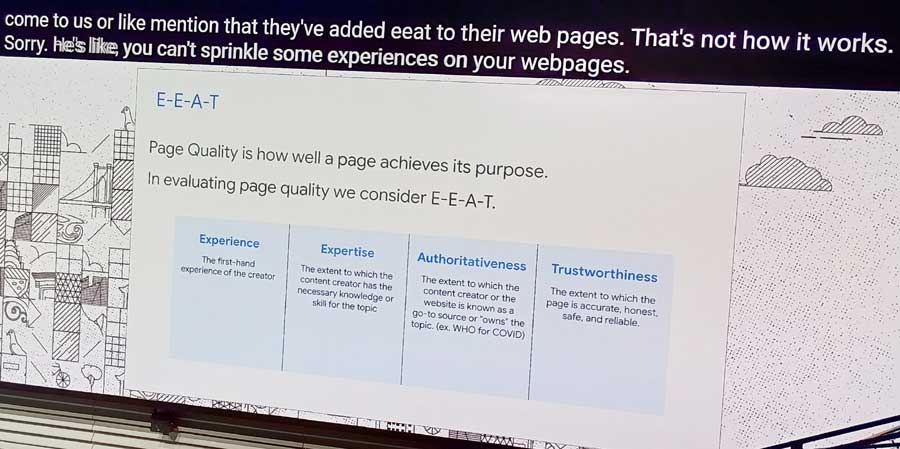
Google’s John Mueller offered an overview of EEAT (Experience, Expertise, Authoritativeness, and Trustworthiness) at the Search Central Live NYC event and affirmed why it matters for some sites and why it’s not something SEOs can add to a website.

EEAT’s Relation To Quality Raters And YMYL Websites

John Mueller started this part of his discussion by explicitly tying the concept to its use as a way for the third party quality raters to provide a more objective judgment about the quality of the search results. He did not say that EEAT was created for SEOs to use as a ranking factor guide, in fact he expressly said that’s not how it works.

What is especially notable is that Mueller says that EEAT comes into play algorithmically for sites that are in topics that affect health or finance, what Google terms Your Money Or Your Life (YMYL) topics.

This is what he said, according to my notes, which contains some paraphrasing:

“EEAT is one of the ways that we look at page quality. EEAT is experience, expertise, authoritativeness and trustworthiness. And this is something that we tell the third party quality raters to watch out for when they’re doing page quality evaluation and something that we take into account when we think the query or a set of pages is on a specific topic where it’s more critical, where we call them your money, your life pages. Where we think that the user actually needs to have something that they can rely on and some signs that they can rely on the content that is present.”

EEAT Is Not Something You Add To Web Pages

In his follow-up statements he dismissed the idea that an SEO can add EEAT to their web pages. EEAT is not something you can add to a website. That’s not how it works. So if adding EEAT is part of what you do for SEO, stop. That’s not SEO.

This is what Mueller said:

“Sometimes SEOs come to us or like mention that they’ve added EEAT to their web pages. That’s not how it works. Sorry, you can’t sprinkle some experiences on your web pages. It’s like, that’s that doesn’t make any sense.”

Photo From Google Search Central Live NYC

EEAT Is Not Needed On Non-YMYL Pages

Lastly, Mueller repeated the point that EEAT is not something that they’re looking for in run of the mill websites. Obviously it’s great if the content has expertise and trustworthiness and so on. But he said it’s not something they’re algorithmically alert for on those kinds of sites, specifically naming recipe sites.

This is what he said:

“From a practical point of view, it’s important to look at this, especially if you’re publishing things on these critical topics, and to look at how you can highlight what it is that you’re already doing so that it’s clear for users.

But if you’re creating a recipe for cookies, you don’t need to have the sidebar with like, ‘this author has created cookies for 27 years.’ I think most people will be able to understand.”

Takeaways

EEAT’s Purpose and Scope

EEAT is used by third-party quality raters to assess search result quality. It was not created by Google as a list of ranking factors for an SEO checklist.

EEAT’s Role in YMYL Topics

Google algorithmically considers EEAT for pages that affect users’ finances or health, which is  referred in the Quality Raters Guidelines  Your Money or Your Life (YMYL) topics. These are the topic areas where reliability and trust are critical for user safety and confidence and where Google is especially concerned that those qualities are expressed in some way internally and/or externally about those sites. Google doesn’t say what those signals are.

Misconceptions About EEAT in SEO

John Mueller emphasized that EEAT is not something SEOs can “add” to a website the way they might add keywords or internal links. Attempting to “add EEAT” is a misunderstanding of how the concept works within search.

EEAT and Non-YMYL Websites

EEAT is not something that is required in an algorithmic context for non-YMYL sites, such as recipe blogs or other kinds of non-critical content. While it’s useful in a general or marketing sense to to reflect expertise and trust, it’s not a ranking focus for most topics.

EEAT is explicitly created for the third party quality raters to use as a more objective benchmark. That fact gets lost in all the conversations by SEOs about the topic of EEAT. It is also something that’s not particularly important for sites that are outside of YMYL topics. Lastly, EEAT is not something that an SEO can add to their page. Creating a bio with an AI generated image, linking it to a fake LinkedIn profile and then calling it EEAT is not a thing. Trustworthiness, for example, is something that is earned and results in people making recommendations (which doesn’t mean that SEOs should create fake social media profiles and start talking about an author at a website). Nobody really knows what the EEAT signals are.

Featured Image by Shutterstock/RealPeopleStudio

https://www.searchenginejournal.com/google-confirms-you-cant-add-eeat-to-your-web-pages/543177/


Unlock Local SEO: Online Review Trends Broken Down By Industry via @sejournal, @lorenbaker

For local SEO businesses, maintaining a positive reputation and earning customer trust is crucial for driving conversions.

Watch on-demand as we uncover data-backed insights from tens of thousands of businesses across industries, revealing how customer feedback and review behaviors shape reputation. 

Plus, discover key trends driving local traffic this year.

You’ll learn:

  • Key trends in customer feedback, review volume, and Net Promoter Scores (NPS).
  • New data on star ratings and how they affect customer trust & conversions.
  • Best practices for increasing positive reviews & driving customer loyalty.

We shared actionable strategies to improve your online reputation, build customer loyalty, and drive local traffic this year.

If you’re an agency owner, reputation manager, or marketing leader, this is your chance to get data-driven insights to refine your local strategy. 

View the slides below or check out the full webinar for all the details.

Join Us For Our Next Webinar!

Win Higher-Quality Links: The PR Approach To SEO Success

Reserve your spot now and start turning your brand’s data and expertise into authoritative media coverage.

https://www.searchenginejournal.com/online-review-trends-broken-down/540732/


Google Says They Launch Thousands Of Updates Every Year via @sejournal, @martinibuster

Google’s John Mueller explained during a session of the Search Central Live NYC event that they do over 700,000 tests per year in order to keep up with user expectations. His explanation of why Google performs so many tests and launches thousands of changes should give SEOs an idea of the pace of change going on at Google and should inspire publishers and SEOs to consider ways that they too can take steps to anticipate user expectations and roll out changes to satisfy them.

Updates Are Not Done In Isolation

The first thing that Mueller said about updates is that they’re not done in isolation but rather they use a third party raters, a fresh pair of eyes, to evaluate their tests and new updates to their algorithms.

Mueller explained:

“So there is a lot of activity happening on the web and we kind of have to keep up with that as well.

How we look at things when it comes to updates, I think this is maybe a bit of a jarring transition here, but essentially when we work on changes with regards to search, one of the things that is core to all of the changes that we do is that we don’t do them in isolation just because we think they’re good, but rather that we find ways to actually test to make sure that they are actually good.

And one of the ways that we do that is we work together with so-called quality raters.”

Number Of Tests And Launched Updates

Google conducts a staggering number of tests every year and launches thousands of changes (updates).

Photo Showing Number of Google Updates Per Year

John Mueller said (includes paraphrasing):

“When it comes to changes that we do this number is from 2023. I imagine the number from last year is similar. We’ve made over 4,700 launches. And these launches come from over 700,000 tests and we make tests all the time. You can try to calculate like how many tests are running every day. If you assume that a test maybe runs for two weeks over the course of the day, like there are lots of tests that are happening in parallel.”

Google Says It’s All About User Expectations

Mueller offered an explanation of what motivates Google to do so many tests and launch so thousands of updates to the search results. He said it’s all about meeting user expectations.

This is what he said:

“And that also means that when people look at the search results, they see things that are sometimes a bit different.

From our point of view it’s not so much that we’re doing all of this work to keep making changes to make it hard for people to keep up, but rather because we see that users have very high expectations of the web and we want to make sure that whatever expectations they have tomorrow we can still kind of fulfill.”

Takeaway For Publishers And SEOs

Google’s not running hundreds of thousands of tests a year to confuse SEOs and publishers. They’re doing it to stay ahead of what users want before users even know they want it.

SEO has historically been reactive, which means that search marketers and publishers wait until Google announces an update and then they run back to their websites and “fix” whatever they think is broken. SEO eyes are always on Google when they should really be thinking ahead about how their consumers or site visitors are aging out or no longer reading blogs and whose habits might be changing. Do you have to wait until Google announces an accessibility update before you test if your site is usable for visitors on screen readers? Are client sites usable for people who are color blind or are you going to wait for an update? That’s reactive.

One of the reasons Google is number one in many things is because they didn’t wait for someone else to do it first. Before GMAIL all email providers gave their users email space measured in megabytes. Google killed their competition because they were offering users gigabytes of free space.

So maybe SEOs and publishers should scroll up and re-read the reasons that John Mueller gave to explain why Google does hundreds of thousands of tests and launches thousands of updates every year. If you’re not already being proactive then I really think that this is the year you start thinking about ways to do that.

Takeaways:

Google’s Testing Volume and Frequency

  • Google performs over 700,000 tests annually.
  • In 2023 alone, these tests led to over 4,700 changes to Search.
  • Tests often run in parallel, with many active at the same time.
  • This volume reflects a continuous, high-speed development cycle.

Why Google Runs So Many Tests

  • Google’s motivation for running so many tests is to anticipate user expectations.
  • Despite their setbacks with AI, the number of tests and changes is the reason why Google remains a formidable competitor.

Implications for SEOs and Publishers

  • Search marketers and publishers who want to keep up with Google should consider emulating Google’s approach to users and look for ways to anticipate user behavior, expectations, and trends.
  • Start testing and improving now rather than waiting for a Google update before accounting for shortcomings.
  • Consider a site audit by a fresh pair of eyes.

https://www.searchenginejournal.com/google-says-they-launch-thousands-of-updates-every-year/543187/