Google AIO: 4 Ways To Find Out If Your Brand Is Visible In Generative AI [With Prompts] via @sejournal, @bright_data

This post was sponsored by Bright Data. The opinions expressed in this article are the sponsor’s own.

Imagine this in the time of Google AIO: A potential customer asks Google Gemini, ChatGPT, or Perplexity AI for the best SEO tools, top e-commerce platforms, or leading digital agencies.

Your brand has dominated traditional search rankings for years. But your company isn’t mentioned when AI generates an answer.

No ranking. No link. No Google AIO visibility.

This is the new reality of AI-driven search, and most SEOs aren’t tracking it.

Your brand might be invisible in AI search. Find out if it is now →

For years, you may have relied on keyword rankings, organic traffic, and SERP features to measure success.

But as AI-powered search engines reshape how information is delivered, these traditional SEO tracking methods are no longer enough.

How can brands ensure they are visible, accurately represented, and competitive if AI-generated answers influence user decisions without linking to websites?

With new challenges come new solutions. As AI answer engines continue to evolve, SEO professionals and rank tracking platforms must adapt by finding ways to monitor AI-generated search results in real time.

The ability to track brand mentions, analyze AI-driven recommendations, and compare competitor visibility is becoming just as critical as traditional keyword tracking.

In this article, we’ll explore:

  • Why traditional SEO tracking is becoming obsolete in the AI era.
  • The key queries brands should monitor in AI-generated search results.
  • How Bright Data’s Web Scraper API provides a unique solution for AI search tracking.
  • Why SEO pros must demand AI-ready tracking tools, and why rank tracking platforms must evolve to meet this need.

Why Traditional SEO Tracking Doesn’t Work For AIO

For years, SEO tracking has revolved around keyword rankings, organic traffic, and SERP features like featured snippets and People Also Ask (PAA).

However, AI-generated search results don’t follow these traditional ranking structures.

How AIO Affects SERPs

In a standard Google search, ranking in the top three positions means high visibility and traffic. But in AI-generated search, there are no numbered rankings, just a synthesized response that may or may not include your brand.

For example, if a user asks “What are the best SEO tools?”, Google Gemini or ChatGPT might generate a list of tools based on their training data and real-time web sources.

If your brand isn’t included in that response, you’re invisible to the user, regardless of how well you rank in traditional search.

How AI Affects Search Engine Optimization Tools

Without a way to track how AI search engines mention brands, you may be flying blind, and rank tracking tools are missing a critical data layer.

How To Track Your Brand In Generative AI Search & Artificial Intelligence Overviews (AIOs)

Tracking AI-generated search results isn’t as simple as checking keyword rankings.

Since AI models don’t rank pages but generate answers, you have to rethink what they measure.

Here are the four key query types that can reveal how AI search engines perceive and present your brand:

1. How To Find Out If AIO Knows Your Brand Exists:

If AI answer engines don’t mention your brand when users ask about your industry, you’re invisible in AI search.

Even worse, if they misrepresent your brand, you could be losing trust without realizing it.

For example, if a user asks “What is [Your Brand] known for?”, the AI’s response could shape public perception. If it pulls outdated or incorrect information, you need to intervene.
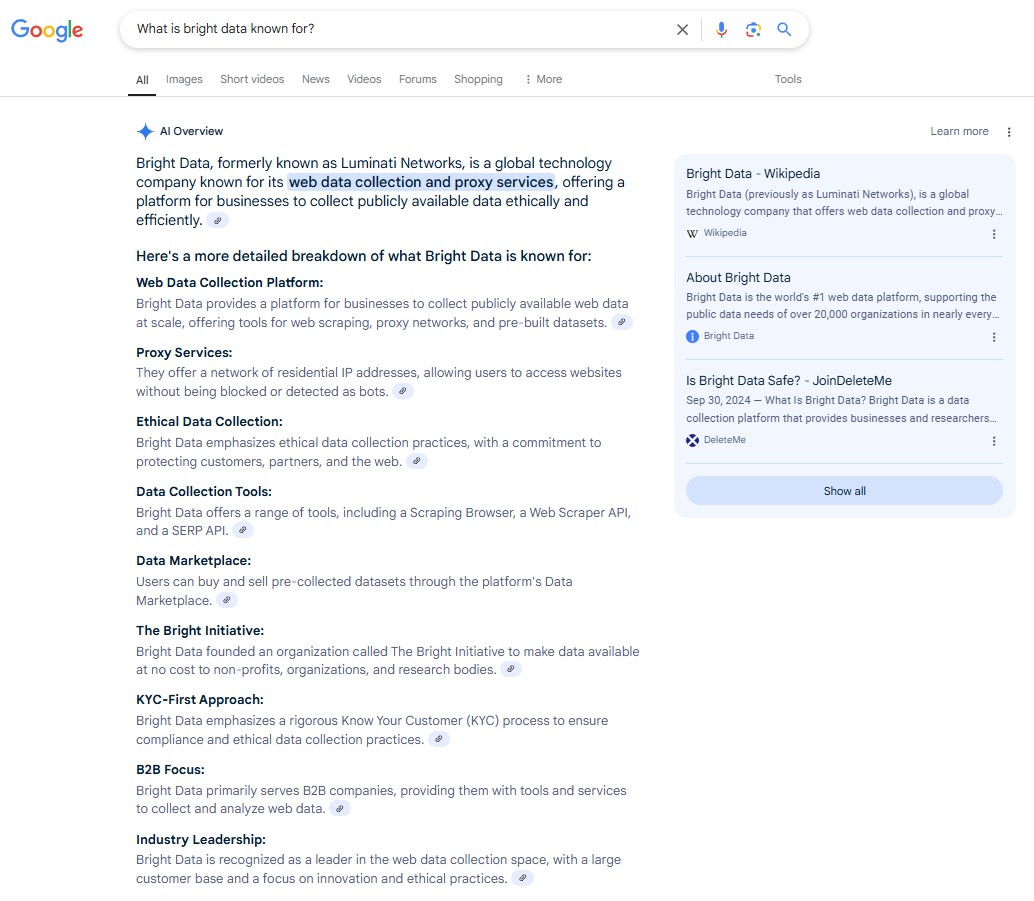
Google AIO response for "What is Bright Data?"Screenshot from Google, March 11, 2025
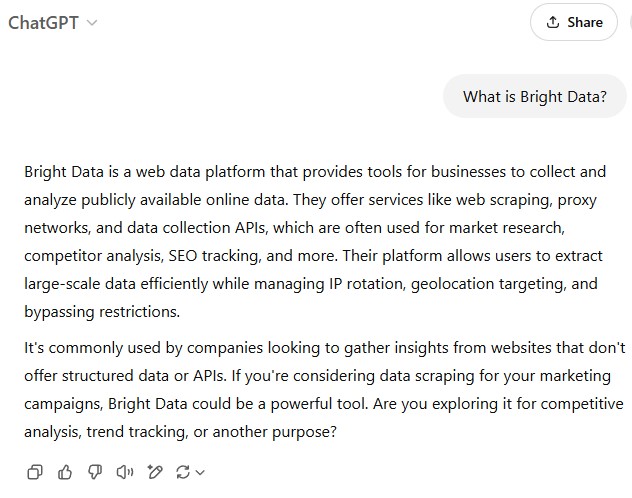
ChatGPTT response for "What is Bright Data?"Screenshot from ChatGPT, March 11, 2025

2. Listicles & Perception Terms: Are You a Top Recommendation?

AI-generated search results frequently generate list-based recommendations like:

  • “Best SEO platforms for enterprise businesses.”
  • “Top marketing automation tools in 2025.”

If your brand doesn’t appear in these AI-generated lists, you’re missing out on potential customers who rely on AI search for recommendations.

3. Competitor Comparisons: How Do You Stack Up?

AI search engines dynamically compare brands, often answering queries like:

  • “Is [Your Brand] better than [Competitor]?”
  • “Best alternative to [Competitor]?”

If AI consistently recommends a competitor over your brand, you need to adjust your positioning and content strategy to improve your AI search presence.

Try it!

Pick a prompt from above and visit:

How Bright Data’s Web Scraper API Enables AIO Tracking & Answer Engine Tracking

Bright Data provides the data collection infrastructure that can extract AI-generated search data for:

  • SEO platforms.
  • Rank tracking tools.
  • Enterprises.

Key Capabilities Of Bright Data’s Web Scraper API:

  • Access AI Answer Engines – Extracts real-time data from Google Gemini, OpenAI’s GPT, Claude, and Perplexity AI.
  • Customizable Data Extraction – Enables platforms to collect AI-generated responses for specific queries, industries, or competitors.
  • Seamless Integration – Allows rank tracking platforms and SEO tools to integrate AI search data into their existing dashboards.
  • Scalable & Real-Time – Provides continuous monitoring of AI-generated search results to track brand mentions, sentiment, and competitor positioning.

By leveraging Bright Data’s Web Scraper API, you can gain visibility into AI search, ensuring you stay ahead in an evolving search landscape.

The Future of Rank Tracking In An AI-Integrated SERP

As AI-generated search results become more dominant, SEO’s are already demanding AI search tracking capabilities from their tools, and rank tracking platforms must evolve to meet this need.

  • Traditional keyword rankings will decline in importance as AI-generated answers take up more space in search results.
  • SEO tools must adapt to track brand presence, AI-generated citations, and dynamic competitor comparisons.
  • SEOs should begin integrating AI search tracking now to stay ahead of the curve.

AI search tracking is no longer optional, it’s essential.

Bright Data’s Web Scraper API provides the data collection infrastructure that enables brands and SEO platforms to monitor their presence in AI-generated search results across multiple platforms.

🔗 Explore Bright Data’s Web Scraper API
🔗 Read more on optimizing for generative AI search


Image Credits

Featured Image: Image by Bright Data. Used with permission.

https://www.searchenginejournal.com/google-aio-serp-rankings-brightdata-spa/541172/


Is Compression A Google SEO Myth? via @sejournal, @martinibuster

I recently came across an SEO test that attempted to verify whether compression ratio affects rankings. It seems there may be some who believe that higher compression ratios correlate with lower rankings. Understanding compressibility in the context of SEO requires reading both the original source on compression ratios and the research paper itself before drawing conclusions about whether or not it’s an SEO myth.

Search Engines Compress Web Pages

Compressibility, in the context of search engines, refers to how much web pages can be compressed. Shrinking a document into a zip file is an example of compression. Search engines compress indexed web pages because it saves space and results in faster processing. It’s something that all search engines do.

Websites & Host Providers Compress Web Pages

Web page compression is a good thing because it helps search crawlers quickly access web pages which in turn sends the signal to Googlebot that it won’t strain the server and it’s okay to grab even more pages for indexing.

Compression speeds up websites, providing site visitors a high quality user experience. Most web hosts automatically enable compression because it’s good for websites, site visitors and also good for web hosts because it saves on bandwidth loads. Everybody wins with website compression.

High Levels Of Compression Correlate With Spam

Researchers at a search engine discovered that highly compressible web pages correlated with low-quality content. The study called Spam, Damn Spam, and Statistics: Using Statistical Analysis to Locate Spam Web Pages  (PDF) was conducted in 2006 by two of the world’s leading researchers, Marc Najork and Dennis Fetterly.

Najork currently works at DeepMind as Distinguished Research Scientist. Fetterly, a software engineer at Google, is an author of many important research papers related to search, content analysis and other related topics. This research paper isn’t just any research paper, it’s an important one.

What the 2006 research paper shows is that 70% of web pages that compress at a level of 4.0 or higher tended to be low quality pages with a high level of redundant word usage. The average compression level of sites was around 2.0.

Here are the averages of normal web pages listed by the research paper:

  • Compression ratio of 2.0:
    The most frequently occurring compression ratio in the dataset is 2.0.
  • Compression ratio of 2.1:
    Half of the pages have a compression ratio below 2.1, and half have a compression ratio above it.
  • Compression ratio of 2.11:
    On average, the compression ratio of the pages analyzed is 2.11.

It would be an easy first-pass way to filter out the obvious content spam so it makes sense that they would do that to weed out heavy-handed content spam. But weeding out spam is more complicated than simple solutions. Search engines use multiple signals because it results in a higher level of accuracy.

The researchers from 2006 reported that 70% of sites with a compression level of 4.0 or higher were spam. That means that the other 30% were not spam sites. There are always outliers in statistics and that 30% of non-spam sites is why search engines tend to use more than one signal.

Do Search Engines Use Compressibility?

It’s reasonable to assume that search engines use compressibility to identify heavy handed obvious spam. But it’s also reasonable to assume that if search engines employ it they are using it together with other signals in order to increase the accuracy of the metrics. Nobody knows for certain if Google uses compressibility.

Impossible To Determine If Google’s Using Compression

This article is about the fact that there is no way to prove that a compression ratio is an SEO myth or not.

Here’s why: 

1. If a site triggered the 4.0 compression ratio plus the other spam signals, what would happen is that those sites wouldn’t be in the search results.

2. If those sites are not in the search results, there is no way to test the search results to see if Google is using compression ratio as a spam signal.

It would be reasonable to assume that the sites with high 4.0 compression ratios were removed. But we don’t know that, it’s not a certainty. So we can’t prove that they were removed.

The only thing we do know is that there is this research paper out there that’s authored by distinguished scientists.

Is Compressibility An SEO Myth?

Compressibility may not be an SEO myth. But it’s probably not anything publishers or SEOs should be worry about as long as they’re avoiding heavy-handed tactics like keyword stuffing or repetitive cookie cutter pages.

Google uses de-duplication which removes duplicate pages from their index and consolidates the PageRank signals to whichever page they choose to be the canonical page (if they choose one). Publishing duplicate pages will likely not trigger any kind of penalty, including anything related to compression ratios, because, as was already mentioned, search engines don’t use signals in isolation.

https://www.searchenginejournal.com/is-googles-use-of-compressibility-an-seo-myth/541771/


U.S. DOJ Antitrust Filing Proposes 4 Ways To Break Google’s Monopoly via @sejournal, @martinibuster

The plaintiffs in an antitrust lawsuit against Google filed a revised proposed final judgment for the judge in the case to consider. The proposal comes after a previous ruling where the court determined that Google broke antitrust laws by illegally maintaining its monopoly.

The legal filing by the plaintiffs, the United States Department Of Justice and State Attorneys General, argue that Google has maintained monopolies in search services and text advertising through anticompetitive practices.

The filing proposes four ways to loosen Google’s monopolistic hold on search and advertising.

  1. Requiring Google to separate Chrome from its business—this could mean selling it or spinning it off into an independent company.
  2. Limiting Google’s payments to companies like Apple for making Google the default search engine, reducing its ability to secure exclusive deals.
  3. Stopping Google from favoring its own products over competitors in search results and other services, ensuring a more level playing field.
  4. Increasing transparency in Google’s advertising and data practices so competitors have fairer access to key information.

The proposal asks that Google be subjected to continuous oversight through mandatory reporting to ensure transparency in Google’s advertising and data practices:

“Google must provide to the Technical Committee and Plaintiffs a monthly report outlining any changes to its search text ads auction and its public disclosure of those changes.”

It also suggests ongoing enforcement to guarantee that Google doesn’t impose new restrictions that undermine transparency requirements:

“Google must not limit the ability of advertisers to export in real time (by downloading through an interface or API access) data or information relating to their entire portfolio of ads or advertising campaigns bid on, placed through, or purchased through Google.”

The goal of the above section is to increase transparency in Google’s advertising system and make it easier for advertisers to analyze their ad performance, greater transparency.

Real-time access ensures advertisers can make immediate adjustments to their campaigns instead of waiting for delayed reports and it assures that advertisers aren’t locked into the Google advertising system by holding them hostage to their historical data.

The legal filing requires government-imposed restrictions and changes to Google’s advertising business practices. It proposes remedies for how Google should be regulated or restructured following the court’s earlier ruling that Google engaged in monopolistic practices. However, this is not the final judgment and the court must still decide whether to adopt, modify, or reject these proposed remedies.

Featured Image by Shutterstock/Shutterstock AI Generator

https://www.searchenginejournal.com/u-s-doj-antitrust-filing-proposes-4-ways-to-break-googles-monopoly/541652/


Why Google May Adopt Vibe Coding For Search Algorithms via @sejournal, @martinibuster

A new trend in Silicon Valley, Vibe Coding, is driving an exponential acceleration in how quickly engineers can develop products and algorithms. This approach aligns with principles outlined by Google co-founder Sergey Brin in a recent email to DeepMind engineers.

Top Silicon Valley insiders call Vibe Coding the “dominant way to code,” and Brin’s message suggests that Google will embrace it to dramatically speed up AI development. Given its potential, this approach may also extend to Google’s search algorithms, leading to more changes to how search results are ranked.

Vibe Coding Is Here To Stay

The four Y Combinator executives agreed that vibe coding is a very big deal but were surprised at how fast it has overtaken the industry. Jarede Friedman observed that it’s like something out of the fairy tale Jack and the Beanstalk, where the world-changing magic beans sprout into gigantic beanstalks over night.

Garry Tan agreed, saying:

“I think our sense right now is this isn’t a fad. This isn’t going away. This is actually the dominant way to code, and if you’re not doing it, you might be left behind. This is here to stay.”

What Is Vibe Coding?

Vibe coding is software engineering with AI:

  • Software engineers use AI to generate code rather than writing it manually.
  • Rely on natural language prompts to guide software development.
  • Prioritize speed and iteration.
  • Time isn’t spent on debugging as code is simply regenerated until it works.
  • Vibe coding shifts software engineering focus from writing code to choosing what kinds of problems to solve.
  • Leverage AI for rapid code regeneration instead of traditional debugging.
  • It is exponentially speeding up coding.

Vibe coding is a way creating code with AI with an emphasis on speed. That means it’s increasingly less necessary to debug code because an engineer can simply re-roll the code generations multiple times until the AI gets it right.

A recent tweet by Andrej Karpathy kicked off a wave of excitement in Silicon Valley. Karpathy, a prominent AI researcher and former director of AI at Tesla, described what Vibe Coding is and explained why it’s the fastest way to code with AI. It’s so reliable that he doesn’t even check the modifications the AI makes (referred to as “diffs”).

Karpathy tweeted:

“There’s a new kind of coding I call “vibe coding”, where you fully give in to the vibes, embrace exponentials, and forget that the code even exists. It’s possible because the LLMs (e.g. Cursor Composer w Sonnet) are getting too good.

Also I just talk to Composer with SuperWhisper so I barely even touch the keyboard. I ask for the dumbest things like “decrease the padding on the sidebar by half” because I’m too lazy to find it. I “Accept All” always, I don’t read the diffs anymore.

When I get error messages I just copy paste them in with no comment, usually that fixes it. The code grows beyond my usual comprehension, I’d have to really read through it for a while.

Sometimes the LLMs can’t fix a bug so I just work around it or ask for random changes until it goes away. It’s not too bad for throwaway weekend projects, but still quite amusing.

I’m building a project or webapp, but it’s not really coding – I just see stuff, say stuff, run stuff, and copy paste stuff, and it mostly works.”

Sergey Brin Emphasizes Vibe Coding Principles

A recent email from Google co-founder Sergey Brin to DeepMind engineers emphasized the need to integrate AI into their workflow to reduce time spent on coding. The email states that code matters most and that AI will improve itself, advising that if it’s simpler to prompt an AI for a solution, then that’s preferable to training an entirely new model. Brin describes this as highly important for becoming efficient coders. These principles align with Vibe Coding, which prioritizes speed, simplicity, and AI-driven development.

Brin also recommends using first-party code (code developed by Google) instead of relying on open-source or third-party software. This strongly suggests that Google intends to keep its AI advancements proprietary rather than open-source. That may mean any advancements created by Google will not be open-sourced and may not show up in research papers but instead may be discoverable through patent filings.

Brin’s message de-emphasizes the use of LoRA, a machine learning technique used to fine-tune AI models efficiently. This implies that he wants DeepMind engineers to prioritize efficient workflows rather than spending excessive time fine-tuning models. This also suggests that Google is shifting focus toward simpler, more scalable approaches like vibe coding which rely on prompt engineering.

Sergey Brin wrote:

“Code matters most — AGI will happen with takeoff, when the Al improves itself. Probably initially it will be with a lot of human help so the most important is our code performance. Furthermore this needs to work on our own 1p code. We have to be the most efficient coder and Al scientists in the world by using our own Al.

Simplicity — Lets use simple solutions where we can. Eg if prompting works, just do that, don’t posttrain a separate model. No unnecessary technical complexities (such as lora). Ideally we will truly have one recipe and one model which can simply be prompted for different uses.

Speed — we need our products, models, internal tools to be fast. Can’t wait 20 minutes to run a bit of python on borg.”

Those statements align with the principles of vibe coding so it’s important to understand what it is and how it may affect how Google develops search algorithms and AI which may be used for the purposes of ranking websites.

Software Engineers Transitioning To Product Engineers

A recent podcast by Y Combinator, a Silicon Valley startup accelerator company, discussed how vibe coding is changing what it means to be a software engineer and how it will affect hiring practices.

The podcast hosts quoted multiple people:

Leo Paz, Founder of Outlit observed:

“I think the role of Software Engineer will transition to Product Engineer. Human taste is now more important than ever as codegen tools make everyone a 10x engineer.”

Abhi Aiyer of Mastra shared how their coding practices changed:

“I don’t write code much. I just think and review.”

One of the podcast hosts, Jarede Friedman, Managing Partner, Y Combinator said:

“This is a super technical founder who’s last company was also a dev tool. He’s extremely able to code and so it’s fascinating to have people like that saying things like this.

They next quoted Abhi Balijepalli of Copycat:

“I am far less attached to my code now, so my decisions on whether we decide to scrap or refactor code are less biased. Since I can code 3 times as fast, it’s easy for me to scrap and rewrite if I need to.”

Garry Tan, President & CEO, Y Combinator commented:

“I guess the really cool thing about this stuff is it actually parallelizes really well.”

He quoted Yoav Tamir of Casixty:

“I write everything with Cursor. Sometimes I even have two windows of Cursor open in parallel and I prompt them on two different features.”

Tan commented on how much sense that makes and why not have three instances of Cursor open in order to accomplish even more.

The panelists on the podcast then cited Jackson Stokes of Trainloop who explains the exponential scale of how fast coding has become:

“How coding has changed six to one months ago: 10X speedup. One month ago to now: 100X speedup. Exponential acceleration. I’m no longer an engineer, I’m a product person.”

Garry Tan commented:

“I think that might be something that’s happening broadly. You know, it really ends up being two different roles you need. It actually maps to how engineers sort of self assign today, in that either you’re front-end or backend. And then backend ends up being about actually infrastructure and then front-end is so much more actually being a PM (product manager)…”

Harj Taggar, Managing Partner, Y Combinator observed that the LLMs are going to push people to the role of making choices, that the actual writing of the code will become less important.

Why Debugging With AI Is Unnecessary

An interesting wrinkle in Code Vibing is that one of the ways it speeds up development is that software engineers no longer have to spend long hours debugging. In fact, they don’t have to debug anymore. This means that they are able to push code out the door faster than ever before.

Tan commented on how poor AI is at debugging:

“…one thing the survey did indicate is that this stuff is terrible at debugging. And so… the humans have to do the debugging still. They have to figure out well, what is the code actually doing?

There doesn’t seem to be a way to just tell it, debug. You were saying that you have to be very explicit, like as if giving instructions to a first time software engineer.”

Jarede offered his observation on AI’s ability to debug:

“I have to really spoon feed it the instructions to get it to debug stuff. Or you can kind of embrace the vibes. I’d say Andrej Karpathy style, sort of re-roll, just like tell it to try again from scratch.

It’s wild how your coding style changes when actually writing the code becomes a 1000x cheaper. Like, as a human you would never just like blow away something that you’d worked on for a very long time and rewrite from scratch because you had a bug. You’d always fix the bug. But for the LLM, if you can just rewrite a thousand lines of code in just six seconds, like why not?”

Tan observed that it’s like how people use AI image generators where if there’s something they don’t like they just reiterate without even changing the prompt, they just simply click re-roll five times and then at the fifth time it works.

Vibe Coding And Google’s Search Algorithms

While Sergey Brin’s email does not explicitly mention search algorithms, it advocates AI-driven, prompt-based development at scale and high speed. Since Vibe Coding is now the dominant way to code, it is likely that Google will adopt this methodology across its projects, including the development of future search algorithms.

Watch the Y Combinator Video Roundtable

Vibe Coding Is The Future

[embedded content]

Featured Image by Shutterstock/bluestork

https://www.searchenginejournal.com/why-google-may-adopt-vibe-coding-for-search-algorithms/541641/


10 Top Converting Landing Pages That Boost Your ROI [With Examples] via @sejournal, @unbounce

This post was sponsored by Unbounce. The opinions expressed in this article are the sponsor’s own.

Want to increase sign-ups, sales, or demo requests from your landing page?

How can you ensure your landing page is optimized for conversions?

Landing pages can make or break your conversions.

A well-designed landing page doesn’t just look good; it also seamlessly guides visitors toward action, such as signing up, purchasing, or booking a demo.

A high-performing landing page should align with your goals:

  • Capturing leads.
  • Driving sales.
  • Promoting an event.

The best landing page templates are designed with conversion in mind, featuring strategic layouts, persuasive copy, and clear calls to action.

So, let’s look at a few top-performing landing page examples to learn about why they work and how you should implement them.

1 & 2. FreshGoods & Radiant Yoga Studio: Great For A Clear & Compelling Unique Selling Point

The secret to beating the competition is positioning your brand so you’re the only one in your specific space.

How? By honing in on your Unique Value Proposition (UVP):

  • What is the one reason to choose you, your products, or services?
  • Where does your competition fall short?
  • How do you make your UVP stand out?

FreshGoods Landing Page

Landing pageImage by Unbounce, 2025

Radiant Yoga Landing Page

yoga landing pageImage by Unbounce, 2025

Why They Work

These conversion-optimized landing page templates effectively highlight a USP throughout the design.

  • A clear and bold headline that immediately communicates the core benefit.
  • The supporting subheadline allows brands to reinforce the core USP message by expanding on the offer in a way that adds clarity without overwhelming visitors.
  • The strategic use of whitespace and strong typography ensures that the USP remains the focal point, making it easy for visitors to grasp the value of the offer at a glance.

How To Recreate These Landing Pages

Step 1: Define Your Unique Selling Proposition

A strong USP makes visitors feel like they’ve found exactly what they need. Instead of blending in with competitors, it positions your brand as the only choice.

  • Ask yourself: What is the one reason customers should choose you over others?
  • Example: FreshGoods & Radiant Yoga Studio’s landing pages showcase a crystal-clear UVP in their messaging and design.

Step 2: Craft a Compelling Headline & Supporting Headline

Your headline is your first impression, so you have to make it count. The supporting headline expands on that core message.

  • Best Practices:
    • Be specific: Instead of “The Best Marketing Tool,” try “Turn Clicks into Customers with AI-Powered Marketing in Minutes.”
    • Reinforce value: “No coding, no guesswork. Just smarter campaigns that drive real revenue.”

Step 3: Address Concerns with Reinforcing & Closing Statements

  • A reinforcing statement builds trust (“Trusted by over 10,000 businesses…”).
  • A closing statement eliminates hesitation (“Every second you wait is a sale you’re losing. Start your free trial now.”)

3 & 4. Vita Health & Orbit SaaS: Great For Hero Images & Visual Storytelling

Before visitors read a single word, visuals will capture their attention and convey meaning.

A strong hero image isn’t just decoration,  it sets the tone, builds trust, and instantly reinforces your message. The right imagery makes your offer feel more tangible, relatable, and desirable.

Vita Health Landing Page

health wearables landing page exampleImage by Unbounce, 2025

Orbit Flow Landing Page

SaaS landing page example and inspirationImage by Unbounce, 2025

Why They Work

A landing page’s imagery is a strategic tool that helps communicate your offer, build trust, and nudge visitors toward conversion. Choose visuals that don’t just look good but work hard to sell.

A well-chosen visual:

  • Supports the UVP.
  • Evokes an emotion that drives action
  • Showcases the product, service, or outcome in action
  • Makes the page feel polished, professional, and credible

In addition to the visual, the full landing page benefits from:

  • Strong hero image placement
  • An opportunity to reinforce the messaging conveyed with the hero image throughout the page
  • White space highlights supporting visuals
  • Visual hierarchy guides site visitors down the page to the parts that matter.

How To Recreate These Landing Pages

Step 1: Choose the Right Hero Image

Before visitors read a word, visuals capture attention. A great hero image should:

  • Support the USP
  • Evoke emotion & drive action
  • Showcase the product, service, or outcome

Step 2: Guide the Visitor’s Eye

Strategic use of visuals can nudge visitors toward your CTA:

  • Eye gaze: People follow where others are looking in an image.
  • Angles & positioning: Lines or arrows subtly direct attention to the CTA.
  • Contrast & color: Key elements should stand out.

Step 3: Reinforce Messaging with Supporting Imagery

Don’t rely on just one image. Use:

  • Icons & illustrations
  • Graphs & charts
  • Customer photos & testimonials
  • Short videos or GIFs

Bonus Tip:

Use A/B testing to find the ingredients for maximum impact.

The right image can make or break conversions, so test different options. Some images resonate better with your audience, drive more engagement, or feel more aligned with your brand.

Some elements to test include:

  • People vs. product-focused visuals.
  • Static images vs. motion (GIFs or videos).
  • Close-ups vs. wider perspective shots.
  • Different background colors or lighting.

5 & 6. Serene Vista & Digital Foundry: Great For Clearly Conveying Benefits

Visitors specifically care about what it does for them.

That’s why benefits should take center stage on a conversion-optimized landing page, not just a list of features.

Serene Vista

Travel website landing page inspirationImage by Unbounce, 2025

The Digital Foundry Landing Page

Marketing agency landing page inspirationImage by Unbounce, 2025

Why They Work

  • The benefits are concise and audience-focused
  • Each feature section is well-spaced to garner attention
  • Benefits are integrated well into the page structure with the subheadings and images to help visitors scan

How To Recreate These Landing Pages

Step 1: Translate Features into Benefits

  • Feature: “AI-powered keyword research tool”
  • Benefit: “Find high-converting keywords in seconds—no guesswork needed.”

Step 2: Address Pressing Concerns

  • What pain points does your audience face?
  • How does your product solve them better than competitors?

Step 3: Qualify Your Audience

  • Use benefit-driven copy that attracts the right people:
  • Example: “Perfect for fast-growing teams who need to scale without the chaos.”

7 & 8. Revive Aesthetics & Smile Dental: Great For Social Proof That Builds Trust

Not all social proof is created equal.

The best reinforces your UVP, addresses concerns, and speaks directly to your audience.

See what we mean here.

Revive Landing Page

Health and spa landing page inspirationImage by Unbounce, 2025

Smile Kids Landing Page

Dentist landing page inspirationImage by Unbounce, 2025

Why These Landing Page Templates Work

  • The headshots paired with the social proof enhance trustworthiness and make a connection with site visitors because they can see themselves in the experiences being described.
  • The rounded shape and contrasting colors make the social proof stand out.
  • Located near the point of conversion.

How To Create This Landing Page

Step 1: Choose the Right Type of Social Proof

  • Customer testimonials & reviews
  • Case studies & success stories
  • Logos of recognizable brands
  • Ratings & review scores
  • Media mentions & awards

Step 2: Strategically Place Social Proof

  • Near the CTA: Reinforces trust before action.
  • Midway down the page: Nudges hesitant visitors.
  • In the hero section: Puts endorsements front and center.

9 & 10. Livewell Lifestyle & Inner Handyman: Great For Turning Interest Into Conversions With Calls To Action

A landing page without a strong CTA is like a roadmap without a destination.

Your CTA is the single most important element that tells visitors what to do next.

And if it’s unclear, compelling, and easy to find, you’ll lose conversions.

A compelling CTA is a combination of copy, design, and placement that removes hesitation and drives action.

Livewell Landing Page

Healthy living landing page exampleImage by Unbounce, 2025

Inner Handyman Landing Page

Local business landing page and website inspirationImage by Unbounce, 2025

Why They Work

  • CTAs can be customized to stand out and get attention
  • CTA sizing and positioning make them clear focal points despite having multiple elements on the page. It ensures you get the most conversion power in every pixel
  • The CTA buttons are placed where it matters throughout the page, making sure the page attempts the conversion when and where it matters most

How To Recreate These Landing Pages

Step 1: Craft a Clear, Compelling CTA

A high-converting CTA should be:

  • Action-oriented: “Start Growing Today” vs. “Submit”
  • Benefit-driven: “Unlock Exclusive Access” vs. “Sign Up”
  • Urgent (if appropriate): “Claim Your Spot Today”

Step 2: CTA Placement for Maximum Impact

  • Above the fold: First CTA visible immediately.
  • After key information: CTA follows value explanation.
  • Near social proof or benefits: Reinforces trust.
  • At the end of the page: Captures hesitant visitors.

Step 3: CTA Design That Stands Out

  • Color contrast: The CTA should pop from the background.
  • Size & positioning: Large enough to be noticeable but not overwhelming.
  • Whitespace & directional cues: Ensures the CTA is the focal point.

Bonus Tip:

A/B test your CTAs for better conversions.

CTAs aren’t one-size-fits-all. Even small tweaks can make a huge impact on conversions, so A/B testing different variations is essential:

  • Wording – Try “Get Started” vs. “Try It Free”
  • Color – A bold button color vs. a softer, branded one
  • Placement – Above the fold vs. midway down the page
  • Size and shape – Larger buttons vs. compact ones
  • Personalization – “Start My Free Trial” vs. “Start Your Free Trial”

Build High-Converting Landing Pages Faster

A great landing page isn’t just about design.

It’s about strategy.

Every element, from your USP and hero images to your social proof and CTAs, is critical in guiding visitors toward conversion. When these elements work together, your landing page drives action.

But building a high-converting landing page from scratch can be time-consuming and complex. That’s why using proven, conversion-optimized templates can give you a head start.

With Unbounce, you get access to 100+ professionally designed landing page templates built for maximum conversions. Whether capturing leads, promoting a product, or running a campaign, these templates help you launch faster, test smarter, and convert better—without needing a developer.

Ready to build an optimized landing page that converts?

Explore Unbounce’s best-performing templates and start optimizing today!


Image Credits

Featured Image: Image by Shutterstock. Used with permission.

https://www.searchenginejournal.com/ux-landing-page-inspiration-unbounce-spa/541224/


Google CTR Study: AI Overviews Rise As Click Rates Decline via @sejournal, @MattGSouthern

A new study on Google search behavior examines changes in clickthrough rates across industries. The data correlates with increased AI Overviews (AIOs) in Google’s search results.

Research from Advanced Web Ranking (AWR) reveals that AIOs appeared in 42.51% of search results in Q4, up 8.83 percentage points from the previous quarter.

With this increase, clickthrough rates for informational queries dropped significantly.

Websites in the top four positions for searches using terms like what, when, where, and how saw a combined decrease of 7.31 percentage points in desktop clickthrough rates.

Study author Dan Popa states:

“This surge in AI Overviews may be impacting clickthrough rates for organic listings, as informational content is increasingly getting overrun by these AI-generated summaries.”

Here’s more about the study and what the findings mean for your website.

Industry CTR Gap

The study reveals SEO success is becoming increasingly industry-dependent.

For example, law and politics sites recorded a 38.45% CTR in position one, while science sites get 19.06% for the same ranking. That gap nearly tripled in a single quarter.

CTR shifts were observed in the following sectors:

  • Law & Politics: Recorded Q4’s highest position-specific increase with a 7.39 percentage point CTR gain for top desktop positions, alongside 68.66% higher search demand.
  • Science: Recorded Q4’s largest CTR decline with top desktop positions dropping 6.03 percentage points, while experiencing a 37.63% decrease in search demand.
  • Careers: Despite search demand more than tripling (+334.36%), top three desktop positions lost a combined 4.34 percentage points in CTR.
  • Shopping: The holiday season brought a 142.88% surge in search demand, yet top-ranked sites saw CTR declines of 1.39 and 1.96 percentage points on desktop and mobile, respectively.
  • Education: Mixed bag with top positions gaining nearly 6% in CTR while positions 2-3 declined, all during a traffic increase.

Only the business and style and fashion sectors saw increased search demand and improved CTRs, making them rare bright spots in a challenging market.

Desktop vs. Mobile

The report also looks at behavior patterns between devices.

While desktop CTR for informational queries declined, mobile showed opposing trends, with top-ranked sites gaining 1.81 percentage points.

Similar device-specific shifts appeared across multiple industries. For example, arts and entertainment websites saw a 1.01 percentage point drop in desktop CTR but a 2.28 percentage point mobile gain for position one.

Query length also influenced click behavior differently across devices.

Long-tail queries (four or more keywords) experienced CTR declines on desktop for positions 2-3. In contrast, single-word queries gained nearly two percentage points in CTR on mobile for top positions.

Why This Study Matters

These findings demonstrate that ranking #1 doesn’t guarantee the same traffic it once did. Your industry, query type, and SERP features (especially AI Overviews) all impact click potential.

AWR suggests tracking pixel depth (how far users must scroll to see your listing) alongside rankings for more accurate traffic forecasting.

It’s important to account for these widening performance gaps, particularly for informational content competing with Google’s AIOs.

Related: Studies Suggest How To Rank On Google’s AI Overviews

Study Methodology

Advanced Web Ranking’s research compared CTR averages from Q4 2024 to Q3 2024. It included data from markets like the US and UK, linking CTR shifts with industry search demand.

Using AWR’s free AIO tool, the study found an 8.83 percentage point rise in AI Overview presence. Queries were categorized by intent, length, and 21 industry verticals to identify user behavior patterns.

For more, read the full study.


Featured Image: jack_the_sparrow/Shutterstock

https://www.searchenginejournal.com/google-ctr-study-ai-overviews-rise-as-click-rates-decline/541465/


CMO Guide To Schema: How Your Organization Can Implement A Structured Data Strategy via @sejournal, @marthavanberkel

Putting together an actionable strategy to keep your organization relevant in the ever-changing search marketing landscape is harder than ever.

To help support your organization through this journey, this guide provides insights into why schema markup is essential and how you can implement a structured data markup strategy to support your organization’s goals this year.

What Is Schema (A.k.a. Structured Data)?

Schema, also used interchangeably with the term structured data, refers to machine-readable data that you can add to your website to describe your content.

Schema is actually the industry standard vocabulary that is used to markup structured data. This helps search engines understand the content on your website in the context of your brand, making your content more visible to your target audience.

Optimizing your website is like translating your content into the language of search engines and machines.

Enable Higher Visibility In Search

By implementing structured data markup, you unlock the potential for your content to appear as rich results in Google search listings.

These rich results – which showcase additional information such as product pricing, star ratings, job posting details, and video thumbnails – take up more real estate in search results, drawing more attention and leading to higher click-through rates (CTR) and more traffic to your website.

Example of content with a rich result vs content without rich results on the SERPImage created by author, February 2025

Schema markup helps ensure your website can achieve rich results, supporting increased visibility and conversion from search engine results pages (SERPs), resulting in more traffic and leads.

Tip #1: Maximize Rich Results On Your Site

When implementing a structured data strategy, focus on maximizing the number of rich results you can achieve. These results can significantly improve your website’s visibility and conversion rate on the search engine result page

Top-performing rich results include Products, Reviews, Questions and Answers, and Job Postings.

Have your team review your current content to identify existing opportunities for rich results.

Google’s Guide provides examples to get your team started. Also, look for opportunities to update content to unlock new rich result opportunities.

For example, if you have a product page with pricing information, consider expanding it with additional recommended properties like availability, shipping details, ratings, and reviews. This could help you achieve a more detailed Merchant Listing in search results.

We recommend marking up more than just the minimum required fields.

Include Google’s recommended properties to increase your chances of achieving rich results, as well as other properties that showcase the uniqueness of your content or products. This helps inform search engines about your content and match them to specific queries.

While rich results have been around for some time, they remain a powerful tool in the age of zero-click searches to drive traffic to your site. Accelerating the optimization of your content with schema markup to achieve these rich results should be a priority.

Manage Your Brand With A Semantic Data Layer

With the introduction of AI Overviews in Google, as well as the rise of generative AI platforms such as ChatGPT, Perplexity, and Gemini, your target audience is increasingly interacting with your website data before they even visit a webpage on your site.

The data these AI models interact with is derived from the content on your site. While you have control over the content on your website, you have little control over how AI platforms interpret and understand the data.

When AI “hallucinates,” it can result in incorrect information showing up in search experiences, and these inaccuracies could harm your brand’s reputation.

While it’s not clear if these AI platforms are currently being trained on schema markup, adding semantic schema markup, which results in a semantic data layer, provides a resource to machines for how you want your content understood. This semantic data layer gives you a control point in how your brand is presented to these machines.

Large language models (LLMs) and AI tools are advancing and changing every day.

As the experiences powered by these models evolve, your web content will remain constant. You want to be sure your data is ready to be crawled and consumed – and structured data markup allows you to do that.

Tip #2: Shift Your Team From Keywords To Entities Using Structured Data Markup

To create a semantic data layer, your team needs to shift from thinking about keywords to thinking about entities. There is value in describing “things” on your website in context.

In this world of advanced search engines, think of keywords as being one-dimensional and entities being multi-dimensional.

For example, I, Martha van Berkel, am a person, and I can be defined as an entity on my author page.

The words on the page talk about things that people might want to know about me, and the schema markup structures this data to be understood by machines.

The schema markup on my author page explains who I am, my relationship to my organization, and information about my area of expertise.

Example of Martha van Berkel's author page translated into Schema MarkupImage created by author, February 2025

Doing so will translate your unstructured content into machine-readable data, enhancing your semantic data layer.

So, in addition to trying to achieve rich results, you should leverage the Schema.org vocabulary to its fullest to explain what your website content is about and create a semantic data layer.

Add schema markup to your entire site to identify and describe your entities – the key topics or “things” within your content.

Tip #3: Connect The Things On Your Website With Schema Markup

Identifying and describing the entities on your site is only the first step. Many entities on your site can also be defined by their relationship to other things on your site and across the web.

Therefore, it is important that your team uses structured data markup to define the entities and topics on your site and explain their relationships.

For example, I, Martha van Berkel, am the founder of the organization Schema App. I am also the author of a few blog articles on the Schema App website.

Schema App and these blog articles are all unique entities. We can use schema markup to articulate my relationship with these entities.

Example of Martha's connection to other entities using Schema MarkupImage created by author, February 2025

Moreover, markup enables you to link entities across the web, providing greater context to search engines and AI.

This process, known as entity linking, helps to not only further define your entities, but also clarify their meaning.

Continuing our example: I, Martha van Berkel, know about knowledge graphs. One could easily mistake the knowledge graph we’re talking about as Google’s knowledge graph.

To clarify what “knowledge graph” we’re referring to, we could link the term “knowledge graphs” to the corresponding entity in authoritative knowledge bases like Wikidata, where the term structured data is already defined and understood by the machines consuming the content.

Example of doing entity linking using Schema markupImage created by author, February 2025

In addition to building the semantic data layer, at Schema App, we’ve seen an increase in related queries after adding entity linking.

For example, “near me” queries increased after we implemented place-based entity linking for location pages.

By connecting entities both within your site and across the web with structured data markup, you are effectively building a content knowledge graph.

This semantic data layer ensures that search engines, AI, and other data consumers understand the entities on your site and their relationships – far beyond just keywords.

Preparing For AI Within Your Organization

Many organizations have been tasked with developing AI strategies to prepare for the future. The good news is that the content knowledge graph you’ve built for search is equally valuable in enabling your internal AI innovations.

In February 2024, Gartner assessed 30 emerging technologies that companies need to invest in to stay relevant in this new AI world.

They named “knowledge graphs” as a critical enabler for generative AI. Knowledge graphs can support generative AI adoption by grounding the LLM in factual information, reducing hallucinations.

Furthermore, another research by Data.World showed that using knowledge graphs for responses in enterprises improves GPT-4’s accuracy from 16% to 54%.

The digital landscape is changing rapidly, and there are now many ways consumers and businesses can “search.” At the heart of these new experiences is your brand’s website content or your website data.

By investing in optimizing your website with schema markup and building a dynamic content knowledge graph, you are preparing your organization’s web data for internal AI initiatives.

When you do semantic schema markup, your web data is reusable and adaptable to future technologies.

Tip #4: Challenge SEO Professionals To Shift From Optimizing Pages To Optimizing Your Web Data

Just like content teams need to shift from thinking about keywords, SEO teams need to think about optimizing their web data vs. their webpages.

Challenge your SEO specialists to think about your entities and their relationships across your website using schema markup. This shift will require teams to think about how structured their web data is and how they can make it easily accessible to crawl and understand.

SEO professionals need to think like data architects to ensure your brand’s website data is future-proofed for what’s coming next in search and AI within and outside your organization.

Managing Your Web Data To Prepare For The Future

Implementing a structured data markup strategy is not just about optimizing for visibility in search. It is also about defining and connecting entities to build your brand’s semantic data layer.

The search landscape is ever-evolving, and AI technologies will come and go.

Therefore, SEO teams should take this opportunity to leverage schema markup for its semantic value and develop a content knowledge graph that prepares your brand for whatever comes next.

More Resources:


Featured Image: PeopleImages.com – Yuri A/Shutterstock

https://www.searchenginejournal.com/how-your-organization-can-implement-structured-data-strategy/539493/


Google On Low-Effort Content That Looks Good via @sejournal, @martinibuster

Google’s John Mueller used an AI-generated image to illustrate his point about low-effort content that looks good but lacks true expertise. His comments pushed back against the idea that low-effort content is acceptable just because it has the appearance of competence.

One signal that tipped him off to low-quality articles was the use of dodgy AI-generated featured images. He didn’t suggest that AI-generated images are a direct signal of low quality. Instead, he described his own “you know it when you see it” perception.

Comparison With Actual Expertise

Mueller’s comment cited the content practices of actual experts.

He wrote:

“How common is it in non-SEO circles that “technical” / “expert” articles use AI-generated images? I totally love seeing them [*].

[*] Because I know I can ignore the article that they ignored while writing. And, why not should block them on social too.”

Low Effort Content

Mueller next called out low-effort work that results content that “looks good.”

He followed up with:

“I struggle with the “but our low-effort work actually looks good” comments. Realistically, cheap & fast will reign when it comes to mass content production, so none of this is going away anytime soon, probably never. “Low-effort, but good” is still low-effort.”

This Is Not About AI Images

Mueller’s post is not about AI images; it’s about low-effort content that “looks good” but really isn’t. Here’s an anecdote to illustrate what I mean. I saw an SEO on Facebook bragging about how great their AI-generated content was. So I asked if they trusted it for generating Local SEO content. They answered, “No, no, no, no,” and remarked on how poor and untrustworthy the content on that topic was.

They didn’t justify why they trusted the other AI-generated content. I just assumed they either didn’t make the connection or had the content checked by an actual subject matter expert and didn’t mention it. I left it there. No judgment.

Should The Standard For Good Be Raised?

ChatGPT has a disclaimer warning against trusting it. So, if AI can’t be trusted for a topic one is knowledgeable in and it advises caution itself, should the standard for judging the quality of AI-generated content be higher than simply looking good?

Screenshot: AI Doesn’t Vouch for Its Trustworthiness – Should You?

Screenshot of ChatGPT interface with the following warning beneath the chat box: ChatGPT can make mistakes. Check important info.

ChatGPT Recommends Checking The Output

The point though is that maybe it’s difficult for a non-expert to discern the difference between expert content and content designed to resemble expertise. AI generated content is expert at the appearance of expertise, by design.  Given that even ChatGPT itself recommends checking what it generates, maybe it might be useful  to get an actual expert to review that content-kraken before releasing it into the world.

Read Mueller’s comments here:

I struggle with the “but our low-effort work actually looks good” comments.

Featured Image by Shutterstock/ShotPrime Studio

https://www.searchenginejournal.com/google-on-low-effort-content-that-looks-good/541113/


Google AIO Is Sending More Traffic To YouTube via @sejournal, @martinibuster

New data confirms that AIO is becoming an increasingly significant source of traffic to YouTube channels. A closer look reveals that complex search queries, which traditional organic search may not adequately answer, create opportunities for optimized YouTube videos but only for certain topics.

BrightEdge Data On YouTube And AIO

BrightEdge’s data shows that YouTube’s presence in Google’s AI Overviews (AIO) is increasing faster month over month. There was a 21% increase since January 1st and a 36.66% month-over-month growth from January to February.
The data revealed the kind of video content that’s benefiting from AIO.

Topics and Keywords with an AIO that cite YouTube:

  • Instructional Content (31.2%): With “how-to” queries leading at 22.4%
  • Visual Demonstrations (28.5%): Physical techniques, style guides
  • Verification/Examples (19.7%): Product comparisons, visual proof
  • Current Events (8.2%): Breaking news, live coverage

Which Industries Benefit The Most From Videos In AIO?

The BrightEdge data shows that healthcare topics benefited the most, closely followed by eCommerce related topics. Education only accounted for less than 4% of citations.

Here are the full rankings by industry:

  • Healthcare: 41.97%
  • eCommerce: 30.87%
  • B2B Tech: 18.68%
  • Finance: 9.52%
  • Travel: 8.65%
  • Insurance: 8.62%
  • Education: 3.87%

Google Is Actively Targeting Video Content

Many people feel more comfortable consuming video content, especially for topics where they’re learning something related to a hobby but also Your Money Or Your Life (YMYL) topics which related to health and finances.

The data shows that there’s a change happening in Google’s AIO to integrate videos as answers. Google’s AI is clearly becoming more multimodal.

These are the kinds of videos cited by the analysis as benefiting from the shift in emphasis to video in AIO:

  • “Visual demonstrations
  • Step-by-step tutorials
  • Product comparisons
  • Real-world examples”

A startling data point is that almost 70% of the YouTube citations are related to instructions or demonstrations.

  • Instructional 35.6%
  • Visual Demo 32.5%

Takeaways

BrightEdge suggests that prioritizing product demonstrations, step by step tutorials and focusing comparison content may be a useful strategy if Google’s emphasis on YouTube citations in AIO continues.

Read the BrightEdge analysis:

YouTube’s Growing Impact on Google AI Overviews: What Marketers Need to Know

Featured Image by Shutterstock/Gearstd

https://www.searchenginejournal.com/google-aio-is-sending-more-traffic-to-youtube/540951/


Google AI Overviews Trending Toward Authoritative Sites via @sejournal, @martinibuster

New data provided to Search Engine Journal shows that the sites Google is ranking in AI Overviews varies by time and industry, offering an explanation of volatility in AIO rankings. The new research shows what industries are most impacted and may provide a clue as to way.

AIO Presence Varies Over Time and By Industry.

The research was provided by BrightEdge using their proprietary BrightEdge Generative Parser technology that tracks AI Overviews, detects patterns and offers insights useful for SEO and marketing.

Healthcare, Education, and B2B Technology topics continue to show greater presence in Google’s AI Overviews. Healthcare and Education are the two industries where BrightEdge saw the strongest growth as well as stability of which sites are shown.

Healthcare has the highest AIO presence at 84% as of late February 2025. AIOs shown for Education topics show a consistent growth pattern, now at 71% in February 2025.

The travel, restaurant and insurance sectors are also trending upward, with the travel queries being a notable trend. Travel had zero AIO presence in May 2024 but that’s completely different now. Travel is now up to 20-30% presence in the AIO search results.

The presence of restaurant related topics in AIO are up from 0 to 5%, suggesting a rising trend. Meanwhile insurance queries have grown from 18% of queries in May 2024 to a whopping 47% of queries by February 2025.

B2B technology queries that trigger AIO are at 57%. These kinds of queries are important because they are typically represent research related by people involved in decision making. Purchase decisions are different than with consumer queries. So the fact that 57% of queries are triggering AIOs may be a reflection of the complexity of the decision making process and the queries involved with that process.

Let’s face it, technology is complex and the people using it aren’t expert in concepts like “data modeling” and that’s the kind of queries BrightEdge is seeing, which could be reflective of the end user wrapping their minds around what the technology does and how it benefits users.

Having worked with B2B technology it’s not unusual for SaaS providers to use mind numbing jargon to sell their products but the decision makers or even the users of that technology aren’t necessarily going to understand that kind of language. That’s why Google shows AI Overviews for a keyword phrase like associative analytics engine instead of showing someone’s product.

Finance related queries, which had been on a moderate growth trend have doubled from 5% of queries in May 2024 to 10% of queries in February 2025.

Here’s the takeaway provided by BrightEdge:

  • B2B Tech is at 57%, in Feb-25. Finance has been growing moderately and doubled from 5% in May-24 to 10% in Fed-25
  • Ecommerce 4% (down from 23% in May-24). Entertainment has dropped to 3%.
  • Ecommerce and Entertainment presence drops from suggests more testing and alignment with traditional Google search where users can engage in platform experiences. For Ecommerce, the use of features like product grids may be the reason. Traditional search provides more in-platform experiences.

See also: Studies Suggest How To Rank On Google’s AI Overviews

What Does This Mean?

This volatility could reflect variable quality of complex user queries. Given that these are complex queries that are triggering AIO then it may be reasonable to assume that they are longtail in nature. Longtail doesn’t mean that they’re long and complex queries, they can also be short queries like “what is docker compose?”

Screenshots of Google trends shows that more people query Docker Compose than they do What is Docker Compose or What is Docker. Why do more people do that?

Screenshot Of Google Trends

It’s clearly because people are querying Docker Compose as a navigational query. And you can prove that Docker Compose is a navigational query because Google’s search results don’t show an AIO for the query “Docker Compose” but it does show AIO for the other two.

Screenshot Shows SERPs For Docker Compose

Screenshot Shows “What Is” Query Triggers AIO

Changes In AIO Patterns: Gains For Authoritativeness

An interesting trend is that queries for some topics correlated to answers from big brand sites. This is interesting because it somewhat mirrors what happened with Google’s Medic update where SEOs noticed that non-scientific websites no longer ranked for medical queries. Some misunderstood this as Google betraying a bias for big brand sites but that’s not what happened.

What happened in that update was not limited to health related topics. It was a widespread effect that was more like a rebalancing of queries to user expectations- which means this was all about relevance. A query about diabetes should surface scientific data not herbal remedies.

What’s happening today with AIO, particularly with AIO, is a similar thing. Google is tightening up the kind of content AIO is showing to users for medical and technology queries.

Is it favoring brands or authoritativeness? The view that Google has favored brands is shallow and lacks substance. Google has consistently shown a preference for ranking what users expect to see and there are patents that support that observation. SEOs who expect to see rankings based on their made for search engines links, optimized for search engines content, and naïve “EEAT optimized” content completely miss the point of what’s really going on in today’s search engines that rank content based on topicality, user preferences and user expectations. Trustworthy signals of authoritativeness very likely derive from users themselves.

Here’s what BrightEdge shared:

  • “For example, in the healthcare category, where accuracy and trustworthiness are paramount, Google is increasingly showing search results from just a handful of websites.
  • Content from authoritative medical research centers account for 72% of AI Overview answers, which is an increase from 54% of all queries at the start of January.
  • 15-22% of B2B technology search queries are derived from the top five technology companies, such as Amazon, IBM, and Microsoft.”

Watch also: Mastering AI Overviews For Greater Search Visibility

Takeaways:

  • AIO Presence Varies by Industry and Time
  • There is growth in AIO visibility for Healthcare, Travel, Insurance, and B2B Technology
  • Declining presence of AIO in Ecommerce and Entertainment
  • AIO patterns indicate a preference for authoritative sources. AIO results are increasingly sourced from authoritative sites, particularly in Healthcare and B2B Tech.
    In B2B Tech, 15-22% of AIO responses come from the top five companies. This shift may mirror previous Google updates like the Medic Update that appeared to rebalance search results based on authoritativeness and user expectations.

More information about AI Overviews at BrightEdge

https://www.searchenginejournal.com/google-ai-overviews-trending-toward-authoritative-sites/540937/