Google Went ‘Not Provided’ In 2011 And Blinded Us, ChatGPT Just Shipped Its Version via @sejournal, @DuaneForrester

The attribution you are waiting for from ChatGPT is coming, and it is not coming to you. I ran a survey this month (it’s still open; please take it) asking whether dedicated AI visibility platforms are worth paying for, and I deliberately never asked about attribution. It showed up anyway. One consultant wrote that the whole problem is tying visibility, citations, and mentions to dollars. An agency owner managing over a dozen clients answered the “what’s your biggest-unanswered-question” prompt with a single word and an exclamation point: attribution! Another respondent put it more wearily: that tracking is only the first step, so what comes next.
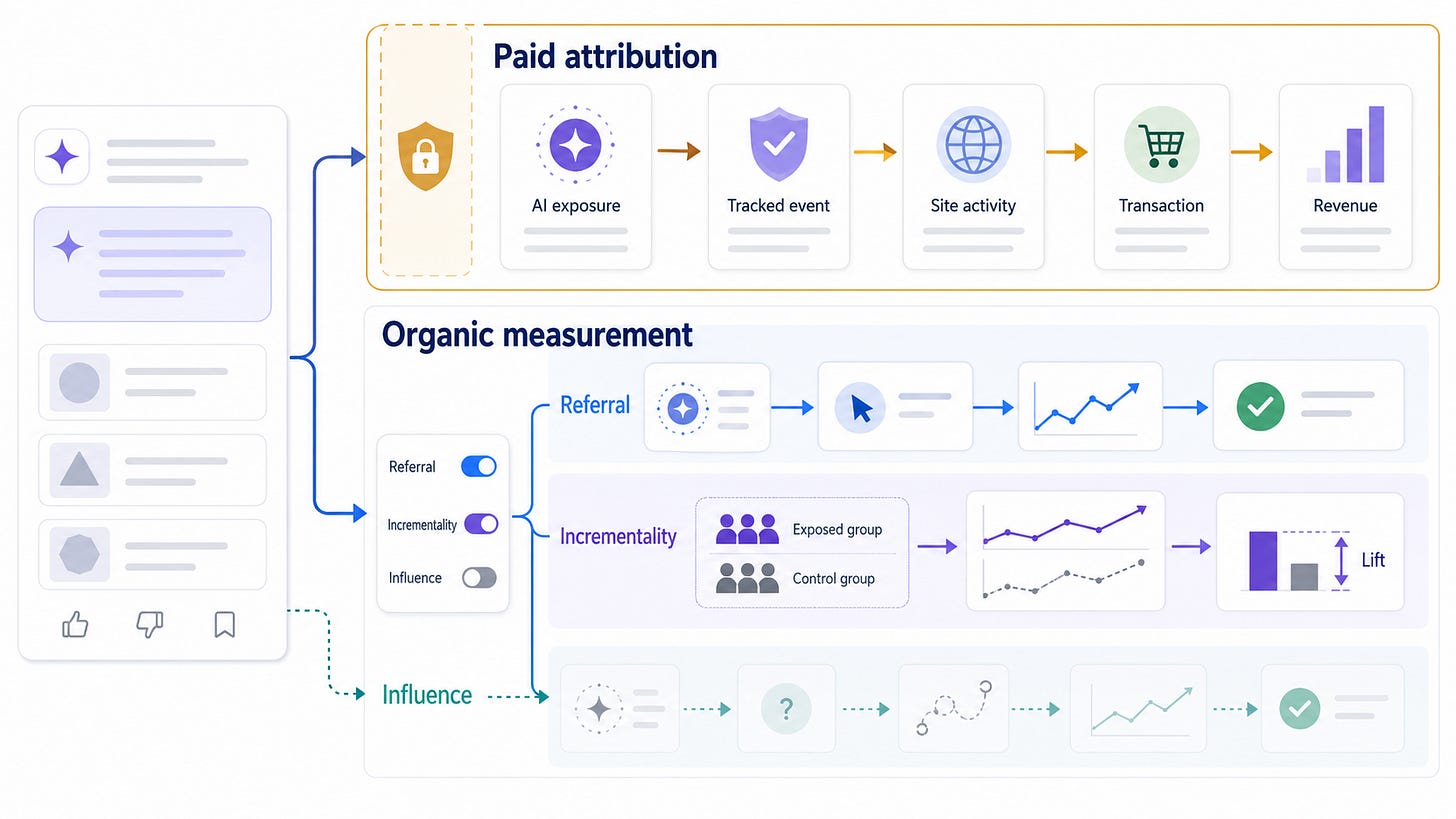
Image Credit: Duane Forrester

Two different frustrations hide inside that one word, attribution. One is whether a tracker reads your AI visibility accurately at all. The other is whether that visibility can be tied to revenue. This piece is about the second. The first runs underneath it, and I come back to it at the end.

That corner has stayed dark for a reason, and it is not the reason most people think. The instinct is to treat missing attribution as a gap some vendor will eventually fill, the way rank tracking filled in twenty years ago. It will not fill in that way. The click-path attribution that organic search practitioners were trained to expect, the deterministic line from impression to session to conversion, is gone, and AI did not kill it. Referral traffic from AI answers is real but tiny, under one percent of total traffic on most sites, which means the thing people are asking for was never going to be answered by watching their own analytics. So let me toss a flashlight at the corner. Here is where attribution stands, why it stands there, and an idea about what you do starting tomorrow.

The Deterministic Era Was Ending Before A Single LLM Shipped

Third-party cookies went into slow deprecation, Apple’s App Tracking Transparency cut off a huge slice of mobile signal, Google Analytics moved to modeled conversions rather than counted ones, and media mix modeling, a technique older than most of the people now using it, came roaring back precisely because the clean deterministic path had frayed. Every one of those shifts happened for its own reasons and none of them involved ChatGPT. LLMs did not break attribution. They arrived after the break and made it impossible to keep pretending. The measurement world you are standing in was already modeled, probabilistic, and permission-dependent before answer engines entered the picture, and that is the ground we are now building on.

Now The Part That Will Annoy You, Because It Is Both Simple And Deliberate

Attribution from the platforms is coming, but it is arriving through the ads door, not the webmaster-tools door. The signal a paying advertiser needs and the signal a free organic practitioner wants are the same signal. A platform will build that signal for the person spending money and withhold it from the person who is not, because there is no business reason to give away for free what someone else will pay for.

We have watched this movie. In 2011, Google encrypted organic search referrals and organic keyword data vanished into the not-provided bucket, while paid search advertisers kept getting richer and richer conversion data. Same query intent, same underlying behavior, monetized on one side and starved on the other. Organic SEO spent a decade angry about it. (Maybe you still are?)

ChatGPT just shipped its version, and you can read both halves of it in OpenAI’s own documentation. On the organic side, the controls OpenAI gives webmasters are switches, not meters. You can allow OAI-SearchBot so you appear in ChatGPT’s answers, or disallow GPTBot so your content is not used in training. Toggles. On or off. What you cannot do is measure via OpenAI. On the paid side, OpenAI has already built a full server-to-server conversions pipeline: a pixel, an events API keyed to an Ads Manager account, standard events like order_created carrying amount, currency, and item-level detail, deduplication between browser and server, and a privacy-preserving identifier to tie exposure to outcome. That is closed-loop conversion attribution. It exists right now. It sits behind an ad account. The organic operator on the same platform gets a robots.txt file and best wishes.

The Sharper Cut Is This

Nobody at OpenAI needed to say Google’s name for this to happen. The not-provided lesson has been in plain sight for more than a decade, in every conference post-mortem and forum thread written since 2011, and the lesson is precise: taking access away costs you years of goodwill, so do not take it away; simply never grant it. Google paid for its mistake because it was a taking, and people fight takings. A designed absence generates no protest, only a low, unfocused unease. That knowledge was ambient. Any competent operator building an answer engine already had it.

Which is why this is not really an OpenAI story. Plot the model companies along a line by their stated reason to exist, a sell-to-serve spectrum if you want a handle for it, meaning where each one sits between built to sell and built to serve. OpenAI is running hard at commerce and ads, so it builds the paid measurement loop first and most visibly. Perplexity is chasing a slice of the discovery-and-shopping pie and moves in the same direction. Google already is an ad company. Anthropic frames itself around safety and long-term benefit and has the least structural reason to build an ads attribution layer at all. The doors differ, and the timing differs, but read the whole line and the conclusion holds in every seat: None of these companies has an incentive to hand free, item-level organic attribution to SEOs. The commercially driven ones gate it behind ad spend. The mission-driven ones simply have better things to build. Do not expect it from ChatGPT is the narrow version. The real version is do not expect it anywhere, sadly.

So Stop Asking 1 Question That Is Actually 3

When practitioners say attribution, they are usually blending three different problems that have three different answers. The first is referral attribution, meaning did an AI answer link to you, did someone click, did that session convert. That one is measurable today, because the click carries a referrer into your own analytics. The second is incrementality, meaning not who clicked but whether your visibility caused lift you would not otherwise have gotten. The third is influence, the dark-funnel case, meaning the buyer read your brand inside an AI answer, never clicked, and showed up three weeks later through a branded search. Referral you can see now. Incrementality you can prove yourself. Influence is genuinely hard. The mistake is treating all three as one blocked pipe, when two of them are already flowing and need nothing from the platforms at all.

Here Is The Work, And None Of It Requires Permission From OpenAI

Start with referral classification, and do it properly, because the default is wrong. AI sessions do not reliably self-label, and referrer strings alone will misfile a large share of them into direct or organic. Tag deliberately with UTMs where you control the link, build a classification rule that combines referrer with landing-page and query patterns rather than trusting the referrer field on its own, and treat the number you get as a floor, because unattributable and cross-window purchases bias every honest count downward. That gets you an accurate read on the one layer that is visible.

Then run incrementality yourself, which is the layer most teams skip because it takes design rather than a dashboard. Hold out a set of geographies and change nothing in them while you push visibility work everywhere else, or run on-off tests over defined windows, or track a fixed set of queries before and after a content push and watch what moves. This is causal measurement, and it belongs to you, not to the platform, which means the opacity of the black box does not touch it.

For the dark funnel, borrow the muscle B2B has used for twenty years, because this is not new-hard; it is old-hard wearing a new coat. Self-reported attribution, the how-did-you-hear-about-us field at the point of conversion, catches influence that no pixel will ever see. Branded-demand correlation, watching whether branded search and direct navigation rise as your AI visibility rises, gives you a defensible read at the aggregate level. Brand-lift studies do the same with more rigor when the budget is there. None of it is deterministic, and that is fine, because deterministic is not on the menu for anyone anymore.

Before You Buy Anything In This Space, Run 1 Test On The Vendor

Ask what data source closes the loop, and listen carefully to the answer. If the honest answer is first-party, meaning their agents on your site, your Google Analytics 4, your CRM, then what they sell is real but bounded, and it lives at the referral layer. If the answer implies signal drawn from inside OpenAI or Anthropic, they are either misrepresenting a referrer-detection method or lying to you. There is no third source. That single question separates the credible from the theatrical faster than any feature list.

This Is Where The Discipline Shows

Attribution counts orders from sessions you classified as AI-referred. Some of those buyers would have found you anyway. Incrementality measures the lift you actually caused, and it requires the experiments described above. Report attribution as attribution, and reserve the word incremental for the cases where you ran the test. The vendors who keep that distinction clean read as trustworthy. The ones who collapse it and promise to prove ROI are the 2026 reissue of guaranteed-first-page SEO, and they will age exactly as well, I think.

Look At Who Is Doing This Credibly, And The Thesis Proves Itself

The players with defensible revenue measurement all sidestep the black box and run on first-party data. Some vendors compute attribution by joining their own storefront sessions to checkout events against a sitewide baseline, and the numbers that get reported vary wildly, which is the honest headline. Microsoft Clarity’s study of 1,200 publisher sites found AI-referred visitors converting to sign-ups at eleven times the rate of organic search, while the peer-reviewed work in Marketing Science, 973 sites and 20 billion dollars in revenue, found organic LLM traffic converting below every traditional channel except paid social. I think both are true, and that is the point. The channel is small, high-intent, and wildly uneven, and it is not even measured the same way twice. Others resolve the loop the same first-party way, routing through affiliate infrastructure or handing purchase reporting back to your own analytics. The pattern under all of it is the tell: Everyone credible closes the loop with data you already own, because that is the only door open.

Give It 12 To 24 Months, And The Shape Is Predictable

Referral classification standardizes and gets boring, as the engines increasingly identify themselves and the analytics tools catch up. Attribution proper gets monetized as an ads product, gated and paid, exactly along the line OpenAI has already drawn in its documentation. And the honest vendors converge on the attribution-versus-incrementality language, because the market eventually punishes the ones who oversold. None of that returns free organic attribution to you, because none of it ever had a reason to.

Which Brings Me Back To The Survey, And To The Thing Underneath The Thing

The attribution requests were loud, but they were the sharp, nameable tip of something larger and more corrosive. As I read the early open-text answers together, what surfaces is not mainly a demand for better numbers; it is a refusal to believe the numbers already on offer. Respondents said they do not trust the trackers, that they cannot tell whether any of it is accurate, that they are struggling to invest because they do not trust the results. That is not a feature gap. That is a trust deficit, and part of it is the correct read of a market built on designed absences and overselling. But I would be lying if I put all of it there. Some of that unease is old thinking meeting a new situation, practitioners carrying SEO reflexes into an environment that does not run on them and skipping the work of learning what actually changed, because “GEO = SEO” is a more comfortable story than the truth. I can’t tell you how big that share is and nobody can measure it cleanly; we read it off what we see and hear online, at conferences, etc. But if it is even a third of the industry’s working mindset, that is not something a vendor comes along and fixes. That is a literacy problem, and it belongs to all of us.

If you are wrestling with this in your own stack, tell me where your loop breaks, in the comments or directly, because the playbook here is still being written and the field’s real answers are coming from practitioners, not vendors. And if you want the longer argument for why the underlying systems, not the dashboards, are where this literacy has to live, that is the whole spine of The Machine Layer.

More Resources:


This post was originally published on Duane Forrester Decodes.


Featured Image: Prostock-studio/Shutterstock

https://www.searchenginejournal.com/google-went-not-provided-in-2011-and-blinded-us-chatgpt-just-shipped-its-version/582839/




Anthropic’s Claude Can Now Watch A Video And Learn Your Job via @sejournal, @martinibuster

Anthropic announced that users on its paid plans can now teach Claude Cowork a skill by recording a walkthrough of a task, which Claude can then use to create a skill that it can subsequently use to complete the same task. It’s called Record a Skill.

Anthropic tweeted:

“New in Claude Cowork: teach Claude a skill.

Record your screen while you do a task, talk through it as you go, and Claude turns it into a skill it can run again. Find it under Record a skill in the + menu of the Claude desktop app.

Available on Pro, Max, and Team plans.”

Screenshot Of Anthropic Claude Record A Skill

Screenshot: Anthropic

Also Available On OpenAI Codex

The ability to record a skill has been available for OpenAI Codex users since June 18. Known as Record and Replay, it’s available only to Apple Mac users and excludes users in the European Economic Area, Switzerland, and the United Kingdom. It’s not known when it will be available for Windows users.

Response To Anthropic’s Announcement

Several people who read the announcement felt threatened by it, commenting that it’s a way to quickly lose your job.

@alfredversa tweeted:

“This has to be the easiest way to be replaced and lose your job man.”

Several others used the announcement to complain that their accounts had reached their limits, preventing them from actually trying out the new feature.

Anthropic’s Teach A Skill Feature

It may very well be that the record a skill function may lead to job losses. Some may argue that if a job can be fully automated with zero humans in the loop then the job may not have needed a human to begin with. A counterargument can be made that a person’s skill and experience is what makes a difference in the output regardless if there’s an AI in the loop.

Which is it then? Is Anthropic’s new feature something good and a timesaver or maybe not so much?

https://www.searchenginejournal.com/anthropics-claude-can-now-watch-a-video-and-learn-your-job/583053/


Google’s AI Search Data Is Growing, But The Gaps Remain via @sejournal, @MattGSouthern

Google’s Merchant Center opened a pilot last week that shows retailers what shopping-related questions people ask AI Mode and AI Overviews about.

Brodie Clark, an independent SEO consultant who got access on a client sub-account, published screenshots and called it the first Google product to give query data for these surfaces

The query data is new, and it’s useful if you run a product feed. But it’s important to know Google groups the questions rather than listing them individually. So what you get in the report are the vocabulary of a category instead of the queries themselves.

That’s enough query data to tell you which attributes to add to your product listings, but it won’t tell you whether AI Mode sent anyone to your site.

What Shipped

The report is called AI performance insights, and Google’s help documentation describes it as showing how a brand is discovered across AI Mode and AI Overviews. If you have access, you’ll find it in Merchant Center under Analytics, then Products, then the AI performance tab.

Google announced the reporting at Google Marketing Live in May, roughly seven weeks before the pilot opened.

What It Tells You

The report sorts shopping questions by query type, using Google’s examplesof searching by category, researching product specs, or looking for reviews. Query frequency shows how popular a given type has been.

Phase of shopping journey groups the questions by how far along the shopper is. Product terms are the words shoppers reach for when they describe what they want, with Google’s documentation giving “maximum cushioning” and “arch support” as examples. Share of voice compares your AI impressions against your competitors’.

Google’s documentation is clear about what to do with all this:

  1. Click through to all product terms and work the relevant concepts into product titles and descriptions.
  2. Check the popular attributes against what’s missing from your product data.

The second point is the most actionable detail in the report. Attribute completeness has long been a common challenge, and now you can close the gap with a clear demand signal from Google’s AI surfaces. If shoppers in your category are frequently asking about a feature your feed doesn’t have, that’s an easy fix.

What The Metrics Actually Are

None of the metrics in Merchant Center’s AI Performance insights show you a real question anyone typed.

You understand the shape of the demand, rather than the demand itself. That’s why the product terms serve well as input feeds but aren’t suitable as a keyword list.

Share of voice should be viewed in a similar way. Google calculates it as your AI impressions divided by total impressions across you and your competitors, and you can’t change that competitor set, because it’s defined by the competitors already available in Merchant Center. It can also produce numbers that look like performance and aren’t. If you lack sufficient impressions, share of voice displays as a zero. If your account has no competitors defined, it displays as 100%.

The scope filters carry their own limits. Traffic is restricted to organic AI traffic, and paid ads traffic isn’t included. Product category filters one category at a time, and there isn’t a report that covers all of them. Insights only count conversational queries that indicate shopping or brand intent; anything else isn’t factored in.

How We Got Here

Last month, Google began testing dedicated generative AI performance reports in Search Console, starting with a subset of UK sites. Those reports show impressions broken out by page, country, device and date. They don’t include click data, and they don’t include query-level metrics. Both absences were the story at the time, and both are still open.

The same week, the UK’s Competition and Markets Authority imposed a conduct requirement on Google covering publisher controls and reporting. The CMA’s interpretive notes call for impressions, click-throughs and click-through rates for search generative AI features, separated from other parts of general search. The click and click-through rate reporting hasn’t appeared. Under the CMA’s decision, Google has nine months to implement all changes.

In July, Google told CMOs that third-party AI-visibility tools don’t have access to its internal metrics, and named Search Console and Merchant Center reporting as the baseline for tracking gains. That was three weeks before this pilot lit up.

Line those up and the pilot reads differently. Google has put AI reporting in front of two different audiences in two months, both times as a limited test. The first answered neither of the two questions people asked. This one answers half of one, for merchants, in the US, with paid traffic excluded and clicks still missing.

Where Google Filed It

In June, SEJ contributor Slobodan Manic argued that Google put AI visibility inside Search Console on purpose, and that the filing decision was itself an argument. AI visibility is search visibility, so it belongs in the search tool, and companies tell you what they believe by where they spend engineering.

The Merchant Center pilot doesn’t refute that. Google’s CMO guidance names both dashboards as first-party reporting, so nothing here contradicts the position that AI visibility gets measured where search visibility gets measured. The grouped query information landed in the dash merchants use for feeds, not the one everyone else opens to check search performance.

Why This Matters For Search Professionals

With access to the Merchant Center pilot, you get two things that change a workflow. You get a demand signal to prioritize against, which is a different input from anything in Search Console, and share of voice becomes a number that will land in a monthly report whether anyone has explained it yet.

As for the rest, Clark isn’t so optimistic, and he drew the Search Console comparison himself:

“In its current form, similar to the recent rollout of AI reporting in Search Console, there isn’t a great deal of actionability behind the data, though it is good to see at least some form of query data being included – something that has been lacking in GSC.”

Most merchants don’t have it yet, and holding an eligible Merchant Center account isn’t enough, since the pilot covers a limited number of US accounts. The check is whether an AI performance tab has appeared. Until it does, your AI reporting is the impression data in Search Console and nothing more.

Sites without a product feed don’t get these grouped shopping-query insights at all. Affiliate sites, review sites and editorial teams publishing buyer guides compete for the same AI Mode answers as the brands they write about, and their reporting is Search Console’s impression data, which covers the same two AI surfaces without any query dimension. The gap this pilot narrows for merchants stays exactly as wide for everyone else in the same result.

Agencies have a different problem, which is the share-of-voice number itself. It travels well in a deck and badly in a conversation, because it’s relative to a competitor set the merchant didn’t pick and can’t edit. A zero can mean thin impressions. A hundred can mean an empty competitor list. Neither one is a bad quarter, and both will look like one on a slide.

What Still Can’t Be Measured

Clicks remain the most significant data point we’re missing. After a year of covering this topic, we’re still facing the same question, and this report doesn’t provide an answer either. Impressions show how often a link to your product appeared, and John Mueller has clarified how those impressions are counted. These rules also apply to share of voice, as that metric is based on impressions.

Individual queries aren’t accessible at the moment, and the details about your competitor set haven’t been shared. As of now, Google hasn’t announced if grouped query information will be available in Search Console, especially for sites that don’t have product feeds.

Looking Ahead

Google says the pilot will expand to Australia, Canada, India and New Zealand in the coming months, which will tell you whether the metrics hold up under more accounts and categories.

The open question is whether any of this crosses over. Google said in June that it would add metrics to the Search Console reports over time, without naming which ones or when.

The nearest fixed point is the CMA’s nine-month implementation window, which covers engagement reporting including clicks and click-through rates for UK publishers. That’s a different dashboard, a different audience and a different jurisdiction from this pilot.

If you want to be part of discussions with industry leaders like Loren Baker, Brent Csutoras, Shelley, Katie, Heather, Roger and myself, then check out SEJ Pro and be part of the new community where conversations happen before they become industry news.

More Resources:


Featured Image: fengdr0517/Shutterstock

https://www.searchenginejournal.com/googles-ai-search-data-is-growing-but-the-gaps-remain/582558/


The New Google Business Profile Playbook for AI Local Search via @sejournal, @CallRail

You probably set up your Google Business Profile a while back, filled in your address, picked your categories, maybe chased down a few reviews, and then called it done. Totally understandable. That was enough, once.

But here’s what’s changed: If you haven’t meaningfully touched that profile in months, you’re losing visibility to competitors who figured out something you haven’t yet. Google transformed GBP from a directory listing into a live engagement surface, and businesses that treat it like the former are quietly bleeding map pack rankings they don’t even know they’ve lost.

This applies to every local business. Retailers, yes, but also law firms, dental practices, restaurants, gyms, plumbers, and salons. If your GBP isn’t actively signaling to Google that you’re open for business and earning it every day, you’re leaving real visibility on the table.

Let’s talk about what killed the static profile, what Google built in its place, and exactly what you need to do about it.

When “Set It And Forget It” Actually Worked

Cast your mind back to the directory era. You filled out your name, address, and phone number (NAP), chose a category, uploaded a logo, and crossed your fingers. Google treated these profiles as reference points, fixed coordinates in the physical world. The algorithm cared about NAP consistency across directories more than anything else. Match your citations across 50 listing sites? You were golden.

It worked because that’s genuinely all Google needed. The platform was confirming you existed at a given address. Nothing more.

The New Table Stakes (And Why They’re Not Enough)

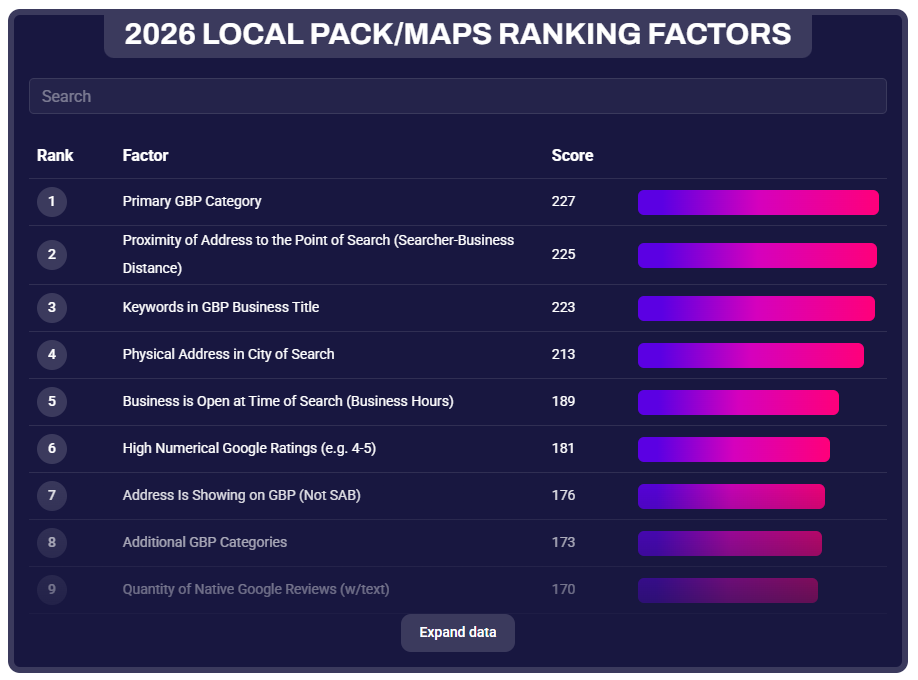
Those fundamentals haven’t disappeared; they’ve just become the entry fee. According to the 2026 Local Search Ranking Factors report, the primary GBP category is still the No. 1 factor for local pack visibility, followed by proximity to the searcher and keywords in the business title. These matter enormously. But when every serious competitor has them dialed in, they stop being differentiators.

Screenshot from Whitespark, March 2026

The report also makes clear that behavioral and engagement signals, posts, photos, clicks, calls, direction requests, and review cadence are climbing fast in importance. Google is actively rewarding businesses that “look alive.”

There’s also a finding worth pausing on: Being open when users search is now the No. 5 local pack ranking factor. Your hours aren’t just informational; they’re a ranking signal. This was first noted by Joy Hawkins of Sterling Sky and subsequently confirmed by a BrightLocal study of 50 businesses across 10 categories, which found that rankings tended to drop when a business is listed as closed. Don’t treat your hours as a set-and-forget field. Audit them quarterly, set special hours for holidays before the holiday arrives (not after), and consider whether your current hours are costing you visibility during high-intent search windows.

A static profile with perfect NAP and a 4.8-star rating is like showing up to a job interview in a great suit but refusing to speak. You look the part, but you’re not convincing anyone you’re the right choice.

Google’s Shift: From Listings To Live Engagement

Google didn’t randomly decide to make GBP harder to manage. They followed user behavior. People aren’t browsing businesses anymore; they’re searching with immediate intent. “Who can help me with this right now?” isn’t a research question; it’s a decision waiting to happen.

So Google built GBP into an active engagement surface. For retailers, that meant integrating Merchant Center so real-time product inventory could surface directly in search results and Maps. For service businesses, it means appointment booking, Q&A, and post-activity are all live signals. For restaurants, it’s menus, wait times, and reservation links. The platform expects ongoing input, and it rewards the businesses that provide it.

The core principle is the same whether you sell hiking boots or handle divorces: Google favors profiles that continuously demonstrate relevance and activity. The mechanism differs by business type. The outcome doesn’t.

The Signals That Actually Move The Needle

Review Velocity, Not Just Review Volume

Reviews have always mattered, but the 2026 Local Search Factors Ranking Report data adds important nuance. Fresh reviews don’t just help you rank; they help people pick you over a competitor with the same star rating. Research further confirms that review signals are gaining influence across local rankings, with proximity earning you the look, but review content helping secure the top spot.

Do this: Make review requests part of your operational workflow. Send the ask within 24 hours of a completed service or transaction while the experience is fresh. Respond to every review, positive and negative, within 48 hours. Owner responses are an engagement signal, not just a reputation management courtesy.

Not that: Don’t batch review requests monthly or rely on a generic follow-up email. Don’t respond to positive reviews with a copy-paste “Thanks for your feedback!” Google and potential customers can both tell.

A law firm that earns 12 reviews over three years and one that earns 12 reviews over three months are sending very different signals to the algorithm, even with identical star ratings.

GBP Posts: The Most Underused Freshness Signal

Most businesses either never post to GBP or publish one post in January and forget it exists. That’s a significant missed opportunity. Posts, whether offers, updates, events, or business news, are a direct freshness signal that tells Google your profile is actively managed.

Do this: Post at least once a week. Tie posts to things that are actually happening: a seasonal promotion, a recently completed project, a staff milestone, or a local event you’re involved in. Use the “Offer” post type when you have something time-sensitive; the expiry date creates urgency and signals recency.

Not that: Don’t recycle the same “Welcome to our business!” post every few months. Don’t post only when you remember to; build it into a recurring task, same as you would any other content channel. And don’t ignore the post types Google gives you; Events and Offers get more real estate in the profile than standard Updates.

Photos: Recency Matters As Much As Quality

According to Birdeye’s State of Google Business Profile 2025 report, verified profiles with photos consistently receive more website visits, direction requests, and calls, and listings with recent photos and video see measurably higher engagement than those with stale or infrequently updated imagery. That “recently updated” part is key. A profile with 80 photos, all uploaded three years ago, isn’t sending the same freshness signal as one with steady uploads over recent months.

Do this: Set a recurring reminder to upload new photos at least twice a month. Show real things: recent work, your current team, your updated space, seasonal inventory. For service businesses, job-site photos and before/after shots are gold; they’re authentic, specific, and far more compelling than stock imagery.

Not that: Don’t upload a batch of 50 photos once a year and call it done. Don’t use obviously staged or stock photos as your primary images; research on competitor GBP analysis shows that photo quality and authenticity are increasingly factored into how profiles are perceived. And don’t ignore customer-uploaded photos; respond to them or flag inappropriate ones rather than leaving them unattended.

Booking And Messaging: Closing The Loop Inside Google

Google increasingly wants to keep searchers inside its own ecosystem. For local businesses, that means enabling every feature your business type supports: “Book Online” links, appointment URLs, and the Q&A section. These aren’t just convenience features; they’re engagement signals. When a user books directly through your GBP, that interaction tells Google your profile is functional and driving real-world action.

Do this: If your business supports appointments, connect a booking link (Google supports integrations with platforms like Booksy, Vagaro, OpenTable, and others). Seed your Q&A section with the three to five questions customers actually ask most, and answer them yourself before strangers do it for you.

Not that: Don’t leave your Q&A section empty or unmonitored, unanswered questions (or worse, inaccurate answers from random users) erode trust and represent a missed engagement opportunity.

For Retailers: Real-Time Inventory Is Its Own Category

If you sell physical products, everything above applies, but you have an additional lever that service businesses don’t: real-time inventory.

Google integrated Merchant Center with GBP specifically to surface what’s on your shelves in search results and Maps.

Do this: Prioritize your top 50 highest-intent, most-searched products first. Get those live and accurate before trying to sync your entire catalog. Add product schema markup to your website’s product pages so your feed and your site are telling Google the same thing.

Not that: Don’t upload a feed manually once a week and assume that’s close enough to real-time. Don’t skip the Merchant Center diagnostics step; a feed with errors will silently underperform, and you won’t know why until you check. And don’t assume inventory feeds only matter for paid ads; enabling free local listings through Merchant Center unlocks organic product visibility in search, Maps, and your GBP profile at no additional cost.

The AI Layer: Why This All Matters More Than Ever

Here’s the dimension that makes everything above more urgent: GBP signals are now feeding directly into AI-driven local results, not just the traditional map pack.

Google’s AI Mode pulls from the same signals discussed in this article: review recency and sentiment, photo freshness, post activity, accurate hours, and service completeness. The Whitespark 2026 report introduced an entirely new AI Search Visibility category for the first time, with three of the top five AI visibility factors being citation and entity-based signals. Businesses that keep their GBP current and consistent are the ones being surfaced in AI-generated answers. Businesses with stale profiles aren’t just losing map pack spots; they’re becoming invisible to AI-driven discovery entirely.

Treat every update you make to your GBP not just as a ranking tactic for the traditional local pack, but as a data signal for AI systems that are increasingly acting as the front door to local search. Accurate hours, fresh photos, recent reviews, and complete service descriptions aren’t just best practices; they’re the inputs AI needs to confidently recommend your business.

What To Measure

Once you’re actively managing your profile, track what’s actually moving:

Profile interactions: calls, direction requests, website clicks, and (where applicable) booking clicks tell you which features are actually driving action. 

Review velocity: not just your total count, but how many you’re earning per month and how quickly you’re responding. 

Post engagement: views and clicks on GBP posts help you understand which content types your local audience actually responds to. For retailers, add product impressions and store visit conversions to this list.

The Compounding Effect

Here’s what makes dynamic GBP management so powerful over time: the signals compound. Consistent posting builds freshness and authority. Steady review velocity builds trust signals. Updated photos drive higher engagement. Higher engagement improves rankings. Better rankings bring more profile views, more reviews, and more interactions, which further improve rankings. And now, all of those same signals are feeding AI systems that are reshaping how local businesses get discovered in the first place.

Local visibility is increasingly built on engagement, credibility, and connection, not just keyword optimization. Static profiles erode authority over time. Dynamic profiles compound it.

The businesses treating GBP like a compliance checkbox are the ones watching competitors steal map pack spots they used to own. The ones showing up consistently, posting, earning reviews, updating photos, keeping information current, and (for retailers) feeding Google live inventory, are building durable local visibility that’s genuinely hard to disrupt, whether the search happens in the traditional map pack or in an AI-generated answer.

That’s the gap. The only question is which side of it you want to be on.

More Resources:


Featured Image: A_stockphoto/Shutterstock

https://www.searchenginejournal.com/rundowns/the-new-google-business-profile-playbook-for-ai-local-search/


AI SEO: Writing That’s Specific May Get Cited More via @sejournal, @martinibuster

Someone posted on social media about their experience writing deep and insightful articles last year and was pleasantly surprised to see that AI was leaning on their articles and even referencing them. Their secret was to choose highly specific topics, which is a good idea.

SEO And Natural Language AI

SEOs like to write articles based on keywords, and that’s actually how people did it in the relative caveman days of SEO, well over 25 years ago. Natural language processing has come a long way, and LLMs are now able to understand topics and questions in a conversational manner. So it’s truly outdated to proceed with SEO by focusing on keywords.

User behavior and what other sites and people are saying about a site or product are increasingly important. The best way to influence that is with content that’s insightful and gives users what they’re looking for and a lot of it, as often as possible.

It’s Not Just About Being Insightful

The person who started the discussion pointed out that they chose a “specific enough topic” and wrote something insightful about it. That’s a deceptively simple tip, but it is one of the key points about writing for an audience of humans and machines that interpret content as if they were humans.

Choosing a specific enough topic is about keeping the article focused on a topic and not allowing it to stray. One of the hallmarks of good writing is the willingness to remove the bits that tend to wander off topic. This is an American style of writing, although Europeans as far back as Charles Dickens knew the value of staying on topic so that the effect is a constant stream of interesting sentences that pull a reader all the way to the end of the page.

Writing is an art, like painting and composing music. But you don’t have to have a literature or journalism degree to engage users with text.

How Someone Got Lots Of Love From Claude AI

Bluesky user @danabra.mov posted about their experience writing an insightful article that subsequently began getting referred to by Claude AI.

He posted:

“If you write an insightful blog post on a specific enough topic, and people link to it, you have a real chance at influencing everyone’s LLM output in a year or so. it’s a bit wild.

I wrote some articles last year that I thought nobody would read because they’re super long. And now I see Claude regurgitating what I wrote in those articles in a perfectly condensed way (and occasionally explicitly referring to the posts). they took away exactly what I wanted the reader to take!

For me it’s a relief because i was worried about falling interest to longform blogs and declining readership. but in a sense maybe it has significantly expanded! It’s just that my reader is now infinitely patient and really wants to hear the entire thing.”

Others Agree That Being Specific Is Key To Success With AI Citations

The response to Dan’s post was overwhelmingly positive, with one person commenting that it gave them hope.

One person named Tyler shared that they had a similar experience with content they published that was specific.

‪@tylergaw.com‬ responded:

“I’ve seen a couple of mine, not even that insightful, just specific, get pulled into them and used within like 6 months. Wild.”

The person who started the discussion, Dan, agreed:

“I mean yeah but I think being specific by itself is enough…”

Why Is Being Specific Enough?

Based on my well over forty years of writing experience, including writing poems, short stories, one novel, blog posts, and articles for Search Engine Journal, my opinion on the matter is that focusing on being specific helps to keep a work focused in a way that matches the reader’s focus. The moment the article strays off topic is when the reader loses interest and jumps away.

Being insightful is not enough. Being witty or clever is nice in moderation, but in higher doses it becomes off topic and will, in my opinion, lose the reader. That’s why anyone who writes content must be willing to ruthlessly cut words out to keep it focused and specific (on topic).

What Google Said About The Topic

Google’s John Mueller reposted Dan’s post with the comment:

“Make more insightful & useful stuff.”

There was one skeptic in the crowd who argued that the economics remove the incentive to put in the work.

They wrote:

“Why on earth would anyone put in the effort required at this point only to have it immediately stolen, receive no compensation and no credit. It’s never been more hostile environment to be a creative. The economics DO NOT WORK.”

Yes, it’s true that today’s environment is hostile to creators because of AI. Yet there is always an opportunity for success by writing about the topics that interest you because they will be sure to be of interest to someone else.

Featured Image by Shutterstock/Nur Alam sabuz

https://www.searchenginejournal.com/ai-seo-writing-thats-specific-may-get-cited-more/582531/


Google Is Using Social Media Signals To Mask AI Search Click Loss via @sejournal, @TaylorDanRW

As you may already know, Google recently updated Search Console to let brands track how their social media and video posts perform in search results.

Most marketers view this update as a helpful gift. They believe Google wants to reward brands that build strong footprints across TikTok, YouTube, and X. And not wanting to be glass-half-full, I think this is the positive optics Google was hoping for.

If you look past the official announcements, a different picture comes into focus; this update is a clever trap. It serves as a shield to hide the traffic loss caused by artificial intelligence while positioning creators into further training Google’s AI models.

Redefining Success In The Era Of Click Loss

To understand this strategy, you must look at the crisis Google faces with web publishers.

Generative search experiences and AI summaries answer user questions directly on the search page. This setup keeps users on Google instead of sending them to external websites.

Organic traffic to a company website was the main measure of marketing success, and a narrative we as an industry pinned to the mast for years as to whether or not we were justifying our budgets.

By tracking social media views inside Search Console, Google is trying to change the definition of success. If your website traffic drops by a third, Google can point to your social media data. They can show you that your TikTok videos received thousands of impressions on the search page; they want you to believe you are still winning, even if you do not get actual clicks.

It forces marketers to view Google as the central control room for all visibility, even when Google stops sending visitors to their websites, as they’re still providing visibility.

Outsourcing The Search Graph To Creators

The update also serves as a tool to train Google’s artificial intelligence and to power generative search, Google needs to understand the real world.

The engine maps relationships between people, brands, and topics. This process is called entity resolution.

Google needs to know who is an expert, what they write about, and whether they are a real person or just an automated spam site.

By encouraging you to verify your social accounts inside Search Console, Google makes you do their work. You hand over the exact connections they need, tell them that your website, your X profile, and your TikTok account are all the same entity.

Instead of Google guessing which profile belongs to which author, publishers hand-deliver verified identity maps. Google can then use this clean data to train its language models on who the true authorities are.

This Search Console update also ties in nicely with the initial release of Google Search Profiles, which feels like a modern re-spin of the authorship benefits of Google+.

The Human Trust Filter

Having verified data is essential in the age of generative text.

Anyone can build a website, buy a drop domain, and programmatically generate thousands of articles with AI, and inflate third-party authority metrics.

Social profiles with real human engagement are the best proof of life. Real companies and real brands operate across the multiple channels and have a form of pulse and presence outside their single web domain.

Google uses these connections as a trust filter to separate real brands from synthetic spam. You are giving Google the exact blueprints it needs to verify content ownership. This helps Google decide which sources are reliable and which sources are junk.

Looking at this cynically, the ability to verify social profiles in Google Search Console is an optics masterclass in platform survival.

It somewhat pacifies publishers by giving them new vanity metrics to track, and at the same time, it creates a new network for those same publishers to map the entity relationships that Google needs to build its AI future.

How Google Get Social Content

Google pulls social media posts into search engine results pages through a combination of live data firehoses, standard web crawling, and dynamic JavaScript rendering. The process differs based on the specific platform and user privacy settings.

Some of these data pipelines have been around for almost a decade, with the X (then Twitter) firehose deal coming into play in 2015.

This doesn’t mean that fresh posts are the only ones considered. In my own Search Console profile, I’m seeing X posts receiving clicks on Google that I posted in October 2024.

LLMs behave in a similar manner, and because of this we need to look at a post deprecation strategy.

Reviewing pricing prompts for one of our clients, I found that a couple of LLMs were returning pricing information from an X post advertising a student only offer from July 2022. This isn’t only misinformation, but can lead to a negative brand experience when a user clicks through expecting to receive one price, but find one substantially different.

Your Audience, Google’s Platform

The brands that win in this new landscape will not focus on these new Google metrics, but understand these are now another piece of the puzzle.

We need to stop treating Google as a neutral partner, as Google needs Search to bring people to the platform for Ads.

We should use our social channels to build a direct connection with your audience. Gather your community on platforms you control, rather than a search engine that wants to keep your visitors for itself.

More Resources:


Featured Image: beast01/Shutterstock

https://www.searchenginejournal.com/google-is-using-social-media-signals-to-mask-ai-search-click-loss/582227/


How Google May ‘Understand’ Unique Content

Thanks to Rand’s excellent research and Barry’s expletive-laden ranting, we know that Google processes over 5 trillion searches each year. Trillion. Per day, that’s 13.7 billion. Per second, 158,000.

There are some sizeable and growing caveats here:

That still means Google processes 2.92 billion clicks to the open web every day. It’s still a figure worth fighting for – particularly for publishers whose business models heavily rely on a click.

So let’s not totally lose sight of what matters in the here and now. And unique content certainly fits that mould.

I have reviewed a few previous patents (Google’s in-depth article patent explained and how Google ranks news sites), and it is not a thoroughly enjoyable experience. A granted patent protects an idea; it doesn’t prove deployment or real-world use cases – and it’s certainly not unlike big tech to claim ownership of something just so it can’t be used elsewhere.

Generally, if:

  1. The patent is cited regularly and recently? This patent (Contextual estimation of link information gain) has been cited 24 times and as recently as last year.
  2. Whether it has international filings? Yes, but with some caveats. US, China, ceased in Europe and worldwide, but extended in the US to 2039 very recently.
  3. Whether Google has protected the ranking technology around the world? Yes, again with some caveats.
  4. Does it broadly align with your understanding of the concept (in this case non-commodity content)? Very much so. As the rasping breaths of SEO-first, commodity content make even iron lungs work hard, it would be inconceivable for Google to not measure or evaluate uniqueness in some manner.

It is more likely to be used in some capacity.

TL;DR

  1. Google has multiple public and leaked systems that appear to evaluate originality, effort, and unique contribution – see OriginalContentScore and ContentEffort.
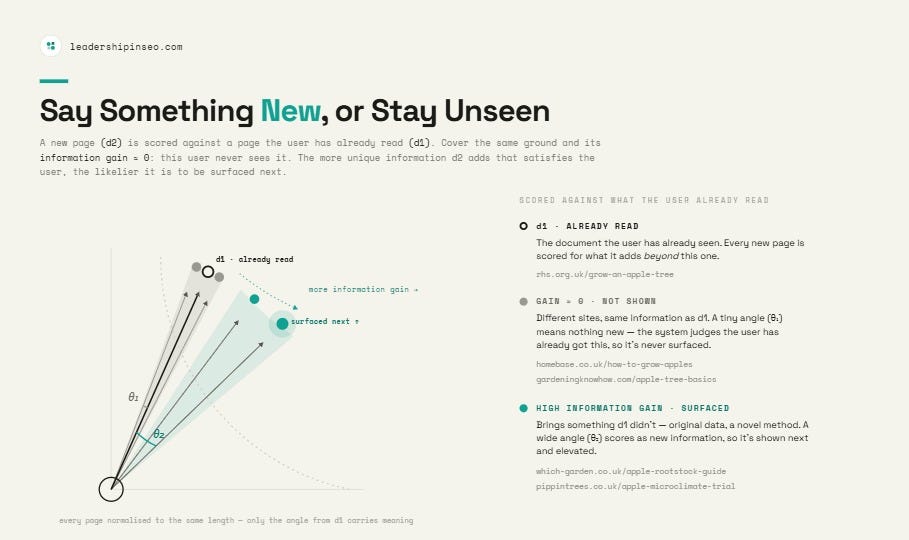
  2. The patent describes an information gain score (potentially in a 0 – 1 framing) that is assigned to a document based on how much new information it adds beyond documents a user has already seen on the same topic.
  3. In my – and many others’ – opinion, Google’s systems reward originality in some way. Whether that’s directly through an information gain score and re-ranking system, a Bayesian predictive score, or indirectly through positive engagement signals, I couldn’t tell you.
  4. Originality doesn’t mean an entirely different document. As little as a 10% difference could be the delineator between marketing success or failure.

How Does It Work In Practice?

This patent is not about the information gain applied to the current set of search results. It’s about the subsequent set of results – ranking the next set of search results based on wider user search behavior, personalization, and added document value.

It highlights that documents:

  • May be reranked.
  • May be excluded.
  • May be significantly demoted.
  • May no longer appear in results.

Based on the amount of novel, relevant information provided when compared to other similar documents.

For any tech SEO geeks out there, you’ll be well aware of the concept of preloading. In nerd circles, preloading tells browsers which resources should be prioritized to improve the page load speed and above-the-fold rendering.

I think this patent works in a similar manner, but with bloody unreliable people instead of machines. Maybe bfcache is a more apt comparison, but I haven’t really got stuck into technical SEO for a while, so forgive me for my appalling analogies.

Step-By-Step

  1. A user reads a document about a certain topic, let’s say, growing an apple tree.
  2. Google understands that the majority of users don’t stop at one page here. It’s a rich topic. When should I plant one? Where? What do I feed it?
  3. With 13 months of click and engagement data to hand, Google knows – with, I imagine, an unerring level of accuracy – what piece of content each user should be shown and when based on goal fulfillment.
  4. But new content is written every day. Pages are updated. So this isn’t a static corpus to work with. And maybe someone has a novel way of growing apple trees?
  5. So pages are compared. A user reads a document (d1). Google then compares a new or updated article (d2) to the original.
  6. If d2 generates a favorable information gain score, it will likely be shown to the user as part of their journey. If it doesn’t, it’s doomed.

“An information gain score for a given document is indicative of additional information that is included in the given document beyond information contained in other documents that were already presented to the user.”

Let’s say two documents are chosen based on a user’s search and search history. They’re represented as d1 or d2. D1 is an already-consumed document, and d2 is brand spanking new. Well, to the user at least. These documents can be represented as a vector (or some other semantic representation) to help the model fake understanding of the document and its position against similar documents.

A diagram showing how documents are scored against each other in the vector space
Vector mapping is all about angles and positioning on a graph to quantify a scoring or positioning system (Image Credit: Harry Clarkson-Bennett)

The system provides a quantitative score to assess whether the user should also view d2 after having viewed d1. If the machine learning model generates an information gain score of document d2 over document d1, then d2 is likely to be shown – for future use cases, possibly at the expense of d1.

There are some incredibly practical implications here.

If a topic has been done to death, you have a more limited chance to rank and generate value without providing something extra. In a scenario where your article scores 0, the system has assessed it provides nothing extra, and a user who has seen d1 is less likely to see d2 – your article.

If nothing else, make sure you stand out above your closest competitors in some manner.

A lot of this describes the foundations of creating brilliant content. Being different and standing out.

As with so many of these Google-led ideas or initiatives there are flaws. You don’t have to follow it to the letter. But E-E-A-T and “information gain” are sound principles. You have to be memorable. There is no alternative.

How Important Is It?

I think uniqueness and standing out are more important than ever. Strip the patent out of the conversation. People or brands who publish content won’t survive if they aren’t memorable to people and – by proxy – search engines.

So you’ve got to do something differently.

In Google’s case, I think it’s more about efficiency than anything else. If they know the information gain scores of two documents are virtually identical, then a user isn’t going to be shown both versions of the document. The second document will be deprioritized in favor of richer, more unique content.

Google has enough engagement data to go along with these proxy scores to understand what document should be shown and when. They can get a user closer to their goal by removing overly similar pages from a user’s SERP or AI response.

Which may be exactly why they’re thinning their index – the removal of non-value-add content. Well, that and all the AI slop you’re creating.

It is quite literally down to a) computational resources (money) and b) getting the user to the point of completion quicker. In the DOJ Antitrust trial, Pandu Nayak’s sworn testimony called Navboost “one of the important signals that we have.”

“…a shorter query session or fewer dialogue turns can provide a corresponding reduction in the resource demands of the system e.g. with respect to memory and/or power usage of the system.”

And the Quality Rater Guidelines make numerous references to effort, originality and talent. Frameworks like E-E-A-T and the product reviews update really highlight the importance of actually using products and showcasing the effort you have gone to. The amount of “effort” you put in is quite literally quantified (highly recommend Sean’s breakdown here). It is part of the Helpful Content update (booooooo) and the more difficult your page is to replicate, the better chance it has of success, all things being equal.

These are not stupid principles. They’re very good ones. The problem is, effort is expensive. The fewer clicks content produces, the less each article will generate.

In an attributable manner at least.

Google Is Building An Audience Loyalty Ecosystem

Don’t take my word for it, take Barry’s. Google has wanted to get rid of click-chasing churnalism for years. Now it can. And it is – in most cases, I think, a positive.

They are trying to build something around engaged users – like every publisher out there. Your most engaged users are your most valuable. Google’s quietly building a subscriber ecosystem that could one day rival their ad business. No reason to think that

Publishers that can demonstrate they have an audience outside of SEO are being “rewarded.” Although I suspect you could replace rewarded with crushed a little more slowly.

You can follow your favorite publisher via Preferred Sources and as a Search Profile via the Discover feed (U.S.-only at the time of writing this), and badges like “highly cited” have been in play for some time. It doesn’t work very well, but they are trying to promote unique reporting.

You can now see how content from social and video platforms performs on Google Search if you meet the requirements. Your digital footprint and impact within the industry you’re in really matters. Particularly when you consider how prevalent social and creator accounts are in Discover.

I worry that this is completely impossible to explain what is happening to users. What is Preferred Sources vs. a Search Profile?

It’s tough to force people to follow you on platforms – maybe that’s the point. Which I kind of understand – but I think one of these would’ve sufficed.

If you want to know a little more about where Discover is heading, I made a short video about it:

[embedded content]

Does Information Density Matter?

Yes and no. Long articles are not necessarily more effective at satisfying the user.

Google has methods to normalize the length of an article to prevent additional keywords and semantically relevant phrases from ranking the document too highly. Factors like TF-IDF normalization prevent long documents with high word counts from artificially inflating their relevance scores just because they’re quote-unquote richer.

More detail may be the wrong phrasing here. Detail and rigor are typically positives. But it’s less important than answering the question and getting the user closer to their end goal.

User satisfaction is quantified through goal completions and Navboost data – it trumps everything else.

How Does It Affect AI Systems?

Well, traditional search ranking is still crucial in AI systems – whether that’s how effectively you rank for the primary search, your inclusion in the training data, RAG, or suite of fan-out searches run concurrently. And AI searches are extremely personalized – something that’s likely to only increase over time.

When Claude starts knowing what toilet paper I buy or selects a poorly chosen “Happy Mother’s Day” card for my mum’s birthday that showcases my lack of effort and empathy, it’s time to call it a day.

According to Kevin Indig’s latest excellent research, first-party research is rare in AI citations, but it earns 3.3x more. And original data is the strongest single predictor of page originality. Good for traditional SEO, good for AI search. Who knew?

The ideas described in this patent map almost too neatly onto how modern AI search systems retrieve relevant information. Of the SGE. It helps anticipate the user’s next interest in an assistant-like context. Personalized, “helpful” and with extreme memory.

As Roger Montti pointed out, this may give a clearer indication of how AIOs use pages that the user in question may be interested in. Their entire job is to synthesize answers from multiple sources and searches to provide the perfect jumping-off point. I suspect this scoring system is an excellent way to avoid computationally expensive, unnecessary utilization of documents.

contentEffort – described as a ‘Large Language Model (LLM)-based effort estimation for article pages’ – estimates the amount of effort invested in creating an article. As slop makes up more than 50% of the internet, this is seemingly one of Google’s way of dealing with it.

How Can I Use This Effectively?

Make differentiated, non-commodity content. It’s really simple. Apply what we call information gain in this context to your own content – if you cannot add anything of value to the existing index, then don’t bother.

You can use this with:

  • Original data.
  • First-hand experience.
  • Interviews.
  • Real reporting.
  • Being first on the scene and developing the story as it happens.
  • Proprietary analysis.

You don’t need a big budget. You can do amazing things with a few free data sources, some creativity, and a bit of rope. Just make sure the article has an element of uniqueness.

I think this really helps frame whether content is still worth creating. If you’re doing something just for SEO reasons and you can’t add anything extra to the existing suite of information, kill it. If a document contributes very little new information, the patent suggests it’s a strong candidate to be deprioritized when selecting subsequent documents.

Still costs time and money to make, but is less and less likely to drive any real value. Stay in your lane, but drive a nicer car.

I have a feeling your indexation report in GSC is invaluable here. Beige content has a shelf life so low it’s in the running for the new UK Prime Minister. So check for any pages dropping out of the index at scale for more serious issues.

More Resources:


Read Leadership In SEO. Subscribe now.


Featured Image: Roman Samborskyi/Shutterstock

https://www.searchenginejournal.com/how-google-may-understand-unique-content/581959/


Google Says No SEO Penalty For Year-Long A/B Tests? via @sejournal, @martinibuster

Google’s John Mueller recently answered a question about A/B testing web pages for long durations, warning that an unintended consequence is that enabling variations to be indexed can result in uncertainty as to which will be visible in the search results.

A/B Testing Traffic From Live Search Results

A/B testing is when one or more versions of a web page is shown to users. The reason for doing this is generally for testing conversion rates and user responses.

The important takeaway from the guidelines is that A/B testing live web pages is the guidelines were created to minimize impact on search performance.

The guideline begins:

“This page covers how to ensure that testing variations in page content or page URLs has minimal impact on your Google Search performance.”

While Google does not explicitly forbid using A/B testing to test which page ranks better, the context of the guidelines itself is defined as protecting search performance; measuring search performance is not in the guidelines.

What Google’s document describes getting measured is consistently user behavior, not rankings.

On a side note, something that’s not in the guidelines is that there is no “right” button color and size for improving clicks on a call to action button. Longstanding SEO knowledge and experience about this is that large buttons and/or colors that contrast strongly against the web page backgrounds tend to get more clicks. This likely explains why Amazon’s Add To Cart button is a bright mustard color and Walmart’s version is bright blue contrasted against a solid white background.

Google’s Guidelines On A/B Testing

Google’s guidelines on A/B testing describe it as showing different versions of a website and collecting data on how users react to them. In terms of SEO performance it says not to expect any disruption but by allowing Google to index the slightly different pages once the testing is over the winning combination will be indexed much sooner.

There are two kinds of A/B testing:

  1. A/B Testing
    Testing two or more changes to a web page. Google uses the example of testing different fonts on buttons.
  2. Multivariate Testing
    This is a test of multiple changes all at once in order to identify which combination of factors work best together. Google uses the example of testing different combinations of different fonts on buttons and on the web page itself.

Four Considerations For A/B Testing

Google also recommends four best practices:

1. Use The rel=”canonical” Link Attribute
This is probably the most important factor to consider. Using the rel=canonical link attribute enables site owners to put all kinds of variations of a web page online and still include a strong hint about which version of a web page is best.

2. Use 302 redirects
If you’re randomly redirecting users to different versions of a web page you should be using a 302 redirect, not 301 redirects. 302 means that a resource (like a web page) has been temporarily moved. That’s different from a 301 redirect which means that a move or change in URL is permanent.

3. Don’t Cloak
Cloaking is the practice of showing one thing to Google and something else to users. If you’re testing different web pages to see how users react when they click through from search then Google insists that site owners show the same thing to Google, even if the page elements are constantly changing.

4. Don’t A/B Test For A Long Time

Google warns site owners to limit how long A/B testing goes on. They warn that excessive testing could get a site in trouble:

“If we discover a site running an experiment for an unnecessarily long time, we may interpret this as an attempt to deceive search engines and take action accordingly. This is especially true if you’re serving one content variant to a large percentage of your users.”

That last warning relates directly to the question asked on the Bluesky social network.

Google Answers Question About Long-term A/B Testing

The person asking the question specifically wanted to know about how Google handles A/B testing that lasts for as long as a year.

They asked:

“Hey @johnmu.com, As Google’s A/B testing guide suggests to avoid running same A/B test for long durations, I was wondering how does Google handle long term holdouts (eg. 10% for 6-12 months), especially for a large scale marketplace with 10s of millions of crawls to similar amount of pages.”

Google’s John Mueller answered:

“Depending on your setup, what might happen is that one or the other version is used for indexing. If they’re close enough, probably that doesn’t matter. If they’re significantly different, that could be visible in search results too.”

The person who asked the original question then followed up with an additional question that revealed more about how much the web pages are changing.

They asked:

“…what if it’s fully different like a redesigned page, and since Googlebot is getting alternative versions with each crawl (sometimes in a day). Can that rapid change in core HTML structure cause issues with indexing and lead to Google potentially dropping the pages from index?”

Mueller responded:

“We’d take the content into account the way that we crawl it for indexing. There’s no (as far as I know) “penalty” or “demotion” for having varying content (lots of sites have that), but it can make it harder for you to debug & monitor if the content constantly changes.”

The person asking the question wanted to know how Google handled long-term A/B testing. They did not ask how Google handles indexing, but that’s the question Mueller answered. That may explain why the person followed up with a second question that was more precise about the extent of their A/B testing and Mueller again focused on indexing.

No Penalty For Having Varying Content?

Mueller’s statement seems to contradict Google’s own guidance about long-term A/B experiments.

The relevant context of Google’s guidelines is:

  1. It confirms that A/B testing is legitimate.
  2. Normal experiments are reasonably assumed to be temporary.
  3. Once enough data is collected to reach conclusions the A/B test it’s normal that it ends.

That’s where we get to the warning part of the guidance:

“If we discover a site running an experiment for an unnecessarily long time, we may interpret this as an attempt to deceive search engines and take action accordingly. This is especially true if you’re serving one content variant to a large percentage of your users.”

So the point of where things get fishy is when the experiment goes on longer than what seems reasonable and where one variation of the content becomes the prime version for most users as part of an attempt to “deceive search engines.”

Featured Image by Shutterstock/logofank

https://www.searchenginejournal.com/google-says-no-seo-penalty-for-year-long-a-b-tests/582349/


The Web Is Eating Itself And Your Metrics Look Fine via @sejournal, @DuaneForrester

That is not a moral claim, and it is not a warning about getting caught. It is a description of a mechanism that several groups of researchers have now documented from different angles, and once you see how the pieces fit together, a good deal of confusing behavior in AI search stops being confusing. I am going to walk through it in the real terminology, because the real terminology is where the understanding actually lives, and then put each piece into plain language so it’s approachable for everyone.

Set two curves side by side before we go further, because together they are why this matters now rather than someday. On the supply side, more than half of newly published English-language web articles are already AI-generated, according to a Graphite analysis of tens of thousands of pages. On the demand side, the machines are about to do most of the asking: Microsoft’s Jordi Ribas, who runs Search and AI there, has floated that, within a few years, AI agents could fire off a thousand times more queries than all human search combined. The web is filling with machine-written pages at the very moment machine readers are set to become its dominant audience. Both ends of the pipe are turning synthetic at once.

One thing to note is that there is a good chance you’ve already heard about the things I’m suggesting you do at the end of this article. But I’m betting you haven’t heard why, or how the systems operate that will lead to the change I’m predicting. TL;DR – the humans win.

Now, let’s start with the part that surprised me most.

The Systems Have A Thumb On The Scale For Machine-Written Text

Machine-written text carries a detectable structural signature, a generation fingerprint, and the detection research treats that signature as probabilistic rather than certain, a strong tell rather than a stamp. Fine. What matters is not that the fingerprint exists, which we have assumed for a while, but what the retrieval systems do with it, and the answer is the opposite of what most people expect.

There is a growing body of peer-reviewed work on what researchers call source bias, named invisible relevance bias in one influential paper. In plain terms: the retrieval systems, the components that decide which pages get pulled in to build an answer, have a measurable preference for machine-written text. They reach for it first and rank it higher, even when a human-written page answers the question just as well. The SIGIR study that named the effect found retrieval models ranking AI-generated items above human ones with no relevance justification for the promotion, extending an earlier finding of the same bias in plain text search. The leading explanation is that machine-written text tends to be smoother and more statistically predictable word-to-word, a property measured by something called perplexity, which is no relation to the answer engine that shares the name, and the retrieval models appear to find that smoothness easier to trust. The cause is still being argued. The effect is replicated. Right now, the fingerprint is not a liability. It is an advantage.

In practice, that looks like this. Two pages answer the same question equally well, one written by a person and one produced by a model. Offered both, the retrieval system reaches for the generated one, not because it is more accurate but because its smooth, evenly predictable phrasing reads as more trustworthy to a system that was trained on an enormous amount of exactly that kind of text. The human page was not worse. It simply did not sound like what the machine has learned to expect a good answer to sound like, and that expectation is now a ranking advantage you did nothing to earn and your human competitor did nothing to lose.

LLM Data For Decisions

A Little Synthetic In The Pool Becomes A Lot In The Answers

Now layer time onto that preference. A 2026 Web Conference paper modeled what happens as machine-written content keeps accumulating in the pool that answer engines draw from, and gave the failure mode a name: retrieval collapse. Their controlled experiment is worth following in its own terms. They began with real search results, then added machine-written, SEO-optimized pages round by round until synthetic content made up two-thirds of the available pool.

Here is the number that matters. At that two-thirds contamination of the pool, more than 80% of what actually got retrieved into answers was synthetic. Say it plainly: a modest majority of machine-written pages in the pool produced an overwhelming majority of machine-written sources in the finished answers, because those pages were built to trip the ranking signals and so they got selected far out of proportion to their share. The bias from the first section is the amplifier. A little synthetic in the pool becomes a lot of synthetic in the answers.

Picture that on a single question, say how long probiotics take to work. At the start, the ten sources an answer engine can reach for might be a clinician’s explainer, a university health page, a supplement maker, a long forum thread, and a couple of established health publishers, a real spread of origins and points of view. Twenty rounds of synthetic accumulation later, eight of those ten slots are near-identical machine-written articles that each paraphrase the same small set of claims, differing mainly in the logo at the top. The answer you receive still reads fine. It is now assembled almost entirely from copies of copies, and the disagreement and texture that used to live in that source list has simply gone quiet.

The Dial Everyone Watches Stays Green

This is the part that should have your attention. Through all of that contamination, answer accuracy barely moved, holding around 68% to 70%. The researchers call this a deceptively healthy state, and the plain-language version is the entire reason this piece exists: the answers still sound right, so from the outside nothing looks broken, while underneath, the sources feeding those answers have narrowed to mostly synthetic and real source diversity has collapsed. The system looks fine on the one dial most people watch, and is hollow on the dial almost nobody watches.

Concretely, here is the trap. A content team opens its AI-visibility dashboard and sees its citation rate steady, maybe ticking up. Everything on the screen is green. What the screen does not show is that the three or four sources appearing alongside them in those answers, which a year ago were eight or ten genuinely different outlets, are now a cluster of near-duplicates repeating the same claims in the same shape. The team is still cited, so the tool reports health. The information environment their citation sits inside has quietly narrowed to an echo. Presence held, diversity collapsed, and only one of those two things was ever on the dashboard.

That gap is the measurement lesson, and it is easy to get exactly backward. If you track how often an answer engine cites you, a healthy-looking number tells you that you are being surfaced on a given run. It tells you nothing about whether the pool around you is collapsing into sameness, and citation frequency across repeated prompts is a directional read on how you are represented, not a clean count of demand.

Why This Cannot Simply Settle Into A New Normal

So if the fingerprint is favored and the pool is homogenizing, why call it a poisoned well rather than a stable equilibrium? Because the system is drinking its own output, and we have strong evidence about what that does over time. The Nature research on model collapse showed that models trained on recursively generated data degrade across successive generations, the way a photocopy of a photocopy loses a little fidelity each pass until the image is mush. A retrieval layer that increasingly grounds its answers in machine-written sources, which those same models produced, is a slower turn of that loop. The systems have a survival reason to care, and the retrieval-collapse authors say so outright, recommending that organizations treat trusted, human-reviewed content as a strategic asset and begin tracking provenance and source diversity instead of accuracy alone.

And here’s a thought that’s important. Right now the platforms say they are neutral about how content is made. Google’s own guidance on its AI features states plainly that it cares whether content is helpful, not how it was produced. So three forces are pointing in different directions at once: a documented, present-tense bias that favors machine-written text, a stated platform neutrality that neither rewards nor punishes it, and a structural survival pressure that should eventually push these systems to privilege human-verified, diverse sources. I cannot tell you the date those forces resolve, or which one wins. I can tell you that betting a strategy on the current bias holding forever is betting against the one force the systems’ own continued function depends on. And my money? It’s on human-created content being more valuable over time.

What To Do About It

None of what follows here is generic content hygiene, and each move traces to a specific mechanism mentioned above.

Produce the thing a synthetic pool cannot reproduce. The one category of content a homogenizing, self-referential pool structurally cannot generate is original evidence: first-party data, primary research, firsthand testing, direct reporting. Everything a language model writes is derived from what already exists. Truly new information has to enter the system from outside it, carried in by someone who went and found it. That is not only a quality play; it is the exact material that preserves the source diversity the researchers say the system will come to need. In the probiotics example, the eight duplicate pages all recycle the same claims; the one that ran an actual test, or published real intake data, is the only source in the set that a copy could not have produced, which is precisely what makes it hard to displace.

Make your provenance legible. If the coming pressure is toward privileging human-verified sources, the practical near-term move is to be unmistakably identifiable as one: clear authorship, real credentials attached to real people, sourcing a reader or a machine can check, a track record that exists in public. You are working to be the kind of node that a provenance-aware system, once it arrives, can recognize and keep. The researchers name trusted human-reviewed content as the strategic asset. The task is making sure you are legibly inside that set before it matters.

Read your own numbers against the collapse. Hold citation frequency as directional rather than absolute, and watch specifically for the deceptively healthy gap: are you being cited into answers that are themselves narrowing to a handful of synthetic-leaning sources? A rising citation count inside a collapsing pool may not be the win it looks like. The teams that internalize this will be watching source diversity and provenance, not presence alone.

Do not optimize your way into the fingerprint. This is the uncomfortable one, because the same optimization that wins the retrieval preference today is what feeds the collapse tomorrow. I am not telling you to abandon structure or clarity. I am telling you that if your content is structurally indistinguishable from machine-generated filler, you have bet everything on a bias the system has a survival reason to reverse. The hedge is to be verifiably human where it counts, in the evidence, the authorship, and the judgment a model cannot manufacture.

The Bet

Here is where it nets out. The content that wins the answer engines today sits on a collision course with what those engines need in order to keep working at all. The practitioners who build the non-synthetic, provenance-clear, evidence-bearing node are not chasing the current bias. They are positioning for the correction that the system’s own survival requires. That is a slower game than optimizing for this quarter’s retrieval preference, and it is the one I would put my own money on.

More Resources:


This post was originally published on Duane Forrester Decodes.


Featured Image: fizkes/Shutterstock

https://www.searchenginejournal.com/the-web-is-eating-itself-and-your-metrics-look-fine/581497/


Google’s New Merchant Listing Structured Data Improves SEO via @sejournal, @martinibuster

Google made a major change to their Merchant Listing structured data requirements in addition to adding clarification on how to use structured data to indicate how long a sale prices will last. In total, there are three new additions but the biggest change by far is the addition of a new Category property. While it’s not a “required” structured data property it’s still a recommended one.

New Category Property

In Schema.org structured data, a Type is a classification of an entity, to say what something is. A structured data Property is an attribute of the Type, it can say what kind of type or add other descriptive details about the Type.

Google added a new category property to the Product structured data, which enables merchants to more granularly classify products directly in markup rather than relying solely on feed attributes. It also gives merchants a way to tie the web page structured data to Google’s own product taxonomy, closing a gap between what’s marked up on the page and what’s submitted through the Merchant Center feed.

Google’s new category property accepts either plain text or a CategoryCode object.

Plain Text

Plain text works like the existing product_type attribute in product feeds. It’s a custom category label that merchants define themselves.

CategoryCode

CategoryCode is a structured object that lets you declare a Google Product Category (GPC) directly in markup, using inCodeSet to point to Google’s taxonomy and codeValue to specify the category, either by numeric ID or full path. The CategoryCode object directly corresponds to the merchant feed specific Google Product Category (GPC). CategoryCode enables merchants to put that same GPC value directly into their on-page structured data instead of it only appearing in the merchant feed.

Here is example structured data showing how it works:

"category": [
{ "@type": "CategoryCode", "inCodeSet": "https://www.google.com/basepages/producttype/taxonomy-with-ids.en-US.txt", "codeValue": "2271"
},
{ "@type": "CategoryCode", "inCodeSet": "https://www.google.com/basepages/producttype/taxonomy-with-ids.en-US.txt", "codeValue": "Apparel & Accessories > Clothing > Dresses"
}, "Dresses", "Special Occasion > Wedding & Bridal Party Dresses"
]

Google’s new guidance explains:

“Text or CategoryCode

Specifies the product’s categories. This property can accept an array of values, mixing plain text strings and CategoryCode objects.

Custom product types: Plain Text values represent your custom product category, similar to the product_type attribute in product feeds. We recommend keeping custom product types under the 750-character limit.

Google Product Category (GPC): To specify a GPC, similar to the google_product_category attribute in product feeds, use the CategoryCode type.

Set @type to CategoryCode.

Set inCodeSet to a Google Product Taxonomy URL (for example, “https://www.google.com/basepages/producttype/taxonomy-with-ids.en-US.txt”).

Set codeValue to the GPC ID (for example, “2271”) or the full category path (for example, “Apparel & Accessories > Clothing > Dresses”).

When using the path format, use > as the separator between levels. Each segment in the path must contain at least one letter. Numeric IDs are also accepted.
You can provide multiple category values. For example, you can include several GPC codes or paths and several custom product type strings.”

Sale Duration Structured Data

Google also added a new section to the Merchant Listing structured data documentation that enables merchants to express how long a sale will last. It adds new documentation about three properties:

  • priceValidUntil
  • validFrom
  • validThrough

Here are the new explanations:

“priceValidUntil

Date

The date and time after which the price will no longer be available, in ISO 8601 format. Your listing may not display if the priceValidUntil property indicates a past date. For details and markup examples, see Sale duration.

validFrom
DateTime or Date

The start date and time when the price is valid, in ISO 8601 format. For details and markup examples, see Sale duration.

validThrough
DateTime or Date

The end date and time when the price is valid, in ISO 8601 format. For details and markup examples, see Sale duration.”

Sale Duration

Lastly there is an entirely new section about Sale Duration. Sale duration is just the date that corresponds to the three structured data properties, priceValidUntil, validFrom, and validThrough. It tells Google exactly when a sale price starts and ends. It’s meant to keep sale pricing accurate in search results, so a listing doesn’t keep showing a deal after it’s expired.

The new documentation explains:

“Sale duration
To specify the period when a sale price is active, use the following schema.org properties in ISO 8601 format (for example, 2025-12-31T23:59:59+01:00):

Start date and time: Use the validFrom property.
End date and time: Use either the validThrough property or the priceValidUntil property.

Best practices:
Provide both a start and an end date/time to clearly define the sale period.
Ensure the start date/time (from the validFrom property) is earlier than or equal to the end date/time (from the validThrough property or the priceValidUntil property).

We recommend including the time and timezone in the ISO 8601 format for accuracy in Google systems.

Where to place the properties:
On the Offer node: You can add the validFrom property and (the validThrough property or the priceValidUntil property) directly to the Offer node. These dates apply when the price property on the Offer node represents the current active sale price.

On a PriceSpecification node: If the sale price is defined within a PriceSpecification node (typically one without the priceType property when a StrikethroughPrice value is also present), add the validFrom property and the validThrough property to that specific PriceSpecification node. Note that the priceValidUntil property isn’t applicable to the PriceSpecification type.”

How It Benefits Merchants

Google’s new documentation for the Merchant Listing Structured Data enables merchants to express category and sale pricing details directly in structured data, which helps Google display accurate product information in the search results. The new structured data properties create unity between the Schema.org structured data and the Merchant Feed Google Product Category (GPC) data. Category now matches product_type and google_product_category from Merchant Center feeds, and Sale Duration matches sale_price_effective_date, so merchants have a page-level way to express them instead of relying solely on the feed.

Featured Image by Shutterstock/allegro

https://www.searchenginejournal.com/googles-new-merchant-listing-structured-data-improves-seo/581879/