5 New SEO Ranking Challenges You’re Facing Right Now [& A Fix] via @sejournal, @bright_data

This post was sponsored by Bright Data. The opinions expressed in this article are the sponsor’s own.

Struggling to adapt your SEO strategy to ever-changing AI-driven SERPs?

Have the most recent Google updates left your rank-tracking methods outdated?

What happens when you can no longer deliver key information on traffic sources?

Generative AI (GenAI) technologies like Google Gemini and Bard are reshaping search results.

This is creating unprecedented challenges, especially when it comes to the elephant in the room: “The New Position 0.”

In this article, we’ll help tackle the key ways to:

The Latest Google Updates & What They Mean For You

Just this week, Google rolled out unexpected changes to SERP structures, causing widespread disruptions for many SEO strategies that rely on SERP rankings.

These updates led to outages and inaccurate data across the industry, forcing many businesses to quickly adapt to avoid prolonged disruptions.

“The disruptions caused by Google’s latest SERP changes left many platforms unable to deliver accurate data to their users. Our clients, however, were unaffected thanks to our immediate response and robust infrastructure. If not for the media and search community, they wouldn’t have known there were any changes.” – Ariel Shulman, VP Product at Bright Data

Generative AI has fundamentally altered how search engines deliver results.

Classic SERP features have become central to understanding user intent and the user journey.

Until now.

The SERP layout we know and love has changed.

These overall changes present challenges for rank-tracking platforms tasked with capturing and analyzing SERPs:

  • Dynamic Content: AI-generated answers often feature multimedia, conversational snippets, or interactive elements, making parsing and analyzing data increasingly complex.
  • Personalization: Search results now adjust based on user history, geography, and device type, requiring platforms to capture nuanced, context-specific data.
  • Position-Zero Dominance: The growing prominence of position zero highlights the need for precise tracking and optimization insights tailored to this feature.

The challenge for rank-tracking platforms is clear: adapt to these AI-driven shifts or risk leaving users without the insights they need to thrive.

What Is Position 0 On Google?

Position 0 on Google refers to any of the featured snippets that appear at the very top of the search engine results page (SERP), above all organic search results.

It’s a special box that highlights concise information in response to a query, often in the form of a paragraph, list, or table.

For example, if you search for “How to tie a tie,” the featured snippet might display step-by-step instructions directly at the top. Being in Position 0 can boost your SEO strategy significantly since it’s considered premium real estate in search rankings.

The featured snippet is designed to provide users with quick answers to their questions without requiring them to click on a website. It’s highly coveted by website owners because it significantly increases visibility and click-through rates.

However, it’s becoming more difficult to track what is ranking in position 0 due to 5 different issues that baffle the current MarTech stack.

So, let’s dive deeper: What did Google change that you’ll need to change?

1. New Changes To SERP Layout Makes Ranking & Organic Clicks More Difficult

As we’re seeing in real-time, AI technologies like Google Gemini (previously Bard) and Microsoft’s Bing AI are reshaping SERP layouts.

So far, SERP structures are evolving rapidly with AI updates.

Elements like conversational answers or rich media snippets appear inconsistently, requiring you to constantly adapt your SEO strategy and data collection methods.
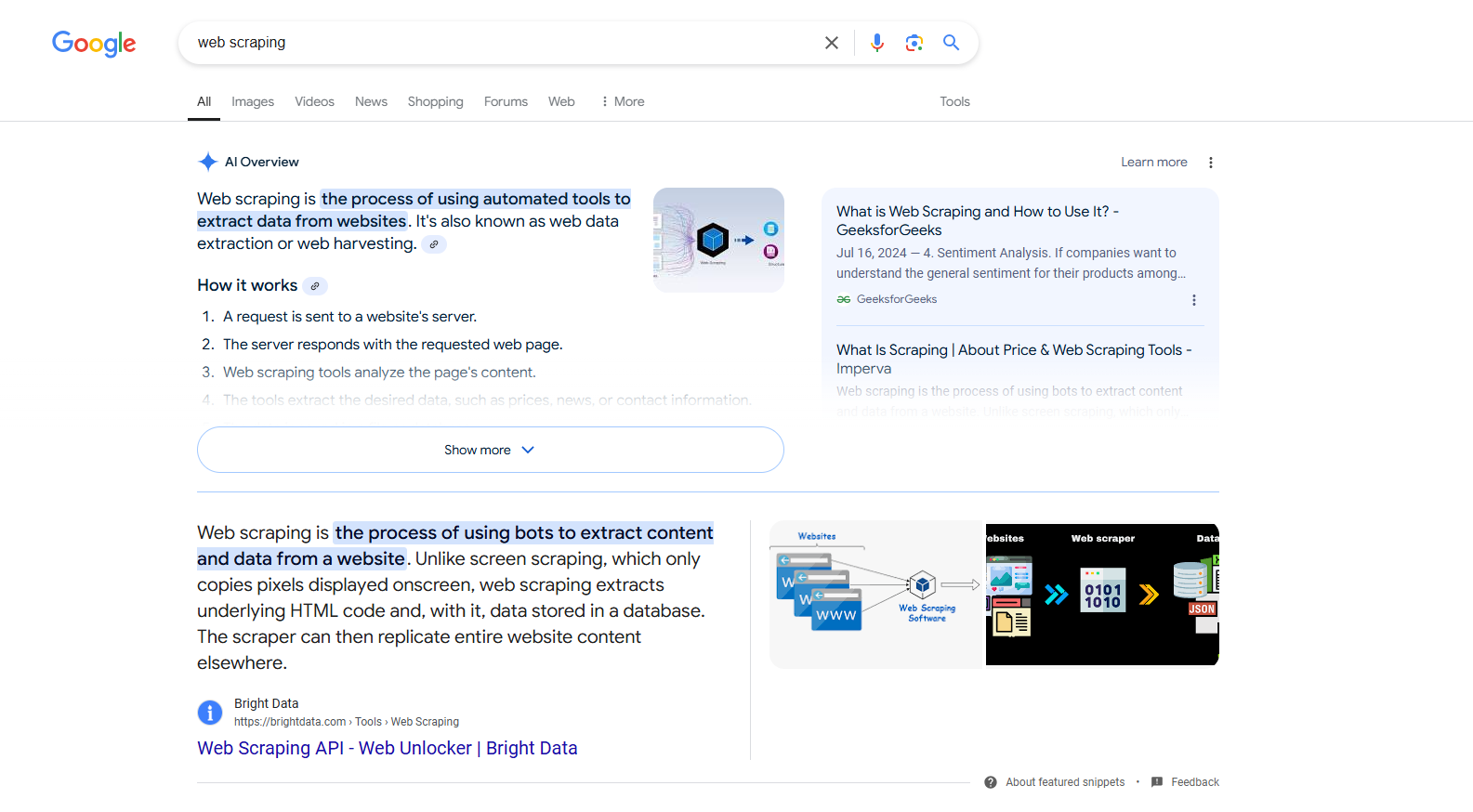
SERP - web scraping with AIO

The New Order Of Search Results

Instead of seeing Google Ads placements, featured snippets, positions 1-3, and People Also Ask, we’ll now be seeing:

  1. Google Ads take up more space, with up to 4 results that could also contain additional expanded site links.
  2. Google AI Overviews (AIO) now dominate the SERP above the fold, pushing positions 1-10 below interactive snippets.
  3. Featured Snippets take the space where positions 1-3 used to live, pushing position 1 down further.
  4. People Also Ask also comes before position 1.
  5. Position 1 starts here.

However, this is not its final state. The new layout of SERPs is dynamic; it will continue to change, and you have to be ready.

Position 1 No Longer Dominates

With position 1 pushed down at least 3 scroll lengths, this is no longer the top clicked result.

Additionally, the layout of a searcher’s query will also vary based on new advances in SERP personalization.

Now, clicks are possible in many new locations on the SERP, such as in a cited link for Google’s AI Overview (AIO).

These are not as easily trackable nor attributable.

SEO analysts and SEO strategists will see a massive impact on their traffic data and how they optimize their content to display above the fold.

Google’s AI Overview (AIO) Steals Top Clicks

Finally, position 1 on Google SERPs has seen its decline from providing at least 33% of organic search clicks to just 11% as of January 2025 depending on the search term.

Organic CTR declined ~70% when an AIO was present on the SERP.

AIO not only makes it difficult to obtain clicks, but one final change has made it nearly impossible to attribute clicks to positions.

In short:

  • You will lose traffic.
  • You will lose visibility into where your traffic is coming from.
  • You will lose the ability to strategize your content for visibility on SERPs.

What does this mean?

Google AIO and other dynamic SERP features are the new Position Zero.

2. Dynamic & Lazy-Loading SERP Content Hides Key SEO Data

Many SERP elements, especially those influenced by AI, load dynamically based on user interaction.

As we know from past SEO knowledge, dynamic and lazy-loading content cannot be seen by bots and scrapers until something triggers the content to load.

Therefore, to retrieve all the necessary data, you’ll need to simulate interactions like clicks and scrolls, which adds complexity and latency.

3. Google’s Anti-Bot Measures Removes Your Visibility To Rankings

As you can see so far, dynamic and personalized search results are more prominent.

Your favorite SEO keyword research and rank-tracking tools rely on bots to crawl the web for key data to help you build your SEO strategy.

However, Google has removed a large piece that makes that data scraping possible: bots.

Google’s evolving anti-bot measures further complicate real-time data collection, pushing platforms to the brink of what their systems can handle.

Sophisticated anti-bot defenses, such as CAPTCHA challenges, IP-based blocking, and JavaScript obfuscation, make real-time data collection a significant hurdle. Many traditional scraping tools cannot meet these challenges.

4. Personalized & Regionalized SERPs Removes Control Data

Control data is something that remains the same from one experiment to another. It enables you to have direct comparisons to build conclusions from when you’re building your SEO strategy.

The old SERP’s control data was the standardized layout. SERP layouts and results were similar enough for the same search query, meaning you could compare multiple searches for the same query to create conclusions that drove your strategy.

Now, user-specific factors like location, language, and device type create unique SERP views with vastly different orders of results.

It’s no longer simple to look at SERP data for [What is a 5-star hotel?] and know which link was clicked from which position:

  • User 1 could have been served your link in an AIO, which would not show up in classic SEO tools.
  • User 2 could have clicked on your link in position 1, which would show up in classic SEO tools.

Capturing this variability at scale while maintaining accuracy is critical yet immensely difficult.

5. Evolving Answer Content & Embracing Answer Engine Optimization (AEO)

AI-generated responses are constantly updated, with position-zero content shifting based on new data and context.

These AI-generated responses are part of an evolution of Search Engine Optimization (SEO) called Answer Engine Optimization (AEO).

You’ll need tools that have been updated to extract data from Answer Engines in real-time.

How To Gain Traffic From Position 0 & Regain Organic Traffic from SERPs

To regain your lost traffic, you’ll need to refer to more sophisticated tools to gain access to new SERP data streams to inform your organic traffic strategy.

Tools that previously helped you understand your position on SERPs are now outdated.

Rank-tracking platforms that have upgraded should be ready and able to collect data using more modern sources that align with the roadblocks above.

These tools don’t just need to collect data, they need to deliver actionable insights to help their users optimize for “The New Position 0” based on the data and AIO’s best practices. By extracting the right data and presenting it clearly, platforms empower users to improve their strategies effectively.

Here’s how platforms are leveraging Data from GenAI results:

1. Emphasizing Content Designed for AEO

Platforms will need insights into which content types (e.g., FAQs, schema markup, and structured data) are prioritized by AI-driven search engines. This will help their users create concise, authoritative content that aligns with SERP preferences, improving visibility and relevance in position zero.

2. Focusing on Position Zero Metrics

They will need metrics such as click-through rates (CTR), impressions, and engagement specific to position zero. These metrics will help their users monitor performance and refine their strategies to maintain or improve their rankings.

3. Supporting Regional and Device-Specific Insights

Platforms will need geo-targeted and device-specific data to provide segmented insights. This will help their users tailor their optimization efforts to specific regions, languages, or devices, ensuring their strategies are more precise and effective.

4. Adjusting to Conversational Queries

They will need data on conversational and intent-driven search queries. This will help their users align their content with how large language models prioritize conversational patterns, resulting in higher engagement and relevance.

SEO tools using Bright Data’s toolkit have access to all this data in real-time and at scale. That’s why the leading SEO tools choose Bright Data as their go-to data provider. Platforms leveraging these insights position themselves as indispensable tools for helping their users dominate “The New Position 0.”

Conclusion

As “The New Position 0” continues to redefine search, rank-tracking platforms face mounting challenges in delivering accurate, actionable data. Choosing the right data collection partner is no longer optional, it’s the key to staying ahead. Platforms leveraging Bright Data’s SERP API are equipped to meet these challenges, empowering their users to succeed in an AI-driven search landscape.

Bright Data’s proactive approach meant their clients experienced uninterrupted services during the disruptions that affected many in the industry. SEO tools leveraging Bright Data’s SERP API maintained seamless operations, continuing to deliver accurate, real-time insights to their users without issue.

Integrating your platform with Bright Data’s SERP API is quick and straightforward. Want to see what it’s all about? Check out the documentation here or test it out in the SERP API playground to see if it’s the perfect match for your SEO tool. When data matters, companies choose Bright Data.

This article has been sponsored by Bright Data, and the views presented herein represent the sponsor’s perspective.


Image Credits

Featured Image: Image by Bright Data. Used with permission.

https://www.searchenginejournal.com/new-seo-ranking-challenges-brightdata-spa/538084/


2025 Marketing Trends: The End Of SEO? [Webinar] via @sejournal, @hethr_campbell

Finding it tough to keep up with AI’s impact on location marketing?

You’re not alone.

AI is reshaping location marketing, and now there’s a new buzzword in town: GEO (Generative Engine Optimization).

As search evolves, it’s crucial to stay ahead of the trends and ensure your strategy aligns with how AI and search engines process location-based content.

Join us for our upcoming webinar on February 13, 2025, “2025 Marketing Trends: The End Of SEO?” where we’ll demystify the latest trends and give you actionable insights to drive results in 2025.

Why This Webinar Is A Must-Attend Event

We’ll cover everything you need to elevate your location marketing strategy.

In this webinar, you’ll get:

  • The latest AI-powered tools and tech shaping the industry
  • 5 reasons why GEO should be your new go-to SEO tactic
  • How to balance authenticity with AI-driven marketing
  • Emerging trends and their impact on Location Performance Optimization (LPO) and your Location Performance Score (LPS)

Why This Webinar Is A Must-Attend Event

This session is packed with real-world tips to help you craft high-impact, ROI-driven strategies for 2025—because even superheroes need the right tools to navigate the future.

Live Q&A: Get Your Questions Answered

Stick around for an interactive Q&A, where we’ll answer your biggest questions about AI, GEO, and the future of location marketing.

Secure Your Spot Today!

Can’t make it live? No worries—register anyway, and we’ll send you the recording.

Get ready to supercharge your location marketing strategy. See you there!

https://www.searchenginejournal.com/the-end-of-seo-webinar/537958/


AI Overviews Data Shows Massive Changes In Search Results via @sejournal, @martinibuster

Enterprise SEO platform BrightEdge published results on current AI Search trends, showing that Google AI Overviews (AIO) has expanded its presence by up to 100% in increasingly complex search queries. The changes suggest growing confidence in AI for search, with indications that Google is relying on authoritativeness and greater precision in context awareness for matching queries to answers, particularly in relation to content modality.

The data shows that AI Overviews (AIO) has evolved from showing featured snippet style answers to being capable of handling multi-turn, complex search queries. The takeaway is that Google is increasingly comfortable with AI’s ability to surface precise answers for longer queries and this is a trend that may continue to rise.

Google AIO Presence Is Growing

Google continues to show confidence in their AI Overviews (AIO) search feature as BrightEdge has discovered that more keyword phrases are triggering AI answers now than at any point since the feature was rolled out last year.

25% of search queries using 8 words or more are displaying AI Overviews (AIO), which is a clear upward trend indicating that Google continues to refine the accuracy of AIO and is better able to handle increasingly complex search queries.

A graph shows how the keywords with 8, 9, and 10 words continued to increasingly show AI Overviews

Graph Representation Of AI Overviews Growth

Keyword phrases with less than four words continue to show an increasing amount of AIO but the growth in longer more precise keywords is growing significantly faster.

Screenshot Showing Percentage Of Keywords With Google AI Overviews

Change In AIO Patterns: Gains For Authoritative Brands

BrightEdge provided additional data that looks at specific topic categories, showing how queries for some topics consolidating to answers from big brand sites.

For example, in the healthcare category where accuracy and trustworthiness are paramount Google is increasingly showing search results from just a handful of websites. Content from authoritative medical research centers account for 72% of AI Overview answers, which is an increase from 54% of all queries at the start of January.

15-22% of B2B technology search queries are derived from the top five technology companies such as Amazon, IBM, and Microsoft.

Qualities Of AIO Answers

BrightEdge data reveals that AIO answers follow certain patterns that reveal qualities that Google feels make content more relevant.

  • Excels at step by step and how to answers (structured hierarchical information)
  • Shows precise real-time relevance
  • Answers lean toward general guidance

Educational Search Queries

For educational queries AIO shows a preference toward concise answers with a clean visual presentation. In the below example Google is hiding content that has additional information that answers additional questions beyond the main query. This may relate to Google’s information gain patent which is about anticipating additional information that a user will be interested in after receiving the answer to their original search query.

AIO Showing Information Gain Ranked Content

Change In YouTube Citations

An interesting pattern picked up by BrightEdge is that YouTube technical tutorials have increased by 40% in AIO while health related queries that show YouTube videos are trending downward by 31%.

Of particular interest is that the high volume search queries (100k+ search volume) that trigger YouTube content have decreased by 18.7%. This may reflect a change in user needs and Google’s ability to identify that context and understand that it’s not served well by video content.

What all of this means is that it’s increasingly important to think about context awareness, the appropriateness of the content to the query. The question to ask is what kind of content best serves the context and to expand that answer across modalities like images, sound, video, and text, then within those formats think in terms of how-to, data dump, informative, etc.

BrightEdge observes:

“Most Interesting Pattern:
AI Overviews are developing sophisticated, context-aware citation models. While YouTube citations are declining for health queries (e.g., “symptoms,” “diet”), they’re increasing for technical how-to content, jumping from 2.0% to 2.8% of citations in this category.

Pay Attention:

1. Context is King – Focus video content where it’s gaining traction (technical tutorials, DIY) and pivot to text for topics where traditional authority is preferred (health, finance)
2. Match Your Industry’s Pattern – In sectors with distributed authority (like B2B tech at 15-22% per source), focus on direct citations; in consolidated spaces (like healthcare at 72% institutional),

partner with established authorities

3. Monitor Actively – With citation patterns shifting dramatically in just one month, weekly monitoring of your space is crucial to spot new opportunities before competitors”

Takeaway

A way to make sense of the data is that it Google AI Overviews appear to be increasingly relying on the authoritativeness of the content as the stakes go higher with more complex search queries.

Authoritativeness isn’t just about being a big brand but it may have to do with simply being meaningful to the Internet audience as a go-to source for a particular topic. Trustworthiness and other related factors are important and this has nothing to do with superficial SEO activities like author bios and so on.

Read the data:
How AI Giants Are Carving Distinct Territory in the Search Landscape

https://www.searchenginejournal.com/ai-overviews-data-shows-massive-changes-in-search-results/538878/


Google AI Overviews Found In 74% Of Problem-Solving Queries via @sejournal, @MattGSouthern

Write a summary for this article using no more than 20 words that would be suitable for a news publication

A new report shows that AI Overviews (AIOs) in Google’s search results are uncommon but significantly affect visibility and user engagement.

Authoritas’s study examines how generative AI Overviews impact organic search performance. In December, the team analyzed search data for 10,000 keywords across seven U.S. industries.

The report highlights the growing impact of AI Overviews and explains trends, user intent, and the search volume levels that trigger AI-driven results.

Key Findings

1. AI Overviews Appear In Less Than One-Third of Searches

AI Overviews appeared for 29.9% of the 10,000 keywords studied but made up only 11.5% of the total search volume.

High-volume keywords are less likely to have an AI Overview than mid-range search terms, with monthly search volumes between 501 and 2,400. About 42% of keywords in this mid-range featured an AI Overview.

Takeaway: While AI Overviews are limited in overall presence on search engine results pages (SERPs), they are more common for mid-volume queries. This indicates that there are opportunities in areas with lower competition.

2. Industry and User Intent Are Major Influencers

Telecommunications had the highest percentage of keywords linked to AI Overviews at 56%, while Beauty and Cosmetics had the lowest at 14%.

Queries aimed at solving problems or asking specific questions most often triggered AI Overviews at rates of 74% and 69%, respectively.

Conversely, navigational queries, like searching for a specific website, rarely resulted in AI Overviews. This shows that AI Overviews focus on general information rather than direct navigation.

Takeaway: Content that answers questions or solves problems is more likely to appear in AI Overviews. Brands in more straightforward industries should explore topics where complexity or perceived risk drives research.

3. Non-Brand Terms More Likely to Produce AI Overviews

About 33.3% of non-brand searches show an AI Overview, while only 19.6% of brand searches do.

Brand searches usually happen closer to purchasing, but AI Overviews for informational brand queries can still help shape how people view a brand.

Takeaway: AI Overviews might slow potential customers’ buying process, but they can help influence how users see a brand in the early and mid-decision-making stages.

4. Impact on Traditional Organic Results

When you expand the AI Overview on desktop by clicking “Show more,” the page moves down by about 220 pixels. This shift often lowers organic search results on the screen.

On mobile devices, only one or two organic listings are visible without scrolling, making it harder for SEO professionals.

Takeaway: Since AI Overviews occupy significant space at the top of the search results page, brands must find ways to stay visible. They should focus on appearing in the AI Overview’s answer links and the regular organic results below.

5. Overlap with Traditional Rankings

High-ranking URLs are likelier to appear in AI Overviews, but this isn’t always true.

About half of the top-ranking pages are included in AI Overviews, and some pages outside the top ten may appear too.

Featured Snippets often coexist with AI Overviews. If you have a Featured Snippet, there’s a better than 60% chance you’ll also be mentioned in the AI Overview.

Takeaway: A high rank or Featured Snippet doesn’t guarantee an AI Overview link, but optimizing for these can improve your chances. To remain competitive, keep producing clear and authoritative content.

6. Trust & YMYL (Your Money or Your Life) Topics

Websites known for their expertise, especially in finance and healthcare, are commonly included in AI Overviews.

In contrast, despite having strong rankings in search results, sites like Reddit and Quora are mentioned less often in AIOs.

Takeaway: Websites with reliable voices, verified information, and trustworthy content will likely be cited in AI Overviews.

Conclusion

AI Overviews are still relatively new, but their impact is significant, especially for common or problem-solving questions.

If your website is in an industry requiring detailed research or high stakes, you may see more AI Overviews and tougher competition for top citations.

Even if you don’t see many AI Overviews in your area now, this could change as Google improves its language models and collects more user information.

For SEOs and advertisers, there are two main concerns:

  1. Determine which terms or user intents attract AI Overviews and adjust your content or advertising strategies accordingly.
  2. Keep focusing on essential practices, like optimizing for Featured Snippets and E-E-A-T signals. This will increase your chances of being cited in the context of AI Overview.

The complete study and accompanying whitepaper offer more granular insights into the appearance of AI Overviews.

https://www.searchenginejournal.com/google-ai-overviews-found-in-74-of-problem-solving-queries/538504/


Google Confirms Alt Text Is Not Primarily An SEO Decision via @sejournal, @martinibuster

Google’s John Mueller shared Jeffrey Zeldman’s Bluesky post reminding publishers and SEOs of proper alt text usage, including a link to the W3C decision tree for guidance. The most important takeaway is that the decision process for alt text is not primarily an SEO decision.

The W3C (World Wide Web Consortium) is an international standards making body for the Internet. A lot of the guidance that Google provides about how Googlebot crawls HTML and treats server response codes are based on the web standards developed by the W3C, so it’s always a good idea to go straight to the source to understand exactly how to deploy HTML (like alt text) because doing it the right way will very likely align with the same standards that Google is using.

A decision tree is basically a decision making tool or diagram that asks a yes or no question. If the answer is “no” then the tree leads to another branch. Answering “yes” leads to a node that advises on what to do. The purpose of the W3C Alt Text decision tree is to guide publishers and SEOs on the proper use of alt text, which is for accessibility.

The decision tree that Zeldman linked to has five questions:

  1. Does the image contain text?
  2. Is the image used in a link or a button, and would it be hard or impossible to understand what the link or the button does, if the image wasn’t there?
  3. Does the image contribute meaning to the current page or context?
  4. Is the image purely decorative or not intended for users?
  5. Is the image’s use not listed above or it’s unclear what alt text to provide?

Google’s John Mueller Affirms Proper Use Of Alt Text

John Mueller did a repost on Bluesky with the additional insight that the decision making process for alt text is not “primarily” an SEO decision, meaning that accessibility should be the first consideration when deciding how to use alt text.

This is what John Mueller said about alt text:

“The choice of ALT text is not primarily an SEO decision.

If you like working with structured processes, check out, bookmark, share, and use this decision tree of when & what to use as ALT text, when it comes to accessibility.”

Zeldman’s post praised the simplicity of the decision tree:

“So straightforward, so good. An ALT text decision tree. “

Someone else posted a link to an interactive version of the decision tree called the “Alt text decide-o-matic” which is a different way to interact with the decision tree.

Check out the W3C Alt text decision tree here or try the decide-o-matic to become better acquainted with alt text best practices and become a better SEO and publisher in the process.

Related: Google Shows How To Use Alt Text For SEO

Featured Image by Shutterstock/Master1305

https://www.searchenginejournal.com/google-confirms-alt-text-is-not-primarily-an-seo-decision/538412/


Brand Performance Unlocked: Advanced Strategies for SEO and Marketing Synergy via @sejournal, @sejournal

Balancing brand and performance marketing has nothing to do with giving each side its amount of time in the limelight.

There’s no magic harmony you’re going to create that delivers some sort of marketing tactic equilibrium and equality.

This is the most controversial article I have ever written. A lot of people reading this will not be happy about what I have to say. For the record, there’s a bit of irony in this, considering I have said way more controversial things about marketing and SEO in the past.

Yet, here we are as I am about to tell you that the only way to balance brand and performance marketing is to give brand supremacy.

Let the fireworks begin.

Balance Brand & Performance Marketing? Why Is There Even A Problem?

In keeping with espousing heresy I will not start this post with “What is brand marketing?” and/or “What is performance marketing?” nor will I dive right into how to balance the two.

Instead, I’m going to challenge the very premise of the article so that you can better understand why this question is even worth your time.

While I see the problem as basically being self-evident, let’s flush it out a bit. The way I see it, there are two fundamental issues at play here (there are more, but this post is going to be long enough as it is):

1. Mindset

The mindset required for good brand marketing is, at times, lightyears away from the performance mindset.

I’m not saying that they intrinsically have to be this way. As I’ll get into later, I think the two ways of thinking complement each other.

However, at the risk of generalizing, there does tend to be a strong divergence between how the two types of marketers think. At least, this has been my experience over the past decade or so as someone who straddles both marketing disciplines.

I often find performance marketers very focused on the immediate. What’s bringing traffic right now, and how do we get more of it?

For the record, that’s not necessarily a bad thing. Nor is it unreasonable (I mean, it is, but it’s not).

This hyperfocus on immediate performance metrics is quite logical since performance marketers are graded on immediate ROI. Is it thus any surprise they focus on the immediate? (So, performance marketers, it’s not you…it’s the system.)

Brand has an entirely different goal. With brand building, the focus is on exactly that: building. Building an identity, associations and sentiment, messaging, positioning, etc.

All of that takes time. You don’t immediately leave an imprint on someone. If you want to create an impression with an audience, it’s pretty obvious it’s going to take time.

This process is also far more compounded and less linear than performance marketing is often perceived. It’s not like getting a page to rank well and driving in traffic who will convert.

You’re creating a reputation for yourself that involves micro-moments and micro-activities compounding over an extended period (like how any association is formed).

(For what it’s worth, I would argue that performance-based activities, such as SEO, also compound over time. You’re not going to rank for that meaty keyword on day one).

Brand marketing naturally lends itself to a bit more of a holistic long-term mindset whereas performance-based marketing lends itself to focusing more on the immediate impact of a given activity.

These divergent mindsets make it entirely difficult to properly balance brand and performance. They’re almost at war with each other.

To sum it all up: Performance marketing (to its detriment) looks at the end result and often doesn’t care about context, environment, and ecosystems. Brand, on the other hand, is all about contextualization and understanding the environment and ecosystem the brand is operating within.

Now, you might be thinking, well a lot of brand marketers also seem to care less about context, environment, and ecosystems and generally operate in the here and now much like a performance marketer might.

Which brings me to my next point.

2. Misunderstanding What Brand Is

Part of what makes balancing brand and performance marketing almost an inherent difficulty is the lack of understanding of what “brand” actually is.

Too often, what we call “brand marketing” is really performance or product marketing disguised as brand marketing.

What happens is that a company will put emphasis on brand when in reality it’s just another form of performance marketing. The net result is a lack of balance but without even realizing it.

Imagine a TV commercial that doesn’t have a message or any positioning but rather simply tells you what the product is and what it does. Is this brand marketing? I say no. This is just product marketing. It’s pure product awareness.

The web is filled with the equivalent of this.

You talking about your product or service across the internet is not brand marketing; it’s product marketing.

Brand marketing is entirely about who you are in the context of who your audience is and how you want to then be perceived. It is fundamentally associative. If it’s not associative, it’s probably not genuine brand marketing. That is a hot take right there.

Branding is about putting yourself in a position to grow; it is not growth per se. If brand marketing were farming, it wouldn’t even be planting the seeds; it would be sowing the soil so that you could eventually plant the seeds.

Brand is concerned with perception and momentum, not adoption. I know that sounds crazy, and half of y’all out there on both the brand and performance side of marketing are shaking your heads, if not your fists, right now.

But it is the truth. Real brand marketing, the kind you see the Cokes and Lexuses of the world doing, is about perception that leads to momentum. It’s about putting you in a position to grow and to have opportunities that you can capitalize on.

How Do You Then Balance Brand And Performance?

Brand is the setup for performance. Brand creates the opportunity, and performance captures it.

It’s all one dance.

Allow me to explain.

Brand Is Primary, And Here’s Why

Balancing performance and brand marketing isn’t about some sort of give-and-take between the two approaches. If you’re thinking about balance in terms of scales, that’s not how this is going to work.

It’s about knowing where each discipline sits in the “marketing hierarchy” and how the two interact.

This is why I am telling you brand is primary – and it’s not even close.

There are two fundamental ways brand is primary to performance marketing (I was going to insert another, but I think for now these two are the most important):

The Ultimate Goal Is To Have People Come To You

Brand is primary in the very goal it sets out to achieve – to bring audiences to you (as opposed to you chasing your audience across social and search screaming “Pick me! Pick me!”).

It’s like the old line from the Cheers theme song, “You wanna go where everybody knows your name.” No one wrote a line in a sitcom theme song that said, “You wanna go chasing everyone around the block screaming like a mad person so that they will know your name.”

Consumers knowing who you are and seeking you out is self-evidently more advantageous than trying to chase after your consumer base and hoping to heaven you found them at the right moment in the buyer journey.

In case it’s not entirely self-evident (because I have heard performance marketers say the complete opposite), people coming to you creates more momentum and opens up new revenue possibilities than the inverse ever could.

Buzz is contagious. I’m not saying you need to go viral or anything like that, but creating momentum naturally leads to more momentum. The momentum your brand creates for itself leads to all sorts of new possibilities.

Being sought after on whatever level builds upon itself. If done with care and patience it can create real stable opportunity growth for you. This is really what any serious company wants: long-term stable growth. Nothing is more long-term and more stable than being sought after and enticing.

Serious connections with your audience are hard to create but they are hard to really break as well.

Unless you become a known quantity in your niche, no amount of performance marketing is going to help you achieve what you really want: self-sustained staying power.

Brand helps fulfill the ultimate goal any company has: to be a market leader.

Brand Is What Allows Performance To Perform

Can pure performance marketing perform (for lack of a better word)? Yes, obviously.

Can it reach its true potential without brand? No.

Brand marketing is what creates the willingness to invest and interact with your performance marketing.

Imagine you’re on a train, and some random goofball starts waving at you. Are you gonna wave back? And even if you do, are you really interested in interacting with this person?

Now imagine instead that some random whacko your friend sees you on the train and waves. Would you wave back? Wave? You might go on mosy over and have an actual conversation.

Performance without brand is randomly waving at people and hoping that they converse with you. Sometimes they might, but you’re fighting an uphill battle.

Creating a connection with your audience that exists beyond utility is what enables your performance marketing to perform the way you want it to.

To use an SEO analogy, trying to get your product or service to perform without brand is like trying to get a single page on a new website to rank for a highly competitive keyword without any other content history to support it.

Effectively establishing your brand is what enables you to make the pitch that can covert at the appropriate time.

That’s why I would say 99% of brand marketing is not about trying to build revenue. It’s about building the possibility of building revenue. It’s about building cadence and momentum so that the part of your marketing that asks folks to open their wallets works.

Brand puts you on the doorstep of performance. In effect, brand creates the lead, and performance signs the deal.

Like I said earlier, if marketing were a farm, then branding wouldn’t even be planting the seeds. It would be sowing the ground so that you could plant them. And like a field, if you don’t sow it first, you will not have a crop.

If you want revenue without fighting an uphill battle, you have to realize that brand is primary. It is what allows your other marketing activity to perform as you really want it to.

This goes back to what I was saying earlier about people not understanding what brand is.

As far-out as it sounds, brand is not about revenue, it’s about building the opportunities that will eventually lead to revenue. Understanding this one point puts you so far ahead of everyone else.

The Problems In Giving Performance Primacy In A Balanced Approach

Let’s take this from the other side of the coin. What would happen if you gave performance primacy, not brand?

If performance is the building block of the marketing strategy you’re setting yourself up for significant problems down the road.

There are more than a few reasons why this is true, here are some of the more notable ones:

Performance First Means Working With Your Hands Tied Behind Your Back

I don’t even know where to start with this one because a performance-first mindset limits you in so many ways.

Broadly speaking, performance being primary, as I mentioned earlier, means fighting an uphill battle. You’re constantly trying to find the right audience at the right time and then convincing them to funnel through.

Yes, you can get to a good place that way but it’s never really working on its own for you. You never really become a “thing” this way and can’t naturally build momentum upon your activities the same way.

Again, a) I spoke about this at length above b) I am sure you will find me a case where I am wrong – that’s not my point.

On top of that, performance generally tends to be siloed – an obvious inefficiency. Link builders do link building, PPC does paid, etc. – there’s a general lack of broader strategy and comms when performance takes the lead.

Each team has its own KPIs and does whatever it takes to meet them, resulting in obvious inefficiency.

Performance Will Pigeon-hole You Every Time

Because performance marketing is very here-and-now, it generally lacks the flexibility to build for the future.

Doing what’s best for the KPIs is too often doing what’s best in the immediate only.

That means a lack of flexibility in both structure and activity.

I’ll give you a great example of what I mean when I say performance limits a business structurally.

While this case may sound “far-fetched” today, SEOs who have been around a while will search their feelings for they know what I am about to say to be true.

Back in the day, if I had a site that sold DVDs, “the SEO play” would be to name the site “buydvds.com,” or whatever.

It’s generally not a good idea to name your brand after a specific tech asset as, well, tech assets change. In this case, DVDs are basically defunct.

Now the business here may have pivoted to streaming media but now has to deal with a whole rebrand (including a site migration) and all of the immense headaches that come with it. What they should have done at the onset was name the site something like “entertainmentmedia.com” or whatever.

Why didn’t they? Because the performance play became primary, and the brand play was discarded.

Performance, by its very nature, lacks breadth and as a result, will often limit the scope of how the business is able to function or structure itself.

The other way performance limits a business relates directly to the marketing activities performance signs off on and doesn’t sign off on.

Now, if you think I’ve been a bit salty thus far…hold my beer.

What performance-based marketing does to overall marketing activities is the equivalent of a marathon runner deciding to amputate their foot mid-race while maintaining the expectation to break a world record.

To see this in action, look no further than what happens when performance owns a content strategy.

What is the value of content in the context of performance? Impressions, clicks, traffic, conversions, etc.

You see this all the time in the SEO space. You can’t go a week without seeing someone somewhere ask, “If a keyword has 0 search volume should I bother writing content for it?”

Every time I see this question, a piece of me dies.

Not because it might not be true. There might not be a ton of search volume but because that’s a not reason not to write a piece of content.

Leave aside the fact that your current users may expect that content to be there on your site, it could signal the same expectation to new consumers hitting the site for the first time. Also, content is a corpus. You have to build it up to the point where you can write that post for that money keyword.

Performance marketing never asks, “What does writing this content allow me to do next?”

Instead, it’s always, “Why does this content do for me right now?”

Pigeon-holed.

Folks Might Use You, But They Also Might Hate You (And Is That What You Really Aim To Do?)

My sister recently told me how she’s so reliant on Amazon but hates using them at the same time due to how they allegedly treat their workers.

It’s entirely possible that folks may consume your offering but will not be fond of you when doing so. It’s also almost certain that your brand can’t get away with it the way Amazon can.

If all you’re thinking about is traffic KPIs and conversions, etc., you’re missing the most fundamental aspect of success – likability.

It doesn’t even have to be so extreme. Look at the oversaturation of content between Marvel and Star Wars (and even my personal favorite, HBO’s Hard Knocks NFL documentary series).

Sure, they get viewers, but it all comes with negative sentiment. While the end product of Hard Knock’s new preseason series was actually not bad, New York sports radio (the series featured a New York team) trounced HBO before its release.

For a week, every sports host was basically shaking their heads at the idea of having to watch a whole series about phone calls between General Managers making trades, etc. So HBO got the numbers but accumulated a lot of brand baggage to do it.

How smart is that as a long-term strategy?

That’s, fundamentally, a testimony to the fact that brand can assess a move qualitatively while performance just can’t.

That’s not to say performance’s quantitative measurement isn’t vital. It’s a very important part of this brand balancing act.

If Brand Builds, Then Performance Course Corrects

I don’t want you to walk away thinking that performance marketing doesn’t hold value. This article isn’t about brand being better. It’s about the balance.

Brand needs performance to leverage its full power, just like performance needs brand. Again, brand can set you up, but performance closes the deal. Brand, for example, can set up a business to have the authority it needs to pull in organic traffic.

But you need a genuine SEO strategy that includes things like keyword targeting, etc. In this specific case, a performance-based mindset is what will take the brand from potentiality to actuality.

Very often, brand course corrections should be based on the data performance marketing provides.

If there’s a drop in whatever KPI whether it be sign-ups or traffic or whatever, it’s often a change in brand and business strategy that’s needed. That change can’t occur unless you have the data insights performance marketing provides.

Take Starbucks. At the time of this writing, they’ve seen a decline in business, and there are multiple reasons for it. What I found interesting was the user sentiment towards Starbucks’ “corporate identity.”

In an interview with CBS, one customer said, “Starbucks started really feeling like corporate America in a way it hadn’t before.”

If I were Starbucks, I would at least explore the idea of creating a sub brand that is more niche and local. Much the way the beer companies did when they saw craft beer sales surge (hence Coors created Blue Moon).

That sort of shift in brand strategy can’t possibly occur without the insights offered by performance marketing. You have to have sound performance marketing processes in place to effectively run your brand marketing.

So when I say brand is “primary,” I mean that in the sense of the stages of marketing thought and activity.

Not necessarily importance (I do think brand is fundamentally more important, but that’s, again, not what this post is about). You literally have to balance (maybe integrate is a better word) performance into your brand marketing in order to be effective.

Can’t Performance Build Up The Brand?

Doing this is like trying to pull a whale through a needle hole.

Yeah, I guess it might be technically possible, and someone out there did it – but it is not the norm. Upon considering this, I am sure no one has pulled a whale through a needle hole, but I think you get my point.

You are trying to build up a tidal wave one raindrop at a time. Yes, it is possible, but it goes against the very foundation of what you’re trying to actually do – gain momentum.

I’ve heard the argument that by ranking for this and that query and everything in between, you will become an established presence – a brand.

That can be possible. And yes, your content strategy (SEO and beyond) is a big part of your brand strategy. But thinking about something like Google Search as being the method to establish a brand reputation is a chaotic way to go about building a brand.

To start, Search isn’t a medium where your audience may even be interested in “hearing from you.” They may have a specific need at a specific moment that brings them to search. Once that need is met does the user really care to explore more about your product or service? It’s a toss-up at best.

It’s like trying to have a conversation with someone in the middle of a lecture – it’s just not conducive.

You want to have a conversation and make a connection in a place and time that is meant to have a conversation and connection (social media, YouTube, live events, etc.).

Using something like Search to establish a distinctly recognizable brand is just not what Search is.

SEO and search engines are a great way to supplement and reinforce the messaging and positioning you establish on more suitable platforms.

If a consumer sees you on social and interacts with you over time and then goes to search and keeps seeing your results pop up it can reinforce your positioning. It may even make it likely to get a conversation out of it.

What makes performance hard in terms of it being the method to establish a brand is that the assets usually associated with it (PPC, SEO, etc.) are secondary branding assets in the context of how users discover them.

They can supplement, accent, and reinforce, but they are not designed to be primarily effective at establishing a brand identity and audience connection.

Think of it like the difference between someone specifically coming to your blog after interacting with your brand for years on social versus someone who finds a single post on Google.

Yes, they both might read the same content but in the latter case, there is no identity contextualization. They don’t know who you are and how that post fits in with your overall identity and positioning. They get the information in the post but in terms of getting “you,” it’s not very direct.

The way the audience interacts with your brand via performance marketing activity is far too limited and narrow in scope for identity contextualization to easily take place.

So it can happen, and it does happen a bit each time that person interacts with your content (say via search), but it’s piecemeal and disjointed.

Better Balance Means Better Marketing

Balancing brand and performance means knowing the role and place of each marketing discipline. It means allowing the two areas to interact and influence each other at the right time and in the right way.

While it all starts with branding at the onset, the relationship between the two areas of marketing should grow to be reciprocal. Brand should open the doors for performance and performance should help the brand evolve.

For too long, the digital marketing space has siloed these two areas, with inefficiency (and more) being the net result.

The future of marketing is being able to unite these two concepts effectively. I think there is a lack of attention given to how brand impacts performance efficacy (and vice versa).

Uniting the two areas of marketing will better align with where the web and its user base are headed.

More resources: 


Featured Image: Jack_the_sparow/Shutterstock

https://www.searchenginejournal.com/rundowns/brand-performance-unlocked-advanced-strategies-for-seo-and-marketing-synergy/


Data On Fastest Growing Sites Yields Surprising Insights via @sejournal, @martinibuster

The competitive research tool similarweb released its Digital 100 list of sites with the largest growth in traffic, providing insights into what’s driving traffic growth across various informational and shopping categories.

Gig Economy Shows Strong Growth

The website with the most growth is JustAnswer.com, a gig economy platform that enables consumers to consult with experts such as doctors, home repair experts, lawyers, and veterinarians. JustAnswer.com experienced 81% year over year visitor growth, soaring from 11.6M monthly unique visitors (MUVs) in 2023 to a whopping 21M visitors.

JustAnswer.com’s performance highlights the popularity of the gig economy with consumers and freelancers who are able to share their expertise without the overhead of a storefront and traditional advertising

ChatGPT Shows Strong Growth

ChatGPT kept on growing in 2024, surging by 33% from 28.8M monthly unique visitors (MUVs) to 38.2M MUVs.

News Site Category Experiences Growth

Fifty percent of the top ten fastest growing sites were in the news industry. Growth in traffic to news sites increased year over year with the recent American election driving a large part of that growth.

  • Newsweek.com 71% growth, increasing from 27.2M in 2023 to 46.4M in 2024.
  • APNews.com experienced 47% growth, increasing from 26.1M to 38.4M visitors in 2024.
  • Traffic to ABCNews.go.com grew by 35% year over year, growing from 19.6M visitors in 2023 to 26.4M site visitors in 2024.
  • Fortune.com experienced 33% growth with traffic soaring from 12.6M to 16.7M visits in 2024.

The surprise winner in the news category is Substack, the news outlet for trustworthy independent news content. Substack is a platform that allows journalists and other writers to monetize their talent, keeping 90% of their earnings. Substack experienced 37% growth in traffic, increasing from 13.8M visitors in 2023 to 18.9M visitors in 2024.

Similarweb shared:

“Unsurprisingly, in an election year, news sites saw high growth. The real surprise? Half of the top 10 fastestgrowing US sites were news-focused. Like Newsweek (up 71%). But among the traditional sites is Substack — our
overall Digital Winner. Its success suggests consumers are increasingly seeking independent news sources.”

Apparel Websites

Similarweb’s statistics for apparel websites shows where consumer trends are and also has surprises related to the kinds of top level domains consumers feel comfortable with.

Similarweb’s insight on this category:

“The sportswear and sneakers craze shows no signs of slowing down. JD Sports emerged as the overall Digital Winner in the category — 150% growth in monthly active app users and 35% in web visitors. Additionally, the growth of Discount Divas and Depop reflects the rising demand for sustainability and affordability in fashion.”

Biggest Growth In Apparel Category

Peppermayo.com experienced the strongest growth for apparel websites, rising from 416% from 58.8K monthly unique visitors in 2023 to 303.7K in 2024. T

Most Actual Traffic

The apparel website with the most actual traffic is Quince.com, a fashion company that offers fashionable clothing for men and women at reasonable prices. They’re not fast fashion but focus on every day staples as well as clothes that an adult man or woman might wear on a night out or on vacation. Judging by the images posted on their site it looks like they’re focusing on a relatively underserved segment of the clothing consumer from the thirties on up and they’ve certainly cracked it because their monthly unique visitors jumped 176% from 2.06 million monthly unique visitors to 5.68 million visitors. How did they do it? Something that may be contributing to their success is that Quince encourages their customers to leave reviews with images, which in turn makes it easier to see how the clothes fit on real people and read the reviews on the clothes. The discounts offered to repeat customers and their liberal return and exchange policies encourage a positive user experience, a strategy that made a company like Zappos wildly popular in the early 2000s.

Something else that’s interesting about the apparel website rankings is that there are two .US top level domains, one .SHOP generic top level domain, and one site with a hyphen in it, showing how consumers are okay with domains that aren’t dot coms and that a hyphenated domain name can still work fine.

Here are the top ten by year over year growth (2023 to 2024) for apparel websites:

  1. peppermayo.com 416% (58.8K to 303.7K MUVs)
  2. babyboofashion.com 210% (80.2K to 248.6K)
  3. sopula.com 207% (38.9K to 119.3K)
  4. jeanpaulgaultier.com 198% (85.9K to 256.2K)
  5. edikted.com 182% (167.1K to 471.8K)
  6. quince.com 176% (2.06M to 5.68M)
  7. retro-stage.com 167% (69.3K to 184.6K)
  8. disturbia.us 154% (78.9K to 200.2K)
  9. amberjack.shop 140% (55.6K to 133.7K)
  10. clubllondon.us 139% (111.5K to 266.5K)

Serving Niche Product Consumers

Other notable rankings are in consumer electronics which shows the value of offering useful products at a reasonable price point to value ratio like SharkNinja vacuums. SharkNinja.com improved their traffic by 187%, going from 98.9K to 283.7K monthly unique visitors. SharkNinja offers popular and well reviewed products.

The other notable consumer electronics brand making big strides in traffic is Yotoplay.com, which offers a unique product that may be higher cost but appeals to parental values. The screen-free children’s audio player electronics company Yotoplay.com increased traffic by 130%, going from 199K monthly unique visitors in 2023 to 457.6K monthly visitors in 2024. Their secret is offering parents a screen-free way to engage young children with stories, music and learning with a device that’s easy for little kids to use together with their parents.

Both of these sites show how profitable it can be to focus on a narrow niche, understand your customers and deliver a quality product and experience.

Read similarweb’s post about their data:

Digital 100 – The Official 100 Fastest-Growing Companies Online in 2024

Read the PDF version of the report that contains detailed data.

Featured Image by Shutterstock/Gearstd

https://www.searchenginejournal.com/data-on-fastest-growing-websites/538034/


How Use WordPress Multisite To Create a Website Subdirectory via @sejournal, @atuljindal01

WordPress Multisite is a feature for managing the structure and multiple sites from a single WordPress installation.

In this article, I’ll share the step-by-step approach to creating a new WordPress website or converting an existing WordPress website into a WordPress Multisite.

But before that, let’s understand the basics of WordPress Multisite.

What Is WordPress Multisite?

WordPress Multisite enables you to create and run multiple websites on the same WordPress installation. It is like having one central hub to control an entire network of sites.

Websites on a Multisite network share core files and databases, making it easy for network administrators to manage all websites from one WordPress user account.

The reason why businesses opt for Multisite is because it helps save both time and money. Plus, it takes less server space than separate installations.

To know WordPress Multisite better, let’s look at some of its significant features:

  • Centralized management: Allows you to control all your websites from one single dashboard.
  • Shared themes and plugins: Use your website anywhere after you install these shared themes and plugins.
  • User management: Enables you to create super admins to oversee the entire network.
  • Domain mapping: Facilitates you assigning unique domains to each site in your network.

How Does WordPress Multisite Work?

To understand the functionality of WordPress Multisite, you need to understand WordPress user roles and how they differ. By default, a standard WordPress site has five user roles:

  • Administrator (site Admin).
  • Editor.
  • Author.
  • Contributor.
  • Subscriber.

However, for WordPress Multisite, there is one more user role called super admin. There are six user roles for WordPress Multisite:

  • Super Admin (own/control – all sites of multisite network).
  • Administrator (site Admin) – controls one website of the network.
  • Editor.
  • Author.
  • Contributor.
  • Subscriber.

For a regular WordPress website, the site admin has administrative access to only one website. As there is just one website on the network, the admin controls only that website.

Site admins can add users, but only to the websites they administer. They cannot install WordPress plugins or themes, but they can choose which ones to activate or deactivate.

However, in WordPress Multisite, the super admin has access to more than one website.

The super admin, also known as the network admin, controls a whole network of websites and has activated Multisite initially.

They also have access to every website’s network admin setting and dashboard within the network. Super admins can also map custom domains.

Pros And Cons

After weighing the pros and cons of WordPress Multisite, it will become easy for you to decide if it aligns with your specific needs and technical expertise.

The Pros

  • Easy To Manage: With Multisite installation, you can control multiple sites from one admin panel. There is no need to switch and log each site separately.
  • Efficient Updates: You can apply core updates, plugin updates, and theme changes across all your websites with just a few clicks.
  • Easier Delegation: WordPress Multisite enables you to assign site-level admins to network sites to make it easy to share site management tasks.
  • Scalability: The best part about Multisite websites is that you can scale it as your business grows, as unlimited WP subsites are allowed under one URL. It will also enable you to delete the old ones that are not required without impacting the rest of the network.
  • Targeting Marketing And Branding: Multisite websites let you create tailored experiences for different geographic regions, product categories, and customer segments. For instance, if you’re doing SEO and link building, you can promote content in a much more geographically or niche-relevant way.
  • Greater Control: When you use multisite, you have greater control over using plugins and themes for each site. This lessens the risk of bad plugins or themes, which can compromise the security or performance of the entire network.
  • SEO-Friendly: WordPress multisite can help with SEO as well. You can properly structure your website and content for languages, locations, topics, products/services, etc. Having a well-structured website helps Google to understand your website easily. Also, you can track and understand which part of the site is performing well (even for Google algorithmic updates) and adjust your SEO strategy accordingly.

The Cons

Here are some of the drawbacks of using multisite:

  • Performance Issues: One of the major challenges with Multisite is that users may face performance issues in situations when one site gets adversely impacted; it affects the other sites as well.
  • Steep Learning Curve: Multisite has its own set of complexities. If you are not a technical expert, the initial setup and management can be quite challenging for you.
  • Limited Plugin Compatibility: Not all plugins are compatible with a Multisite setup, which can limit your options. In fact, various premium plugins may require a license per subsite, which can lead to an increase in cost.
  • Backup And Migration Challenges: Migrations can be challenging as every site shares one database. Migrating one site off your network is very challenging; therefore, ensure that you have a solid backup strategy in place.

Use Cases: When To Use A WordPress Multisite

Here are some use cases when using a WordPress Multisite is a good idea:

Franchise Businesses

If you have a franchise business, opting for Multisite can be one of the best decisions.

Every franchise will get a separate website, but you will have control over the look and functionality of all of them.

Subway, McDonalds, Dominos, and many other brands use this to give every location a unique online presence while ensuring brand consistency.

Learning Management System (LMS) Websites

Imagine a university where every department needs its own website. Using Multisite, offers each department its own space while maintaining brand consistency and centralized management.

LMS websites are created for various schools and universities, but they have a similar structure and functionality.

Multi-Language Websites

WordPress Multisite can be a great idea for businesses that target a global audience. It also offers a solution for managing multiple language versions of a website.

Every language gets its own site, which makes it easier to manage translations and localized content.

Business Or Ecommerce Sites

Using WordPress Multisite is a perfect option for ecommerce sites. It creates different versions of the same service or product website.

For instance, you can create different sites on the same product line, accounting for differences in language and culture. Furthermore, you can delegate network administrator control to business representatives in every region.

Social Commerce Integration

WordPress Multisite can be a powerful tool for businesses looking to leverage social commerce.

By creating separate subsites for different product categories or target audiences, businesses can tailor their offerings and marketing messages to specific demographics.

Additionally, plugins can be integrated to allow for direct product sales from social media platforms like Facebook and Instagram, creating a seamless shopping experience for customers.

A Multisite installation could be useful for government sites, SaaS businesses, educational organizations, magazines and media publications, ecommerce, etc., or simply where you want to create a well-structured website with an easy approach.

When Using A WordPress Multisite Is Not Recommended

Here are some of the use cases that explain when you should think twice about using WordPress Multisite capability:

1. Have Different Website Requirements

WordPress Multisite is not recommended for websites with varied functionalities, structures, plugins, or purposes.

For example, if you have three types of businesses that provide healthcare, LMS, and SaaS services, Multisite won’t help.

2. Can’t Afford Sufficient Hosting

WordPress Multisite is resource-intensive, especially when your business grows.

It requires substantial hosting plans, as inadequate hosting can lead to slow load times across all your sites. To avoid this, you should ensure that you have a WordPress Multisite optimized hosting for your website.

3. Security Risks

All the websites in a multisite network share a single database, potentially compromising data isolation. This shared structure might also not comply with industry-specific regulations.

Thus, if you have security concerns, it might not be an ideal choice for you.

4. Don’t Have A Permanent Programmer

If you run a small company without a dedicated programmer or IT team, opting for Multisite might get you in more trouble than it’s worth.

Multisite demands more technical know-how to set up and maintain, so if any issues arise, they will be challenging to diagnose and fix without expert help.

Steps To Create A WordPress Multisite

Before you start creating a WordPress Multisite, you need to choose a domain structure for Multisite – either a subdomain or subfolder structure.

Example of Sub-domain structure:
blog.website.com/
uk.website.com/
Examples of Sub-folder structure:
website.com/blog/
website.com/uk/

WordPress Multisite also allows using a different domain for each website of the network. For example, you can use the website.us domain for the USA-targeting website and website.ca for the Canada website.

You can follow this guide to set up domain mapping for your WordPress website.

Once you have these essentials, you can start with the process of creating a WordPress Multisite.

Step 1: Enable The WordPress Multisite Network Feature

To enable this, you need to install a new WordPress as you normally do. You need to enable a WordPress Multisite network feature on an existing WordPress website if you want to convert it into a Multisite.

But before that, you should completely back up your website.

Follow these steps to enable the Multisite feature:

  1. Set up an FTP connection to your website or Cpanel > file manager and edit the wp-config.php file.
  2. Navigate to the wp-config.php file. Scroll down to the bottom and add this code before the /* That’s all, stop editing! Happy blogging. */. line:
/* Multisite */ define( 'WP_ALLOW_MULTISITE', true );

Save the changes and close the wp-config.php file.

Step 2: Setting Up The Multisite Network

deactivate-plugins-bulk-Screenshot from WordPress, December 2024

Before doing anything, you need to deactivate all of your plugins to complete the process.

Then go to Tools > Network Setup page.

create-network multisite Screenshot from WordPress, December 2024

Now, you should choose between subdomains (e.g., site1.yourdomain.com) or subdirectories (e.g., yourdomain.com/site1) for the Multisite structure. Then Click “Install.”

Now, WordPress will show you some code snippets to add to your website’s wp-config.php and .htaccess files.

wp multisite enable-networkScreenshot from WordPress, December 2024

Step 3: Edit The wp-config.php And .htaccess Files

You need to edit the wp-config.php file and add the code just below the line (code) you added before.

Then, edit the .htaccess file and replace the existing code with the new code of the WordPress Multisite installation.

Don’t forget to save the changes.

After finishing it, you need to re-login to your website to access the Multisite network.

Step 4: Configure Network Settings

After logging in to your website, go to Network Dashboard to add new sites and change network settings. For this, go to My Sites > Network Admin > Dashboard.

multisite network-dashboardScreenshot from WordPress, December 2024

Settings and other things are the same as those for the normal WordPress installation.

It’s done. This is how you can create your first site in your Multisite network.

If you want to convert your existing website into a Multisite, then here are the steps.

How To Convert An Existing Site To Multisite?

By default, WordPress allows you to convert an existing WordPress site into a Multisite sub-domain only.

If you want to convert a WordPress Subdomain Multisite, then you can follow the above-mentioned steps.

But if you want to convert an existing site into a Multisite Subfolder, then follow these steps:

(Pro tip: Take a complete website backup before starting the process.)

Step 1: Enable The WordPress Multisite Network Feature

You need to edit the wp-config.php file and add this code:

/* Multisite */ define( 'WP_ALLOW_MULTISITE', true );

Before the line: /* That’s all, stop editing! Happy blogging. */

Step 2: Deactivate All Plugins

deactivate-plugins-bulk-Screenshot from WordPress, December 2024

To do this, go to Dashboard > Plugins. Then select all and deactivate them.

Step 3: Network Setup

You need to refresh the page to see changes.

Then, go to Appearance > Theme Editor > Theme Functions to edit the functions.php file, and add the following code at the end.

add_filter( 'allow_subdirectory_install', create_function( '', 'return true;' ) );

Save it.

Now, you can find and choose the subfolder option for your Multisite. To do this, go to Tools > Network setup.

create-network multisite Screenshot from WordPress, December 2024

Then, choose the Subfolders option, and click the Install button.

Step 4: Enable The Network

You need to add the code shown by WordPress to the wp-config.php and .htaccess files, as shown above in Step 3 of creating a new multisite.

Once you have done it, you can create your first subfolder site. For this:

add-new-sites wp multisiteScreenshot from WordPress, December 2024

Go to My Sites > Network Admin > Sites.

Congratulations! You’ve successfully converted your WordPress site to a Multisite.

WordPress Multisite FAQs

What is the difference between WordPress Multisite vs. managing separate installations?

Here are the major differences:

  • In separate installations, you have full control and customization for each site, whereas WordPress Multisite offers limited individual site customization.
  • WordPress Multisite has a centralized dashboard for all sites, whereas separate installations demand individual management for each site.
  • Multisites generally use server resources more efficiently; on the contrary, for separate installations, each site uses its own resources.

What are the best tips for managing WordPress Multisite?

Some of the best tips for managing WP multisite are:

  • Choose network-wide themes carefully.
  • Implement two-factor authentication.
  • Set up regular, automated backups of your entire network.

Wrapping Up

Setting up a WordPress Multisite network is like creating a digital theme park where visitors can effortlessly explore all your attractions.

Converting a WordPress site to a Multisite subdirectory is a powerful solution whether you are managing multiple brands, creating a network of niche sites, or simply planning for future growth.

Use this guide to create a WordPress Multisite for your business.

More Resources:


Featured Image: VectorMine/Shutterstock

https://www.searchenginejournal.com/how-to-use-wordpress-multisite-to-create-website-subdirectory/535040/


What Happens Next To The U.S. Vs. Google Antitrust Case? via @sejournal, @AlliBerry3

With the punishment for Google’s first search antitrust case expected to be delivered in August 2025, the looming question is what will happen now with a new U.S. President and a new set of Department of Justice (DOJ) appointees.

Early signs suggest the Trump administration will largely stay the course of the Biden administration when it comes to antitrust enforcement against large tech companies, including Google.

Their rationale is drastically different from that of the previous administration, but the recent nominations and appointments for the DOJ suggest that President Trump is serious about holding Google accountable, even if their preferred remedies may differ.

Before we get into it, let’s recap what has happened so far.

The U.S. Vs. Google Case

In August 2024, Federal Judge Amit Mehta ruled that Google violated the U.S. antitrust law by maintaining an illegal monopoly through exclusive agreements it had with companies like Apple to be the world’s default search engine on smartphones and web browsers.

Additionally, Google was found guilty of monopolizing general search text advertising because Google was able to raise prices on search advertising products higher than what the government claimed would have been expected or possible in a fair market.

Potential Remedies For Google

The DOJ submitted two filings with their suggestions to remediate Google’s monopolistic actions.

Proposed remedies range from restrictions on deals that feature Google’s search engine as the default on browsers and devices all the way to a breakup of the company by forcing the sale of Google’s browser Chrome.

Other intriguing remedies that have been proposed include syndicating the Google search algorithm to competitors, forced licensing of ad feeds to competitors, and divesting the Android operating system.

The DOJ under Biden made it clear in their most recent filing on November 20, 2024, that divesting Chrome is their preferred option, along with the discontinuation of exclusive agreements with browsers and phone companies.

The implications of divesting Chrome are also the most wide-reaching – not only is Chrome used by nearly two-thirds of the world’s internet users, but we learned through this trial that click data from Chrome is used to train the search algorithms using Navboost, helping Google maintain its competitive edge.

Losing Chrome’s data would almost certainly guarantee a drastically different Google search engine.

Google filed its response to the DOJ, arguing that the proposed remedies are much wider reaching than what the case was about and that America’s global leadership position in tech could be hindered by this.

Instead, they proposed allowing exclusive agreements to be made with companies like Apple and Mozilla, but with the ability to set a different default search engine on different platforms and browsing modes.

It also proposed that Android device manufacturers could preload multiple search engines, as well as preload Google apps without Google Search or Chrome.

Both sides will return to court for the remedies litigation in May 2025, with a ruling expected to be delivered in August 2025.

What Happens Now

Back to the question at hand: What happens once Trump takes office?

The initial signals, including Trump’s nominations for key roles at the FTC and the Department of Justice Antitrust Division, suggest the administration will continue to use a heavy hand against large tech companies facing antitrust troubles like Google. But, their solutions may differ from the current proposed remedies.

Trump’s Relevant Nominees

Trump has nominated several key individuals who will influence antitrust enforcement, particularly concerning Big Tech companies.

These appointments indicate that the crackdown on tech giants will likely continue, in effect, a surprising bipartisan effort. Trump’s key nominees include:

  • Gail Slater: Nominated to lead the Department of Justice’s Antitrust Division, Slater has a background as a policy advisor to Vice President-elect J.D. Vance and experience in tech policy at the National Economic Council. If confirmed, she would inherit the antitrust case against Google.
  • Andrew N. Ferguson: Appointed as Chair of the Federal Trade Commission (FTC), Ferguson has expressed intentions to reassess the agency’s approach to mergers and acquisitions, which has been uncommonly strong against mergers and acquisitions, while still maintaining oversight of dominant tech platforms.
  • Mark Meador: Appointed as an FTC Commissioner, a role previously held by Ferguson, Meador is recognized for his pro-enforcement stance, especially regarding technology companies, in his previous work with the U.S. Senate Judiciary Committee. His previous work includes drafting legislation aimed at addressing competitive practices in the tech industry.

While all three of these nominees are deeply rooted in the Republican party, they are all united in their pro-enforcement stances when it comes to Big Tech.

This is a departure from the typical Republican pro-business, anti-regulation position, signifying Trump’s seriousness in curbing the power of Google and other tech giants.

The Trump Administration’s Views On Google’s Antitrust Case

Trump’s disdain for Big Tech companies, including Google, has been consistent since his first presidency.

Why does he hate Google so much? A couple of reasons seem most likely:

  1. He has claimed the search engine is “rigged” because it presents negative stories about him.
  2. He sees weakening Big Tech companies as a way to promote “free speech” because of their misinformation moderation policies and claims the search results are biased against conservatives.

Despite this seemingly constant position against Google, President Trump has also suggested that breaking Google up may destroy the company rather than help promote fairness and competition.

He has also warned that breaking up Google may make the U.S. appear weaker to foreign powers because “China is afraid of Google.”

Elsewhere in the administration, Vice President Vance has previously called for the breakup of Google and praised the Biden administration’s Federal Trade Commission Chair, Lina Khan, for her aggressive approach to antitrust enforcement.

Whether they decide to take a stance that is pro-breaking Google up remains to be seen, but it appears that they will be taking office with a desire to strengthen competition in this market.

Final Thoughts

There is a lot of time between Trump taking office and the remedies litigation starting up again for the case against Google in May 2025.

The DOJ still needs to argue why they believe Google should be forced to sell Chrome, and if this is no longer the belief of the DOJ appointees, they will need to argue why other remedies make more sense.

It seems reasonable to assume, based on the appointees, that they will be taking some big swings at Google and arguing for the remedies that they believe would be most effective at enhancing competition.

If you are someone who believes action needs to be taken against Google, Trump’s current anti-Google stance may work in your favor regardless of whether you agree with his rationale for it.

More Resources:


Featured Image: PanuShot/Shutterstock

https://www.searchenginejournal.com/what-happens-next-us-vs-google-antitrust-case/537700/


SEOs Are Recommending Structured Data For AI Search… Why? via @sejournal, @martinibuster

A post on LinkedIn questioned the idea that Schema.org structured data has an impact on what a large language model outputs. Apparently there are some SEOs who are recommending structured data to rank better in AI search engines.

Distinction Between Fact And Opinion

This topic is suggests a weird thing that happens in SEO where the distinction between opinion and fact disappears. When a person says “I think” – that’s a signal that what follows is an opinion. Opinions are important, it’s where discoveries are born. Where they can become problematic is when the distinction between opinion and fact is lost and the opinions are accepted as fact.

A Search Professional Asks: Did I Miss Something?

Patrick Stox wrote the following post on LinkedIn:

“Did I miss something? Why do SEOs think schema markup will impact LLM output?”

Patrick said “LLM output” in the context of an SEO recommendation so it’s likely that it’s a reference to ChatGPT Search and other AI search engines. So do AI search engines get their data from structured data?

LLMs are trained on web text, books, government records, legal documents and other text data (as well as other forms of media, too) which is then used to produce summaries and answers but without plagiarizing the training data.  What that means is that it’s pointless to think that optimizing your web content will result in the LLM itself sending referrals to that website.

AI search engines are grounded on search indexes (and knowledge graphs) through Retrieval Augmented Generation (RAG). Search engine indexes themselves are created from crawled data, not Schema structured data.

Perplexity AI ranks web-crawled content using a modified version of PageRank on their search index, for example. Google and Bing crawl text data and do things like remove duplicate content, remove stop words, and other manipulation of the text extracted from the HTML, plus not every page has structured data on it.

In fact, Google only uses a fraction of the available Schema.org structured data for specific kinds of search experiences and rich results, which in turn limits the kind of structured data that publishers use.

Then there’s the fact that both Bing and Google’s crawlers render the HTML, identify the headers, footers and main content (from which they extract the text for ranking purposes). Why would they do that if they’re going to rely on Schema structured data, right?

The idea that it’s good to use Schema.org structured data to rank better in an AI search engine is not based on facts, it’s just fanciful speculation. Or it could be from a “game of telephone” effect where one person says something and then twenty people later it’s transformed into something completely different.

For example, Jono Alderson proposed that structured data could be a standard that AI search engines could use to understand the web better. He wasn’t saying that AI search engines currently use it, he was just proposing that AI search engines should consider adopting it and maybe that post got telephoned into a full-blown theory twenty SEOs later.

Unfortunately, there’s a lot of unfounded ideas floating around in SEO circles. The other day I saw an SEO assert in social media that Google Local Search doesn’t use IP addresses in response to search “near me” search queries. All anyone had to do to test that idea is to sign into a VPN, choose a geographic location for their IP address and do a “near me” search query and they will see that the IP address used by the VPN influenced the “near me” search results.

Screenshot Of Near Me Query Influenced By IP Address

Google even publishes a support page that says they use IP address to personalize search results yet there are people who believe otherwise because some SEO did a correlation study and when questioned we’re back to someone bellowing that Google lies.

Will You Believe Your Lying Eyes?

Schema.Org Structured Data And AI Search Results

“SEOs” recommending that publishers use Schema.org structured data for LLM training data also makes no sense because training data isn’t cited in LLM output, just for output that is sourced from the web, which itself is sourced from a search index that’s from a crawler. As mentioned earlier, publishers only use a fraction of available Schema.org structured data because Google itself only uses a tiny fraction of it. So it makes no sense for an AI search engine to rely on structured data for their output.

Search marketing expert Christopher Shin (LinkedIn profile) commented:

“Thinking the same thing after reading your post Patrick. This is how I interpret it currently. I thought LLM’s typically do not generate responses from search engines serps but rather from data interpretation. Right? But schema data markup would be used by SER{s to show rich snippets etc. no? I think the key nuance with schema and LLMs is that search engines use schema for SERPs whereas LLM’s use data interpretation when it comes to how schema impacts LLM’s.”

People like Christopher Shin and Patrick Stox give me hope that pragmatic and sensible SEO is still fighting to get through the noise, Patrick’s LinkedIn post is proof of that.

See also: Digital Marketers See Schema Structured Data Shifting Beyond SEO

Pragmatic SEO

The definition of pragmatic is doing things for sensible and realistic reasons and not on opinions that are based on incomplete information and conjecture.

Speaking as someone who’s been involved with SEO since virtually the birth of it, not thinking things through is why SEOs and publishers have traditionally wasted time with vaguely defined issues, spun their wheels on useless activities like superficial signals of EEAT and so on and so forth.  It’s truly dispiriting to point to documentation and official statements and get blown back with statements like, “Google lies.” That kind of attitude makes a person “want to holler.”

A little more pragmatic SEO please.

https://www.searchenginejournal.com/seos-are-recommending-structured-data-for-ai-search-why/537959/