Sam Altman returns to OpenAI as CEO ‘in principle’
Sam Altman is returning as CEO, OpenAI announced.
It is – perhaps (hopefully?) – the final chapter of a chaotic week that saw Altman ousted as CEO, two interim CEOs announced and nearly every OpenAI threaten to quit and go to Microsoft unless the entire board resigned.
The announcement. OpenAI announced the news via an X post on Tuesday night:
“We have reached an agreement in principle for Sam Altman to return to OpenAI as CEO with a new initial board of Bret Taylor (Chair), Larry Summers, and Adam D’Angelo. We are collaborating to figure out the details. Thank you so much for your patience through this.”
Why we care. Now that the drama is over, let’s solve these ChatGPT service interruptions. Some of us are trying to work.
Status quo ante. Despite all the drama, OpenAI seemingly is now returning back to the way things were before all the drama that unfolded started Friday, with the shocking news that Altman had been ousted as CEO and all the chaos that followed.
They’re back. OpenAI’s (former – and once again(?) president) Greg Brockman shared this image via X:
Microsoft’s reaction. Altman posted that this move had the support of Microsoft Chairman and CEO Satya Nadella:
“i love openai, and everything i’ve done over the past few days has been in service of keeping this team and its mission together. when i decided to join msft on sun evening, it was clear that was the best path for me and the team. with the new board and w satya’s support, i’m looking forward to returning to openai, and building on our strong partnership with msft.”
“We are encouraged by the changes to the OpenAI board. We believe this is a first essential step on a path to more stable, well-informed, and effective governance. Sam, Greg, and I have talked and agreed they have a key role to play along with the OAI leadership team in ensuring OAI continues to thrive and build on its mission. We look forward to building on our strong partnership and delivering the value of this next generation of AI to our customers and partners.”
@media screen and (min-width: 800px) { #div-gpt-ad-3191538-7 { display: flex !important; justify-content: center !important; align-items: center !important; min-width:770px; min-height:260px; }
}
@media screen and (min-width: 1279px) { #div-gpt-ad-3191538-7 { display: flex !important; justify-content: center !important; align-items: center !important; min-width:800px!important; min-height:440px!important; }
}
About the author
Danny Goodwin has been Managing Editor of Search Engine Land & Search Marketing Expo – SMX since 2022. He joined Search Engine Land in 2022 as Senior Editor. In addition to reporting on the latest search marketing news, he manages Search Engine Land’s SME (Subject Matter Expert) program. He also helps program U.S. SMX events. Goodwin has been editing and writing about the latest developments and trends in search and digital marketing since 2007. He previously was Executive Editor of Search Engine Journal (from 2017 to 2022), managing editor of Momentology (from 2014-2016) and editor of Search Engine Watch (from 2007 to 2014). He has spoken at many major search conferences and virtual events, and has been sourced for his expertise by a wide range of publications and podcasts.
In a world where even your toaster wants to discuss AI over breakfast, SEO professionals are currently mastering how to integrate it into their strategies – especially their content strategies.
For those who are still trying to grasp the concept of how AI and SEO can work synergistically for content, this article is for you. I’ll discuss:
How Google feels about AI
Search engines know the power of AI. Technology like ChatGPT (a Microsoft partner) is an asset to Bing and a threat to Google.
In that guide, Google says it will focus on “the quality of content, rather than how content is produced,” but that “using automation – including AI – to generate content with the primary purpose of manipulating ranking in search results is a violation of our spam policies.”
The bottom line is that using AI content is fine in your search engine strategies so long as it is original, helpful and demonstrates expertise, experience, authority and trust.
It is Google’s job to weed out the garbage. And, if AI creates a problem with the quality of its search results, Google will likely find a way to address it. But more on that next.
How Google’s generative AI might impact content and SEO as we know it
The organic search results as we know them today are a byproduct of the fact that Google cannot have 1 million experts on staff. They have to get the data from somewhere.
As I see it, Google will not be the single point of truth. It’s not in anybody’s interest to have Google be the expert – including Google.
So, websites and their content will always be there, and Google will always leverage others’ expertise.
So how will it work when Google starts to integrate more fully its AI functionality?
As it stands now, Google SGE will continue to pull information from expert sources across the web.
Google is testing its AI feature to display at the top of the search results, with the normal search engine result page underneath it, so people can still access the results that way.
As the AI generates answers, it cites the links of its sources so people can click through to the original sources.
Will this impact organic search traffic to your site? Definitely. For better or for worse? That remains to be seen.
Let’s now talk about the quality of the search results. If everyone starts using AI to generate answers – what happens to the integrity of the search results?
Using AI to create content outlines often brings up ideas for topics and research that the writers may not have considered. This gives them a new launching-off point.
So, in theory, if you are following a process that integrates AI-generated content in a way that doesn’t cut out the human writer and/or editor, the content can be of higher quality than before.
Now, if people are simply using AI tools to generate massive amounts of content without regard to quality, and those pages end up ranking, we could have a problem.
Many writers look to the top-ranking pages in the search results as part of their research process before writing the content.
You can task AI tools to pull answers from the search results, too.
So if 90% of all content in the search results is substandard AI-generated content, then it becomes a self-fulfilling prophecy that whatever AI says becomes the truth. (And we all know that AI is flawed.)
The silver lining in all this is that Google’s algorithms are pretty good at knowing today which websites out of millions deserve the top spots in its search results.
If you continue to differentiate through your content (being average won’t help you), you can continue to be viewed as an expert source that rises above the rest.
Ultimately, it’s the job of the search engine to ensure that AI garbage doesn’t dominate the search results.
And it’s the website publisher’s job to continue putting all their efforts into creating quality content.
How AI content is changing SEO skillsets
AI isn’t just for content creation.
AI-powered tools are helping SEOs do their jobs better in many of their day-to-day tasks, eliminating some of the more mundane and manual tasks they’ve been used to.
When it comes to content creation, the newest skillset for SEOs is understanding which AI tools are out there for content, and how to properly use them – whether you’re using the tools yourself or working alongside a content team.
A major portion of the time spent using these tools will be creating and perfecting the prompts for the AI tool.
The magic lies in the prework. Get this right, and you will spend less time editing the content.
I say “less” time because there will still be time spent editing (at least until the tools get even better).
Most SEOs don’t want to be AI content editors, but you are ultimately responsible for the work you turn into clients. So even if you work with content editors, you sign off on the content.
That means that another emerging skill set will be to view AI content with a critical eye before passing it to the client.
Because not every SEO will feel natural as a content editor, having a checklist for what quality content should be is helpful. (If ever in doubt, see what Google says about creating helpful, reliable content.)
You should also be able to bring a deep understanding of the brand(s) you serve so you can align the content with both search quality guidelines and client expectations.
Redundancy, bad grammar, a lack of personal experience and an overall “generic” approach to the content can rear its ugly head.
And because AI programs lack a human touch, there isn’t anyone to verify facts, figures or statements.
It can be challenging to differentiate between content that adds genuine value versus long, but ineffectual articles (and AI certainly can ramble). Again, this takes a keen eye.
This is exactly the reason that AI content needs professional editors.
All AI-generated content should be considered a “rough draft.” The most effective approach to using AI tools today is combining them with human review.
Get the daily newsletter search marketers rely on.
Integrating AI content into your SEO strategy: Five steps
When done right, AI can help boost your online visibility faster because generating article outlines and first drafts via AI can save significant writing time.
After much experimentation, we have found a process that currently works for generating AI content for brands that aligns with SEO goals for search engines and search engine users.
Now, I’ll outline the steps we take to make AI content work, including:
Persona identification
Keyword selection
The prewriting stage
Content editing
Content optimization
1. Persona identification
It may come as no surprise that you should still lean heavily on traditional marketing tactics before you create your content.
This means having an understanding of the persona that you are targeting with the content.
Some companies may already have their personas ready to go. In the absence of that, SEOs will need to do some of the legwork, which many already know how to do.
You could also use an AI tool to help you identify the persona(s). For example, you could feed an article to an AI tool and ask it to help you identify the target audience for that topic.
2. Keyword selection
Another traditional step in content creation for SEO that is not going away is identifying the search queries that the target audience is using.
You still need a target as to what you will write about and what other topics are related to that topic.
This helps with the next step, which is an outline.
For example, you could use an AI tool to take a particular keyword (a.k.a., a topic you want to write about) and generate things like:
The goal is to then take that list and organize it into a preliminary outline of topics that you want to write about.
The SEO and/or the writer will decide which out of all the keywords / topics generated are worthy of being included in the outline.
You should now have an outline to feed to the AI tool.
3. The prewriting stage
This is where the rubber meets the road. SEOs need a solid process for how they will prompt the AI tools to output the content.
This is typically where the most thought will go into the process in terms of how you want the AI-generated content to be.
Depending on the AI tool, the prompt may vary, but some ideas include:
Indicate what type of persona the author of the content is.
Confirm who the target audience is for the topic.
Discuss the tone of voice you desire.
Talk about how you would like the article formatted.
List any other parameters that you would require to be quality content.
For some AI tools, you may want to ask, “Do you understand?” to get confirmation before moving on to the next step.
Then, the next step is to ask the tool to create an article using the outline you generated in the previous stage of the process and with the prompts that you clarify.
The whole process from start to finish, once you have the prompts down, should take only minutes, usually under 10 minutes.
You now have a rough draft that goes into editing.
Here’s where you need a skilled editor. Ideally, the editor is not only a good editor but also is up to speed on the brand(s) that the content is being created for.
Bonus points here for editors who have subject matter expertise in the thing that is being written about.
And please note that not all writers are natural editors – writing and editing can require different skill sets.
All the basic facets of editing will need to be covered here, including:
Fact-checking
Tone of voice
Grammar
General flow
Asking: Does this actually make sense?
Sticking to any brand guidelines
Expect one to two rounds of editing on average before you get it to completion, depending on the technicality of the subject matter.
5. Content optimization
During the process of creating the outline and generating a first draft, you will have an article or page that is naturally optimized for the topics you want to talk about.
Where the human element comes in is to further optimize the webpage beyond just the topics and keywords.
This is where the SEO will perform all the best practices for optimization that need to happen for that webpage as they normally would.
@media screen and (min-width: 800px) { #div-gpt-ad-3191538-7 { display: flex !important; justify-content: center !important; align-items: center !important; min-width:770px; min-height:260px; }
}
@media screen and (min-width: 1279px) { #div-gpt-ad-3191538-7 { display: flex !important; justify-content: center !important; align-items: center !important; min-width:800px!important; min-height:440px!important; }
}
About the author
Bruce Clay is the founder and president of Bruce Clay Inc., a global digital marketing optimization firm providing search engine optimization, PPC management, paid social media marketing, SEO-friendly site architecture, content development, and SEO tools and education.
Clay authored the book “Search Engine Optimization All-In-One For Dummies,” now in its fourth edition, and “Content Marketing Strategies for Professionals.” He wrote the first webpage-analysis tool, created the Search Engine Relationship Chart® and is credited with being the first to use the term search engine optimization. Bruce Clay’s renowned SEO training course is available online at SEOtraining.com.
Opening a new business location can be an exciting yet chaotic time.
As a local SEO expert, you want to do everything possible to hit the ground running and get the new location visible immediately. This requires coordination across teams and channels while keeping some key local ranking factors in mind.
This article covers tips for preparing and executing local SEO strategies when your client opens a new physical location, including:
Critical tactics like optimizing online listings, websites and citations.
Best practices for aligning your efforts with paid search, social, PR and other marketing initiatives leading up to opening day and beyond.
Local SEO: Setting the groundwork
Marketers should optimize a client’s onsite and off-site presence to reach people in local markets.
Once you have the business details, plan tactics to reach your client’s target audience and engage potential customers effectively.
Google Business Profile: Set an opening date
Google Business Profile (GBP) is fundamental to any local SEO strategy. Once the location’s details are live on the website, you can set up GBP next.
For GBP, there’s the opportunity to set an opening date to share when the business will open. This will make the profile eligible in search results and allow potential customers to engage with the business.
Creating a post calendar that can be used to announce promotions or events leading up to the grand opening.
To do this, all you need to have is the year and month for when the business is scheduled to open.
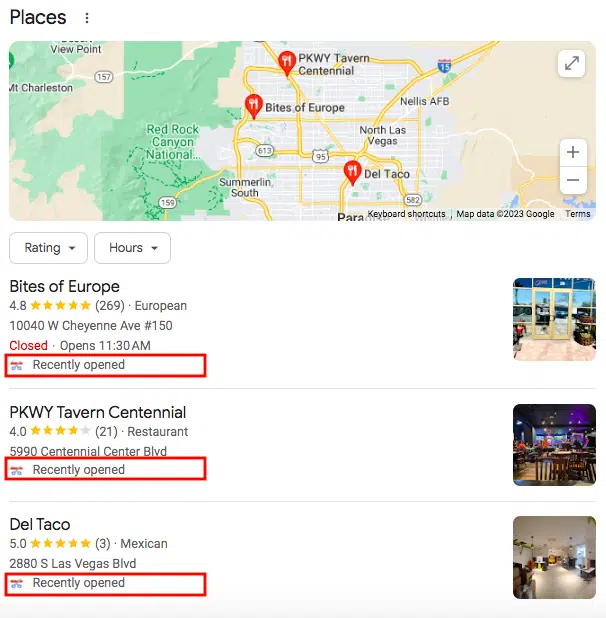
Once the data is entered and the profile has been verified, the profile will start showing on Google 90 days before the scheduled opening date, along with a message to inform users that the business is opening soon.
Yelp has a similar process for letting users know when a business plans to open soon.
However, Yelp recommends that a business add its opening date to the “From the Business” section or add “Opening Soon” to the business name to convey the message.
Your client’s website is a vital channel to share information about the business.
From a digital perspective, it’s the main way to tie everything together and drive users to become potential customers.
From a local SEO standpoint, you’ll want to get the website ready to capture organic traffic and potentially start ranking for local queries.
The website should include valuable information about the business, such as where it’s located and the products or services that will be offered.
For a business that isn’t open yet, include messaging that states when it’ll be opening or a “coming soon” message.
This should be displayed promptly for users above the fold to avoid any confusion. Other areas to utilize “coming soon” or “opening soon” messages could be through on-page content, title tags, or meta descriptions.
Another benefit of launching the website before opening is that now there’s a way to start collecting potential customer information. For a location opening soon, consider including a website form for users to sign up for updates or enter information for a promotional offer.
Additionally, for any location page, always include unique information regarding that location to avoid duplicate content.
While this can be difficult before a business opens, think of unique ways to gather details about your client’s new location, such as adding an owner bio or introducing new team members.
Keep in mind that on-site SEO is never just a one-time project.
Once the business is opened and you go through the QA process to ensure that all information is correct, develop new ways to add content and highlight the business, such as getting photos or parking details on the page.
Additionally, as you build out a content strategy, it can be beneficial to add unique information about the business, like team bios, event information, or FAQs, to avoid duplicate content against other locations on the website.
A good starting point for building local backlinks to a website is through citations like GBP and Apple Business Connect.
Also, look into partnerships with nearby establishments and where the business can be listed in directories (i.e., the shopping center where a business is located).
Being listed in local directories or niche publications can help connect your client with a new audience.
Get the daily newsletter search marketers rely on.
Developing a comprehensive grand opening strategy
While local SEO is crucial for businesses, it’s just one part of a comprehensive marketing strategy.
Businesses can connect with consumers by sharing consistent messages across various channels and platforms to reach diverse audiences.
As marketers, we should consider the big picture and align strategies with our clients’ goals. A holistic approach often strengthens marketing channels more effectively than staying siloed.
Paid search: Get in front of your target audience
Paid search is a powerful tool for increasing brand awareness in new markets. It efficiently targets the right audience by leveraging collected emails from web queries.
These emails can be used for remarketing or to create lookalike audiences, reaching individuals who share interests in your client’s products or services.
With a paid search strategy, you’ll have the opportunity to:
Reach new people whom you haven’t gotten in front of through other channels.
Continue to market to audiences that have already shown interest in your client by visiting the website.
Organic efforts build a digital presence, but paid campaigns amplify reach.
Running diverse campaigns with targeted messages ensures each audience receives relevant information based on their place in the customer journey, whether discovering the business or aiming to re-engage for conversion.
Social media: Share updates and build followers
Start building an audience and showing off the business’s personality through social media marketing.
This can include sharing updates about the construction progress via Instagram Stories, TikToks, and Meta posts to give followers an exclusive look into the business and help build some anticipation around the opening.
Some companies will giveaways to followers or share exclusive offers to entice people to engage with the profile and keep up with the information that’s shared over time.
Many chains and multi-location companies have a local presence on social media with dedicated groups or pages for individual locations.
Ensure that you stay consistent with the business name whenever possible and provide users with a way to navigate your client’s website or contact the business.
With paid social efforts on Instagram or Meta, you can re-engage with audiences that have already visited a website via another channel through targeted campaigns that include eye-catching graphics, videos or offers.
This can be another way to get in front of users and lead them to a conversion action or sign up for a promotion.
Many businesses want to start interacting with customers before they open. For some, this can be done through promotional offers or by getting people to sign up for informational newsletters.
Where customers come to the website via organic search, a paid ad, or clicking on a link from an announcement online, make sure there is a form filled out to capture customer information.
If these people have gone to the website and filled out their information, they want to learn more. Once the email list grows, create a comprehensive email marketing plan to build a relationship between your client and the audience.
Use email campaigns to send special offers, information about grand opening events, or a newsletter to share updates.
Even if some of the audience doesn’t convert right away, this is an opportunity to nurture leads over time through efforts like drip campaigns and personalized emails.
PR: Spread the word out
With a new business coming, this can be a great chance to partner with PR teams.
If the team has planned press releases or announcements, ensure that a link to the website is included in that communication.
This doesn’t have to be limited to press releases. There are also opportunities to get grand opening events listed or ribbon-cutting ceremonies promoted.
Depending on the business, the business owner can also do interviews with publications or news outlets to share the story of the business.
These are opportunities to earn links and grow awareness about the business. Also, don’t be afraid to ask for a link when a story gets picked up on an online publication.
Final stop: Opening day and beyond
We’ve finally made it to opening day – what an exciting time!
Some quick reminders for marketers on launch day to ensure all publicly available information is accurate:
Update messaging from “Coming Soon” to “Now Open.” This includes social media posts, ad copy, metadata, web copy, or anywhere else as necessary.
Check that local listings indicate the business is now open and that information like hours are updated.
Developing an integrated local promotion plan and building visibility early can help maximize awareness and drive traffic as soon as the doors open.
With the right preparation, your hard work will pay off with a successful launch and a strong foundation for getting the new business spotted locally.
Opinions expressed in this article are those of the guest author and not necessarily Search Engine Land. Staff authors are listed here.
@media screen and (min-width: 800px) { #div-gpt-ad-3191538-7 { display: flex !important; justify-content: center !important; align-items: center !important; min-width:770px; min-height:260px; }
}
@media screen and (min-width: 1279px) { #div-gpt-ad-3191538-7 { display: flex !important; justify-content: center !important; align-items: center !important; min-width:800px!important; min-height:440px!important; }
}
About the author
Dayna is a Strategist, SEO at Amsive Digital and has almost a decade’s experience executing and developing comprehensive strategies for multi-location and franchise brands. Her experience in local SEO has spanned various industries including health, beauty and spa, fitness, home improvement, and more.
Quality rater and algorithmic evaluation systems: Are major changes coming?
Crowd-sourced human quality raters have been the mainstay of the algorithmic evaluation process for search engines for decades. Still, a potential sea-change in research and production implementation could be on the horizon.
Recent groundbreaking research by Bing (with some purported commercial implementation already) and a sharp uptick in closely related information retrieval research by others, indicates some big shake-ups are coming.
These shake-ups may have far-reaching consequences for both the armies of quality raters and potentially the frequency of algorithmic updates we see go live, too.
The importance of evaluation
In addition to crawling, indexing, ranking and result serving for search engines is the important process of evaluation.
How well does a current or proposed search result set or experimental design align with the notoriously subjective notion of relevance to a given query, at a given time, for a given search engine user’s contextual information needs?
Since we know relevance and intent for many queries are always changing, and how users prefer to consume information evolves, search result pages also need to change to meet both the searcher’s intent and preferred user interface.
Some changes have predictable, temporal and periodic query intent shifts. For example, in the period approaching Black Friday, many queries typically considered informational might take sweeping commercial intent shifts. Similarly, a transport query like [Liverpool Manchester] might shift to a sports query on local match derby days.
In these instances, an ever-expanding legacy of historical data supports a high probability of what users consider more meaningful results, albeit temporarily. These levels of confidence likely make seasonal or other predictable periodic results and temporary UI design shifting relatively straightforward adjustments for search engines to implement.
However, when it comes to broader notions of evolving “relevance” and “quality,” and for the purposes of experimental design changes too, search engines must know a proposed change in rankings after development by search engineers is truly better and more precise to information needs, than the present results generated.
Evaluation is an important stage in search results evolution and vital to providing confidence in proposed changes – and substantial data for any adjustments (algorithmic tuning) to the proposed “systems,” if required.
Evaluation is where humans “enter the loop” (offline and online) to provide feedback in various ways before roll-outs to production environments.
This is not to say evaluation is not a continuous part of production search. It is. However, an ongoing judgment of existing results and user activity will likely evaluate how well an implemented change continues to fare in production against an acceptable relevance (or satisfaction) based metric range. A metric range based on the initial human judge-submitted relevance evaluations.
In a 2022 paper titled, “The crowd is made of people: Observations from large-scale crowd labelling,” Thomas et al., who are researchers from Bing, allude to the ongoing use of such metric ranges in a production environment when referencing a monitored component of web search “evaluated in part by RBP-based scores, calculated daily over tens of thousands of judge-submitted labels.” (RBP stands for Rank-Biased Precision).
Human-in-the-loop (HITL)
Data labels and labeling
An important point before we continue. I will mention labels and labeling a lot throughout this piece, and a clarification about what is meant by labels and labeling will make the rest of this article much easier to understand:
I will provide you with a couple of real-world examples most people will be familiar with for breadth of audience understanding before continuing:
Have you ever checked a Gmail account and marked something as spam?
Have you ever marked a film on Netflix as “Not for me,” “I like this,” or “love this”?
All of these submitted actions by you create data labels used by search engines or in information retrieval systems. Yes, even Netflix has a huge foundation in information retrieval and a great information retrieval research team tool. (Note that Netflix is both information retrieval with a strong subset of that field, called “recommender systems.”)
By marking “Not for me” on a Netflix film, you submitted a data label. You became a data labeler to help the “system” understand more about what you like (and also what people similar to you like) and to help Netflix train and tune their recommender systems further.
Data labels are all around us. Labels markup data so it can be transformed into mathematical forms for measurement at scale.
Enormous amounts of these labels and “labeling” in the information retrieval and machine learning space are used as training data for machine learning.
“This image has been labeled as a cat.”
“This image has been labeled as a dog… cat… dog… dog… dog… cat,” and so on.
All of the labels help machines learn what a dog or a cat looks like with enough examples of images marked as cats or dogs.
Labeling is not new; it’s been around for centuries, since the first classification of items took place. A label was assigned when something was marked as being in a “subset” or “set of things.”
Anything “classified” has effectively had a label attached to it, and the person who marked the item as belonging to that particular classification is considered the labeler.
But moving forward to recent times, probably the best-known data labeling example is that of reCAPTCHA. Every time we select the little squares on the image grid, we add labels, and we are labelers.
We, as humans, “enter the loop” and provide feedback and data.
With that explanation out of the way, let us move on to the different ways data labels and feedback are acquired, and in particular, feedback for “relevance” to queries to tune algorithms or evaluate experimental design by search engines.
Implicit and explicit evaluation feedback
While Google refers to their evaluation systems in documents meant for the non-technical audience overall as “rigorous testing,” human-in-the-loop evaluations in information retrieval widely happen through implicit or explicit feedback.
Implicit feedback
With implicit feedback, the user isn’t actively aware they provide feedback. The many live search traffic experiments (i.e., tests in the wild) search engines carry out on tiny segments of real users (as small as 0.1%), and subsequent analysis of click data, user scrolling, dwell time and result skipping, fall into the category of implicit feedback.
In addition to live experiments, the ongoing general click, scroll and browse behavior of real search engine users can also constitute implicit feedback and likely feed into “Learning to Rank (LTR) machine learning” click models.
This, in turn, feeds into rationales for proposed algorithmic relevance changes, as non-temporal searcher behavior shifts and world changes lead to unseen queries and new meanings for queries.
There is the age-old SEO debate around whether rankings change immediately before further evaluation from implicit click data. I will not cover that here other than to say there is considerable awareness of the huge bias and noise that comes with raw click data in the information retrieval research space and the huge challenges in its continuous use in live environments. Hence, the many pieces of research work around proposed click models for unbiased learning to rank and learning to rank with bias.
Regardless, it is no secret overall in information retrieval how important click data is for evaluation purposes. There are countless papers and even IR books co-authored by Google research team members, such as “Click Models for Web Search” (Chuklin and De Rijke, 2022).
“We look at a very long list of metrics, such as what people click on, how many queries were done, whether queries were abandoned, how long it took for people to click on a result and so on.”
And so a cycle continues. Detected change needed from Learning to Rank, click model application, engineering, evaluation, detected change needed, click model application, engineering, evaluation, and so forth.
Explicit feedback
In contrast to implicit feedback from unaware search engine users (in live experiments or in general use), explicit feedback is derived from actively aware participants or relevance labelers.
The purpose of this relevance data collection is to mathematically roll it up and adjust overall proposed systems.
A gold standard of relevance labeling – considered near to a ground truth (i.e., the reality of the real world) of intent to query matching – is ultimately sought.
There are various ways in which a gold standard of relevance labeling is gathered. However, a silver standard (less precise than gold but more widely available data) is often acquired (and accepted) and likely used to assist in further tuning.
Explicit feedback takes four main formats. Each has its advantages and disadvantages, largely about relevance labeling quality (compared with gold standard or ground truth) and how scalable the approach is.
Real users in feedback sessions with user feedback teams
Search engine user research teams and real users provided with different contexts in different countries collaborate in user feedback sessions to provide relevance data labels for queries and their intents.
This format likely provides near to a gold standard of relevance. However, the method is not scalable due to its time-consuming nature, and the number of participants could never be anywhere near representative of the wider search population at large.
True subject matter experts / topic experts / professional annotators
True subject matter experts and professional relevance assessors provide relevance for query mappings annotated to their intents in data labeling, including many nuanced cases.
Since these are the authors of the query to intent mappings, they know the exact intent, and this type of labeling is likely considered near to a gold standard. However, this method, similar to the user feedback research teams format, is not scalable due to the sparsity of relevance labels and, again, the time-consuming nature of this process.
This method was more widely used before introducing the more scalable approach of crowd-sourced human quality raters (to follow) in recent times.
Search engines simply ask real users whether something is relevant or helpful
Real search engine users are actively asked whether a search result is helpful (or relevant) by search engines and consciously provide explicit binary feedback in the form of yes or no responses with recent “thumbs up” design changes spotted in the wild.
Crowd-sourced human quality raters
The main source of explicit feedback comes from “the crowd.” Major search engines have huge numbers of crowd-sourced human quality raters provided with some training and handbooks and hired through external contractors working remotely worldwide.
Google alone has a purported 16,000 such quality raters. These crowd-sourced relevance labelers and the programs they are part of are referred to differently by each search engine.
Google refers to its participants as “quality raters” in the Quality Raters Program, with the third-party contractor referring to Google’s web search relevance program as “Project Yukon.”
Bing refers to their participants as simply “judges” in the Human Relevance System (HRS), with third-party contractors referring to Bing’s project as simply “Web Content Assessor.”
Despite these differences, participants’ purposes are primarily the same. The role of the crowd-sourced human quality rater is to provide synthetic relevance labels emulating search engine users across the world as part of explicit algorithmic feedback. Feedback often takes the form of a side-by-side (pairwise) comparison of proposed changes versus either existing systems or alongside other proposed system changes.
Since much of this is considered offline evaluation, it isn’t always live search results that are being compared but also images of results. And it isn’t always a pairwise comparison, either.
These are just some of the many different types of tasks that human quality raters carry out for evaluation, and data labeling, via third-party contractors. The relevance judges likely continuously monitor after the proposed change roll-out to production search, too. (For example, as the aforementioned Bing research paper alludes to.)
Whatever the method of feedback acquisition, human-in-the-loop relevance evaluations (either implicit or explicit) play a significant role before the many algorithmic updates (Google launched over 4,700 changes in 2022 alone, for example), including the now increasingly frequent broad core updates, which ultimately appear to be an overall evaluation of fundamental relevance revisited.
Get the daily newsletter search marketers rely on.
Relevance labeling at a query level and a system level
Despite the blog posts we have seen alerting us to the scary prospect of human quality raters visiting our site via referral traffic analysis, naturally, in systems built for scale, individual results of quality rater evaluations at a page level, or even at an individual rater level have no significance on their own.
Human quality raters do not judge websites or webpages in isolation
Evaluation is a measurement of systems, not web pages – with “systems” meaning the algorithms generating the proposed changes. All of the relevance labels (i.e., “relevant,” “not relevant,” “highly relevant”) provided by labelers roll up to a system level.
“We use responses from raters to evaluate changes, but they don’t directly impact how our search results are ranked.”
In other words, while relevance labeling doesn’t directly impact rankings, aggregated data labeling does provide a means to take an overall (average) measurement of how well a proposed algorithmic change (system) might be, more precisely relevant (when ranked), with lots of reliance on various types of algorithmic averages.
Query-level scores are combined to determine system-level scores. Data from relevance labels is turned into numerical values and then into “average” precision metrics to “tune” the proposed system further before any roll-out to search engine users more broadly.
How far from the expected average precision metrics engineers hoped to achieve with the proposed change is the reality when ‘humans enter the loop’?
While we cannot be entirely sure of the metrics used on aggregated data labels when everything is turned into numerical values for relevance measurement, there are universally recognized information retrieval ranking evaluation metrics in many research papers.
Most authors of such papers are search engine engineers, academics, or both. Production follows research in the information retrieval field, of which all web search is a part.
Such metrics are order-aware evaluation metrics (where the ranked order of relevance matters, and weighting, or “punishing” of the evaluation if the ranked-order is incorrect). These metrics include:
Mean reciprocal rank (MRR).
Rank-biased precision (RBP).
Mean average precision (MAP).
Normalized and un-normalized discounted cumulative gain (NDCG and DCG respectively).
In a 2022 research paper co-authored by a Google research engineer, NDCG and AP (average precision) are referred to as a norm in the evaluation of pairwise ranking results:
“A fundamental step in the offline evaluation of search and recommendation systems is to determine whether a ranking from one system tends to be better than the ranking of a second system. This often involves, given item-level relevance judgments, distilling each ranking into a scalar evaluation metric, such as average precision (AP) or normalized discounted cumulative gain (NDCG). We can then say that one system is preferred to another if its metric values tend to be higher.”
Information on DCG, NDCG, MAP, MRR and their commonality of use in web search evaluation and ranking tuning is widely available.
Victor Lavrenko, a former assistant professor at the University of Edinburgh, also describes one of the more common evaluation metrics, mean average precision, well:
“Mean Average Precision (MAP) is the standard single-number measure for comparing search algorithms. Average precision (AP) is the average of … precision values at all ranks where relevant documents are found. AP values are then averaged over a large set of queries…”
So it’s literally all about the averages judges submit from the curated data labels distilled into a consumable numerical metric versus the predicted averages hoped for after engineering and then tuning the ranking algorithms further.
Quality raters are simply relevance labelers
Quality raters are simply relevance labelers, classifying and feeding a huge pipeline of data, rolled up and turned into numerical scores for:
Aggregation on whether a proposed change is near an acceptable average level of relevance precision or user satisfaction.
Or determining whether the proposed change needs further tuning (or total abandonment).
The sparsity of relevance labeling causes a bottleneck
Regardless of the evaluation metrics used, the initial data is the most important part of the process (the relevance labels) since, without labels, no measurement via evaluation can take place.
A ranking algorithm or proposed change is all very well, but unless “humans enter the loop” and determine whether it is relevant in evaluation, the change likely won’t happen.
For the past couple of decades, in information retrieval widely, the main pipeline of this HITL-labeled relevance data has come from crowd-sourced human quality raters, which replaced the use of the professional (but fewer in numbers) expert annotators as search engines (and their need for speedy iteration) grew.
Feeding yays and nays in turn converted into numbers and averages in order to tune search systems.
But scale (and the need for more and more relevance labeled data) is increasingly problematic, and not just for search engines (even despite these armies of human quality raters).
The scalability and sparsity issue of data labeling presents a global bottleneck and the classic “demand outstrips supply” challenge.
Widespread demand for data labeling has grown phenomenally due to the explosion in machine learning in many industries and markets. Everyone needs lots and lots of data labeling.
Recent research by consulting firm Grand View Research illustrates the huge growth in market demand, reporting:
“The global data collection and labeling market size was valued at $2.22 billion in 2022 and it is expected to expand at a compound annual growth rate of 28.9% from 2023 to 2030, with the market then expected to be worth $13.7 billion.”
This is very problematic. Particularly in increasingly competitive arenas such as AI-driven generative search with the effective training of large language models requiring huge amounts of labeling and annotations of many types.
Authors at Deepmind, in a 2022 paper, state:
“We find current large language models are significantly undertrained, a consequence of the recent focus on scaling language models while keeping the amount of training data constant. …we find for compute-optimal training …for every doubling of model size the number of training tokens should also be doubled.”
When the amount of labels needed grows quicker than the crowd can reliably produce them, a bottleneck in scalability for relevance and quality via rapid evaluation on production roll-outs can occur.
Lack of scalability and sparsity do not fit well with speedy iterative progress
Lack of scalability was an issue when search engines moved away from the industry norm of professional, expert annotators and toward the crowd-sourced human quality raters providing relevance labels, and scale and data sparsity is once again a major issue with the status quo of using the crowd.
Some problems with crowd-sourced human quality raters
In addition to the lack of scale, other issues come with using the crowd. Some of these relate to human nature, human error, ethical considerations and reputational concerns.
While relevance remains largely subjective, crowd-sourced human quality raters are provided with, and tested on, lengthy handbooks, in order to determine relevance.
Google’s publicly available Quality Raters Guide is over 160 pages long, and Bing’s Human Relevance Guidelines is “reported to be over 70 pages long,” per Thomas et al.
Bing is much more coy with their relevance training handbooks. Still, if you root around, as I did when researching this piece, you can find some of the documentation with incredible detail on what relevance means (in this instance for local search), which looks like one of their judging guidelines in the depths online.
Efforts are made in this training to instill a mindset appreciative of the evaluator’s role as a “pseudo” search engine user in their natural locale.
The synthetic user mindset needs to consider many factors when emulating real users with different information needs and expectations.
These needs and expectations depend on several factors beyond simply their locale, including age, race, religion, gender, personal opinion and political affiliation.
The crowd is made of people
Unsurprisingly, humans are not without their failings as relevance data labelers.
Human error needs no explanation at all and bias on the web is a known concern, not just for search engines but more generally in search, machine learning, and AI overall. Hence, the dedicated “responsible AI” field emerges in part to deal with combatting baked-in biases in machine learning and algorithms.
However, findings in the 2022 large-scale study by Thomas et al., Bing researchers, highlight factors leading to reduced precision relevance labeling going beyond simple human error and traditional conscious or unconscious bias.
Even despite the training and handbooks, Bing’s findings, derived from “hundreds of millions of labels, collected from hundreds of thousands of workers as a routine part of search engine development,” underscore some of the less obvious factors, more akin to physiological and cognitive factors and contributing to a reduction in precision quality in relevance labeling tasks, and can be summarised as follows:
Task-switching: Corresponded directly with a decline in quality of relevance labeling, which was significant as only 28% of participants worked on a single task in a session with all others moving between tasks.
Left side bias: In a side-by-side comparison, a result displayed on the left side was more likely to be selected as relevant when compared with results on the right side. Since pair-wise analysis by search engines is widespread, this is concerning.
Anchoring: Played a part in relevance labeling choices, whereby the relevance label assigned on the first result by a labeler is also much more likely to be the relevance label assigned for the second result. This same label selection appeared to have a descending probability of selection in the first 10 evaluated queries in a session. After 10 evaluated queries, the researchers found that the anchoring issue seemed to disappear. In this instance the labeler hooks (anchors) onto the first choice they make and since they have no real notion of relevance or context at that time, the probability of them choosing the same relevance label with the next option is high. This phenomenon disappears as the labeler gathers more information from subsequent pairwise sets to consider.
General fatigue of crowd-workers played a part in reduced precision labeling.
General disagreement between judges on which one of a pairwise result was relevant from the two options. Simply differing opinions and perhaps a lack of true understanding of the context of the intended search engine user.
Time of day and day of week when labeling was carried out by evaluators also plays a role. The researchers noted some related findings which appeared to correlate with spikes in reduced relevance labeling accuracy when regional celebrations were underway, and might have easily been considered simple human error, or noise, if not explored more fully.
The crowd is not perfect at all.
A dark side of the data labeling industry
Then there is the other side of the use of human crowd-sourced labelers, which concerns society as a whole. That of low-paid “ghost workers” in emerging economies employed to label data for search engines and others in the tech and AI industry.
Major online publications increasingly draw attention to this issue with headlines like:
And, we have Google’s own third-party quality raters protesting for higher pay as recently as February 2023, with claims of “poverty wages and no benefits.”
Add together all of this with the potential for human error, bias, scalability concerns with the status quo, the subjectivity of “relevance,” the lack of true searcher context at the time of query and the inability to truly determine whether a query has a navigational intent.
And we have not even touched upon the potential minefield of regulations and privacy concerns around implicit feedback.
How to deal with lack of scale and “human issues”?
Enter large language models (LLMs), ChatGPT and increasing use of machine-generated synthetic data.
Is the time right to look at replacing ‘the crowd’?
A 2022 research piece from “Frontiers of Information Access Experimentation for Research and Education” involving several respected information retrieval researchers explores the feasibility of replacing the crowd, illustrating the conversation is well underway.
Clarke et al. state:
“The recent availability of LLMs has opened the possibility to use them to automatically generate relevance assessments in the form of preference judgements. While the idea of automatically generated judgements has been looked at before, new-generation LLMs drive us to re-ask the question of whether human assessors are still necessary.”
However, when considering the current situation, Clarke et al. raise specific concerns around a possible degradation in the quality of relevance labeling in exchange for huge scale potentials:
Concerns about reduced quality in exchange for scale?
“It is a concern that machine-annotated assessments might degrade the quality, while dramatically increasing the number of annotations available.”
The researchers draw parallels between the previous major shift in the information retrieval space away from professional annotators some years before to “the crowd,” continuing:
“Nevertheless, a similar change in terms of data collection paradigm was observed with the increased use of crowd assessor…such annotation tasks were delegated to crowd workers, with a substantial decrease in terms of quality of the annotation, compensated by a huge increase in annotated data.”
They surmise that the feasibility of “over time” a spectrum of balanced machine and human collaboration, or a hybrid approach to relevance labeling for evaluations, may be a way forward.
A wide range of options from 0% machine and 100% human right across to 100% machine and 0% human is explored.
The researchers consider options whereby the human is at the beginning of the workflow providing more detailed query annotations to assist the machine in relevance evaluation, or at the end of the process to check the annotations provided by the machines.
In this paper, the researchers draw attention to the unknown risks that may emerge through the use of LLMs in relevance annotation over human crowd usage, but do concede at some point, there will likely be an industry move toward the replacement of human annotators in favor of LLMs:
“It is yet to be understood what the risks associated with such technology are: it is likely that in the next few years, we will assist in a substantial increase in the usage of LLMs to replace human annotators.”
Things move fast in the world of LLMs
But much progress can take place in a year, and despite these concerns, other researchers are already rolling with the idea of using machines as relevance labelers.
Despite the concerns raised in the Clarke et al. paper around reduced annotation quality should a large-scale move toward machine usage occur, in less than a year, there has been a significant development that impacts production search.
Very recently, Mark Sanderson, a well-respected and established information retrieval researcher, shared a slide from a presentation by Paul Thomas, one of four Bing research engineers presenting their work on the implementation of GPT-4 as relevance labelers rather than humans from the crowd.
The enormity of this recent work by Bing (in terms of the potential change for search research) was emphasized in a tweet by Sanderson. Sanderson described the talk as “incredible,” noting, “Synthetic labels have been a holy grail of retrieval research for decades.”
While sharing the paper and subsequent case study, Thomas also shared Bing is now using GPT-4 for its relevance judgments. So, not just research, but (to an unknown extent) in production search too.
So what has Bing done?
The use of GPT-4 at Bing for relevance labeling
The traditional approach of relevance evaluation typically produces a varied mixture of gold and silver labels when “the crowd” provides judgments from explicit feedback after reading “the guidelines” (Bing’s equivalent of Google’s Quality Raters Guide).
In addition, live tests in the wild utilizing implicit feedback typically generate gold labels (the reality of the real world “human in the loop”), but with a lack of scale and high relative costs.
Bing’s approach utilized GPT-4 LLM machine-learned pseudo-relevance annotators created and trained via prompt engineering. The purpose of these instances is to emulate quality raters to detect relevance based on a carefully selected set of gold standard labels.
This was then rolled out to provide bulk “gold label” annotations more widely via machine learning, reportedly for a fraction of the relative cost of traditional approaches.
The prompt included telling the system that it is a search quality rater whose purpose is to assess whether documents in a set of results are relevant to a query using a label reduced to a binary relevant / not relevant judgment for consistency and to minimize complexity in the research work.
To aggregate evaluations more broadly, Bing sometimes utilized up to five pseudo-relevance labelers via machine learning per prompt.
The approach and impacts for cost, scale and purported accuracy are illustrated below and compared with other traditional explicit feedback approaches, plus implicit online evaluation.
Interestingly, two co-authors are also co-authors in Bing’s research piece, “The Crowd is Made of People,” and undoubtedly are well aware of the challenges of using the crowd.
Source: “Large language models can accurately predict searcher preferences,” Thomas et al., 2023
With these findings, Bing researchers claim:
“To measure agreement with real searchers needs high-quality “gold” labels, but with these we find that models produce better labels than third-party workers, for a fraction of the cost, and these labels let us train notably better rankers.”
Scale and low-cost combined
These findings illustrate machine learning and large language models have the potential to reduce or eliminate bottlenecks in data labeling and, therefore, the evaluation process.
This is a sea-change pointing the way to an enormous step forward in how evaluation before algorithmic updates are undertaken since the potential for scale at a fraction of the cost of “the crowd” is considerable.
It’s not just Bing reporting on the success of machines over humans in relevance labeling tasks, and it’s not just ChatGPT either. Plenty of research into whether human assessors can be replaced in part or wholly by machines is certainly picking up pace in 2022 and 2023 in other research, too.
Others are reporting some success in utilizing machines over humans for relevance labeling, too
In a July 2023 paper, researchers at the University of Zurich found open source large language models (FLAN and HugginChat) outperform human crowd workers (including trained relevance annotators and consistently high-scoring crowd-sourced MTurk human relevance annotators).
Although this work was carried out on tweet analysis rather than search results, their findings were that other open-source large language models were not only better than humans but were almost as good in their relevance labeling as ChatGPT (Alizadeh et al, 2023).
This opens the door to even more potential going forward for large-scale relevance annotations without the need for “the crowd” in its current format.
But what might come next, and what will become of ‘the crowd’ of human quality raters?
Responsible AI importance
Caution is likely overwhelmingly front of mind for search engines. There are other highly important considerations.
Responsible AI, as yet unknown risk with these approaches, baked-in bias detection, and its removal, or at least an awareness and adjustment to bias, to name but a few. LLMs tend to “hallucinate,” and “overfitting” could present problems as well, so monitoring might well consider factors such as these with guardrails built as necessary.
Explainable AI also calls for models to provide an explanation as to why a label or other type of output was deemed relevant, so this is another area where there will likely be further development. Researchers are also exploring ways to create bias awareness in LLM relevance judgments.
Human relevance assessors are monitored continuously anyway, so continual monitoring is already a part of the evaluation process. However, one can presume Bing, and others, would tread much more cautiously with this machine-led approach over the “the crowd” approach. Careful monitoring will also be required to avoid drops in quality in exchange for scalability.
In outlining their approach (illustrated in the image above), Bing shared this process:
Select via gold labels
Generate labels in bulk
Monitor with several methods
“Monitor with several methods” would certainly fit with a clear note of caution.
Next steps?
Bing, and others, will no doubt look to improve upon these new means of gathering annotations and relevance feedback at scale. The door is unlocked to a new agility.
A low-cost, hugely scalable relevance judgment process undoubtedly gives a strong competitive advantage when adjusting search results to meet changing information needs.
As the saying goes, the cat is out of the bag, and one could presume the research will continue to heat up to a frenzy in the information retrieval space (including other search engines) in the short to medium term.
A spectrum of human and machine assessors?
In their 2023 paper “HMC: A Spectrum of Human–Machine-Collaborative Relevance Judgement Frameworks,” Clarke et al. alluded to a feasible approach that might well mean subsequent stages of a move toward replacement of the crowd with machines taking a hybrid or spectrum form.
While a spectrum of human-machine collaboration might increase in favor of machine-learned methods as confidence grows and after careful monitoring, none of this means “the crowd” will leave entirely. The crowd may become much smaller, though, over time.
It seems unlikely that search engines (or IR research at large) would move completely away from using human relevance judges as a guardrail and a sobering sense-check or even to act as judges of the relevance labels generated by machines. Human quality raters also present a more robust means of combating “overfitting.”
Not all search areas are considered equal in terms of their potential impact on the life of searchers. Clarke et al., 2023, stress the importance of a more trusted human judgment in areas such as journalism, and this would fit well with our understanding as SEOs of Your Money or Your Life (YMYL).
The crowd might well just take on other roles depending upon the weighting in a spectrum, possibly moving into more of a supervisory role, or as an exam marker of machine-learned assessors, with exams provided for large language models requiring explanations as to how judgments were made.
Clarke et al. ask: “What weighting between human and LLMs and AI-assisted annotations is ideal?”
What weighting of human to machine is implemented in any spectrum or hybrid approach might depend on how quickly the pace of research picks up. While not entirely comparable, if we look at the herd movement in the research space after the introduction of BERT and transformers, one can presume things will move very quickly indeed.
Furthermore, there is also a massive move toward synthetic data already, so this “direction of travel” fits with that.
“Solutions such as AI-specific data management, synthetic data and data labeling technologies, aim to solve many data challenges, including accessibility, volume, privacy, security, complexity and scope.”
“By 2024, Gartner predicts 60% of data for AI will be synthetic to simulate reality, future scenarios and de-risk AI, up from 1% in 2021.”
Will Google adopt these machine-led evaluation processes?
Given the sea-change to decades-old practices in the evaluation processes widely used by search engines, it would seem unlikely Google would not at least be looking into this very closely or even be striving towards this already.
If the evaluation process has a bottleneck removed via the use of large language models, leading to massively reduced data sparsity for relevance labeling and algorithmic update feedback at lower costs for the same, and the potential for higher quality levels of evaluation too, there is a certain sense in “going there.”
Bing has a significant commercial advantage with this breakthrough, and Google has to stay in and lead, the AI game.
Removals of bottlenecks have the potential to massively increase scale, particularly in non-English languages and into additional markets where labeling might have been more difficult to obtain (for example, the subject matter expert areas or the nuanced queries around more technical topics).
While we know that Google’s Search Generative Experience Beta, despite expanding to 120 countries, is still considered an experiment to learn how people might interact with or find useful, generative AI search experiences, they have already stepped over the “AI line.”
However, Google is still incredibly cautious about using AI in production search.
Who can blame them for all the antitrust and legal cases, plus the prospect of reputational damage and increasing legislation related to user privacy and data protection regulations?
“These technologies come with an extraordinary range of risks and challenges.”
However, Google is not shy about undertaking research into the use of large language models. Heck, BERT came from Google in the first place.
Certainly, Google is exploring the potential use of synthetic query generation for relevance prediction, too. Illustrated in this recent 2023 paper by Google researchers and presented at the SIGIR information retrieval conference.
Since synthetic data in AI/ML reduces other risks that might relate to privacy, security, and the use of user data, simply generating data out of thin air for relevance prediction evaluations may actually be less risky than some of the current practices.
Add to the other factors that could build a case for Google jumping on board with these new machine-driven evaluation processes (to any extent, even if the spectrum is mostly human to begin with):
The research in this space is heating up.
Bing is running with some commercial implementation of machine over people labeling.
SGE needs loads of labels.
There are scale challenges with the status quo.
The increasing spotlight on the use of low-paid workers in the data-labeling industry overall.
Respected information retrieval researchers are asking is now the time to revisit the use of machines over humans in labeling?
Openly discussing evaluation as part of the update process
Google also seems to be talking much more openly of late about “evaluation” too, and how experiments and updates are undertaken following “rigorous testing.” There does seem to be a shift toward opening up the conversation with the wider community.
Here’s Danny Sullivan just last week giving an update on updates and “rigorous testing.”
And again, explaining why Google does updates.
Search off The Record recently discussed “Steve,” an imaginary search engine, and how updates to Steve might be implemented based on the judgments of human evaluators, with potential for bias, amongst other points discussed. There was a good amount of discussion around how changes to Steve’s features were tested and so forth.
This all seems to indicate a shift around evaluation unless I am simply imagining this.
In any event, there are already elements of machine learning in the relevance evaluation process, albeit implicit feedback. Indeed, Google recently updated its documentation on “how search works” around detecting relevant content via aggregated and anonymized user interactions.
“We transform that data into signals that help our machine-learned systems better estimate relevance.”
So perhaps following Bing’s lead is not that far a leap to take after all?
What if Google takes this approach?
What might we expect to see if Google embraces a more scalable approach to the evaluation process (huge access to more labels, potentially with higher quality, at lower cost)?
Scale, more scale, agility, and updates
Scale in the evaluation process and speedy iteration of relevance feedback and evaluations pave the way for a much greater frequency of updates, and into many languages and markets.
An evolving, iterative, alignment with true relevance, and algorithmic updates to meet this, could be ahead of us, with less broad sweeping impacts. A more agile approach overall.
Bing takes a much more agile approach in their evaluation process already, and the breakthrough with LLM as relevance labeler makes them even more so.
Fabrice Canel of Bing, in a recent interview, reminded us of the search engine’s constantly evolving evaluation approach where the push out of changes is not as broad sweeping and disruptive as Google’s broad core update or “big” updates. Apparently, at Bing, engineers can ideate, gain feedback quickly, and sometimes roll out changes in as little as a day or so.
All search engines will have compliance and strict review processes, which cannot be conducive to agility and will no doubt build up to a form of process debt over time as organizations age and grow. However, if the relevance evaluation process can be shortened dramatically while largely maintaining quality, this takes away at least one big blocker to algorithmic change management.
We have already seen a big increase in the number of updates this year, with three broad core updates (relevance re-evaluations at scale) between August and November and many other changes concerning spam, helpful content, and reviews in between.
Coincidentally (or probably not), we’re told “to buckle up” because major changes are coming to search. Changes designed to improve relevance and user satisfaction. All the things the crowd traditionally provides relevant feedback on.
So, buckle up. It’s going to be an interesting ride.
If Google takes this route (using machine labeling in favor of the less agile “crowd” approach), expect a lot more updates overall, and likely, many of these updates will be unannounced, too.
We could potentially see an increased broad core update cadence with reduced impacts as agile rolling feedback helps to continually tune “relevance” and “quality” in a faster cycle of Learning to Rank, adjustment, evaluation and rollout.
Opinions expressed in this article are those of the guest author and not necessarily Search Engine Land. Staff authors are listed here.
@media screen and (min-width: 800px) { #div-gpt-ad-3191538-7 { display: flex !important; justify-content: center !important; align-items: center !important; min-width:770px; min-height:260px; }
}
@media screen and (min-width: 1279px) { #div-gpt-ad-3191538-7 { display: flex !important; justify-content: center !important; align-items: center !important; min-width:800px!important; min-height:440px!important; }
}
About the author
Dawn Anderson is a SEO & Search Digital Marketing Strategist focusing on technical, architectural and database-driven SEO. Dawn is the managing director at Bertey.
Attracting good traffic to your website and related properties is a great achievement in SEO. Pat yourself on the back for being good enough at keyword research, metadata, UX, etc., to get those traffic numbers up!
OK, celebration time is over. How much of that traffic is actually converting?
SEOs don’t have the luxury of focusing only on transactional keywords and/or relying on direct response-focused landing pages.
Much of the content we create (or help optimize) is focused on education and awareness – think position pieces, guides and how-toblog posts – so acquisition rates tend to be lower than those of paid traffic sources.
That’s not an excuse to accept low numbers. Smart brands (or clients, if you work at an agency) will push you to do better in converting your traffic into leads and/or sales.
And smart SEOs will relish the challenge and put the following nine strategies into action to make it happen.
1. Test different in-content CTAs
You’ve got a lot of options here, whether it’s on a landing page that goes into detail about a product or service or a blog post on a secondary topic. Test levers, including language, design, placement and style.
For example, you can embed text-based CTAs near the top of a blog post or image-based CTAs midway down or use button CTAs at any point in your content. Whatever your ideas, create a clear testing approach and see what works best for driving actual acquisition.
2. Test different offers
You don’t need to go for a hard sell (although you can try, for instance, offering to send alerts for price drops with sign-ups on a product page).
Creating a softer lead magnet or giveaway might get you plenty of email addresses. Test giveaways like newsletters, event guides, etc., especially those related to the content on the page.
3. Align CTAs with content
Connecting CTAs to the content can be very effective.
For instance, if the user has landed on a blog article related to product A, create a CTA specific to product A (e.g., “Register to receive the 2024 buyer’s guide for {product category}”).
In-line CTAs can work well, but it’s always good to test placements elsewhere on the page: sidebar, top-nav drop-down, top-of-page banner, take-over, etc.
An important note here is to keep an eye on both conversion rate and bounce rate – if you’re getting minimal movement in the former at the expense of the latter, feel free to cut the test early and move on to the next.
5. Extend the content journey
Especially for educational content, it can be more effective to convince visitors to spend more time elsewhere on the site before asking them for any information.
If your content is situated squarely at the beginning of the buying journey, guide users to middle- or lower-funnel pieces before asking for anything.
If they move down the funnel on their own, that’s a great signal that they’re more likely to give you information.
For top-of-funnel pieces, I like building maps of related content, sometimes a couple of steps deep, to gently condition users to take action.
Get the daily newsletter search marketers rely on.
6. Build engagement before the conversion event
Warm up users – giving them ways to engage can help them feel invested in your product or service, which will move the needle in acquisition activity down the road.
Surveys are a great tool here – and it can even be a short path from “interested in seeing the survey results? Drop your email here” if you’re using the survey to collect robust data and insights.
7. Use heatmaps
Heatmapping tools like Hotjar and FullStory can give you incredible insights into where your traffic interacts on the site, not just the content in focus.
Look for the prime engagement real estate on your homepage, navigation, service pages, top blogs, etc., and make sure you’re giving users a way to convert.
8. Leverage insights from your higher-converting content
Dig into your Google Analytics to find instances of posts or properties that have relatively low traffic and relatively high conversion rates. What are those pages providing that leads to conversions?
Whether it’s language, product information, or CTA type, there’s likely something you can recreate on more popular pages.
As a bonus, look for ways to optimize your high-converting pages further to get more volume in traffic andconversions.
9. Do your qualitative research
Gathering anecdotal information from some of your current/loyal users can be extremely insightful.
Asking questions to identify the hooks that would catch their eye, the product attributes that most appeal to them, and offers that would entice them to sign up can give you valuable new ideas to test that you won’t find in rows of data.
If you’re bringing healthy traffic into your owned properties, you’ve built a great base for establishing SEO as a huge growth driver – but remember, the point of building a base is to keep building.
Adding the strategies above will help you increase SEO’s impact down the funnel, which should be the ultimate goal.
Improving the pipeline or revenue gains directly attributable to SEO is a great way to build your team’s reputation as a growth resource in the greater organization.
Opinions expressed in this article are those of the guest author and not necessarily Search Engine Land. Staff authors are listed here.
@media screen and (min-width: 800px) { #div-gpt-ad-3191538-7 { display: flex !important; justify-content: center !important; align-items: center !important; min-width:770px; min-height:260px; }
}
@media screen and (min-width: 1279px) { #div-gpt-ad-3191538-7 { display: flex !important; justify-content: center !important; align-items: center !important; min-width:800px!important; min-height:440px!important; }
}
About the author
Adam Tanguay is Head of SEO and Content at Jordan Digital Marketing, which he joined in Feb. 2019. Formerly Head of Marketing at Webflow and Head of Organic Growth at Weebly, Adam has developed successful growth programs with a mix of content strategy, copywriting, technical know-how, and analytics acumen across a range of organic channels.
How SEO and digital PR can drive maximum brand visibility
Ranking on Google, Bing and emerging search platforms now requires a strategic combination of search expertise and public relations finesse.
At a time when brand reputation and visibility are critical, blending SEO with digital PR is a must.
This article gives an overview of integrating SEO into digital PR to achieve business goals, plus best practices for effective collaboration and communication.
Why support digital PR efforts with tested SEO strategies?
Integrating SEO and digital PR can strengthen your brand narrative and ensure a robust digital presence. Other benefits include:
Harnessing data-driven insights for targeted campaigns
With SEO’s wealth of data, including trending topics and search volumes, PR teams can craft campaigns that resonate with target audiences.
This approach ensures that PR efforts are relevant and strategically aligned to influence audience interests and behaviors.
Enhanced content visibility through SEO best practices
Merging SEO insights with PR strategies transforms traditional content into search-friendly, user-friendly assets.
By leveraging keyword research and SEO best practices, PR initiatives gain enhanced visibility and reach, effectively capturing the desired audience’s attention.
Strategic reputation management in search results
SEO is crucial in managing a brand’s online reputation, particularly for “branded queries.” Aligning PR content with your SEO strategy enables you to craft compelling narratives, leading to effective digital storytelling and favorable search rankings.
PR and marketing teams prioritize the brand’s appearance on a search engine results page (SERP), emphasizing page titles, meta descriptions and hero images. Collaborating with the SEO team ensures new pages are discoverable, enhancing visibility and engagement.
Creating and boosting compelling, searchable stories
At its core, PR is about storytelling. When these stories are optimized for search, they become engaging and easily discoverable.
These stories could be “on-page” (owned website assets) or “off-page” (appearing on other websites, news outlets, publishers, etc.). Even optimizing social media profiles for organic search can make a sizable difference for trending topics.
Earning backlinks
With effective media outreach and content distribution, PR’s potential for high-quality backlinks is crucial for SEO.
The SEO team can likewise analyze the impact of these mentions and assess competitors.
The long-term impact of SEO-informed PR
Incorporating SEO into PR strategies goes beyond immediate visibility, building a foundation for sustained online presence.
This integration enhances your overall authority, creates a digital footprint and fosters long-term brand success and recognition.
By understanding and leveraging these benefits, brands can effectively combine SEO and digital PR efforts to create a powerful and enduring online presence, resonating deeply with their audiences and standing out in a competitive digital landscape.
Aligning brand messaging to your business goals
A unified SEO and digital PR strategy ensures consistent on-brand messaging across digital spaces, including the SERPs.
For a brand message to resonate, consistency is crucial. Different departments – from marketing to sales, customer service to PR – should harmonize their messaging to create a cohesive brand narrative.
Gaining buy-in on an established keyphrase and/or content strategy enables stakeholders to be on the same page.
Consider a non-profit organization aiming to increase awareness about a specific cause. While the PR team might focus on media coverage and storytelling, the marketing team can use SEO to optimize related content for relevant search queries.
This may include ensuring that slogans, phrases and important messages are consistent on webpage copy and across SEO elements like page titles, meta descriptions, headers, CTAs and internal link anchor text.
Additionally, an SEO can optimize a media or press page to ensure that contacts in the field connect to the right people and information with press opportunities.
Collaboration between these departments ensures that the organization’s message is consistently presented across all channels, thereby amplifying its reach and impact.
Focus on cross-promotion of content for amplification
In digital marketing, content’s effectiveness extends beyond creation to strategic promotion. PR teams can amplify content reach and influence through skillful cross-promotion strategies.
By leveraging social media, email newsletters, partner networks and other channels, PR can ensure that content resonates far beyond its initial publication.
The intersection of media outreach and SEO-centric link optimization is where PR practices shine. An effective PR strategy involves disseminating content to the right media outlets and optimizing it for search engines. Essentially, the goal is to earn backlinks by being newsworthy, relevant and helpful.
Optimizing involves integrating keywords and securing strategic backlinks in webpages, press releases and earned media. This boosts content visibility and authority, attracting organic traffic to the brand’s digital assets.
Get the daily newsletter search marketers rely on.
Intelligent cross-linking practices
Cross-linking strategically connects content across owned platforms and with external partners, boosting SEO value and improving user experience with additional relevant information.
Best practices for cross-linking include:
Relevance and context: Ensure that all cross-links add value and context to the content. Links should be naturally integrated and lead to related topics, offering readers a deeper dive into the subject matter.
Quality over quantity: Prioritize linking to high-quality, authoritative sources. Avoid excessive linking, which can overwhelm the reader and dilute the content’s focus.
User experience: Design cross-links with the user in mind. They should enhance the user’s journey, providing them easy access to related content without disrupting their engagement with the current page.
No need to be redundant: Sometimes, a credible news source, a reliable partner, or a well-trusted ally has the best platform to speak to a brand or campaign. Rather than recreating the wheel to put the same story on an owned site, strategically place “external links” that both users and search engine crawlers can use.
PR teams can maximize content exposure, improve SEO performance and create a cohesive and engaging user experience through these strategies.
By combining the strengths of content amplification, media outreach and intelligent cross-linking, brands can achieve a powerful and influential online presence.
Improving interdepartmental communication
For many organizations, brand, web and search marketing teams operate in silos.
Yet, establishing communication channels and integrated strategies between these departments is key to enhancing a brand’s online presence.
Here are some key methods to foster effective interdepartmental communication:
Regular cross-departmental meetings
Scheduling regular meetings between SEO and PR teams is essential. These meetings provide opportunities to align strategies, share insights and discuss ongoing projects.
They can range from weekly tactical check-ins to monthly strategy sessions, ensuring that both teams are on the same page and working towards common goals.
Shared goals and KPIs
Developing shared goals and KPIs is crucial for driving interdepartmental collaboration.
When both SEO and PR teams are working towards the same objectives, such as increasing brand visibility or driving website traffic, their efforts become more unified and impactful.
In the case of a combined approach, visibility (organic impressions) and engagement (clicks) can be valuable benchmarks for digital public relations teams hoping to move the needle.
Collaborative tools and platforms
Using collaborative tools and platforms can significantly improve communication and project management.
Tools like shared calendars, project management software and real-time communication apps enable both teams to track progress, share documents and communicate efficiently.
Cross-training sessions
Organizing cross-training sessions allows team members to learn about each other’s roles, strategies and challenges.
Understanding the nuances of each department’s work fosters empathy and enhances collaborative efforts.
Joint content planning and brainstorming sessions
Conducting joint content planning and brainstorming sessions is a great way to leverage the strengths of both teams.
SEO can provide data-driven insights, while PR can contribute creative storytelling ideas. This combination leads to engaging and optimized content for search engines and users.
Transparent communication channels
Whether it’s through regular email updates, shared dashboards, or open Slack channels, ensuring that both teams are informed about ongoing activities prevents silos and encourages a culture of openness.
Feedback loops and continuous improvement
Implementing feedback loops and focusing on continuous improvement helps both teams learn from each other and adapt their strategies.
Regularly reviewing the outcomes of joint efforts and discussing what worked and what didn’t pave the way for more effective collaborations in the future.
Blending SEO and PR for brand awareness and traffic
As the digital landscape evolves, integrating SEO with PR becomes crucial. The tactics above create a foundation for your efforts, but ongoing collaboration, adaptability and innovation will drive success.
Aligning SEO with PR is a dynamic journey. Leveraging tools, effective tactics and fostering collaboration helps a brand achieve a strong online presence, standing out in the competitive digital arena.
Opinions expressed in this article are those of the guest author and not necessarily Search Engine Land. Staff authors are listed here.
@media screen and (min-width: 800px) { #div-gpt-ad-3191538-7 { display: flex !important; justify-content: center !important; align-items: center !important; min-width:770px; min-height:260px; }
}
@media screen and (min-width: 1279px) { #div-gpt-ad-3191538-7 { display: flex !important; justify-content: center !important; align-items: center !important; min-width:800px!important; min-height:440px!important; }
}
About the author
Dale Hanstad is an enterprise SEO and digital experience professional, utilizing omnichannel integration to serve multinational corporations and household names. His work at global ad/marketing agencies has solidified his expertise, particularly in the tourism, leisure, and health/wellness sectors. Additionally, Dale spearheads Keyword People, an initiative that leverages organic marketing best practices to foster authentic connections with audiences and niche or local brands through optimized messaging.
Google Search Console experience and enhancement reporting bug
Google has confirmed a bug with some of the reporting within Google Search Console. The bug impacts the experience and enhancement reports, including the core web vitals, mobile usability, HTTPS, AMP and other enhancement and experience reports. The issue is it shows a drop in the number of valid URLs being reported.
What Google said. Google posted on X saying, “The team has been looking into this and is working to resolve it.” It is unclear when the issue will be resolved, but Google is working on it.
Indexing and ranking. Google added, “This is a Search Console reporting issue, and not related to indexing or ranking.”
So, this reporting bug should have no impact on your rankings, indexing, or crawling of your website. It is just a reporting issue with Google Search Console, which is something Google can fix on their end.
What it looks like. Here is an example of the HTTPS report of one of my sites showing a dip in valid HTTPS URLs:
Why we care. There have been a number of SEOs and site owners who noticed this drop in valid or “good” reported URLs in these Search Console experience and enhancement reports. There is no need to be concerned, this is a reporting bug, and Google will fix it.
Again, this has no impact on indexing or ranking, it is just a reporting bug on Google’s end.
@media screen and (min-width: 800px) { #div-gpt-ad-3191538-7 { display: flex !important; justify-content: center !important; align-items: center !important; min-width:770px; min-height:260px; }
}
@media screen and (min-width: 1279px) { #div-gpt-ad-3191538-7 { display: flex !important; justify-content: center !important; align-items: center !important; min-width:800px!important; min-height:440px!important; }
}
About the author
Barry Schwartz is a Contributing Editor to Search Engine Land and a member of the programming team for SMX events. He owns RustyBrick, a NY based web consulting firm. He also runs Search Engine Roundtable, a popular search blog on very advanced SEM topics. Barry can be followed on Twitter here.
Preparing for Google SGE: Essential guide for marketers
After months of seeing Google’s Search Generative Experience (SGE) in action, it’s not the digital marketer’s apocalypse many thought it would be.
Despite some hiccups, it has presented several opportunities for those who have gained a deeper understanding of the experiences SGE seeks to provide users – giving perfect answers right on SERPs.
Here’s how marketers should prepare for Google’s SGE.
Understanding Google SGE
SGE is Google’s AI-driven initiative to provide personalized and conversational answers to user search queries.
Google’s Search Generative Experience uses natural language processing (NLP) capabilities to understand complex topics and detailed search queries better.
But what does this mean?
Simply put, imagine asking your friend about their favorite restaurant – you’d expect them to give its name and share details like location, ambiance, best dishes, etc., right?
That’s exactly how Google aims at answering through SGE – providing complete information without needing follow-up questions.
The dawn of Google’s Search Generative Experience, or SGE, marks a significant shift in how users interact with search engine results pages (SERPs). This new paradigm leverages generative AI to provide personalized answers to user queries.
A key aspect differentiating SGE from traditional Google search is its focus on conversational queries and featured snippets. These are more likely to appear as AI-generated text rather than typical web content and may increase the time users spend on SERPs.
In the past, position zero (the featured snippet) was a snippet of information from the website Google deemed to offer the best information on the topic. With SGE, Google’s AI parses different sites to develop a single comprehensive answer to a search query.
Unlike the featured snippet, this answer has links to the articles the AI engine pulled from to generate the SGE snapshot. Contrary to popular belief, this means SGE won’t steal your traffic. If anything, it’s giving publishers more ranking opportunities.
So, instead of anticipating a drop in website traffic, marketers and content creators should look for ways to increase it by leveraging the ranking opportunities presented by Google’s generative AI.
However, SGE is still experimental, so this may change.
SEO experts agree that the change to SERPs has an intriguing result – users will spend more time on search result pages thanks to SGE.
The reasoning?
It provides comprehensive responses akin to a real human conversation.
Get the daily newsletter search marketers rely on.
How can marketers prepare for SGE?
With all these massive changes, should you close shop as a marketer? Not at all.
SGE does not spell doom for SEO and search marketing in general. You can still thrive and drive traffic to your website.
And no, the tips outlined below aren’t just for SEO specialists. Anyone can implement most of them.
So, here’s how the marketer should prepare for SGE.
1. Move beyond traditional SEO strategies
One of the first ways to thrive in the era of SGE is to move beyond traditional Google search engine optimization practices. You need an evolved SEO strategy to leverage these advancements better.
A typical example is keyword research and content optimization. Gone are the days when proper keyword research and placement would help you rank. SEO content is now more about building topical authority and thought leadership.
And that can only be done by creating valuable content users find helpful.
Generic answers and traditional search tactics aren’t enough anymore. The focus has moved towards creating content that offers a unique experience and reflects real human perspectives.
Your content should also be personality-driven and thought-provoking to set it apart from the generic content most publishers are churning out, thanks to the proliferation of AI tools.
And don’t get me wrong here. I’m absolutely for AI tools. However, I believe they should be used ethically and wisely.
For instance, you should always edit your AI content output to ensure accuracy, reliability, and human-like flow.
2. Pay closer attention to E-E-A-T signals
In this new landscape, Google’s search algorithm values E-E-A-T signals – experience, expertise, authoritativeness and trustworthiness – more than ever. Your SEO strategy should prioritize these elements to drive traffic effectively.
A few ways to ensure you meet Google’s E-E-A-T standards include demonstrating your expertise and experience. It also involves authority-boosting activities like link building and trust-building through customer reviews and case studies.
You should also consider leveraging subject matter experts as much as possible in your content creation workflow.
3. Reputation management is more important than ever
Another way to optimize for SGE is to ensure your reputation management game is on point. This is because Google wants to ensure that every SGE response is accurate. To do this, it pulls answers from reputable sites.
Building a good online reputation involves drumming up positive reviews, being active on social media, and actively looking for negative reviews so you can combat them. You should also consider running a PR campaign to promote mentions of your brand in a positive light and for link building purposes.
Both signal to search engines that you’re producing valuable, relevant content.
Owning the narrative in your industry is another way of preparing for SGE as a marketer.
This means going beyond targeting your money-earning keywords and being the go-to resource for all information in your niche.
As you create your content, make sure to cover your topics in-depth. You should also strategically build internal links to your priority pages to enhance their authority.
And don’t forget to earn backlinks as they also boost the authoritativeness of your content.
5. Become an agile marketer
Agility becomes key in this dynamic digital landscape where change is the only constant.
SEO strategists should constantly evaluate their approach based on data analysis and make necessary tweaks quickly when things aren’t working as expected.
Because Google’s SGE is still in its infancy, marketers and SEOs are still trying to determine what makes it tick. SGE is the Wild West all over again.
This means you should try new tactics to help you get visibility in SGE. This may involve experimenting with new concepts and SGE-based content strategies – and leaving some of your old standards and practices behind.
Their unique nature allows AI to generate personalized, detailed answers from various sources. When the AI links to you as a source, that can boost your visibility and engagement on search engine result pages. This is why informational queries, particularly long-tail ones, are anticipated to gain prominence in SGE.
To tap into this potential, it’s important to comprehensively answer questions users have. That means you should try to create and optimize content specifically for question-based queries.
Plus, long-tail queries have the added advantage of having higher conversion rates than their short-tail counterparts.
7. Embrace experimentation
Last but not least, embrace experimentation.
Trying innovative ideas can help identify what resonates best with your audience in this new SGE reality. Experiment with everything you can, from incorporating user-generated content to exploring personal branding tactics to creating AI content.
While SGE brings challenges, it also presents opportunities for marketers to better engage with users. So, let’s roll up our sleeves and get ready to navigate this exciting new search paradigm.
8. The power of first-person narratives
In the era of SGE, first-person narratives have taken center stage.
The reason?
They provide glimpses into real human experiences that AI simply can’t replicate. These narratives give life and authenticity to your content – making them invaluable assets when dealing with complex topics or answer-focused inquiries.
When crafting your next piece, ensure you’re using conversational language and addressing follow-up questions naturally within the text. Google’s Search Quality Rater Guidelines suggest weaving personal insights throughout your content as it enhances E-E-A-T signals.
9. Leverage structured data markup and SEO strategies
A robust SEO strategy coupled with effective structured data markup techniques also plays a significant role in optimizing for SGE.
Sure, structured data has been around for a long time, but it’s even more important now than ever. This is because it helps AI and search engines understand your content better. It may even help you rank better in SGE carousels.
For instance, using structured data markup can help Google understand when you’re sharing a recipe or when you’re providing a list of FAQs.
How the marketer should prepare for SGE: The future is bright
Embarking on the SGE journey can feel like a leap into the unknown. But now, you’re better equipped with knowledge on how to navigate it.
And contrary to popular belief, it’s not all doom and gloom.
If anything, SGE brings many promises of a brighter feature for marketers.
And while no one is 100% certain about what SGE will eventually evolve into, you can still take advantage of this new frontier to boost your rankings, drive traffic, and increase your revenue.
However, regarding how the marketer should prepare for SGE, I can offer a one-word answer – optimism.
Embrace the future of search and digital marketing with at least a little optimism, and you’ll be just fine.
Opinions expressed in this article are those of the guest author and not necessarily Search Engine Land. Staff authors are listed here.
@media screen and (min-width: 800px) { #div-gpt-ad-3191538-7 { display: flex !important; justify-content: center !important; align-items: center !important; min-width:770px; min-height:260px; }
}
@media screen and (min-width: 1279px) { #div-gpt-ad-3191538-7 { display: flex !important; justify-content: center !important; align-items: center !important; min-width:800px!important; min-height:440px!important; }
}
About the author
Julia McCoy is an 8x author and a leading strategist around creating exceptional content and presence that lasts online. As the President at Content at Scale, she leads big initiatives for one of the fastest-growing AI content writing tools for SEO marketers on the planet. She’s been named in the top 30 of all content marketers worldwide, is the founder of Content Hacker, and exited a 100-person writing agency she spent 10 years building with a desire to help marketers, teams, and entrepreneurs find the keys of online success and revenue growth without breaking. Read her eight books on Amazon, including a non-fiction memoir of her life growing up in and escaping a radical cult: Woman Rising, A True Story. Connect with her on LinkedIn.
Sam Altman, ousted on Nov. 17, won’t return to OpenAI as its CEO. That’s because he has joined Microsoft, announced Satya Nadella, Microsoft chairman and CEO.
Except, in a possible plot twist, Altman to Microsoft still may not be a done deal. Altman could be trying to return as OpenAI CEO, tech rag the Verge reported.
New AI team. Altman, OpenAI co-founder Greg Brockman and more “colleagues” are joining Microsoft, Nadella posted on X:
“We’re extremely excited to share the news that Sam Altman and Greg Brockman, together with colleagues, will be joining Microsoft to lead a new advanced AI research team. We look forward to moving quickly to provide them with the resources needed for their success.”
Microsoft remains committed to OpenAI. Microsoft has invested more than $10 billion in OpenAI, which powers Microsoft Copilot (formerly Bing Chat) and numerous other Microsoft products. Despite hiring Altman, Brockman and others, OpenAI and Microsoft’s partnership will continue on, Nadella wrote:
“We remain committed to our partnership with OpenAI and have confidence in our product roadmap, our ability to continue to innovate with everything we announced at Microsoft Ignite, and in continuing to support our customers and partners.”
satya and my top priority remains to ensure openai continues to thrive
we are committed to fully providing continuity of operations to our partners and customers
the openai/microsoft partnership makes this very doable
Microsoft wins one. Why is this a phenomenal outcome for Microsoft? Stratechery analyst Ben Thompson wrote:
“The company already has a perpetual license to all OpenAI IP (short of artificial general intelligence), including source code and model weights; the question was whether it would have the talent to exploit that IP if OpenAI suffered the sort of talent drain that was threatened upon Altman and Brockman’s removal. Indeed they will, as a good portion of that talent seems likely to flow to Microsoft; you can make the case that Microsoft just acquired OpenAI for $0 and zero risk of an antitrust lawsuit.”
Why we care. ChatGPT has been the go-to generative AI tool for search marketers since it launched Nov. 30. Will ChatGPT continue to be a functional tool with most of OpenAI’s employees in full revolt and ready to abandon the company? Microsoft’s fate is also very much tied to OpenAI technology.
Another new interim CEO. Mira Murati, OpenAI’s chief technology officer, was named the interim CEO on Nov. 17. Two days later, Emmett Shear was named OpenAI CEO.
Shear was announced following failed negotiations to bring Altman back as CEO. Altman reportedly refused to agree to whatever proposed terms would result in his reinstatement.
Will Shear last long as CEO? It’s entirely possible Shear may not, considering some of his “opinionated” X posts, which include criticism of Microsoft, being in favor of slowing down AI development, and more. He also ignored abuse happening on Twitch, as Screenrant reported.
Future Microsoft employees? Murati, among many other current and former employees, took to X with a unified message:
“OpenAI is nothing without its people.”
Also, 700+ (per New York Times) of OpenAI’s 770 employees signed a letter threatening to quit and potentially join Microsoft if the board doesn’t resign. From the letter:
“The process through which you terminated Sam Altman and removed Greg Brockman from the board has jeopardized all of this work and undermined our mission and company. Your conduct has made it clear you did not have the competence to oversee OpenAI.”
“Microsoft has assured us that there are positions for all OpenAI employees at this new subsidiary should we choose to join.”
Board stands by its decision. In a Nov. 19 memo signed by the four board directors (Adam D’Angelo, Helen Toner, Ilya Sutskever, Tasha McCauley), the board wrote:
“The board firmly stands by its decision as the only path to advance and defend the mission of OpenAI.”
“Put simply, Sam’s behavior and lack of transparency in his interactions with the board undermined the board’s ability to effectively supervise the company in the manner it was mandated to do.”
Go deeper into the chaos. The Atlantic’s Inside the Chaos at OpenAI is a good read explaining what led to this tumultuous weekend, including ideological rifts that developed following the commercial success of ChatGPT.
@media screen and (min-width: 800px) { #div-gpt-ad-3191538-7 { display: flex !important; justify-content: center !important; align-items: center !important; min-width:770px; min-height:260px; }
}
@media screen and (min-width: 1279px) { #div-gpt-ad-3191538-7 { display: flex !important; justify-content: center !important; align-items: center !important; min-width:800px!important; min-height:440px!important; }
}
About the author
Danny Goodwin has been Managing Editor of Search Engine Land & Search Marketing Expo – SMX since 2022. He joined Search Engine Land in 2022 as Senior Editor. In addition to reporting on the latest search marketing news, he manages Search Engine Land’s SME (Subject Matter Expert) program. He also helps program U.S. SMX events. Goodwin has been editing and writing about the latest developments and trends in search and digital marketing since 2007. He previously was Executive Editor of Search Engine Journal (from 2017 to 2022), managing editor of Momentology (from 2014-2016) and editor of Search Engine Watch (from 2007 to 2014). He has spoken at many major search conferences and virtual events, and has been sourced for his expertise by a wide range of publications and podcasts.
While the fee you will pay an SEO consultant or agency is part of the cost to do SEO, getting results also requires a contribution in time and effort from the business.
This article will look beyond the surface at the full spectrum of costs associated with doing SEO well, enabling you to approach 2024 well-prepared for SEO success.
SEO costs: The basics
If you are just looking for a straightforward overview of SEO costs, several studies have answered the question.
Exact costs vary depending on factors such as business size, goals, industry, geographical location, and the overall complexity of the project, but as an average in 2023 we have:
Hourly rates between $75 and $100
Project-based fees from $2,501 to $5,000
Monthly retainers ranging from $500 to $1,500
Most small businesses in the U.S. using SEO spend $500 (or less) per month on SEO. In the UK, most small business SEO is around £500 monthly.
The problem with generic SEO costs
Unfortunately, there is a problem with this pricing model as it relates to SEO.
Improving your SEO is a more involved and complicated process than buying traffic.
Generic, top-level figures assume that SEO is an entirely hands-off process.
You pay a consultant or agency $$$ per month, and they wave their magic SEO wand and shout “Optimizara” and – Bibbidi-Bobbidi-Boo! – you appear magically at the top of the search rankings.
Unsurprisingly, that is not how things work in the real world, and effective SEO requires a synergy between the business and the SEO consultant.
As we head into 2024, SEO is hyper-competitive. Competition comes from search ads, brands, and more aggressive and advanced competitors.
Succeeding in this landscape requires sage SEO guidance and hard work. You have to aim at what Google is aiming at.
Fortunately, Google’s philosophy for SEO is articulated by E-E-A-T.
The content Google wants to surface is based on experience and expertise from trusted authority figures in your industry.
Your SEO is unlikely to be that authority in your business, so rather than someone who does it all for you, your SEO should be a guide who analyzes the current SEO situation and provides you with a map to better results.
Your SEO should be a kind of SEO Obi-Wan Kenobi – a wise sage who will tutor you in the ways of the SEO force and guide you forward.
Rather than thinking of SEO as something you pay for, it is all done. You should think of SEO within the framework of the 3Ms model: manpower, money and minutes.
Manpower is the time you provide.
Money is how you pay for guidance and advice.
Minutes is how long it will take to get results (a key SEO consideration).
Is SEO the right choice for now?
On that note, you must consider whether SEO is the right fit for your immediate needs.
SEO is powerful, but it often takes time, so if you need new business today, you may need to have an SEO or PPC conversation first.
To help, clearly articulate your overall marketing goals using a structured system like SMART goals.
Then, apply the same approach to setting your SEO goals as a subset of your overall marketing goals.
Smart SEO goals and related SEO KPIs provide a control system to keep your marketing aimed squarely at what matters most.
Google wants to show the best sites at the top of the search engine.
You can’t just pay to play with SEO.
This thinking can cause you to fall into an SEO outsourcing trap. This is where you constantly seek the agency that knows the secret to SEO and will be able to succeed where many others have failed before them.
Remember, no agency has a special relationship with Google, and there is no secret trick to get to the top of Google (for long, at least).
Strategize. Plan. Do the work.
The real costs of SEO
SEO is a complicated marketing tactic, and costs are not as black and white as what you pay an agency vs. results.
Investing in organic search requires analysis, insight, strategy, expert guidance, tactical support, technical updates, and creative efforts. This works best when the SEO and business are working together.
If you want to improve your SEO, and you really should, then you have to go into this with your eyes open and expect it to be difficult. You will need to sacrifice time and money on the altar of SEO success, but if your sacrifice is worthy, there will be a pile of gold at the end.
The smartest SEO is found at the intersection of your business knowledge and the agency’s SEO knowledge. Working together, you will get results far beyond what either could achieve alone.
That leads us to a more comprehensive set of SEO costs, including:
1. SEO outsourcing costs
Your first SEO cost is for professional advice from a credible, experienced expert.
As detailed above, this will cost you anywhere from $75 per hour to $500 monthly, depending on competition, complexity and scope.
Be mindful that there are many types of SEO companies, all of which will offer a range of services from analysis and strategy to technical SEO and content creation, so educate yourself on your situation and likely requirements.
Be prepared to do an initial piece of work to understand your marketplace and your current SEO situation and develop an SEO plan with clear timelines.
Then, with a plan, you can determine who will do what on the client and agency side.
The plan is crucial here. Don’t skip planning. Failing to plan is planning to fail. It may seem like an extra step, but planning saves time and money whilst improving results. One thing separates professionals from amateurs, and that is having a plan.
Choose wisely and plan effectively. This step differentiates between success and slow, gradual, painful failure.
2. SEO internal resources costs
As a business, there are many ways you can inform and assist the agency in developing your SEO, including:
The marketing big picture: The agency needs to understand the overall marketing strategy and approach and where SEO fits into that bigger picture.
Defining goals and objectives: Goals and objectives must be clear for the overall marketing and SEO within that larger framework.
Content creation and approval: The agency may help, but often, this will depend upon specific industry knowledge that the business may need to provide. In many cases, the content may need to come from authentic individuals within the company to hit those E-E-A-T targets.
Website support:Not all agencies provide website support, and many websites are complicated and require developer support to optimize the website design and SEO fully.
Reporting and feedback: SEO will often be judged on several KPIs, but it can be helpful to close the loop here and reconcile conversions to the actual leads and sales. This helps the agency understand the real-world impact rather than just the metrics and will improve results.
Training: Where the business will perform some of the more day-to-day SEO tasks, time may be assigned for training sessions.
Day-to-day SEO tasks: Where the business is undertaking website updates or content creation, there are some SEO tasks here (all of which should be covered in the SEO training).
Regular communication and meetings: SEO is an iterative process, and healthy engagement on the client side only helps ensure that opportunities are grasped and the SEO stays oriented toward the goal. Regular catch-ups, reviews and communication help ensure hurdles are overcome and progress is consistent. This all takes time but will improve results and keep you on track.
The specifics here will always vary depending on the business and that all-important SEO plan. The key takeaway is that the best results will come when the business and agency work together toward agreed goals.
Not doing SEO is also not without costs and impact on the business.
Reduced visibility: If your customers search, not being organically visible will lead to less visibility and fewer visitors.
Reduced local or brand awareness: If customers can’t find you, this impacts direct business, referrals and recommendations.
Credibility: There is a trust associated with organic rankings, and if you rely solely on ads or other means, then this will impact credibility and conversions.
Impact on other channels: Should a prospect find you from other marketing, they may still search for you unless you consider how your business is presented in search results. Then, you could lose business for all the wrong reasons.
Losing out to competitors: Each job you don’t win is what your competitors do. By not having a solid organic presence, you are slowly losing ground that will be harder to reclaim.
Higher advertising costs: Organic, when well-established, tend to have higher engagement and lower costs for generating leads and sales than other channels. This pushes you to rely on more expensive channels and again seeds a competitive advantage to your competitors who are winning more work at lower costs.
Ultimately, if your customers use search engines and you don’t do SEO, you are almost certainly losing out and handing opportunities to your competitors.
4. The cost of doing SEO badly
There is the old saying that if you think it is expensive to use an expert, wait until you see how expensive it is to do the job cheaply with an amateur.
That is SEO in a nutshell.
There are SEO experts on Fiverr.
There is always someone who will do the job for less.
Many low-rent SEO tools and companies will make wondrous promises but deliver very little.
The SEO AI tools are the latest addition of big promises and offer to pump out content daily to boost your SEO, but they will do little to help and could cost you dearly.
The key is to use a credible, experienced expert and to put a plan together.
Don’t scrimp on SEO today; it is too expensive in the long run!
5. Costs for SEO software and tools
Another SEO cost is the many tools available that aim to help you rank.
These tools range from around $50 to $100 monthly for a single site.
These tools certainly have their uses from a monitoring perspective, and they can also provide suggestions regarding tasks that may improve your SEO.
The main problem with these tools is that they have to make recommendations, many of which will do nothing to improve your SEO whilst eating up a lot of your time.
John Mueller addressed the output of SEO tools in a recent Reddit SEO thread.
“Any SEO tool will spit out 10s or 100s of ‘recommendations,’ most of those are going to be irrelevant to your site’s visibility in search. Finding the items that make sense to work on takes to experience.”
That is our experience, and whilst SEO tools can be helpful, they require an experienced eye to separate the wheat from the chaff.
My take on whether you should use SEO tools is that it depends upon your experience. If you are a novice SEO trying to use the tool to steer your efforts, you will likely eat up many hours, days and weeks following the advice of a tool that will do nothing to help your SEO.
The real cost of SEO tools for most novice users is simply the lost time (which is the most precious resource of all).
6. Time to results
An important note with SEO vs. other paid tactics is that it can take a while to benefit from improved visibility and traffic.
Over time, you can often reduce SEO spend while seeing results stabilize and keep improving, but be prepared for the long game and don’t give up before you capture the hill!
In the early days, SEO can often recommend a marketing spend with progress toward a goal but little in the way of tangible business results, so keep this in mind.
Get the daily newsletter search marketers rely on.
SEO planning and accurate SEO costs
The key to getting accurate SEO costs is to work on an SEO plan.
The specifics here will vary, but at a high level, you will need to determine your:
Situation: Where are you now?
Objectives: Where do you want to get to?
Strategy: What is the overarching strategy? Why should Google rank you?
Tactics: What are the specifics of your approach?
Action plan: Who will do what and when?
Measurements: How will you measure progress and results?
Once you understand all of the financial costs and internal resources and how long before you will start seeing some actual traffic, you can decide on how to proceed.
There is a wonderful little book called “The Art of War” by the military strategist Sun Tzu, written around 500 BCE. There is much that can be mined from this book for business and marketing strategy, and the following statement seems particularly apt for SEO:
“Strategy without tactics is the slowest route to victory. Tactics without strategy is the noise before defeat.”
A lot of SEO is tactics without strategy, citations, links, blog posts etc. This never goes anywhere. Strategy is only useful if actioned through tactics.
You need a well-researched and documented plan to understand the costs and timescales.
Remember, professionals have plans; with modern SEO, this is the difference between success and failure.
How much should you spend on SEO?
This is a trickier question and depends on your business and situation.
Small businesses should generally spend between 7% and 12% of their gross revenue on marketing. How much of that should be spent on SEO depends on your current rankings, how vital a channel SEO is for customer acquisition and myriad other factors.
If you believe that 50% of customers will search and find you, investing 50% of your marketing budget on organic search and SEO may make sense. Or you could spend 25% on paid search and 25% on organic (depending on your short vs. long-term goals).
It is impossible to answer this question without considering your current situation, so I would recommend enlisting the help of an expert to help you develop a plan and guide you forward.
The real cost of SEO
This article aims to give you a realistic overview of what will be required to get SEO results in 2024 and beyond.
If you go into this thinking that you can get everything you need by just spending $500 a month, you will never compete with businesses that will also devote their time and effort to building a long-term plan and vision for SEO.
If you have read this far, take solace that most won’t, and likewise, most won’t put the requisite effort into getting results.
Most companies will still either do the job badly or not all. By being one of the few who will make the effort to do the job properly, you are already way ahead of the pack.
Find an expert to guide you, work diligently to construct a plan and then aim squarely at being the best and letting the world know about it.
@media screen and (min-width: 800px) { #div-gpt-ad-3191538-7 { display: flex !important; justify-content: center !important; align-items: center !important; min-width:770px; min-height:260px; }
}
@media screen and (min-width: 1279px) { #div-gpt-ad-3191538-7 { display: flex !important; justify-content: center !important; align-items: center !important; min-width:800px!important; min-height:440px!important; }
}
About the author
Marcus Miller is an experienced SEO & PPC consultant based in Birmingham, UK. Marcus focuses on search marketing strategy and helping businesses cut through the smoke and mirrors of SEO, PPC and search marketing. Marcus is managing director of the UK SEO and digital marketing company Bowler Hat that focuses on helping businesses with their SEO & PPC, but also on training internal staff to help empower businesses to manage their own search destiny.