LinkedIn is the most popular social networking site for people who want to build relationships, learn and figure out a way to do business online.
LinkedIn collaborative articles program was launched early this year, and it reached over 1.5 million organic users. The articles are AI-powered to start a conversation about various topics, then enhanced with expert perspectives and contributions from the LinkedIn community.
But with much AI-powered content, why are collaborative articles so successful?
First of all, LinkedIn’s authority in the space is second to none. They have been around for a long time, and the website generates over 700+ million monthly visits from search engines. This is not simply a site that does some traditional SEO.
Instead, they test new strategies and tactics to find the best one that works for them. They also launched LinkedIn Pulse many years ago, similar to a news and blogging platform for the community.
Secondly, LinkedIn collaborative articles work by invitation only, which means you need to be an expert in your field to contribute to a piece of content and receive an invitation. For LinkedIn, exclusive access to this talent pool is a goldmine, and this is exactly what Google E-E-A-T is looking for in your content.
In exchange for their expert advice, contributors will receive a “Top Voice” badge once they add a certain number of highly specialized contributions to the AI-written piece.
The exact number of contributions needed to get the badge is not clear yet. Some experts recommend writing 10-15 contributions to become eligible. Look at the collaborative articles home page to find what you can contribute.
However, starting in September, after reaching a peak of 2.7 million visits, the program started losing significant organic visitors, with many pages losing indexing on Google and other search engines.
This is a consequence of Google algorithms assessing their AI-written content as not good and not helpful enough, despite the human contributions to them.
2. Bankrate
Monthly visits: 20 million
Model: AI-written content with human editing and fact-checking.
Estimated AI-written articles: 213
Bankrate is a huge affiliate website that focuses on providing personal finance advice on products and services from credit cards to savings, home buying and personal loans. It’s been running since 1976, and although it’s not the most modern affiliate marketing website, I love its simplicity.
Bankrate is doing what most blogging and affiliate marketing sites do when it comes to generating many articles – they let AI generate an article and then get an editor to fact-check and review it.
The difference is that Bankrate operates in the sensitive niche of the YMYL industry (Your Money, Your Life), which includes personal finance. And Google has stricter guidelines about YMYL topics.
“For pages about clear YMYL topics, we have very high Page Quality rating standards because low-quality pages on such topics could potentially negatively impact a person’s health, financial stability, or safety, or the welfare or well-being of society.”
Because Bankrate articles fall into the YMYL niche, Google is especially strict, and if they don’t like AI-written content, they definitely won’t reward Bankrate’s article.
I love that Bankrate published 213 AI articles and that they are very open about using AI for content. They have a disclaimer at the bottom of every piece:
“This article was generated using automation technology and thoroughly edited and fact-checked by an editor on our editorial staff.”
Take this article about “What is a prepaid card” for example, if it wasn’t for the disclaimer, I wouldn’t be able to tell if AI or a human wrote it.
However, in the last few months, Bankrate started to display the disclaimer less often, meaning that they stopped using AI-written content for many articles.
From 213 articles at the beginning of the year, they went down to just 90 at the time of writing.
I checked this by adding the search parameter:
site:https://www.bankrate.com “This article was generated using automation technology”
It’s not unusual to see companies stopping the use of AI-written articles. I found other companies doing the same thing and dropping AI altogether. There are a few reasons for doing this: either AI didn’t save Bankrate enough time, or AI content is not doing so well on search engines.
Although we can’t be sure of the reason, Bankrate was one of the first companies to experiment with AI-generated articles and much of their content ranked on top of search engines for many months during 2023. So, we can safely say that AI content can rank if it’s considered helpful, correct and fact-checked.
This brings us to the next company using bot-generated content but without enjoying the previous companies’ success: CNET.
Get the daily newsletter search marketers rely on.
3. CNET
Monthly visits: 25 million
Model: AI-assisted content
Estimated AI-written articles: 70
CNET is probably the most visited tech review website in the U.S. The site has built its reputation as a trustworthy media outlet by reviewing products and publishing opinions and news on tech.
“If you can snap a picture with it, watch it, type on it or subscribe to it, chances are we’ve reviewed it.” This is what they pride themselves on.
So, what is the deal with CNET and AI-generated content? Earlier this year, in January, CNET made news worldwide for being the first site to publicly admit using ChatGPT for writing content. Just like Bankrate, they used the same type of disclaimer at the bottom of their articles.
The difference between Bankrate and CNET is that CNET’s disclaimers receive a lot of criticism because CNET is turning its back on journalistic research and expert opinions in exchange for cheap writing.
This move doesn’t only raise ethical concerns related to the loss of writing jobs. Still, it also tries to manipulate organic rankings – especially when articles are carefully structured to rank high on search engines.
As we know, this goes against Google’s guidelines, so CNET future of the program with AI will make or break according to Google’s algorithm. It’s a risky move for the company, which seemed to backfire.
In February 2023, CNET received even more criticism because factually incorrect sentences started to emerge.
The initial reports about the stories had inaccuracies, including mix-ups between APR and APY and an incorrect calculation suggesting a savings account with $10,000 at a 3% interest rate would gain $10,300 when, in fact, it would earn $300.
As a result, CNET drastically reduced the amount of content written by AI as they realized the opportunity to artificially manipulate rankings and gain an SEO advantage against ruining their reputation probably wasn’t worth the effort.
If you are looking for SEO A/B testing of AI-generated content, RD @ TV 2 Fin is your case study. Over three weeks in December 2022 and January 2023, the team conducted A/B testing with ChatGPT-generated headlines.
These tests involved feeding the AI both full articles and article summaries, then refining the suggested headlines based on specific criteria, like including certain words or names.
The effectiveness of these AI-generated headlines was then compared with the original human-created headlines and evaluated using data from Chartbeat, a platform that tracks web analytics.
In the experiment, each test included one original headline and two created in collaboration with ChatGPT. Out of 46 A/B tests conducted, the AI-generated headline won in 21 instances, the original won in 11, and 14 cases, there was no clear winner due to low click-through rates.
When focusing on tests with a definitive winner, the AI had a 65-35 advantage. However, adjusting for the fact that there were two AI headlines against one original in each test, the distribution slightly favored human editors over AI.
So, what exactly can we learn from these experiments?
AI efficiency: AI can significantly streamline the headline creation process, saving time and resources.
Effectiveness in engagement: The use of AI-generated headlines led to a notable increase in click-through rates (59% overall), indicating that AI can effectively engage readers.
Human-AI collaboration: The best results were often achieved when human editors refined AI-generated headlines, suggesting a potential between AI and human creativity.
Learning curve and limitations: While AI was generally responsive to specific instructions, there were instances where it struggled to develop headlines, highlighting the technology’s current limitations further.
5. The Verge’s satirical AI post ranking for a competitive keyword
Monthly visits: 8 million
Model: ChatGPT without human check
The experiment involving The Verge’s AI-written blog post, “Best printer 2023: just buy this Brother laser printer everyone has, it’s fine,” illustrates the complex relationship between content quality and search engine optimization.
Although AI-generated and not intended as serious content, the article still ranks well in Google search results. They admittedly didn’t even check any facts or proofread the content.
They simply copy-pasted the copy provided by ChatGPT. The 275-word article written in five minutes ranks on Google for an extremely competitive keyword, “best printer 2023.”
This high ranking can be attributed more to The Verge’s strong authority than the capabilities of AI like ChatGPT.
While a website’s overall authority significantly influences search rankings, Google’s focus on content quality and user search intent means such AI-generated content might only achieve temporary real estate in search results.
I said “it might” because this article was written in March 2023, and back then, everyone believed it wouldn’t last a month on search results.
However, we are in November, and the article still ranks above Forbes, The New York Magazine, Trusted Reviews and many more.
So, what factors impact the success of AI-driven content?
The use of AI in content creation, particularly for SEO, is a rapidly evolving field with diverse outcomes. Several key factors influence the success of AI-written content:
Platform authority and trust
Platforms like LinkedIn benefit from established authority and a wide user base, enhancing the performance of their AI-generated content.
Human-AI collaboration
The most successful use of AI in content creation involves a blend of AI efficiency and human expertise. This is evident in LinkedIn’s collaborative articles and Bankrate’s fact-checked AI articles.
Content accuracy and quality
For sensitive topics, particularly in the YMYL (Your Money, Your Life) sector, the accuracy and quality of content are paramount. AI content must be fact-checked and aligned with ethical guidelines to avoid misinformation.
Google’s evolving algorithms
Google’s algorithms are increasingly sophisticated in evaluating content quality. AI-written content must meet high standards of helpfulness and accuracy to perform well in search rankings.
Ethical and professional considerations
The use of AI in journalism and content creation raises ethical questions, as seen with CNET’s backlash. Maintaining journalistic integrity and ethical standards is crucial.
SEO strategy and execution
The success of AI content in SEO is not just about the content itself but also about how it is integrated into a broader SEO strategy. This includes understanding the nuances of algorithmic changes and user search intent.
Authority
The case of The Verge highlights that strong authority can influence the search rankings of AI-generated content. However, this is not a standalone factor and must be balanced with content quality and relevance.
Finding success in your AI-assisted content efforts
The use of AI for SEO content creation is still in its early stages, with mixed results across different companies. While AI tools can improve efficiency, the highest performance seems to come from combining AI with human expertise.
As Google’s algorithms evolve, content accuracy, quality and alignment with user intent will likely grow as determining factors.
Brands must balance ethics and SEO strategy when leveraging AI writing. With the right approach, AI can become an asset for content creation, but human oversight remains critical.
Google adds small business filter to shopping search results
Google has officially added a new filter to its shopping search results to show just products offered by small businesses.
Businesses can mark themselves as being a small business in the Google Business Profile or Merchant Center account as of earlier this month and now Google officially rolled out a way for searchers to filter by that attribute.
This feature seemed to launch shortly after the small business attribute went live but Google now officially announced it.
What it looks like. You may see the small business filter for shopping-related queries, tap it to filter to just show products for those small businesses. Here is a screenshot:
What Google said. Google wrote, “84% of people say supporting local and/or small businesses is important to them. So we’re making it easy for U.S. shoppers to discover and shop at small businesses this weekend and beyond.”
Why we care. If you are a small business, it might make sense to add this attribute to your business so that if searchers want to support small businesses by purchasing from them, maybe they will find your business over a bigger retailer.
@media screen and (min-width: 800px) { #div-gpt-ad-3191538-7 { display: flex !important; justify-content: center !important; align-items: center !important; min-width:770px; min-height:260px; }
}
@media screen and (min-width: 1279px) { #div-gpt-ad-3191538-7 { display: flex !important; justify-content: center !important; align-items: center !important; min-width:800px!important; min-height:440px!important; }
}
About the author
Barry Schwartz is a Contributing Editor to Search Engine Land and a member of the programming team for SMX events. He owns RustyBrick, a NY based web consulting firm. He also runs Search Engine Roundtable, a popular search blog on very advanced SEM topics. Barry can be followed on Twitter here.
Shocker – Sam Altman out at OpenAI in huge CEO change
Sam Altman is no longer CEO of OpenAI. Mira Murati, OpenAI’s chief technology officer, has been named interim CEO, the company announced.
Why was Altman ousted? Altman was not consistently candid in his communications with the OpenAI’s board of directors, “hindering its ability to exercise its responsibilities. The board no longer has confidence in his ability to continue leading OpenAI,” according to OpenAI’s statement.
What’s next? OpenAI will begin its search for its next permanent CEO, the company said.
Why we care. Search marketers were shocked to learn of Altman being forced out of OpenAI, the company behind the extremely popular generative AI tool ChatGPT, which launched less than a year ago on Nov. 30, 2022. It has changed the way we work and the direction of search. This will be a story to watch over the next few weeks.
State of ChatGPT. It has 100 million active users – including about 90% of Fortune 500 companies. ChatGPT Plus sign-ups were paused Nov. 14 due to surge in demand, according to Altman. That followed a series of ChatGPT outages due to DDoS attacks.
Reaction. Here are some of the early reactions from the industry:
What OpenAI is saying. Here’s the full statement:
The board of directors of OpenAI, Inc, the 501(c)(3) that acts as the overall governing body for all OpenAI activities, today announced that Sam Altman will depart as CEO and leave the board of directors. Mira Murati, the company’s chief technology officer, will serve as interim CEO, effective immediately.
A member of OpenAI’s leadership team for five years, Mira has played a critical role in OpenAI’s evolution into a global AI leader. She brings a unique skill set, understanding of the company’s values, operations, and business, and already leads the company’s research, product, and safety functions. Given her long tenure and close engagement with all aspects of the company, including her experience in AI governance and policy, the board believes she is uniquely qualified for the role and anticipates a seamless transition while it conducts a formal search for a permanent CEO.
Mr. Altman’s departure follows a deliberative review process by the board, which concluded that he was not consistently candid in his communications with the board, hindering its ability to exercise its responsibilities. The board no longer has confidence in his ability to continue leading OpenAI.
In a statement, the board of directors said: “OpenAI was deliberately structured to advance our mission: to ensure that artificial general intelligence benefits all humanity. The board remains fully committed to serving this mission. We are grateful for Sam’s many contributions to the founding and growth of OpenAI. At the same time, we believe new leadership is necessary as we move forward. As the leader of the company’s research, product, and safety functions, Mira is exceptionally qualified to step into the role of interim CEO. We have the utmost confidence in her ability to lead OpenAI during this transition period.”
OpenAI’s board of directors consists of OpenAI chief scientist Ilya Sutskever, independent directors Quora CEO Adam D’Angelo, technology entrepreneur Tasha McCauley, and Georgetown Center for Security and Emerging Technology’s Helen Toner.
As a part of this transition, Greg Brockman will be stepping down as chairman of the board and will remain in his role at the company, reporting to the CEO.
OpenAI was founded as a non-profit in 2015 with the core mission of ensuring that artificial general intelligence benefits all of humanity. In 2019, OpenAI restructured to ensure that the company could raise capital in pursuit of this mission, while preserving the nonprofit’s mission, governance, and oversight. The majority of the board is independent, and the independent directors do not hold equity in OpenAI. While the company has experienced dramatic growth, it remains the fundamental governance responsibility of the board to advance OpenAI’s mission and preserve the principles of its Charter.
@media screen and (min-width: 800px) { #div-gpt-ad-3191538-7 { display: flex !important; justify-content: center !important; align-items: center !important; min-width:770px; min-height:260px; }
}
@media screen and (min-width: 1279px) { #div-gpt-ad-3191538-7 { display: flex !important; justify-content: center !important; align-items: center !important; min-width:800px!important; min-height:440px!important; }
}
About the author
Danny Goodwin has been Managing Editor of Search Engine Land & Search Marketing Expo – SMX since 2022. He joined Search Engine Land in 2022 as Senior Editor. In addition to reporting on the latest search marketing news, he manages Search Engine Land’s SME (Subject Matter Expert) program. He also helps program U.S. SMX events. Goodwin has been editing and writing about the latest developments and trends in search and digital marketing since 2007. He previously was Executive Editor of Search Engine Journal (from 2017 to 2022), managing editor of Momentology (from 2014-2016) and editor of Search Engine Watch (from 2007 to 2014). He has spoken at many major search conferences and virtual events, and has been sourced for his expertise by a wide range of publications and podcasts.
How to ‘un-ruin’ the internet: The ultimate guide for SEOs
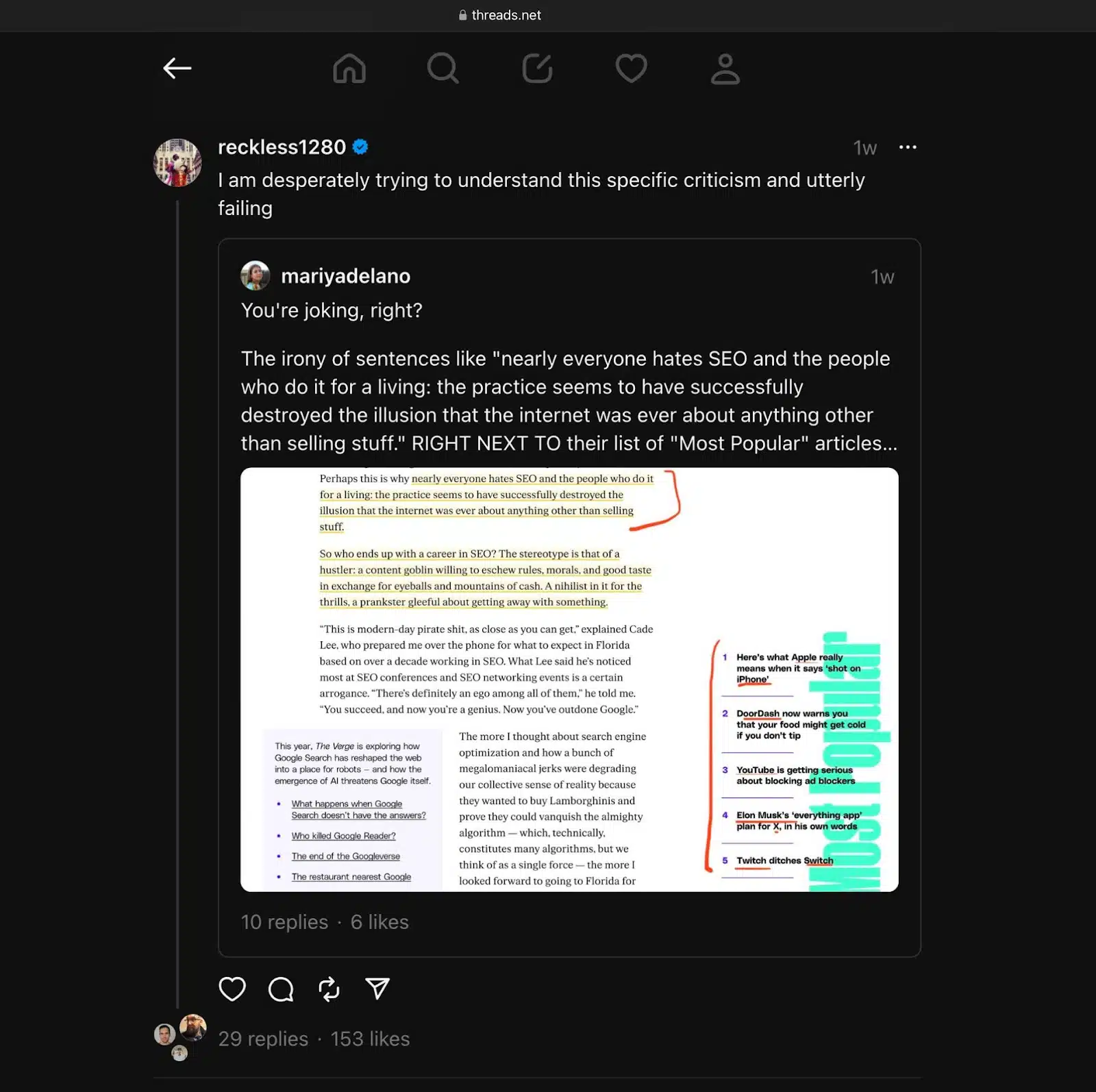
When The Verge published “The people who ruined the internet” on Nov. 1, it caused a shockwave across the search engine optimization (SEO) world. Their writer, Amanda Chicago Lewis, described us in a particularly unflattering way:
“So who ends up with a career in SEO? The stereotype is that of a hustler: a content goblin willing to eschew rules, morals, and good taste in exchange for eyeballs and mountains of cash. A nihilist in it for the thrills, a prankster gleeful about getting away with something.”
As you might be able to guess, calling people “content goblins” doesn’t tend to make them feel particularly great. So, predictably, the article did what it seemed designed to do: The Verge made many search marketers angry, including me.
While this is another response piece, I won’t be repeating the claims made before me. If you’d like to catch up on this story, you can find some other notable replies here:
Instead, I’d like us to use The Verge as a jumping-off point. I’ll show you why I consider their piece problematic, describe the impact it’s had on us in SEO, and then zoom out to what I see as the more interesting conversation:
Who, if anyone, “ruined the internet” and how did it get us where we are now?
Buckle up. It’s going to be a long ride.
Original illustration by the author.
Why we care
Here’s my larger point: the Verge article correctly pointed out a problem. The web, as it exists today, is in trouble. Things are falling apart. Something needs to change.
However, the Verge didn’t point their finger in the right direction. Instead, I propose a more complex explanation – the web is stuck in a “sucker’s choice” created by the advertising and publishing status quo.
Everyone who wants to make a living online seems to feel trapped between two terrible options:
Spam and force your way into getting people to pay attention and buy from you.
Give up on ever making money, sharing your work with others, or promoting your products or services.
But I believe that by properly examining the problem that The Verge pointed out, we can figure out how not to resort to extremes of silence or violence.
Marketers, journalists and users – it’s time for us to have a crucial conversation about the web, why it broke and how we can fix it.
What happened
At first, I didn’t want to write this piece.
I don’t think I’m the most qualified person to do so. I’ve only been in marketing for four years.
I’m not a journalist, and I existed on the 2000s internet exclusively confined to Ukrainian- and Russian-language forums about the Sims, MMORPGs, and Winx Club. I haven’t lived the history of SEO or the larger internet the way most of you reading this probably have.
But I feel a deep sense of obligation to do this topic justice. Because so far, many of the people I would have assumed to be more qualified have messed it up. At best, major journalists and publications have been treating the field of SEO as some strange middle-school drama and, at worst, as a shadowy internet mafia.
I’m disappointed in how much The Verge’s editor-in-chief, Nilay Patel, has gleefully indulged in celebrating and mocking every bit of anger that their article caused in our community.
It’s hard not to feel like he’s trying to pick on a small account, given that I had less than 300 followers on Threads when this happened and he had 20,000+.
Above all, I’m disappointed by how little people like Patel are interested in talking to the people they’re supposedly studying – SEOs and marketers like me or those of you who frequent Search Engine Land.
Voyeuristic coverage like this stinks of tabloids, yet Business Insider also decided to jump aboard, painting the whole affair as salacious suburban gossip:
“I never thought I’d say these words, but, friends: The SEO drama is spicy.”
It seems that Insider’s writer, Katie Notopoulos, shared The Verge’s mindset. Talking about The Verge’s piece on his podcast, Patel stated:
“The funniest thing about this whole situation is the SEO professionals being mad at us but doing perfect SEO by instinct, and all the places where they’re yelling at us. Chef’s kiss.”
Patel’s eagerness to drum up strife prompted me to examine whether he has some long-standing grudge against the SEO profession.
I discovered that he graduated from the same law school in the same year as my mother’s ex-boyfriend. But, disappointingly, when I asked that ex-boyfriend about it, he said he didn’t have any recollection of Patel whatsoever.
I understand why our angry reactions are so compelling. Much like I’m disappointed that I couldn’t dig up any fun stories about Patel’s law school years, The Verge seems upset at how devoid of drama the SEO industry truly is.
The boring reality of ‘SEO subculture’
Patel claims that The Verge’s recent piece is about “the culture of the people who practice it professionally.” Well, if that was the intent with which Chicago Lewis was sent on assignment, no wonder they felt compelled to manufacture outrage.
After all, SEO, as a “subculture,” is actually really boring. We don’t even have alligators, despite The Verge’s claims:
“I’ve yet to see one alligator – though, full disclosure, I once saw Danny Sullivan and Matt Cutts toss out plush penguins to the audience at an SMX Advanced keynote in Seattle,” recalled Goodwin, managing editor of Search Engine Land and SMX.
Plush penguins sound absolutely adorable. But they are a far cry from the supposed antics of “megalomaniacal jerks [who] were degrading our collective sense of reality because they wanted to buy Lamborghinis” that Chicago Lewis wrote about.
We aren’t even particularly rich. Our collective economic status is woefully unremarkable. As Tommy Walker, founder of The Content Studio, explained:
“The majority are struggling or ‘middle class; SEOs doing what they can and just get by.”
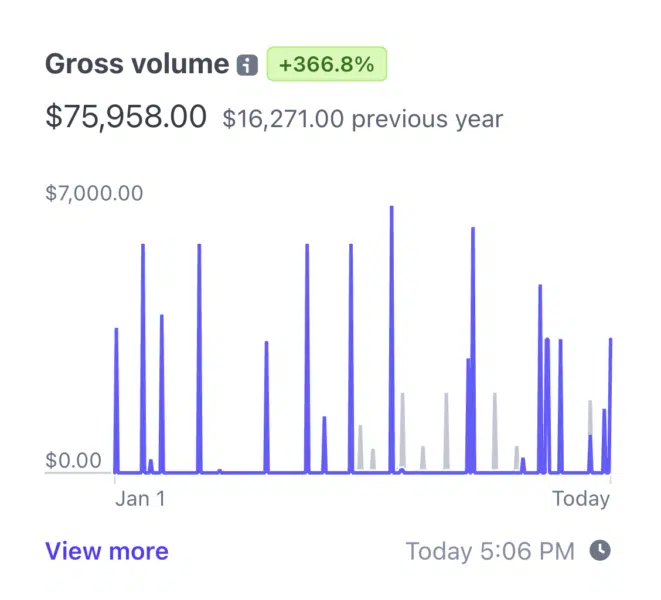
I know it’s easy to think that we’re all rich and successful. That would be so much more “spicy.” And third-party estimates can certainly give you that impression. For instance, this email-scraping website thinks that my agency’s revenue is somewhere between $1 million and 5 million.
As much as I wish that number were true, the reality of running a boutique marketing agency in its second year is much less exciting.
A screenshot of the Kalyna Marketing Stripe dashboard as of Nov 14, 2023.
So, if we aren’t millionaires hanging out with alligators, who are we? What does this “subculture” of SEOs really look like?
We are a profession of people with a similar skillset: doing tasks around helping websites show up on search engines like Google or Bing. That’s… it.
Sure, like any specialized field, people in SEO tend to talk to each other. As described by Duane Forrester, vice president of industry insights at Yext:
“The SEO community is tight-knit and supportive – everyone started as random usernames in forums, then built friendships over years of attending conferences and tackling problems together.“
We do talk to other people in our field. And, controversially, sometimes we even like those people enough to hang out together!
I understand that SEO seems mysterious. After all, we help others become visible online. But ourselves, we’re more hidden.
“We’re a somewhat in-the-background industry that employs thousands of people,” Forrester said.
The Verge claimed they wanted to bring our field out of the shadows and into the spotlight. So, let’s do exactly that.
I’d like to start by introducing you to the people that The Verge left out.
To that end, I’ve interviewed 17 SEO and marketing professionals, all appearing in this piece.
I’ve also created a public gallery to feature some of the wonderful people who make up SEO and celebrate how they work to improve our field and the web. You can browse through the gallery here, and nominate other SEOs using this form.
The voices they left out
Both The Verge and Insider argued that they wished to expose the people in SEO to the public. But if you read their pieces, you’ll notice a curious absence.
Most SEOs are nowhere to be seen. Neither Chicago Lewis nor Notopoulos inquire about the different subgroups of our industry, the organizations and communities within it, the events that we run and attend, or our relationships with others in our field and other professions.
As Lily Ray, head of organic research at Amsive Digital (and one of the people quoted in The Verge’s piece), told me:
“The article didn’t share enough about the work of real, modern-day SEOs, whose commentary would have painted a much more clear picture.”
It doesn’t make sense. Why not just ask us what we think?
Although our work is often behind the scenes, we are easy to find as people. Many of us love media features and actively seek out exposure. We are right there, ready to share our opinions and expertise.
But when I tried to engage Notopoulos on this exact question, she offered me a link and then left me on “seen.”
Perhaps if these journalists listened to us, they might have discovered voices that didn’t fit into their neat narrative. People like Walker, who are riddled with self-doubt as to the impact of their own work:
“Is it us that’s ruining the internet, or is it Google that’s ruining us? I think we’ve all been asking that for a while, so then having that reflected back at us, called content goblins, and painted as riding around in Ferraris making money hand over fist, had most of us feeling bewildered and hurt.”
I’m neither a full-time journalist nor an expert on journalistic responsibility, but I am a public-facing writer and creator. And I know that when you’re trusted to represent other people’s stories, you must handle them with care and empathy because real people feel really hurt when their words are twisted and misrepresented for somebody else’s gain.
So, if journalists with years of experience and big budgets won’t do our story justice – I’ll do it.
Armed with my 25 years of being a human on this planet, a generous network of people who offered up their words for this piece, a byline in this “trade rag,” and only two weeks of time – here’s what I managed to put together. I hope I’ve managed to give voice to those of you who felt erased from the other coverage.
At the end of the day, this story isn’t about me. It’s about you – the person reading this piece. It’s about your relationship to the internet, the media you consume, and the people who make it happen.
Let’s see why it’s all such a mess.
How we can find a way out
When we feel hurt and helpless, it’s easy to point fingers.
If we can blame our pain on somebody else, then we don’t have to do the difficult work of looking into how we might have contributed to perpetuating our own suffering. We can simply find a scapegoat and pin all responsibility for fixing the mess on them.
I don’t blame the Verge for falling into this trap. When they see us (SEOs), they see the people who work explicitly helping businesses make money online. And they see our role in commercializing the web all too clearly, while missing the other parties who may have also played a part:
“Google isn’t perfect. And neither are the people or the brands that write content getting found on Google,” says Nikki Lam, senior director of SEO at NP Digital.
But why are we looking for anyone else to blame?
Fighting with each other won’t help us improve anything. So, to find a solution, I’d like to reframe the question that The Verge asked in their title.
Instead of trying to point fingers at who ruined the internet, let’s diagnose the problem by asking:
What did “ruining the internet” mean?
How can we improve the internet going forward?
How to make money on the internet: The origins of spam
If you want to understand the web today, you need to think about this image:
Targeted advertising can be fun, too.
This is an old ad from Fox News that was shared with me by Mastodon user HunterNP. An ecommerce platform for finding deals and promo codes is advertising on a conservative news site with a banner ad that:
Shows an old white man reading a newspaper, representing the type of person who they think would go on Fox News.
Takes up a lot of space on the page and catches enough attention that someone took a screenshot of it and remembered it for years.
Promotes the company’s value proposition of saving money.
Targets the presumed interest of a Fox News visitor – conservative politics and a fondness for a figure like Ronald Reagan.
All of this feels obvious.
Right now, you’re probably wondering why I’d point your attention to an archaic ad in an article about SEO. But your confusion is the point: we have been missing something that’s been hiding in plain sight this entire time.
Chicago Lewis explains her distaste for SEO because “the practice seems to have successfully destroyed the illusion that the internet was ever about anything other than selling stuff.”
But that complaint is much larger in scope than search engine optimization. If “ruining the internet” means turning it into a place for “selling stuff,” then we need to consider online ads, user targeting, and the very practice of digital marketing.
Why was Groupon advertising on Fox News? And why do businesses promote themselves online?
What’s the point of SEO?
Ray told me that “the goal of most SEOs is not simply to make as much money as possible while recklessly ‘ruining the internet.’”
But SEOs are in the business of helping companies sell things, right?
Before truly addressing why the web is filled with marketing, we need to understand what SEO and marketing are. (I expect people outside Search Engine Land’s typical audience to read this piece, so feel free to skip this section if you are already in the field.)
Chicago Lewis displayed a certain level of ignorance about our field. She may have talked to marketers, but she didn’t truly figure out what our jobs are for. I’m not saying this to criticize her. Chicago Lewis is in good company:
“Really, the average person doesn’t understand what we do. ‘SEO? What’s that?’ Ten minutes later, blank stares. Or the subject has already changed.” – Goodwin said.
Marketing is not well understood in popular culture. And SEO, as a technical and obscure subset of marketing, seems even more confusing. After all, why would you need to optimize anything for Google? As Eric Enge, president at Pilot Holding, told me:
“Many assume that all you need to do is publish your website and then you’re done. But that’s not true.”
We frequently work with businesses who don’t know why they might need our help. They believe that as long as their website has some kind of design, a couple pages, and information about their company or a topic – that’s all they need to get found by others.
But search engines don’t work that way.
You might have the best business in the world, but if your site doesn’t account for how users look things up or how services like Google categorize websites, you won’t appear at the top of a search engine results page (SERP).
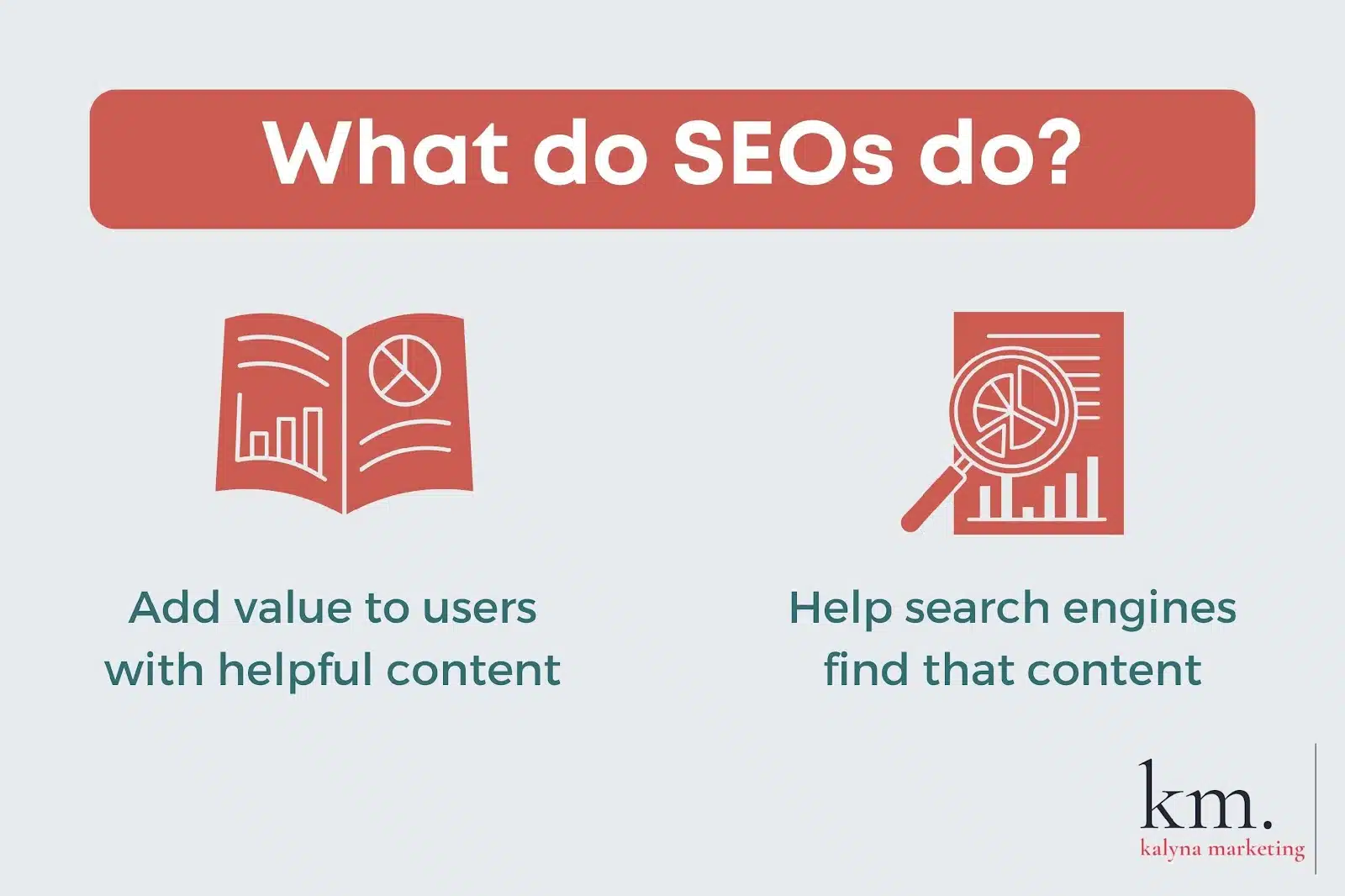
Professionals like Enge view their job as a way to “help dispel myths about SEO and help organizations understand what they need to succeed.” And helping organizations succeed comes down to two types of tasks:
Content optimization: Creating and assisting with creation of pages that might provide information, entertainment, or other value to site visitors.
Technical optimization: Ensuring that sites load well, are correctly parsed by search engines, and provide a good user experience.
The main jobs of an SEO, based on quotes from Eric Enge.
This separation is the source of a common misunderstanding: many SEOs never even touch content. I happen to be a content specialist, but there are search marketers who work purely with web development, UX and accessibility.
“We often work hand in hand with website accessibility specialists, who ensure content is accessible to users with disabilities because we often share the same goals,” Ray said.
How are these two parts of SEO connected? By chasing the same goal as all of marketing – helping the right messages reach the right people. And online, that means:
“A ‘good’ internet experience is one that allows users to easily access the information they’re looking for, in a reliable way,” said Aleyda Solís, international SEO consultant and founder at Orainti.
If you think of the internet as an organism, you could describe it as I have in another piece:
“Its bloodstream is the flow of all the content that the users produce over the days, months, and years. Its pulse is the meaning created from those spontaneous connections and ideas. Its beating heart is a synthesis of all the people who live out sections of their lives on its pages.”
And what role do marketers play in this system?
We are the red blood cells, messengers carrying all that content and the meaning humans create from one website or social account to another.
We are the agents who help disparate organs of the web to connect, forming the large integrated organism that we call “the internet.”
What is spam, really?
So, if marketers are the messengers enabling communication between different parts of the web, how can we also be a source of the toxic sludge ruining it?
The Verge claims that marketers are “clogging the internet with bullshit.” Or, in less graphic detail – that in chasing financial returns for businesses, we are creating spam.
But many of us see that conflation as a misunderstanding. After all, if we are clogging the veins and arteries we move through, we are no longer enabling good communication.
“Showcasing doing SEO as being equal to spamming is like saying all journalism is writing clickbait fluff or fake news. No, it’s not. Most SEOs out there are doing fantastic work helping businesses to connect with clients through search, to better satisfy their needs,” Solís said.
We can’t call marketing content spam until we know what “spam” even is. So I’ve asked my Mastodon followers to share some examples of encountering online spam from the earlier days, preferably pre-2005. I hoped that in distancing these examples from our current moment we would have an easier time defining what turns them into “spam”.
One of the responses was from Paul Bissex, who sent me this post he wrote back in 1997, titled “Second Thoughts on Spam”:
“So far today I have received 16 new pieces of e-mail. Eight of them are the usual — items from discussion lists, messages from friends. The other eight are also the usual, unfortunately. They’re what’s known as “spam”: junk e-mail.The official term is “unsolicited commercial e-mail.” For those lucky readers unfamiliar with it, these messages are generally cheesy, repetitive, ungrammatical sales pitches. “ARE YOU LOOKING FOR A WAY TO DRAMATICALLY INCREASE YOUR BUSINESS OR START ONE?” asks the first spam message in my in-box. “AMAZING international calling rates,” boasts the next. These are typical. Quick money. Lots of capital letters.”
Another response came from Edward Vielmetti, who was quoted in a 1994 story about online advertising by The New York Times. The piece describes the controversy around a company that wished to create ad-specific “zones” on Usenet. Placing ads on the network:
“[W]hile not illegal, violated long-held traditions against random placement of any type of messages on news groups. Such scatter-shot messaging is known as ‘spamming’,” Peter H. Lewis writing for The New York Times (1994).
However, not everyone felt that any presence of commercial promotion online would count as spam. My commenter, Vielmetti, was quoted saying that advertising groups appeared “spontaneously and organically” around “existing discussion groups with a ready audience. That appears to work phenomenally well.”
So, what can we learn from these early references to spam and online marketing? I would say that these stories show us that spam is:
Context-dependent and open to interpretation
Delivered to non-consenting users
Large-scale, random, and repetitive
Impersonal
Intrusive
Perhaps this is a controversial opinion, but I don’t see how spam is necessarily connected to commercial interests. These examples aren’t concerned about people making money or promoting services. They are upset because the businesses who spammed them promoted their services in a haphazard, intrusive way.
If you’re a brand, you must remember that users, websites, or platforms don’t owe you attention.
Spam, black hat SEO, or other “growth hacking” tactics arise from the same mistake: assuming that because you publish online or pay for ads, others owe you attention and sales.
SEOs are operatives within the system that they work in. If structural changes happen to that system, like Google pushing another core update to its algorithm, then SEOs will adapt to those changes. Our job is to help you get found online, remember?
And here’s the harsh reality: a search engine like Google doesn’t care about your website continuing to drive the same amount of traffic. Their function is to deliver “magic” to the user typing things into the search box.
And that magic comes from guessing what the user may want to see on the SERP, watching how they interact with results, and then adapting those results once that user (or another) searches for something again.
This means that Google is mostly website-agnostic. As Enge explained:
“Google cares primarily about what questions/needs you address for their users. That often involves addressing many very specific questions, probably far more than meets the eye unless you have thoroughly researched all the various questions that relate to your market space. Develop the content to address these needs or give that Google traffic to someone else.”
You cannot force a platform like Google Search to guarantee traffic to your site. Because if you are not providing the kinds of answers users are looking for, you shouldn’t show up for their search results. To imagine otherwise is to fundamentally misunderstand the incentives at play.
“People that don’t understand these things are not bad people, they’re just ignorant of the realities of the way the market works,” Enge said.
So, who are spammers? The people and organizations who force themselves to be visible anyway, because they think they’re entitled to attention. And when they manage to force themselves into the SERP or your internet experience in some way, that’s when we are talking about spam and “clogging the internet”.
“We’re having a ‘tactics’ debate, but we’re really having a ‘quality’ debate. We’re not debating SEO as a tactic. We’re talking about whether SEO is good. SEO ruined the internet because people did it badly, with content that’s not good. So if I make a bunch of mediocre stuff, that is not helpful. It doesn’t serve people.”
That mediocre content being shoved in your face is why you might feel like Google search is not that good anymore. So, why are you seeing it?
Digital ads: Why the internet only has one business model
Let’s go back to that Groupon ad. When discussing the internet or search, we need to remember how money fits into the equation.
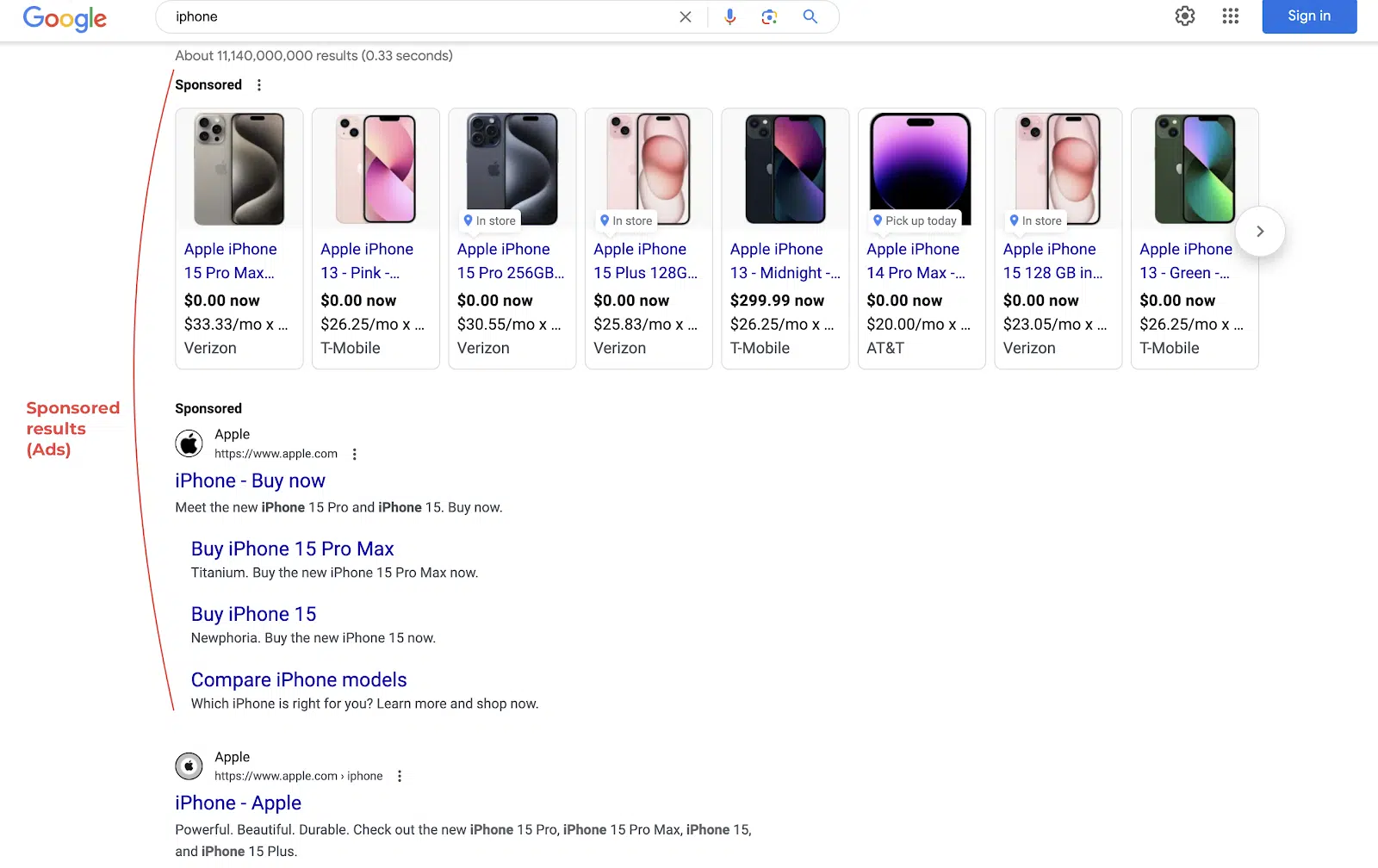
Most of Google’s revenue comes from digital ads. So, as much as the search engine may wish to serve users the most helpful results, we can’t ignore the “sponsored” aspect of the SERP.
A SERP when looking up “iPhone”
We need to distinguish between two types of marketing:
Organic marketing: Made up of information, pages, and posts that operate on the same playing field as any other content, surfaced by an algorithm or shared by people directly.
Paid marketing: Content and links that are paid to be shown, otherwise known as “advertising.”
So far, we’ve mostly touched on the core work of SEO – optimizing for organic visibility and playing by the rules of search engine algorithms. We make useful content, listen to guidelines and anticipate what users want to see.
But when most search results, websites, and social media platforms offer options for “sponsored” content, that playing field is no longer level.
To truly address the Verge’s criticism, we have to speak about algorithms that underlie both organic and paid marketing. As explained by my friend Ronnie Higgins, director of content at OpenPhone:
“People who game algorithms aren’t just an SEO problem. Social influencers and creators have been doing the same thing for 20 years and counting.”
I’d take it further: gaming algorithms to make more money online is a problem fundamental to the fabric of the internet itself.
Because, at the end of the day, our work as SEOs conforms to the overarching business model that supports the internet and trickles down to search engines and individual websites. And that business model is pay-per-click (PPC) and programmatic advertising.
Various companies, including Google, offer businesses predictable exposure on their online platforms based on a buyer’s willingness to pay.
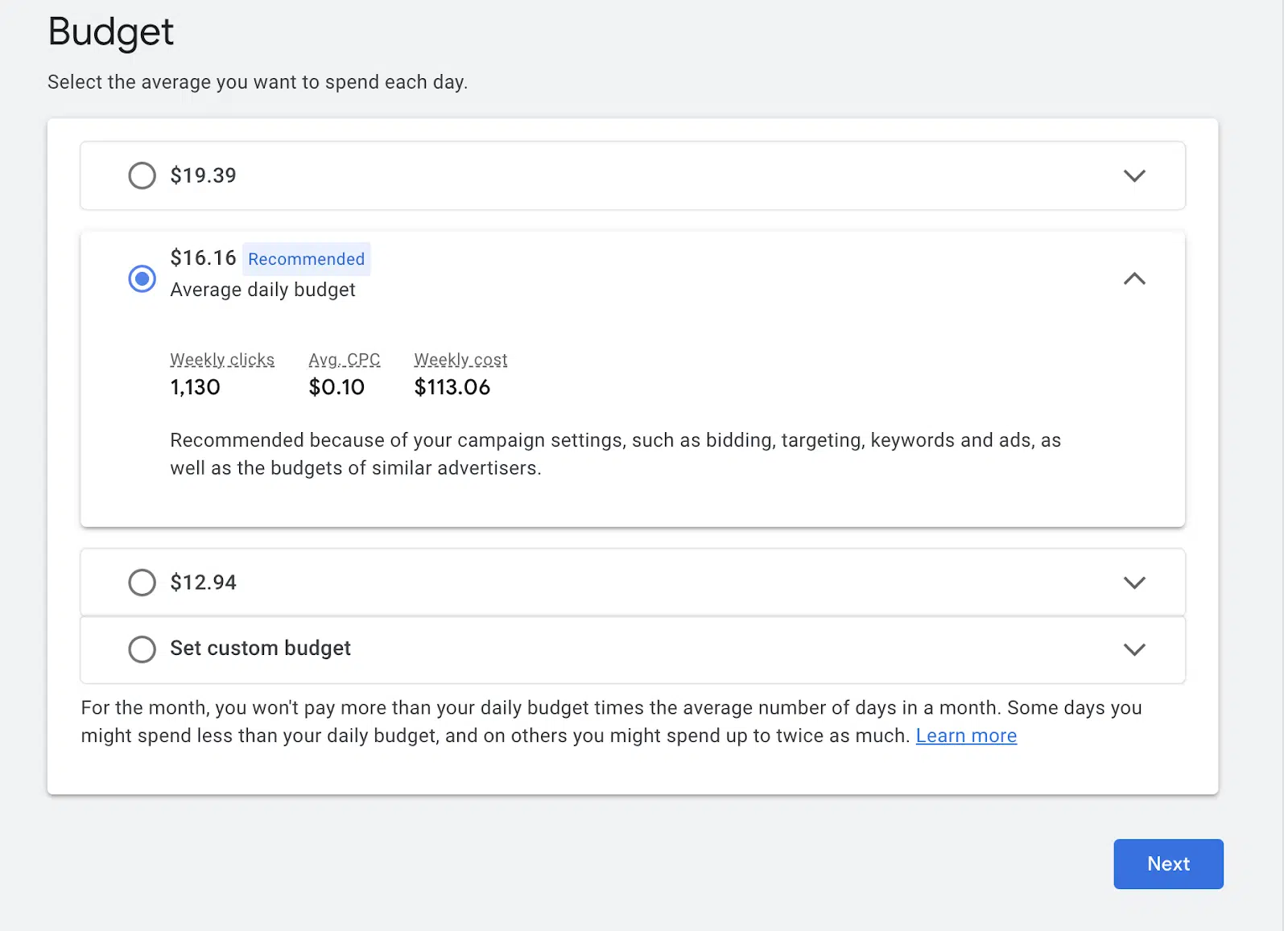
A fake campaign interface that I set up for this article showcasing various budget suggestions once I specified that I only want to pay $0.10 per click.
The numbers that make up this business model are simple:
Impressions: The number of times your ads have been shown to users.
Cost-per-click (CPC): The average amount you pay to get one user to click through to your website.
Click-through rate (CTR): The amount of clicks on your ad divided by the amount of impressions.
Conversion rate: The percentage of ad clicks that results in a desired action, typically a sale.
Cost per conversion (also CPC): The cost of an ad campaign divided by the amount of conversions.
This system is so elegant and simple. If you’d like to get attention online, you can choose to pay for exposure on a variety of marketing channels – search, YouTube, social media like Facebook, a large ad exchange, a newsletter, a podcast, or more.
“The ad buyer is an investor of a sort, choosing how to allocate limited resources across many different types of promotions that offer different kinds of returns.”
And when using a standardized ad platform like with Google Ads, you get to make your bids via a predictable, clear interface.
“In this context, online platforms like Facebook and Google offer new, shiny assets in the broader marketplace for grabbing attention,” Hwang writes.
The way these platforms are set up, the only obstacle standing between your business and the attention you crave is your own wallet. You can purchase the success of any marketing goal.
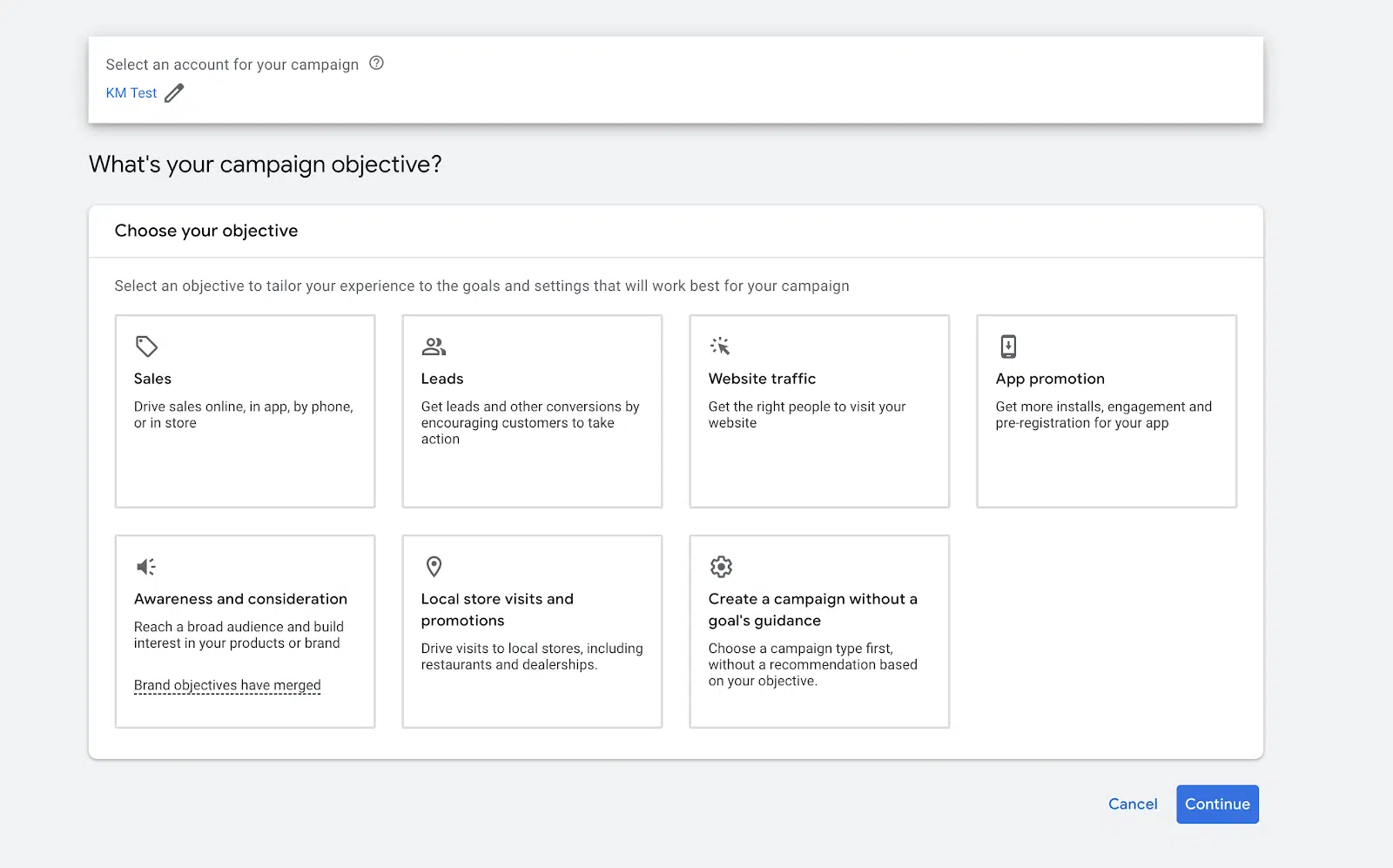
Types of campaign objectives allowed in Google Ads.
PPC treats the internet as an infinite supply of little slices of every user’s attention, up for sale to the highest bidder. You simply have to click some buttons, specify the text and media that will show up on your ad, and off you go.
Websites with audiences can choose to rent access to those audiences out to other parties by offering up ads.
For instance, The Verge monetizes their own articles this way, including the very piece where they complained about everything online becoming about “selling stuff.”
Perhaps it’s not quite SEO, but I’d claim that The Verge is “making money” based on my “misery” in having to scroll past so many ads.
“As a company The Verge is probably getting paid when you go to their website, it’s chock full of ads. They’re making money off views. It’s just a different monetization model and a different traffic source,” Hufford told me.
It’s all on the table: every scroll, every click, every last millisecond of attention. And we are all sick of it.
Privacy, third-party cookies, decreasing efficacy of digital ads
Ads have become an infinite money button for too many companies that market themselves online. As Rand Fishkin wrote on his SparkToro blog:
“Almost every link a marketer placed on the web, every ad they bought, every search ranking they achieved, and every social network post contained easily collectable data showing where their efforts were working. Marketers (and even more so, company leadership) got addicted to this trackability.”
I agree. We’ve all gotten hooked on the drug that is digital advertising.
It’s hard to step away from an interface that allows you to pump more money in while promising a consistent supply of money out.
But the promises of that infinite money button turned out to be resting on a faulty foundation.
You see, the predictable tracking of return on investment (ROI) and the ability to show ads to the precise people you wanted to reach were based on collecting too much user data.
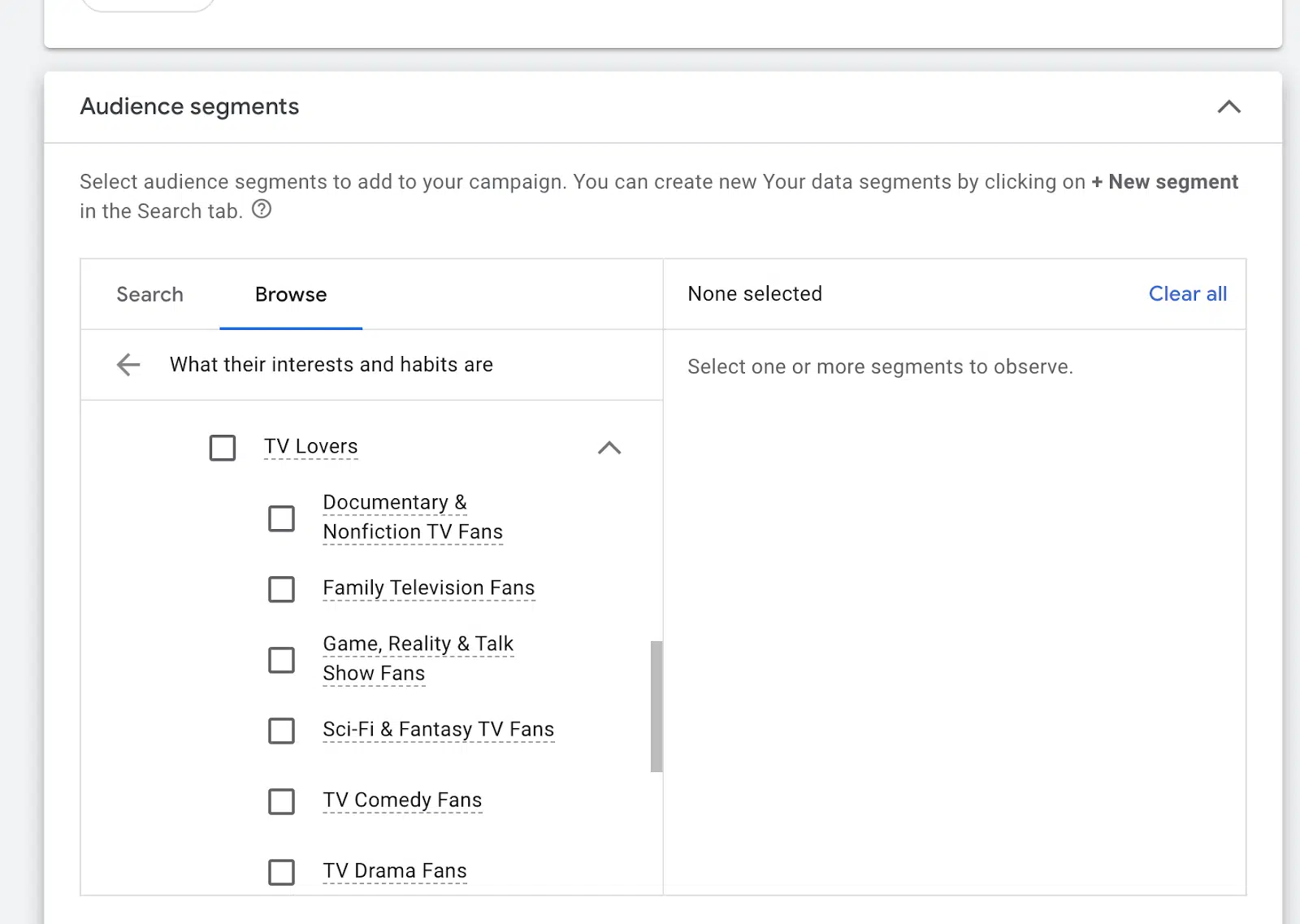
Some options that Google’s Ad Manager currently offers for targeting your campaign by user interests.
As Emily Gertenbach, B2B content writer at (e.g.) creative content, explained to me:
“Our internet usage is increasingly tracked, monitored, parsed, and sold. We’re all largely tracked much more than we need to be. Companies collect far more data than is actually necessary to carry out various marketing activities, because we’ve been conditioned to believe that providing—and accepting—hyper-personalized marketing is the right or modern thing to do.”
The Cambridge Analytica scandal showed us that allowing companies like Facebook to collect unlimited data wasn’t a good idea, to say the least. As a result, we’ve been witnessing a rapid increase in data privacy regulations from governments and restrictions from certain tech companies and collectives, which means that digital advertising suddenly got a whole lot harder.
But because so much of the internet has already become conditioned to having easy access to tracking and identifying users for advertising… the mindset shift is difficult.
What happens when ads stop working?
But without overly intrusive tracking capabilities, digital ads aren’t working so well. As demonstrated in a recent academic paper by Nico Neumann et al.:
“While we find that deterministic data segments perform marginally better than probabilistic data segments, our results show that both types of these third-party audiences do not lead to better outcomes than random prospecting.”
Or, in plain English – advertising platforms aren’t good at predicting which users they should show ads to based on whether they are likely to match a certain audience persona (for example, a specific type of professional like an IT executive). Those predictions were so poor that you’d be better off simply showing ads to random users based on a roll of the dice or reading a Tarot deck.
And when ads become less good at figuring out who might want to see them, those ads tend to perform much worse for advertisers. If your product is aimed at 30-35-year-old suburban moms, but your ad gets shown to 14-year-old boys – not many of those views will turn to clicks, let alone sales.
But here’s where things get tricky: how do companies respond when their ads are suddenly resulting in fewer sales?
Since businesses don’t want to lose money, when sales drop they are likely to invest more into marketing or sales. And when the marketing channel used to work was digital advertising, those businesses are likely to increase their ad spending to compensate for lower conversions.
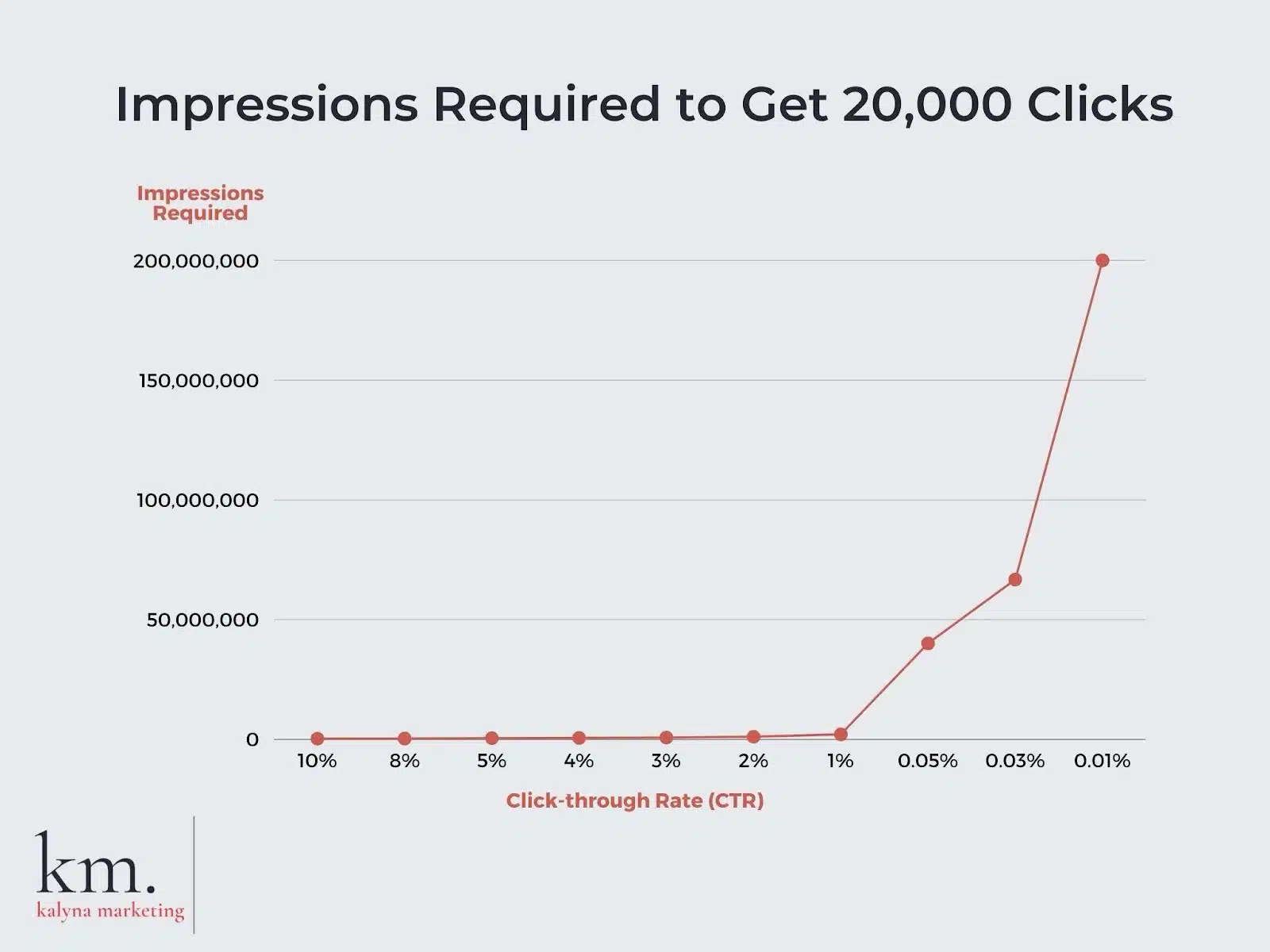
For instance, if you used to get 20,000 clicks at a 4% conversion rate, you needed your ads to have 500,000 impressions. But if now your ads are converting only at 1%, then to maintain the same amount of traffic to your site (20,000 clicks), you’ll need to show those ads 2,000,000 times.
This means that as ads convert at lower rates, companies try to chase the same results by making their ads more intrusive and showing those ads to more and more people.
As your CTR decreases, the amount of impressions you need to maintain the same number of clicks increases exponentially.
As ads become less effective, the amount of web spam can increase. Businesses are chasing the promise of past performance that is getting harder and harder to reach, and they are frustrated because they can’t get another hit.
Get the daily newsletter search marketers rely on.
How organic marketing hasn’t been allowed to exist
Now that we’ve talked about paid advertising, let’s return to SEO.
The problem with organic marketing is that it’s a lot less clear-cut than paid ads used to be.
“Creating the right content is a difficult task,” Enge said.
Organic marketing is hard to do and even harder to explain to people with control over marketing budgets. As Walker explained:
“There’s not an experienced veteran I know who hasn’t had to spend a significant portion of their time back peddling or having to justify their existence, after losing rank, and not knowing why it dropped, or really, honestly, scientifically, knowing how it got to its position in the first place. We have hunches and best practices, but there’s also a lot of luck and finger-crossing and hoping for the best.”
Incentives and assumptions created by digital ads
Unfortunately, the alluring promise of perfect trackability and low barrier-to-entry with paid ads has made it difficult for many businesses to understand how difficult marketing without those ads truly is.
Most SEOs working with content are doing a ton of work. With content, we have to remember the audience who we are making it for.
“No SEO represents the ‘average consumer.’ Do the research, track the journeys, hold the focus groups,” Forrester said.
In addition to customer research, as SEOs we also need to keep track of changes made by platforms like Google to their algorithms, since:
“At the end of the day Google is the driving force behind the types of content that perform well, the logic behind it, and the types of results that show up for specific terms,” said Tory Gray, senior SEO consultant at Gray Dot Company.
But because digital advertising has provided companies with beautiful dashboards, clear numbers, and easy ROI calculations (such as cost per lead or return-on-ad-spend, ROAS) – there’s been pressure on organic marketers to keep up and have their own set of clear numbers and graphs.
Except, you can’t force organic marketing into an empirical box. You can try. You can add quantitative factors. You can make predictions.
But you can never fully guarantee or attribute performance of any organic marketing campaigns. Because you can’t quantify or reliably predict the complexity of human emotions and behavior.
But finance-oriented executives don’t accept that level of uncertainty. They want to ensure that their marketing investments deliver results. Which results in a fundamental incompatibility between executive expectations and the creative uncertainty inherent in most marketing work. And when marketers can’t prove why their work is valuable, their budgets get cut.
As a result, organic marketers try to do the same things as paid advertisers – chasing large reach, assuming low conversion rates, thinking about campaigns in isolated silos, and hoping for perfect attribution.
Essentially, we are all stuck in a self-fulfilling cycle of marketing failure.
The trap all of us are caught in.
Reach at all costs
This is time to admit: the Verge was right that some SEOs are making the web worse.
There are people who cover blogs in what we call “thin content,” endless variations of existing webpages and repetitive arguments rephrased from other websites. Bad SEOs exist.
“SEO gurus that ‘consult’ and don’t deliver results are a dime a dozen (and there are dozens),” said Sarah Stockdale, founder of Growclass.
Some companies are hiring writers or paying for AI to churn out 50 blog posts a month, setting targets to write 5,000 words in every single post (as opposed to churning out an occasional 7-8,000 word manifesto as any good marketer obviously should do, right?).
They don’t care about whether they are introducing anything new to the conversation. They simply want to steal the traffic that they believe they are entitled to.
These companies are often referred to as “content mills.” Many of us have been caught in their trap at some point: we may have accidentally hired them or even worked for them ourselves. I started out as a freelance content writer on Upwork and churned out blog posts for $0.01 a word or less.
These marketing practices exist because of the reach-at-all-costs mentality that we see with ads. When you assume that all conversion rates are low and that the only way to get people to buy from you is to annoy or trick them into clicking on your links – your only leverage is content volume.
Content mills tend to track traffic and nothing else: they show dashboards with the amount of views, visitors, and keywords that sites rank for as proof of results. And they never stop to look at how long people might stay on webpages or whether they are the right people to be sending to those pages to begin with.
The real problem with this mindset isn’t just that it’s annoying for users. It’s that this approach doesn’t actually work.
I once spoke with a friend who told me that their startup was afraid of doing any more marketing. Why? Because their sales team became so swamped with random traffic and sales call sign-ups, they were burnt out trying to get through all of those “leads”, desperately searching for anybody who could actually become a customer.
When you put out spam content or ads onto the web, you get spam attention back. Clog the web with garbage, clog your operations with irrelevant visitors who won’t buy from you. Play stupid games, win stupid prizes.
Optimizing for reach is a race to the bottom. If you think marketing is too saturated, you’ve already lost. Because if you market to everyone, you are truly marketing to nobody.
The alternative is learning to understand your audience and the people you’d like to attract. But here’s the catch: it requires making truly good content that your target audience actually wants to see. And making good content is really hard.
As Enge explains, you need to:
“Research user needs in detail, learn what questions they have, and determine what content needs to be created and what information architecture needs to be created to make it easy for users to navigate. These are tasks that require a large amount of effort.”
Remember, spam is context-dependent.
No topic, product, or company is inherently “spam.” But once you’re churning out enough content to fill a bookshelf every couple of days, then it’s spam! That’s all that those promotional efforts could ever be.
Let’s return to The Verge now, because the issues that we’ve explored with marketing, ads, and SEO aren’t isolated to just us. They are also extremely familiar to any journalist working in the field today.
As Goodwin explains:
“Most SEOs and journalists aren’t that different. My college degree is in journalism. SEO, journalist, whatever the job titles, the end goal is really about informing, educating, entertaining and – yes – sometimes selling.”
And how could we be different?
After all, both media companies and marketers are trying to create web pages that get attention. We both operate on social media, video platforms, blogs, and even search engines. Our desired audiences are often the same people, browsing the same internet from the same mobile phone or computer.
As we compete for attention and reach in this world of broken economic incentives, we end up making the same mistakes. As Hufford pointed out:
“The Verge are playing the SEO game just as much as anybody else. There’s no way that they have 1000 people linking to their best cell phones page organically. Those links are paid for (or traded for).”
Journalists are also caught in the cycle of marketing failure.
Because so many media companies are reliant on PPC advertising to support their businesses, they need to flood their pages with ads and produce as much content as possible to show those ads.
But a website is only paid for ads that actually get viewed and clicked on. So media publications like The Verge are incentivized to drive traffic however they can.
For instance, many of us suspect that’s why The Verge published that SEO piece in the first place. As Walker summed up “it wouldn’t surprise me if it was intended to tap into a niche community to manufacture outrage and drive up page views.”
This is, in the field, known by the obscure term “clickbait.”
Clickbait and chasing rage engagement
Look, that article was… strange. It felt engineered to make our entire field angry.
The Verge got many details wrong. For instance, Ray told me that “the now infamous ‘alligator party’ wasn’t even a true SEO event, but rather a casual meetup for affiliate marketers.”
It seemed like the whole point of that piece was simply to create “spicy drama.” For instance:
“Amanda (the author) did all this research, attending the party, talking to folks, and somehow never realized her own preconceived bias prevented her from learning anything,” Higgins explained.
And yes, it worked. As I’ve shown above – all of us in marketing and SEO are already worried about our field. We feel like marketing, as we know it, might be falling apart. And this article dug into our insecurities.
As Walker described:
“In a lot of ways, I feel like it was kicking people when they were feeling down, because it was the darkest reflection of what we all fear deep down.”
Walking away from the casino: Why people are giving up
Again, The Verge isn’t an isolated actor in our online wasteland. I agree with Hufford that “the game that The Verge is participating in, we’re all playing it.”
The digital marketing status quo is broken. It’s not working for users, websites, journalists, or marketers. And figuring out how to change that status quo is hard. So many people are looking at the state of things and deciding that everything is hopeless.
Giving up on targeting
Chasing reach at all costs is a form of giving up. If you are trying to chase those hundreds of thousands or millions of impressions, that means you’ve given up on any concept of niche or properly targeting your content to a relevant audience.
Mass marketing becomes your only form of marketing. Because if your ads aren’t reaching the right people – might as well just throw money into the dark and hope that it comes back in the form of some views, from anybody, who cares who they are?
Typical SEO keyword research boils down to believing that “the way to run a content strategy is we do our keyword export, we sort for highest volume and lowest difficulty, and there’s your content strategy. I think that needs to go straight into the toilet.” As Hufford told me.
When the old way of tracking users is breaking down, we aren’t sure what to do instead. As explained Gertenbach described, we’re feeling:
“Disillusionment with our hyper-tracked, hyper-monetized, and hyper-advertised world of media consumption. And I don’t think the author knew quite how to separate out the different parts of modern marketing culture that create that sensation. Which is understandable—it’s complex!”
Giving up on marketing
Others might give up on the practice of marketing entirely. And perhaps part of that is our fault. As Montserrat Cano, international SEO consultant, told me:
As SEOs “we tend to do a bad job at marketing ourselves and what we do.”
People are told that to promote themselves. They need to either play the reach-at-all-costs game or give up. So the false conclusion that the public is encouraged to reach boils down to “all marketing bad.”
For instance, Elizabeth Tai replied to me the other week wondering about the future of the web, and she wrote:
“I wonder how marketers will navigate this space or are they even allowed in.”
So many people think we are ruining the internet. It’s not just the Verge. As Walker described:
“Our community is having an existential crisis where many people have been feeling, to some extent, some truth to what the article was saying. Many people I know have been questioning whether or not they’re being helpful or just spinning their wheels to appease the search engines.”
Giving up on the internet
Some go as far as to start believing that the entire internet is ruined or may have been a mistake.
But how can that be? The internet isn’t static. As Becky Hendriksen, CEO of Green Hearted, explained to me:
“An internet that stops evolving is ruined. A non-ruined internet will continue to shift and adapt.”
So if we give up on the internet, we are dooming it to fail.
What if things could change?
What if we refuse to give in to nihilism? What if we actually try to salvage what has been great about niching down, marketing, and the internet itself?
After all, things have changed before.
SEO used to be very different even a few years ago. As Eugene Zatiychuk, one of my clients and SEO lead at Belkins, told me:
“You could get the top position in Google with some spam-ish techniques. But five years ago, Google improved because of things we, SEOs, have done. And they actually updated the algorithm to combat abuse. And now, it’s almost impossible to do spam. So you can do it. It just doesn’t work.”
Google has changed how it ranks pages, and the spammy tactics of previous years are no longer prevalent or effective. How? As Schwartz, president at RustyBrick, Inc. and contributing editor to Search Engine Land, said:
“We just cracked down. What was ‘accepted’ 20 years ago is simply not today and for good reason.“
Where search is moving
Google has been pushing many updates to prioritize niche, targeted, and user-centric content.
This means that for pages to rank, they should show why a particular author is qualified to speak on a topic. As Lam explained:
“For example, if a website produces a blog comparing pros and cons of visiting different national parks, but the writer has never visited those parks, there’s no clarity on who the writer is – then that blog will be considered low quality. And in theory, it should not be easy to find on Google. This is great for searches, because we don’t want recommendations from sources that don’t have first-hand expertise and experience to draw on.”
Fixing the internet: Refuse the sucker’s choice
Look, SEOs aren’t a different breed of human. We are also internet users who want to have a good time online and help others navigate the web.
As Stockdale said, “most marketers focused on SEO just want to do good work and help their companies and clients be seen in an increasingly noisy content environment.”
The internet doesn’t have to be toxic sludge (or even a cesspool, as former Google CEO Eric Schmidt once called it way back in 2008). It can also make us better. For example, Lam told me:
“For me, as a mom, a wife, a leader, and simply as a human, I appreciate the internet, because it gives me instant access to the information and inspiration I need to be the best (and honestly, less anxious) version of myself.”
But to improve the good, we need to make changes. I agree with Gertenbach, who said:
“To change the fundamental dissatisfaction expressed in (The Verge) article, we’d have to take a broader look at how we (as a society) consume, demand, create, and monetize content.”
We should do things the right way. Which means that as SEOs, we must remember what our jobs are meant to do:
“As findability specialists, we help to surface and maximize the visibility of what’s needed at each stage of the users’ search journey, whatever the platform or the format.” explained Solís.
We aren’t on opposite teams from regular users or journalists. And we can educate our field to think differently. For instance, here’s how Stockdale teaches SEO at Growclass:
“Selling something should mean connecting someone with a problem to a useful solution, not tricking them. We teach modern marketing, focused on the needs of the customer, and delighting people.”
What truly ruined the internet: Erasing humanity out of our online experiences
We should let everyone be human.
Marketers should be trusted to market how they think is right. Reviewers and influencers should be trusted to describe their real experiences with products. And users and buyers should be trusted to figure out what they should buy for themselves.
The dependence on large ad networks has become like the ideal espoused by crypto – a fully zero trust system with no human intervention or appreciation for humanity in the mix. And in surrendering our humanity, we’ve helped create a spam-ridden wasteland.
This isn’t a story about SEOs, the Verge, or any particular group. This story is about humans who go online and want to connect with others. And that story can easily have an optimistic future.
After all, as Gertenbach told me:
“There’s plenty of room to create content and digital experiences that answer questions people are searching for online.”
I won’t pretend to know what that future would look like. But I do know that we won’t get there by calling each other “goblins.”
Opinions expressed in this article are those of the guest author and not necessarily Search Engine Land. Staff authors are listed here.
@media screen and (min-width: 800px) { #div-gpt-ad-3191538-7 { display: flex !important; justify-content: center !important; align-items: center !important; min-width:770px; min-height:260px; }
}
@media screen and (min-width: 1279px) { #div-gpt-ad-3191538-7 { display: flex !important; justify-content: center !important; align-items: center !important; min-width:800px!important; min-height:440px!important; }
}
About the author
Mariya Delano is the founder of Kalyna Marketing, a marketing agency for B2B technical brands. She combines her background in academic writing and her love for research into helping clients with content marketing strategy, creation, and distribution. She’s worked with clients in SaaS, cybersecurity, data analytics, DevOps, AI, ecommerce, MarTech, and more. Mariya is originally from Zhytomyr, Ukraine and is currently based in New York, USA.
How to integrate user-generated content into your SEO strategy
What excites me about SEO is that it’s always changing. You can’t stand still – staying ahead is crucial.
Small advantages matter in the competitive battle for audience attention.
One activation that is seeing growing prominence for brands is user-generated content (UGC). This article tackles UGC and its potential as a driving force for our SEO content efforts.
Understanding UGC
Before we delve into its impact on SEO, let’s start with the basics and define what user-generated content actually is.
At its core, UGC includes content created by users or customers, ranging from product reviews to comments and discussions.
UGC is a game-changer in digital content. It shifts from brands telling the story to your audience speaking collectively.
UGC is now a key part of our online experience, shaping opinions, influencing decisions, and fostering communities.
The role of UGC in SEO
So, why should search marketers like us pay attention to user-generated content?
UGC has the potential to be a key activation within your search SEO strategy, especially now that:
Google is developing a UGC-prominent search feed with Perspectives.
Users are migrating searches to platforms where first-hand experience is more obvious.
The evolution of UGC
The concept of UGC isn’t new, but its prominence and influence have grown exponentially, specifically as younger audiences, who are true digital natives, have begun to contribute to the search landscape. Several factors drive this shift:
Empowered users
With the proliferation of social media platforms, users have more opportunities to voice their opinions and share their experiences.
Ease of creating content
TikTok, Instagram and other social platforms have made it easier for audiences to create content.
This has enabled them to join, lead and create their own conversations alongside contributing to the existing brand conversations on platforms.
Authenticity and trust
Audiences tend to trust peer recommendations and authentic content more than traditional advertising or brand-generated content.
Community building
UGC fosters a sense of belonging and community among users, increasing engagement and loyalty, even contributing to advocacy.
Search engine visibility
Search engines led by Google have recognized the value of UGC in providing fresh, relevant, and dynamic content. As a result, they’ve gone as far as to create their own UGC search filter, Google Perspectives.
Why UGC matters in SEO
User-generated content can attract and engage users in unique ways. It can supercharge our brand activations, enabling us to deliver truly helpful content.
Away from Google, UGC enables us to grow visibility throughout the emerging search universe effectively. You can prompt your communities to guide important conversations and repurpose that content on your blogs or landing pages.
All this helps you showcase experience, display expertise, build trustworthiness and develop authenticity – E-E-A-T signals you should be looking to showcase within your content.
Reward your audience with discounts, free products, or exposure as they contribute to your search content library, filling content gaps. Just ensure you follow local guidelines on paid partnerships and advertising legislation.
This approach allows SEOs to build keyword universes aligned with UGC content. Brands can motivate their audiences to generate UGC, creating a scalable search strategy supported by a brand community.
When you incorporate UGC into your SEO strategy, you can reap the following benefits:
Enhanced search engine rankings
UGC can be used to ensure your content is fresh and constantly iterated upon, alongside improving keyword diversity. These factors should positively impact search engine rankings.
Increased user engagement
UGC fosters user interaction. Audiences are likely to spend more time on your page watching UGC elements or engaging on social platforms, always learning about your brand and putting you top of mind.
Content variety
UGC introduces a wide range of content types. The content is only restricted by the imagination of your audiences. This means your content library could become more diverse. Your audience is likely to create UGC that resonates with your audience, sending you signals of where you should be investing content creation efforts.
Long-tail keywords
UGC naturally includes long-tail keywords and phrases, broadening your keyword coverage and attracting audiences with focused pains, needs, wants and desires.
Authenticity and trust
UGC is perceived as authentic and unbiased, building trust and credibility with your audience. This can then be leveraged on your branded website.
Community building
UGC creates a sense of community around your brand or website, encouraging repeat visits and user loyalty.
Communities are emerging as a vital part of search marketing, and UGC can enable you to grow your branded community at scale.
Social signals
UGC often gets shared on social media platforms, generating signals that indirectly benefit your SEO efforts and connecting with your audiences on social search platforms like TikTok and Pinterest, keeping your brand visible across multiple touchpoints.
User-generated backlinks
High-quality UGC can attract natural backlinks from other websites, enhancing your site’s authority. This can be huge within niche publications that discuss the activities of influencers and content creators within your industry.
Lower content creation costs
UGC reduces the need for constant content creation, saving time and resources. You establish your strategy and become content curators looking for UGC that works for the needs of that strategy.
Feedback and insights
UGC provides valuable insights into user preferences, pain points, and product/service improvements. This should enable your brand to constantly iterate and develop your “owned” marketing channels and SEO content.
Diverse perspectives
UGC brings diverse perspectives and opinions to your content, catering to a broader audience and once again growing your brand community.
Get the daily newsletter search marketers rely on.
Tips for leveraging UGC in SEO
Leveraging UGC effectively requires a strategic approach for seamless integration into your SEO workflow.
Actively encourage and incentivize user contributions
You’re not here to exploit your audience for free content but to empower them to create great content alongside your brand.
We’ve already touched on how discounts, free products and events can be used as compensation.
If a user creates UGC for your brand, they likely have an affinity for you, and these techniques would likely be well-received.
Strategically showcase UGC on your platforms
After asking permission from users, showcase UGC on your website your social channels or maybe even within your next TV ad.
Use it wherever works best for your brand, whether testimonials, product reviews, commentaries, or guides to enhance your existing content library.
Invite UGC creators to contribute guest blogs
Consider inviting UGC creators to contribute guest blog posts or articles. Protect your brand, but let them create content in their style, especially if it has resonated with your audience.
Remember, UGC often contains long-tail keywords naturally used by users. Identify these keywords and optimize your content around them to capture search traffic.
Think of how you can empower your community
Integrating social sharing options can amplify the reach of UGC while engaging with user comments, and any content they create fosters a sense of community.
You should encourage customers to leave reviews and ratings and then use structured data markup to display star ratings in search results as you look to improve your click-through rates.
Another option is to organize UGC-friendly contests and challenges, such as encouraging users to:
Check out and review specific city restaurants on TikTok.
Recommend outfit ideas for specific holidays on Instagram.
Monitor UGC analytics based on user behavior and engagement metrics to refine your strategy.
Gymshark’s effective use of UGC
Gymshark has masterfully utilized user-generated content to bolster its brand presence and connect with its audience.
At the heart of their strategy is a community-centric approach. They have built a robust brand community, encouraging customers to share their fitness journeys and experiences with Gymshark products, thus fostering a sense of belonging and loyalty.
Successful hashtag campaigns, such as the #Gymshark66 challenge, have been key to this. This campaign encourages users to share their fitness progress over 66 days, generating significant attention for the brand.
In terms of social media integration, Gymshark excels on platforms like Instagram, Pinterest and TikTok, where fitness content thrives.
They often repost content from their users, blending professional and user-generated content to enhance authenticity and reach.
This integration extends to collaborating with fitness influencers and regular customers, further amplifying their brand visibility.
From the outset, Gymshark’s strategies prominently feature UGC showcasing their fans using their products. Take their flagship store as an example, where the mannequins were created based on members of their community.
This is a powerful tool for product promotion and builds trust among potential buyers. The brand also features a user-generated content gallery on its website, showing customers how others benefit from their products.
Engaging the community through contests and events is another cornerstone of Gymshark’s strategy. They organize contests where participants share content related to Gymshark products, often featuring winners on their social platforms or rewarding them with merchandise.
This approach engages the community and serves as an effective marketing tool. Additionally, Gymshark uses UGC as a feedback loop for product development. Insights gathered from user content help them understand customer preferences, shaping their product and marketing strategies.
By showcasing a diverse range of customers, Gymshark promotes inclusivity and body positivity, reinforcing a positive brand image that resonates with a wide audience.
Through these multifaceted strategies, Gymshark has adeptly harnessed the power of UGC, demonstrating its significant impact on brand growth, customer engagement, and overall digital marketing success.
Now, most of these successes have taken place away from “traditional search.” However, with Google’s E-E-A-T developments and its move toward Perspectives, I anticipate Gymshark to start reaping benefits on a Google SERP, alongside its successes with social-search platforms.
Risks of UGC in SEO strategy and how to mitigate them
Quality control challenges
Risk: UGC may vary in quality, with some content being poorly executed or irrelevant.
Solution: Implement a robust moderation system. Use automated tools for initial filtering and have a dedicated team for manual review to ensure content quality and relevance.
Negative or harmful content
Risk: UGC can include negative reviews, inappropriate comments and undesirable content.
Solution: Establish clear community guidelines and enforce them consistently. Create a reporting system for users to flag inappropriate content. Beyond this, ensure as SEO content curators. We don’t showcase such content when leveraging UGC.
Dependence on user participation
Risk: Difficulty in generating enough quality UGC.
Solution: Encourage user participation through incentives, contests, and active engagement. Foster a strong community feeling to motivate content creation.
Impact on page load speed
Risk: Slower page load times due to media-rich UGC.
Solution: Optimize images and videos for the web. Implement lazy loading and leverage content delivery networks (CDNs) to improve loading times.
Vulnerability to spam and malicious content
Risk: UGC areas may attract spam and malicious content.
Solution: Use anti-spam filters and regularly monitor UGC areas for suspicious activities. Implement strict registration and posting guidelines and educate SEO teams on best practices.
Potential for echo chambers
Risk: Creation of echo chambers where only certain opinions are amplified.
Solution: Promote a diverse range of views and opinions in UGC. Encourage respectful discourse and discourage groupthink.
As should be becoming clear, most of the risks can be reduced by an effective content curation effort by SEOs, considering the various risks and looking to eliminate or reduce these risks as we leverage UGC within our strategies.
Managing risks and maximizing benefits of UGC in SEO
Integrating user-generated content into an SEO strategy offers many benefits, from positively impacting search engine rankings and driving better user engagement to providing authentic and diverse content.
However, as with any strategy, it has unique challenges and risks. The key to successfully leveraging UGC is balancing its advantages and potential drawbacks. And this is where I see our evolving role as SEO content curators coming to the forefront of SEO strategy.
Effective moderation and quality control are essential to maintain the credibility and relevance of UGC. Implementing robust guidelines, educating the user community, and employing both automated and manual moderation processes can mitigate risks associated with our brand’s content quality.
Encouraging diverse and active user participation while maintaining the brand message ensures a consistent and positive portrayal, allowing us to scale our activations effectively.
While UGC can significantly boost SEO efforts and enhance brand visibility and credibility, it requires thoughtful strategies and vigilant management.
By acknowledging and addressing the potential risks and continuously engaging with their communities, brands can harness the full power of UGC to enrich their SEO strategies and establish a strong, authentic, and dynamic online presence.
Opinions expressed in this article are those of the guest author and not necessarily Search Engine Land. Staff authors are listed here.
@media screen and (min-width: 800px) { #div-gpt-ad-3191538-7 { display: flex !important; justify-content: center !important; align-items: center !important; min-width:770px; min-height:260px; }
}
@media screen and (min-width: 1279px) { #div-gpt-ad-3191538-7 { display: flex !important; justify-content: center !important; align-items: center !important; min-width:800px!important; min-height:440px!important; }
}
About the author
Ashley is an aspiring content and brand marketer with a focus on putting ‘search’ at the heart of marketing efforts by brands across varying industries. Working as an SEO Content Strategist, Ashley is responsible for assisting global brands in developing and better leveraging strategic efforts around on-site content as part of wider marketing strategies – all designed to deliver the best marketing approach possible.
Google has updated its search quality raters guidelines for the first time in 2023 with a number of updates including simplifying the needs met scale, adding some more modern examples and some other minor changes.
The last update to this document was 11 months ago on December 15, 2022, which was a much larger update to the document.
What changed. Here is a list of the documented changes:
Simplified Needs Met scale definitions and added guidance for specific types of Needs Met ratings; refreshed rating guidance and examples accordingly
Modernized examples by adding examples for popular platforms and video formats and removing outdated and redundant examples
Minor changes throughout (expanded rating guidance for forum pages; updated language, examples, and explanations for consistency across sections; fixed typos; etc.)
Google said, “None of these involve any major or foundational shifts in our guidelines.”
What the quality raters do. Google’s quality raters are used by outside consultants hired by Google to assess the quality of the Google search results. They do not directly influence the search results and quality raters cannot downgrade or upgrade a specific site in Google Search.
“As a reminder, these guidelines are what are used by our search raters to help evaluate the performance of our various search ranking systems, and their ratings don’t directly influence ranking. The guidelines share important considerations for what content is helpful for people when using Google Search. Our page on how to create helpful, people-first content summarizes these concepts for creators to help them self-assess their own content to be successful in Google Search,” Google added.
Why we care. Although search quality evaluators’ ratings do not directly impact rankings, they do provide feedback that helps Google improve its algorithms. It is important to spend some time looking at what Google changed in this updated version of the document and compare that to the previous version of the document to see if we can learn more about Google’s intent on what websites and web pages Google prefers to rank. Google made those additions, edits, and deletions for a reason.
@media screen and (min-width: 800px) { #div-gpt-ad-3191538-7 { display: flex !important; justify-content: center !important; align-items: center !important; min-width:770px; min-height:260px; }
}
@media screen and (min-width: 1279px) { #div-gpt-ad-3191538-7 { display: flex !important; justify-content: center !important; align-items: center !important; min-width:800px!important; min-height:440px!important; }
}
About the author
Barry Schwartz is a Contributing Editor to Search Engine Land and a member of the programming team for SMX events. He owns RustyBrick, a NY based web consulting firm. He also runs Search Engine Roundtable, a popular search blog on very advanced SEM topics. Barry can be followed on Twitter here.
How to use Bard to get ahead of Google algorithm updates
To succeed in Google search, SEO professionals must stay updated on Google’s algorithm changes and be adaptable to evolving search trends that influence website rankings and online visibility.
Enter Bard, Google’s conversational AI chatbot.
Among Bard’s many potential uses, the tool can be a powerful ally for SEOs looking to dissect and understand Google’s algorithm updates and identify actionable recommendations for impacted sites.
Bard is uniquely positioned to help interpret algorithm updates with its live access to the web, ability to generate real-time insights and direct connection to Google resources. These features are invaluable in an industry where timing plays a crucial role.
Understanding Bard’s limitations
Bard is powerful but not without its limitations. One notable constraint is its production of “AI hallucinations.”
AI hallucinations occur when an AI model generates insights that may appear accurate but are based on patterns or associations that are not truly reflective of real-world data.
In the context of SEO, this could mean that Bard might provide recommendations that seem logical but do not align perfectly with the actual performance of a website or the tools to which Bard has access.
For example, in algorithm tests for this article, I asked Bard to examine the bounce rate of a client site in relation to the September 2023 helpful content update.
Bard claimed to have access to Google Analytics but provided inaccurate metrics. In other tests, Bard has claimed access to paid tools like Semrush and Sitebulb.
SEOs must exercise judgment and lean on their expertise, cross-referencing Bard’s insights with other data sources to ensure the validity of their recommendations.
With an understanding of what Bard is (and what it isn’t), let’s dive into how you can use it to better understand, interpret, and act on Google algorithm changes.
Generate a timeline of how recent algorithm updates may have impacted your site
With a simple prompt, Bard can provide a timeline of recent algorithm updates.
While this is readily available information, we can start to see Bard’s analytical prowess shine by enhancing our prompts.
Prompt: “Provide a complete list of algorithm updates from 2023. For each algorithm update describe how it may have impacted the ranking of sites like [INSERT DOMAIN NAME] and why it would have made that impact. Provide the size of the impact across all search results for each update.”
The expanded prompt requires Bard to analyze how these algorithm updates may impact your site. By keeping this higher level, we can see industry-level trends that may impact your rankings.
Bard’s output can then be used to generate hypotheses about the impact of algorithm updates. These hypotheses can be tested using live data, like traffic from Google Analytics and ranking data from Google Search Console or Semrush.
The “why” here is essential in understanding the rationale behind Bard’s conclusions. By asking it, you are prompting it to dig deeper into the mechanics of each update’s impact. This will lead you to actionable recommendations.
Get the daily newsletter search marketers rely on.
Digging deeper into algorithm updates: A practical example
Once you have generated a timeline of algorithm updates and assessed their overall impact, you can use follow-up prompts and live data from Semrush, Google Analytics, Google Search Console, or other SEO tools to dig deeper into the data and understand any fluctuations in traffic and ranking – either positive or negative.
Selecting supplementary data sources
The first step following your algorithm exploration in Bard is determining which supplementary data sources will enrich your analysis.
In this practical example examining the influence of algorithm updates on Merrell.com, we will harness the capabilities of Semrush, a versatile SEO tool capable of providing vital ranking data and traffic modeling insights.
Semrush excels in aligning search algorithm activity with your website’s ranking keyword trends.
Their Semrush Sensor monitors search engines for volatility and maps those fluctuations on a trend line with your total ranking keywords.
The dates for high search engine activity, indicating an algorithm change, can be seen with a red comment icon.
By merging this data with the insights gathered in the previous section, we gain valuable perspective on how these updates have influenced the search engine rankings of Merrell.com.
We can then use follow-up prompts to identify actions to take next.
Analyzing the data and crafting follow-up prompts
Examining the last six months of ranking keywords for Merrell.com reveals a positive trend with no notable negative impacts from algorithm updates.
Notably, the September 2023 algorithm update has significantly boosted performance.
To further understand this positive impact and identify ongoing optimization opportunities, we’ll utilize follow-up prompts with Bard.
Prompt: “Following the September 2023 Helpful Content Update, the number of ranking keywords for merrell.com drastically increased. Provide more insights on why. The increase globally was from 142k in early September 2023 to 209k keywords in November 2023. Explain how this update has impacted top competitors. And outline additional recommendations for continuing to improve rankings.”
Through this prompt, Bard reveals the factors contributing to the performance boost experienced by Merrell.com and sets the stage for ongoing enhancement. However, the guidance provided is at a higher level and is not necessarily actionable.
To bring our SEO strategy full circle and elevate our defense against algorithm updates, the practice of prompt engineering emerges as a critical component.
This entails delving deeper and refining previous prompts to uncover nuanced insights to sharpen your strategy further.
Prompt: “The recommendations provided previously are solid but appear to be fairly generic. Provide specific recommendations for how Merrell.com can continue to see positive organic growth in the face of the September 2023 Helpful Content Update. Consider looking at competitor websites for specific content they’ve developed that is performing strong in this market.”
This final prompt constructs a clear roadmap for achieving continued SEO success following Google’s September 2023 helpful content update:
Create more “how-to” content: Cater to the needs of your audience by offering valuable instructional content.
Develop product comparison content: Help users make informed decisions by comparing your products with competitors.
Produce in-depth reviews: Provide comprehensive, unbiased reviews to guide consumers.
Foster local content: Tailor your content to local audiences, enhancing relevance.
Optimize for long-tail keywords: Capture specific search queries with less competition.
Build high-quality backlinks: Strengthen your site’s authority and trustworthiness with valuable external links.
While these recommendations align with SEO best practices, Bard consolidates and customizes them based on your brand’s unique characteristics and competitor insights. It’s essential to treat these recommendations as a versatile toolkit.
With these insights, you can craft a robust SEO strategy tailored to enhance organic results and navigate any algorithm update successfully.
Bard and the future of algorithm updates
Staying ahead of Google’s algorithm updates is a must for SEO success. Bard, our Google-powered, trusty AI companion, plays a vital role in this mission.
With its direct connection to Google resources and live access to the web, Bard can provide a thoughtful analysis of how Google algorithm updates may impact sites like yours.
Think of your algorithm analysis like a funnel approach.
We start broad, checking out the big picture of how these updates impact the web.
Then, we zoom in to see how they’ve specifically influenced your site.
Finally, with Bard’s help, we identify actionable strategies to avoid any negative impacts and propel positive results forward.
While Bard can be your reliable partner, always watch the limitations of AI and verify any recommendations against your knowledge and the available data.
Keeping this in mind, you can take charge of your SEO strategy by leveraging the power of AI and Bard to understand and respond to Google algorithm changes quickly.
@media screen and (min-width: 800px) { #div-gpt-ad-3191538-7 { display: flex !important; justify-content: center !important; align-items: center !important; min-width:770px; min-height:260px; }
}
@media screen and (min-width: 1279px) { #div-gpt-ad-3191538-7 { display: flex !important; justify-content: center !important; align-items: center !important; min-width:800px!important; min-height:440px!important; }
}
About the author
Lauren Busby is the Co-Founder of Trebletree, a boutique SEO and web design agency, where she leads the SEO/web teams in building websites for SEO success. She has worked in the SEO field since 2009, driving organic growth for a range of medium-sized to enterprise-level brands, including Carpet One and Urban Air. Lauren specializes in keyword strategy, technical SEO, and large-scale franchise/enterprise SEO.
Google Search goes after fraudulent and manipulative DMCA takedown requests
Google has filed a lawsuit in the northern district of California against two men who allegedly used the DMCA takedown request mechanism to try to remove competitor URLs from the search results. The lawsuit writes that the “defendants have weaponized copyright law’s notice-and-takedown process and used it not for its intended purpose of expeditiously removing infringing content, but instead to have the legitimate content of their competitors removed based on false allegations.”
The lawsuit. You can read the PDF document of the lawsuit over here; it says:
“Google brings this action to stop Defendants’ systematic abuse of Google accounts to submit a barrage of fraudulent copyright takedown requests aimed at removing hundreds of thousands of their competitors’ website URLs from Google Search results. Defendants have weaponized copyright law’s notice-and-takedown process and used it not for its intended purpose of expeditiously removing infringing content, but instead to have the legitimate content of their competitors removed based on false allegations. Defendants’ illegal, fraudulent scheme harms consumers, third-party businesses, and Google; stifles competition; and threatens to tarnish Google’s trusted brand.”
More details. The lawsuit claims that two individuals created at least 65 Google accounts to submit thousands of fake DMCA claims. These were filed against 117, third-party website URLS in the space of selling printed t-shirts.
“Over the past few years, Nguyen, Pham and those working with them, are said to have created at least 65 Google accounts to send confirmed bogus notices targeting 117,000 URLs, plus another 500,000 URLs via notices that Google suspects are fraudulent too,” reported TorrentFreak.
Why we care. Google clearly wants to send a message to anyone trying to use the DMCA takedown request to harm competitors withing Google Search or to try to boost their own rankings by removing those listings above them. We believe this is the first lawsuit filed by Google over such allegations and it may not be the last.
@media screen and (min-width: 800px) { #div-gpt-ad-3191538-7 { display: flex !important; justify-content: center !important; align-items: center !important; min-width:770px; min-height:260px; }
}
@media screen and (min-width: 1279px) { #div-gpt-ad-3191538-7 { display: flex !important; justify-content: center !important; align-items: center !important; min-width:800px!important; min-height:440px!important; }
}
About the author
Barry Schwartz is a Contributing Editor to Search Engine Land and a member of the programming team for SMX events. He owns RustyBrick, a NY based web consulting firm. He also runs Search Engine Roundtable, a popular search blog on very advanced SEM topics. Barry can be followed on Twitter here.
Like any marketing and advertising channel, SEO should be budgeted for. However, creating an SEO budget isn’t as simple as allocating a set monthly amount.
To properly invest in organic search, you need a strategic plan backed by a comprehensive budgeting process. Without clearly defined goals, assessing website needs, and mapping resource requirements, you risk wasting time and money.
This article tackles the key steps for budgeting SEO in a way that sets your efforts up for success.
The ideal SEO budget depends on your needs
Budgeting, like auditing and reporting, may not directly boost impressions, rankings, clicks, or conversions in search, but it’s a vital element for any successful SEO campaign.
For the types of clients and work that my team does, it is nearly impossible to do SEO properly and completely without working through a budgeting process.
A red flag for me is when someone mentions another agency quickly dictating SEO spending. Similarly, if a brand has a fixed budget but can’t explain its origin, it raises concerns.
As you plan your budget, note that there are both hard and soft costs beyond those directly involved with SEO.
Create your strategy and plan
Before jumping into SEO tactics, you must start with a strategy and planning process.
The biggest hurdle to properly investing in or controlling costs within SEO efforts is the lack of a defined plan.
On top of AI changing how we do things and how our users find our content, there are too many moving parts we need to account for, including technical, on-page, and off-page elements.
Within your strategy and planning process, you need several steps to allow you to have a full picture of resources and activities to set your budget.
Know your KPIs and ROI
Establish an objective measure of what success is for your campaign. This involves knowing:
Without understanding these things, you can’t determine if your budget is too small or large (beyond the law of diminishing returns) or how it scales as you flex it up or down.
Remember, though, we’re not doing advertising so we won’t see immediate returns from the scaling or flexing.
Determine how aggressive you want to be
If you can see ROI connected with your SEO goals, you can start thinking about how much you want to pull the levers of speed and scale.
Speed is how fast you want to see the results.
Scale is how wide and broad you might want to go.
Want to maximize positioning and visibility for your full funnel? Want to do it as quickly as possible? That is going to take a larger investment.
Website issues or limited resources often slow down SEO progress.
In a number of cases, a larger budget could have helped us overcome the constraints of a fully booked development team by building a new site or bringing in additional resources.
Constraints related to development sprints and cycles can include things as basic as being unable to implement title tags or more complex, like addressing schema, page experience performance, or technical indexing issues.
In essence, understanding your resources is crucial. Before diving into an SEO plan, assess factors like:
Page experience.
Technical issue resolution.
Content scaling.
UX improvement.
Conduct audits now to anticipate challenges and uncover potential hidden costs.
Scope your content needs
Content creation is a core activity for SEO.
It is important to optimize existing, evergreen content or consistently create new pieces as part of a thought leadership strategy.
I know some SEOs who wear a content writer hat and are multi-talented. Even the most talented people have trouble getting everything done wearing multiple hats.
SEO is big enough on its own. In most cases, someone else without SEO in their title is writing copy.
Is this person internal on your team or an external resource? What do they cost?
That can be pretty variable based on how aggressive you want to be and how big the initial lift will be.
Understand legal, compliance and review cycles
Another fun barrier when you have everything planned out for SEO is the level of review needed by any legal, compliance or approval teams.
This can impact budgeting when it comes to the number of reviews, revision cycles and even the speed and scale at which you can create content, make web updates, and get SEO work done.
Map out internal and external resources
With a full view of your strategy coming into focus, you can map out a plan of tactics your timeline, and hopefully have audited enough aspects to understand where you need help within and outside of SEO functions.
If you have an agency working with you, they likely can cover many or most of the resource functions. If you have a mix of internal and external resources, you need to understand the costs of both.
The costs for internal resources can be a little harder to track down if you have in-house teams and don’t know what the true cost of a fraction of an employee’s time is.
For internal resources, time and other constraints must be considered risk factors to determine if you need to hire more full-time resources or find contractors to fill gaps.
For external resources, you want to have a full understanding of costs and scopes and to make sure that you have all SEO needs covered. The point of budgeting is not to be surprised down the road with new costs or needs messing up your projections and ROI math.
Get the daily newsletter search marketers rely on.
Match the budget to your plan
You should now understand how SEO can be profitable and what resources you need to get it done.
Agency and/or in-house resources can include:
SEO strategist(s)/tactician(s)
UX designer(s), developer(s)
IT
Content strategist(s)/writer(s)
Legal/compliance
Stakeholders, approvers
Hopefully, the math you need to do isn’t too complex, and you don’t have too many unknowns or holes in your budget.
Sometimes, you can’t know it all upfront and must move forward. But it’s good to know potential returns and costs so you can do the important ROI math and start your plan.
Ongoing budget management
The constant in SEO and digital marketing is change.
Adaptability and agility are essential as AI impacts industries and your company navigates product updates, competitive shifts, and changes in consumer behavior or search engine algorithms.
That’s on top of uncovering some hidden resource needs or issues. A website bug you didn’t find when auditing? Not able to get the resources you thought you had up front? Is someone on the team leaving their role?
I could keep going, but my point is that you can’t set and forget it. You also need to manage the budget to have accountability within the plan, the resources working toward it, and the measurement of KPIs toward ROI.
Maximize your investment with a strategic SEO budget
In the absence of planning, it is hard to budget for SEO. Paying a provider or a single in-house salary to do everything SEO can seem like a single cost and a simple solution.
However, as I unpacked things done by people without SEO in their title or not within their complete control, there will be other costs.
The budgeting process is critically linked up with your strategy and planning process to know all costs, how you make money, and not waste years, plus thousands of dollars, not to see the return you expect on that investment.
Opinions expressed in this article are those of the guest author and not necessarily Search Engine Land. Staff authors are listed here.
@media screen and (min-width: 800px) { #div-gpt-ad-3191538-7 { display: flex !important; justify-content: center !important; align-items: center !important; min-width:770px; min-height:260px; }
}
@media screen and (min-width: 1279px) { #div-gpt-ad-3191538-7 { display: flex !important; justify-content: center !important; align-items: center !important; min-width:800px!important; min-height:440px!important; }
}
About the author
Corey Morris is a skilled marketing professional with 15+ years of experience developing award-winning, ROI-generating digital strategies for local and national brands. He was recently honored as the recipient of the KCDMA 2019 Marketer of the Year award. Corey serves as President & CEO at Voltage – a marketing firm based in Kansas City, MO. Previously, he founded the KC Search Marketing Conference to help build a local community for search marketers for career growth. He was recognized for his involvement in the conference and invited to join the global board of SEMPO (now part of DAA) as the VP of Cities.
Automated SEO reporting for clients: The agency’s guide by SE Ranking
SEO agencies place a high value on client satisfaction and trust. This is why comprehensive reporting can make a huge difference. It not only demonstrates the value of your services but also serves as a critical communication channel between your agency and your clients.
SEO reports are integral to agency work, report creation being one of the primary challenges associated with it. Manually collecting data for numerous client projects from different data sources, such as traffic stats, search rankings, technical issues, backlinks and competitive analysis, consumes valuable time.
Fortunately, there’s a solution: automated SEO reports.
By using SEO report templates, setting up a dashboard in Looker Studio (or other similar platforms), or even granting your clients access to SEO software data points, you can save loads of time. It also fosters strong client relationships built on transparent communication and mutual respect.
Here are some benefits and challenges of automated SEO reporting and different ways to set up a streamlined reporting process for your clients.
What is automated SEO reporting?
Automated SEO reporting is the process of using digital tools to generate, compile, and deliver SEO performance reports to clients. This results in minimal manual effort.
The main automated SEO reports benefits are:
Data accuracy: Automation reduces the likelihood of human errors when collecting and organizing data. This is especially beneficial when your agency manages multiple clients, as it’s easy to get overwhelmed.
Time-saving: Automation frees up your team’s time, allowing them to focus on other crucial tasks, such as implementing SEO strategies and conducting SEO experiments.
Streamlined communication with clients: With automation, you can regularly deliver reports to clients’ inboxes at a set time. This can be challenging if done manually instead.
Like any process, automated SEO reporting has its challenges, one of the main ones being the additional cost of automation tools. Dedicated reporting solutions can be somewhat costly and can place additional strain on your agency’s budget. Nevertheless, you can always find SEO software for your daily SEO operations, including built-in reporting capabilities.
Thankfully, these disadvantages are easily outweighed by the pros mentioned above.
Now, let’s explore how to set up automated SEO reporting in just three simple steps.
How to set up automated SEO reporting in three steps
Setting up automated reports can seem like a daunting task. But by investing a bit of time in this process, you can save your team’s resources so they can spend more time working on other important tasks. This greatly reduces the time required for successful reporting.
Step 1: Defining KPIs
The foundation of any successful reporting system is a clear understanding of KPIs, as they ensure that your reporting efforts stay focused and relevant.
Identify the metrics that most closely align with the client’s goals. Some of these metrics include increased website traffic, higher search engine rankings, or improved conversion rates. This will determine what information you need to include in the SEO report. For example, if the defined KPIs are local search visibility and organic traffic growth, the report should contain a detailed overview of the site’s local positions and visitor analytics.
Remember: The choice in KPIs depends on the industry, business model and specific goals of the company. For a local bakery, some SEO KPIs worth looking into are local search visibility and organic traffic growth. Meanwhile, a fintech product website could prioritize SEO KPIs like organic keyword rankings, domain authority and the number of leads.
Once you have defined your KPIs, you can move on to the main step: creating an automated SEO report.
Step 2: Creating the report
This is one of if not the most, crucial step. It needs to be approached with great care.
As mentioned earlier, the data included in your SEO reports should align with your client’s goals and preferences. But most SEO reports made for clients include information on metrics like keyword rankings, traffic, backlinks, competitor overviews and the website’s technical health.
By automating the reporting process, you can build a thorough but concise report (with all of these sections) in minutes. For example, SE Ranking’s Report Builder generates reports with easy-to-read graphs based on data from SE Ranking’s Rank Tracker, Website Audit, Local Marketing tool and other tools. Just create a project with the client’s website, launch a couple of audits, and connect Google Analytics and Google Search Console accounts to get reports on website traffic and conversions.
Within the tool, you can use either the modular approach or the ready-to-go report template.
With the first option, you’re free to decide what sections and data to include. Just choose the pre-created project alongside your client’s website, select the reporting period and start crafting your report.
Add the cover page, the table of contents and the sections with data on website health, rankings, traffic, keyword research, competitor analysis, etc. After that, customize the report with your agency’s branding and your client’s logo. To help your client understand your progress better, you can also leave comments on the data next to the graphs.
Another option is ready-to-go reports, which include predefined sections. There’s no need to add them manually. Just choose the relevant report template from the list and select your project. And that’s it. You have a ready report with your data. Don’t forget to add the final touch by adjusting the date range and personalizing the automated ranking report for your agency. You can also easily add additional sections to any template if needed. This process typically takes 5-10 minutes.
Keep in mind: Clients may occasionally require video presentations or recorded explanations alongside automated ranking reports for a more personal touch. Your objective is to effectively showcase your work’s results to the client and provide options that suit their preferences.
Step 3: Select your preferred report format
Once your report has been generated, it’s time to deliver it to the client. Choosing the right report delivery method is a crucial part of meeting your client’s expectations. This step can also be easily automated. Here’s how:
Automatically send PDF reports. Many reporting tools offer the option to send PDF reports to your clients’ emails automatically, providing a convenient and hassle-free solution. In SE Ranking’s Report Builder and other comparable platforms, you can set up a report delivery schedule for your clients. You can choose the frequency and delivery day and enter your client’s email. Once configured, you no longer need to worry about sending reports manually; the tool handles it all for you.
Remember that the reporting frequency is often established in the early stages of your cooperation with the client. Your automated tool absolutely must accommodate this frequency.
Data dashboard access in Looker Studio. Some clients prefer using Looker Studio, a platform with customizable dashboards, to view automated SEO reports. So, it’s a good idea to offer this option to your clients. You can use Google Looker Studio to showcase ranking data and website tech audit results, along with other metrics from your KPI list. Simply connect the data sources and share the link with the client, allowing them to access the latest report data anytime. This option requires more setup but provides a higher level of transparency.
White Label access. If you have SEO-savvy clients who want to delve deeper into the data and explore the ongoing SEO progress on their own, you can provide them with custom access to the SEO platform. White Label access is the best option for this purpose. This feature allows you to customize the platform to match your brand identity. You can change colors, logos and even configure your personalized domain name. This customization gives the platform the appearance of being your own. After completing the customization, you can share custom access with your clients by adding additional user seats to the platform. Many White Label SEO tools let you customize each client’s access. You can define which tools they can use and the amount of data they can view in their account.
Recap
Automated SEO reporting is not just a time-saving solution; it’s a means to enhance the overall client-agency relationship. By automating your reporting processes, your agency can deliver more accurate and timely information to your clients, thereby demonstrating your commitment to their success.
Don’t hesitate to incorporate the steps outlined in this article into your reporting process. Pick a reliable tool that meets all your automated SEO reporting needs and communicate with the client to craft an SEO report that incorporates all their preferences.
Exclusive Black Friday offer for new clients
Save an extra 20% on all annual plans and add-ons, in addition to the year-round 20% discount, with SE Ranking’s Black Friday deal.
SE Ranking is a powerful cloud-based SEO and marketing platform packed with over 30 tools and features. With more than 500,000 users worldwide, it provides entrepreneurs, SMBs, agencies and enterprises with everything they need to get their websites to the top of the search results and stay there, including advanced competitive and keyword research, rank tracking in every major search engine, technical and SEO website audit, backlink analysis and monitoring, and so much more. All housed in an intuitive, user-friendly interface, the all-in-one platform can help you make the most of your digital marketing activities and yield better sales results.