Conveying keyword insights to non-SEOs: A visual approach

Explaining keyword research to those unfamiliar with SEO to gain support can be challenging.

Stakeholders often find it difficult to grasp the value of SEO, and at the same time, SEOs struggle to communicate the benefits and contributions effectively.

Fortunately, there are strategies available for SEOs to bridge this gap by employing their keyword research more strategically and effectively. 

This article explores a visual approach for effectively communicating keyword research insights with stakeholders outside the search industry. 

Leveraging unique visuals

Non-SEO-savvy stakeholders may not know much about search keywords but likely understand general marketing concepts like the marketing funnel and audience segments.

You can use this understanding to explore keywords more deeply and create strategies that align with these broader marketing terms.

One critical yet frequently overlooked element here is search intent. 

You can group keywords based on intent and create a bubble chart to visually represent the position of each keyword cluster within the marketing funnel, like the chart below.
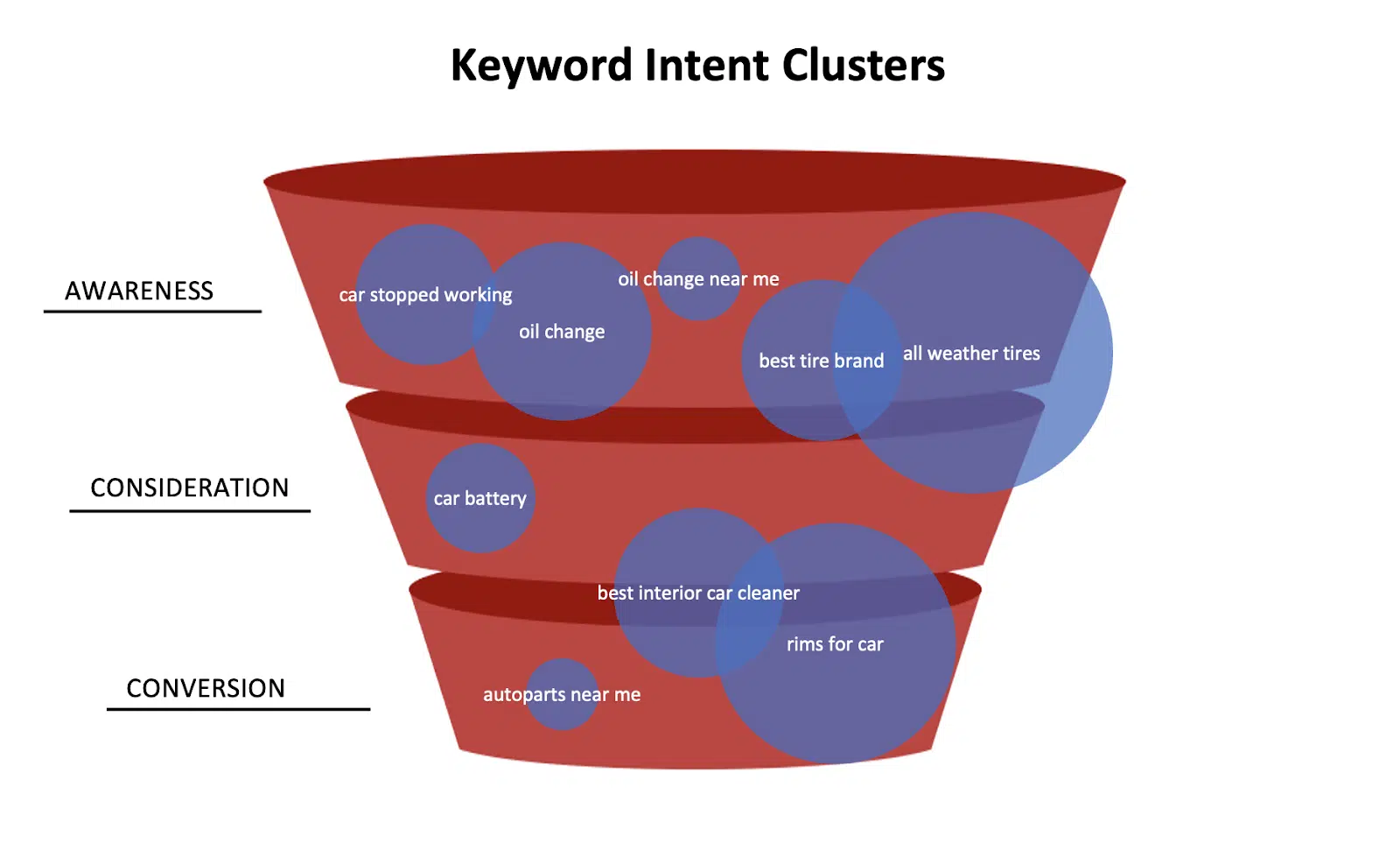
Keyword intent clusters

The chart clearly shows the content needed to help searchers at each level of the marketing funnel. Overall, it reveals the necessary content for different stages of the funnel.

But it’s not just limited to that; you can also narrow it down to specific topics or subsets of keywords. This allows for a detailed analysis and a better understanding of the specific types of content needed for each topic.

Taking the above keyword intent visualization and drilling into the “all-weather tires” cluster shows that “Awareness” content should be produced to target these keyword clusters. Unlocking this insight means SEOs can match the searchers’ expectations.
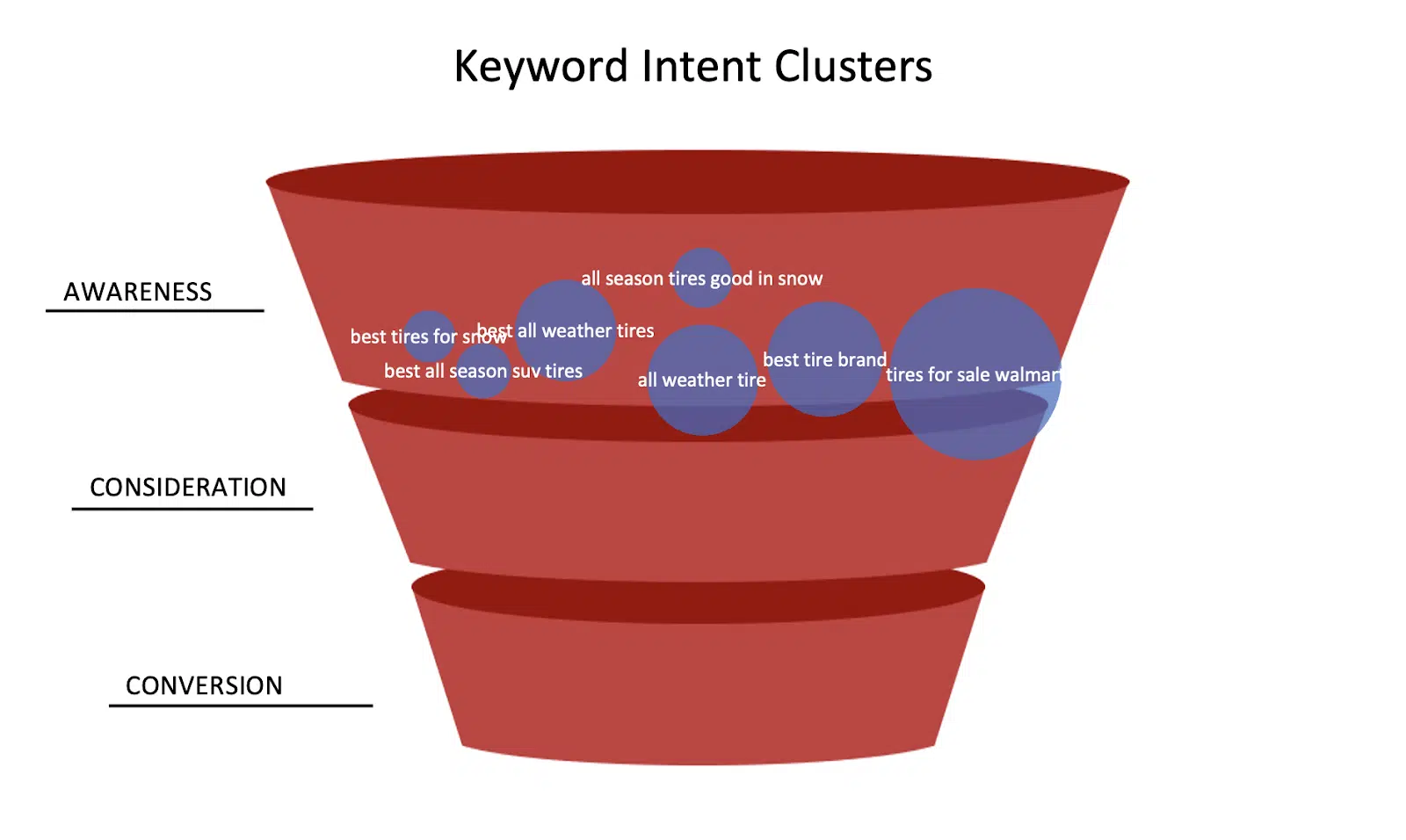
Keyword intent clusters - Awareness

This visualization shows how certain keywords help users move through the marketing funnel, and there are more actions you can take to optimize it further.

Companies often use audience personas or segments in broader marketing efforts. Integrating this knowledge is vital for effective communication, especially with stakeholders focused on paid search, as they commonly associate keywords with audience segments.

Likewise, by utilizing ChatGPT, SEOs can categorize keyword topics based on audience personas, resulting in a visual representation like the one below:
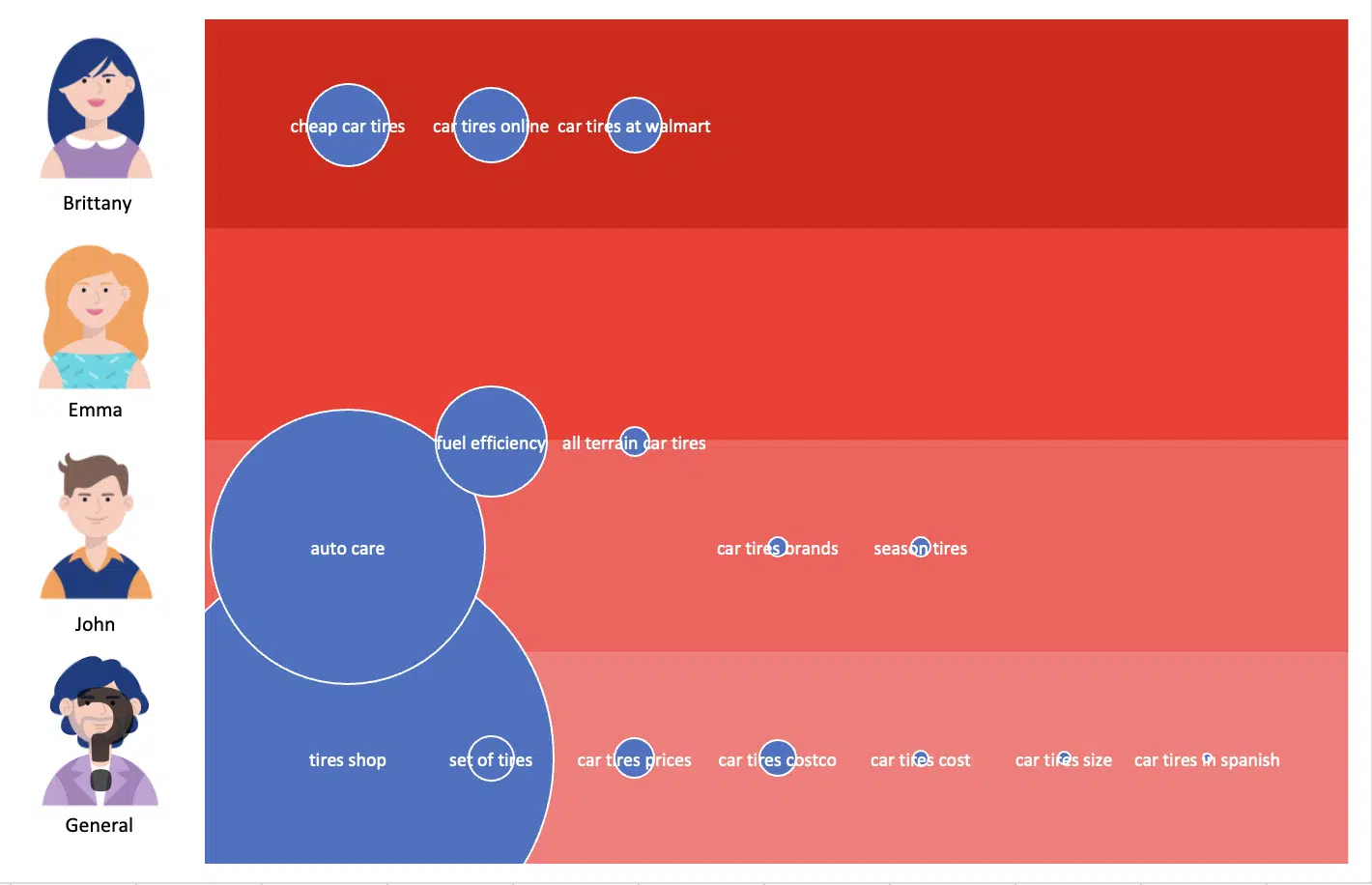
Categorized keyword topics based on audience personas

This chart displays the size of various topics and indicates which audience segments are most likely to engage with content related to those topics.

With these visuals, you are in a stronger position to develop more effective content strategies and enhance your communication with stakeholders outside the search domain.


Get the daily newsletter search marketers rely on.


How to build the visuals

The effectiveness of these two visuals is undeniable, though they require additional effort to develop.

Keyword intent cluster

SEOs can use various approaches to build keyword intent clusters, but I’ll outline the most straightforward and effective method.

To begin, we need more than just keyword data and search volume to craft this visual. Specifically, it will require top 10 organic listings and a keyword intent score.

A keyword intent score can be calculated through various means. I suggest you use a tool you can access that supplies keyword intent. 

When creating my own visuals, I used the DataForSEO API and assigned a score for each SERP feature that appeared on a SERP, then calculated the average score for each keyword. 

This can also be accomplished in a tool like Semrush by transforming the categorical keyword intents into a numerical scale. 

When assigning a value for each intent, select a minimum value representing transactional intent and a maximum value representing informational intent. A blended intent can also be calculated by assigning a value between two intents. 

We can create the intent clusters now that a numerical value has been established for keyword intent. 

By gathering page 1 organic listings data, we leverage Google’s intelligence to create more accurate and relevant keyword clusters.

To create the clusters, compile the organic listings for a keyword into a list and compare it to another keyword list, keeping track of the number of similar pages appearing in each list. 

Upon completing this analysis, we will be in a position to construct a similarity matrix for all the keywords, identical to the example provided below:

keyword matrix

Next, create the clusters and aggregate all of their associated metrics. Through my experimentation, I discovered that establishing a threshold at 4 or 5 similar URLs resulted in the most cohesive clustering.

Once all keyword clusters have been aggregated along with their metrics, it’s time to assemble a bubble chart. The data at this point should closely align with the below:
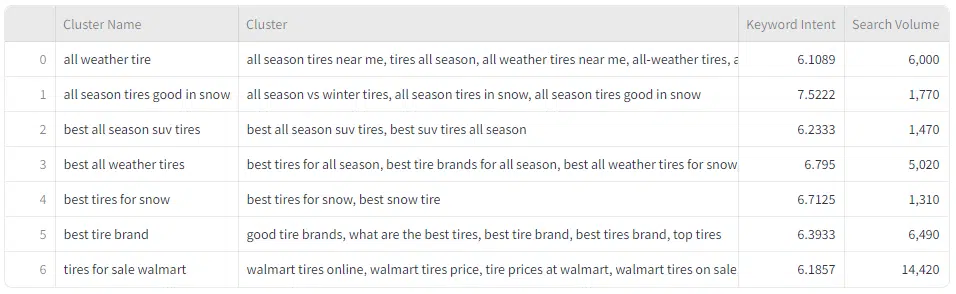
aggregated keyword clusters

Each cluster in the bubble chart should ideally start with a value of 0 on the x-axis unless you are in the process of fine-tuning the visual to reduce bubble overlap. 

I advise initializing all clusters at 0 and making necessary adjustments to the data once the bubble chart has been generated. 

This fine-tuning step is crucial. Without it, the visual can become unclear and difficult to comprehend. To see the impact of this step, compare the examples below.
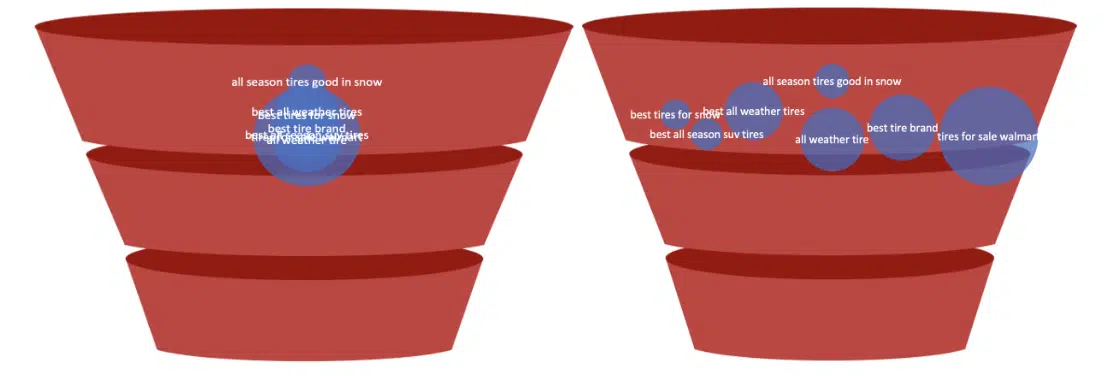
fine-tuning funnel visuals

After fine-tuning, the visual is complete and ready to help communicate the value of specific keywords to stakeholders outside the search domain.

Associate topic clusters with audience personas

If you can access your company’s audience personas or segments, use this information to better align with stakeholders.

Integrating topic clusters with audience personas offers insight into the content that targets each audience within a business. These insights enable SEOs to identify content gaps and potential areas for improvement, equipping them with the necessary data to communicate more strategically.

A quick analysis of the chart below clearly reveals that the business is not effectively engaging with “Emma.” Consequently, when determining the direction for future content creation, they might utilize this insight as a valid reason to devise content that resonates more with “Emma.”
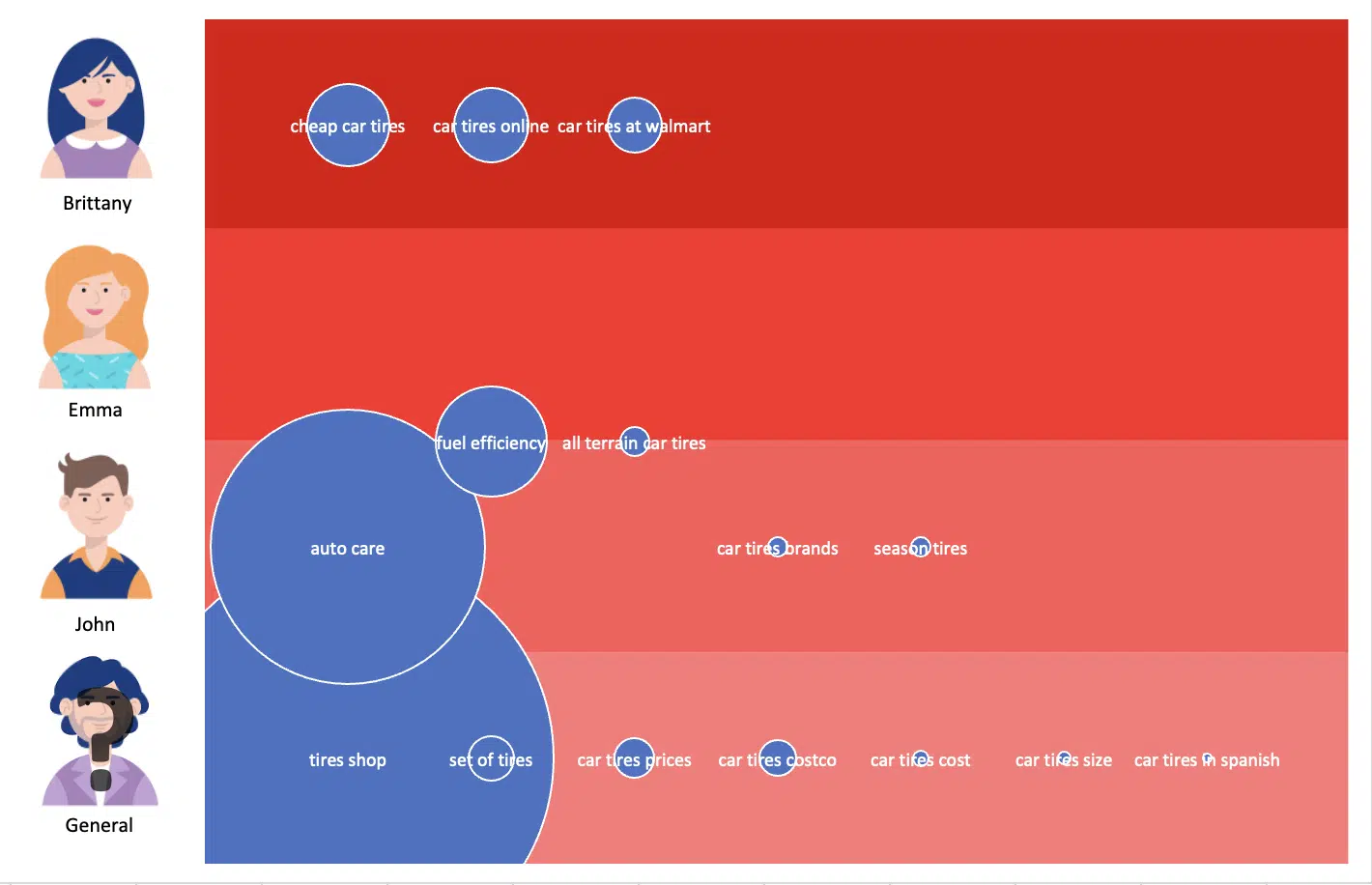
Associate topic clusters with audience personas

Similar to the keyword intent cluster visualization, there are various ways to create this chart. I’ll share the simplest method I’ve found.

Start by giving ChatGPT your audience personas and asking it to summarize each. This helps make sure that ChatGPT really understands them. 

Here is an example prompt:

“I have a list of topics that I would like you to categorize based on the audience personas that I will provide and your knowledge of each topic. Before starting, write a paragraph about each persona to ensure you understand them well. Then I will give you the list of topics to categorize. After categorizing the keywords, please return them to me in a table that I can copy and paste into Excel.

Persona 1:
NAME: INSERT PERSONA NAME
DESCRIPTION: INSERT PERSONA DESCRIPTION – RECOMMENDED >100 WORDS
DEMOGRAPHICS:
AGE: …
GENDER: …
LOCATION: …
EDUCATION: …
INCOME: …
FAMILY LIFE: …
STRUGGLES: INSERT LIST OF STRUGGLES/PAIN POINTS
HOBBIES: INSERT LIST OF HOBBIES
VALUES: LIST PERSONAL VALUES OF THIS PERSONA


Persona 2:
[INSERT PERSONA KNOWLEDGE]


Persona 3:
[INSERT PERSONA KNOWLEDGE].”

When creating this prompt, provide ChatGPT with comprehensive details about each persona. This helps it establish the best understanding of the audience personas possible, which can be verified through the summaries. 

After confirming that it has an accurate grasp of the personas, proceed by uploading the list of keyword topics that require categorization.

If all goes well, ChatGPT should generate a table for you that is separated by commas and resembles the following structure:
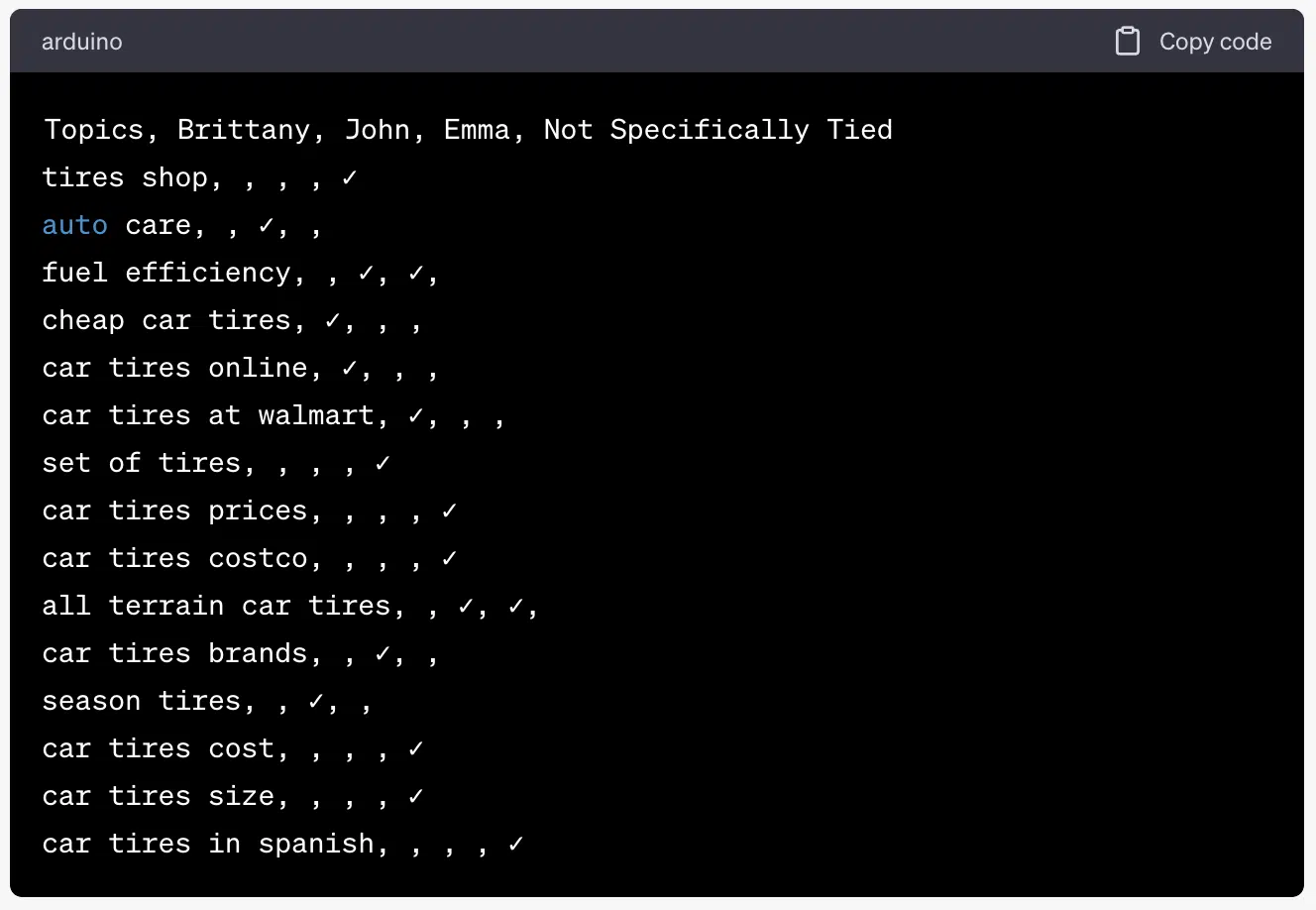
Topic clustering per audience persona with ChatGPT

Next, simply transfer the output to Excel and utilize the “Text to Columns” feature to split the data effectively.

Once the data has been collected, convert the audiences’ names into values for the bubble chart. So, this is to say that Brittany will now be represented by the number four on the y-axis. 

For topics assigned to two or more audiences, take the average of the audience number.

An example is the topic “fuel efficiency,” which was categorized for John and Emma, so it was assigned 2.5 as an audience value. 

After gathering all necessary data, transform the audience names into numerical values for the bubble chart. 

To illustrate, Brittany will be represented as the number four on the y-axis. For topics assigned to two or more audiences, calculate the mean of the audience numbers.

Take, for instance, the topic “fuel efficiency,” attributed to both John and Emma, resulting in an assigned audience value of 2.5.

Subsequently, count the number of subjects assigned to each audience and allocate a numerical value to each topic, indicating its position on the x-axis. The data should closely resemble the example below:
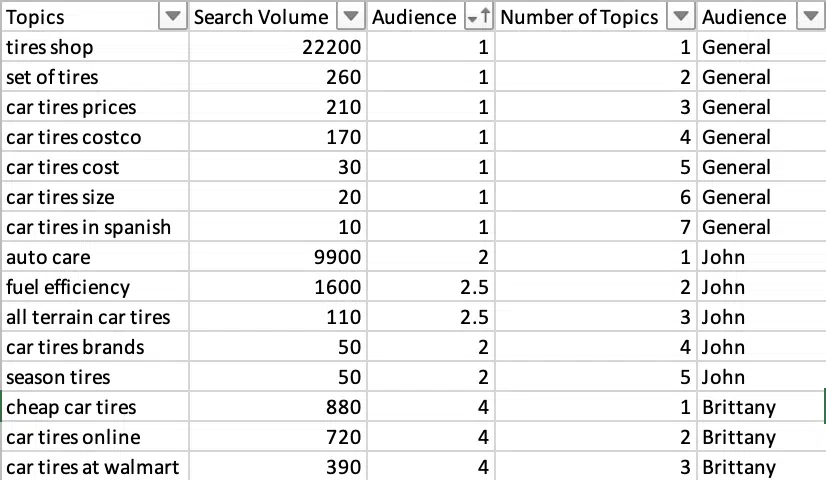
Topics with assigned numerical values

After gathering all necessary data, SEOs can create a bubble graph using Excel.

They can enhance the graph by incorporating additional visual elements, such as background images or gradients, to delineate segments for each target audience clearly.

Visualizing complex SEO concepts for effective stakeholder communication

Bridging the gap between SEO concepts and stakeholder understanding is challenging but crucial. 

With keyword intent clusters and audience persona charts, SEOs have a streamlined and visual way to convey complex concepts. 

Using the visual aids discussed in this article, you can approach stakeholders with more strategic content insights that align with familiar concepts. 


Opinions expressed in this article are those of the guest author and not necessarily Search Engine Land. Staff authors are listed here.


Related stories

New on Search Engine Land

@media screen and (min-width: 800px) { #div-gpt-ad-3191538-7 { display: flex !important; justify-content: center !important; align-items: center !important; min-width:770px; min-height:260px; } } @media screen and (min-width: 1279px) { #div-gpt-ad-3191538-7 { display: flex !important; justify-content: center !important; align-items: center !important; min-width:800px!important; min-height:440px!important; } }

About the author

Tyler Rouwhorst

Tyler is an Associate Director, SEO at Tombras, where he provides SEO consultancy for clients of varying sizes across healthcare, SaaS, and retail sectors. His focus areas include strategic roadmaps that resonate with customers and technical SEO to improve clients’ overall site health. In addition, he is fascinated by the intersection of data science and SEO, and by leveraging his knowledge of Python, he develops custom tools that power unique insights and efficiencies. To connect with Tyler, visit his LinkedIn or website.

https://searchengineland.com/keyword-insights-non-seos-visual-approach-434491


Google says major changes coming to search rankings

Google’s Search Liaison, Danny Sullivan, has reportedly said that major changes are coming to Google’s search rankings in the future. This comes from a talk Sullivan gave at an event last Friday, where he was quoted as saying that these “major changes” are coming and that some may need to “buckle up.”

Danny Sullivan after this story was published replied on X saying, “I was talking about various things people have raised where they want to see our results improve, or where they think “sure, you fixed this but what about….” And that these things all correspond to improvements we have in the works. That there’s so much coming that I don’t want to say buckle up, because those who are making good, people-first content should be fine. But that said, there’s a lot of improvements on the way.”

Quotes. Here are the two sources I found quoting Sullivan as saying, “buckle-up there are major changes coming to search ranking signals…”

Here is some more clarification:

Busy year of algorithm updates. It has been a wild and very volatile year for SEOs with a ton of Google search ranking algorithm updates. Just this past few weeks we had the November 2023 reviews update, November 2023 core update, October 2023 spam update, and the October 2023 Core Update.

Why we care. Are there more big changes coming to Google’s core ranking algorithms in the near term? What will be so “major” that some of us need to “buckle up” and get ready for? How much will these future algorithm updates be even more impactful than the ones we are currently experiencing?

Or maybe these quotes were taken out of context and we don’t need to stress too much about these changes.


Related stories

New on Search Engine Land

@media screen and (min-width: 800px) { #div-gpt-ad-3191538-7 { display: flex !important; justify-content: center !important; align-items: center !important; min-width:770px; min-height:260px; } } @media screen and (min-width: 1279px) { #div-gpt-ad-3191538-7 { display: flex !important; justify-content: center !important; align-items: center !important; min-width:800px!important; min-height:440px!important; } }

About the author

Barry Schwartz

Barry Schwartz is a Contributing Editor to Search Engine Land and a member of the programming team for SMX events. He owns RustyBrick, a NY based web consulting firm. He also runs Search Engine Roundtable, a popular search blog on very advanced SEM topics. Barry can be followed on Twitter here.

https://searchengineland.com/google-says-major-changes-coming-to-search-rankings-434548


Transformer architecture: An SEO’s guide

As we encounter advanced technologies like ChatGPT and BERT daily, it’s intriguing to delve into the core technology driving them – transformers.

This article aims to simplify transformers, explaining what they are, how they function, why they matter, and how you can incorporate this machine learning approach into your marketing efforts. 

While other guides on transformers exist, this article focuses on providing a straightforward summary of the technology and highlighting its revolutionary impact.

Understanding transformers and natural language processing (NLP)

Attention has been one of the most important elements of natural language processing systems. This sentence alone is quite a mouthful, so let’s unpack it. 

Early neural networks for natural language problems used an encoder RNN (recurrent neural network). 

The results are sent to a decoder RNN – the so-called “sequence to sequence” model, which would encode each part of an input (turning that input into numbers) and then decode and turn that into an output. 

The last part of the encoding (i.e., the last “hidden state”) was the context passed along to the decoder. 

In simple terms, the encoder would put together and create a “context” state from all of the encoded parts of the input and transfer that to the decoder, which would pull apart the parts of the context and decode them. 

Throughout processing, the RNNs would have to update the hidden states based on the inputs and previous inputs. This was quite computationally complex and could be rather inefficient. 

Models couldn’t handle long contexts – and while this is an issue to this day, previously, the text length was even more obvious. The introduction of “attention” allowed the model to pay attention to only the parts of the input it deemed relevant. 

Attention unlocks efficiency

The pivotal paper “Attention is All You Need,” introduced the transformer architecture.

This model abandons the recurrence mechanism used in RNNs and instead processes input data in parallel, significantly improving efficiency. 

Like previous NLP models, it consists of an encoder and a decoder, each comprising multiple layers. 

However, with transformers, each layer has multi-head self-attention mechanisms and fully connected feed-forward networks. 

The encoder’s self-attention mechanism helps the model weigh the importance of each word in a sentence when understanding its meaning.

Pretend the transformer model is a monster:

The “multi-head self-attention mechanism” is like having multiple sets of eyes that simultaneously focus on different words and their connections to understand the sentence’s full context better. 

The “fully connected feed-forward networks” are a series of filters that help refine and clarify each word’s meaning after considering the insights from the attention mechanism. 

In the decoder, the attention mechanism assists in focusing on relevant parts of the input sequence and the previously generated output, which is crucial for producing coherent and contextually relevant translations or text generations.

The transformer’s encoder doesn’t just send a final step of encoding to the decoder; it transmits all hidden states and encodings. 

This rich information allows the decoder to apply attention more effectively. It evaluates associations between these states, assigning and amplifying scores crucial in each decoding step.

attention scores

Attention scores in transformers are calculated using a set of queries, keys and values. Each word in the input sequence is converted into these three vectors. 

The attention score is computed using a query vector and calculating its dot product with all key vectors. 

These scores determine how much focus, or “attention,” each word should have on other words. The scores are then scaled down and passed through a softmax function to get a distribution that sums to one.

To balance these attention scores, transformers employ the softmax function, which normalizes these scores to “between zero and one in the positive.” This ensures equitable distribution of attention across words in a sentence.

attention scores - sentence

Instead of examining words individually, the transformer model processes multiple words simultaneously, making it faster and more intelligent. 

If you think about how much of a breakthrough BERT was for search, you can see that the enthusiasm came from BERT being bidirectional and better at context.

Word order

In language tasks, understanding the order of words is crucial. 

The transformer model accounts for this by adding special information called positional encoding to each word’s representation. It’s like placing markers on words to inform the model about their positions in the sentence.

During training, the model compares its translations with correct translations. If they don’t align, it refines its settings to approach the correct results. These are called “loss functions.”

When working with text, the model can select words step by step. It can either opt for the best word each time (greedy decoding) or consider multiple options (beam search) to find the best overall translation.

In transformers, each layer is capable of learning different aspects of the data. 

Typically, the lower layers of the model capture more syntactic aspects of language, such as grammar and word order, because they are closer to the original input text. 

As you move up to higher layers, the model captures more abstract and semantic information, such as the meaning of phrases or sentences and their relationships within the text. 

This hierarchical learning allows transformers to understand both the structure and meaning of the language, contributing to their effectiveness in various NLP tasks.

What is training vs. fine-tuning? 

Training the transformer involves exposing it to numerous translated sentences and adjusting its internal settings (weights) to produce better translations. This process is akin to teaching the model to be a proficient translator by showing many examples of accurate translations.

During training, the program compares its translations with correct translations, allowing it to correct its mistakes and improve its performance. This step can be considered a teacher correcting a student’s errors to facilitate improvement.

The difference between a model’s training set and post-deployment learning is significant. Initially, models learn patterns, language, and tasks from a fixed training set, which is a pre-compiled and vetted dataset. 

After deployment, some models can continue to learn from new data they’re exposed to, but this isn’t an automatic improvement – it requires careful management to ensure the new data is helpful and not harmful or biased.

Transformers vs. RNNs

Transformers differ from recurrent neural networks (RNNs) in that they handle sequences in parallel and use attention mechanisms to weigh the importance of different parts of the input data, making them more efficient and effective for certain tasks.

Transformers are currently considered the best in NLP due to their effectiveness at capturing language context over long sequences, enabling more accurate language understanding and generation.

They are often seen as better than a long short-term memory (LSTM) network (a type of RNN) because they are faster to train and can handle longer sequences more effectively due to their parallel processing and attention mechanisms.

Transformers are used instead of RNNs for tasks where context and the relationship between elements in sequences are paramount.

The parallel processing nature of transformers enables simultaneous computation of attention for all sequence elements. This reduces training time and allows models to scale effectively with larger datasets and model sizes, accommodating the increasing availability of data and computational resources.

Transformers have a versatile architecture that can be adapted beyond NLP. Transformers have expanded into computer vision through vision transformers (ViTs), which treat patches of images as sequences, similar to words in a sentence.

This allows ViT to apply self-attention mechanisms to capture complex relationships between different parts of an image, leading to state-of-the-art performance in image classification tasks.


Get the daily newsletter search marketers rely on.


About the models

BERT

BERT (bidirectional encoder representations from transformers) employs the transformer’s encoder mechanism to understand the context around each word in a sentence. 

Unlike GPT, BERT looks at the context from both directions (bidirectionally), which helps it understand a word’s intended meaning based on the words that come before and after it. 

This is particularly useful for tasks where understanding the context is crucial, such as sentiment analysis or question answering.

BERT

BART

Bidirectional and auto-regressive transformer (BART) combines BERT’s bidirectional encoding capability and the sequential decoding ability of GPT. It is particularly useful for tasks involving understanding and generating text, such as summarization. 

BART first corrupts text with an arbitrary noising function and then learns to reconstruct the original text, which helps it to capture the essence of what the text is about and generate concise summaries.

BERT

GPT

The generative pre-trained transformers (GPT) model uses the transformer’s decoder mechanism to predict the next word in a sequence, making it useful for generating relevant text.

GPT’s architecture allows it to generate not just plausible next words but entire passages and documents that can be contextually coherent over long stretches of text.

This has been the game-changer in machine learning circles, as more recent massive GPT models can mimic people pretty well.

GPT

ChatGPT

ChatGPT, like GPT, is a transformer model specifically designed to handle conversational contexts. It generates responses in a dialogue format, simulating a human-like conversation based on the input it receives.

Breaking down transformers: The key to efficient language processing

When explaining the capabilities of transformer technology to clients, it’s crucial to set realistic expectations. 

While transformers have revolutionized NLP with their ability to understand and generate human-like text, they are not a magic data tree that can replace entire departments or execute tasks flawlessly, as depicted in idealized scenarios.

Dig deeper: How relying on LLMs can lead to SEO disaster

Transformers like BERT and GPT are powerful for specific applications. However, their performance relies heavily on the data quality they were trained on and ongoing fine-tuning. 

RAG (retrieval-augmented generation) can be a more dynamic approach where the model retrieves information from a database to generate responses instead of static fine-tuning on a fixed dataset. 

But this isn’t the fix for all issues with transformers. 

Frequently asked questions

Do models like GPT generate topics? Where does the corpus come from?

Models like GPT don’t self-generate topics; they generate text based on prompts given to them. They can continue a given topic or switch topics based on the input they receive.

In reinforcement learning from human feedback (RLHF), who provides the feedback, and what form does it take?

In RLHF, the feedback is provided by human trainers who rate or correct the model’s outputs. This feedback shapes the model’s future responses to align more closely with human expectations.

Can transformers handle long-range dependencies in text, and if so, how?

Transformers can handle long-range dependencies in text through their self-attention mechanism, which allows each position in a sequence to attend to all other positions within the same sequence, both past and future tokens. 

Unlike RNNs or LSTMs, which process data sequentially and may lose information over long distances, transformers compute attention scores in parallel across all tokens, making them adept at capturing relationships between distant parts of the text.

How do transformers manage context from past and future input in tasks like translation?

In tasks like translation, transformers manage context from past and future input using an encoder-decoder structure. 

  • The encoder processes the entire input sequence, creating a set of representations that include contextual information from the entire sequence. 
  • The decoder then generates the output sequence one token at a time, using both the encoder’s representations and the previously generated tokens to inform the context, allowing it to consider information from both directions.

How does BERT learn to understand the context of words within sentences?

BERT learns to understand the context of words within sentences through its pre-training on two tasks: masked language model (MLM) and next sentence prediction (NSP). 

  • In MLM, some percentage of the input tokens are randomly masked, and the model’s objective is to predict the original value of the masked words based on the context provided by the other non-masked words in the sequence. This task forces BERT to develop a deep understanding of sentence structure and word relationships.
  • In NSP, the model is given pairs of sentences and must predict if the second sentence is the subsequent sentence in the original document. This task teaches BERT to understand the relationship between consecutive sentences, enhancing contextual awareness. Through these pre-training tasks, BERT captures the nuances of language, enabling it to understand context at both the word and sentence levels.

What are marketing applications for machine learning and transformers?

  • Content generation: They can create content, aiding in content marketing strategies.
  • Keyword analysis: Transformers can be employed to understand the context around keywords, helping to optimize web content for search engines.
  • Sentiment analysis: Analyzing customer feedback and online mentions to inform brand strategy and content tone.
  • Market research: Processing large sets of text data to identify trends and insights.
  • Personalized recommendations: Creating personalized content recommendations for users on websites.

Dig deeper: What is generative AI and how does it work?

Key takeaways

  • Transformers allow for parallelization of sequence processing, which significantly speeds up training compared to RNNs and LSTMs.
  • The self-attention mechanism lets the model weigh the importance of each part of the input data differently, enabling it to capture context more effectively. 
  • They can manage relationships between words or subwords in a sequence, even if they are far apart, improving performance on many NLP tasks.

Interested in checking out transformers? Here’s a Google Colab notebook to get you started.


Opinions expressed in this article are those of the guest author and not necessarily Search Engine Land. Staff authors are listed here.


Related stories

New on Search Engine Land

@media screen and (min-width: 800px) { #div-gpt-ad-3191538-7 { display: flex !important; justify-content: center !important; align-items: center !important; min-width:770px; min-height:260px; } } @media screen and (min-width: 1279px) { #div-gpt-ad-3191538-7 { display: flex !important; justify-content: center !important; align-items: center !important; min-width:800px!important; min-height:440px!important; } }

About the author

Jess Peck

Jess is an MLOps engineer and technical SEO at LocalSEOGuide, she likes big data and little websites.

https://searchengineland.com/transformer-architecture-an-seos-guide-434505


Google adds reports for learning video rich results

Google has added new reporting within Google Search Console’s performance reports for the learning video rich results. You can access these reports under the search appearance section within the performance report, if you have learning video structured data on your website.

What it looks like. Google shared a screenshot of the report showing learning video rich results on X.

Google Search Console Performance Report Learningv Videos Scaled

What Google said. Google wrote, “Search Console will start reporting Learning Video rich results as a search appearance in the Performance reports.”

What are learning video rich results. Google added support for learning video rich results back in June 2022. Google said these are videos that provide “educational level and concept and skills covered in the video” that have learning-specific information with structured data. “Learning Video markup is intended to give more visibility into the educational contents of the video. The markup can hold information about the various concepts and skills taught in the video,” Google added.

What they look like. Google provided the screenshot below as a sample, but we have yet to see a raw learning video rich result in the wild just yet:

Learning Videos Example 1 600x600

When it shows. Google said learning video results can show in English in all regions where Google Search is available, when searching for academic learning content on desktop and mobile.

Why we care. Now you can see how those learning video rich results are performing within Google Search. These reports will show you impressions, clicks and other analytics data to see if you are getting a better response in Google Search from these rich results.


Related stories

New on Search Engine Land

@media screen and (min-width: 800px) { #div-gpt-ad-3191538-7 { display: flex !important; justify-content: center !important; align-items: center !important; min-width:770px; min-height:260px; } } @media screen and (min-width: 1279px) { #div-gpt-ad-3191538-7 { display: flex !important; justify-content: center !important; align-items: center !important; min-width:800px!important; min-height:440px!important; } }

About the author

Barry Schwartz

Barry Schwartz is a Contributing Editor to Search Engine Land and a member of the programming team for SMX events. He owns RustyBrick, a NY based web consulting firm. He also runs Search Engine Roundtable, a popular search blog on very advanced SEM topics. Barry can be followed on Twitter here.

https://searchengineland.com/google-adds-reports-for-learning-video-rich-results-434541


Top 5 SEO data pitfalls to avoid for accurate analysis and reporting

If you work in marketing or SEO, looking at data is essential to your day-to-day.

You’re probably analyzing performance to see the results of your efforts, assessing the impact of Google’s latest update, or working on a case study to share with the SEO community.

But when dealing with SEO data, things are not always what they seem. How you perceive data on a high level may not necessarily be valid once you dig deeper.

You need to be thorough, or your assumptions or insights that looked solid initially may be inaccurate. 

Throughout my career, I’ve seen many pitfalls that marketing and SEO professionals can encounter when dealing with data. Below are five examples.

1. Misunderstanding the relationship between impressions and rankings

Understanding the relationship between impressions and website’s average ranking metric can save you plenty of time when you’re reporting on SEO performance. 

Did your website impressions increase and the average ranking metric decrease? Some clients are fixated on this metric and will be very concerned that the average ranking metric is performing “poorly.” But is it?

Let’s take a simplistic example to explain the relation between impressions and average ranking. 

Your website gets:

  • One impression from keyword X ranking 2
  • One impression from keyword Y ranking 1
  • One impression from keyword Z ranking 3

In this case, the average ranking is (6/3 = 2).

Now your website starts to rank for a new keyword, and now you’re also getting:

  • One impression for keyword A ranking 10th

That looks like an accomplishment, but at first glance, for the average ranking metric, not so much because your average ranking is now lower (16/4 = 4). 

So, while the average ranking metric appears to have worsened, it doesn’t necessarily signify a negative outcome because your website is starting to rank for more keywords. Over time, the rankings for those keywords can further improve. Let alone that ranking 10th for a new keyword is a good place to be.

So, it is quite normal that your average ranking increases when impressions increase, too. It’s not a bad sign and does not mean you’re performing any less!

Tip: Think about the relationship between impressions and CTR. When impressions increase (a good thing), CTR may decrease.

Dig deeper: How to make better SEO reports for the C-suite

2. Comparing apples to oranges

It’s common to show SEO improvement by comparing performance month-over-month. While this is a reasonable approach, there are situations where such comparisons are insufficient and need to be accompanied by comparing the performance of the same month of the previous year. Here’s why.

If you compare January 2023 to December 2022, the results can be an improvement in traffic and performance. For many businesses, especially B2B, December (and sometimes November) are low seasonality months, and they face a natural dip in performance during those months.

Therefore, comparing January 2023 to December 2022 can commonly show performance improvement when actually there may not be any, it’s just a “return to normal.”

So saying something like “we’ve compared the Jan. 1 to April 30 period vs. the previous period, we’ve seen an increase in performance by 60%” may be inaccurate. 

In this situation, you may want to:

  • Compare Jan. 1 to April 30 of this year vs. last year.
  • Use an automated tool/script that helps you consider the seasonality fluctuations.

Get the daily newsletter search marketers rely on.


3. Using vanity metrics

I get it. There’s plenty of pressure on SEOs to show results and improvement. However, this does not mean reporting on vanity metrics that don’t really matter. 

For instance, presenting the quantity of internal or external links created as an “improvement” metric is an invalid approach to reporting SEO activities. 

“X% improvement in external links” is not a sound statement. 

Also, an increase in something does not necessarily mean “improvement.” More is not always more. Is an increase in keyword density of an article an “improvement,” or does it make it spammy? 

Dig deeper: SEO KPIs to track and measure SEO success

4. Reporting migrations as an SEO win

Website migrations are a traditional SEO task, and having a successful migration project is an expectation, not a bonus. It’s common for SEOs to migrate domains/websites and report on the performance afterward.

Once a website is migrated/redirected to the main domain, many SEOs tend to make the mistake of considering the subsequent increase in traffic to the primary domain as a definitive SEO success.

It’s crucial to recognize that this increase is largely anticipated, given that numerous URLs and their associated traffic have been redirected to the main domain. Is this really a win? 

Instead, report the percentage of traffic successfully transferred to the main domain. It may take time to settle, but showing how much of the original traffic was preserved is the real SEO win.

5. Failing to report SEO’s value and attribution

SEO is a complicated channel. Unlike PPC where you can have a clear action to ROI path and conversions are well attributed, in SEO, we sometimes need to dig deeper to show the real value the channel is bringing.

For example, in a previous role, the company ran very few PPC ads, and the website’s main/biggest traffic source was SEO. 

At first glance, everything seems to be clear and straightforward. But when I started looking at data, I noticed a big percentage of traffic (and therefore conversions) was attributed to “direct traffic.” I got curious, so I drew a graph comparing direct and SEO traffic, it came out looking like this:

Direct traffic and organic search

You can see how the SEO traffic directly impacts the direct traffic. They go hand in hand in that when SEO increases, direct traffic increases – and vice versa. 

If this is the case for your business, it is worth mentioning in your monthly SEO reporting.

Another thing to check is the Attribution reports in GA4 under the Advertising section. You can then click on either Model comparison or Conversion paths. Both will give you insights into how the SEO channel contributes to or supports other channels’ performance. This is another thing worth reporting on.

Strive for accurate SEO data analysis and reporting

We must be thorough when looking at SEO data for auditing or reporting purposes.

Making conclusions based on the data you see first is inaccurate, might put you in a tight spot with your clients, and you can potentially miss out on SEO wins that go unnoticed.

Still, we want to balance being thorough and getting stuck in analysis paralysis. More data is not always a good thing. The best approach is to:

  • Define the question you want to answer with data.
  • Ensure it’s valid and valuable.
  • Start your data journey from there.

Lastly, always double-check your numbers, assumptions and conclusions. Remember, there’s more to data than meets the eye!


Opinions expressed in this article are those of the guest author and not necessarily Search Engine Land. Staff authors are listed here.


Related stories

New on Search Engine Land

@media screen and (min-width: 800px) { #div-gpt-ad-3191538-7 { display: flex !important; justify-content: center !important; align-items: center !important; min-width:770px; min-height:260px; } } @media screen and (min-width: 1279px) { #div-gpt-ad-3191538-7 { display: flex !important; justify-content: center !important; align-items: center !important; min-width:800px!important; min-height:440px!important; } }

About the author

Sara Taher

Sara Taher is a Canadian based SEO consultant with over 8 years experience in the field. She is most known for her SEO tips and riddles that she shares on her Linkedin account. You can sign up for her newsletter & check out her blog here.

https://searchengineland.com/seo-data-pitfalls-accurate-analysis-reporting-434442


Why ecommerce brands must showcase authentic E-E-A-T

Online shoppers want to buy from real experts. When searching for products or services, they look for sites with genuine experience, expertise, authoritativeness and trustworthiness (known as E-E-A-T). 

To earn user trust, ecommerce brands must move out of the shadows and focus on building strong E-E-A-T signals, both on-site and off-site. Here’s why and how.

The value of E-E-A-T beyond SEO

As an online shopper, there is nothing more frustrating than seeking expert insight or experience-based advice on products or services – only to be provided with neither. 

I want to read a review from a real person who has used the item I am about to buy or who has stayed in the hotel I am about to book – one with specific details and real-life photos (or in internet parlance, receipts).

I don’t want to be persuaded by an anonymous expert that this is the best way to invest my money or time. 

This is why user-generated content (UGC) has become so valuable. It looks and feels authentic to people. 

It’s why journalists on the most authoritative news sites have bylines, often with a photo, and even their own personal brands that have been cultivated with social posts and podcast appearances. 

On a web rife with disinformation, I am far more likely to trust the words of a journalist with proven expertise and experience in their chosen beat, especially when it comes to topics such as finance and politics.

These days, consumers often exhibit the same due diligence when shopping. They want to buy skincare recommended by someone who knows what they’re talking about, not someone who has just been paid to share a #ad post on behalf of a skincare brand, and rightly so.

This tends to apply across the web. When there is so much content, you only want to spend time or money on the really helpful stuff.

For example, when it comes to travel blogs, I want the opinions of someone who has traveled to Rome and tried the cacio e pepe they are recommending before I’ll read their blog about it and click on an affiliate link to book a trip. 

Dig deeper: Ecommerce content: How to demonstrate beneficial purpose and expertise

What ecommerce can learn from George Foreman

In 1994, four years before Google was founded, the world was awash with television advertisements fronted by the former boxer George Foreman.

Foreman, the original influencer, was selling the Lean Mean Fat-Reducing Grilling Machine, a type of countertop grill that could apparently reduce the content of the average mixed grill. At the end of the ad he would turn to the camera and deliver his catchphrase, “It’s so good I put my name on it!” 

This appeal to consumer trust clearly worked. By the end of the 1990s, it seemed like everyone had a Foreman grill in their kitchen. The grill went on to sell over 100 million units.

Suppose you’re writing content online to sell something directly or otherwise. In that case, you should be willing to put your name, face and brand into that content, like journalists using their byline to instill trust in their reportage and Foreman using his name to instill trust in his low-fat grill.

The best and most trusted content creators have created a personal brand as experts in their chosen niche, building trust with those who consume their content and come to them for their expertise.

It is what we expect from journalists, TikTok creators and also websites. If a website is full of content created by anonymous, nameless and faceless authors, it’s a pretty big red flag to consumers, and Google knows that this is not the content they are looking for. 

Beware of the B.S. bio

You can’t build trust and authority overnight with a hastily optimized author page and blank LinkedIn profile. Nothing about the below example, shared by Lily Ray on X, implies any real expertise or experience. 

Lily Ray on X - Travel blog author bio

A great example of an ecommerce site implementing E-E-A-T is Freddie Chatt’s The Village Cricket Co.

You’ll first notice a picture of Chatt in his cricket whites. He doesn’t go on to claim to be a cricket expert – quite the contrary. 

His bio on the site makes clear he is a passionate amateur and a lover of the game. It’s also full of references and inside jokes that will demonstrate to readers and fellow cricket fans that he is part of an in-group of genuine cricket enthusiasts.

Freddie Chatt's bio

This is a far better approach than pretending to be something he isn’t.

You don’t have to be an expert in the game. Relevant experience is enough as long as you’re transparent about it.

The most important thing about this is how clearly it demonstrates he is a real human who genuinely cares about cricket.

If I knew what a wicket was, I’m fairly certain that this is the type of website I would choose to buy my cricket bats from. 

The lesson here is not to go and create a persona, complete with a page-long fictitious bio and a Midjourney-generated photo.

It really doesn’t matter how elaborate a bio you write – or prompt ChatGPT to write – if the person behind it doesn’t exist.

This is one of the most worrying quick fixes to E-E-A-T. Combining this technique with digital PR raises some severe ethical concerns. I have written about this issue in “Why using AI to create YMYL experts is a REALLY bad idea.”

Step out of the shadows 

Much like consumers, Google prefers to deal with real brands rather than anonymous sites, especially ones led by humans with names and faces and real-life experience and expertise. 

So build a brand you are proud of around a topic you know (and/or love), and don’t be afraid to shout about it on- and off-site. 

The best brands share content across social. Some ecommerce sites have focused on building their off-page trust signals with their social accounts more aggressively than on-page ones.

Luxury goods reseller’s Luxe Collective has a pretty simple About us page, but it signposts you to their social pages where they demonstrate their E-E-A-T.

They refer to Instagram as “their main home” and also point toward their TikTok, where they demonstrate just how well they know and understand their short-form videos to their 1.5 million followers.

This is what has made them the go-to in pre-loved luxury. 

Luxe Collective - About us page

If “social at scale” feels beyond your reach, invest in some digital PR, which (aside from the links) will help you build brand recognition and let your authors build off-site expertise and trust signals. 

Moving on from faceless ecommerce

Shopping online is ubiquitous, and helping ecommerce sites reach their consumers (despite what a certain Verge article might have you believe) isn’t ruining the internet. 

But we all want to spend our money on websites we can trust, from people who are invested in what they are selling and not ashamed to put their name and face to it. 

Most importantly, while a brand is important, people buy from people. That is – real people with genuine human opinions, not from the AI-generated author profiles of pseudo-people.

Dig deeper: Ecommerce marketing next year: 5 ways to set up for success


Opinions expressed in this article are those of the guest author and not necessarily Search Engine Land. Staff authors are listed here.


Related stories

New on Search Engine Land

@media screen and (min-width: 800px) { #div-gpt-ad-3191538-7 { display: flex !important; justify-content: center !important; align-items: center !important; min-width:770px; min-height:260px; } } @media screen and (min-width: 1279px) { #div-gpt-ad-3191538-7 { display: flex !important; justify-content: center !important; align-items: center !important; min-width:800px!important; min-height:440px!important; } }

About the author

Jo OReilly

Jo O’Reilly is Freelance Digital PR Consultant based in North West England. She has been working in Digital PR for 6 years both in-house and agency side, before that she was a journalist. She is fascinated with all things digital pr, especially reactive pr and newsjacking.

https://searchengineland.com/ecommerce-brands-showcase-eeat-434437


No, ChatGPT isn’t stealing Google’s search market share

Reporting on Google’s market share these days is like reporting on the sky (did you know it’s blue?).

Yet today, Seeking Alpha published an article with a clickable headline of ChatGPT eats away at Google search’s dominance.

This article (which is paywalled, so I’m not linking to it) is based on a Bank of America report (why is Bank of America talking about search market share?), which is based on data from StatCounter and Similar Web, which I learned of via an X post by Greg Sterling.

By the numbers. Google’s worldwide search market share, according to StatCounter:

  • October 2023: 91.53%
  • October 2022: 92.34%

This is Google’s lowest global search market share in the past 12 months. But is this ChatGPT eating into Google’s search market share? Extremely unlikely.

The problem? Statcounter doesn’t track ChatGPT because – hello? – it isn’t a search engine. It’s an LLM-based generative AI chatbot.

Relatively stable. Google Search has been “relatively stable” over the past 12 months, according to the report. Well, yes. But we can actually go further back than that on StatCounter.

Google has been “relatively stable” since August 2015. That’s the month Google surpassed 91% search market share worldwide for the first time.

In the past seven years, Googe’s search market share has bounced around from 91.1% (December 2015) to 93.37% (February 2023). For most of these eight years, ChatGPT didn’t exist, including from April to August 2018 when Google’s search market share dipped below 91%.

What about Bing? Microsoft Bing is still down year-on-year, 3.13% (October 2023) vs. 3.59% (October 2022), according to Statcounter. Meanwhile, Microsoft CEO Satya Nadella has warned us that AI will make Google more dominant.

Dig deeper. The new Bing has failed to take any market share from Google after six months.

Other numbers. Some month-over-month comparisons from Similar Web:

  • Google traffic declined to 2.8 billion (down 0.4%).
  • Bard traffic increased to 8.7 million (up 2%).
  • Bing traffic increased to 42.7 million (up 8%)
  • ChatGPT traffic increased to 55 million (up 4%). An important reminder here – ChatGPT’s traffic is only 2% of Google’s web traffic.

Why we care. Generative AI is – and will continue to – reshape search as we know it. But false narratives aren’t helpful for anybody. Google is still as dominant as it has been since 2015. The impact of Google, ChatGPT and generative AI on search is a story for search marketers to watch. But for now, there’s nothing to see here.


Related stories

New on Search Engine Land

@media screen and (min-width: 800px) { #div-gpt-ad-3191538-7 { display: flex !important; justify-content: center !important; align-items: center !important; min-width:770px; min-height:260px; } } @media screen and (min-width: 1279px) { #div-gpt-ad-3191538-7 { display: flex !important; justify-content: center !important; align-items: center !important; min-width:800px!important; min-height:440px!important; } }

About the author

Danny Goodwin

Danny Goodwin has been Managing Editor of Search Engine Land & Search Marketing Expo – SMX since 2022. He joined Search Engine Land in 2022 as Senior Editor. In addition to reporting on the latest search marketing news, he manages Search Engine Land’s SME (Subject Matter Expert) program. He also helps program U.S. SMX events. Goodwin has been editing and writing about the latest developments and trends in search and digital marketing since 2007. He previously was Executive Editor of Search Engine Journal (from 2017 to 2022), managing editor of Momentology (from 2014-2016) and editor of Search Engine Watch (from 2007 to 2014). He has spoken at many major search conferences and virtual events, and has been sourced for his expertise by a wide range of publications and podcasts.

https://searchengineland.com/no-chatgpt-isnt-stealing-googles-search-market-share-434465


Why you shouldn’t measure SEO performance by ROI

Every day, we hear marketers talk about the ROI of SEO.

In this article, I’ll explain why we must stop thinking like that.

Why ROI is a dangerous

SEO costs and business profits

Over recent years, thanks to work by marketing experts such as Tom Roach, I’ve dug into the concept of ROI in marketing.

In particular, the ROI of SEO.

After all, the term has been used to terminate SEO retainers and even stop them from occurring. 

So, if we throw a term around, we need to understand precisely what it means.

Thankfully, Tom has handily broken it down:

ROI is the net profit generated by your activity divided by the total cost of that activity. 

Profit = Costs / Total costs

And this is where we run into difficulties.

Because ROI is a measurement of efficiency rather than effectiveness.

Yes, ROI is a ratio. Not a sales figure.

And this is where ROI starts to fall apart and is dangerous to use for SEO.

Budget realism

For most SEOs, the idea of getting a six-figure budget is in the land of dreams.

Yes, most SEOs are still in the $500 to $2,000 per month model. 

But why?

This is largely because SEO is the worst sell in marketing.

“If you pay now, you’ll get results in 6 to 12 months. Oh, and we don’t guarantee results”.

This immediately triggers the risk-averse, and so people pluck their budgets out of thin air.

And if you’ve been in SEO for a while, you’ll have heard this line.

“We want to start small, and if we see some returns, we’ll invest more.”

And this is where things start to fall apart. 

Because SEO doesn’t work like that.

You’re either investing to get the job done, or you’ll waste money.

Dig deeper: What percentage of your budget should go toward SEO?

Monthly reporting: The destroyer of ROI

There’s nothing like being the last agency a client uses.

When you’re the last SEO agency in a succession, much of the work has probably been done. 

The client is within the top 11-15 for their core terms, and with a bit of a nudge, everyone wins, and off you skip to the SEO awards.

In reality, before that, the previous three or four agencies all tried and did a bit of work.

Each agency built upon the last, and each promised results.

The issue is that there needed to be more budget or the money was spent on the wrong things. 

Regardless, clients quickly tire when monthly reporting shows little to no results or progress.

And here lies the core issue for SEO.

The less you pay, the longer it takes for results to come. 

This brings us to the next issue with ROI.

You don’t get returns on investment until you rank

So there you have it: the client signs the retainer and awaits the SEO to do their magic.

And here lies the issue.

Distance.

As I said earlier, being the last agency is fun. Being the agency before this can be tough.

Because there is always a starting point.

This means that there is going to be a certain amount of time before the client ranks, and then they can start to see some results.

And this becomes the low-investment death loop of SEO.

Clients want to see some returns before they invest more. So, they invest a small amount.

The website needs more authority and is too far away from the buyer intent keywords to generate results.

The client terminates the agency and moves on to another, repeating the low investment. And either through sheer time, they eventually rank or give up on SEO entirely. 

And so goes another retainer, the graveyard of ROI.

SEO is an investment in your business, and like many investments, it takes time to bring returns.

Dig deeper: Why next year’s SEO results depend on your SEO work this year


Get the daily newsletter search marketers rely on.


People don’t know what ROI actually means

London Business School marketing professor Tim Ambler states:

“ROI was devised for assessing capital projects where the investment is made once, and the returns flow during the following years.”

And this is a core issue when people look at the ROI of SEO. 

What they usually mean is “sales.”

Clients log into their analytics dashboards and try to attribute sales of some kind to organic search.

ROI is not a monthly sales increase.

SEO increases business profits, but we measure it on sales

Most people turn to SEO to increase the leads or sales coming into their business.

And why do people want that? Because more sales will mean more money coming into the business.

But the real power of SEO is that it places a business in front of people in the market to buy without paying per click.

And, due to the nature of PPC (paid search), which seeks to reduce waste by targeting only the most likely to buy today. SEO reaches people researching the category and more of today’s buyers due to the higher organic click-through rates.

Simply put, SEO places your business in front of more prospects, and you don’t pay per click.

In addition, SEO also allows you to reduce the need to spend on paid search.

You can start to see how SEO works.

  • It increases sales volume by reaching more buyers.
  • It reduces the need to spend on paid search.
  • It reduces the dependence on paid search.

The above increases a business’s profits.

Dig deeper: How long SEO takes to work

You don’t measure the performance of SEO through ROI – you justify its investment

When I consult, I always ask what businesses spend on paid search.

It’s almost always a lot.

And so, this is what SEO does. 

Its ROI is to reduce the paid search spend and increase sales volume.

So, if you’re paying $100,000 a year on paid search, the ROI of the SEO is to reduce the need to spend that $100,000.

You also reach more buyers without paying per click, so you’ll increase sales, which increases profits.

So, you justify the cost of investing in SEO through ROI. You just don’t measure its performance that way.

So, how do you measure its performance?

Measure SEO effectiveness, not ROI

Measure SEO effectiveness, not ROI

When it comes to SEO, there is a lot of noise. But when you use the word “effectiveness,” you drown that noise out.

Because effectiveness can be directly linked to the goal of generating more business profit.

But a word of warning: you can only judge the effectiveness once you are ranking for your buyer intent keywords.

That’s when you start the clock.

And after a decent enough period (which will depend on purchase cycles), you can then stop and measure its effectiveness.

Which should show up in your turnover.

Remember, sales count, not credit for sales. We’re not trying to break down where the last click came from, but rather that sales have increased since organic rankings occurred.

Effectiveness, not vanity metrics

Effective SEO

I need to point out something here.

The effectiveness of SEO to grow the sales (and profit) of a business is what is key. 

I keep seeing SEOs talk about conversion to become an “email subscriber.” 

And while yes, that is a conversion technically, all you’ve really done is grow your email list.

You have to nurture this lead through emails over time and hope they convert down the road. 

This is not the best way for brands to leverage SEO, and indeed, the cost of doing SEO to grow email lists should be compared with other methods, such as Facebook advertising.

Traffic is vanity. Profit is sanity.

Regarding performance SEO, the question is a simple one.

Is SEO an effective way to increase profits and turnover? 

And then you can figure out what your returns have been.

But we need to speak about investment.

Dig deeper: How to determine the SEO metrics that matter

SEO is a sunk cost

I haven’t mentioned forecasting in this article. 

Mainly because it’s mostly a waste of time, and if we’re honest, if a business is being propped up by paid search, the forecast is arguably quite simple.

If you’re not using SEO to grow, you’ll have to find another way, or you’ll stagnate/ plateau.

This is why ROI is such a dangerous thing to measure SEO performance around.

Because you’ll look to reduce your risk and try and scale investment based on perceived returns.

Every business wants the perfect world of getting $5 back for every $1 you spend on marketing. But the world isn’t perfect. 

SEO is a sunk cost.

Once you have decided to invest in SEO, the money is gone.

If results haven’t happened, this is where you need to assess the effectiveness of the SEO agency, staff or freelancer.

And your budget.

All of which are sensible and logical discussions to have.

It’s entirely right to speak to management and suggest that the budget isn’t sufficient to get the desired results.

Every business must understand that SEO is like winning Wonka’s golden ticket.

It’s a competition where the ones on top of the SERPs started long before you, and they have spent far more money to get there.  And spend money to stay there.

But it’s a growth tactic and should be financed like that. Not a “test.” 

The rules of SEO are simple.

  • You justify investment in SEO through ROI potential.
  • You measure performance through rankings for buyer intent keywords and share of search.
  • And once you’re ranked, over time, you can measure the impact of SEO through profit and turnover.

Measuring the performance of SEO through ROI is a little like measuring the success of your children while they’re at school.

Or, to put it even more bluntly.

If you spend $100,000 a year on paid search, you’ll spend half a million in the next five years.

SEO can massively reduce and potentially save you $500,000.

But it can’t do that with a small monthly budget and people asking, “Where’s my ROI?”

If you are going to invest in SEO, make sure the budget matches the problem and the potential.

SEO can double or triple your turnover while reducing your paid search costs. All of which will increase profits.

But it needs time, proper investment and SEOs to use an effective strategy.

And when all of the above happens, the magic in SEO takes place.


Opinions expressed in this article are those of the guest author and not necessarily Search Engine Land. Staff authors are listed here.


Related stories

New on Search Engine Land

@media screen and (min-width: 800px) { #div-gpt-ad-3191538-7 { display: flex !important; justify-content: center !important; align-items: center !important; min-width:770px; min-height:260px; } } @media screen and (min-width: 1279px) { #div-gpt-ad-3191538-7 { display: flex !important; justify-content: center !important; align-items: center !important; min-width:800px!important; min-height:440px!important; } }

About the author

Andrew Holland

Andrew Holland is the Director of SEO at JBH, an award-winning Digital PR and SEO agency. His SEO background stems from a 17-year career in the police, where a number of years were spent within intelligence, utilizing SEO within internal systems to catch criminals. After developing chronic asthma, Andrew left the police and launched a freelance SEO and digital marketing career, and has worked with a wide range of clients, from SMEs to 8-figure businesses. Today, he directs the SEO delivery for one of the UK’s fastest-growing Digital PR and SEO agencies. Building organic visibility, trust and fame for consumer brands.

https://searchengineland.com/why-you-shouldnt-measure-seo-performance-by-roi-434377


How SEO experts improve the web and help search engines

By now, you’ve probably already read “Critical, cynical Verge article blames SEOs for ruining the internet” on Search Engine Land. 

The Verge article in question provides a critical mention of notable figures in the SEO industry. I haven’t had personal or professional interactions with them, so I can’t provide detailed insights regarding the criticism.

However, I’ve had the opportunity to meet several of these individuals at SEO conferences, such as SMX, which I attended three times in 2011, 2013, and 2015. The fact that I traveled from India to New York to attend these SEO conferences underscores the high level of dedication I have for my work.

The Verge article has rightly mentioned that “SEO is now baked into everything.” Today, we not only optimize for search engines but also optimize the overall web presence of a business. We are moving on from SEO to search optimization.

Some points of concern and care are mentioned below. Additionally, I’ve emphasized how SEO is effectively contributing to the sustainability of the web ecosystem.

How SEOs have always helped the search engines

As someone who has been involved in SEO since 2001, I can attest to the significant evolution of this field over the years. 

In the early days, optimizing websites for search engines like AltaVista and Yahoo mainly involved adding keywords to the keyword tag and the content. Unfortunately, this simplistic approach led to a proliferation of spam and clutter on the world wide web.

However, with the rise of Google as the dominant search engine, fresh air swept through the industry. SEO professionals like myself recognized the need for more sophisticated algorithms that could combat spam effectively. 

Google’s increasing popularity and the coined term “SEO” brought hope to those striving to help small businesses establish a strong online presence.

Nonetheless, every industry has its dark side. The search engine industry is no exception.

The search engine algorithms are not built in a vacuum or as a result of somebody’s imagination but by working on the best practices based on past experiences, research and detailed study of human behavior and indexing issues so that quality results can be churned out for the users. 

SEO professionals play a crucial role in enhancing the quality of websites, whether through on-page or off-page optimization. 

Every aspect of SEO aligns with the broader purpose of improving the web ecosystem, not merely for rankings.

SEO professionals perform actions that benefit both the web ecosystem and search engines, including:

  • Focus on quality content: Regularly removing outdated and irrelevant content from websites and search engine indexes helps reduce clutter and maintain search result quality.
  • Error-free HTML code: While search engines don’t mandate W3C compliance, maintaining error-free HTML can help the web maintain a cleaner codebase and assist search engines indirectly.
  • Setting proper 301 redirects and canonical tags: Efficiently using 301 redirects and canonical tags not only benefits SEO but also reduces duplication in search engine indexing, improving search result quality.
  • Follow search engine guidelines: Adhering to search engine guidelines and tools assists webmasters in indexing and ranking websites, further improving the quality of search results.
  • Guest blog if you find it difficult to maintain your own blog: Writing guest posts for well-maintained blogs with a strong readership can help share knowledge and improve SEO while preventing the proliferation of abandoned blogs on the web.
  • Educate the client about what SEO is: SEO companies need to educate their clients about SEO’s impact on their digital assets, making them aware of the value it adds. Hence, it is necessary to have discussions with the client time and again to inform him about the SEO changes made and also about how SEO is making his digital asset (i.e., the website) more valuable day by day.

Certainly, it’s crucial to consider the ethical aspects of SEO in the context of client relationships.

When a client invests a significant amount in improving their website’s rankings and online visibility, it’s not only about achieving short-term results but also about long-term brand building and effective marketing.

SEO professionals need to maintain transparency and open communication with their clients.

Often, clients may not be interested in the technical intricacies of SEO, such as algorithms, meta tags, or backlink strategies. Instead, they are primarily concerned with the outcomes and the impact on their brand.


Get the daily newsletter search marketers rely on.


The right SEO approach

The search and web ecosystem revolves around the people who publish content, people who index content and people who search for content. 

Everyone who uses the web falls in at least one of the categories. In our own little way, we can contribute to improving the web rather than only putting the blame on the search engines for not giving us quality search results.

As the internet is a network of networks, we need to harness all the viral and linkable content efficiently. 

We need to understand the intent behind every SEO factor implemented on the site and contribute to the web cosmos as an SEO. 

SEOs have to think from a wider perspective because, when we speak about the convergence of the earned, owned and paid media, we are referring to the web as a whole and not only to the search engines.

Search engines are not the world wide web, but a subset of the WWW superset 

In today’s SEO landscape, genuine SEO professionals do not confine themselves solely to Google’s algorithms. They look beyond and consider how a website can conform to web standards that are not only currently integrated by search engine algorithms but also focus on standards that hold the potential to be incorporated by search algorithms in the future.

This not only ensures the long-term good health of the website but also makes it prepared to face any algo updates without getting adversely affected.

Instead of running after the algorithmic updates and changes, if we focus on what makes the web a better place and implement the quality factors on the websites as per web standards, then we can be prepared before the search engines use them in their algorithms.

W3C laid the foundations of today’s web with standards such as HTML (in 1997) and XML (in 1998). Many forward-looking W3C recommendations emerged from these earlier technologies and show the organization’s current focus on device-independent data and the promise of a “semantic web.”

By giving importance only to Google algorithms, we are paving the way for Google algorithms to become the standard and helping it to monopolize the web.

Since the term SEO was coined, SEOs have been executing repair functions on websites to make them search engine-friendly, but it’s high time we move on from thinking only about search engines.

SEOs should start thinking about the quality standards that are friendly to the web ecosystem and build and structure online presence (earned and owned) as per the web standards before they get accepted by the search engines.

Instead of understanding what Google wants, we need to understand the standard norms of web design and development, which will make the web a better place and websites robust technically.

Prioritizing web standards

Search engines are a subset of the world wide web. They aim to provide quality search results by extracting signals from the web.

Instead of fixating on algorithmic updates, SEO professionals should concentrate on what makes the web a better place.

Proactive implementation of standards

For instance, microformats, a standard since the early 2000s, gained widespread attention only when Google introduced the Knowledge Graph in 2012.

SEOs should implement such standards proactively rather than waiting for search engines to enforce them.

Empowering SEOs and website owners

By prioritizing only Google’s algorithms, we risk making those algorithms the de facto standard, potentially leading to a web monopoly.

SEOs must embrace standards that enhance the web ecosystem and prepare websites to withstand algorithm updates.

A wider perspective: Beyond search engines

Ensuring credibility and trust

Just as an engineer applies scientific and practical knowledge to design structures, a good SEO professional must apply technical specifications that align with web standards.

This approach strengthens the web presence and fosters trust and credibility.

Embracing the semantics of the web

In the modern digital landscape, user-generated content and word-of-mouth play a vital role in decision-making.

Users rely on recommendations from their networks more than website claims, emphasizing the importance of maintaining consistency between website content and social media platforms.

Optimizing beyond search engines: Focus on users and standards

SEO’s role is not limited to search engines but extends to the broader web standards applicable now and in the future.

This approach ensures a website’s long-term health and resilience to algorithm updates.

A holistic approach to SEO and the web ecosystem

SEO professionals should shift their focus from search engines to the quality standards that benefit the entire web ecosystem.

By adhering to these standards and collaborating with website owners, SEOs can make the web a better place for all its users.


Opinions expressed in this article are those of the guest author and not necessarily Search Engine Land. Staff authors are listed here.


Related stories

New on Search Engine Land

@media screen and (min-width: 800px) { #div-gpt-ad-3191538-7 { display: flex !important; justify-content: center !important; align-items: center !important; min-width:770px; min-height:260px; } } @media screen and (min-width: 1279px) { #div-gpt-ad-3191538-7 { display: flex !important; justify-content: center !important; align-items: center !important; min-width:800px!important; min-height:440px!important; } }

About the author

Bharati Ahuja

Bharati Ahuja is the Founder of WebPro Technologies LLP. She is also an SEO Trainer and Speaker, Blog Writer, and Web Presence Consultant, who first started optimizing websites in 2000. Since then, her knowledge about SEO has evolved along with the evolution of search on the web.

https://searchengineland.com/seo-search-engine-optimization-experts-improve-web-help-search-engines-434393


Google SGE expands to 120 countries while adding new follow-up questions, AI translation help and more definitions

The generative AI version of Google Search, Google Search Generative Experience, is now rolling out to over 120 countries and territories. Google also added new ways to follow up with AI-generated search answers, new AI translation help, and additional AI-powered definitions.

This is Google’s “largest global expansion yet” of SGE, the company announced.

SGE Follow-up questions

Google is now testing a new way for searchers to ask follow-up questions within the SGE search results page. As you continue to explore a topic, you can easily see your prior questions and search results, Google explained.

Here is what it looks like:

Easier Follow Ups SGE

This update will start to roll out over the coming weeks, starting first in English in the United States, Google said.

SGE AI-translation help

Shalom! When one word can have multiple translations, it can be a bit confusing to understand the meaning. That is why SGE AI-translation is adding context to your translations. Google explained, “Let’s say you want to translate “is there a tie?” from English to Spanish. It seems straightforward, but it’s possible that the word tie could refer to either a piece of clothing or a contest with no winner.”

When Google Search finds there may be more than one meaning or translation for a word or phase, Google will underline the terms. You can then tap any of those words and you can indicate the specific meaning that reflects what you want to say. This option may also appear when you need to specify the gender for a particular word, Google added.

Here is what it looks like:

Translation SGE

More SGE definitions

SGE now supports showing more definitions from its initial launch of this feature in August. In August, SGE showed definitions for educational topics — like science, economics, or history. Now Google is expanding those definitions for categories such as coding and health information.

Here is what those look like:

Inline Definitions

This update is rolling out over the next month, in English in the United States, with more countries and languages expected to follow soon, Google said.

120 countries/territories and more languages

SGE is also rolling out in Search Labs to 120 countries and territories and more languages. These countries include most of Latin America, South Korea, Indonesia, and Sub-Saharan Africa. Plus, SGE will work for four new languages for everyone using SGE: Spanish, Portuguese, Korean and Indonesian.

Here is how it looks in Spanish:

Spanish Language SGE

Here are the countries SGE is now currently supported in (help document here):

  • American Samoa
  • Angola
  • Antigua and Barbuda
  • Bahamas
  • Bangladesh
  • Barbados
  • Belize
  • Benin
  • Bhutan
  • Bolivia
  • Botswana
  • Brazil
  • Brunei
  • Burkina Faso
  • Burundi
  • Cambodia
  • Cameroon
  • Cape Verde
  • Central African Republic
  • Chad
  • Chile
  • Colombia
  • Comoros
  • Congo [DRC]
  • Congo [Republic]
  • Cook Islands
  • Costa Rica
  • Côte d’Ivoire
  • Dominica
  • Dominican Republic
  • Ecuador
  • El Salvador
  • Equatorial Guinea
  • Eritrea
  • Eswatini
  • Ethiopia
  • Fiji
  • French Guiana
  • Gabon
  • Gambia
  • Ghana
  • Grenada
  • Guadeloupe
  • Guam
  • Guatemala
  • Guinea
  • Guinea-Bissau
  • Guyana
  • Haiti
  • Honduras
  • Indonesia
  • Jamaica
  • Kenya
  • Kiribati
  • Kyrgyzstan
  • Laos
  • Lesotho
  • Liberia
  • Madagascar
  • Malawi
  • Malaysia
  • Maldives
  • Mali
  • Marshall Islands
  • Mauritius
  • Mexico
  • Micronesia
  • Mongolia
  • Mozambique
  • Myanmar
  • Namibia
  • Nauru
  • Nepal
  • New Zealand
  • Nicaragua
  • Niger
  • Nigeria
  • Niue
  • Northern Mariana Islands
  • Pakistan
  • Palau
  • Panama
  • Papua New Guinea
  • Paraguay
  • Peru
  • Philippines
  • Puerto Rico
  • Rwanda
  • Saint Kitts and Nevis
  • Saint Lucia
  • Saint Vincent and the Grenadines
  • Samoa
  • São Tomé and Príncipe
  • Senegal
  • Seychelles
  • Sierra Leone
  • Singapore
  • Solomon Islands
  • Somalia
  • South Africa
  • South Korea
  • South Sudan
  • Sri Lanka
  • Suriname
  • Taiwan
  • Tajikistan
  • Tanzania
  • Thailand
  • Timor-Leste
  • Togo
  • Tokelau
  • Tonga
  • Trinidad and Tobago
  • Turkmenistan
  • Tuvalu
  • U.S. Virgin Islands
  • Uganda
  • United States Minor Outlying Islands
  • Uruguay
  • Uzbekistan
  • Vanuatu
  • Venezuela
  • Vietnam
  • Western Sahara
  • Zambia
  • Zimbabwe

Related stories

New on Search Engine Land

@media screen and (min-width: 800px) { #div-gpt-ad-3191538-7 { display: flex !important; justify-content: center !important; align-items: center !important; min-width:770px; min-height:260px; } } @media screen and (min-width: 1279px) { #div-gpt-ad-3191538-7 { display: flex !important; justify-content: center !important; align-items: center !important; min-width:800px!important; min-height:440px!important; } }

About the author

Barry Schwartz

Barry Schwartz is a Contributing Editor to Search Engine Land and a member of the programming team for SMX events. He owns RustyBrick, a NY based web consulting firm. He also runs Search Engine Roundtable, a popular search blog on very advanced SEM topics. Barry can be followed on Twitter here.

https://searchengineland.com/google-sge-expands-to-120-countries-while-adding-new-follow-up-questions-ai-translation-help-and-more-definitions-434351