Marketing analytics and generative AI: What’s in store for marketers
Generative AI has emerged as a driving force in the marketing industry. We have already seen many use cases, from content creation to campaign optimization. It is also poised to revolutionize how we gain deeper insights into our marketing data.
In this article, we’ll dive deep into how generative AI is reshaping marketing analytics and uncovering its potential to drive data-driven decisions and insights.
The best place to start is by looking at some built-in tools that currently – or will soon exist – within our data hubs and business intelligence (BI) tools.
Data analytics platforms powered by generative AI
Generative AI tools built on large language models (LLMs) explicitly for data analytics are somewhat newer and fairly rudimentary. It’s also important to consider that using an LLM requires a clean and robust underlying data model.
We will likely see the data analyst’s role shift to account for this, spending less time gathering insights, providing analyses, building dashboards and creating visualizations.
Instead, the focus will be refining data models to extract these insights using natural language processing.
Tableau
Take Tableau’s newest AI product, Pulse, which is slated for release by the end of 2023.
The user will select priority KPIs that Tableau will automatically generate visualizations for and alert the user when unusual trends or patterns are detected.
From there, the user can simply click on the relevant KPI to unearth the “why” behind the change in trend.
Tableau has stated explicitly that its goal is to “simplify and streamline” the existing workflows of the data analyst, which is a key idea that we will begin to see more and more.
Generative AI tools will do more of the heavy lifting. Conversely, analysts will shift their focus either to the data model development side or become a power user of a generative AI tool of choice by understanding how to construct and modify natural language queries to extract the most value out of their capabilities.
Source: Tableau.com
Get the daily newsletter search marketers rely on.
function getCookie(cname) { let name = cname + "="; let decodedCookie = decodeURIComponent(document.cookie); let ca = decodedCookie.split(';'); for(let i = 0; i <ca.length; i++) { let c = ca[i]; while (c.charAt(0) == ' ') { c = c.substring(1); } if (c.indexOf(name) == 0) { return c.substring(name.length, c.length); } } return ""; } document.getElementById('munchkinCookieInline').value = getCookie('_mkto_trk');
Funnel.io
Funnel.io, a popular omnichannel marketing hub, takes a slightly different approach with what they have branded as Funnel AI.
While I mentioned that generative AI solutions generally require strong data models, users can extract, explore, manipulate and analyze all their marketing data in Funnel AI without leaving the Funnel platform.
The one-stop-shop data pipeline approach is on the rise, aiming to eliminate data silos and democratize data, making it easily accessible for everyday use, even without the technical skills of a traditional analyst.
Funnel AI and similar tools are extremely useful for on-the-fly ad hoc analysis, rather than having to slice and dice data in an existing dashboard that requires ongoing maintenance.
Funnel AI features auto-suggested queries for users unsure where to start, such as "What is the breakdown of CPC per channel in the last four weeks?"
This query delivers a bar graph of each channel's CPC, which users can refine with additional filters or enter new queries into the search bar.
Previously, obtaining this basic insight required data analysts to extract, model and visualize data tailored to specific parameters.
With generative AI, what took hours now takes seconds, freeing users for focused analysis and decision-making.
Tellius
Tellius, a similar all-encompassing data platform that is more generalized, takes a similar approach through its generative AI tools to the prior examples.
In the example below, their platform automatically detected a decrease in campaign conversions and immediately offered the top contributing points to explain the decrease by creating a segment analysis.
Typically, this process would consume hours of a marketer's or analyst's time, from identifying the drop-off to digging to determine causation.
The ability to swiftly uncover such critical insights undoubtedly provides marketers using these tools with a significant advantage, enabling them to take action promptly instead of investing time in searching for this information.
Source: Tellius.com
Trust and transparency considerations
While we can clearly see the power and value of generative AI tools, getting widespread user adoption and trust in these models is a challenge organizations must overcome.
Human oversight and data validation will still be required for the foreseeable future. Three in four CEOs believe that competitive advantage will depend on who has the most advanced generative AI, but 48% worry about bias or data accuracy.
This will require marketers to implement new roles and processes to ensure accountability for the AI models and transparency in AI-based decision-making.
The future of digital marketing is closely intertwined with the advancement of AI capabilities. Marketers who adapt, understand best practices, and establish effective oversight gain a competitive edge.
The secret to work-life harmony in SEO: Setting boundaries
If you are anything like me, once you start diving into a project, it can be difficult to stop. Doing SEO feels like dealing with a never-ending set of tasks. Setting boundaries is essential for managing expectations and caring for your well-being.
When I tell people what I do, they often envisage me tapping away at the keyboard into the early morning hours, pizza boxes and half-drunk mugs of coffee littered around me. Owls are hooting, bats are swooping, and a dim light barely shows the outline of the dark bags under my eyes.
There is a perception that anyone working in this world doesn’t really do anything except work. In reality, it can sometimes feel like that. We love what we do, and often, our hobbies include, well, SEO. (Show me an SEO, and I’ll show you a side hustle!)
Regardless of the extracurricular, having boundaries at work is vital, even more so for an almost never-ending role. So how do you do it?
Setting boundaries with colleagues and clients
There are things you can do from the moment you work with a new client or on a new project.
It’s always best to start setting boundaries straight away because, as time goes on, it can be challenging to reset expectations.
Make it clear that SEO is a long-term strategy. This must be understood from the outset to ensure expectations are set immediately.
Education is key here, helping colleagues and clients alike to understand that significant changes in search rankings and organic traffic are the result of consistent effort over time.
I always err on the side of caution and give a longer-term estimate before it’s likely to see the results of SEO work. That way, if things start to move sooner, it’s a bonus.
When it comes to the actual work, assign dedicated research and deep work time and block out your calendar. Make it clear that you are not to be disturbed in these periods.
Alternatively, work from home or lock yourself in an office with the door shut. We all need periods to complete deep work without being interrupted.
Once you set these times, you must stick to them. If you start responding to emails or consulting with colleagues during these sessions, people are less likely to respect your need to work uninterrupted.
Set up reporting or meetings at specific intervals to review progress. This will help to avoid requests for information in between these times.
Having unplanned emails asking for metrics on an ad-hoc basis not only adds additional work, but you may find that it soon becomes the norm.
If reporting is already set and agreed upon, then there should be little need for interim information. If there is, then it may be that you need to review reporting or meeting schedules.
Set aside specific times when clients and colleagues can consult you on SEO queries. If you make yourself available and approachable within a structured timeframe, people are much less likely to want to infringe on those times you have blocked out for deeper work.
Try to avoid answering emails or communications outside of working hours. But if you decide to catch up with email on an evening or weekend, set your replies to send first thing the next workday morning.
For example, if people see you responding to emails on a Saturday morning, they may expect you to work every Saturday morning.
Never give work colleagues or clients permission to use social media messaging to get in touch. It is so easy for this to creep into your personal time, creating very blurred lines between the two. If this happens and someone messages you, direct them to your email address or work number.
The only exception is if social media management or engagement forms part of your role. Otherwise, stick to more formal communication routes.
Get the daily newsletter search marketers rely on.
function getCookie(cname) { let name = cname + "="; let decodedCookie = decodeURIComponent(document.cookie); let ca = decodedCookie.split(';'); for(let i = 0; i <ca.length; i++) { let c = ca[i]; while (c.charAt(0) == ' ') { c = c.substring(1); } if (c.indexOf(name) == 0) { return c.substring(name.length, c.length); } } return ""; } document.getElementById('munchkinCookieInline').value = getCookie('_mkto_trk');
Setting boundaries for yourself
In a world where it only takes the lifting up of a laptop lid or the scroll of an iPhone to access our work, it’s challenging to separate the personal from the professional.
That said, there are things you can do to make sure that when you are not working, you are actually not working.
You could have separate devices for work and non-work activities. If that’s not possible, having separate email accounts is an absolute minimum.
Getting into a situation where your work and personal life become jumbled up can make it incredibly difficult to untangle and get away from thinking about work all the time. When you feel like you are constantly on call, it can reduce performance when at work through things like decision fatigue.
If you don’t have separate devices, put your phone on airplane mode when you aren’t working and, most importantly, keep it out of the bedroom. It’s so much easier not to check if it’s in a different room.
So many of us have our phones plugged in on the nightstand while we sleep. It’s just too tempting to have a peek when we wake up in the middle of the night needing the bathroom.
Likewise, avoid picking up your phone first thing in the morning. Give yourself some time to wake up, have some water and if you can, just sit for a while. If you can resist long enough, stay away from all work communication until you are at your desk.
You could use the commute to listen to an audiobook or podcast instead. Nothing that’s in your phone can’t wait an hour or so until you get to work. This can take a lot of willpower initially, but like many things, it can be a habit you can eliminate.
If you work from home, maybe go for a walk first. This can be a great way to separate non-work from work time. If walking isn’t your thing, choose something else. However, having a clear distinction between the two can help to keep those boundaries in place.
When doing deep work, try to reduce distractions as much as possible.
Close all the tabs or applications you don’t need on your computer.
Switch your phone to silent mode.
Wear noise-canceling headphones and listen to music.
For others, the constant background buzz of a busy office can help concentration.
Work out what is best for you and stick to it.
The importance of boundaries as an SEO
Clear boundaries mean that tasks can be completed without constant interruption and distractions. This leads to getting tasks done more quickly and accurately. It can also reduce feelings of pressure and overwhelm because you don’t constantly have to deal with multiple things at once.
It also helps in managing the expectations of colleagues and clients, reducing misunderstandings, and building trust. It can also ensure that SEO work is completed according to project guidelines because keeping your boundaries mean the work is done as planned.
Establishing time or task-based boundaries in SEO prevents the urge to work endlessly, providing a structured framework for task completion. Having a clear start and stop point can assist in ensuring that planned work is done while reducing overwhelm.
Maintaining work-life balance by prioritizing self-care leads to improved performance. Dedicate time to activities you love, whether it's exercise, socializing, or personal SEO projects.
Stress, anxiety and burnout are rampant. With the worries of global conflicts, economic turmoil, and mass layoffs across industries, fear becomes a prominent feeling.
We’re all a little on edge, waiting for that last-minute meeting invite or the “have a second?” Slack message. We’re worried by all the uncertainty, and it’s impacting our well-being and our work.
Search marketers have a unique challenge. In addition to the uncertainty and stressors, we are constantly driven by our need to maximize performance, deliver results and cope with ever-changing algorithms and platforms. The demands are exceedingly high. And all of this leads to burnout.
Understanding burnout
Burnout is not a myth or a sign of weakness. It’s not something we should be ashamed of or hide from. More than 89% of Americans have experienced burnout in the past year. Just because it is common doesn’t mean that it should be ignored.
What are the signs of burnout?
The signs of burnout can vary from person to person, but common indicators are:
Physical and mental exhaustion.
Increased negativity and cynicism.
Reduced motivation and productivity.
Poor performance and inattention to detail.
Emotional and physical detachment from work.
Sleep disturbances, headaches, and digestive problems.
Phases of burnout
For many who feel burned out, we ask ourselves, “How did we get here?” It was gradual. It was sneaky. It was unmanaged stress. Burnout typically progresses through several phases (see chart).
If stress is left unaddressed, it can escalate to “burnout,” which feels like extreme physical and emotional exhaustion, detachment from responsibilities, and a significant drop in job performance.
The shift then moves into chronic or habitual burnout, where health and well-being are at significant risk. Recognizing these phases is crucial for early intervention and prevention of burnout because burnout can have serious consequences for your well-being and professional life.
The impact of workplace burnout
It’s not just the employee who suffers from burnout; so does the company.
Research consistently shows that workplace burnout has wide-ranging negative consequences for both individual employees and organizations.
Harvard Business Review estimates the annual healthcare spending due to workplace burnout is anywhere from $125 billion to $190 billion.
According to a global study from the Workforce Institute, managers impact employees’ mental health (69%) more than doctors (51%) or therapists (41%) – and even the same as a spouse or partner (69%).
Burned-out employees are 63% more likely to take a sick day and 23% more likely to visit the ER (Gallup study).
More than 80% of employees would rather have good mental health than a high-paying job (WFI).
Two-thirds of employees would take a pay cut for a job that better supports their well-being (WFI).
These statistics should be a motivator for organizational change. The data is clear and burnout leads to increased absenteeism, reduced job satisfaction, and decreased productivity.
For individuals, the health and well-being impact is significant. Employees experience anxiety, depression, insomnia and physical health problems such as heart disease, gastrointestinal issues, headaches and more.
Get the daily newsletter search marketers rely on.
function getCookie(cname) { let name = cname + "="; let decodedCookie = decodeURIComponent(document.cookie); let ca = decodedCookie.split(';'); for(let i = 0; i <ca.length; i++) { let c = ca[i]; while (c.charAt(0) == ' ') { c = c.substring(1); } if (c.indexOf(name) == 0) { return c.substring(name.length, c.length); } } return ""; } document.getElementById('munchkinCookieInline').value = getCookie('_mkto_trk');
Common causes of burnout
How do you solve burnout and its negative impacts? So often, the response to an employee who shares they are burned out is, “Just take a vacation.” It’s not that simple.
Reducing an employee's hours will not solve burnout. It’s part of the solution but not the entire solution.
Research from Gallup reveals that how employees experience their workload has a stronger influence on burnout than actual hours worked.
For many marketers, we are always on. To effectively combat burnout, it is important to understand the causes.
Christina Maslach, a renowned psychology professor emerita at UC Berkeley, has dedicated decades of research to understanding and addressing burnout.
In the book, "The Burnout Challenge," co-written with Michael P. Leiter, Maslach and Leiter offer a solutions-focused approach to combating workplace burnout.
Maslach and Leiter identify mismatches between employees and their jobs that contribute to burnout:
Workload: When priorities and demands exceed an individual's capacity, leading to excessive stress and exhaustion.
Control: Constant uncertainty, lack of priorities and direction, lack of autonomy and decision-making authority, leave individuals feeling powerless and restricted.
Rewards: Insufficient recognition, appreciation, and compensation for one's efforts, leading to feelings of undervaluation.
Community: A lack of social support, collaboration, and positive relationships in the workplace, resulting in feelings of isolation.
Fairness: Perceived unfairness, injustice, and inequity in how employees are treated, leading to resentment and cynicism.
Values: Conflict between an individual's personal values and the values espoused by the organization, causing a sense of dissonance and moral distress.
These six mismatches can be identified and resolved intentionally by organizations and individual employees.
Important ways to reduce burnout
Addressing burnout involves solutions and actions from both the employee and the employer.
Employees
Prioritize self-care and work-life balance
Self-care is crucial for maintaining overall well-being and preventing burnout. Regular exercise, healthy eating, and sufficient sleep are foundational to self-care.
Focus on activities that allow you to play (bring joy) and pause (relaxation). Make a list of these two types of activities, then regularly schedule them.
Don’t overcommit and set boundaries
Stop saying yes to every project, task or committee if it impedes your ability to recharge and prioritize self-care. It’s important to set clear boundaries that allow you not to feel overworked and out of control.
This may include turning off notifications on weekends and after-hours, not vacationing with your work laptop, or ensuring you are present at family events and activities. By setting boundaries, you are allowing yourself time to recharge.
Gain clarity on personal values and goals
Dedicate time to contemplate and ask yourself meaningful questions about what truly matters to you, what brings you joy, and what your aspirations are.
Having an understanding of your values and strengths enables you to understand how you can leverage those in your work. Complete a value exercise. If you need extra support, work with a coach to help guide you through the process.
Employers and leaders
First, companies and leaders need to recognize and acknowledge the impact of burnout. One of the key ways to address burnout is to ensure that managers are trained and supported. A Gallup study shows that in most situations of burnout, a good manager was missing.
Organizations need to upskill and invest in developing good managers. Second, it’s important to remove managers who fail to trust, respect, or intimidate their employees. These behaviors will lead to increased burnout and poor company culture.
To be a great manager for your marketing teams, here are six ways to combat burnout that address Maslach’s misalignments.
Conduct regular assessments
Create feedback mechanisms to gauge employee burnout levels and identify areas of mismatch in the workplace. Use surveys, one-on-one meetings and other mechanisms to gather feedback.
Establish realistic workloads and prioritize tasks
Ensure that workloads are manageable and realistic, and provide resources and support to help employees meet their job demands.
Managers should set reasonable and clear expectations and deadlines. Help teams delegate tasks, outsource when necessary, and effectively use project management tools to distribute work.
Foster a supportive community
Encourage and reward teamwork, collaboration, and open communication. Be sure to create a positive and inclusive work environment where employees feel valued and supported.
Prioritize time for team-building, celebration, reflection and feedback. These all contribute to a healthier workplace.
Promote fairness and equity
Be clear about responsibilities and fairly reward employees for their contributions. When employees perceive unfair treatment, it dramatically impacts morale and motivation.
This may mean giving credit to one person for a team’s efforts or extending deadlines for certain employees over others. Be sure to address unfair treatment quickly and without judgment.
Align values and organizational culture
Creating and fostering a shared sense of purpose and values between the organization and the individual are important.
For leaders, it’s important to understand the value of your employees and what motivates them. Then, be sure to articulate the company’s values clearly.
Encourage work-life integration
A sense of control over someone’s day is important, and flexible work arrangements are critical. By offering flexible work arrangements, such as remote work options or flexible hours, leaders can help alleviate stress and promote work-life balance.
Leaders and individuals have an important role in reducing burnout at work. So often, the ownership of burnout is placed on the individual. The burned-out individual needs to do more to reduce burnout – prioritize self-care, sleep more, exercise more, meditate more.
Although there are actions individuals can take, it’s important to recognize the systems we all operate in. Companies must start listening to their employees and responding to their needs with flexibility. As leaders, evaluate how you can help address Maslach’s six mismatches that lead to burnout.
Revenue, customer growth returns Semrush to profitability in Q3
With customer and revenue growth hitting new highs in Q3, Semrush achieved its first profitable quarter since Q1 2021. That ends a stretch of nine straight quarters posting a net loss.
Semrush’s third quarter revenue was $78.7 million, up 20% year-over-year ($65.8 million) from 2022.
Earlier this year, Semrush said it expected to break even or show a profit for 2023, after losing $33.8 million in 2022.
Customers. Semrush had about 106,800 paying customers as of Sept. 30. This was up nearly 14% from the “over 94,000” figure it reported a year ago. Also:
20% growth in customers who pay more than $10,000 annually.
987,000 registered free active customers (up 25%)
Price increases starting. On the investor call, Eugene Levin, President, discussed one of the company’s growth pillars – to “maximize the value” Semrush generates from its users. Pricing changes started rolling out in Q3, according to Levy:
“We took the opportunity to optimize our pricing strategy to better align with the tremendous value our product delivers. During Q3, and into the early part of Q4, we tested price increases with a cohort of customers, and we were encouraged by the response, as net adds, and retention were in line with our expectations and recent trends.
“In our view, this indicates customers have a strong need for our offering and are willing to pay more given the unique benefits it provides them with. While we are still in the early phases of pricing adjustments, these initial findings suggest there may be room to prudently raise prices to better capture the value we provide, which we think, over time, would also contribute further to our growth.
“Our plan is to be thoughtful and measured. We expect to continue testing and analyzing data so that any broader pricing changes are backed by customer insights while maintaining our commitment to delivering exceptional value.”
Why we care. Many Search Engine Land readers use Semrush daily, so it’s good to know the company continues to be in good shape financially. Meanwhile, these results show SEO and SEO platforms continue to be in-demand. However, be aware pricing changes have started – and if you haven’t seen them yet, they are coming.
@media screen and (min-width: 800px) { #div-gpt-ad-3191538-7 { display: flex !important; justify-content: center !important; align-items: center !important; min-width:770px; min-height:260px; }
}
@media screen and (min-width: 1279px) { #div-gpt-ad-3191538-7 { display: flex !important; justify-content: center !important; align-items: center !important; min-width:800px!important; min-height:440px!important; }
}
About the author
Danny Goodwin has been Managing Editor of Search Engine Land & Search Marketing Expo – SMX since 2022. He joined Search Engine Land in 2022 as Senior Editor. In addition to reporting on the latest search marketing news, he manages Search Engine Land’s SME (Subject Matter Expert) program. He also helps program U.S. SMX events. Goodwin has been editing and writing about the latest developments and trends in search and digital marketing since 2007. He previously was Executive Editor of Search Engine Journal (from 2017 to 2022), managing editor of Momentology (from 2014-2016) and editor of Search Engine Watch (from 2007 to 2014). He has spoken at many major search conferences and virtual events, and has been sourced for his expertise by a wide range of publications and podcasts.
Google’s November 2023 core update is now rolling out and may take up to two weeks to complete.
This is the fourth broad core algorithm update of 2023. the first core update of 2023 was the March 2023 core update, which started rolling out on March 15 and was completed on March 28. The second core update of 2023 was the August 2023 core update, which started rolling out on August 22 and was completed on September 7. The third core update was the October 2023 core update, which started rolling out on October 5 and was completed on October 19.
New in the core update. Google said, that this core “update involves an improvement to a different core system than last month.” Google said its guidance about core updates is the same for both.
Reviews update coming next week. Google said a reviews update will also be coming next week. Google said this “will also mark a point when we’ll no longer be giving periodic notifications of improvements to our reviews system, because they will be happening at a regular and ongoing pace.”
More details. Google posted a more detailed Q&A over here, explaining more about the new core update and the upcoming reviews update.
Why another core update so soon? Google said, “We have different systems that are considered core to our ranking process; this month’s core update involves an improvement to a different core system than last month.”
Difference between a ranking update and ranking system? Google said, “Ranking systems are what we use to generate search results. We use multiple ranking systems that do different things. We have a guide to Google search ranking systems that explains some of our more notable ones. Updates are when we make an improvement to a ranking system.”
What do updates do? Google said, “We use automated systems to rank search results, and like anything, these aren’t perfect. We’re always looking at ways to improve these systems to show better results.”
Why do some updates overlap? Google said, “We do try to separate notable updates, so that if they produce changes, site owners can better identify which system is involved. However, given we have so many updates overall, it’s not always possible. In addition, when an update is evaluated and approved because it will make Search better, we don’t want to hold that back.”
Why are some updates during the holiday season? Google said, “We do try to avoid having updates during the late-November to mid-December period when possible. But it’s not always possible. If we have updates that can improve Search, that have been developed over the course of several months, we release them when they’re ready.”
What to do if you are hit. Google has given advice on what to consider if you are negatively impacted by a core update in the past:
There aren’t specific actions to take to recover. A negative rankings impact may not signal anything is wrong with your pages.
Google said you can see a bit of a recovery between core updates but the biggest change would be after another core update.
Why we care. Whenever Google updates its search ranking algorithms, your site can do better or worse in the search results. Knowing when Google makes these updates gives us something to point to understand if it was something you changed on your website or something Google changed with its ranking algorithm. Today, we know Google has released a core ranking update, so keep an eye on your analytics and rankings over the next couple of weeks.
Although with the spam update rolling out at the same time, it might be hard to isolate which update or updates impacted your site.
Previous core updates. Here’s a timeline and our coverage of recent core updates:
@media screen and (min-width: 800px) { #div-gpt-ad-3191538-7 { display: flex !important; justify-content: center !important; align-items: center !important; min-width:770px; min-height:260px; }
}
@media screen and (min-width: 1279px) { #div-gpt-ad-3191538-7 { display: flex !important; justify-content: center !important; align-items: center !important; min-width:800px!important; min-height:440px!important; }
}
About the author
Barry Schwartz is a Contributing Editor to Search Engine Land and a member of the programming team for SMX events. He owns RustyBrick, a NY based web consulting firm. He also runs Search Engine Roundtable, a popular search blog on very advanced SEM topics. Barry can be followed on Twitter here.
Google AdSense unveils major changes to how it pays publishers
Google AdSense is rolling out two new changes for publishers which will come into effect early next year:
Moving to pay publishers per impression.
Splitting the AdSense revenue-share into separate rates for buying and selling.
The platform has said that these changes offer publishers a consistent way to compare fees across different monetization technologies and will enhance transparency in the media-buying process.
Publishers are unlikely to see a difference in their earnings following these updates, according to Google’s research.
Why we care. These changes will help publishers to better understand their earnings from Google products and third-party platforms, allowing them to make more informed data-driven decisions based on what works best.
What separate rates mean for publishers. Publishers using AdSense for content will receive 80% of the revenue after any fees are deducted, whether from Google or third-party platforms.
For instance, if Google Ads buys display ads on AdSense, they usually retain 15% of the advertiser’s spend, though it can vary since they charge based on user actions. In the end, publishers typically get about 68% of the revenue.
When advertisers use third-party platforms to buy display ads on AdSense, publishers still get 80% of the revenue after the third-party platform takes its fee. Google doesn’t control or see the third-party platform fees.
Paying per-impression. Google AdSense is switching from paying publishers based on clicks to paying them per-impression. This change makes it easier for publishers to compare earnings across Google’s products and other technology providers they use. It won’t affect the types or number of ads that publishers can show on their websites.
AdSense rules. Publishers must follow the AdSense policies and the Better Ads Standards, which prohibit things like pop-up ads or disruptive ads that cover most of the screen.
Get the daily newsletter search marketers rely on.
What Google is saying. Dan Taylor, VP of Global Ads, Google, said:
“Advertising technology helps fund the creative and diverse content we all enjoy online.”
“That’s why we’ve spent years investing in AdSense to help publishers of all sizes easily make money and grow.”
“As the internet evolves, we will continue our work to contribute to the open web and the access to content that advertising supports, while continuing to simplify and provide transparency into the process.”
Deep dive. Read Google AdSense’s announcement in full for more information.
@media screen and (min-width: 800px) { #div-gpt-ad-3191538-7 { display: flex !important; justify-content: center !important; align-items: center !important; min-width:770px; min-height:260px; }
}
@media screen and (min-width: 1279px) { #div-gpt-ad-3191538-7 { display: flex !important; justify-content: center !important; align-items: center !important; min-width:800px!important; min-height:440px!important; }
}
About the author
Nicola Agius is Paid Media Editor of Search Engine Land after joining in 2023. She covers paid search, paid social, retail media and more. Prior to this, she was SEO Director at Jungle Creations (2020-2023), overseeing the company’s editorial strategy for multiple websites. She has over 15 years of experience in journalism and has previously worked at OK! Magazine (2010-2014), Mail Online (2014-2015), Mirror (2015-2017), Digital Spy (2017-2018) and The Sun (2018-2020). She also previously teamed up with SEO agency Blue Array to co-author Amazon bestselling book ‘Mastering In-House SEO’.
Alternative facts? Google denies rushing out Bard at trial
I was incredibly surprised to see the headline Google VP Says Bard Chatbot Wasn’t Rushed Out to Beat Microsoft on Bloomberg (warning: paywalled).
That Google VP is Elizabeth Reid, the vice president and GM of Search. She spoke yesterday at the ongoing U.S. vs. Google antitrust hearing.
Why we care. If Google fails to recognize what it looked like from everyone watching, they are essentially living in the land of alternative facts. Which, in case you forgot, are called lies. For a company that preaches about how “trustworthiness” is the most important part of E-E-A-T, they really ought to demonstrate some.
The AI Search race. February was one of the most memorable times in all of Search. I remember it well.
Perhaps the worst-kept secret then was that Microsoft Bing was about to announce a new AI-powered version of Bing, powered by OpenAI’s technology that was powering the hottest new thing in the world – ChatGPT. We first reported on this Jan. 4 in Microsoft to add ChatGPT features to Bing Search.
Search Engine Land’s Barry Schwartz was invited by Microsoft on Thursday, Feb. 2 to an exclusive briefing scheduled for Tuesday, Feb. 7 in Redmond, Wash. The invite even said there were no plans to livestream this event – though that quickly evolved into a special press event.
Why? Google, that’s why. Suddenly, Google has huge embargoed news to share. That news – the announcement of Google’s ChatGPT competitor, an experiment called Bard – went live on Monday, Feb. 6, less than 24 hours before Microsoft’s event.
Press coverage called Google’s news a rushed announcement because it clearly was. Google, at this point, had no product to share. Bard was vaporware, supposedly being released to “trusted testers.”
Google Bard fumbles early. Google then held a public demonstration in which Bard got the first answer wrong about NASA’s James Webb Space Telescope – an early warning of hallucinations that LLMs produce. Alphabet paid a big price, losing $100 billion in market value.
Google disagrees. Reid testified that Bard wasn’t rushed out because Microsoft was planning to announce its generative AI take on search.
“I don’t think you can make that conclusion. Microsoft’s announcement also had several errors in it. The technology is very nascent. It makes mistakes. That’s why we’ve been hesitant to put it forward,” Reid said.
Yes, so hesitant, that Google rushed to upstage Microsoft with its Bard news, less than a day before its biggest Search announcement in years.
@media screen and (min-width: 800px) { #div-gpt-ad-3191538-7 { display: flex !important; justify-content: center !important; align-items: center !important; min-width:770px; min-height:260px; }
}
@media screen and (min-width: 1279px) { #div-gpt-ad-3191538-7 { display: flex !important; justify-content: center !important; align-items: center !important; min-width:800px!important; min-height:440px!important; }
}
About the author
Danny Goodwin has been Managing Editor of Search Engine Land & Search Marketing Expo – SMX since 2022. He joined Search Engine Land in 2022 as Senior Editor. In addition to reporting on the latest search marketing news, he manages Search Engine Land’s SME (Subject Matter Expert) program. He also helps program U.S. SMX events. Goodwin has been editing and writing about the latest developments and trends in search and digital marketing since 2007. He previously was Executive Editor of Search Engine Journal (from 2017 to 2022), managing editor of Momentology (from 2014-2016) and editor of Search Engine Watch (from 2007 to 2014). He has spoken at many major search conferences and virtual events, and has been sourced for his expertise by a wide range of publications and podcasts.
SEO meta-skills: How research on goal setting can make you a better SEO
Mastering SEO is not just about understanding which optimizations will drive the desired outcomes but also a reflection of meta-skills like learning and goal-setting that enable us to achieve our goals.
In our previous article, we delved deep into the meta-skill of learning advanced concepts that elevate one’s SEO game. Now let’s focus on what many might argue is the most crucial of them all: achieving the goals we set.
Whether you’re trying to grow revenue on a client’s website or managing your website, much of your success hinges on your ability to set goals and make them a reality.
The SEOs who can persistently execute against their plans, whether through their own work or the systems they build, are usually the ones with the most remarkable results.
Consistency is arguably more important than in the past.
In semantic search, success tends to be a product of sustained effort. Semantic SEO and topical authority often favor websites that consistently produce quality content and links over time.
Ask yourself, how often do you get a great idea, learn a new skill, or start a new affiliate project, and you never see it to completion? Or worse, you begin a new project with a surge of excitement, and then the gradual wane of that initial enthusiasm dies down, and eventually, you abandon the project.
If you’ve experienced this, you’re not alone. It’s what behavioral scientists call the intention-action gap.
The good news is that, like learning research, there are many practical takeaways to help you develop better plans that you are more likely to stick to.
Because this meta-skill is so important, I’ve invested time reading and testing ideas from this topic and want to share the most practical and key takeaways that I have found beneficial.
Goal-setting frameworks
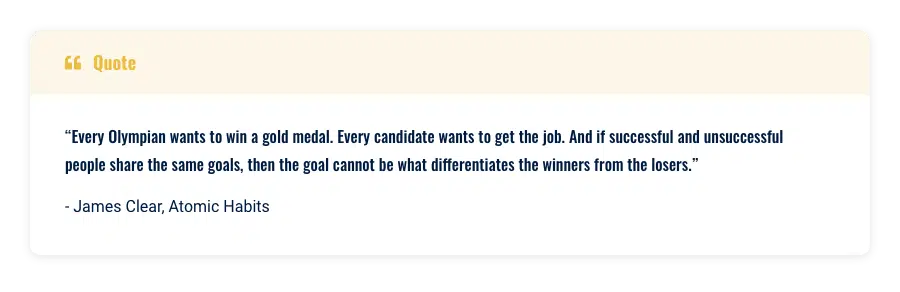
As best-selling author James Clear insightfully points out, merely setting goals is insufficient; it’s the systems and processes we establish for achieving these goals that set us apart.
One such system that can improve the odds of success is goal-setting frameworks. Let’s start by diving into goal-setting frameworks to help bridge the gap between what we intend to do and what we actually do.
What are goal-setting frameworks?
These acronym-based systems extend beyond mere adherence to a rigid set of rules or the mechanical filling out of a worksheet. Instead, each letter in the acronym embodies a fundamental principle that experts and researchers have identified as effective in goal setting.
The true essence of these frameworks lies in grasping these core concepts, enabling an adaptable application of these insights to various goal-setting scenarios rather than in the rote completion of a template.
Many of us were introduced to the SMART goals approach during our educational years. Yet, often, this introduction was geared more toward completing worksheets than deeply understanding the fundamental principles intended to enhance goal setting.
When you get the core ideas and the big picture of turning ideas into real action, these insights become more powerful.
Since many of you are already acquainted with the SMART framework, I will devote the majority of my discussion to newer frameworks and insights that might be novel to you.
However, I want to emphasize the importance of specificity (the “S” in SMART), as it has significant ramifications across all modern frameworks and is a vital takeaway for SEOs.
Why does specificity matter in goal setting?
Many know the importance of specificity, yet its significance is sometimes underestimated.
Drawing from my experience as a programmer, the absence of specificity in requests for new features can be a challenge.
In software development, minor alterations can necessitate a complete overhaul. A lack of specificity not only burdens the developer cognitively but also complicates predicting timelines.
A valuable insight I gained from a mentor in digital marketing is the significance of pinpointing the exact issue we’re trying to address.
They often remarked that many campaigns falter not due to lack of effort but because of a failure to define objectives.
Let’s take, for instance, the task of optimizing a website for conversions. It’s not just about increasing web traffic; the specifics matter immensely.
Are we looking to boost newsletter sign-ups, enhance ecommerce sales, or encourage more video views? Each goal requires distinct strategies, tools, and metrics to gauge success.
Suppose we don’t define the goal with enough precision. In that case, it becomes challenging to assess whether we are on track or off track and to determine if a change in strategies is needed – a common scenario in the ever-changing world of SEO.
Let’s summarize why is achieving clarity through specificity so important.
Reduced cognitive load: Our working memory has finite capacity. Addressing a vague problem requires juggling various interpretations and potential solutions. Specific problems, however, allow the working memory to channel its focus, streamlining the cognitive process.
Clear starting point: Ambiguous problems can stymie action due to the challenge of determining the initial step or subsequent course of action.
Avoiding cognitive tunneling: Ambiguity can cause the brain to fixate on less relevant aspects of a problem. Specificity mitigates this, ensuring focus on what truly matters.
Boosting motivation and reward: Our brain’s reward mechanisms thrive on clear objectives. The dopaminergic pathways, integral to motivation and reward, function optimally when goals are precisely defined.
Get the daily newsletter search marketers rely on.
Why is specificity so important to SEOs and developing SEO plans?
If you work with clients, how often have you heard, “we just want more revenue.” Usually, clients in this position don’t have a firm grasp of what drives revenue from digital marketing and thus pass the task onto the SEO of figuring out how to achieve it.
The wrong approach is to agree to drive more revenue. The better approach is to get as specific as possible about how much growth can be produced and, specifically, what needs to be done to achieve it.
Many of us have invested sweat and blood to master assessing this from a distance and providing accurate answers.
Let’s say we will increase revenue, but we don’t assign any specificity:
Lack of feedback: A few months in, we won’t have real-time feedback on what we are doing on-track or off-track.
Inability to make audibles and pivots: When we develop the plan, we won’t adjust the parameters to be in accordance with a specific number, e.g., how many content pieces or how much effort should go into link building.
Focus on the wrong things: We might engage in many checking check boxes that are good in SEO theory (e.g., adding alt tags to all images) instead of recognizing our time constraints and executing the work that can actually deliver on our goals.
Without these detailed targets, we’re navigating without a compass, unable to genuinely measure whether our strategies are fruitful. This not only stunts our growth and expertise in SEO but also robs us of the chance to refine our approaches for future projects based on past insights.
Summarizing SMART goals
SMART isn’t just a rigid framework for goal setting but a consensus on important concepts simplified into an easy-to-apply acronym.
It has served us well for decades, and one of its core principles, specificity, has been inherited by newer goal-setting methodologies.
Recent advances in behavioral science have introduced a new model, WOOP, which can be applied to help limit your intention-action gap.
Introducing WOOP
Years of research in behavior science have produced a new framework called WOOP that builds on the concepts of SMART but adds a few additional concepts.
WOOP stands for wish, outcome, obstacle, and plan.
Let’s jump into what each letter in the acronym represents.
1. Wish and outcome
At the core of every SEO campaign lies a wish and a desired outcome. It could be reaching Position 1 for a list of high-value keywords, 10xing organic traffic, or elevating a brand’s online visibility.
This wish serves as the bedrock of an SEO professional’s aspirations. However, what differentiates a fruitful SEO strategy from the rest is its ideal difficulty.
However, there are key parameters to consider when picking a desired outcome. If you pick something too vague or too difficult, it can serve to demotivate you over motivating you.
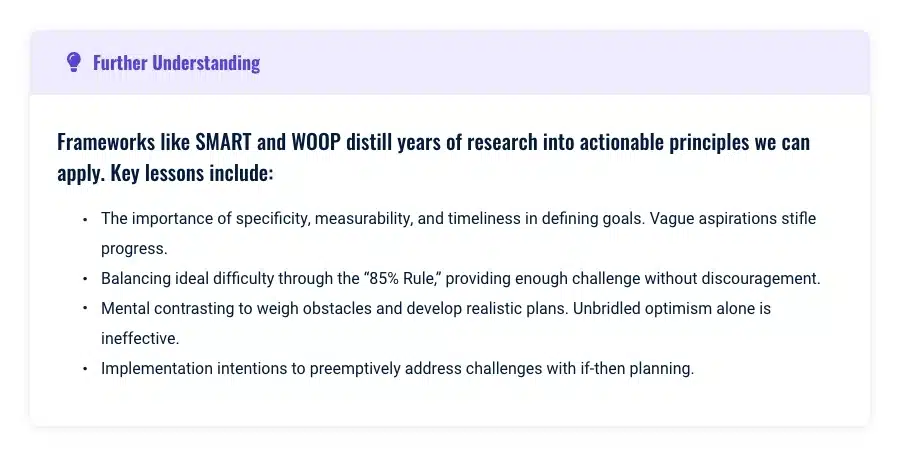
Ideal difficulty: Drawing parallels from AI model training, human learning and motivation also thrive on an optimal level of difficulty. If a task is too easy, it doesn’t stimulate growth. Conversely, if it’s too hard, it leads to frustration. The research-backed “85% Rule” suggests that the right balance is struck when there’s a 15% failure rate, offering enough challenge to foster continuous learning and improvement without disheartening. This principle holds true in various domains, promoting a culture of learning and adaptability essential for navigating dynamic landscapes like SEO.
Clarity is key: The wish should be specific. In the world of SEO, rather than just saying “I want more traffic,” it should be more aligned, like, “I want a 20% increase in organic traffic from search engines over the next six months.”
In her book “Rethinking Positive Thinking: Inside the New Science of Motivation,” Gabriele Oettingen discusses her expectations from her research.
At first, she thought that thinking positively about future goals would make them more likely to happen, a common belief and teaching.
The idea was that the most successful people stayed optimistic the whole way through. However, her findings repeatedly showed that unbridled optimism can be detrimental.
Strategically considering potential roadblocks and challenges were found to be:
More motivating: Oddly enough, visualizing successful outcomes sometimes had a demotivating effect. In contrast, pondering on the obstacles led to motivational shifts.
More likely to succeed: Time and again, those who employed what Oettingen calls “mental contrasting” – weighing the pros and cons – ended up achieving their goals more frequently.
For an SEO professional, this means that during goal-setting, it’s crucial to also envision and account for potential challenges.
One key takeaway from mental contrasting is the value of realistic planning, which means seeing both the good and the bad in a situation.
Unlike the common belief, especially in Western culture, that just thinking positively will lead to success, mental contrasting shows that a more balanced view can be more effective.
This approach suggests that it’s not just about hoping for the best but also about understanding and preparing for possible challenges.
It’s a philosophical shift toward seeing things as they are and planning accordingly, which can actually make reaching our goals more achievable.
3. Planning
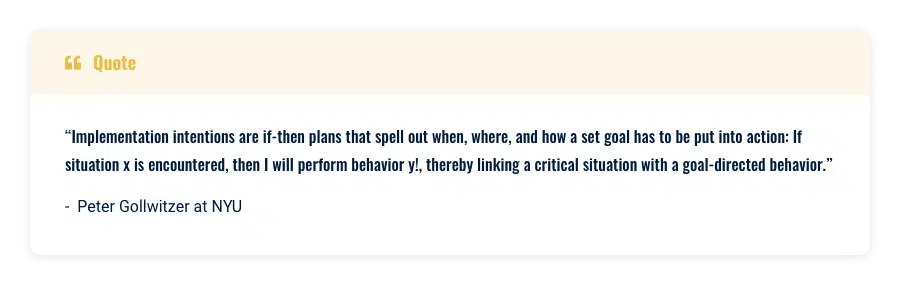
A cornerstone of the WOOP framework is “planning,” represented by the letter P. The significance of this component is backed by research conducted by Professor Peter Gollwitzer at NYU.
He introduced a concept called “implementation intentions.” These are short and precise statements (e.g., “If situation X arises, then I will perform response Y”). His findings highlighted that creating these intentions led to several major benefits:
Automaticity in response: The act of creating these implementation intentions prepares the mind to respond automatically when faced with specific obstacles. It’s akin to setting up a mental reflex.
Increased likelihood of action: The simple exercise of formulating these statements made people two to three times more likely to act on their intentions.
Mental preparation: Knowing in advance how to tackle a problem reduces hesitation and doubt when the problem actually arises.
For SEO professionals, the implication is clear: while developing strategies, it’s beneficial to anticipate possible challenges and devise short, actionable plans for each one.
When combined with a comprehensive understanding of potential obstacles, as advocated by the WOOP framework, the impact on outcomes can be profound.
Let’s put it all together:
Wish and outcome: The goal is specific, measurable, and time-bound, aligning with the SMART framework while also reflecting a clear wish and envisioned outcome.
Ideal difficulty: The goal is challenging yet achievable, adhering to the “85% Rule” to foster motivation and continuous learning
Clarity: The goal is clear and specific, avoiding vague aspirations like simply “increasing traffic.”
Mental contrasting: By identifying potential obstacles, a balanced view of the goal is established, promoting realistic planning.
Planning: The use of implementation intentions in the planning stage prepares for automatic responses to anticipated obstacles, increasing the likelihood of action and reducing hesitation when challenges arise.
This multi-step process, rooted in the WOOP framework, provides a structured, realistic, and proactive approach to SEO goal-setting, enhancing the likelihood of successful goal attainment while promoting a culture of strategic planning and adaptability.
As discussed above, one of the main issues so many people run into is that when they begin a project, their motivation is at its peak. As time goes on, motivation dwindles and important projects get abandoned.
One advantage of meticulous upfront planning – identifying potential obstacles, setting specific goals, and devising plans for handling each challenge – is that it lays a solid foundation for fostering realistic expectations about the outcome.
A key idea based on related research is that motivation is at least partially influenced by our expectancy of a successful outcome (see expectancy theories). This is often termed self-efficacy.
If you expect success, you’re more likely to aggressively pursue it, but it’s also not something you can lie to yourself about. That is why your desired outcomes must align with your internal compass of what is actually possible.
This final insight illustrates that without confidence in our systems or seeing others succeed, maintaining motivation becomes challenging. Therefore, goal-setting should leverage past victories to improve our confidence.
Goal-setting is a crucial meta-skill for SEO professionals to master as we set targets for ourselves and clients, whether long-term objectives or daily micro-goals. Having an effective framework optimizes our chances of success.
By internalizing these goal-setting best practices, we can boost motivation, persistence, and performance. With each achievement, our confidence and expertise also grow through a culture of continuous improvement.
Ultimately, marrying knowledge of SEO strategies with meta-skills like intentional goal-setting gives us our best shot at delivering results for our brands, companies, and clients.
Though the web landscape evolves, the psychology behind achievement remains constant. With the right outlook and preparation, any target can be within our reach.
Opinions expressed in this article are those of the guest author and not necessarily Search Engine Land. Staff authors are listed here.
@media screen and (min-width: 800px) { #div-gpt-ad-3191538-7 { display: flex !important; justify-content: center !important; align-items: center !important; min-width:770px; min-height:260px; }
}
@media screen and (min-width: 1279px) { #div-gpt-ad-3191538-7 { display: flex !important; justify-content: center !important; align-items: center !important; min-width:800px!important; min-height:440px!important; }
}
About the author
Paul DeMott, a serial tech innovator and the founder of the Helium brand line, including Helium SEO, Helium Interactive, and Venture Automotive, currently holds the position of Chief Technology Officer at Helium SEO. Paul is a software developer that has made significant contributions to the development
of SEO and paid search technologies, including the creation of Saas tools NobleSEO.io, H1seo.io and MobileAdMonitor LLC. With a background in using programming, Natural Language Processing (NLP) and data science, he has constructed tools designed to enhance SEO strategies, providing a competitive edge to practitioners. Helium SEO is a technology-forward digital marketing agency that is driven by data and maximizes the use of AI and Machine Learning to deliver excellent SEO outcomes for both mid-sized businesses and large enterprises. Helium SEO boasts a team of over 50 professionals spread across 15 states with its headquarters in Cincinnati, OH. The company’s impressive growth and performance have earned it significant accolades: It has been recently recognized as the 5th fastest growing company and the 10th largest Marketing and Advertising Agency in Cincinnati, in addition to earning the #679 spot on the Inc 5000 list of rapidly expanding firms.
Hosting third-party content: What Google says vs. the reality
Ever since media publishers moved online, SEOs have been working to help rent out space on their sites in order to gain quicker traction.
This is not a new concept and has been done and abused over the past few decades, so much so that it has earned the name “parasite SEO.”
What is parasite SEO?
Parasite SEO is when a third party publishes content on a larger website in order to leverage its authority and gain quicker traction. This practice often happens to large media publishers and news outlets.
So why would large media publishers and news outlets let this happen? Well, it all comes down to money.
The third party does all the work, and all the website has to do is host the content. Easy revenue share opportunity! These third parties often do affiliate marketing or general high-interest content that earns either affiliate or ad revenue.
Google’s warning
Google updated its helpful content documentation in September 2023 with the following:
“If you host third-party content on your main site or in your subdomains, understand that such content may be included in site-wide signals we generate, such as the helpfulness of content… we recommend that it should be blocked from being indexed by Google.”
For third parties and media publishers currently in partnerships, this was a scary announcement to see. However, what made it worse was when Gary Illyes posted this on LinkedIn:
So, does this mean that all third-party content is inherently bad?
Get the daily newsletter search marketers rely on.
It’s easy to take what Google says at face value and roll with that. But their algorithm is so much more nuanced than they could ever really explain.
So let’s break down a few things in the official statement:
‘Included in site-wide signals’
“If you host third-party content on your main site or subdomains, understand that such content may be included in site-wide signals we generate, such as the helpfulness of content.”
What this means
If you rent out sections of your site, any content the third party produces will be lumped with your main site’s content.
The reality
Google using site-wide signals isn’t a new thing. What’s important to note is that Google uses a mix of page-specific and site-wide signals simultaneously. All ranking factors may be weighed differently at any given moment depending on the search intent.
A bigger reality is that larger news and media publishers have some of the largest sites on the web due to their lengthy history. This means that even without third-party content, they will be affected by the helpful content update due to poor content already existing on the site.
As someone who actively publishes content on third-party sites, this makes me much more selective with the media publishers I choose to partner with. I don’t want to invest my team’s time and effort into a site we’ll struggle to rank on.
‘…host third-party content on your main site or in your subdomains…’
What this means
It’s common for media and news sites to carve out completely siloed sections of their site for third parties. This can be a subfolder or a subdomain. What happens is these sites allow third parties to have free reign over these sections, but they receive no internal links from the core site.
The reality
This is actually a negative signal for Google, telling them almost explicitly that this content is renting space and the publisher doesn’t want to affiliate themselves with the content other than sharing the root domain and branding.
This practice really doesn’t help the third party that much and is a practice that needs to go. If you’re in this situation, talk with your publisher about finding ways to add internal links to your content naturally.
‘…typically without any oversight…’
This comes from Illyes’s LinkedIn post about the change in documentation. The full quote is:
“We’ve heard (and also noticed) that some sites “rent out” their subdomains or sometimes even subdirectories to third-parties, typically without any oversight over the content that’s hosted on those new, generally low quality micro-sites that have nothing to do with the parent site.”
What this means
Based on the sites I’ve analyzed, news publishers often fall victim to this. They form partnerships with agencies and give them free rein over a microsite.
It’s often unlinked from the parent site and is typically focused on general affiliate marketing, while the main site is focused on news.
The reality
Google is actually pretty spot-on here. The content I’ve seen doesn’t follow any E-E-A-T guidelines. It disobeys my number one rule of content, “Does it sound like ChatGPT wrote it?”
Typically, the authors on these posts just say the name of the marketing agency and the content is very generalized without providing any meaningful value or usefulness.
‘…we recommend that it should be blocked from being indexed by Google.’
The full quote is:
“For this reason, if that content is largely independent of the main site’s purpose or produced without close supervision or the involvement of the primary site, we recommend that it should be blocked from being indexed by Google.”
What this means
Google is recommending to these publishers that they place a noindex tag on all third-party content that is not closely supervised.
The reality
I’m really torn on this comment. If I was the lead SEO at a publisher and discovered all of this low-quality content, I wouldn’t just noindex it, I’d likely remove it.
However, there are so many business contracts and relationships at play that this is likely not feasible. This is often revenue-generating content that is there for a reason.
If you’re currently in a situation like this, the logical next step is to do a mass overhaul of your content and create an E-E-A-T rubric for your third party to follow.
Who’s Google talking about?
As I’ve mentioned before, Google is mostly targeting local news sites and larger media publishers who have active third-party content on their sites.
Here are a few telltale signs of sites that the next implementation of the helpful content update will hit.
The content is completely siloed
This means that the site has no internal links coming from the parent site and the content is not relevant to the main site.
The content sounds like AI wrote it
This is my number one criterion for judging content quality. When you read it, does it have a voice, or does it sound like a robot wrote it to be generalized?
Your content should have a point of view, otherwise, it might as well be instructions on a shampoo bottle.
There’s no authorship
It’s worth noting that Google’s algorithm doesn’t actually use authors as a ranking factor. This was confirmed at Pubcon in 2023 by Illyes and documented by Mark Traphagen.
Contradictory? Well, kind of. It means that Google can recognize authors but doesn’t actively use it as a ranking signal.
What this means for us is that Google may end up using this as a ranking signal in the future.
So, if “Acme Marketing” authors your content, you may want to invest in some meaningful experts in the field.
Hosting third-party content: How to do it correctly
I’d like to reiterate that there’s nothing inherently bad about hosting third-party content and it’s not against Google’s guidelines.
There are ways to do it correctly where you actually provide value to users. Here are my top tips to do it correctly.
Stay on-brand
Your content must stay on-brand with the parent theme. So, if you’re partnering with a media publisher that focuses on home decor, make sure any content you’re producing fits within that niche.
This, unfortunately, makes it difficult for news sites, but you might be able to creatively find a way to produce meaningful content for news sites.
Get qualified experts
Especially when it comes to YMYL content, getting qualified subject matter experts is vital to maintaining E-E-A-T. You’d be surprised how many experts would love to review or even write content for you if it means they get featured somewhere notable.
Make sure to create meaningful author bio pages to demonstrate why users should trust them.
Find and create natural internal linking opportunities
If your content is staying on-brand with the parent site, then you should have no problem finding natural internal linking opportunities.
If none exists, work with your team to create meaningful content that may naturally link to your third-party content.
Work closely with the parent company
It’s critical to work closely with your parent company to ensure your content is on-brand with the rest of the site.
Because the helpful content update is a site-wide signal, all content on the site must be consistent in tone and messaging.
Making third-party content work for you
Never take announcements from Google at face value. Take time to think about what Google is saying and decide what nuances may play into it.
Nothing is final. If the algorithm worked exactly like Google said it does, we wouldn’t have so many algo updates. It’s an evolving process.
So, pick up on the signs of where Google is heading and always focus on creating the best experience for your users.
Opinions expressed in this article are those of the guest author and not necessarily Search Engine Land. Staff authors are listed here.
@media screen and (min-width: 800px) { #div-gpt-ad-3191538-7 { display: flex !important; justify-content: center !important; align-items: center !important; min-width:770px; min-height:260px; }
}
@media screen and (min-width: 1279px) { #div-gpt-ad-3191538-7 { display: flex !important; justify-content: center !important; align-items: center !important; min-width:800px!important; min-height:440px!important; }
}
About the author
John McAlpin has nearly a decade providing advanced SEO consultations to health organizations across the United States. John is deeply engaged in both the local and national SEO community and has a strong background in technical SEO, web development, and digital marketing strategy. McAlpin also provides freelance web development services for WordPress hosted sites.
The issue started on October 5, 2023, when the core update started to roll out, and was fixed on October 31, 2023.
What Google said. Google wrote, on the Search Status report, “On October 5, we found a bug with how our October 2023 core update was applied to Discover.” “As of October 31, we fixed the bug. Some sites may see an increase in Discover-related traffic, as a result of this bug fix,” Google added.
Google also posted, “We found a bug with how our Oct. 2023 core update was applied to Discover, which has now been corrected. Some sites may see an increase in Discover-related traffic, as a result. Start and end time for this issue is now on the Search Status Dashboard,” on X.
Why we care. If you noticed unusually low Google Discover traffic for your site since October 5th, it may be related to this bug with the core update. If you notice an increase in your Discover traffic starting today, then you can be assured it was likely due to that bug.
That being said, traffic from Google Discover is not normally something you can rely on as it can be very sporadic with highs and lows.
@media screen and (min-width: 800px) { #div-gpt-ad-3191538-7 { display: flex !important; justify-content: center !important; align-items: center !important; min-width:770px; min-height:260px; }
}
@media screen and (min-width: 1279px) { #div-gpt-ad-3191538-7 { display: flex !important; justify-content: center !important; align-items: center !important; min-width:800px!important; min-height:440px!important; }
}
About the author
Barry Schwartz is a Contributing Editor to Search Engine Land and a member of the programming team for SMX events. He owns RustyBrick, a NY based web consulting firm. He also runs Search Engine Roundtable, a popular search blog on very advanced SEM topics. Barry can be followed on Twitter here.