Google Search Hits All-Time Usage Record During World Cup via @sejournal, @MattGSouthern
Nick Fox, Google’s senior vice president of Knowledge & Information, said that Google Search reached its highest usage ever on July 7, coinciding with Argentina’s comeback victory over Egypt at the World Cup.
In the post, Fox wrote: “Google Search broke all prior usage records and saw its highest usage in history right after Argentina scored their winning goal in yesterday’s match!”
Robby Stein, vice president of product for Google Search, amplified the post, writing that Search “hit all time high in usage yesterday.”
Fox didn’t share any specific figures or methods for the record, and Google hasn’t released a blog post or data about it.
The statement is consistent with Google’s public messaging this year. During its Q1 2026 earnings call, Pichai mentioned that “Search queries are at an all-time high,” though specific numbers weren’t shared.
Google has pointed to a World Cup traffic record before. In the 2022 final, Pichai stated that Search reached its highest traffic in 25 years, again without providing exact figures.
Argentina defeated Egypt 3-2 in the Round of 16 on July 7, overturning a two-goal deficit with Enzo Fernández scoring a stoppage-time winning header. Their quarterfinal against Switzerland is next, which tracks with Fox’s line about looking ahead to “the semis and final.”
Why This Matters
There’s been a lot of talk recently about whether AI answers are changing the way we search. A record day, if it holds up, is a reminder that Google is still where people turn the moment something happens live.
Keep in mind that ‘record usage’ and ‘record queries’ refer to Google’s side, not clicks to publisher sites. It’s possible for search usage to increase even when outbound clicks to your pages remain low.
Fox also didn’t define how “usage” is counted, or say whether the figure excludes bots. Imperva, which sells bot-management tools, estimated that automated traffic made up more than 53% of web traffic in 2025, up from 51% in 2024. None of that shows Google’s record was driven by bots. Without a clear methodology, it’s hard for external readers to understand exactly how Google counts automated traffic.
Looking Ahead
Google put no figures behind the 2022 claim and none behind this one, so whether it backs the record with data is the thing to watch. Argentina’s quarterfinal is next, and another usage spike is possible if the run continues.
AI Search Is Exposing SEO’s Risk Of Losing Ownership Of GEO Outcomes via @sejournal, @martinibuster
Tom Critchlow, a longtime search marketer with deep experience, recently shared his opinions of where the SEO industry is today, saying that AI Search is changing business priorities in a way that exposes the weaknesses inherent in SEO today. This transformation means that search marketing professionals need to evaluate the services they offer in order to align better with what is useful for today’s modern search surfaces.
Brand Marketing: The Hidden Pillar Of SEO
Google’s algorithms have long relied on user behavior signals. Google’s founders said that PageRank could “be thought of as a model of user behavior,” showing that user behavior relative to content was important to Google at the very dawn of Google.
What people respond to most online are brands. People could be said to be hardwired to respond to products and service providers they are already familiar with. This phenomenon is called Familiarity Bias, a tendency to prefer things one is already familiar with. Making potential site visitors familiar with a brand is a powerful marketing activity, and that approach aligns perfectly with what we know about Google’s algorithms relative to Navboost and branded search.
SEO Fundamentals Are A Foundation
In an interview with Ross Hudgens, Critchlow observed that the foundations of SEO remain the same in AEO/GEO. Google consistently says that the fundamentals of SEO remain the same. Critchlow’s view of AI Search goes beyond that by showing that SEO is more like a foundation.
Critchlow explained:
“And it points to something very important, which is I think that GEO, AI Search, is much more like brand marketing than it is SEO, in my opinion.
Right now, there is an underpinning, obviously, of the technical foundations and crawling and indexing that is kind of the same, or the same kind of discipline, right?
That is equally important before and after.”
It is at this point that Critchlow develops the idea that what is built on top of that foundation goes beyond just classic SEO, with the implication being that failing to anticipate this change could pose a career risk.
People Who Drive Outcomes Are Not SEO
Critchlow continues his thoughts, building on the idea of SEO being a starting point and going further by saying that the outcomes in AI Search are not driven by SEO. He describes this as contrarian, which is someone who holds an opinion contrary to what is commonly accepted. But as you’ll see, Critchlow’s ideas are founded on a more practical view of what drives ranking in both classic and AI Search.
Here Critchlow considers the questions that all SEOs need to be asking as the industry transitions to a post-Search AI-driven environment:
“But a lot of what you do, back to that question of like, okay, you put in a prompt and you say, do you recommend brand A or brand B?
And it says your competitor. What do you do about that, right?
And so like, and this, I’m a little contrarian, so forgive me, but like this was true in classical SEO and I think is increasingly true in the GEO world.
The people that drive SEO outcomes are not SEO professionals, by and large.
It’s painting with a broad brush and there are exceptions. …Both in the old SEO world and in the GEO world, the people that drive out the outcomes are the brand, product, PR and editorial teams, not the SEO teams.
And that was true in a classical SEO world. And I think it’s going to be increasingly true in a GEO world.
If I’m a CEO and I’m sat looking at my organization and I’m like, who’s going to do this GEO thing for me?
Is it the SEO team?
Or is it the brand team?
Or is it the product team?
And your answer to that question is going to depend a little bit on what kind of business it is and what industry you’re in, but there’s a real risk for the SEO industry, which was also a risk in classical SEO days…
…Because again, SEO has done a great job of being like, we’ve got to produce great content. We’ve got to have a good brand. We’ve got to have like strong branded search. We’ve got to be mentioned in all these places. We’ve got to have like positive reputation.
But does an SEO team do any of those things? In most organizations, the answer is no.
In most organizations, those outcomes are owned by other teams. That’s a real, I think of that as a career risk.”
Takeaway
Critchlow’s observations raise many questions that SEOs need to consider today:
Who drives SEO outcomes today in AI Search?
Is there a risk for the SEO industry as GEO becomes more important?
What does SEO emphasize organizations should do, and does SEO actually own those activities?
Who owns the outcomes that matter in most organizations, and how should SEO fit into that?
If SEO doesn’t drive the outcomes that matter, is there a career risk, or should SEO transform to encompass more?
Looked at another way, it could be we are in a liminal state where we are neither here nor there, where what was SEO is transforming and becoming something else.
Reclaiming Brand Sovereignty In The AI Era via @sejournal, @billhunt
For more than two decades, digital strategy has revolved around a deceptively simple objective: Drive people to webpages. Search engines rewarded documents. Analytics rewarded pageviews. Marketing rewarded engagement. As organizations matured, they invested heavily in designing increasingly sophisticated digital experiences that guided customers through carefully orchestrated buying journeys. Information was intentionally distributed across dozens, sometimes hundreds, of interconnected pages, each optimized for a different stage of consideration.
Consider how a company such as Ford presents the F-150, one of the best-selling vehicles in America. Rather than offering a single comprehensive representation of the vehicle, Ford brilliantly guides prospective buyers through an emotional journey spread across seven distinct viewports. The homepage establishes the lifestyle. Model pages introduce trim levels. Interactive configurators allow customers to visualize ownership. Feature pages explain towing capacity, off-road performance, and technology packages. Galleries reinforce the brand’s identity, while technical specifications are located deeper within the site, alongside regional offers and financing options.
For people, this architecture works remarkably well. Every page serves a purpose. Every interaction builds confidence. Every transition moves the customer toward a purchase decision. It is an outstanding human experience. For AI, however, the same architecture introduces friction.
The Quiet Crisis Of AI Disintermediation
The AI labs frequently tell enterprise leaders that their large language models (LLMs) are smart enough to crawl any messy web architecture, synthesize the data, and deliver accurate answers regardless of how that information is organized. That message oversimplifies reality and how AI retrieval actually works.
When data is deliberately fractured across multiple pages to serve human emotions, the AI’s synthesis engine breaks. Because the machine lacks an emotional context window, it searches for a high-density, low-latency semantic payload. When it cannot find that payload natively on an official corporate domain, it looks elsewhere. It then assembles the most complete answer it can from whichever sources are easiest to retrieve, reconcile, and trust. The consequences are already visible.
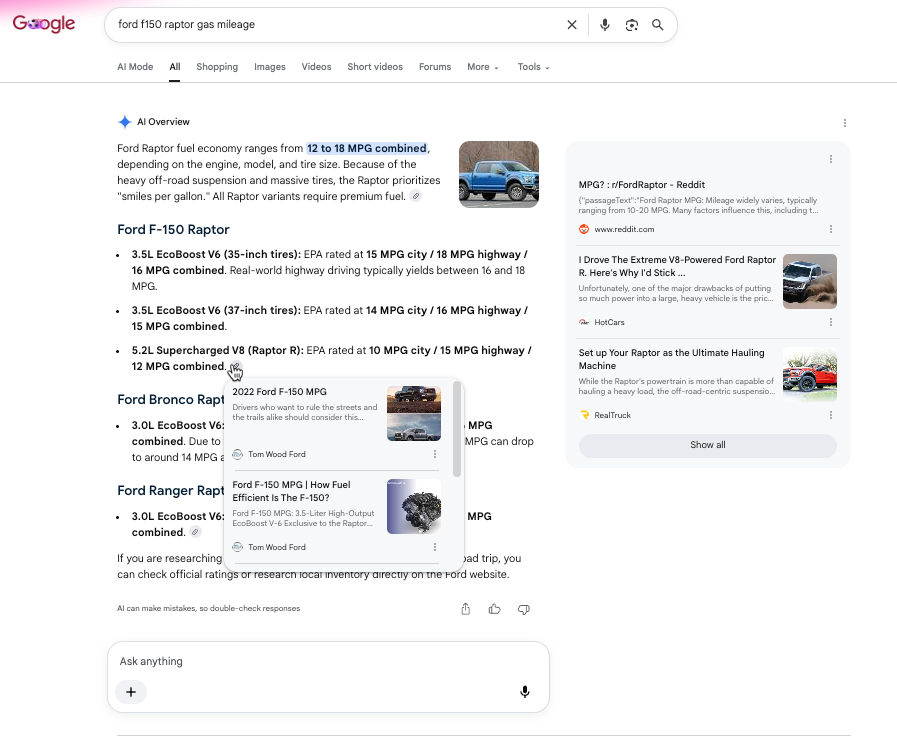
A straightforward query such as [ford f-150 Raptor gas mileage] produces a Google AI Overview that draws information from Reddit discussions, automotive publishers, and a local dealership rather than Ford itself.
Screenshot from search for [ford f-150 Raptor gas mileage], Google, July 2026
Ford already has the answer to nearly every conceivable question. The issue isn’t that the information doesn’t exist. The issue is that Google found it easier to assemble an answer from Reddit, an automotive publisher, and a dealership than from Ford itself. When that happens, the discussion is no longer about rankings or citations. It is about who controls the authoritative representation of your brand.
This is no longer simply an SEO problem. It is a content governance problem.
The issue is that AI has simply exposed a structural weakness that has existed for years. Enterprises organized their digital presence around webpages because search rewarded webpages. In many ways, search became the detour. Organizations optimized for ranking documents and triggering an emotional reaction rather than organizing knowledge. That approach worked because search engines retrieved pages. AI assistants attempt to synthesize a coherent representation of the organization. In doing so, they expose every inconsistency, every missing relationship, and every gap in the underlying architecture.
The organizations struggling today are rarely missing information. They possess enormous knowledge of their products, services, policies, and expertise. The problem is that the knowledge has been fragmented across webpages, content management systems, product databases, marketing campaigns, PDFs, support portals, and countless disconnected repositories. Humans can navigate those silos. Machines increasingly cannot.
AI did not create this problem. It simply made it impossible to ignore.
Brand Sovereignty Becomes An Executive Responsibility
Years ago, I had the opportunity to consult for Dell, where Michael Dell demonstrated an approach to digital leadership that feels even more relevant today than it did then. He regularly tested both Google Search and Dell’s internal search experience himself, not because he wanted to micromanage marketing or technology teams, but because he understood something many executives overlooked: the interface through which customers discover your products ultimately shapes how they perceive your company.
If he or a customer searched for a product and failed to find the right answer, Michael Dell did not see an isolated technology issue. He saw an organizational failure. That mindset has become even more important in the AI era.
I think of this as brand sovereignty: an organization’s ability to remain the authoritative source for information about its own products, services, and expertise, regardless of where those answers are ultimately delivered. For years, digital success was measured by how effectively organizations attracted visitors to their websites. Increasingly, a more important question will be whether AI systems consistently recognize the organization itself as the best source of that information.
This isn’t something marketing, SEO, or technology can solve on their own because none of those teams owns the complete picture. Product information, documentation, customer support, legal policies, and commerce all contribute to how an organization is represented digitally. Reclaiming brand sovereignty, therefore, becomes less about publishing more content and more about organizing organizational knowledge so that those pieces reinforce one another rather than compete.
From Pages To Knowledge
Most organizations didn’t set out to fragment their knowledge. It happened gradually. Every project added another page, another microsite, another content repository, or another system designed to solve a specific business problem. Over time, product information, marketing content, customer support, policies, and commerce evolved independently while the corporate website became responsible for stitching everything together into a coherent customer experience.
That approach worked because the web rewarded navigation. Customers could move between pages, and search engines could retrieve the most relevant document. Neither required organizations to explicitly connect the relationships between their products, services, policies, and expertise.
AI exposes the limitations of that model. Large language models are not attempting to navigate websites in the way people do. They are attempting to understand organizations by reconstructing the relationships between products, services, documentation, policies, locations, expertise, and supporting evidence. Every answer generated by an AI assistant represents an attempt to assemble that understanding from the information available to it. When those relationships remain implicit, distributed across hundreds of webpages, databases, and disconnected repositories, the resulting representation becomes incomplete or inconsistent.
Rather than treating products, services, documentation, policies, reviews, offers, support resources, and locations as independent publishing assets, organizations should begin managing them as interconnected business objects within a Unified Object Graph. Each object maintains its own identity while explicitly connecting to every related object throughout the enterprise. A product connects to its technical documentation, compatible accessories, warranty information, inventory, customer reviews, dealerships, and service locations. The webpage becomes one expression of those relationships rather than the place where those relationships are created.
One of the questions I hear most often is whether this requires replacing existing systems. In most cases, it doesn’t. Organizations have already invested heavily in product information systems, content management systems, commerce platforms, digital asset management, and customer support tools. Those systems continue to serve important purposes and should remain the systems of record for the information they manage best. The challenge is that none of them represents the organization as a whole.
Instead of trying to consolidate everything into a single platform, organizations should focus on creating a machine-readable knowledge layer that brings those pieces together. Product information, documentation, policies, reviews, marketing content, and commerce data continue to live where they belong, but they are aggregated into a single, machine-readable representation that explicitly describes the entities and relationships across the business.
Once that layer exists, the conversation changes. Publishing to a website, exposing an API, generating structured data, supporting an MCP endpoint, or adopting whatever protocol comes next all become different ways of expressing the same underlying knowledge rather than separate implementation projects.
This is the architectural shift that AI is exposing. For years we managed channels independently and treated the website as the place where everything came together. Increasingly, organizations will manage knowledge centrally while allowing every interface to consume the same authoritative representation. Websites, customer support portals, AI assistants, commerce platforms, and future interfaces all become consumers of the same knowledge rather than maintaining their own versions.
That shift also changes how content is created. Most organizations still separate technical accuracy from marketing language because different teams own different parts of the story. Product Information Management systems manage specifications, creative teams develop messaging, SEO teams research customer language, and customer support documents common questions. Each group adds value, but very little of that knowledge remains connected once it leaves the team that created it.
Consumers, however, do not separate facts from feelings when making decisions. A customer searching for [the safest family SUV], [a truck that feels unstoppable off-road], or [a quiet hotel for remote work] combines objective requirements with subjective expectations in the same question. Increasingly, AI systems are expected to interpret those blended expressions of intent in much the same way.
At Bisan Digital, we call this emotifacts (where feeling and fact are inseparable), and they become valuable to the process because they combine factual product attributes with the emotional language customers naturally use to describe, discover, and ultimately choose products or services. Rather than treating emotional messaging as creative copy layered onto technical specifications, both are treated as part of the same reusable knowledge object.
If marketing positions the Ford Raptor around freedom, confidence, and rugged independence, those ideas should be explicitly connected to the engineering evidence that supports them: suspension travel, approach angles, locking differentials, horsepower, towing capacity, and terrain management systems. The emotional promise and the technical proof reinforce one another because they originate from the same underlying object. The same principle extends well beyond the automotive industry. A luxury hotel should connect its promise of tranquility to room location, sound insulation, wellness amenities, and guest reviews. A healthcare provider should connect claims of clinical expertise to physician credentials, treatment outcomes, published guidelines, and patient education. In each case, trust is strengthened because the emotional narrative and the supporting evidence are inseparable.
This represents the broader transition from digital publishing to knowledge architecture. Machines can infer many things, but they should not be expected to infer the relationships that organizations already know to be true. Increasingly, competitive advantage will belong to the organizations that explicitly declare those relationships, govern them consistently, and make them available across every interface through which customers and intelligent systems engage with the business.
Building For Adaptability Rather Than Standards
Once knowledge becomes independent from presentation, exposing it to both people and machines becomes significantly easier. This is where much of today’s conversation around AI interoperability is focused, and understandably so. New protocols, APIs, and discovery mechanisms are emerging almost monthly as organizations race to determine how AI assistants should access trusted enterprise information.
Emerging standards such as MCP represent an important shift toward explicit machine interfaces. Today’s protocol may be MCP. Tomorrow it may be another widely adopted standard. The objective is not to predict which protocol will win but to organize knowledge so it can be exposed through whichever standards ultimately become dominant.
The same principle applies to commerce. Emerging initiatives such as Google’s Universal Commerce Protocol (UCP) illustrate how structured product knowledge can flow directly into AI-assisted purchasing experiences. Whether UCP becomes the dominant protocol is less important than ensuring the underlying knowledge is structured well enough to participate in whichever transactional ecosystem emerges.
This distinction between architecture and implementation has always mattered, but it has rarely been as visible as it is today. Organizations that continue to treat their website as the primary repository of business knowledge will find themselves repeatedly adapting to new interfaces, new protocols, and new retrieval models. Organizations that instead invest in well-governed, reusable knowledge assets will discover that supporting new delivery mechanisms becomes an incremental engineering exercise rather than a fundamental organizational transformation.
The conversation, therefore, should not begin with MCP, UCP, or any other emerging specification. It should begin with a more fundamental question: Does the organization possess a coherent, authoritative representation of its own knowledge independent of the interfaces through which that knowledge is delivered? Every protocol introduced over the coming decade will simply become another window through which that knowledge can be expressed.
The New Measure Of Digital Success
For much of the web’s history, digital success was measured by a familiar collection of metrics: rankings, website traffic, pageviews, engagement, and conversions. Those measures remain valuable because websites will continue to play an important role in how organizations communicate with customers. They are no longer, however, the only measure of digital effectiveness.
As AI assistants increasingly become intermediaries between organizations and consumers, a new question emerges. When an intelligent system answers a question about your company, your products, or your expertise, does that answer originate from your organization’s knowledge, or from someone else’s interpretation of it? That distinction defines brand sovereignty.
The organizations that succeed during the next decade will not necessarily publish more content than their competitors, nor will they build the most sophisticated websites. They will recognize that digital strategy is no longer centered on documents but on knowledge itself. Their webpages, mobile applications, customer support experiences, AI assistants, commerce platforms, and technologies yet to be invented will all become distinct expressions of the same authoritative foundation.
Search taught organizations how to build better webpages. The AI era is teaching them how to build better knowledge.
The organizations that win the AI era will not be the ones with the most webpages. They will be the ones with the best-organized knowledge. Your website is no longer your digital asset. Your knowledge is. The website is simply one way of expressing it.
An Easy Digital PR Strategy For AI SEO via @sejournal, @martinibuster
I had a conversation with an old friend from my WebmasterWorld Forum days about PR marketing for AI search. The friend had contacted me to hear my thoughts about it. The discussion seemed useful, so I rewrote it into an article.
Digital PR Outreach Because Links Matter Less
The friend I had this conversation with is Alistair White (LinkedIn profile), a search marketing professional based in Australia who has decades of experience.
White asked me:
“I was wondering if you have any thoughts on performance based digital?”
My response was, yes, I have a load of thoughts on the topic. The following is one of them. In the future, I will do a follow-up on more ideas.
I used to do PR outreach slash brand marketing for a B2B starting around 2004. But I scaled it up for another company around 2013 because I saw the writing on the wall that links were already on the decline. So my approach grew out of link building, but my intuition was that links did not matter. It was about putting the company in front of ten thousand, twenty thousand, sixty thousand potential customers and doing it in a way that makes it clear that this company solves the problem that these professionals have.
Strategy: Outreach Directly To Potential Customers
What I did was narrowly focus on a specific demographic that strictly lined up with their target customer. So, one typical customer was the head of IT and IT workers at a large corporation. Another demographic was the department manager. Two different demographics that both needed the same solution. So the campaign was split into two parts, one for each demographic.
It was essentially a PR campaign that was focused on identifying associations and organizations. Virtually every industry has an association of professionals. So, what I did was first target the organizations at the national level. The reason is that once you do a project with the national level, getting similar projects done at the state level was ten times easier. You just show them the national level article that featured the company, and the state-level organizations would almost always say yes.
Once you got that state-level project done, getting to yes with the individual chapters at the regional or county level became ten times easier. Each time I got a project done, it put the client in front of thousands of potential customers. Eventually, everyone knew who my client was and getting projects done became easier.
What were these projects?
Newsletters
Organization magazines
Website articles
Interviews
Every organization was different. So I would click around and see what they were up to and create the pitch to fit with what they were publishing.
Attribution Is Not Always Possible
This was not about building links, it was about building customers, making money.
And that’s not something that any SEO thirteen years ago would ever consider doing because there isn’t a clear way to track that the client spent X this month and earned Z the next month because of that activity. An SEO would never consider it because there’s no way to directly track the ROI.
You can track some of it with the “how did you hear about us” question. But how will you know if a customer heard of the company because a colleague at a conference who saw the client’s propaganda told them about it?
Not everything can be tracked. That’s why everyone else in SEO did not pursue these opportunities because they were like, where is the link, where is the attribution? Well, now the secret’s out. It’s infinitely adaptable, too.
Both companies that I did this for experienced year-over-year steady growth, and both were eventually acquired and made a lot of money for the founders. And how did I know it worked? Because this is how I promoted some of my websites, by building top-of-mind awareness, the kind that makes people type a domain name into the search box.
Google has algorithms that track things like branded navigation. You can’t build that kind of user behavior with links. You cannot build branded navigation with SEO. And yet, these are things that have been a part of Google’s algorithms since 2004 with the Navboost algorithm and in 2012 with Google’s branded navigation.
Brand Marketing And PR… And SEO?
SEOs have historically been about five to ten years behind the actual algorithm developments at Google. And I get it that ideas that a five year old can understand, like “adding EEAT” to articles, that’s easy to understand. Everyone else is doing it. But you know, everyone who did that knows now it was a grand waste of time.
And it’s not that I am a contrarian. It’s just that most of the time SEOs chase these ephemeral tactics with an SEO hammer, going bang, bang, bang. But it’s becoming clearer now that SEO for AI search is not the nail that building links used to be.
Like, how are you going to encourage people to do a branded search on Google? How are you going to get people to know about your brand in the first place? How are you going to target the office manager that makes the decisions at a company? Well, I shared an idea about that, right?
Those are the kinds of things that are going to trigger a positive ranking factor at Google, and yet none of those are a part of the SEO toolbox.
Back in 2015 I raised the idea that content is king misses the point of being successful online.
“If content is king, how come the top Internet businesses sites are not in the content business? What about Netflix? You think that’s content you are paying a monthly subscription for? Or is it convenience?
Netflix is not in the content business. They are in the convenience business. Anyone can provide content but nobody delivers convenience the way Netflix does. That’s because their focus is and always has been the user experience. Convenience, the user experience, is why customers pay Netflix. If Netflix had followed the Content is King strategy it would have been Blockbuster.
…Don’t focus on cranking out content. Focus on understanding what the user wants and your content strategy follows.
I cannot overstate the importance of understanding that the user experience underlies many of Google’s important decisions related to its algorithm.”
These are not new ideas that I’m presenting, but they were ahead of their time, maybe still are. Yet, they are as relevant today as they were in 2015 or 2004. Some are saying they are more relevant today because of AI Search.
You Can’t See How AI Ranks You, So Build What It Can Read via @sejournal, @slobodanmanic
Web strategy in the AI era has a strange shape. You spend your days optimizing for systems nobody will let you look inside. You publish, you watch the traffic move, and when an AI answer surfaces a competitor instead of you, there is no panel that explains why. So when a regulator forces one of these systems to show its work, the question gets concrete: What actually changes for the people who build websites? After reading the order, the honest answer is two things at once. The recourse is real and worth taking seriously. The work it points to is not new.
A Regulator Is Forcing Google To Explain How It Ranks
On June 17, the UK Competition and Markets Authority used Google’s Strategic Market Status designation, granted last October on the basis that Google handles more than 90% of UK search, to impose two binding rules. The first matters to anyone with a website. Google has to rank organic results by “objective and non-discriminatory criteria,” and the regulator wrote that this applies inside AI Overviews, not only the 10 blue links. Google also has to give businesses real transparency into how ranking works, advance notice before major changes to its ranking systems, and a documented process to raise complaints. It has six months. “Step by step, we’re ensuring that Google’s search services work better for businesses and consumers across the UK,” said Will Hayter, the CMA’s executive director for digital markets.
For 25 years, the ranking system was something you inferred from the outside, never something you could question from the inside. Advance notice of changes and a real complaints process is recourse web professionals have never had, and “objective criteria” is a promise that the unexplained demotion has to end. It is UK-only for now, Google will contest it, and nothing is live for six months. But rules like this rarely stay in one country, and the direction is not ambiguous. The layer that decides whether your website is seen might end up being exposed.
Opening The Box Would Change Less Than You Hope
Now run the thought experiment all the way. Say the order goes further than anyone expects, and you could read the exact criteria that decide what gets surfaced and cited, across every engine, not only Google. What would you actually do differently?
You would probably change less than the excitement suggests. Transparency would settle many arguments, sure. It would end the seasonal debate over whether llms.txt does anything (the latest large-scale data says it does not), whether schema markup is a citation cheat code (a controlled study says it is not), whether stuffing a page with “best in class” claims earns the recommendation (it earns the citation and loses the recommendation to the competitors you named). Seeing the rubric would kill the folklore. It would not change the work. A system reading your website still has to find the answer, parse it cleanly, and have some reason to trust it. Whether you can see the criteria or not, the page either presents its substance in a form a machine can extract, or it hides it behind something the machine never runs.
That through-line sits under every one of these stories. A court in Munich ruled in May that Google’s AI Overview is Google’s own speech, which Google can be held liable for. The AI answer is being treated as a product with an owner and rules. None of that touches the one input you fully control, which is whether your content is legible to the thing doing the answering.
Audit What A Machine Can Read On Your Website Today
Waiting for the box to open is the wrong instinct. That is someone else’s six-month timeline, in one country. The right move now is to audit what a machine can already read on your website, and fix what it cannot.
Run three checks, in order.
Rendering First: Does your meaningful content exist in the HTML a system receives, or does it depend on client-side JavaScript that most AI fetchers never run? Load your most important page with JavaScript disabled and see what is left.
Verifiability Last: Are the facts that define you, who you are, what you sell, what is true about it, stated plainly and consistently across your website, or does the machine have to take your word for claims it cannot confirm anywhere else?
That is machine-first work, and it is the same work whether Google is forced to publish its criteria or not. It’s upstream of every ruling, which is why it will survive all of them. A website a machine can read, parse, and verify wins in the opaque version of this world and in the transparent one. The only thing transparency would add is proof you were right.
So, when that black box opens is not on your roadmap. A regulator or a court could force that, in their country, on their clock. What should be on your roadmap is whether the answer to a real question about your business sits in your HTML right now, in a form a machine can lift out and trust. You don’t need anyone’s permission to do that.
AI Search: Is Your Content Strategy Accidentally Recommending Your Competitors?
This post was sponsored by FirstPromoter. The opinions expressed in this article are the sponsor’s own.
For years, software companies have published pages that rank the best tools in a category and place their own product at the top. The tactic was cheap and easy to scale, and for a long time it helped shape what buyers saw.
In AI search, comparison listicles backfire. Google’s AI Overview quotes the listicle as a source, then recommends a competitor from your own cited list.
Your content only gets the citation. Meanwhile, your competitor gets the recommendation and the click. Your competitor gets the sale.
What makes your cited content recommend competitors?
Lily Ray quantified how often a brand’s own listicle earns the citation but loses the recommendation to a competitor.
In research published in June 2026, she analyzed 100 B2B “best [category] software” queries in Google’s AI Overviews and checked the same queries three times between April and June.
The Results
Across the 80 queries that produced an AI Overview, self-ranked listicles were cited 323 times. In 224 of those cases, Google named a brand’s own page, then recommended a rival ranked inside it.
In other words, when a brand’s own listicle was cited, that brand was left out of the recommendation 69% of the time.
What’s the Difference Between Being Cited & Being Recommended in AI Search?
AI search produces two separate outcomes, and only one of them drives sales.
A citation means the engine named a page as one of the sources behind its answer.
A recommendation means the answer told the reader which product to choose.
The recommendation is what buyers act on.
A citation is easy to mistake for progress, because the brand still appears on the screen.
What an engine cites depends on the content of the page. What it recommends depends on what the rest of the web says about a brand: how many independent sites mention it, link to it, and review it.
Why Does Self-Promotional Content Backfire in AI Search?
Google now treats self-ranked pages differently in its AI answers, Ray found.
The brands that win recommendations are the established names the web already covers.
Recommended brands had far more referring domains, and far more mentions across AI Overviews and ChatGPT, than brands that were cited and passed over.
On-page changes can’t fix this. The gap isn’t on the page; the citation-recommendation gap lies within how often the rest of the web covers the brand.
How to Measure Whether AI Search Recommends Your Brand
You can run this check for any category without special tools. Because citations and recommendations carry different intent, the goal is to separate two figures that usually get combined:
How often your brand is cited (informational intent).
How often it is recommended (transactional intent).
Step 1: Build Your Query List
Start with the questions a buyer would type, such as “best project management software,” “Notion alternatives,” or “best [category] software.”
Step 2: Record Citations & Recommendations Separately
Run each one in Google and record two things: the pages Google cites as sources, and the products it recommends in the answer.
Step 3: Repeat Each Query
Run each query more than once, since AI answers shift from session to session.
Step 4: Score Your Share of Voice
Then score the share of recommendations won, rather than the number of citations earned.
Step 5: Extend the Audit Beyond Google
The pattern is documented for Google’s AI Overviews, so begin there. Run the same queries through ChatGPT and Perplexity to map which publishers those engines surface for your category.
Ray’s research shows what the exercise produces. For “best LMS for selling courses,” Google cited Oasis LMS repeatedly, in the body of the answer and in the sidebar. Oasis ranks itself number one in that article. Google recommended Kajabi, Thinkific, LearnWorlds, and Teachable instead, each of them named inside the Oasis piece.
Ray found the same split across categories, from CRM to help desk to SEO software.
Finding 2: Do AI Recommendations Come From Coverage You Don’t Publish? Yes.
Ray’s data shows where AI recommendations originate. Google leans heavily on third-party and user sites, with Reddit, Forbes, and YouTube among the most-cited domains. Content independent from the brand earns a recommendation: reviews, comparisons, and walkthroughs published by someone other than the vendor.
How Do You Get More Independent Brand Mentions That Win AI Recommendations?
Each of these should be published by third parties. Not one placement at a time, but as ongoing output.
How Do You Do This Quickly?
Give creators a financial reason to publish. When a creator earns money each time their coverage converts a customer, they keep writing reviews, updating comparisons, and publishing walkthroughs, without you commissioning each piece.
You can start with a handful of creators and a revenue-share agreement. What that produces is coverage. What it does not produce, on its own, is consistency.
How Do You Keep A Consistent Flow Of Mentions?
Run an always-on channel: an affiliate program. Paying creators piece by piece gets you a review here and a comparison there. Mention velocity stays flat because every new URL requires new outreach. Consistent output takes structure: recruiting good partners, tracking what each one produces, rewarding the ones who perform, and paying them on time. An affiliate program is that structure.
Affiliates are third parties who earn a commission when a customer they refer makes a purchase. They include niche site owners, YouTube reviewers, newsletter writers, and media publishers. To earn it, they write reviews, record walkthroughs, and publish side-by-side comparisons on their own sites and channels. That content is what Google draws from when answering a “best [category] software” query.
Proof of Concept: The Brands That Dominate AI Answers Already Run Programs At This Scale.
Run any “best [category] software” query and the same names recur. Behind them sit networks of third-party sites reviewing and comparing those products, earning a commission on the customers they refer. Their referring domain counts keep climbing because the program funds new coverage continuously.
Programs built for editorial output win; programs built for referral volume don’t. A program aimed at raw referral volume tends to attract coupon and deal sites, which drive clicks but rarely publish the editorial content AI Overviews cite. A program aimed at AI recommendations recruits partners who write and review for a living, and favors partners with real audiences over partners who only distribute discount codes.
Telling a strong partner from a weak one takes judgment. The signals worth checking are long-term organic search performance, credible mentions on sites the partner doesn’t control, and a presence across more than one platform. Partners who rank well in AI Overviews usually have that track record already.
“Affiliates are one of the biggest sources of AI citations right now, and yet most brands don’t even think about it. A citation in an AI Overview today doesn’t mean much on its own, because we’re seeing AI-generated sites get cited for a few weeks and then disappear once Google catches up to them. So check the organic history behind it first, look at the fluctuations, scroll through the content. And do that for every partner type, not just websites. A YouTube channel or an influencer can end up in an AI answer too, and they need the same check.” – Tautvydas Vasiliauskas
A referring domain earned this quarter doesn’t keep earning on its own. The brands that hold AI recommendations are the ones whose third-party coverage keeps growing, and that output depends on partners staying active.
Partners stay active when the program is run well. Each task involved is simple. Done by hand, together they consume the hours the program was supposed to save.
Time is not the only thing at stake. AI systems draw recommendations from the pool of referring domains that mention a brand. Low-quality affiliates and self-referrals pollute that pool., and when they do, the citations a program earned stop counting in the brand’s favor.
Keeping the pool clean requires detecting fraud, vetting partners, and blocking self-referrals, continuously, not as a one-time cleanup.
This is the operational work FirstPromoter handles. It tracks each partner’s performance and ties it to revenue, so you can see which partners produce sales, and which produce the coverage AI Overviews cite. It keeps partners motivated with contests, performance tiers that pay higher commissions, one-time placement fees, and target bonuses. Payouts run on a scale from do-it-yourself to fully managed, and setup requires little to no developer resource.
The software won’t choose partners or brief them; that judgment stays with you. It handles the operations, so the coverage keeps compounding without constant hands-on work.
Stop Building Content That Benefits Your Competitors. Start Building Connections That Reinforce Your Brand.
The self-ranked listicle had a good run, and that run is ending. In AI search, Google gives the recommendation to the brands the wider web already trusts, and it builds that trust out of independent content.
An affiliate program is one of the most direct ways to produce content that gets you brand recommendations, and you pay for it based on results rather than adding headcount. It’s worth considering whether you’re starting a program or already run one. FirstPromoter offers a free trial to test the approach.
62% Of AI Brand Recommendations Vanish After One Buyer Question – New Clovion Data via @sejournal, @gregjarboe
Zahir Hasan didn’t have to tell me his company’s numbers were wrong.
I’d sent Hasan, COO of the Oslo-based research firm Clovion AI, a list of methodology questions about “Surviving the AI Funnel,” Clovion’s new study of how Claude, ChatGPT, and Gemini recommend brands across a conversation. Question ten was routine, the kind of thing you ask every research team. The report says the three AI assistants flatly contradict each other on brand facts 15% of the time, based on 33 verified contradictions. Was 33 really enough to support a claim about which model tends to undersell a brand’s features and which tends to oversell them?
Hasan’s answer wasn’t a defense of the number. It was a correction. “The real number is 330,” he wrote back. “A designer dropped a zero in layout.” The same slipped decimal, he said, had also turned 2,040 brands into “204” on page seven of the PDF that I’d been sent in advance of its publication. A revised version is coming out this week. So, I got the corrected figures first.
That’s a strange way to start a column about an AI research report, admitting before anything else that the draft report had an error in it. But it’s the most honest way in, because the correction says something the study’s headline stats never could. Reading AI answers correctly, whether you’re a marketer trying to figure out if ChatGPT is recommending your product or a researcher building a study about it, comes down to catching the decimal point before you build a strategy on it.
The Funnel, Recapped
Set the typo aside for a moment and the underlying research holds up. Clovion ran 69,120 multi-turn conversations across the three assistants in 36 B2B software and fintech categories, asking an opening question like “best CRM tools?” and then a single realistic follow-up. Re-asking the same question kept 90% of the recommended list intact. Adding one ordinary buyer detail, something as plain as “for a small team,” kept only 28%. Sixty-two percent of the brands that made the first answer were gone by the second one.
I asked Hasan whether “small team” was cherry-picked to produce that drop. It wasn’t. His team also tested “for a large enterprise” and got almost identical churn, around 72% either way, against roughly 10% when the question was simply repeated. The list isn’t unstable. It’s responsive, and mostly to whether the model has decided who a brand is actually for.
That’s the part worth sitting with if you do SEO or brand strategy for a living. Being named in an AI answer is not the same thing as being trusted by it. A model that puts you in its first CRM list can still cut you the moment a buyer gets specific, and Clovion’s data says that happens most of the time, not some of the time.
The Correction Changes the Shape of the Smallest, Most-Cited Number
Here’s where the fixed decimal actually matters for how you should read this study. The old figure, 33 verified contradictions, was small enough that any per-model claim built on it was standing on thin ice. Corrected, it’s 330, and the per-model breakdown Hasan shared is far more telling than the aggregate 15% figure the draft report leads with: Claude underclaims a brand’s own features 160 times against 10 overclaims. ChatGPT underclaims 70 times and never overclaims. Gemini runs the other way, overclaiming 80 times against 30 underclaims.
Hasan’s working theory, drawn from a separate, not-yet-published Clovion study on where each model sources its answers, is that Gemini leans more heavily on marketing material and video, so it tends to credit a brand with whatever it’s hyping. Claude and ChatGPT lean more on documentation and product pages, describe the core product accurately, and hedge toward “doesn’t have it” when a newer feature isn’t well documented. If that holds up under the study Clovion hasn’t released yet, it means the direction of an AI assistant’s error about your product is a function of what kind of content you’ve put in front of it, and where that content lives.
I’ve spent more than 20 years telling clients that ranking well and being described accurately are two different problems. This is the clearest evidence I’ve seen that they’re now the same problem, playing out inside a single conversation, and that the fix depends on which assistant is doing the misdescribing.
Why Nobody Catches the Missing Zero
Frederick Vallaeys has a story in his book “The AI-Amplified Marketer” that explains exactly why a dropped decimal survives all the way to publication. An automated report once flagged “great performance” on a keyword because its cost per acquisition was running much higher than the target. Somewhere in the system, high had gotten swapped for good, when a high CPA is bad news, not good news. Anyone skimming the summary would have nodded along, because the sentence read smoothly even though its meaning had flipped.
Vallaeys ties this to research on predictive processing, the idea that fluent readers aren’t decoding every word, they’re predicting what comes next based on context and moving on. That’s how “teh” reads as “the” and a missing “not” slides right past you. As Vallaeys puts it, our mental model of the sentence overrules the text in front of us. A confident, well-formatted PDF is the easiest place in the world for that to happen, and a dropped zero in a layout file is a much smaller, much more forgivable version of the same failure.
It’s also why the fix isn’t “trust the report less.” It’s “keep a human pilot in the loop who checks the number instead of the vibe of the paragraph around it.” Thirty-three contradictions and 330 contradictions don’t just differ by a factor of ten. They support entirely different confidence levels about whether a per-model pattern is real. Two hundred four brands and 2,040 brands aren’t the same study. If Clovion hadn’t caught it, and if I hadn’t asked, the smaller, shakier numbers would have kept circulating as fact, cited by exactly the kind of trade press that’s supposed to catch this.
What Clovion Isn’t Claiming, and Why That’s the Honest Part
The report is careful to say the link between how a model perceives your fit and whether it recommends you is “a strong, consistent coupling, not a proven causal law.” I pushed Hasan on what a real causal test would look like. His answer: change one thing, a brand’s public positioning content, leave everything else alone, and see whether the models’ behavior moves relative to brands nobody touched. Clovion hasn’t run that test yet. He also conceded the more uncomfortable possibility directly, that a brand’s actual real-world positioning is probably driving both how the model describes it and whether it gets recommended, which would make positioning the real lever and the model’s “perception” just a symptom, not a cause.
That’s an unusually candid answer from a company selling AI visibility monitoring, and it’s exactly why I trust the rest of what Hasan told me. He also had no data on how fast an AI’s perception of a brand shifts after that brand changes its own content. “We didn’t do a before-and-after test,” he said. “Treat it as worth testing, not guaranteed in X weeks.” Anyone telling you they can promise a specific timeline for moving Claude’s or Gemini’s opinion of your brand is guessing, by Clovion’s own admission.
What To Actually Do About It
There are three things that you should do, based on what Hasan told me and what the corrected data supports.
First, track the whole conversation, not the first answer. If you’re monitoring AI visibility with a single-prompt check, you’re measuring the top of a funnel that loses 62% of its contents one sentence later. Build your monitoring around the follow-up questions your real buyers actually ask.
Second, fix the assistants one at a time, in order. Hasan was direct that a single content change won’t move all three models at once, because they pull from different sources. His suggested order: correct flat factual errors first, since those are cheap wins, then go after the segment-fit combinations that matter most to your pipeline, checking each assistant across several runs rather than trusting any single answer.
Third, don’t cite a stat you haven’t traced to its source, including this one. Clovion’s own report needed a correction on its most technical, most citable number. Before you build a column, a client deck, or a content brief around any AI research percentage, ask where the underlying count came from and whether anyone’s checked the math since it left the design software.
I’ve watched SEO go through a few of these moments, from Panda to mobile-first indexing to the slow bleed of zero-click search. Each one rewarded the practitioners who checked the primary source instead of repeating the headline number. AI visibility is shaping up the same way. The brands that win the disappearing act Clovion documented won’t be the ones with the best press release about their AI Overviews strategy. They’ll be the ones who read the report closely enough to ask what a “33” really meant, and who keep asking that question after this one.
Zahir Hasan is COO of Clovion AI, based in Oslo, Norway. Clovion’s corrected version of “Surviving the AI Funnel,” reflecting the figures in this column, is expected this week.
Google On Using Markdown For AI SEO via @sejournal, @martinibuster
Google’s John Mueller responded to a post on Bluesky that lamented all the effort being wasted on AI agent accessibility instead of focusing on the more productive activity of making sites accessible for humans.
Tactical SEO
One of the consistent aspects of the history of SEO is that practitioners tend to follow tactical trends if it’s apparent that everyone else is doing it. I guess it’s human nature.
Back in the early days there was a guy who built a directory and purchased enough high PageRank links to the home page to get it to about a PageRank of 7 (on a scale of 1-10). SEOs were practically pushing each other out of the way to hand this guy their money. He sold thousands of links from his directory, and nobody thought to check if any of the links actually made a ranking difference. It was easy to check, but nobody did.
The latest tactic is LLMs.txt and creating markdown pages for AI agent consumption. Cloudflare announced in February that their infrastructure can automatically create markdown files, largely as a way for developers to save LLM token consumption. Their announcement stated that OAI-SearchBot, OpenAI’s search crawler, was consuming markdown pages.
OpenAI’s official documentation explicitly positions its OAI-SearchBot as crawling websites and does not mention or recommend markdown files.
“OAI-SearchBot is for search. OAI-SearchBot is used to surface websites in search results in ChatGPT’s search features. Sites that are opted out of OAI-SearchBot will not be shown in ChatGPT search answers, though can still appear as navigational links. To help ensure your site appears in search results, we recommend allowing OAI-SearchBot in your site’s robots.txt file and allowing requests from our published IP ranges below.”
Yes, it can crawl markdown if it’s pointed to it but that’s not what it’s out there for.
“Sad truth: we are making the web accessible for AIs, not for people. Some sites now offer a text version for LLMs, but still skip real accessibility needs like proper heading structure, landmarks that screen reader users need.”
“A properly made website works well for AI agents … and search engines, and LLMs, and above all, for actual people.
If you’re trying to fix accessibility issues by making a separate “agent-friendly” version, you are just building technical debt. You’ll have to redo it multiple times. Just fix it.”
AI Agents Crawl HTML
It’s a relatively trivial thing to crawl HTML. Search engines have been doing it for over thirty years. Making sites accessible for everyone makes sense, especially since it’s user behavior signals that have always driven search engine rankings. From links to users searching with a brand name, Google has consistently used user signals for ranking purposes.
So, from the perspective of SEO, it makes a load of sense to make websites accessible for everyone.
Meanwhile, every SEO LinkedIn feed is lit up with someone either declaring markdown the future of the web or explaining why you should ignore all of it.
The truth, as per usual, sits somewhere more interesting than either camp.
The web is developing a parallel machine-readable infrastructure (MCP/WebMCP, OKF, ARD, LLMs.txt…) and SEOs who understand what each layer actually does, rather than treating it all as “AI SEO” or a silver bullet, will make better decisions about where to spend their time.
First: The Layer Cake
There are at least six distinct things being discussed under the umbrella of “making your site AI-ready.” They sit at different layers and serve different purposes:
Crawlable HTML Pages: Still the foundation. Nothing has changed here. Everything else sits on top.
Schema.org/Structured Data: Semantic hints baked into HTML that tell machines explicitly what a page is about. It is, in essence, a vocabulary.
LLMs.txt: Essentially a navigation file. Its purpose is to essentially tell an AI agent that’s already on your site which pages matter. But as John Mueller puts it on the Search Off the Record podcast:
“If someone is already on your website, maybe some kind of automated system is helpful. Where if it goes, I want to go to Martin’s Splitt and buy a photograph, then the LLM system can go to your website and can look around, like, how do you buy a photograph? Maybe he has some guidelines for me as an agent for buying photographs. That kind of makes sense.”
MCP/WebMCP: Before ARD came into play, we were presented with another solution for the challenge of interoperability. An MCP, in its simplest explanation, is a standardized way for an AI to connect to your services to extract knowledge or take action. WebMCP, as the name itself suggests, gives websites a way to engage with agents directly. WebMCP is for live browser interactions on a webpage; MCP is for tools and services beyond the page.
Open Knowledge Format (OKF): A bundle of markdown files with YAML frontmatter.
Agentic Resource Discovery (ARD): A new open spec for how agents find and verify tools, skills, and other agents across the web. Here, the focus is not your content; it’s your capabilities.
The format itself is almost disarmingly simple: a directory of markdown files, each with a small YAML header declaring a type, title, description, resource, and some tags. The files link to each other like any markdown document would. That’s it.
As Google’s own blog puts it, OKF is “just markdown, just files, just YAML frontmatter.”
SEO Suganthan Mohanadasan has a clear breakdown of this. He describes OKF as one floor in a stack that now includes sitemap.xml (which URLs exist), LLMs.txt (which pages you most want read), and OKF (the library itself). They stack rather than compete.
The confusion sets in not when you look at what OKF is, but what it does and in which layer of the agentic and search mayhem it sits.
In my mind, OKF is not a retrieval system. It doesn’t replace crawling. And, personally, I do not see a future where AI systems no longer ingest massive amounts of HTML or where search and RAG are not a multistep complex pipeline that consists of self-reported and “unbased” signals.
Any self-reported system can and will be gamed. So thinking you can just slam a bunch of markdown files on your site and be THE preferred choice in retrieval and discovery is far-fetched.
OKF is a higher-signal source among many. It may reduce parsing cost and improve signal quality, but it doesn’t replace existing pipelines.
It’s also worth being honest here: OKF was built for data teams, not marketing sites.
It arrived as a way to share internal knowledge, i.e., table schemas, runbooks, metric definitions, between AI agents inside organizations. Pointing it at a public website to me seems a bit like we are yet again repurposing.
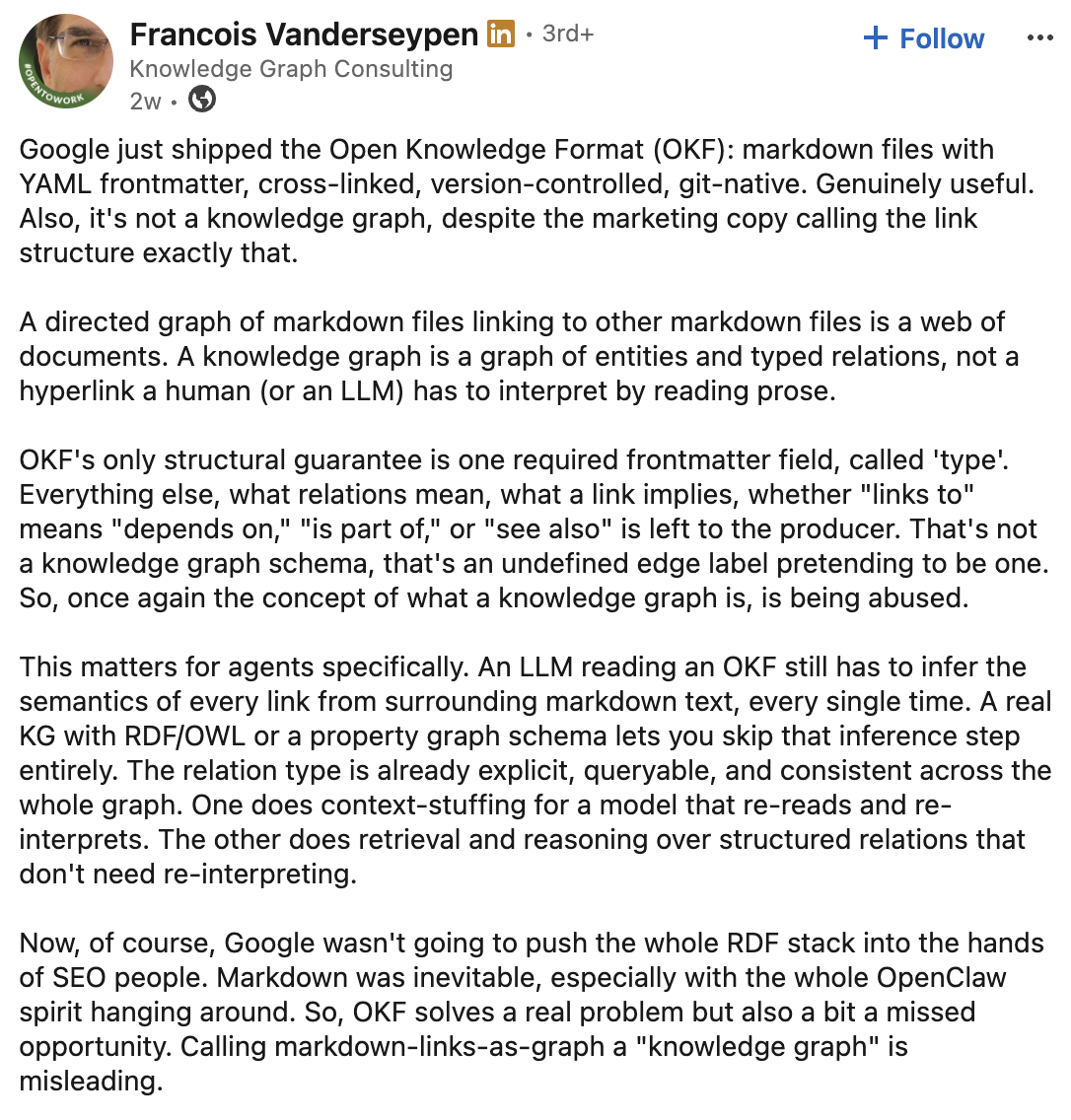
Francois Vanderseypen makes the most precise point about what OKF actually is and isn’t: a directed graph of markdown files is a web of documents, not a knowledge graph (at least not in its purest sense). A real KG has explicit, queryable, typed relations. OKF leaves what a link implies entirely up to the producer, and an LLM still has to infer the semantics every single time it reads it.
Screenshot from LinkedIn, July 2026
For me, this points to the crux of how I understand the web and what we do as SEOs. OKF doesn’t change the stack. It adds one more input into it.
It’s not a shortcut. There are no shortcuts.
The Schema.org Parallel, And Why It Matters
One of the patterns to understand here is the one Schema.org already went through.
Structured data followed a predictable arc:
Adoption – ranking boost – widespread use (and gaming) – platform learning – reduced dependency as a ranking signal.
FAQ schema had a moment in SERPs, then Google discontinued the FAQ rich result. The platforms learn from the signals, fold the lessons into the algorithm, and the explicit markup becomes less necessary.
OKF and LLMs.txt may follow the same path. They’re most valuable early, as clear signals in a world where AI systems are still learning to parse the web.
Over time, if the formats work, the systems learn. Explicit markup becomes redundant or remains a verification layer. For example, in ecommerce, in particular, schema and feed alignment has become more and more important. Another notch in the call for co-ownership of the product feed between SEO and paid teams!
There’s also a subtler point worth making here about the relationship between schema.org and discovery. Jarno van Driel’s deep dive on product variants in Search Engine Journal illustrates this well: For years, Google Search and Google Merchant Center had conflicting structured data requirements, forcing publishers to duplicate markup. Schema.org evolves to close gaps, but it’s slow, it’s complex, and implementation is still often a mess.
Structured data has never been a plug-and-play ranking lever. OKF won’t be either.
Should You Convert Your Site To Markdown?
It’s a big fat no from me. That doesn’t mean I won’t test it and apply carefully!
“When it comes to things like a search engine or probably also in generic LLM system, having a website that uses normal HTML for the pages is critical. Because a search engine or crawler can just go to that page. It can recognise all of the other links that are within the website.”
The structural information in HTML – nav links, footers, header hierarchies, internal links – is how crawlers understand your site’s shape. Markdown files strip all of that out. You’d be breaking discovery in order to marginally improve machine readability of individual pages.
Recently, on LinkedIn, I even saw a piece of research showing how “Your navigation might be eating your LLM (it’s ChatGPT Deep Research in fact) reading budget.” Interesting findings, but please don’t remove your navigation to “save some tokens”!
Screenshot from LinkedIn, July 2026
Jono Alderson makes this point brilliantly: “A page is not just a container for words. It’s an editorial artifact.” Hierarchy, emphasis, placement, what comes first, what’s prominent, what’s tucked in a footnote … these aren’t pretty decorations for humans. “They are signals about meaning.”
“When you flatten a page into markdown, you don’t just remove clutter. You remove judgment, and you remove context.” And the moment you publish a machine-only representation, you’ve created a second candidate version of reality.
The boring fix still works: Semantic HTML, clear structure, sensible hierarchy, content that exists when the page loads.
John Mueller covers the markdown debate extensively in the podcast: The parallel versions problem, the dynamic rendering lessons we already learned the hard way, and why maintaining a shadow version of your site for AI doubles your maintenance burden and creates a debugging nightmare nobody will tell you about.
The one exception Mueller carves out is developer documentation:
“If you have something like developer documentation, where, again, if the agent or the LLM system already knows about your website and the user says, how do I usethis API? Then if you give the LLM system a Markdown file, it’s a lot easier for it to understand.”
Now, I can definitely see a straightforward use case there.
What ARD Is Actually Doing
The Agentic Resource Discovery specification, announced by Google on June 17, 2026, is a different beast entirely. It arrived only a couple of days behind OKF, not a coincidence, and is already making huge waves.
The problem ARD solves is a coordination one. Right now, an agent has to be wired to each tool, MCP server, or API it uses before it can do anything with it.
That works when you’re connecting a handful of known services. It stops scaling the moment the number of available capabilities grows beyond what any team can pre-configure by hand.
ARD moves that discovery out of setup and into runtime. The agent finds what it needs when it needs it, rather than only knowing what it was told about in advance.
It’s built on two primitives:
Catalogs: An ai-catalog.json file hosted on your domain, describing your available capabilities (MCP servers, A2A agents, OpenAPI tools). Ownership of the domain acts as the cryptographic foundation for identity and trust.
Registries: Search engines for the agentic web. They crawl catalogs, index them, and return matching capabilities with the metadata needed to verify the publisher before connecting.
If OKF is about packaging knowledge for consumption, ARD is about advertising capabilities for connection.
These are parallel efforts at different layers of the emerging agentic stack. Both shipped within inches of each other and now adopted with the speed of light by some very big players in the game, i.e., Hugging Face and their Discover Tool.
It’s possibly a more pragmatic bet than the formal logic layer that came before it and never reached web scale. Time will tell.
A Gap Worth Watching
Within days of both specs shipping, a contributor opened companion issues on the ARD and OKF repos pointing out something basic was missing: There’s no agreed media type for an OKF bundle, so a catalog can list one but can’t actually recognize it as OKF without sniffing the contents.
In the meantime, publishers are already advertising bundles in production using their own interim types, which, as the issue itself notes, won’t agree with each other.
On the face of it, this looks like a small ask, just a request for a shared label.
After a bit of a dive into this particular rabbit hole, it turns out that’s quite normal practice. Waiting for full agreement before anyone ships anything is exactly how a spec dies in committee, and shipping fast and patching as real adoption surfaces is an age-old strategy.
Application/json itself wasn’t formally registered until 2006, roughly five years after JSON was already in wide, informal use. Nobody worried about that, because the cost of the label being unsettled was low: A parser might reject something or fall back ungracefully.
But OKF is different, because what happens after the fetch is different. The artifact behind the label is a bundle an autonomous agent is meant to ingest, verify, and potentially act on, inside a discovery system built specifically for agent-to-agent and agent-to-tool connection. Get the type wrong here, or leave an agent to infer it, and the risk isn’t a parse error; it’s a system acting on something it shouldn’t have trusted, with no one checking the result first.
I wonder about the risk involved in settling this later rather than sooner in this case. I guess it depends on how fast it gets resolved relative to how fast adoption runs ahead of it.
What This Means If You’re An SEO
A few honest conclusions and my current thinking:
For most marketing and content sites, not much has changed. HTML, well-structured for humans, is still the right foundation. A contact-us form and a clean site architecture will serve you better than any OKF bundle ever will. Discovery still depends on links, authority, user signals … and indexing.
LLMs.txt is a signpost, not an SEO tool. It’s useful for helping an agent navigate within your site once it’s already there. It very likely doesn’t make a big difference in how agents find you in the first place. And, probably never will.
MCP/WebMCP. Neither is urgent for most marketing sites today, but if you’re building anything with programmatic interfaces or ecommerce flows you want agents to navigate, this is the direction the infrastructure is heading.
OKF makes a lot of sense if you’re sitting on structured internal knowledge, i.e., documentation, API references, product specs … and you want to make it easier for agents to consume. The free OKF generator Suganthan built will produce a bundle and give you a graph view of your internal link structure as a side benefit. The structural audit alone seems worth it. But I will be running it on my website first, not on my client’s website.
ARD is worth watching if you’re building services with programmatic interfaces. If you have tools, agents, or APIs you want discoverable by other agents, ARD is the emerging standard for how that gets done. Just know the identity layer underneath it, what an agent is actually looking at when it finds your catalog entry, is still being settled in real time, so I’d treat this as infrastructure to watch closely rather than build critical paths on just yet.
The schema adoption cycle might repeat. These formats are most valuable now, as early signals. Implement them if you can do it cheaply. Don’t build your strategy around them holding value forever and don’t bank on them as a silver bullet.
Ultimately, be aware of the shiny things – if your company has bigger fish to fry, i.e., a terrible website, a brand no one knows or cares for, an audience you don’t understand … then deal with this first before you get caught up in any of these new shiny things.
The Underlying Shift
What all of this points to is a web that’s genuinely growing a second layer or a third head, one written for machines alongside the one written for browsers and humans.
Sitemap.xml told crawlers which URLs existed. Robots.txt told them where not to go. LLMs.txt, OKF, and ARD are similar infrastructure for agentic systems: navigation hints, content packaging, and capability discovery.
None of it is mandatory today. None of it replaces solid HTML, authoritative content, sensible structure, or the thing that actually sits underneath all of it: a brand worth finding.
But the SEOs who understand what each layer actually does, rather than treating it as a single undifferentiated “AI SEO” category, will make better bets on where to spend their time.
My money is on the second layer, a parallel infrastructure written for machines, not a replacement for what already exists.
The third head scenario, where agentic systems fully diverge from the human web, would require a different set of bets than any of us are currently making.
Big thanks to Jarno van Driel, Jono Alderson, Chris Green, Suganthan Mohanadasan, Kristine Schachinger, Gianluca Fiorelli, Victor Pan, Renee Bigelow (and anyone else I’ve missed) for some brilliant discussions on this topic over the last few weeks.
Search And Agents Are One Product. You Only Need One Playbook via @sejournal, @slobodanmanic
Google Search is becoming an agent manager. Sundar Pichai said it plainly across two interviews this spring:
“A lot of what are information-seeking queries will be agentic in Search. You’ll be completing tasks. You’ll have many threads running.”
One week later, at Google Marketing Live 2026, Nick Fox, the SVP who oversees Search, Ads, and Commerce, said the corollary:
“The way to optimize for AI search is the same way to optimize for search. Create great content.”
When the CEO describes a product direction and the SVP confirms the optimization path, treating search and agents as two separate disciplines means running two playbooks for one product.
That surface is already live. AI Mode is in the Chrome address bar. Search agentsrun in the background on queries too long for a single click. Chrome auto-browse fills forms and completes bookings on behalf of users with OS-level permissions. These are not separate products with separate optimization playbooks. They all inherit the same web.
What Pichai Actually Said
Pichai gave two interviews this spring that together draw the clearest picture of where Google Search is headed. On the Cheeky Pint podcast in April 2026, he described the trajectory: “If I fast-forward, a lot of what are just information-seeking queries will be agentic in Search. You’ll be completing tasks. You’ll have many threads running.” He called it “Search as an agent manager” and framed it as already happening in AI Mode, where users run deep research queries that do not fit the classical keyword model.
Then, on Decoder with Nilay Patel after I/O 2026, he did something more revealing. Patel showed him a live AI Overview result on his phone for “best Chromebook.” Pichai looked at it and said: “It’s probably more opinionated than it should be for the particular query you showed me.”
That admission matters more than the convergence statement. He is not pretending the product is finished. He called it scope for improvement in a fast-evolving space. In the same interview, he also said Google is committed to sending traffic to the web: “Everything we do across all, you will see us five years from now sending a lot of traffic out to the web. I think that’s the product direction we are committed to.”
Both claims sit next to each other in the same interviews. The product direction is convergence: search queries become agentic, tasks get completed inside Search, agents browse on behalf of users. The promise is continuity: traffic will still flow to websites. Hold both in your head at the same time, because that gap between the direction and the promise is where your risk lives.
Nick Fox Said The Same Thing From A Different Angle
At Google Marketing Live 2026, Nick Fox sat down with Semafor’s Ben Smith and addressed the optimization question directly. Fox is Google’s SVP of Knowledge and Information, the person who oversees Search, Ads, and Commerce. His statement: “The way to optimize for AI search is the same way to optimize for search. Create great content.”
He added one qualifier: “Go beyond the surface level.” His reasoning is that AI handles first-level responses, so the content that performs in AI search is content that goes deeper than the summary the model already produces. “If you’re looking to buy something, you don’t want to hear what the AI says. You want to hear someone that’s used it.” This is the commodity-vs-non-commodity content distinction Google has been circling for a while now: if the AI can produce the answer itself, your content needs to offer something the AI cannot.
This is also what No Hacks guest Jono Alderson has been saying for over a year. The content that AI ignores is the content that restates what the model already knows. The content that gets cited is the content that carries something the model has to retrieve because it cannot generate it: original data, first-person experience, named-entity specificity, a take the model is not confident enough to produce on its own.
When the CEO says the products are merging and the SVP says the optimization is the same, the implication lands: one strategy, not two. The separate “AEO strategy” or “GEO strategy” that consultants have been selling as a new discipline collapses when the vendor itself says it is one playbook. The r/TechSEO community arrived at the same conclusion this week when Google published its official AI optimization guide: “It’s basically just. SEO.”
What This Means For The Website You Are Building
The website that works for classical search is the same website that works for agents. Server-rendered HTML so the content is visible without JavaScript hydration. A study I published this week measured 274 fintech companies and found 36% are partially invisible to AI crawlers because they depend on JavaScript to render core content. 17% deliver zero content without JS execution. The fix is not complicated. 99% of those same websites deliver full content once rendered. The gap is the default: raw HTML first, not JS-rendered-eventually. Semantic markup so the agent knows what each element is. Structured data so the identity is machine-readable. Fast delivery so neither the crawler nor the agent times out. Internal linking so both the index and the agent can navigate the full surface.
The companies that treated agent-readiness and search optimization as the same discipline were accurate. They were not early. The vendor confirmed what the practice already showed: the audit is the same audit applied to a visitor class that now includes both humans on Google Search and agents in AI Mode. Build for one playbook: machine-readable identity, extractable content, discoverable actions, server-rendered and semantic and structured and fast and well-linked. That description fits classical search and the agentic web and the product Pichai is describing, which is both at once.
Pichai admitted the product is not finished. “More opinionated than it should be” is a refreshingly honest read of a product in motion. The gap between where AI Overviews are today and where search-as-agent-manager is going is your window. The direction is set. Build for one playbook now, and you are building for the product Google is becoming.