Build trust and boost profits with programmatic ads by Cynthia Ramsaran

5 tips for a successful programmatic ad campaign

When it comes to programmatic advertising, consent isn’t just a requirement; it’s the key to unprecedented revenue potential. Programmatic advertising thrives on precision and relevance, but how can you achieve these without compromising user trust or regulatory compliance?

Register and attend this digital advertising webinar to stay ahead, mastering consent-driven ad strategies so you can build trust and boost profits: “Why Consent and Compliance Matter With Programmatic Ads,” presented by OneTrust.


Click here to view more Search Engine Land webinars.


Related stories

New on Search Engine Land

@media screen and (min-width: 800px) { #div-gpt-ad-3191538-7 { display: flex !important; justify-content: center !important; align-items: center !important; min-width:770px; min-height:260px; } } @media screen and (min-width: 1279px) { #div-gpt-ad-3191538-7 { display: flex !important; justify-content: center !important; align-items: center !important; min-width:800px!important; min-height:440px!important; } }

About the author

Cynthia Ramsaran

Cynthia Ramsaran is director of custom content at Third Door Media, publishers of Search Engine Land and MarTech. A multi-channel storyteller with over two decades of editorial/content marketing experience, Cynthia’s expertise spans the marketing, technology, finance, manufacturing and gaming industries. She was a writer/producer for CNBC.com and produced thought leadership for KPMG. Cynthia hails from Queens, NY and earned her Bachelor’s and MBA from St. John’s University.

https://searchengineland.com/build-trust-and-boost-profits-with-programmatic-ads-433833


Google Search is having issues serving search results to some searchers

Google is currently having an issue serving or showing search results to some searchers. You may see error pages when you search on Google.com, keep in mind, Google is aware of the issue and working on a fix.

What Google said. Google posted on its search status dashboard at 11:01 am ET saying, “There’s an ongoing issue with serving search results. Users may see an error page when doing a search. We’re working on fixing the issue. Next update will be within 12 hours.”

What is next. Expect Google to work to fix this issue quickly because if Google is unable to fully serve search results, that can impact their ad revenue in a big way. Google Search is one of the most used features on the internet.

I personally am not seeing any serving issues with Google Search, but I suspect some users are.

Why we care. If you notice a drop in traffic from Google Search to your sites today, this may be one reason why there was a decline. Google is working on fixing the issue and it should be resolved soon.

Now fixed. Less than an hour later, Google said the serving issue was fix. “We fixed the issue with serving search results. There will be no more updates,” Google posted at 11:51 am ET.

The post Google Search is having issues serving search results to some searchers appeared first on Search Engine Land.

https://searchengineland.com/google-search-is-having-issues-serving-search-results-to-some-searchers-433817


Google adds search themes to Performance Max

Google today is adding search themes – a new, optional signal – to Performance Max.

Search themes are a new way for advertisers to provide information about a business (e.g., what topics lead to conversions) or customers (e.g., search queries your customers are likely to use) to help improve performance.

As Google explained:

  • “When you add search themes, you’re telling Google AI you want to reach that traffic in your Performance Max campaign across all Google Ads inventory, including Search, YouTube, Gmail, Discover, Maps, and Display. Search themes also help you find audiences across channels based on users’ search behavior.”

Google also emphasized that for Search inventory, “exact match keywords that are identical to the search queries will continue to be prioritized over search themes and other keywords.”

Filling in knowledge “gaps.” With search themes, Performance Max can go beyond using assets, feeds and landing pages to predict campaign-level performance. Google provided five examples of where it makes sense for advertisers to use search themes:

  • Your landing page doesn’t have complete details or the latest updates about the products and services you offer.
  • You’ve just expanded into a new market or launched a new product or service where your campaigns don’t have extensive performance history.
  • You are launching a new promotion or sale for the holiday season where you don’t have extensive performance history. 
  • You want to expand your reach within Performance Max—including on Search inventory in Performance Max—and ensure you have comprehensive coverage on important business themes.
  • You want to provide important information to help your campaign ramp up and optimize performance faster.

How it works. According to Google:

  • You can add 25 unique search themes per asset group (e.g., “car” and “automobile” would be the same audience).
  • Search themes will respect brand exclusions in Performance Max and account-level negative keywords.
  • Results driven from search themes will bring your customers to the landing pages you’ve indicated via your Final URL expansion, page feeds, and URL contains settings.
  • Search themes will have the same prioritization as your phrase match and broad match keywords in your Search campaigns.
  • You’ll be able to see the search categories that your ads matched to in your search terms insights at both the campaign and account levels, and associated conversion performance. You can now view search term insights for custom date ranges, download your data, and access it via the API.

New help doc. You can find instructions from Google on how to add search themes to campaigns, as well as FAQs, here.


Related stories

New on Search Engine Land

@media screen and (min-width: 800px) { #div-gpt-ad-3191538-7 { display: flex !important; justify-content: center !important; align-items: center !important; min-width:770px; min-height:260px; } } @media screen and (min-width: 1279px) { #div-gpt-ad-3191538-7 { display: flex !important; justify-content: center !important; align-items: center !important; min-width:800px!important; min-height:440px!important; } }

About the author

Danny Goodwin

Danny Goodwin has been Managing Editor of Search Engine Land & Search Marketing Expo – SMX since 2022. He joined Search Engine Land in 2022 as Senior Editor. In addition to reporting on the latest search marketing news, he manages Search Engine Land’s SME (Subject Matter Expert) program. He also helps program U.S. SMX events. Goodwin has been editing and writing about the latest developments and trends in search and digital marketing since 2007. He previously was Executive Editor of Search Engine Journal (from 2017 to 2022), managing editor of Momentology (from 2014-2016) and editor of Search Engine Watch (from 2007 to 2014). He has spoken at many major search conferences and virtual events, and has been sourced for his expertise by a wide range of publications and podcasts.

https://searchengineland.com/google-search-themes-performance-max-433776


Google Maps new search results makes photos significantly more important

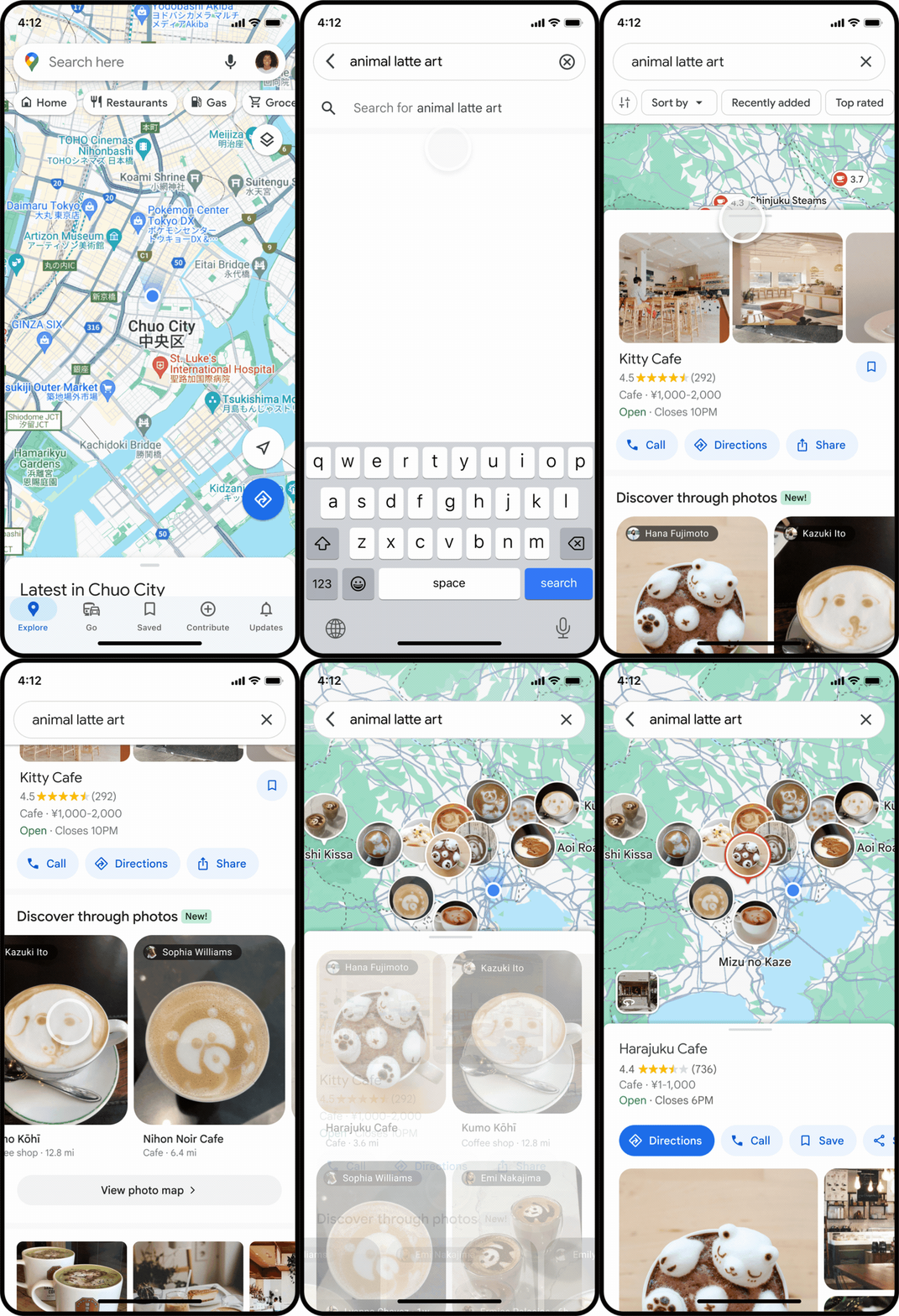
Google is launching a new Google Maps search results interface that brings to focus the photos that are associated with Google Business Profile listings. Google is calling this a “photo-first” search result listing interface that is going live this week in France, Germany, Japan, the U.K. and the U.S..

What it looks like. You can see from the GIF below that the search results in the Google Maps listings show photos above the other parts of the listing, like the company name, star reviews, address, phone number and more details. Photos here are coming first.

Here is that GIF:

Google Maps Photos First

Why photo-first. Google said when it comes to some local searches, searchers want to see photos of the food, the attractions, the venue and more. Google wrote, “you’ll soon see better-organized search results to spark your imagination.”

“Thematic results for activities and dining roll out globally on Android and iOS in the coming weeks,” Google added.

Which photos are selected. Google said it picks the photos using AI, so algorithms decide which photos to choose. “These results are based on the analysis of billions of photos shared by the Google Maps community — all done with AI and advanced image recognition models,” Google wrote.

Why we care. As business owners, you should be more conscious of which photos are showing up in your local maps listings. You can upload your own using Google Business Profiles and you may want to encourage customers to upload positive photos, if possible, when they review your business within Google Maps and Local.


Related stories

New on Search Engine Land

@media screen and (min-width: 800px) { #div-gpt-ad-3191538-7 { display: flex !important; justify-content: center !important; align-items: center !important; min-width:770px; min-height:260px; } } @media screen and (min-width: 1279px) { #div-gpt-ad-3191538-7 { display: flex !important; justify-content: center !important; align-items: center !important; min-width:800px!important; min-height:440px!important; } }

About the author

Barry Schwartz

Barry Schwartz is a Contributing Editor to Search Engine Land and a member of the programming team for SMX events. He owns RustyBrick, a NY based web consulting firm. He also runs Search Engine Roundtable, a popular search blog on very advanced SEM topics. Barry can be followed on Twitter here.

https://searchengineland.com/google-maps-new-search-results-makes-photos-significantly-more-important-433811


Reassessing the role of links in SEO: What data tells us

The debate over the significance of links has been a recurring theme in SEO.

Recently, Google’s Gary Illyes has once again ignited discussions around the topic when he said that “people overestimate the importance of links,” and it hasn’t been in the top three ranking factors for some time. 

Such statements from Google have been made in the past, prompting SEO professionals and businesses to reconsider their strategies. 

This got me thinking about how essential links really are today. What would the data show? 

To find out, I analyzed 100 random keywords spanning various categories, collecting data on the top 100 ranking websites, including referring domains and backlinks. This comprehensive dataset consisted of over 10,000 rows of URL ranking data. 

It’s important to note that correlation does not imply causation, especially considering Google’s stance on the ever-evolving nature of ranking factors. However, digging into the data can give us a sense of where links are more important as a category. 

Data analysis and key findings

Considering Illyes’s comment, I initially expected we would find a moderate link between backlinks and rankings, but nothing that suggested this was the key to improving rankings.

Probably for the first time in a while, the data aligned with this hypothesis. 

To conduct this analysis, I divided the 100 keywords into specific categories: Electronics, Health and Beauty, Entertainment, and more.

In correlation analysis, a higher value indicates a stronger relationship between the two variables, while a value closer to zero signifies a weaker relationship. 

In the context of our analysis, where the goal is to achieve the top rank, an ideal score is -1. This means that as the number of backlinks increases, the ranking “decreases” or moves closer to the number one position.

Here are the takeaways from the data:

  • No keyword grouping or individual keyword was greater than -0.4. This means no data set was super highly correlated.
  • There were keywords and groups that, when the number of links increased, rankings actually decreased (these would be positive correlations given the rank numbers get higher). However, again, nothing was greater than 0.4. 
  • The highest correlation groupings were Outdoor and Sports and Health and Wellness. 
  • The groupings where links drove a decrease in rank were Home and Kitchen and Ecommerce and Online Services.
Image 36
  • At a keyword level, “fisherman beanie” and “oat milk” showed the greatest correlation, while “MLB fitted hats” and “acrylic nails” were the lowest. (The graph below that shows the keyword level only graphs the top and bottom five.)
Image 37

Get the daily newsletter search marketers rely on.


Knowing that the correlation coefficient aligns with Google’s point, what should we do with this information? How should we alter or think about your own brand’s link profile? 

Here are three takeaways and recommendations from this data set for your SEO strategy.

While Google emphasizes that links aren’t as powerful a ranking factor as in past years, they remain a valuable signal. 

Consider them an indicator of user and website endorsement for your content and products. If a specific blog post or product garners a substantial increase in links, it signals user appreciation. 

Redirect your efforts accordingly – create more content or products in that area or intensify your promotion. 

These links provide essential intent-based data for optimizing your time, even if it doesn’t always translate into higher rankings.

2. You should always be evaluating your competition and specific data sets

With over 10,000 data points, our dataset holds significance, but it’s not tailored to your brand or industry. Use this article as a guide to analyzing your own data for insights. 

Examining your top 100 keywords will clarify your competitive landscape, enabling more focused strategy development. 

If other brands in your space have significantly more links, it signals a challenge, but remember, links aren’t the sole driver of rankings. Instead of feeling overwhelmed, use this data to inform and refine your strategy.

3. The fundamentals have been, and will always be, the North Star for organic search 

SEO’s original objective is to boost brand rankings, a goal that remains relevant today.

However, the emphasis has shifted toward delivering a great user experience, evident in Google’s E-E-A-T framework: Experience, Expertise, Authoritativeness and Trustworthiness.

E-E-A-T underscores the significance of user experience and values. They don’t advocate link acquisition as the primary strategy but instead highlight the importance of building a website that enhances the value of your goods or services for end-users.

This user-centric approach should be your guiding light.

I found this dataset interesting as it spans various industries and consistently suggests that while links matter, they are not the sole determinant.

I’ll closely monitor how the data evolves with large language models incorporating more links, which could reshape link values and website visibility. 

It’s an exciting time for search, marked by innovation, and data will be our compass to gauge the changing landscape. I’m eager to see how links continue to influence rankings in this next phase.


Opinions expressed in this article are those of the guest author and not necessarily Search Engine Land. Staff authors are listed here.


Related stories

New on Search Engine Land

@media screen and (min-width: 800px) { #div-gpt-ad-3191538-7 { display: flex !important; justify-content: center !important; align-items: center !important; min-width:770px; min-height:260px; } } @media screen and (min-width: 1279px) { #div-gpt-ad-3191538-7 { display: flex !important; justify-content: center !important; align-items: center !important; min-width:800px!important; min-height:440px!important; } }

About the author

Jason Tabeling

Jason Tabeling is the CEO of Airtank and is an accomplished marketing executive and proven leader with over 20 years of experience growing strong and profitable teams, working for and with Fortune 500 companies in a variety of industries.
Prior to AirTank, Jason served as Executive Vice President of Product for BrandMuscle, an enterprise software and services company focused on Fortune 1,000 brands, where he led product innovation and strategy. He earned the company a Leadership Ranking in the Forrester 2020 Through-Channel Marketing Automation Wave. He also spent 16 years working with Rosetta, Razorfish and Progressive Insurance, leading Paid, Earned and Owned media teams across health care, financial services and retail verticals. He was named a “40 under 40” by Direct Marketing News, has been a judge for the AMA Reggie Awards, and has been published in Forbes and many other publications as a subject matter expert.

https://searchengineland.com/links-seo-role-data-433761


How to use DIY content to boost your visibility and leads

From home services to SEO and everything in between, do-it-yourself (DIY) content is one of the best ways businesses can engage with their audience online. 

You’re probably wondering, “How will showing potential customers how to do my work going to help grow my business?” 

DIY content has always been popular, but the continued rise in popularity of social media video sites like YouTube and TikTok makes do-it-yourself tutorials and content more accessible than ever.

Sharing DIY content offers a variety of benefits to businesses, from improving E-E-A-T to increasing online visibility and even generating leads. 

The benefits of using DIY content

Here are a few of the critical ways DIY content can help you boost business, both online and in the real world.

Establishing authority and expertise

Creating and sharing DIY content related to your industry demonstrates your knowledge and expertise in your field. 

It positions your business as a trusted authority, which can help you gain visibility online and attract potential customers seeking solutions or insights.

Building trust and credibility

DIY content helps display transparency and a willingness to help your audience solve their problems, even when you won’t directly profit from the solutions. 

This, in turn, builds trust and credibility with your audience, making them more likely to choose your services when they need professional assistance.

Engaging your audience

DIY content tends to be relatable and easy to engage with and keeps your brand top of mind. 

By offering valuable tips, guides, or tutorials, you can keep your audience engaged and encourage them to interact with your brand. 

This engagement can lead to a more profound connection with potential customers, industry peers, and potential business partners. Everybody wins!

Educating your audience

Sharing DIY content can educate your audience about the problems your services solve. This education can help potential customers understand the value of your services and why they might need them – now or in the future.

Enhancing reach and visibility

DIY content is often shared and re-shared on social media and other online platforms.

This sharing can expand your reach to a broader audience, potentially introducing your service business to people who might not have encountered it otherwise.

The more your content is shared, the higher the platforms and search engines will rank your content, continuing to increase your reach and visibility.

Generating leads

Yes, DIY content can serve as a lead magnet. 

By offering valuable resources, information, or tools, you can encourage visitors to provide their contact information in exchange for access to exclusive content or offers. 

This helps you build a database of potential leads for your services. 

Even if you’re not collecting personal information, being helpful to someone now can pay off big in the future. 

That quick tutorial an electrician shares on how to switch out a light switch may turn into a panel replacement job or a rewiring project when the customer they helped is ready to move forward with a bigger project. 

Who do you think they’re going to call?

Marketing your business cost-effectively 

While people are generally intimidated by putting content out, especially video content, you don’t need much to get started. 

Audiences don’t care about production value when they’re looking for help on how to snake a drain. They want quick, easy, direct direction on what to do. 

Because of this, DIY content is generally cost-effective to produce, especially compared to the high costs of other types of marketing materials. 

It can be an excellent way to maintain a consistent online presence without a significant financial investment.

Improving SEO and online presence

Creating DIY content that is optimized for search engines can help improve your visibility in a variety of ways. Image and video content ranks well, especially for how-to searches. 

Combined with a well-optimized website, this can make owning the SERPs for industry terms an easy way to increase your online presence in a variety of places, which further increases trust and authority signals for your audience.

Gathering feedback and intel

DIY content can provide invaluable insights into what your audience is interested in and the problems they’re looking to solve. 

By analyzing the engagement and feedback on your DIY content, you can adapt your services and marketing strategies to meet your customers’ needs better. 

Establishing E-E-A-T with DIY content

E-E-A-T – or experience, expertise, authoritativeness, and trustworthiness – are critical elements in how a follower or customer determines if your content is trustworthy and reliable and how Google determines the quality of individual websites and search results as a whole. 

In the past few years especially, Google has increased the importance of E-E-A-T in a continued effort to ensure their search results are as reliable and helpful as possible.

What better way to share your experience and expertise than in a how-to video? 

Providing reliable, accurate information to your audience will also increase your authority in your field with your audience, which leads to increased trust. 

Your audience gets helpful information, you get a loyal audience, Google sees your value, and your audience continues to grow – everybody wins.

Dig deeper: How to create local content that builds trust and drives sales


Get the daily newsletter search marketers rely on.


Ideas for using DIY content to grow your business

There are DIY content opportunities for every business. 

Helping your audience (and future customers) learn how to do simpler aspects of the services your business provides lets them – and your business – save time and money. 

We know tradespeople tend to be incredibly busy. Instead of charging someone a trip fee for a five-minute fix, why not shoot them a link to a quick video to troubleshoot the issue themselves? 

You can help with a quick fix and have availability to send your team out on larger jobs. 

Not sure what the client needs help with? Send them a video that walks them through diagnosing a problem. 

Then you’ll know what supplies to bring when they hire you to do the repair job. 

Here are a few content ideas for a variety of industries that will help your audience without taking work away from your team:

Electrician

There are various opportunities for simple tasks that are incredibly helpful to homeowners, like:

  • How to swap an outlet or light switch.
  • How not to connect extension cords in the garage.
  • How to install a ceiling fan.
  • Any of the other small requests you get that people balk at paying for. 

Medical

While you have to be very careful with medical advice, there are many safe topics you can share information for that are incredibly helpful, such as: 

  • How to best take a sick child’s temperature.
  • How to identify a rash.
  • Knowing when it’s time to go to the emergency room.
  • Basic first aid skills.

These topics are very helpful and often needed quickly when someone is searching for assistance.

Plumber

Do you really want to go plunge someone’s toilet or unclog their sink at 9 p.m. on Christmas Eve? 

Help them and yourself by offering some quick tips on how to resolve these problems. 

Create a video on:

  • Resetting a garbage disposal.
  • How to retrieve an earring that was dropped down a sink.
  • How to manually drain a washing machine. 

While these are no-brainers to a pro, they are issues that homeowners need help with often.

Salon

No, I’m not recommending you teach someone how to craft the perfect style at home. Instead:

  • Help a tired mom trim her kiddo’s bangs.
  • Show people how to choose the perfect product for their needs.
  • Share styling tips for anything from easy updos to everyday looks.

These are great ways to gain followers while earning the trust of your audience.

Local SEO

Even SEOs can grow their audience with helpful tips. Show business owners or fellow SEOs: 

We’ve spent the better part of the year working on this at our agency, and the benefits have been clear – from audience growth to website traffic to actual leads.

Attorney

People are constantly searching for help with:

  • Arguing traffic tickets.
  • How to know if they have a personal injury case.
  • Knowing if they need a lawyer for their custody meeting. 

Give them helpful tips and explain when they can handle something themselves vs when it’s time to consult with an attorney. 

They’re far more likely to retain you if they trust you to tell them when they do and don’t need your help.

Travel agent

Reduce the number of last-minute calls and emails you get by creating a content library of helpful information that covers:

  • When to get a passport.
  • How to get a last-minute passport.
  • How to pack.
    What to bring vs. what you can buy when you get there.
  • Anything else you’ve learned along the way to simplify travel and make vacations more enjoyable.

Police department

As with the private sector, connecting with the local community is a great way for local government agencies to build positive relationships and earn trust. 

Keep content light and entertaining when possible, sharing helpful information about your community, when to call for help, or even team up with other local agencies to share who to call for different issues. 

Use DIY content to improve service offerings

Take a look at your most popular content and common search phrases to see where gaps are in your service offerings. 

  • Is there something that people need help with that you can provide? 
  • Is there something you get tons of calls for that is a waste of time to offer as a service? 
  • Can you create a video tutorial to share or send out to free up your phones? 

Listen to your customers, they’re telling you what they need help with. If you don’t offer that assistance, someone else will.

Creating great DIY content: Final tips

It is a lot of work to create content in addition to running a business. Don’t waste time creating content that isn’t going to work for you. Encourage community discussions to further increase the value of your DIY content. 

Whether it’s a blog post, a video, or a social media post, encourage people to share their thoughts and experiences in the comments. This will increase your engagement and increase the value of your channel for your users. 

Be sure to let people know ahead of time if they’ll need special parts or tools for a project. Also, remind people within your content that they can reach out to you at any time for assistance. 

It isn’t uncommon for people to start a DIY project and quickly realize they’re in over their heads. Who better to be right there to help step in and take on the project than you?

Remember, when creating videos, you don’t need special equipment or production. People want helpful information. They do not care if you’re in your office, a studio, or a basement if you give them the information they need. 

That said, try to match your setting to the project being discussed. It makes a lot more sense for a plumber to film in a bathroom than an attorney. Don’t be afraid to show your audience your unique personality, but be aware of what may be off-putting or offensive. It is far easier to earn trust and prove experience when you have the respect of your audience.

Bonus points if you modify content for multiple channels. For example, share a YouTube Shorts that links to a long-form video and publish a complementary blog post explaining your topic in more detail or linking to additional resources. 

Embed your video into your blog post, link to your blog post from your social media channels, and connect content wherever relevant.

Dig deeper: How to survive and thrive in a Google helpful content world


Opinions expressed in this article are those of the guest author and not necessarily Search Engine Land. Staff authors are listed here.


Related stories

New on Search Engine Land

@media screen and (min-width: 800px) { #div-gpt-ad-3191538-7 { display: flex !important; justify-content: center !important; align-items: center !important; min-width:770px; min-height:260px; } } @media screen and (min-width: 1279px) { #div-gpt-ad-3191538-7 { display: flex !important; justify-content: center !important; align-items: center !important; min-width:800px!important; min-height:440px!important; } }

About the author

Erin Jones

Erin Jones has been working in digital marketing and SEO since 2005. She specializes in local SEO, social media, and brand reputation. She works at Sterling Sky and is also a Local University faculty member. Erin is passionate about community and loves helping brands connect with their ideal audiences both online and in person.

https://searchengineland.com/diy-content-boost-visibility-leads-433748


Google rolls out about this image and more SGE links

Google is now rolling out the about this image feature that it announced back in May and is also adding new links to the SGE AI powered answers, the company announced.

Google said it is now adding to the Search Generative Experience‘s AI-generated AI answers
“descriptions of some sources, supported by information on high-quality sites that talk about that website.” Google added new links to these sites in the AI-generated description of the source.

It does look and feel familiar to the links we saw earlier but these are different. Google said “These AI-generated descriptions of the source will show up in the “more about this page” section of About this result for some sources where there isn’t an existing overview from Wikipedia or the Google Knowledge Graph.”

“At this stage, we’re starting small in exploring how this technology can be useful to support and supplement our existing information literacy efforts,” Google added.

Glenn Gabe seems to have spotted these and posted some screenshots on X:

Sge Links

About this image

Google is now rolling out the about this image feature in Google Search. Google said, “today, this feature is rolling out to English language users globally in Google Search.” The about this image feature tells you more about the image, specifically:

  • History of an image: About this image shows you when an image or similar images may have first been seen by Google Search, and whether it was previously published much earlier on other webpages. “This can be helpful if an image is being taken out of context and shared in relation to a current event, but it’s actually much older,” Google explained.
  • How sites describe and use your image: You can see how an image is used on other pages, and what other sources, like news and fact checking sites, have to say about it. “This information can be helpful to assess the claims being made about an image, and to see evidence and perspectives from other sources,” Google added.
  • Image metadata including AI: This feature will also show you metadata, if it is available, that image creators and publishers have added to an image, including fields that may indicate that it has been generated or enhanced by AI. “All Google AI-generated images will have this markup in the original file,” Google added.
Crooked House Walkthrough Pixel


Related stories

New on Search Engine Land

@media screen and (min-width: 800px) { #div-gpt-ad-3191538-7 { display: flex !important; justify-content: center !important; align-items: center !important; min-width:770px; min-height:260px; } } @media screen and (min-width: 1279px) { #div-gpt-ad-3191538-7 { display: flex !important; justify-content: center !important; align-items: center !important; min-width:800px!important; min-height:440px!important; } }
About the author

Barry Schwartz

Barry Schwartz is a Contributing Editor to Search Engine Land and a member of the programming team for SMX events. He owns RustyBrick, a NY based web consulting firm. He also runs Search Engine Roundtable, a popular search blog on very advanced SEM topics. Barry can be followed on Twitter here.

https://searchengineland.com/google-rolls-out-about-this-image-and-more-sge-links-433756


Survey: Only 26% of SMBs are using AI for marketing

Small and medium-sized businesses (SMBs) have been slow to adopt AI technology. While 74% of SMBs are not using AI, 44% of those hope to start using it within the next year, a survey has found.

Why we care. Marketers have felt overwhelmed by AI and all the changes we’ve seen in the past year. SMBs that can unearth the potential of AI tools and harness its power can reap the benefits (e.g., saving time and money). But it’s a steep learning curve and SMBs typically are time-strapped.

By the numbers. Larger SMBs (with over 50 employees) are more likely to be using AI, according to a report from Constant Contact:

  • 40% of SMBs with 50+ employees use AI.
  • 30% of SMBs with 10-49 employees use AI.
  • 12% of SMBs with 1-9 employees use AI.

How SMBs use AI. So how are those 26% of SMBs that have adopted AI using it most in marketing?

  • 52% for social media.
  • 44% for content creation (writing and images).
  • 41% for email campaigns.

Benefits for SMBs using AI. Ninety-one percent of SMBs that use AI said it has helped their business be more successful, according to the survey.

  • 72% of marketers said using AI helped them save more than 25 minutes per week.

SMBs also expect to save money as a result of using AI for marketing, with 72% saying it will save them up to $5,000 per year:

Ai Save Money Constant Contact

Barriers to entry. Many surveys have shown the biggest barrier to implementing AI is a lack of training and education. This is also true among SMBs:

  • 80% of SMBs have a beginner- or intermediate-level understanding of using AI for marketing.

The biggest concerns preventing SMBs from using AI include data security, costs and the time needed to learn how to use and implement it.

Ai Concerns Constant Contact

The search marketer’s generative AI survival guide. Make sure to join me at SMX Next for my keynote presentation that will address this topic. (Register for free here.)

About the survey. Ascend2 collected this data in partnership with Constant Contact, surveying 486 small business owners and decision makers who work at U.S. organizations operating in both B2B and B2C.

Read the report. An AI Awakening (PDF).


Related stories

New on Search Engine Land

@media screen and (min-width: 800px) { #div-gpt-ad-3191538-7 { display: flex !important; justify-content: center !important; align-items: center !important; min-width:770px; min-height:260px; } } @media screen and (min-width: 1279px) { #div-gpt-ad-3191538-7 { display: flex !important; justify-content: center !important; align-items: center !important; min-width:800px!important; min-height:440px!important; } }

About the author

Danny Goodwin

Danny Goodwin has been Managing Editor of Search Engine Land & Search Marketing Expo – SMX since 2022. He joined Search Engine Land in 2022 as Senior Editor. In addition to reporting on the latest search marketing news, he manages Search Engine Land’s SME (Subject Matter Expert) program. He also helps program U.S. SMX events. Goodwin has been editing and writing about the latest developments and trends in search and digital marketing since 2007. He previously was Executive Editor of Search Engine Journal (from 2017 to 2022), managing editor of Momentology (from 2014-2016) and editor of Search Engine Watch (from 2007 to 2014). He has spoken at many major search conferences and virtual events, and has been sourced for his expertise by a wide range of publications and podcasts.

https://searchengineland.com/smb-using-ai-marketing-survey-433699


Google syntax graph merge for structured data

Google Search now supports what is called supports syntax graph merge. Essentially this means different syntaxes of structured data can now connect together as one. Google has updated validator.schema.org, the Google rich result test and “all Google ingestion” to support this.

What does this mean. Ryan Levering, a Software Engineer at Google explained, “so you could implement the Breadcrumb markup in JSON-LD but reference a WebPage node that’s in Microdata.” Do keep in mind, Google was able to process multiple structured data types on the same page before but this is a new method for better support.

“It was motivated by some platforms that needed to connect markup together that are generated by different libraries/plugins,” Ryan Levering.

Be careful. Google warned you should be very careful before using syntax graph merge. Saying, “somewhat advanced feature” and adding “please use carefully only when necessary.”

More details. Alyeda Solis was at the Google Search Central Live event in Zurich where this was announced, she posted this photo of the talk on X:

Rrlevering Google Syntax Graph Merge 1698169121

Why we care. If you need to use multiple syntaxes for structured data, now Google officially supports it through syntax graph merge. Just be super careful and test, test, test when you implement it. Once implemented and live, make sure to validate that your rich results continue to show up in the Google search results.


Related stories

New on Search Engine Land

@media screen and (min-width: 800px) { #div-gpt-ad-3191538-7 { display: flex !important; justify-content: center !important; align-items: center !important; min-width:770px; min-height:260px; } } @media screen and (min-width: 1279px) { #div-gpt-ad-3191538-7 { display: flex !important; justify-content: center !important; align-items: center !important; min-width:800px!important; min-height:440px!important; } }

About the author

Barry Schwartz

Barry Schwartz is a Contributing Editor to Search Engine Land and a member of the programming team for SMX events. He owns RustyBrick, a NY based web consulting firm. He also runs Search Engine Roundtable, a popular search blog on very advanced SEM topics. Barry can be followed on Twitter here.

https://searchengineland.com/google-syntax-graph-merge-for-structured-data-433734


Google rich results for events removed from search snippets

Google has confirmed that it has removed event rich results from showing under search result snippets. This was confirmed at the Google Search Central live SEO event in Zurich today by Ryan Levering of Google during the Q&A session.

What happened. Over the past few weeks or so, some SEOs started to notice that the event rich results were not showing. A German SEO blog reported on it, as did I, and we were not sure if it was a bug or if Google removed them for other reasons. It turns out it was not a bug but rather intentional, Google removed it.

What Google said. Here are some posts on X where this was recorded:

What event rich results looked like. Here is an old screenshot of what those event rich results looked like:

Google Rich Results Events Before 1697651435

Now they no longer show up:

Google Rich Results Events After 1697651435 800x433

Recent changes. Google recently reduced the visibility of FAQ rich results and then removed HowTo rich results completely from search. Google also dropped indented results as an interface. But Google did add support for vehicle listing structured data, for now.

Why we care. You may have noticed that your event search result snippets have been missing these event rich results. It may have resulted in reduction in traffic due to a lower click-through rate. You have to consider that adding any Google structured data today may not work tomorrow but while it does work, generally the click through rates from Google search to those with rich results does improve. Is it worth the short term gain, that depends on you.


Related stories

New on Search Engine Land

@media screen and (min-width: 800px) { #div-gpt-ad-3191538-7 { display: flex !important; justify-content: center !important; align-items: center !important; min-width:770px; min-height:260px; } } @media screen and (min-width: 1279px) { #div-gpt-ad-3191538-7 { display: flex !important; justify-content: center !important; align-items: center !important; min-width:800px!important; min-height:440px!important; } }

About the author

Barry Schwartz

Barry Schwartz is a Contributing Editor to Search Engine Land and a member of the programming team for SMX events. He owns RustyBrick, a NY based web consulting firm. He also runs Search Engine Roundtable, a popular search blog on very advanced SEM topics. Barry can be followed on Twitter here.

https://searchengineland.com/google-rich-results-for-events-removed-from-search-snippets-433647