Google Business Profiles adds disabled-owned attribute to listings
Google has added a new business attributed within Google Business Profiles for “disabled-owned” businesses. This new disabled-owned attribute can show up on businesses that are owned by disabled business owners.
Google said, “When businesses choose to identify as disabled-owned in their Business Profile, the attribute will appear on their listings in Maps and Search. This update builds on our existing business attributes, including Asian-owned, Black-owned, Latino-owned, LGBTQ+ owned, veteran-owned, and women-owned.”
What it looks like. Here is a screenshot of this new “disabled-owned” badge or label on business listings in Google Search and Google Maps:
@media screen and (min-width: 800px) { #div-gpt-ad-3191538-7 { display: flex !important; justify-content: center !important; align-items: center !important; min-width:770px; min-height:260px; }
}
@media screen and (min-width: 1279px) { #div-gpt-ad-3191538-7 { display: flex !important; justify-content: center !important; align-items: center !important; min-width:800px!important; min-height:440px!important; }
}
About the author
Barry Schwartz is a Contributing Editor to Search Engine Land and a member of the programming team for SMX events. He owns RustyBrick, a NY based web consulting firm. He also runs Search Engine Roundtable, a popular search blog on very advanced SEM topics. Barry can be followed on Twitter here.
One of my favorite aspects of SEO is diving into competitive research. It’s illuminating and produces many strategic ideas and content topics. Clients always love seeing insights about how they stack up against their rivals.
There are a few standard, check-box steps SEOs take for competitive research, plus a few less orthodox methods that have proven useful for me and my clients over the years. These include:
Product/business reviews
SparkToro
Reddit
Analysis of your competitors’ owned media
First, let’s review what SEOs should be using (with a couple of bonus use cases).
You likely know this list: Ahrefs, BuzzSumo and Semrush.
Ahrefs
Ahrefs is a great source of info for:
Search traffic.
Paid traffic.
Trends over time.
Search engine ranking for keywords.
Topics and categories your competitors are writing content for.
Top pages.
And more.
I also like to use Ahrefs for a couple of more advanced initiatives:
High-level batch analysis
This a very fast overview of backlinks for any list of URLs you enter.
This lets you see potential important topics to address with your brand’s differentiators in mind
To do this, go to Ahrefs’ Site Explorer, drop in a competitor domain, and then go to the Organic Keywords report.
From here, you’ll want to filter out non-question keywords. The result is a good list of questions from actual users in your industry.
BuzzSumo
BuzzSumo sends you alerts about where your competitors receive links from their public relations and outreach efforts.
This is the same idea as the batch analysis, but it’s more real-time and gives you good insights into your competitors’ current priorities.
Semrush
Semrush is a super-useful tool for competitive research.
The domain vs. domain tool to see what keywords competitors rank for with associated metrics. You can get insights on competitor keywords, ad copy, organic and paid listings, etc.
Armed with all of this research, a fun content play I like to suggest to clients is “{client} vs. {competitor}” pieces, particularly once you have some differentiators fleshed out to play up in your content.
You might not rank above your competitor just by using their brand name. Still, if you’re a challenger taking on bigger brands, it’s a good way to borrow their brand equity.
With this angle, I’ve gotten some great first-page rankings and reached users with buying intent.
Get the daily newsletter search marketers rely on.
Product and business reviews
Product/service or brand reviews for your competitors are a great way to find problems you can address with your content and related metadata, particularly if those weaknesses are relative strengths for your client.
Poor customer service? Consider a blog on why {client} customer service is key to their growth.
Missing a key feature that users are craving?
Even if it’s not part of your brand’s offering yet, the competitive research you can bring, along with suggestions for your client’s roadmap that they can play up in top-of-funnel content, will be extremely well received by the product team.
Along with Google reviews, Yelp is a great resource for local businesses. Capterra and sites like G2 are super-useful for B2B and SaaS companies.
You can use the rich audience insights from SparkToro to analyze your own brand’s users – what they talk about and where they engage.
But it’s also fair game to use it to identify what your competition’s users are doing.
You can see that SparkToro’s data leads to a wealth of keyword and content ideas. The related sites and accounts visited provide a nice halo of interests you may be able to address more directly with your brand.
Reddit
If you’re a challenger brand trying to take market share from a bigger fish, you may find that the brand itself has its own subreddit (as in this NerdWallet example).
If not, you’ll still likely be able to find competitive insights by searching for your competitor in more general subreddits, e.g., “nerdwallet” in a credit card subreddit.
Perhaps as much as product reviews, Reddit is extremely fertile territory for brand insights and questions you can address with your SEO strategy.
It might be a bit of a thorny landscape, but posts that have drawn a lot of engagement are good starting points for content ideas that will resonate with your end users.
This is where you can really roll up your sleeves and find growth opportunities. Start with a SERP analysis to do basic “query to landing page” mapping, but don’t stop there.
Evaluate the site’s information architecture and structure.
Analyze blogs, case studies, and other ungated content to find themes.
Sign up for newsletters and analyze them as you get them.
Watch social media profiles to see real-time trends and topics under discussion.
Go through the user journey and/or sign-up process to assess strengths, weaknesses, and competitive positioning.
All of this research should directly inform projects like a content gap analysis.
This is not just a list of keywords where your competitors are ranking and you need to develop content, but a list of blue-sky opportunities you can address first.
You may even find that while competitors rank well for highly competitive keywords, there’s room for a land grab through a differentiated approach that aligns with your brand.
Presenting the competitive insights to clients and/or management teams in a digestible package is a good start (and may make it all the way up to the executive team for strategic planning purposes).
Where the rubber really meets the road is when you make strong recommendations for how to usethe insights you’ve gathered.
Aim for takeaways like:
“{Competitor} is great at x, so I suggest we target y.”
“{Competitor} is less popular with {audience}, which would likely engage with content on {topic}.”
Ultimately, your client/teammates should be able to use your insights to glean an understanding of the market and align with you on priorities for initiatives to expand their footprint.
Executed well, those initiatives will put you and your team in a great position when it’s time for performance reviews or contract renewals.
Opinions expressed in this article are those of the guest author and not necessarily Search Engine Land. Staff authors are listed here.
@media screen and (min-width: 800px) { #div-gpt-ad-3191538-7 { display: flex !important; justify-content: center !important; align-items: center !important; min-width:770px; min-height:260px; }
}
@media screen and (min-width: 1279px) { #div-gpt-ad-3191538-7 { display: flex !important; justify-content: center !important; align-items: center !important; min-width:800px!important; min-height:440px!important; }
}
About the author
Adam Tanguay is Head of SEO and Content at Jordan Digital Marketing, which he joined in Feb. 2019. Formerly Head of Marketing at Webflow and Head of Organic Growth at Weebly, Adam has developed successful growth programs with a mix of content strategy, copywriting, technical know-how, and analytics acumen across a range of organic channels.
How to repair your Google search results and reclaim your online reputation
Online reputation is a brand’s most valuable asset today. How it appears – whether positive or negative – is of equal significance.
A favorable online reputation can open doors of opportunity, while a detrimental one can rapidly slam them shut.
These days, your “first impression” is no longer forged in traditional face-to-face encounters. Rather, it’s established through a simple Google search.
Unfavorable news articles, critical reviews, embarrassing photos or damaging content can linger persistently in Google Search, casting a shadow over your accomplishments and limiting your potential.
Below is a three-step process to help you identify, address and repair your online reputation.
Step 1: Audit your Google search results
Repairing your online reputation starts with a comprehensive audit of your search results to identify any negative, inaccurate or erroneous content.
To perform a successful audit, start by conducting a simple Google search. The areas you will want to pay close attention to are:
You will notice a drop-down list of suggested keywords when you type your name into Google’s search bar.
These keywords can display negative or inaccurate results, which become the “first impression” anyone will see when they search for your name or business.
So, you will want to ensure they are positive or neutral.
Top 20 search results
You will want to focus your time and energy on analyzing the first 20 results that are displayed for your name.
Although there may be hundreds of results available, the top 20 are the most influential in shaping your public perception and online reputation.
Image carousel
When you search your name, you’ll notice a section that contains a handful of images displayed near the top of your results.
Ensure that each image displayed represents you accurately and does not contain anything embarrassing or harmful.
Related searches
Near position 10 of your search results, you’ll see “Related searches.” This section can display negative keywords that you will want to take note of.
People Also Ask
Your results may display a People also ask section that pulls in questions Google thinks are relevant. Ensure that the questions and associated answers displayed are positive or neutral.
Google Knowledge Panel
If Google deems you as “notable,” you will likely have a Google knowledge panel.
This contains a summary of who you are with links to various profiles.
We have seen knowledge panels contain false or inaccurate information, so be sure to audit your knowledge panel if you have one.
Get the daily newsletter search marketers rely on.
Step 2: Remove negative content on Google
Once your audit is complete, you will want to determine if you can permanently remove any of the negative or unwanted content that you identified.
Below are a few common scenarios and how to handle them:
Negative or outdated articles
To remove this type of content, reach out to the host website’s admin and/or editor. Be respectful and explain your reasoning for why the content should be removed.
In an ideal scenario, they will delete the entire article, which will make the link disappear in Google search results. If they are unwilling to remove the article, you can request that they redact your name or deindex the link.
Personal information
When you search for your name, you will likely see sites that display information containing your address, phone number, family members’ names, etc.
These data aggregator sites are displayed in everyone’s search results but will rank higher in Google if your name is unique or you don’t have much information online about yourself.
To remove this information, look for a Contact us or Opt out page on the site to request the removal of your information.
If the site does not adhere to your request, submit a request to Google to remove the link from its search results.
Negative reviews or comments
It’s possible to get negative reviews or comments about you/your business permanently removed. Most review sites will have their own set of guidelines as to the type of content allowed on their platform.
Analyze these guidelines to determine if the negative review(s) contain violations. If so, you can either “flag” the review or reach out to the site directly to request removal.
Negative or embarrassing images
If you find an unwanted image in your search results, click on the image to find the website hosting it.
To remove the image, you will need to reach out to that website and request removal. If the image of you displayed is from when you were a minor (under the age of 18), you can request Google to remove it here.
Google provides a few other options for potentially removing images, which can be found here.
Once you have removed as much negative content as possible, it’s time to push down any remaining negative content in your Google search results.
The industry term for this process is “search engine suppression.” This process involves creating new positive content that ranks above the negative links.
To develop a suppression strategy, you must first consider how you want to be perceived by the public and what type of content you want to display in search results.
When we work with clients, we create a comprehensive content strategy that aligns with their specific goals and objectives. This is an opportunity to reshape your perception to the public, so take time to consider what type of content you want to display as a “first impression.”
There are a significant amount of strategies that can be implemented to suppress negative links while simultaneously helping you build a positive online reputation.
To be successful at suppression, it’s important to have a foundational understanding of SEO. Below are a few of the quickest and most impactful ways to suppress negative links on Google:
Create a professional website
Buy a website domain that includes your first and last name (or some variation of it). There are hundreds of free website builders that you can use to quickly create a professional website.
Within your website, you will want to ensure that you have a biography and that the title tag of the website includes your full name.
Make the website meaningful. Include content about your professional background and other information you want to display.
Generally speaking, the more content you have that describes who you are, the higher the probability the site will rank highly on Google for your name.
Create online profiles
Various profile-based websites (also known as web 2.0 properties) historically rank highly in search results.
From our analysis of thousands of sites, a handful typically make their way to the top of search results quickly if optimized properly. A few examples are LinkedIn, Medium, and Crunchbase.
Publishing a press release about you or your company is one of the most impactful strategies to suppress negative content and enhance your online reputation.
Press releases get distributed to hundreds of different news sites, and typically, at least one of the press release links will rank highly in search results for your name if optimized properly.
If you publish multiple press releases, ensure that you use a different press release distribution channel each time. Well-known PR distribution sites include PR Newswire, PR Web, and EIN.
Interviews and podcasts
When suppressing negative links and building your online reputation, look for interview or podcasting opportunities in your niche.
Interviews and podcasts historically rank highly in search results and help suppress negative links on Google.
This also gives you the opportunity to showcase your expertise or knowledge in a specific industry, which can further enhance your online reputation.
Improve and optimize existing content
Suppressing negative results on Google is not all about publishing new content.
Look for existing web properties or profiles you control and explore opportunities to optimize them for search engines.
If done correctly, you can get your existing positive and neutral links to rank above the negative.
Take control of your online reputation
The three-step process outlined above empowers you to repair and take control of your online reputation.
Begin with a thorough audit to identify issues, then address and remove negative content whenever possible.
Finally, employ strategic suppression tactics to turn your online reputation from a liability into an asset that will help you earn more opportunities.
Remember, your online reputation is a dynamic reflection of who you are. Invest the proper time and effort into crafting a first impression that truly represents your best self.
With the right approach, you can restore and maintain an image that opens doors and propels you toward a brighter future.
Your online reputation is worth the effort. Protect, nurture, and let it pave the way for your success.
Opinions expressed in this article are those of the guest author and not necessarily Search Engine Land. Staff authors are listed here.
@media screen and (min-width: 800px) { #div-gpt-ad-3191538-7 { display: flex !important; justify-content: center !important; align-items: center !important; min-width:770px; min-height:260px; }
}
@media screen and (min-width: 1279px) { #div-gpt-ad-3191538-7 { display: flex !important; justify-content: center !important; align-items: center !important; min-width:800px!important; min-height:440px!important; }
}
About the author
Anthony Will is the CEO and Co-founder of Reputation Resolutions, one of the leading online reputation management firms in the United States and globally. He is best known for his expertise in improving, protecting, and managing his clients’ online reputations on Google. Anthony is considered one of the foremost experts in online reputation management, having helped thousands of clients improve and manage their online reputations over the last decade. His company is currently rated by Business.com as the #1 online reputation management company for those dealing with online attacks and/or negative content online. Throughout his professional career, he has cultivated an impressive portfolio of clients, including Fortune 500 companies, prominent C-level executives, SMBs, politicians, celebrities, and many more. With an unwavering commitment to excellence, Anthony’s innovative strategies and experience have solidified his position as a leading authority in the online reputation management industry.
Transitioning to people management: 3 tips for search marketers
Are you an individual contributor who’ll soon be stepping into – or just recently started – a people management role? Congratulations on such an exciting move!
I’ve been in your shoes and know firsthand the journey you are beginning to embark upon. This will be one of the most significant changes you will experience in your professional career.
In this article, I’ll share learnings from my personal journey and essential insights on mindset shifts, problem-solving dynamics, and diverse motivation approaches.
From associate to team lead: Key learnings
In May 2016, I began my digital marketing career as a paid media associate, managing diverse campaigns. Over time, I desired a shift to mentoring and teaching, which led to my transition to a paid media team lead role after five years as an individual contributor.
The month before my new role, I immersed myself in people management. I sought insights from colleagues and mentors and read “Be The Boss Everyone Wants To Work For” by William Gentry. I thought I was fully prepared at the end of those 31 days.
Spoiler alert: I was definitely not as prepared for my new role as I had thought.
On Jan. 3, 2022, I was no longer solely responsible for meeting my clients’ KPIs. As a team lead, I now had two analysts under my management.
Analysts sought my help with issues in campaign performance, client retention and conflict resolution that were beyond the guidance I had received or read about. I felt awkward and even let imposter syndrome creep in at times.
You might be going through the challenges of moving from a contributor to a manager or feeling fully prepared – just as I did.
Either way, I’m here to share essential tips from my own journey into people management, offering insights I wish I’d had from the beginning.
1. You have to shift your mindset
You got this people management role because you have proven to someone somewhere that you are good at what you do.
No broken link got past you as an SEO analyst.
Or maybe you can optimize a paid search campaign like nobody’s business.
Fantastic!
I hate to break it to you, but that won’t get you far in people management. Why?
Because it’s not about youanymore.
Your success is no longer measured by what you yourself can accomplish. Your success is now measured by the success and development of your team.
It’s great that you can import conversions into Google Ads from Salesforce.
But what happens when a client asks one of your direct reports about that? Would they say:
“I don’t know how to do that, let me ask my manager.”
…or…
“Yes, I’m familiar with this process, and I can help you implement it.”
I know which I’d prefer if I were your client. This brings me to my next piece of advice.
Get the daily newsletter search marketers rely on.
3. You have to accept that people are motivated differently
When I started my career, I was hungry to learn and eager to grow quickly. Chasing promotions and seeking words of affirmation from my superiors kept me motivated.
Stepping into people management opened my eyes to the different ways that others are motivated and the various aspirations they have for their careers.
When managing people, you should consider the platinum rule instead of the golden rule. By that, I mean instead of treating people how youwant to be treated, you should treat people how theywant to be treated.
Your direct report may not be chasing a promotion like you. They may be content in their current role and want to hone their skills to help them become more efficient.
Unsure what motivates your team? Ask!
As you step into people management, it’s so important to be in tune with what motivates each of your direct reports.
At my agency, we provide all employees with the book “The 5 Languages of Appreciation in the Workplace”by Gary Chapman and Paul White, which helps people uncover their top languages of appreciation.
I found out that one of my direct reports does not find words of affirmation motivating at all. Instead, spending quality time with managers and colleagues motivates them the most.
People are different, and that’s OK. Be mindful of how each person on your team likes to be celebrated, motivated and appreciated.
Crafting your path to effective people management
People management is an ever-evolving skill. It’s something that you craft over time.
Unfortunately, you won’t wake up one day and say to yourself, “I’m perfect at managing people now! Woohoo, skill achieved!”
I’ve been in people management for just two years now and have grown my team from two analysts to five. I’m still learning every single day and will continue to do so.
By sharing my journey into people management with you, I hope it has helped motivate you, excite you, or maybe even see things in a new light.
Pat yourself on the back! People management is no easy feat, so congratulations on reaching this point in your career. I wish you the best of luck!
@media screen and (min-width: 800px) { #div-gpt-ad-3191538-7 { display: flex !important; justify-content: center !important; align-items: center !important; min-width:770px; min-height:260px; }
}
@media screen and (min-width: 1279px) { #div-gpt-ad-3191538-7 { display: flex !important; justify-content: center !important; align-items: center !important; min-width:800px!important; min-height:440px!important; }
}
About the author
Christine Askew is a Paid Media Team Lead at Workshop Digital where she manages a team of analysts as well as Paid Media strategies for clients. Christine is a proud James Madison University (JMU) alumni whose participation in the Google Online Marketing Challenge (GOMC) back in 2016 was a catalyst for her interest in digital marketing. Today she brings 6+ years of experience to the table after climbing the ranks at multiple agencies. Christine was recently featured on a panel in the 2022 SMX Next Session “Ask The Winners” after having received the “Best B2B Search Marketing Initiative” in the Search Engine Land Awards 2022. When Christine isn’t working to exceed her client KPIs, you can find her outside in the Denver, CO sunshine walking/running/camping/hiking locally.
Google has added new markup and structured data support for new vehicle listings, designed to help car dealerships get more exposure for their listings. “Vehicle listings on Google allows car dealerships to show their for-sale inventory on Google Search and other Google surfaces,” Google announced.
Vehicle listing structured data. Google’s structured data help documentation added a new section for vehicle listing (car) structured data. Google provides two ways for dealerships to add their inventory. One is through structured data markup on their websites, which is the main focus of this document, and the other is through feed files uploaded to the vehicle listings partner portal.
Google said the vehicle listing rich result is currently only available in English in the US and US territories for both mobile and desktop interfaces.
You can follow the technical guidelines over here to learn more.
New Search Console report. Google also launched a new rich result report in Search Console to monitor markup issues. This report will show valid and invalid items for pages with structured data for your vehicle listing markup.
Rich results test updated. Google also updated its Rich Results Test to support vehicle listing structured data. You can post your URL of a page or a code snippet to the tool. Using the tool, you can confirm whether or not your markup is valid instantly without waiting for Rich result reports to be updated, Google added.
Why we care. If you have a dealership or you have clients that are dealerships and want more ways to get visibility in Google Search, you now have new markup and structured data you can use to get more eye-balls on your cars.
@media screen and (min-width: 800px) { #div-gpt-ad-3191538-7 { display: flex !important; justify-content: center !important; align-items: center !important; min-width:770px; min-height:260px; }
}
@media screen and (min-width: 1279px) { #div-gpt-ad-3191538-7 { display: flex !important; justify-content: center !important; align-items: center !important; min-width:800px!important; min-height:440px!important; }
}
About the author
Barry Schwartz is a Contributing Editor to Search Engine Land and a member of the programming team for SMX events. He owns RustyBrick, a NY based web consulting firm. He also runs Search Engine Roundtable, a popular search blog on very advanced SEM topics. Barry can be followed on Twitter here.
Unassigned traffic in Google Analytics 4 (GA4) is a common headache for digital marketers.
It’s like trying to solve a puzzle with missing pieces: your data is incomplete, making it hard to measure the success of your marketing efforts.
This article covers the common causes of unassigned traffic in GA4 and tips to ensure your campaigns are accurately tracked and optimized.
What is unassigned traffic?
Unassigned traffic refers to web traffic that isn’t categorized under any of the traffic sources or mediums provided by Google Analytics 4 (GA4).
Often, this arises when we use UTMs that reference traffic sources or mediums that GA4 doesn’t recognize. In such cases, Google labels this as Unassigned.
While this is a frequent reason, there can be other factors causing this classification.
How does GA4 classify user acquisition and traffic?
The traffic source dimensions provide information about where the website or app traffic comes from. GA4 provides different dimensions to analyze it. Among the most used include:
Default channel groups
Source
Identifies the origin of your traffic, like from a search engine such as Google, or another website.
Medium
Indicates through which method you acquired the website traffic, i.e., via organic, CPC, etc.
First user source / medium
Given at the user level, this indicates the source or medium responsible for the user’s initial session.
Session source / medium
Assigned at the session level, this represents what originated the session.
Get the daily newsletter search marketers rely on.
What are the causes and how to prevent unassigned traffic in GA4?
Manual tagging based on source and medium
One of the main causes of unassigned traffic is the manual tagging of UTMs that do not follow Google’s recommendations.
UTM parameters enable you to manually tag URLs for emails, ads, and more. They can be easily added using Google’s Campaign URL Builder, providing insights into the origin of visits.
The essential and most recommended tagging fields are:
Source and medium, which will allow you to identify where the campaigns come from.
Campaign name, which allows you to assign a name to the campaign so you can analyze its results through the campaign dimension.
Below are common channels for manual traffic:
If you don’t tag these fields per Google’s recommendations, GA4 will not be able to group them into its predefined categories, so the traffic will be labeled as Unassigned.
For instance, if we want to manually tag a newsletter URL, we will have to fill in the UTMs parameter fields using Google’s predefined ones:
*Newsletter is optional. If you choose to put this source, it is always recommended to stick with it. If not, we can set the name of the ESP used or look for how the source is tagged.
When tracking links from another website, verify your source and medium tracking, then create a UTM with a campaign ID:
For platforms like social networks or marketplaces, Google has a list of sources and categories to ensure accurate tagging and prevent unassigned traffic.
Other ways to prevent unassigned traffic
Since Universal Analytics ceased processing data beginning July 2023, GA4 has become the primary analytics tool from Google.
This means the tool may still have bugs, discoveries and improvements. As of today, some other actions we can do to prevent unassigned traffic include:
Reporting identity
Google Analytics 4 uses methods like User ID, Google signals, Device ID, and Modeling for tracking user data across platforms. Selecting the right method can help prevent unassigned traffic. Device-based is the recommended one nowadays.
Event configuration
Unassigned traffic can also stem from incorrectly configured events. Ensure your Google Tag Manager settings are spot-on. Events and parameters must also be tagged following Google’s guidelines.
Other causes of unassigned traffic include:
Events sent through regular tracking without session_start (h/t Antoine Eripre).
Incorrect session tracking due to short user visits, ad blockers, or connection and data collection errors.
Ad blockers and other devices
Devices or ad blockers that hinder Google’s data capturing can also cause misclassifications of traffic, Himani Kankaria has found.
Simon Vreeman noted mobile apps as a potential source of channel assignment issues.
Use of audience triggers
As Himanshu Sharma highlighted the use of audience triggers in GA4 can greatly increase the volume of unassigned traffic.
If the event generated by the audience trigger isn’t tied to an existing session, perhaps because the session has ended or the criteria are met outside of the user’s current session, the source/medium might default to (not set) / (not set), which then appears as Unassigned in some GA4 reports.
Managing unassigned traffic in GA4
Addressing unassigned traffic in GA4 requires a combination of best practices, accurate tracking, and awareness of potential causes.
Implement these tips to ensure your campaigns are accurately tracked and optimized, providing a more comprehensive view of your marketing performance.
Opinions expressed in this article are those of the guest author and not necessarily Search Engine Land. Staff authors are listed here.
@media screen and (min-width: 800px) { #div-gpt-ad-3191538-7 { display: flex !important; justify-content: center !important; align-items: center !important; min-width:770px; min-height:260px; }
}
@media screen and (min-width: 1279px) { #div-gpt-ad-3191538-7 { display: flex !important; justify-content: center !important; align-items: center !important; min-width:800px!important; min-height:440px!important; }
}
About the author
Gemma Fontané is an SEO consultant, co-founder of Orvit Digital consultancy and founder of the international ecommerces denadal.cat & tiodenadal.online. With her company, she leads strategies for B2B and Ecommerce companies to help them generate business. Gemma has knowledge and experience in international SEO as well as content and technical SEO. In the last year, as a public speaker, Gemma has spoken at conferences in different countries such as Friends of Search in Amsterdam, Search Y Paris 2022 in Paris or the International Search Summit in Barcelona and has collaborated with different industry blogs and seminars.
How communication issues prevent you from getting buy-in for SEO
As marketing professionals, we frequently feel like we are at war with the financial decision-makers of our organizations.
The CEO, CFO, and CRO seem like the villains keeping us away from the funds needed to do our best work.
We ask for buy-in on exciting initiatives that, we think, will exponentially improve our work’s impact, only to hear a dismissive “no.” We describe the results of our campaigns, just to be questioned about the “actual ROI”.
Worse yet, we might feel like Natalie Marcotullio, head of growth and operations at Navattic.
“Marketing is just often seen as a cost center since we’re not directly bringing in revenue like sales or customer success,” Marcotullio said.
To find out why this happens, and whether that gut feeling is actually true, I spoke to fellow marketing practitioners as well as people who have crossed over to the other side – marketers who turned into CROs and CEOs themselves.
Here are four things I learned from those conversations:
Marketers feel trapped and suffocated by the controlling and overbearing behavior from executives and finance teams.
Executives do indeed doubt whether marketing departments are actually doing useful work.
Both sides have fallen into dysfunctional and toxic communication patterns, giving up on the hope of ever finding common ground.
Despite this lack of understanding, both marketers and executives are actually pursuing the same goals.
Let’s examine how poor communication affects buy-in for our work as SEOs, content professionals, or other marketing specialists. And, who knows, maybe we’ll discover a way to finally break out of that self-perpetuating cycle.
Why we’re afraid of executives and decision-makers
Have you failed to get budget approval for an SEO campaign recently?
If you’re anything like most marketers I talk to, that question might have caused you to shiver with dread. If you’ve been asked to prove the impact of your SEO work, whether you work in-house or as an external consultant, you have probably struggled to do so.
You put together a slide deck with all the new keywords your website recently ranked for, added graphs showing an upward trend of impressions and clicks, and maybe even threw in some competitor analysis for that extra oomph. Then, as you talked through those undeniable results of your hard work – a terrible feeling began to creep into the back of your mind.
Your boss or client stared at you with a skeptical glint in their eyes. They impatiently asked for you to “get to the point.” They didn’t laugh at the clever joke that you placed on Slide 7.
And then, once you finished walking them through the entire slide deck, your boss crossed their arms, sighed, and asked the most terrifying question of all:
“So, how does any of this impact our revenue?”
*Cue the sound of shattering glass and whimpers of broken self-esteem*
Proving impact of marketing work is freaking difficult
Unlike sales or product, marketing can feel like a much more nebulous function. Getting a better SERP ranking, or even improving a website’s CTR, only indirectly connects to revenue.
SEO can be a more difficult channel for demonstrating a clear ROI: user journeys tend to involve search either at the initial exploratory phase or at the final comparison step.
In most cases, the first time someone clicks on our link from a search is very distant from the moment they decide to make a purchase.
“We know today that marketing takes a lot of touchpoints (LinkedIn, email, communities, WOM) to influence prospects. It can be hard to figure out the influenced ROI of channels that had an impact, especially if they were not the first or last place where a prospect found you,” Marcotullio said.
We often can’t point to our activities and correlate them to how much money came into our organization in a particular quarter. And because we aren’t able to clearly connect those dots for decision-makers, they might end up dismissing our work as not relevant to core business functions.
“Marketing can often be an afterthought. In many instances, it’s still seen as a creative support function to sales, not as a function that has bottom-line impacts.” said Brooke Duffy, a fractional CRO for B2B SaaS.
Without a clear ROI, we suffer the consequences of not being trusted.
Not all executives will even give marketers the benefit of the doubt, as Duffy learned the hard way in a previous role.
“The CEO couldn’t get past his old-school mentality of a sales-led organization, which resulted in marketing getting cut. It’s one thing to work for someone who doesn’t understand marketing, but it’s another to work for someone who doesn’t believe in it. I’ll never do that again!” Duffy said.
Key decision-makers don’t see the value in marketing, so the lack of trust spills over into individual functions.
I’ve seen content and SEO programs gutted by an insistence on avoiding any risk, repeating past tactics, and minimizing any chance of creative input.
Ever wonder why so many results on any given SERP sound the same?
An uninspired yet all-too-common search results page.
Many organizations have turned their content operations into an assembly line, pumping out predictable, stable and utterly uninspired algorithm-pleasing content.
And we do that because we have to, for fear of getting punished.
The content we create is so bland because often we are actively discouraged and prevented from expressing any creativity. We can’t take creative risks when those creative risks might come with an order to pack our bags.
Just look at how Kiran Shahid, a freelance B2B content writer, gets assigned work:
“Established brands often give writers minimal room for creativity. Very rarely do I get the chance to create outlines – most of the time I get the keyword and outline and it’s a ‘fill-in-the-blanks’ approach.”
The fill-in-the-blanks strategy is frequently excused away with SEO, as we fixate on what has already ranked for a given keyword.
We turn to AI-powered content planning tools, turning a writer’s unique perspective into “another re-hashed post made to tick off keyword lists and word count goals,” as Paul Woodland once wrote on my agency’s blog.
“This is above and beyond SEO indicators” shouldn’t be the sole standard by which we measure creativity, original thought, or value delivered to our prospective customers. Yet, that’s how we justify our short-sightedness:
Shahid shared this screenshot of a real email that she received from one of her clients.
How well do you think this cookie-cutter approach will actually serve you now that the helpful content update has fully rolled out?
Google is going to incentivize unique, high-quality, and expert pieces. Not garbage that was Frankenstein-ed from competitor articles already ranking on SERPs.
If we want our SEO work to deliver real business impact, we must take risks.
“There is so much noise in every channel, creativity makes sure your brand and product actually get noticed,” Marcotullio said.
Remember: making your site rank well on search is a means to an end, not an end in and of itself.
We increase visibility with SEO to help our businesses with overall financial objectives. And acting like everyone else won’t help us stand out from the crowd.
But why are executives making our lives so difficult?
Marketing is an essential business function, so don’t the people leading our organizations want us to do our best work? The actions of CEOs and CFOs who question our judgment and cut our budgets can seem counter-productive, if not downright absurd!
To try and truly understand what drives the other side to act this way, I turned to one of the world’s best experts on the topic.
Mark Stouse, chairman and CEO at ProofAnalytics.ai, has interviewed more than 300 CEOs and CFOs of Fortune 1000 companies about marketing impact. And he graciously agreed to share what they said:
“They’ve been frustrated for decades on this issue of ‘I’m spending, and whatever I’m spending on marketing – how do I know that I’m getting anything of value? How long does it take for things to pay off?’”
And that executive frustration, after brewing for years and decades, has turned into a much more destructive emotion.
“Disgust. That’s probably the truly accurate phrase or word to use, with the way that a lot of marketing teams actually keep their books. That they are perennially over budget, that they don’t really know how much they’re over budget until it’s too late,” Stouse said.
It’s a hard reality to face. Your CEO or CFO might feel literally disgusted with the way that you and your team have been spending your money and time. That isn’t an emotion that can be countered with even 1,000 SERP snippets.
How did executives get so upset with us?
Well, some tension boils down to how most CFOs think, according to Stouse. When faced with someone who doesn’t know how to manage spend, a CFO might take it personally:
“If you’re the kind of person who goes into finance, you’ll find those attributes of anyone to be kind of almost like a personal affront. It’s almost like a character flaw.”
You can be the best SEO in the world. But if your CFO figures out that you can’t put together a P&L, they might not care to give you a chance to say anything else.
So, if you want to be taken seriously, you might need to get involved more directly in the financial processes of your organization.
“Marketing should be in forecasting, budgeting, reporting, and strategy meetings. If that occurs, then marketing needs to build trust by communicating value clearly, for the right audience, through use of data & analytics,” Duffy said.
You might already be resisting the idea. I suspect that some of you are currently thinking: “why should I bother to connect with those decision-makers if they feel disgusted by me?”
And that’s a fair question. Thankfully, one answer to it can be found in a 20-year-old business book.
How ‘crucial conversations’ can help us find a way out
Marketers and executives want the same thing. We are all working toward making our organizations more successful.
And when we can finally show how our marketing efforts contribute to business success, nobody is going to minimize that.
Once a financial model for establishing impact is put in place, everyone is happy:
“When the analytics come back, everyone is sort of nonplussed in different ways. The finance teams are like, ‘dang, that’s better than we thought it was gonna be’. And the marketers are lightning cigars and saying, ‘yeah, we know, we just couldn’t prove it,’” Stouse said.
So how can we get to the point of setting up analytics and explaining impact, so executives are truly satisfied?
“A crucial conversation” is “a discussion between two or more people where (1) stakes are high, (2) opinions vary, and (3) emotions run strong.”
Unfortunately, when emotions are high, we are often on our worst behavior. We’re scared, so we try to protect ourselves from harm. But in becoming defensive, we put up walls and forget to listen to other perspectives.
The personal vs. shared pool of meaning in dialogue
Each person participating in a conversation has a “personal pool of meaning” made up of “opinions, feelings, theories, and experiences about the topic at hand.” The information available to any one person informs and influences what actions they’ll take.
Every conversation also has what the book calls a “shared pool of meaning,” or information that is openly and explicitly shared with every participant in that conversation.
And when the reasons behind our desired behavior are allowed to develop from the shared pool of meaning, it’s a lot easier to get buy-in. As explained in the book:
“They understand why the shared solution is the best solution, and they’re committed to act.”
How dialogue breaks down
But why do conversations so frequently become unproductive?
When we argue with executives over the importance of our SEO work, and they respond with disgust, that doesn’t feel like a great way to add to our shared pool of meaning.
Conversations break down into a dysfunctional mess with little notice. Most frequently, this happens because at least some participants no longer feel safe. And when we don’t feel safe, we would rather not be vulnerable or honest.
“Crucial Conversations” states that when people don’t feel safe, they turn to one of two behaviors:
Silence: When participants are withholding meaning from the shared pool.
Violence: When participants decide to compel others, forcing their meaning into the shared pool.
Neither of those options is particularly conducive to healthy dialogue or rebuilding trust.
You can’t discuss your budget or explain why a particular strategy was effective if the other person is already shutting down and feeling attacked!
How to establish safety before jumping into explanations of your work
Alright, so if you notice others turning to either silence or violence during an important conversation, what can you do?
Your priority should be to help re-establish safety with other conversation participants. Make them feel a little less overwhelmed, and start reflecting on what you truly want. And yes, this applies even to decision-makers and executives. No matter how much power they might hold, they are still humans.
To begin establishing trust, you should try what the book calls “starting with the heart”. Essentially, take a moment and reflect on your actions and what you truly want. Here are four questions that they suggest:
Question 1: What do I want to achieve for myself?
Is your goal to prove that your particular backlink strategy was superior, or to actually get the CEO to resonate with the principles that convinced you of that approach?
Or is your goal to prove yourself right and take out your frustration on that CEO for the times they didn’t make your life easy?
When we get emotional, it’s easy to lose sight of what we are actually trying to accomplish and begin defending ourselves at all costs.
Question 2: What do I want others to achieve?
Are you trying to prove the CFO wrong, or are you actually aligned with their goal of spending the marketing budget in the most effective way?
Sometimes, you might think that you disagree with someone when, in reality, you share a common purpose.
Question 3: What kinds of relationships do I want with others?
Might it be worth giving up a portion of your content optimization spend to preserve trust and goodwill?
Long-term, showing that you’re capable of changing your mind and listening to the executives’ concerns might actually help you get buy-in faster.
Question 4: How would I act if I really wanted those results?
Now that you know what you want for yourself, for the executive on the other side, and for your relationship with them – what do you really want out of this particular situation?
It’s easy to bottle your concerns, fuming with coworkers, or even blame the other side directly. But will that help you achieve any of the goals that you set for yourself?
Try to push past your anger and truly reflect on what actions you can take to achieve your desired outcomes. Perhaps you might realize that it’s worth trying to truly listen to your CEO or CFO and empathize with their frustration. As Stouse suggested:
“Have you done anything to connect with your internal customers using their language? To help them understand your value? Or are you going to sit there with your arms crossed?”
Yes, tensions run high. Perhaps you have been treated unfairly. But if you want that decision-maker to change their mind – perhaps try to speak their language first?
By showing that you’re willing to listen to them, you’ll make them more likely to listen to you. And speaking their language would likely include learning to read a P&L statement, as boring as they sound.
It’s tempting to imagine the people who question our skills, interrogate us about ROI, and withhold budgets as villains.
We might picture our CEO sitting in their office, maniacally chuckling while their shadow expands behind them, just like Scar’s does in the original Lion King. But that’s not true, is it?
Deep down, you know that the executives in your organization aren’t simply one-dimensional. They aren’t out to get you because they have a personal vendetta against SEO.
But when you come in and mention domain authority, featured snippets, or the latest core update – those executives might get lost in the sea of specialized concepts. As Duffy described it:
“Throwing a bunch of acronyms and data points at everyone without good reason can actually seem like a smoke screen, decreasing trust.”
Remember, when people seem to get angry and act unreasonably, it’s because your communication has broken down. Stop, pause on talking about your marketing work, and focus on establishing safety.
When both you and your executives feel safe and confident that all perspectives will get heard, getting buy-in can become all that much easier.
Opinions expressed in this article are those of the guest author and not necessarily Search Engine Land. Staff authors are listed here.
@media screen and (min-width: 800px) { #div-gpt-ad-3191538-7 { display: flex !important; justify-content: center !important; align-items: center !important; min-width:770px; min-height:260px; }
}
@media screen and (min-width: 1279px) { #div-gpt-ad-3191538-7 { display: flex !important; justify-content: center !important; align-items: center !important; min-width:800px!important; min-height:440px!important; }
}
About the author
Mariya Delano is the founder of Kalyna Marketing, a marketing agency for B2B technical brands. She combines her background in academic writing and her love for research into helping clients with content marketing strategy, creation, and distribution. She’s worked with clients in SaaS, cybersecurity, data analytics, DevOps, AI, ecommerce, MarTech, and more. Mariya is originally from Zhytomyr, Ukraine and is currently based in New York, USA.
Google has stopped showing indented results in the Google search listings. Google has historically showed an indented search result under the main result when it was from the same domain but over the past few weeks, Google stopped indenting those results.
What changed. Danny Sullivan, the Google Search Liaison, posted “We stopped doing “indented results” a few weeks ago.” Google stopped the intended results because “especially with continuous scroll, it wasn’t as helpful as in the past,” Sullivan wrote.
Google has been intending search results on and off since 2009.
What it looks like. Here is a screenshot of the old indented results from a few months ago:
Now I see them listed out, without being indented and not in a specific order:
What didn’t change. Google said its “diversity system still works to generally show only two results from the same site in the top results.” So Google has not changed how often Google Search may show the same domain for a single query on the same search results page. Google just won’t intent the result anymore.
Why we care. This change should not impact how many times your content is shown in Google Search, it just will impact how that second listing appears in those search results.
Will that impact your click-through rate in a positive or negative way is yet to be determined.
@media screen and (min-width: 800px) { #div-gpt-ad-3191538-7 { display: flex !important; justify-content: center !important; align-items: center !important; min-width:770px; min-height:260px; }
}
@media screen and (min-width: 1279px) { #div-gpt-ad-3191538-7 { display: flex !important; justify-content: center !important; align-items: center !important; min-width:800px!important; min-height:440px!important; }
}
About the author
Barry Schwartz is a Contributing Editor to Search Engine Land and a member of the programming team for SMX events. He owns RustyBrick, a NY based web consulting firm. He also runs Search Engine Roundtable, a popular search blog on very advanced SEM topics. Barry can be followed on Twitter here.
Google Search Generative Experience can now create images
Google Search Generative Experience is now able to generate images, just like other AI-generation tools but in the new experimental search interface. Plus, Google SGE can also provide written drafts, so you can see and change responses sooner.
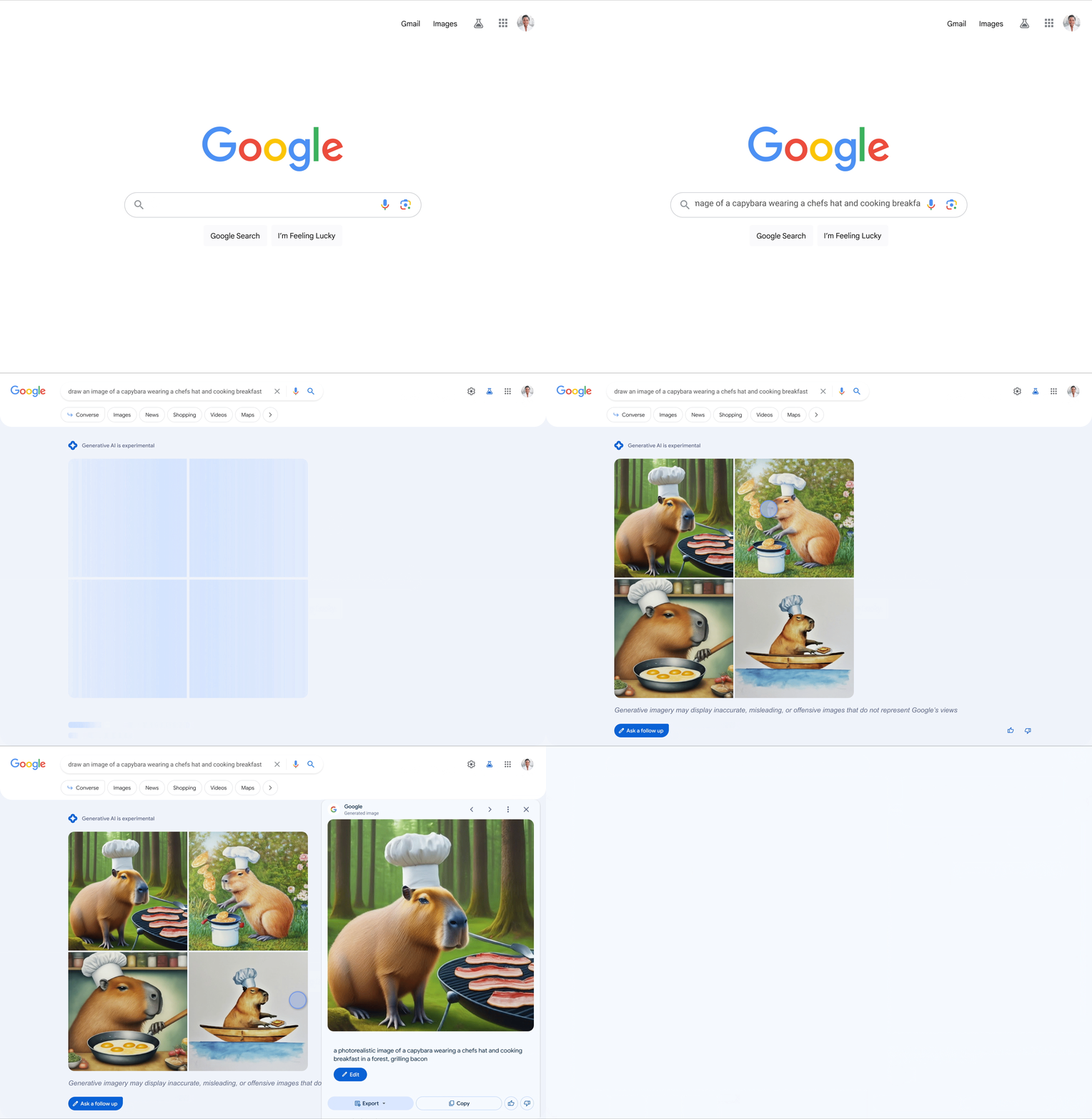
SGE image creation. Google wrote that today it is “introducing the ability to create images with our generative AI-powered Search experience (SGE).” You can ask Google SGE to “draw a picture of” something and it will provide you with four samples, similar to the other AI-image generation tools. You can click on an image and edit that image further or download it.
How it works. Here is a GIF of it in action:
Image Search. Google is also testing this directly in Google Image search. If you are opted in to SGE and you use Google Images, you may see this option there as well. “This feature is designed to appear when you’re searching for inspiration, like “minimalist halloween table settings” or “spooky dog house ideas.”,” Google wrote.
Image generation in SGE is currently available in English in the United States, to people who opted into the SGE experiment and who are 18 years or older, Google explained.
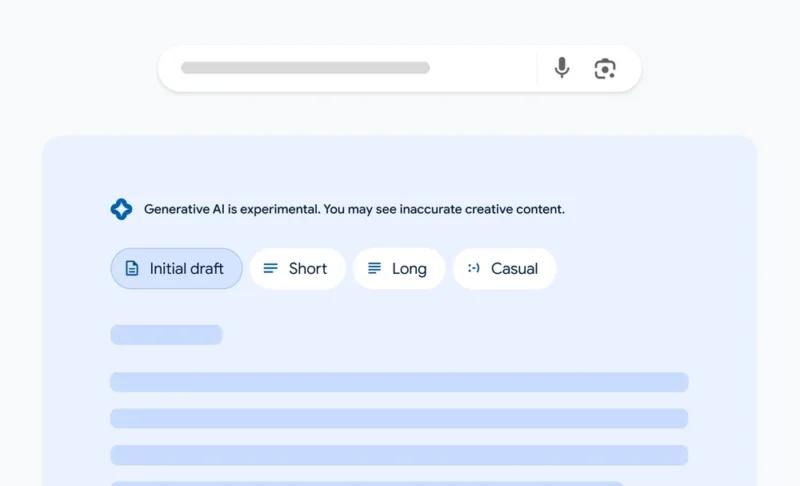
Drafts. Google SGE also now can write draft responses. Google said, “Sometimes when you’re researching a project or topic in Search, you end up looking for writing ideas and inspiration along the way. To help with these longer-running searches, we’re introducing written drafts in SGE. You’ll be able to make the draft shorter, or change the tone to be more casual.”
Why we care. Google keeps enhancing and adding more AI-features to SGE, Bard, as other search engines and AI companies do the same. It is exciting to watch the features continue to expand and grow.
Oh, I used Midjourney, an AI-image creation platform, for the featured image for this story.
@media screen and (min-width: 800px) { #div-gpt-ad-3191538-7 { display: flex !important; justify-content: center !important; align-items: center !important; min-width:770px; min-height:260px; }
}
@media screen and (min-width: 1279px) { #div-gpt-ad-3191538-7 { display: flex !important; justify-content: center !important; align-items: center !important; min-width:800px!important; min-height:440px!important; }
}
About the author
Barry Schwartz is a Contributing Editor to Search Engine Land and a member of the programming team for SMX events. He owns RustyBrick, a NY based web consulting firm. He also runs Search Engine Roundtable, a popular search blog on very advanced SEM topics. Barry can be followed on Twitter here.
But is it possible to proactively influence AI performance via large language model optimization (LLMO) or generative AI optimization (GAIO)?
This article discusses the evolving landscape of SEO and the uncertain future of LLM optimization in AI-powered search engines, with insights from data science experts.
What is LLM optimization or generative AI optimization (GAIO)?
GAIO aims to help companies position their brands and products in the outputs of leading LLMs, such as GPT and Google Bard, prominent as these models can influence many future purchase decisions.
For example, if you search Bing Chat for the best running shoes for a 96-kilogram runner who runs 20 kilometers per week, Brooks, Saucony, Hoka and New Balance shoes will be suggested.
When you ask Bing Chat for safe, family-friendly cars that are big enough for shopping and travel, it suggests Kia, Toyota, Hyundai and Chevrolet models.
The approach of potential methods such as LLM optimization is to give preference to certain brands and products when dealing with corresponding transaction-oriented questions.
How are these recommendations made?
Suggestions from Bing Chat and other generative AI tools are always contextual. The AI mostly uses neutral secondary sources such as trade magazines, news sites, association and public institution websites, and blogs as a source for recommendations.
The output of generative AI is based on the determination of statistical frequencies. The more often words appear in sequence in the source data, the more likely it is that the desired word is the correct one in the output.
Words frequently mentioned in the training data are statistically more similar or semantically more closely related.
Which brands and products are mentioned in a certain context can be explained by the way LLMs work.
LLMs in action
Modern transformer-based LLMs such as GPT or Bard are based on a statistical analysis of the co-occurrence of tokens or words.
To do this, texts and data are broken down into tokens for machine processing and positioned in semantic spaces using vectors. Vectors can also be whole words (Word2Vec), entities (Node2Vec), and attributes.
In semantics, the semantic space is also described as an ontology. Since LLMs rely more on statistics than semantics, they are not ontologies. However, the AI gets closer to semantic understanding due to the amount of data.
Semantic proximity can be determined by Euclidean distance or cosine angle measure in semantic space.
Semantic proximity in vector space
If an entity is frequently mentioned in connection with certain other entities or properties in the training data, there is a high statistical probability of a semantic relationship.
The method of this processing is called transformer-based natural language processing.
NLP describes a process of transforming natural language into a machine-understandable form that enables communication between humans and machines.
NLP comprises natural language understanding (NLU) and natural language generation (NLG).
When training LLMs, the focus is on NLU, and when outputting AI-generated results, the focus is on NLG.
Identifying entities via named entity extraction plays a special role in semantic understanding and an entity’s meaning within a thematic ontology.
Due to the frequent co-occurrence of certain words, these vectors move closer together in the semantic space: the semantic proximity increases, and the probability of membership increases.
The results are output via NLG according to statistical probability.
For example, suppose the Chevrolet Suburban is often mentioned in the context of family and safety.
In that case, the LLM can associate this entity with certain attributes such as safe or family-friendly. There is a high statistical probability that this car model is associated with these attributes.
Get the daily newsletter search marketers rely on.
Can the outputs of generative AI be influenced proactively?
I haven’t heard conclusive answers to this question, only unfounded speculation.
To get closer to an answer, it makes sense to approach it from a data science perspective. In other words, from people who know how large language models work.
I asked three data science experts from my network. Here’s what they said.
“Theoretically, it’s certainly possible, and it cannot be ruled out that political actors or states might go to such lengths. Frankly, I actually assume some do. However, from a purely practical standpoint, for business marketing, I don’t see this as a viable way to intentionally influence the “opinion” or perception of an AI, unless it’s also influencing public opinion at the same time, for instance, through traditional PR or branding.
“With commercial large language models, it is not publicly disclosed what training data is used, nor how it is filtered and weighted. Moreover, commercial providers utilize alignment strategies to ensure the AI’s responses are as neutral and uncontroversial as possible, irrespective of the training data.
“Ultimately, one would have to ensure that over 50% of the statements in the training data reflect the desired sentiment, which in the extreme case means flooding the net with posts and texts, hoping they get incorporated into the training data.”
Barbara Lampl, Behavioral mathematician and COO at Genki:
“It’s theoretically possible to influence an LLM through a synchronized effort of content, PR, and mentions, the data science mechanics will underscore the increasing challenges and diminishing rewards of such an approach.
“The endeavor’s complexity, when analyzed through the lens of data science, becomes even more pronounced and arguably unfeasible.”
Philip Ehring, Head of Business Intelligence at Reverse-Retail:
“The dynamics between LLMs and systems like ChatGPT and SEO ultimately remain the same at the end of the equation. Only the perspective of optimization will switch to another tool, that is in fact nothing more than a better interface for classical information retrieval systems…
“In the end, it’s an optimization for a hybrid metasearch engine with a natural language user interface that summarizes the results for you.”
The following points can be made from a data science perspective:
For large commercial language models, the training database is not public, and tuning strategies are used to ensure neutral and uncontroversial responses. To embed the desired opinion in the AI, more than 50% of the training data would have to reflect that opinion, which would be extremely difficult to influence.
It is difficult to make a meaningful impact due to the huge amount of data and statistical significance.
The dynamics of network proliferation, time factors, model regularization, feedback loops, and economic costs are obstacles.
In addition, the delay in model updates makes it difficult to influence.
Due to the large number of co-occurrences that would have to be created, depending on the market, it is only possible to influence the output of a generative AI with regard to one’s own products and brand with greater commitment to PR and marketing.
Another challenge is to identify the sources that will be used as training data for the LLMs.
The core dynamics between LLMs and systems like ChatGPT or BARD and SEO remain consistent. The only change is in the optimization perspective, which shifts to a better interface for classical information retrieval.
ChatGPT’s fine-tuning process involves a reinforcement learning layer that generates responses based on learned contexts and prompts.
Traditional search engines like Google and Bing are used to target quality content and domains like Wikipedia or GitHub. The integration of models like BERT into these systems has been a known advancement. Google’s BERT changes how information retrieval understands user queries and contexts.
User input has long directed the focus of web crawls for LLMs. The likelihood of an LLM using content from a crawl for training is influenced by the document’s findability on the web.
While LLMs excel at computing similarities, they aren’t as proficient at providing factual answers or solving logical tasks. To address this, Retrieval-Augmented Generation (RAG) uses external data stores to offer better, sourced answers.
The integration of web crawling offers dual benefits: improving ChatGPT’s relevance and training, and enhancing SEO. A challenge remains in human labeling and ranking of prompts and responses for reinforcement learning.
The prominence of content in LLM training is influenced by its relevance and discoverability. The impact of specific content on an LLM is challenging to quantify, but having one’s brand recognized within a context is a significant achievement.
RAG mechanics also improve the quality of responses by using higher-ranked content. This presents an optimization opportunity by aligning content with potential answers.
The evolution in SEO isn’t a completely new approach but a shift in perspective. It involves understanding which search engines are prioritized by systems like ChatGPT, incorporating prompt-generated keywords into research, targeting relevant pages for content, and structuring content for optimal mention in responses.
Ultimately, the goal is to optimize for a hybrid metasearch engine with a natural language interface that summarizes results for users.
How could the training data for the LLMs be selected?
There are two possible approaches here: E-E-A-T and ranking.
We can assume that the providers of the well-known LLMs only use sources as training data that meet a certain quality standard and are trustworthy.
There would be a way to select these sources using Google’s E-E-A-T concept. Regarding entities, Google can use the Knowledge Graph for fact-checking and fine-tuning the LLM.
The second approach, as suggested by Philipp Ehring, is to select training data based on relevance and quality determined by the actual ranking process. So, top-ranking content to the corresponding queries and prompts are automatically used for training the LLMs.
This approach assumes that the information retrieval wheel does not have to be reinvented and that search engines rely on established evaluation procedures to select training data. This would then include E-E-A-T in addition to relevance evaluation.
However, tests on Bing Chat and SGE have not shown any clear correlations between the referenced sources and the rankings.
Influencing AI-powered SEO
It remains to be seen whether LLM optimization or GAIO will really become a legitimate strategy for influencing LLMs in terms of their own goals.
On the data science side, there is skepticism. Some SEOs believe in it.
If this is the case, there are the following goals that need to be achieved:
Establish your own media via E-E-A-T as a source of training data.
Generate mentions of your brand and products in qualified media.
Create co-competitions of your own brand with other relevant entities and attributes in qualified media.
The chances of success with LLM optimization increase with the size of the market. The more niche a market is, the easier it is to position yourself as a brand in the respective thematic context.
This means that fewer co-occurrences in the qualified media are required to be associated with the relevant attributes and entities in the LLMs. The larger the market, the more difficult this is, as many market participants have large PR and marketing resources and a long history.
GAIO or LLM optimization requires significantly more resources than classic SEO to influence public perception.
Suppose LLM optimization turns out to be a sensible SEO strategy. In that case, large brands will have significant advantages in search engine positioning and generative AI results in the future due to their PR and marketing resources.
Another perspective is that one can continue in search engine optimization as before since well-ranking content can also be used for training the LLMs simultaneously. There, one should also pay attention to co-occurrences between brands/products and attributes or other entities and optimize for them.
However, tests on Bing Chat and SBU have not yet shown clear correlations between referenced sources and rankings.
Which of these approaches will be the future for SEO is unclear and will only become apparent when SGE is finally introduced.
Opinions expressed in this article are those of the guest author and not necessarily Search Engine Land. Staff authors are listed here.
@media screen and (min-width: 800px) { #div-gpt-ad-3191538-7 { display: flex !important; justify-content: center !important; align-items: center !important; min-width:770px; min-height:260px; }
}
@media screen and (min-width: 1279px) { #div-gpt-ad-3191538-7 { display: flex !important; justify-content: center !important; align-items: center !important; min-width:800px!important; min-height:440px!important; }
}
About the author
Olaf Kopp is an online marketing expert with 15+ years of experience in Google Ads, SEO and Content Marketing. Olaf Kopp is Co-Founder, Chief Business Development Officer (CBDO) and Head of SEO at the online marketing agency Aufgesang GmbH. He is an internationally recognized industry expert in semantic SEO, E-E-A-T, modern search engine technology, content marketing and customer journey management. He is co-founder and host of the podcasts OM Cafe and Digital Authorities (both german language). Olaf Kopp is author of the german book “Content Marketing entlang der Customer Journey” and co-organizer of the Performance Marketing event SEAcamp.