How to find your niche in SEO

In the era of E-E-A-T, it’s not just websites that need top-notch standards for visibility and conversions. SEO professionals also need to step up. 

I’ve talked to many colleagues, and many struggle with nailing down their areas of expertise.

To stand out in SEO and digital marketing, the key is to niche down and pinpoint your unique selling proposition (USP). 

Throughout my career, I’ve delved deep into niche specialization to unearth my authentic voice and area of expertise. 

In this article, I’ll share insights to help you enhance your distinctiveness in SEO, boosting your personal and brand identity.

The power of niching down in SEO

In SEO, a jack-of-all-trades approach might seem appealing, but it can dilute expertise.

Consider someone claiming expertise in every aspect of SEO. Can they genuinely master the nuanced art of link-building when others dedicate their entire career to just that?

Think about a real-life situation. You have bought an older home to renovate it. The bathroom, in particular, had beautiful but worn-out mosaic tile flooring that you wanted to restore.

Now, you are faced with a decision: should you hire a general contractor who handles a range of home renovations or a specialized mosaic tiler?

A general contractor might offer a one-stop solution, overseeing the floor and other aspects of the bathroom renovation. Their broad experience could be advantageous in addressing any unexpected issues that arise during the project. Plus, their wider network could offer more flexibility regarding materials and design.

On the other hand, a specialized mosaic tiler would bring a depth of expertise specific to the work that your floor requires. They likely have a keen eye for detail essential for mosaic restoration, ensuring the patterns and designs are preserved and highlighted. Their specialized tools and techniques could guarantee a more authentic and durable finish, reflecting the artistry of the original work.

Your dilemma as a homeowner boils down to this: do you prioritize the convenience and broad oversight of a generalist, or do you opt for the precision and expertise of a specialist? Your decision ultimately depends on your renovation goals, budget, and how much you value the unique craftsmanship of your mosaic floor.

This analogy mirrors the SEO landscape.

Businesses yearning for a transformative SEO impact lean toward specialists. Yet, those viewing SEO as just another checkbox might gravitate to generalists, enticed by their versatility and affordability.

Herein lies the magic of niching down. 

Niching down refers to the strategic process of focusing on a narrower or more specific market or industry segment. 

Instead of trying to serve a broad audience, those who niche down tailor their products, services, or expertise to cater to a particular subgroup or specialized need

As an SEO professional, you identify and leverage your unique strengths by niching down and focusing your efforts on specific services where you truly excel. 

The rationale: A clear niche highlights your expertise, making you the go-to authority for your target audience. Establishing authority in a focused niche is easier than in a broad field.

Specialization enhances your brand value and often commands a premium, rewarding your wallet and reputation and making it hard for others to copy you.


Get the daily newsletter search marketers rely on.


How to niche down in SEO

Niching down is a strategic approach aimed at honing in on your ideal customer and directly addressing their unique needs. 

Rather than offering broad solutions, the focus shifts to providing products or services tailored to solve specific problems for a narrower market segment. This prevents dilution of expertise and allows for more precise targeting.

Picture this as an inverted pyramid. At its broadest top, you find general SEO services commonly provided by newcomers to the industry. 

As you move downward, the services evolve, becoming progressively specialized and culminating at the narrowest point of the pyramid, where there’s a deep specialization in SEO. 

This apex almost always merges SEO expertise with another distinct discipline.
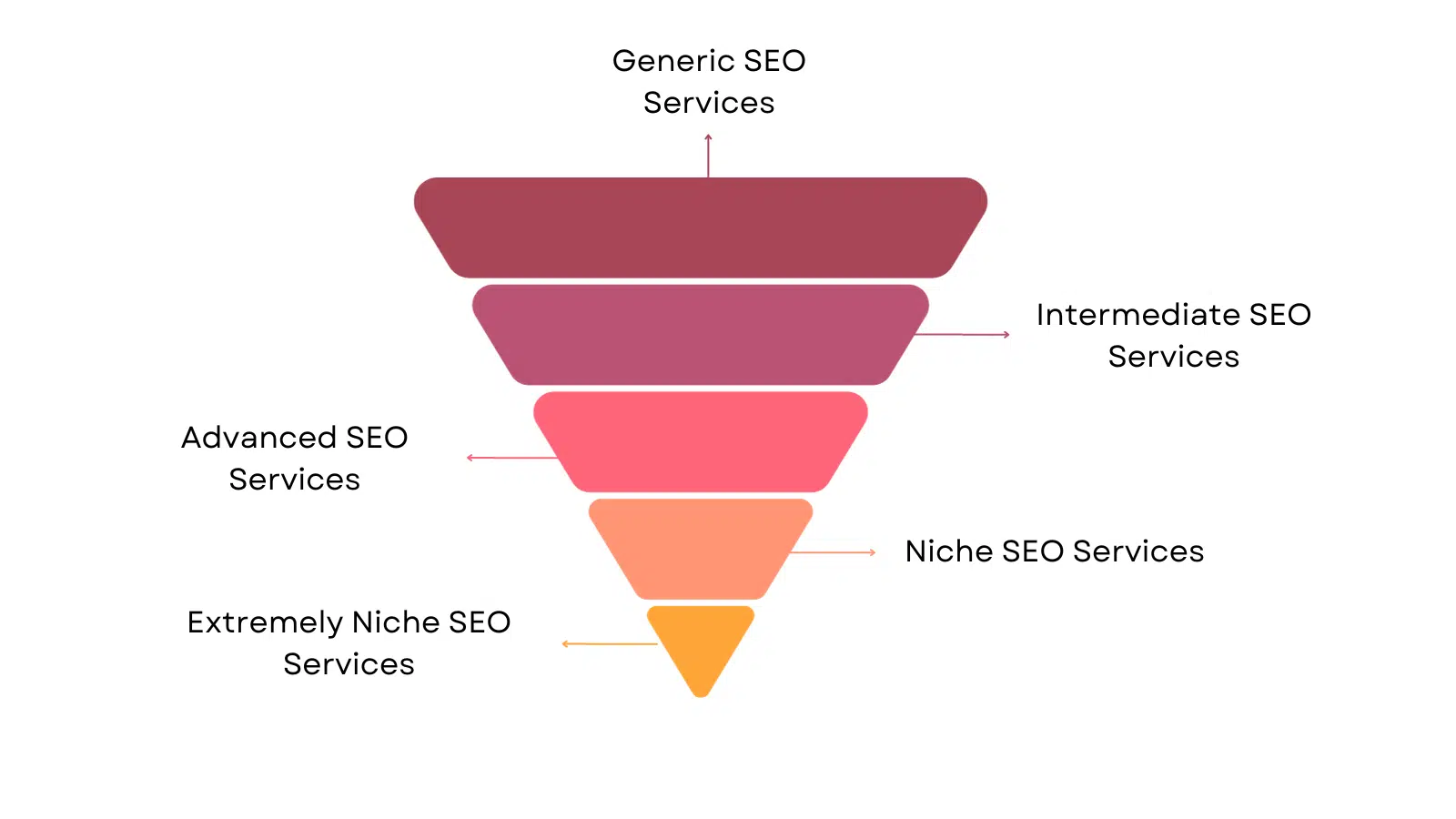
Niching down

This is the framework I’ve used to offer extremely specialized services in an extremely specialized niche and that I recommend to people wanting to find their unique USP in SEO.

1. Evaluate your professional background and interests

Selecting a niche that aligns with your professional experience or passion can greatly enhance your long-term commitment and drive. 

(Professor Melissa Cardon’s framework for establishing and measuring passion among entrepreneurs is a great starting point to assess your interest.) 

This alignment often results in heightened motivation and sharper focus, fostering endurance in your endeavors. However, it’s equally crucial to assess the viability of your chosen niche to ensure it supports your long-term plans. 

When making this choice, balance intuition with evaluating your strengths and capabilities. Ensure you approach this introspection honestly.

Avoid being overconfident or underselling your skills. A balanced perspective will guide you to a sustainable niche and authentically resonate with your expertise and passion.

2. Identify the problem that you can solve

Every impactful solution is rooted in identifying a genuine challenge or need. 

Success comes from addressing unique challenges that match your strengths, not following trends or copying others.

Whether it’s derived from your skills, past experiences, or deep insights, SEO professionals can succeed by matching their expertise to unmet market demands.

Identifying these gaps provides direction and fuels purpose-driven action, making your efforts impactful.

3. Identify your ideal customer

Who will benefit most from the solution you offer? Precision in targeting is paramount. 

Ensure you understand the long-term feasibility of your ideal customer: is this a niche destined to live for a long time? Or is it just a trend? 

Generic SEO strategies put you in a crowded, competitive market, often with lower prices. 

On the other hand, specializing in niche-specific SEO sets you apart and establishes you as the expert, creating a unique space for your expertise.

4. Evaluate competition

Assessing your competition in similar markets and industries is crucial. Focus on what makes your offering different and special in your field. 

Carving out a niche often happens when competitors provide poor offerings or when there’s high demand but a lack of expertise.

Alternatively, zero in on a specific pain point that remains largely unaddressed. 

By tailoring your services to these gaps, you address a genuine need and elevate your brand’s distinction and relevance.

5. Define your product/service

After defining your ideal customer and industry niche, design your services, providing a specialized solution to a distinct problem.

Tailoring your marketing to a specific demographic captivates their attention, fosters engagement, and builds trust, leading to lasting relationships, conversions, and referrals, solidifying your expert status.

This approach sets you apart from competitors and fosters a loyal clientele who value your expertise and advocate for you within their networks. 

Your ultimate goal is to be the solution for people and companies looking to solve a specific issue. You want to be helpful, just like your content. 

As long as you have the skills and can prove your value with real examples, being the solution implies establishing trust, gaining widespread recognition, and becoming irreplaceable.

Dig deeper: Authority management: A new discipline in the era of SGE and E-E-A-T

How to make niching down work for you 

So you have niched down, what’s now? Consider the following steps to ensure your niche decision truly resonates and delivers results.

Ask for feedback

Engaging them for feedback is essential if you’ve already established a client base. Understanding their experiences can offer invaluable insights into your business’s strengths and areas for improvement. 

Ask specific questions: 

  • How did they perceive the quality of your deliverables? 
  • Were their expectations met? 
  • Were there any gaps or areas they felt needed enhancement? 

Their feedback informs your current performance and guides future strategies, helping you adapt to evolving client needs.

Analyze the data

Once you’ve gathered project data, deep analysis can uncover valuable insights. 

For instance, if your expertise is SEO data science in a specific market segment, identifying a strong demand for in-depth user behavior analysis can be a golden opportunity. 

Focusing on this specialized niche positions you as an expert, attracting clients willing to invest more for premium insights. 

Consider whether you want to expand your skills to meet this demand.

Be meticulous

Niching down involves introspection and strategy, finding the intersection of passion and expertise. It’s about aligning your heart’s calling with surpassing the competition. 

Specialization requires unwavering selectiveness, making every decision deliberate, including:

  • Project selection: Align only with projects that perfectly fit within your specialized domain. Regardless of how lucrative it might seem, anything misaligned dilutes your niche focus.
  • Refined clientele: Embrace the power of ‘no’. By turning down opportunities that don’t align with your specialization, you further cement your expertise in your chosen niche.
  • Pricing power: Expertise comes at a premium. With specialized knowledge, you’re justified in commanding higher fees. Clients seeking your niche expertise often recognize its value and are prepared to compensate accordingly.
  • Strategic visibility: Your presence matters. Choose to speak or participate only in events that closely resonate with your area of specialization. This reinforces your authority in that domain and ensures your message reaches the right audience.

By leveraging these strategies, you solidify your position as a niche expert and amplify your value proposition, ensuring you’re sought after by those who truly appreciate and are willing to invest in your unique expertise.

Niche down to stand out

Niching down is more than just finding a specialized sector. It’s about discovering where your unique talents meet market demand, crafting a narrative only you can tell, and consistently delivering unparalleled value. 

As the digital landscape becomes even more crowded, those who carve out a distinct niche will stand tall and resonate more deeply with an audience that values specificity. 

Sometimes, the most powerful voice is not the loudest but the most distinct. Dive deep, find your niche, and let it be the compass that guides you to success.

Dig deeper: 11 tips for using social to become an authority in your niche


Opinions expressed in this article are those of the guest author and not necessarily Search Engine Land. Staff authors are listed here.


Related stories

New on Search Engine Land

@media screen and (min-width: 800px) { #div-gpt-ad-3191538-7 { display: flex !important; justify-content: center !important; align-items: center !important; min-width:770px; min-height:260px; } } @media screen and (min-width: 1279px) { #div-gpt-ad-3191538-7 { display: flex !important; justify-content: center !important; align-items: center !important; min-width:800px!important; min-height:440px!important; } }

About the author

Veruska Anconitano

Veruska Anconitano is a Multilingual SEO and Localization Consultant with 20+ years of experience working with established brands that seek to enter non-English-speaking markets. Her work is at the intersection of SEO and Localization, where she manages workflows and processes to facilitate the collaboration of both teams to increase brand loyalty, visibility, and conversions in specific markets. She’s a polyglot and she follows a culturalized approach to SEO and Localization that merges sociology, neuroscience, and data. Aside from SEO and Localization, Veruska is also a food-travel writer, professional pizza eater, and smiler with a strong passion for everything Korean and Japanese.

https://searchengineland.com/how-to-find-your-niche-in-seo-433141


Share of search: The SEO metric you can’t ignore

SEO is about to be taken seriously.

And share of search is how we’ll make it happen.

Let’s find out why.

Share of search: What it is and why it matters

Share of search is an SEO metric developed by expert marketers Les Binet and James Hankins a few years ago.

The concept of share of search is fairly simple – decide who you’re competing against, add the searches for all the brands and work out the percentage.

Now, as SEOs, we’re taught largely to ignore brand search because it’s “free traffic.” 

But that’s not quite true. Brand search is hugely important for several reasons, and actively trying to increase it has many benefits.

Share of search = share of market, and data suggests that brands with a higher and increasing share of search will enjoy sales growth in the future.

There is an obvious reason for this. Because brands people want to buy will likely be brands they search for.

And if that’s the case, why are we not digging deeper?

A tale of two websites

Earlier in my career, I worked on two projects for the same company.

Essentially, they were two businesses in the same sector but different brands.

The first brand decided to go all in on their advertising and publicity.

We’re talking billboards, sponsorship, display ads, and news features.

The second brand did the opposite and went all in on SEO and PPC.

Here’s the thing: while, without a doubt, the budget for the first brand was vastly higher, they almost immediately started to generate brand traffic, backlinks and sales.

The SEO and the PPC did very little.

There is a natural reason for this – reach.

The fundamental rule of growth for any business is to reach as many people as possible and tell them you exist.

If people don’t know you exist, they can’t buy from you.

OK, so this is where search comes in.

Thanks to keywords, brands didn’t need to spend money reaching everyone. Instead, they used PPC, SEO or both to meet potential buyers online.

This is where the last 10 years have thrown “brand” marketing under the bus.

But it has its issues.

How people buy online 

Search is the new shelf. 

Well, that’s what marketing professor Byron Sharp says. And he’s right.

Imagine a supermarket that sells everything you could ever want.

You walk in and tell the staff, “We need the car insurance aisle.”

“Certainly, sir, that is on aisle 15”.

You walking along aisle 15 is the manifestation of a Google search, and the SERPs are the products on the shelves.

The thing with search – and why PPC is so expensive – is that people aren’t always ready to buy. 

For a long time, people enter research mode and make numerous repeated searches over an extended period of time.

Google research has defined these two states as being:

  • Exploration mindset.
  • Evaluation mindset.

Brand marketers will refer to them as category researchers and people ready to buy.

Essentially, they are the same thing.

Search is now overloaded, and purchase cycles can take a long time, depending on the category.

Some B2B categories require research periods of 12 months or longer, others far less time.

And certain factors slow purchase speed down, including:

  • Lack of urgency
  • Risk aversion
  • Decision fatigue
  • Lack of time or knowledge
  • Choice overload 
  • And more.

In simple terms, we leave the supermarket, repeatedly return, and look at many options during each visit. This is often why PPC and even SEO returns are hard to realize and explain.

Purchase cycles are possibly increasing in length, not decreasing.

Eventually, we’ll have a few brands we want to consider and then pick one. But we only pick when we’re ready to buy.

For many businesses, search is the only way they are discovered online.

They do little brand marketing, and organic and paid searches linked to buyer intent keywords are how they are found.

And this is where share of search comes in.

Be easy to mind and easy to find

If someone types a buyer intent keyword into Google, you’re up against strong competition.

Every organic result and ad is fighting for the click. It’s hard.

But it’s a lot easier if you’re a brand that the searcher is already aware of, and ideally, they searched for you directly.

And that’s where brand marketing is important.

By reaching the prospect while they are not in the market to buy, including during their exploration phase, you increase the likelihood that they’ll remember you when they decide it’s time to purchase.

But SEO is a demand capture channel. It can’t affect this. 

Turns out it can.

Publicity: SEO’s secret weapon

BrightonSEO hosted a Q&A with Google’s John Mueller in October.

One of the questions pitched at him was, “Is digital PR link spam?”

Mueller answered:

  • “I think a lot of digital PR is really fantastic. By creating something fantastic that’s aligned with the rest of your website that is interesting for a broader audience. I think that is fantastic.”

In his book, “Product Led SEO,” Eli Schwartz points out:

  • “Some of the best link builders I know build their links by using PR methods. Your goal should always be getting attention. Remember, for backlink-building success, think PR first, links second.”

I’m lucky enough to work for a digital PR agency that has started an SEO side. 

So, I have a team of link builders and PRs at my disposal and a shed load of data to look at.

I can look at every campaign we launch and see if/ how digital PR lifts a brand’s search.

And it does.

Publicity fuels brand search and links.

Not every link or mention landed will do this; the key is contextual relevance.

Landing a media link and gaining publicity are two entirely different things.

The idea of digital PR is that the topic placement is brand-relevant when you acquire a link. 

In other words, you want some readers to see your brand name and be interested enough to search for you.

Monthly search volume over time

Now, let’s be clear. Many in SEO will criticize this approach. 

I’ve had SEOs admit to buying links. Some actually prefer to buy links than do digital PR.

But we are marketers, first and foremost. 

No one hires an SEO because they want to buy links and niche edits.

They hire SEOs because they want sales, and it’s our job to maximize our budgets to grow a greater share of search.

But what happens if we don’t grow share of search?


Get the daily newsletter search marketers rely on.


A brand’s mental availability is everything

Mental availability is the likelihood of your brand being considered in a buying situation.

And this is key for growth. 

Because brand power allows companies to:

  • Charge more for their goods or services than the competition. 
  • Sell more goods and services at the same price.

Over the years, I’ve seen businesses that exist in search but have to compete in a race to the bottom because they have little brand power.

You’d be forgiven for thinking, “But we’re SEOs. We care about traffic and rankings?”

Come on, folks, it’s 2023.

If we want to gain more significant budgets, we need to have a faster and greater impact.

Share of buyer intent search

It’s not the job of the SEO department to ensure the success of a business’s marketing.

But in a world where SEO wants to gain larger budgets, we need to be able to showcase the value we deliver.

And by measuring our share of brand search and buyer intent search, we can prove our value.

So, what is the share of buyer intent search?

This is what SEOs typically focus on.

It’s the traffic that brands typically pay for to reach buyers.

And just like share of “brand search,” the business with the greater share will likely attract greater revenue and traffic in the future.

So, as SEOs, we can actively measure a brand’s share of search interest and the share of buyer intent search volume.

Search volume via My Telescope

Tools like My Telescope and Google Trends can be used to track brand searches, while  Semrush and Ahrefs can be used to track the share of buyer intent search.

And this changes the conversation around the benefits of SEO.

Moving SEO from demand capture to brand growth

Brands grow when they increase their sales, and SEO helps this to happen.

But to maximize this, we need brand awareness and ranking for buyer intent keywords to increase.

  • Use digital PR to build links and brand awareness.
  • Leverage SEO, and the code of search engines, to grow the share of buyer intent search.

This double approach makes SEO more valuable and delivers faster results.

Movement is in the air for SEO.

And in a semantic search era, it’s time for a new approach.

It’s time for SEO to claim it’s place as a powerful marketing channel that deserves the respect of marketers and the right budgets.

That time is now.


Opinions expressed in this article are those of the guest author and not necessarily Search Engine Land. Staff authors are listed here.


Related stories

New on Search Engine Land

@media screen and (min-width: 800px) { #div-gpt-ad-3191538-7 { display: flex !important; justify-content: center !important; align-items: center !important; min-width:770px; min-height:260px; } } @media screen and (min-width: 1279px) { #div-gpt-ad-3191538-7 { display: flex !important; justify-content: center !important; align-items: center !important; min-width:800px!important; min-height:440px!important; } }

About the author

Andrew Holland

Andrew Holland is the Director of SEO at JBH, an award-winning Digital PR and SEO agency. His SEO background stems from a 17-year career in the police, where a number of years were spent within intelligence, utilizing SEO within internal systems to catch criminals. After developing chronic asthma, Andrew left the police and launched a freelance SEO and digital marketing career, and has worked with a wide range of clients, from SMEs to 8-figure businesses. Today, he directs the SEO delivery for one of the UK’s fastest-growing Digital PR and SEO agencies. Building organic visibility, trust and fame for consumer brands.

https://searchengineland.com/share-of-search-seo-metric-433133


Leverage data, not guesses: Use SEO A/B testing to increase your organic search traffic by Digital Marketing Depot

A/B testing

Up to 80% of website changes driven by SEO have no positive impact on organic traffic. In fact, many changes actually decrease organic traffic. Most companies have no way to measure the impact of changes, so they struggle to prioritize efforts effectively.

Many marketing teams are operating blindly, making changes without measuring impact. Seemingly insignificant changes waste time and money. Meanwhile, impactful changes, whether positive or negative, go undetected.

This whitepaper from SearchPilot explains how SEO A/B testing provides a disciplined, data-driven approach to avoid losses and boost results. Download this paper to:

  • Understand the marketing benefits of SEO A/B testing
  • Utilize data and analytics to make informed decisions, cutting through noise from seasonality, Google updates, etc.
  • See industry-specific SEO testing examples
  • Learn how to implement SEO A/B testing

Visit Digital Marketing Depot to download the “SEO A/B testing: The secret to increasing your organic search traffic.”


Related stories

New on Search Engine Land

@media screen and (min-width: 800px) { #div-gpt-ad-3191538-7 { display: flex !important; justify-content: center !important; align-items: center !important; min-width:770px; min-height:260px; } } @media screen and (min-width: 1279px) { #div-gpt-ad-3191538-7 { display: flex !important; justify-content: center !important; align-items: center !important; min-width:800px!important; min-height:440px!important; } }

About the author

Digital Marketing Depot

Digital Marketing Depot is the resource center for digital marketing strategies and tactics. Created by Third Door Media, Digital Marketing Depot features a robust library of hosted white papers, eBooks, original research, and webinars on a wide range of digital marketing topics- from advertising, analytics, data and content management, to email marketing, SEO and PPC campaign management, and much more. Visit us at http://digitalmarketingdepot.com.

https://searchengineland.com/leverage-data-not-guesses-use-seo-a-b-testing-to-increase-your-organic-search-traffic-433168


How to prepare for Google SGE: Actionable tips for SEO success

While there are some reasonable assumptions of how Search Generative Experience (SGE) might affect our sites, others are not so realistic. 

This article highlights:

  • Theories about SGE’s traffic impact. 
  • What we know so far. 
  • What we don’t know yet.
  • Things to avoid.
  • Ways to prepare for SGE.

Theories on SGE’s potential traffic impact

SGE will undoubtedly impact organic search, with both positive and negative consequences, if it launches as it currently stands.

But how big will that impact be?

It is reasonable to assume that we could see a decrease in organic traffic of up to 30% – similar to how featured snippets impact some search results. This depends on the niche, business model and keyword types.

With that said, there is no magic number that can be generalized.

If there is no AI overview for the query, the impact will be close to zero. 

If users are prompted to create an AI overview, a certain portion will follow through and create one.

AI-powered overview

However, creating this overview takes time, and general users won’t immediately adopt this behavior.

If your site gets an auto-generated AI overview but doesn’t appear in the response, expect a negative impact on your traffic. If you do appear, the impact will be less severe.

However, the human eye focuses more on things that appear on the left side, at least in countries where people read from left to right. So, the left part of the overview is probably more important. 

Currently, sources are displayed on the right side, and there are small dropdown arrows in the response itself to signal interaction, which also reveals sources used for the response.

As such, regular organic results will be pushed down just like if any other SERP feature (i.e., ads) appears above them.

It’s fair to say that Google has less pressure to release the SGE to the general public because ChatGPT is losing steam. 

Google is known for sticking to plans and trying to make its products work. Google doubled down on SGE in their earning’s call. And, if Google+ is any indicator, it would take quite some time for Google to kill SGE.

Google is continuing to invest in cloud technology to find growth opportunities. But right now, search advertising revenue is too important to risk making mistakes.

Another theory: The EU will get SGE much later than other regions, just like Bard. 

Bard was officially released in March, but it took almost five months later to become available in the EU due to data privacy concerns. 

This will serve as an opportunity for a part of the SEO community to observe what happens in first markets and to adapt accordingly.

While a lot of talk focuses on the negative impact on traffic, there are definitely some benefits. 

  • Ecommerce queries for products will see a spike as products are prominently displayed in the AI overviews. 
  • Great product images will likely have an impact on CTR, just like a good thumbnail on YouTube or attractive images in general.
  • It is also very possible that SGE will lead to more zero-click searches when an answer is already given in a search result. We already saw this with featured snippets, though SGE might appear for more queries based on observations since its unofficial launch.

Get the daily newsletter search marketers rely on.


What we know about SGE so far

Those were a lot of theories, so let’s focus on things we actually know now.

SGE real estate will look different than the current SERP landscape

While an SGE overview is similar to other SERP features, like a featured snippet, it takes up much more space. 

For many queries, the auto-generated overviews often fill the entire screen on desktop and require the user to scroll on mobile.

A screenshot with the comparison of two SERPs. Both show the query "how to cure depression". There are coloured boxes that show the different SERP features. On the left side SERP (the traditional, current Google search) there is a big block with paid ads above the regular results and a knowledge panel next to it on the right. Below the paid ads there is a block of organic Google SERP features and below that the regular organic results start. The SERP on the right is build differently. The paid ads are switched for the SGE AI overview. The organic SERP features are below that. The regular organic results start below the organic SERP features once again.
Comparison between SERP layouts for “how to cure depression” with the regular search on the left and SGE-powered search on the right

However, as you can see in the example above (for the query “how to cure depression”), the regular search features and ads also take up considerable screen real estate. 

I doubt that Google will just show fewer ads, but that is what we frequently see at the moment. 

If ads are added to this, either above or below the AI overview, regular organic results will get pushed down more than they do now.

Just recently, Google started showing a new layout for SGE when an overview is automatically generated. There is only a small preview and a “Show more” button. It does not fill the entire above-the-fold area or show any images of the linked sources.

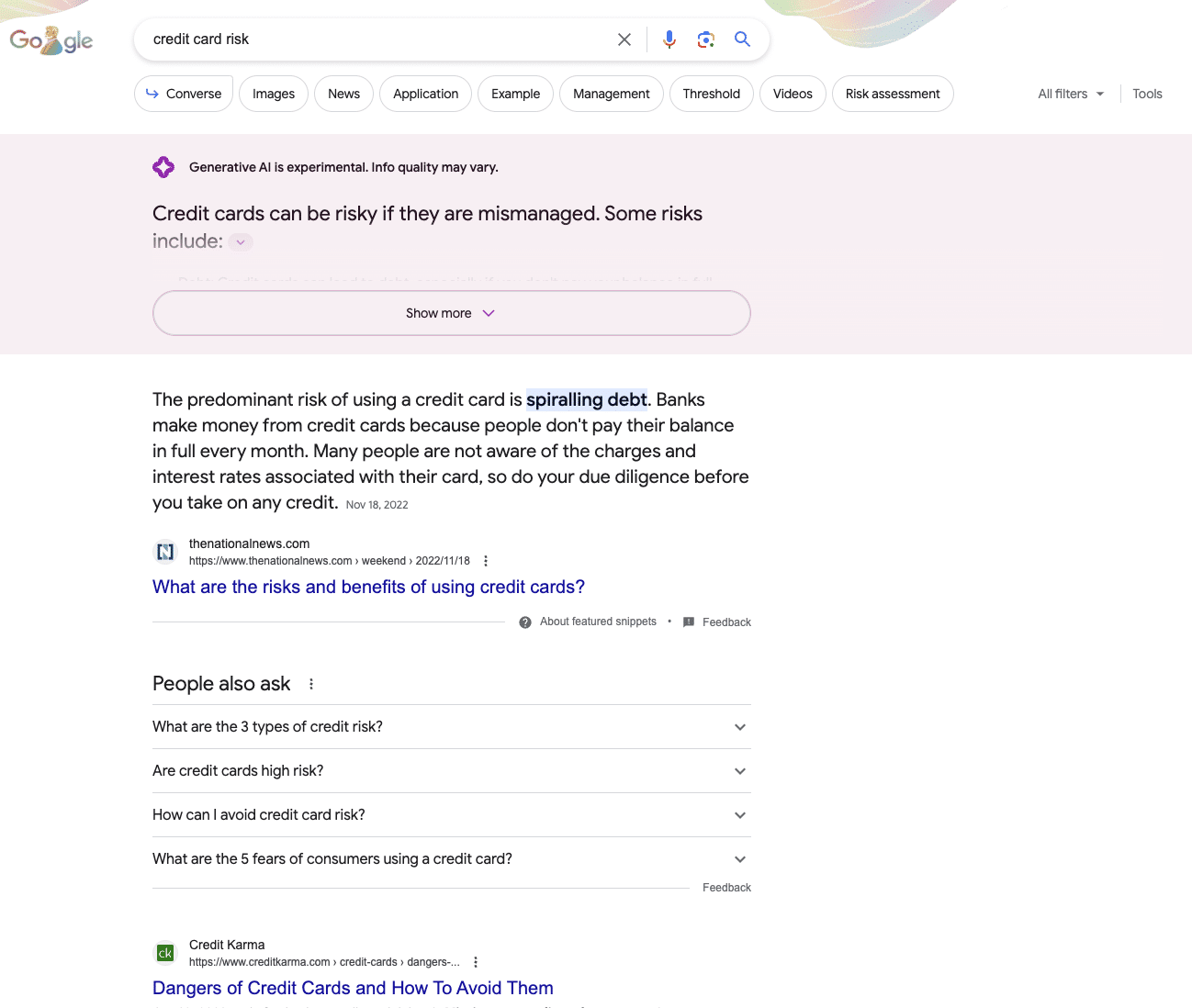
Compare this AI snapshot for “credit card risk” from two different dates:

SERP with SGE feature for “credit card risk” from end of September 2023
SERP with SGE feature for “credit card risk” from the start of October 2023

The first overview from late September was about 780px high, while the new one from early October is about 230px high – not even a third of the original size. 

The organic traffic impact of the latter layout would probably be less than that of the former.

Images for the cited sources will likely impact CTR

Like good YouTube thumbnails, attractive images get a higher CTR than less attractive images. 

For the cited sources, this has implications for not only getting an image to show up but also being attractive for users to click on. 

Consider this an avenue for optimization: show exeption images in the overview that aim to stand out against the rest.

If an AI overview is presented, CTRs of regular organic results might drop

Assuming your site does not appear in the AI overview but is highly ranked in the regular organic results, your CTR will drop.

This is natural and a no-brainer, as everything above the fold is more important on both websites and in search results. 

Like any SERP with many SERP features, the CTR is affected by their appearance and placement.

In my tests, I saw fewer ads in SGE compared to regular search. This is backed by other research from Moz and Insight Partners. 

These tests and studies were conducted in September, but just like Google testing the new layout, I often saw more ads appearing over time.

You can be sure that Google is testing this as much as possible to not jeopardize their search ad revenue.

Things change all the time in SGE

As recently as late August, it was confirmed that SGE would retain sources, due to user feedback. 

But that is not the only thing that has changed. After watching SGE for months, here are some other developments I have observed:

  • Queries that can trigger an overview (increasing and decreasing).
  • Ecommerce category keywords not automatically generating an overview.
  • YMYL queries getting more overviews which might be a sign that Google trusts the quality of SGE’s output.
  • Local packs showing a variety of two-packs up to five-packs (the latter being the most frequent one).
  • Number of ads slightly increasing.
  • Ad placement more often above the overview.
  • Size of the overview for the same query which changes all the time.
  • SGE response layouts.
  • Content of the overview on a single day (changes all the time).

This list could go on and on. 

One important point about SGE is its dynamics. Overviews for the same query are rarely 100% similar.

What we don’t yet know about SGE

This brings us to things we actually don’t know.

Will the SGE stay this volatile?

AI overviews change often, and most of the time, the changes are drastic. See the following examples (both screenshots were taken just two weeks apart):

A screenshot of the SERP for the query "dresses". The SGE response takes up a good chunk of the above the fold area and can be expanded by clicking "Show more".
SERP with SGE feature for “dresses” from the end of August 2023
A screenshot of the SERP for the query "dresses". The SGE response takes up a bigger chunk than the previous one. Its size is approximately double in comparison.
SERP with SGE feature for “dresses” from mid of September 2023

If your site wasn’t part of the first overview, it wouldn’t be half as bad as in the second overview, which is more than twice as big. 

We simply don’t know if this will be normal for SGE, so any concrete calculations are pretty useless, especially if Google changes to a different layout, as mentioned before.

Will we ever get official data on SGE?

This is a complicated question with big implications. I’m sure the SEO community will develop ways to track changes in SGE over time. 

There are already some suggestions for what you can do, which I will discuss in this article’s last chapter.

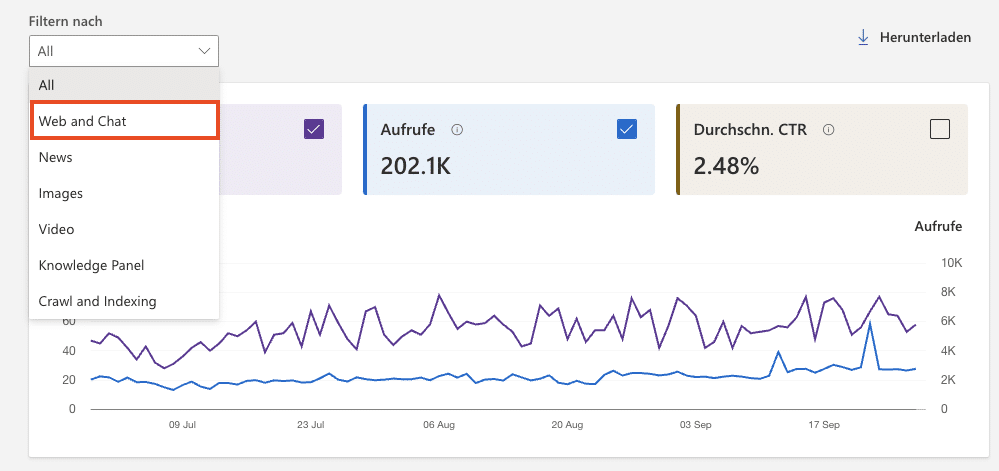
Microsoft promised to bring Bing Chat data into Bing Webmaster Tools. 

While they delivered on that promise – albeit later than first announced – what we got is quite disappointing. 

Both web and chat data are merged together with no filtering capabilities, making this data useless.

A screenshot from Bing Webmaster Tools. When the filter area is clicked, "Web and Chat" can only be chosen together and not separately.

Why would Microsoft do this? Perhaps Bing Chat numbers are negligible, which is bad for PR.

My guess is that it will be many months after launch before we get data on SGE in Google Search Console.

Will there be ways to scale data collection on SGE?

Yes, even without official data, I’m sure SEO tool providers and smart people in the community will find ways to make them accessible. 

But once again, it will take some time.

How exactly do we become part of the AI overview?

No one can say this with 100% certainty. From my observations in looking at informational queries especially, a reverse-engineering approach seems to work. 

Try to see what kind of content is in the overview and what angle is covered, then find a way to present that information as clearly as possible.

However, as mentioned before, SGE elements change constantly –  the angle, the answer to the same type of headline/question, and even the sources.

Let’s hope Google will provide more detailed information soon. Until then, we SEOs will have to test and see what works.

What kind of CTR can we expect if we get into the AI overview?

This is a tricky one. If we assume that every query generates the same type of snippet – with the same size, layout, etc. – then I would think that the CTR will be lower than for featured snippets.

But this cannot be generalized. However, it’s safe to say that it would be lower than the current number one spots for informational queries, where the CTR often ranges between 25-30%. 

Things to avoid

There are quite a few things I would advise against, whether the reader is an SEO agency, freelancer, or even a company wondering, “What can I do to prepare for and/or mitigate the effects of SGE?”

A few things summarized from this article:

  • Volatility is high.
  • Scalability in any framework is questionable at the moment.
  • We have no official data and don’t know how users will interact with the new features.

To illustrate how useless any model for measuring SGE impact can be, just look at the various screenshots I provided here. 

To double down on this, a colleague and I did an experiment on volatility.

Imagine two people in the same VPN searching for the same query at the same time: The result should be the same, right?

We looked at 10 different queries and checked their SGE response three times on the same day at the same time. 

Out of a total of 60 observations, here’s what we found:

  • The average sources cited overlap was 57% – meaning on average less than two out of three sources overlap from one observation to another, so in less than 1/3 of our observations the same sources were used.
  • There was only one case where the content differences were zero.
  • The average content difference is at least medium* in 12 out of 30 comparisons.
  • In only one of 60 observations we saw ads above the SGE response, even though some keywords that we selected feature top ads above organic results in regular Google search (much less than we recently observed).

*Differences

  • Small: Only very small text differences, but some layout.
  • Medium: Atleast small text differences and small changes in layout.
  • Big:Text differences and big changes in layout.

Here is a direct example of the query “pros and cons of electric cars.”

A screenshot of a SERP for the query "pros and cons of electric cars". The SGE response can be expanded by clicking "Show more". No cons are immediately visible.
SERP with SGE feature for “pros and cons of electric cars” from Oct. 4, 2023 12:00 p.m. CEST (User A).
A screenshot of a SERP for the query "pros and cons of electric cars". The SGE response is formatted differently and both pros and cons are immediately visible.
SERP with SGE feature for “pros and cons of electric cars” from Oct. 4, 2023 12:00 p.m. CEST (User B).

This was classified as “big differences” because:

  • The text differs.
  • The layout is different and one takes up way more space, especially when expanded.
  • All visible sources are different.

This was a fairly small sample. However, we regularly monitor SGE queries and compare the results over time. 

The results of this test are no different than our other observations – SGE is as volatile as some cryptocurrencies.

There is literally very little value in investing a lot of time in models and frameworks to project traffic loss. All you need to know is that SGE will have an impact. 

If your business model and current organic traffic is mostly informational, you can expect a bigger impact than if you were an ecommerce site. 

But no one knows how big that impact will be, and numbers ranging from -95% to +200% for the same site are not very helpful.

What you can do now to prepare for SGE

Focus on the things that have an SEO impact today.

While I always say to stay vigilant and keep an eye on new developments, we should not let shiny new things distract us from what is happening right now.

There are opportunity costs associated with things you do, and the opportunity cost of investing a lot of time in SGE is much higher than improving your SEO now and preparing for changes when we know more.

You can accurately measure what you pay by doing things later. This is one of the best arguments, in my opinion.

It’s like compound interest. If you publish valuable content today, it can start to work and bring in more revenue than if published later.

Dig deeper: Why next year’s SEO results depend on your SEO work this year

What I suggest you do instead of obsessing about the possible effects of SGE is the following:

  • Work on things you know will have an impact now and in the future.
  • Make sure you have attractive images in your content to be displayed in SGE.
  • Put important words that make users click early in your titles. 
  • Monitor some important keywords in SGE.
    • Always save screenshots with the same screen resolution.
    • Capture the HTML so you can compare not just visual changes.
    • Try to see overlap in what cited sources do well and corroborate like you would for featured snippets.
  • If you are from the EU or countries that might not get SGE immediately. Watch the impact in first markets and learn from that.
  • Wait and see.

The key takeaway?

Don’t become overly fixated on SGE. Avoid listening to people trying to sell you SGE-related solutions.

No one, except Google, knows the extent and impact SGE has on organic search.


Opinions expressed in this article are those of the guest author and not necessarily Search Engine Land. Staff authors are listed here.


Related stories

New on Search Engine Land

@media screen and (min-width: 800px) { #div-gpt-ad-3191538-7 { display: flex !important; justify-content: center !important; align-items: center !important; min-width:770px; min-height:260px; } } @media screen and (min-width: 1279px) { #div-gpt-ad-3191538-7 { display: flex !important; justify-content: center !important; align-items: center !important; min-width:800px!important; min-height:440px!important; } }

About the author

Philipp Götza

Philipp is an Online Marketing Expert, SEO enthusiast, as well as a Web Sustainability and Accessibility advocate with multiple years of experience. His mission is to help businesses improve their websites through tailor-made Organic Growth strategies and solutions. He works as a Junior SEO Consultant for Wingmen Online Marketing. He also hosts his own website project, is an avid reader and is active on LinkedIn – his social media of choice.

https://searchengineland.com/prepare-google-sge-tips-seo-success-433083


Personal connection is key to your marketing team’s success

Many managers overlook a key opportunity: getting to know their team better.

This is the secret to success for search marketing teams.

This article explores the significance of truly knowing your team and provides steps to initiate a deeper understanding for improved relationships and job performance.

I am not an HR manager and have never worked in HR. Still, I have managed people in some capacity over the years and have a strong interest in the psychology behind human behavior – that is what I’m pulling from for this article. If you are uncertain about appropriate employee questions, don’t hesitate to consult your HR team.

Why knowing your team on a deeper level matters

In some ways, I’m writing to advocate for those who (like me) wished their managers took the time to understand them as individuals rather than maintaining superficial relationships that neglect their preferences, strengths and career aspirations.

I’m mainly referring to a direct manager, but in some cases, even higher-level managers and department leads should share the responsibility of understanding their team.

It never made sense to me how to build a successful team without truly knowing them. How else can you create a high-performing team?

A rockstar team has trust and respect as a foundation, but that is merely table stakes.

When you understand your employees’ backgrounds, address their motivations, and invest time in challenging and teaching them, you’re paving the way to individual growth and team success.

As a search marketing manager, here are some questions you can ask to learn more about your team.

What are their previous work experiences?

This question will help you:

  • Know more about the work they’ve done in the past and their experience in other work environments. 
  • Give you insight into their past experiences and what they can bring to your team now. 

Granted, this is typically asked during interviews before hiring. But I find that my managers rarely remember or know the real extent of the work that I’ve actually done. 

This is a key question to build on. Don’t just ask about one particular job. Ask about all the roles they’ve held, and feel free to discuss more about each role.

What do they enjoy most about what they do?

Asking this can reveal your employee’s motivations and what makes them tick. This helps you assign work they enjoy, ultimately improving retention. 

Some people work just for money, and that’s OK. But it’s still important to ask so you can better support them. 

What skills do they want to improve?

All your employees have skills, and you would be hard-pressed to find a good, motivated employee who doesn’t want to improve their skills. 

In some positions I’ve held, I was dying to acquire new skills and build upon my current skills, but I felt like I never had the time in my workday to do so. 

Often, I was afraid to assert myself more and wished my managers would have asked. 

Asking this question will benefit the employee and help you round out your team’s skills by identifying skill gaps.

You’ll know where you may be able to have your team teach other members of your team new skills.

Dig deeper: 5 leadership traps new SEO team managers should avoid


Get the daily newsletter search marketers rely on.


Ask them future state questions

Beyond the “where do you see yourself in five years” question, ask your employees what they see in their future in terms of career. 

This may get them to open up about some hangups they may have now in their current position. 

It could also be a chance for you to learn about other positions in the company they may be interested in (which isn’t necessarily a bad thing!).

Getting to know your marketing team on a deeper level

These aren’t questions that are always covered in a performance review (although some could be), but they are important questions to ask your team that often go unasked. 

Knowing the answers to these questions is pivotal and will help you learn more about your team’s motivations and build a solid foundation of trust and respect. 

When I know a manager cares about me and my future, I am willing to put in more work and stick around. 

When I feel like a manager could care less, I have no reason to stick around or care about them.

Investing time in asking your team these questions allows you to witness the impactful changes just a few simple questions can bring about.

I hope you find value in adding some of these questions to your list to ask your team or that it helped spark even more questions or thoughts about improving your overall team dynamic.

Dig deeper: Marketing leadership: The dangers of ego


Opinions expressed in this article are those of the guest author and not necessarily Search Engine Land. Staff authors are listed here.


Related stories

New on Search Engine Land

@media screen and (min-width: 800px) { #div-gpt-ad-3191538-7 { display: flex !important; justify-content: center !important; align-items: center !important; min-width:770px; min-height:260px; } } @media screen and (min-width: 1279px) { #div-gpt-ad-3191538-7 { display: flex !important; justify-content: center !important; align-items: center !important; min-width:800px!important; min-height:440px!important; } }

About the author

Rachel Fredrickson (Howe)

Rachel Fredrickson (Howe) is a Search Engine Land contributing writer and is based out of Milwaukee, Wisconsin. She has been in the digital marketing space for over ten years working with Fortune 500 brands to mom and pop shops helping them with all things digital with a focus on SEO. In 2017, she was a runner-up and finalist for the Brightedge SEO & Content Award for her work on OfficeChairs.com. She currently works as an SEO Contractor at Milwaukee Tool and is looking for a full-time gig (shameless plug). When not working, she enjoys spending time with her husband and their four fur babies and working on home DIY projects.

https://searchengineland.com/nurture-marketing-teams-success-personal-connection-433116


The enterprise guide to elevating findability and ROI

The concept of findability has evolved into a critical factor for businesses striving to connect with consumers.

It’s no longer just about being present, but being discoverable, chosen and seamlessly integrated into the intricate web of customer journeys.

This article explores findability and how a robust omnichannel findability strategy can help brands create meaningful and lasting customer relationships. 

What is findability?

The discipline of findability is centered around connecting the appropriate consumer with the suitable product or service, at the right moment and in the correct location – whether physical or digital.

At my company, Vodafone Spain, our findability approach signifies a shift from solely addressing specific digital requirements and platforms (a static concept) to engaging with a comprehensive journey to discover, locate and fulfill those requirements (a dynamic concept). 

Simply put, it emphasizes customer-centricity (the complete journey) and omnichannel focus (consumer behavior regardless of channels).

With the evolution of the web, consumers have transitioned from restricted searches within a solely digital platform to exploring various channels, contingent on their journey phase. 

There are now multiple search properties and formats (text, image, video, virtual reality, augmented reality, etc.) that have gradually contributed to addressing diverse needs:

  • Search engines: “I want to know” searches.
  • Digital video platforms (e.g., YouTube, Vimeo): “I want to know” and “I want to do” searches.
  • Geolocation platforms (e.g., Google Maps, store locators): “I want to go” and “I want to buy ” searches.
  • Ecommerce platforms (e.g., Amazon, AliExpress, eBay): “I want to buy” searches.
  • Social platforms (e.g., Facebook, LinkedIn, TikTok, X, Pinterest): “I want to know” searches (through acquaintances and friends).

As these different aspects of search strategies developed, the focus changed from optimizing for specific elements (like the environment, product or service, and keywords) to a more comprehensive approach that aligns with the various stages of the consumer’s journey.

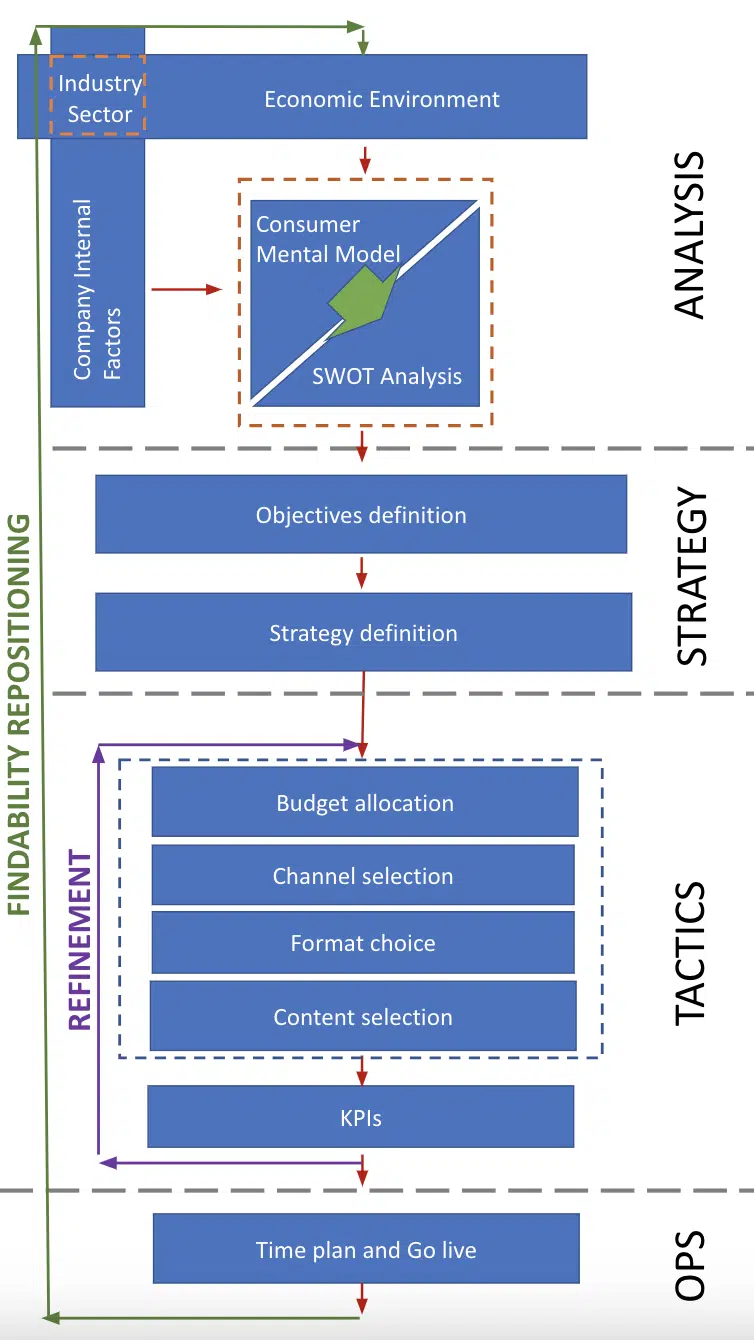
The findability model: A 4-phase framework

Our findability approach is based on a 360-degree model, spanning analysis to operations.

It prioritizes continuous tactic review for potential corrections and strategy evaluation to adapt to market or competitive changes.

Moreover, findability has visibility in our digital direction, which serves a dual purpose: 

  • Enhancing our brand and product visibility.
  • Functioning as a source of business intelligence. 
Findability model in Vodafone Spain
Vodafone Spain’s findability model

Phase 1: Analysis

Economic environment

Understanding the economic environment is crucial for crafting an impactful findability strategy. It helps make informed decisions about resource allocation and ROI-focused marketing tactics.

Within this segment, our focus centers on these key areas:

  • Demographic trends.
  • Consumption trends.
  • Allocation of consumer expenditures across product and service categories.
  • Political landscape.
  • GDP trajectory.

Company internal factors

While analyzing the economic landscape is crucial, don’t overlook internal factors like organization, innovation, logistics and other intrinsic dimensions in shaping a successful findability strategy.

We are particularly attentive to these pivotal elements:

  • Products and services differentiation.
  • Market share – splitting by digital and non-digital.
  • Internal digital skills vs. outsourcing.
  • Attribution model maturity implementation.
  • Omnichannel maturity.

Industry sector

The industry sector includes all factors that simultaneously characterize the economic environment and the company internal factors. 

Exploring the industrial sector is essential, as economic trends can significantly impact performance. A thorough evaluation helps:

  • Identify opportunities and threats.
  • Refine the findability strategy to adapt to changing market dynamics.

This allows businesses to innovate and stay competitive.

Within this segment, our focus is directed toward these key aspects:

  • Competitors.
  • Elasticity of demand.
  • Demand growth rate.
  • Regulatory environment.
  • Annual growth trends.
  • Volume of revenue.

You can also use public information repositories to access some of this information. 

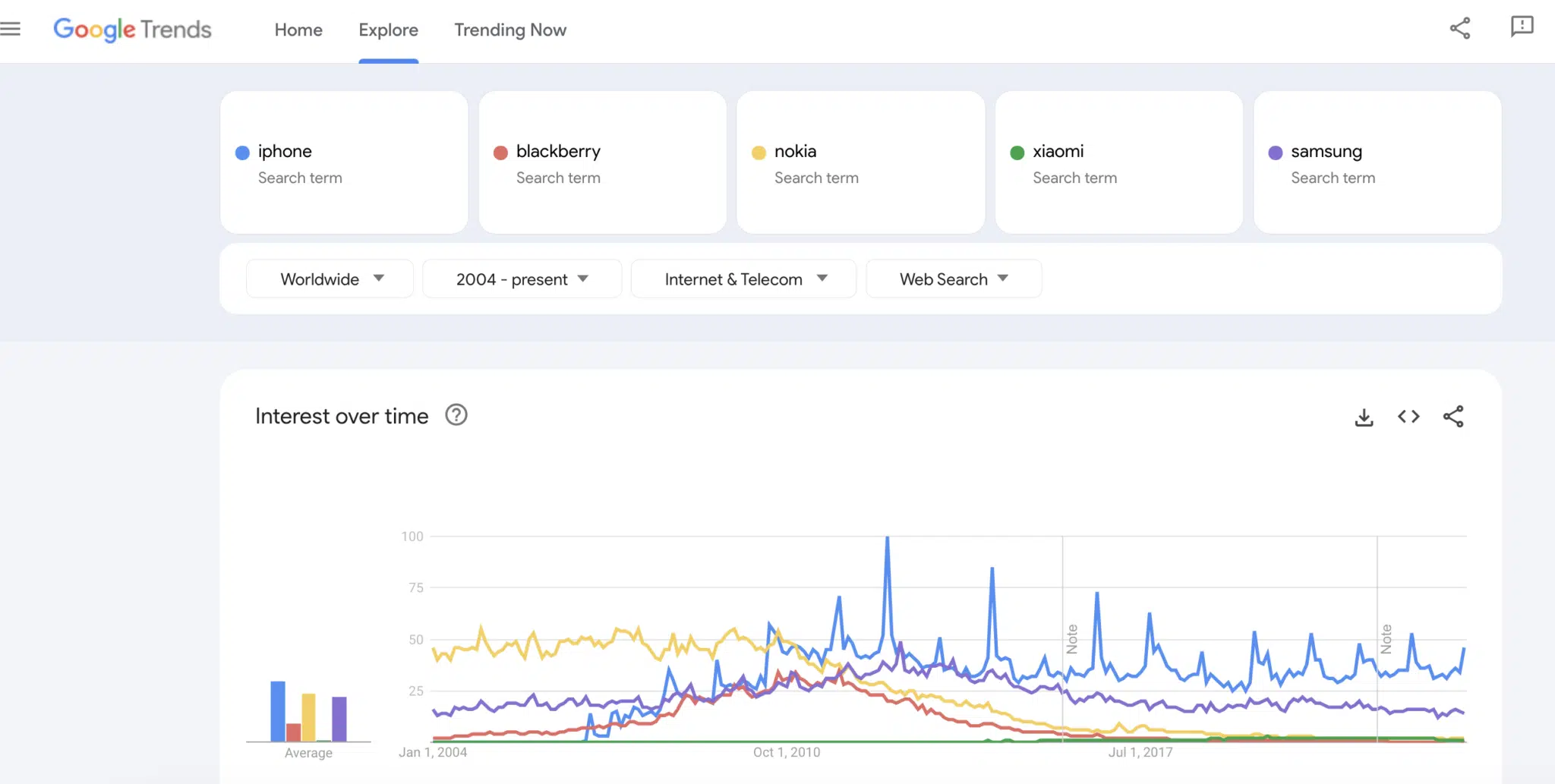
For instance, Google Trends can be a valuable resource. 

Let’s imagine exploring the demand growth rate in relation to the most popular mobile handsets brands from 2004 to the present day:

Demand growth rate - popular mobile handsets

Consumer mental model

Products and services aren’t merely the results of supply and demand but are intricately tied to the consumer’s engagement within their environment. 

How consumers connect with their environment, mental constructs and worldviews shapes their perception and use of products and services. 

Exploring their mental models helps us understand how people reference and value concepts.

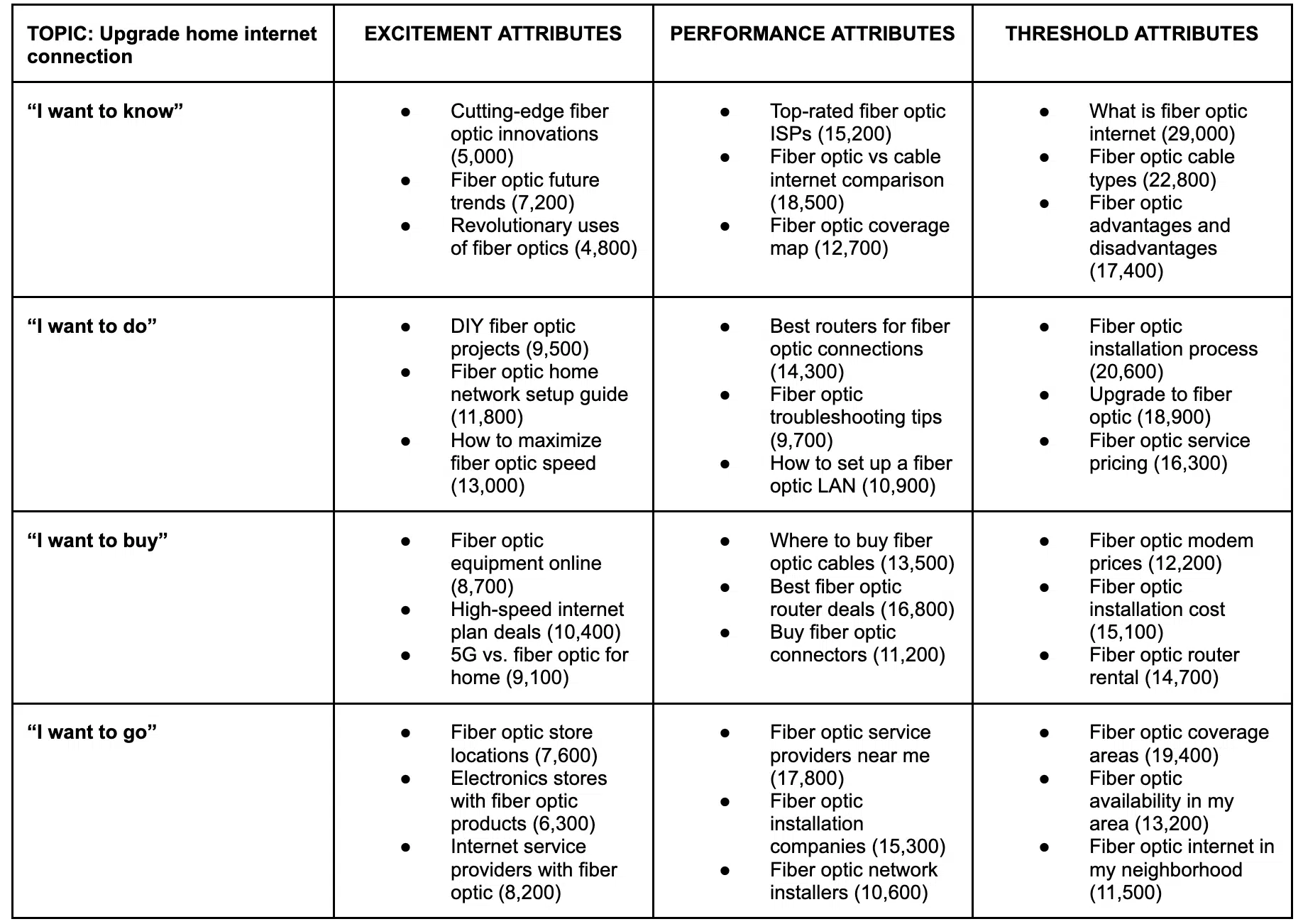
Analyzing consumers’ search queries and using matrices to identify critical product attributes (i.e., usage frequency and volume) can provide valuable insights.

Consider the scenario of Sarah, a tech-savvy individual considering upgrading her home internet connection.

Here’s how you can approach this:

  • Conduct a comprehensive analysis of searches across various platforms to build a detailed consumer profile. 
  • Adopt models like the Kano model to pinpoint which product attributes resonate with the consumer’s mental framework. 
  • Delve into the process of how consumers search for and categorize each type of attribute within the Kano model, examining these actions in every micro-moment:
Attributes categorization for micro moments
Attributes categorization for micro-moments

SWOT analysis

Companies can capitalize on economic opportunities by having the right tools and processes that align with consumer thinking to create an effective findability strategy.

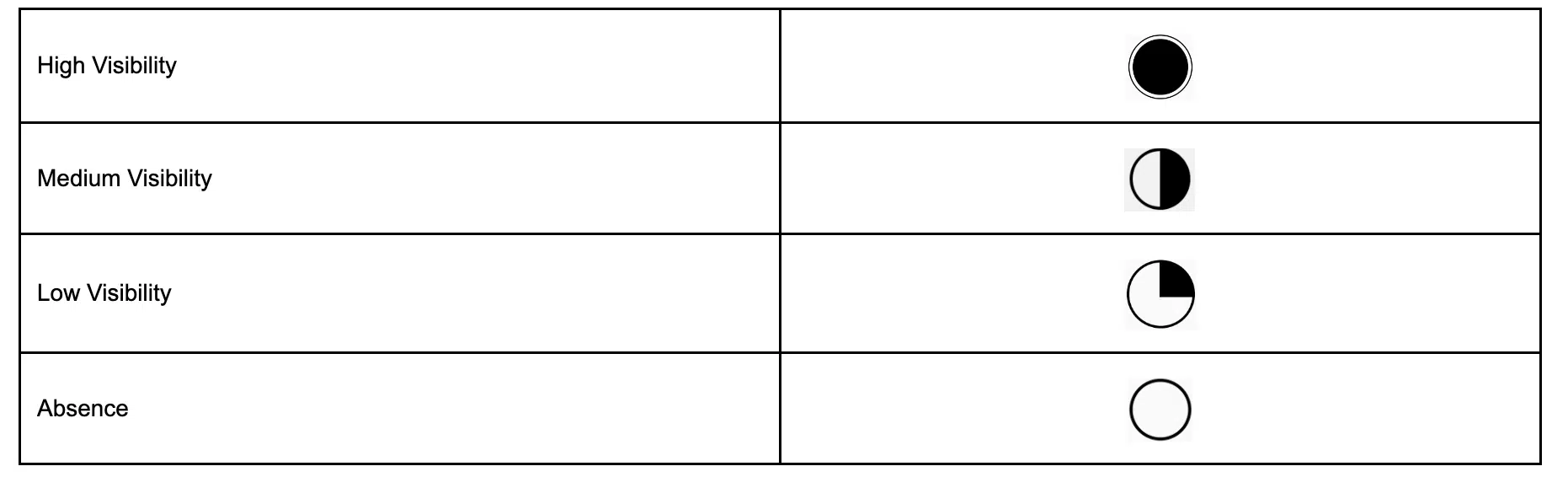
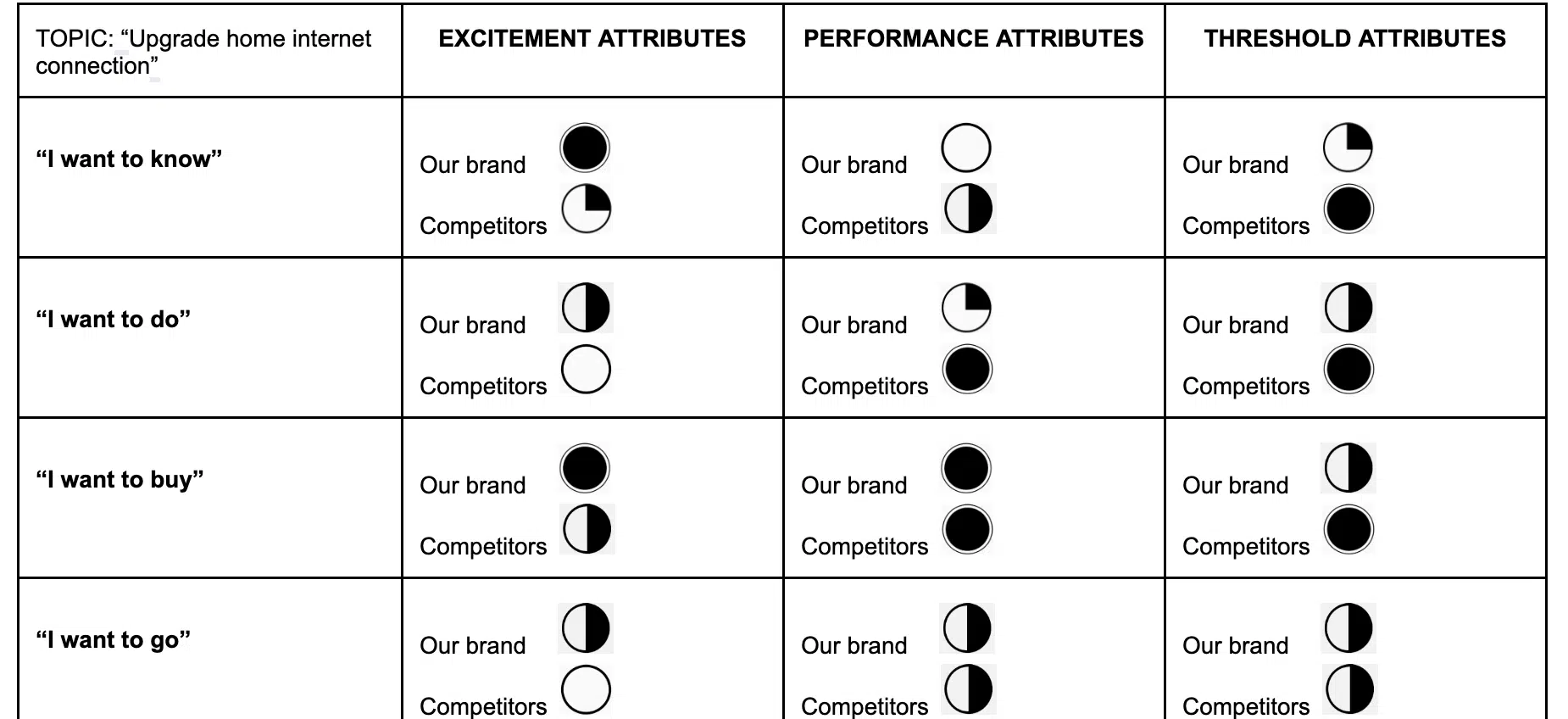
At my company, we assign a Visibility Index we developed internally to each attribute in correspondence with a specific micro-moment:

Representation of Visibility Index
Example of attributes categorization for micro-moments by Visibility Index

Dig deeper: SEO SWOT analysis: How to optimize where it counts

Phase 2: Strategy

Objectives definition

For our products or services to be discoverable by potential customers, we define specific objectives to implement the model seamlessly. 

Objectives can be categorized into:

  • Revenues
  • Savings 
  • Orders
  • Leads
  • Etc.

The objectives must align with both the company and the digital unit’s goals to synchronize efforts on findability with the company’s overall objectives, actions and budget allocation.

Strategy definition starting from customer journey conceptualization and design

This marks the next phase in findability strategy planning, involving the analysis and synthesis of preceding aspects. Here, we aim to streamline potential strategic options and select the implementation strategy.

Customer journey empowers us to define a strategy to position ourselves where the customer is, in a manner and format that resonates with their expectations, precisely when they anticipate encountering them:

  • Where
  • How
  • When

Prioritize enhancing user experiences for both digital and physical assets.

Dig deeper: How to create and execute a buyer journey-based content strategy


Get the daily newsletter search marketers rely on.


Phase 3: Tactics

Budget allocation

Effectively allocating the budget to various marketing channels is crucial for brand visibility and consumer discovery.

Consider investing in:

  • Pay per click (PPC). 
  • Pay per acquisition (PPA), including affiliate marketing. 
  • Pay per impressions. 
  • Optimizing store locations.
  • Enhancing signage.
  • And more.

By assessing these channels and their strengths, you can customize our budget strategy to match your brand’s goals and audience. 

There’s no one-size-fits-all approach; each business has its unique combination. Regularly monitoring and adjusting budget allocation is vital for a successful findability strategy.

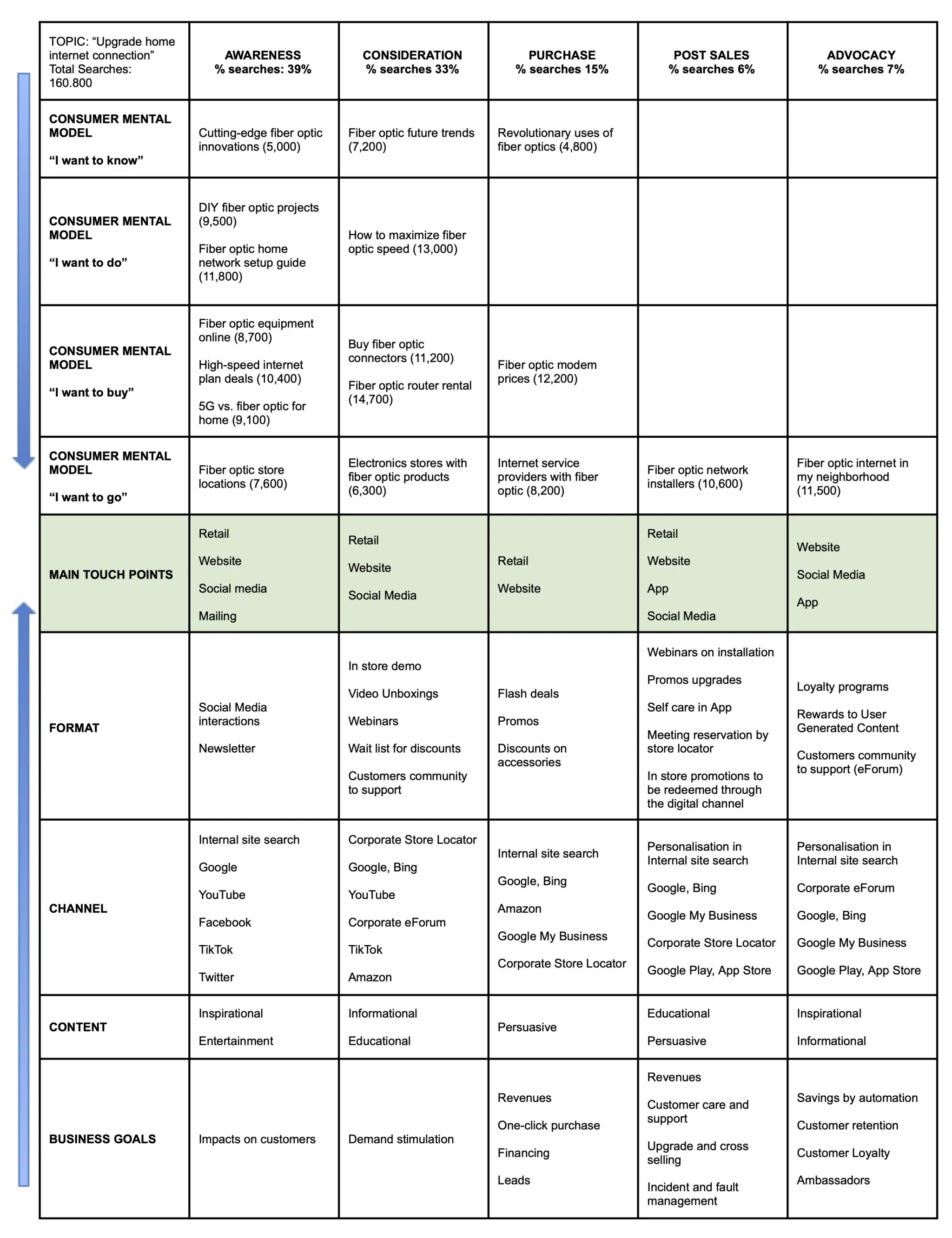
Channel selection, format choice and content selection

Every strategic decision and budget allocation must translate into tactics supported by:

  • Channel selection: Utilizing search environments/search engines such as Google, YouTube, Amazon, Facebook, X (formerly Twitetr), physical stores, corners, malls, etc.
  • Format choice: Considering options like video, voice, text, PDFs, images, photos, catalogs. It’s essential to assess the feasibility of generating new content or repurposing existing material.
  • Content selection: Focusing on aspects like inspiration, education, entertainment, persuasion, etc.

All of this aims to achieve specific business goals defined at each stage of the purchase funnel.

Example of Findability strategy and specific tactics by purchase funnel stage

Key performance indicators

Defining your key performance indicators (KPIs) will enable you to clarify objectives and track progress, ultimately leading to the initiative’s launch.

Below are some of the main KPIs we track:

  • Zero results searches
    • This KPI measures the number of searches that don’t yield any results or satisfactory responses for the user, which is crucial for improving search result accuracy and relevance.
    • This can be improved by offering search suggestions, autocomplete and related links, or even making a suggestion to add a new product or service to the portfolio to cover the unmatched demand.
  • Most common queries
    • This KPI tracks popular keywords or search terms used by searchers to find information or products on a website. 
    • Monitoring this KPI helps identify relevant and popular search terms, aiding in SEO.
  • Trending search terms
    • Refers to search terms gaining or declining popularity among users.
    • Analyzing these trends is vital to adjust the findability strategy to changing user needs.
  • Context
    • Refers to where users search from (i.e., webpages, Google, site search, social media).
    • This KPI examines different platforms or sources from which users initiate searches, helping tailor the findability strategy to those platforms.
  • Date
    • Refers to when users searched. 
    • Relates to search trends based on the date or time when searches occur. Important for planning findability strategies in sync with seasonal trends.
  • Geographic area
    • Analyzes the geographic location from which users perform searches, useful for adapting search strategies to different regions.
  • Devices
    • Examines the devices used for searches, helping optimize the search experience for each type of device.
  • Bounce rate
    • Measures how often users leave a website after searching without clicking on any results, indicating relevance issues.
  • Popular content/products
    • Measures the popularity of products or content that users search for.
  • Search refinements
    • Additional search terms users add after an initial query to refine their search, indicating the need for more precise results.
  • Digital searches to store visits
    • Measures the effectiveness of Findability efforts in driving physical foot traffic to a retail store. 
  • Online-to-offline conversion rate
    • The percentage of online visitors who make a purchase in a physical store.
  • Offline-to-online conversion rate
    • The percentage of in-store visitors who make a purchase online.
  • In-store traffic influenced by online
    • The number of store visits that can be attributed to online marketing efforts.
  • Local SEO rankings
    • The positions of the physical stores in local search results in a context of unbranded product or service searches. 
  • Customer lifetime value (CLV) by channel
    • The value a customer brings over their entire relationship with your brand, broken down by channel.
  • Omnichannel customer effort score (CES)
    • Measures how easy it is for customers to interact with your brand across all channels.
  • Mobile search traffic to physical store visits
    • Measuring how many users who found you through mobile search actually visited your physical store.

By consistently measuring and reviewing KPIs, we can enhance the performance of our tactics across all the channels at every stage of the purchase funnel. 

This iterative process aims to amplify each tactic’s impact on our business, ultimately driving greater overall success.

Dig deeper: 13 key SEO metrics to track

Phase 4: Operations

4.1: Time plan and go live

In this phase, we plan meticulously and set implementation dates for specified tactics. 

We prioritize swift and adaptable execution using agile methodologies, like Kanban for content changes and Scrum for programming code interventions.

Modernizing enterprise search for improved ROI

Mastering findability is vital for enterprise companies. 

By seamlessly optimizing for search, integrating online and offline channels and leveraging data-driven insights, enterprise brands can meet their customers where they are and provide a seamless, personalized experience. 

Remember, findability isn’t just about being discovered; it’s about being chosen.

As you embark on this journey, continuously monitor KPIs, adapt strategies and stay attuned to the evolving needs of your audience. 

With a robust omnichannel findability strategy, you’re not just connecting with customers but creating lasting, meaningful relationships.


Opinions expressed in this article are those of the guest author and not necessarily Search Engine Land. Staff authors are listed here.


Related stories

New on Search Engine Land

@media screen and (min-width: 800px) { #div-gpt-ad-3191538-7 { display: flex !important; justify-content: center !important; align-items: center !important; min-width:770px; min-height:260px; } } @media screen and (min-width: 1279px) { #div-gpt-ad-3191538-7 { display: flex !important; justify-content: center !important; align-items: center !important; min-width:800px!important; min-height:440px!important; } }

About the author

Vincenzo Musumeci

Vincenzo Musumeci is the Search and Findability Manager at Vodafone Spain. He has been working on optimizing and enhancing SEO effectiveness in the company for over fifteen years. He is an accomplished executive with international experience and a proven track record in developing digital strategies and tactics for companies, empowering them to achieve high-performance status. Able to visualize opportunities for change that will generate business for a company, while improving its digital channels performance. He has also worked individually in small outfits and start-ups with shoestring budgets, and in consulting services.

https://searchengineland.com/the-enterprise-guide-to-elevating-findability-and-roi-433030


5 behavioral strategies to make your content more engaging

This article is written assuming you are already creating fantastically optimized content.

(If you need some help with that, there are a plethora of articles you can read. I’d suggest starting with “How to create captivating, compelling and optimized content.”)

Here, I will take you through my top five tips on bringing a behavioral marketing approach to your content, thus making it more engaging. 

1. Identify the audience and where your content fits within their journey

With search engine algorithms today, optimizing content for your audience is synonymous with optimizing for search engines. 

Ensure you have absolute clarity on: 

  • Who your audience is.
  • What motivates them.
  • Why they would be interested in your content.
  • What they are trying to do. 

Considering the content’s place in the customer journey helps you tailor it more intentionally by understanding what came before and the next actions.

This can surface questions about content relevance and audience segmentation. It’s a valuable discussion since it signifies a commitment to personalized visitor experiences.

While some SEOs may worry about potential cannibalization, when done correctly and aligned with the audience’s needs, you can work around such issues.

For instance, I worked with a technical software business a while back. They had a super savvy tech audience that needed to assess their products but also a much more business-minded C-suite audience that would also be browsing. 

We had a simple button that moved the content between “I’d like to get more technical” to “I’d like to get less technical.” 

This content was all fully indexable on the same URL and served their two main audiences, ensuring they had the right content to answer their requirements. 

The lesson? Think behaviorally about the customer’s journey. If you use the “Think, Feel, Do” methodology to put yourself in the customer’s shoes: 

  • The “think” will tell you what they are thinking and give you insight into the message you need to convey. 
  • The “feel” unearths how they are feeling and gives a window into the emotions you may want to convey. 
  • The “do” tells you what they are trying to do, giving you a vision of what they need to do next and therefore helps you to optimize on onward experience, also telling you what you need to track to measure the success of the content.  

Dig deeper: Content creation: A psychological approach

2. Understand the power of language and storytelling

Whatever industry you are in, we must remember that human beings are not “thinking creatures that feel, but we are actually feeling creatures that think,” as pointed out by Jill Bolte Taylor in her book “My Stroke of Insight: A Brain Scientist’s Personal Journey.” 

We’ve been telling stories since 30,000 BC by first painting murals on the walls of caves. Storytelling is integral to how we communicate. With every piece of content you create, the story or narrative must be at the foundations. 

To craft a story, you need to have a beginning and an end, and when we think about how this plays into the customer journey, the beginning could be before the user has even landed on your content, and the end could be somewhere in the future. 

Storytelling is a skill, and one of the key parts of that skill is the ability to use language. Language evokes emotions that play into the feeling part of our being. 

A 1996 psychological study best demonstrates this phenomenon and has become synonymous with a behavioral technique known as “priming.”

At New York University, students were grouped into two and taken to different rooms. In the rooms, they had pieces of paper with words written on them that they had to organize into sentences. Once complete, they had to walk down the hall to another room, sign out, and they were done. 

What was unknown to the students was that out of the two rooms, one had totally random words, and the other had words associated with the elderly.

Psychologist John Bargh found that the group primed to think about the elderly walked down the corridor more slowly than the group with random word prompts, demonstrating a clear change in behavior.

This study is one of the most notable studies on priming and shows how powerful the words we choose can be.

If you write an article in a bad mood and that mood slips into your storytelling, you will likely leave the reader feeling a bit deflated.

If your storytelling is boosted with energy because of your passion and excitement for a topic, you will likely transfer this feeling onto the reader. 

The lesson here is all about making a conscious decision to use language within your content that will resonate with your audience and match the feeling you want to impart to them.

Language must be intentional, not a lazy attempt to convey a message. 


Get the daily newsletter search marketers rely on.


3. Build a relationship with your audience, be memorable

Every interaction your brand has with a user is a significant opportunity to build on that relationship.

We live in a world where the relationship individuals have with brands is critical to the decision-making process of where to buy from. With every interaction, you want to ensure you are building your brand positively in that user’s memory. 

There are many studies on memory, but the attribute I always see as a common thread is, unsurprisingly, around feelings. If you make people feel something, they will be much more likely to remember it. 

This links back to the previous two points, as if you know where the customer is in the journey and you can make the content resonate with them, priming them with the mindset that suits their onward journey. Then, you are likely to make them feel something. 

The other linked gem here is that storytelling allows people to see themselves in the story. When we attach meaning to something or visualize ourselves as part of something, this again intensifies the opportunity to remember it. 

4. Put the user in the driving seat

There are two ways I like to look at businesses: 

  • Those that are “inside out.” 
  • Those that are “outside in.” 

The “inside-out” businesses make decisions internally, without attempting to reach their audience to understand their needs and requirements. These businesses think they know best. 

An “outside-in” business is the complete opposite. They take time to listen to their customers, their potential customers and the needs of their audience, and they use this to power the direction of their business. 

For some research I did a few years back, we built a tool that assessed how much content was written about the business (selfish) rather than the customer (selfless). 

For the 100+ leisure and entertainment sites the tool assessed, we found 50% of the content to be business-first (selfish). And of the 650+ B2B sites we looked at, we found 40% of the content to be business-first (selfish).

These staggering statistics show how much content exists out there just broadcasting their views to the world, instead of reframing what they want to convey to put the user into the story. 

When you take a customer-first approach, your content suddenly becomes much more relevant and resonates better with the audience. 

5. Consider the relevant thinking style for your audience and the content

Think about whether your content should be static or dynamic. There isn’t a right or wrong here other than just ensuring you consider what is right in the context of the customer journey.

Static content tends to be written in the present and can be good at evoking clarity. This suits the “what” and “why” thinkers (i.e., detail-orientated users), so this is often relevant to product descriptions. 

Dynamic content tends to be more future-focused and sparks more imagination. This suits the “how” and “so what” thinkers looking for more inspiration and fits service or experience-led content. 

You can also create balanced content, answering the why, what, how and so what, to resonate from all angles. 

The danger here is that the content can end up really long, and might lose someone mid-way through if they haven’t found the bit that really resonates with them. 

To counteract this, think about how you break the content up, use anchor links and aim to direct the user through the content, ensuring they can reach what is most relevant to them as quickly as possible. 

Drive audience engagement with compelling content

Content is our number one tool as marketers to build relationships with our audience online. This could be anything from long-form articles, product descriptions, videos, helpful guides, etc. 

Content is also one of the easiest ways to turn a user off. We’ve all been there – you Google something, click on the listing that seems to answer your query, but then quickly retreat, as the website was masquerading as something it is not. 

Our audience is time-poor, so every moment their attention is on your content is a chance to build a relationship. To engage effectively, understand what they seek and how your brand can assist. 

Serve relevant content at the right journey stage, creating a lasting impact and guiding them forward. This strategy not only captures their attention but also fosters future brand loyalty. Remember, being helpful and generous with content pays off in the long run.

Dig deeper: How to leverage neuromarketing for SEO


Opinions expressed in this article are those of the guest author and not necessarily Search Engine Land. Staff authors are listed here.


Related stories

New on Search Engine Land

@media screen and (min-width: 800px) { #div-gpt-ad-3191538-7 { display: flex !important; justify-content: center !important; align-items: center !important; min-width:770px; min-height:260px; } } @media screen and (min-width: 1279px) { #div-gpt-ad-3191538-7 { display: flex !important; justify-content: center !important; align-items: center !important; min-width:800px!important; min-height:440px!important; } }

About the author

Becky Simms

Becky has spent the last 15 years working in digital marketing, starting Reflect Digital in 2011, which is now a team of over 35 digital specialists. Becky secured a three-year hat-trick in 2023 of being listed in the BIMA 100, a list of the top 100 people shaping the future of the digital industry. Becky’s passion for digital lies within understanding human behaviourand applying behavioural science to digital channels. It is her belief that when you truly understand your audience you unleash a performance potential previously not possible to attain.

https://searchengineland.com/behavioral-strategies-engaging-content-433024


Google-Extended does not stop Google Search Generative Experience from using your site’s content

Google-Extended, the new standalone product token, to tell Google through your robots.txt to not use your site content for Bard and Vertex AI and other AI projects does not work for the AI-answers and snapshots provided in the Search Generative Experience.

Google told us that Google-Extended does not work for SGE. “SGE is a Search experiment so website administrators should continue to use the Googlebot user agent through robots.txt and the NOINDEX meta tag to manage their content in search results, including experiments like Search Generative Experience,” a Google spokesperson told us.

Why not for SGE. Google explained that SGE is part of the Google Search experience; it is a search feature and thus it should work as how normal search directives work. “The context is that AI is built into Search, not bolted on, and integral to how Search functions, which is why robots.txt is the control to give web publishers the option to manage access to how their sites are crawled,” Google told us.

SGE AI-answers. There are examples of SGE showing AI-generated answers, with website cards, from sites that have specifically directed Google not to use their content for AI purposes.

Glenn Gabe posted a screenshot of VentureBeat.com that specifically has Google-Extended disallowed in its robot.txt file, being used in the AI-generated answer in SGE:

F78bb WWEAA26Jo

Why we care. If you thought using Google-Extended would prevent Google from using your content for SGE AI-powered answers, then you were wrong. Google-Extended is for Bard and Vertex AI and other non-search-specific products.

If you don’t want your answers in SGE, then you would need to block Googlebot completely, which most of you do not want to do.


Related stories

New on Search Engine Land

@media screen and (min-width: 800px) { #div-gpt-ad-3191538-7 { display: flex !important; justify-content: center !important; align-items: center !important; min-width:770px; min-height:260px; } } @media screen and (min-width: 1279px) { #div-gpt-ad-3191538-7 { display: flex !important; justify-content: center !important; align-items: center !important; min-width:800px!important; min-height:440px!important; } }

About the author

Barry Schwartz

Barry Schwartz is a Contributing Editor to Search Engine Land and a member of the programming team for SMX events. He owns RustyBrick, a NY based web consulting firm. He also runs Search Engine Roundtable, a popular search blog on very advanced SEM topics. Barry can be followed on Twitter here.

https://searchengineland.com/google-extended-does-not-stop-google-search-generative-experience-from-using-your-sites-content-433058


Overstock’s Bed Bath & Beyond rebrand: The SEO impact

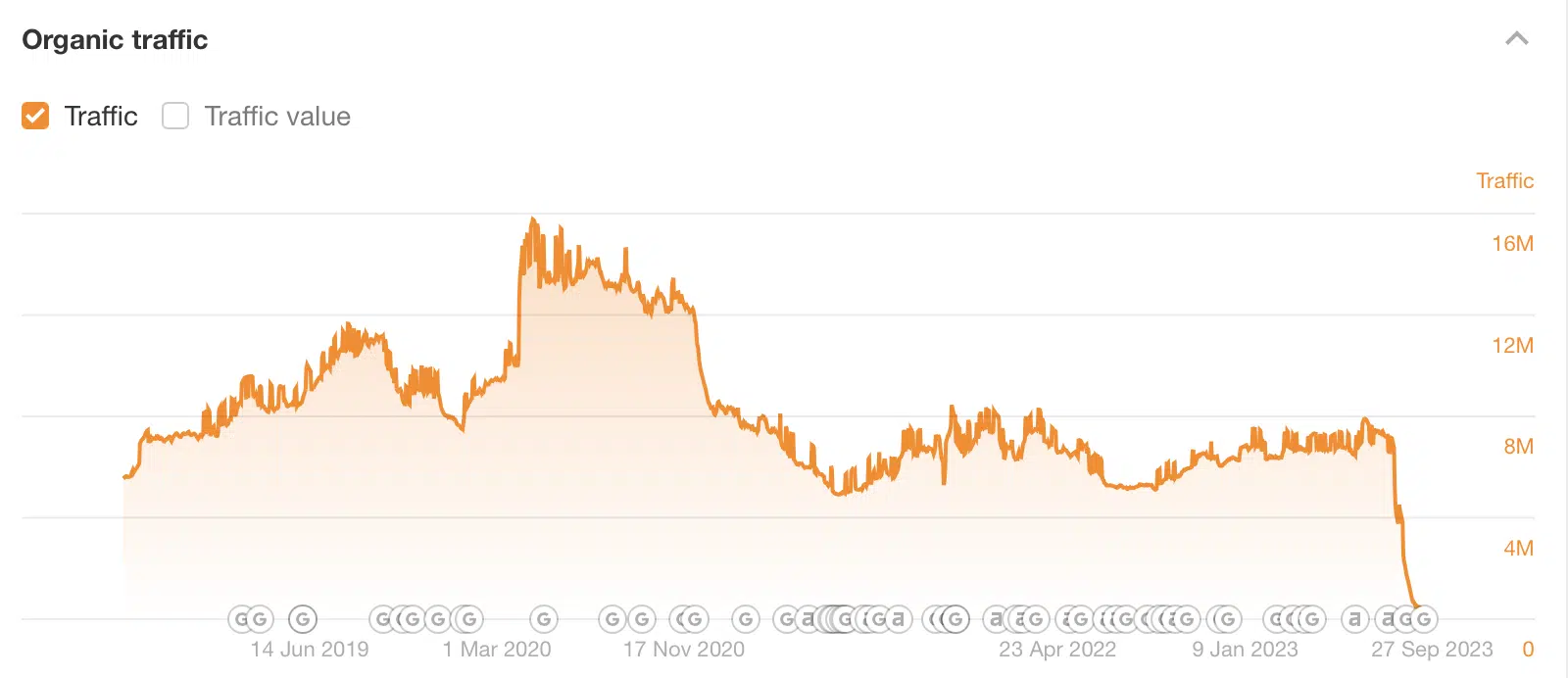
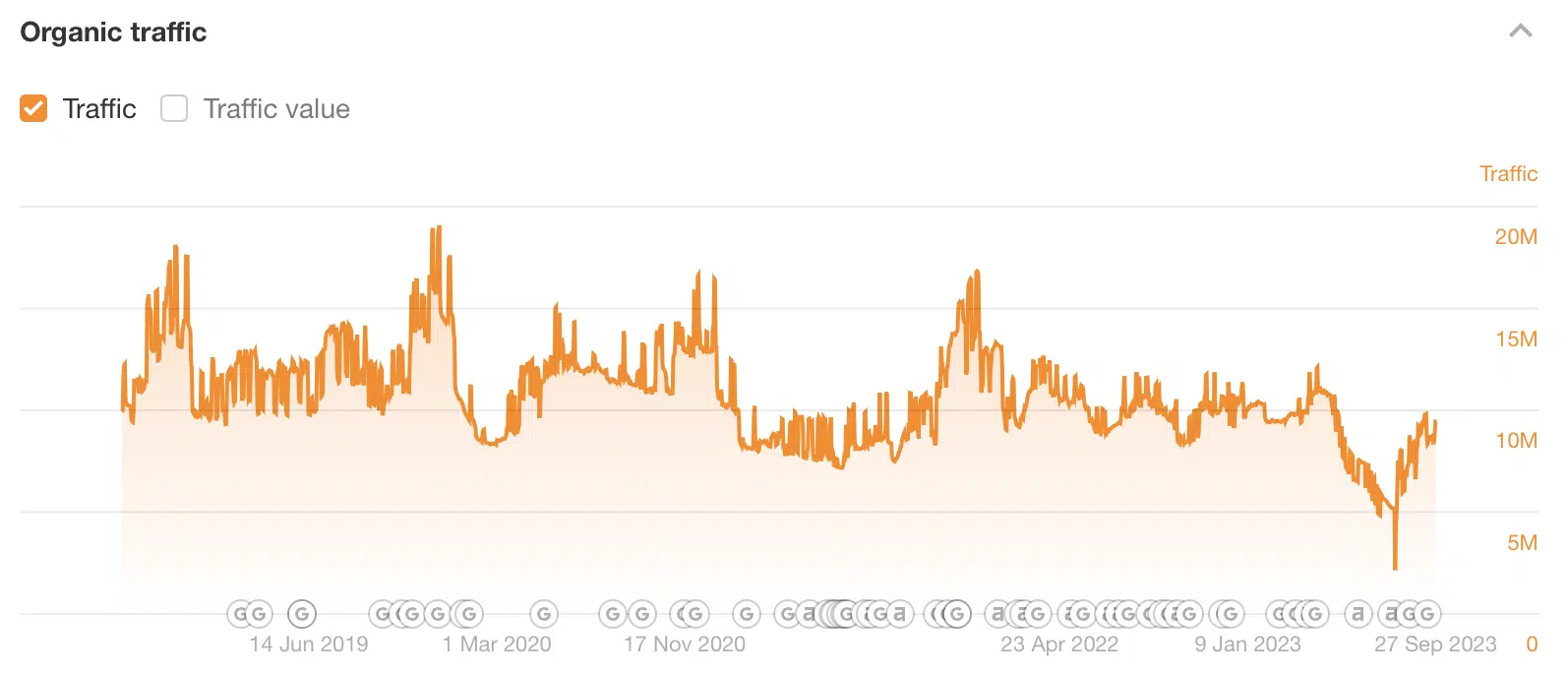
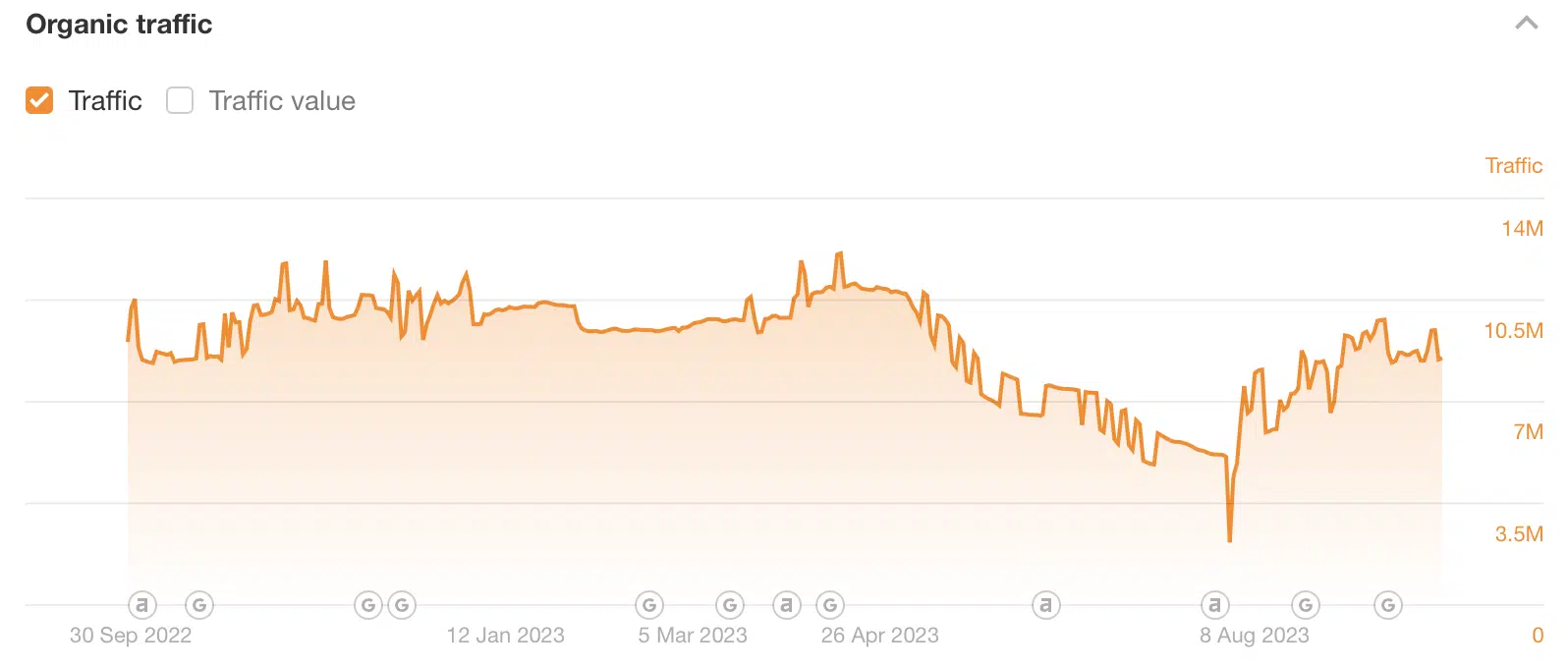
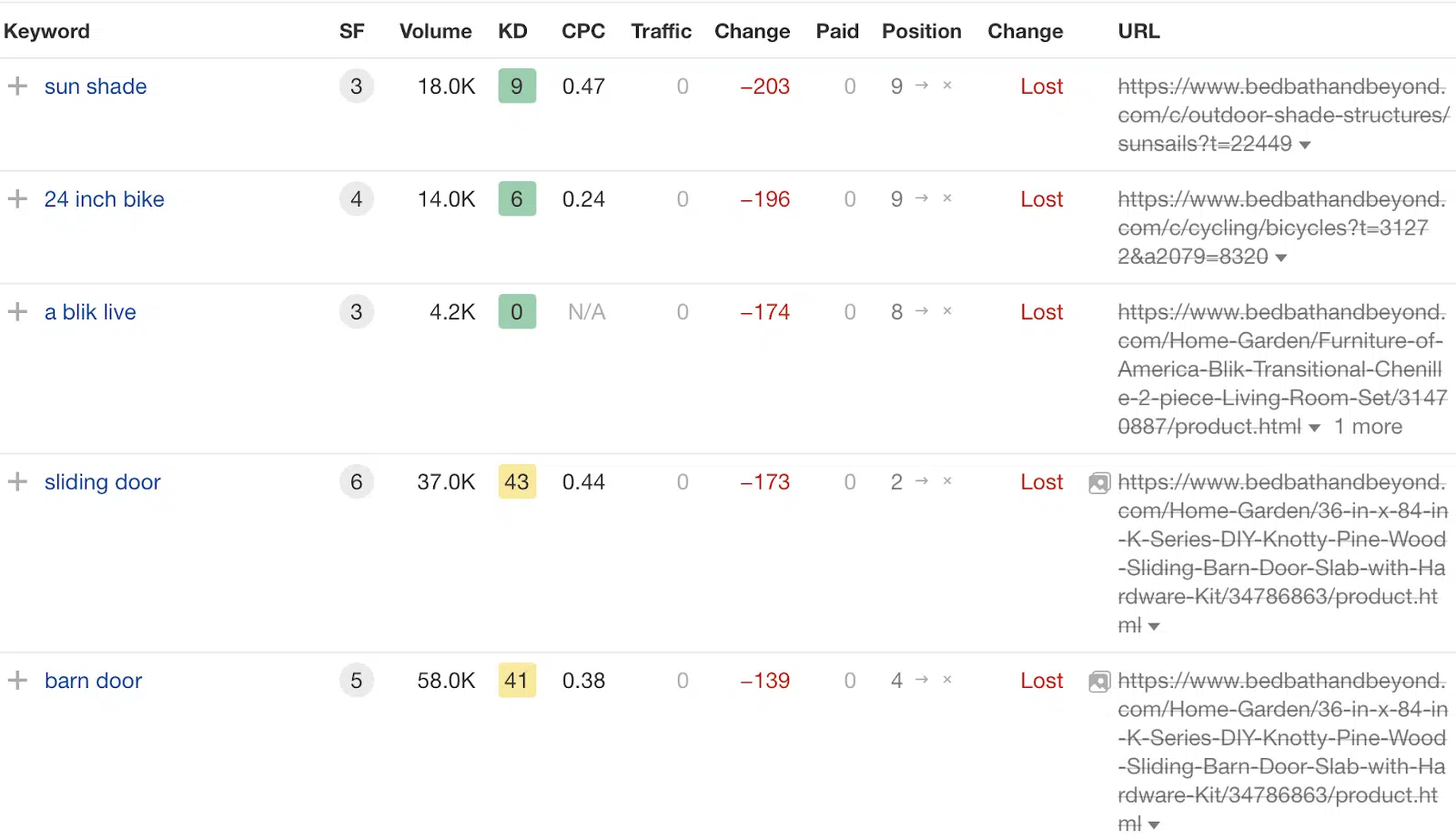
Overstock relaunched as Bed Bath & Beyond on Aug. 1. Many SEO professionals have been critical of the move as the community has begun analyzing early data. 

The primary complaint is that overstock.com did not cleanly 301 redirect all URLs to an equal counterpart on bedbathandbeyond.com. Thousands of URLs have not been redirected, and many more were blanketly redirected to the bedbathandbeyond.com homepage. 
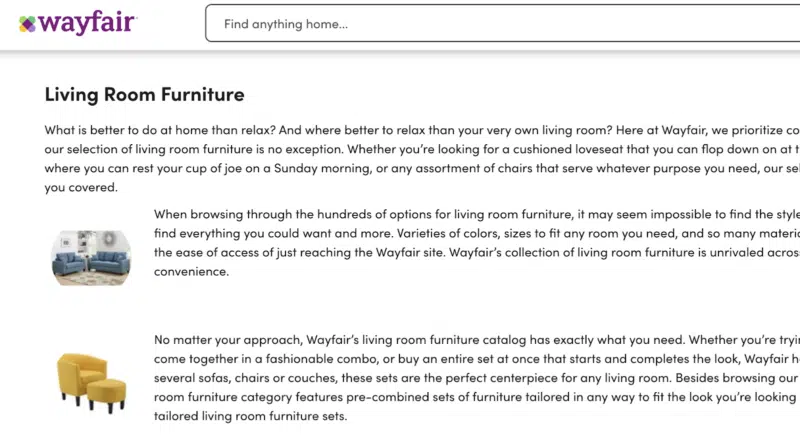
There are multiple reasons this might have happened. 

  • The Overstock team determined that certain URLs didn’t contain enough value to burden with a redirect.
  • There may have been business reasons for not making the connection, such as reducing the number of products sold on the site.
  • The initial merger was the MVP (minimal viable product) and the migration will be released in phases.

Why the merger was big SEO news

Overstock was founded in 1999 as a digital-only shopping destination that offered consumers deals on liquidated inventory. Over the last 20 years, they have evolved into a shopping destination spanning multiple categories.

Everyone knows Bed Bath & Beyond (BB&B) as the store that mails out a blue and white postcard with a discount. The store was founded in 1971 as a fixture in strip malls and suburban areas. As the name implies, the store specializes in home goods, primarily in the bed, bath and kitchen categories. 

These two stores were powerhouses online for much of the last 20 years. Their traffic levels were significant among online retailers, making the merger such a big deal for search marketers. 

Overstock’s organic traffic peaked during the pandemic when everyone was forced to shop online. Still, they couldn’t sustain their growth, losing market share to Amazon and other online retailers.

Overstock organic traffic

Bed Bath & Beyond’s organic traffic peaked prior to the pandemic but never recovered post-pandemic.

Bed Bath & Beyond organic traffic

Traffic is growing, but still below pre-bankruptcy levels

Over three weeks after the migration, the initial results have been OK. That said, organic traffic has yet to rebound to pre-Overstock levels, according to Ahrefs.

Bed Bath & Beyond organic traffic Aug 2023

It is not expected that BB&B’s website will reach pre-bankruptcy traffic and absorb Overstock’s organic traffic. 

Much of bedbathandbeyond.com’s organic traffic prior to the bankruptcy was customers looking for coveted blue coupons, shopping online for store pickup, or looking at products and then shopping in-store. 

It’s safe to assume that BB&B can rise above their pre-bankruptcy organic traffic levels with the combined sites’ organic traffic but below the aggregate traffic totals of overstock.com and bedbathandbeyond.com. 

Why won’t BB&B reach the aggregate traffic totals of the two sites? 

Partially for the reasons above (mainly shopping online and in-store pickup and people looking to shop in-store) and also due to product and other page overlap. 

Many of the categories are the same and will be consolidated on BB&B. There are likely thousands of products that are the same, in which case those pages will be consolidated. 

Due to these variables, traffic will be less than the previous sum of both sites. However, over time, BB&B can earn incremental traffic across pages that cater to customers in each stage of their shopping journey.


Get the daily newsletter search marketers rely on.


Where does Bed Bath & Beyond go from here?

Here are some additional steps that bedbathandbeyond.com can take to boost its organic traffic. 

  • Focus on category page performance, which has declined since bedbathandbeyond.com declared bankruptcy.
    • To counter this decline, the company should focus on improving the content related to its products on these category pages. 
    • By updating and enhancing the information on these pages, the company can work to regain its lost search engine rankings.
Living Room Product Category Page

vs.

Wayfair Product Category Page 800x440
  • Assuming the migration is completed in steps, URLs redirected to the homepage should be redirected to the closest counterpart on bedbathandbeyond.com.
  • To capitalize on the recent improvement in search engine rankings, the company could create individual pages on the new BB&B website that correspond directly to the content from the old website. This means there should be a dedicated new page on bedbathandbeyond.com for each piece of content that was moved.
  • Stop the bleeding on deeper pages that contain keywords which are no longer ranking since the migration.
BB&B keywords
  • Determine if the influx of new pages has compromised the internal linking structure. Create an internal linking map to ensure that priority pages remain the priority and that link equity is being spread throughout the site.
  • Review crawl logs to determine if any site sections are having issues being crawled and accessed.

Dig deeper: How to complete a website shutdown with a split migration

How we would have migrated Overstock to BB&B

Migrations are difficult and complex, especially when merging and/or moving onto a new platform. A lot must happen in the right sequence to ensure the site functions as expected during launch. 

When thinking of a migration from an SEO perspective, the main objective is matching pages (old to new) so that they pass their value onto the new pages. While this sounds simple, there are a number of steps that must be planned and executed.

Here are the steps we would take at our agency to ensure that all angles are being considered and that the old site is prepared to pass value onto the new pages:

  • Review content on templated pages (e.g., product, category pages) and other content contained in buyer’s guides, blogs, how-to articles, etc.
  • Review traffic data to determine which content should be kept on the new version of the site and which content can be retired.
  • Once URL structure is understood on the new site, create a URL map that details redirects needed (e.g., single page level or directory level redirects).
  • Create rules for programmatic update of internal links.
  • Create canonical tag logic for the new pages on the new site.
  • Update href-lang links to pages on the new site.
  • Create XML sitemap strategy and QA once implemented.
  • Review the site from a technical point of view in a sandbox environment to ensure that the site has no major issues and structured data is included on key pages.
  • Ensure site speed is addressed for both mobile and desktop.
  • Update robots.txt file. List any new XML sitemaps and remove all old references to the old site.
  • Validate all changes prior to going live in the sandbox environment.
  • Conduct post-migration steps, hotfix important issues, and add less-important issues to the dev backlog.

With most migrations, there will be some hiccups even if all the steps are followed. 

It could be an issue with data migration, incorrect canonical logic, or a directive in the robots.txt file that blocks the site from being crawled. 

As an SEO, you need to find and fix issues quickly. Product and development teams must be aligned to handle these hotfixes quickly. 

Exploring the SEO impact of Overstock and Bed Bath & Beyond’s website merger

So, has it been a perfect migration? Not quite. But it’s also not as bad as some SEOs were initially reporting. 

Organic traffic is growing, the number of keywords ranking is increasing, and the BB&B team is learning more about the site daily. 

There are clear growth opportunities that the SEO and content teams can undertake. Adding content over time to priority category and subcategory pages would be among the most impactful tasks the BB&B team can tackle. 

Also, a focus on internal linking and ensuring the entire site is crawlable and indexable. 

The core focus must be getting people comfortable shopping on the new BB&B site. In time, traffic will grow organically if the brand reestablishes itself as a leader in shopping for home goods. W

hile these two combined powerhouses have the potential to eat market share, there are still many risks in the space – giants like Amazon and smaller companies – as DTC businesses continue to grow in popularity due to their ability to adapt to market needs.


Opinions expressed in this article are those of the guest author and not necessarily Search Engine Land. Staff authors are listed here.


Related stories

New on Search Engine Land

@media screen and (min-width: 800px) { #div-gpt-ad-3191538-7 { display: flex !important; justify-content: center !important; align-items: center !important; min-width:770px; min-height:260px; } } @media screen and (min-width: 1279px) { #div-gpt-ad-3191538-7 { display: flex !important; justify-content: center !important; align-items: center !important; min-width:800px!important; min-height:440px!important; } }

About the author

Brian Free

Brian has been in digital since 2007, and is the Vice President, Digital Marketing for Eyeful Media. His focus is acquisition marketing, with deep expertise in SEO, paid search, and affiliate marketing. Prior to joining Eyeful, Brian served as Director, SEO for Lulus.com and Director of Customer Acquisition for Legacy.com. He has worked in both agency and in-house environments over the last 17 years and is based in Moorpark, CA.

https://searchengineland.com/seo-impact-overstock-bed-bath-beyond-website-merger-432995


9 salary negotiation tips for search marketers

Whether you’re working in SEO, PPC or somewhere in between, salaries are always a contentious subject. They can be hard to talk about, challenging to quantify and difficult to change.

There are a lot of guides out there that help with salary negotiations, but in this article, I want to talk specifically about negotiating your marketing salary.

Difficulties with marketing salaries

There are some critical complexities to marketing jobs that make it trickier to benchmark appropriate salaries.

There is no industry standard

Unlike other professions, which have a national body and associated grades, there is no standardization for marketing roles. As such, it can be difficult to attribute salary bands inter-company.

Job titles have little consistency

A VP of marketing in one company could be the junior level account manager, but in another, the most senior marketer. 

Due to the lack of consistency in titling, it can be hard to identify the seniority of roles and, therefore, the rough salary bands that would be appropriate.

Recent years have seen huge fluctuations

During the COVID-19 pandemic, plenty of roles were made redundant.

Events managers, experiential marketers and out-of-home (OOH) advertising executives all saw reduced employment opportunities as countries experienced lockdowns. 

On the other hand, SEOs saw a steep rise in demand for their skillset as more companies explored online trading. 

With lockdowns and restrictions ending, the levels of these roles changed again. As a marketing discipline becomes more or less in demand, salaries will change to compensate. 

Some marketing channels can be misunderstood

Less marketing-savvy companies often advertise one role to cover three or more distinct specializations, all for bottom-of-the-market salaries. 

Even those companies that value the skillsets of marketers more accurately may struggle to understand the sheer complexity and range of knowledge and experience required to excel in a role. This can lead to huge under-valuing of marketers. 


Get the daily newsletter search marketers rely on.


Knowing that marketing salaries can be hard to navigate from an employer’s perspective, how should you ensure you’re fairly compensated for your knowledge and experience as an employee?

The following nine tips can be loosely categorized as follows:

  • Know what you bring to the table.
  • Know what’s realistic.
  • Identify and demonstrate what’s valuable to the company.
  • Stick to your boundaries.

Know what you bring to the table

We’ll start with the side of salary negotiations that, for some, can be very difficult – accurately valuing their own skillset.

We can assume that if you are in the position of negotiating a salary, you have either already been offered the job or you work for the company and are hoping to secure a raise. 

In either case, congratulations! The company must already think you are suitable for the role. However, that doesn’t stop them from trying to secure your services at the most economical price.

Knowing what you bring to the table is key to having the bargaining power and confidence to negotiate a fair salary. This doesn’t just mean how much direct experience you have of the role you have landed. 

Tip 1: Demonstrate your experience in the industry

Don’t underestimate how much employers value candidates who have knowledge and experience within their sector. 

You may also find that some industries will struggle to hire marketing professionals, and your willingness to join that industry can command a higher salary. 

If you have worked within notoriously difficult industries like gambling, adult entertainment or pharmaceuticals in the past, you might well be able to demand a higher salary because of it. This can be down to the perception of difficulty in marketing within these industries.  

Tip 2: Promote your prior experience in – and out of – similar roles

Your years of experience in a role might feel like an obvious bargaining chip when negotiating salary. However, don’t forget that an employer might also benefit from the knowledge and experience you gained outside of the role you are applying for.

Just because your prior job titles may not have sounded similar to the role you are negotiating now doesn’t mean the skills you learned there aren’t directly relevant.

Review your CV and compare it to the role you are applying for. Pick out the elements in your work history that match the ad.

Look beyond the obvious and consider transferable skills like communication, problem-solving and stakeholder management.

Dig deeper: 13 essential SEO skills you need to succeed

Tip 3: Highlight extra skills outside of your job specification

Also, think about the skills that you have acquired over the years that might not be listed in the job description, but you imagine will be critical for success in the role anyway.

This can be particularly useful if you are more junior in your career and lack directly relevant experience in similar roles. 

Consider what you learned through volunteering roles or your first weekend and summer jobs.

They might be a million miles away from the marketing industry, but chances are you will have learned lessons through them that can put you in good stead for your current career. 

Know what is realistic

It’s one thing to know your worth in terms of the skills and experience you can bring to a company, it’s another to value that in the employment market accurately. 

Unfortunately, salaries are capped by what employers are willing to pay their staff. 

Tip 4: Be familiar with the industry benchmarks

Do some research when considering your salary. You may have been paid above or below average in the job you are leaving, which could skew your view of an acceptable salary. 

Look at job ads in your geographic area that require similar skills and experience and plot out the bottom and top ranges of salaries. 

Make sure you don’t identify like-for-like roles just on the job title alone. As mentioned earlier, there is often no standardization, and you might be comparing your role with one for a more senior or junior candidate. 

Similarly, keep an eye on the industry these jobs are for. You are unlikely to see charity roles paying the same as ones in tech or finance.

Have a look at salary benchmarking reports like the following. 

These can give you an objective view of your market. Remember that different countries will have vastly different salaries, so don’t compare U.S. with UK salaries, for instance. 

Tip 5: Find out the internal salary ranges

During the process of applying for a role, it is always helpful to find out the salary range being offered. This isn’t always possible. 

Some companies will wait for the candidate to make the first move concerning salary and won’t want to tip their hand for fear of offering more than they could have gotten away with. 

This is why it’s important to consider Tip 4 first, so you know what your skills and experience are worth in the open market.  

Some companies will operate with banding for roles. For example, a senior SEO specialist might be a level 4 on the company’s career level chart and a junior SEO, a level 2.

You could ask the recruiter for that information if they are unwilling to divulge the exact salary band. This might give you some insight into where the role fits within the operational hierarchy of the company and, therefore, what ceiling the salary might have. 

If you can find out the salary range, try to identify what makes the top of the band achievable.

Is the company seeking additional “nice to haves” to award the top salary? Perhaps it is reserved for people with experience in their particular industry. 

Once you know what skills command the higher salary, you can highlight them in your CV and interviews. 

Identify and demonstrate the values of the company

As many of us know from job interviews, sometimes what a company really wants isn’t explicitly detailed in the job ad or early conversations with recruiters. 

Unfortunately, hiring managers won’t always know what they want from a successful candidate until they have interviewed a few people to compare with. 

This can mean that you are left not knowing what is important to a company in regard to the role and, therefore, will struggle to highlight your suitability for it and why you deserve the salary you are requesting. 

Interviews can be a good opportunity to explore these values more. 

Ask the interviewers what “successful” looks like in the role or even the characteristics of their top-performing colleagues. 

This will give you the necessary insight into the traits and behaviors that the company appreciates.  

Tip 6: Demonstrate how you live up to those values

Once you know what is valuable to a company, you must identify how to add that through the role. 

For example, perhaps “initiative” is something that the company holds in high regard. You could use the interview process to highlight how you use your initiative throughout your work. 

Use examples from previous work experience to demonstrate how you embody the company’s values. Give evidence of projects or situations where you showed those values. 

For example, if “transparency” is important to the company, you can talk about a time when you owned up to a mistake you made. 

Your compatibility with the company, not just the job proficiency, will make you an even more attractive candidate. With that comes the opportunity to be awarded a higher salary. 

Stick to your boundaries

When negotiating your salary, you must know what your absolute minimum is. This isn’t just the lowest salary you can afford to take.

It means identifying what is important to you in a role to feel respected and valued and what the remuneration package would need to be to assist with that. 

If you go into negotiations knowing your boundaries, it will make saying “no” to a job easier. 

Tip 7: Consider other benefits that will make up for a lower salary

There may be good reason to take a lower salary in some circumstances. 

You may be moving into a slightly different role where you have less experience and, therefore, are starting at a more junior level. The opportunity to grow in new skills may warrant a reduction in your salary.

There could be other tangible benefits, like great health coverage, more paid holidays, shorter working hours or gym membership, that you feel are a good trade-off for taking a lower salary.

Tip 8: Identify other good points about the company that allows for a lower salary

You may be moving to an industry you are passionate about. Perhaps you are joining a charity and feel that the satisfaction from helping the cause is enough to make up for lower pay. 

Make sure that you factor this into your salary expectations when considering your boundaries. 

Tip 9: Decide how little is enough for you to walk away

Having worked through the above tips, you should now understand how much you are willing to take – or remain in – a job for.  

Remember this during the negotiating process. You may feel pressure to not lose the role due to asking for more money. You might not want to appear too financially motivated.

Joining a company and immediately feeling like you should be asking for a pay raise will not work, nor will it help you positively embed yourself in the company. However, working and feeling underpaid will not be sustainable for you either.

You will likely be better off turning down a role that cannot close the gap between their offer and your minimum salary expectations.

Empower yourself in marketing salary talks

You deserve to be paid what you are worth.

Use the above tips to identify what that is, to factor in any mitigating circumstances and to arrive at a figure you are willing to take a job for. 

Once you know what that number is, negotiating for it is a case of demonstrating why you add value to the company above other candidates and how you working there will be greatly impactful. 

If there is too big a divide between what the company is willing to pay and what you feel your skills and experience are worth in that role, you may be better off walking away from it. 


Opinions expressed in this article are those of the guest author and not necessarily Search Engine Land. Staff authors are listed here.


Related stories

New on Search Engine Land

@media screen and (min-width: 800px) { #div-gpt-ad-3191538-7 { display: flex !important; justify-content: center !important; align-items: center !important; min-width:770px; min-height:260px; } } @media screen and (min-width: 1279px) { #div-gpt-ad-3191538-7 { display: flex !important; justify-content: center !important; align-items: center !important; min-width:800px!important; min-height:440px!important; } }

About the author

Helen Pollitt

Helen is a senior SEO with over a decade’s experience in the industry. She has a passion for equipping teams and training individuals in SEO strategy and tactics. Helen is often seen on stage at conferences delivering talks about digital marketing.

https://searchengineland.com/negotiating-salary-search-marketing-432979