How the Google antitrust lawsuit can impact advertisers

Digital advertising could be on the cusp of changing forever.

The antitrust lawsuit against Google is one of the most significant filed by the U.S. Department of Justice (DOJ) in over 25 years.

While there are numerous digital advertising providers, Google still captures approximately 28% of digital ad spend, making it the industry’s predominant player. 

If the DOJ wins the lawsuit, the digital advertising landscape will forever change. 

Understanding the official DOJ lawsuit 

To understand the complaints within the DOJ lawsuit, you need to read the official press statement of the Office of Public Affairs for the U.S. Department of Justice. The official complaints against Google’s anticompetitive conduct include:

  • Acquiring competitors: Engaging in a pattern of acquisitions to obtain control over key digital advertising tools used by website publishers to sell advertising space.
  • Forcing adoption of Google’s tools: Locking in website publishers to its newly-acquired tools by restricting its unique, must-have advertiser demand to its ad exchange, and in turn, conditioning effective real-time access to its ad exchange on the use of its publisher ad serve.
  • Distorting auction competition: Limiting real-time bidding on publisher inventory to its ad exchange, and impeding rival ad exchanges’ ability to compete on the same terms as Google’s ad exchange.
  • Auction manipulation: Manipulating auction mechanics across several of its products to insulate Google from competition, deprive rivals of scale, and halt the rise of rival technologies.

Keep in mind that this isn’t the only lawsuit Google faces. Three antitrust suits have been launched against Google since 2020. 

In November 2020, the DOJ launched its first antitrust lawsuit against Google. In this public filing, the DOJ lodged these complaints against Google: 

  • Entering into exclusivity agreements that forbid preinstallation of any competing search service.
  • Entering into tying and other arrangements that force preinstallation of its search applications in prime locations on mobile devices and make them undeletable, regardless of consumer preference.
  • Entering into long-term agreements with Apple that require Google to be the default – and de facto exclusive – general search engine on Apple’s popular Safari browser and other Apple search tools.
  • Generally using monopoly profits to buy preferential treatment for its search engine on devices, web browsers, and other search access points, creating a continuous and self-reinforcing cycle of monopolization.

Get the daily newsletter search marketers rely on.


Recent revelations from the antitrust proceedings 

Over the past few weeks, startling revelations have been revealed about how Google manipulates auction prices. Search Engine Land’s Nicola Agius reported: 

  • “The search engine ‘frequently’ changes the auctions it uses to sell search ads, increasing the cost of ads and reserve pricing by as much as 5% for the average advertiser.” 

If Google can raise ad prices without competition, it can support the Justice Department’s claim that they have an unlawful monopoly.

While free for users, the department can argue that increased competition could have addressed other issues in the search industry, like privacy standards.

These accusations have significantly impacted advertiser trust in Google. Google has damaged its trust and credibility by prioritizing quarterly targets over the success of businesses on its platform. 

The unfair manipulation of actions harms the businesses that rely on its platform and earn money at their expense.

The antitrust lawsuits against Google are still pending. The legal proceedings could have numerous potential outcomes. 

It’s almost impossible to predict what will happen between Google and DOJ. But we can look to history for a precedent set by other antitrust lawsuits against tech companies. The first that comes to mind is the lawsuit against Microsoft in 1998. 

In 1998, the Department of Justice lawsuit accused Microsoft of dominating the personal computer market and unlawfully blocking a rival browser, Netscape Navigator.

The court found Microsoft guilty, and a settlement was reached that allowed the company to continue operations. And Google Chrome would eventually dominate the browser market. 

Potential outcomes of the lawsuit

As I said, predicting what will happen with these lawsuits is impossible. But, we can discuss the potential consequences for Google’s core business. 

Google wins

If Google wins the numerous DOJ lawsuits, its business should remain relatively unchanged. The DOJ is circling Google with multiple accusations, and it’s possible that even if Google wins this round, the DOJ could file other lawsuits. 

Google loses

The complaints lodged in the DOJ lawsuits are extensive and wide-reaching. The DOJ could be casting an aggressively wide net, knowing it will likely have to settle with Google’s army of attorneys. 

If Google loses, there are degrees of potential impact on its business. Let’s breakdown those impacts into rank order:

  • Break up the entire Google ad stack business: If Google loses terribly, the most significant outcome would be the DOJ breaking up Google. This is an unlikely outcome.
  • Segment DV360 and Display network: Google’s dominance in the digital ad market is indisputable. The DOJ could break up Google’s monopoly by breaking out DV360 and the Display Ads network.
  • Extract YouTube from Google: YouTube is a significant factor in Google’s advertising business. The DOJ could extract YouTube and/or display ads from Google’s core business. The objective would be to leave Google more search-focused. 
  • Gut Google’s tech stack: Google provides inventory and the buy-side of delivering digital ads. The DOJ could break this up by forcing Google to sell its Google Marketing Platform (GMP). This is unlikely, but it would break up the supply and demand side issue. 
  • Apply fees and regulations: The lightest outcome if Google should lose one or more lawsuits would be fines and regulations. The DOJ could impose rules that Google products are not the default on devices from other companies like Apple. This would impact Google’s financials and growth, but it would leave the company intact. 

What about advertisers?

Below are ways the antitrust lawsuit could impact Google Ads advertisers.

  • Channel access and management: Advertisers have access to numerous advertising channels via Google. If the DOJ has its way, advertisers may have to access this ad inventory through varying providers. You could have one platform for YouTube, another for Google display inventory and Google Ads for search marketing. 
  • Blended campaign uncoupling: Along with multiple platforms to access inventory, Google’s automated blended campaigns would no longer exist. These products include Performance Max, Demand Gen, Video Views, and Video Reach campaigns. The channels blended into these products are Search, YouTube, Display, Gmail, Shopping, and Discovery – and those could reside in segmented businesses. 
  • Data-driven attribution disruption: Measurement and attribution continue to be impacted by privacy policy and device software, most notably Apple. However, Google will suffer complete signal loss across channels if not connected on the backend through Google servers. 

Bracing for impact amid Google’s legal battles

The DOJ’s antitrust lawsuit against Google represents a pivotal moment in digital advertising.

The potential outcomes are wide-ranging, and while it’s impossible to predict the exact path this legal battle will take, one thing is certain: advertisers need to be prepared for change.

History shows that the DOJ will have to fight an uphill battle to get a clear victory over Google.

However, if the DOJ wins any of these lawsuits, the digital advertising landscape will forever change for advertisers and global users. 


Opinions expressed in this article are those of the guest author and not necessarily Search Engine Land. Staff authors are listed here.


Related stories

New on Search Engine Land

@media screen and (min-width: 800px) { #div-gpt-ad-3191538-7 { display: flex !important; justify-content: center !important; align-items: center !important; min-width:770px; min-height:260px; } } @media screen and (min-width: 1279px) { #div-gpt-ad-3191538-7 { display: flex !important; justify-content: center !important; align-items: center !important; min-width:800px!important; min-height:440px!important; } }

About the author

Joseph Kerschbaum

Joseph Kerschbaum is Senior Vice President of Search & Growth Labs for 3Q/DEPT. During his 20 years of experience in digital marketing, Joseph has worked with businesses of every size from SMBs to enterprise-scale. Joseph has been a regular speaker at digital marketing conferences for over a decade. Joseph is a regular contributor to Search Engine Land. He is co-author of the Wiley/Sybex book, “Pay-Per-Click SEM: One Hour a Day,” which was published long enough ago to be outdated but that is a good thing because SEM is such a dynamic industry.

https://searchengineland.com/how-the-google-antitrust-lawsuit-can-impact-advertisers-433006



How to use AI to refresh old blog content

Unique, quality and intent-focused content remains a key element of any digital marketing strategy. But in today’s rapidly changing landscape, it’s easy for your once-promising blog content to become stale and outdated.

Gone are the days when you’d publish a blog post and forget about it. As the web gets inundated with new content daily, it’s even more crucial to consider your content’s fresh and relevant.

This article explores an AI-assisted process to help you revisit, refresh, and rejuvenate your old blog posts and keep them informative and useful to your users.

Understanding the importance of refreshed content

Search engines tend to prefer fresh and relevant content. When users ask questions, search algorithms aim to give accurate and up-to-date answers. 

And while your old blog post might have valuable insights, some parts could be outdated.

Updating old content improves its value for readers and shows search engines that our content is always current, evolving and rank-worthy.

Dig deeper: Creating new content vs. optimizing old webpages: Which is better for SEO?

The role of AI in a content revamp

Traditional content audits can be time-consuming, particularly with large blog libraries. While blogs help us establish scale and authority, maintaining their long-term effectiveness becomes increasingly challenging.

So, where does AI come into the picture?

There are a number of AI tools that can scan your content, identify outdated information, suggest relevant updates, and even pinpoint where user engagement dropped. 

This isn’t about replacing the human touch but enhancing it. By offering data-driven insights, AI can guide your revamp strategy, ensuring that your efforts are effective and efficient.

For instance, AI-driven tools can:

  • Analyze keyword trends to suggest the inclusion of newer, relevant terms.
  • Identify broken links or outdated references that need replacements.
  • Gauge reader sentiment and feedback, highlighting sections that might benefit from more in-depth explanations or updates.
  • Provide examples of similar content that is performing well to enable you to compare and ultimately improve your own.

Human creativity meets AI efficiency

The essence of good content remains rooted in human creativity and understanding. While you should use AI tools to help speed up the content audit process, it should not be relied on 100%. 

It’s down to that invaluable human understanding to review any suggestions and make a judgment call based on the individual’s SEO expertise and experience. 

AI only provides the data. It’s up to us humans to craft the narrative.

Dig deeper: How to do a content audit as painlessly as possible


Get the daily newsletter search marketers rely on.


Rewriting and refreshing old blog posts with AI assistance

Now that we have identified those blogs that need improvement, we have two options: 

  • A refresh.
  • A complete rewrite.

Refreshing existing content

Giving your blog posts a refresh can breathe new life into their performance. 

If you have a blog that drives a lot of traffic already or used to drive traffic but that traffic is starting to fall, then this is the perfect time to give those blog posts a refresh. 

By taking the time to update any factual information and ensure relevancy, you can help to ensure you’re your blog posts continue to attract new visitors.

Here’s a framework you can follow.

Identify outdated information

  • Action: Review the blog post to pinpoint outdated facts, data, references, or perspectives.
  • How AI helps: Advanced AI tools can cross-reference your content with a vast database of current information, highlighting discrepancies or outdated sections in your blog post.

Content enhancement and expansion

  • Action: Look for areas that can benefit from added depth or breadth. This may involve elaborating on points briefly touched upon or introducing new, relevant sub-topics to make the post more comprehensive.
  • How AI helps: By analyzing current top-performing content on similar topics, AI can suggest areas where your post could be enhanced or expanded to match the depth of top-ranking articles.

Tone and style consistency

  • Action: Ensure the entire blog post maintains a consistent tone and style, especially if new sections are added or substantial edits are made.
  • How AI helps: AI-driven writing assistants can evaluate the overall tone and style of a piece, ensuring that any additions or revisions match the original voice of the article.

Semantic analysis

  • Action: Ensure that the message remains consistent and that updates don’t unintentionally change the original meaning of sections.
  • How AI helps: AI tools can understand context and semantics. They can provide insights into whether the revised content maintains its original intent and meaning.

Visual content update

  • Action: If the blog contains outdated diagrams, charts, or images, these must be updated or replaced to align with the refreshed content.
  • How AI helps: AI-driven design tools can enhance images, suggest new visual content, or even generate basic infographics based on the updated text.

Readability and engagement

  • Action: Review the flow of the article. Ensure that the updates haven’t disrupted the readability and that the content remains engaging from start to finish.
  • How AI helps: There are AI tools that can score the readability of content, suggest improvements to enhance flow, and provide metrics on potential user engagement based on text analysis.

Feedback incorporation

  • Action: If users have left comments or feedback on the original post, consider incorporating relevant insights or addressing common questions in the refresh.
  • How AI helps: By analyzing user comments to extract common themes or questions, providing a summarized view of areas the refreshed content should address.

The need for rewriting

If you have a blog post that used to perform but now gets little or no traffic, it might be time for a complete rewrite.

Using AI tools, you can meticulously scan and analyze old content to understand its tone, style, and overall sentiment. This understanding then becomes really useful in guiding the rewriting process.

One of the remarkable strengths of AI lies in tone matching. It ensures that the refreshed piece retains the unique voice of its original – be it professional, casual, humorous, or authoritative. This can be especially useful when rewriting old blog posts originally written by someone else.

Beyond preserving the original tone, AI also excels in identifying areas for content expansion. By staying attuned to current trends and common user queries, AI can suggest where more detail or context might elevate the piece. 

Alternatively, you can feed in these expansion points, and AI can ensure that this is written in a way that fits in with the rest of the blog post.

Dig deeper: 17 tips to improve your AI-assisted content creation process

Balancing AI and human touch when refreshing your content

When using AI to refresh or rewrite content, the goal should be to harness its insights, aid in content expansion, and maintain a concise structure. Yet, the core message, tone, and perspective must remain rooted in human expertise.

To stand out in the crowded marketplace, we must use these tools to enhance our existing content creation process and improve efficiency. 

The optimal content refresh strategy blends AI’s analytical capabilities with the authenticity and depth only a subject matter expert can provide. 

Striking this balance ensures that our blog content remains cutting-edge and relatable, meeting our audience’s needs without losing our unique voice.


Opinions expressed in this article are those of the guest author and not necessarily Search Engine Land. Staff authors are listed here.


Related stories

New on Search Engine Land

@media screen and (min-width: 800px) { #div-gpt-ad-3191538-7 { display: flex !important; justify-content: center !important; align-items: center !important; min-width:770px; min-height:260px; } } @media screen and (min-width: 1279px) { #div-gpt-ad-3191538-7 { display: flex !important; justify-content: center !important; align-items: center !important; min-width:800px!important; min-height:440px!important; } }

About the author

Claire Taylor

Claire Taylor co-founded her Digital Marketing Agency, TU Marketing, in 2007. What sets Claire apart is her holistic and flexible approach and she has helped countless clients achieve online growth and success in what is often a crowded and competitive space. Claire loves business but also love to spend time travelling and challenging herself physically and mentally. From running ultra-marathons, racing against horses in Wales, through to trekking across Peru. You’ll often find her out in the countryside running or hiking with her dog Darcy and day dreaming about her next adventure.

https://searchengineland.com/use-ai-refresh-old-blog-content-432945


Future-proofing digital experience in AI-first semantic search

The rise of artificial intelligence (AI) and its integration into search engines is reshaping how businesses and consumers interact with digital platforms. 

This article will share specific steps to future-proof your customer experience across various channels and touchpoints. 

Understanding AI-first semantic search 

Semantic search represents a quantum leap in the world of search engines. Unlike traditional keyword-based search, semantic search focuses on comprehending the context and intent behind a user’s query, leading to more accurate and contextually relevant results. 

This is achieved through natural language processing (NLP) and machine learning (ML) techniques, making it an essential aspect of AI-driven search. 

With AI-first semantic search, search engines are no longer confined to merely matching keywords. They can now comprehend the nuances of language, interpret user intent, and provide answers rather than just links. 

This is why brands must adapt and provide a more intuitive and personalized digital experience for users across all channels and touchpoints.

Dig deeper: How to future-proof your digital presence in the era of AI-powered search

Strategies for future-proofing your digital experience

To remain competitive in this AI-first semantic search landscape, businesses must proactively adapt their digital strategies. 

Here are some key strategies and initiatives to consider as you create a roadmap for a future-proof experience in 2024. 

  • Content orchestration: Omnichannel presence and connected customer journey. 
  • Personalization: Tailoring user experiences based on individual preferences and behaviors.
  • Semantic search and embracing entity-rich topical content.
  • Multi-modal search capabilities: Text, voice, image, core business information.
  • Page experience and Core Web Vitals for site speed, responsiveness and visual stability. 
  • Tech stack: Flexible, scalable, customizable, decoupled architecture.
  • Performance optimization: CDN, caching and lazy loading.
  • Technical SEO and structured data.  
  • UI/UX and workflows. 
  • Safe and secure: Governance and compliance. 

Content orchestration

Content-Orchestration-Omnichannel-Presence-Connected-Customer-Journey

Maintaining a consistent and connected customer journey and experience across all channels is ta challenge for most brands.

To achieve this, centralizing core digital assets, brand USP, and essential attributes is crucial. Once this information is centralized and improved, digital platforms like DAM, CMS, and CRM can deliver consistent content across all channels and touchpoints seamlessly. 

Personalization

Personalization-Tailored-User-Experiences

Tailoring experiences based on individual preferences and behaviors enhances user engagement and drives better conversion rates. 

This requires securing, segmenting customer data and personalizing digital journey based on user variables such as location, interest, and demographics. 

Brands must leverage the right CMS, CDP and CRM for personalizing user experiences.


Get the daily newsletter search marketers rely on.


Semantic search and entity-rich topical content 

Sematic Search Entity Rich Content

Semantic search understands the context and intent behind user queries. 

Businesses must understand the intent behind questions customers are asking and should provide comprehensive answers for the most accurate search results. 

An entity-first strategy for creating content is essential and is a competitive advantage in AI-powered search. Entities, when connected using schema, help in surfacing search results in semantic search. 

By embracing entity-rich content, businesses can provide more relevant and accurate search results. 

Dig deeper: 8 steps to a successful entity-first strategy for SEO and content

Multi-modal search capabilities

Multi Model Search Capabilities

Multimodal search uses various types of information about businesses to provide the most comprehensive search results. 

Google sees big potential in multimodal search, combining text, images, and video to surface the most relevant search results.

Google Lens and Bard play an increasingly important role here, enabling users to search and create content easily by leveraging images, text, videos and all other forms of content. 

To futureproof a digital presence, the most critical step is to ensure core information about your brand is discovered across all channels. 

Adopting a data-driven approach to assess the quality and relevancy of all assets helps in SERP dominance. 

All digital assets such as images, videos, PDFs, forms, and FAQs should use enhanced schema for discovery and use Google NLP and various AI models to score high on quality and relevancy. 

Page experience and Core Web Vitals

Core Web Vitals are a set of user-centric metrics that Google uses to quantify key aspects of user experience in the real world.

Optimizing for Core Web Vitals is critical for ensuring a good page experience. 

Google is set to replace the metric First Input Delay (FID) with Interaction to Next Paint (INP), which irepresentas a more accurate measure of a page’s responsiveness. These changes show that Core Web Vitals remain important user-centered metrics to measure experience. 

Tech stack

A flexible, scalable, customizable, and decoupled architecture ensures that businesses can adapt to customers’ changing needs. 

With the content separated from its presentation, it becomes easier to push the same content to multiple channels (websites, mobile apps, IoT devices, etc.) without duplicating. 

It is important to decouple the presentation layer of your website from the content and data and ensure content and data are stored in separate databases. 

Decoupled CMS and a flexible platform allow businesses to adapt to new technologies and integrations, ensuring brands are always ready at the forefront of digital innovation.  

Performance optimization

Performance Optimization

Optimizing a website’s performance is crucial for both user experience and business success.

Enhancements in infrastructure, including CDNs, CI/CD and DevOps practices, cloud solutions, microservices architecture, and containerized hosting, contribute to the robustness of the deployed tech stack. 

Lazy loading best practices can drastically reduce load times, ensuring users remain engaged with the website and have a good site experience. 

CDNs store cached versions of your website on multiple servers worldwide, enabling users to access content fast by delivering it from the nearest server based on the user’s geographical location.

Cloud solutions are easy to scale based on the demand of business. 

Technical SEO and structured data

Technical SEO Structure Must Haves

Delivering quality user experience is an important goal for search. Google tries to predict page quality when crawling any site and has given guidelines for businesses to follow. 

Low-quality content, broken links, wrong URL directives, nonrelevant images, confusing deep site architecture, schema with errors, and site coding practices.

They all impact quality and experience metrics for any website. Most businesses spend time fixing technical foundations rather than investing time in building.

When you have a proper data structure, it helps in the discovery of content and creating a knowledge graph for your business.

A solid technical foundation for websites enables search engines to crawl, index and render content easily. 

UI/UX

UI UX Workflow Must Have

An intuitive user interface and efficient workflows are crucial for user retention.

A few essential practices brands must follow include:

  • Keeping site design simple and uncluttered.
  • Maintaining consistent messaging and design.
  • Engaging users by sending notifications and confirmation messages after submitting a form. 

As you begin thinking about futureproofing your experience, ensuring the platform and website are designed for scalability and growth is critical. Our UI-UX workflow must take the user journey, touchpoint, and experience into account.

This includes designing a library of reusable design components to ensure consistency and establishing a design system that includes web-safe fonts, typography, spacing and other elements. It is critical to follow these best practices to ensure a seamless, frictionless and enjoyable experience. 

Safe and secure 

Safe And Secure

Google has offered best practices for developers to ensure website users’ experience is secure and a safe browsing experience. This includes:

  • Using HTTPS.
  • Establishing regular cadence for any security updates on the server and multi-factor authentication.
  • Establishing best practices for securing and encrypting user data and activities
  • Establishing layers of safe and secure infrastructure. 

By following these guidelines and best practices, website owners can provide a safer and more secure web experience for their users, fostering trust and confidence in their platform. 

It is important to set up the process to regularly review security and safety policies, including user activities, log analysis, API failures, alert systems, etc.

As the digital realm continues to evolve, businesses must stay ahead by adopting strategies that ensure a future-proof digital experience. Embracing AI-first semantic search and its associated strategies will be pivotal in achieving this goal. 


Opinions expressed in this article are those of the guest author and not necessarily Search Engine Land. Staff authors are listed here.


Related stories

New on Search Engine Land

@media screen and (min-width: 800px) { #div-gpt-ad-3191538-7 { display: flex !important; justify-content: center !important; align-items: center !important; min-width:770px; min-height:260px; } } @media screen and (min-width: 1279px) { #div-gpt-ad-3191538-7 { display: flex !important; justify-content: center !important; align-items: center !important; min-width:800px!important; min-height:440px!important; } }

About the author

Benu Aggarwal

Benu Aggarwal, founder and president of Milestone Inc., is a highly recognized expert in digital marketing solutions, voice search, SEO and local. Benu oversees product development, client services, technology and strategic vision for the company. Under her leadership, the company has prospered as it launched a suite of SEO-first software products and thousands of websites of which dozens won design and technology awards. With her technical marketing experience, entrepreneurial spirit, and motivating attitude, Benu has the ability to translate technical ideas into tangible practice that drive results for customers.

https://searchengineland.com/future-proofing-digital-experience-ai-first-semantic-search-432949


Google having issues indexing new content for the past few hours

Google may be having some issues indexing and/or serving new content in Google Search. There have been reports from various news publishers about these issues starting at about 2pm ET today.

Google statement. Google’s Search Liaison Danny Sullivan said, “I’ve heard some sporadic reports, and we’re checking on these.”

40 minutes after publishing this article, Google confirmed the issue as an indexing issue with new content. Google wrote, “There’s an ongoing issue that’s delaying the indexing of newly published content. We’re working on identifying the root cause. You can monitor progress here on the Google Search Status Dashboard.”

Reports. Edward Hyatt, the Director of Newsroom SEO at the Wall Street Journal, wrote, “Indexing of new content in Search looks like it dropped around 2-3pm.”

We will continue to monitor the potential issues and keep you posted in this story if there are any confirmed issues with Google Search index and serving.

I am seeing content being indexed and served by Google Search in the past hour or so, but Edward Hyatt added, “t’s still crawling existing content but not new URLS unfortunately..”

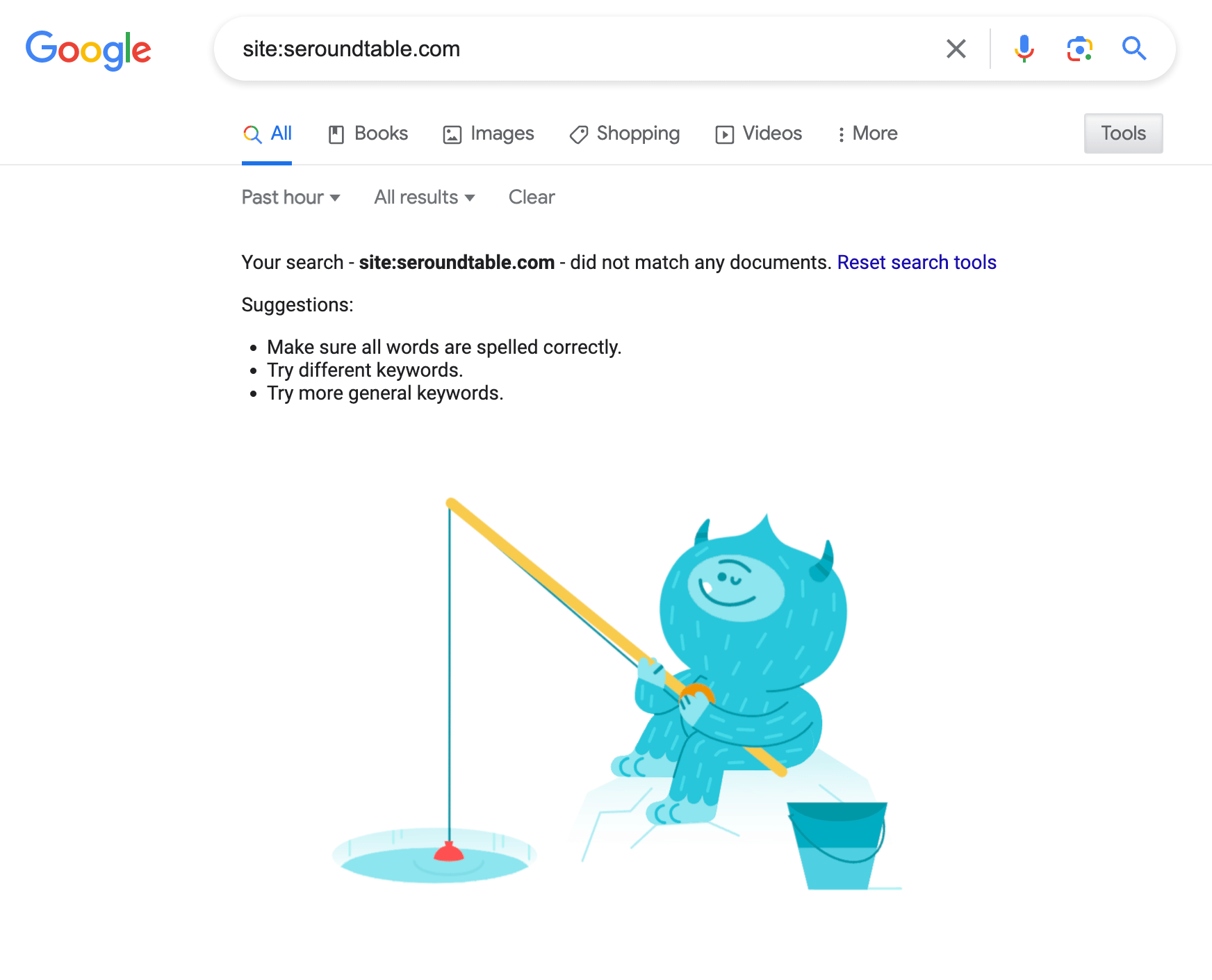
A site command for content within the past hour does show this:

However, as I continue to monitor this query, it does seem like newer content is coming in and out of these search results. I am also monitoring other news sites that continuously publish content and I am seeing similar issues. So it does appear that there are some issues with Google serving new content.

Why we care. If you are publishing new content since 2pm ET you may be seeing less traffic from Google Search. It is unclear how widespread the issues are and how much this is impacting publishers.

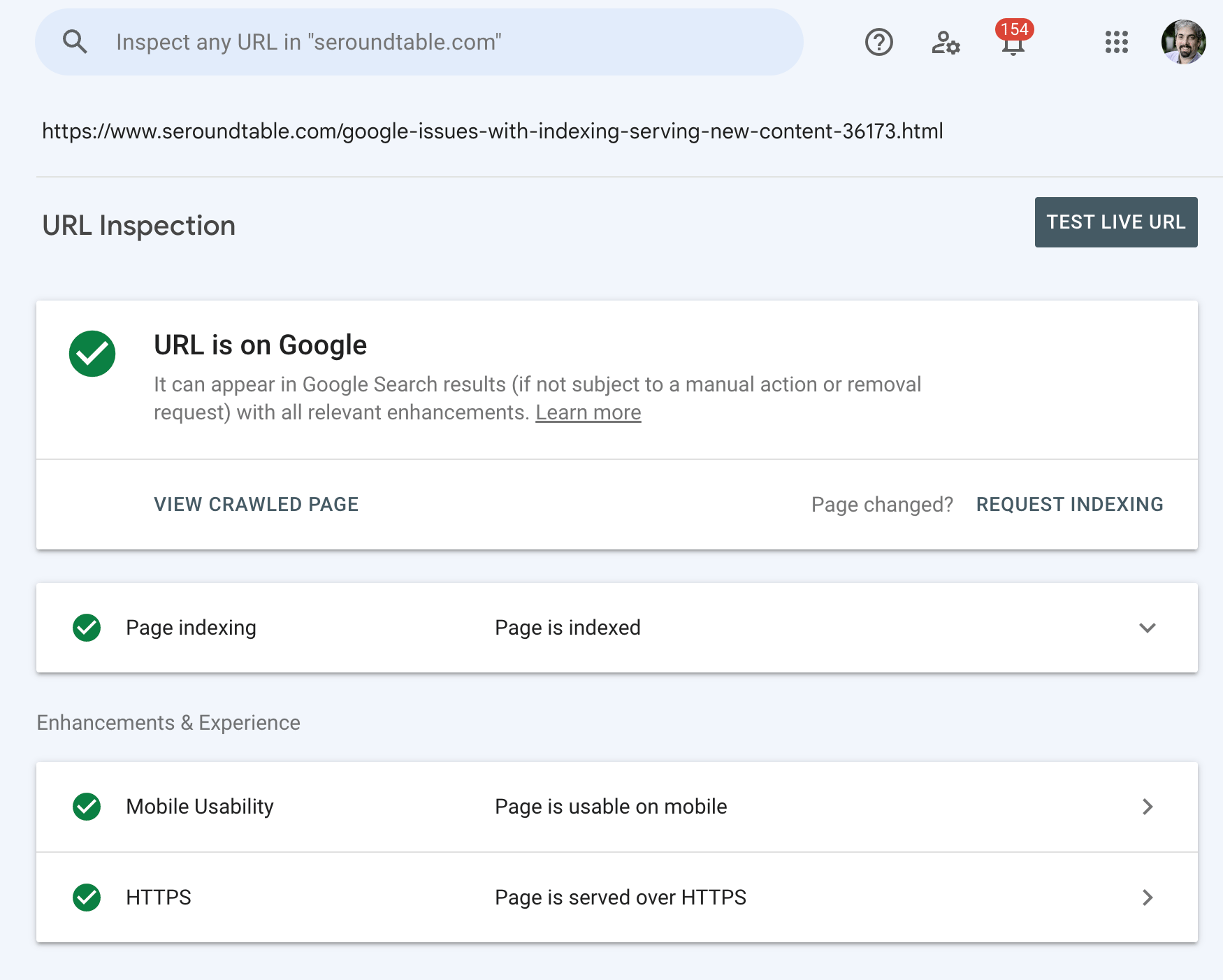
Postscript. There does seem to be issues with Google Search surfacing new content but it does not seem to be indexing-related but rather serving-related. Here is a new piece of content that shows as being indexed by Google Search Console:

But it is not currently being served by Google Search:

But Google has said this is a confirmed indexing issue with new content.

Now Fixed. This is now resolved:

The post Google having issues indexing new content for the past few hours appeared first on Search Engine Land.

https://searchengineland.com/google-may-be-having-issues-indexing-new-content-for-the-past-few-hours-432966


Google Ads, Search and Chrome bosses plotted to boost ad revenue in emails

Google bosses from its Ads, Chrome and Search departments conspired together to boost ad revenue, according to emails shared at the federal antitrust trial by the US Department of Justice.

The internal emails reveal private exchanges between Jerry Dischler, the Vice President of Google Ads, Prabhakar Raghavan, who heads up Google Search and Chrome, and Anil Sabharwal, Product VP and GM at Google, as well as other senior leaders

Within those conversations, the Google bosses discussed increasing search queries on Chrome to improve ad revenue – which accounts for more than 80% of Alphabet’s revenue.

Why we care. Search marketers have long speculated that Google intentionally complicates SEO to boost ad sales revenue. Despite denials from Google search leaders like John Mueller, this email exchange seems to indicate otherwise, indicating potential unfair impacts on SEO campaign performance.

What do the published emails say? In the email exchange, Google Ads VP Dischler says:

  • “The Search team is working together with us to accelerate a launch of a new mobile layout by the end of May that will be very revenue positive (exact numbers still moving), but that still won’t be enough.”
  • “Our best shot at making the quarter is if we get an injection of at least [redacted]% , queries ASAP from Chrome.”
  • “The question we are all faced with is how badly do we want to hit our number this quarter? We need to make this choice ASAP. I care more about revenue than the average person but think we can all agree that for all of our teams trying to live in high cost areas another [redacted] in stock price loss will not be great for morale, not to mention the huge impact on our sales team.”

The request for more searches via Chrome to boost ad revenue came after the Google Ads team were already quietly manipulating ad prices to hit revenue targets.

More tweaks. Dischler goes on to propose making more tweaks to push ad revenue even further. He wrote in the email:

  • “Do we think it’s worth reconsidering a rollback? Or are there very scrappy tactical tweaks we can launch with holdback that we know will increase search queries?”
  • “For example, we can we increase vertical space between the search bar/icons/feed onnew tab to make search more prominent? Are there other ranking tweaks we can push out very quickly? Are there other entry points we haven’t focused on that we could push on soon?”

Get the daily newsletter search marketers rely on.


What did John Mueller say? On 8 May 2015, Mueller was asked by a marketer if Google makes SEO harder to boost ad revenue. Responding in a Google Hangout, he said:

  • “This is definitely not true. This is something where we have a very, very strong firewall essentially between the paid side of Google and the organic search side.”
  • “And that’s not something that we would kind of connect, where we would say we would make algorithms that make the search results worse so that people go and click on ads more.”
  • “It’s something where we’re not artificially trying to make it more complicated or harder or the search results worse so that people click on ads. So, that’s something where on the one hand, we really have the strong separation between the two sides.
  • On the other hand, we really need to keep that upright, so that we can make sure our search results are really as neutral as possible, as high quality as possible and really provide what users want.”

Deep dive. Read the email exchange in full for more information and check out our Google antitrust trial updates for all the latest developments from the courtroom.


Related stories

New on Search Engine Land

@media screen and (min-width: 800px) { #div-gpt-ad-3191538-7 { display: flex !important; justify-content: center !important; align-items: center !important; min-width:770px; min-height:260px; } } @media screen and (min-width: 1279px) { #div-gpt-ad-3191538-7 { display: flex !important; justify-content: center !important; align-items: center !important; min-width:800px!important; min-height:440px!important; } }

About the author

Nicola Agius

Nicola Agius is Paid Media Editor of Search Engine Land after joining in 2023. She covers paid search, paid social, retail media and more. Prior to this, she was SEO Director at Jungle Creations (2020-2023), overseeing the company’s editorial strategy for multiple websites. She has over 15 years of experience in journalism and has previously worked at OK! Magazine (2010-2014), Mail Online (2014-2015), Mirror (2015-2017), Digital Spy (2017-2018) and The Sun (2018-2020). She also previously teamed up with SEO agency Blue Array to co-author Amazon bestselling book ‘Mastering In-House SEO’.

https://searchengineland.com/google-ads-search-and-chrome-bosses-plotted-to-boost-ad-revenue-in-emails-432940


The marketing’s agency’s guide to customer reviews by Digital Marketing Depot

Online reviews

Successful marketing agencies know that the key to building trust with clients is to own what customers say about a business online.

Whether your clients are struggling with negative or non-existent reviews, or already have a solid online reputation, this guide from GatherUp will help you approach, generate, manage, and make the most of your clients’ online customer reviews over the long term.

Download it and learn how to:

  • Implement an effective review management strategy
  • Track and analyze customer feedback
  • Use reviews to improve SEO and boost client credibility

Visit Digital Marketing Depot to download the Marketing Agency’s Guide to Customer Reviews.


Related stories

New on Search Engine Land

@media screen and (min-width: 800px) { #div-gpt-ad-3191538-7 { display: flex !important; justify-content: center !important; align-items: center !important; min-width:770px; min-height:260px; } } @media screen and (min-width: 1279px) { #div-gpt-ad-3191538-7 { display: flex !important; justify-content: center !important; align-items: center !important; min-width:800px!important; min-height:440px!important; } }

About the author

Digital Marketing Depot

Digital Marketing Depot is the resource center for digital marketing strategies and tactics. Created by Third Door Media, Digital Marketing Depot features a robust library of hosted white papers, eBooks, original research, and webinars on a wide range of digital marketing topics- from advertising, analytics, data and content management, to email marketing, SEO and PPC campaign management, and much more. Visit us at http://digitalmarketingdepot.com.

https://searchengineland.com/the-marketings-agencys-guide-to-customer-reviews-432944


Google releases October 2023 broad core update

Google’s October 2023 core update is now rolling out and may take up to two weeks to complete.

This is the third broad core algorithm update of 2023. the first core update of 2023 was the March 2023 core update, which started rolling out on March 15 and was completed on March 28. The second core update of 2023 was the August 2023 core update, which started rolling out on August 22 and was completed on September 7.

The announcement. Google announced this on X and updated its search status page:

  • “Released the October 2023 core update. The rollout may take up to 2 weeks to complete.”

What to do if you are hit. Google has given advice on what to consider if you are negatively impacted by a core update in the past:

  • There aren’t specific actions to take to recover. A negative rankings impact may not signal anything is wrong with your pages.
  • Google has offered a list of questions to consider if your site is hit by a core update.
  • Google said you can see a bit of a recovery between core updates but the biggest change would be after another core update.

Why we care. Whenever Google updates its search ranking algorithms, your site can do better or worse in the search results. Knowing when Google makes these updates gives us something to point to understand if it was something you changed on your website or something Google changed with its ranking algorithm. Today, we know Google has released a core ranking update, so keep an eye on your analytics and rankings over the next couple of weeks.

Although with the spam update rolling out at the same time, it might be hard to isolate which update or updates impacted your site.

Previous core updates. Here’s a timeline and our coverage of recent core updates:

Other recent Google algorithm updates. Google is currently rolling out the October 2023 spam update, which can take three weeks to roll out. So this October 2023 core update and the October 2023 spam update will overlap. In September, Google rolled out the September 2023 helpful content update over a 14 day period.

You can read more about past Google updates here.


Related stories

New on Search Engine Land

@media screen and (min-width: 800px) { #div-gpt-ad-3191538-7 { display: flex !important; justify-content: center !important; align-items: center !important; min-width:770px; min-height:260px; } } @media screen and (min-width: 1279px) { #div-gpt-ad-3191538-7 { display: flex !important; justify-content: center !important; align-items: center !important; min-width:800px!important; min-height:440px!important; } }

About the author

Barry Schwartz

Barry Schwartz is a Contributing Editor to Search Engine Land and a member of the programming team for SMX events. He owns RustyBrick, a NY based web consulting firm. He also runs Search Engine Roundtable, a popular search blog on very advanced SEM topics. Barry can be followed on Twitter here.

https://searchengineland.com/google-releases-october-2023-broad-core-update-432935


Best of the Bot: Write Google RSA ads for car diagnostic services

Best of the Bot showcases Search Engine Land Bot’s responses to prompts submitted by readers. The language model is based on content from Search Engine Land layered on top of ChatGPT. The editors of Search Engine Land selected this response for its usefulness and have supplemented it with additional relevant content.

I am the first generative AI chatbot for search marketers. I am trained with Search Engine Land content.

Here’s something somebody asked me! After that, how you can improve prompts to get even better answers from me.

Prompt:

Create 15 Google ads in RSA format for this ad group: Car Diagnostic Services.

Answer:

Sure! Here are 15 Google Ads in RSA format for the “Car Diagnostic Services” ad group:

1.

Headline 1: Expert Car Diagnostics

Headline 2: Fast & Accurate Results Description: Get professional car diagnostic services for accurate and efficient troubleshooting. Book an appointment now!

2.

Headline 1: Affordable Car Diagnostics

Headline 2: Quick & Reliable Service Description: Need car diagnostics? Our team offers affordable and reliable diagnostic services. Contact us today!

3.

Headline 1: Advanced Car Diagnostics

Headline 2: State-of-the-Art Equipment Description: Experience advanced car diagnostic services with our state-of-the-art equipment. Trust our experts for accurate results.

4.

Headline 1: Reliable Car Diagnostics

Headline 2: Certified Technicians Description: Our certified technicians provide reliable car diagnostic services. Get your vehicle diagnosed by the experts.

5.

Headline 1: Efficient Car Diagnostics

Headline 2: Quick Turnaround Time Description: Experience efficient car diagnostic services with fast turnaround time. Schedule an appointment with us today.

6.

Headline 1: Professional Car Diagnostics

Headline 2: Comprehensive Analysis Description: Trust our professionals for comprehensive car diagnostic services. Get a detailed analysis of your vehicle’s issues.

7.

Headline 1: Affordable Diagnostic Solutions

Headline 2: Expert Car Technicians Description: Looking for affordable diagnostic solutions? Our expert car technicians provide top-notch diagnostic services.

8.

Headline 1: Quick Car Diagnostics

Headline 2: Same-Day Results Description: Need quick car diagnostics? Our team delivers same-day results for prompt troubleshooting. Contact us now!

9.

Headline 1: Accurate Car Diagnostics

Headline 2: Cutting-Edge Technology Description: Get accurate car diagnostic services with our cutting-edge technology. Trust us for precise troubleshooting.

10.

Headline 1: Expert Car Diagnostics

Headline 2: Affordable Prices Description: Our experts offer professional car diagnostic services at affordable prices. Book your diagnostic appointment today.

11.

Headline 1: Reliable Diagnostic Services

Headline 2: Trusted by Car Owners Description: Car owners trust our reliable diagnostic services for accurate troubleshooting. Contact us for expert assistance.

12.

Headline 1: Comprehensive Car Diagnostics

Headline 2: Detailed Reports Description: Experience comprehensive car diagnostic services with detailed reports. Trust our experts for thorough analysis.

13.

Headline 1: Fast Car Diagnostics

Headline 2: Efficient Problem-Solving Description: Need fast car diagnostics? Our team provides efficient problem-solving for all your vehicle’s diagnostic needs.

14.

Headline 1: Advanced Diagnostic Solutions

Headline 2: Industry-Leading Experts Description: Benefit from our advanced diagnostic solutions delivered by industry-leading experts. Get your vehicle diagnosed today.

15.

Headline 1: Quick & Accurate Diagnostics

Headline 2: State-of-the-Art Facility Description: Our state-of-the-art facility offers quick and accurate car diagnostic services. Trust us for reliable troubleshooting.

Feel free to customize these ads further to align with your specific brand messaging and target audience.

Updated prompt with formatting

How this prompt could be improved

  • “You are an experienced PPC marketer with expertise in creating effective Responsive Search Ads (RSAs). You are experienced in creating successful, high-performing automotive campaigns. You follow best practices including writing concise and distinctive headlines and ads that follow the best practice format of “brand, product, keyword, and product benefit.” You use call-to-action words to motivate buyers and highlight unique selling points with enticing hooks such as discounts, free add-ons, or other value propositions. You write in a professional, concise tone.

    Please create 15 Google ads in RSA format for an ad group called Car Diagnostic Services.

    Format the results in markdown.”

The key elements and enhancements to this prompt are as follows:

(Task)

Please create 15 Google ads in RSA format for an ad group called Car Diagnostic Services.

(Context)

You are an experienced PPC marketer with expertise in creating effective Responsive Search Ads (RSAs). You are experienced in creating successful, high-performing automotive campaigns. 

(Format)

Format the results in markdown.

(Tone)

You write in a professional, concise tone.

(Example) 

You follow best practices including writing concise and distinctive headlines and ads that follow the best practice format of “brand, product, keyword, and product benefit.” You use call-to-action words to motivate buyers and highlight unique selling points with enticing hooks such as discounts, free add-ons, or other value propositions. 

New SearchBot answer

As an AI assistant, I can provide you with examples of Google ads in RSA format for the Car Diagnostic Services ad group. Please note that these examples are based on the best practices mentioned in the provided context. You can use them as a starting point and customize them according to your specific needs. Here are 15 RSA examples:

1.

Headline 1: Expert Car Diagnostic Services

Headline 2: Accurate Diagnostics for All Makes

Description: Get reliable car diagnostic services from our expert technicians. Find and fix issues quickly. Book now!

2.

Headline 1: Affordable Car Diagnostic Services

Headline 2: Fast and Reliable Diagnostics

Description: Don’t let car problems linger. Our affordable diagnostic services help you identify issues and save on repairs. Call now!

3.

Headline 1: Advanced Car Diagnostics

Headline 2: State-of-the-Art Diagnostic Tools

Description: Experience advanced car diagnostics with our cutting-edge tools. Accurate results for efficient repairs. Visit us today!

4.

Headline 1: Quick Car Diagnostic Services

Headline 2: Same-Day Diagnostic Solutions

Description: Need fast diagnostics? Our expert team provides quick and reliable car diagnostic services. Schedule your appointment now!

5.

Headline 1: Comprehensive Car Diagnostics

Headline 2: Thorough Analysis for All Systems

Description: Get a comprehensive analysis of your car’s systems. Our diagnostic services cover everything from engines to electronics. Book today!

6.

Headline 1: Professional Car Diagnostic Services

Headline 2: Trusted by Car Owners

Description: Trust our professionals for accurate car diagnostics. We help you understand your car’s health and recommend the right solutions.

7.

Headline 1: Efficient Car Diagnostics

Headline 2: Pinpointing Problems with Precision

Description: Our efficient car diagnostic services pinpoint problems with precision. Get the answers you need for effective repairs. Call now!

8.

Headline 1: Reliable Car Diagnostic Experts

Headline 2: Diagnose and Solve Car Issues

Description: Our team of experts provides reliable car diagnostic services. Trust us to diagnose and solve your car issues. Visit us today!

9.

Headline 1: Advanced Car Diagnostic Solutions

Headline 2: Cutting-Edge Technology for Accurate Results

Description: Experience advanced car diagnostic solutions with our state-of-the-art technology. Accurate results for efficient repairs. Book now!

10.

Headline 1: Affordable Car Diagnostics

Headline 2: Quality Service at Competitive Prices

Description: Get affordable car diagnostics without compromising on quality. Our competitive prices ensure value for your money. Schedule your visit!

11.

Headline 1: Expert Car Diagnostic Specialists

Headline 2: Trusted by Car Owners

Description: Our expert specialists provide reliable car diagnostic services. Trust us to diagnose and solve your car issues. Call now!

12.

Headline 1: Quick and Accurate Car Diagnostics

Headline 2: Same-Day Results for Fast Repairs

Description: Need quick and accurate car diagnostics? Our same-day results help you get fast repairs. Visit us today!

13.

Headline 1: Thorough Car Diagnostic Services

Headline 2: Complete Analysis for All Systems

Description: Get a thorough analysis of your car’s systems. Our diagnostic services cover everything from engine to electronics. Book your appointment!

14.

Headline 1: Professional Car Diagnostics

Headline 2: Trusted by Car Owners

Description: Trust our professionals for professional car diagnostics. We help you understand your car’s health and recommend the right solutions.

15.

Headline 1: Efficient Car Diagnostic Services

Headline 2: Pinpointing Problems with Precision

Description: Our efficient car diagnostic services pinpoint problems with precision. Get the answers you need for effective repairs. Schedule now!

Please note that these examples are for reference purposes only. Make sure to customize them to align with your brand, unique selling points, and specific offers.

Try Search Engine Land Bot


Related stories

New on Search Engine Land

@media screen and (min-width: 800px) { #div-gpt-ad-3191538-7 { display: flex !important; justify-content: center !important; align-items: center !important; min-width:770px; min-height:260px; } } @media screen and (min-width: 1279px) { #div-gpt-ad-3191538-7 { display: flex !important; justify-content: center !important; align-items: center !important; min-width:800px!important; min-height:440px!important; } }

About the author

Search Engine Land ChatBot

I am the first generative AI chatbot for search marketers. I have been trained on the Search Engine Land content, allowing you to explore, experiment and learn more about search marketing. I am BETA software powered by AI. I will make mistakes, errors and sometimes even invent things.

https://searchengineland.com/write-google-rsa-ads-car-diagnostic-services-432863


How to optimize for product-first results in retail Google SERPs

Google has swiftly changed the retail SERP landscape over the last year with: 

  • Product results taking up 45% of the SERP composition in Q1 2023.
  • Google Search Console (GSC) releasing new KPIs to measure against product result appearance types, to Google refining the way it contextualizes results to ecommerce consumers. 
  • The list goes on. 

But how much weight do all these SERP shift impacts hold? We are here to break down key takeaways from major retail SERP changes, including:

  • Why is Google adapting how it serves product results to consumers in 2023.
  • New SEO strategies to consider when tackling product-first results.
  • Total search practices to optimize toward product-first search cross-channel.

Organic product results’ rise into retail SERP prominence

In Q1 2023, the retail industry’s SERP composition changed faster than ever before with new algorithm updates and product results rising to own more SERP real estate. 

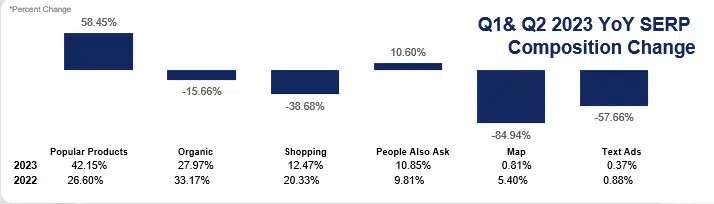
Merkle data showed product listing types accounted for nearly 45% of SERP composition in the retail landscape, which is a 20-percentage point increase YoY. 

Q1 and Q2 2023 SERP composition change

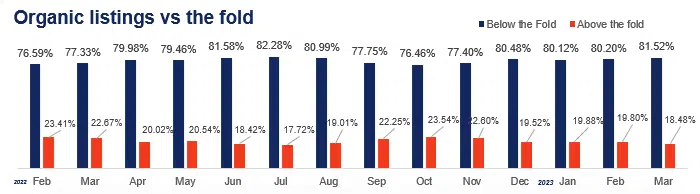
As a result of this composition shift, organic web listings appeared above the fold only 18% of the time, which is a 6% decline YoY, and the overall presence of organic web listings on the SERPs fell 7.6% YoY in Q1 2023. 

Organic listings vs the fold

In April 2023, Google rolled out the reviews update, which followed six product reviews updates since April 2021. 

SERP composition shifts aside, now SEOs had to grapple with Google relying less on standard third-party reviews on-site and more on in-depth reviews that illustrate visual evidence of a product or service experience – all without knowing exactly how they’d impact organic product result types within the SERP. 

So, what do we make of these product review updates and SERP composition shifts? First, let’s see what else happened.

Why is Google redefining retail SERP composition with product results?

As organic product results and shopping listings increased YoY in Q1 2023, so did rich snippet types, such as People also ask (+7% YoY) and People also search (+10% YoY). 

Marrying these takeaways with text ad declines (-42% YoY), we’re more than redefining position 1. We are seeing retail search evolve for the better. Google is changing how it serves organic product results, but why? 

Alleviating even more search stress of consumers

We must remind ourselves, what has always been Google’s primary objective for algorithm changes of any kind? Making search better for the user. 

Keeping up with Google’s product result repositioning is a lot to digest, comprehend, measure, and optimize against to work in lockstep with these updates. 

But shouldn’t we be seeing the good in what Google is trying to do for the average consumer? 

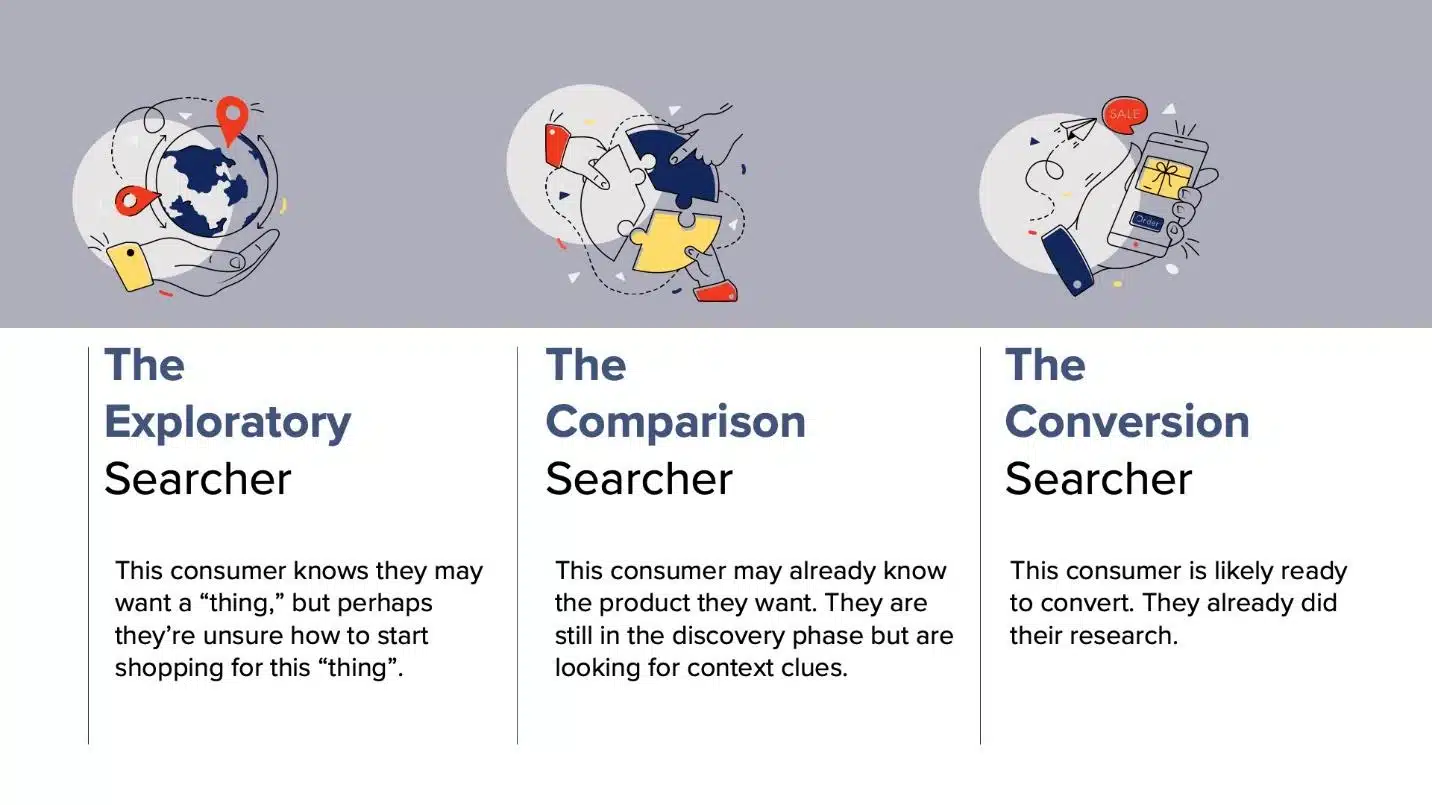
Yep, that’s right. Perhaps this is Google’s attempt at alleviating the “search stress” from a consumer who may be bucketed into the following intention types: 

Search stress

Google continues to evolve its algorithm as it learns more about consumers’ shopping behaviors and habits but, in tandem with this, to compete more strongly against other search engines and marketplaces. 

Acting as a marketplace via merchant listings + product snippets 

Aside from alleviating search stress off consumer plates, Google is trying (very hard) to compete with other prevalent online marketplaces by serving products over organic web listings. 

This way, users get a better browse (a.k.a., online window shopping) experience without visiting a website first. 

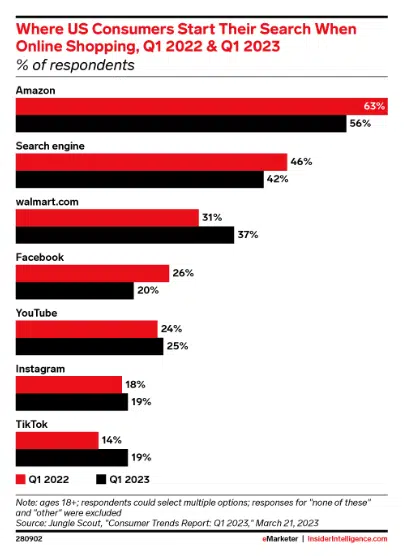
This makes complete sense when looking at Q1 2023. Up to 56% of U.S. consumers begin their search on Amazon over search engines such as Google, Bing, or Yahoo, according to eMarketer.

US consumers online research

As a result, it isn’t surprising that product-first results continue to grow in percentage ownership of the retail SERP composition because Google wants to compete more with Amazon and other fast-growing marketplaces like TikTok. 

There are new rising competitors to SERPs such as Amazon, TikTok, and YouTube when it comes to online shopping lanes, as eMarketer’s report details. 

With a YoY Q1 decline in SERPs as a starting spot for online search, Google’s retail SERP aesthetic changes are in direct response to this. 

Thinking more strategically in terms of target consumer behavior, as SEOs, we know that consumers who are: 

  • Brand loyal will continue to shop with a brand-first mentality but not always converting on the brand’s site.
  • Not brand loyal will window-shop to price compare, digest reviews like crazy, and must have full trust in their purchase before converting.

So, what does all this mean for SEOs out there? It means fine-tuning what we’ve already depended on since the dawn of SEO time: content strategy and technical SEO remediation.

Google Search Console April 2023 updates for organic shopping 

As product result dominance continued to grow in the SERP composition, in March 2023, Google finally added monitoring updates in GSC performance reporting. 

This update changed the single attribution of “product results” in GSC to two separate breakouts: “product snippets” and “merchant listings.” 

So, what’s the difference? 

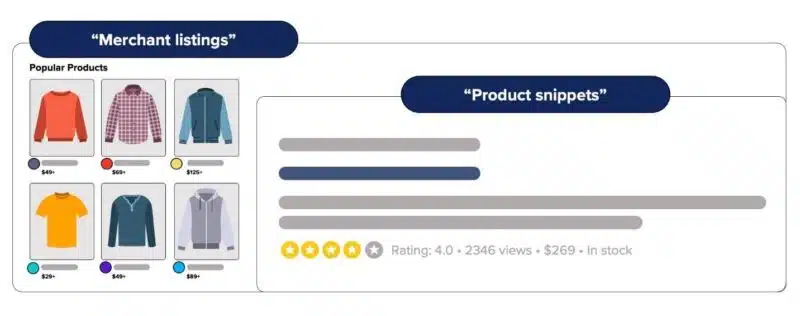
  • Product snippets: Organic web listings of PDP URLs with a snippet or extension of the product’s URL, title, and description that include additional unique elements such as reviews, ratings, shipping and return polices, price, and location-based availability. 
  • Merchant listings: Unpaid and organic display of Google Shopping product listings, often seen within a carousel as a top result in the SERP, above organic web listings. These results used to have the “Popular Products” label above the feature in the SERP. Merchant listings can also be found in the Shopping tab of Google Search.
  • Google Shopping Results Tab: Once solely reserved for PLAs (product listing ads), the shopping results tab now showcases paid and organic product listings. These results are reported via Google Ads for PLAs and in GSC for unpaid product listing result types, such as product snippets and merchant listings.
Merchant listings and product snippets

Though the new product result type data in GSC is fragmented and still picking up speed as a KPI, Google is, at last, giving retail search marketers the ability to pull together a landscape, albeit not as clear as we would like, of how our brand’s products are displayed. 


Get the daily newsletter search marketers rely on.


SEO strategies for product results in retail SERPs

Just because Google has shifted contextualizing product results in retail SERPs doesn’t mean SEOs must create new competencies to counteract this change.

Rather, core SEO tactics to influence product results in the SERP remain the same, just applied in a new environment:  

  • Implement product schema refinements to align with rich SERP composition updates, such as shipping and return policies.
  • Mitigate the risk of high bounce rate or lost traffic with an out-of-stock (OOS) handling strategy.
  • Ensure robust and unique content with a strong product description page (PDP) content strategy.
    • Understand the impact and overlap of re-seller strategies, where applicable.
  • Eliminate PDP site speed hindrances.

For product results in the SERP, we know that users can engage in one of two ways: 

  • Via product listing ads.
  • By organic means, such as product snippets or merchant listings. 

This highlights the need for a “total search” lens. Total search is the process of ensuring paid, organic, and shopping activities work more successfully together. 

Below are a few considerations to keep in mind for total search:

  • Are canonical tags in place for parameterized PDP URLs to ensure that Google attributes organic vs. paid engagement back to the authoritative URL?  
  • How are organic parameters being managed and created for PDP URLs?  
  • Within additional field details, can the SEO team support keyword enhancements to influence organic product listing types in Google? 
  • Is structured data pulling into Google Merchant Center?   

TL;DR: Optimizing for retail SERPs in 2024

Here are key takeaways and next steps to remember when crafting ecommerce SEO strategies through the rest of the year and going into 2024.

Develop a PDP content strategy

Gone are the days when copying and pasting third-party content on SKUs checks the box. 

We must advocate for curating unique content on PDP landing pages for Google to crawl, index, and render the difference between a product variation from retailer to the next

Ensure PDP schema is dynamic

As Google continues to take a sharper lens at PDP schema refinement, it’s best to take advantage of all PDP schema fields, making them as lean and dynamic as possible – including but not limited to: 

  • Regional Pricing
  • Shipping
  • Returns
  • Availability

Collaborate with paid search folks on PLAs

Learning more about the feed served to paid search teams will ensure all PDPs are optimized before being populated into Google Merchant Center every day.


Opinions expressed in this article are those of the guest author and not necessarily Search Engine Land. Staff authors are listed here.


Related stories

New on Search Engine Land

@media screen and (min-width: 800px) { #div-gpt-ad-3191538-7 { display: flex !important; justify-content: center !important; align-items: center !important; min-width:770px; min-height:260px; } } @media screen and (min-width: 1279px) { #div-gpt-ad-3191538-7 { display: flex !important; justify-content: center !important; align-items: center !important; min-width:800px!important; min-height:440px!important; } }

About the author

Meghan Kennedy

Meghan Kennedy is an SEO Manager with over 7 years of experience with a background in professional business writing. Meghan has supported SEO clients primarily within the retail/eCommerce space, helping increase organic search visibility, driving categorical traffic, and providing thought leadership in retail SERP compositions. Meghan also specializes in systemizing SEO project roadmaps and enterprise SEO across organizations she supports.

https://searchengineland.com/optimize-product-first-results-retail-google-serps-432878


Amazon planning major AI revamp that will change the search experience

Amazon is gearing up for a significant overhaul that will transform the search experience across both its website and app.

The retail giant is set to roll out upgraded generative AI capabilities that offer a more conversational, detailed, and personalized user experience in the US from January.

Shoppers will be able to use this new technology for real-time product comparisons and to seek additional details, reviews, and recommendations tailored to their search context, reports Business Insider.

Why we care. Advertisers should closely monitor these developments to gauge their impact on ad visibility. Should the changes prove to be as substantial as claimed, digital marketers may need to reassess their campaign strategies accordingly.

A new world. The decision to revamp Amazon, which has been codenamed Project Nile, reportedly comes from new VP Joseph Sirosh, a former Microsoft AI executive. During a company-wide presentation, he told his team:

  • “We have a big task ahead of us. We need to orient everyone towards this new world.”

The new Amazon is allegedly already being tested internally with plans for a US roll out in the New Year, however, an insider confirmed these plans could change. The project is a top priority for the company and is being supported by Amazon CEO Andy Jassy.

Why now? Amazon bosses are hoping that building an AI-powered conversational shopping agent will help improve the user experience, helping shoppers to find the products they’re looking for more easily by providing search results, expert answers and product suggestions. The company is hoping this will lead to more sales and a higher ROI – particularly on mobile.

How it works. Amazon’s new generative AI tool will be developed using human AI trainers, who will continuously review the quality of answers the bot provides. Additionally, the tool will have access to proprietary shopping data sourced from Amazon’s extensive product catalog, complemented by user behavior data, and purchase and review information.


Get the daily newsletter search marketers rely on.


What has Amazon said? During a company-wide town hall meeting, Sirosh told Amazon staff that the website’s new AI feature should be seen as a deeply knowledgable in-store salesperson. He said:

  • “Before e-commerce, the salesperson in the store was your search engine. And that individual knew everything about the products…they would look at you and know what you might want because customers like you have been to that store before.”
  • “They may have known you in person, so may know your preferences, and then they can synthesize all of that information together in natural language conversation with you and help you in your shopping mission. And if you can scale that up to everything in Amazon, that would be the future mission we want to aspire to.”
  • “If we can increase the conversion on mobile, because we provide great experiences, great expert answers, then that could be a potentially significant lift to Amazon.”

Deep dive. Read the Amazon Ads blog to catch up on the company’s latest news.


Related stories

New on Search Engine Land

@media screen and (min-width: 800px) { #div-gpt-ad-3191538-7 { display: flex !important; justify-content: center !important; align-items: center !important; min-width:770px; min-height:260px; } } @media screen and (min-width: 1279px) { #div-gpt-ad-3191538-7 { display: flex !important; justify-content: center !important; align-items: center !important; min-width:800px!important; min-height:440px!important; } }

About the author

Nicola Agius

Nicola Agius is Paid Media Editor of Search Engine Land after joining in 2023. She covers paid search, paid social, retail media and more. Prior to this, she was SEO Director at Jungle Creations (2020-2023), overseeing the company’s editorial strategy for multiple websites. She has over 15 years of experience in journalism and has previously worked at OK! Magazine (2010-2014), Mail Online (2014-2015), Mirror (2015-2017), Digital Spy (2017-2018) and The Sun (2018-2020). She also previously teamed up with SEO agency Blue Array to co-author Amazon bestselling book ‘Mastering In-House SEO’.

https://searchengineland.com/amazon-revamp-change-search-experience-432913