White hat link building strategies that work in 2023 by Admix Global

Admix Header 800x450

Wonder why link building matters? Imagine it as a virtual endorsement – search engines recognize your credibility and trustworthiness when other websites link to yours.

Link building is one of the main factors that boost your website’s visibility. A striking 55.7% of respondents underscore its potency, attesting to the profound results it delivers in the realm of SEO. Serpstat surveyed 523 professionals and asked them to rate the impact backlinks can have on search engine rankings on a 10-point scale. Here are the final results:

Consider backlinks as signposts directing people to your website. Shockingly, around 90.63% of web pages don’t get any visitors. Backlinks help lead people to your digital doorstep.

Not all links are equal. Quality and relevance are crucial in the digital landscape. Furthermore, search engines distinguish authentic links from counterfeit ones. Google’s Search Advocate, John Mueller, emphasizes the importance of quality over quantity regarding links. Many low-quality links won’t have a meaningful impact.

Many in the SEO field view the process of link building as a challenging task. A remarkable 41% of experts echo the sentiment that link building constitutes the formidable frontier in the realm of SEO.

So, what makes link building feel like such a colossal challenge in 2023? Amidst a sea of questionable practices, uncovering genuinely valuable and ethical white-hat strategies isn’t a walk in the park. But let’s delve into these methods further in the discussion!

The relationship-based approach is rooted in ethical and clean practices, following the principles of white-hat SEO and playing fair in the digital landscape. A website can enhance its credibility and standing in the online community by forging genuine connections within the industry.

Take, for example, the Boxemode site, which succeeded in acquiring a significant number of backlinks with a domain rating of 90+. It would have been unattainable to acquire such links through conventional mass outreach.

3 Admix 493x600

How can you achieve such an outcome?

Reverse engineering your competitors for link building or relationship-building purposes can be swift and impactful, and Ahrefs’ Site Explorer is a powerful tool for this task. Simply enter your domain, input the competitor’s domain and identify potential link sources the competitor has acquired.

This strategic approach allows you to identify valuable link prospects that align with your industry and niche, boosting link-building endeavors.

4 Admix 800x474

Once you’ve found websites that link to your competitors but not you, take a closer look and select the juiciest ones that match your needs.

5 Admix 570x600

Ahrefs’ Batch Analysis tool is your trusty sidekick, helping you check their traffic stats in one go.

6 Admix 800x501

Next, find the important people in these companies or websites. Engage them with a friendly message, share your story, and watch those relationships bloom into valuable links.

But how do you initiate contact with representatives of other websites gracefully? One of the best ways is to feature a link to their content in your article and then inform them with a touch of “Hello, your content is fantastic, and I’ve decided to reference it in my article. Just wanted you to know.” And voilà!

But how can you discover the prime opportunities for this? Here’s a quick action plan:

  1. Open Site Explorer.
  2. Input the website.
  3. Choose organic keywords report.
  4. Apply a filter for keywords ranked 5 -10.
7 Admix 800x352

Although not all of these keywords might be their primary targets, a closer look at the list can usually reveal the ones they aim to rank for.

At first, don’t expect an immediate return; the gifted link will be an investment in the future. After a while, you can re-establish contact, remind them of your connection and eventually seek assistance in placing the link you need.

As you can see, nurturing these connections requires time, effort and finesse. For those seeking a helping hand in this intricate dance, there are Editorial Link experts who have mastered the art of relationship-based link building. These professionals possess a curated network of industry peers and excel in crafting collaborations that yield fruitful results, even up to an increase in traffic from 32 to 3.1k. Their approach transcends the ordinary, yielding exceptional backlinks that traditional methods struggle to achieve. With their expertise, they secure impressive backlinks from top-notch sites like g2.com, cloudways.com, monday.com, blog.hubspot.com, hive.com, hostpapa.com, mageplaza.com and more. 

Link bait content, as the name implies, is the kind of content that’s so captivating and impressive that other content creators can’t resist linking to it. This type of content comes in various formats, each with its own allure:

  • Engaging visuals. Captivating images, stunning graphics and eye-catching videos can draw attention and encourage sharing, making them prime candidates for link bait. Here’s an example from a vinepair site that presented a visualization and got top results.
8 Admix 800x507
9 Admix 800x269
  • Interactive infographics. Transforming data into interactive visuals adds an extra layer of engagement. Check out how many backlinks this infographic has garnered:
10 Admix 800x424
11 Admix 800x220
  • In-depth guides. Comprehensive guides and lengthy articles become go-to resources others want to reference and share. Here’s a great example of this kind of content:
12 Admix 800x480
13 Admix 800x280
  • Data-driven studies. Conducting and presenting original research or studies with compelling data sets positions you as an authoritative source, earning you natural backlinks.
  • Provocative content. Content that sparks debate or challenges conventional wisdom can be irresistible to those seeking to contribute to the conversation.
  • Compelling stats. Sharing intriguing statistics can establish your content as a reliable reference. For example, these stats gained 6,600 backlinks from 2,600 domains.
14 Admix 800x473
  • Engaging questionnaires. Crafting interactive surveys or questionnaires that gather unique insights can entice others to link back to your content as a source of intriguing data.

The beauty of link bait content lies in its organic appeal. When your content resonates and strikes the right chord, it generates its own buzz.

Moreover, link bait is a dual effort: crafting captivating content and positioning it strategically in the digital landscape. So, keyword research is pivotal.

Let’s take a closer look at one example of successful link bait content and why it worked:

15 Admix 800x386

Fundera’s link bait, ‘What Percentage of Small Businesses Fail,’ attracted 9.5K backlinks from 1.4K referring domains. This cleverly designed stats page might seem simple, but it’s an incredibly effective link-building tactic.

16 Admix 800x185

The power lies in providing valuable statistics and facts that journalists, bloggers and content creators seek to back up their claims. This illustrates how link bait can serve as a magnet for organic backlinks.

17 Admix 800x450

When boosting your SEO strategy, there’s an often overlooked gem known as HARO link building.

HARO, or “Help A Reporter Out,” emerged in 2008 as an online service conceived by Peter Shankman. Originally designed to connect writers globally, it evolved into an expansive database facilitating journalist requests. This platform, now a go-to for media giants like The New York Times and Forbes, has become a potent link-building tool.

If HARO hasn’t crossed your radar, it’s possible your link builders dismissed it. But are there limitations? The answer is a resounding “no.”

While notably popular in finance, business and tech niches, HARO isn’t exclusive. Here’s why it’s worth considering for all types of brands:

  • The majority of queries boast a DR of 50 or higher.
  • Over 50% of published articles on the platform feature dofollow links.

To illustrate, let’s consider how HARO can secure backlinks from top platforms like Forbes:

18 Admix 800x461
An example is provided by Editorial.Link.

But wait, the HARO link building stage isn’t all glitter and glamour:

  • Rise above. Amid the pitch commotion, responses must sparkle like stars, outshining the rest.
  • Finding opportunities. In the midst of the overwhelming number of daily emails, finding valuable offers can be a challenge.
  • Masterful art. Crafting responses is an art that demands finesse and expertise, showcasing industry know-how.
  • Building relationships. Creating strong connections with reporters demands dedication, a skill that experts master.

HARO offers a realm of link-building opportunities, but like any grand performance, the mastery turns link builders into true virtuosos. Thus, many savvy individuals opt to entrust this task to seasoned professionals.

HARO is the most popular but not the only service of this kind because it has a number of competitors that can also be considered: Featured, Helpab2bwriter, Prowly, etc.

Conclusion

White hat link building in 2023 is a journey of authenticity and value. Quality triumphs over quantity, as we’ve seen through the allure of link bait content and the power of HARO link building. The relationship-based approach adds depth to your brand, connecting you with industry peers and amplifying your authority.


Related stories

New on Search Engine Land

About the author

Admix Global

Admix Global is a relationship-based link-building agency that helps companies significantly increase traffic from search engines by building editorial links from sites that don’t sell links. We get backlinks from reputable sites, building strong and long-lasting relationships.

https://searchengineland.com/white-hat-link-building-strategies-that-work-in-2023-432051



Trojan horse SEO: How to gain traction in new markets

We all love Netflix binge-watching now, but do you remember how you first learned about Netflix? I’m guessing it wasn’t by typing “DVD mail rental subscription” into Google on a whim.

And that represents a similar challenge for any business with a new or disruptive idea: how do you build engagement for something nobody knows exists?

Luckily, there is an audience for your product or service, regardless if they already know it. And you do have a category, regardless of its keyword volume.

Much like paid search practitioners occasionally like to borrow competitor clout and poach traffic by bidding on brand terms, SEO professionals who are growing brands in new markets need to look at poaching the demand that already exists for related markets – and then explain why their brand is a great alternative. 

This article will break down my approach to what I call “Trojan Horse SEO” for category creation:

  • Researching the existing market you’ll disrupt.
  • Creating an SEO and content strategy around the old terms.
  • Introducing your new category/keywords in the process.

SEO research for new markets

Your mission at this step is to discover how people search for that thing you’ll disrupt – even if it doesn’t overlap with your new product or service. 

To do this, you really have to understand the old way of thinking and why people are motivated to search. 

  • Find the search volume for keywords associated with the old way.
  • Create an SEO strategy using those old terms as a foundation.
  • Acquire them for your new category.

Start by interviewing the early customers of your new product, your customer service team, and the product managers who helped define the product-market fit. 

This research should teach you about the problems or gaps within the old industry, specifically what was broken or missing and what people absolutely love about your new solution. That’s your qualitative research, which should inform your keyword and content strategy. 

If you were on the Netflix SEO team in the early days, maybe “DVD rental” could have been a keyword to focus on, with the knowledge that folks in super-rural communities or folks without cars or public transportation might not have had access to traditional options like Blockbuster.

Another great resource is customer reviews of the products or services you’re disrupting. These will help you isolate even more pain points.

And try to dig up industry reports that talk about how things are shifting. For instance, Gartner, Forrester and Adobe can give you great SaaS (software as a service) insights.

As for quantitative research, go to the usual set of keyword research and planning tools – and remember that for new products or services, it’s a volume game. 

Keyword planners help you prioritize the old terms by impact, often expressed by search volume (the bigger the search volume, the bigger the potential to introduce your concept to a group of customers who might need it).

As a sanity check, do a quick Google search for the old terms you’re focusing on. If they’re returning SERPs that include the brand or brands you’re trying to disrupt, that indicates that user intent aligns with your strategy.


Get the daily newsletter search marketers rely on.


Creating a new-market SEO strategy

Content is great for new-market SEO strategy, and you should have many byline ideas from your quantitative research. 

Talk about the existing market, optimize it for the known/heavily searched terms and use content to introduce a better alternative. For example, “DVD Rental When There’s No Blockbuster Near You” or “The New DVD Rental: Get {Recent Oscar Winner for Best Picture} Delivered to Your Doorstep.”

There’s one thing you must remember at this step: it isn’t enough to bring people to your Trojan Horse content – you have to give them a reason and a clearly defined path to learn more. 

How to introduce your new category

So you’ve brought your users in through the old-category Trojan Horse. Now teach them your new language. 

Your goal should be to own a term, rank for the term, and then try to turn up the volume on that term (I think of this almost as I do a brand campaign).

Start seeding the market with your new term and optimizing your properties, including:

  • Your homepage.
  • A statement blog post.
  • Your company’s boilerplate and social media profile.

Make sure that everything you create that mentions the old term carries internal links to your fundamental pieces. 

The stakes

Is this tough to pull off? Absolutely. 

Can it work? 

Consider Five-Hour Energy (energy shots), HubSpot (inbound marketing), Asana (task management), Fitbit (wearable fitness trackers) and Salesforce (cloud software), among others. 

Those brands all developed a new term now widely used in the market and earned a huge advantage. They’ll always be one of the brands you’ll associate first with that term, no matter how competitive the market gets.

For me, few challenges are more rewarding than using your full array of research, technical, and content skills to bring a new product or brand to the mainstream. 

And if you do it right, you’ll be more than the team that brought “the new {competitor}” to market. You’ll be “the marketing team behind {amazing brand success story}.”

Dig deeper: 6 SEO considerations for a successful international expansion


Opinions expressed in this article are those of the guest author and not necessarily Search Engine Land. Staff authors are listed here.


Related stories

New on Search Engine Land

@media screen and (min-width: 800px) { #div-gpt-ad-3191538-7 { display: flex !important; justify-content: center !important; align-items: center !important; min-width:770px; min-height:260px; } } @media screen and (min-width: 1279px) { #div-gpt-ad-3191538-7 { display: flex !important; justify-content: center !important; align-items: center !important; min-width:800px!important; min-height:440px!important; } }

About the author

Adam Tanguay

Adam Tanguay is Head of SEO and Content at Jordan Digital Marketing, which he joined in Feb. 2019. Formerly Head of Marketing at Webflow and Head of Organic Growth at Weebly, Adam has developed successful growth programs with a mix of content strategy, copywriting, technical know-how, and analytics acumen across a range of organic channels.

https://searchengineland.com/trojan-horse-seo-new-markets-432081


Google autocomplete: The silent threat to your online reputation

While useful for searchers, Google autocomplete has become a significant reputational risk to companies and individuals. 

Negative Google autocomplete keywords displayed for your name or company can become the “first impression” of who you are.

This can be highly damaging if the suggested keywords displayed are inaccurate and include terms like scams, complaints, pyramid schemes, lawsuits or controversies.

With the rise of AI-generated search results, Google autocomplete keywords will become more visible – and potentially more damaging. 

This article explores:

  • How Google autocomplete keywords are derived.
  • The reputational risks of Google autocomplete and Search Generative Experience (SGE).
  • How to remove Google autocomplete keywords that are harmful, defamatory or inappropriate. 

Google autocomplete: How does it predict searches? 

Google autocomplete can shape a user’s perceptions before clicking “enter.” 

As a user types a search term, Google autocomplete suggests words and phrases to complete the term. 

This may cut down the searcher’s time and effort, but it can also shift them in an entirely different direction than what they were looking for in the first place. 

Google observes several factors to determine what shows up in Google autocomplete results:

  • Location: Google autocomplete results can be geolocated to where you are searching. 
  • Virality/trending topics: If there is a large surge in keyword searches around a specific event, person, product/service, or company, Google is more likely to pick up that keyword in Google autocomplete.
  • Language: The language associated with a particular keyword search can influence the predictions that are displayed.
  • Search volume: Consistent search volume around a specific keyword can trigger a keyword being added to Google autocomplete (even if that volume is relatively low).
  • Search history: If you are logged in to your Google account, you’ll often see previous searches show up in Google autocomplete. This can be bypassed by searching in an incognito browser that does not take your search history into account. 
  • Keyword associations: If a keyword related to a brand, product, service or person is mentioned on a site Google deems trustworthy, an autocomplete keyword can be derived from one of these sources. Although this is not a confirmed factor by Google, our team has noted keyword associations as being a precursor to having a negative autocomplete result.

Google autocomplete: Shaping reputations before clicking enter

I’ve seen a growing number of negative, defamatory, and oftentimes inaccurate autocomplete results that display prominently in a Google search for a brand, product, service or individual.

The predictive functionality of Google autocomplete and AI search engines can sometimes lead to negative associations between a company or a person’s name. 

A company or individual might find itself linked to rumors, scandals, lawsuits or controversies that it had no involvement in simply due to the algorithm’s unpredictable nature. 

Such associations can severely impact your reputation, erode customer trust, and hinder a company’s ability to attract new business.

Let’s look at Chipotle, for example. A colleague recently noticed the autocomplete keyword “human feces” while he was searching for Chipotle:

Image 65

The keyword “Chipotle” receives an average of 4 million searches monthly, per Semrush. 

So, how many of those 4 million people saw that Google autocomplete keyword “human feces” and decided to go to Qdoba instead? 

How many prospective investors in Chipotle stock saw this keyword and decided to take their money elsewhere? 

Although it’s impossible to get exact answers to these questions, one thing is for sure: This negative keyword has the potential to cost Chipotle millions of dollars while simultaneously diminishing its brand value. 

As of this writing, the inappropriate autocomplete search is not seen for the brand keyword (“Chipotle”). However, it is still displayed for various long-tail branded keywords and will likely continue fluctuating until the issue is addressed. 


Get the daily newsletter search marketers rely on.


Amplification of misinformation and discrimination 

Google autocomplete can inadvertently amplify false or misleading information by suggesting related queries or displaying incorrect snippets. 

For instance, if a company or individual has been unfairly targeted by false rumors or negative publicity, Google may perpetuate these inaccuracies by suggesting them to users. 

This can lead to a widespread acceptance of misinformation, causing lasting reputational damage. 

We have worked with many individuals who have dealt with discriminatory keywords in Google autocomplete search results (gay, transgender, etc.), which can cause privacy, safety and reputation issues. 

This type of content should never be displayed in Google autocomplete, but the algorithmic nature of the predictions can cause such keywords to be displayed. 

How AI might impact Google autocomplete 

In Google’ SGE (beta), users are displayed AI-generated answers directly above the organic search listings. 

While these listings will be clearly labeled as “generated by AI,” they will stand out among the other answers simply because they’ll appear first. 

This could lead users to trust these results more, even though they might not be as reliable as the other results on the list.

For a generative AI Google search, the autocomplete terms will now be featured in “bubbles” rather than in the traditional list you see in standard search results. 

We have noticed that there is a direct correlation between the autocomplete “bubbles” that are shown and the “traditional” autocomplete terms:

Image 66

What does Google say about harmful and negative autocomplete keywords?

Google admits that its autocomplete predictions aren’t perfect. As they state on their support page: 

“There’s the potential for unexpected or shocking predictions to appear. Predictions aren’t assertions of facts or opinions, but in some cases, they might be perceived as such. Occasionally, some predictions might be less likely to lead to reliable content.” 

Google has the following policies to deal with these issues:

  • Autocomplete has systems designed to prevent potentially unhelpful and policy-violating predictions from appearing. These systems try to identify predictions that are violent, sexually explicit, hateful, disparaging, or dangerous or that lead to such content. This includes predictions that are unlikely to return much reliable content, such as unconfirmed rumors after a news event.
  • If the automated systems miss problematic predictions, our enforcement teams remove those that violate our policies. In these cases, we remove the specific prediction in question and closely related variations.

How to remove Google autocomplete keywords 

If you or your company encounter a negative, false, or defamatory autocomplete keyword that violates Google’s policies, follow the steps below to “report the inappropriate prediction.” 

Image 67

If you are on mobile, long press on the inappropriate prediction for a pop-up to display:

Image 68 545x600

If there is a legal issue associated with the Google autocomplete prediction, you can request the removal of the content you think is unlawful at this link. You will need to choose which option applies to your situation.

Managing the reputational risks of Google autocomplete

The power of Google autocomplete and AI search engine results cannot be underestimated. 

The seemingly innocuous feature of Google autocomplete predictions holds the potential to shape perceptions, influence decisions and even damage reputations. 

The reputational risks posed by negative autocomplete keywords, whether inaccurate, defamatory or discriminatory, are substantial and far-reaching.

The evolving landscape, with the integration of generative AI search engine results, further underscores the need for vigilant management of autocomplete keywords. 


Opinions expressed in this article are those of the guest author and not necessarily Search Engine Land. Staff authors are listed here.


Related stories

New on Search Engine Land

@media screen and (min-width: 800px) { #div-gpt-ad-3191538-7 { display: flex !important; justify-content: center !important; align-items: center !important; min-width:770px; min-height:260px; } } @media screen and (min-width: 1279px) { #div-gpt-ad-3191538-7 { display: flex !important; justify-content: center !important; align-items: center !important; min-width:800px!important; min-height:440px!important; } }

About the author

Anthony Will

Anthony Will is the CEO and Co-founder of Reputation Resolutions, one of the leading online reputation management firms in the United States and globally. He is best known for his expertise in improving, protecting, and managing his clients’ online reputations on Google. Anthony is considered one of the foremost experts in online reputation management, having helped thousands of clients improve and manage their online reputations over the last decade. His company is currently rated by Business.com as the #1 online reputation management company for those dealing with online attacks and/or negative content online. Throughout his professional career, he has cultivated an impressive portfolio of clients, including Fortune 500 companies, prominent C-level executives, SMBs, politicians, celebrities, and many more. With an unwavering commitment to excellence, Anthony’s innovative strategies and experience have solidified his position as a leading authority in the online reputation management industry.

https://searchengineland.com/google-autocomplete-online-reputation-432106


Google Search can now validate responses from Bard

Google has updated Bard with a number of features, including the ability to double-check the responses provided by Bard by using Google Search. Google also has extensions for Gmail, Docs, Drive, Maps, YouTube, and Google Flights and Hotels for Google Bard. Bard has expanded Lens integration in 40 new languages and Bard upgraded its PaLM2 model to make it more capable, the company announced.

Google updated the Google it button within Bard to allow users to “more easily double-check its answers,” Google said. This improvement works in English results only, right now, but said this “taps into work by Google Research and Google DeepMind.”

When you Google the answer in Bard by clicking on the “G” icon, Bard will read the response and evaluate whether there is content across the web to substantiate it. When a statement provided by Bard can be evaluated, you would be able to click the highlighted phrases and learn more about supporting or contradicting information found by Search. 

Google said the links provided in this feature are content found by Google Search and do not imply these sources informed Bard’s initial response.

Here is a screenshot:

Google Search Check Bard Answers

Bard extensions

Google is rolling out extensions for Bard, specifically for Google’s other products including Gmail, Docs, Drive, Maps, YouTube, and Google Flights and Google Hotels. Bard can search your emails for questions, it can look up flights using Google Flights, it can find nearby hotels using Google Hotels and even show you directions, videos and more.

Here is the example Google provided, with a GIF demonstrating it all: “For example, if”If you’re planning a trip to the Grand Canyon (a project that takes up many tabs), you can now ask Bard to grab the dates that work for everyone from Gmail, look up real-time flight and hotel information, see Google Maps directions to the airport, and even watch YouTube videos of things to do there — all within one conversation,” Google wrote.

Google Bard Extensions

Continue shared conversations

Bard now lets you share links to your conversations with your friends and then your friends can pick up the conversation themselves, from where you left off. You can click on the share icon to share a a public link of your Bard conversation and then you can continue that chat to ask additional questions of Bard.

Expanding Lens features to more

Google is also expanding some of the new Bard features to more languages. Google said it is “expanding access to existing English language features — such as the ability to upload images with Google Lens, get Search images in responses, and modify Bard’s responses — to more than 40 supported languages.”

Bard is smarter

Finally, Google said Bard is more capable, more intellegent and useful by improvements they made to the PaLM2 models. Google said they made updates to their “PaLM 2 model, our most capable yet.”

“Based on your feedback, we’ve applied state-of-the-art reinforcement learning techniques to train the model to be more intuitive and imaginative. So, whether you want to collaborate on something creative, start in one language and continue in one of 40+ others, or ask for in-depth coding assistance, Bard can now respond with even greater quality and accuracy,” Google added.


Related stories

New on Search Engine Land

@media screen and (min-width: 800px) { #div-gpt-ad-3191538-7 { display: flex !important; justify-content: center !important; align-items: center !important; min-width:770px; min-height:260px; } } @media screen and (min-width: 1279px) { #div-gpt-ad-3191538-7 { display: flex !important; justify-content: center !important; align-items: center !important; min-width:800px!important; min-height:440px!important; } }

About the author

Barry Schwartz

Barry Schwartz is a Contributing Editor to Search Engine Land and a member of the programming team for SMX events. He owns RustyBrick, a NY based web consulting firm. He also runs Search Engine Roundtable, a popular search blog on very advanced SEM topics. Barry can be followed on Twitter here.

https://searchengineland.com/google-search-can-now-validate-responses-from-bard-432075


How to use Quora for SEO and research

Assessing and researching what people want and need is one of the most important SEO tasks. 

However, traditional SEO tools can’t always capture the diversity of a query. 

Often, keywords, questions and phrases can be asked differently and SEO tools can all report them as “zero volume” keywords.

In reality, these keywords have high engagements on other platforms such as Quora, in the form of likes, reshares and upvotes.

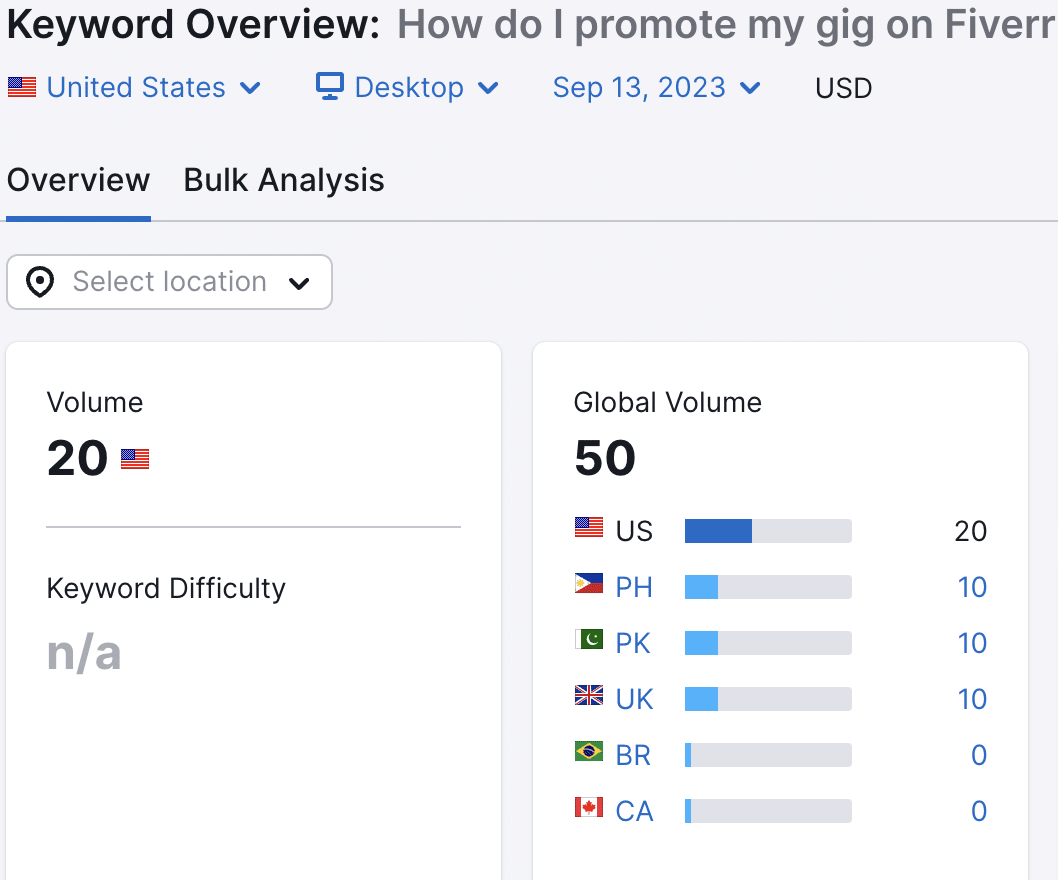
For example, the query “How do I promote my gigs on Fiverr” has a search volume of 20 in the U.S. and 50 globally, according to Semrush:

Semrush Keyword Overview Promote Gig On Fiverr

Based on this data, the logical conclusion is that this keyword is not worth pursuing for SEO.

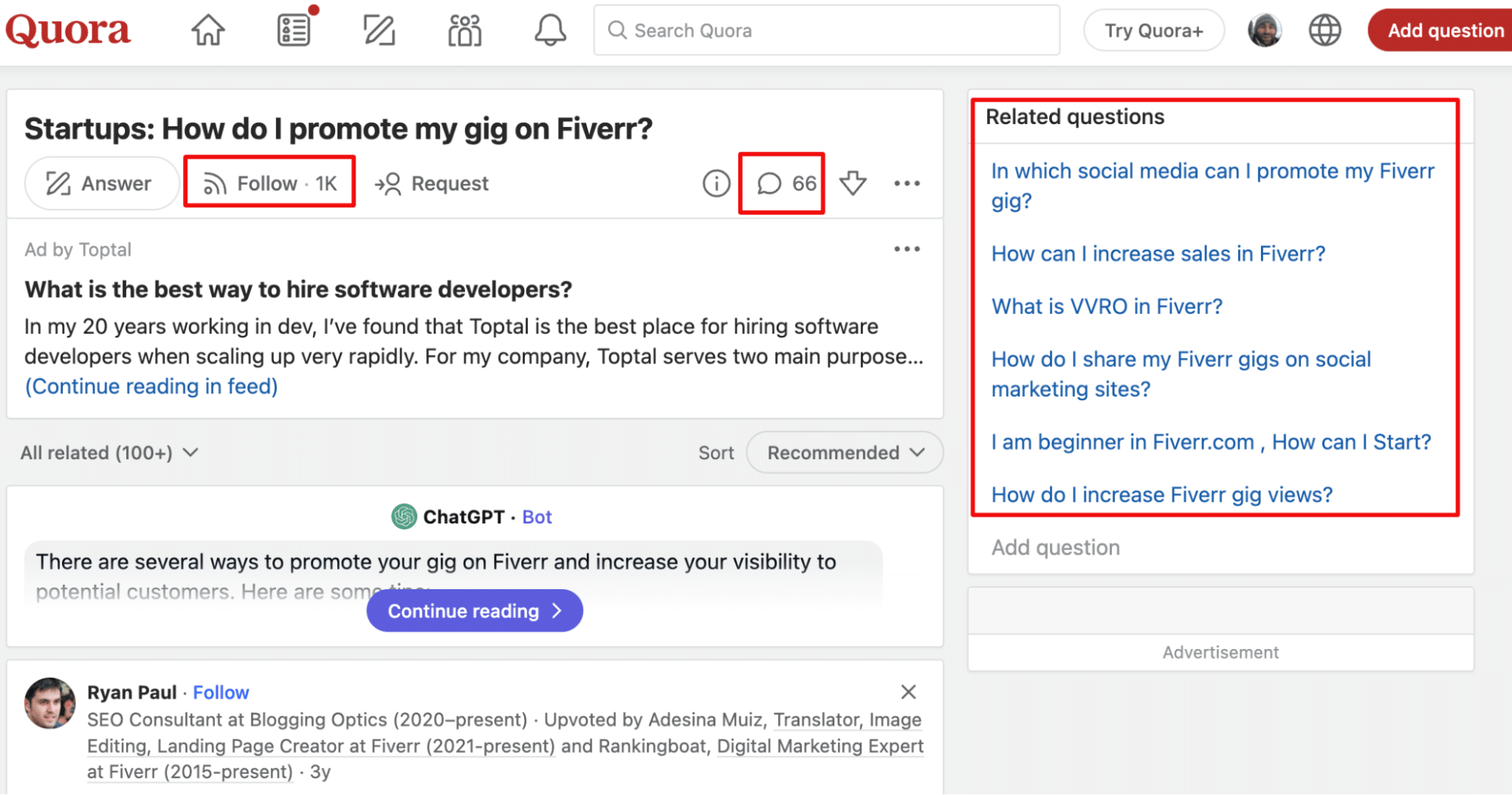
Instead, on Quora the question has a different type of engagement. There are hundreds of related questions:

Quora Promote Gig On Fiverr

Plus, over 1,000 people follow the topic and thousands of upvotes for many answers people give. 

We all want these keywords, questions and variations. 

Why use Quora?

Are these terms really zero-volume keywords?

Probably not. 

When people engage and discuss a topic, that topic is certainly important to them. If we pass on this opportunity, we will miss important insights. 

Quora is also a platform for industry professionals and experts to share knowledge and insights. 

By actively participating in relevant discussions and questions on Quora, you can gain valuable insights into industry trends and stay updated on your competitors’ activities.

This information allows you to refine your content strategies and tailor your offerings to a targeted audience. 

Another benefit in addition to the previous ones is the formal market research methods. Participating in Quora also allows businesses to conduct informal market research. 

Observing users’ questions gives you insight into potential customer pain points and needs.

Assessing quality and credibility on Quora

When it comes to finding reliable and accurate information online, Quora generally stands out as a trustworthy platform. 

With millions of users and contributors, maintaining quality and credibility is extremely important to Quora. 

Here’s how Quora ensures the reliability of information on the platform:

Reliability of information

Quora has implemented several measures to ensure the accuracy and reliability of answers provided by its users. 

First and foremost, Quora has a robust community moderation system. Trusted users with expertise in various fields help maintain the quality of content by reviewing and flagging inappropriate or misleading answers.

Also, Quora encourages the use of citations and references by allowing users to provide links and sources in their answers. 

This helps authenticate the information provided and enhances the credibility of the answers.

Verification Process

Quora takes the verification process seriously to ensure that experts and knowledgeable individuals contribute to the platform.

Quora verifies the identities of notable individuals (e.g., renowned professionals, industry experts, public figures) to ensure their credibility.

Quora also allows users to showcase their expertise through their profile credentials. 

Users can mention their educational background, work experience, and any other relevant qualifications to establish their credibility in specific topics or industries.

All these efforts combined make Quora a reliable source of information, where users can assess the quality of answers and credibility of contributors before relying on the information provided.

How to use Quora as a resource for learning and research?

Here are a few tasks we can all use when researching a topic on Quora.

Utilizing Quora for research

Quora serves as a valuable research tool, offering a wide range of information and expertise on countless topics. By leveraging the collective knowledge of its users, this platform allows you to tap into a vast pool of insights and experiences.

You can check the section about related questions, read the comments and replies and pick those that people upvote the most.

The platform encourages detailed explanations, personal anecdotes, and thoughtful discussions, making it a goldmine for researchers seeking diverse perspectives.

Gathering information

By simply searching for a topic of interest, you’ll find numerous questions and answers related to that subject. 

For instance, going back to the topic of “how to find Fiverr customers”, Quora can provide you with firsthand accounts and valuable opinions. The platform allows you to interact directly with experts and gain insights that may not be readily available through traditional research channels.

You’ll find experienced Fiverr sellers sharing golden nuggets and sharing their experiences and tips on how to promote your gigs. Something that would take a very long time on the traditional search engines like Google or Bing.

Quora also allows you to follow topics and individuals, ensuring that you receive updates on the latest trends and discussions pertaining to your research interests. This feature provides a curated stream of relevant information, saving you time and effort.

In addition, the ability to upvote or downvote answers on Quora ensures that the most helpful and accurate information is prominently displayed. This voting system promotes quality and credibility, empowering you to trust the information you gather from the platform.

How Quora compares to other platforms

Quora vs. Reddit

When it comes to Q&A platforms, Quora and Reddit are two popular choices among internet users. However, there are several key differences that set them apart.

  • Community: Quora boasts a large and diverse community of experts, professionals, and enthusiasts. On the other hand, Reddit is known for its extensive range of topic-specific communities called subreddits.
  • Format: Quora emphasizes longer, more detailed answers that come from personal experiences or expertise. Reddit, on the other hand, encourages shorter, more conversational responses and often relies on upvoting and downvoting to determine the visibility of each post.
  • Content Discovery: Quora uses algorithms to show users relevant content based on their interests and preferences. Reddit, on the other hand, allows users to customise their homepage by subscribing to their preferred subreddits.
  • Anonymity: Quora encourages users to use their real identities and build their reputation through their contributions. Reddit, however, offers more anonymity options, allowing users to participate without revealing their identity.

Quora vs. Stack Exchange

While both Quora and Stack Exchange serve as knowledge-sharing platforms, they cater to different audiences and have distinct features.

  • Focus: Quora covers a wide range of topics and encourages users to share personal insights and experiences. Stack Exchange, on the other hand, primarily focuses on specific fields such as programming, science, or math, providing a platform for experts to ask and answer questions within their respective domains.
  • Structure: Quora relies on a more open-ended Q&A format, allowing users to provide subjective answers and engage in discussions. Stack Exchange, however, follows a strict question-and-answer format to maintain a concise and factual database of knowledge.
  • Reputation system: Quora’s reputation is built based on the quality and engagement of a user’s contributions. In contrast, Stack Exchange assigns reputation points based on the accuracy and helpfulness of answers, aiming to recognize the expertise of its users.
  • Community moderation: Quora relies on its user base to report and moderate content, whereas Stack Exchange has a dedicated group of moderators who oversee the platform and ensure the quality of the content.

What results can you generate on Quora?

Quora isn’t just a platform for individuals seeking knowledge and inspiration; it can also be a valuable resource for businesses and marketers. 

Here’s how businesses can leverage Quora for marketing and lead generation, plus some strategies for you to make the most out of Quora as a social platform.

Quora as a platform for businesses

By creating a business profile on Quora, companies can engage in conversations related to their products or services and provide valuable insights, ultimately building trust and credibility with potential customers.

  • Generate leads: Businesses can actively participate in relevant Quora discussions and subtly promote their offerings as a solution to users’ inquiries. By providing helpful and informative answers, businesses can attract potential leads who are already interested in their niche.
  • Establish thought leadership: Quora allows businesses to showcase their industry expertise by answering questions and sharing valuable insights. By consistently providing high-quality answers, businesses can position themselves as thought leaders in their domain, attracting attention from both customers and industry peers.
  • Build brand awareness: By actively engaging with users on Quora, businesses can increase their visibility and reach a broader audience. By including their brand name and relevant keywords in their answers, businesses can effectively create brand awareness and recognition.

Quora strategies for SEOs

For SEOs, Quora can be a goldmine for finding potential customers and promoting their products or services. 

In addition to the “zero-volume” keywords considerations I made in the introduction, I’ll share here some useful tips for improving your presence on Quora and driving targeted traffic back to your websites:

  • Create a compelling profile: You should optimize your Quora profile by providing a clear and concise description of your expertise and the value you offer. Including relevant keywords and links to your website or social media profiles can enhance your visibility and credibility.
  • Identify targeted topics: You should identify the topics that are relevant to your target audience and regularly monitor those topics for new questions and discussions. By keeping a pulse on industry trends and actively engaging with users, you can position yourself as a valuable resource and attract potential customers.
  • Provide value through answers: You should focus on providing valuable and informative answers to users’ questions. By demonstrating your expertise and offering helpful solutions, you can establish yourself as a trusted authority and increase the likelihood of users seeking more information from them.
  • Promote content strategically: SEOs can leverage Quora’s platform to strategically promote your content, such as blog posts, articles, or videos, that provide further insights or solutions to users’ inquiries. By including relevant links within your answers, you can drive targeted traffic to your websites or landing pages.

Conclusion

Quora is a powerful platform that offers immense potential for improving your SEO and research efforts.

Quora can help you explore keywords from a different perspective, gather useful insights about the target audience and discuss directly with content creators and topical experts. 

It’s important to note that all types of marketers can benefit from Quora, not just SEO professionals. SEO can change (think the introduction of AI into search results) but knowing your audience will always be a valuable and pivotal part of marketing strategy.


Opinions expressed in this article are those of the guest author and not necessarily Search Engine Land. Staff authors are listed here.


Related stories

New on Search Engine Land

@media screen and (min-width: 800px) { #div-gpt-ad-3191538-7 { display: flex !important; justify-content: center !important; align-items: center !important; min-width:770px; min-height:260px; } } @media screen and (min-width: 1279px) { #div-gpt-ad-3191538-7 { display: flex !important; justify-content: center !important; align-items: center !important; min-width:800px!important; min-height:440px!important; } }

About the author

Luca Tagliaferro

Luca Tagliaferro is an SEO consultant based in the U.K. consulting medium to large businesses.

https://searchengineland.com/use-quora-seo-research-432036


Google search antitrust trial updates: Everything you need to know (so far)

Google is on trial for allegedly using underhand tactics to ensure it stays the world’s leading search engine.

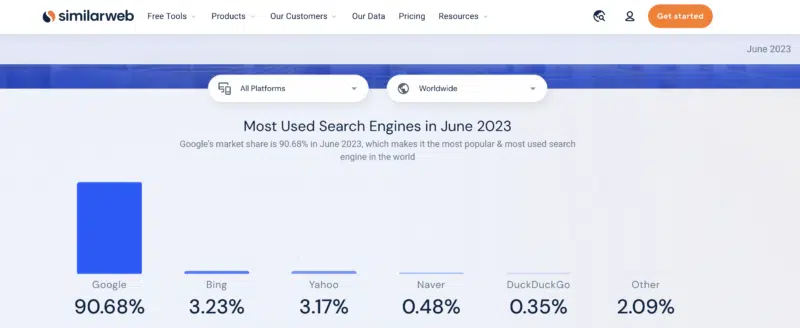
The U.S. Justice Department claims Google, which owns a 90% market share in search, paid massive sums to companies like Apple to make it the default search engine on products like the iPhone.

These multibillion-dollar deals gave Google an unfair advantage, the DOJ alleges, making it nearly impossible for rival companies to compete.

The trial will last 10 weeks and include testimonies from key figures like Alphabet and Google CEO Sundar Pichai.

The outcome of the landmark case could bring significant changes to Google and the future of the Internet. But it’s equally likely the trial will result in no changes and Google will be free to continue operating however it wants.

We’ll keep updating this article with the latest developments from this landmark trial.

As the trial is set to cover many Google search-related issues, we have organized the updates by topic to make the timeline easier to follow.

Google credits its 90% market share to being a superior platform (Sept. 12)

  • John Schmidtlein, lead lawyer for Google, claims the company dominates the search market due to being a superior product.
  • Google argues that users can easily switch to rival search engines even if it’s the default.
  • Antonio Rangel, a California Institute of Technology economist, testified that Google’s defaults discourage users from switching, saying switching to a different search engine is not easy.
  • He cited an example where switching to Bing from Google on an Android 12 phone required 10 steps, describing it as “considerable choice friction”, reports Business Insider.
Screenshot 2023 09 15 At 20.54.05 800x328

Google ‘hid and destroyed evidence’ (Sept. 12)

  • Justice Department attorney Kenneth Dintzer accused Google of “hiding and destroying documents because they knew they were violating the antitrust laws”, reports Bloomberg.
  • In his opening statement on day one, Dintzer presented evidence to show that Google was knowingly breaking laws.
  • He pointed to an October 2021 chat message from CEO Pichai, which read: “Need the link for my leaders circle tomorrow…can we change the setting of this group to history off… thanks.”
  • When history is off, conversations are auto-deleted after 24 hours.
  • Google declined to comment.

Apple allegedly didn’t want a default search engine (Sept. 12)

  • The DOJ revealed that Apple intended to provide users with a choice screen to select between Google and Yahoo as their search engine.
  • However, Google rejected this proposal with the statement “No default placement, no revenue share,” as stated in an email.
  • Kenneth Dintzer, the lead attorney for the DOJ, characterized Google’s response as a monopolistic action.

Google pays $10 billion a year to maintain default status (Sept. 12)

  • Justice Department attorney Dintzer accused Google of recognizing the important of default status and said this was the reason why the company spent more than $10 billion a year to brands like Apple.
  • Dintzer added that ” this wheel has been turning for more than 12 years and it always turns to Google’s advantage.”
  • He claimed Google staff had previously described losing the company’s search default status on mobile as a “code red situation”.
  • Google’s counterargument said that despite commanding 90% of the search market share, it faces competition from companies like Amazong, Microsoft’s Bing and Yelp.
  • Google attorney John Schmidtlein, added: “There are lots of way users access the web other than default search engines, and people use them all the time.”

Google calls its competition ‘inferior’ (Sept. 12)

  • Google’s lawyer, Schmidtlein, argued in court that the government is pursuing a regressive lawsuit.
  • He said the claims was “all in the hopes that forcing people to use inferior products in the short run will somehow be good for competition in the long run.”

Google’s search engine default status on phones was a ‘priority’ (Sept. 13)

  •  Chris Barton, who worked for Google from 2004 to 2011, said negotiating deals to make Google the default search engine on mobile devices was a top priority during his time at the company.
  • He claimed that in return for default status, phone service providers and manufacturers were guaranteed a portion of ad click revenue.
  • This strategy, central to the government’s antitrust case, aimed to establish Google as the primary search engine across various devices, reports News Bytes.

Google faced competition to become default search engine on mobile (Sept. 13)

  • Former Googler, Barton, emphasized that Google faced competition from other search engines in becoming the default choice for phone companies during his testimony,.
  • In a 2011 email exchange, Google executives observed that AT&T had selected Yahoo as its default search engine, while Verizon had opted for Microsoft’s Bing.
  • Barton testified that he encountered a challenge because mobile carriers were fixated on revenue share percentages.
  • He aimed to convince potential partners that Google’s high-quality searches would lead to more clicks and greater advertising revenue, even with a lower percentage share.

Googlers were told to be mindful of their language (Sept. 13)

  • Google staff were allegedly told back as far as 2023 to avoid using certain terms to avoid being perceived as “monopolists”.
  • A memo written by Google Chief Economist Hal Varian read: “We have to be sensitive about antitrust considerations…We should be careful about what we say in both public and private.”
  • Staff were told to avoid terms like “market share” and “bundle”.

Get the daily newsletter search marketers rely on.


Verdict. U.S. District Judge Amit Mehta isn’t expected to issue a ruling until early next year. If he decides Google broke the law, another trial will decide what steps should be taken to rein in the Mountain View, California-based company.

Why we care: If the US Government wins this case, it could mean Google is no longer automatically installed as the default search engine on everyday products, which could threaten its position as the world’s search leader. This means rival companies like Yahoo could realistically stand a chance of taking Google’s crown for the first time, which could bring significant changes to the search landscape as we know it.

What’s at stake. The U.S. and state allies are not asking for money; they want a court order to stop Google from its alleged unfair practices. This order could greatly affect Google’s business. For example:

  • The court could potentially split up the company as a solution.
  • On a broader scale, the Justice Department might argue that it aims to prevent Google from using its alleged search monopoly to secure exclusive deals in new markets, like AI.

This lawsuit is considered one of the most significant challenges to the tech industry’s dominance since the DOJ sued Microsoft in 1998 for its control of the personal computer market. In that case, the trial court ruled that Microsoft had unlawfully attempted to hinder the rival browser Netscape Navigator. Microsoft ultimately reached a settlement that didn’t break up the company.

If Google’s lead attorney Schmidtelein looks familiar, that may be because he represented Microsoft against the DOJ in the 1998 trial.

Deep dive. Read the US Justice Department’s official statement for more information on why it is suing Google.


Related stories

New on Search Engine Land

@media screen and (min-width: 800px) { #div-gpt-ad-3191538-7 { display: flex !important; justify-content: center !important; align-items: center !important; min-width:770px; min-height:260px; } } @media screen and (min-width: 1279px) { #div-gpt-ad-3191538-7 { display: flex !important; justify-content: center !important; align-items: center !important; min-width:800px!important; min-height:440px!important; } }

About the author

Nicola Agius

Nicola Agius is Paid Media Editor of Search Engine Land after joining in 2023. She covers paid search, paid social, retail media and more. Prior to this, she was SEO Director at Jungle Creations (2020-2023), overseeing the company’s editorial strategy for multiple websites. She has over 15 years of experience in journalism and has previously worked at OK! Magazine (2010-2014), Mail Online (2014-2015), Mirror (2015-2017), Digital Spy (2017-2018) and The Sun (2018-2020). She also previously teamed up with SEO agency Blue Array to co-author Amazon bestselling book ‘Mastering In-House SEO’.

https://searchengineland.com/google-search-antirust-trial-hearing-updates-431977


Microsoft calls deceased NBA player ‘useless’ in AI-written obituary

Microsoft has been criticised after publishing an AI-generated obituary for NBA star Brandon Hunter.

The former Boston Celtics and Orlando Magic player passed away suddenly this week, aged 42, after collapsing during a hot yoga class in Orlando, Fla.

Shortly after his passing, fans were shocked to see the father of three described as “useless” in an obituary published on MSN.

The headline read:

  • “Brandon Hunter useless at 42.”
Screenshot 2023 09 15 At 17.14.00 522x600

Why we care. MSN laid off two dozen editorial staff a few years ago with plans to replace the writers with generative AI, the Guardian reported. This case highlights the importance of not relying solely on AI for generating content due to factual inaccuracies and problematic errors, and the need to ensure that all work produced by AI is supervised by humans. Failure to do so could harm your brand’s reputation as well as negatively impacting your search rankings.

Incomprehensible. While the MSN headline was offensive, the rest of the article was incoherent. It read:

  • “Former NBA participant, Brandon Hunter, who beforehand performed for the Boston Celtics and Orlando Magic, has handed away on the age of 42, as introduced by Ohio male’s basketball coach Jeff Boals on Tuesday.”
  • “Hunter, initially a extremely regarded high school basketball participant in Cincinnati, achieved vital success as a ahead for the Bobcats.”

Reputational damage. Despite swiftly removing the article from the MSN website, Microsoft was criticized on social media for publishing the offensive content:

Screenshot 2023 09 15 At 17.09.57 800x140
Screenshot 2023 09 15 At 17.10.08 800x176
Screenshot 2023 09 15 At 17.12.48 734x600

What Microsoft is saying. A Microsoft spokesperson told Search Engine Land:

  • “The accuracy of the content we publish from our partners is important to us, and we continue to enhance our systems to identify and prevent inaccurate information from appearing on our channels. The story in question has been removed.”

However, the company is yet to officially apologize.

Dig deeper. Futurism broke the news in Microsoft Publishes Garbled AI Article Calling Tragically Deceased NBA Player “Useless”.

Other brands stumbles with AI. We’ve previously reported on a number of brands that have published articles with errors, all of which were lacking in E-E-A-T in different ways:

  • Men’s Journal published an AI-generated article, What All Men Should Know About Low Testosterone, that contained bad advice and information.
  • BuzzFeed published 44 terrible “AI-assisted” articles.
  • Gizmodo published an article on “Star Wars” with numerous factual errors.
  • Red Ventures-owned properties (including CNET, BankRate and CreditCards.com) have also leaned heavily into AI-generated content.

As a reminder, Google doesn’t care who – or what – writes your content, as long as that content is helpful and not created to manipulate search results.


Related stories

New on Search Engine Land

@media screen and (min-width: 800px) { #div-gpt-ad-3191538-7 { display: flex !important; justify-content: center !important; align-items: center !important; min-width:770px; min-height:260px; } } @media screen and (min-width: 1279px) { #div-gpt-ad-3191538-7 { display: flex !important; justify-content: center !important; align-items: center !important; min-width:800px!important; min-height:440px!important; } }

About the author

Nicola Agius

Nicola Agius is Paid Media Editor of Search Engine Land after joining in 2023. She covers paid search, paid social, retail media and more. Prior to this, she was SEO Director at Jungle Creations (2020-2023), overseeing the company’s editorial strategy for multiple websites. She has over 15 years of experience in journalism and has previously worked at OK! Magazine (2010-2014), Mail Online (2014-2015), Mirror (2015-2017), Digital Spy (2017-2018) and The Sun (2018-2020). She also previously teamed up with SEO agency Blue Array to co-author Amazon bestselling book ‘Mastering In-House SEO’.

https://searchengineland.com/microsoft-brandon-hunter-useless-ai-obituary-432008


SEO, generative AI and LLMs: Managing client expectations

Large Language Models (LLMs) remain a hot topic in SEO – especially with the popularity of OpenAI’s ChatGPT and other generative AI tools with user-friendly chat interfaces.

It’s so easy to get excited about the potential of generative AI and what it means for an SEO strategy. But managing client expectations remains critical. 

This overarching guide serves to help SEOs educate clients on the potential functionality of LLMs as it applies to SEO from the client perspective. This pragmatic approach will help you set and maintain realistic expectations throughout your SEO projects.

Preliminary steps: Ask the client the right questions

Some clients come to the table operating from info collected in word-of-mouth interactions, social media posts, and headlines rather than a detailed understanding of what AI is and how it works.

As the expert in the room, the SEO maintains the responsibility of naming both the benefits and drawbacks of using AI tools for organic search initiatives.

Asking the right questions before jumping in too far clarifies objectives and serves as a preliminary risk assessment for all parties:

Assess client familiarity

Gauge the client’s knowledge of LLMs (as it pertains to SEO) to ensure effective communication.

If the client brings up the topic, ask leading questions about what inspired the ask – whether it was an intensive course, first-hand experience, or a stakeholder brainchild. The conversation allows SEO to steady the course.

Understand client desires around ROI

Determine what the client hopes to achieve in terms of return on investment (ROI) by using these tools.

Learn about the potential investment in enterprise or developer-owned versions of the tools that can offer more in terms of privacy and/or quality output.

Clarify client objectives

With more context, help the client shape their specific goals for using generative AI in their SEO strategy if unclear.

Empirical testing: Measure feasibility, quality and time commitment

Conduct empirical tests to assess the effectiveness of generative AI for a given task.

To get started, outline the steps involved in conducting empirical tests, such as:

  • Setting up test environments (which LLMs are being used).
  • Creating and experimenting with prompts.
  • Evaluating the quality of generated responses.

Evaluate the feasibility, quality, and time efficiency of LLMs compared to manual methods.

Ensure that these metrics are directly tied back to any initial objectives set, providing a complete feedback loop in your project management.

Offer a formal point of view (POV) before initiating work

A well-crafted POV document can help set clear expectations for clients.

A typical POV on using LLMs in SEO could include the following sections:

  • Introduction: Briefly explain the purpose of the POV and its importance in answering the client challenge at hand. Name the problem the client aims to solve and frame the usage of AI as a possible solution.
  • Competitor/landscape research: Look to competitors to determine how they are integrating AI technologies into their SEO and digital marketing processes. Whether the use case is backend or user-facing, a competitor who is already using the technology offers a glimpse into what looks to be pure hype versus what produces results.
  • Capabilities: Outline the specific features and benefits of generative Ai based on the client’s ask. Avoid oversharing jargon-ridden details unless necessary. It may be useful to include screenshots of outputs from the tool.
  • Limitations and risks: Dispel the notion that LLMs are a cure-all solution by explaining their limitations. Note that LLMs are evolving, and today’s hurdles might not apply soon. Conversely, today’s capabilities could be scaled back due to legal or ethical implications. Discuss potential risks associated with using generative AI, such as privacy concerns, data security, or the possibility of generating inappropriate, inaccurate or biased content.
  • ROI: Provide an estimate of the potential ROI based on the project’s objectives and scope. Consider naming the effort and impact of the work compared to doing it manually.

Creating a comprehensive POV document establishes a solid foundation for managing the client’s perspective and enables all parties to be on the same page before moving forward with the project. 

Establish objectives and goals for generative AI and LLM usage

It’s no secret that effective marketing initiatives, SEO and otherwise, are built around clear objectives and goals.

Based on the client’s initial questions and the response to a POV, formulate Specific, Measurable, Achievable, Relevant, and Time-bound (SMART) SEO goals for your project to ensure the usage of LLMs is for a specific purpose.

  • Define key performance indicators (KPIs): Identify metrics that will be used to evaluate success. Both SEO metrics and product output metrics might be considered based on client goals.
  • Incorporate objectives and KPIs into an SEO roadmap: Develop a roadmap that outlines how you will achieve your goals.

Incorporate goals into an SEO roadmap

Using the findings from researching and testing the LLM tools, adding sensible deliverables to your SEO roadmap allows you to make necessary adjustments that align with your client’s overall goals and strategies. 

Remember that setting and managing expectations is an ongoing process, so be prepared to adapt and adjust your strategy and roadmap as needed due to technological advancements and changes in the legal landscape.

With proper planning and communication, you can help your clients harness the power of LLMs while minimizing potential risks and maintaining a sustainable and ethical approach to SEO.

Look to the future in answering client questions

When addressing client questions about AI and LLMs, consider the future implications of implementing the tools in an SEO strategy. 

Stay informed about industry trends and updates to make well-informed decisions about which tactics to employ.

For instance, while ChatGPT and similar tools can quickly generate FAQ and how-to blocks with associated schema, Google recently announced that this feature is being phased out for most sites. This emphasizes the importance of recognizing that the longevity of certain tactics may be uncertain.

In other cases, it is a matter of considering ethical concerns for a suggested SEO strategy using something like ChatGPT. 

For example, if a client intends to automate SEO content creation for numerous pages using prompts like “Write a 500–700-word search engine optimized article about Carpet Cleaning in XYZ City” without human supervision, imagine the potential impact on user experience and search engine reactions to similar content across multiple websites. 

Pose questions such as:

  • What happens if everybody does this?
  • How would consumers react to seeing ten similar generative-text-created blogs on 10 similar websites?
  • How might Google modify its system if/when this occurs? 

This line of thinking can help prevent wasted resources and ensure a more sustainable approach to SEO.

Conclusion

By following the steps outlined in this article, and maintaining open lines of communication with your client, you can foster stronger relationships and ensure the long-term success of your SEO projects. 


Opinions expressed in this article are those of the guest author and not necessarily Search Engine Land. Staff authors are listed here.


Related stories

New on Search Engine Land

@media screen and (min-width: 800px) { #div-gpt-ad-3191538-7 { display: flex !important; justify-content: center !important; align-items: center !important; min-width:770px; min-height:260px; } } @media screen and (min-width: 1279px) { #div-gpt-ad-3191538-7 { display: flex !important; justify-content: center !important; align-items: center !important; min-width:800px!important; min-height:440px!important; } }

About the author

Dale Hanstad

Dale Hanstad is an enterprise SEO and digital experience professional, utilizing omnichannel integration to serve multinational corporations and household names. His work at global ad/marketing agencies has solidified his expertise, particularly in the tourism, leisure, and health/wellness sectors. Additionally, Dale spearheads Keyword People, an initiative that leverages organic marketing best practices to foster authentic connections with audiences and niche or local brands through optimized messaging.

https://searchengineland.com/seo-generative-ai-and-llms-managing-client-expectations-431979


What’s new with the Google helpful content update

The September 2023 Google helpful content update is rolling out as of yesterday at about 4:20 pm ET and while we expect it to continue to roll out for the next two weeks, everyone wants to know what to expect from this update.

Thankfully, Google dropped some clues in its revisions to its search documentation about what has changed with the Google helpful content system.

Let’s dive in.

Improved classifier

When Google announced this update, it mentioned there is an “improved classifier” for the helpful content system. Google wrote, “The September 2023 helpful content update is rolling out with an improved classifier.”

What exactly was improved? That is hard to say but Google did drop more hints.

Hosted third-party content

Google added a new section to its help document on the helpful content update on the topic of hosted third-party content. It reads, “If you host third-party content on your main site or in your subdomains, understand that such content may be included in site-wide signals we generate, such as the helpfulness of content. For this reason, if that content is largely independent of the main site’s purpose or produced without close supervision or the involvement of the primary site, we recommend that it should be blocked from being indexed by Google.”

To be clear, this is not really new advice. In 2019, we reported that Google’s thoughts of hosting third-party content on other sites.  “We’ve been asked if third-parties can host content in subdomains or subfolders of another’s domain. It’s not against our guidelines. But as the practice has grown, our systems are being improved to better know when such content is independent of the main site & treat accordingly. Overall, we’d recommend against letting others use subdomains or subfolders with content presented as if it is part of the main site, without close supervision or the involvement of the primary site. Our guidance is if you want the best success with Search, provide value-added content from your own efforts that reflect your own brand.” Google stated in a three-part tweet.

Gary Illyes from the Google Search team added more background on why Google now added this section to the helpful content documentation. “We’ve heard (and also noticed) that some sites “rent out” their subdomains or sometimes even subdirectories to third-parties, typically without any oversight over the content that’s hosted on those new, generally low quality micro-sites that have nothing to do with the parent site. In fact the micro-sites are rarely ever linked from the parent sites, which don’t actually want to endorse these often questionable sites. The only reason the owners of these shady (?) micro-sites rent the sub-spaces is to manipulate search results., he posted on LinkedIn.

Content written by people or machines

Google also removed a few words that clearly reiterated its stance on using AI to help produce content. Google removed the words “written by people” and just wrote “helpful content created for people in search results.” 

Here are before and after screenshots:

Before After 1694727594

So humans do not need to fully write the content for that content to be considered helpful according to Google’s helpful content system.

Self-assess your content if hit

If you think this last helpful content update negatively impacted your site, Google said you should self-assess your content. Google added, “If you’re producing helpful content, then you don’t need to do anything; in fact this system may be good for your site, as it is designed to reward helpful content.”

“If you’ve noticed a change in traffic you suspect may be related to this system (such as after a publicly-posted ranking update to the system), then you should self-assess your content and fix or remove any that seems unhelpful,” Google added.

Reviewed by experts

Google updated the creating helpful content document to add “or reviewed” to this line of text “Is this content written or reviewed by an expert or enthusiast who demonstrably knows the topic well?” under the experise questions section.

This again is not new information from Google, Google has been saying it is helpful to have your content reviewed by an expert, if you are not an expert on that topic.

Changing dates of content

One of my personal pet peeves is when sites change the dates or even worse, do not list dates, on their news content. Google added this line “Are you changing the date of pages to make them seem fresh when the content has not substantially changed?” under the avoid creating search engine-first content section.

We see it all the time where sites will make a couple of changes to their content from years ago, update the date, and republish it. This is a common SEO “strategy” that is on Google’s radar.

Adding or removing content for search engines

With the whole CNet debate from a couple of months ago, Google also added this line to that section “Are you adding a lot of new content or removing a lot of older content primarily because you believe it will help your search rankings overall by somehow making your site seem “fresh?” (No, it won’t)”

Be careful when deciding what content to add or remove and think about why are are adding or removing that content.

More to come

In May, Google told us a helpful content system update would be coming this year. Google said this update would enable the helpful content system to “more deeply understand content created from a personal or expert point of view.” Also:

  • “We’re also improving how we rank results in Search overall, with a greater focus on content with unique expertise and experience,” Google said a few months ago.

But Google said this is not today’s update:

  • “This work is still continuing and is not part of this particular update. We’ll share more about our work in this area in the future,” Google wrote.

So this is not part of the September 2023 helpful content update.


Related stories

New on Search Engine Land

@media screen and (min-width: 800px) { #div-gpt-ad-3191538-7 { display: flex !important; justify-content: center !important; align-items: center !important; min-width:770px; min-height:260px; } } @media screen and (min-width: 1279px) { #div-gpt-ad-3191538-7 { display: flex !important; justify-content: center !important; align-items: center !important; min-width:800px!important; min-height:440px!important; } }

About the author

Barry Schwartz

Barry Schwartz is a Contributing Editor to Search Engine Land and a member of the programming team for SMX events. He owns RustyBrick, a NY based web consulting firm. He also runs Search Engine Roundtable, a popular search blog on very advanced SEM topics. Barry can be followed on Twitter here.

https://searchengineland.com/whats-new-with-the-google-helpful-content-update-431994


A guide to multichannel marketing for one-person marketing teams

Being a one-person marketing team can be both exciting and stressful.

You have a high level of control over the company’s creative messaging, which gives you the power to truly launch a brand.

But you’re responsible for building and executing a company’s entire marketing strategy, which can feel overwhelming given the sheer amount of effort it takes to be present in the right places at the right times. 

Whether you’re a solopreneur, the first marketing hire at an early-stage startup, or the sole marketing employee at an emerging business, these tips are for you.

Keep reading to learn how to build a multichannel marketing strategy as a one-person marketing team.

Step 1: Align with executive stakeholders on a business plan

Being efficient as a one-person marketing team is all about precision and scalability.

Adopting an “action first, planning later” mentality may be tempting – especially for early-stage startups – but this approach will only cause more headaches later when you’re forced to make time-consuming changes to a large number of pages or delete entire projects en masse.

You also risk losing revenue if you launch marketing campaigns without understanding your target audience. Your business objectives and the goals you set as milestones toward meeting those objectives will be the north star guiding all your marketing efforts.

Before embarking on your marketing journey, make sure you align with executive stakeholders on these business plan essentials:

  • Mission statement
  • Vision
  • Core values
  • Unique value proposition or selling point
  • Target audience
  • Perceived competitors
  • Business goals and objectives
  • Brand guidelines (including voice and tone)

Step 2: Establish your online presence with your company website

After you’ve outlined your business plan, your next step is to make sure your online presence:

  • Is consistent with your brand guidelines.
  • Speaks to your target audiences.
  • Reflects your brand’s mission, vision, core values and unique value proposition.

Start with the company website.

If you’re just starting out and don’t have the budget to hire a designer, don’t worry about having all the bells and whistles. Many CMS platforms come with built-in templates that can be customized with your brand logo and colors.

The most important part of your website will be the content on its pages. Make sure your site provides an accurate representation of your brand and the products/services you offer.

Your content should speak volumes about your brand or product using as few words as possible. Write in the language of your target audience, not the language you use internally.

As a one-person marketing team, you can’t be everywhere at once no matter how badly you might want to be.

Maintaining an active presence on Facebook, Instagram, TikTok, LinkedIn, X and Pinterest will lead to burnout with minimal results to show for all the additional effort. 

If you haven’t done so as part of your business plan (see step 1), you’ll want to create buyer personas for each of your target audiences and align your marketing efforts to guiding those personas through each stage of their buyer journey.

Identify your personas’ favorite social platforms and focus your efforts only on the platforms with the highest engagement potential.

If your business doesn’t have an established social presence yet, look to your competitors:

  • What channels do they have the most success with, and how do they interact with users on those channels?
  • What are their most successful posts, and what type of content do those posts contain?

Your initial attempts at social media marketing might require a bit of trial and error, but identifying what works and focusing your future efforts on tactics with proven business value will help you grow your following (and revenue) enough to make room for some of your more experimental ideas.

Step 4: Create a multichannel content calendar

Once you have your business’s foundation in place (your website) and have identified your target audience’s favorite social channels, your next step is to scope out your content marketing strategy.

If you’ve ever tried looking for online resources about building a content strategy, you’ve probably read that you should be posting on social media at least once a day every day as a bare minimum.

As a one-person marketing team, posting every day might not be viable, and that’s OK. The key is to post consistently, and to consistently provide value.

Start by posting valuable informational content once or twice a week on the same day(s) each week (finding the best days might require some testing).

A few additional tips for creating a content calendar as a one-person marketing team:

  • Keep a running list of ideas: Maintain a spreadsheet for any content or campaign ideas that may pop into your head throughout the month. On that spreadsheet, add columns for the type of content or campaign you’ll be posting as well as the keyword focus, audience persona, and marketing funnel position the piece of content will be targeting.
  • Adopt a hub and spoke model: Beginning with a few pieces of pillar content (your hub) and expanding on the pillars with related content (your spokes) is a great way to naturally scale a content strategy by providing valuable information related to a topic your audience cares about.
  • Don’t be afraid to reuse content: By human nature, attention is fleeting. The upside to this is that you can repost a piece of evergreen content you wrote three months ago and still gain new engagement. As your content library continues to grow, reposting your most successful pieces of content should become an integral part of your content marketing strategy.
  • Make curated content and integral part of your strategy: Content creation is a full time job in and of itself. As a one-person marketing team, you won’t have the time to consistently write valuable thought leadership. The good news is you don’t need to continuously post your own content to create value for your audience. When done right, curated content can save time, build industry connections, and extend your social reach. (Just don’t forget to give credit to the original creator.)
  • Don’t jump into paid advertising until you have cohesive messaging: Paid advertising is a great way for new businesses to quickly build brand awareness. However, launching an ad campaign with a half-baked landing page or an underdeveloped product runs the risk of leaving users with a bad first impression. Ads may generate brand awareness, but if your brand story or product purpose aren’t clear to new users, you’ll lose money without generating conversions.
  • Leverage your fanbase: Businesses with larger marketing teams or bigger budgets might join an influencer network, but as a one-person marketing team, you’ll probably need to be a bit more creative. Consider asking your current customers to be influencers. Whether you’re a more established brand or an emerging business without a large social following, having real users proselytize about your product will build audience trust and brand awareness.
  • Leverage your coworkers: You may be a one-person marketing team, but expanding your share of voice doesn’t need to be a solo effort. Involve your coworkers from other departments in the process. Have ongoing conversations about what motivates them to do what they do, and make their passions and interests part of your content strategy. Involve them in the sharing process, too. Ask them if they’d be willing to share your posts throughout the week. 
  • Scale your strategy with automation and scheduling: Once you get the ball rolling, invest in a social media management tool like Hootsuite, Buffer, and Loomly. Set aside an hour or two every Friday and schedule your posts for the following week. Create an automated email newsletter and include a few recent pieces of content every month or quarter.
  • Build audience interaction into your strategy: It’s not enough to just post new content on a variety of channels. You’ll also want to set aside time to interact with your followers. Because today’s users expect prompt response times, you should make user interaction a daily practice, even if you only post once or twice a week.

Step 5: Master the art of time management and task prioritization

Ruthlessly prioritizing your time is one of the hardest parts of being a one-person marketing team as you’re often juggling competing demands from different departments.

Yet, expending effort on tasks that don’t clearly align with the business goals you’ve outlined with your executive stakeholders will only lead to problems down the road when you fall behind on your project roadmap.

Organization-wide communication about the tasks you plan to complete, how those tasks will contribute to the business goals, and how long it takes to complete them is vital for operating at peak efficiency.

A few suggestions:

  • Invest in a project management system with built-in time tracking: When you’re just starting out with marketing campaigns and asset creation, gauging how long different tasks take might seem difficult, but continuing to track your time will help you identify trends. You can then block off time to complete these tasks in your calendar and initiate realistic reprioritization discussions with your boss if other projects or emergencies come up that must take precedence over your planned activities. If your company doesn’t have a project management system already, you can start with the free version of ClickUp or Hive.
  • Use hard data to optimize your day: As marketers, we love our data. We optimize our campaigns around it, so why not optimize our days around it? Consider your project management system your virtual assistant, planner, calendar, and to-do list. Obsessively document everything you do and track how long it takes you to do it. At first, this practice may feel counterproductive as it will take time and effort to develop the best system for you, but once you do, you’ll find the time you save by optimizing your day far outweighs the time you spend documenting your tasks. Try to work on your high effort tasks when you have the most energy and save the smaller, less thought-intensive tasks for your low-energy time periods. 
  • Block off “distraction time” each day for conversation and collaboration: Whether it’s a boss who needs frequent status updates or a chatty coworker, encourage anyone who regularly disrupts your workflow to set up regularly recurring meetings with you at a set time and cadence that works with both your schedules. You may need to reinforce your need for uninterrupted “deep work” hours from time to time, but inviting your colleagues to a regular meeting will demonstrate that you care about what they’re saying enough to ensure you can give them your undivided attention. Scheduling regular collaboration meetings is another great way to move projects forward in a more efficient manner.
  • Define what is and isn’t an emergency: If setting up regular meetings with a frequent interruptor isn’t resulting in your desired outcome, your work relationship may be suffering from a miscommunication about what constitutes an emergency. Sit down with the person and come to an agreement on what types of conversations require immediate attention as well as topics and line items that can wait until your next 1:1. If your project requires status updates, come to a mutual agreement on when and how frequently you’ll provide those updates.

Final thoughts

Being a one-person marketing team is an exciting, sometimes stressful opportunity to level up your skill set across a variety of marketing disciplines.

Clear communication and thoughtful planning will make your role feel a lot more manageable.


Opinions expressed in this article are those of the guest author and not necessarily Search Engine Land. Staff authors are listed here.


Related stories

New on Search Engine Land

@media screen and (min-width: 800px) { #div-gpt-ad-3191538-7 { display: flex !important; justify-content: center !important; align-items: center !important; min-width:770px; min-height:260px; } } @media screen and (min-width: 1279px) { #div-gpt-ad-3191538-7 { display: flex !important; justify-content: center !important; align-items: center !important; min-width:800px!important; min-height:440px!important; } }

About the author

Daryl Fanelli

Daryl Fanelli is Marketing Director at REACHUM, an instructional design and video conferencing platform with a mission to make education more accessible and inclusive. Daryl has been a content writer from the moment she could lift a writing apparatus but began her journey into digital marketing almost a decade ago. Daryl has specialized in SEO for the past 8 years before expanding her knowledge of paid, social, and email channels as a one-person marketing team. When she’s not jamming big ideas into 160 characters or less, Daryl can be found writing poetry, painting or curled up on the couch watching horror movies with her husband and cat.

https://searchengineland.com/multichannel-marketing-one-person-marketing-teams-431984