Google September 2023 helpful content system update rolling out
Google has begun to push out an update to its helpful content system, the last helpful content system update was the December 2022 helpful content update. The update started on September 14 and should take about two weeks to fully roll out.
What is new. Google said, “The September 2023 helpful content update is rolling out with an improved classifier. It will take about two weeks to complete. We’ll update our ranking release history page when the rollout is complete.”
Google added new details about helpful content, specifically:
Google also removed the words “written by people” and just wrote “helpful content created for people in search results.” I suspect this is to say AI-generated content is fine when it is helpful. Here is a screenshot of the before and after.
In May, Google told us a helpful content system update would be coming this year. Google said this update would enable the helpful content system to “more deeply understands content created from a personal or expert point of view.” “We’re also improving how we rank results in Search overall, with a greater focus on content with unique expertise and experience,” Google also said a few months ago.
Google said this is not today’s update. Google wrote, “This work is still continuing and is not part of this particular update. We’ll share more about our work in this area in the future.”
What to do if you are hit. Google has provided a list of questions you can ask yourself about your content. Read through those questions as we posted over here, and in an unbiased manner, ask yourself if your content is in sync with this update.
Please note if this update has hit you, it can take several months to recover if you do everything right and make changes to your content over time.
More on the helpful content update. Google’s helpful content update specifically targets “content that seems to have been primarily created for ranking well in search engines rather than to help or inform people.”
This algorithm update aims to help searchers find “high-quality content,” Google told us. Google wants to reward better and more useful content that was written for humans and to help users.
Searchers get frustrated when they land on unhelpful webpages that rank well in search because they were written for the purpose of ranking in search engines. This is the type of content you might call “search engine-first content” or “SEO content.”
Google’s helpful content algorithm aims to downgrade those types of websites while promoting more helpful websites, designed for humans, above search engines.
Google said this is an “ongoing effort to reduce low-quality content and make it easier to find content that feels authentic and useful in search.”
Why we care. If you notice any ranking and visibility changes in Google search over the next two weeks or so, especially if those were big changes, you can likely attribute it to this update. Read Google’s advice, make the necessary changes, and hope for a recovery in the upcoming months.
We hope you all will see a positive trend with your ranking and visibility in Google Search from this update.
@media screen and (min-width: 800px) { #div-gpt-ad-3191538-7 { display: flex !important; justify-content: center !important; align-items: center !important; min-width:770px; min-height:260px; }
}
@media screen and (min-width: 1279px) { #div-gpt-ad-3191538-7 { display: flex !important; justify-content: center !important; align-items: center !important; min-width:800px!important; min-height:440px!important; }
}
About the author
Barry Schwartz is a Contributing Editor to Search Engine Land and a member of the programming team for SMX events. He owns RustyBrick, a NY based web consulting firm. He also runs Search Engine Roundtable, a popular search blog on very advanced SEM topics. Barry can be followed on Twitter here.
Amazon sellers can now use AI to write product titles, descriptions and listing details
Amazon is rolling out enhanced AI capabilities to help advertisers create better product listings.
The new technology simplifies how sellers create product descriptions, titles, and listing details by automatically generating content based on brief product descriptions.
Previously, sellers were required to enter many pieces of information to create product listings, however, the process has now been streamlined into just one step.
Why we care. Creating product titles, bullet points and descriptions has historically been a time-consuming task for sellers that demanded substantial effort. AI adoption could help alleviate this workload, simplifying and speeding up the process of listing new products, while also potentially improving product listing content.
How it works. To get started, you need to provide a brief description of your product in a few words or sentences. Amazon will then create content for you – which you can then review.
If you wish, you can make further adjustments to the generated content, or you can submit it directly to the Amazon catalog as it is.
Reviews. Early feedback collected over the last few months shows that most sellers are using the content generated by the AI model for their listings without editing it at all.
Get the daily newsletter search marketers rely on.
What has Amazon said? Robert Tekiela, vice president of Amazon Selection and Catalog Systems, said in a statement:
“With our new generative AI models, we can infer, improve, and enrich product knowledge at an unprecedented scale and with dramatic improvement in quality, performance, and efficiency.”
“Our models learn to infer product information through the diverse sources of information, latent knowledge, and logical reasoning that they learn. For example, they can infer a table is round if specifications list a diameter or infer the collar style of a shirt from its image.”
@media screen and (min-width: 800px) { #div-gpt-ad-3191538-7 { display: flex !important; justify-content: center !important; align-items: center !important; min-width:770px; min-height:260px; }
}
@media screen and (min-width: 1279px) { #div-gpt-ad-3191538-7 { display: flex !important; justify-content: center !important; align-items: center !important; min-width:800px!important; min-height:440px!important; }
}
About the author
Nicola Agius is Paid Media Editor of Search Engine Land after joining in 2023. She covers paid search, paid social, retail media and more. Prior to this, she was SEO Director at Jungle Creations (2020-2023), overseeing the company’s editorial strategy for multiple websites. She has over 15 years of experience in journalism and has previously worked at OK! Magazine (2010-2014), Mail Online (2014-2015), Mirror (2015-2017), Digital Spy (2017-2018) and The Sun (2018-2020). She also previously teamed up with SEO agency Blue Array to co-author Amazon bestselling book ‘Mastering In-House SEO’.
Amazon launches new search functions on mobile to rival Google
Amazon is rolling out new features to improve its search capabilities on mobile.
In a bid to rival search engines like Google and Pinterest, the retail giant is launching new search and discovery tools, including:
Multimodal search (the ability to search using both text and images)
Expanded AR features
Find-on-Amazon (a new tool that identifies similar products to those in a photo you share directly with the Amazon app)
Why we care. Although each update may seem inconsequential on its own, together, these new tools can influence how consumers search for products and redirect more searches to Amazon. Consequently, these changes could affect Google’s advertising revenue, as Amazon has been closing in on the dominant position held by Google and Meta in digital ad spending.
Multimodal search. This new tool, which is an improvement on Amazon’s existing visuals search engine, allows consumers to add text as well as images to search for matching products. For example, if you need a replacement part for an appliance, you can snap a photo of the part and include the appliance’s name, such as “Frigidaire.”
Expanded AR efforts. Amazon’s augmented reality tool, initially used for visualizing furniture and decor in your space, now extends to smaller items such as lamps and appliances such as toasters and coffee machines. With this AR feature, you can also rearrange items from one surface to another.
Find-on-Amazon. With this tool, you can search for products using a photo from anywhere. If you see something you like on social media, while browsing the web, reading emails, or chatting online, you can tap the “Share” button and send the image to the Amazon Shopping app. This allows the app to find visually similar products even if you don’t know their name or how to describe them.
More updates. Amazon announced that in addition to the changes mentioned above, it is also rolling out other smaller improvements, including:
The introduction of sales trend data next to listings (for example, how many items were bought in the past month).
An improved way to easily search for previously purchased items.
Get the daily newsletter search marketers rely on.
What has Amazon said? An Amazon spokesperson said in a statement:
“We are always testing new features and honing existing ones to see what works best to help customers in every phase of their shopping journey.”
“We know that customer trust is hard to win and easy to lose, so we pay close attention to customer feedback about the shopping experience on Amazon.”
“We’re always experimenting with ways to make it even easier to shop our store. This means that sometimes things may look different as we test new features, but our mission remains the same: to help you find what you’re looking for.”
@media screen and (min-width: 800px) { #div-gpt-ad-3191538-7 { display: flex !important; justify-content: center !important; align-items: center !important; min-width:770px; min-height:260px; }
}
@media screen and (min-width: 1279px) { #div-gpt-ad-3191538-7 { display: flex !important; justify-content: center !important; align-items: center !important; min-width:800px!important; min-height:440px!important; }
}
About the author
Nicola Agius is Paid Media Editor of Search Engine Land after joining in 2023. She covers paid search, paid social, retail media and more. Prior to this, she was SEO Director at Jungle Creations (2020-2023), overseeing the company’s editorial strategy for multiple websites. She has over 15 years of experience in journalism and has previously worked at OK! Magazine (2010-2014), Mail Online (2014-2015), Mirror (2015-2017), Digital Spy (2017-2018) and The Sun (2018-2020). She also previously teamed up with SEO agency Blue Array to co-author Amazon bestselling book ‘Mastering In-House SEO’.
TikTok quietly adds Wikipedia snippets to its search results
TikTok now serves Wikipedia snippets in some of its search results.
This is the first time that the platform has offered its users results from the wider web as historically, it exclusively featured its own content in SERPs.
The Wikipedia snippets were first noticed in TikTok SERPs by The Verge, as shown here:
A spokesperson for the social media app confirmed that the new feature has been live for several months, however, a formal announcement was never made.
Why we care. While Google has previously stated that it sees TikTok as a search competitor, the social media app is clearly intensifying its efforts in the search arena.
A recent survey revealed the majority of Gen Z women are favoring TikTok over Google for their search needs. This shift in user preference raises questions about whether Google might find itself facing a more concerning competitor in the search space than previously anticipated.
How it works. Wikipedia snippets are served on some accounts for select SERPs for”
People
Places
Events
The snippets been spotted wedged between relevant videos as users have been scrolling down through in-app search results pages.
By clicking on the links that appear at the bottom of the snippet, users are taken to different sections of the Wikipedia entry.
Deep dive. Read TikTok’s Search and Discover guidelines for more information.
@media screen and (min-width: 800px) { #div-gpt-ad-3191538-7 { display: flex !important; justify-content: center !important; align-items: center !important; min-width:770px; min-height:260px; }
}
@media screen and (min-width: 1279px) { #div-gpt-ad-3191538-7 { display: flex !important; justify-content: center !important; align-items: center !important; min-width:800px!important; min-height:440px!important; }
}
About the author
Nicola Agius is Paid Media Editor of Search Engine Land after joining in 2023. She covers paid search, paid social, retail media and more. Prior to this, she was SEO Director at Jungle Creations (2020-2023), overseeing the company’s editorial strategy for multiple websites. She has over 15 years of experience in journalism and has previously worked at OK! Magazine (2010-2014), Mail Online (2014-2015), Mirror (2015-2017), Digital Spy (2017-2018) and The Sun (2018-2020). She also previously teamed up with SEO agency Blue Array to co-author Amazon bestselling book ‘Mastering In-House SEO’.
Unlocking the power of prompts is key to supercharging your SEO content strategy.
Well-crafted prompts helped yield remarkable results for SEO expert Shelly Fagin, with website traffic experiencing an impressive increase of up to 30%. This is why perfecting prompts is essential for ensuring generative AI tools like ChatGPT deliver the best output, she said.
But where should you start? And what qualities make a prompt perfect – or at least good?
Here’s a recap of Fagin’s top tips from SMX Advanced, as well as some prompts she has used for maximum performance.
Prompt protocol
Crafting effective prompts is crucial for generating unique outputs. Always assume your competition is also using ChatGPT and that it learns from the prompts you provide.
To stand out, be concise, provide detailed instructions, and avoid overly complex questions that can lead to confusion and deviation from your intended point. As Fagin explained:
Be concise: “Be specific. I’ve found breaking prompts down into sections helps here as well.”
Be relevant: “Make sure your prompts are relevant as ChatGPT is very conversational. If we’re breaking them down, we want to try to avoid introducing unrelated topics, even accidentally and it can go astray in your answers.”
Be focused: “Make sure you stay focused. This should be similar to being relevant but in your prompts. Avoid open-ended questions or prompts that are too broad. We want to be as specific as possible.”
Be defined: “Avoid technical terms that might be known to us, but maybe ChatGBT just isn’t as savvy on understanding the context behind the term or the jargon. Instead of using the term, just be very specific about what it means instead. You’ll get a better output.”
Use this eight-step prompt strategy for producing unique, high-quality editorial briefs using ChatGPT:
Identify primary query/keywords and content topic.
Scrape Google search results.
Search intent analysis.
Audience analysis.
Content summaries.
Title and descriptions.
Missing topics.
Content outline.
Breaking prompts down into eight steps significantly improved output quality, Fagin said, adding that additional steps could be added to the process.
While it might seem time-consuming, she stressed it’s still more efficient than creating briefs manually without ChatGPT’s assistance.
Due to limited resources, Fagin wanted to automate content generation as much as possible, so she and her team explored different tools. Three valuable tools for making this all work were:
Streamlit.
Github.
Selenium.
Search intent analysis prompting
Step 1
“How could you not start any creative or optimization brief without understanding the search intent?” Fagin said. She uses the following prompt for ChatGPT when she’s trying to understand what people are expecting when searching for different keywords:
“I am writing A blog post. I want to analyze the search intent for this search term on Google. The Google search term is [insert keyword]. I want to understand what people are expecting when searching for this term.”
Step 2
Fagin said she uses the instructions below in the same prompt:
“The titles of the current top 10 results have been provided below and can be considered for analysis. It can be helpful to understand what is currently appearing on Google Search [insert scraped page titles from Google search for the target keyword].”
ChatGPT then “inserts all of the scraped page titles that came from that first step that actually runs in the background.”
Step 3
ChatGPT understands intent categorizations – similar to tools like Semrush or Ahrefs, and so its analysis can include an intent categorization section where the intent is divided into four parts:
Informational.
Navigational.
Commercial.
Transactional.
Step 4
You want ChatGPT to produce its answers this format:
Search intent analysis: For each search title, determine what people are looking for when they are searching for the keyword and provide a classification by search intent.
Intent categorization: Mention the four intents and provide reasoning on whether the search is suitable for that intent. And intent categorization.
Audience analysis prompting
Audience analysis helps you to understand what kind of reader you should be targeting, Fagin said.
Step 1
To get ChatGPT to assist you with this when writing blog posts, she advised using the following prompt:
“I am writing a blog article which is centered around the keyword [insert keyword]. I want to understand what audience to target in my blog post.”
Step 2
Combine your knowledge of keywords with the insights you’ve gained from your search intent analysis, Fagin said. This analysis should encompass the ultimate search intent and specific audience information.
Final search intent.
Relevant insights about the audience.
Gender breakdown of readers.
Age range of readers.
Geographic location of readers.
Interest and hobbies of readers.
List of longtail keywords to mention in the article for the target audience.
You can then prompt AI to analyze based on these findings.
Content summary prompt
You can use your own article as input. Alternatively, you can enter the URL of the article that currently ranks number one for your target keyword.
The goal is to outperform them, so you want to request a well-organized summary that covers all the essential topics, with a length between 500 and 1,000 words.
To do this, Fagin advised using the following content summary prompt:
“I want to summarize an article on [insert target keyword]. The name of the article is [insert page title]. Provide a well-structured output that covers all topics mentioned in their articles.”
Title and description prompt
This aims to improve the title and meta description for your blog. Use elements from your existing title or the title itself.
The aim is to create better content that targets the keyword and outperforms the current one.
Step 1
Fagin recommended using this exact prompt:
“I want to optimize a blog article’s title and meta description. The current title is [insert title] and the current meta description is [insert meta description]. The article is centred around the keyword [insert keyword].”
Step 2
Fagin stressed the importance of giving AI clear instructions and urged using one of the following prompts below for improved titles and descriptions:
“Use the insights from the search intent analysis for the keyword. Give me 5 blog titles that are tailored towards this audience. The blog title should mention the keyword or variation of the keyword and stand out in the search results and be up to 60 characters long.”
Or:
“Give me 5 meta descriptions for the article. Use the article summary provided below to produce meta descriptions. The meta description should mention the article keyword, be clickworthy in Google search results and up to 150 characters long.”
Fagin added that you can change and tailor these prompts as you see fit, depending on what makes sense for your brand and company.
Step 3
Fagin then explained how to tell ChatGPT to format the results using this prompt:
“Please answer in the following format.
1.
2.
3,
4.
5.”
Do this for each of the elements, title and the description, she said.
Missing topic prompts
You can also instruct ChatGPT to include additional information and what approach it should take for writing the copy, which Fagin said “really elevated our output”, using this prompt:
“I want you to act as an SEO and a topic expert on [Insert Your Topic]. Your task is to add additional information in an article that is centred around the keyword [insert keyword].”
“The article outline and content of the article that has been provided below. I want you execute these tasks in the following order:
Suggest 10 new additional topics relevant to the keyword, and this new topic should enhance the article by providing more depth and value to our readers.
Explain why each new topic is important and how it contributes to the overall understanding of the keyword.
Recommend appropriate locations within the article to insert each new topic, ensuring A coherent and well structured flow of information.”
Content outline prompt
Step 1
The prompt below tells AI to act as an SEO strategist with the goal of enhancing an existing article structure by including the topics previously identified in the outline:
“Act as a SEO content strategist on [insert topic]. I am optimizing an article for the keyword [insert keyword] and I want to improve the current outline and insert missing topics within the current outline.”
Step 2
Fagin explained there are even more instructions that can be used to improve content further still, which she said could be “really helpful” for editors:
“Provide the current outline in a structured format with headings and subheadings. Separate the headings with lines and provide indentations for subheadings.”
“Add the additional topics to the current article outline and suggest a new content outline in a clear and easy-to-follow format for the reader.”
“In the new outline, mark which topics are new and which were existing in the previous outline.”
“Provide any additional suggestions on how to improve the outline.”
General prompting tips
Fagin went on to share some useful advice to make your prompts more effective:
Incorporate a surprising fact or statistic: “You always need to verify the accuracy. If statistics don’t exist or ChatGPT doesn’t find them, it will make something up. So make sure you have experts who are reviewing and verifying any kind of fact or statistic.”
Ask it to use an analogy to explain complex concepts: “I am awful at analogies, so this has been a godson for me!”
Ask it to act as a journalist, accountant, SEO, etc. “Whatever makes the most sense for your content in your topic, ask ChatGPT to write in that style.”
Write in the voice of…: “A lot of companies have a voice for their brand – I know we certainly do. So you want AI to learn how you write and write in the style of your brand.”
Ask for suggestions to improve the content: “Once you’re done, ask for suggestions on how to improve your content. These may not be great but you just never know.”
Warnings and disclaimers
While AI can boost your SEO strategy, there are still some concerns, Fagin said:
“ChatGPT can sometimes write plausible sounding but incorrect or nonsensical answers, so please fact check.”
“The model is often excessively verbose. It often overuses certain phrases, and it tends to restate things. So watch out for this.”
“This should be pretty self-explanatory, but please invest heavily in expert editors to edit your copy to vet and verify your claims and any content that’s being produced by ChatGPT.”
“Whatever you put into ChatGPT, it learns. And so it could potentially expose that information it’s learning to others. So consider a self-contained version for corporate privacy. That is how we work.”
Get the daily newsletter search marketers rely on.
Key benefits so far
Fagin concluded her presentation by outlining the key benefits after implementing this prompt process:
6x increase in brief velocity: “This honestly will probably continue to improve. We just haven’t had the time to create that many briefs. But I’m sure once we are able to have more resources, we will be able to increase our current velocity tremendously.”
Improvement in overall brief consistency: “This process has been honestly life-changing because it allows us to hand off very consistent outlines and creative briefs to our editorial team, which I think has been just fantastic overall.”
30% traffic increase from AI briefs: “These are very early results as we switched over to utilizing our AI briefs in the last five months. We are very excited about the improvements and I expect that to keep going up.”
Watch: Perfecting prompts for SEO content development
Below is the complete video of Fagin’s SMX Advanced presentation.
@media screen and (min-width: 800px) { #div-gpt-ad-3191538-7 { display: flex !important; justify-content: center !important; align-items: center !important; min-width:770px; min-height:260px; }
}
@media screen and (min-width: 1279px) { #div-gpt-ad-3191538-7 { display: flex !important; justify-content: center !important; align-items: center !important; min-width:800px!important; min-height:440px!important; }
}
About the author
Nicola Agius is Paid Media Editor of Search Engine Land after joining in 2023. She covers paid search, paid social, retail media and more. Prior to this, she was SEO Director at Jungle Creations (2020-2023), overseeing the company’s editorial strategy for multiple websites. She has over 15 years of experience in journalism and has previously worked at OK! Magazine (2010-2014), Mail Online (2014-2015), Mirror (2015-2017), Digital Spy (2017-2018) and The Sun (2018-2020). She also previously teamed up with SEO agency Blue Array to co-author Amazon bestselling book ‘Mastering In-House SEO’.
@media screen and (min-width: 800px) { #div-gpt-ad-3191538-7 { display: flex !important; justify-content: center !important; align-items: center !important; min-width:770px; min-height:260px; }
}
@media screen and (min-width: 1279px) { #div-gpt-ad-3191538-7 { display: flex !important; justify-content: center !important; align-items: center !important; min-width:800px!important; min-height:440px!important; }
}
About the author
Andrew Holland is the Director of SEO at JBH, an award-winning Digital PR and SEO agency. His SEO background stems from a 17-year career in the police, where a number of years were spent within intelligence, utilizing SEO within internal systems to catch criminals. After developing chronic asthma, Andrew left the police and launched a freelance SEO and digital marketing career, and has worked with a wide range of clients, from SMEs to 8-figure businesses. Today, he directs the SEO delivery for one of the UK’s fastest-growing Digital PR and SEO agencies. Building organic visibility, trust and fame for consumer brands.
“Continuing our efforts to simplify Google’s search results, we’re extending the How-to change to desktop as well. As of September 13, Google Search no longer shows How-to rich results on desktop, which means this result type is now deprecated.”
“This change will be visible in the metrics for the How-to search appearance in the performance report, and in the number of impressions reported in the How-to enhancement reports. Since How-to results no longer appear in Google Search, we will be dropping the How-to search appearance, rich result report, and support in the Rich results test in 30 days. To allow time for adjusting your API calls, support for How-to in the Search Console API will be removed in 180 days.”
Why we care. If How-to rich results drove any incremental traffic for you, Google is now taking that all away from you, starting yesterday. And because the result type is now deprecated, that reporting will soon be gone in Google Search Console.
36 days later. Google said the How-To, from HowTo structured data, rich results would only be shown on desktop search results, and no longer on mobile devices, when the changes were announced Aug. 8.
Google added that “with mobile indexing, Google indexes the mobile version of a website as the basis for indexing: to have How-To rich results shown on desktop, the mobile version of your website must include the appropriate markup.”
But now How-To rich results are gone entirely – from desktop and mobile.
FAQ rich results now gone. FAQ rich results would “only be shown for well-known, authoritative government and health websites,” Google also announced last month. That reduction finally started yesterday as well.
“FAQs in the Google search results are now barely showing up in the search results anymore. If you look at the tracking tools, they show a huge drop in how often the FAQ rich results are showing in the Google search results.”
Here’s a screenshot SEO consultant Brodie Clark shared on X:
The day has come. Google has now removed FAQ Schema rich results for the vast majority of sites on desktop. I checked a few GSC properties for large sites that use it heavily, and its gone. This is over a month since the change was meant to happen, but we knew it was coming. pic.twitter.com/E2Lu7kFWHE
@media screen and (min-width: 800px) { #div-gpt-ad-3191538-7 { display: flex !important; justify-content: center !important; align-items: center !important; min-width:770px; min-height:260px; }
}
@media screen and (min-width: 1279px) { #div-gpt-ad-3191538-7 { display: flex !important; justify-content: center !important; align-items: center !important; min-width:800px!important; min-height:440px!important; }
}
About the author
Danny Goodwin has been Managing Editor of Search Engine Land & Search Marketing Expo – SMX since 2022. He joined Search Engine Land in 2022 as Senior Editor. In addition to reporting on the latest search marketing news, he manages Search Engine Land’s SME (Subject Matter Expert) program. He also helps program U.S. SMX events. Goodwin has been editing and writing about the latest developments and trends in search and digital marketing since 2007. He previously was Executive Editor of Search Engine Journal (from 2017 to 2022), managing editor of Momentology (from 2014-2016) and editor of Search Engine Watch (from 2007 to 2014). He has spoken at many major search conferences and virtual events, and has been sourced for his expertise by a wide range of publications and podcasts.
Whether we know it or not, we’re caught in a paradox.
There is an industry-wide obsession among SEOs with scalability. More specifically, how we can use generative AI to help with scalability.
With unprecedented advancements in AI as of late, it’s no surprise.
On the one hand, efficiencies of scale are amazing and AI can help craft more content to grow organic visibility and rankings. On the other, over-indexing on content scalability and automation via AI can lead to major problems.
This explosion of generative AI is only fueling the fire of the misguided notion that “more is more” in marketing.
SEOs are debating the value and efficiency of AI-generated content, and deciding how to use it at scale as part of their SEO strategy.
There have been countless articles covering how to scale SEO content quickly with AI… or how to scale without using AI at all. There have also been an equal number of rebuttals from experts ready to tell you how to scale your SEO content strategy with AI, but responsibly and the right way.
For many of us, it’s difficult to know what’s right.
At the same time, Google’s Search Liaison, Danny Sullivan, feels the need to remind us that “…there are well-recognized issues with AI-generated content, so human oversight is important if using it to create content.”
This leaves many of us wondering, “What does it mean for SEO to be scalable today without just adding more pages to your site as fast as you can?”
The pitch for AI
AI-powered content generation tools like ChatGPT, Bard, Copy.ai, and others are potentially transformative for SEOs.
These tools use natural language processing, artificial intelligence, and machine learning to generate quality content on any range of topics.
You can ask ChatGPT just about anything.
Generative AI can save countless hours by automating and streamlining content creation, and ultimately help marketers achieve amazing results.
Important note: Although tempting, this article was 100% written by a human!
There should always be human oversight to review and copy edit any AI-generated content.
As always, Google’s goal is relevance and quality. These same benchmarks determine how well AI-generated content will perform in search results.
As such, rigorous quality control is critical, but the benefits are clear.
The problem of more
The potential for AI tools to be integrated within SEO is intriguing. But creating content just for the sake of more content is unlikely to improve your site’s organic visibility in the long term.
We all know poor-quality content can do more harm than good in the eyes of search engines and there are still so many unknowns surrounding content created by AI.
The ethical and legal ambiguities coupled with the capabilities of generative AI make it all too easy for bad actors to take advantage of the tech.
So, what are the implications of generative AI on SEO? What are the inherent risks we need to weigh against any potential value?
Rankings: It is yet to be determined how good Google and Bing are at deciphering human- vs. AI-created content. How well does AI-generated content rank in the search engines?
Penalties: What if Google eventually begins to penalize AI-generated content?
Copyright: If you post content created by ChatGPT or Bard or some other tool, do you own the copyright? Or are you opening yourself up to potential disputes?
Duplicate content: Popular generative AI tools may not give the exact same answer to everyone who asks the exact same question, but we don’t know exactly how similar the answers are. Could they be similar enough to be considered duplicate content by search engines?
Accuracy: The accuracy and reliability of ChatGPT has been heavily monitored and a number of studies claim that accuracy has gotten worse over time.
Value: Most importantly, if you are one of many using the same AI tools to create automatically generated content, how is that delivering unique value to your audience? And isn’t that what SEO is all about?
What is scale in SEO?
Don’t get me wrong, OpenAI has a wide range of use cases for generative AI via plugins that can be beneficial for SEOs:
Keyword Explorer for keyword research.
Now for Google Trends data.
SEO for on-page analysis.
There are even plugins to create audio transcriptions and edit images.
However (and this is important):
Content replication is not scaling SEO.
Running a data collection tool that delivers reports is not scaling SEO.
So what is?
At the most basic level, scalability in SEO is about pattern recognition. It is identifying patterns to build a data-driven and creative process for repeatable optimization efforts.
Notice that speed is not part of the equation.
Efficiency is certainly a goal, but the two are not binary. It is possible to scale without speed.
Tthe key to scaling SEO is defining a process that follows best practices and leads to a great user experience.
The challenge is in overcoming a potential sacrifice in quality, whether that’s with content, links, or site structure.
You have to maintain a clear vision of the goal of SEO – providing value to your audience – while adapting to growth.
Scalability vs. efficiency
Without a doubt, AI is making its mark on every aspect of the marketing industry.
The tech is powerful and exciting. Finding ways to integrate it into workflows can be rewarding. Many useful plugins can support SEO and content marketing beyond just content production.
However, building a strategy around using ChatGPT to produce a high volume of content for the sake of content is not going to serve you long-term.
At this stage, the technology still has a long way to go and needs meticulous oversight.
Scalability in SEO has to look beyond just efficiency; beyond adding more content to your site as fast as you can.
Scalable SEO is about striking a balance between growth and optimization with the right process. It’s about:
Ensuring user experience continues to exceed expectations.
Developing strategies that can be efficiently applied at scale without sacrificing quality.
AI alone is not there. Not yet.
Opinions expressed in this article are those of the guest author and not necessarily Search Engine Land. Staff authors are listed here.
@media screen and (min-width: 800px) { #div-gpt-ad-3191538-7 { display: flex !important; justify-content: center !important; align-items: center !important; min-width:770px; min-height:260px; }
}
@media screen and (min-width: 1279px) { #div-gpt-ad-3191538-7 { display: flex !important; justify-content: center !important; align-items: center !important; min-width:800px!important; min-height:440px!important; }
}
About the author
As Vice President of Marketing at Nebo Agency , Stephanie oversees SEO, Email Marketing, Social Media & Influencer Marketing, and Public Relations. She is a multi-channel storyteller who loves to talk about the future of search and whole-funnel digital strategy. Stephanie was honored as Search Engine Land’s Female Search Marketer of the Year in 2018 and is a featured speaker at marketing conferences including Inbound, MozCon, PubCon, SMX, and more.
How to use fan-driven marketing to foster brand love
Who loves your brand the most?
No matter what you sell, you probably have customers who:
Truly care about your company, products or services and content.
Find your products valuable and also see your business as an extension of themselves.
See their own sense of being reflected in your brand.
Sounds great, doesn’t it?
If you have fans who sincerely love your brand, they are a lot less likely to churn and leave you for a competitor. On the other hand, they are much more likely to bring you even more business – superfans often become walking marketing campaigns for things they like, spreading word of mouth as much as their connections allow them.
If engaged fans are such a significant business advantage then why aren’t most brands investing into fan-oriented campaigns?
Most businesses don’t really think about their customers (let alone their superfans) as a marketing channel. Whenever I bring this topic up with marketers, directors, or executives all across the B2B world – I get met with blank stares.
But that’s precisely why investing into marketing for and your biggest fans is the biggest growth hack you can possibly implement. Because fan advocacy is such a niche undertaking, especially in channels like content and SEO, if you actually put in an effort – you will overtake your competition in a heartbeat.
So let’s take a look at what fan-driven marketing actually is, how it returns such an outsized ROI on marketing spend and why you should incorporate it into your marketing work.
What is fan-driven marketing?
If your business has a customer community or engagement program, you’re probably feeling pretty skeptical about what I’ve said so far.
You might be sitting there thinking: ”well, yeah. There’s a reason why all of our competitors invest into customer communications. This isn’t exactly a secret.” And you would be right.
Neither “customer communications” nor “customer engagement” are particularly niche concepts in and of themselves. But most businesses stop long before those efforts could truly realize their potential.
Just because you spam your buyers with webinar links and occasionally like their LinkedIn posts from your company account doesn’t mean you actually run a customer engagement program.
Most businesses engage their customers with the sincerity of a grumpy teenager forcing a smile at a family photo. It’s fake. And everyone can tell.
If you were to truly embrace customer-centric marketing, what would it look like?
Your investments in your fans would become a flywheel. Each effort would compound on every bit of work that came before it, driving momentum across all of your marketing channels.
For SEO and content professionals, a fan-driven marketing flywheel might look something like this:
Fan-Driven Marketing Flywheel / Mariya Delano
Make some compelling content that’s targeted to your audience’s real pain points and distribute it via some mix of SEO, social, email or paid channels.
Once people begin looking at your content, locate your vocal fans. By definition, they’re easy to find – you simply need to start paying attention.
Now that you know who likes your brand, interact with your fans. Make them feel seen, heard and cared about. Open up those channels of communication.
Take your communications further, and thank your fans by helping them too. Promote your vocal fans using your existing platforms and channels.
Once you’ve been communicating with fans for some time, they’ll begin giving you feedback. Listen to them, and incorporate some of their thoughts into your new content.
My clients often ask how they can possibly figure out which of their content resonates.
Here’s a secret: if you actually let your fans talk to you and hear what they’ve got to say – audience and customer research becomes so easy.
You will always have a ready feedback loop to test engagement on any marketing initiative that you wish to run.
Why we care
All of this fan engagement might sound like a lot of work. It’s so much simpler to steal ideas from your competitors or paste keyword lists into Semrush for the 500th time that week.
Why would you bother changing your ways?
Well, let’s think about it. If your brand develops fans who are emotionally attached, love what you’re doing, and constantly tell others about you – you’ll likely begin seeing results across all of your marketing KPIs.
Here are some potential benefits from investing into your superfans:
High-quality backlinks from organic shares.
Content engagement across your websites, socials, and other channels.
Brand awareness compounds via spontaneous word of mouth.
Retention even when markets are tight, thanks to improved customer loyalty.
User-generated content that your fans create simply because they want to.
Higher LTV from fans who are more likely to upgrade and remain with your brand long-term.
Share this list with your stakeholders, and I’ll be shocked if they don’t see the objective business opportunity in building a fan-driven marketing program.
How do people become fans and fall in love with brands?
The concept of superfans might sound a little strange.
You might operate in what’s classically considered a “boring” vertical such as law, cybersecurity, construction or insurance. You may believe that nobody could ever see your products or services as anything more than a necessary evil or a minor nuisance. You could wonder if anyone can possibly fall in love with your brand.
In my experience, any business can inspire sincere love. It doesn’t actually matter what you sell, as long as you’re not actively scamming and misrepresenting your value proposition.
But outside of extreme exceptions, any business with some degree of product-market fit is perfect for attracting superfans.
How?
Because whether people become your fans actually has nothing to do with your brand. Their love is, first and foremost, about how your brand makes them feel. As Brittany Hodak wrote in her book about superfans:
“fandom and identity are intrinsically linked. The things we love become part of our personal stories and influence the way we see the world and everyone who lives in it. They play a role in how and why we form relationships with those around us.”
Customers love your business because of how you:
Improve their lives.
Connect them to others.
Help them achieve their goals.
This works for B2C (e.g., a cyclist who buys carbon wheels to perform better in a race) or B2B (e.g., a marketer who pays for an audience research SaaS to craft better strategies for her clients – hello!).
Beyond brand loyalty: consider “brand love”
Do you want to improve brand loyalty and increase customer retention? Fostering brand love might be your fastest road to success.
“Love-based and attachment-based brand relationships are most strongly linked to customer brand loyalty.” an academic study from 2019 found. Their analysis found that brand loyalty was affected by love and attachment more than trust, time, product type, or consumer characteristics.
In other words:
You’ll improve brand loyalty more by getting customers to love you than by improving your product, getting better reviews / testimonials or targeting different market segments.
So what is this “brand love” I keep mentioning?
Take it from one of the world’s foremost experts on the topic, Dr. Aaron Ahuvia, Professor of Marketing at University of Michigan-Dearborn, who is also known as ”Dr. Brand Love”.
As Ahuvia wrote in one of his earlier papers on the subject (co-written with Rajeev Batra and Richard P. Bagozzi), brand love is made up of the following elements:
Self–brand integration,
Passion-driven behaviors
Positive emotional connection
Long-term relationship
Positive overall attitude valence
Attitude certainty and confidence (strength)
Anticipated separation distress.
In other words, when people love brands they:
Spend a lot of time and energy on it.
Connect their sense of identity.
Feel positive emotions.
Feel afraid of losing that brand from their lives (or the brand’s products and services).
Brand love is a sincere and deep emotional bond, just like our love for people.
Object vs. person thinking
How do people end up feeling such intensity for inanimate objects and the organizations that make them?
Ahuvia was kind enough to grant me permission to share one of his newest frameworks that answers precisely that question. In fact, this article is the first time this model has appeared online (outside of an earlier description published in his 2022 book).
Here is my graphic summarizing his points:
Object Thinking vs. Person Thinking based on ideas from Dr. Aaron Ahuvia / Mariya Delano
Essentially, our brains process our interactions with the outside world in two distinct ways:
Object thinking: When we interact with inanimate objects, we think of them in terms of their practical utility. An object is only important insofar as it can help us improve our own lives. For example, I like my water bottle as long as it can carry liquids without spilling.
Person thinking: When we interact with people, we think of them as individuals with unique significance in relation to us. People are important to us because we know them, we care about them in terms of emotional attachment. For example, even if my husband decided to lie on the couch all day for the next week and not help out with the dishes, I wouldn’t just stop loving him and marry someone else.
As you might imagine, love is only possible within person thinking.
Object thinking is fundamentally selfish, almost apathetic – when an object stops serving its purpose, it gets replaced.
Love, on the other hand, requires some level of sacrifice. We often love someone almost for the sake of loving them, practicality be damned.
When modes of thinking get crossed
If you’ve been paying attention, you probably have some questions.
We’ve spent all of this time talking about the love that people have for brands. Yet, now I’m telling you that humans are only capable of loving other people, not objects.
That’s because the brains of most people tend to make some exceptions.
Every now and then, we might think of certain people as objects. We even have a term for that in the English language: objectification. When you objectify someone, you see them purely in terms of what they can do for you.
On the other hand, we might also begin to think of certain objects like people. Even when we consciously know that our favorite shirt or SaaS tool might be just an object, our brains process it like a person that we have a relationship with. We begin to feel sincere attachment, and that’s when we become capable of experiencing brand love.
Ahuvia mentions three ways in which this switch from object to person thinking can occur:
Anthropomorphism: When objects act like humans. Think voice assistants like Siri or AI like ChatGPT.
People connectors: When objects symbolize connections to other people. I love SparkToro because it connects me to people I like in the marketing world (both on their team and within their community).
Sense of self: When objects expand our sense of what’s possible and connect us to our values. That’s why people get obsessed with pumpkin spice lattes – the coffee becomes a representation of comfort, relaxation and fall weather.
Why nobody loves your brand
Alright. If any brand can be loved, why does nobody love your business?
To answer that, you need to realize that the distinction between object and person thinking can be applied to marketing in two ways:
How customers think of your brand
How your brand thinks of its customers.
The reason why many businesses don’t have superfans is because they treat their customers purely in object terms. A buyer is simply a means to an end, adding numbers to financial reports and justifying the business’s existence.
If you only treat customers in terms of their functional utility, why are you surprised when they do the same to you?
Where have you looked for your fans?
Start at the beginning: how have you tried to find your fans?
I frequently assist B2B companies with customer and audience research, and you’d be surprised at how many businesses have never made an effort to involve customers in their marketing efforts.
We used to fight tooth and nail simply to get approval for interviews, and to this day I explain the idea behind online audience research on most discovery calls.
You might think you have no fans simply because your business never made an effort to look for them. When people feel like talking to you is about as effective as squirting Gatorade at a wildfire, they will stop trying to connect with you.
Think about it. How many fans have you missed out on because you ignored the people who cared about your brand?
Maslow’s hierarchy of customer care
You might fall into a different trap when you try to interact with fans. Not all customer interactions and fan engagements are equally meaningful.
“Even when they delight, or try to take care of their fans, their efforts are very singular. Like, it’ll be swag. And usually they pat themselves on the back. And yes, I think they’ve done a great job. But that isn’t how everyone likes to be loved or have their love returned,” Christina Garnett, HubSpot’s principal marketing manager of offline community and advocacy, told me.
Garnett strongly believes in building up customer care efforts by meeting different types of customer needs. She created her own version of Maslow’s Hierarchy of needs to illustrate what those levels of engagements look like:
Maslow’s Hierarchy of Customer Care / Christina Garnett.
If you want superfans who truly love your brand and promote it, you need to go beyond meeting their needs for a functional product (survival) or basic support (safety).
While efforts like creating swag of acknowledgment on social media to get into meeting a need for love or belonging, true attachment requires you to help customers feel important (esteem) and get better at the things they care about (self-actualization).
In B2B, the best way to make customers truly love you is to help them improve in their own jobs. Just as you are trying to grow the business you work for, your customers are individuals or teams that want to grow their own organizations. So consider how you can help them reach their potential with your marketing efforts.
How to implement fan-driven marketing
Now you’re ready to implement some tactics to create, nurture and empower your superfans.
Measure brand love
How do you create benchmarks around something as nebulous as emotional attachment? After all, your stakeholders won’t be satisfied with pure speculation.
Thankfully, there is a way to objectively measure brand love. You can run surveys or interviews that ask customers questions about their emotional investment in your brand, such as:
To what extent do you feel that using [Product] says something “true” and “deep” about who you are as a person?
Is [Company] an important part of how you see yourself?
Does [Product]contribute something towards making your life worth living?
How frequently do you find that [Company] keeps popping into your head?
Do you feel there is a natural “fit” between you and [Product]?
To help you incorporate a quantifiable scale of brand love into your marketing mix, I’ve adapted the questions above and more of Ahuvia’s work into a custom Notion template.
Put your customers first
To transition from fan-driven marketing strategy to actionable tactics, I’d like to introduce you to a framework made by Sophia Agustina, global brand-to-demand strategy at IBM.
Agustina allowed me to be the first to publish this graphic that she crafted in collaboration with Margaret Safford, head of US community at greyhairworks!
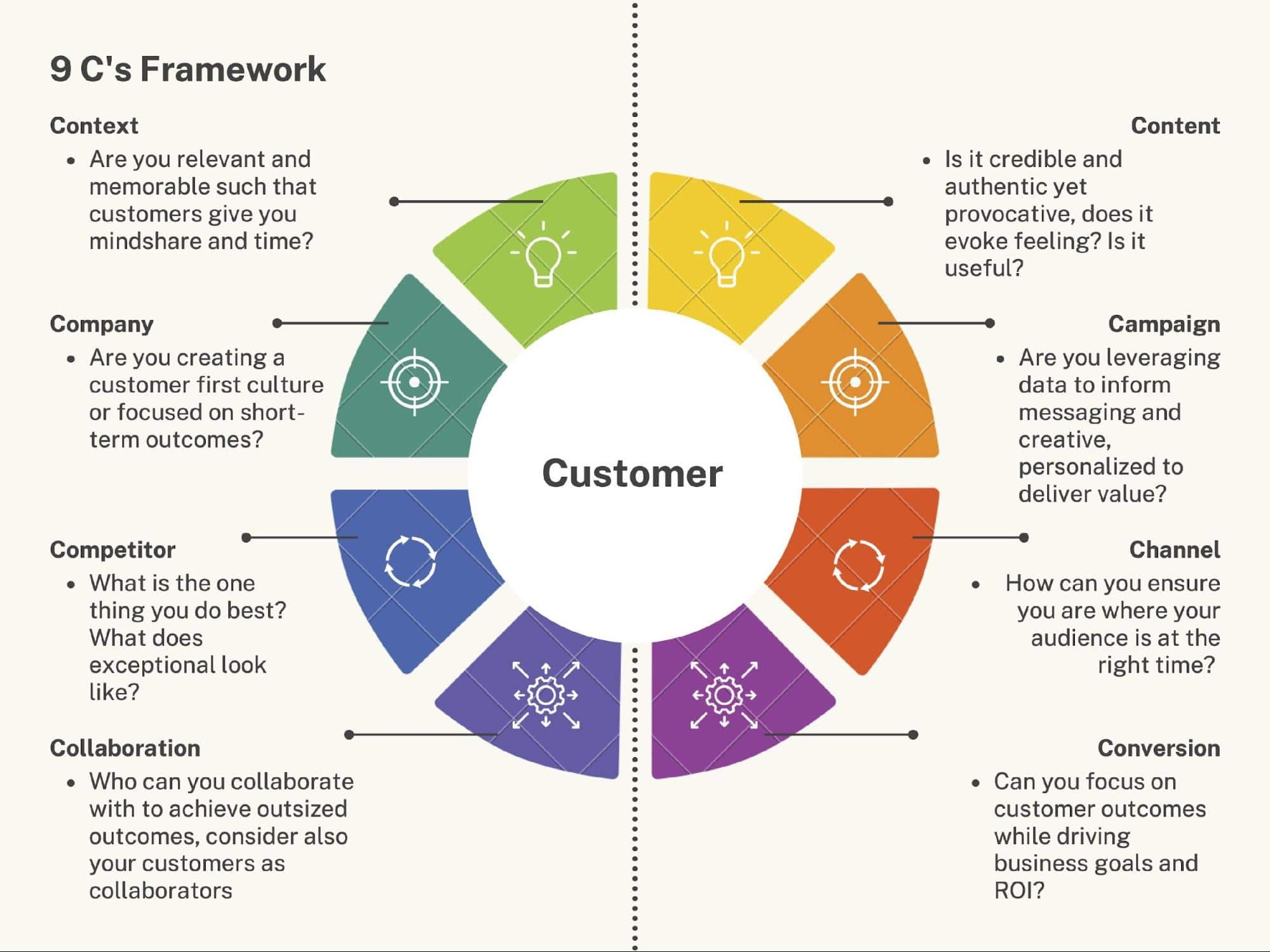
9C’s Framework / Sophia Agustina and Margaret Safford
As you can find above,the 9C’s framework combines 8 different concepts to center the customer at the core of your marketing campaigns:
Context: Are you relevant and memorable such that customers give you mindshare and time?
Company: Are you creating a customer-first culture or focused on short-term outcomes?
Competitor: What is the one thing you do best? What does exceptional look like for your brand?
Collaboration: Who can you collaborate with to achieve outsized outcomes (consider your customers are also collaborators)?
Content: Is it credible and authentic yet provocative, does it evoke feeling? Is it useful?
Campaign: Are you leveraging data to inform messaging and creative, personalized to deliver value?
Channel: How can you ensure you are where your audience is at the right time?
Conversion: Can you focus on customer outcomes while driving business goals and ROI?
By answering these questions and using all of your marketing campaigns to prioritize your customers and your needs, you can foster brand love in a sustainable and strategic way.
Meet practical and emotional needs of your fans
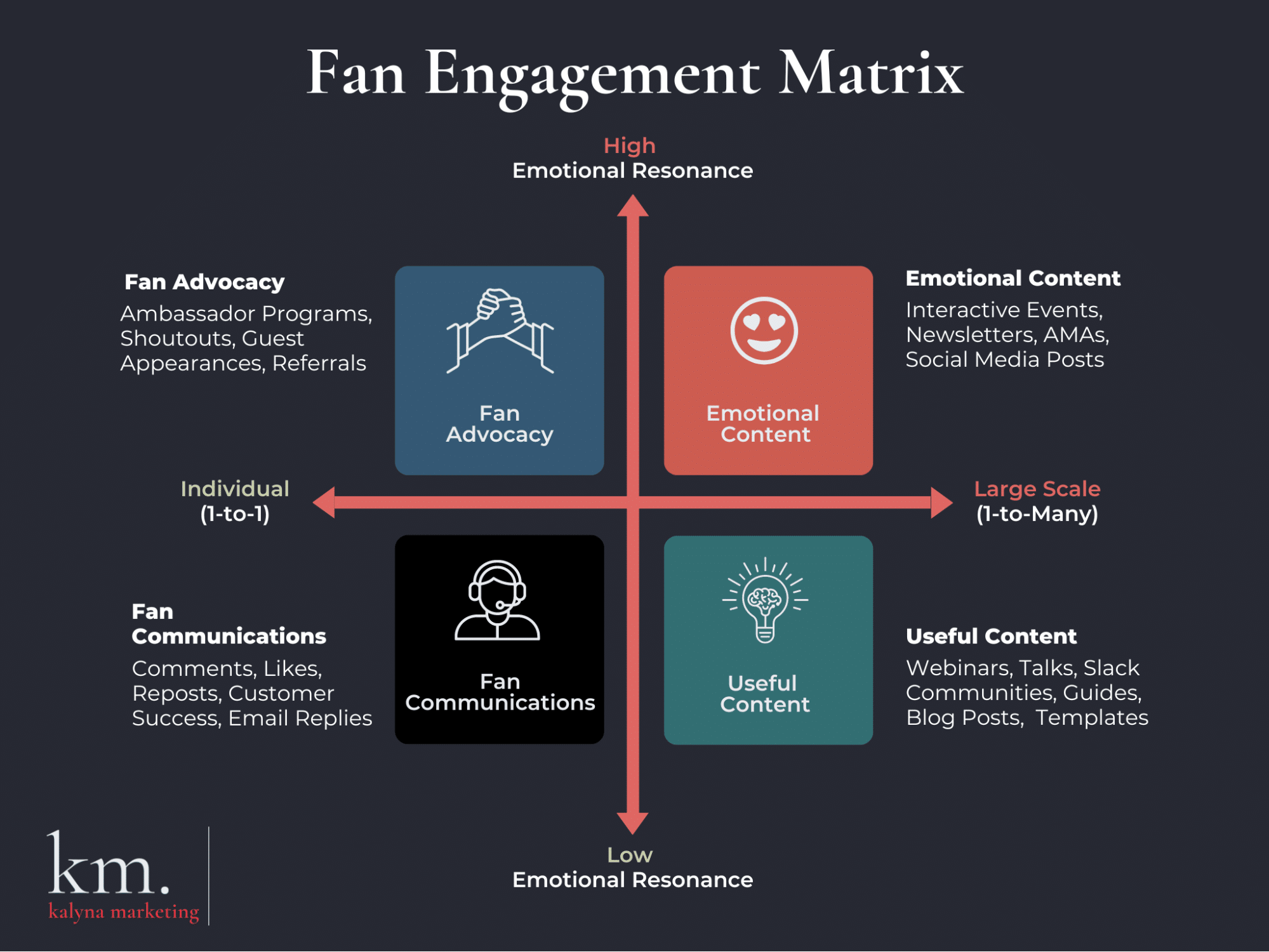
Fan Engagement Matrix / Mariya Delano
If you’d like to fulfill both practical (e.g., safety, self-actualization) and emotional (e.g., belonging, esteem) needs of your customers, consider categorizing your marketing activities into the following buckets:
Fan communication: Speak with your customers one-on-one via customer support, social media engagement and other practical communications.
Fan advocacy: Expand past communication and engage customers one-on-one on a more emotional level by advocating for their interests and success via promotion and collaborations.
Useful content: Create useful content that helps your customers improve their skills at scale.
Emotional content: Create content that fosters parasocial attachment by allowing your customers to see the human side to your business and people within your organization.
As with any tactic, the most effective combination of fan engagements will change from one business to another. But at its core, each marketing activity needs to be customer-centric and drive business ROI through a relentless focus on customer outcomes.
What next?
When you put in an effort to help your biggest fans, they will help you 10 times more.
Yes, targeting something as subjective as brand love can be scary. You’re messing with people’s deep emotional attachments, and there are plenty of risks to getting that wrong. But as with any meaningful relationship, love is usually worth it.
So show your customers that you care about them becoming your fans. And demonstrate that you love them as much as they are starting to love you.
Opinions expressed in this article are those of the guest author and not necessarily Search Engine Land. Staff authors are listed here.
@media screen and (min-width: 800px) { #div-gpt-ad-3191538-7 { display: flex !important; justify-content: center !important; align-items: center !important; min-width:770px; min-height:260px; }
}
@media screen and (min-width: 1279px) { #div-gpt-ad-3191538-7 { display: flex !important; justify-content: center !important; align-items: center !important; min-width:800px!important; min-height:440px!important; }
}
About the author
Mariya Delano is the founder of Kalyna Marketing, a marketing agency for B2B technical brands. She combines her background in academic writing and her love for research into helping clients with content marketing strategy, creation, and distribution. She’s worked with clients in SaaS, cybersecurity, data analytics, DevOps, AI, ecommerce, MarTech, and more. Mariya is originally from Zhytomyr, Ukraine and is currently based in New York, USA.
I mean, if we think SEO is hard (and it is) imagine if you were trying to build a search engine in a world where:
The users vary dramatically and change their preferences over time.
The technology they access search advances every day.
Competitors nipping at your heels constantly.
On top of that, you’re also dealing with pesky SEOs trying to game your algorithm gain insights into how best to optimize for your visitors.
That’s going to make it a lot harder.
Now imagine if the main technologies you need to lean on to advance came with their own limitations – and, perhaps worse, massive costs.
Well, if you’re one of the writers of the recently published paper, “End-to-End Query Term Weighting” you see this as an opportunity to shine.
What is end-to-end query term weighting?
End-to-end query term weighting refers to a method where the weight of each term in a query is determined as part of the overall model, without relying on manually programmed or traditional term weighting schemes or other independent models.
What does that look like?
Here we see an illustration of one of the key differentiators of the model outlined in the paper (Figure 1, specifically).
On the right side of the standard model (2) we see the same as we do with the proposed model (4), which is the corpus (full set of documents in the index), leading to the documents, leading to the terms.
This illustrates the actual hierarchy into the system, but you can casually think of it in reverse, from the top down. We have terms. We look for documents with those terms. Those documents are in the corpus of all the documents we know about.
To the lower left (1) in the standard Information Retrieval (IR) architecture, you’ll notice that there is no BERT layer. The query used in their illustration (nike running shoes) enters the system, and the weights are computed independently of the model and passed to it.
In the illustration here, the weights are passing equally among the three words in the query. However, it does not have to be that way. It’s simply a default and good illustration.
What is important to understand is that the weights are assigned from outside the model and entered it with the query. We’ll cover why this is important momentarily.
If we look at the term-weight version on the right side, you’ll see that the query “nike running shoes” enters BERT (Term Weighting BERT, or TW-BERT, to be specific) which is used to assign the weights that would be best applied to that query.
From there things follow a similar path for both, a scoring function is applied and documents are ranked. But there’s a key final step with the new model, that is really the point of it all, the ranking loss calculation.
This calculation, which I was referring to above, makes the weights being determined within the model so important. To understand this best, let’s take a quick aside to discuss loss functions, which is important to really understand what’s going on here.
What is a loss function?
In machine learning, a loss function is basically a calculation of how wrong a system is with said system trying to learn to get as close to a zero loss as possible.
Let’s take for example a model designed to determine house prices. If you entered in all the stats of your house and it came up with a value of $250,000, but your house sold for $260,000 the difference would be considered the loss (which is an absolute value).
Across a large number of examples, the model is taught to minimize the loss by assigning different weights to the parameters it is given until it gets the best result. A parameter, in this case, may include things like square feet, bedrooms, yard size, proximity to a school, etc.
Now, back to query term weighting
Looking back at the two examples above, what we need to focus on is the presence of a BERT model to provide the weighting to the terms down-funnel of the ranking loss calculation.
To put it differently, in the traditional models, the weighting of the terms was done independent of the model itself and thus, could not respond to how the overall model performed. It could not learn how to improve in the weightings.
In the proposed system, this changes. The weighting is done from within the model itself and thus, as the model seeks to improve it’s performance and reduce the loss function, it has these extra dials to turn bringing term weighting into the equation. Literally.
ngrams
TW-BERT isn’t designed to operate in terms of words, but rather ngrams.
The authors of the paper illustrate well why they use ngrams instead of words when they point out that in the query “nike running shoes” if you simply weight the words then a page with mentions of the words nike, running and shoes could rank well even if it’s discussing “nike running socks” and “skate shoes”.
Traditional IR methods use query statistics and document statistics, and may surface pages with this or similar issues. Past attempts to address this focused on co-occurrence and ordering.
In this model, the ngrams are weighted as words were in our previous example, so we end up with something like:
On the left we see how the query would be weighted as uni-grams (1-word ngrams) and on the right, bi-grams (2-word ngrams).
The system, because the weighting is built into it, can train on all the permutations to determine the best ngrams and also the appropriate weight for each, as opposed to relying only on statistics like frequency.
Zero shot
An important feature of this model is its performance in zero-short tasks. The authors tested in on:
MS MARCO dataset – Microsoft dataset for document and passage ranking
TREC-COVID dataset – COVID articles and studies
Robust04 – News articles
Common Core – Educational articles and blog posts
They only had a small number of evaluation queries and used none for fine-tuning, making this a zero-shot test in that the model was not trained to rank documents on these domains specifically. The results were:
It outperformed in most tasks and performed best on shorter queries (1 to 10 words).
And it’s plug-and-play!
OK, that might be over-simplifying, but the authors write:
“Aligning TW-BERT with search engine scorers minimizes the changes needed to integrate it into existing production applications, whereas existing deep learning based search methods would require further infrastructure optimization and hardware requirements. The learned weights can be easily utilized by standard lexical retrievers and by other retrieval techniques such as query expansion.”
Because TW-BERT is designed to integrate into the current system, integration is far simpler and cheaper than other options.
What this all means for you
With machine learning models, it’s difficult to predict example what you as an SEO can do about it (apart from visible deployments like Bard or ChatGPT).
A permutation of this model will undoubtedly be deployed due to its improvements and ease of deployment (assuming the statements are accurate).
That said, this is a quality-of-life improvement at Google, that will improve rankings and zero-shot results with a low cost.
All we can really rely on is that if implemented, better results will more reliably surface. And that’s good news for SEO professionals.
Opinions expressed in this article are those of the guest author and not necessarily Search Engine Land. Staff authors are listed here.
@media screen and (min-width: 800px) { #div-gpt-ad-3191538-7 { display: flex !important; justify-content: center !important; align-items: center !important; min-width:770px; min-height:260px; }
}
@media screen and (min-width: 1279px) { #div-gpt-ad-3191538-7 { display: flex !important; justify-content: center !important; align-items: center !important; min-width:800px!important; min-height:440px!important; }
}
About the author
Dave Davies is the Lead SEO for the Machine Learning Operations company Weights & Biases. He got his start in SEO in the early 2000s and in 2004 co-founded Beanstalk Internet Marketing with his wife Mary, who still runs its day-to-day operations. He hosts a weekly podcast, speaks regularly at the industry’s leading conferences, and is proud to be a regular contributor right here on Search Engine Land.