Overcoming the Google SGE challenge: Assessment and recovery strategies by Cynthia Ramsaran

Woman On Phone Google Logo 1920 800x457

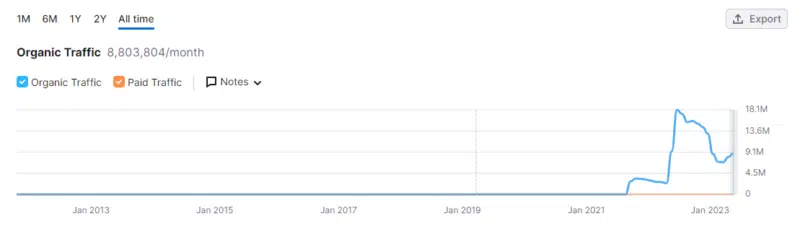
Google Search Generative Experience (SGE) is looming over the search industry, but little is understood about its mechanisms and expected impact on our organic traffic.

Join this webinar to understand how to overcome the Google SGE challenge. The first step is assessing how Google SGE goes live and how it will impact your organic traffic. Next, identify how to recover from expected traffic drops. Register now to learn about solutions that will help your organization mitigate the risk of SGE.

Register and attend “Overcoming the Google SGE Challenge: Assessment and Recovery Strategies” presented by AgileSEO.


Click here to view more Search Engine Land webinars.


Related stories

New on Search Engine Land

@media screen and (min-width: 800px) { #div-gpt-ad-3191538-7 { display: flex !important; justify-content: center !important; align-items: center !important; min-width:770px; min-height:260px; } } @media screen and (min-width: 1279px) { #div-gpt-ad-3191538-7 { display: flex !important; justify-content: center !important; align-items: center !important; min-width:800px!important; min-height:440px!important; } }

About the author

Cynthia Ramsaran

Cynthia Ramsaran is director of custom content at Third Door Media, publishers of Search Engine Land and MarTech. A multi-channel storyteller with over two decades of editorial/content marketing experience, Cynthia’s expertise spans the marketing, technology, finance, manufacturing and gaming industries. She was a writer/producer for CNBC.com and produced thought leadership for KPMG. Cynthia hails from Queens, NY and earned her Bachelor’s and MBA from St. John’s University.

https://searchengineland.com/overcoming-the-google-sge-challenge-assessment-and-recovery-strategies-431906


9 Amazon reviews best practices to boost sales and trust

Asking whether Amazon reviews are important is like wondering whether your body needs water to thrive. 

The answer is a resounding, “Yes!” 

Acquiring as many positive reviews as possible will pay off for Amazon sellers.

8 reasons Amazon reviews are important

Amazon reviews aren’t just testimonials; they are powerful tools that can make or break your sales on the platform.

Here’s why Amazon reviews have so much impact.

1. Consumer trust

Amazon reviews provide valuable insights into the quality and performance of products. Potential buyers often rely on these reviews to make informed decisions about whether to purchase a product.

Positive reviews can instill trust and confidence in a product, while negative reviews can serve as warnings that scare people off.

2. Product information

Reviews often contain detailed information about the product’s features, benefits and drawbacks — even more so than official product descriptions. 

This can help consumers understand what they are buying and whether it meets their specific needs.

3. Quality assurance

Reviews help hold sellers accountable for the quality of their products. A high number of positive reviews can indicate that a product is reliable and of high quality, while a consistent pattern of negative reviews may signal quality issues.

4. Improved products

Constructive feedback in reviews can be valuable for sellers. 

They can use this feedback to make improvements to their products, addressing issues raised by customers and enhancing overall product quality.

5. SEO and visibility

Amazon’s algorithm considers reviews when ranking products in search results. 

Products with more and better reviews often appear higher in search results, making them more visible to potential customers.

6. Seller reputation

For sellers, maintaining a good reputation on Amazon is crucial. Positive reviews can help build a seller’s credibility and attract more customers. Negative reviews, on the other hand, can harm a seller’s reputation and negatively impact sales.

7. Competitive advantage 

In a competitive marketplace like Amazon, positive reviews can give a product a significant advantage. They can differentiate a product from similar offerings and encourage more sales.

8. Risk mitigation

For consumers, reading reviews can help them avoid making poor purchasing decisions. They can learn from the experiences of others and avoid products that consistently receive negative feedback.

Use these Amazon review best practices to your advantage

With reviews playing such an important role in everything from SERP rankings to sales, it’s inevitable that some sellers would try to game the system by manipulating reviews.

As a result, Amazon has been cracking down, revising its review policy to preserve quality and credibility and maintain consumer trust. They have outlawed many of the practices sellers used to solicit reviews.

This doesn’t mean you should give up on trying to obtain reviews any more than you would stop drinking water. The key is to do so smartly, without violating Amazon’s zero-tolerance policy.

The following Amazon reviews best practices will help you boost sales and improve customer satisfaction. 

1. Understand the algorithmic impact

Amazon is notoriously tight-lipped concerning its review methodology.

However, certain factors – including how recently a review was written and whether the purchase was verified – carry significant weight. Fresh reviews are more valuable for long-term relevancy. 

The bottom line remains the same: the more reviews you have, the higher your search rankings and visibility, and the better your sales.

2. Leverage Amazon Vine

Amazon Vine is a program developed to help facilitate the collection of customer reviews for new and pre-release products on its platform.

Amazon Vine primarily targets more established and trusted reviewers, often referred to as “Vine Voices,” who have a history of writing helpful and informative reviews. Amazon Vine reviews include a badge stating “Vine Customer Review of Free Product” to ensure transparency.

In exchange for providing free items, sellers who enroll in the Amazon Vine program get early reviews from unbiased Vine Voices reviewers who have demonstrated high standards in writing trustworthy reviews. This improves visibility and rankings and can boost sales by up to 30%, according to Amazon. 

3. Encourage organic reviews

Encouraging organic Amazon reviews – reviews that naturally occur without manipulation or incentivization:

  • Improves your credibility and trustworthiness.
  • Helps you build a long-term reputation.
  • Helps potential buyers make informed purchasing decisions.
  • Can improve your product’s visibility in search results.

The best way to obtain organic reviews, which ensure compliance with Amazon’s policies, eliminating any risk of penalties or account suspension, is by providing high-quality products, exceptional customer service, and clear communication.

Respond promptly to customer issues, ensure your products meet or exceed expectations, create informative and engaging product listings, and use constructive customer feedback to make product improvements when necessary.

It’s OK to send customers follow-up emails requesting feedback on their purchases as long as you don’t offer incentives that violate Amazon policies.

4. Respond professionally to negative reviews

Nobody likes a negative review, but they are an inevitable part of doing business.

Responding professionally can have a significant impact on your reputation. Negative reviews are visible to the public, and how you respond can influence how your business is perceived.

Professional responses help minimize damage to your brand and help build trust with both current and potential customers. When you acknowledge their concerns and offer solutions, you have an opportunity to turn dissatisfied customers into loyal ones.

Responding professionally to negative reviews may be easier said than done, so start out by taking a deep breath. Next:

  • Avoid getting defensive; focus on the facts and the customer’s concerns by acknowledging their complaint and expressing empathy.
  • Offer a solution to the problem or provide additional information that might help clarify any misunderstandings.
  • Use courteous and professional language, offer a sincere apology when warranted, and suggest moving the conversation offline to address the issue more personally.

5. Highlight positive reviews in marketing

Positive reviews are a blessing. Highlighting them in other channels is a great way to build trust with potential customers and showcase the quality and value of your products and services.

Incorporating positive reviews into your marketing efforts might involve:

  • Including snippets in your Amazon product descriptions.
  • Creating a testimonials section on your website, including a mix of written reviews and star ratings.
  • Sharing positive reviews on your social media profiles.
  • Using pull quotes in marketing collateral.
  • Incorporating reviews into ad campaigns or product packaging.

Remember to always seek permission from customers before using their reviews or testimonials in your marketing efforts. Doing so ensures your marketing practices comply with Amazon’s policies and any other regulations and ethical guidelines. 

6. Regular monitoring and analysis

Regularly tracking customer reviews keeps you informed about customer perceptions, helps you identify emerging trends or recurring issues, improves customer engagement, and allows you to make data-driven improvements.

Consider using an online monitoring tool like Amazon CloudWatch to continuously track the digital experiences of your customers, or third-party services that aggregate and analyze reviews from various platforms, including Amazon. These tools can help you efficiently manage your online reputation and stay proactive in addressing customer feedback. 

Additionally, establish clear internal processes for reviewing and responding to customer reviews to ensure consistent and timely engagement with your customers’ feedback. 

7. Stay compliant with Amazon’s policies

Staying compliant with Amazon’s policies is crucial. The online platform has established a strict set of rules and guidelines to maintain a fair and trustworthy marketplace.

Violating Amazon’s policies, whether intentionally or not, can lead to the suspension or termination of your seller account, with serious long-term business implications. 

Understanding what is allowed and what is not will help you build and maintain trust with both customers and other sellers, and promotes fair competition.

Amazon’s policies are designed to ensure a positive shopping experience for customers; by focusing on compliance, you’ll help contribute to a more consistent and reliable shopping experience, which can result in higher customer satisfaction and loyalty.

8. Learn from your competitors

By tracking customer reviews of your competitors, you can gain insights into their strengths and weaknesses. This knowledge can inform your own business strategies, helping you differentiate your offerings and outperform the competition.

Begin by identifying your key Amazon competitors – those sellers that offer similar products or services. Collect a sample of competitor reviews for analysis (you can do this by manually reading through their reviews or using review aggregation tools or services to streamline the process), analyze the overall star ratings for consistency, and pay attention to recurring complaints or praises.

Look for competitive advantages, evaluate pricing strategies, and assess their overall brand reputation. Compare the insights gained from competitor reviews with your own reviews, identifying areas where you can leverage strengths or address weaknesses. 

9. Use third-party tools for advanced management

Amazon provides sellers with access to many valuable tools for managing their accounts, but third parties often include additional features designed to streamline operations, optimize sales and enhance overall business performance.

Third-party tools can:

  • Automate repetitive tasks.
  • Provide access to robust analytics and reporting capabilities.
  • Track and manage inventory.
  • Optimize product listings.
  • Manage Amazon advertising campaigns.
  • Integrate with other ecommerce platforms to expand your reach.
  • Help manage customer communications. 

Evaluate third-party management tools carefully, investing in those that align with your specific needs, budget, and business goals.


Opinions expressed in this article are those of the guest author and not necessarily Search Engine Land. Staff authors are listed here.


Related stories

New on Search Engine Land

@media screen and (min-width: 800px) { #div-gpt-ad-3191538-7 { display: flex !important; justify-content: center !important; align-items: center !important; min-width:770px; min-height:260px; } } @media screen and (min-width: 1279px) { #div-gpt-ad-3191538-7 { display: flex !important; justify-content: center !important; align-items: center !important; min-width:800px!important; min-height:440px!important; } }

About the author

Evan Facinger

Evan Facinger is a digital marketer with 15 years of experience and is the Director of Sales and Marketing at Foremost Media, a full-service digital marketing and web development agency. Evan has a robust background that includes; Amazon optimization, search engine optimization (SEO), conversion rate optimization (CRO), marketing automation, and pay-per-click management. He has helped hundreds of clients realize their business goals through digital marketing.

https://searchengineland.com/amazon-reviews-best-practices-sales-trust-431879


4 simple ways to put an end to unprotected paid search by Adthena

Adthena 9 13 23 SEL Image 800x452

In an era dominated by digital interactions and virtual marketplaces, we cannot overstate the significance of brand protection in search marketing. As businesses strive to establish and maintain a distinctive identity in the vast online realm, they face the ever-present challenge of safeguarding their brand from trademark infringements, ad hijackers and other potential brand threats. The convergence of search marketing and brand protection has emerged as a strategic imperative, ensuring not only the integrity of a brand but also its sustained growth and reputation.

The nexus of brand and search marketing

Search marketing, encompassing search engine optimization (SEO) and pay-per-click (PPC) advertising, serves as a digital storefront for businesses, enabling them to connect with their target audience directly at the point of interest. However, this potent tool is also susceptible to misuse by malicious actors seeking to exploit established brands for personal gain. This is where the concept of brand protection becomes paramount.

  1. Preserving authenticity: Counteracting impersonation

In the digital landscape, impersonation poses a substantial threat to brands. Unauthorized third parties, including competitors and affiliates, may create websites or ads that closely mimic the appearance and messaging of genuine brands, leading unsuspecting consumers astray – and reaping commissions they aren’t entitled to.

By implementing vigilant monitoring and taking swift action against such impersonators, businesses can prevent reputational damage and ensure their customers are not misled.

Search marketing offers opportunities for proactive brand protection by allowing businesses to bid on their own branded keywords. This ensures that when users search for the brand’s name, they are directed to the official website, thereby mitigating the chances of falling victim to counterfeit websites or unauthorized resellers.

  1. Defending against ad-hijacking

Counterfeit products erode a brand’s market share and compromise its reputation for quality and authenticity. In search marketing, counterfeiters may bid on keywords related to genuine products, diverting potential customers towards fake alternatives. 

Deploying robust brand protection measures involves consistent monitoring of search results and active collaboration with brand protection platforms such as Adthena Ad-Hijacking. By indexing and reporting the hundreds of affiliate networks, advertisers can detect thousands of instances of affiliate ad hijacks. They will provide evidence of the fraud, including the ad screenshot and affiliate ID.

Adthena recently helped one global hotel brand identify 50 reservations during the last two months. They suspended the publisher for seven days and bookings generated during the period have been canceled for commissioning. 

The possible budget wastage is substantial. As a benchmark, if 10 publishers are spotted, fraudulent activities can cost close to $10K.

  1. Kick out the trademark infringers

Trademark infringement in search refers to the unauthorized use of a registered trademark or brand name in online search advertising, particularly in paid search campaigns. It occurs when a third party uses a registered trademark as a keyword to trigger the display of their own advertisements in search engine results or uses the trademark in the ad copy itself without the permission of the trademark owner. 

This practice can lead to confusion among consumers and may divert traffic or customers away from the legitimate trademark owner.

There are two main types of trademark infringement in search:

Keyword trademark infringement: This occurs when a competitor or third party bids on a registered trademark or brand name as a keyword in their paid search campaigns. When users search for that trademark, the infringing ad may appear alongside or above the legitimate search results, potentially leading users to click on an ad not associated with the actual trademark owner.

Ad copy trademark infringement: In this case, a competitor or third party uses the registered trademark in the text of their paid search ad, creating the impression that their products or services are affiliated with or endorsed by the legitimate trademark owner, even when they are not.

It is important for trademark owners to actively monitor their brand’s use in online advertising and report any instances of infringement.

When global software provider Sage added new partners and affiliates, they soon realized they needed to keep close tabs on their partner network and competition.

Brand bidding was a real problem, not just by competitors. Affiliates and partners also used  Sage’s branded terms and trademarks in their ad copy, inflating CPCs and stealing impressions that belonged to Sage. Even with agreements to prevent brand bidding by partners and independent software vendors (ISVs), violators were a problem.

Adthena’s Infringement Tracker was put to work, identifying 89K infringements by a single partner alone over 12 months. Five days after enforcing agreements based on Adthena’s monitoring, Sage saw a 75% decrease in CPCs for brand terms and a 33% decrease in partner impression share.

  1. Get granular

If there is a market shift, you need to know so that you can take action and protect your position. Whether competitors are changing tactics, entering or leaving your market, or attacking or piggybacking on your brand, adapting your strategy quickly keeps you one step ahead of your competitors.

On a path to growth, Australian retailer Koala Mattresses operated in competitive blindness, unable to understand how competitors’ strategies compromised their search performance and impacted their campaigns. 

Adthena’s Smart Monitor helped them counter performance threats, especially during critical sales periods and new product launches, by immediately defending its position when competitors close in on its market share or target its customers. Koala has been able to reduce overall CPA by almost 45% and improve share of impressions on core product terms by 10%.

Forging success: The cornerstone alliance of brand protection and online visibility

In the ever-evolving digital commerce landscape, brand protection in search marketing is an indomitable force that safeguards a brand’s essence and growth potential. 

By nurturing authenticity, countering impersonation, combatting counterfeits, and leveraging legal and technological tools, businesses can cultivate an environment where their brand thrives, free from the shackles of misrepresentation and exploitation. 

As search marketing continues to shape the digital narrative, the alliance between brand protection and online visibility becomes a cornerstone of success in the modern business landscape.

As we explored, when your brand is unprotected in paid search, it’s left wide open to competitors stealing valuable clicks or affiliates hijacking your ads and compromising brand integrity.
Take a three-minute tour of Adthena’s Brand Protection solution and see how you could safeguard your brand. Or for further reading, our Brand Crashers guide reveals five steps to optimize your brand in search.


Related stories

New on Search Engine Land

About the author

Adthena

Founded in 2012, Adthena is an award-winning search intelligence platform. Our unique combination of patented, AI-driven technology and a world-class team of experts helps brands, marketers, and agencies across the globe dominate their competitive landscapes. We provide our customers with a clear view of the paid search landscape, helping them optimize their spend to increase ROI, all while saving them time and better informing their cross-channel strategies. Adthena’s solutions are powered by our market-leading technology: Whole Market View creates a unique market map of a client’s entire search landscape and Smart Monitor automatically detects threats and opportunities every day. Our award-winning Local View product provides the location-based strategic insights that marketers need to dominate at a local level. For more information, visit: www.adthena.com

https://searchengineland.com/4-simple-ways-to-put-an-end-to-unprotected-paid-search-431714


Google CEO on SGE and Search evolution: ‘We’ll get it right’

The multibillion-dollar question right now is whether the Search Generative Experience (SGE) will blow up Google’s Search business model. Based on early testing, Google CEO Sundar Pichai is “confident” that won’t happen.

“It’s important to us to connect users with what’s out on the web, and we are working deeply to make sure that continues to work well,” Pichai told Steven Levy in a Q&A published on Wired.

Why we care. Google may be confident that the SGE experiment will continue to send people to websites, but we’re still finding it hard to trust Google at this point. They won’t reveal any real data to us about whether AI answers are driving clicks to websites, click-through rate data, or advertising performance data on what we are calling CHERPs, or Chat Engine Results Pages. And we have no way to track this in Google Search Console, Google Ads or Google Analytics.

Ads vs. organic. Levy pointed out to Pichai that the AI-generated answers are different from a list of links, which could further add confusion about whether an SGE answer is sponsored or organic.

  • “Even in a generative experience we would give you a set of sites that support what we are saying. We want to make sure users are consuming those sites. So I don’t think the core part of the experience will change. We will have a space for ads in a way that makes sense for users and particularly on commercial queries,” Pichai said.

Helping people find information. Pichai pointed out that even though the way Google presents information has evolved greatly in 25 years – but ultimately people are searching for information.

  • “We are still trying to help people find the best information that exists online. Inherently, people are also looking for commercial information, and ads are very valuable commercial information, because they connect merchants and businesses, small and big, to users. None of that changes just because we are applying AI deeply. When we evolve search with generative AI, we’ll apply the same principles,” Pichai said.

Like desktop to mobile? Pichai pointed out that people asked similar questions as Google shifted its focus from desktop to making everything mobile-first.

  • “Our early testing shows that we’ll be able to get it right. It’s core to the company to evolve search while applying the underlying principles. I am confident we’ll be able to get that right through this transition,” Pichai said.

The search community was also extremely worried about Google’s featured snippets stealing traffic. When Bard launched in February, there were no links. And SGE only finally added links to websites Aug. 30 after months of pressure by search marketers and publishers.

Bing burn. Did the new Bing, powered by ChatGPT, make Google “dance.” Pichai essentially dissed their efforts, comparing it to Alexa and Siri. Pichai also claimed:

  • “Around the end of last year, my thoughts were, how can we bring generative AI to search in a way that makes sense for our users? That’s what I’m thinking about, and that’s what will matter in the long run.”

Could that time in late 2022 coincide with OpenAI launching ChatGPT in late November? Generative AI exploded on the scene and supposedly triggered a code red within Google, leading to the return of Google founders Larry Page and Sergey Brin.

Pichai was also asked about the antitrust trial, but had little to say beyond throwing around the word “innovation.”

You can read the full interview here: Sundar Pichai on Google’s AI, Microsoft’s AI, OpenAI, and … Did We Mention AI?


Related stories

New on Search Engine Land

@media screen and (min-width: 800px) { #div-gpt-ad-3191538-7 { display: flex !important; justify-content: center !important; align-items: center !important; min-width:770px; min-height:260px; } } @media screen and (min-width: 1279px) { #div-gpt-ad-3191538-7 { display: flex !important; justify-content: center !important; align-items: center !important; min-width:800px!important; min-height:440px!important; } }

About the author

Danny Goodwin

Danny Goodwin has been Managing Editor of Search Engine Land & Search Marketing Expo – SMX since 2022. He joined Search Engine Land in 2022 as Senior Editor. In addition to reporting on the latest search marketing news, he manages Search Engine Land’s SME (Subject Matter Expert) program. He also helps program U.S. SMX events. Goodwin has been editing and writing about the latest developments and trends in search and digital marketing since 2007. He previously was Executive Editor of Search Engine Journal (from 2017 to 2022), managing editor of Momentology (from 2014-2016) and editor of Search Engine Watch (from 2007 to 2014). He has spoken at many major search conferences and virtual events, and has been sourced for his expertise by a wide range of publications and podcasts.

https://searchengineland.com/google-ceo-on-sge-and-search-evolution-well-get-it-right-431888


Ecommerce marketing next year: 5 ways to set up for success

Q4 is almost here, along with the holiday shopping season.

Rather than focus on ecommerce holiday SEO strategies and campaigns – which you should (hopefully) already have nailed down – now is a good time to start thinking ahead to next year.

1. Learn from last year

Start by reviewing last year’s campaign wrap-ups to identify any missing data or insights.

One big change from last year is that you’re likely now fully using Google Analytics 4. This requires rethinking or reevaluating your reporting.

Revisit your past reports. Can you report on all the data you have before?

Use this opportunity to inform stakeholders about any significant differences due to the new tracking setup.

Unsure where to begin with tracking? Consider a future state workshop.

Gather your team, project to the time when you need to report on holiday campaigns, and collaboratively create the report framework. This workshop format encourages idea exchange and innovative performance review methods.

These sessions also often make us think about ways to test and learn.

2. Test and learn from with a larger dataset than usual

During the holiday season, I’ve seen ecommerce site traffic surge by as much as 70%. This increased activity makes it a great time to spot data trends – and quickly test new ideas.

These tests could be general improvements or holiday-specific optimizations.

I recently worked on a test during peak season for a client, and it doubled revenue per session in a quick experiment, which might have taken weeks to achieve at another time of the year.

Key principles still count:

  • Test one idea at a time.
  • Keep it simple.
  • Ensuring the test is scientifically robust.

I’m a fan of behavioral science, and when I need testing ideas, I turn to nudges – or small adjustments to influence decisions.

Inspired by the research of Daniel Kahneman and Amos Tversky, nudges can be a valuable source of testing inspiration, especially when aligned with audience insights to match potential customer behavior.

Successful testing yields valuable insights to guide your 2024 strategy, whether it’s for regular campaigns or holiday and sales-focused ones.

3. Gamification

Gamification is an underutilized marketing tool that goes through ups and downs in popularity.

The holiday season is an ideal time to experiment with gamification to learn about your audience for your future marketing.

Gamification varies, from generic fun games to customized ones that can captivate your audience for extended periods. For instance, we once created a football-related game for a client that achieved an astonishing average time on site of over 30 minutes.

The secret? A highly relevant, engaging, and addictive quiz.

To use gamification for audience insights, focus on custom games, like a personalized psychographic quiz tailored to your brand.

For example, a clothing brand could create a quiz like “What Does Your Wardrobe Say About You?” It guides users through statements to reveal a persona linked to popular characters, providing valuable insights into your audience.

Done well, this benefits the brand and user. But it must be executed well to avoid harming the brand-user relationship.

Now that you’ve categorized your audience using the quiz profiles, you can create targeted segments. This enables personalized email communications for each profile based on what you’ve learned about them.

4. Data capture

Zero-party data is highly valuable. Finding mutually beneficial ways to collect it from customers can greatly benefit your future strategy.

The holiday season offers more chances to connect with your audience through promotions and exclusive deals. Make the most of this by asking customers what matters most to them in advance. This enables better content personalization, which can increase conversion rates.

To gain an advantage over competitors, consider using games, quizzes, or planning tools to capture information ahead of time for holiday shopping. This allows you to benefit now and in the coming year.

Strike the right balance between questions and rewards to make it worthwhile for customers to provide this information.

Consider offering exclusive access to Black Friday sales in exchange for customer preferences. These insights benefit both your event and customer interests.

Additionally, categorize purchases to distinguish between personal and gift items. This prevents marketing misalignment, allowing you to collect more information, such as birthdays, in exchange for discounts on gifts.

To collect zero-party data effectively:

  • Ensure mutual benefit.
  • Store data for usability.
  • Actively use and track its impact.

5. Digital PR

Digital PR can boost authority for ecommerce holiday season campaigns and the upcoming year, if executed correctly. Preparation and relevance are key.

Publications will share gift guides, Black Friday/Cyber Monday deals, and more. Ensure your brand aligns with these opportunities by analyzing last year’s coverage and your competitors’ visibility.

During planning, wear both your SEO and digital PR hats.

  • Be mindful of URLs, so you don’t invest heavily in temporary ones. Create a clear strategy for seasonal landing pages to keep them active, even building anticipation for future campaigns.

Aim for immediate impact and the upcoming year.

Strategically target publications for potential backlinks, especially those you don’t already have. Examine their past holiday content for opportunities your brand can fill.

Be proactive and plan for January content, as the new year arrives swiftly with its own opportunities.

Don’t hesitate to request links when it comes to link building. We had a client with a popular beauty advent calendar capitalize on this by identifying mentions and asking for links.

Ecommerce marketing success is all about planning

Start with your future vision for holiday campaign results and work backward to achieve it.

Learn from the past and adapt to changes (e.g., GA4, economic shifts) to effectively shape your plans.

If you can’t do everything this year, start a holiday 2024 planning document and start preserving your valuable ideas. Testing and learning doesn’t happen all at once. Now is the best time to start testing and learning.


Opinions expressed in this article are those of the guest author and not necessarily Search Engine Land. Staff authors are listed here.


Related stories

New on Search Engine Land

@media screen and (min-width: 800px) { #div-gpt-ad-3191538-7 { display: flex !important; justify-content: center !important; align-items: center !important; min-width:770px; min-height:260px; } } @media screen and (min-width: 1279px) { #div-gpt-ad-3191538-7 { display: flex !important; justify-content: center !important; align-items: center !important; min-width:800px!important; min-height:440px!important; } }

About the author

Becky Simms

Becky has spent the last 15 years working in digital marketing, starting Reflect Digital in 2011, which is now a team of over 35 digital specialists. Becky secured a three-year hat-trick in 2023 of being listed in the BIMA 100, a list of the top 100 people shaping the future of the digital industry. Becky’s passion for digital lies within understanding human behaviourand applying behavioural science to digital channels. It is her belief that when you truly understand your audience you unleash a performance potential previously not possible to attain.

https://searchengineland.com/ecommerce-marketing-success-next-year-431846


How the August 2023 Google core update compared to March 2023 core updates

Now that the Google August 2023 Core Update is done rolling out, we wanted to take a deeper dive on how this core update differed from previous Google core updates, specifically the March 2023 broad core update. This update was indeed a big one, and caused a lot of ranking volatility across many verticals in the Google search results. But this update was also surrounded by a very volatile set of weeks prior to the update, making the update itself feel a bit more muted than previous updates.

August 2023 core update. As a reminder, the Google August 2023 broad core update started rolling out August 22, 2023, and was completed 16 days later on September 7, 2023.

Data providers on the August 2023 core update

Semrush. Semrush data showed that the August 2023 core update hit a peak of 9.3 in terms of their Semrush Sensor data volatility, which occurred on August 25th, a few days after the update officially started to roll out. When you compare that to the March 2023 core update, that update only reached about 8. Here is a look at the peaks for both updates over the period of time they rolled out:

Semrush Aug Core Update Compare

You can clearly see that while the March 2023 core update had wide volatility spikes, the August 2023 core update did not. It was just continuously heated before, during and after the update finished rolling out with some larger peaks on August 25th and on September 7th, the day it completed.

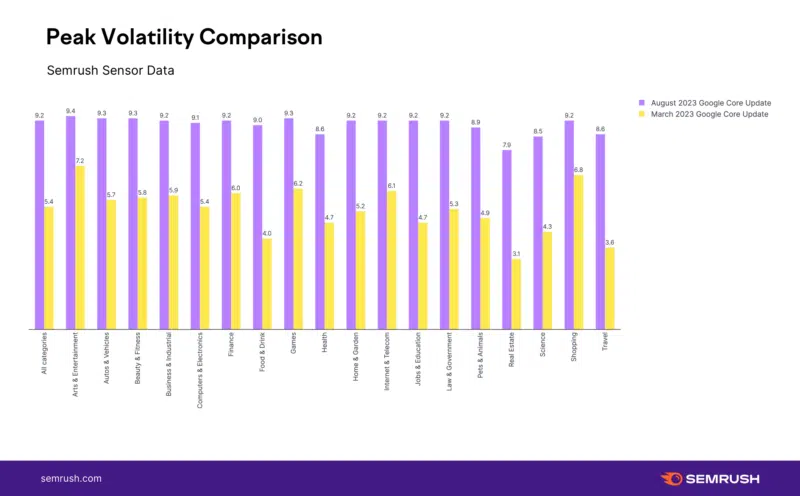
This next graph compares the peak volatility across verticals between the March and August 2023 core updates:

Semrush Aug Core Update Compare Verticles 800x496

Since Google’s search results have been so volatile it is hard to say which update was more impactful because of the constant volatility. Mordy Oberstein on behalf of Semrush told me, “As compared to pre-update volatility the March 2023 Core Update saw a more significant increase in volatility overall as compared to August. This makes sense when looking at the volatility trends because by the time the August update was officially released rank volatility levels were already quite high. “

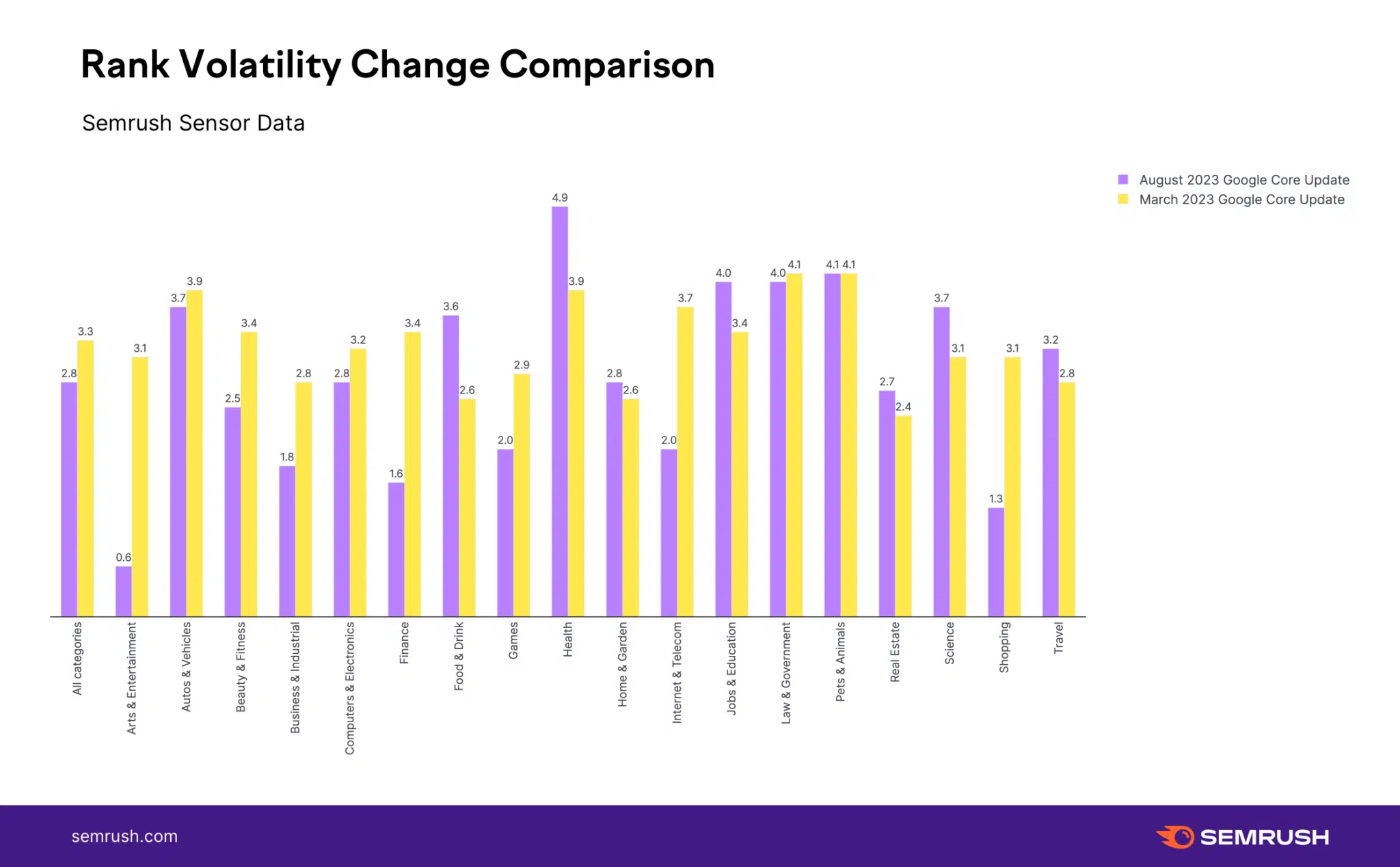
This chart shows the overall change by verticle comparing the March to the August core updates:

Semrush Aug Core Update Compare Change

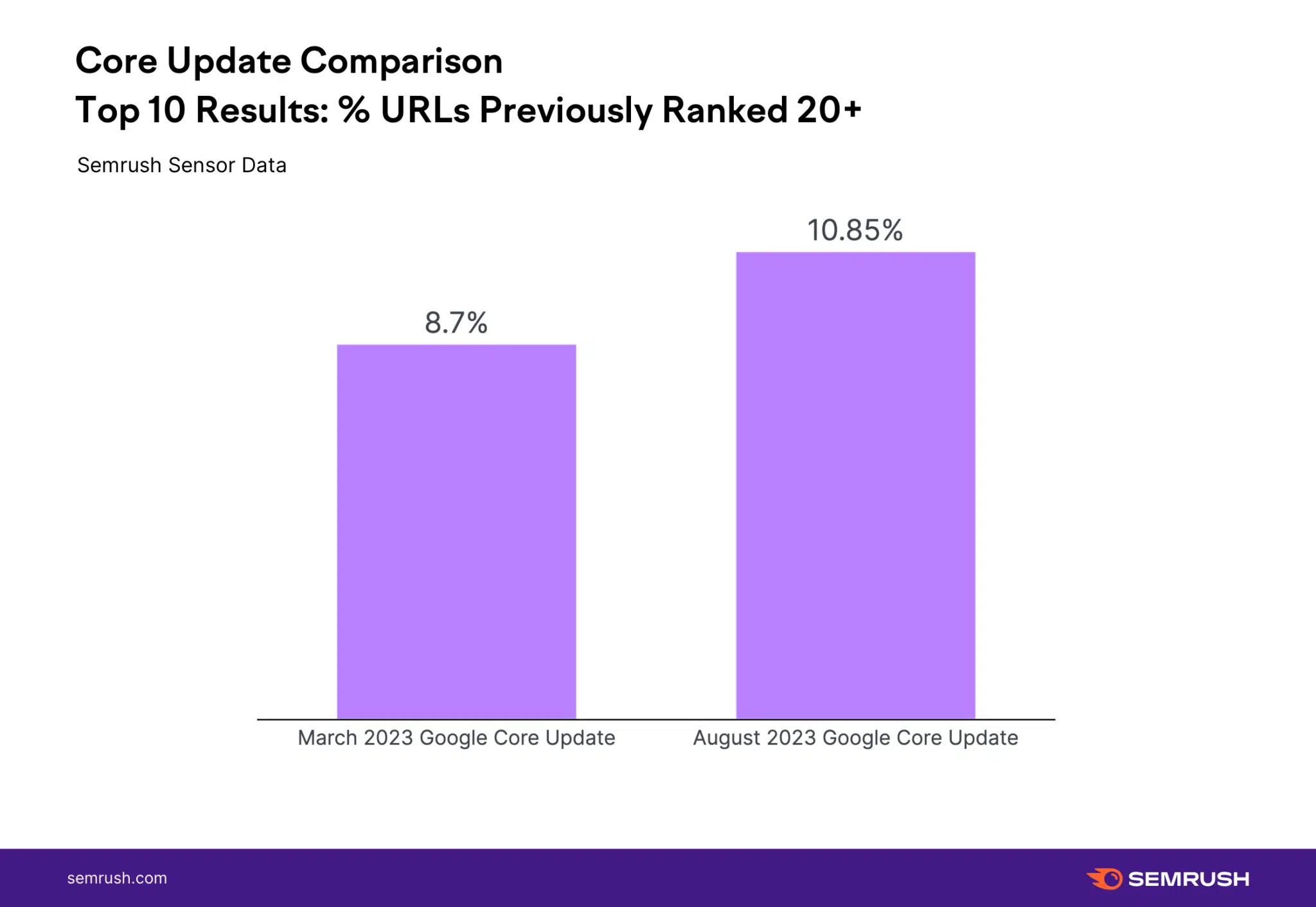
Also there was a noticeable difference in the percentage of URLs now ranking top 10 of the Google search results that were ranking in the twenty or higher position before the update when comparing the March and August 2023 Core Updates:

Semrush Aug Core Update Compare New Urls

“When you look at it all together it’s a bit of a mixed bag. From a peak volatility point of view, August was more powerful than the March 2023 Core Update,” Mordy Oberstein said. “However, if you look at the increase in rank volatility as compared to the pre-update volatility then the March 2023 Core Update seems more significant. However, even there, as mentioned, more than a few verticals saw more dramatic volatility increases with the most recent update,” he added.

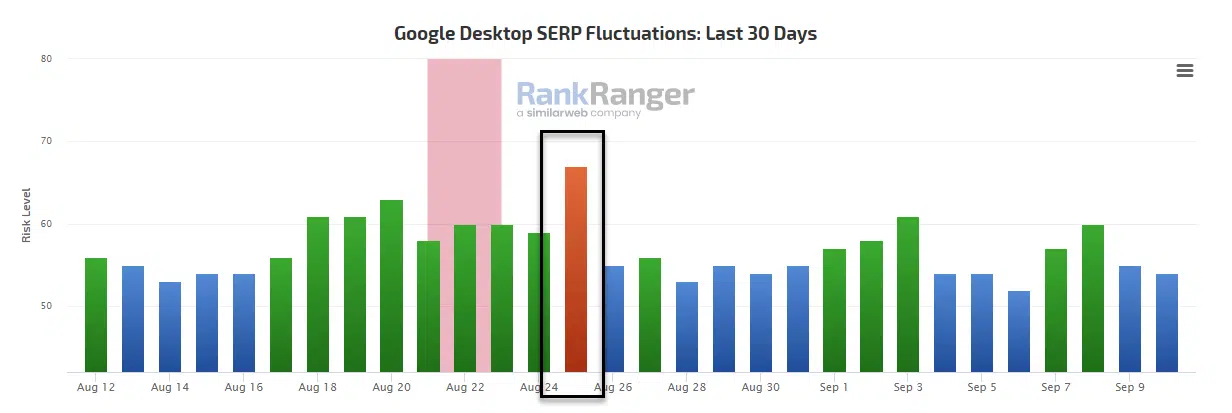
RankRanger. The RankRanger team also sent us data comparing this August 2023 core update to the March 2023 core update. First off, this was a big update, the RankRanger Rank Risk Index showed big volatility on August 25th as well, a few days after the update officially started to roll out:

Rankranger August Core Update

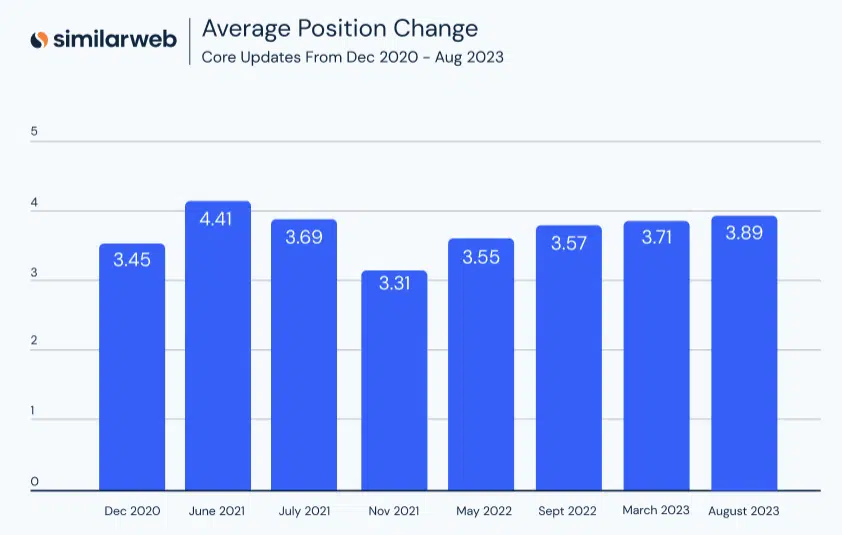
RankRanger, being a Similarweb company, plotted the average position changes for all the Google core updates since December 2020. When they looked at the average fluctuations for the August update, they saw that it was one of the biggest updates topped only by the June 2021 update, based on position change.

Similar Web

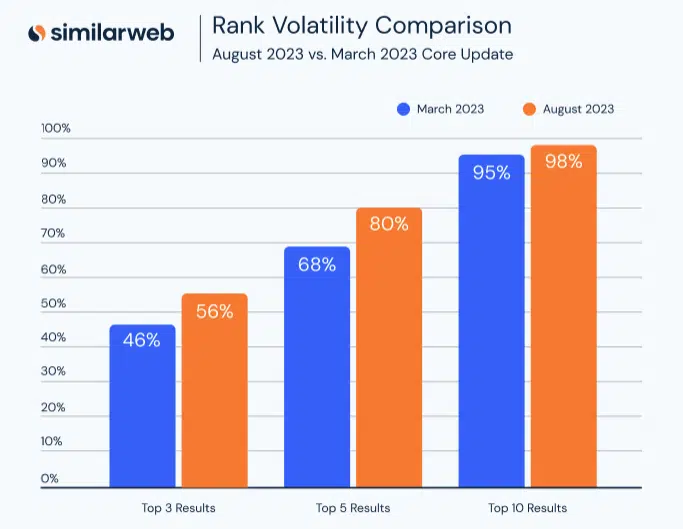
When you compare by position, the March and August update, the August update was more volatile according to the data.

Rankranger August Core Update Compare

Shay Harel from Similarweb told us, “Comparing different niches, we see the retail niche was hit hardest in the top 3 and top 5 positions, followed by the finance niche. We also see that the health niche saw the lowest fluctuation levels.”

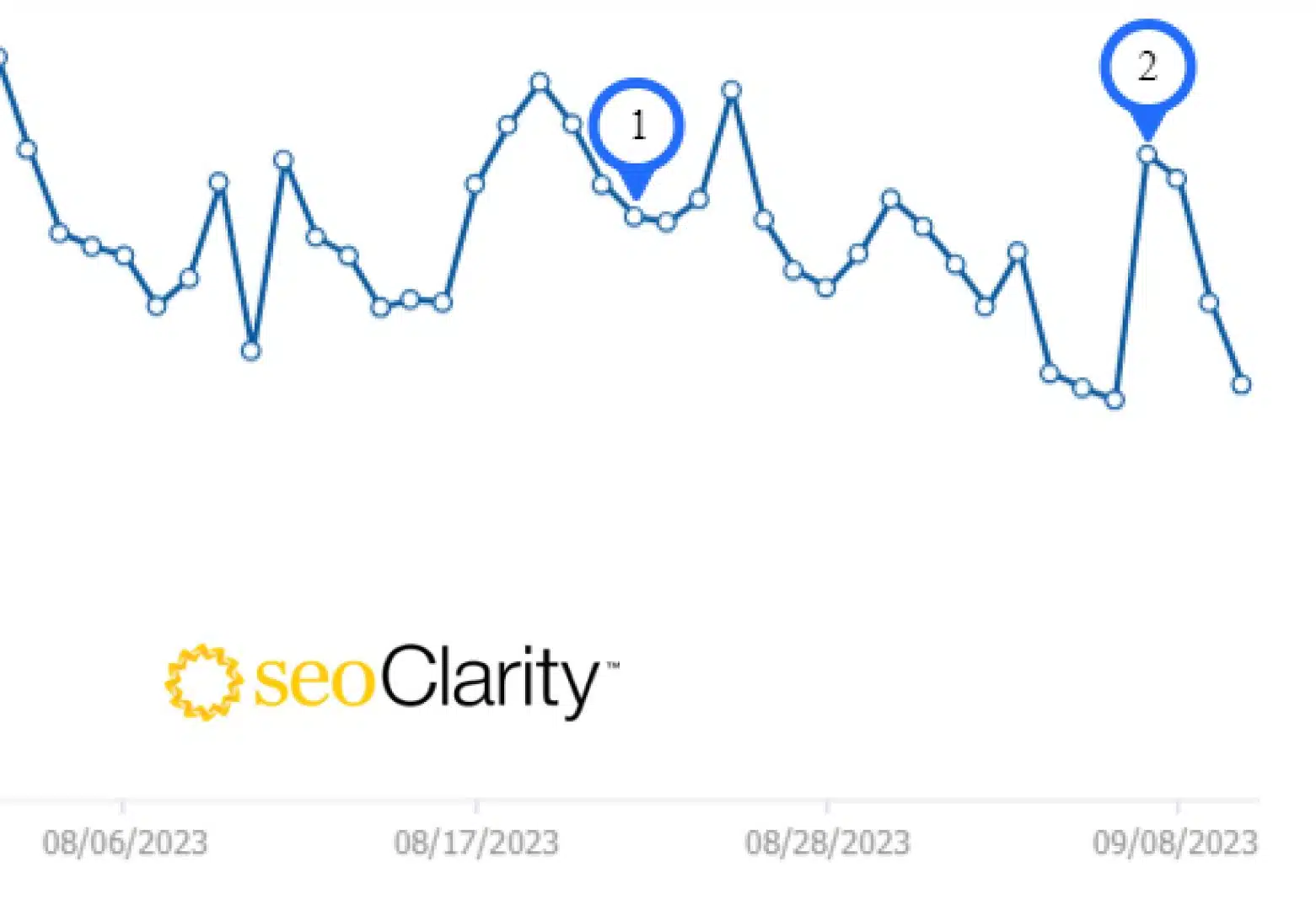
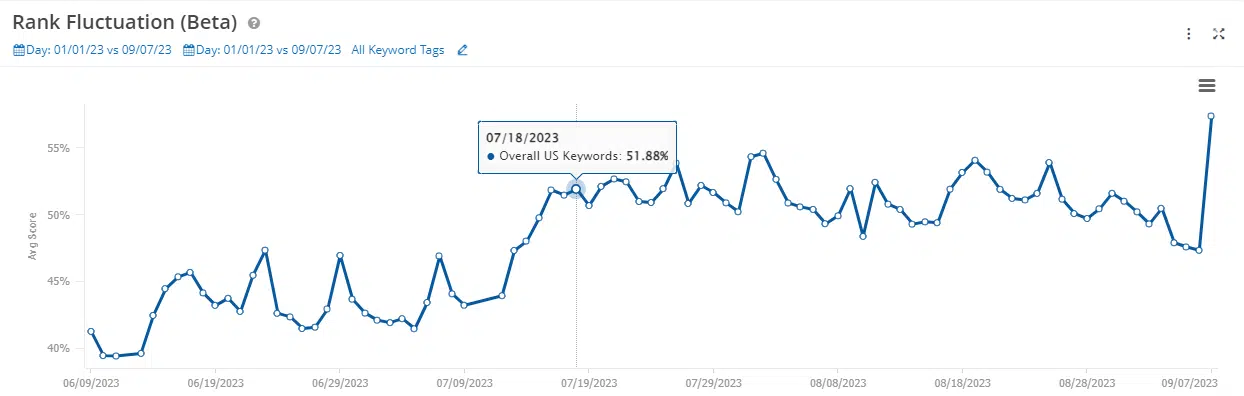
seoClarity. Mark Traphagen from seoClarity shared the seoClarity Rank Fluctuation tracker. This looks at its internal US keyword data. He said, “Interesting we saw a spike to 51% volatility on the final day, which tapered off over the weekend.”

He shared this chart with me:

Seoclarity Core

Here is another chart Mark sent me from their data set:

Seoclarity Core2

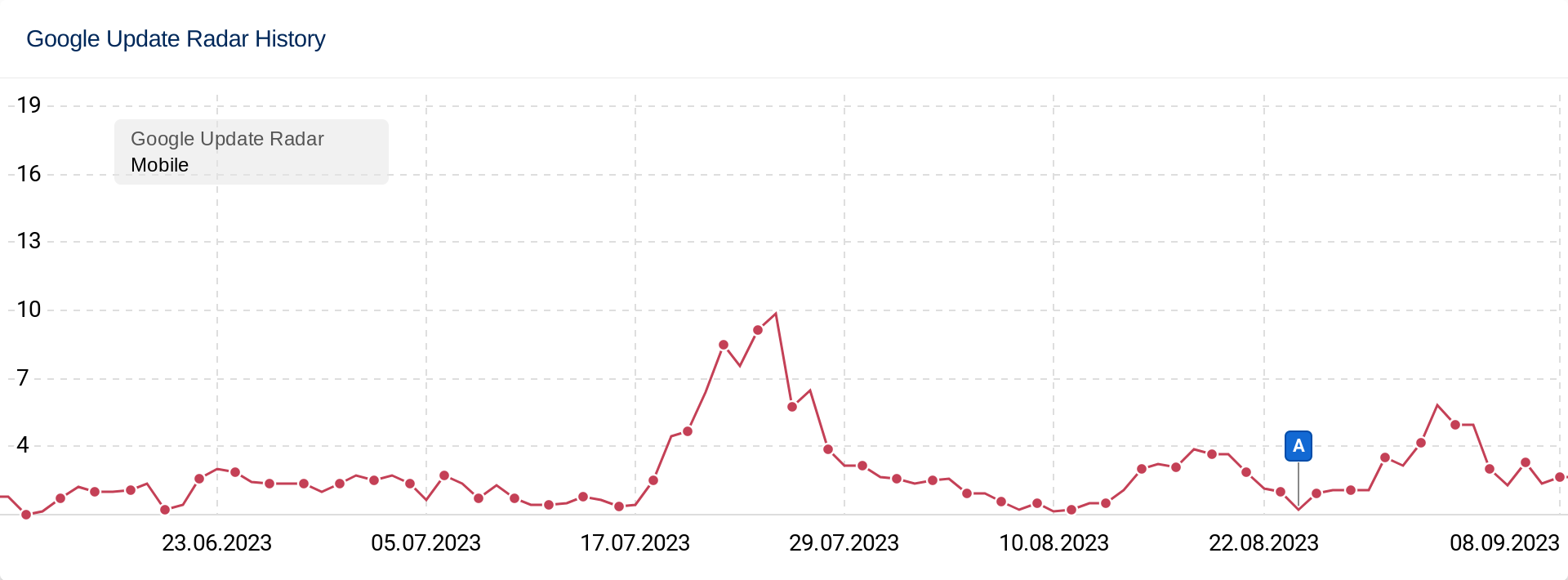
Sistrix. Steve Paine from Sistrix did its own analysis and told Search Engine Land, “Overall it was quite a quiet core update in comparison with others but there were stand-out losses and gains.” Here is a chart showing the volitlity over time from Sistrix’s data:

App.sistrix.com En Google Update Radar Uk Mobile 5.png

Steve Pain said, “The large peak seen during July in our Update Radar was never confirmed as an algorithm change by Google but, overall, had a much bigger effect on domain visibility than the August Core Update.”

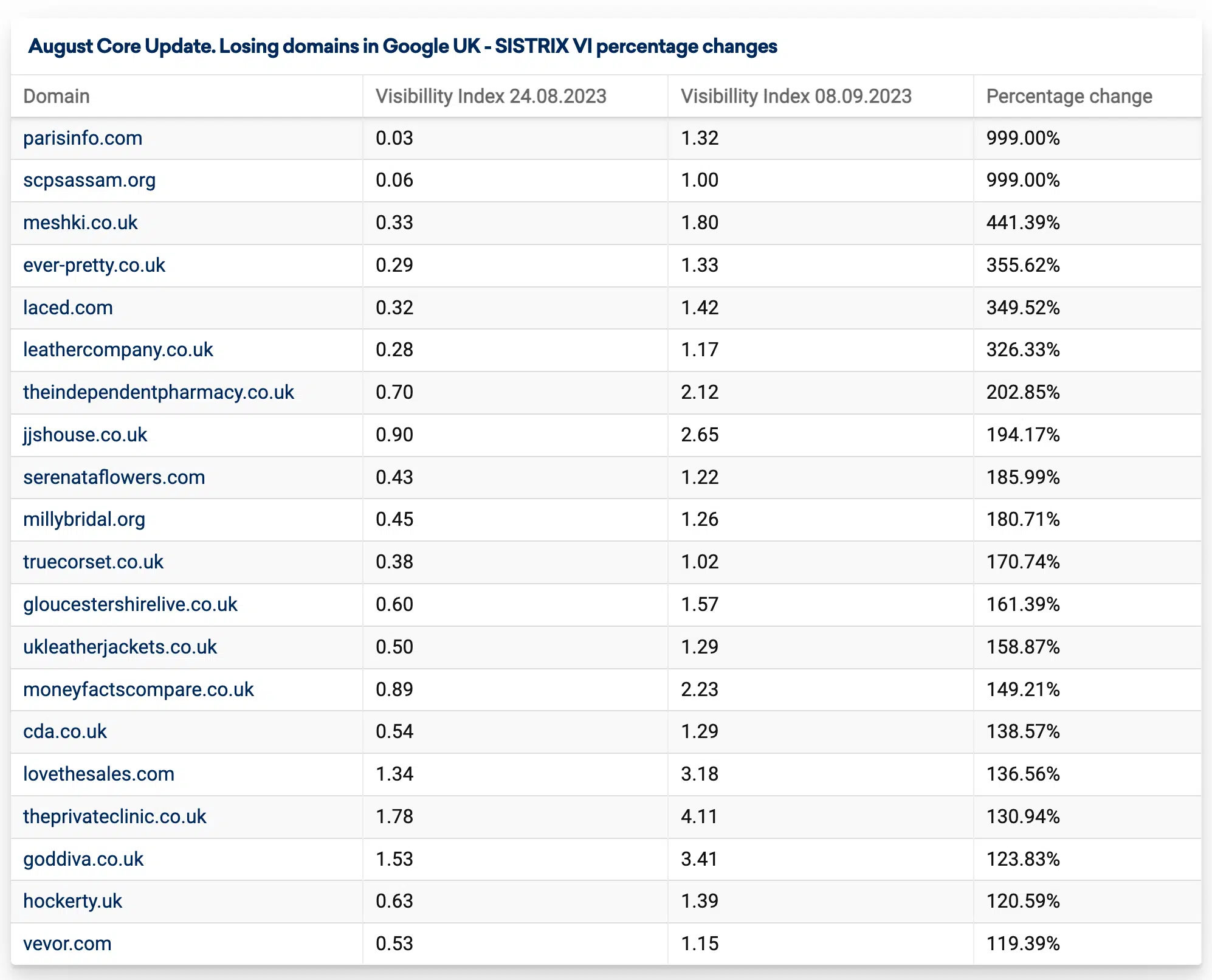
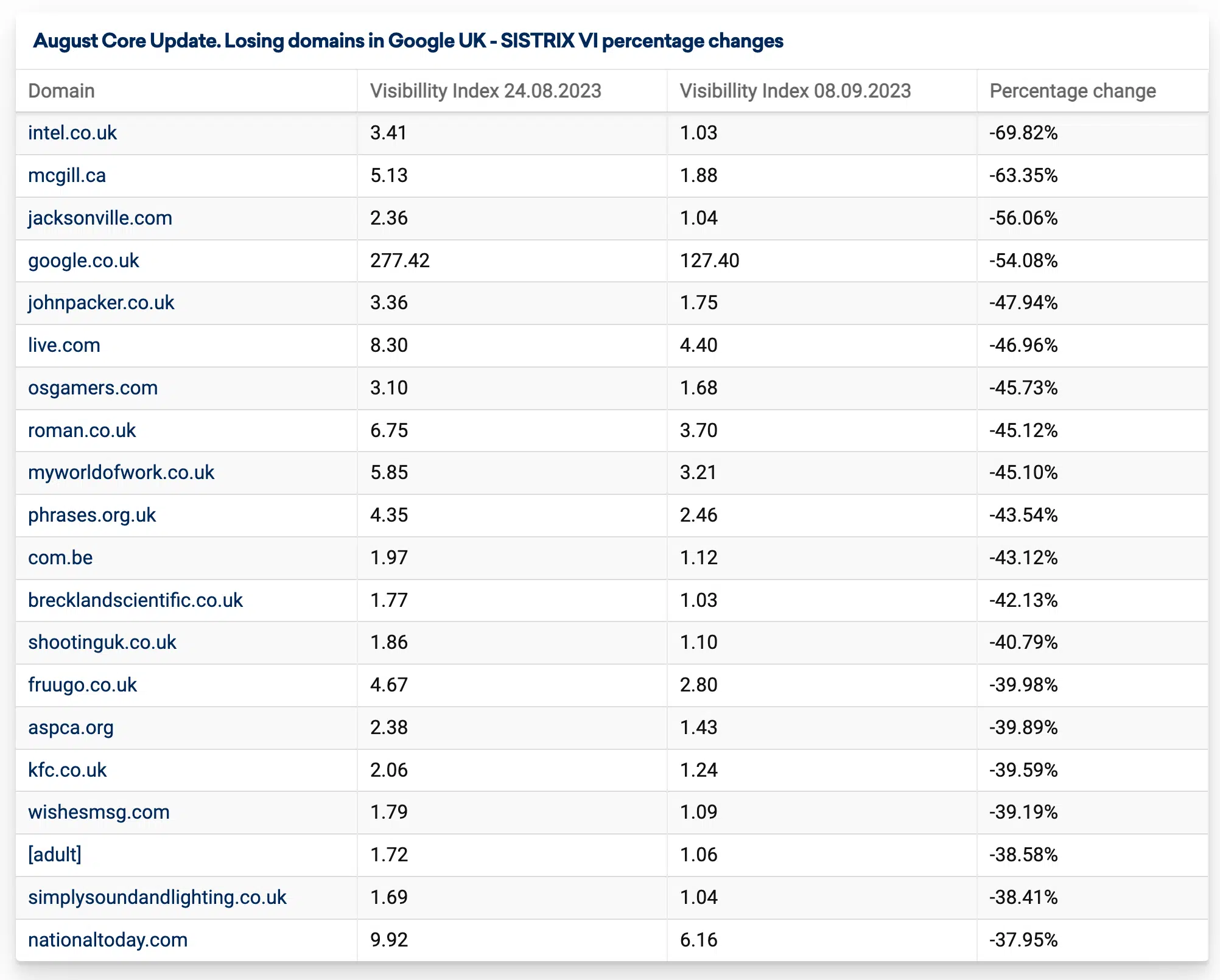
Sistrix also provides the top winners and losers from these updates, the ones that saw the biggest visibility changes in their Google search rankings.

Top winners:

Winners

Top losers:

Losers

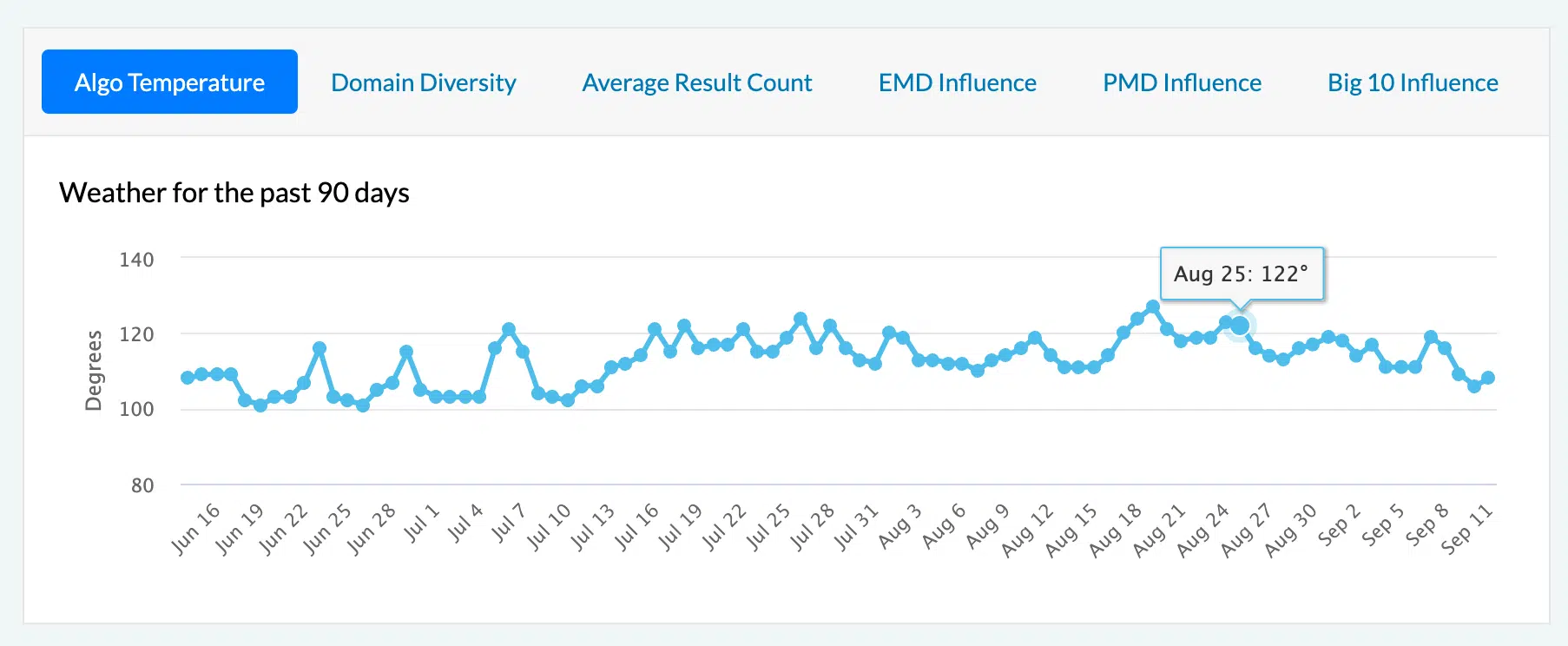
Moz. The folks at Moz picked up on the core update volatility as well. Mozcast documented the spikes ain volatility as well, as you can see from this screenshot:

Mozcast

Dr. Pete Meyers from Moz told us that they “saw peak flux on MozCast around August 23-24 (around 122°F).” “Core Updates are already multi-signal and a bit mysterious, and this one is even harder to disentangle than most,” he added.

More on the August 2023 core update

Community. On the Search Engine Roundtable, I did a bit of a roundup on what the community noticed across several different stories. The stories combined had about 500 comments including the slow start to the update, then the first big impact noticed on August 25th, then another tremor a few days after that, then the final wave arouund the day the update ended, of course, after it ended, some minor tremors.

Based on all I see from the community, this update was big but didn’t feel as heated because of the constant volatility we’ve been seeing across Google search for the past several months.

What to do if you are hit. Google has given advice on what to consider if you are negatively impacted by a core update in the past. There aren’t specific actions to take to recover, and in fact, a negative rankings impact may not signal anything is wrong with your pages. However, Google has offered a list of questions to consider if your site is hit by a core update. Google did say you can see a bit of a recovery between core updates but the biggest change you would see would be after another core update.

Why we care. It is often hard to isolate what you need to do to reverse any algorithmic hit your site may have seen. When it comes to Google core updates, it is even harder to do so. What this data and previous experience and advice has shown us is that these core updates are broad, wide and cover a lot of overall quality issues. The data above has reinforced this to be true. So, if your site was hit by a core update, it is often recommended to step back from it all, take a wider view of your overall website and see what you can do to improve the site overall.

Hopefully, your company and your clients did well with this update.

More on Google updates

You can read more of our coverage in Search Engine Land’s Google Algorithm Updates history.


Related stories

New on Search Engine Land

@media screen and (min-width: 800px) { #div-gpt-ad-3191538-7 { display: flex !important; justify-content: center !important; align-items: center !important; min-width:770px; min-height:260px; } } @media screen and (min-width: 1279px) { #div-gpt-ad-3191538-7 { display: flex !important; justify-content: center !important; align-items: center !important; min-width:800px!important; min-height:440px!important; } }

About the author

Barry Schwartz

Barry Schwartz is a Contributing Editor to Search Engine Land and a member of the programming team for SMX events. He owns RustyBrick, a NY based web consulting firm. He also runs Search Engine Roundtable, a popular search blog on very advanced SEM topics. Barry can be followed on Twitter here.

https://searchengineland.com/how-the-august-2023-google-core-update-compared-to-march-2023-core-updates-431851


Google search antitrust trial ready to begin: What’s at stake

The Justice Department’s antitrust case against Google and its search engine dominance is set to begin Tuesday. 

The case, U.S. et al v. Google, focuses on the company’s popular search engine, alleging Google used its 90% market share to illegally throttle competition in both search and search advertising.

This is one of several antitrust cases against the company. In January, the DOJ filed an antitrust case against it concerning Google’s role as an advertising broker, publisher and auctioneer.

The charges. The federal government alleges Google is harming consumers by stifling innovation in online search tools and limiting choice.

The DOJ also says Google has been able to maintain its monopoly over online search through exclusive agreements that preinstall its search application on devices. This, the government alleges, allowed Google to become the dominant search engine over its rivals and stifle competition.

Federal prosecutors are likely to argue that Google is not allowing a free market of rivals who could offer search choices with better technical perks — such as the speed at which search results are presented — and on policy choices, such as more stringent data privacy practices.

The defense. Google has pushed back strongly on the allegations of anticompetitive behavior. Its products and services are more popular because they are simply better, not because Google has tilted the playing field away from potential rivals, the company will argue.

Google is also expected to argue that their contracts to be default search engines on browsers are not exclusive and do not limit competition. The company argues that users can easily set a new default search engine and that their contracts do not limit access to other search options.

Dig deeper. Report: Google sharing Chrome iOS search revenue with Apple

Why we care. A big change at Google could cause big changes throughout the digital marketing ecosystem. If the DOJ proves its case and somehow alters Google’s search stranglehold it might mean lower costs for advertisers. If Google wins more tech regulation may be harder to achieve. Time, as always, will tell.

Dig deeper. US Justice Department sues Google again, aims to dismantle its ad division

What’s at stake. The U.S. and state allies are not seeking a monetary penalty, but rather an injunction barring Google from continuing the alleged anticompetitive practices. Such an order could have significant business implications for Google. For example:

  • The government said in its lawsuit that the court could break up the company as a fix.
  • More broadly, the Justice Department may argue it wants to stop Google from leveraging its alleged search monopoly to make exclusive deals in newly emerging markets, including artificial intelligence.

The case is widely seen as one of the biggest challenges to tech industry power since the DOJ sued Microsoft in 1998 over its market dominance for personal computers. The trial court in that case found Microsoft unlawfully tried to block rival browser Netscape Navigator. Microsoft later reached a settlement that left the company intact.

Dig deeper. Judge: No evidence Google harmed competitors by limiting search visibility


Related stories

New on Search Engine Land

@media screen and (min-width: 800px) { #div-gpt-ad-3191538-7 { display: flex !important; justify-content: center !important; align-items: center !important; min-width:770px; min-height:260px; } } @media screen and (min-width: 1279px) { #div-gpt-ad-3191538-7 { display: flex !important; justify-content: center !important; align-items: center !important; min-width:800px!important; min-height:440px!important; } }

About the author

Constantine von Hoffman

Constantine von Hoffman is managing editor of MarTech. A veteran journalist, Con has covered business, finance, marketing and tech for CBSNews.com, Brandweek, CMO, and Inc. He has been city editor of the Boston Herald, news producer at NPR, and has written for Harvard Business Review, Boston Magazine, Sierra, and many other publications.

https://searchengineland.com/google-search-antitrust-trial-ready-to-begin-whats-at-stake-431844


How publishers can regain traffic and revenue with affiliate marketing

Media companies and publishers play a pivotal role in affiliate marketing. They are in the position to wield significant influence, enhance search engine rankings and drive substantial revenue for businesses. 

However, recent shifts in the industry have seen traditional publications lose their traffic, with smaller, newer players dominating Google’s top positions.

I’ve worked with several media organizations that have sought guidance to boost their traffic and revenue through affiliate marketing.

This article distills valuable insights and recommendations, offering a roadmap for success in a field where reputation and backlinks no longer guarantee instant returns.

Organic traffic performance of established publications vs. newer, smaller publishers 

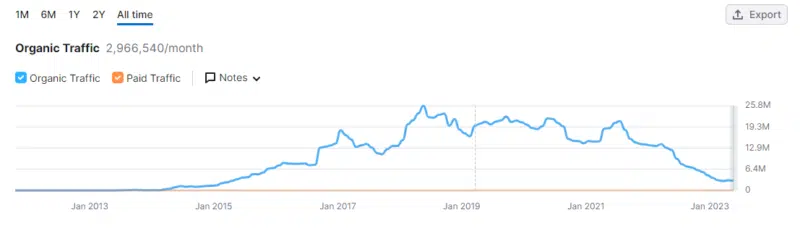
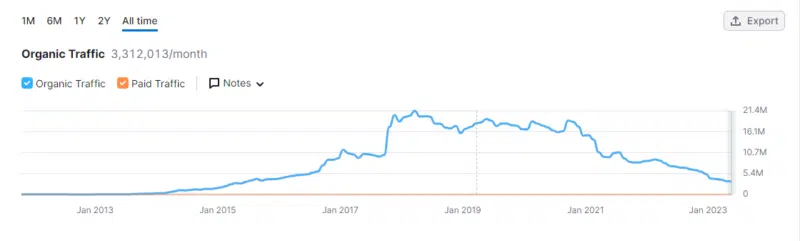
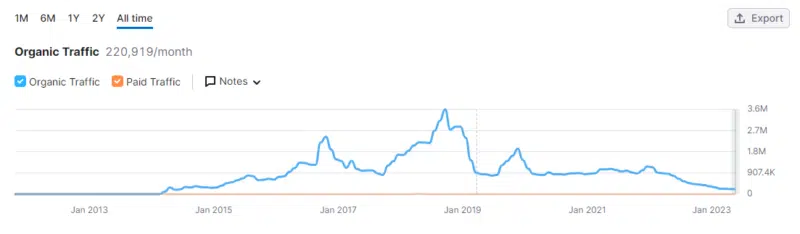
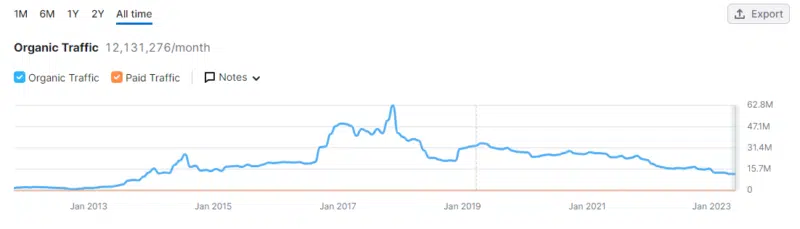
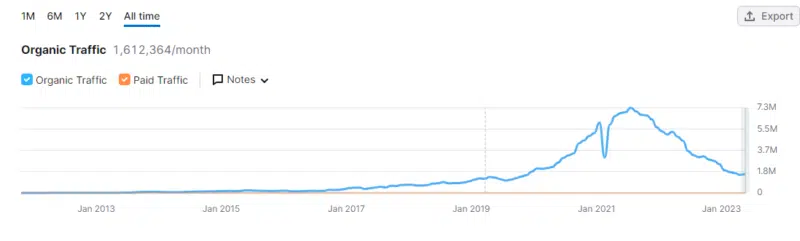
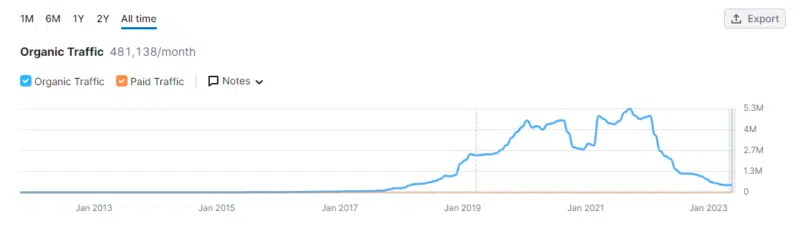
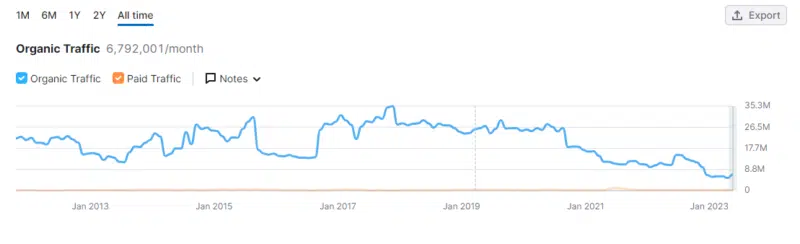
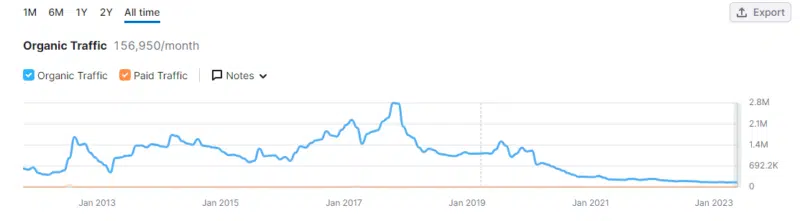
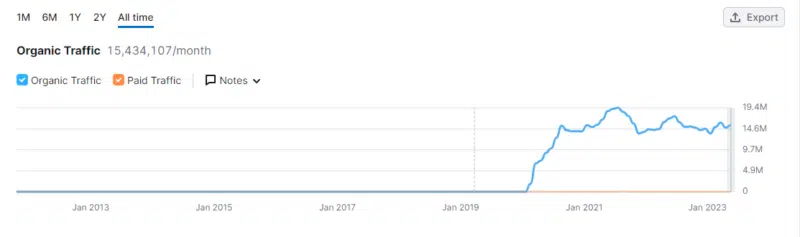
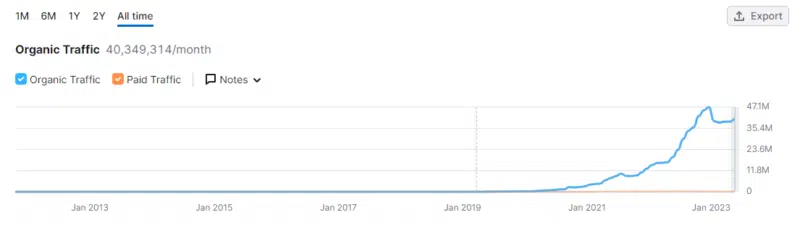
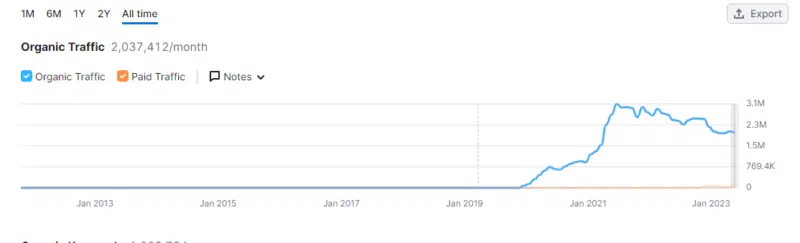
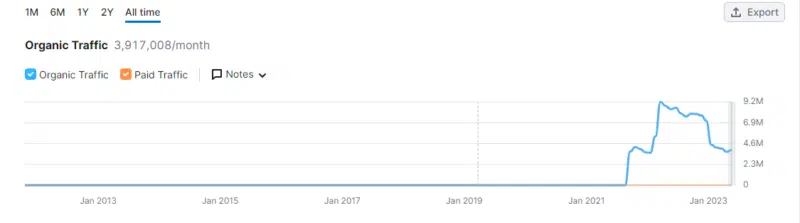
While tracking the performance of media companies doing affiliate marketing, I started seeing traffic declines for established brands. 

Below are some snapshots of the websites’ performance. They reflect the entire website’s organic traffic performance, not just the specific sections related to affiliate marketing.

Specifically, keep an eye on the years 2017 and 2021, as these were pivotal periods when significant changes occurred. The screenshots were taken from Semrush, but other tools show the same or similar traffic patterns. 

Several publications that encountered traffic declines require a media fee, so you mostly only see big brands and the same products featured in their content. 

Image 43 800x231
Image 44 800x241
Image 45 800x234
Image 46 800x229
Image 47 800x241
Image 48 800x231
Image 49 800x244
Image 50 800x221

On the other hand, newer publications are moving in to take their place. Some are making the same mistakes, while others are doing things differently. 

Here are a few new players that moved in and are making bank. These are only the website’s affiliate sections so that you can see the gains.

Image 51 800x237
Image 52 800x241
Image 53 800x243
Image 54 800x223
Image 55 800x232

What can be the reason behind these movements? 

Let’s look at the sites’ affiliate programs and the types of vendors being promoted 

The absence of variety and alternatives

Part of Google’s reviews update is to show variety for shopping. Still, some media outlets tend to focus on big brands and overlook diversification in their affiliate marketing lists. 

Some of the publications in the screenshots will tell you that they must work only with certain vendors to add affiliate links, which is a huge mistake (at least in my opinion). 

The lack of diversity and options provides a worse experience for consumers, and the sites that did this all have the same traffic-dropping patterns. And although it is not necessarily against Google’s reviews update, it does not meet the guidelines. 

Other times, publications won’t add new or up-and-coming brands because their affiliate team requires sponsorships and advertorial purchases. Only the big brands can afford this, especially because placements aren’t always guaranteed. 

Often, these smaller or up-and-coming brands will feature the logos and sometimes backlinks to the publication. Although the publications have tons of links, these are harder to get and could help especially if the link is to the listicle they’re featured in.

Smaller stores and brands may share the listicle on social media, and that can bring search engine spiders back to the content for crawling. This sharing also brings potential shoppers to the media listicles and drives more sales for the publication. 

There’s a lot of SEO and monetization benefits from going with smaller brands. Still, if the decision-makers at media companies demand big brands and ad fees, they’re sacrificing their online success and ongoing commissions for a one-time fee. It’s a long-term loss for a short-term gain and the potential loss of traffic as a whole. 

The struggle of balancing helpful content and monetization

Outside of the advertiser and brand diversity, some publications syndicate their lists with the same vendors to their other brands. 

That makes the quality drop on each brand, even if they spin the content. The pros and cons stay roughly the same, so do the products and services featured, and they use the same talking points. 

Adding a couple of unique variations won’t make the content helpful or value-adding. That’s why it is important to let editors remain 100% independent on each publication and from the affiliate and ads teams. 

They will do the research and choose the best items they can talk about from their expertise. But that doesn’t mean ads and affiliate teams cannot contribute. They can say, “please feature these brands” within. The editors will be free to talk about their experience, whether it is positive, neutral or negative.

But that goes to another issue. Even with editorial freedom, the ads teams may interfere with content by adding cards, carousels, and predominant spaces that feature affiliate and paid links. This offsets the list of services ranked based on merit and quality. 

The pay-to-play content is part of the page which means it can potentially impact SEO. The good news is that these features are clearly ads and not part of the content. But these ad spaces can impact the usefulness of the content if they bury it. There’s a balancing act between providing the content the person wants and displaying ads or affiliate lists.

On some lists, the content could be value-adding, fact-checked, and written by industry experts. That’s why the page currently ranks. Then ads carousels or widgets are placed above or between them for monetization. This could cause a drop as the content is no longer as helpful, but it is a needed feature for the publication to make money. There’s a balancing act that occurs. 

These paid placements – whether an affiliate, a CPC, a flat fee, a CPM, an advertorial, or a mix of payment models – offset the original text. The paid portions may exist above the expertise content, and that changes the user experience. 

The changed UX could make it so the helpful content update devalues their pages and the site. This is where smaller publishers, new media companies, and niche sites can move in and dominate. 

Let’s use a pair of running shoes as an example. 

Suppose all the lists have Brooks Running for three of the five results and Under Armour for the other two. 

Each list has the same shoes and similar talking points. There’s not much difference and variety. This is where the Google reviews update with multiple stores comes in.

Featuring the big brands is OK. Still, try to find independent stores or emerging stores and test the products. 

By including a couple of independent retailers or unknown brands, you can add unique copy and shopping options that others cannot. And consumers may enjoy supporting small businesses, not to mention discovering new favorites. 

Suppose you discover an equally good shoe for road running that is eco-friendly. Replace something from the list and write original content about the new option. 

Then, link directly to their store and elsewhere to shop if they aren’t a DTC-only brand. 

Your content has a unique experience combined with the standard best-in-class products. And finding these hidden gems is easy.

Start by looking at retail shows for the footwear and sportswear industries and see who is presenting, advertising, and attending. You’ll discover the brands trying to get their “foot” in the door. 

You can also look for new brands on affiliate networks and ask for products to test. On top of having a unique store or brand to help your list stand out, you’ll have original photos and be able to show you physically tried the product, which works to your advantage with E-E-A-T.

As an added bonus, the smaller brands will have more flexibility with commissions, in many cases, and be more attentive as they appreciate the chance you’re taking on them. 

Key recommendations

  • Ensure that 20-30% of the brands, stores, or products featured on your list are lesser-known and unique, not commonly found on generic “best” or “top” lists. Get the product in hand and give a unique perspective on it – both good and bad. 
  • Unique and original experiences tend to get rewarded by search engines, along with the standards on the other lists. By having at least 20% of your list different from the others, you’re providing something the others don’t. These new features are why your content is more unique and original – a value-add to the consumer.

Get the daily newsletter search marketers rely on.


Author bios that don’t demonstrate E-E-A-T

Demonstrating the author’s credentials is a key element for E-E-A-T. 

In many cases, author bios are “thin” and don’t share how or why the person is qualified to create the content. 

Some will say they love spending the weekend with their dogs or family, which is fine. But they must also list their professional experience, accolades, and qualifications. 

  • Where are they published, or what industry awards do they have? 
  • How have they had real-life experience in the niche for an extended time?
  • What certifications or degrees do they have that are accredited and recognized by industry professionals? 

If they’re reviewing or writing content about the best hosting service, being a tech writer doesn’t help. 

Anyone can write an article about technology by researching or reading the service provider’s websites. The writer and fact-checker must both be qualified. 

Having a degree or advanced degree in IT and having worked for a hosting company on the product, engineering, or development team for more than 10 years does. 

Getting multiple certifications related to the field and sharing the most recent ones also helps make the case why you are an expert in the field. 

Ensure the editor and/or fact-checker does not just write listicles and reviews. They should also write guides on how to configure servers, troubleshoot common issues, etc. 

Having this mixed within the shopping content builds their trust with the community, and that trust can be passed to their choices on the shopping lists or shopping content. And with that trust, you may see higher conversion rates. 

If the person is not writing the guides and “how to” posts on the publication, don’t worry. Link to their bios for where they write high-value content. 

For example, I write both here and at other large SEO and marketing publications. 

If I am writing a list of marketing tools or services to shop for, ecommerce tools, or guides on affiliate marketing where I’ve won awards, featuring that I’m a columnist or contributor and linking to my author pages allows both people and search engines to associate my knowledge and credibility with the shopping content. 

This is something some of the media companies that lost traffic did not do a good job of.

Non-unique selling points or lack of hands-on experience

Many media companies require editorial integrity. A few, in particular, make it clear that editorial and ad sales/affiliate relationship managers are separate. That is a very good thing! 

The two teams cannot impact each other for a strong site SEO-wise. These media houses are flourishing and will likely continue because all integrity is intact. 

But that doesn’t mean the affiliate teams should not have editors. Allowing the affiliate teams to have writers makes the company better overall.

Successful media companies often separate the teams and allow the affiliate relationship managers to recommend vendors if there is space and a reason. 

In other cases, the affiliate team has editors, and the content goes through an SEO and ads review to ensure quality and UX. 

By having editors with the affiliate team, they can ensure diversity and introduce new brands and products. Not all sites require an ad fee, which is why these sites have more product and brand diversity. These ones are flourishing. 

In these cases, the editors have full control and say over who and what gets featured as their preferences while being able to include good alternatives from the affiliate and ads teams. 

It keeps the quality of the content way up. One issue does not apply to the majority above but exists with a few I’m not featuring.

In very few cases, editors are not allowed to receive products, which is odd. If they’re required to write about it, they should be able to test it and have full authority to evaluate it. 

They need to be experts to win the readers’ trust and appease algorithms, and they need to share their real experiences for an authentic voice.

The way to do this is to have the product in hand or use the service. If the brand cannot send samples because the media house does not allow that, then the media company needs to buy or hire the service provider for the real-life experience. 

There’s no other way around that if the publication wants to succeed. But this has become rare. Most allow product samples now.

Having real photos vs. ones from the brand, showing it in real life, and sharing unique ways to use it all build trust and work for E-E-A-T. 

The FTC already requires disclosures at the top of the content or in a clear and easy-to-see space when using affiliate links or selling advertorials. Having a disclosure that you got the products featured in the post isn’t a big deal. 

Consumers probably prefer to know that you tried it before recommending it. And if you feature the bad and the good, you’ll keep the consumer’s trust because you’re giving them the full story. 

The content isn’t relevant to their audience

I see the publication going for high payments vs. product or service quality. 

This tactic gets higher affiliate commissions but also reduces the value of the recommendations because it isn’t based 100% on actual quality. 

Higher payouts can lead to irrelevant user experiences. When a publisher sees success because the trust of the domain lifts a topically irrelevant listicle, it may expand further into niches that aren’t topically relevant to its audience. This is bad for many reasons. 

If you’re a cooking website and people love the recipes, chef interviews, and ingredient highlights, having a list of the best pet insurance is irrelevant to your audience, even if most readers have pets. 

Neither are website builders, even if your audience has their own recipe blogs. 

And just because they have blogs, it does not mean they’re on your site looking for small business loans or vacuum cleaners, even though they could use them. Your audience may need them at some point, but that isn’t why they come to you.

When you start pumping out content because it can make you money with affiliate marketing, you take away from the good user experience. If people want dinner recipes, and every third article is a shopping post, the site is no longer helpful and doesn’t meet their needs. 

They’ll shift to a new site that stays true to the niche, and you’re likely confusing search engines with what the topic of your site is. 

The helpful content update looks at your site as a whole instead of page by page. Google wants to ensure the person gets an easy answer to what they are searching for in the fastest way possible. 

That can include multiple forms of media like a blog post, a video, or a sound clip. Because the helpful content update assesses your entire website, it’s reasonable to expect that the articles surrounding the one the user is reading should also be related and relevant.

If the person is on your article learning how to clean wine off a silk shirt, and you give them an answer, they may click on the homepage to see what else you have. 

The content and categories should be broken into cleaning and upkeep topics if the site is a cleaning and housekeeping site. 

If the person finds life insurance lists, web hosting, or extended car warranties but not the themes they expected, it is a bad experience. 

The end user might click on one of them because it is interesting, but you lost your chance to be their go-to resource for cleaning and upkeep. 

Instead of irrelevant but high-paying lists, create content with the best cleaning products, landscapers, types of flowers by region and season, etc. 

These are part of cleaning and owning a home and tie into the theme. Your entire website will have a better human experience because it is relevant for the humans on your site. 

And there are good paying affiliate programs with each niche if you put the work in to find them. 

The relevant topics of the shopping lists show the reader you have a lot of resources that complement why they came to you, and by having these, you give them a reason to subscribe to your publication and follow it on social media. 

You can link to the lists from the how-to guides, creating an even better UX. When the person clicks from the how-to guide, you’ve increased pageviews for CPM money and can earn a commission. It is a big win for you as a publisher. 

When you win their trust, they may opt-in to your email or SMS list. Having them on your email and SMS list means you can make money for many years.

Regaining traffic and profitability with better affiliate marketing strategies

The media companies in the first set of screenshots can turn things around if they change their focus. They can get their traffic back and expand revenue if they:

  • Diversify their product and shopping options.
  • Work on E-E-A-T and topical authority. 
  • Maintain a balance between content and monetization. 

Note: The screenshots showing traffic declines are for sites I do not work on directly for SEO but watch and use as examples with clients. In some cases, I do work with them through affiliate programs.

The information was publicly available and accessed using third-party tools. Site names have been withheld. The specific websites are not disclosed to avoid any potential scrutiny or repercussions and also out of respect for their privacy and business operations.


Opinions expressed in this article are those of the guest author and not necessarily Search Engine Land. Staff authors are listed here.


Related stories

New on Search Engine Land

@media screen and (min-width: 800px) { #div-gpt-ad-3191538-7 { display: flex !important; justify-content: center !important; align-items: center !important; min-width:770px; min-height:260px; } } @media screen and (min-width: 1279px) { #div-gpt-ad-3191538-7 { display: flex !important; justify-content: center !important; align-items: center !important; min-width:800px!important; min-height:440px!important; } }

About the author

Adam Riemer

Adam Riemer is an award winning digital marketing strategist, keynote speaker, and growth consultant with more than 20+ years of experience. His agency creates and executes integrated and growth marketing strategies based on data points and ROI. From top funnel affiliate marketing to SEO, email, and conversion optimization, he helps brands of all sizes grow and scale.

https://searchengineland.com/how-publishers-can-regain-traffic-and-revenue-with-affiliate-marketing-431798





When your business doesn’t need SEO

While SEO can be highly effective, it’s not a one-size-fits-all solution for all businesses.

SEO might not be the immediate answer to your digital marketing needs.

Here’s why SEO may not be the best fit for a business, with alternatives and insights into when it may be a more valuable investment.

1. You require fast results

Do you need fast results for your business and a way to attract tons of visitors to your website in no time? Then SEO may not be your best course of action. 

SEO takes time to work.

New websites can take at least three to six months to rank on Google. Even then, 95% of pages don’t enter the top 10 positions within a year, per an Ahrefs study. 

Results will vary depending on your strategy, but data suggests that you must wait to see an impact. That’s why this path is not for everyone. 

For example, if you are hosting a one-time event or concert, or it’s the first time you are organizing it, you are limited in time. 

You can’t just wait for search engines to index your website or for people to start searching for your event. You need to make them aware of it and get them excited. 

That’s when paid search or social media ads are more effective in promoting your event and getting people to buy tickets or register.

Or let’s say you have a new solution, such as a CRM or a mobile app, that you want to introduce to the market. You want to show people how awesome your solution is and how it can solve their problems. 

Here, you can’t rely solely on SEO. You’ll need to use other marketing methods to grab your audience’s attention and convince them to try your solution. 

PPC advertising is key in this case. After you build up some traction and reputation, you can start investing in SEO, as people will search for your solution independently.

So, SEO is not always the best option if you need to quickly generate interest around a new topic or when launching a new product to the market. 

You’ll need marketing methods that will help you reach your target audience instantly, such as social media ads or other types of paid advertising, and drive them to your website or landing page. 

2. You operate on a tight budget or limited resources

SEO isn’t prohibitively expensive. You can manage much of it yourself with basic knowledge and free tools. Advanced tools like Ahrefs are available for under $100 per month to level up your game.

The problem is that good SEO takes a lot of time and effort. 

You have to research keywords, analyze competitors, create content, build links, monitor rankings, and so on. And that’s not even counting the technical aspects of SEO, like site speed optimization, mobile-friendliness and security. 

These tasks can consume your precious time and energy, which you could use for other important aspects of your business like customer service and sales. 

So what do you do? You could hire an SEO agency or professionals to handle everything for you. They have the skills and tools to get the job done right. 

They don’t come cheap, however. Depending on the scope and quality of their services and the things you need help with, you could end up paying anywhere from $500 to $10,000 per month for SEO. 

While this can be acceptable for larger companies, it may be a significant sum for many startups and small businesses. 

Now, don’t get me wrong. I’m not saying that SEO is not worth the expenses. It can be one of the best investments you make for your business in the long run. 

You can drive organic traffic, generate leads, increase conversions, and grow your brand awareness while outranking your competitors and dominating your niche.

The thing is, SEO can wait if you’re on a tight budget or have limited human resources or time. 

First, you should focus on developing your business and perfecting the product or service to form a more comprehensive SEO strategy.

You can also defer your SEO efforts if you already have an in-house marketing team that knows what they’re doing and you’re making money from other promotion channels that are working well for you.


Get the daily newsletter search marketers rely on.


3. You face low demand for your product or service

SEO is about getting people to find you online when searching for something related to your niche. 

There must be interest in your topic and demand for information to justify implementing SEO initiatives like content marketing. 

For example, if you run a local pet store, you can use the high demand for pet products, information and services online. 

It makes sense to try to rank high for keywords such as “how to groom your dog” or “healthy treats for cats,” as they can translate to more sales. 

Similarly, your store has to deal with increased competition from other pet businesses for limited ad placements, which can quickly become expensive and unsustainable. 

SEO may save you money over time. Once your page ranks among the top results, you only need to keep it updated to retain rankings, proving to be a strategic advantage. 

But what if your product or service is not very popular, or you cater to a specific audience? Then, you might not need SEO as much. 

For instance, if you’re in security contracting, arms, nuclear, or other industries with low demand or high barriers to entry, you don’t have to worry about optimizing your website for search engines. 

Not many people are looking for these things online, and you probably have other ways of reaching your customers.

4. You are not concerned about outranking your competitors

Another case where you don’t need SEO is when your brand is so well-known that everyone recognizes it. 

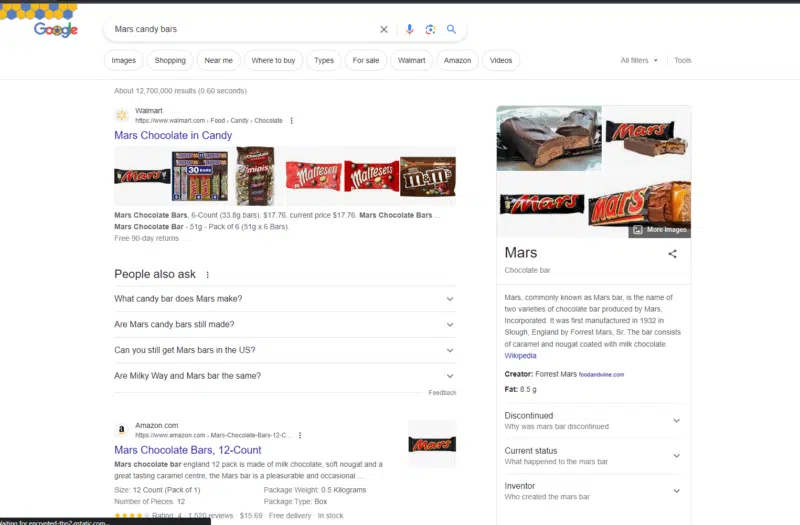
Think of Mars candy bars, for example. 

They have a great website but don’t focus on creating elaborate blogs or landing pages targeting specific keywords. 

They don’t have to because they’re already famous and are not concerned with beating their competitors in the search results. 

What’s more, they don’t sell their products directly to customers. Instead, they rely on a well-developed indirect sales distribution system. 

So, they are not interested in ranking for the keyword “Mars candy bar.” Ranking for this keyword may even jeopardize stores that want to get found in their market.

Even if you search for their main keyword, depending on your region, the official website may not reach the top of the search engine results page.

Image 42 800x525

You can see the same trend with other established brands like Coca-Cola that operate under a franchise distribution model.

However, you don’t need to be a global business chain not to concern yourself with competitors. 

Another scenario where SEO might be optional is if you have a very niche business that serves a very specific market. 

Maybe you sell custom-made jewelry for weddings and only work with a few clients per year. 

In that case, you don’t need to compete with thousands of other websites for generic terms like “wedding jewelry.” 

You need to reach your potential customers by other means, such as referrals, social media, or email marketing.

5. Your target market does not use search engines

Sometimes, your target audience doesn’t use search engines to find you. They already know you and trust you, and they visit your store in person or type your website address directly into their browser.

For example, if you run a local bakery with a loyal customer base, you don’t need to worry about ranking high on Google for keywords like “best bakery near me.” 

Your customers know where to find you and love your products. They might even recommend you to their friends and family through word-of-mouth. 

However, just because I said you don’t have to worry about SEO doesn’t mean you can ignore your online presence. 

You still need a great website that shows off your brand and what you do. You must also be active on social media to connect with your audience and share valuable content. 

Additionally, you can benefit from local SEO, and you still have to optimize and maintain your online pages, whether it’s social media or Google My Business listings. 

These things matter greatly if you want to grow your business and reach more people.

Assessing the pros and cons of SEO

If you’re still on the fence about whether SEO is right for your business, consider the following opportunities it can provide to your business:

Pro: Increased visibility and traffic

  • SEO can help you attract more organic visitors interested in your products or services. 
  • You can also target specific audiences based on location, demographics, or preferences.

Enhanced credibility and trust

  • You can establish your brand as an authority in your industry through content marketing. 
  • Appearing at the top of search results will make you seem more authoritative, showing your expertise and value to your customers. 

Improved user experience and conversion

  • SEO will ensure that you create a user-friendly and engaging website that provides relevant and useful information to your visitors. 
  • You’ll get to optimize your website for mobile devices and ensure high load speed and accessibility. 
  • This will improve your customer satisfaction and loyalty and increase your chances of converting visitors into buyers.

Evaluate how important these factors are to your company. Try to consider the long-term perspective of your business. 

If you think these opportunities are important, you can start taking small steps toward developing an optimization strategy. 

SEO takes time to show results, so it may be worth it to start working on your optimization as soon as you notice chances for growth. 

While the benefits are great, and many SEO experts tout the selling points, I believe you should also be aware of the possible disadvantages of this promotion strategy. Here are the things to keep in mind:

Con: High competition and intensity

  • SEO is a dynamic and ever-changing field that requires constant research, analysis, and adaptation. 
  • You must keep up with the latest trends, algorithms, and best practices to stay ahead of your competitors. 
  • Hiring professional SEO experts or agencies to help you with your strategy may be necessary.

Uncertain and delayed results

  • SEO is not a quick fix or a guaranteed solution. Building your ranking and visibility on search engines takes time and effort. 
  • You may not see immediate or consistent results from your SEO efforts. 
  • Technical issues, algorithm changes, or manual actions from search engines may impact your progress.

Ethical risks

  • SEO can be risky if you don’t follow the ethical and legal guidelines of search engines. 
  • You may be tempted to use risky techniques to manipulate your ranking or deceive your customers. However, this can backfire and damage your reputation and credibility. 

Consider SEO’s value for your business at the moment

SEO is valuable but not obligatory. Assess its pros and cons for your situation. 

If you choose SEO, invest fully in experts and resources, be patient for results, and offer unique contributions. 

If it’s not right for your business now, don’t stress. You can revisit it when the time is right.


Opinions expressed in this article are those of the guest author and not necessarily Search Engine Land. Staff authors are listed here.


Related stories

New on Search Engine Land

@media screen and (min-width: 800px) { #div-gpt-ad-3191538-7 { display: flex !important; justify-content: center !important; align-items: center !important; min-width:770px; min-height:260px; } } @media screen and (min-width: 1279px) { #div-gpt-ad-3191538-7 { display: flex !important; justify-content: center !important; align-items: center !important; min-width:800px!important; min-height:440px!important; } }

About the author

Victor Karpenko

Victor Karpenko is a Founder and CEO at SeoProfy (200+ employees company focusing only on SEO traffic for 200+ clients). He is an SEO expert with more than 16 years of experience. Victor spoke at LRT Con, Chiang Mai SEO Conference, IGB Affiliate (London and Amsterdam) and dozens of others.

https://searchengineland.com/when-business-doesnt-need-seo-431777


Google Search Console rolling out new Merchant Center integrated reports

Google Search Console is rolling out new reports within the Shopping tab listings section with deeper integration with Google Merchant Center. Google is rolling out two new reports, one that shows you issues that are causing your products not to show in the Google Shopping tab and the other that shows you increases or decreases in clicks and rankings of your products in Google Search.

These reports are rolling out gradually over the next few weeks, Google announced.

Issues report. Google Search Console added a new Shopping tab listing issues report that will notify merchants when products stop appearing on the Shopping tab due to any issues, Google said. This is similar information that you can get in Google Merchant Center but it is also now able to be displayed in Search Console.

Here is the report:

Search Console Shopping Tab Listings Notification

Opportunity and visibility reports. The second report Google added to Search Console shows you visibility changes in Google Search for your products and “opportunities” to improve product visibility within Google Search. Google said, “The second enhancement shows merchants opportunities to increase clicks and improve ranking of products on Google.”

Here is what that report looks like:

Search Console Shopping Tab Listings Growth Opportunities

An upgrade. Last November, Google launched the shopping tab listing section in Google Search Console that brought Merchant Center data to Search Console. This is an upgrade to that report, bringing even more data from Merchant Center to Search Console.

How to see these reports. Google said, “To enable these new enhancements in your Shopping tab Listing report, you will need to associate your Search Console property with a Merchant Center account. The association can be easily created by any Search Console property owner with admin rights to the relevant Merchant Center account. Once the association is created, all Search Console users of the property will be able to see the new experience.”

Why we care. More information from Google on how well you are performing in Google Search, especially as we approach the holiday shopping season, is super useful. So dig in and see how your products are performing in Google Search and see where you can optimize as the holiday shopping season kicks into gear.

Make sure to see if anything is holding back your products from being visible in Google Search and what you can do to improve the visibility of those products in Google.


Related stories

New on Search Engine Land

@media screen and (min-width: 800px) { #div-gpt-ad-3191538-7 { display: flex !important; justify-content: center !important; align-items: center !important; min-width:770px; min-height:260px; } } @media screen and (min-width: 1279px) { #div-gpt-ad-3191538-7 { display: flex !important; justify-content: center !important; align-items: center !important; min-width:800px!important; min-height:440px!important; } }

About the author

Barry Schwartz

Barry Schwartz is a Contributing Editor to Search Engine Land and a member of the programming team for SMX events. He owns RustyBrick, a NY based web consulting firm. He also runs Search Engine Roundtable, a popular search blog on very advanced SEM topics. Barry can be followed on Twitter here.

https://searchengineland.com/google-search-console-rolling-out-new-merchant-center-integrated-reports-431832