Best of the Bot: Optimizing a Contact Us page for Google E-E-A-T
Best of the Bot showcases Search Engine Land Bot’s responses to prompts submitted by readers. The language model is based on content from Search Engine Land layered on top of ChatGPT. The editors of Search Engine Land selected this response for its usefulness and have supplemented it with additional relevant content.
I am the first generative AI chatbot for search marketers. I am trained with Search Engine Land content.
Here’s something somebody asked me! After that, how you can improve prompts to get even better answers from me.
Prompt:
Tell me all the points I need to follow to make an EEAT SEO-optimized contact us page
Answer:
To create an EEAT (Expertise, Authoritativeness, Trustworthiness1) SEO-optimized Contact Us page, consider the following points:
1. Clear and prominent contact information: Display your contact information prominently on the page, including phone number, email address, and physical address if applicable. This helps establish trust and accessibility.2
2. Multiple contact options: Provide various contact options to cater to different preferences. Include a phone number, email address, contact form, and live chat if possible. This ensures visitors can reach out in their preferred way.
3. Relevant and helpful content: Include relevant information on your Contact Us page that addresses common questions or concerns. This can include FAQs, customer support information, or links to helpful resources. Providing valuable content demonstrates expertise and helps build trust.3
4. Professional design and layout: Ensure your Contact Us page has a clean and professional design that is easy to navigate. Use clear headings, bullet points, and concise paragraphs to make the information easily digestible.4
5. Privacy policy and data protection: Assure visitors that their personal information is secure by including a link to your privacy policy. Highlight your commitment to data protection and explain how you handle and protect customer information.5
6. Testimonials or reviews: If available, showcase positive testimonials or reviews from satisfied customers on your Contact Us page. This helps build trust and credibility.
7. Responsive and user-friendly: Optimize your Contact Us page for mobile devices to ensure a seamless user experience across different screen sizes. Make sure the page loads quickly and is easy to navigate on all devices.6
8. Schema markup: Implement schema markup on your Contact Us page to provide search engines with structured data about your contact information. This can enhance the visibility and relevance of your page in search results.
9. Regularly update and maintain: Keep your Contact Us page up to date with accurate contact information and ensure that all contact methods are functioning properly. Regularly review and respond to inquiries received through the page.7
By following these points, you can create an EEAT SEO-optimized Contact Us page that not only improves your website’s visibility but also enhances user experience and builds trust with your audience.8
Updated prompt with formatting
How this prompt could be improved:
“I want you to create an E-E-A-T SEO-optimized contact page. I’m looking for guidelines to start and once we agree, I’ll give you the basic contact info so you can create the page. You are an SEO expert with 20 years of experience building SEO-optimized websites. Please format this list in a bullet format. Keep it professional.”
The key elements and enhancements to this prompt are as follows:
(Task)
I want you to create an E-E-A-T SEO-optimized contact page. I’m looking for guidelines to start and once we agree, I’ll give you the basic contact info so you can create the page.
(Context)
You are an SEO expert with 20 years of experience building SEO-optimized websites.
(Format)
Please format this list in a bullet format.
(Tone)
Keep it professional.
(Bonus points: Example) You could also copy and paste in what you think is a great contact us page and ask the chatbot to refer to it as an example.
AI:
Certainly! Here are some guidelines to create an E-A-T (Expertise, Authoritativeness, Trustworthiness) SEO-optimized contact page:
Title: Choose a title that includes relevant keywords and reflects the purpose of the page. For example, “Contact Us for Expert SEO Services and Support.”
Introduction: Provide a brief introduction that highlights your expertise and establishes trust. Mention your years of experience, industry certifications, and any notable achievements.
Contact Information: Include your business name, physical address, phone number, and email address. This information should be easily visible and accessible.
Business Hours: Specify your operating hours, including days of the week and time zone. This helps visitors know when they can expect a response.
Response Time: Set expectations by mentioning your average response time for calls and emails. For example, “We strive to respond to all inquiries within 24 hours.”
Map and Directions: If applicable, include a map or a link to a mapping service to help visitors find your location. Provide clear and concise directions from major landmarks or starting points.
Testimonials: Showcase positive feedback from satisfied clients to build trust and credibility. Include their names, job titles, and companies (with permission).
Privacy Policy: Link to your privacy policy to assure visitors that their personal information will be handled securely and in accordance with applicable laws.
Social Media Links: If you have active social media profiles, include links to them. This can help visitors connect with you on other platforms.
Call-to-Action: Encourage visitors to take the next step by providing a clear call-to-action. For example, “Contact us today to discuss your SEO needs and receive a free consultation.”
Remember, these guidelines are just a starting point. It’s important to tailor your contact page to your specific business and audience.
From here you could feed the bot additional instructions such as: “Ok, that’s a great set of recommendations. Below is our contact information, please create a page with this information. I’ll embed a contact form when I publish the page to the website. Please format this in html so I can paste it into WordPress and edit from there.”
Consider also adding a map of your location to your Contact Us page. And if you have multiple locations and/or phone numbers, include any that are relevant to people who want to contact you. ↩︎
Be careful about adding too much content to your Contact Us page – people who go to this page have a clear intent – to contact you. So make it easy for people to find out how to contact you. ↩︎
The Contact Us page design should also match your website’s look, feel and brand voice. ↩︎
The privacy policy should be linked to from every page of your website anyway, most likely in the footer navigation. Most Contact Us pages don’t add an extra link to the privacy policy. ↩︎
This is just good SEO that applies to every page of your site. ↩︎
Adding a 10th point: Consider adding images – of locations and/or employees – to humanize your brand. ↩︎
Optimizing your Contact Us page won’t improve your “website visibility” because Google ranks webpages, not websites. And, as with any SEO advice, there are no guarantees that doing all these things perfectly will result in greater organic visibility – because just about every other website is also doing these things. ↩︎
@media screen and (min-width: 800px) { #div-gpt-ad-3191538-7 { display: flex !important; justify-content: center !important; align-items: center !important; min-width:770px; min-height:260px; }
}
@media screen and (min-width: 1279px) { #div-gpt-ad-3191538-7 { display: flex !important; justify-content: center !important; align-items: center !important; min-width:800px!important; min-height:440px!important; }
}
About the author
I am the first generative AI chatbot for search marketers. I have been trained on the Search Engine Land content, allowing you to explore, experiment and learn more about search marketing. I am BETA software powered by AI. I will make mistakes, errors and sometimes even invent things.
SEO topic clusters: How to create, measure and analyze
As a website’s content grows, its organization and structure often suffer.
Many website owners publish content without a cohesive internal linking or content organization strategy, confusing visitors and search engines.
This disorganized approach hampers the user experience and makes it difficult for search engines to understand and index the content.
But there’s a solution.
You can avoid a messy website by implementing a simple topic cluster structure.
Here’s how embracing topic clusters can elevate your SEO efforts and meet your audience’s needs more effectively.
Why you need to organize content for Google
Part of how Google assesses your content is how they are linked together.
When websites establish smart connections between their content pages, especially those with similar subject matter, they can gain recognition as authoritative sources.
To achieve content authoritativeness, you can use topic clusters, or content clusters, which are a highly effective method of organizing, structuring and interlinking your website’s content.
Topic clusters offer a strategic way to organize and structure your content, providing valuable information to your target audience.
Sometimes called content siloing, this approach involves creating a central main content page (pillar page) and connecting it with related subtopic pages through strategic linking.
It results in a more organized website with a smoother user experience and improved search engine visibility.
With topic clusters, you can build a network of interconnected content that showcases your expertise and authority in a specific subject.
This grouping of related content helps search engines grasp context and relevance, enhancing organic search visibility and increasing website traffic.
To organize your content into topic clusters:
Begin with a pillar page or cornerstone content as the central topic.
From there, develop blogs or additional content pages covering related subtopics that can naturally link back to the pillar content.
Topic clusters vs. traditional keyword-based SEO strategies
The topic cluster strategy shifts the focus from individual keywords to comprehensive topics while prioritizing user intent and experience through strategic internal linking.
Instead of targeting specific keywords, the topic cluster approach centers on creating comprehensive content around a core topic.
This involves having a central pillar page covering the main topic, which is then linked to related subtopic content.
This way, search engines like Google can better understand the context and relevance of your content beyond just singular keywords.
Unlike keyword-based SEO, the topic cluster strategy takes a more user-centric approach – providing valuable and comprehensive content that satisfies user intent and answers their questions.
By creating content that addresses both the main topic and its subtopics, you can:
Offer a better user experience.
Establish authority.
Encourage longer visit durations.
All of which can positively impact your SEO rankings.
The anatomy of a topic cluster
A topic cluster has three main components:
Pillar content.
Cluster content.
An internal linking strategy.
Pillar content
Pillar content should cover a broad topic or theme and provide a comprehensive overview of the subject.
Cluster content
Cluster content delves into specific subtopics or aspects of the pillar content topic, providing more detailed information and linking back to the pillar content.
Internal linking strategy
This is arguably the most important aspect of your topic cluster. Each piece of cluster content should link back to the pillar content, and the pillar content should link back to each relevant piece of cluster content.
This internal linking structure helps search engines discover and navigate your content more effectively. It also signals to search engines that your website provides in-depth coverage of a particular topic, enhancing overall SEO visibility.
Examples of an effective topic cluster strategy
Let’s explore how a topic cluster strategy might work for “Digital Marketing”:
Pillar content
Start with a comprehensive article or guide covering all aspects of “digital marketing.”
Include key strategies and channels like:
Social media.
Content marketing.
SEO.
Paid media.
Email marketing.
Cluster content
Create more content that delves deeper into specific subtopics.
For example, write blogs on:
“Social media marketing strategies.”
“Mastering SEO techniques.”
“Effective PPC advertising.”
“Best email marketing practices.”
Internal linking
Connect all subtopic content back to the main “digital marketing” pillar.
Also, link between the subtopics to reinforce their relevance and strengthen the overall topic cluster.
Using this strategy, you create a network of connected content on digital marketing, helping search engines understand the relationships between your pieces.
Real-life examples of topic clusters
Colgate
Colgate is one of my favorite websites to see a great example of topic clusters in action.
The brand sells oral care products, but its website provides readers with helpful information on oral health, dental conditions and treatments.
They understand that their end purchasers are interested in topics like dental implants, so they have created a topic cluster around it.
The related cluster content spans all areas of dental implants, from “What are Dental Implants?” to “Peri-Implantitis and Protecting Your Dental Implants.”
Each subtopic is thoughtfully linked back to the pillar page and to other related pages within the cluster.
Monster
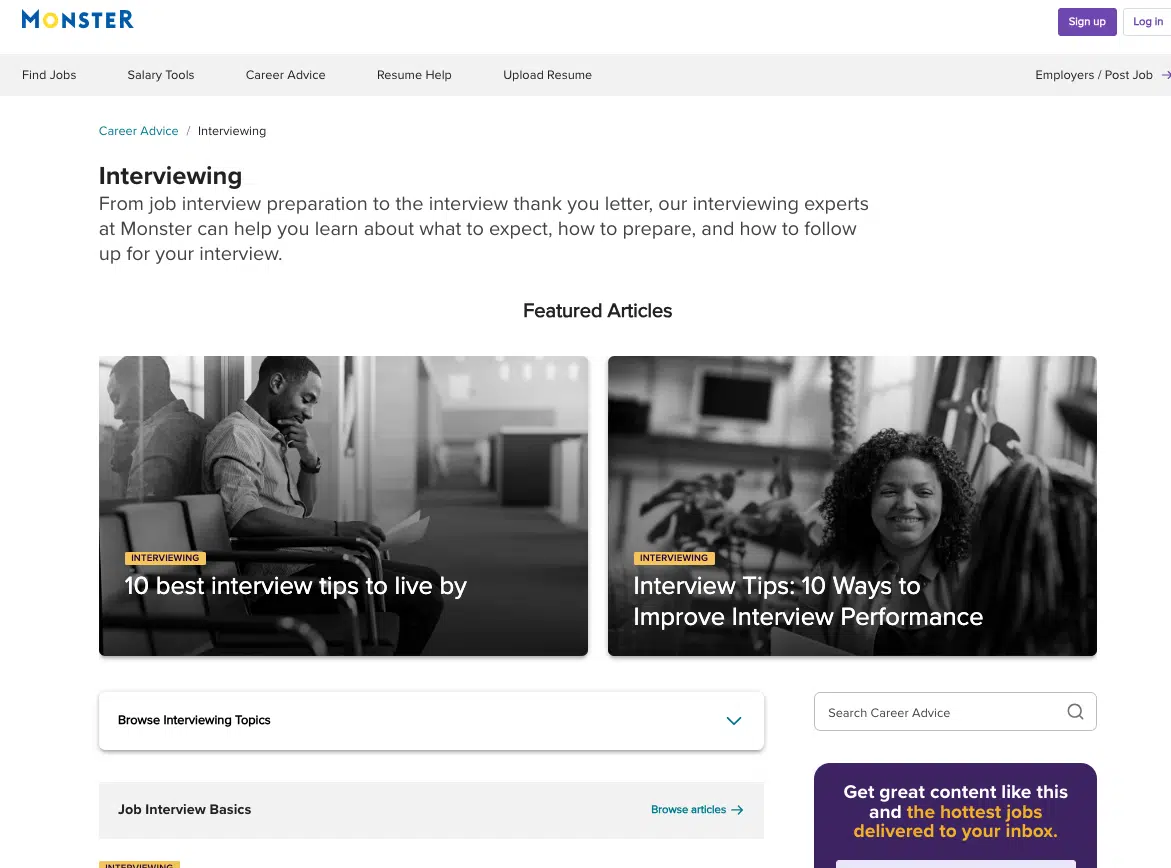
Another example of effective pillar page usage comes from Monster, a website connecting job searchers with available job openings.
Again, recognizing that their target audience might be searching for interview tips, they have created a topic cluster around interviewing.
Creating a strong foundation for SEO topic clusters
Creating a solid foundation for SEO topic clusters involves identifying the pillar content and conducting comprehensive keyword research.
When considering your pillar content topics, ensure they align with your business goals and target persona’s needs.
By selecting broad topics or themes that align with your business goals and target audience’s interests, you lay the groundwork for an effective topic cluster strategy.
Once the pillar content is determined, keyword research remains essential to identify relevant target keywords.
This strategic use of keywords helps search engines understand the main focus of the content.
It also establishes a solid foundation for the subsequent subtopic content pieces that will support your ongoing efforts to grow your topic cluster.
Get the daily newsletter search marketers rely on.
Measuring and analyzing the impact of your topic clusters
To determine if your topic clusters are working effectively and to measure the success of your strategy, you can use various metrics and tools. Here are some key indicators to consider:
Organic search traffic
Monitor the organic search traffic to the pillar page and the subtopic pages within the topic cluster.
An increase in organic traffic indicates that your content attracts more visitors through search engines.
Keyword rankings
Check the rankings of your pillar page and subtopic pages for relevant keywords.
Improvements in keyword rankings suggest that search engines recognize your content as valuable and relevant.
Time on page and bounce rate
Analyze visitors’ average time on the pillar page and subtopic pages, along with the bounce rate.
Higher time on page and lower bounce rates indicate that users find your content engaging and useful.
Internal link click-through rate (CTR)
Track the CTR of internal links within your topic cluster.
A higher CTR shows that users are navigating between different pieces of content within the cluster.
Backlinks
Monitor the number and quality of backlinks your pillar page and subtopic pages receive.
Quality backlinks from authoritative sources demonstrate that other websites find your content valuable.
Conversion rate
If your content is designed to drive conversions (e.g., sign-ups, downloads, purchases), make sure to track this metric.
User feedback
Ask users for their opinions to understand how they perceive your content’s usefulness.
You can use SEO tools and GA4 to track these indicators. Regularly review and analyze the data to improve your topic cluster strategy.
Remember, it may take time to see results, so be patient and consistent in your approach.
Boost your SEO with topic clusters
Topic clusters are an effective SEO strategy that helps websites build authority, improve search rankings, and attract targeted organic traffic by organizing content around specific topics and establishing content-rich topical hubs.
Creating valuable content clusters builds a comprehensive resource hub for your website visitors. This makes it easy for humans and search engine bots to see your website’s extensive knowledge and expertise on a specific topic, starting from the pillar page.
As a result, your site gains better signals, higher search engine rankings, and increased overall authority.
Opinions expressed in this article are those of the guest author and not necessarily Search Engine Land. Staff authors are listed here.
@media screen and (min-width: 800px) { #div-gpt-ad-3191538-7 { display: flex !important; justify-content: center !important; align-items: center !important; min-width:770px; min-height:260px; }
}
@media screen and (min-width: 1279px) { #div-gpt-ad-3191538-7 { display: flex !important; justify-content: center !important; align-items: center !important; min-width:800px!important; min-height:440px!important; }
}
About the author
Tabitha is a Director of Client Strategy at SmartBug Media. She has 10+ years of digital marketing experience and is well-versed in implementing marketing strategies for many industries including SaaS, healthcare, consumer services, automotive, and more. Outside of work, you’ll find Tabitha traveling with her husband, taking her 2 rescue corgis on adventures, and researching a Costa Rican retirement plan.
How to create a successful 2023 holiday season SEO strategy
What comes to mind when you think of the fading days of summer? For those in brand marketing or SEO, the answer might be (or should be) Q4 and holiday planning.
Although temperatures continue to linger in the upper half of the thermometer, it’s never too early to begin setting your SEO campaigns up for success amid an ever-crowded holiday shopping field.
These are the trends shaping the 2023 season – with best practices for search-optimized content marketing, technical SEO and more.
Understanding the 2023 holiday landscape
Start strategizing by researching and understanding the consumer trends shaping the 2023 holiday landscape, especially as they relate to your customer and product.
You might need to expand your definition of the “holiday season” altogether. On average, 21% of consumers complete their seasonal gift purchases by mid-October, according to Google.
With major retailers rolling out Black Friday and Christmas campaigns as early as the September and October timeframe, it’s even more vital to keep up.
Other expected trends and consumer behaviors include:
Generative AI
As virtual and augmented reality continue to stake their foothold on interactive shopping experiences, consumers are also discovering new products with Google’s Search Generative Experience (alongside shopping ads) and via conversational AI like Bard and ChatGPT.
Chatbots have also been integrated natively within ecommerce websites.
Buy now, pay later
“Buy now, pay later” purchases accounted for 7% of all online orders in 2022 and are expected to rise amid the overall lagging economic performance.
While overall spending will likely grow, consumers still note their cost consciousness.
Discounts
Similarly, discounts continue to drive sales for merchants, especially around the holiday window.
Armed with an increasing amount of information from online and in-person opportunities, shoppers have indicated a willingness to wait for the best deal.
Mobile
You’ve likely heard this before, but mobile traffic typically accounts for nearly half (if not more) of all online sales.
Don’t overlook the importance of optimizing your pages for the best mobile experience to maximize your conversions.
Keyword research for the holidays
As is always the case with all keyword research, the goal is finding queries, topics and terms with relatively large volume but highly targeted user intent.
Remember that consumers might be looking for general category information or seeking out a specific product depending on their keyword, and tailor your content accordingly.
Up to 70% of people would rather get information about a company or learn something from an article or blog post than a traditional advertisement. This is where long-tail keywords come in.
Don’t underestimate their importance: they get 1.76x more clicks in organic SERPs. For informative blog posts and in-depth guides, target users who are searching for specific phrases, such as “best tech gifts for kids under $50.”
These terms might have lower search volumes, but their specificity makes them easier to rank for and convert exceptionally well.
Short-tail keywords come into play for your product landing pages, targeting users in the buying phase.
With the most competition and volume within this space, save these terms for your site’s highly optimized and highest-impact pages.
Plan your strategy with competitive and consumer analysis
Take a data-centric approach to your holiday content strategy. While the season is an annual occurrence, a successful strategy demands more than recycling old, stagnant content.
Begin by harnessing Google Trends to gain insights into emerging product trends and shifts in consumer interests.
Next, look inward and analyze your website’s data from Google Search Console and Google Analytics. Identify:
The pages that experienced the highest traffic during the previous holiday season.
The channels and search queries that were most effective in driving traffic.
It’s important to remain aware of any emerging trends within the geographic areas you serve and the product categories in which you compete.
Uncovering potential breakout product or service categories with social listening tools or Google Business insights.
Finally, use SEO tools to assess how your competitors might craft their own strategy.
Analyze their keyword strategy and content quality. How relevant are they to those with similar products, audiences or markets?
Pay attention to their backlink profile, site user experience (UX), and keyword targeting.
These insights will assist in formulating a dynamic strategy unique from the competition.
Holiday SEO content: Planning, creation and optimization
While the holiday season is a great time for implementing refreshed strategies, it’s not the time to be caught flat-footed or behind schedule.
An effective content calendar:
Ensures all stakeholders know their assigned roles.
Brings structure and clarity to campaigns across diverse platforms.
Maintains brand consistency across all creative and audience-facing materials.
The holiday season is both a marathon and a sprint.
November and December seemingly blur into one continuous period of shopping and promotions. That said, consumer behavior actually follows a pattern dictated by major holidays and retail pushes like:
Black Friday and Cyber Monday.
Then the lead-up to Christmas, Hanukkah, Kwanzaa, and New Year’s Eve.
Each of these occasions presents distinct opportunities to create content and drive traffic.
When it comes to the style and topics of your content, originality is the name of the game. Keep the following best practices in mind:
Promotions and sales
Align your content with holiday promotions and discounts, ensuring that every piece of content supports your overarching sales strategy.
Audience sentiments
A deep understanding of what the holidays signify to your audience is paramount. Tailor your content to resonate with their emotional and practical needs during this festive period.
Brand building and storytelling
Consider the most enduring holiday content. In many cases, it leaves you with warm and nostalgic emotions.
If your brand actively engages in charitable endeavors, the holiday season offers an ideal platform to amplify and communicate your philanthropic efforts.
Showcasing your business’s underlying values provides a valuable opportunity to cultivate brand trust and customer loyalty in the season of giving.
Strategic timing
Timing is everything. Release your content strategically, ensuring that it complements your broader marketing initiatives.
Gift guides and catalogs should go live well ahead of the holiday shopping frenzy.
Get the daily newsletter search marketers rely on.
Technical optimizations for seasonal success
Here is where the importance of actively preparing your SEO strategy early comes into play. It can take eight weeks (or more) to index a page, and even longer for that page to rank.
Depending on the trending products within your product vertical and your keyword targeting strategy around specific holidays, you might have a series of dedicated landing pages you hope to perform.
These pages can be prepared well in advance, and a temporary 302 redirect can be employed to conceal them until needed.
This approach provides ample time for holiday preparations and allows search engine crawlers to index the site thoroughly.
However, ensuring that any newly created landing pages are promptly added to your XML sitemap, and navigation is essential for seamless accessibility.
Make sure your seasonal URLs are evergreen (i.e., “/new-years-deals” instead of “/2023-new-years-deals”) so your pages can build authority over time and maintain any backlinks.
Request Google to recrawl the page after any refresh and update title tags, headers and copy as necessary.
To maximize visibility and engagement during this high-stakes season, also consider these techniques:
Semantic SEO
Go beyond exact-match keywords and employ semantic SEO.
This entails using related keywords, synonyms, and contextually relevant terms, which signal to search engines that your content is comprehensive and valuable.
Schema markup
Implement schema markup on your seasonal product pages and blog posts to maximize your chance of appearing in rich snippets and boosting click-through rates.
User-generated content
Encourage user-generated content such as reviews, comments, and testimonials to add credibility to your offerings.
With mobile browsing becoming the preferred platform for holiday shoppers, optimization in these areas is not just a checkbox but a necessity.
To ensure your holiday content thrives in the mobile arena, follow these basics at a minimum:
Responsive design: Ensure your website is responsive, automatically adjusting to different screen sizes and devices.
Page speed: Optimize page speed for mobile users. Compress images, minimize code, and leverage browser caching to reduce load times.
Mobile-friendly content: Craft content that is easily digestible on mobile devices. Break content into concise sections, use legible fonts, and ensure clickable elements are appropriately spaced for touch navigation.
Testing and measuring SEO success
Although the fall and winter months are quickly approaching, it’s not too late to analyze user behavior via A/B and conversion rate optimization (CRO) testing.
Different page layout combinations or language variations might prove more compelling and lead to a higher conversion rate.
Data-driven decisions will make all the difference for your holiday SEO campaigns. Identify the KPIs that matter most for your strategy, including organic traffic, conversion rates, revenue generated, click-through rates, and bounce rates.
Recognize the importance of adaptability in your holiday SEO strategy. Stay vigilant for emerging trends and shifts in consumer behavior, and be prepared to pivot your strategy accordingly via continuous monitoring and real-time adjustments.
If you are concurrently running paid holiday advertising campaigns, insights there can serve as early indicators for how you might want to tweak your SEO-focused content.
A successful season of SEO
If you only take away one conclusion from this piece, let it be this one: the time to start preparing your holiday SEO strategy is now.
The seasonal landscape is no longer limited to the November-December timeframe. Prepare early and understand evolving consumer behaviors.
As you develop your holiday strategies and content, remember the following:
2023 holiday season trends indicate early shopping, generative AI, “buy now, pay later” purchases, and the continued importance of discounts.
Mobile optimization is critical, with mobile traffic accounting for a significant portion of online sales.
Balance long-tail and short-tail keywords based on user intent for effective SEO.
Plan your content calendar meticulously to align with holiday events and promotions, focusing on originality and relevance.
A/B test messaging and use conversion rate optimization (CRO) to refine your user experience.
Flexibility and real-time adjustments in your strategy are vital to staying competitive in the ever-evolving holiday landscape.
Opinions expressed in this article are those of the guest author and not necessarily Search Engine Land. Staff authors are listed here.
@media screen and (min-width: 800px) { #div-gpt-ad-3191538-7 { display: flex !important; justify-content: center !important; align-items: center !important; min-width:770px; min-height:260px; }
}
@media screen and (min-width: 1279px) { #div-gpt-ad-3191538-7 { display: flex !important; justify-content: center !important; align-items: center !important; min-width:800px!important; min-height:440px!important; }
}
About the author
Alex Klugerman is a New York city-based SEO professional. He is currently an Analyst on the Enterprise SEO team at Direct Agents, optimizing the online presence of a diverse range of clients in the B2B, B2C, and retail domains. With a focus on enhancing technical SEO strategies and curating tailored content, Alex’s knowledge and areas of interest encompasses various aspects of digital marketing, particularly content creation and marketing, as well as the dynamic and evolving interplay between artificial intelligence and the SEO landscape.
I started building links in 2010. The process then was very simple: scale your outreach to build backlinks directly to the pages we want to rank.
Approaching link building with this perspective can lead one to focus too much on nurturing skills for bulk outreach or email automation.
These are good skills, but the best link building methods are based on the marketing of content.
Modern link building uses expert content to engage with content creators around a topic, showing experience and expertise.
This is the marketing of content, which is a different skill than traditional link building.
If you’re new to link building, eventually, you’ll reach a fork in the road. The first path is building links with highly controllable methods. The second path is to be a marketer of content.
The second path is harder at first, but staying focused will lead you to build more skills in content marketing.
It’s harder because you have to become great at understanding what the audience wants to read.
This guide is for the second path.
Keep reading to establish a foundation for your professional growth in building links from highly reputable and trusted websites.
Image created by author in Midjourney, August 2023
What is link building today?
Link building is an SEO practice to increase the number of inferred or direct hyperlinks (links) to a webpage.
While initially focused on website list building and outreach, it has since expanded to include content marketing and strategy.
Modern link builders use traditional methods like building lists and fixing broken links but also analyze, create, and share content.
Link building has changed. Now, links come from creating and sharing good content rather than being the main focus.
6 types of link building
We will group link building tactics and strategies into one of these categories.
These groupings require wildly different link building and content marketing skills to execute and oversee a campaign.
1. Earned links
These links appear naturally when content creators find your content valuable and link to it without your direct request.
To earn links, create content that creators want for their audience.
If the content is optimized to be linkable or shareable, they are likelier to share, discuss and ideally link to it.
Typical methods to distribute the content to earn links:
Social ads remarketing
Social ads
Social media organic shares
Google Ads
In contrast to link building outreach, earning a link does not require a request to place a link or share content.
2. Outreach-based links
Link building outreach is a proactive method. It involves contacting content creators or websites through email, phone or social media.
Outreach uses tactics from influencer marketing and digital PR to secure links.
An outreach campaign could use one or multiple of these campaign types:
Linkable content: Strategically creating content that content creators want or need to link to or share.
Expert sources: Being seen as an expert in a specific field can get you links from news sites, blogs, and industry publications.
Add-on value: Adding value to creators by sharing their content or exchanging links helps them reach a wider audience and expand their community. Get creative with the add-ons to convince them to link back.
Relationship building: Contacts that already know you tend to respond at a higher rate.
Content creators constantly search and find data, quotes or helpful resources to enhance their content’s value to the reader.
During this research process, the creator saves and links to content.
This link building method doesn’t need outreach. It focuses on creating content that ranks for research keywords or in online research communities.
A popular example of a discovery link is targeting “statistic” keywords, like “SEO statistics 2023.”
Content creators use these types of search queries to research facts and data for their content.
Once the content ranks for those keywords, the content creators will find it naturally when searching.
4. Passive PR
You can get these links by answering requests for sources or experts. Journalists and content creators typically use special tools or communities to accomplish this.
For beginners, this type of link building is a simple process to find high-quality links without cold pitching.
To use this method, you must either have an expert or become an expert yourself. This is necessary to answer questions or provide quotes.
Tip: Read the book “Mastery” by Robert Green to learn how to master link building – or anything.
5. Submitted links
Submit a site to directories, posts on social or forums, and other sites that don’t require significant vetting or editing by a community manager.
Although these links may not directly improve ranking they can provide traffic and more context to Google about the site’s topics or direct traffic.
6. Paid links
This technique is simply exchanging money to have a link placed on a website.
Sure, you can get a lot of links this way. However, many of these links are not beneficial for the site.
And despite being an easy link to build, analyzing these links’ impact is too complex for beginners to spend time on. You’ll find yourself building the wrong skills by focusing on paid, hurting your professional growth.
Furthermore, Google can identify and devalue many links that violate their spam policy.
However, a link builder can leverage sponsored links to share content strategically in a community. This is just another way to earn links by sharing content that is shareable.
Google says that “you might want to tell Google your relationship with the linked page,” recommending the use of rel=”sponsored”.
Tip: Beginners should only use link building techniques that work with content creators. Find ways to enhance the content using subject matter expertise.
3 mistakes to avoid as a first-time link builder
I made a series of early mistakes that are common for first-time link builders.
However, these mistakes caused me to waste a lot of time, reduced campaign performance and delayed my professional growth.
I can’t urge you enough to avoid these mistakes:
Mistake: Focusing solely on paid links
Paid links are easy but addicting.
Don’t focus on paid links, and build skills for other link building techniques that are more impactful at scale.
Mistake: Not selecting niches
Not focusing on a niche, and building links from any place that will take the site. Building a reputation in a niche, not broad categories, takes much less effort.
Mistake: Thinking the goal was backlinks
Instead, focus on building relationships with content creators for a meaningful idea or concept.
Many people aim for a certain number of links each week or month, which can distract from working a valuable relationship with important creators.
Learn how to analyze content, find gaps, and create content that is helpful to their audience.
What are ‘quality backlinks’?
This is one of the most hotly debated topics in SEO. Google has a different definition from many SEOs for what makes a quality link.
But quality is much simpler than that. Here’s an overview:
Google defines quality based on the reputation of the content and the company or people behind it.
Some use SEO metrics like Domain Rating (DR) from Ahrefs to triangulate a quality site.
A manual review of the content to identify if the creator understands the topics.
Overall page quality rating considerations in the guidelines are:
Quality for the main content.
Reputation of the website and content creators.
Experience, expertise, authoritativeness, and trust (E-E-A-T).
The company provides the quality raters with a scale from lowest to highest quality.
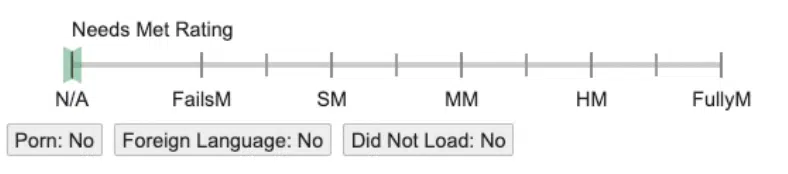
The guidelines go on to include a “needs met rating scale” that reviewers use to “focus on user needs and think about how helpful and satisfying the result is for the users”
According to Ben Gomes, former Google VP of search engineering:
“You can view the rater guidelines as where we want the search algorithm to go… They don’t tell you how the algorithm is ranking results, but they fundamentally show what the algorithm should do.”
This suggests we can use these guidelines to understand a site’s reputation.
However, many digital marketers and SEOs use popular metrics from the main link tools Ahrefs, Moz, Majestic or Semrush.
“Nobody knows for sure how exactly Google measures the value of each link. But there are some general concepts of evaluating links that the SEO community believes to be true:
Authority
Relevance
Anchor text
Nofollow vs. follow
Placement
Destination.”
Using third-party metrics has proven beneficial in reducing the time for evaluating a site’s quality during list building or to audit a competitor’s links.
Google’s review process takes time, but using quality metrics will speed up site reviews for list building and outreach.
However, using PR and social media metrics to find content creators creating engaging content.
Analyzing the content’s performance for a site will give you a list of quality sites by default.
Tip: Identify and showcase your company’s expertise on sites that discuss your target subject instead of spending too much time building lists and evaluating each site. Find people talking about it and create a conversation.
Link building strategy basics
“Link building strategy” is the navigation of the marketplace of online content creation to secure links as a consequence of the marketing of content.
A link building strategy is a plan to improve a website’s reputation in search engines and readers, leading to better rankings.
Analysis: How to identify the tactic and messaging.
Guiding policy: General approach or technique customized to the specific campaign.
Steps: List of simple steps to execute the strategy.
To begin, choose one of the following methods. They help you get links fast and show how content creators in that field will respond to your message.
Link building techniques to start:
Expert guest posting: Use your expertise to post on other websites about important topics in your industry.
Passive PR: Respond to requests from content creators and journalists who are actively searching for expert sources for articles.
Resource links: List your site, study, or product/service on sites that are already listing them.
Creating a list of sites, analyzing them, and customizing your pitch for outreach using the techniques above will ensure you are challenged to solve problems by showing your company or expertise and experience.
Get the daily newsletter search marketers rely on.
A starter link building process
Although you should test other processes, this process will set a new link building program down the right path to scale up the market of content.
Step 1: Strategy and planning
Before diving in, outline a clear link building strategy. Define your goals, target audience and strategies.
Linkable content or an expert?
Can you build new content?
How new is the site or company?
Does your experience and expertise fill a gap or enhance an existing subject or conversation?
Step 2: List building
In this step, you’ll find potential link building opportunities using:
Advanced search operators in Google. For example, if you’re in the health niche, you might search for “health + write for us” to find guest posting opportunities.
Link databases like Majestics, Moz, Ahrefs, and Semrush.
You can also find sites with specializedlist building tools or features. Pitchbox has default campaigns that use Semrush, Ahrefs and Moz APIs to create lists based on a type of campaign. Buzzstream is another low-cost option.
Tip: Use the advanced search operator feature in Pitchbox to create larger lists of sites.
Step 3: Backlink outreach
Use the site lists to create an outreach strategy and contact the sites.
Based on the site list, determine which technique to use and group the sites by technique.
Select an email template that is best suited for the technique. For example, a guest posting strategy can use a standard guest posting template.
Then, customize the template based on the prospective site.
Step 4: Measurement and optimize
Evaluate the initial performance with a count of quality links obtained from influential content creators.
When evaluating the link building, focus on analyzing the messaging and how the contacts are responding or not responding.
The analysis needs to answer the question, “Why did the creators not want to share these topics?”
Refine the messaging to understand the wants and needs of the content creators in the specific niche.
Backlinks are not the end goal
Today, the emphasis isn’t just on finding links. It’s about sharing a message based on your experience and expertise.
Many link builders in the industry are now focusing on adding genuine value through content marketing and building relationships instead of just using ranking tactics.
For newcomers and veterans alike, the mantra remains the same: quality over quantity.
Avoid the allure of quick wins like paid links. Focus on content niches, compelling content and community relationships.
As tactics evolve, the heart of link building has grown to be about adding value, fostering relationships and ensuring sustainable success.
Opinions expressed in this article are those of the guest author and not necessarily Search Engine Land. Staff authors are listed here.
@media screen and (min-width: 800px) { #div-gpt-ad-3191538-7 { display: flex !important; justify-content: center !important; align-items: center !important; min-width:770px; min-height:260px; }
}
@media screen and (min-width: 1279px) { #div-gpt-ad-3191538-7 { display: flex !important; justify-content: center !important; align-items: center !important; min-width:800px!important; min-height:440px!important; }
}
About the author
Kevin Rowe is the Founder of PureLinq, an enterprise link building solution, and an SEO Product Marketer. He has designed and implemented almost every type of link building technique over his 14 year stint in SEO. Since 2009, Kevin has worked on SEO, link building, and advanced analytics programs for enterprise clients like Hyatt Hotels, Kaplan University, Bullet Proof Coffee, VMware, Novartis, Coca Cola, and so much more. After studying at the Park School of Communications @ Ithaca College, he found a passion for content development and messaging which led him to publication in Forbes, Fast Company, Huffington Post, and Search Engine Land.
E-E-A-T: Making experience and expertise your content advantage
Google probably won’t ever tell us how its algorithms work – but that doesn’t mean it won’t drop a few hints.
Google’s Search Quality Rater guidelines mention E-E-A-T (experience, expertise, authoritativeness and trustworthiness) 126 times – which is a pretty big indicator that this is important, according to Melissa Fach, lead SEO content manager at Kelley Blue Book & Autotrader.
Leveraged correctly, ensuring your content delivers E-E-A-T to a high standard can supercharge your SEO, she explained.
Here’s how you can use experience and expertise to your content advantage, as presented by Fach at SMX Advanced.
Experience is a priority
Google updated its E-A-T guidelines in December 2022 to add an extra ‘e’, which stands for experience – and it’s a factor all SEOs should prioritize when it comes to their content strategy. Fach explained:
“The experience aspect is really great because anyone can learn to write about any topic – but only someone with experience can provide the insights people need to make a decision that could impact their life, whether it be health or financial or even just what they’re going to eat for dinner.
“So does your content demonstrate it was produced with some degree of experience, such as actual use of a product? Or has the writer actually visited a place they’re discussing?”
“There are some situations where really what you value most is content produced by someone who has first-hand life experience.”
Demonstrate your expertise
The level of expertise leveraged in your content can help Google to understand the quality, making it an important consideration, Fach said:
“Please go read the guidelines on that. Be helpful as quickly as you can by adding value. Remember consensus because accuracy is a critical effort. The level of effort will help Google determine if your content was written by a human or by AI.
“I also suggest you have a very detailed strategy for winning With every piece of content that you produce, prove that you are a true expert. Experts have experience and thus are authoritative on the topic. You’re going to have to prove that in your content in new ways.”
Think about authoritativeness
Authoritativeness is vital in E-E-A-T because it establishes credibility and trust, ensuring that content is reliable and valuable to users. This, in turn, contributes to improved search rankings and user satisfaction, according to Fach:
“It’s important to think about how you will always be the most authoritative voice in your field. Think about what will keep you above everybody else in the space.”
Trust is crucial
The word ‘trust‘ is mentioned 213 times in the latest update of Google’s guidelines, which means SEOs should pay close attention to it:
“Google says that trust is the most important member of the E-E-A-T family because untrustworthy pages have low E-E-A-T no matter how experienced, expert, or authoritative they may seem. You may have a great writer, but if your trust factors are not there, it’s an issue.
“My recommendation is to read Google’s guidelines. Please, if you haven’t read them, go read about trust and learn what you need to do for your website and your content to have this most important member of E-E-A-T.”
Consensus is important
Fach emphasized that Google’s guidelines mention “consensus” a whopping 32 times, underscoring the need for SEOs to ensure their content aligns with the platform’s quality standards. She explained:
“There was an auto site that always ranked in the top 10 for car reviews. But when the site wrote about this specific vehicle, it wasn’t ranking in the top 10. Because I was so used to seeing this auto-site ranking, I went to look at the review to see, well, what did they say? How did everyone else outrank them?
“This vehicle had a lot of electric batteries in the back that took up a lot of room, so it didn’t have a spare tire in the back. This meant that the vehicle came with what we call run-flat tires – so it’s a little bit more expensive than a regular tire.
This is a factor to keep in mind if you’re going to buy a vehicle because of the cost. So is that a YMYL topic? Possibly it is.
“However, the website said the vehicle did have a spare tire. Was this the thing that hurt the well-established site? I can’t say for sure. I don’t know how Google’s algorithm works for sure, but as someone who looks at cars and car sites all day long, this was a huge mistake that could negatively impact the buyer or the consumer on that site, so it didn’t match consensus.”
Put in the effort
Google’s guidelines reference the importance of effort with regard to content 101 times – so it’s another factor SEOs need to take into consideration, according to Fach:
“Google advises in its guidelines that it considers the extent to which a human being has actively worked to create satisfying content. That is a massive statement. ‘A human being’? They knew AI content was coming. They want a human making the effort – not AI.
“They said that for most pages, the quality of the main content can be determined by the amount of effort, originality, and talent or skill that went into it. They want original content – not content if it’s copied with little or no effort, has no manual curation, or has no added value for the user.
“Moving forward, the amount of effort you put into content is going to be an important factor.”
Are the user’s needs met?
Fach highlighted how crucial it is to make sure your content meets user needs and aligns with their intent, something Google’s guidelines emphasize 119 times. She explained:
“Do you provide a helpful answer to someone’s query in your content? And did you do it fast or are you making them work to find the answer? Because we all know that people do not like to work – and they’re not going to work, so needs met is an issue.
“The other thing I want to say is that content does not have to be long form. Gone are the days of creating 5,000 words on this topic to beat your competitor. Needs met doesn’t need 5,000 words. Short-form content works. Short-form answers are good and help the user to find their answer quickly.”
YMYL should be taken seriously
“Your Money, Your Life” isn’t casually mentioned in Google’s guidelines; it’s actually highlighted 120 times, which means you need to pay attention to it, Fach said:
“Google says that some topics have a high risk of harm because content about these topics could significantly impact the health, financial stability, safety, welfare or well-being of society. Google doesn’t want to put up bad information in these areas.
“In fact, Google has removed harmful content because it takes the safety, welfare and wellbeing of society very seriously.
“If this is your niche, you’re going to have to work harder than everybody else to make sure that your content is correct.”
The AI dilemma
While AI is continuously getting better, it can’t quite replicate human experience, just like how it can’t review the luxurious feel of a leather couch. Keeping this in mind, Fach cautioned SEOs against over-reliance on this emerging technology:
“Of course, AI can be a great time-saving tool, but it isn’t capable of evaluating and creating an SEO strategy to outrank a high-ranking, highly competitive website. An inexperienced SEO may think that AI content is enough, but it isn’t.
“I’ve seen many guides on ChatGPT replacing SEO human processes, but they’ve missed key elements – so don’t depend on those completely. Question everything – as you should as an SEO.
“As we underscore the importance of experience as an element of helpful content, we continue our focus on information quality and critical attributes like authoritativeness, expertise and trustworthiness. So what I want to say to businesses out there who are trying to make the call, do we save money by letting writers go and using AI? My recommendation is absolutely not.
“Please do not depend on AI to replace your employees.”
Get the daily newsletter search marketers rely on.
Key takeaways
Here are five key takeaways on how to effectively use E-E-A-T to supercharge your SEO content strategy from Fach:
Study: “Moving forward, my recommendation is to study every SERP change across at least five industries. What you see change for one will eventually come over and apply to you in one way or another.”
Test: “Test, test and retest everything. Failure is learning.”
Plan: “Plan to win in 12 to 18 months. Yes, you may have your winning content now but you need to anticipate what will happen in 12 to 18 months out because of the way that Google and AI are changing.”
Anticipate: “Try to guess what will change and where you want to be when that happens. You have to always think about the progression of search.”
Competitive analysis: “I’m not saying Google is your competitor – but it is! Google’s SERP features will compete with you. You have to find a way to integrate yourself into them. So study them deeply across multiple industries to get an idea of where the progression of change is going in the future.”
@media screen and (min-width: 800px) { #div-gpt-ad-3191538-7 { display: flex !important; justify-content: center !important; align-items: center !important; min-width:770px; min-height:260px; }
}
@media screen and (min-width: 1279px) { #div-gpt-ad-3191538-7 { display: flex !important; justify-content: center !important; align-items: center !important; min-width:800px!important; min-height:440px!important; }
}
About the author
Nicola Agius is Paid Media Editor of Search Engine Land after joining in 2023. She covers paid search, paid social, retail media and more. Prior to this, she was SEO Director at Jungle Creations (2020-2023), overseeing the company’s editorial strategy for multiple websites. She has over 15 years of experience in journalism and has previously worked at OK! Magazine (2010-2014), Mail Online (2014-2015), Mirror (2015-2017), Digital Spy (2017-2018) and The Sun (2018-2020). She also previously teamed up with SEO agency Blue Array to co-author Amazon bestselling book ‘Mastering In-House SEO’.
How Google SGE will impact your traffic – and 3 SGE recovery case studies
Much has been written about Google Search Generative Experience (SGE), but the most important questions remains unanswered:
If and when Google SGE goes live, how will it impact organic traffic?
Will our traffic drop, and if so, by how much?
And what can we do about it?
This article presents a framework that can provide clear answers to these questions. Using this framework, we have:
Estimated SGE traffic drops for 23 websites.
Discovered an optimization technique that helps pages rank in the SGE snapshot carousel.
Carried out three SGE recovery projects, in which we have mitigated (at least partially) the expected traffic drops from Google SGE.
We’ll share our data and findings, but more importantly, we’ll share our framework – which you can use yourself to understand the risk Google SGE poses to your websites and find solutions.
TL;DR
This article is quite extensive because we tried to give you everything you need to assess the impact of Google SGE and, in case of a major traffic drop, design your own SGE recovery project while sharing data from our own research.
Here are the key takeaways, with links to learn more further in this article:
It’s possible to estimate how much traffic you’ll lose or gain from Google SGE.
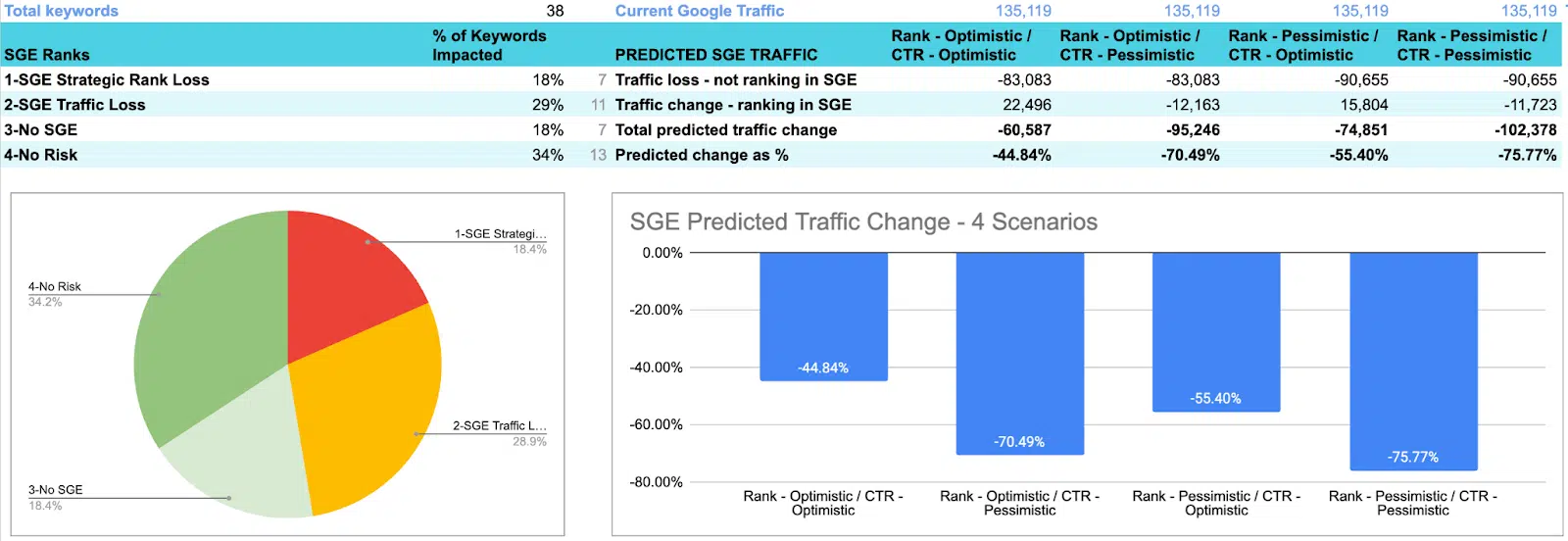
We propose an open SGE Impact Model, which anyone can implement using an Excel spreadsheet. It will help you estimate, across a range of possible outcomes, what will happen to your traffic when SGE goes live. Below is an example of a real website, expected to lose between 44-75% of its organic traffic due to Google SGE. Learn how the model works.
In a study of 23 websites, the aggregate organic traffic drop as a result of SGE was 18-64%.
Our study focused on websites in the technology industry, with traffic mainly from informational keywords. There is large variance inside our sample, with some websites gaining as much as 219% in traffic while others are losing as much as 95%. See the results of the study.
It’s possible to optimize pages to appear in SGE snapshot carousels.
You can combine the SGE impact model and experimental framework to mitigate SGE risk.
By analyzing which keywords are responsible for traffic drops, and optimizing them for SGE, you can save a website from a large expected traffic drop with relatively low effort. See how to design an SGE recovery project.
We share results from the world’s first three SGE recovery projects.
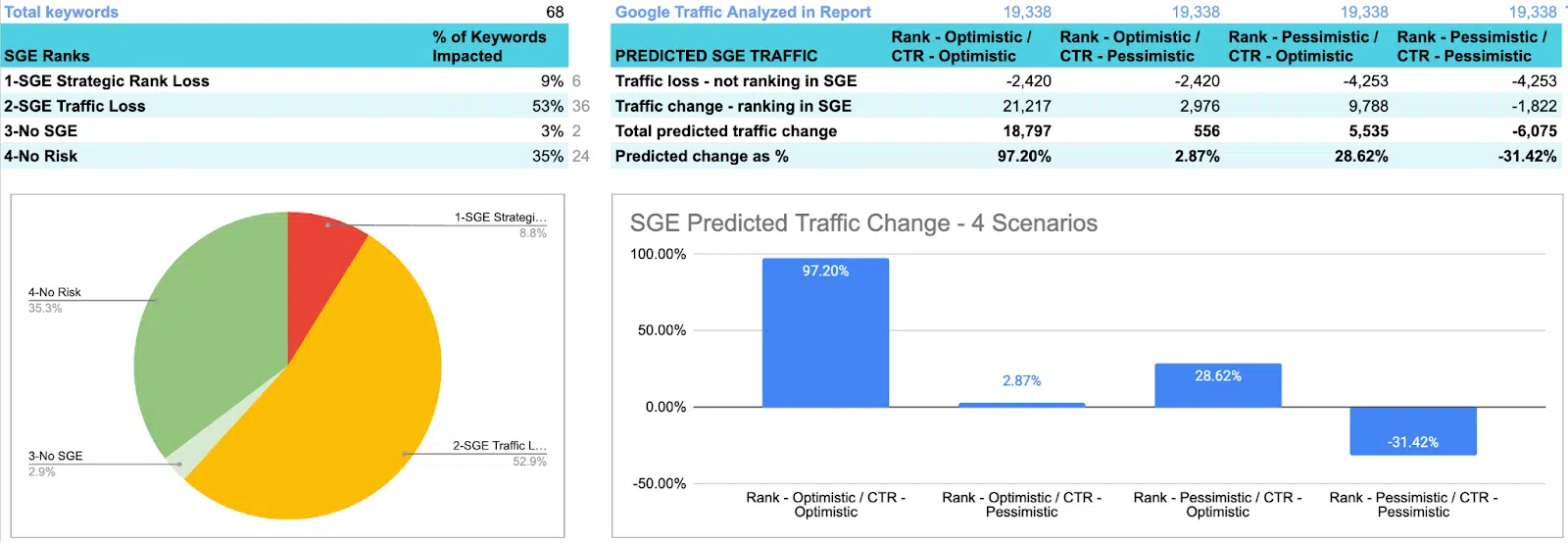
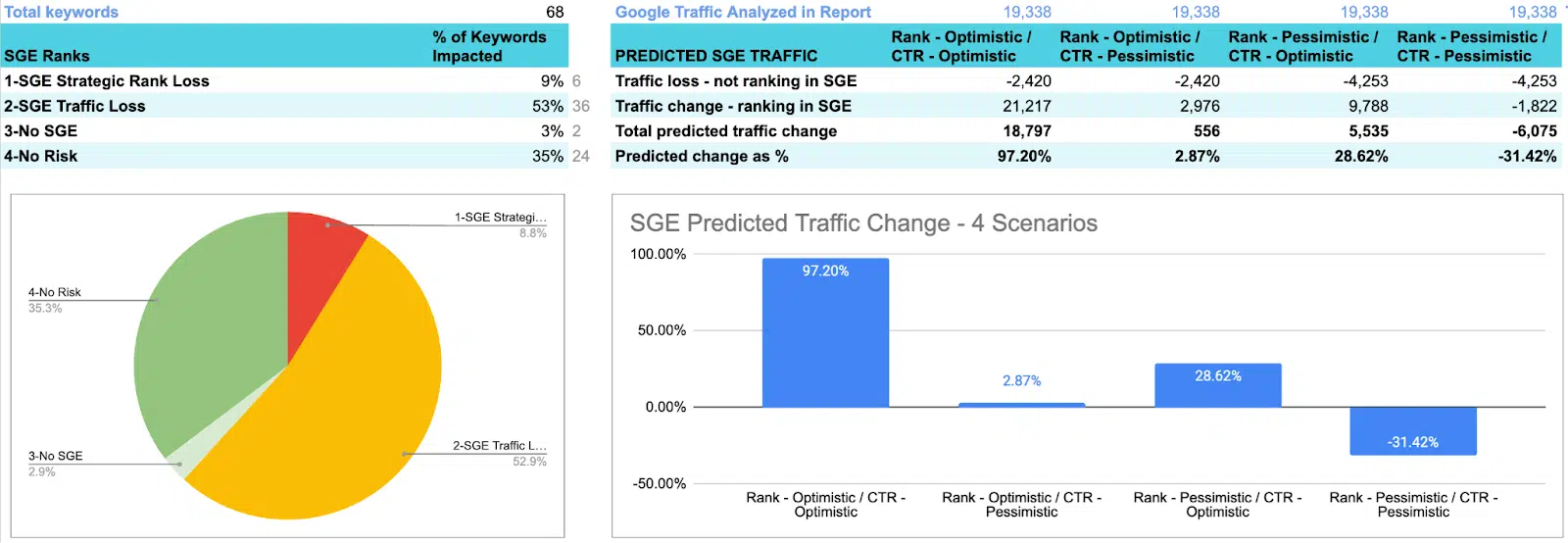
In our most successful project, a client expected to lose at least 79% of organic traffic is now expected to grow by 97% (in the most favorable scenario). To achieve this result, we optimized 11 existing pages for Google SGE and wrote four new “ideal pages” that are favorable to SGE. Read more about our three case studies.
Before
After
We are committed to helping the community survive and grow from Google SGE.
How the SGE impact model works
In order to deal with the risk of SGE, we first need to understand how our important keywords are ranking in the new search experience, and how those ranks translate into traffic.
By summing up the expected traffic in SGE and comparing it to current traffic, we can see if our organic traffic is expected to drop, or even possibly grow, when Google transitions to SGE.
We built a simple model to achieve this for an entire website, estimating the expected traffic change across four possible scenarios. We propose this as an open model for the community to use.
Anyone can use the principles below to build an SGE Impact spreadsheet in Excel or Google Docs, to understand how SGE will affect their website and get actionable insights for recovery.
Simplifying assumptions
Google SGE is a complex system and many parts of it are unknown. To model it, we use a few simplifying assumptions. These assumptions are debatable and are not universally true, but we believe them to be reasonable based on thousands of keywords we observed ranking in SGE:
Assumption 1: If your page ranks in the snapshot carousel, you will get (some) organic traffic.
Assumption 2: Traffic from the snapshot carousel will be equal to or less than the same rank on Google today.
Assumption 3: If you don’t rank in the SGE snapshot carousel, but you do rank in the traditional 10 blue links, you won’t get any traffic (this is a conservative assumption; in reality, some users will probably scroll past SGE and click the blue links).
Assumption 4: If the SGE experience is not active, you will rank the same as you do today.
Next, we use two parameters to define “how bad” or “how good” SGE will be for our websites: CTR and rank.
Click-through rate (CTR) in SGE
It is a mystery what will be the actual CTR of different positions in the SGE snapshot carousel. In our model, we take two extreme options, one optimistic and one pessimistic, to understand the range of possibilities between them.
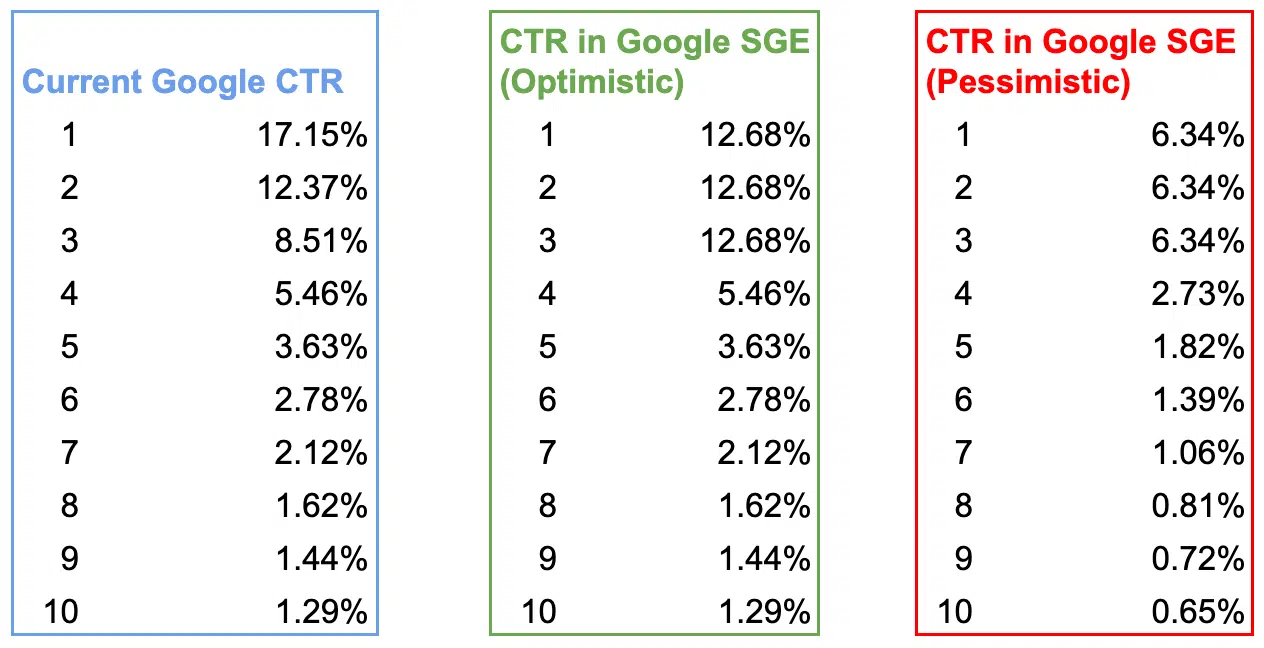
In the table below, we show:
Current Google CTRs for the top 10 positions, according to Advanced Web Rankings. This is live data for June 2023, for informational non-branded keywords. You can adapt the model to other types of keywords by using a different baseline CTR.
CTR in Google SGE (Optimistic) The optimistic CTR for the top 10 positions is similar to Google today. This is our “best case”. The only change is that we expect the first three positions will get the same CTR, because they appear side by side, not one above the other like in Google today.
CTR in Google SGE (Pessimistic). Here, we estimate that SGE will result in half the CTR for the top 10 positions. Again, we assume the first three positions in SGE have identical CTR.
Actual rank in SGE
If you have observed rankings for your favorite keywords in SGE, you probably noticed that ranks are quite volatile. Pages can disappear from the snapshot carousel, appear again, change in rank, and in some cases, the SGE experience does not appear at all. This means that in multiple observations of the same keyword, your page might have different ranks.
In our model, we take a set of rank observations and create two “ideal ranks”:
Optimistic rank: This is the best rank seen. For example, if you checked three times and ranked 3, 5, and one time didn’t rank at all, the optimistic rank is 3.
Pessimistic rank: The pessimistic rank is taken as ‘not ranking’ if the page wasn’t ranking in even one observation. If the page is ranking in all of them, we take the average. In the example above, the pessimistic rank is ‘not ranking’.
Four scenarios
Based on the parameters we describe above, we define four possible scenarios for SGE’s impact on traffic, from best to worst:
Best scenario
Optimistic rank / Optimistic CTR: Across all keywords, we take the optimistic rank (best rank seen) and the optimistic CTR (like Google today).
Mixed scenario
Optimistic rank / Pessimistic CTR: Across all keywords, we take the optimistic rank but combine it with the pessimistic CTR (half of the current CTR).
Mixed scenario
Pessimistic rank / Optimistic CTR: Here we take the pessimistic rank combined with the optimistic CTR (like Google today).
Worst scenario
Pessimistic rank / Pessimistic CTR: This is the worst possible case, combining the pessimistic rank with pessimistic CTR (half of what we have today).
Selection of keywords
This is a critical part of our SGE model. We want the model to be actionable – in other words, we want to optimize and improve traffic based on the results of this model. So, we aim to find a small set of keywords that “explains” most of the organic traffic.
Here are a few steps you can take to find the 20% of keywords that make 80% of the impact for your website:
Identify the “SEO-relevant” traffic on the site. If there are sections on your site that you don’t optimize or “don’t care about” for SEO purposes, exclude them from the analysis.
Identify the top pages that drive at least 70% of organic traffic. Typically, even if you have thousands of pages, there will be only a handful that drive most of the traffic.
For each page, select one representative keyword. In most cases, even if a page is ranking for many keywords, there is one “flagship keyword” you can identify for that page. If that keyword ranks, probably most of the others will rank as well.
Using this process, you can arrive at around 10-50 keywords (for small websites) or up to hundreds of keywords for larger websites that drive most of your SEO traffic. These are the keywords you should use to estimate SGE impact.
In addition, identify strategic keywords – these are keywords that, even if they didn’t show up in the above analysis, are strategically important for the business. We want to make sure they rank in SGE.
Get the daily newsletter search marketers rely on.
Results of our SGE impact model for 23 websites
You must be curious to see what our model shows in terms of traffic drops (or growth!) for actual websites. Here are the results:
The dataset
Our agency, Agile SEO, specializes in the technology industry.
We ran our impact model on 23 client websites, all corporate websites of startups or established technology companies focusing on informational keywords in their SEO efforts.
They all have between 100-10,000 indexed pages, and between 1,000 to 300,000 monthly organic visits.
Keyword ranks
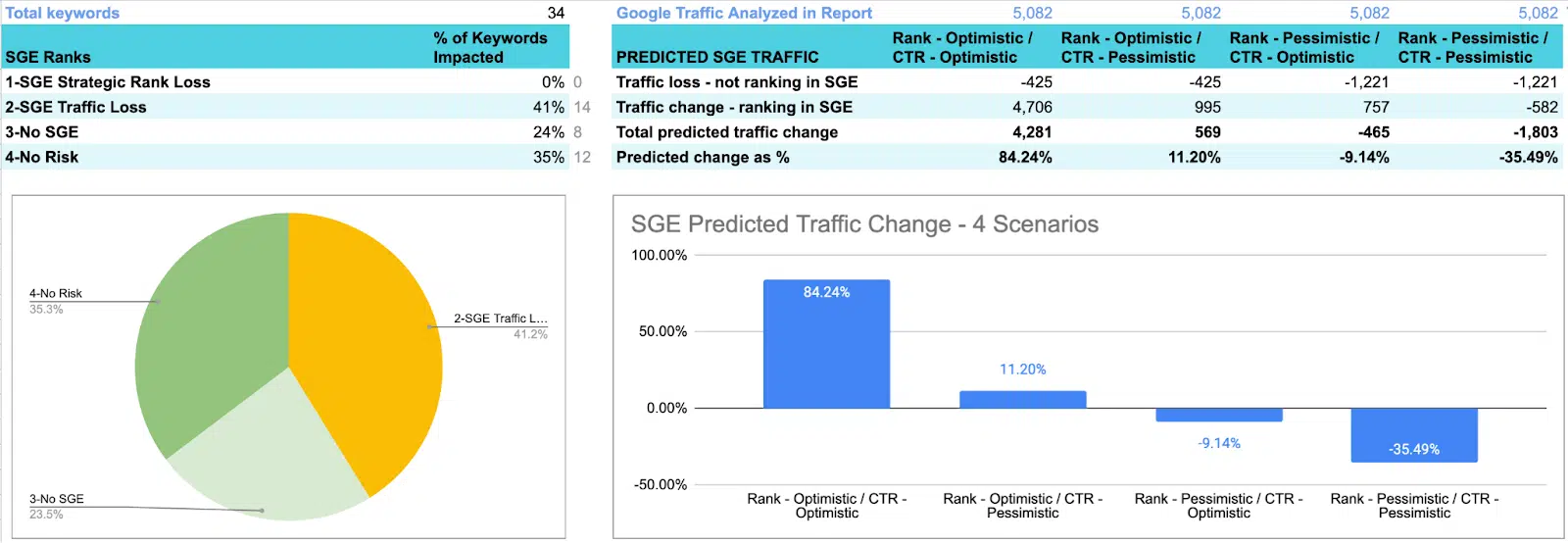
The pie chart below shows what is expected to happen to our clients’ most important keywords when SGE goes live.
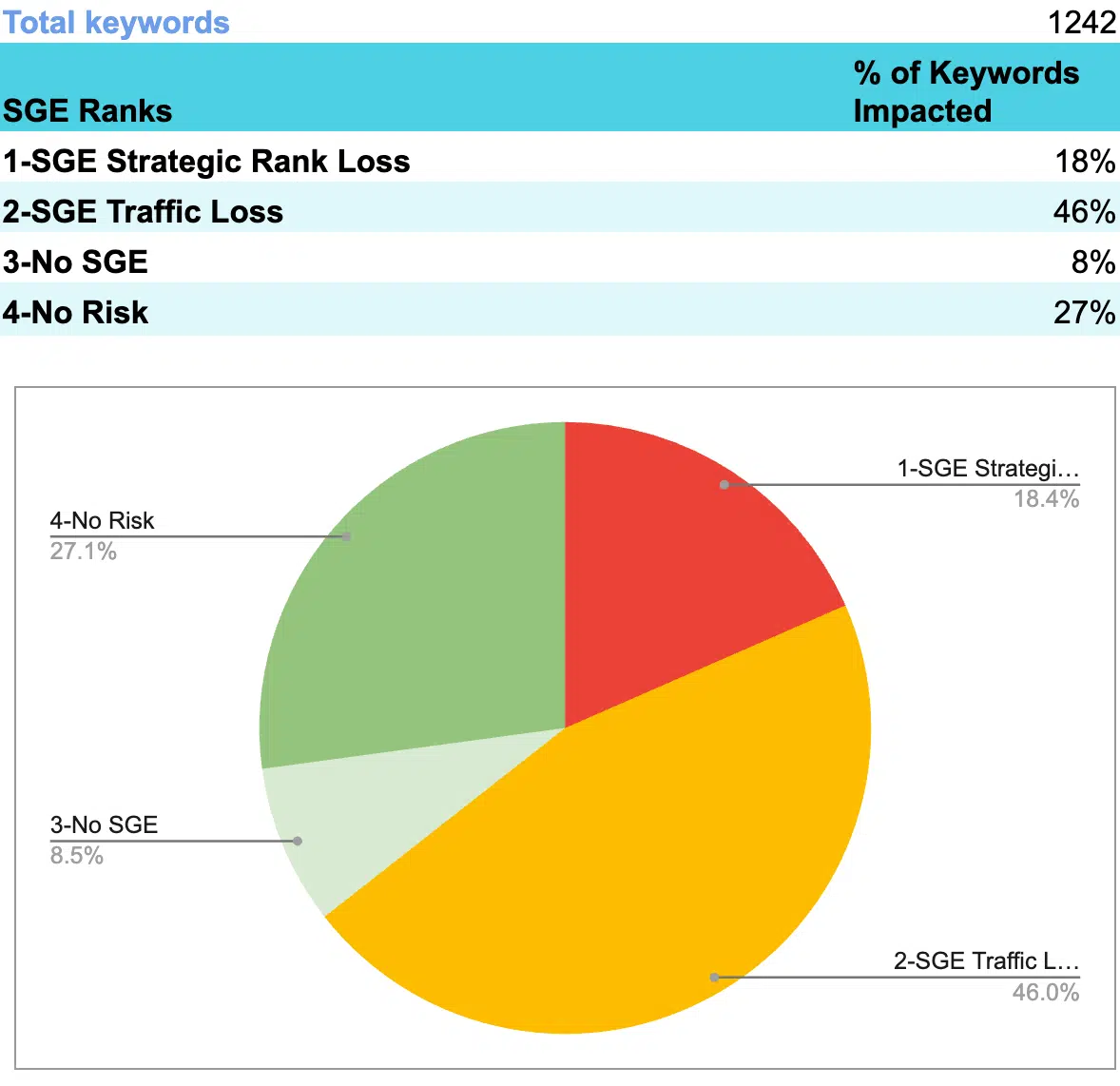
There are 1,242 high-impact keywords we identified across all 23 websites.
The dramatic finding is that 64% of strategic or high-traffic keywords are losing rank in SGE – they do not appear in the SGE snapshot carousel.
On the bright side, 27% keywords have no risk – this means that the expected traffic in SGE is the same or higher as it is today or that strategic keywords are still ranking roughly as they are today.
Another important finding is that 8% of keywords have no SGE. We have seen a similar number of 8-10% across multiple studies, indicating that Google does actually activate the SGE experience for the vast majority of keywords.
Aggregate traffic in SGE
Below, we see what is expected to happen to the overall traffic of all 23 websites.
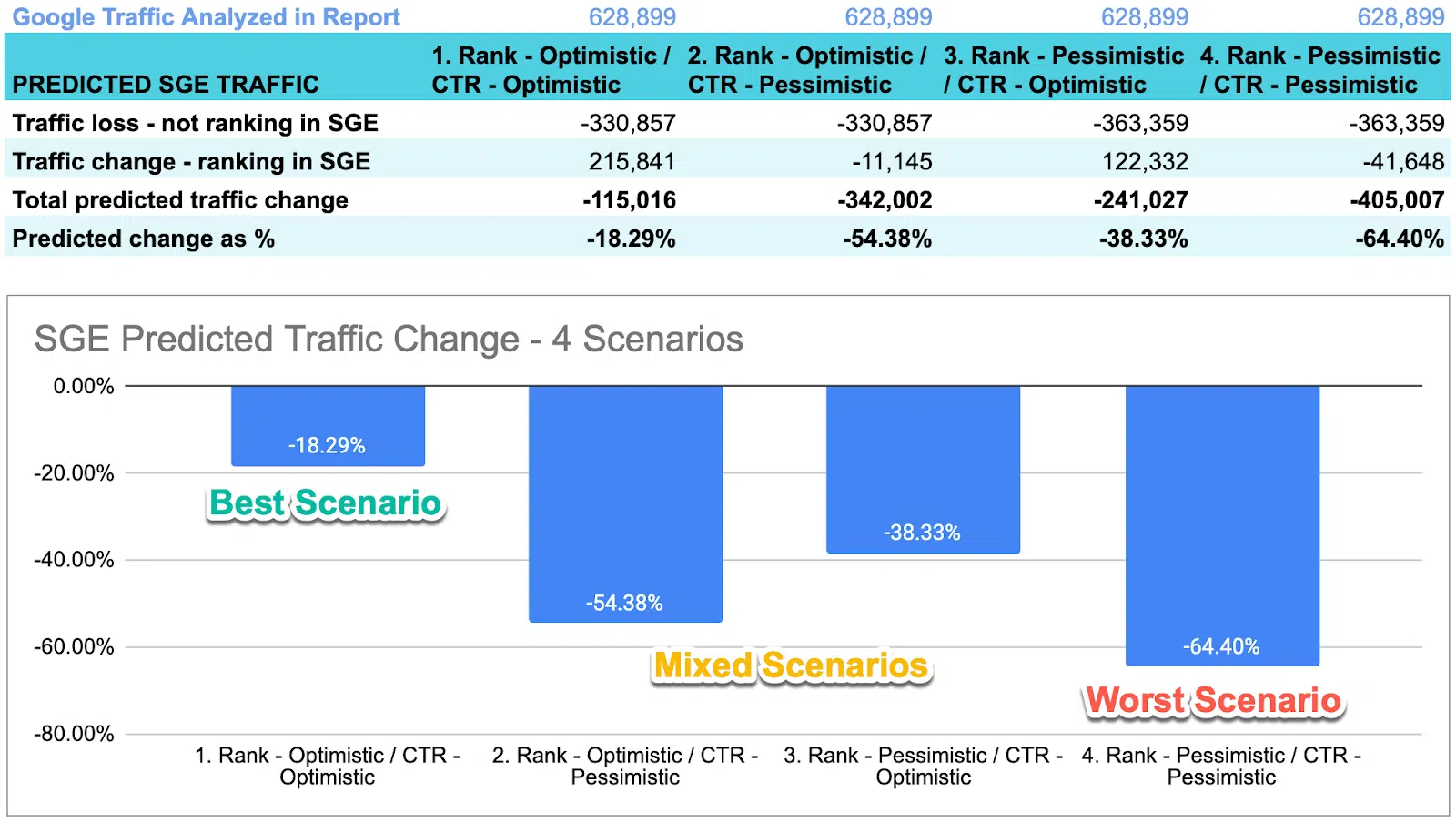
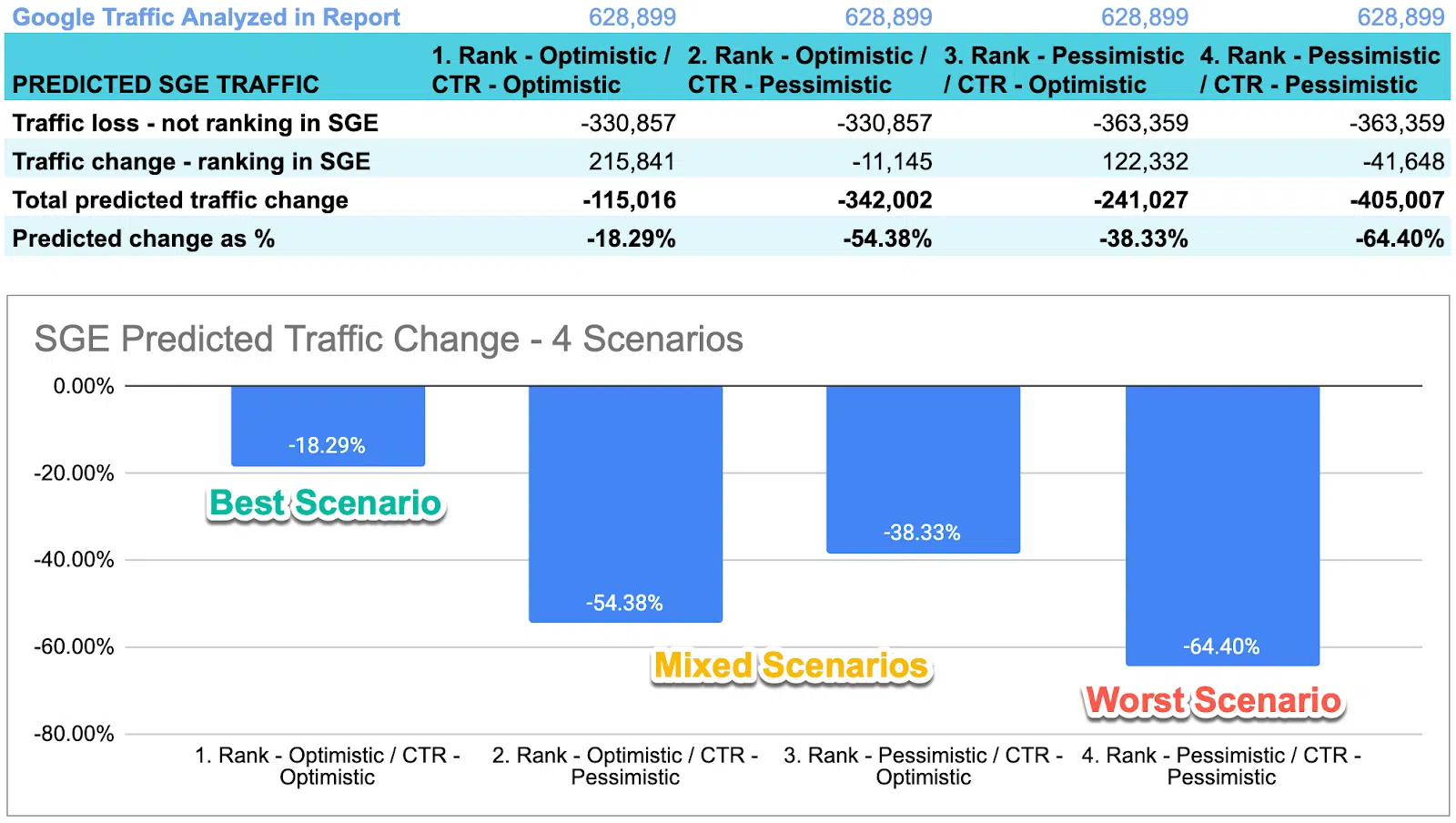
We are analyzing 628,000 monthly organic visits (driven by the 1,242 high-impact keywords seen above).
The columns of the table and the four bar charts show our four scenarios:
In the best scenario the websites drop by 18% in relevant organic sessions. Here we estimate a relatively high CTR (roughly the same as in Google today) and we’re taking the best rank seen for each keyword.
In the worst scenario, the websites drop by 64%, wiping out 405,000 monthly organic traffic sessions – ouch. Here we estimate that CTR in Google SGE will be half of what we have in Google today, and we assume that if a keyword isn’t ranking in even one observation, it doesn’t rank at all.
In the mixed scenarios (with optimistic rank / pessimistic CTR or vice versa), there are still significant drops of 38-54%.
What is most significant is that even in the most optimistic scenario, SGE results in significant traffic drops.
If we take the pessimistic assumption on just one of our parameters (rank or CTR), those traffic drops increase by 2X-3X.
Traffic per website in SGE
The aggregate data hides important differences between the websites.
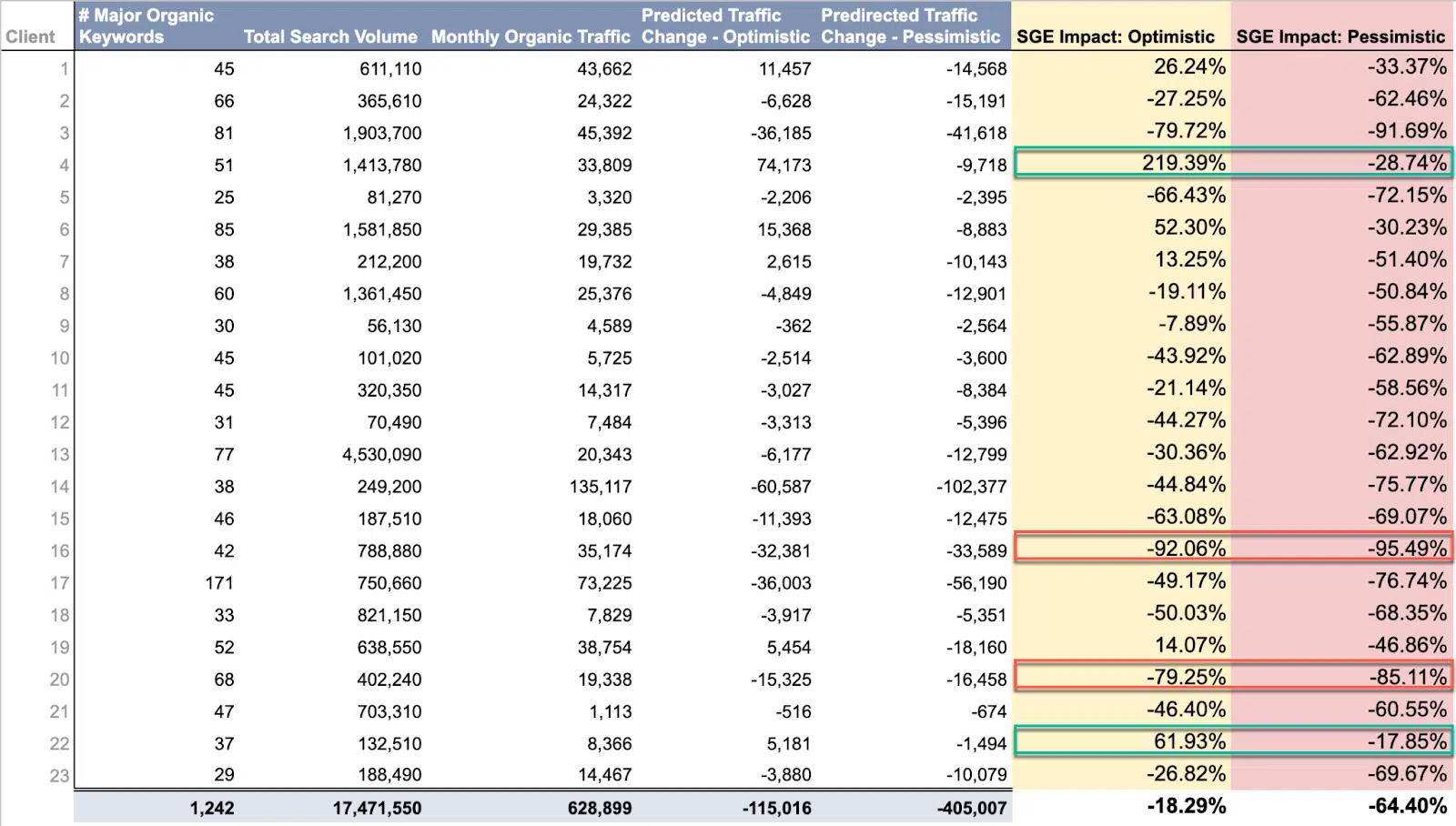
Below is a table showing the data of all 23 websites, the number of high-impact keywords, current organic traffic, and expected traffic change in Google SGE.
In our sample of 23 websites, some actually experience traffic growth in SGE.
This is because they have important keywords that are ranking better in SGE, and driving more traffic, compared to the current situation.
We highlighted two such examples in green: most notably, website #4 is growing traffic by a massive 219% in the best scenario.
These cases give us hope, because they show that with certain assumptions, it is possible to actually grow traffic in Google SGE.We also experienced this in two of our SGE recovery case studies (see below).
On the downside, some websites are very hard hit – see the two examples highlighted in red. For example, website #16 is dropping by over 90% across all scenarios.
Across all websites in our sample, there is undoubtedly a major cause for concern. This brings us to the next stage of the discussion: what can we do about SGE traffic drops?
An experimental framework for SGE optimization
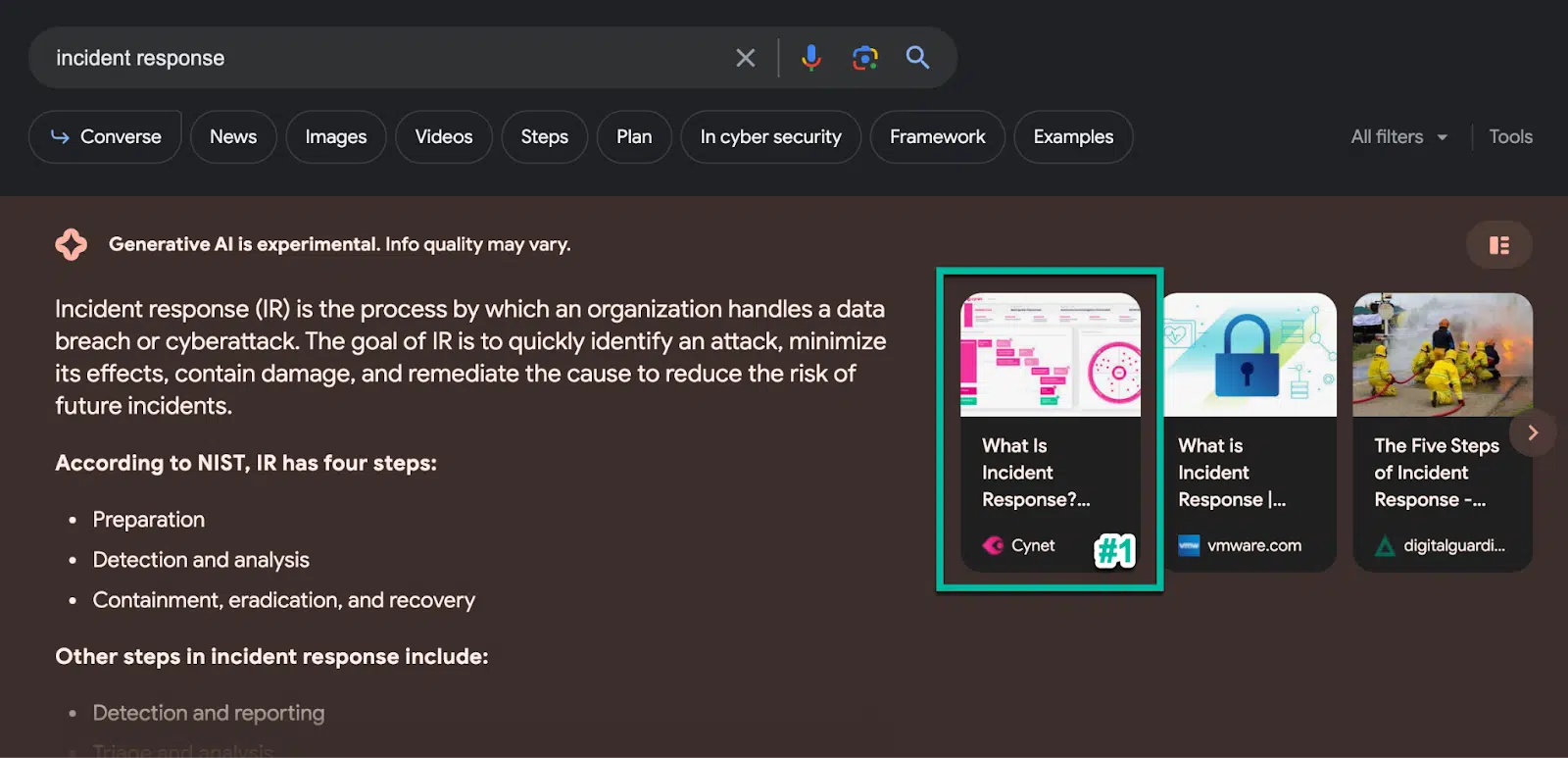
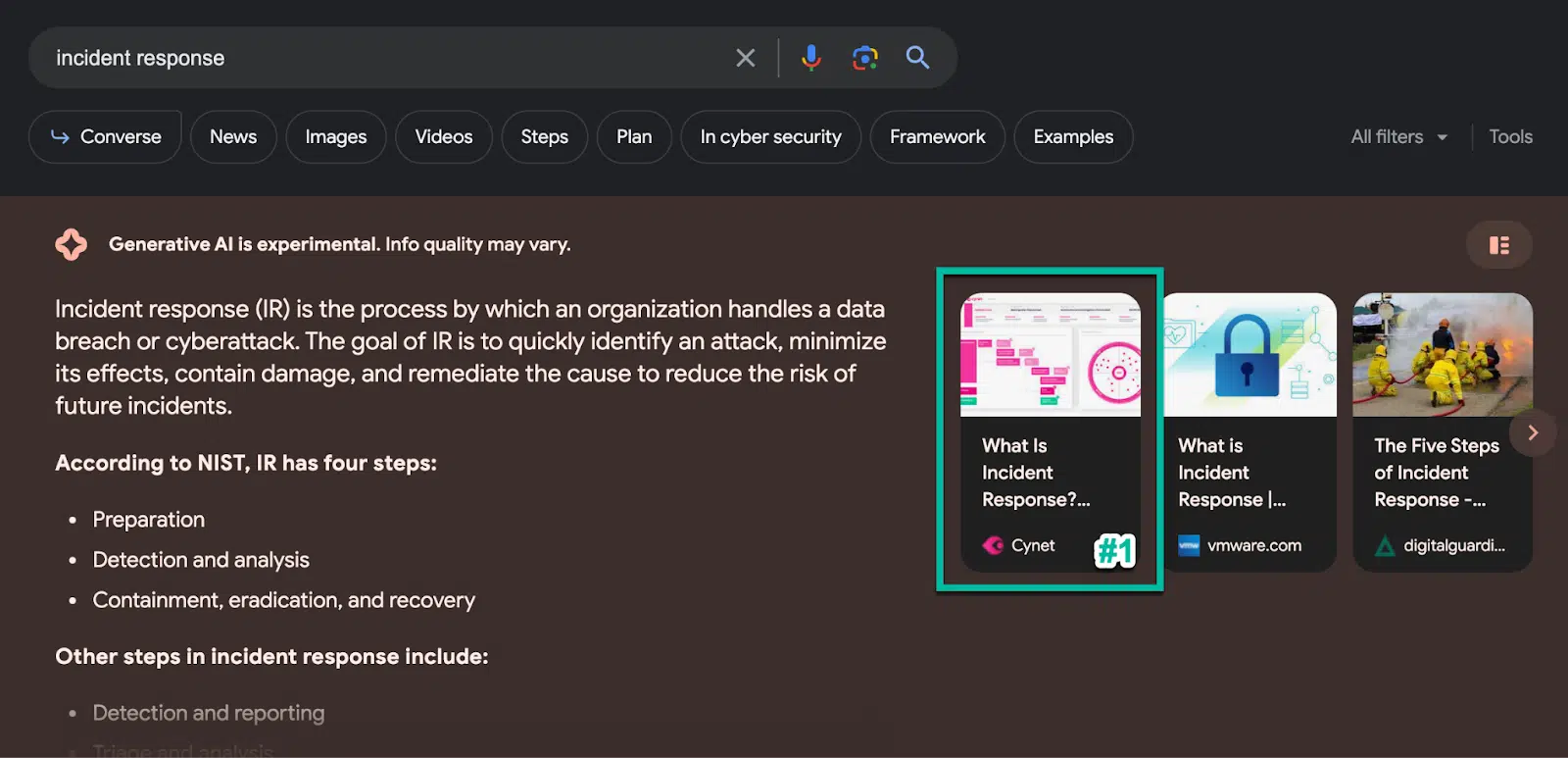
Let’s start from the end. Here is the first keyword we managed to optimize to get our client into position 1 on the SGE snapshot carousel.
This page originally ranked between position 1-3 on Google for the keyword [incident response], but in SGE, it wasn’t ranking.
We applied an intervention, and now the page has been ranking consistently in the top positions in SGE for over two months.
This is what we need to achieve – identifying pages that are not ranking in SGE, and getting them to rank as high as possible in the snapshot carousel (or more accurately, as far as possible to the left).
4 rules for a useful SGE experiment
The following conditions will help you carry out useful experiments to discover how to achieve the result shown above:
Focus on one page at a time: The intervention should be limited to a specific page / keyword, keeping site-wide factors constant.
Focus on factors within your control: For example, if you don’t control the content or design of the page, those factors cannot be part of your experiment.
Carry out the intervention in the space of one week: This is important because SGE ranks change fast. If you make a change and measure the result in the space of one week, there is a lower chance the result is due to a random rank change.
Use a control group: Find a group of comparable pages / keywords and observe their ranks, in parallel to carrying out your intervention. If their ranks remain stable (on average) and your experimental page improves in rank, you have a winner.
You might say that this framework is too limiting, because it does not consider site-wide factors, or anything that cannot be manipulated in the space of one week.
This is true, but think of it this way – if you can find a method that satisfies these rules and works, you have something you can easily use to recover from SGE traffic drops.
Our SGE experiment results
Following the rules above, we conducted an experiment to try to optimize pages to appear in the SGE snapshot carousel.
We tried to optimize 14 keywords across three websites – these are currently in the top 10 positions of Google but do not appear in the SGE carousel.
We used two intervention methods (A and B), involving both on-page and off-page factors (7 keywords for each intervention).
In parallel, we tested a control group of similar keywords on the same websites, for which there was no intervention.
Before the experiment, we checked the rank of all 14 keywords for each intervention in two Google accounts:
Account 1 → no keywords ranked in citations
Account 2 → only 2 ranked
After intervention A, we checked the ranks of the 7 keywords in three Google accounts:
Account 1 → no keywords ranked in citations
Account 2 → 2 ranked
Account 3 → no keywords ranked in citations
After intervention B, we checked the ranks of the 7 keywords in three Google accounts:
Account 1 → 6 ranked in top 3, 1 no SGE
Account 2 → 6 ranked in top 3, 1 no SGE
Account 3 → 6 ranked in top 3, 1 not ranked
Control group:
To check if pages naturally improved and entered SGE unrelated to our experiment, we checked a control group of 89 keywords, which were previously not ranking in the SGEsnapshot carousel:
21% of these keywords entered the snapshot carousel during the week of the experiment.
79% were still not ranked in snapshot carousel.
This shows that the odds of a keyword entering the snapshot carousel ‘by chance’ is 21%. However, in our experiment we managed to get 93% of tested positions (15 of 16 ranks when SGE was active) into the snapshot carousel. This proves the intervention resulted in rank change.
As a result, we concluded that intervention B was successful in achieving SGE rank, for top 10 rank keywords, which are not currently ranked in SGE.
Note
We are not sharing our technique here, because it was developed for our specific use case of informational keywords in the technology/SaaS market. It’s well-documented that the Google algorithm works differently in different niches and for different types of keywords.
So there will probably be different techniques for every niche. We shared our general experimental framework, which anyone can use to find a technique for their specific use case.
Process for an SGE recovery project
Once you find a repeatable technique that can achieve SGE ranks for your high-impact keywords, you can design a full SGE recovery project for a website using this process:
Strategic and currently ranking in the top 10 and not ranking in Google SGE. We call this “strategic rank loss.”
Driving high traffic and expected to have less traffic in Google SGE, according to the worst scenario. We call this “maximum traffic impact.”
Step 3: Prioritize the keywords as follows:
First, take the strategic keywords your business absolutely cannot afford to lose rank for.
Second, take the keywords with highest traffic impact (you can weed out keywords that have lower search intent for your business).
Step 4: Optimize existing pages using your experimental technique.
Step 5: Other options for achieving SGE rank:
Identify an “ideal page” that could rank better, given the ranking factors you identified, and create that page. In many cases, the new page will rank in SGE.
Identify another page that has the required parameters but is not well-focused on the keyword. Rewrite it to focus on the keyword you need to rank in SGE.
Step 6: Rerun SGE impact analysis and see if you have managed to:
Reduce the number of keywords losing rank.
Mitigate the traffic drop, at least across some of the four scenarios.
Since we discovered this process, we have successfully carried it out for several clients. Below are the results we achieved.
3 SGE recovery case studies
From the moment we discovered how much of a threat SGE represents, we were laser-focused on one goal – mitigating the risk of SGE and saving our clients from the expected traffic drops. We have completed three successful SGE recovery projects, and are excited to share the results.
Note: We are not sharing the names or domains of our clients to protect their privacy. However, we are able to share this information, in confidence, with members of the press or prospective clients. If you are interested, please reach out to us.
Case 1: Cloud native developer tool, 175,000 monthly organic sessions
Background
Corporate website with product pages, blog and learning center.
755 indexed pages.
Organic traffic grew from 21,000 in September 2021 to 174,000 on average in 2023 Q3.
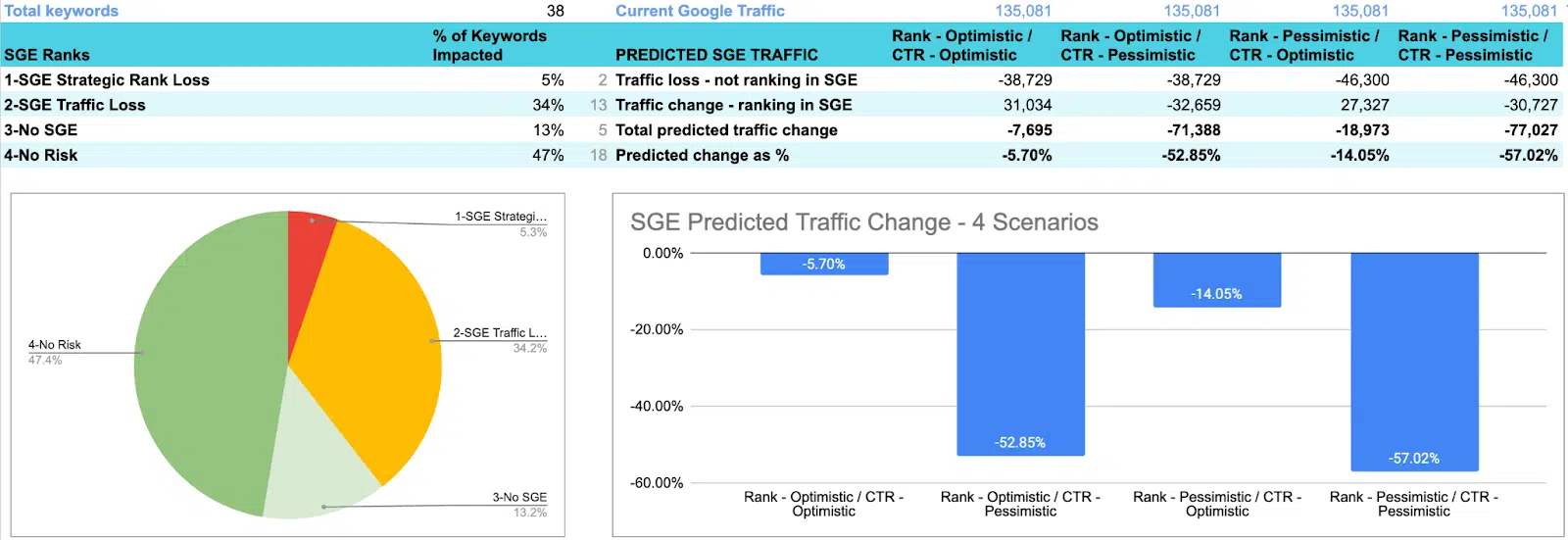
SGE recovery project focused on 135,000 visits driven by 38 keywords.
SGE impact analysis
Before the project, the website was expected to:
Lose rank for 7 strategic keywords.
Lose between 60,000 (44%) and 102,000 (75%) of organic traffic, depending on SGE scenario.
What we did
Optimized 9 existing pages for SGE snapshot carousel, using our experimental technique.
8 out of 9 entered the SGE snapshot carousel (88% success rate).
Wrote 8 new “ideal pages” we felt could rank better in SGE, and applied relevant off-page factors.
3 out of 8 entered the SGE snapshot carousel (37% success rate).
After the project, the website is expected to:
Lose rank on only 2 strategic keywords – saved 4 keywords.
Drop only 5% in the best scenario (compared to 44% before the project).
Drop 57% in the worst scenario (compared to 75% before the project).
Evaluation
We have mitigated the risk for this client in the best scenario. A significant risk remains in two other scenarios. It is possible to continue and optimize more keywords to completely mitigate the risk across all scenarios.
Case 2: Enterprise cloud platform, 35,000 monthly organic sessions
Background
Corporate website with product pages, blog and learning center.
1,250 indexed pages.
Organic traffic grew from 10,000 in January 2021 to 45,000 in 2023 Q2. Traffic dropped to 35,000 in 2023 Q3 due to site relaunch.
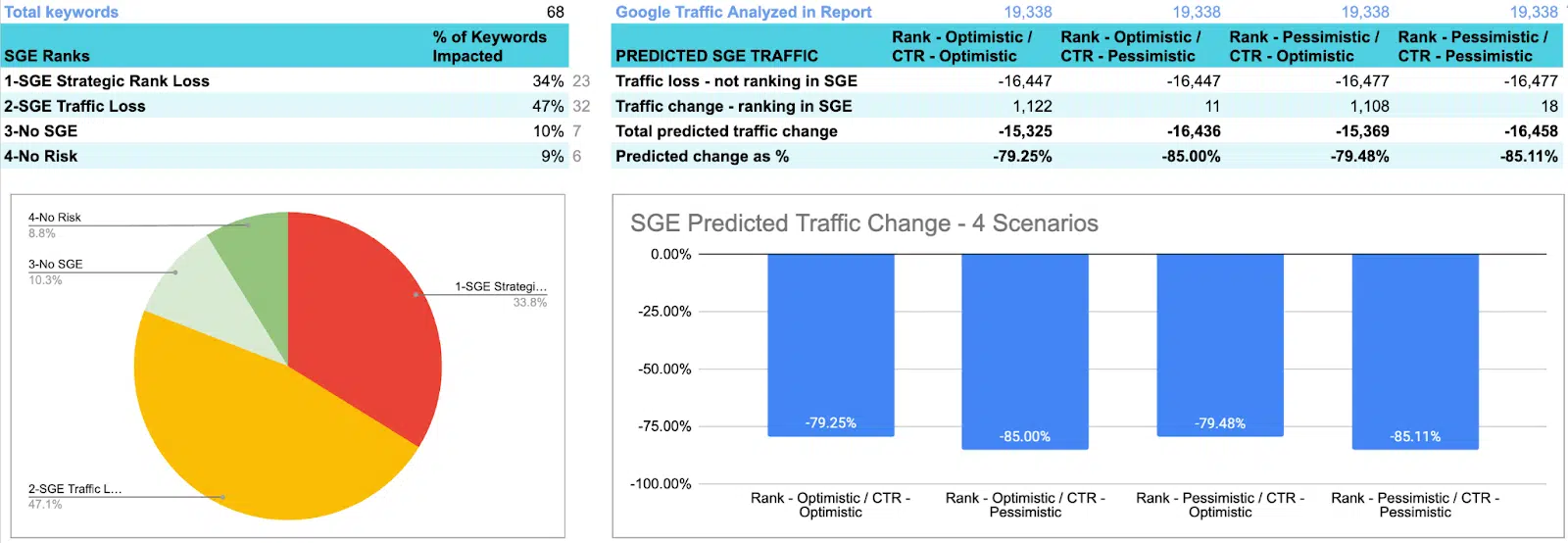
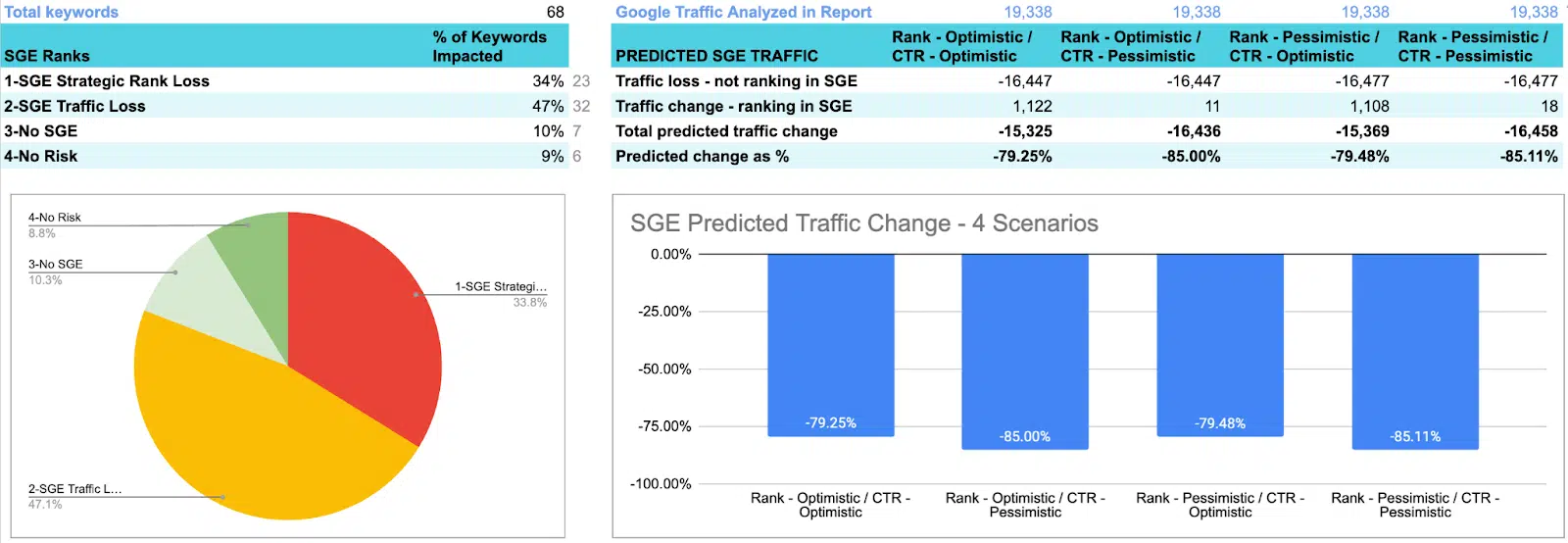
SGE project focused on 19,000 visits driven by 68 keywords.
SGE impact analysis
Before the project, the website was expected to:
Lose rank for 23 strategic keywords.
Lose between 15,000 (79%) and 16,000 (85%) of organic traffic, a massive traffic drop.
What we did
Optimized 11 pages for SGE snapshot carousel, using our experimental technique.
8 out of 11 entered the SGE snapshot carousel (72% success rate).
Wrote or rewrote 4 pages to create “ideal page” for ranking in SGE, and applied relevant off-page factors.
3 out of 4 entered the SGE snapshot carousel (75% success rate).
After the project, the website is expected to:
Lose rank on only 6 strategic keywords – we saved 17 strategic keywords (there were several strategic keywords ranking with the same page).
Actually grow 97% in the best scenario – or between 2-28% in mixed scenarios.
Drop only 31% in the worst scenario (compared to 85% before the project).
Evaluation
We managed to completely turn SGE impact around from a massive traffic drop to a potential increase of almost 100% in organic traffic (in the best scenario).
In addition, we saved 17 strategic keywords that were losing visibility in SGE.
Case 3: Cybersecurity solution, 15,000 organic sessions per month
Background
Corporate website with product pages, blog and learning center.
888 indexed pages.
Organic traffic grew from 3,000 in January 2022 to an average of 15,000 in 2023 Q3.
SGE project focused on 5,000 visits driven by 34 keywords (the rest of the traffic is less important to the business due to change in strategic focus).
SGE impact analysis
Before the project, the website was expected to:
Lose between 1,100 (22%) and 2,100 (42%) of its valuable organic traffic.
What we did
Optimized 3 pages for SGE snapshot carousel, using our experimental technique.
2 out of 3 entered the SGE snapshot carousel (66% success rate).
Wrote or rewrote one pages to create “ideal page” for ranking in SGE, and applied relevant off-page factors.
The page entered the SGE snapshot carousel (100% success rate).
After the project, the website is expected to:
Actually grow 84% in the best scenario – or move between growth of 11% to a minor drop of 9% in mixed scenarios.
Drop only 34% in the worst scenario (compared to 42% before the project).
Evaluation
This is an example of a relatively small SGE traffic drop which was largely mitigated by optimizing only four pages.
This shows the importance of focusing on the right keywords and opportunities in SGE recovery.
Conclusion and next steps
Despite many important insights shared about Google SGE, we have not seen concrete advice explaining how SGE will affect websites and what they can do to recover.
Hopefully, this article contributes to the understanding of Google SGE in three main respects:
Impact: Understanding what is likely to be the impact of Google SGE on specific websites, in concrete terms – what keywords will lose rank and how much organic traffic is at risk – using our open SGE impact report.
Action: Understanding what we can do to mitigate specific rank and traffic drops identified by the impact model via our experimental framework, which we have used to execute successful SGE recovery projects.
Hope: Our experience proves that even if SGE poses a risk to the organic traffic you have built in your SEO projects, it is possible to adapt your practices to this new search experience and recover. It is not – as some have claimed – the end of SEO. Rather, it is the beginning of a new and exciting era.
SGE Recovery Webinar
On Thursday, Sept. 28 at 1 p.m. ET, I will hold a free webinar – Overcoming the Google SGE Challenge: Assessment and Recovery Strategies – in which we’ll go into more depth about the SGE Impact Model, our experimental framework, and our SGE recovery case studies, and take questions from the audience. Save your spot.
We hope this article will spur a community effort to gather more data and find solutions for SGE in a variety of niches.
Here’s to the next 20 years of SEO!
Opinions expressed in this article are those of the guest author and not necessarily Search Engine Land. Staff authors are listed here.
@media screen and (min-width: 800px) { #div-gpt-ad-3191538-7 { display: flex !important; justify-content: center !important; align-items: center !important; min-width:770px; min-height:260px; }
}
@media screen and (min-width: 1279px) { #div-gpt-ad-3191538-7 { display: flex !important; justify-content: center !important; align-items: center !important; min-width:800px!important; min-height:440px!important; }
}
About the author
Gilad David Maayan is CEO and Founder of Agile SEO, working with leading tech brands like IBM, Intel, NetApp, and Imperva on enterprise SEO and content projects. We also support organizations with Google SGE assessment and recovery.
Is Google’s new AI chatbot the Bard of the digital age? by First Page
In the ever-evolving realm of artificial intelligence (AI), launching new technologies is no longer an anomaly but a relentless pursuit of innovation. Amid this technological maelstrom stands Google’s latest creation, Google Bard, a name reminiscent of the ancient bards renowned for their poetry and storytelling.
As a multifaceted tool developed and launched by Google AI earlier this year, Bard is not confined to rigid algorithms; it promises fluidity and creativity. From simply having a chat to generating content and translating languages to developing complex strategies, Google Bard is sculpting a new narrative in AI.
Functions of Google Bard
Google Bard is designed to perform a plethora of tasks:
Brainstorming ideas: Be it the next groundbreaking business innovation or a tantalizing plot twist, Bard’s creative assistance is unparalleled.
Developing plans: Stuck with a complex project? Bard’s logical prowess can delineate a comprehensive roadmap.
Finding solutions: From navigating the digital maze of code to mapping out the best route for your journey, Bard’s resourcefulness knows no bounds.
Creating content: Whether it’s penning poetic lines or summarising multifaceted topics, Bard’s literary skills are extraordinary.
Google Bard‘s technology
Bard’s architecture
Google Bard rests on a state-of-the-art language model, having been built upon Google’s Language Model for Dialogue Applications (LaMDA). This technology had been unveiled two years earlier. This isn’t about simple keyword detection. It comprehends the nuances of context, syntax, and semantics, enabling human-like interaction. The underlying technology analyzes vast amounts of textual data, allowing Bard to engage in natural, personal and captivating conversations.
Generative AI
The essence of Google Bard’s ingenuity lies in its use of generative AI. Unlike traditional algorithms that follow predetermined paths, Bard’s generative model allows for a level of creativity and adaptability that is strikingly human-like.
Understanding context: Bard doesn’t just analyze words; it comprehends the context in which they are used. This enables it to craft sentences that are not only grammatically correct but resonate with the underlying theme or emotion of the conversation.
Dynamic creativity: Beyond mere mimicry, Bard’s generative AI can brainstorm and innovate. Whether it’s suggesting a unique marketing concept or coming up with a poetic metaphor, Bard offers a degree of creativity previously unattainable in AI-driven tools.
Interactive collaboration: Bard’s generative AI also promotes a collaborative approach. It can work with you as a partner, offering suggestions, accepting feedback, and refining its responses. It’s a dynamic and interactive process, not a one-way communication.
Google Bard vs. ChatGPT
As artificial intelligence progresses, language models have become sophisticated tools, adapting to various applications and functions. Google’s Bard and OpenAI’s ChatGPT are two notable contenders in this realm. Here, we dive into the distinct differences:
Origins
Google Bard: Developed by Google, leveraging its vast expertise in search algorithms and data handling.
ChatGPT: From OpenAI, stemming from the GPT series, reflecting OpenAI’s mission for widespread AI benefits.
Data and size
Google Bard: Uses Google’s extensive data repositories, ensuring broad knowledge coverage.
ChatGPT: Trained on vast amounts of internet text, ensuring a comprehensive grasp of language.
Functionality
Google Bard: Suitable for diverse applications, possibly integrated with Google services.
ChatGPT: Known for its conversational prowess, it is used from chatbots to writing aids.
Customizability
Google Bard: Likely benefits from integration within Google’s ecosystem.
ChatGPT: Offers extensibility via platforms like the OpenAI API.
Ethics and bias
Google Bard: Pursues fairness and bias reduction in line with Google’s AI principles.
ChatGPT: OpenAI actively addresses bias challenges and seeks continuous feedback.
How to use Google Bard
Using Google Bard is as simple as logging into bard.google.com. This ease of accessibility sets the stage for what is far from an ordinary interaction. Unlike traditional chatbots that often feel mechanical and detached, Bard encourages continuous dialogue, follow-up inquiries, feedback and guidance. It’s akin to conversing with a thoughtful human assistant.
When to use Google Bard
Research
Scholars can utilize Google Bard to quickly scan vast academic databases, obtaining relevant literature for their studies. Researchers, especially in interdisciplinary fields, might find Bard invaluable in translating jargon-filled texts into simpler terms, bridging knowledge gaps. Additionally, when formulating a hypothesis or discerning research trends, Bard’s analytical abilities can provide crucial insights, speeding up the research process.
Business processes
In the realm of customer service, representatives could use Bard to instantly pull up customer histories and provide timely, accurate responses. Marketers, on the other hand, might exploit Bard’s data analytics to pinpoint consumer trends and optimize campaigns. Product developers could engage Bard to collate feedback across various platforms, ensuring user needs are centrally addressed in design iterations.
Risks of using Google Bard and similar models
Potential biases
The algorithms that power these AIs are trained on vast datasets collected from the internet. If these datasets have biases, the AI could inadvertently perpetuate those biases. For instance, if Google Bard was trained predominantly on data from one demographic, its responses might unwittingly reflect that group’s perspective, potentially marginalizing other perspectives.
Uncertainties in accuracy
No AI is infallible. There could be times when Bard provides information that is inaccurate or outdated. For example, if a student relies on Bard for historical data, there might be a risk of the AI offering a skewed or outdated interpretation of events.
Alternatives to Google Bard and ChatGPT
Microsoft’s Turing-NLG: Aimed at businesses and developers, Microsoft’s Turing-NLG is designed to generate language for various applications, such as answering user queries, creating dynamic conversational agents and more. Its robust framework and extensive support make it suitable for a range of professional needs.
IBM Watson:IBM’s Watson offers a suite of AI-powered products, including chatbot solutions tailored for customer service. Its deep learning and robust analytics capabilities make it a preferred choice for businesses looking to enhance customer engagement through intelligent interactions.
Amazon Lex: Targeted mainly at developers, Amazon Lex provides the building blocks for creating conversational interfaces. With its integrations into the AWS ecosystem, it’s a favored tool for businesses invested in Amazon’s cloud infrastructure and looking to build sophisticated chatbots.
Facebook’s BlenderBot: Known for its engaging and diverse conversations, Facebook’s BlenderBot is a research project that showcases the potential of large-scale, open-domain chatbots. While not directly aimed at business applications, it represents an exciting direction in AI conversational models.
The future of Google Bard
Expanding language horizons
Google Bard is only at the beginning of its journey, and one of its most exciting prospects lies in supporting various languages. While initially focusing on English, the developers are working to understand and interact in multiple languages, including Spanish, Chinese, French and more. This multilingual approach will broaden Bard’s reach and appeal, making it a global tool for communication.
Incorporation of visual elements
Another tantalizing possibility is the incorporation of images into Bard’s answers. Currently focused on text-based responses, future updates may include the ability to embed pictures, charts and diagrams. Visual aids could enhance understanding and engagement, especially for complex topics or when visual illustration can convey an idea more effectively than text alone.
Integration into existing systems
Beyond standalone use, Google Bard’s future may include integration into existing platforms and systems. Whether it’s business software, educational tools, or personal assistants, the possibilities for embedding Bard’s intelligence are vast. This integration could transform various industries by making AI-powered communication a standard feature.
The pricing aspect
As of now, Google Bard remains free, democratizing access to this groundbreaking tool. It’s a step towards ensuring that as many people as possible can explore and benefit from AI-powered communication. However, the future pricing strategies are worth keeping an eye on. Subscription models, premium features or tiered access could shape how this tool evolves and integrates into diverse platforms and users’ lives.
What we can become with Google Bard
In this uncharted territory, it’s not about keeping up with the trends but setting new benchmarks and exploring untapped potential. Leading the charge in this AI revolution is First Page Digital, in Singapore. This leadership is not about merely staying ahead in the game but recognizing the endless possibilities and daring to explore them.
This is just the beginning. As technology advances and Bard continues to evolve, so will the opportunities and challenges we face. The digital landscape is in constant flux, and tools like Google Bard underline the importance of adaptability, ingenuity and a willingness to venture beyond the known.
In the end, the question isn’t just “What is Google Bard?” but “What can we become with Google Bard?”
At First Page, we stop at nothing to get the best for your business. Since 2011, we have consistently created targeted digital marketing strategies that maximise your website’s potential – resulting in increased online exposure. With a 360° view of your business goals, we implement an integrated digital strategy that’s validated by data. We collaborate and integrate seamlessly with your team to ensure all parties are aligned. Think of us as an extension of your marketing team.
4 top affiliate search partners to consider: A breakdown
Q4 is looming, and many brands are strategizing how to optimize their budgets to get more traffic to their products when buyer intent soars.
One humble suggestion from this longtime affiliate marketer: TM+ partners (also known as Trademark+ partners or affiliate search partners), who work with brands to bid on brand keywords to drive traffic to coupon or offer sites.
Despite what you may have heard, TM+ models are a no-risk model – the affiliate site pays for the click and gets paid by the brand when the ads lead to conversions.
To keep the guidelines clearly delineated, brands should give their affiliate partners a list of keywords approved by the search teams, with any other keywords off-limits to the TM+ partner to ensure both parties aren’t bidding against each other.
I work with a ton of affiliate search partners, but if you’re just getting your feet wet in this initiative, you should start with a short list of targets who can help you get traction.
This article covers four major partners – why I recommend them, their unique strengths, and when they might not make sense for your brand.
Brands that give PromoCodesForYou (PCFY) bidding rights to a keyword set have more of a chance to get picked up for organic inclusion in the portfolio of sites in Dotdash Meredith, PCFY’s parent company.
The portfolio is broad and includes publications like:
People
Travel + Leisure
Allrecipes
Food & Wine
EatingWell
InStyle
Shape
Better Homes & Gardens
Brands looking for added exposure to complement direct-response coupon campaigns have a potential gold mine with a PCFY partnership.
The flip side is that PCFY won’t work with just any brand (specifically, small, lesser-known ones aren’t going to be a fit here).
Their sweet spot is well-known brands, and their vetting process includes search volume (pulled from Google Ads) with aggressive volume minimums.
That said, if search volume is low but the brand offers a relatively high average order value, PCFY may be willing to run a test to see if the partnership has some sparks.
2. Offers.com
A relatively close second, Offers.com is a Ziff Davis company with the potential of added organic exposure on its portfolio of sites, which include:
Mashable
AskMen
PCMag
Everyday Health
BlackFriday.com
BestBlackFriday.com
TheBlackFriday.com
(The latter three are obviously great and relevant platforms for the holidays, getting over 60 million global sessions during the holiday season).
Offers.com isn’t as particular as PCFY about partnerships, so it could be an ideal starting point for small brands looking to build on their momentum.
Get the daily newsletter search marketers rely on.
3. Slickdeals
This is the deal site that’s most frequently leveraged for clients who have a need for inventory liquidation.
With 69 million unique monthly visitors and a big consumer footprint during the holidays, Slickdeals is great for pushing heavily discounted products.
Working with the site as a TM+ partner means you’ll likely get comped on individual deal submissions, which you usually have to pay for.
Slickdeals is an ideal partner for brands with seasonal catalogs, which usually means there are inventory remnants to clear out for the next season’s line.
It’s not solely for low-priced or mid-priced products. I’ve seen a discounted watch that retailed for $6,000 sell out in a matter of minutes, and some of our high-end clients have seasonal products that have found a great audience on Slickdeals.
But if you’re a brand that’s careful about buying in reasonable quantities and have a limited and/or stable collection of products, you can skip this one and research other partners.
4. CouponCause
CouponCause is different. Its main selling point is a give-back component that encourages consumers to donate their savings to any of a group of partner nonprofits.
It’s a great partner for calendar events like Giving Tuesday, and it’s a natural fit for socially conscious brands who have built a name around doing good.
CouponCause is much more flexible with brand partners, so SMBs and startup brands looking to get awareness or increase sales velocity often start here.
Getting started
If you don’t have relationships with any of these partners, you can go through an affiliate agency (using a recommended vetting process) or dig up a list of contacts at the partner and do the outreach yourself.
Remember that these are partnerships, so you’ll need to create a compelling case for why the platform will benefit from bidding on your brand and product terms.
It bears repeating that when you do get traction, it’s a good idea to make sure your search team is in the loop since they may have reservations or caveats for the partner to address (as well as keywords they want to protect).
Managed well, TM+ partnerships are an added source of low-risk revenue and exposure that can help you maximize purchase intent in the coming months.
Even if you’re not sure you can act in time to catch the Q4 wave, start doing the legwork now – good deals are always in season.
Opinions expressed in this article are those of the guest author and not necessarily Search Engine Land. Staff authors are listed here.
@media screen and (min-width: 800px) { #div-gpt-ad-3191538-7 { display: flex !important; justify-content: center !important; align-items: center !important; min-width:770px; min-height:260px; }
}
@media screen and (min-width: 1279px) { #div-gpt-ad-3191538-7 { display: flex !important; justify-content: center !important; align-items: center !important; min-width:800px!important; min-height:440px!important; }
}
About the author
Kristina Nolan is VP of Media Services at DMi Partners, where she has worked to grow eCommerce, CPG, and a range of B2C brands for over seven years. Kristina’s affiliate chops are bolstered by a background in PR and performance media and a strong track record of partnership growth with top affiliate networks and publishers. Her acumen and insights, as well as her track record of driving profitable growth for her client portfolio and strategic leadership in helping her clients adapt to new consumer behavior during the COVID pandemic, has helped her earn regular speaking opportunities at conferences including eTail, ShareASale’s ThinkTank, and more.
Increasing SERP visibility with structured data and schema testing
A steady decline in organic click-through rate has posed a real challenge for SEOs over the last few years.
With organic ranking becoming increasingly competitive, the best way SEOs can continue to excel is to shift their focus to SERP features and rich results, according to Tanner Zoromski, SEO manager at Merkle, a customer experience management company.
“Essentially we want to make search engines’ lives easier by using these techniques because as a result, they will reward us with our content ranking higher in the SERP and we’ll have more interaction from searchers.”
Below is a summary of how structured data and schema testing can increase SERP visibility, as presented by Zoromski at SMX Advanced.
Search is changing
Search is always evolving. As new features are deployed, structured data can provide sites with the edge needed to effectively and efficiently communicate with search engines, Zoromski explained:
“I want to highlight here that Google is continuing to test and implement search changes, relying more on information scraped from sites. And we are seeing more results resembling product listing pages – which lends clues to the direction Google is looking to take its product.”
“This means we need to question how to stay at the forefront of this. How do we communicate most effectively with search engines? And how do we make sure that despite these different changes, we’re still present and showing up first?”
Understanding the breadth of schema
The SEO expert went on to explain the importance of knowing what schemes are available and how to correctly deploy them for maximum impact:
“There are more than 32 different types of schema that can be implemented to interact with over 16 different SERP features.”
“Whether we’re publishing articles or blogs or we’re reviewing movies, it’s important to understand what schema we can leverage to help search engines to index our sites.”
Winning with product schema
SEOs can implement product schema, images and descriptions across all pages to win feature snippets – otherwise known as position zero, as Zoromski explained:
“Implement this type of schema to prevent traffic from going to competitors.”
“Make sure your brand is putting its best foot forward and answering the questions that consumers want to know about their products.”
“Additionally, make sure that the narrative stays on-site and on-topic for what your brand needs, so you are winning at position zero. Schema is the way to do that on this one.”
Results to shout about
Zoromski shared a case study that he had personally worked on, in which his team was able to double organic sessions for a recipe website by correcting microdata and replacing it with structured data:
“My team were presented with a challenge – to review and address some improperly nested microdata that was causing error recipe videos and article markup on a blog.”
“When we looked at the SERP for this keyword, the top organic listings all had structured data – there wasn’t an organic listing in the top search results, which hammers home the need to implement structured data and be visible.”
“Our approach was to recommend the client remove the microdata and replace it with the JSON LD markup instead. As a result, we provided JSON-LD templates for the structured data types Article, Video, Recipe as well as Recipe with Nested Video.”
“As a result, the recipe and article structured data returned 101% increase in organic sessions.”
“This is a pretty clear demonstration that having schema on those pages really elevated their visibility and their engagement with searchers.”
Get the daily newsletter search marketers rely on.
Tracking performance
From a testing standpoint, Zoromski advised building and monitoring your own SEO testing to track performance and taking multiple factors into consideration, such as:
Establishing the metrics and dimensions being impacted.
Building customized reports to monitor KPI performance.
Defining testing timelines to ensure results within a specific period.
Controling for internal and external variables such as dev releases and site promotions.
Allowing room for assumptions that could impact results.
Relaying findings across teams.
AI and the future of schema
Following recent advancements in AI, Zoromski added that schema will most certainly play a role in this area moving forward – and it’s a situation SEOs need to monitor closely. He concluded:
“With all the buzz around ChatGPT, Bing and Bard, we are seeing ramifications and effects across digital – and SEO is absolutely going to be affected.”
“Search behavior is going to change as AI provides more natural language answers as opposed to a list of links.”
“As SEOs, we need to make sure that in the future, our sites are equipped and able to effectively interact with these different changes. So keep on the lookout and make sure that you’re at the forefront of this.”
@media screen and (min-width: 800px) { #div-gpt-ad-3191538-7 { display: flex !important; justify-content: center !important; align-items: center !important; min-width:770px; min-height:260px; }
}
@media screen and (min-width: 1279px) { #div-gpt-ad-3191538-7 { display: flex !important; justify-content: center !important; align-items: center !important; min-width:800px!important; min-height:440px!important; }
}
About the author
Nicola Agius is Paid Media Editor of Search Engine Land after joining in 2023. She covers paid search, paid social, retail media and more. Prior to this, she was SEO Director at Jungle Creations (2020-2023), overseeing the company’s editorial strategy for multiple websites. She has over 15 years of experience in journalism and has previously worked at OK! Magazine (2010-2014), Mail Online (2014-2015), Mirror (2015-2017), Digital Spy (2017-2018) and The Sun (2018-2020). She also previously teamed up with SEO agency Blue Array to co-author Amazon bestselling book ‘Mastering In-House SEO’.
The trifecta of keyword research strategy: Volume, difficulty, intent
Search marketing is an ever-changing industry, but even amid the generative AI movement, one thing remains constant: keywords.
Identifying the most valuable keywords for your business can make or break your visibility and online presence and put distance between you and your competition. But only when it’s appropriately harnessed.
Learning to do strategic keyword research for SEO allows you to navigate the clutter and noise of search marketing, leading you to the treasure trove of targeted traffic, higher rankings, and increased conversions.
Keyword research goes beyond simply finding popular words or phrases, though. It involves understanding the trifecta of volume, difficulty, and intent.
Volume tells you how often people search for specific keywords.
Difficulty gauges the competition you’ll face.
Intent reveals the underlying purpose of user searches.
Clarifying how to use these three data points will help you create a crystal-clear keyword strategy for your business.
Understanding keyword volume
Keyword volume represents the number of times a keyword is searched for within a given time frame, providing valuable insights into user behavior and search trends and indicating the potential traffic and visibility that a given keyword can bring to your website.
High-volume keywords can be a goldmine, attracting significant organic traffic and potential customers.
On the other hand, low-volume keywords may have less competition (we’ll get to that next), allowing you to carve out a niche and target a specific audience.
Finding high-volume keywords relevant to your business is the ultimate goal of keyword research.
You want to uncover those hidden gems with a high search volume that align with your products, services, or industry.
To find these, start by brainstorming relevant terms and phrases that your target audience might use when searching for solutions or information related to your business.
Put yourself in your target customer’s shoes and think about the language they would use.
Then, leverage keyword research tools to explore the search volume for these keywords and identify the ones with substantial search traffic.
For example, if you’re a roofing company offering various types and styles of roofs, but you want to bring more traffic and awareness to your metal roofing option, you would want to explore a few variations of key phrases your customers might search to find the more commonly used terms.
Here are a few to consider:
Here you can see the average number of times per month each keyword is searched in the Volume column to assess what keyword you might like to go after with your metal roofing service page.
But remember, it’s not just about chasing the highest volume keywords mindlessly. You also need to consider the relevance and competition associated with those keywords.
Finding a balance between high volume and achievable competition is the key to success.
Evaluating keyword difficulty
Keyword difficulty measures how challenging it is to rank for a specific keyword. We turn to our trusty tools to assess keyword difficulty and calculate the factors influencing it.
We’re talking about things like the number of websites already ranking for the keyword, the quality and authority of those websites, SERP features, etc.
A good keyword research strategy is a balance of finding that sweet spot between high-volume and low-difficulty keywords.
You want to target keywords with decent search volume but aren’t overrun by fierce competitors. It’s about choosing your battles wisely and focusing on those keywords where you have a fighting chance.
Choose a keyword difficulty that isn’t more than 10-15% points higher than your current domain authority (a metric you can measure in those all-in-one search marketing platforms mentioned above). This will give you a fighting chance of ranking with the right content.
Following the metal roofing company example, if your domain authority score is sitting at 30, you’ll want to target keywords with a difficulty score between 20-40.
Your site should rank pretty quickly for the keywords with a difficulty under 30. Anything above that will provide a bit more of a challenge for those top 3 spots in the search results, but getting ranked higher for those terms will also help to grow your domain authority over time.
Looking at those same keywords, I would say “types of metal roofs” and “metal roofing contractors” are achievable to rank for with our current domain authority.
SEO is a long game. It’s about finding that delicate balance and adapting your strategy.
Start with a viable strategy now, and as your domain authority builds, you can go after more competitive terms in time.
Matching user intent
User intent refers to the underlying purpose or motivation behind a search query. This is where the scientific field of SEO turns into an art form, open to interpretation.
Identifying the keyword intent is all about deciphering the hidden meaning behind someone’s words.
Users who type their queries into search engines have a specific goal in mind. It could be:
Researching information.
Navigating to a particular website.
Finding a solution.
Completing a transaction.
And more.
User intent is most commonly broken down into four different types. Let’s break it down:
Informational intent
This is when users seek knowledge, answers, or solutions to their questions.
They might search for “how-to” guides, tutorials, or informative articles. Meet their search with a blog or long-form informational landing page on your website.
Navigational Intent
Users with navigational intent already have a specific website or brand in mind. They want to navigate directly to that website.
They might search for the brand name or particular URLs. Meet their search with your company information like an About or Location page.
Commercial Intent
These users are in the investigational research phase and are likely to consider a purchase. They’re looking for product comparisons, reviews, or pricing information.
For example, “best software for bookkeeping” or “top trail running shoes.”
Meet their search with a long-form service page, a UX-optimized homepage, or a great “top products” blog post, depending on your business.
Transactional Intent
Users with transactional intent are ready to take action. They want to make a purchase, sign up for a service, or complete a transaction.
They might search for keywords like “buy,” “order,” or “sign up.” Meet their search with a product or service page with an appropriate CTA.
You’ll want to analyze search engine results to align your keyword targeting with user intent. See what types of content are ranking for specific keywords.
Look at the top-ranking pages and ask yourself, “Does my content align with what users expect to find?”
It’s about stepping into the shoes of your target audience and providing them with the answers and solutions they seek.
Coming back to the metal roofing example, if it’s between “types of metal roofs” or “metal roofing contractor,” we would choose “metal roofing contractor” based on the commercial user intent.
The intent on “types of metal roofs” does show possible commercial intent.
Still, after looking at the other content ranking for this keyword, we would quickly determine that this is a keyword for a blog or other content piece.
By understanding user intent and creating content that addresses it, you improve the user experience and increase your chances of conversions and customer satisfaction.
With some background in making good keyword strategy decisions, here are some best practices to get going with your research.
Conduct comprehensive keyword research
Don’t limit yourself to a handful of keywords. Cast a wide net from the start to explore various keywords to ensure you get all hidden gems instead of only the obvious terms.
Use keyword research tools, brainstorming sessions with coworkers and customers, and competitor analysis to gather a diverse pool of potential keywords.
Prioritize keywords based on the trifecta
Not all keywords are created equal. You need to prioritize based on the trifecta factors.
Identify keywords with a decent search volume that align with your business goals and have a realistic difficulty level.
Also, consider different variations of words (e.g., past or present tense) as you explore the meaningful keywords for your business and audience.
Create content that addresses user intent
Develop content that satisfies the needs and intentions of your target audience. Whether it’s informative blog posts, engaging videos, or interactive guides, tailor your content to align with user intent.
Not sure what language your customers use or what questions they ask?
Talk to your sales and customer service teams to see if they have a list of common objections or frequently asked questions. That is a great place to create a keyword-focused and in-demand content plan.
After identifying your most valuable keywords, the last thing you want to do is target them with the wrong piece of content.
Don’t take that high-volume informational keyword and optimize your product page to get more purchases. Those users are merely looking for more knowledge and are not ready to buy.
Meeting the user intent with the right pieces of content satisfies the customer and rewards your website authority with positive ranking signals.
SEO is constantly evolving. Keep an eye on your keyword performance and be ready to make adjustments as needed.
In-market language can change over time as trends ebb and flow. Analyze the data, track rankings, and listen to what your audience is saying.
Keep your landing pages and content fresh with your top target keywords, but feel free to tweak those keywords as your audience broadens.
Remember to stay agile and adapt your keyword strategy as needed.
Keep experimenting, testing, and refining your approach to stay ahead of the latest search trends and ahead of your competitors.
Where to get your keyword data
You can choose a range of free and paid tools to gather the data points we discussed above. Below are a few options:
Google Keyword Planner
This free tool allows you to explore keyword ideas, analyze search volumes, and even get insights into the competitiveness of specific keywords.
Ubersuggest
This “freemium” tool allows you a few searches per month for data before needing a paid account. It’s a great introductory all-in-one tool if you’re starting out.
Search marketing platforms
A few all-in-one paid tools like Semrush, Ahrefs, and Moz provide all the data you need and some nifty tools for digging deeper when you conquer your keyword strategy, giving you a comprehensive understanding of the search landscape.
Consider volume, difficulty and intent for a solid keyword strategy
Keyword research is not a one-time endeavor. It’s a continuous journey of growth and optimization.
Keyword research isn’t going out of style anytime soon. Even generative AI needs to use language and commonly used search terms.
So if you’re starting to scratch the surface or are ready to dig deeper into keyword research and SEO, you’re on the right path. Just keep going.
Let your curiosity be your compass, your creativity be your fuel, and your commitment be your guiding light.
Soon, your expertly selected target keywords will help you connect with your audience, elevate your online presence, and drive more conversions for your business.
Opinions expressed in this article are those of the guest author and not necessarily Search Engine Land. Staff authors are listed here.
@media screen and (min-width: 800px) { #div-gpt-ad-3191538-7 { display: flex !important; justify-content: center !important; align-items: center !important; min-width:770px; min-height:260px; }
}
@media screen and (min-width: 1279px) { #div-gpt-ad-3191538-7 { display: flex !important; justify-content: center !important; align-items: center !important; min-width:800px!important; min-height:440px!important; }
}
About the author
Lauren is the SEO Strategist for a digital marketing agency in Vancouver, Ollo Metrics, where she helps clients with their on-page, local, and technical SEO. When she’s not geeking out over search marketing, you’ll find her soaking up quality time with family and friends in the beautiful coastal mountains of BC.