12 strategies to scale your SEO team without losing your culture

In 2015, I joined what was a very small SEO team. Since then, we have more than tripled our size. 

As we grew, we faced the challenge of scaling our team and continuing to deliver strong work, all while maintaining the culture that enabled our growth in the first place. 

This article underscores the significance of creating a strong culture and shares our tactical steps as we grew our team. 

Our goal for this journey wasn’t just team expansion but to nurture a culture of excellence and innovation. 

Every new member needed to amplify our collective strength rather than dilute it. 

Here, I’ll take you behind the scenes of our growth story to:

  • Share the importance of cultivating a robust team culture.
  • Highlight the steps we took to scale successfully while preserving the essence of who we are.

Challenges with scaling

Ultimately, the challenges of scaling an SEO team boil down to changes in the quality of your “three Ps”: people, process and product. 

  • People: Rapid growth can lead to a hiring frenzy, and new hires meant to ease the load end up adding to it. Managers find themselves juggling more responsibilities, including training those newcomers.
  • Process: Without well-defined standards of practice (SOPs) and training programs, service delivery can become a game of chance, negatively impacting consistency as the team expands.
  • Product: Growth often means less flexibility in your product offering. Clear swim lanes for your team need to be established and product offerings standardized, rather than offering too many solutions where you customize every task.

To overcome these challenges, you must:

  • Intentionally maintain your team’s culture.
  • Foster communication across locations.
  • Develop a consistent SEO approach.
  • Create a positive work environment that attracts and retains top talent. 

With the right approach, you can successfully scale while maintaining your team culture and delivering great client results.

Why culture matters in an SEO team

SEOs are effectively consultants, often working with other marketers. In any consulting business, the biggest asset is the people. 

Engaged employees are happier and lead to a 202% revenue increase compared to organizations with a less engaged workforce per one study.

A strong culture in the SEO space is essential for a consulting team as it fosters collaboration, attracts and retains top talent, and helps build a strong brand – all of which help your team stand out in the market. Up to 35% of workers would pass on a job if they felt the culture was not a good fit. 

12 ways to maintain your culture as you scale

1. Define your SEO team’s core values

The best corporate cultures are usually rooted in a shared set of beliefs, values, working methods and (perhaps most importantly) purpose. 

To define your core values, start by defining a mission statement. Is there anything people consistently say about you that makes you great?

Discussing shared values and goals with your team in a brainstorming session can be a good place to start, but you may want a smaller group to define the final set of core values. 

Stephanie Gioia offers a useful framework to determine which values may be truly useful versus which do not serve the overall strategy. 

Dig deeper: How to build a values-based agency that drives results

2. Create a strong leadership team and structure 

Leaders typically define the culture of a team. This is why it’s especially important to think about the cultural contributions that are most important when identifying team leaders, as well as how to structure your team beneath those leaders. 

Limit direct reports to maximize time spent with managers

Nothing says that it’s time to look for a new job like a manager who isn’t providing proper leadership.

Building a culture means retaining the key players through supporting their needs. To do so, you need to ensure that your team has what they need, and one of the most important things needed is proper guidance, especially at the junior levels.

We also recognized early on that for managers to be effective, they need time to provide deep learning, tactical support, and strategic guidance. 

We made the business case to hire ahead of the present need state and bring in additional managers to stabilize the management structure. We divided the team into two distinct teams, each with an associate director.

We found that three to four direct reports per manager were the maximum we could allocate without losing our culture and bandwidth to manage and lead.

Frequent manager check-ins

Regular check-ins with team members so that they feel valued and heard is critical to creating an empowered team and retaining personnel. 

For our team, this means that each manager meets with their direct reports at least once weekly to dive into the work. 

Some managers meet with their direct reports twice or thrice weekly to review deliverables or prepare for client presentations. 

Creating a feedback loop

It isn’t enough to just encourage feedback. High-performance teams tend to create a feedback loop wherein feedback is not just heard but clearly actioned upon, thus encouraging more feedback. 

The faster and more publicly you act on feedback, the more feedback people will provide. The more feedback that people provide, the better the team gets.

We frequently ask the team for feedback on onboarding, client kickoffs, projects we executed, and team events. We also encourage our team to provide feedback to their managers on how they can better work together.

3. Delegate ownership of team culture

Another critical aspect of scale is delegating key tasks and objectives across the team, including culture. 

While it often comes from the top, sometimes team members are stronger connectors and culture builders – and that is OK! 

Acquiescing control is tough for most leaders, but the sooner you elect an “owner of team culture,” the sooner you’ll see that garden grow and flourish.

From a tactical perspective, we picked an employee who came to our team with a strong desire to lead culture and had fantastic ideas about implementing it well. 

This person also has a great attitude, is highly thoughtful and pleasant, and even wins awards for their cheerful demeanor. 

Let team members own areas of the business if they are better suited.

4. Hire for culture contribution vs. culture ‘fit’

One of the biggest paradigm shifts I had as a manager and leader was realizing that I didn’t need or want a “culture fit.” Instead, I needed to recruit based on what cultural contributions candidates could make. 

SHRM.org has collected great resources on the idea of “culture ad,” which I recommend reading to learn more about the topic.  

There’s also the danger of hiring people whose own core values are not aligned with your team. Rand Fishkin discusses hiring for competence versus culture fit and makes the astute point that it is unlikely that you will be able to change someone’s views totally. 

Fishkin recommends building questions in your interview process that can help you identify alignment or gaps. 

Identify potential new hires by how well they match your existing culture and what they can add to it.

To put this process into action, map out what you feel your team needs from both a competency and a cultural perspective. Ensure you consider that in your recruiting and career path development approach. 

5. Acknowledge greatness as much as you can

In hearing the stories of CEOs and founders, a common thread that I have noted among the best is that their organizations had a strong culture of acknowledging greatness.

Good deeds, both big and small, that are boldly acknowledged can have a powerful effect on an organization. 

Jim Perdue of Perdue Farms shared in NPR’s, “Wisdom From The Top with Guy Raz” that highlighting his employees’ good work with a “good egg” award was a key part of a critical change that they needed for Perdue to become a $7 billion business. 

You can highlight your team’s work in digital communication channels such as Slack, Teams, or email, or even in person with a paper cut-out award like Jim Perdue. 

Whichever method you take, call out your team’s great work frequently, publicly, and individually during one-on-ones. 


Get the daily newsletter search marketers rely on.


6. Have SOPs that are carefully documented

One thing distinguishing an SEO practice is the SOPs that the team follows and their ability to cater deliverables to client businesses and situations. 

Having an SOP library has helped our team maintain our culture of detail-oriented work and the quality of that work.

Our team has around 40 different SOP deliverables. These deliverables range from on-site, technical/structural, and off-site. 

We generally have a template to follow for each category, an SOP document, and even videos.

This documentation helps our team feel like they know what to do while encouraging them to iterate and improve the SOP.

Having a living, breathing SOP that grows and develops as the industry changes is critical. Accordingly, ensure the team knows that “breaking the mold” is welcomed and encouraged.

Tools like tango.us or fireflies.ai can help you quickly document processes and meetings. A company intranet where all the SOPs live is also a great resource. 

You can also simply use Google Drive or a project management tool like Asana to house all SOP documentation.

Dig deeper: 4 tips to build a data-centric culture in your agency

7. Create frequent learning and development opportunities 

High-performance race cars require fine-tuning – so does your team. Having a culture built with learning and development cultivates top talent while adding value to employees. 

Learning and development create a space people want to be in and an empowered, engaged community.

Here are the regular learning and development practices we have:

  • Every Monday, a team member leads a 30- to 60-minute presentation covering something in the world of SEO or content.
  • A Microsoft Teams channel dedicated to tools, tips, and things happening in the industry.
  • One of our team members creates a weekly round-up that is shared with the team, covering the top digital marketing news.
  • We sponsor conference attendance for employees, paying for airfare, hotels, and tickets to send our team to conferences like Mozcon, Pubcon, Search Love, C3, and State of Search, to name a few. We then compare notes from the conferences everyone attends to share learnings across the team. 

8. Consider a democratic approach

Our most critical decisions are decided based on a vote from the full team or among the managers. 

Running a democratic team requires patience and diplomacy but, in the long term, creates a true sense of community. 

Sometimes, leaders may need to make decisions that not everyone is on board with. 

That said, the more leaders can gain alignment and treat the team as the sum of its parts, the more stock people put into things, and the better everything works.

Making decisions democratically is like rocket fuel for a team dynamic. 

9. Offer up well-planned communication channels

In a remote work environment, we have to navigate having open lines of communication – while still allowing people to focus on their work. 

We analyzed how best to simulate our in-office synergy and landed on using channels in Teams. 

We have channels dedicated to tools and tech, getting help from others, off-topic non-work things, and client-specific channels in Teams that help our team stay connected.  

10. Celebrate together, often

Our focus on celebrating together as a remote team is about celebrating client successes, personal development milestones, years with the company, personal achievements and more. 

One of my favorite things we do is celebrate workiversaries (work anniversaries). 

Whenever a team member hits their company anniversary, we collect quotes from the other team members and send them along as words of praise, encouragement and general cheer. 

With so much of our lives spent at work, we want to make it clear that we appreciate the time people spend with us.

11. Share in what makes people unique

Our Team Hub document is a place for us to collect information about our team members’ interests, hobbies, and favorite foods so that we can celebrate their individuality. 

We use this information during holidays, celebrations, and generally, to create a supportive, festive environment that celebrates our individuality.

We also do something we call “Question of the Day,” where we ask a fun question each week and everyone provides their answer. 

This could be something like “If you were a Disney character, which one would you be?” or, “if you had a YouTube channel, what would it be about?” 

It is a fun way for us to connect and discuss our favorite things in a fairly structured way, enabling everyone to have the mic for a moment. 

12. A strong recruiting approach leads to a strong team

How you approach recruiting can greatly impact the talent pool and how your team culture develops. 

Some of the most important tools that helped maintain our culture were a part of our hiring process.

  • The job description: Having a clear job description that describes the actual day-to-day work pools candidates excited to do that work; this is an obvious grand slam.
  • The interview process: Our interview process has multiple steps, including meeting the associate directors, HR, team members of other titles, and, lastly, our VP or CDO in some cases. This process enables a broader set of team members to reach a consensus-based decision on the hire.
  • Questionnaire: We give all potential new hires the same questionnaire with technical SEO and other SEO questions. We ask some of these questions in person later in the process – giving interviewees time to think. We want to create a level playing field for candidates who may be better at problem-solving through writing vs. firing off answers in an interview. We also welcome research, as research is critical to what we do and who we are as SEOs.
  • Work samples: We ask everyone for work samples to see the attention to detail, quality, care, and insights they offer. 

Running all candidates through the same process helps us to accomplish several things. 

First, make the right hires, adding value to our culture. 

Next, the process helps us provide what we feel is a fair and equitable approach to evaluating talent and fostering an inclusive environment, which is the type of culture we want to build.

Ready to scale your team?

Shift your hiring mindset from culture “fits” to culture “contributors,” delegating the ownership of culture curation, acknowledging greatness and adopting methods to retain and enhance team culture. 

Additionally, we recommend fostering a learning environment, limiting the number of direct reports to managers, and creating a democratic decision-making process. 

Hopefully, some of our learnings will prove helpful to you in your journey. This road was not easy, but with the principles discussed here, we adapted, innovated and grew the way we wanted. 


Opinions expressed in this article are those of the guest author and not necessarily Search Engine Land. Staff authors are listed here.


Related stories

New on Search Engine Land

@media screen and (min-width: 800px) { #div-gpt-ad-3191538-7 { display: flex !important; justify-content: center !important; align-items: center !important; min-width:770px; min-height:260px; } } @media screen and (min-width: 1279px) { #div-gpt-ad-3191538-7 { display: flex !important; justify-content: center !important; align-items: center !important; min-width:800px!important; min-height:440px!important; } }

About the author

John Morabito

John Morabito is the VP of SEO at Stella Rising where he leads strategy and business development. With early experience in fine art photography, music, and graphic design, John brings a multidisciplinary, creative approach to building high-performance SEO programs and teams. John began his SEO career in 2010 on the brand side before shifting to Stella Rising, where he quickly started leading strategy for stellar brands in the consumer middle market. Currently, the Stella Rising SEO team serves medium-sized and enterprise clients, driving transformational growth in the beauty, CPG, retail, and real estate markets. John’s primary focus is to help ecommerce and lead generation-focused businesses reach their potential from search, while growing an engaged and talented team. Over the last five years, John and the Stella Rising SEO team have received over 30 award wins and nominations, including a win from the Search Engine Land Awards for Best SEO Agency.

https://searchengineland.com/strategies-scale-seo-team-maintain-culture-431224


Using ChatGPT to drive technical SEO

Integrating generative AI into search presents a compelling value proposition.

If SEOs figure out how to adopt this technology effectively, it could revolutionize the industry and fundamentally change how people interact with search.

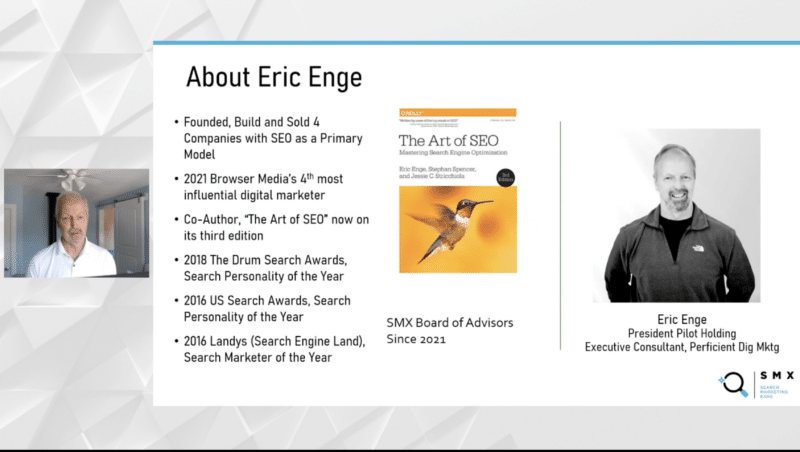
While there are still some concerns around the accuracy of AI-generated content, as well as omissions leading to some information being taken out of context, SEO expert Eric Enge explained that the technology is still a fantastic tool for creative inspiration and saving time.

Below is a summary how generative AI can be used to drive your technical SEO strategy, as presented by Enge at SMX Advanced.

1. Coding

One of the impressive aspects of ChatGPT is its proficiency in coding, according to Enge. He explained:

  • “Chat GPT gives you a very good starting place for your code. Sometimes, it can be a little buggy and needs to be debugged, but it’s a really good place to start – and that’s how I advise you to use it.”
  • “If you use it to generate schema markup, remember, it is just a starting place. So make sure you have someone who knows how to read schema markup to validate that it’s right. Using generative AI just speeds up the process.”

Enge shared an example of a scenario where he used generative AI to create Hreflang tags for different webpages:

  • “I had four different languages. It gave a bunch of tags and they all look pretty good. This is an example of how [generative AI] can help speed things up for you.”

3. Translation

Generative AI produces accurate results when used for translation purposes. Enge said:

  • “I used it to translate keywords from English to French and it produced a really strong set of results.”
  • “This sort of thing could really help from the point of view of operations or speeding up the operations of your business because these are fairly common applications.”

4. Implementing .htaccess rules

Enge added that generative AI can also be used to help speed up the process of implementing .htaccess rules:

  • “If you have somebody who’s saying that they’re GoogleBot, but they’re not from one of Google’s IP addresses, that’s generally speaking not a good thing. I don’t know explicitly what harm could come from it, but there isn’t any good that will come from it. So you can it to block those.”
  • “You can just routinely do a run through to find the the people who are doing that to you and then just block them. This is a pretty good thing to be able to do.”
Screenshot 2023 08 25 At 16.29.23 800x452

Enge recommended using generative AI to get creative inspiration for title tags – but stressed that SEOs should also take into account other factors before publishing anything:

  • “It came up with a bunch of great titles as prospects to use. It’s great for brainstorming ideas but I would recommend applying search volume analysis too because we don’t really have that data from ChatGPT yet.”
  • “But what this technology does let us do is just get some ideas of what we want from the title from the user perspective – and that’s an important perspective to bring.”

When generative AI is used to create meta descriptions, additional prompts can fine-tune the result until you’re happy with it. Enge added:

  • “I just kept throwing these little wrinkles at it and it gave decent suggestions for six different meta descriptions.”
  • “The best way to create a meta description is to create something that compels a user to want to click through – because we know it has no influence on ranking. So we want to make it enticing to the user so that they have an understanding of what they’ll get if they click on your result. Generative AI can be used to create examples that might be closer to what we might want to use.”

7. Summarizing content

Enge said generative AI is accurate when summarizing content as it carries out this task solely using content you have entered, leaving no room for confusion, date omissions or false information:

  • “It’s a great tool for summarizing content because there are no issues with hallucinations.”

Get the daily newsletter search marketers rely on.


8. Keyword grouping

Enge also shared examples of him using ChatGPT prompts to classify and cluster keywords into groups. He added:

  • “It actually did quite well – although it wasn’t perfect – with classifying keyword list and groups based on their search intent for the commercial transaction.”
  • “However, for clustering the keywords into groups based on relevance, ChatGPT did a really good job. In fact, I would say it was 100% accurate with the answers it gave me.”

9. Content assistance

Generative AI is also a useful tool for generating content ideas. You can ask ChatGPT to create a list of popular questions related to a topic to get a list of potential article ideas:

  • “You can use this technique when you’re just beginning to build out a new topic area on your site. You still need to have a subject matter expert go through the details and definitely don’t assume the list it gives you is comprehensive.”
  • “However, it can speed up your brainstorming process and I think this is a pretty interesting aspect of this tool.”

Watch: Using ChatGPT to drive technical SEO

Below is the complete video of Enge’s SMX Advanced presentation.

[embedded content][embedded content]

Related stories

New on Search Engine Land

@media screen and (min-width: 800px) { #div-gpt-ad-3191538-7 { display: flex !important; justify-content: center !important; align-items: center !important; min-width:770px; min-height:260px; } } @media screen and (min-width: 1279px) { #div-gpt-ad-3191538-7 { display: flex !important; justify-content: center !important; align-items: center !important; min-width:800px!important; min-height:440px!important; } }

About the author

Nicola Agius

Nicola Agius is Paid Media Editor of Search Engine Land after joining in 2023. She covers paid search, paid social, retail media and more. Prior to this, she was SEO Director at Jungle Creations (2020-2023), overseeing the company’s editorial strategy for multiple websites. She has over 15 years of experience in journalism and has previously worked at OK! Magazine (2010-2014), Mail Online (2014-2015), Mirror (2015-2017), Digital Spy (2017-2018) and The Sun (2018-2020). She also previously teamed up with SEO agency Blue Array to co-author Amazon bestselling book ‘Mastering In-House SEO’.

https://searchengineland.com/using-chatgpt-drive-technical-seo-eric-enga-431115


How to balance competing forces in SEO

We all want to demonstrate strong results for our clients or stakeholders. But sometimes, pushing to an extreme can undo our efforts. This is much more obvious between different disciplines and departments.

For example, designers (or UX / CRO specialists) may think they can increase a site’s conversion rate by 10% by cutting content and giving a more streamlined look. But if that 10% increase in conversion rate comes at the cost of 20% of organic traffic intake, then it’s probably not a good trade.

These conflicts are common, especially between competing disciplines and roles. But even within one discipline, like SEO, similar issues can arise. 

This article looks at some competing forces in SEO and how to approach them.

Working on a large site with plenty of webpages? Some SEOs might think more pages and content items are synonymous with a broader indexing (and therefore ranking) footprint. 

But more URLs on your site doesn’t always equate to more potential ranking opportunities or organic traffic. This is especially applicable to sites that suffer from poor architecture. 

For example, ecommerce sites that include a product category within a product-level URL which also allow products to be nested within multiple separate categories. In such a situation, you can end up with:

  • Mysite.com/category-1/product-1/
  • Mysite.com/category-2/product-1/
  • Mysite.com/category-3/product-1/

Since all of the above resolve the same product page (product-1), there are now three URLs for the same page (duplicate content). 

This means that Google will invariably end up (eventually, over time) crawling the same product three times. Two of those three crawls could have gone to different products or content. That content could then have gone on to rank.

So, in this situation, inefficient use of the crawl budget actually ends up harming the velocity at which new content is ranked. 

Hopefully, Google will still crawl all the unique, distinct content eventually, but it may take longer. As new content is published, it will take longer to perform.

Several other scenarios can cause this same phenomenon. 

For example, different filtering combinations on a site with faceted navigation may result in exponentially expanding volumes of parameter URLs spawning on a website. 

A non-filtered category page may end up with ten or even 100 parameter variations as different filtering is applied.

We can just put canonical tags on the highly-duplicate pages that we don’t want Google to index and that will handle the content duplication issues, right? 

While that is true, Google still has to crawl and visit the non-canonical addresses to see that they are non-canonical (to read their embedded canonical tags). 

Canonical tags only help to alleviate content duplication, but they don’t really help much with crawl efficiency and content discovery. 

You could argue that this is where you deploy complex wildcard robots.txt rules. Still, you must be careful in that area, as you can easily unintentionally cut off chunks of organic search traffic.

The best practice is to implement correct URL architecture and supporting redirects. If you have those in place, not much can go wrong. 

Often, canonical tags are deployed as a band-aid solution after issues have already arisen. But they’re quite a messy patch to a more fundamental problem.

On the surface, this seems like a no-brainer. Google has constantly stated that quality content and links matter more than mass-manufactured spam. 

SEOs and digital PR specialists can often spend weeks attempting to create great content and ascertain a single high-value placement to knock the competition off their ranking pedestal.

No SEO worth their salt would argue that mass-spun content and spam links are an effective tool. These tactics are ineffective if you expect to maintain a long-term online brand, a foundation of business that you can build upon over time.

So, is there a place for quantity on a quality-first web, where higher quality signals matter more? 

Yes. If you have worked on large sites for enterprise-tier clients, you’ll know that such brands (and those they compete with) already have high-quality links and content. 

Quality never becomes irrelevant, but quantity once again raises its head. 

For such clients, the game is about delivering a quantity of quality. In these situations, both dimensions (quantity and quality) matter.

When your site has such powerful ranking equity, every minute you’re not delivering new content, which targets new keywords, is lost time and traffic. 

Every moment you get three high-value links, as your competitor wins 10, can be a moment of failure.

For such high-caliber sites and clients, the goalposts change entirely. The only way to earn high-value links quickly enough is to do very noticeable things in the real world, like: 

  • Sponsoring charities and speaking at educational institutions. 
  • High-impact PR stunts and the activity types that connect with an audience. (Hint: not web directory submissions!) 

You stop thinking about building links and individual placements and start thinking, “How can we go out there and do something newsworthy?”

While quality is sovereign, don’t forget that quantity is still required within the most competitive spaces. 

Quality real-world activity can deliver a quantity of quality links. That’s where you want to be.

Dig deeper: How to use digital PR to drive backlinks and business growth

Keyword optimization: Sparse vs. spam

A content gap analysis can present you with two primary findings. 

  • A keyword isn’t ranking well enough because the connected content doesn’t make enough of that concept (gap “in” content).
  • There’s a missing page that you need to create for your website (gap “of” content). 

In the former scenario, you’re likely to open an existing page and work out where you could deploy the underperforming keyword. 

Or you might go further and determine whether an additional content section is required.

Either way, you’re browsing a content page and looking for a keyword deployment opportunity. And what’s wrong with that? It’s what we’re paid to tweak content and get each item of content performing to its optimal standard. 

We want to identify sparse, thin, underperforming content, which doesn’t say enough. 

But it’s a thin line between sparse content with too few referenced topics (too few keywords) and spam content, which is nothing but keyword injections.

Even before Google’s well-known Panda update, there were attempts to curb the “keyword enthusiasm” of SEOs. 

Content that doesn’t contain atopical relevance doesn’t have the weight to penetrate Google’s SERPs. By contrast, content that is too optimization-heavy sinks.

Keep these competing forces in mind when optimizing or reducing the optimization intensity of your content. Your content must be heavy enough to penetrate but not so heavy that it sinks.


Get the daily newsletter search marketers rely on.


User experience: Speed vs. functionality

WordPress is known as an SEO-friendly content management system (CMS). But often, some site wonders want more functionality than the default CMS, so they start installing many plugins. 

Fairly quickly, site performance deteriorates as pages load slower and slower. 

Shortcode must be queried and transmuted to HTML / CSS, which involves additional calls to various tables from the database. 

Additional scripts pile up in the browser’s main thread, creating execution bottlenecks.

Getting a good balance of page-loading speeds and functionality was fairly easy in the past. 

As long as you minified your scripts and sheets, compressed your images and installed a caching plugin, you were good to go. 

Those days are over. 

Nowadays, Google wants us to begin interpreting what happens on the client’s (end-user’s) browser’s main processing thread. There’s no point shipping 5-10 scripts to a user really efficiently if all of that JavaScript waits in the browser’s main processing thread to be executed. 

As such, we now have to consider: 

  • JavaScript code audits.
  • Intelligent JavaScript deployment (only call scripts on the pages where they are needed).
  • Server-side rendering (SSR).
  • JavaScript parallelization.

You can still achieve high functionality combined with high speed. It just takes a lot more work (and intelligence) than previously. 

Forging an effective critical JavaScript/CSS rendering path is not for the faint of heart. 

If you can spare the senior development time, you can have a relatively feature-rich and fast site running on mediocre hosting. 

It will take more time than ever, so be prepared. 

Regional deployment: Local focus vs. global reach

This is a trap that can spring both ways. 

You can aim for global reach without sufficient content, architecture and authority. In such a situation, you may wish you had picked a more localized domain (national) instead.

You may wish you had aimed at your local area with NAP signals. Sometimes it’s better to walk before you can run, and over-extending your reach too quickly can lead to failure (success on neither local nor global fronts).

On the other hand, going with a local approach when you have global ambition can really lock you in. For example, it’s unlikely that a .co.uk (UK) domain would rank well in France or Germany. 

It’s important to realize that none of these decisions are concrete. If you lock yourself down locally, you can buy new domains and perform site migrations. 

In such a situation, you’ll likely lose at least a little of your ranking power, so you should only jump ship (from one domain to another) once your site has gained critical mass. 

If you’re only seeing a few hundred organic sessions monthly, it’s probably not time to make that move yet.

Depending on your ambitions, a local or global approach may be better. 

If you’re a local vacuum repair shop, no one is likely to be critically interested in your business. Aiming for global SEO might be a bit of a reach. 

If there are only two other vacuum shops in your local area, a locally targeted SEO campaign would almost guarantee you ranking on top of the search results for relevant, local terms. That’s much less effort than reaching out to potential consumers across the seas. 

If you’re a well-known fashion brand and branching out from clothing to other items like scents (cologne), you’d probably expect some business from other countries.

Take the actions that will bring you the fastest revenue with the least effort. 

If you’re a small business without enough ranking power to rank globally, go local first and circle back later. Otherwise, aim high and chip away.

Internal linking: Connected vs. cumbersome

Adding a few choice links within your content is great, perhaps to support orphaned pages or top-performing products. That said, there’s such a thing as having too many internal links. 

Imagine a page where every other word or phrase was linked to a destination URL. How would you determine where to go? 

It would seem like every snippet of text was competing for your attention equally.

This would be problematic for end users of your website. The same can also be said for search engines. 

If every text item is a link to somewhere else and every page on your site supplies and receives thousands of links, how can a search engine interpret which pages are more or less valuable? 

Even contextual analysis and thematic page categorization become much trickier.

Navigating competing forces in SEO

Balancing competing forces in SEO requires a strategic approach.

  • Volume of URLs: Prioritize efficient crawling over excessive content. Optimize URL architecture and redirects to prevent duplication and wasted crawl budget.
  • Links and content: Emphasize quality while considering the quantity needed in competitive spaces. Focus on delivering high-value content and seeking impactful real-world link building opportunities.
  • Keyword optimization: Strive for a balance between sparse content and keyword stuffing. Ensure topical relevance without overwhelming optimization.
  • User experience: Aim for a blend of speed and functionality. Optimize JavaScript deployment, consider server-side rendering, and manage execution bottlenecks for a smooth user experience.
  • Regional deployment: Tailor your approach based on goals. For local focus, prioritize NAP signals. For global reach, focus on content, architecture, and authority.
  • Internal linking: Maintain a connected structure without overwhelming users or search engines. Include relevant links to enhance navigation while avoiding link overload.

Adopting a holistic and adaptable strategy that respects the nuances of each force can help you make your SEO efforts more manageable.


Opinions expressed in this article are those of the guest author and not necessarily Search Engine Land. Staff authors are listed here.


Related stories

New on Search Engine Land

@media screen and (min-width: 800px) { #div-gpt-ad-3191538-7 { display: flex !important; justify-content: center !important; align-items: center !important; min-width:770px; min-height:260px; } } @media screen and (min-width: 1279px) { #div-gpt-ad-3191538-7 { display: flex !important; justify-content: center !important; align-items: center !important; min-width:800px!important; min-height:440px!important; } }

About the author

James Allen

Hailing from the Midlands of the United Kingdom; James Allen has been working in search since 2009. Specialising in technical SEO early in his career, he is an auditor who is capable of ascertaining his own data. With a solid knowledge of XPath and some working knowledge of Python, James also dabbles in AI scripting. James decided to split his career between then technical SEO, light API scripting and Analytics disciplines. Due to this, he also has high familiarity with Google Analytics, Google Tag Manager and managing custom events within the data layer. James currently works at Anicca in Leicester, where his time is spent auditing websites, exploring AI workflow integrations and implementing in-depth tracking on clients’ websites.

https://searchengineland.com/how-to-balance-competing-forces-in-seo-431215


Bing Chat now works on Chrome, Google’s browser

Bing Chat now works in Chrome, Google’s web browser. Microsoft initially launched Bing Chat to work only on its own browser, Edge. Then Microsoft began testing Bing Chat support on other browsers, such as Chrome and Safari, but it was not fully available to all users.

Chrome support for Bing Chat. Mikhail Parakhin, the CEO of Bing, wrote on X last week that Bing Chat now works for 100% of Chrome. “Chrome is shipped a 100%,” Mikhail Parakhin wrote.

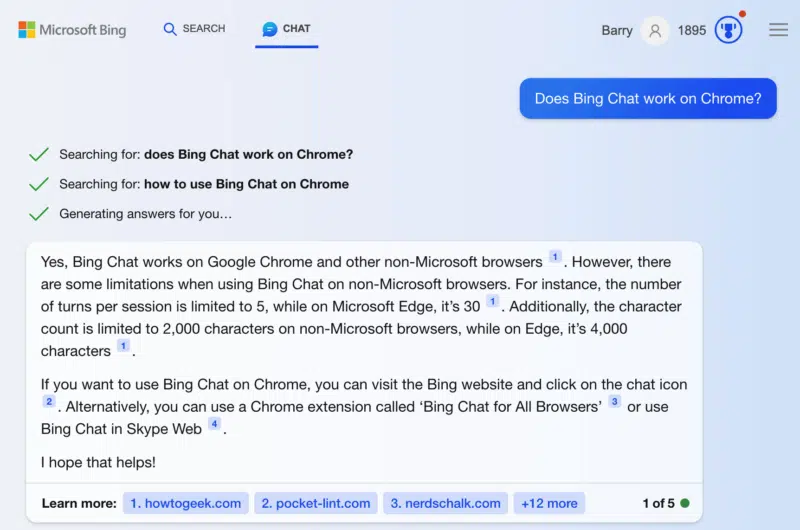
Here is Bing Chat working for me on Chrome on my Mac:

Bing Chat Chrome 800x530

Safari support coming soon. While some are able to also access Bing Chat on Safari, Apple’s browser, it is just a limited test right now. “Working on Safari, hopefully will release soon,” Mikhail Parakhin added.

Why we care. Bing is expanding access to Bing Chat across more and more browsers. That should give more people access to try out and potentially adopt Bing Chat for more searches in the future.

If you were holding out using Bing Chat because of the required Edge browser support, now you can try it on Chrome.


Related stories

New on Search Engine Land

@media screen and (min-width: 800px) { #div-gpt-ad-3191538-7 { display: flex !important; justify-content: center !important; align-items: center !important; min-width:770px; min-height:260px; } } @media screen and (min-width: 1279px) { #div-gpt-ad-3191538-7 { display: flex !important; justify-content: center !important; align-items: center !important; min-width:800px!important; min-height:440px!important; } }

About the author

Barry Schwartz

Barry Schwartz is a Contributing Editor to Search Engine Land and a member of the programming team for SMX events. He owns RustyBrick, a NY based web consulting firm. He also runs Search Engine Roundtable, a popular search blog on very advanced SEM topics. Barry can be followed on Twitter here.

https://searchengineland.com/bing-chat-now-works-on-chrome-googles-browser-431230


Mitigating technical SEO issues by empowering engineers

SEO is not just about keywords and content. It ensures search engines can effectively access, crawl, and interpret a website. This is where technical SEO comes into play. 

As I highlight in my article “Unleashing enterprise SEO superpowers: The 4 pillars for SEO success,” mitigation and error management in technical SEO are crucial for a flawless online experience.

Companies can save time and money by equipping enterprise engineers with the knowledge of common technical SEO issues, streamlining the SEO process, and improving organic search performance.

Why engineers need to understand technical SEO

Here are some reasons why organizations must keep their engineers technical SEO-savvy engineers. 

Cost-effective and time-saving

By identifying and addressing technical issues during the development phase, engineers can prevent costly mistakes that require rework.

Improved website performance

Sites optimized from a technical standpoint offer better user experiences, which can result in higher engagement and conversion rates.

Evolution of SEO

As the SEO landscape changes, having engineers who are up to date with the latest trends and ensures a proactive approach to website development.

Recent developments in SEO

Technical SEO holds significant importance, as Google’s John Mueller tweeted July 24. 

“Technical SEO – it matters a lot. I double-checked some sites regarding SD usage. One had a performance report trending towards zero over 3 weeks. Cookie banner loaded with JS, no other content loaded for Googlebot. Soft 404s everywhere.”

Moreover, Google’s announcement about the reduction in visibility of FAQ rich results and the limitation of HowTo results to desktop devices indicates the dynamic nature of SEO. 

These changes underscore the need for technical vigilance, as even minor technical issues can significantly impact visibility in organic search results.


Get the daily newsletter search marketers rely on.


Technical issues to monitor

Soft 404s

A soft 404 error occurs when a non-existent page displays a “page not found” message but doesn’t return a 404 status code. 

These errors can:

  • Mislead search engines into indexing irrelevant pages.
  • Adversely affects user experience by causing some confusion.
  • Lead to unnecessary crawling and re-crawling by search engine bots.

To address soft 404s:

  • Ensure non-existent pages return a 404 or 410 status.
  • Use 301 redirects for pages that have moved to a new URL.

JavaScript SEO

JavaScript plays a crucial role in modern web development.

However, JavaScript comes with SEO challenges, including:

  • Complex JavaScript can slow down indexing.
  • JavaScript elements, like menus, need regular testing to ensure search engine accessibility.
  • Ensure internal links within JavaScript are recognizable by search engines.

Implementing server-side rendering, code minification, and lazy loading can optimize load times and improve user experience and SEO performance.

Dig deeper: What to look for in a technical SEO audit

Empowering engineers with SEO knowledge

Engineers are at the forefront of website development, and their understanding of technical SEO can be transformative for an enterprise. 

Companies can ensure optimal website performance by integrating SEO best practices into development.

The ever-evolving nature of SEO, as evidenced by Google’s recent announcements, underscores the need for continuous learning and adaptation. 

With this knowledge, engineers can proactively address issues, ensuring that websites are user-friendly and search-engine-friendly.

Technical SEO, often overshadowed by its on-page counterpart, is a cornerstone of organic search performance. 

By empowering engineers with the tools and knowledge they need to tackle these challenges head-on, enterprises can enhance website performance, user experience, and their bottom line. 

As the SEO landscape shifts, a proactive approach to technical challenges will be the key to staying ahead.


Opinions expressed in this article are those of the guest author and not necessarily Search Engine Land. Staff authors are listed here.


Related stories

New on Search Engine Land

@media screen and (min-width: 800px) { #div-gpt-ad-3191538-7 { display: flex !important; justify-content: center !important; align-items: center !important; min-width:770px; min-height:260px; } } @media screen and (min-width: 1279px) { #div-gpt-ad-3191538-7 { display: flex !important; justify-content: center !important; align-items: center !important; min-width:800px!important; min-height:440px!important; } }

About the author

Jenn Mathews

Jenn Mathews, also known as the SEOGoddess since 2004, is a renowned expert in Enterprise SEO with over 20 years of experience in search engine optimization. Her impressive background includes serving as GitHub’s only SEO Manager, directing SEO across Groupon’s global organization, managing the SEO team at Nordstrom, and working with several fortune 500 companies. Jenn’s expertise in technical SEO and her ability to develop overall strategy while advocating for SEO within large organizations has made her an authority in the industry. Today, Jenn shares her knowledge as a mentor and author for Search Engine Land, as well as through various speaking events. Trust in Jenn Mathews to help your enterprise achieve its SEO goals.

https://searchengineland.com/mitigating-technical-seo-issues-empowering-engineers-431207


Dozens of big brands have blocked GPTBot, OpenAI’s new web crawler

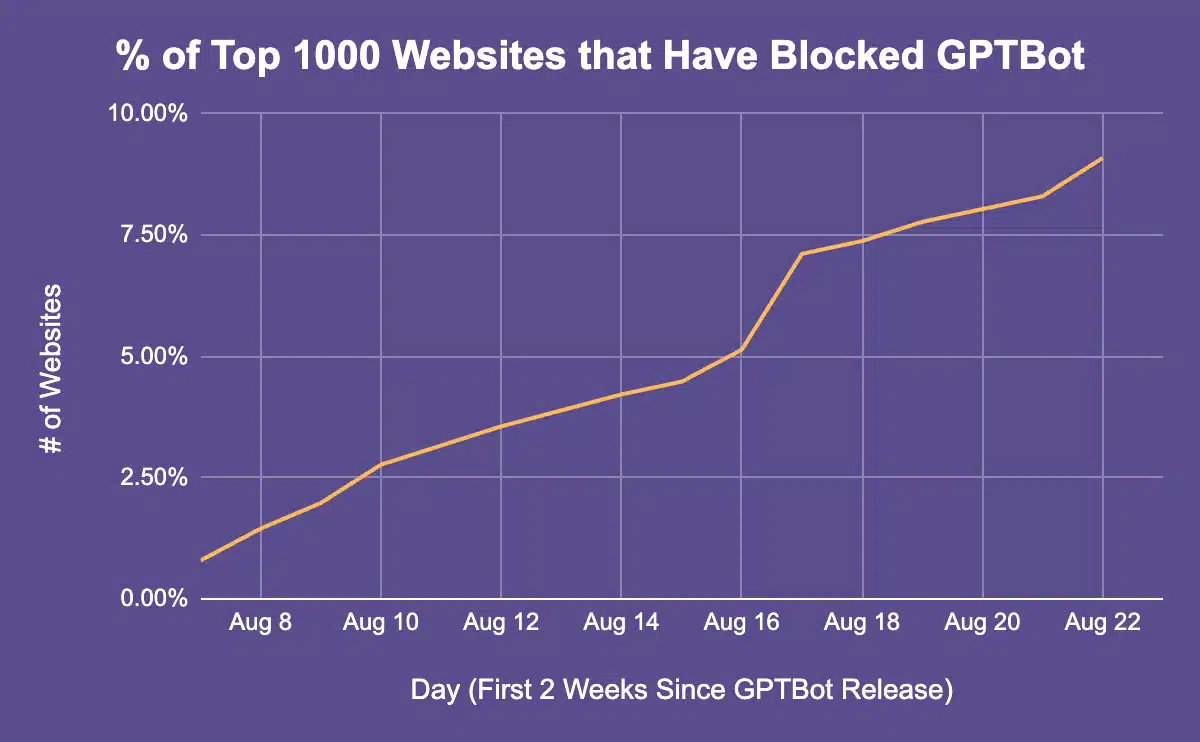
At least 69 of the 1,000 most popular websites in the world have blocked GPTBot, the new web crawler OpenAI introduced Aug. 7, according to a new analysis.

And the percentage of sites is increasing by about 5% per week, according to AI content and plagiarism service Originality.ai.

Websites blocking GPTBot

Why we care. To block or not to block ChatGPT? That has been the big question for many SEOs. Clearly, several popular websites have already blocked GPTBot, presumably because they don’t want OpenAI scraping their data to help train its models – at least not without compensation. Additionally, ChatGPT does not cite or link to its sources.

By the numbers. The 15 most popular sites blocking ChatGPT, according to the analysis, are:

  • amazon.com
  • quora.com
  • nytimes.com
  • shutterstock.com
  • wikihow.com
  • cnn.com
  • foursquare.com
  • healthline.com
  • scribd.com
  • businessinsider.com
  • reuters.com
  • medicalnewstoday.com
  • goodhousekeeping.co
  • amazon.co.uk
  • tumblr.com

But. Even though many sites are blocking GPTBot, they are not also blocking CCbot, Common Crawl’s web crawler. Part of the training data used by OpenAI, Google and others comes from Common Crawl.

There are a few noteworthy exceptions that block both bots, such as the New York Times, which clearly does not want its content used to train AI systems. Other popular websites blocking both GPTBot and CCbot include shutterstock.com, reuters.com and goodhousekeeping.com.

  • At least 62 of the top 1,000 websites have blocked CCBot.

Limitations. 241 robots.txt files out of the 1,000 websites were not identified/inspected as part of this analysis. (That’s why I wrote “at least” in the opening sentence.)

Originality.ai’s analysis. Websites That Have Blocked OpenAI’s GPTBot – 1000 Website Study

Dig deeper. Should you block ChatGPT’s web browser plugin from accessing your website?


Related stories

New on Search Engine Land

@media screen and (min-width: 800px) { #div-gpt-ad-3191538-7 { display: flex !important; justify-content: center !important; align-items: center !important; min-width:770px; min-height:260px; } } @media screen and (min-width: 1279px) { #div-gpt-ad-3191538-7 { display: flex !important; justify-content: center !important; align-items: center !important; min-width:800px!important; min-height:440px!important; } }

About the author

Danny Goodwin

Danny Goodwin has been Managing Editor of Search Engine Land & Search Marketing Expo – SMX since 2022. He joined Search Engine Land in 2022 as Senior Editor. In addition to reporting on the latest search marketing news, he manages Search Engine Land’s SME (Subject Matter Expert) program. He also helps program U.S. SMX events. Goodwin has been editing and writing about the latest developments and trends in search and digital marketing since 2007. He previously was Executive Editor of Search Engine Journal (from 2017 to 2022), managing editor of Momentology (from 2014-2016) and editor of Search Engine Watch (from 2007 to 2014). He has spoken at many major search conferences and virtual events, and has been sourced for his expertise by a wide range of publications and podcasts.

https://searchengineland.com/websites-blocking-gptbot-431183


Google Search can now index CSV files

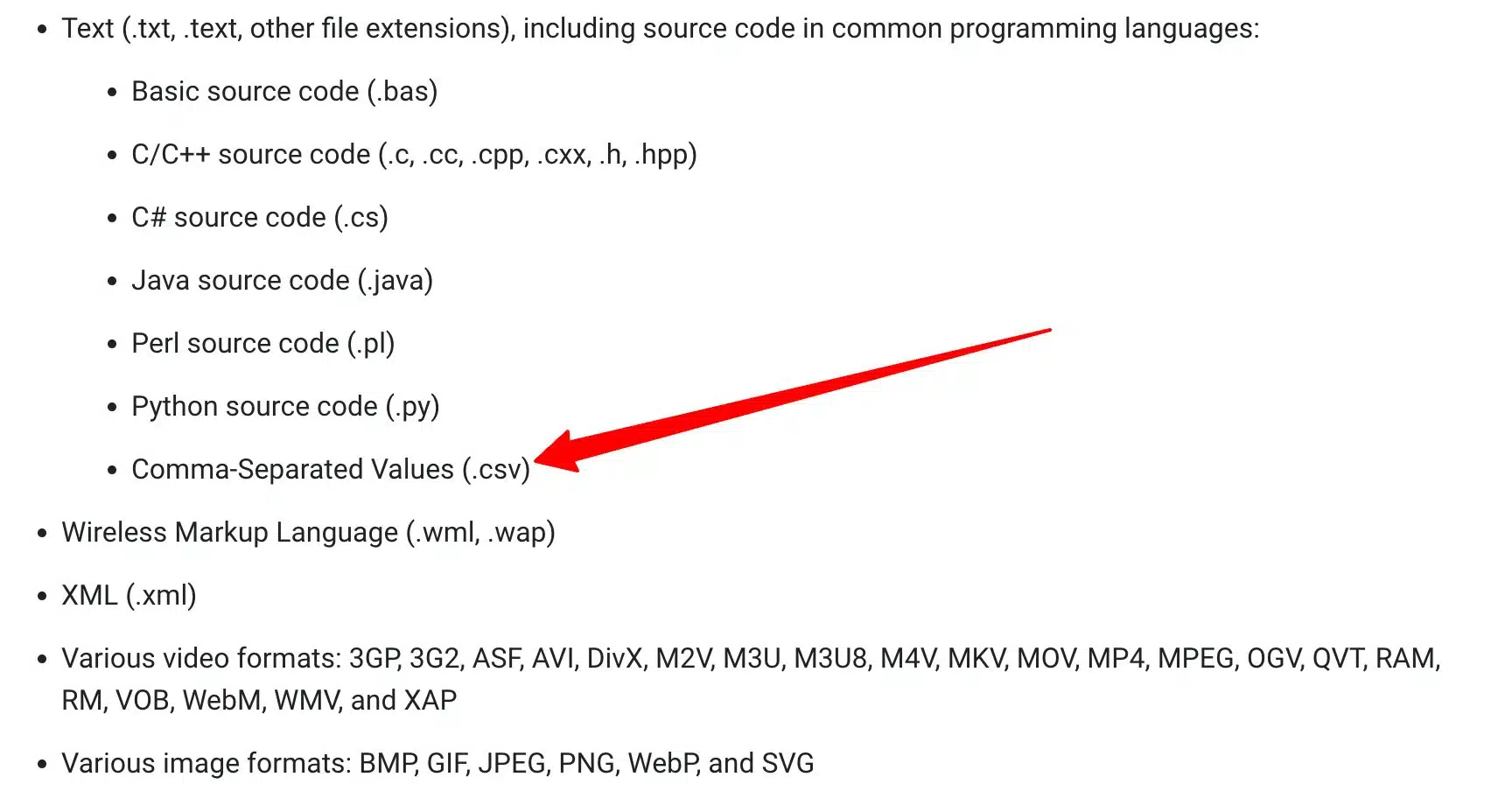
Google Search has added to its file types indexable by Google help document that it can now index Comma-Separated Values (.csv) files. I confirmed with John Mueller of Google that this is not just a help document update but a new update to Google Search in what it can index.

More details. I spotted the update this morning to the help document and wondered initially if this is new outside of just an update to a help document for clarification purposes. I reached out to John Mueller who confirmed with me on Twitter that this is newly added functionally to Google Search:

The document change. Here is the new line added to the help document:

Csv

More changes. The March copy of that help page did not have CSV listed as a file type but it also didn’t have these two sections:

  • Various video formats: 3GP, 3G2, ASF, AVI, DivX, M2V, M3U, M3U8, M4V, MKV, MOV, MP4, MPEG, OGV, QVT, RAM, RM, VOB, WebM, WMV, and XAP
  • Various image formats: BMP, GIF, JPEG, PNG, WebP, and SVG

I am pretty sure Google was able to index those image formats and most, if not all, of those video formats. So that is probably just a clarification in those sections. But the CSV format is new in terms of actual functionality.

Why we care. If you have CSV files out on the web, Google can now index those files. That means that Google Search can show CSV files in its search results when relevant to the query. If you don’t want your CSV files in Google Search, make sure you don’t let Google index them.


Related stories

New on Search Engine Land

@media screen and (min-width: 800px) { #div-gpt-ad-3191538-7 { display: flex !important; justify-content: center !important; align-items: center !important; min-width:770px; min-height:260px; } } @media screen and (min-width: 1279px) { #div-gpt-ad-3191538-7 { display: flex !important; justify-content: center !important; align-items: center !important; min-width:800px!important; min-height:440px!important; } }

About the author

Barry Schwartz

Barry Schwartz is a Contributing Editor to Search Engine Land and a member of the programming team for SMX events. He owns RustyBrick, a NY based web consulting firm. He also runs Search Engine Roundtable, a popular search blog on very advanced SEM topics. Barry can be followed on Twitter here.

https://searchengineland.com/google-search-can-now-index-csv-files-431184


Who cares if Gen Z significantly prefers user-generated content?

“Gen Z Significantly Prefers User-Generated Content, Older Millennials Lean Toward Streaming, InMobi Insights Survey Shows,” proclaims a press release I recently read.

This headline almost drove me to start a loud, angry, uncontrolled rant, but I didn’t want to look like Abe Simpson in the “Old Man Yells at Cloud” meme.

So, let me explain quietly, rationally, and unemotionally why marketers should think twice before continuing to use outdated demographic cliches and obsolete content descriptions.

Before I do, let me provide InMobi Insights with equal time.

What types of content do Gen Z, younger millennials, and older millennials prefer?

InMobi surveyed more than 1,000 US consumers about their streaming subscription behavior and found:

  • Gen Z (ages 18-24) enjoys user-generated content (UGC) more than other content types. UGC was followed by music/podcasts, gaming, and TV in that order.
  • Younger millennials (ages 25-34) consume content across all formats equally. They don’t have a clear content preference.
  • Older millennials (ages 35-44) enjoy TV the most. UGC was their second choice.

In the press release, Justin Sparks, the Director of Vertical Strategy for North America at InMobi, said: 

“The clear generational divide shows how the content vehicle of the time creates lasting habits and familiarity. To win over Gen Z as they come into purchasing power and boardroom and political influence, UGC will be the critical lever across the content ecosystem. You can see this with the NFL’s Sunday Ticket deal with YouTube that starts this year as they move away from a long-standing partnership with Dish TV to court Gen Z fans to the sport.”

OK, equal time is over.

Who is our target audience?

Now, I believe that one of the questions that brands and agencies should continue asking is: “Who is our target audience?” 

But I also think we should start asking, “Why are we still using Gen Z, millennials, Gen X, and baby boomers to segment the audiences we do or don’t want to target?”

There are many ways to segment audiences. This includes specific interests and intents as well as demographics. So, why should we begin asking questions about our use of generations now?

The Pew Research Center, which has been at the forefront of generational research over the years, decided to take a step back and reconsider how they approach generations going forward.

Michael Dimock, the president of Pew Research Center, published “5 things to keep in mind when you hear about Gen Z, Millennials, Boomers and other generations.”

This should be required reading for every marketer and executive at all brands and agencies in America.

Dimock said:

“At Pew Research Center, we think it can be useful to talk about generations. But there are some important considerations for readers to keep in mind whenever they come across a news story or research about generations.” These are:

  1. Generational categories are not scientifically defined.
  2. Generational labels can lead to stereotypes and oversimplification.
  3. Conversations about generations often focus on differences instead of similarities.
  4. Conventional views of generations can have an upper-class bias.
  5. People can change over time.”

If you want to get a second option, then read Mark Ritson’s column in Marketing Week, “Eight out of 10 millennials know demographics are horseshit.” 

Ritson concludes, “It’s time to leave this lazy approach to segmentation behind.”

What can I add?

What is user-generated content?

While you’re reviewing your assumptions about market segmentation, you may also want to tackle another tough question: “What is user-generated content?”

Is it the type of content created by James Donaldson, also known as MrBeast? He’s one of the most successful YouTube creators, with over 163 million subscribers. 

But MrBeast also has a TikTok account with 84 million followers, an Instagram account with 38.5 million followers, an X account (formerly known as Twitter) with 21.3 million followers, and a Facebook account with 4.2 million followers. 

MrBeast’s content features elaborate stunts, challenges, and giving away large sums of money. For example, his most-watched video is “Would You Fly To Paris For A Baguette?” 

Uploaded to YouTube on Dec. 8, 2022, it now has 853 million views and 37.9 million engagements.

[embedded content]

It’s worth noting that this wasn’t a fluke. MrBeast has uploaded 89 videos to YouTube in the last three years, which now have 14.5 billion views and 502 million engagements. 

After watching this “user-generated content” at your next marketing meeting, you might want to ask, “Why can’t we create content like this?” 

If you work at a media and entertainment company, then you should pound the table and ask your team, “Why aren’t we creating content like this?”

It’s also worth knowing that Donaldson isn’t the only YouTube creator to transform user-generated content into a rewarding career. 

Oxford Economics estimates that YouTube’s creative ecosystem supported more than 390,000 full-time equivalent U.S. jobs and contributed over $35 billion to the U.S. GDP in 2022.

Dig deeper: Video content guide: Why you should start creating videos now (plus examples)


Get the daily newsletter search marketers rely on.


What is our target audience watching on TV?

Finally, you may want to ask your marketing team, “What is our target audience watching on TV?”

Yes, I’m a baby boomer. But, no, I’m not trying to turn the clock back to the “Mad Men” era.

Remember, InMobi Insights found older millennials enjoy streaming TV the most.

You might want to re-read my article, “How to use GA4 to optimize your digital marketing strategy.” 

Near the end of the article, I reported what YouTube CEO Neal Mohan had said at Brandcast: 

“We’re seeing a seismic shift in the way people consume content. More and more, viewers are tuning into YouTube on the biggest screen in their home. According to Nielsen, YouTube is the leader in streaming watch time on TV screens in the U.S.”

Although I didn’t report this at the time, Mohan added: 

“Viewers – especially younger viewers – no longer make a distinction between the kind of content they’re watching. When they turn on the TV, they want everything they love in one place – from their favorite creators, to blockbuster movies, to football. And they can find it all on YouTube.”

At that event, YouTube Chief Business Officer Mary Ellen Coe talked about YouTube’s partnership with NFL Sunday Ticket and the unique opportunities YouTube was creating for fans to experience sports on YouTube and YouTube TV. She noted:

“No one does sports better than YouTube. We give you access to all the content fans love with live and on-demand and across league partnerships like the NFL, the NBA, and more. And we’re the number one sports destination for Gen Z fans.”

After making this point, Coe added:

“Tonight, I’m excited to announce a new way for fans to see game day from a creator’s perspective. We’re launching a new original Shorts series on the NFL’s YouTube channel after the football season kicks off this year, ‘NFL Creator of the Week.’”

Finally, NFL Commissioner Roger Goodell told the Brandcast attendees: 

“Millions of football fans are on YouTube to catch all things NFL…. In fact, this past year, NFL content on the platform gained a 27% increase in watch time year-over-year, with 1.9 billion views.”

And after reviewing my notes, it turns out that Goodell added:

“NFL Sunday Ticket is only the beginning…. And creators from every content category – from fashion to food – are going to be a part of this, helping bring new audiences into the world of the NFL. One such creator is MrBeast, who’s YouTube’s biggest creator.”

My story in May mentioned that YouTube reached over 150 million people on connected TVs in the United States, according to Nielsen data. 

And I added, “That’s a much bigger audience than brands and agencies can reach during the Super Bowl.”

Since then, I’ve stumbled into the definition of “co-viewing” in the Google Ads glossary. It shares this news nugget: 

“Panels show that multiple people are watching YouTube together on TV screens, a consumer behavior characteristic of linear television viewership as well.” 

The glossary also explains: 

“When multiple people watch YouTube on a connected TV (CTV) device together and view an ad at the same time, it could lead to more impressions and reach for your campaign.”

Get it? Got it? Good.

So, who is your target audience? 

If it’s Gen Z, then it turns out that YouTube is the number one sports destination for Gen Z fans.

If it’s older millennials, then YouTube is the leader in streaming watch time on TV screens in the U.S.

And if your target audience is football fans, then YouTube is now the exclusive home of NFL Sunday Ticket. 

And as part of this partnership, YouTube creators are getting first-of-its-kind access to the NFL: their games, their clubs, and their athletes, and the fans who love them.

So, the media world is turning upside down – again. That means it’s time to start asking questions like, “Who cares if Gen Z significantly prefers user-generated content or older Millennials lean toward streaming?” 

Why? Because brands and agencies can reach football fans across YouTube’s entire array of NFL content, whether they’re viewing live games on YouTube TV and Primetime Channels or watching highlights, post-game commentary, and other related content across YouTube.

If you miss this opportunity, you might end up looking like Abe Simpson in the “Old Man Yells at Cloud” meme. And you wouldn’t want that.


Opinions expressed in this article are those of the guest author and not necessarily Search Engine Land. Staff authors are listed here.


Related stories

New on Search Engine Land

@media screen and (min-width: 800px) { #div-gpt-ad-3191538-7 { display: flex !important; justify-content: center !important; align-items: center !important; min-width:770px; min-height:260px; } } @media screen and (min-width: 1279px) { #div-gpt-ad-3191538-7 { display: flex !important; justify-content: center !important; align-items: center !important; min-width:800px!important; min-height:440px!important; } }

About the author

Greg Jarboe

Greg Jarboe is the president and co-founder of SEO-PR, which has generated award-winning results for Southwest Airlines, the Search Engine Strategies (SES) Conference & Expo series, and Rutgers University. He is the author of YouTube and Video Marketing and a co-author of Digital Marketing Fundamentals. In addition, he is one of the 25 successful gurus profiled in Michael Miller’s book, Online Marketing Heroes. Since 2003, Jarboe has written more than 1,600 articles for Search Engine Watch, Tubular Insights, Search Engine Journal, and other online publications. Over that time, he has also spoken at more than 80 industry conferences. In addition, Jarboe is an instructor at the New Media Academy in the UAE and for Rutgers, the State University of New Jersey, on Coursera.

https://searchengineland.com/generations-user-generated-content-who-cares-431143


Google Business Profile robocall scams are increasing

Google Business Profile and other types of Google-related phone scams are on the rise in 2023, according to data shared with Search Engine Land by voice security service Hiya.

Why we care. If anyone calls you about your listing – telling you it “needs to be verified,” “has been flagged for review,” or “may be suspended” and promises to help you for a fee, it’s a scam. Google Business Profiles are free, but that hasn’t stopped scammers from trying to profit from them for years.

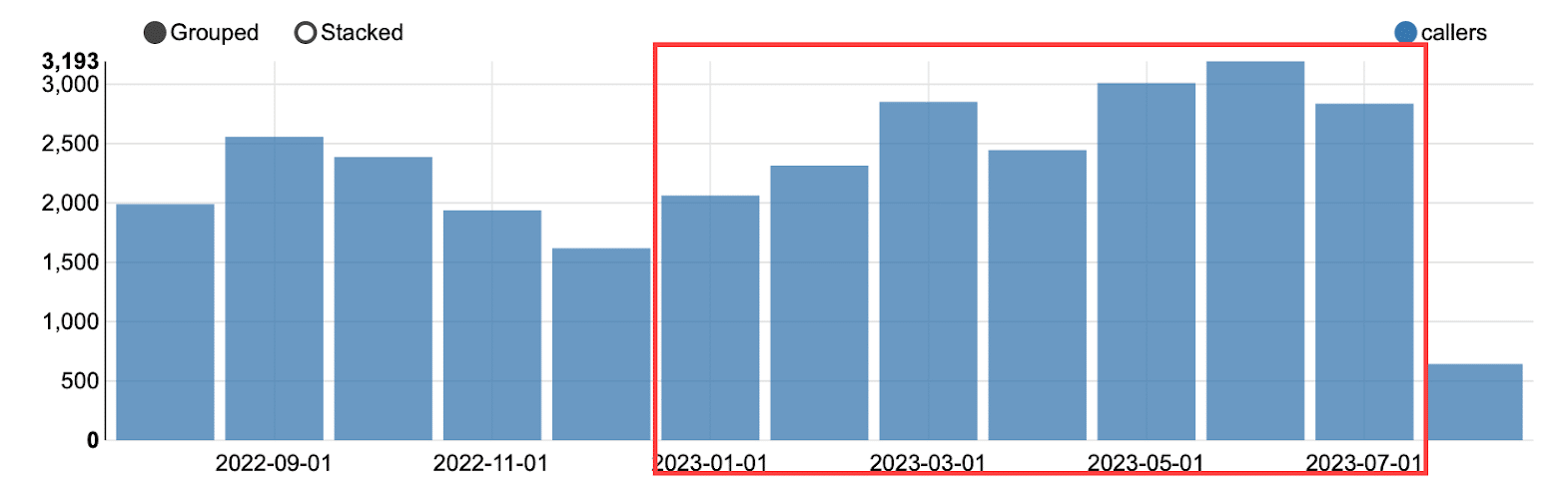
17,000. More than 2,000 Google Business Profile scams were reported every month this year through July, for a total of more than 17,000, according to Hiya.

Google Business Profile Scams

Robocall examples. Here are two examples out of more than 100 variations of messages people have received from these fake “Google partners”:

  • “Business owners, your Google Business Profile has not been registered with Google. Please press 1 to be transferred to a business listing specialist to assist you in registering your Google Business Profile, or press 2 to be placed on the do not call list.”
  • “Hello. We’re calling from Online Listing Group because your Google Business listing needs attention. If your listing is not showing up properly, customers will not be able to contact you or find your location. If you are the business owner, press 1 now to verify or update your business. Press 9 to opt out.”

Sorry, Kentucky. The four U.S. states that get the most Google scam calls, per person:

  • Kentucky
  • Rhode Island
  • Hawaii
  • Wyoming

Past action. Google filed a lawsuit against the company G Verifier in November for allegedly charging business owners money for free Google Business Profiles, selling fake reviews and promising first-page rankings.

Google is aware of these robocalls and has a help document, Help protect against fraudulent calls, which reads:

“Unfortunately, there are many unscrupulous individuals and companies who make fraudulent and misleading calls. Sometimes, callers or pre-recorded robocalls falsely claim to be working “with Google” or “for Google” in an attempt to sell different schemes and online marketing services to unsuspecting individuals and companies.

Many of these types of calls are not allowed under U.S. law (unless you have given permission to receive them), and Google is never behind them.”

Dig deeper. The anatomy of an SEO robocall scheme


Related stories

New on Search Engine Land

@media screen and (min-width: 800px) { #div-gpt-ad-3191538-7 { display: flex !important; justify-content: center !important; align-items: center !important; min-width:770px; min-height:260px; } } @media screen and (min-width: 1279px) { #div-gpt-ad-3191538-7 { display: flex !important; justify-content: center !important; align-items: center !important; min-width:800px!important; min-height:440px!important; } }

About the author

Danny Goodwin

Danny Goodwin has been Managing Editor of Search Engine Land & Search Marketing Expo – SMX since 2022. He joined Search Engine Land in 2022 as Senior Editor. In addition to reporting on the latest search marketing news, he manages Search Engine Land’s SME (Subject Matter Expert) program. He also helps program U.S. SMX events. Goodwin has been editing and writing about the latest developments and trends in search and digital marketing since 2007. He previously was Executive Editor of Search Engine Journal (from 2017 to 2022), managing editor of Momentology (from 2014-2016) and editor of Search Engine Watch (from 2007 to 2014). He has spoken at many major search conferences and virtual events, and has been sourced for his expertise by a wide range of publications and podcasts.

https://searchengineland.com/google-business-profile-robocall-scams-increasing-431166


X referral traffic falls for publishers like BuzzFeed, Reuters, CNN

Many publishers are getting less traffic from X, formerly known as Twitter, this year compared to a year ago.

Why we care. Being visible in social media remains important for brands even as social media continues to lose importance as a referral source for some publishers. But that doesn’t mean it’s safe to ignore X or social media entirely – watch your traffic data to see whether it’s time to revisit your audience and traffic growth strategies.

A 24% drop on average. Traffic from X fell 24%, on average, for a random set of 25 large and small publishers from the first half of 2022 to the first half of 2023, according to analysis by Automattic, as Digiday reported.

By the numbers. Ten publishers that saw significant drops in X referral traffic, according to SimilarWeb, were:

  • BuzzFeed -70%
  • Reuters -67%
  • The Washington Post -48%
  • The Wall Street Journal -42%
  • CNN -41%
  • Fox News -39%
  • NBC News -38%
  • The New York Times -35%
  • The Guardian -29%
  • BBC -20%

A five-year trend. The decline of X/Twitter referral traffic didn’t start this year. Publishers large and small have been watching this happen since 2018, according to Press Gazette:

Data from publisher analytics firm Chartbeat shows that Twitter referral traffic, 1.9% of all traffic in April 2018 to 1,350 publisher sites included in the analysis, had fallen to 1.2% five years later in April this year.

But. Referral traffic from X is not declining for all publishers. I looked at Search Engine Land’s referral data from X, comparing 2023 vs. 2022 (from Jan. 1 to Aug. 23):

  • Sessions were up 50%
  • Pageviews were up 62%.

Twitter/X was our third largest referral source from social, not far behind LinkedIn and Facebook. Social overall accounted for 5.8% of all Search Engine Land sessions.

Search = Elon proof. After Elon Musk bought Twitter, now rebranded as X, some search marketers abandoned the platform, but many others still continue to use it regularly, while others lurk or use it less than in prior years. The nature of the search marketing industry – and our need to stay on top of all the latest news as it happens – could be a contributing factor to Search Engine Land’s growth.

Could things get worse? Potentially. Twitter is testing removing headlines from links to articles – which could further impact referral traffic. Only the article’s featured image and URL will be displayed to “greatly improve the esthetics,” Musk confirmed via X.


Related stories

New on Search Engine Land

@media screen and (min-width: 800px) { #div-gpt-ad-3191538-7 { display: flex !important; justify-content: center !important; align-items: center !important; min-width:770px; min-height:260px; } } @media screen and (min-width: 1279px) { #div-gpt-ad-3191538-7 { display: flex !important; justify-content: center !important; align-items: center !important; min-width:800px!important; min-height:440px!important; } }

About the author

Danny Goodwin

Danny Goodwin has been Managing Editor of Search Engine Land & Search Marketing Expo – SMX since 2022. He joined Search Engine Land in 2022 as Senior Editor. In addition to reporting on the latest search marketing news, he manages Search Engine Land’s SME (Subject Matter Expert) program. He also helps program U.S. SMX events. Goodwin has been editing and writing about the latest developments and trends in search and digital marketing since 2007. He previously was Executive Editor of Search Engine Journal (from 2017 to 2022), managing editor of Momentology (from 2014-2016) and editor of Search Engine Watch (from 2007 to 2014). He has spoken at many major search conferences and virtual events, and has been sourced for his expertise by a wide range of publications and podcasts.

https://searchengineland.com/x-referral-traffic-drop-431154