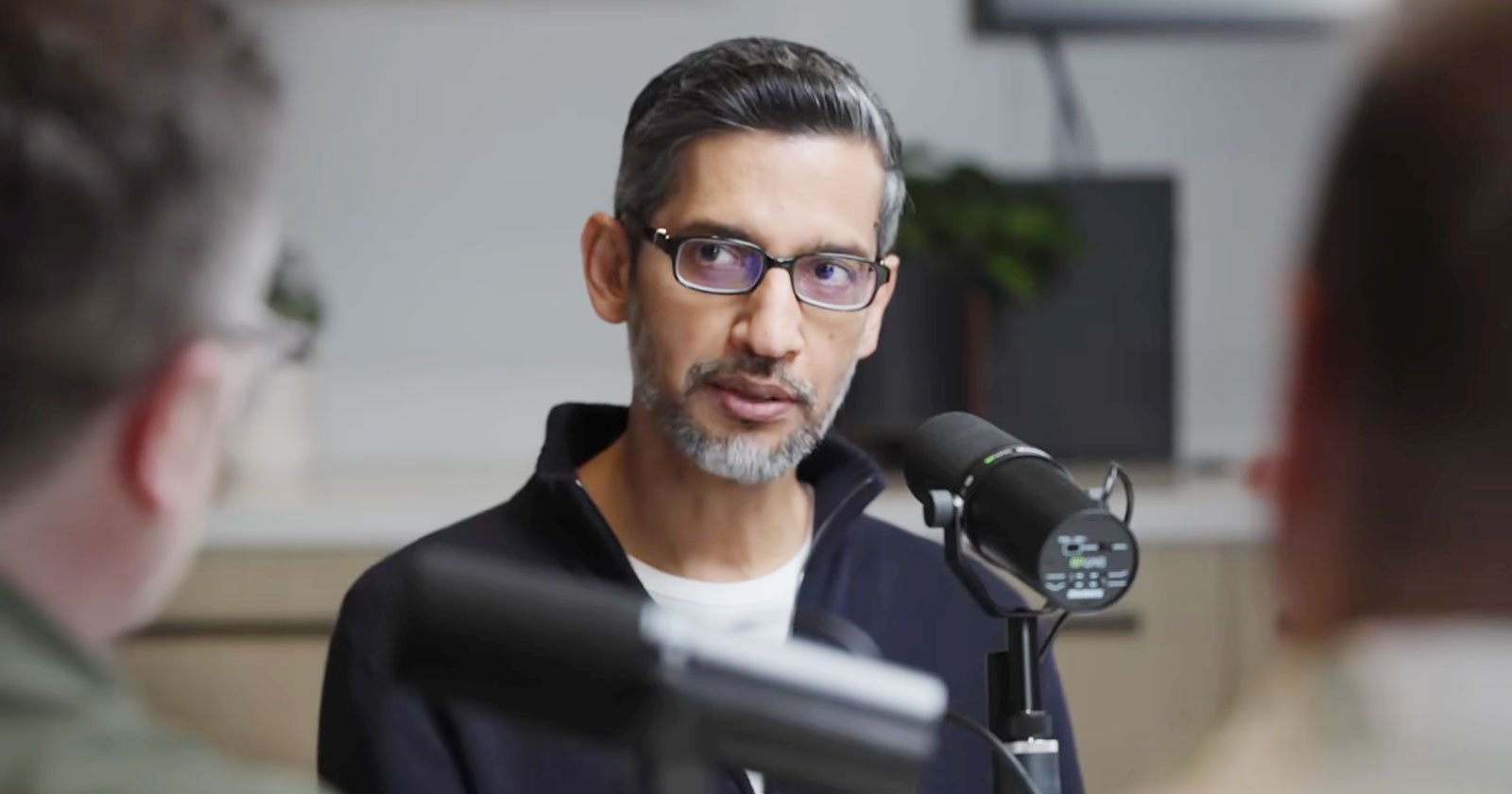
Google CEO Sundar Pichai Is OK With AI Mode Replacing Classic Search via @sejournal, @martinibuster
In a recent interview, Google’s CEO Sundar Pichai confirmed that sources and links will always be a part of the AI answers and when asked how he feels about a decline in the use of Classic Search in favor of AI Search, he mentioned that Google will survive on a blend of subscriptions and advertising.
Google On The Future Of Links And Sources
Google’s CEO acknowledged that people still want to connect with what’s on the web. He also shared that Google is creating a seamless transition from classic search to AI Mode and that according to their internal metrics, people are satisfied with it.
In response to an interviewer question as to whether Google is at some point going to transition away from the ten blue links and classic search, he said that the process is a “continuum,” which means a gradual transition, not a “rip the band-aid” type change.
The question the interviewer asked:
“I think a lot of people expect that at some point, the kind of normal Google sort of classic search interface goes away. The 10 blue links maybe go away and you just kind of have this AI mode as the default.
…Do you think that goes away at any point that you sort of rip the band-aid off and just go full AI mode?”
Sundar Pichai confirmed that sources and links won’t always be a part of Search:
“You know, I think it’s important to bring users along the journey as well as making sure the product is working for their expectations.
So, you know, I try not to get ahead of that.
I think it is very clear as we evolve through these changes, people are responding positively. We can see it in the long-term metrics of the product in such a clear way. And so I think we understand that. But people want search to be fast.
I do think through search, people are looking to connect with what’s out there on the web, so that’s important to us. It’s all of that.
So I think you’re seeing us evolve the product.
And I think you’ll continue to see it be methodical, but we didn’t have AI Mode a year ago. But now a lot of people are experiencing it. I think we have made it more seamless to go there than before.
And so it’s a continuum.
But I don’t see…
Sources and links will always be there as part of it.”
Pichai says people want to connect with what is on the web and that sources and links remain part of the experience. But he also says AI Mode is becoming more seamless and widely used, which actually impacts referrals.
Visibility Is Not The Same As Referrals
The idea of evolving classic search so that it’s seamlessly transitioning to AI Mode is not going to be popular with publishers and SEOs. The reality of “links” and “sources” in AI Mode is that visibility is not the same thing as referral traffic. So when Pichai’s AI Mode offers visibility with one hand, it’s also diminishing referrals with the other.
This ties directly with the concept of Google Zero. Google Zero is the big brand calculation that referral traffic is dwindling to zero. So in order to survive, businesses must promote and monetize as if Google referrals will one day be zero, Google Zero.
The reality of AI Mode is that Google is preserving the appearance of attribution while diminishing the economic value of clicks.
Google Says Users Are Responding Positively
The other important point in his answer is that Pichai says Google can see positive user response to AI Mode in their long-term metrics. But people are increasingly concerned about data center use, the record amounts of water that they use, and the harm that does to the environment as well as to the cost of energy, which affects the cost of everything from the clothes you wear to the dinner on the table.
The interviewer even mentioned how college graduates across the United States booed at the very mention of AI. So with all of the negative public sentiment against AI, Pichai still insists that people are happy with it.
Google Is Okay With Replacing The Search Advertising Model
One of the two interviewers gestured to his co-interviewer and commented that he had told him that he hadn’t done a traditional Google Search in a year and asked Pichai if he’s okay with people abandoning search in favor of pure AI queries.
He asked Pichai if he’s okay with users who don’t use classic search :
“When you hear that, are you cool? Like, this is the kind of user that I want right now, or does it send you a little chill because the traditional search ad business is a pretty good one for you.”
Pichai’s answer seemed to suggest that there may in the future be a blending of subscription and advertising revenues.
He responded:
“Well, I think we will, if anything, in the AI mode, in an agentic… these things are going to do a lot more for you than what we were able to do for users 10 years ago.
I think the economic value is always a function of the total value you’re giving users. All of us would say over time, the value we are providing users increases, there’s more competition, there are more choices.
So I feel comfortable between a combination of subscription and ads that the right models will continue to be there.”
That’s maybe the first time someone at Google has mentioned a blend of subscriptions and advertising as a way of monetizing the AI web. Where does that leave publishers?
When asked about the negative economic future that many feel AI is bringing, he compared AI to the introduction of the spreadsheet and how that revolutionized financial analysis, to how it will make coding easier, and how it will enable doctors to spend more time with patients.
All of those analogies and comparisons sidestep the damage to the web ecosystem that non-referring visibility brings.
His answer:
“I think people are going to be more productive. They will have more time for leisure. All of that will simultaneously be true.”
Pichai is confident that the web ecosystem can subsist on visibility, and that Google will be fine if people stop using classic search. But where does that leave the web ecosystem? Pichai all but recommended eating cake.
Google Won’t Act On Spam Reports If They Contain Personal Information via @sejournal, @martinibuster
Google updated their spam reporting documentation to make it clearer that spam reports are not wholly confidential and that it’s possible for personal identifiable information to be shared with the sites receiving a manual action.
Change In Response To Feedback
Google’s changelog noted that they were updating the spam reporting form based on feedback they’d received about personal information contained in the spam report that is shared with spammy sites that receive a manual action (formerly known as a penalty).
The update contains a new notice that spam reports containing personal information will not be processed.
The changelog noted:
“Clarifying when and why we may take manual action based on spam reports What: Further clarified when and why we may take manual action based on spam reports. Why: To address feedback we received about the change on using spam reports to take manual action.”
Google removed the following from their documentation:
“If we issue a manual action, we send whatever you write in the submission report verbatim to the site owner to help them understand the context of the manual action. We don’t include any other identifying information when we notify the site owner; as long as you avoid including personal information in the open text field, the report remains anonymous.”
The above wording was replaced with the following:
“Don’t include any personally identifying information in your submission. To comply with regulations, we must send the submission text to the site owner to help them understand the context of a manual action, if one is issued.
Because of this, we won’t process your submission if we determine it contains personally identifying information to protect privacy. Not including such information fully ensures your information is safe and prevents your submission from being discarded.”
Action Moving Forward
On the one hand it’s good that Google won’t proceed with a manual action if the report contains personal information. This means that if you’re submitting spam reports to Google, don’t name your site, business name, personal name or anything else that you don’t want the affected spammer to know.
The Real Reason Your SEO Team Hasn’t Made The AI Transition Yet via @sejournal, @DuaneForrester
This series has spent five articles mapping what the AI search transition requires of your team, your content, your technical infrastructure, and your strategic framing. This piece addresses the question those five articles don’t answer: How do you actually make the organizational shift happen?
Most teams won’t fail here because they lack vision. The failure mode is execution, specifically the gap between knowing change is necessary and building the structure that makes it real.
The Transition Problem Is A People Problem, Not A Technology Problem
This isn’t a strategic failure. It’s a change management failure, and it has a predictable shape. Three stall patterns show up consistently.
Analysis paralysis is the team that has attended every conference session, read every report, and built a compelling internal case, but can’t commit to a starting point because the landscape keeps shifting. The logic feels defensible: Why restructure when the platform behavior might change next quarter? The answer is that waiting for stability in an unstable environment isn’t patience. It’s avoidance dressed up as diligence.
Pilot purgatory is more widespread than most leaders want to admit. A survey of 200 U.S. marketing leaders found that 82% of teams using AI for campaigns are still operating in pilot or experimental mode, with 61% using AI only at the individual level rather than building it into collaborative team workflows. The pilot never fails cleanly; it just never graduates to production.
Reorg fatigue is the subtlest of the three. Teams that have been through digital transformation cycles carry scar tissue. They’ve watched priority initiatives get announced, resourced, and quietly abandoned when the next priority arrived. When a VP announces a pivot to AI visibility, the team’s first internal question often isn’t how to do it; it’s how long until this one goes away, too. Credibility for this transition requires demonstrating that it’s structurally different from the previous three, which means visible commitment in budget, headcount, and KPI design, not just slide decks.
The Resistance Map
Not all resistance is the same, and treating it as a uniform problem produces uniform failure. Four distinct patterns appear in SEO and marketing teams, each requiring a different response.
Seniority-based resistance sounds like: I’ve been doing this for 15 years, and I know what works. This is often the hardest pattern to address because it’s partly legitimate. Senior practitioners have real pattern recognition that junior team members lack, and they’ve watched enough vendor-driven hype cycles to be appropriately skeptical of any new essential framework. The correct response isn’t to dismiss the experience; it’s to reframe the transition as an addition to what they know, not a replacement of it. As established in the context moat piece earlier in this series, the fundamentals of relevance and trust don’t disappear in an AI search environment. They compound. Senior practitioners who make that conceptual bridge become accelerants, not obstacles.
Skills-based anxiety is a different problem entirely. This person isn’t resisting because they distrust the framework; they’re resisting because they don’t know how to operate inside it. The language of vector indexes, structured data expansion, and retrieval architecture is genuinely foreign to someone who built their career on keyword clustering and link building. A useful diagnostic lens here comes from the ADKAR model, a change management framework developed by Prosci that identifies five sequential conditions an individual needs to reach for change to stick: Awareness, Desire, Knowledge, Ability, and Reinforcement. Skills-based anxiety is almost always a Knowledge or Ability gap, not a motivation problem. Treating it as motivation resistance wastes time and confirms the team member’s fear that leadership doesn’t understand what they’re actually being asked to do.
Political resistance is structural, not personal. If AI visibility expands SEO scope to include retrieval architecture, machine-facing content design, and cross-functional data coordination, someone’s budget conversation changes. Marketing ops, IT, and content teams all have a plausible claim on parts of that expanded scope. This resistance rarely surfaces as direct opposition; it shows up as slow approvals, ambiguous priorities, and repeated requests to align with stakeholders before anything moves. The response requires making budget and ownership decisions explicitly, not hoping that clarity emerges from collaboration.
Legitimate skepticism deserves its own category because it’s the resistance pattern most leaders mishandle. When someone asks to see the revenue connection, that isn’t obstruction; it’s the right question. The answer needs to be honest, which means acknowledging that the measurement infrastructure for AI visibility is still developing. Trying to manufacture certainty in response to legitimate skepticism destroys credibility faster than admitting the gap. Acknowledging where the data is incomplete while demonstrating directional progress is more durable.
Running Both Operations At Once
Most teams can’t switch from traditional SEO to AI visibility operations in a single reorg cycle, and the honest answer is that most won’t need to. The practical reality is a period of parallel operation, where traditional work continues while AI visibility capabilities are built alongside it, and for the majority of organizations, that parallel period won’t resolve into a clean new structure. It will simply become how the team operates. The most common near-term pattern is already visible: The existing SEO gets handed AEO responsibilities alongside their current work, budgets don’t expand to match the expanded scope, and the team figures it out. That state will persist for years in most organizations, and in many it will persist indefinitely. New dedicated roles will emerge at larger organizations and in more competitive verticals, but that’s the exception rather than the rule.
Ultimately, the right allocation isn’t a fixed ratio dropped in from outside your organization; it’s a function of where your current traffic and business value are coming from, and how fast that’s shifting. What research on enterprise AI adoption does confirm is a consistent structural principle: Organizations that successfully scale AI spend the majority of their transition effort on people and process, not on the technology layer itself. That inversion, most attention on tools and least on people, is the primary driver of the pilot purgatory pattern described above. Your capacity allocation decisions need to reflect that. Building a new AI visibility capability on inadequate team development produces a capability that exists on paper and stalls in practice.
Two operational principles matter during the parallel period. First, not all traditional SEO activities need equal intensity to maintain. Technical hygiene, crawl accessibility, and core structured data work protect your existing position and directly support AI retrieval; they aren’t legacy activities to deprioritize. High-volume tactical content production, by contrast, is where capacity can be reallocated toward AI-era work without meaningful risk to current performance. Second, the AI visibility workstream needs dedicated ownership, not shared bandwidth. Work that lives in everyone’s job description at the margin of their other responsibilities doesn’t graduate from pilot mode. Someone needs to own the new work as a primary accountability.
Sequencing The Role Transitions
Not all roles change at the same time, and trying to restructure everything simultaneously is how reorg fatigue gets manufactured. A phased sequence reduces disruption while building the internal momentum that carries later phases.
Phase one starts with content strategists, because the conceptual bridge is shortest. The move from “what does my audience search for” to “what context does a retrieval model need to surface my content accurately” is an extension of existing thinking, not a departure from it. As covered in the roles series, this is the capability layer with the most upskilling potential and the least new-hire dependency. Start here, build early wins, and let the internal success story carry credibility into subsequent phases.
Phase two moves to technical SEOs, who face a more demanding knowledge transition. Vector index hygiene, structured data expansion beyond standard schema implementations, and crawl accessibility for AI bots require genuine new technical literacy, and not every existing practitioner will choose to develop it. This is where the upskill-versus-hire question starts to get real, and more on that in the next section. The technical SEO role isn’t disappearing, but its scope is expanding in directions that require deliberate investment.
Phase three introduces roles that may not yet exist on your team: an AI visibility analyst responsible for monitoring retrieval inclusion and brand representation, and someone focused on machine-facing content architecture. These may start as partial responsibilities before they justify dedicated headcount, but they need to exist as named functions with owners before the measurement conversation in phase four can work.
Phase four restructures reporting lines and performance metrics to reflect the new operating model. Teams held accountable to AI visibility outcomes, while their performance reviews are built entirely around traditional organic traffic metrics, produce the behavior you’d expect: compliance theater. This phase shouldn’t wait until phase three is complete; it should be designed in phase one and communicated clearly so the team understands what the finish line looks like from the start.
The Training Investment Decision
Whether to upskill existing team members or hire new ones is often framed as a budget decision. It’s actually a knowledge gap assessment.
If the gap is conceptual, covering how retrieval works, how AI models use structured data, how community signals feed into model training as discussed in the community signals piece, invest in training. These are learnable frameworks, and experienced practitioners who understand the underlying logic of traditional SEO have strong transfer potential. Analysis of more than 10,000 SEO job postings shows a 21% year-over-year increase in AI-related skill requirements, which reflects real employer demand but also signals that the market expects existing practitioners to develop these capabilities, not that companies are replacing their teams wholesale.
If the gap is technical execution, building APIs, working directly with embedding architectures, constructing systems that require software engineering background, the calculus shifts toward hiring or contracting. This is specialized enough that the training timeline to bring an existing practitioner to production competency may exceed the cost and speed of hiring someone who already has it.
A practical diagnostic for each capability gap: ask whether a competent practitioner with your team’s existing background could reach working proficiency in 90 days with focused investment. If yes, train. If the honest answer is longer, or if the gap requires a completely different mental model of how software systems work, consider hiring. The important discipline here is answering honestly rather than answering in the direction of what’s cheaper.
Measuring The Transition Itself
The transition needs its own measurement framework, separate from the visibility metrics the transition is designed to improve. Without it, leadership has no way to distinguish between a team that is genuinely progressing and a team that is performing progress.
Leading indicators tell you whether the structural shift is actually happening: team fluency with retrieval concepts verified through practical exercises rather than self-reporting, the number of AI visibility experiments in active testing rather than sitting in a backlog, and cross-functional collaboration frequency between SEO, content, and technical teams on AI-era work.
Lagging indicators connect to the outcomes the transition is meant to produce: Brand citation share in AI-generated responses, retrieval inclusion rates across major platforms, and the accuracy of brand representation when your content is surfaced. The framework for approaching these metrics was laid out in the GenAI KPIs piece, and the methodology there applies directly to the lagging indicators here.
The honest acknowledgment is that standardized measurement infrastructure for AI visibility is still developing. The industry hasn’t produced the equivalent of what organic search has in terms of agreed-upon tracking methodology. That isn’t a reason to defer the transition; it’s a reason to document your own methodology consistently from the start, so you’re building a proprietary baseline as standards eventually emerge. Companies that begin measuring now, even imperfectly, will have comparative data that teams starting eighteen months from now won’t be able to reconstruct.
A 90-day scorecard for the transition itself should include: at least one role with formal AI visibility responsibilities assigned, a named owner for the dual operating model, at least two active retrieval experiments generating learning data, and a completed skills gap assessment for every team member against the phase three role definitions. None of those are visibility metrics. They’re execution metrics, and execution is where most transitions fail.
Who Wins?
The organizations that navigate this transition successfully won’t be the ones with the clearest vision of what AI search requires. They’ll be the ones that converted that vision into structure: named owners, phased timelines, honest skills assessments, and measurement that tracks the work before it tracks the outcomes. Vision is table stakes, and every team reading this already has it. The ones that pull ahead will be the ones that open Mondays with a plan.
Why Google Has Changed & Who’s Really Paying for It
Money, obviously. But it’s deeper than that.
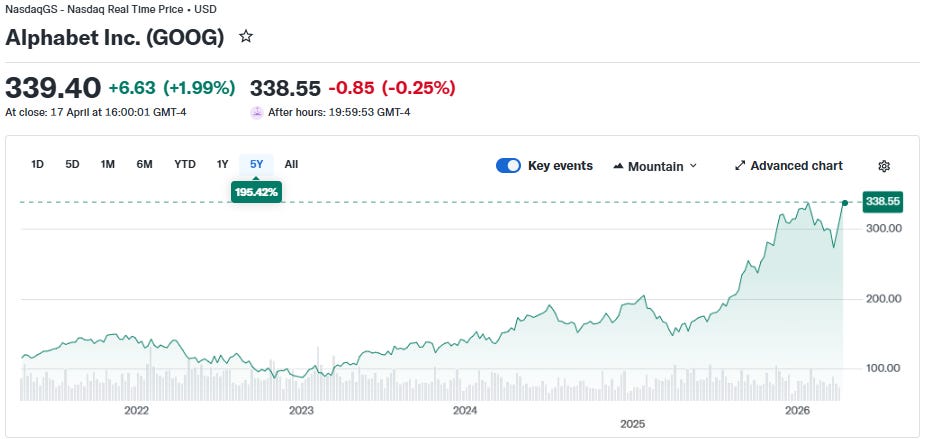
Google’s market share has broadly held firm in the wake of everything AI. By held firm, I mean its share price has gone through the roof, and its AI offering is growing ever stronger.
Happy, happy shareholders. Sad, sad people. (Image Credit: Harry Clarkson-Bennett)
But I don’t think all is as rosy as it seems.
Google’s search product isn’t addictive – as much as they’re trying to change that. Nobody hangs out there except saddos like us. And audiences – particularly younger ones – have options.
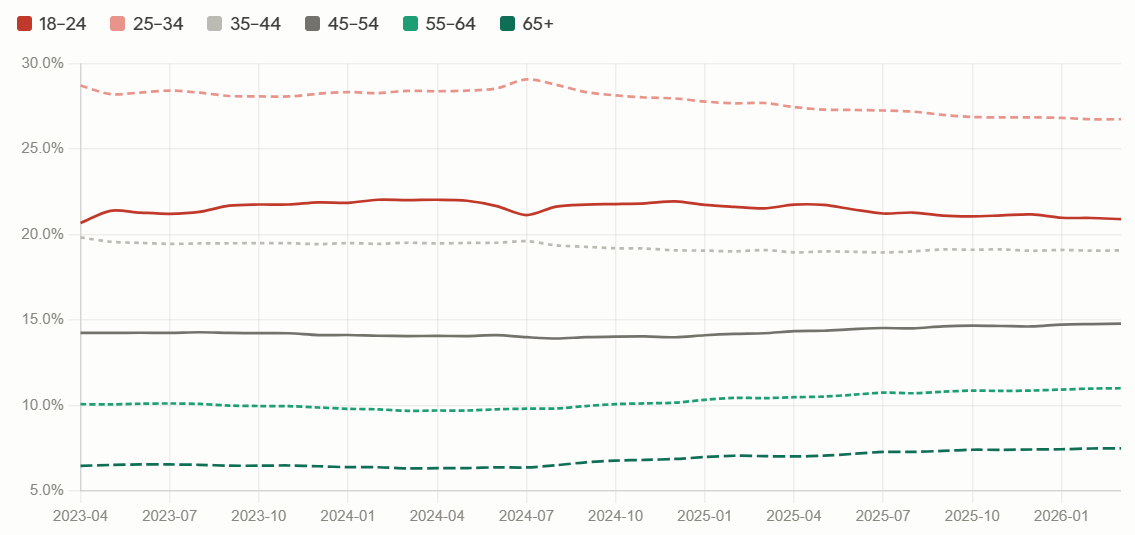
They’re turning away from more traditional methods of information retrieval, and that’s a big problem. Even for Google.
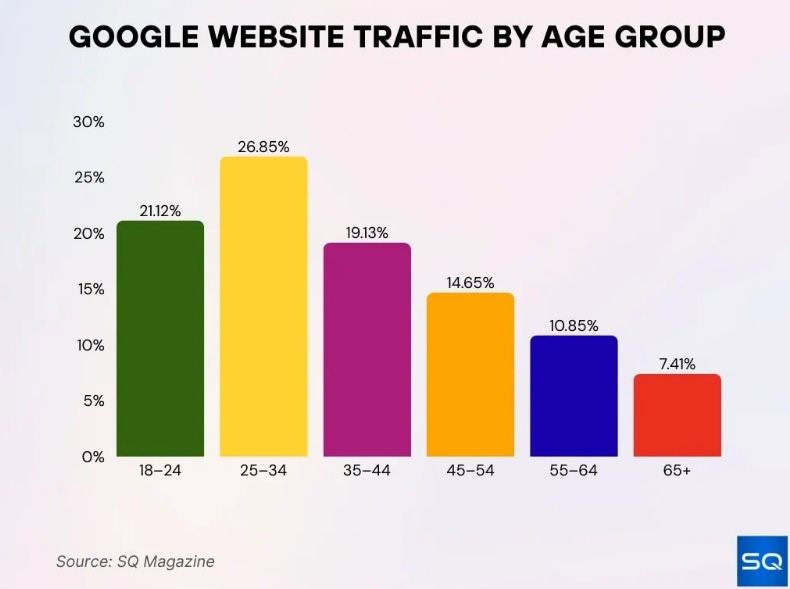
Google’s worldwide audience share by age group (Image Credit: Harry Clarkson-Bennett)
Even the search engine giant isn’t immune.
Older audiences – those already ingrained in the system – are taking up a larger percentage of their audience. The younger ones have more exciting and addictive options, and best believe they’re using them to find stuff.
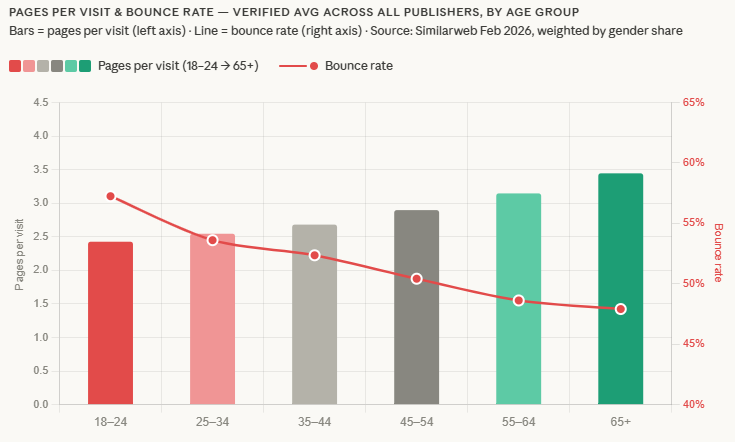
Worldwide Google engagement data broken down by age group (Image Credit: Harry Clarkson-Bennett)
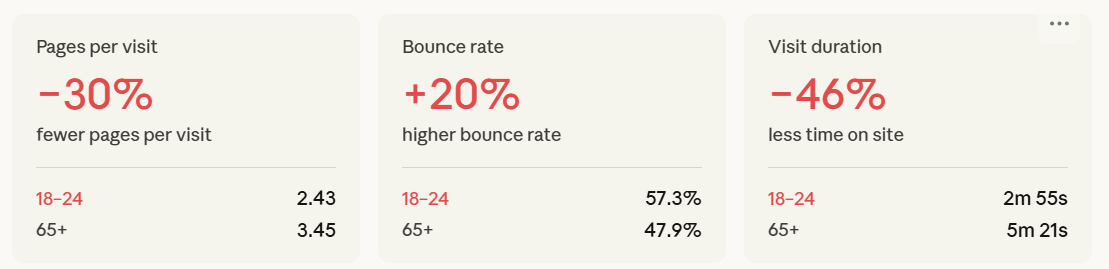
Across every engagement metric, 18-24-year-olds have deteriorated faster than 65+ users over the same period. Shorter visit duration, fewer pages per visit, and a worse bounce rate. And it’s declining more rapidly with younger audiences.
Evolution for Google and the wider web is a necessity.
Although interesting to note that the 18-24 year old audience share has only suffered a small decline according to Similarweb data. The real losses were in the 25-34 cohort.
TL;DR
The publishing industry and Google have more in common than perhaps either of us cares to admit.
The changes Google has made are a very deliberate effort to engage with – and retain – younger audiences. Audiences who behave differently.
Engagement data on news websites (pages per visit, bounce rate, and time on site) declines with audience age. Exactly the same is true of Google.
AI Mode is Google’s attempt to create a “sticky” product. One aimed at younger audiences.
What’s Changed?
Well, the obvious:
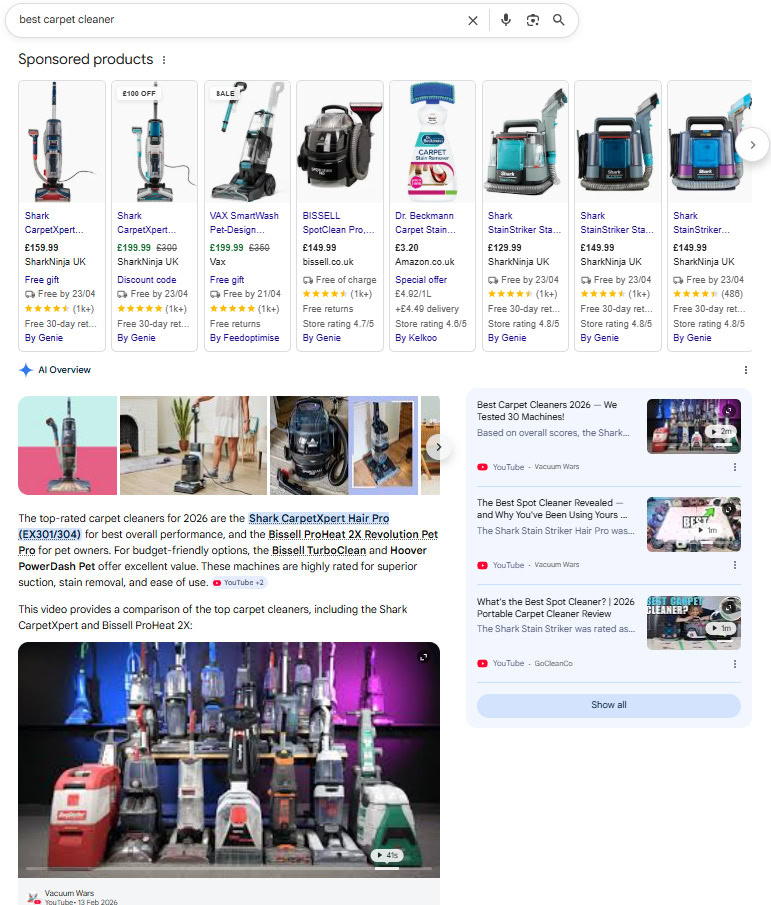
Just look at the SERP for almost any term, particularly middle-of-the-funnel comparison ones.
You can’t move for video, which I sort of hate (Image Credit: Harry Clarkson-Bennett)
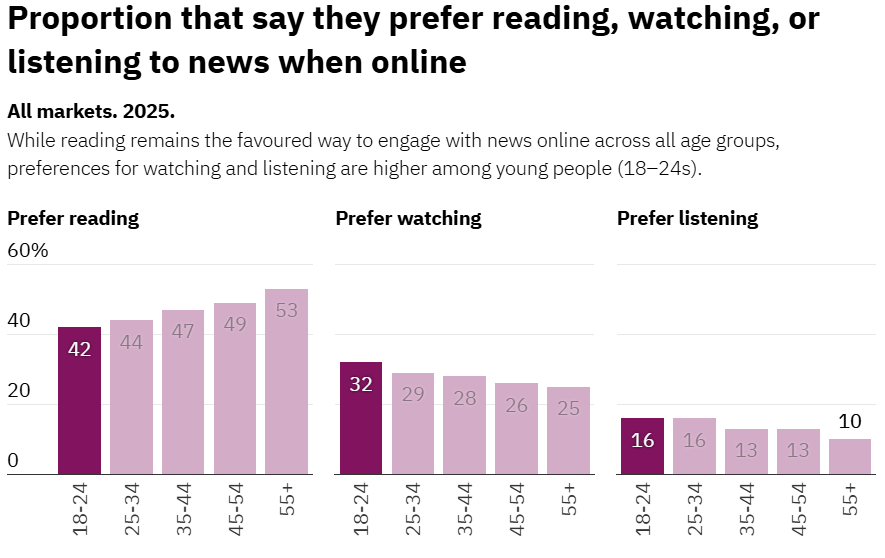
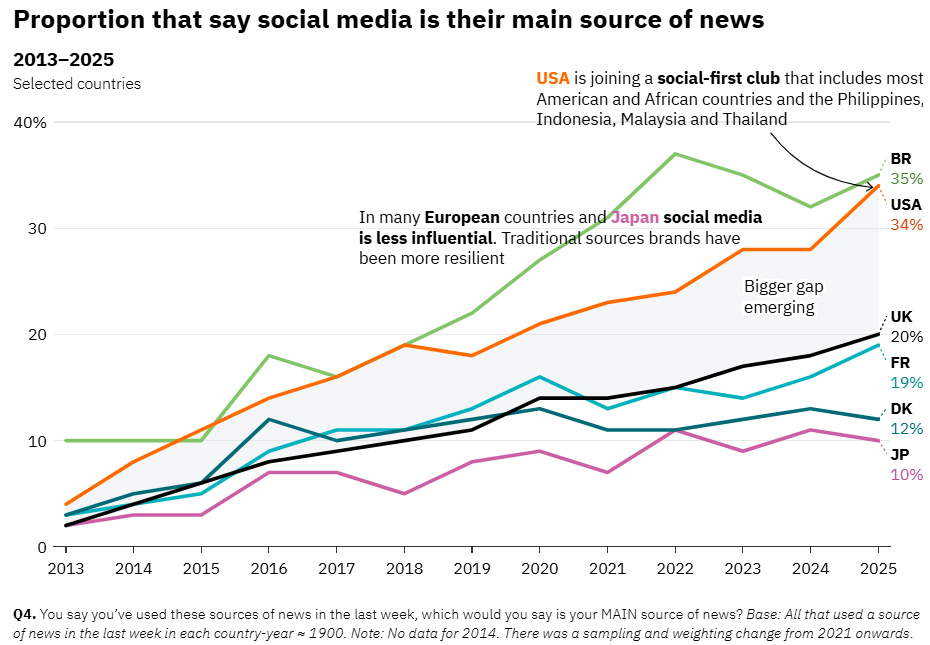
What people apparently want is not very publisher, or legacy-search-friendly. What they want is video.
Particularly the youth.
Right now, it’s feasible children spend almost four hours per day watching video on YouTube and TikTok. Four hours. That same group spends just four minutes on publisher websites.
The younger you are, the more time you spend watching, the less you spend reading. So the obvious counter (from a company that primarily organizes written content) is to saturate the market with video content.
Obviously, it’s very helpful if you own the market.
You could say that’s Google’s way of paying for AIOs – a far more expensive SERP to generate –due to the massive computational power and energy needed to run large language models (LLMs).
But I am not going to insinuate anything of the sort. It would be incomprehensible to me that the guys who earn the entire ad and search market would make the ad side of the business more expensive to run to pay for their search experiments.
Wait a minute…
Why Now?
I think this is a direct response to two things;
The 2023 Code Red Google sent out in response to OpenAI.
Younger audiences shifting information retrieval methods.
One is obvious.
OpenAI forced Google to move quicker than they would’ve liked. Hence, all the absolute trash in AI Overviews in the beginning. Well, and sort of now. It smacked of a product that hadn’t gone through the required amount of rigorous testing.
Two is more nuanced.
The youngest demographic spends less time on search (Image Credit: Harry Clarkson-Bennett)
This data correlates almost perfectly with the Similarweb data I pulled. In isolation, this may not be a problem. Could be as simple as saying younger audiences will grow into it.
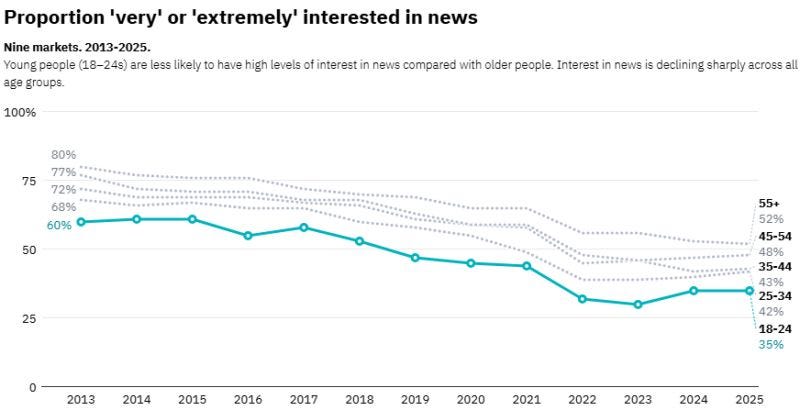
But I don’t think that argument works. We see it in news and publishing. We are living through it, and we’re watching the decline in real time.
Younger audiences have the highest recorded screen time on record (globally, 7 hours 22 minutes), but are spending less and less time reading. More on far more visually engaging, stimulating, and addictive technologies.
Based on screen time alone, younger audiences should spend the most time on Google. But they don’t. I’m sure that is blatantly obvious to the Googlers.
The same principle is true of more traditional search.
At the risk of sounding a bit too AI-y, this is a really seismic shift. Ironically, not one driven by AI. Not entirely. One driven by a combination of big tech’s insatiable appetite for money, a lack of trust in more traditional brands, and the rise of the creator ecosystem.
And AI, obviously.
As someone in the comments said, Google is Unc. Maybe a little like news websites. Their ability to attract younger audiences has diminished.
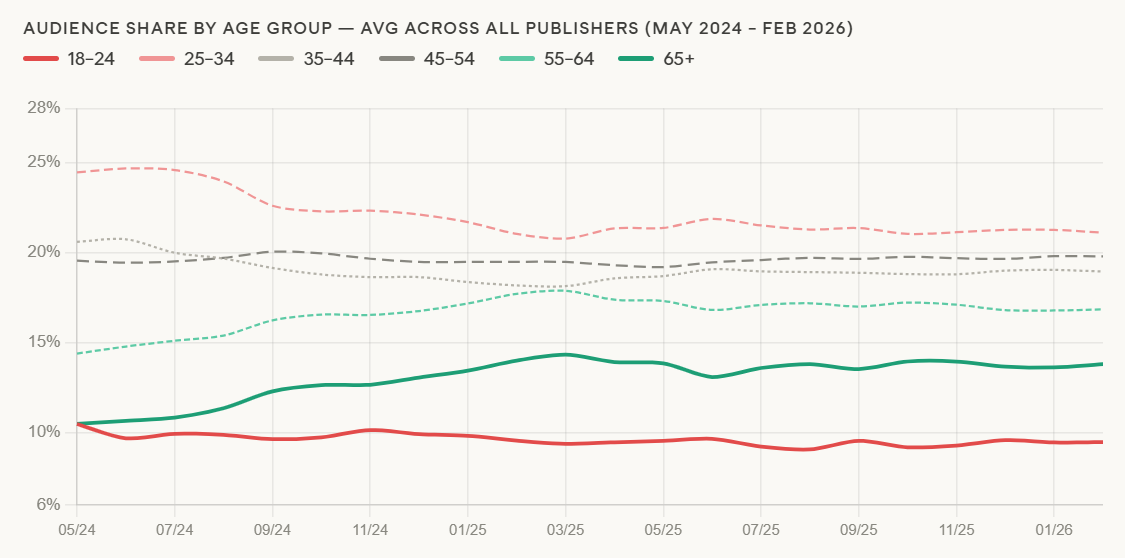
Similarweb publisher data – last 24 months (using six major UK publishers) (Image Credit: Harry Clarkson-Bennett)
I think we can clearly correlate the changes Google has made to the reduction in the younger audience share for publishers. A generation less inclined to click.
One could argue that the traffic losses so many seem to have suffered are almost exclusively from younger audiences. I certainly am.
Audiences more likely to adopt new technologies – particularly flashy ones.
There Are Clear Parallels Between News And Search
Google has gotten richer, as has the AI bubble. All that money has to come from somewhere.
It’s everyone else who struggles.
These changes are designed to counter a younger generation’s shift toward people and ultra-engaging platforms that encourage passive or more incidental methods of information retrieval.
Either you browsed a news website (a real paper if you felt fancy) or you searched for it. But the discovery layer changed, and search – the engine that powered the volume-driven publishing model for two decades – is responding.
Responding to younger audiences’ shifting consumption habits. Just like publishers and websites will have to.
They expect you to just appear. Algorithmic consumption has reduced the need, want, and desire to actively seek something out. If what you serve isn’t delivered directly to their feed, you don’t exist.
Combine this with diminishing trust in more traditional brands, zero-click searches, and the rise of the creator, and you can see why publishers and Google are having to change.
There have been alternatives to Google when it comes to accessing and retrieving information – Instagram, Amazon, YouTube, et al., for years.
Really, this is, or has been, Search Everywhere Optimization. It has been around for a decade. It is also, IMO, why reframing SEO as GEO or some other BS because of LLMs is so moronic.
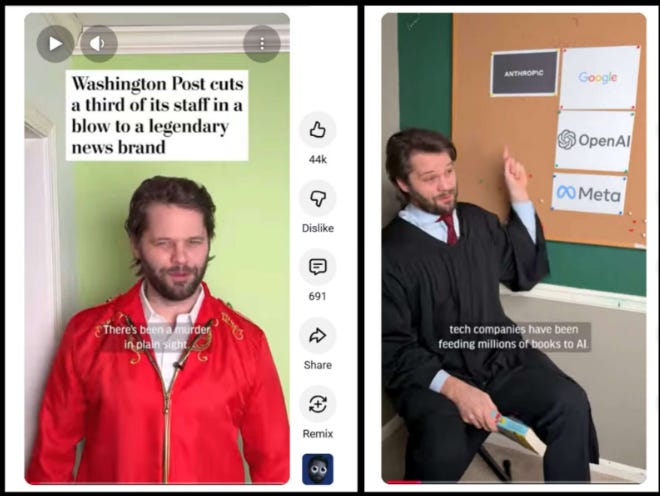
Views for The Washington Post’s YouTube channel dropped by 85% from its peak in April (54 million views) to 8.2 million views in September 2025, two months after Jorgenson’s exit. (Image Credit: Harry Clarkson-Bennett)
And now the individual has become the competition. The creator economy – soon to be worth $480 billion – has produced a new class of competitor: individuals with direct audience relationships, authentic voices, and none of the structural cost of a legacy newsroom.
And this is a problem for Google, too. People used to use their organizational skills to satisfy all of their needs. Now, it is so heavily navigational that it’s hard to know how much “new” stuff people really use it for.
Outside of news, at least, ironically.
Will This Work?
If it’s anything like news publishers, their primary concern is to continually generate new and engaged audiences with habitual products. AI Mode could absolutely be that product. Discover is their version of a social network. They are, in their own way, engaging products.
Although the low intent nature of Discover makes the advertising rubbish, and Google not really care about it. Sad, but true.
Like Google, the engagement data for publishers tells a pretty bleak story.
Similarweb publisher data (using six major UK publishers) (Image Credit: Harry Clarkson-Bennett)
If we isolate this to the youngest and oldest audience, it’s pretty clear what is going on.
(Image Credit: Harry Clarkson-Bennett)
Younger audiences:
Are far less engaged with the traditional news offering than older audiences.
Use these (and any) websites differently.
There’s no denying that younger audiences have more diverse and engaging options. This means they use websites like news publishers differently. To fact-check. To confirm something isn’t just spurious BS. To scan and skim.
The same is true of Google. Less of a discovery journey. More one of fact-checking and navigational searching.
Now, I’m not insinuating that older audiences get stuck with adverts and can’t use a menu. That can’t account for an extra 14 minutes of time spent on news websites.
But having watched my mother with a computer, it’s not impossible.
So, What’s The Answer?
To lean into what the new generation likes. Adapt and evolve.
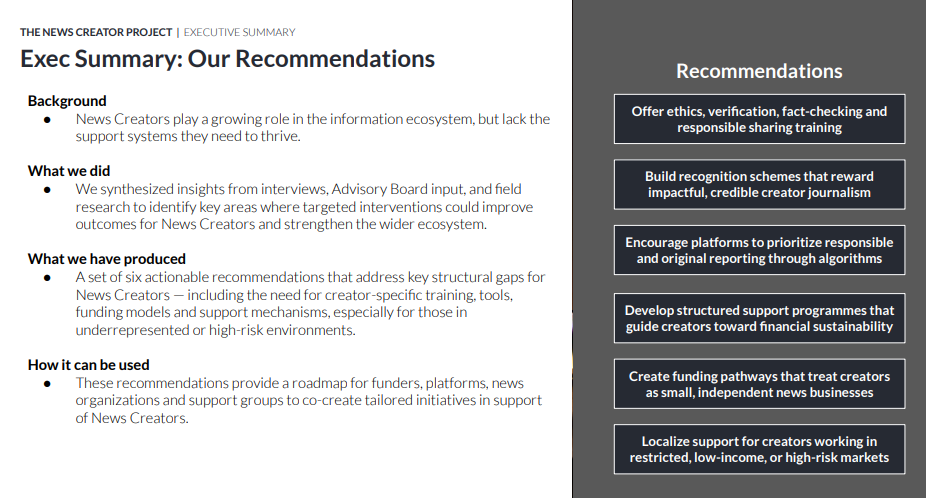
Exec summary from WAN-FRA x the FT Strategies News Creator Project (Image Credit: Harry Clarkson-Bennett)
The same is true for search (internally and externally) and publishers. If you work for Google, it makes complete sense you would try to expand your video presence in the SERP and prioritize “quality” UGC.
The quality part is lacking as most of the internet – as we’re finding out – is a stinking pile of garbage.
But notoriously, the tide is tricky to swim against.
For publishers, it means working with creators, leveraging their audiences and ability to deliver things quickly. Differently. And creators can benefit from the trust associated with proper news organizations.
Is it that unreasonable to think Google should do the same?
Instead of abusing their position, they could start by giving people an idea of the impact of AIOs and AI Mode. I’m not a financial guru, but I reckon Google has enough money to build and foster creator and publisher programs that are not one-sided. That brings genuine value to people and the wider information retrieval ecosystem.
In this scenario, everyone benefits. When AI companies refuse to pay for publisher content, everyone loses.
LLMs lose because they have less unique, human-created, quality content to train on.
Publishers lose because they are forced to suppress their visibility and don’t get any money.
They’re as diverse and resilient as any publisher (Image Credit: Harry Clarkson-Bennett)
Final Thoughts
Unfortunately, I think the recent spate of job losses in the publishing industry is just the beginning. Bauer, the BBC, The Washington Post. It’s not UK or SEO-specific. 100,000 roles are becoming 70,000 ones. Teams are shrinking. And there are real-world ramifications.
We are not in a good moment. Some of this can be attributed to AI. But I think more of it is due to longer-term economic difficulties, audiences switching off from traditional news, and things like the Site Reputation Abuse update destroying much-needed revenue lines overnight.
It is hard to make these businesses profitable. Google doesn’t have that problem. But they’re not immune to changing behaviors and becoming yesterday’s news either.
The Facts About Google Click Signals, Rankings, And SEO via @sejournal, @martinibuster
Clicks as a ranking-related signal have been a subject of debate for over twenty years, although nowadays most SEOs understand that clicks are not a direct ranking factor. The simple truth about clicks is that they are raw data and, surprisingly, processed with some similarity to human rater scores.
Clicks Are A Raw Signal
The DOJ Antitrust memorandum opinion from September 2025 mentions clicks as a “raw signal” that Google uses. It also categorizes content and search queries as raw signals. This is important because a raw signal is the lowest-level data point which is processed into higher level ranking signals or used for training a model like RankEmbed and its successor, RankEmbedBERT.
Those are considered raw signals because they are:
Directly observed
But not yet interpreted or used for training data
The DOJ document quotes professor James Allan, who gave expert testimony on behalf of Google:
“Signals range in complexity. There are “raw” signals, like the number of clicks, the content of a web page, and the terms within a query.
…These signals can be created with simple methods, such as counting occurrences (e.g., how many times a web page was clicked in response to a particular query). Id. at 2859:3–2860:21 (Allan) (discussing Navboost signal) “
He then contrasts the raw signals with how they are processed:
“At the other end of the spectrum are innovative deep-learning models, which are machine-learning models that discern complex patterns in large datasets.
Deep models find and exploit patterns in vast data sets. They add unique capabilities at high cost.”
Professor Allan explains that “top-level signals” are used to produce the “final” scores for a web page, including popularity and quality.
Raw Signals Are Data To Be Further Processed
Navboost is mentioned several times in the September 2025 antitrust document as popularity data. It’s not mentioned in the context of clicks having a ranking effect on individal sites.
It’s referred to as a way to measure popularity and intent:
“…popularity as measured by user intent and feedback systems including Navboost/Glue…”
And elsewhere, in the context of explaining why some of the Navboost data is privileged:
“They are ‘popularity as measured by user intent and feedback systems including Navboost/Glue’…”
In the context of explaining why some of the Navboost data is privileged:
“Under the proposed remedy, Google must make available to Qualified Competitors …the following datasets:
1. User-side Data used to build, create, or operate the GLUE statistical model(s);
2. User-side Data used to train, build, or operate the RankEmbed model(s); and
3. The User-side Data used as training data for GenAI Models used in Search or any GenAI Product that can be used to access Search.
Google uses the first two datasets to build search signals and the third to train and refine the models underlying AI Overviews and (arguably) the Gemini app.”
Clicks, like human rater scores, are just a raw signal that is used further up the algorithm chain to train AI models to better able match web pages to queries or to generate a quality or relevance signal that is then added to the rest of the ranking signals by a ranking engine or a rank modifier engine.
70 Days Of Search Logs
The DOJ document makes reference to using 70 days of search logs. But that’s just eleven words in a larger context.
Here is the part that is frequently quoted:
“70 days of search logs plus scores generated by human raters”
I get it, it’s simple and direct. But there is more context to it:
“RankEmbed and its later iteration RankEmbedBERT are ranking models that rely on two main sources of data: [Redacted]% of 70 days of search logs plus scores generated by human raters and used by Google to measure the quality of organic search results.”
The 70 days of search logs are not click data used for ranking purposes in Google, AI Mode, or Gemini. It’s data in aggregate that is further processed in order to train specialized AI models like RankEmbedBERT that in turn rank web pages based on natural language analysis.
That part of the DOJ document does not claim that Google is directly using click data for ranking search results. It’s data, like the human rater data, that’s used by other systems for training data or to be further processed.
What Is Google’s RankEmbed?
RankEmbed is a natural language approach to identifying relevant documents and ranking them.
The same DOJ document explains:
“The RankEmbed model itself is an AI-based, deep-learning system that has strong natural-language understanding. This allows the model to more efficiently identify the best documents to retrieve, even if a query lacks certain terms.”
It’s trained on less data than previous models. The data partially consists of query terms and web page pairs:
“…RankEmbed is trained on 1/100th of the data used to train earlier ranking models yet provides higher quality search results.
…Among the underlying training data is information about the query, including the salient terms that Google has derived from the query, and the resultant web pages.”
That’s training data for training a model to recognize how query terms are relevant to web pages.
The same document explains:
“The data underlying RankEmbed models is a combination of click-and-query data and scoring of web pages by human raters.”
It’s crystal clear that in the context of this specific passage, it’s describing the use of click data (and human rater data) to train AI models, not to directly influence rankings.
What About Google’s Click Ranking Patent?
Way back in 2006 Google filed a patent related to clicks called, Modifying search result ranking based on implicit user feedback. The invention is about the mathematical formula for creating a “measure of relevance” out of the aggregated raw data of clicks (plural).
The patent distinguishes between the creation of the signal and the act of ranking itself. The “measure of relevance” is output to a ranking engine, which then can add it to existing ranking scores to rank search results for new searches.
Here’s what the patent describes:
“A ranking Sub-system can include a rank modifier engine that uses implicit user feedback to cause re-ranking of search results in order to improve the final ranking presented to a user of an information retrieval system.
User selections of search results (click data) can be tracked and transformed into a click fraction that can be used to re-rank future search results.”
That “click fraction” is a measure of relevance. The invention described in the patent isn’t about tracking the click; it’s about the mathematical measure (the click fraction) that results from combining all those individual clicks together. That includes the Short Click, Medium Click, Long Click, and the Last Click.
Technically, it’s called the LCIC (Long Click divided by Clicks) Fraction. It’s “clicks” plural because it’s making decisions based on the sums of many clicks (aggregate), not the individual click.
That click fraction is an aggregate because:
Summation: The “first number” used for ranking is the sum of all those individual weighted clicks for a specific query-document pair.
Normalization: It takes that sum and divides it by the total count of all clicks (the “second number”).
Statistical Smoothing: The system applies “smoothing factors” to this aggregate number to ensure that a single click on a “rare” query doesn’t unfairly skew the results, especially for spammers.
That 2006 patent describes it’s weighting formula like this:
“A base LCC click fraction can be defined as:
LCC_BASE=[#WC(Q,D)]/[#C(Q,D)+S0)
where iWC(Q.D) is the sum of weighted clicks for a query URL…pair, iC(Q.D) is the total number of clicks (ordinal count, not weighted) for the query-URL pair, and S0 is a smoothing factor.”
That formula describes summing and dividing the data from many users to create a single score for a document. The “query-URL” pair is a “bucket” of data that stores the click behavior of every user who ever typed that specific query and clicked that specific search result. The smoothing factor is the anti-spam part that includes not counting single clicks on rare search queries.
Even way back in 2006, clicks is just raw data that is transformed further up the chain across multiple stages of aggregation, into a statistical measure of relevance before it ever reaches the ranking stage. In this patent, the clicks themselves are not ranking factors that directly influence whether a site is ranked or not. They were used in aggregate as a measure of relevance, which in turn was fed into another engine for ranking.
By the time the information reaches the ranking engine, the raw data has been transformed from individual user actions into an aggregate measure of relevance.
Thinking about clicks in relation to ranking is not as simple as clicks drive search rankings.
Clicks are just raw data.
Clicks are used to train AI systems like RankEmbedBert.
Clicks are not directly influencing search results. They have always been raw data, the starting point for systems that use the data in aggregate to create a signal that is then mixed into ranking decision making systems at Google.
So yes, like human rater data, raw data is processed to create a signal or to train AI systems.
Google Bans Back Button Hijacking, Agentic Search Grows – SEO Pulse via @sejournal, @MattGSouthern
Welcome to the week’s Pulse: updates affect what Google considers spam, what happens when you report it, and what agentic search looks like in practice.
Here’s what matters for you and your work.
Google’s New Spam Policy Targets Back Button Hijacking
Google added back button hijacking to its spam policies, with enforcement beginning June 15. The behavior is now an explicit violation under the malicious practices category.
Key facts: Back button hijacking occurs when a site interferes with browser navigation and prevents users from returning to the previous page. Pages engaging in the behavior face manual spam actions or automated demotions.
Why This Matters
Google called out that some back button hijacking originates from included libraries or advertising platforms, which means the liability sits with the publisher even when the behavior comes from a vendor.
You have two months to audit every script running on your site, including ad libraries and recommendation widgets you didn’t write yourself.
Sites that receive a manual action after June 15 can submit a reconsideration request through Search Console once the offending code is removed.
What SEO Professionals Are Saying
Daniel Foley Carter, SEO Consultant, summed up the community reaction on LinkedIn:
“So basically, that spammy thing you do to try and stop users leaving? Yeah, don’t do it.”
Manish Chauhan, SEO Head at Groww, added on LinkedIn that he was:
“glad this is being addressed. It always felt like a short-term hack for pageviews at the cost of user trust.”
Google updated its report-a-spam documentation on April 14 to say user submissions may now trigger manual actions against sites found violating spam policies. The previous guidance said spam reports were used to improve spam detection systems rather than to take direct action.
Key facts: Google may use spam reports to take manual action against violations. If Google issues a manual action, the report text is sent verbatim to the reported website through Search Console.
Why This Matters
Google now states that spam reports can be used to initiate manual actions, making reports explicitly part of its enforcement process in official documentation.
This also raises concerns about potential abuse, as grudge reports and competitor sabotage may become more appealing when reports have a tangible impact. Therefore, the true test will be the quality of reports that Google actually considers.
What SEO Professionals Are Saying
Gagan Ghotra, SEO Consultant, wrote on LinkedIn about why the change may lead to better reports:
“Now spam reports have direct relation to Google issuing manual actions against domains. Google announced if there is a spam report from a user and based upon that report Google decide to issue manual action against a domain then Google will just send the user submitted content in report to the site owner (Search Console – Manual Action report) and will ask them to fix those things. Seems like Google was getting too many generic spam reports and now as the incentive to report are aligned. That’s why I guess people are going to submit reports which have a lot of relevant information detailing why/how a specific site is violating Google’s spam policies.”
Google expanded agentic restaurant booking in AI Mode to additional markets on April 10, including the UK and India. Robby Stein, VP of Product for Google Search, announced the rollout on X.
Key facts: Searchers can describe group size, time, and preferences to AI Mode, which scans booking platforms simultaneously for real-time availability. The booking itself is completed through Google partners rather than directly on restaurant websites.
Why This Matters
Restaurant booking shows how task completion within search works. For local SEOs and marketers, traffic patterns shift: users now often stay within Google during discovery, with bookings routed through partners.
This depends on Google booking partners, which may limit visibility for restaurants outside those platforms, making presence on Google-supported booking sites more important than the restaurant’s own website. This model may or may not extend to other experiences.
What SEO Professionals Are Saying
Glenn Gabe, SEO and AI Search Consultant at G-Squared Interactive, flagged the rollout on X:
I feel like this is flying under the radar -> Google rolls out worldwide agentic restaurant booking via AI Mode. TBH, not sure how many people would use this in AI Mode versus directly in Google Maps or Search (where you can already make a reservation), but it does show how Google is moving quickly to scale agentic actions.
Aleyda Solís, SEO Consultant and Founder at Orainti, noted a key limitation in a LinkedIn post:
“Google expands agentic restaurant booking in AI Mode globally: You still need to complete the booking via Google partners though.”
What counts as spam, what happens when spam gets reported, and what agentic search looks like all got clearer definitions this week.
Back button hijacking becomes a named violation with an enforcement date. Google’s documentation now says spam reports may be used for manual actions, not just fed into detection systems. Agentic search becomes a live product for restaurant reservations in specific markets rather than a talking point about the future.
Now, the compliance work, reporting mechanics, and agentic experience are all clearly understood enough to be tracked directly, instead of just forecasted.
Google Bans Back Button Hijacking, Agentic Search Grows – SEO Pulse via @sejournal, @MattGSouthern
Welcome to the week’s Pulse: updates affect what Google considers spam, what happens when you report it, and what agentic search looks like in practice.
Here’s what matters for you and your work.
Google’s New Spam Policy Targets Back Button Hijacking
Google added back button hijacking to its spam policies, with enforcement beginning June 15. The behavior is now an explicit violation under the malicious practices category.
Key facts: Back button hijacking occurs when a site interferes with browser navigation and prevents users from returning to the previous page. Pages engaging in the behavior face manual spam actions or automated demotions.
Why This Matters
Google called out that some back button hijacking originates from included libraries or advertising platforms, which means the liability sits with the publisher even when the behavior comes from a vendor.
You have two months to audit every script running on your site, including ad libraries and recommendation widgets you didn’t write yourself.
Sites that receive a manual action after June 15 can submit a reconsideration request through Search Console once the offending code is removed.
What SEO Professionals Are Saying
Daniel Foley Carter, SEO Consultant, summed up the community reaction on LinkedIn:
“So basically, that spammy thing you do to try and stop users leaving? Yeah, don’t do it.”
Manish Chauhan, SEO Head at Groww, added on LinkedIn that he was:
“glad this is being addressed. It always felt like a short-term hack for pageviews at the cost of user trust.”
Google updated its report-a-spam documentation on April 14 to say user submissions may now trigger manual actions against sites found violating spam policies. The previous guidance said spam reports were used to improve spam detection systems rather than to take direct action.
Key facts: Google may use spam reports to take manual action against violations. If Google issues a manual action, the report text is sent verbatim to the reported website through Search Console.
Why This Matters
Google now states that spam reports can be used to initiate manual actions, making reports explicitly part of its enforcement process in official documentation.
This also raises concerns about potential abuse, as grudge reports and competitor sabotage may become more appealing when reports have a tangible impact. Therefore, the true test will be the quality of reports that Google actually considers.
What SEO Professionals Are Saying
Gagan Ghotra, SEO Consultant, wrote on LinkedIn about why the change may lead to better reports:
“Now spam reports have direct relation to Google issuing manual actions against domains. Google announced if there is a spam report from a user and based upon that report Google decide to issue manual action against a domain then Google will just send the user submitted content in report to the site owner (Search Console – Manual Action report) and will ask them to fix those things. Seems like Google was getting too many generic spam reports and now as the incentive to report are aligned. That’s why I guess people are going to submit reports which have a lot of relevant information detailing why/how a specific site is violating Google’s spam policies.”
Google expanded agentic restaurant booking in AI Mode to additional markets on April 10, including the UK and India. Robby Stein, VP of Product for Google Search, announced the rollout on X.
Key facts: Searchers can describe group size, time, and preferences to AI Mode, which scans booking platforms simultaneously for real-time availability. The booking itself is completed through Google partners rather than directly on restaurant websites.
Why This Matters
Restaurant booking shows how task completion within search works. For local SEOs and marketers, traffic patterns shift: users now often stay within Google during discovery, with bookings routed through partners.
This depends on Google booking partners, which may limit visibility for restaurants outside those platforms, making presence on Google-supported booking sites more important than the restaurant’s own website. This model may or may not extend to other experiences.
What SEO Professionals Are Saying
Glenn Gabe, SEO and AI Search Consultant at G-Squared Interactive, flagged the rollout on X:
I feel like this is flying under the radar -> Google rolls out worldwide agentic restaurant booking via AI Mode. TBH, not sure how many people would use this in AI Mode versus directly in Google Maps or Search (where you can already make a reservation), but it does show how Google is moving quickly to scale agentic actions.
Aleyda Solís, SEO Consultant and Founder at Orainti, noted a key limitation in a LinkedIn post:
“Google expands agentic restaurant booking in AI Mode globally: You still need to complete the booking via Google partners though.”
What counts as spam, what happens when spam gets reported, and what agentic search looks like all got clearer definitions this week.
Back button hijacking becomes a named violation with an enforcement date. Google’s documentation now says spam reports may be used for manual actions, not just fed into detection systems. Agentic search becomes a live product for restaurant reservations in specific markets rather than a talking point about the future.
Now, the compliance work, reporting mechanics, and agentic experience are all clearly understood enough to be tracked directly, instead of just forecasted.
Your AI Visibility Strategy Doesn’t Work Outside English via @sejournal, @DuaneForrester
This series has been written in English, tested in English, and grounded in research conducted primarily in English. Every framework discussed here (vector index hygiene, cutoff-aware content calendaring, community signals, machine-readable content APIs) was conceived by an English-speaking practitioner, stress-tested against English-language queries, and validated against benchmarks that, as this article will show, are themselves English-weighted by design. That is not a disclaimer, but it is the central problem this article is about.
The AI visibility discourse at large carries the same limitation. One 2024 study analyzing AI evaluation datasets found that over 75% of major LLM benchmarks are designed for English tasks first, with non-English testing treated as an afterthought. The strategies built on top of those benchmarks inherit the same bias.
Enterprise brands are not the villains in this story. Translation-first search content strategies produced imperfect results globally, but markets had learned to live with the nuanced failures. Traditional search indexed what existed, ranked it imperfectly, and the degradation was quiet enough that no one filed a complaint. LLMs raise the bar in a way search never did, and the reason is structural, which is what the rest of this article examines.
The Platform Map
Before optimizing AI visibility in any market, a brand needs to answer a question the English-centric visibility discourse rarely asks: Which AI system are your target customers actually using? The answer varies more dramatically by region than most global marketing teams have accounted for.
South Korea tells a different version of the same story. Naver captured 62.86% of the South Korean search market in 2025 (more than double Google’s share) and since March 2025 has been deploying AI Briefing, a generative search module powered by its proprietary HyperCLOVA X model, with plans for up to 20% of all Korean searches to surface AI-generated answers by end of 2025. Naver is also a closed ecosystem where results route to internal Naver properties, not necessarily the open web. Western brands whose structured data and llms.txt implementation was designed for open-web crawlers are operating with architecture that was never built to reach Naver’s retrieval layer. China and Korea alone account for well over a billion AI-active users on platforms a standard global visibility strategy does not touch.
The Map Is Far Bigger Than We’re Drawing
Those two markets are the ones that get cited because their scale is impossible to ignore. But the platforms being built outside the English-dominant orbit extend considerably further, and the breadth of what has launched in the last two years deserves attention on its own terms.
Europe
France – Mistral AI’s Le Chat was the No. 1 free app in France after its February 2025 launch; the French military awarded Mistral a deployment contract through 2030, and France committed €109 billion in AI infrastructure investment at the 2025 AI Action Summit.
Germany – Aleph Alpha trains in five languages with EU regulatory compliance by design, backed by Bosch and SAP.
Italy – Velvet AI (Almawave/Sapienza Università di Roma) is built specifically for Italian language and cultural context, designed for EU AI Act compliance from inception.
European Union – The OpenEuroLLM initiative, launched in 2025, is developing a family of open LLMs covering all 24 official EU languages.
Switzerland – Apertus (EPFL/ETH Zurich/Swiss National Supercomputing Centre, September 2025) supports over 1,000 languages with 40% non-English training data, including Swiss German and Romansh.
Middle East
UAE/Abu Dhabi – Falcon (Technology Innovation Institute) ranges from 7B to 180B parameters; Falcon Arabic, launched May 2025, outperforms models up to 10 times its size on Arabic benchmarks.
Saudi Arabia – HUMAIN, backed by the sovereign wealth fund, is framed as a full-stack national AI ecosystem.
South and Southeast Asia
India – Bhashini (Ministry of Electronics and IT) has produced over 350 AI-powered language models; BharatGen, launched June 2025, is India’s first government-funded multimodal LLM.
Singapore / Southeast Asia – SEA-LION (AI Singapore) supports 11 Southeast Asian languages; Malaysia, Thailand, and Vietnam have deployed MaLLaM, OpenThaiGPT, and GreenMind-Medium-14B-R1, respectively.
Latin America
12-country consortium – Latam-GPT launched September 2025, led by Chile’s CENIA with over 30 regional institutions, trained on court decisions, library records, and school textbooks, with an initial Indigenous language tool for Rapa Nui.
Africa/Eastern Europe
Sub-Saharan Africa – Lelapa AI’s InkubaLM supports Swahili, Yoruba, IsiXhosa, Hausa, and IsiZulu; Nigeria launched a national multilingual LLM in 2024.
Russia/Ukraine – GigaChat (Sberbank) is the dominant domestically deployed Russian AI assistant; Ukraine announced a national LLM in December 2025, built with Kyivstar and trained on Ukrainian historical and library data.
This list is not really meant to be exhaustive, but it is meant to be disorienting.
Every entry above represents a retrieval ecosystem, a cultural signal hierarchy, and a community proof-point structure that a North American-optimized AI visibility strategy does not reach. But the more important observation is about which direction these models were built in.
The old content strategy model was centrifugal: the brand sits at the center, creates content, translates it, and pushes it outward into markets. Traditional search accommodated this because crawlers are indifferent to cultural authenticity: they index what is there. The imperfect results were tolerated because most markets had no better alternative.
These regional models were built in the opposite direction. A government mandate, a national corpus, a specific cultural identity, a language’s syntactic logic, that is the origin point. The model was trained on what that place knows about itself. A brand’s translated content arrives as a foreign object with no parametric presence, carrying the syntactic and cultural signatures of its origin language. Translation does not retrofit cultural fit into a model that was built without you in it.
And this does not stop at the English/non-English boundary. Even within English, regional identity shapes what a model treats as native. Irish English carries vocabulary – craic, gas, giving out, that exists nowhere else. Australian idiom, Singaporean English, Nigerian Pidgin all have distinct fingerprints. A U.S. brand’s content may read as subtly foreign to a model trained predominantly on British or Irish corpora. The direction of the problem is the same regardless of whether the language is technically shared. So often these aren’t just words. They’re compressed cultural signals. A literal translation gives you the category, but often strips out aspects like intensity, intent, emotional tone, social expectation, or shared history.
The Embedding Quality Gap
The reason translation does not solve this is not just strategic. It’s structural, and it lives in the embedding layer.
Retrieval in AI systems depends on semantic similarity calculations. Content is encoded as a vector, queries are encoded as vectors, and the system identifies matches by measuring distance in that vector space. The accuracy of those matches depends entirely on how well the embedding model represents the language in question. Embedding models are not language-neutral. (I think of this as a kind of cultural parametric distance, or a language vector bias issue.)
The most rigorous current evidence comes from the Massive Multilingual Text Embedding Benchmark (MMTEB), published at ICLR 2025. Even across more than 250 languages and 500 evaluation tasks, the benchmark’s own task distribution is skewed toward high-resource languages. The benchmarks practitioners use to evaluate whether their embedding architecture works in other languages are themselves English-weighted. A leaderboard score that looks reassuring may be measuring performance on a test that does not represent the language actually in use.
The embedding gap does not produce obvious errors. It produces quietly degraded retrieval and content that should surface does not, without any visible failure signal. The dashboards stay green. The gap only becomes visible when someone tests in the actual market language.
When Translation Isn’t Enough
Below the embedding layer sits a problem that is harder to instrument: Cultural context shapes what a model treats as relevant in the first place. Research published in 2024 by Cornell University researchers found that when five GPT models were asked questions from a widely used global cultural values survey, responses consistently aligned with the values of English-speaking and Protestant European countries. The models were not asked to translate anything; they were asked to reason, and their default frame of reference was shaped by the cultural composition of their training data.
Consider a brand headquartered outside France, but operating in France. Their content, even if professionally translated, was likely written by non-French-speaking teams with non-French-market authority signals: the institutional citations, the comparison frameworks, the professional register. Mistral was built on French corpora, with French institutional relationships and French media partnerships as its baseline for what counts as authoritative. A Canadian brand’s French content, for example, is tolerated by a French-speaking human reader. Whether it clears the threshold for a model trained on native French content as its definition of relevance is a different question entirely.
The community signals argument from the previous article in this series applies here with a regional dimension. The platforms that drive AI retrieval through community consensus differ by market. In China, Xiaohongshu now processes approximately 600 million daily searches (nearly half of Baidu’s query volume) with over 80% of users searching before purchasing and 90% saying social results directly influence their decisions. The community signals that matter for AI visibility in China are not the ones a strategy built around English-language review platforms is generating.
A brand may have excellent English-language retrieval infrastructure, strong community signals in Western markets, and a well-architected machine-readable content layer, and still be effectively invisible in Korea, structurally disadvantaged in Japan, and culturally misaligned in Brazil. This is not a failure of execution as much as a failure of assumption about which direction the optimization flows.
What Enterprise Teams Should Do
An honest note before the framework: The documented, auditable evidence base for enterprise-level non-English AI visibility strategies does not yet exist in a form that holds up to scrutiny. Work is being done, but a citable case study requires a defined baseline, a measurable intervention, a controlled timeframe, and independently validated results. A practitioner’s assertion that their work applies to your situation is not that. The absence of rigorous case data is a reason to build with intellectual honesty about what is validated versus directional, not a reason to wait. With that in mind, here’s what you can do today:
Audit AI visibility per language and per market, not globally. Query performance in English tells you nothing about performance in Japanese, and performance with global AI platforms tells you nothing about performance inside Naver’s AI Briefing. The audit needs to happen at the market level, using queries constructed in the local language by native speakers, not translated from English.
Map the AI platforms that matter in each target market before optimizing. The list in the previous section is a starting point, not a permanent reference, as this landscape shifts quarterly. Optimization work (structured data, content APIs, entity signals) needs to be built toward the platforms that actually serve each market.
Build localized content, not translated content. The four-layer machine-readable architecture discussed in this series applies in every language. But a translated version of an English content API is not a localized one. Entity relationships, cultural authority signals, and community proof points all need to be rebuilt for local context. The optimization direction is inward from the market, not outward from the brand.
Accept that English-English is not a single market either. The same structural logic applies within English. A US brand’s content may carry American syntactic and cultural signatures that read as subtly foreign to models trained on predominantly British, Irish, or Australian corpora. Regional English is not a rounding error. It is evidence of the same underlying principle operating on a smaller scale.
Accept that a single global AI visibility strategy is insufficient. The frameworks developed in English, including the ones in this series, are a starting point for one slice of the global market. Extending them globally requires treating each major market as a distinct optimization problem: different platforms, different embedding architectures, different cultural retrieval logic, and a different direction of trust.
Image Credit: Duane Forrester
There is real work to be done. If we step back and look at the big picture again, it’s clear that markets that were once willing to live with the nuanced failures of translation-first content strategies are increasingly operating on platforms built to serve them natively, and that gap is widening. You know I like to name things when the industry hasn’t gotten there yet so here it is: this is the Language Vector Bias problem. And the brands that start closing it now are not catching up to a solved problem. They are getting ahead of the most consequential visibility gap we aren’t really talking about.
Machine-First Architecture: AI Agents Are Here And Your Website Isn’t Ready, Says NoHacks Podcast Host via @sejournal, @theshelleywalsh
AI agents are already here. Not as a concept, not as a demo, but shipping inside browsers used by billions of people. Every major tech company has launched either a browser with AI built in or an extension that acts on your behalf.
Anthropic’s Claude for Chrome can navigate websites, fill forms, and perform multi-step operations on your behalf. Google announced Gemini in Chrome with agentic browsing capabilities, including auto browse, which can act on webpages for you. OpenClaw, the open-source AI agent, connects large language models directly to browsers, messaging apps, and system tools to execute tasks autonomously.
For more understanding about optimizing for agents, I spoke to Slobodan Manic, who recently wrote a five-part series on optimizing websites for AI agents. His perspective sits at the intersection of technical web performance and where AI agent interaction is actually heading.
From Slobodan Manic’s testing, almost every website is structurally broken for this shift.
“It started with us going to AI and asking questions. And now AI is coming to us and meeting us where we are. From my testing, I noticed that websites are nowhere near being ready for this shift because structurally almost every website is broken.”
The Single Biggest Thing That’s Changed
I started by asking Slobodan what’s changed in the last six to nine months that means SEOs need to pay attention to AI agents right now.
“Every major tech company has launched either a browser that has AI in it that can do things for you or some kind of extension that gets into Chrome. Claude has a plugin for Chrome that can do things for you, not just analyze web pages, summarize web pages, but actually perform operations.”
When ChatGPT first launched in 2023, making AI widely accessible, in parallel with how we started typing basic queries in search engines 25 years ago, we asked AI questions. We are now becoming more sophisticated and fluid with our prompting as we realize that AI can do so much more than [write me an email to politely decline an invitation].
Agents represent an even bigger shift to a different dynamic, where AI can complete tasks on our behalf and run complex systems. [Check my emails and delete any that are spam, sort them into a priority group, and surface what needs my immediate attention and provide a qualified response to anything on a basic query, plus make appointments in my calendar for any meeting invites].
I have a theory that brand websites are becoming hubs, the central point that connects all of your content assets online. But Slobodan has gone further. He’s written about websites becoming optional for the end user, with pages built by machines for machines and the interaction happening through closed system interfaces. I asked him to expand on that vision and what kind of timeframe we’re realistically looking at.
“First I’ll say that this is not fully happening today. This is still near to mid future. This is not March 2026,” he clarified. But the signals are concrete.
He was careful not to overstate it. People still like to browse, read, and compare things. Websites aren’t disappearing.
“Just the same way as mobile traffic has not killed desktop traffic even if it’s taken a bigger share of traffic overall, higher percentage of overall traffic while the desktop traffic is staying flat in terms of absolute numbers, I think this is another lane that will open where things will be happening without a human being involved in every step.”
His timeline for this: “Within a year we can have this become a reality. Not majority, but if Google starts rewriting landing pages using AI, we will see this happening probably 2027, if not sooner.”
When Checkout Becomes A Protocol
Slobodan has written that checkout is becoming a protocol, not a page. If an AI agent can buy on your behalf without ever loading a brand’s website, I asked, “What does that mean for how brands build trust and differentiate when the customer never sees their site?”
“If you’re building trust in a checkout page, you’re doing it wrong. Let’s start there. That I firmly believe. This is not to do with AI. This was never the right place to build trust,” he responded.
Slobodan pointed to every Shopify checkout page that looks identical. “There’s no trust built there. It’s just a machine-readable page that looks the same for everyone, for every brand. You’re supposed to be doing your job before the user needs to pay you.”
This is where he referenced Jono Alderson, and the concept of upstream engineering. “Moving upstream and doing work there and not on the website is the only way to move forward for anyone whose job is optimizing websites. That’s SEO, that’s CRO, that’s content, that’s anyone doing any kind of website work.”
He best summarized by saying “Your website is a part of the equation. Your website is not the equation. And that’s the biggest structural shift that people need to make to survive moving forward.”
What SEOs And Brands Should Actually Do Now
I asked what SEOs and brands can practically start doing to transition over the next year. His answer reframed how we should think about the website itself.
“If your website was your storefront, and it was for decades, people come to you, people do business there. It needs to be a warehouse and a storefront moving forward or you’re not going to survive. Simple as that.”
“We had all those bookstores that were selling books in the ’90s and then Amazon shows up and then you need to be a warehouse. You need to exist in two planes at the same time for the near future at least. So focusing only on your website is the most wrong thing you can do moving forward.”
His main area of focus right now is what he calls machine-first architecture. The principle is to build for machines before you build for humans.
“You don’t build your website for humans until you’ve built it for machines. When you’re working on a product page, there’s no Figma, there’s no design, there’s no copy. You start with your schema. What is your schema supposed to say? What is the meaning of the page? You start with the meaning and then from that build into a web page as it’s built for humans.”
He compared it directly to the mobile-first shift. “That did not mean no desktop. That meant do the more difficult version of it first and then do the easy thing. Trust me, it’s a lot more complicated to add meaning and structure to a page that’s already been designed than to do it the other way.”
And it extends beyond the website. “If you’re saying something on your website, you better check all of your profiles everywhere online, what people are saying about you. It’s everything everywhere all at once. But this is what optimization has become and what it needs to be.”
I also put to him the argument that optimizing for LLMs is fundamentally different from SEO. His response was unequivocal.
“Hard disagree. The hardest possible disagree. If you were doing things the right way, working on the foundations and checking every box that has to be checked, it’s not different at all.”
Where he sees a difference is in the speed of consequences. “With AI in the mix, you just get exposed much faster and the consequences are much greater. There’s nothing different other than those two things.”
This echoed something I’ve felt strongly. The cycle is moving more quickly, but there’s so much similarity with what happened at the foundation of this industry 25 to 30 years ago, which I raised in my SEO Pioneers series. We’re feeling our way through in the same way. And Slobodan agreed.
“They figured this out once and maybe we should ask them how to figure it out again.”
Vibe Coding Is A Trap, Deep Work Is The Moat
For my last question, I put it to Slobodan that he’s said vibe coding is a trap and deep work is the only moat left. For the SEO practitioner feeling overwhelmed, what’s the one thing they should actually do this week?
“It’s really the foundations. I hate to give the boring answer, but it’s really fixing every single foundational thing that you have on your website or your website presence.”
He’s watched the industry chase one shiny tool after another. “There’s always a new shiny toy to work on while your website doesn’t work with JavaScript disabled. Just ignore all of that until you’ve fixed every single broken foundation you have on your website.”
On vibe coding specifically, he was precise: “I don’t like the term vibe coding. It just suggests that you have no idea what you’re doing and you’re happy about it. That’s the way that sounds to me. The concept of AI-assisted coding, it’s there. It’s great. It’s not going away.”
“But just focus on what you should be doing first before you use AI to do it faster.”
What resonated with me is how well this applies to writing, too. AI is brilliant at confidently producing a draft that, at first glance, looks great. But when you actually read it, you realize it’s just somebody confidently talking nonsense.
Slobodan nailed the core problem: “You need to know what good is and what good looks like. Because AI will always give you something. If you don’t know enough about that specific thing, it will always look good from the outside. And there’s a reason why everyone is okay with vibing everything except for their own profession, because they try it and they see that the results are just horrific.”
Build For Machines First, Everything Else Follows
The one thing to take away from this conversation is to build for machines first, then humans. Not because human user experience won’t matter, but because getting the machine layer right first makes the human layer better.
Your website is no longer the only version of your business that people, or agents, will encounter. The brands that treat it as part of a wider ecosystem rather than the whole ecosystem are the ones that will come through this transition in the strongest position.
Watch the full video interview with Slobodan Manic here, or on YouTube.
[embedded content]
Thank you to Slobodan for sharing his insights and being my guest on IMHO.
Google’s Patent On Autonomous Search Results via @sejournal, @martinibuster
The United States Patent Office recently published Google’s continuation on a patent for a search system that detects when there is no satisfactory answer for a query and waits to automatically deliver the answer when it becomes available.
Search And AI Assistant
The patent, published in February 2026, is a continuation of an older patent, with the main changes being to apply this patent within the context of an AI assistant. The invention describes solving the problem of answering a question when no actual answer is available at the time a user makes the query. What it does is waits until there’s a satisfactory answer, at which point it circles back to the user with the answer, without them having to ask again.
The patent is titled, Autonomously providing search results post-facto, including in assistant context. Although the patent mentions quality thresholds, those thresholds are defined in the sense of whether the answer meets the user’s needs.
The patent describes six scenarios that would trigger the invention:
When no search results meet defined quality or authoritative-answer criteria.
When results exist but fail to provide a definitive or authoritative answer that satisfies those criteria.
When no results meet quality criteria because the information is not yet available.
When a query seeks a specific answer and no result satisfies the required criteria.
When a resource later satisfies the defined criteria after previously lacking required information.
When a previously available resource is refined or updated so that it now meets the criteria.
Useful And Complete Answers
Google’s patent says that the invention is a solution for times when there is no useful or complete answers because the information does not yet exist or is not good enough, forcing users to keep searching repeatedly.
The system checks if results meet:
A quality standard
Authoritativeness standard
Or a completeness standard.
If the current answers don’t meet those standards, the system will store the query and monitor for new or updated information. Once it becomes available it will send the results to the user later without them searching again.
Follow-Up Questions Are Not Necessary
What is novel about the invention is that it enables follow-up delivery of results after the original query without requiring a new follow-up questions. It also surfaces search results proactively in notifications or assistant conversations.
At a later time, when new or updated information becomes available that satisfies the criteria, the system proactively delivers that information to the user. This delivery can occur through notifications, within an unrelated interaction, or during a later conversation with an automated assistant.
The system may also optionally notify the user that no good results are currently available and ask if they want to be informed when better results appear.
What this system does is it transforms search from a one-time, user-initiated action into a persistent, ongoing process where the system continues working in the background and updates the user when meaningful information becomes available.
Cross-Device Continuity
An interesting feature of this invention is that it can reach out to the user across multiple devices.
Here is where it’s outlined:
[0012] In some implementations, the query is received on an additional computing device that is in addition to the computing device for which the content is provided for presentation to the user.”
This capabiilty is highlighed again in section [0067]:
“For example, the content may be provided for presentation to the user via the same computing device the user utilized to submit the query and/or via a separate computing device.”
It can also go cross-device as a visual and/or audible output across devices and in the form of an automated assistant, and can present the information when the user is interacting with the automated assistant in a different context, describing an “ecosystem” of devices.
Lastly, the patent explains that the information can be surfaced when the user is interfacing with the automated assistant in a completely different context:
[0040]”…the content may be provided for presentation to the user via the same computing device the user utilized to submit the query and/or via a separate computing device. The content may be provided for presentation in various forms. For example, the content may be provided as a visual and/or audible push notification on a mobile computing device of the user, and may be surfaced independent of the user again submitting the query and/or another query.
Also, for example, the content may be presented as visual and/or audible output of an automated assistant during a dialog session between the user and the automated assistant, where the dialog session is unrelated to the query and/or another query seeking similar information.”
Takeaways
The patent (Autonomously providing search results post-facto, including in assistant context) is in line with Google’s vision of tasked-based agentic search, where AI assistants help users accomplish things. This patent could be applied to an AI agent that is asked for tickets to an event when the tickets aren’t yet available. Or it could be applied to making restaurant reservations when the reservations when the dates open up. Both of those scenarios are related to task-based agentic search (TBAS)
Here are seven takeaways:
The system stores data associated with the user about unresolved queries, allowing it to track unanswered information needs over time rather than treating each search as a one-off event.
It delivers results within future interactions, including unrelated assistant conversations, not just through standalone notifications.
The notifications can happen across an ecosystem of devices.
A lack of results is defined by failing to meet quality criteria, which can be the absence of information, the answer not being available yet, or the answer is not available from authoritative sources.
The system focuses on queries that seek specific answers, rather than general informational searches.
It supports cross-device continuity, enabling a query on one device to be fulfilled later on another.
The design reduces repeated searches by eliminating the need for users to check back, then autonomously circling back when the information is available.