5 top tips to boost your local SEO efforts

Local businesses constantly seek effective strategies to enhance their online presence and attract new customers and leads.

In local SEO it’s essential for businesses to stay ahead of the curve to thrive in their communities. 

Below are key tactics to help you boost your local SEO efforts and connect with your target audience more effectively.

1. Harness the power of video content

Video content has emerged as a dynamic tool for engaging audiences and conveying messages. 

The influence of videos in search engine results pages (SERPs) is on the rise, with Google recognizing the popularity of video content among searchers. 

  • Did you know that video search results are localized? This means that viewers near your business location are more likely to encounter your video content, giving you a competitive edge in your local market.

Maximize the impact of your videos on local SEO by:

Including videos on top-performing pages

  • Integrate videos with top-performing website pages, enhancing user engagement time.

Tracking in Search Console

  • Monitor video performance separately within Google Search Console to gain insights into their effectiveness.
VideoPerformanceGSC 800x213

2. Craft authentic and compelling video content

Creating effective video content goes beyond high production values. Authenticity is key to building a genuine connection with your audience. 

Here are some tips for crafting impactful videos:

Showcase your business

  • Offer an inside look into your business operations, brand values, and team members. Highlight what sets your business apart from the competition.

Share testimonials

  • Build trust by featuring customer testimonials that highlight positive experiences.

Avoid over-editing

  • Embrace authenticity over overly polished content. Users tend to appreciate genuine, relatable videos.

3. Embrace texting for enhanced communication

Text messaging has become a preferred communication method, especially among younger generations. 

Offering text-based communication options on your website can enhance customer interactions and streamline lead generation. 

Here’s how to make the most of texting:

Mobile-friendly texting

  • Given that more than half of website traffic comes from mobile devices, offer seamless text communication options for a user-friendly experience.

Integrate texting apps

  • Tools like Leadferno facilitate easy website-to-text integration, enabling multiple team members to engage with potential customers from anywhere.

Utilize analytics 

  • Leverage analytics provided by texting apps to gain insights into customer behavior and bridge the gap between website visits and conversions.

4. Share valuable insights and transparency

Transparency and valuable information build trust with your audience. 

By sharing information openly, you can establish credibility and showcase your expertise. 

Consider the following tactics:

Offer tutorials and DIY content

  • Provide tutorials, guides, and DIY content that addresses common questions or challenges your audience may have.

List your prices

  • Display pricing information to help potential customers make informed decisions and eliminate the need for unnecessary inquiries.

Address basic information

  • Recognize that many users prefer accessing basic information without making direct calls. Save them time and effort by providing upfront answers.

Dig deeper: How to create a helpful FAQ page (with 7 examples)


Get the daily newsletter search marketers rely on.


5. Optimize Google Business Profile

Your Google Business Profile is a vital asset for local SEO. Make the most of it by considering the following strategies:

Category rotation

  • If your business experiences seasonal demand shifts, adjust your main category accordingly. This ensures that your profile aligns with the changing needs of your audience.
GBP categories
  • Link your Google Business Profile to a relevant page on your website. Choose a page with authority, backlinks, and relevant content for optimal impact.
Bus Accident Lawyer New York After GBP Link Change 800x422

Keyword alignment

  • Analyze organic search results for your main keywords to determine the best-performing pages. Link your profile to the top-ranking pages to enhance your local search visibility.

Boosting your local search visibility today and beyond

Local businesses can position themselves ahead of the competition by implementing these strategies to further elevate their local SEO efforts.

Video content, authentic (and simple) communication, transparency, and fine-tuning your Google Business Profile are powerful tools that help businesses thrive in their local markets. 

By adopting these tactics, you can enhance your online visibility, engage your target audience and drive meaningful results for your business.


Opinions expressed in this article are those of the guest author and not necessarily Search Engine Land. Staff authors are listed here.


Related stories

New on Search Engine Land

@media screen and (min-width: 800px) { #div-gpt-ad-3191538-7 { display: flex !important; justify-content: center !important; align-items: center !important; min-width:770px; min-height:260px; } } @media screen and (min-width: 1279px) { #div-gpt-ad-3191538-7 { display: flex !important; justify-content: center !important; align-items: center !important; min-width:800px!important; min-height:440px!important; } }

About the author

Erin Jones

Erin Jones has been working in digital marketing and SEO since 2005. She specializes in local SEO, social media, and brand reputation. She works at Sterling Sky and is also a Local University faculty member. Erin is passionate about community and loves helping brands connect with their ideal audiences both online and in person.

https://searchengineland.com/boost-local-seo-efforts-tips-431093


How generative AI will change SEO as a profession

Generative AI is going to revolutionize the SEO industry, but perhaps not in the way you think.

Yes, your day-to-day job as an SEO is most likely going to look different in a few years’ time. But are bots going to replace you?

“Absolutely not,” said Britney Muller, Marketing & SEO Consultant at Data Science 101, and Dave Davies, Amplification Team Lead at Weights and Biases. But there’s no denying the industry is evolving.

So how will generative AI change SEO as a profession and what can you do to stay ahead of the curve? Muller and Davies shared their thoughts on generative AI and the future of SEO at SMX Advanced.

AI is not replacing SEO

Muller was adamant that AI would not be coming for SEO jobs. However, she did note that the industry would have to adapt depending on how Google incorporates AI into search results:

  • “AI is not the be-all and end-all. In fact, I think the shine will start to wear off as we continue to see the limitations of large language models (LLMs) and how much additional work is required to do things well.”
  • “LLMs have so many issues that the researchers building this technology have yet to figure out. They are based on a probability distribution and are consistently not factual.”
  • “Google has done information retrieval very well within search and I think LLMs could be a nice addition to really better define the questions that people have and surface additional information.”

Technical SEOs will have an advantage

Davies added that technical SEOs may be better positioned to handle the change that generative AI brings than those specializing in content SEO:

  • “John Mueller from Google said that as long as machines read websites, technical SEO will remain as important as it is. I think that summarizes exactly what sort of world we’re heading into now.”
  • “I think technical SEOs are going to have a bit of an advantage – but content SEO will eventually follow. It just just has to change. The structure that they’ll be optimizing for I think will change.”
Screenshot 2023 08 22 At 17.19.38 800x448

Both Davies and Muller agreed that links may change form and not be such a significant ranking factor in the future. Things like mentions or references to a site may become more valuable signals than traditional links. As Davies explained:

  • “I’m not saying link building is dead, but I think its value is about to be significantly adjusted. It will evolve and might not look like the traditional links that we know and use today – but some version of that instead.”
  • “Think about the way LLMs are constructed in this linguistic space. They use tokens and they use relationships to make connections. Those things are still very important.”
  • “The whole mission of neural networks is to establish understanding between different things and so I believe that will still carry weight – but it might not look as specific as links and link building. Perhaps it could be mentions instead? Perhaps it could take the form of something else and just evolve.”

Prompt customization is key

SEOs will need to master prompt customization for AI to deliver the best results, according to Muller. Fine-tuning based on goals and data is crucial vs. a one-size-fits-all approach.

  • “You really need to customize prompts, learn about prompt engineering and implement those things strategically. I know Andrew Ng just came out with a really great quick and easy course, partnered with Open AI, on that very topic and does a beautiful job explaining those key concepts. So I would definitely check that out,” Muller said.
  • “ChatGPT actually has an API that you can use to customize prompts. It makes things a bit easier for the people that I work with, for my teams, for my clients, and it kind of puts the power in their hands as far as here’s how we need to approach this with an iterative process.”

Saving time on content creation

Numerous SEOs are exploring generative AI for content creation, including headlines, product descriptions and articles. There are current concerns with the quality of responses, however, these issues could potentially be resolved over time, as Davies pointed out:

  • “Generative AI can write quite well. Is it right all the time? No. It’s just a little hack right now. But moving forward, this will speed things up – like with tasks that I was previously doing manually such as looking at what entities were on a page.”
  • “I still need to use my brain and go OK, [generative AI] missed this and that. I then also need to fact-check. But this saves me probably half an hour per piece of research.”
Screenshot 2023 08 22 At 17.19.21 800x444

Search may expand beyond webpages

In the future, search may move beyond webpages into new environments that don’t yet exist on the web today.

  • “In the next five years, I think we’re just going to see a move into two different sorts of landscapes. I think search will diminish a little bit and move into, I don’t want to say Metaverse, but into different environments that don’t exist right now,” Davies said.

Simplifying code

Muller already uses ChatGPT extensively as a code assistant, highlighting that it’s particularly adept at tasks like generating Python scripts:

  • “I think it’s important to make note that code in its nature is supposed to be unambiguous, unlike human language, and so generative AI is a lot better, in my opinion, at generating accurate code outputs for things I’m trying to accomplish, whether it be a Python script for a program or just pandas to clean up data. It’s phenomenal at those tasks.”

Get the daily newsletter search marketers rely on.


Judicious use is required

Although generative AI will transform SEO as a profession, careful application is still essential due to the potential for incorrect uses – and this is the reason Muller doesn’t believe that this technology represents the end of SEO as a career. At least not yet.

  • “Remember, generative AI is a prediction model based on a probability distribution. So if you imagine that it only read let’s say 100 books that were in the realm of sci-fi, and you ask it a medical question, it’s not going to do so well. But it might do really well with generating a new sci-fi character,” Muller said.
  • “Given that context, generative AI is only as good as the text and information it’s trained on, which is inherently problematic because ChatGPT and LLMs are essentially trained on all of the Internet, which isn’t the best place to grab completely factual information or have representation across marginalized groups of people and topics.”
  • “These models don’t have emotions. They aren’t reasoning. They don’t have common logic like humans do. And so you have to be really, really, really careful about how you use them, because it’s very easy when you enter a prompt to automate the bias that you already have by the sheer nature of how you ask a question, it’s going to follow that train of thought.”

Related stories

New on Search Engine Land

@media screen and (min-width: 800px) { #div-gpt-ad-3191538-7 { display: flex !important; justify-content: center !important; align-items: center !important; min-width:770px; min-height:260px; } } @media screen and (min-width: 1279px) { #div-gpt-ad-3191538-7 { display: flex !important; justify-content: center !important; align-items: center !important; min-width:800px!important; min-height:440px!important; } }

About the author

Nicola Agius

Nicola Agius is Paid Media Editor of Search Engine Land after joining in 2023. She covers paid search, paid social, retail media and more. Prior to this, she was SEO Director at Jungle Creations (2020-2023), overseeing the company’s editorial strategy for multiple websites. She has over 15 years of experience in journalism and has previously worked at OK! Magazine (2010-2014), Mail Online (2014-2015), Mirror (2015-2017), Digital Spy (2017-2018) and The Sun (2018-2020). She also previously teamed up with SEO agency Blue Array to co-author Amazon bestselling book ‘Mastering In-House SEO’.

https://searchengineland.com/how-generative-ai-change-seo-431036


What’s the difference between regular SEO and enterprise SEO? by Digital Marketing Depot

Seo Performance Graphs People 800x450

Enterprise SEO—quite literally—refers to SEO that happens at an enterprise-sized company.

Enterprise SEO produces unique challenges for SEOs and digital marketers to overcome for maximum impact. The slower decision-making processes at the enterprise level, organizational silos, historical enterprise SEO neglect, and a lack of understanding from stakeholders on the importance of SEO can dismantle even the most seasoned search expert’s efforts.

This guide from Conductor addresses the eight enterprise SEO challenges that are the most common hurdles to scaling and maximizing impact and how to solve them.

Visit Digital Marketing Depot to download Scaling Enterprise SEO: Navigating Unique Challenges for Maximum Impact.


Related stories

New on Search Engine Land

@media screen and (min-width: 800px) { #div-gpt-ad-3191538-7 { display: flex !important; justify-content: center !important; align-items: center !important; min-width:770px; min-height:260px; } } @media screen and (min-width: 1279px) { #div-gpt-ad-3191538-7 { display: flex !important; justify-content: center !important; align-items: center !important; min-width:800px!important; min-height:440px!important; } }

About the author

Digital Marketing Depot

Digital Marketing Depot is the resource center for digital marketing strategies and tactics. Created by Third Door Media, Digital Marketing Depot features a robust library of hosted white papers, eBooks, original research, and webinars on a wide range of digital marketing topics- from advertising, analytics, data and content management, to email marketing, SEO and PPC campaign management, and much more. Visit us at http://digitalmarketingdepot.com.

https://searchengineland.com/whats-the-difference-between-regular-seo-and-enterprise-seo-431071


How to safeguard your content strategy in an AI-driven search landscape

Search engines, especially Google, are in a constant state of evolution. 

Earlier this month, Google announced de-emphasizing HowTo and FAQ rich results in search.

Last year, to promote more user-centric content, Google added “experience” to their foundational criteria of expertise, authority, and trust, urging marketers to hone in on what matters to end users and consumers.

Google’s recently released guidelines for creating helpful content outline the vital criteria marketers need to be aware of in a search world that’s constantly evolving and driven by AI.

Today, the paramount question isn’t about quantity but rather the quality and impact of the content. 

How can we gauge its effectiveness, align our strategies with changing search algorithms, and understand evolving customer behavior? 

This article delves into strategies and data-driven methods you can deploy to ensure your content remains future-proof and relevant in the age of AI. We will be covering: 

  • Google SGE: What does it mean for content creators?
  • Multisearch and experience: Essential factors for your content strategy
  • Helpful content strategy: 5 must-haves for success

Google SGE: What does it mean for content creators?

Google believes that valuable content is user-centric. 

Their Search Generative Experience (SGE) aims to provide users with accurate answers without navigating away from Google’s homepage. 

Results must have credible citations for validation. As content creators, our challenge is ensuring content is discoverable, consistently distributed, and adequately referenced. 

Google-Search-Generative-Experiences-Must-Haves

To prepare for SGE (slated to launch in December 2023), brands can consider these three steps:

Discovery

Ensure that your valuable content is easily found. Due to gaps in your platforms, CMS and Programming practices, most sites face indexing issues.

Regularly monitor Search Console for technical requirements and indexation and apply the appropriate schema to enhance content discoverability. This is the most critical element for content.

Learn more about future-proofing your digital presence in my previous article.

Discovery-Assets-Critical-Future-Proofing

Relevance

Your content should be pertinent, rich in entities, and topical. Incorporating both branded and non-branded content is crucial. 

I’ve extensively discussed the competitive advantage of entity search and steps to devise an entity-first strategy in other articles. 

Your content should have the right mix of branded and non-branded, navigational, and transactional content. 

Long-tail queries account for almost 35% of traffic and almost 50% of conversions, according to Ahrefs.

Content created around such queries drives more qualified traffic over branded content and is a crucial content pillar.

Visibility

The content displayed in SGE constantly changes, making it vital to keep track of frequently featured results and incorporate similar content types into your strategy. 

We suggest creating a list of results that often appear in SGE and ensuring your content strategies include those content types.

A solid knowledge graph of your brand, localized and current events, videos, and an expert perspective help ensure content is visible in rich results and SGE.  

Ensure your Google Business Profile (GBP), PPC campaigns and PR campaigns are enriched and enhanced with the same topics, entities, images and content to bring consistency. 


Get the daily newsletter search marketers rely on.


Multisearch and experience: Essential factors for your content strategy

In 2022, Google launched its Multisearch feature. Brands are now encouraged to diversify their content offerings, incorporating images, videos, news, and more.

Organizing, fine-tuning, and ensuring this diverse content is discoverable is crucial. 

As a brand, you must go through a three-step process to maintain consistency by centralizing all assets, optimizing them, and ensuring they are discoverable.  

Future-proof experience from discovery to advocacy

Google recently added experience as part of their helpful content guidelines and new metrics that consider site loading speeds.

Google has always measured experience based on bounce rate, how fast your page loads, and how the user interacts with your content. 

Their new metric that measures page experience, called Interaction to Next Paint, also stresses the need for how responsive your site and page are to the user’s query.  

Delivering a consistent omnichannel experience across all touch points, including all devices and channels, is critical. 

When we prioritize Google as a channel, we should also ensure message and image consistency from GBP to paid ads, website, emails, and PR campaigns.

While planning or accessing your content strategy, consider all types of content, including images, videos, news, web stories, etc. 

Personalizing experience is key for winning, but the experience must be consistent across all channels and devices. 

Helpful content strategy: 5 must-haves for success

AI-generated content offers a promising frontier for content creation, but harnessing its potential requires a balanced approach. 

Google announced that AI-generated content is not against its content guidelines as long as the content is not intended to manipulate rankings and it solves user needs. 

AI can be a great tool for drafting content, followed by fact-checking and a thorough human editorial review to maintain accuracy, authenticity, and relatability.

In an age of information saturation, standing out requires producing helpful content that serves the needs of your audience, and this hinges on building a solid foundation that aligns with your business goals. 

Here are the five must-haves that are crucial for any helpful content strategy:

1. Content audit

Recognizing the current landscape of your content is vital for meaningful growth and refinement. 

A content audit is a comprehensive review of the content KPIs on your website, from discoverability to SERP presence to performance. 

This audit helps identify which content pieces are serving your business goals and what gaps are present you can fill in and build on. 

Qualitative, quantitative metrics and performance metrics are must have to do content audits and gaps. 

Content Audit Must Haves 800x450

2. Forecasting

Anticipating the potential impact of content is essential for optimizing resources and achieving maximum engagement. 

Forecasting means assessing your content’s projected reach (opportunity), engagement, and conversion potential. 

Content creators can better tailor their content by: 

  • Understanding the anticipated resonance with target audiences and possible trending topics.
  • Analyzing past content successes.

This ensures the content piece has the desired effect and delivers on audience expectations and business goals.

3. Content marketing plan

Strategic planning paves the path for content that engages and drives business objectives. 

A content marketing plan is a strategic roadmap that outlines your content goals, methods to achieve them, and metrics to evaluate success. 

By tying your plan back to the KPIs discovered in the content audit, you can ensure you’re making data-driven decisions that will have the right impact.

4. Content calendar

Creating a detailed schedule for your content plan ensures consistency and maximum engagement with your audience. 

A content calendar organizes the production and publication of content over a specific timeframe, enabling strategic distribution and allowing you to capitalize on current trends or seasonal events.

5. Performance reporting

To refine and enhance content, understanding its ongoing impact is paramount. 

Performance reporting gathers data on how your content is doing, from engagement rates to audience feedback, allowing for iterative improvement and alignment with audience needs.

Adapt your content strategy for the AI-powered search era. Understand Google's guidelines for creating helpful content for searchers.

Future-proofing your content strategy

In a digital landscape dominated by evolving algorithms and AI-driven search capabilities, the mandate for content creators and marketers has never been clearer: adaptability and a user-centric approach are paramount. 

Brands must:

  • Understand the customer journey and its touchpoints.
  • Bring a data-driven approach to decision-making.
  • Evolve content writer jobs to be more strategy-oriented. 

We also need to ensure our platforms are integrated to accomplish experience goals. 

The wave of changes, from Google’s Search Generative Experience to Multisearch functionalities, necessitates that we remain agile, proactive, and deeply attuned to audience needs. 

As AI continues to reshape the search domain, having a holistic understanding of our audience is more important than ever to ensure that what we create today remains relevant, valuable, and future-proof.


Opinions expressed in this article are those of the guest author and not necessarily Search Engine Land. Staff authors are listed here.


Related stories

New on Search Engine Land

@media screen and (min-width: 800px) { #div-gpt-ad-3191538-7 { display: flex !important; justify-content: center !important; align-items: center !important; min-width:770px; min-height:260px; } } @media screen and (min-width: 1279px) { #div-gpt-ad-3191538-7 { display: flex !important; justify-content: center !important; align-items: center !important; min-width:800px!important; min-height:440px!important; } }

About the author

Benu Aggarwal

Benu Aggarwal, founder and president of Milestone Inc., is a highly recognized expert in digital marketing solutions, voice search, SEO and local. Benu oversees product development, client services, technology and strategic vision for the company. Under her leadership, the company has prospered as it launched a suite of SEO-first software products and thousands of websites of which dozens won design and technology awards. With her technical marketing experience, entrepreneurial spirit, and motivating attitude, Benu has the ability to translate technical ideas into tangible practice that drive results for customers.

https://searchengineland.com/safeguard-content-strategy-ai-driven-search-landscape-431023


No, AI won’t change your marketing job: A contrarian perspective

Artificial intelligence (AI) is over-hyped.

  • AI is not the panacea to your business’s woes. 
  • AI will not fix your unproductive team. 
  • AI will not catapult your career overnight. 

AI is an emerging technology that has captured the zeitgeist, and its long-term impact is unknown. 

Three tenets of my argument for why AI will not change your job include:

  • The need for emotional intelligence.
  • The value of human relationships.
  • The view that AI is a tool, not a replacement for humans.

Emotional intelligence over artificial intelligence

AI will not change the people element of your job. Knowing how to work with people and empowering them to bring their best remains unchanged as technology advances. 

The current era of emerging generative AI is exciting, but it will not replace the need for humans to interact with humans. 

If it ever does, then we as a species have a much bigger problem.  

Instead of taking a course on AI or scrolling through your social media feed to uncover the latest AI hacks, take a course on public speaking or read about how emotions impact decision-making. 

Focusing your time on your “soft skills,” becoming more of a “people person”, and improving your overall emotional intelligence (EQ) will make you a much more well-rounded professional than knowing the ins and outs of AI. 

Humans are emotional beings that use reason to help rationalize our largely emotionally driven decisions. 

Being self-aware of how your emotions impact your decisions and how the emotions of others impact decisions, then using that information to improve your interactions with people are critical life skills. 

The value of EQ cannot be overstated in improving your relations with co-workers, customers, and even your family members.  

AI can help you find data and craft messaging to communicate a message, but AI cannot anticipate nor respond to the emotional reactions of those receiving the message. 

Emotions must be considered in all human interactions, and AI has no emotions. 

I pick EQ every time over AI. 

Human – not artificial – relationships 

Developing, maintaining, and growing relationships remains the most important skill in your career. 

Without that ability, you will find yourself working with people who do not know you, do not trust you and do not offer you help.

A lack of strong relationships limits your prospects of advancing within any organization. Your contributions will likely be undervalued or unnoticed. 

You cannot be successful without the ability to work productively with other people. AI will not change the importance of relationships in your job.

AI does not change the need for you to develop relationships with your customers. 

AI will help you understand and extract insights from large customer datasets to help you craft creative messaging, but AI will not change the need for you to speak with your customers and collect information directly from them. 

What about chatbots? Can’t AI chatbots replace the need for human customer support and customer outreach? 

I argue no, AI chatbots cannot and should not replace the human element. AI can help kick off the conversation in some scenarios, but human intervention should always be a part of the equation. 

Many of us hate speaking to robot voices or chatting with bots when trying to reach customer support, but we have to do those things because many businesses have placed reducing costs over human connections. 

Does AI make chatbots and robot voices more believable? 

Some are even “advanced” enough to fool people into thinking they are talking with a human. But to what end?    

AI does not change the need for you to build a genuine relationship with your customers.

Marketers know the importance of customer relationships because, without those relationships, marketers cannot build brands and drive sales.


Get the daily newsletter search marketers rely on.


Generative AI is the newest and arguably the flashiest tool in recent memory. 

Through its ability to craft creative and copy for marketers, it can remove the human element of our messaging. It can, but in my opinion, it should not.  

If you utilize AI to remove the human element entirely from your messaging, you will create less quality content and miss the uniqueness that humans can only create. 

AI is a tool to help you craft content more efficiently, but it does not replace the need for human content creators. 

Spam is spam whether it is human or AI-created. 

Generative AI’s issues with hallucinations stating incorrect information with confidence are well documented. 

These hallucinations might decrease in time as technology progresses, but AI will never be a perfect source of truth. Imperfect humans create AI tools with imperfect data. 

AI does not replace the need for marketers. AI is just another tool that can be used by marketers to make their jobs easier. 

Dig deeper: Crawlers, search engines and the sleaze of generative AI companies

Prioritize humans over AI

To be clear, I am not opposed to AI. I use generative AI tools to speed up tasks, brainstorm, conduct research, create rough drafts, etc. 

AI is a great topic for any marketer to learn about and test its various tools. 

However, there are many other arguably more important things you could be doing instead, like improving your EQ, building deeper relationships with your co-workers, and speaking directly to your customers. 

This is not a zero-sum game; your time and energy are finite. Prioritize items that will bring you closer to accomplishing your goals. 

AI can make you more efficient at work, but it should not replace the humanity of your work. 

Dig deeper: How relying on LLMs can lead to SEO disaster


Opinions expressed in this article are those of the guest author and not necessarily Search Engine Land. Staff authors are listed here.


Related stories

New on Search Engine Land

@media screen and (min-width: 800px) { #div-gpt-ad-3191538-7 { display: flex !important; justify-content: center !important; align-items: center !important; min-width:770px; min-height:260px; } } @media screen and (min-width: 1279px) { #div-gpt-ad-3191538-7 { display: flex !important; justify-content: center !important; align-items: center !important; min-width:800px!important; min-height:440px!important; } }

About the author

Scott Garrett

Scott is a digital marketing leader with more than a decade of experience developing and executing multi-channel marketing programs to build brands and drive growth. Scott currently serves as the Director of Digital Marketing at Aprio, a premier CPA and business advisory firm. Prior to Aprio, Scott spent time in various digital marketing roles both agency-side and client-side working for small businesses to multinational corporations. Scott is a graduate of James Madison University (BBA, Marketing) and the University of Denver (MBA).

https://searchengineland.com/ai-wont-change-marketing-job-contrarian-perspective-431020


Google sending notifications that UA has stopped processing data

Google has been busy sending notifications that Universal Analytics properties have stopped processing data

Third Door Media, the parent company of Search Engine Land, received one such notification for a UA property – and several other search marketers also confirmed they have received a notice for websites they work on or own within the past 24 hours.

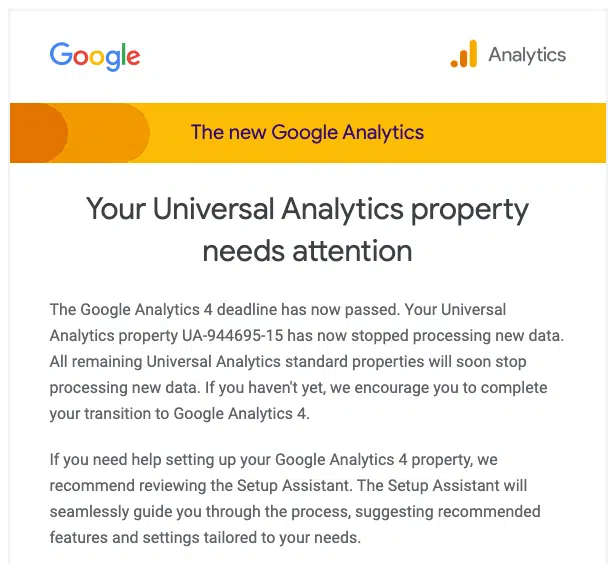
The notification. Google’s email started with “Your Universal Analytics property needs attention” and went on to say:

“The Google Analytics 4 deadline has now passed. Your Universal Analytics property [UA property number] has now stopped processing new data. All remaining Universal Analytics standard properties will soon stop processing new data. If you haven’t yet, we encourage you to complete your transition to Google Analytics 4.

If you need help setting up your Google Analytics 4 property, we recommend reviewing the Setup Assistant. The Setup Assistant will seamlessly guide you through the process, suggesting recommended features and settings tailored to your needs.”

Here’s a screenshot:

Google Ua Property Needs Attention

Several people also sharing their notifications on social media:

Why we care. Multiple polls have shown that the majority of search marketers hate Google Analytics 4 – especially GA4’s user interface. Even though many marketers have set up GA4, they will likely continue using UA until the bitter end.

53 days later. It’s now been 53 days since July 1, the date on which we were told – repeatedly – that Google would stop processing data on Universal Analytics properties as part of the forced switch to Google Analytics 4. To our surprise that didn’t happen.

  • UA continued to process data on July 1. This despite a year-long multichannel assault of switch-or-else warnings (blog posts, emails, social media, etc.) and that super annoying red intrusive interstitial countdown clock every time you logged into GA.
  • UA properties were still processing data on Aug. 1.
  • And it continues to process data on many UA properties today – though Google once again promises that will end “soon.”

When is soon? We’ll find out soon. In Google’s world, that could mean your property is collecting data for weeks or even months from now.


Related stories

New on Search Engine Land

@media screen and (min-width: 800px) { #div-gpt-ad-3191538-7 { display: flex !important; justify-content: center !important; align-items: center !important; min-width:770px; min-height:260px; } } @media screen and (min-width: 1279px) { #div-gpt-ad-3191538-7 { display: flex !important; justify-content: center !important; align-items: center !important; min-width:800px!important; min-height:440px!important; } }

About the author

Danny Goodwin

Danny Goodwin has been Managing Editor of Search Engine Land & Search Marketing Expo – SMX since 2022. He joined Search Engine Land in 2022 as Senior Editor. In addition to reporting on the latest search marketing news, he manages Search Engine Land’s SME (Subject Matter Expert) program. He also helps program U.S. SMX events. Goodwin has been editing and writing about the latest developments and trends in search and digital marketing since 2007. He previously was Executive Editor of Search Engine Journal (from 2017 to 2022), managing editor of Momentology (from 2014-2016) and editor of Search Engine Watch (from 2007 to 2014). He has spoken at many major search conferences and virtual events, and has been sourced for his expertise by a wide range of publications and podcasts.

https://searchengineland.com/google-sending-notifications-that-ua-has-stopped-processing-data-431074


How to build SEO into a new website from the ground up

Launching a new website is one of the more exciting projects for a company. And during these projects, everyone involved obsesses over the smallest details as if their lives depended on it. 

The colors, the logos, the fonts, the pictures – no stone is left unturned, except the stone that has SEO underneath it. Often, SEO is the team not allowed in the room.

After the big launch, everyone expects traffic to appear magically. When it doesn’t, they have to spend more money fixing an SEO problem. 

Building SEO from the ground up in a website is less expensive and gets results faster compared to trying to bolt it on as an afterthought. 

This article will explain the three stages of a website launch and how SEO should play a part in each stage:

  • The strategy phase
  • The build phase
  • The launch phase

If your company is launching a new website and you want to advocate for SEO during the process, read on.  

3 stages of a website launch

Stage 1: The strategy phase

In the strategy phase, teams discuss how the website will look and function. 

While others are debating about whether the website should have black and white or color photos, your job is to lay the foundation for SEO. 

The best way to do that is through the following key tasks that will impact how designers and developers build the site: 

  • Keyword research
  • SEO siloing

Keyword research

Keyword research helps you align your website content with the queries that your target audience uses when they search for what you have to offer. 

What role does this play in the new website? 

The keyword research you do during the planning stage will impact what content shows up on the website at launch. For example, it can help build the navigation on the site and what the topics will be. 

You will get a chance to engage the team during this phase by asking them questions to create your seed list of keywords, like:

  • What are the main topics your website should be relevant for?
  • What would you search for on a search engine if you were looking for what we have to offer? 
  • How does our audience describe what we have to offer? 
  • What are the problems that our products or services solve? What would someone search for if they had those problems?

You should have a nice list after exploring these questions (and possibly more). Then you must do the heavy lifting of refining that keyword list with the right SEO tools.

Once you have refined the list, you can see more clearly what the main navigation will look like. And I’ll touch on what to do with that next in SEO siloing.

SEO siloing

SEO siloing helps to organize content and links on a website. Some of the goals of SEO siloing include:

  • Helping users navigate the website with ease.
  • Maximizing your site’s relevance for important keywords, thus helping pages to rank.
  • Building your site’s expertise and authority on a subject matter.

With your keyword research, you can mock up a site architecture that will support those keywords with content.  

How? I’ll use a fictional power tools website as an example of how you might architect a site using keyword research.

If you ran a power tools company that sold cordless power tools, electric power tools and gas-powered tools, then your keyword research would likely show that you want to go after key terms like “cordless power tools,” “electric power tools” and “gas-powered tools,” among others. 

As you create the site navigation for the website’s designers and developers (yes, you should be involved in this!), you’d show how the site navigation and content will support those keywords. 

Below is a graphic illustrating the landing pages and subpages to be developed on the power tools website. The pages will have content that supports the primary keywords.

SEO siloing example

SEO siloing takes things further and indicates how to link these pages. 

Stage 2: The build phase

As you move away from the strategy phase and enter into the build phase, the designers/developers create the site. 

This is usually the longest phase of the website launch, and it’s another time when your job is to ensure everyone is thinking about SEO.

There are three primary areas of concern: 

  • The technical aspect of the website.
  • The content development on the site.
  • The on-page optimization of the site.

Technical aspects

Many website designers and developers aren’t well-versed in SEO. So they can mistakenly build a site that works against a search engine’s ability to crawl and understand a website.

Not only that, but you could build pages that don’t offer the best user experience. And many website publishers want to keep Google’s page experience update in mind as they optimize their pages.

Before they start their work, make sure your designers/developers are on the same page with SEO-friendly web design. 

Have discussions about how the website will:

  • Be easily accessible and crawlable for search engines.
  • Ensure people using all types of devices can access the site with ease.
  • Have webpages that are easy to interact with (links, buttons, pop-ups, etc.).
  • Be fast and secure. 

The people building the site should keep the following SEO-friendly design principles in mind:

  • Clean code
  • A fast site
  • Mobile-friendliness
  • Core web vitals
  • Avoiding annoying pop-ups
  • Implementing HTTPS

Google has information on many of these topics at Google for Developers.

The content

Content is one of the most important SEO tasks in a website launch.

Google wants to rank the highest quality content in its search engines. And given that you are competing against millions of other websites, this part must count.

As the person advocating for SEO, you need to ensure each landing page and subpage is filled with quality, helpful content. 

As you are creating the content, ask questions like:

  • Will the content be created with the necessary experience and expertise for the topic? 
  • Is your website/brand positioning itself as an authority on the topic? 
  • Can people trust you?
  • Are you answering the query better than your competition?
  • Are you including data from the search results like “People Also Ask and Searches related to in addition to addressing common FAQs?
  • Are you including original research, data, opinions and images?
  • Are you fact-checking and citing quality, relevant resources?
  • Are you writing with a high degree of accuracy when discussing “Your Money or Your Life” topics?

For more, see Google’s:

Dig deeper. How to survive a Google core update and come out on top. 

Optimization

Once the pages are built and the content is in, the next step is to optimize every page to the best of your ability. 

There is no one-size-fits-all checklist here, but some of the most important on-page tactics to consider are:

  • Readability: Is your content written at a grade level appropriate for the audience and the subject matter?
  • Meta tags: Do each of your webpages have original and compelling title tags and meta descriptions with the right character count, that includes your keywords?
  • Heading tags: Are the heading tags on webpages properly formatted in the right sequence? (H1, H2, H3, H4, etc.)
  • Keyword optimization: Can you tweak the content using keywords to improve the page’s relevancy, even a little bit more?
  • Image optimization: Are the images on the page optimized so that you have more chances to drive traffic through images in the search results?
  • Alt text: Did you include alt text on images for the vision impaired?
  • Schema: What opportunities are available to you to clarify to the search engines what the page is about, and also to enhance your search engine results listings? See Schema.org for more.
  • Other structured data: Have you formatted the page to make it easier for search engines and people to understand the content? (Table of contents, tables, bulleted lists, etc.)
  • Links: Are your links fully qualified? Absolute links may take more work upfront but are easier to maintain in the long run.

Get the daily newsletter search marketers rely on.


Stage 3: The launch phase

It’s go time and the pressure is on.  

The launch phase should go smoothly if everything was done well leading up to it. However, there are still some critical SEO tasks in the pre-launch and launch phases.

Pre-launch

Before the site goes live, do the following tasks:

  • Accessibility: Crawl the website with an SEO tool to see if there are any errors.
  • Analytics: Make sure Google Analytics and Google Search Console are correctly configured. 
  • Technical: Ensure things like the XML sitemap, HTML site map and robots.txt file are set up properly. 

Launch

Launch day is an exciting time for everyone involved. In terms of SEO, this stage is all about monitoring and reacting accordingly.

Look for things like:

  • Technical errors: Using SEO tools, monitor the site for technical issues.
  • Indexing problems: It may take a few days or weeks for the site to be fully indexed, but be sure to watch for any indexing problems that arise.

After launch, remember that SEO will never end – it will progress and change.

As long as you have competition, and as long as Google makes changes to Search, you will need an SEO strategy for your website.

Start strong with your new website 

With more competition now than ever in search results, building SEO into a new website from the ground up gives you a better chance to perform.

The sooner you can begin driving traffic, the better – every day counts as you work to get ahead of your competition. 

If you are part of a website launch team, ensure everyone thinks about SEO at every stage, including the strategy, build and launch phases, by following the guidance in this article. 

Dig deeper: SEO during website development and post-launch: Key considerations


Opinions expressed in this article are those of the guest author and not necessarily Search Engine Land. Staff authors are listed here.


Related stories

New on Search Engine Land

@media screen and (min-width: 800px) { #div-gpt-ad-3191538-7 { display: flex !important; justify-content: center !important; align-items: center !important; min-width:770px; min-height:260px; } } @media screen and (min-width: 1279px) { #div-gpt-ad-3191538-7 { display: flex !important; justify-content: center !important; align-items: center !important; min-width:800px!important; min-height:440px!important; } }

About the author

Bruce Clay

Bruce Clay is the founder and president of Bruce Clay Inc., a global digital marketing optimization firm providing search engine optimization, PPC management, paid social media marketing, SEO-friendly site architecture, content development, and SEO tools and education.
Clay authored the book “Search Engine Optimization All-In-One For Dummies,” now in its fourth edition, and “Content Marketing Strategies for Professionals.” He wrote the first webpage-analysis tool, created the Search Engine Relationship Chart® and is credited with being the first to use the term search engine optimization. Bruce Clay’s renowned SEO training course is available online at SEOtraining.com.

https://searchengineland.com/new-website-launch-stages-seo-431014


Bing Chat data may never come to Bing Webmaster Tools

Microsoft told us that we should expect Bing Chat data in Bing Webmaster Tools by May 2023, well, we are now a few months after that deadline and we still do not have any Bing Chat data in Bing Webmaster Tools. In fact, Bing has been talking about this feature since February and guess what, now Bing has gone silent about it.

What Microsoft is saying now. Well, Microsoft is not saying much now and hasn’t said much since May 2023. “Microsoft has nothing more to share on Bing Chat data in Bing Webmaster Tools at this time,” a Microsoft press representative told Search Engine Land today.

Update: After I posted this, Microsoft followed up and said they, “committed to launching Bing Chat data in Webmaster Tools.”

Canel announced that data from Bing Chat would be included in Bing Webmaster tools several weeks ago. He didn’t say precisely when it would be included at that time.

Coming in May we were told. “We will be shipping in May in Bing Webmaster Tools UX and Bing Webmaster Tools API,” Cancel said when asked if Bing Chat data is coming to Bing Webmaster Tools. He said in another tweet, “We will start reporting clicks and impressions in Bing Chat in the following weeks.”

Here are those tweets:

It was built. The Bing Webmaster Tools team built it out, it just was never released. Here is a screenshot Fabrice Canel shared at the end of May when he said they were a few days away from releasing it. Fabrice wrote on there, “The anticipation is building! We’re diligently auditing and fine-tuning to ensure accuracy and precision. Stay tuned for the upcoming new performance report, just a few more days to go.”

Bing Chat Webmaster Tools

Why the delay. I can only speculate but it seems to be that the higher-ups at Microsoft do not want this data in the hands of site owners. I suspect that the click-through rates that Bing Chat would show site owners would be horribly low and Microsoft does not want that data to get out to the public.

There could be technical reasons why it was not released but from what I can tell, this feature was ready to go and Microsoft Bing decided intentionally not to release it. Why? Like I said, publishers and site owners were concerned about AI answering questions well and full enough that users would not need or want to click over to the source.

Why we care. We were hoping that Bing would step up and share this data in a transparent manner. We were not expecting Google to do the same with Google Search Console. But Microsoft Bing has been more transparent with Search and Bing Chat than Google has been with Google Search or SGE.

It is sad to see we are now a few months since Bing teased Bing Chat data in Bing Webmaster Tools and Microsoft won’t comment on this feature at this point.


Related stories

New on Search Engine Land

@media screen and (min-width: 800px) { #div-gpt-ad-3191538-7 { display: flex !important; justify-content: center !important; align-items: center !important; min-width:770px; min-height:260px; } } @media screen and (min-width: 1279px) { #div-gpt-ad-3191538-7 { display: flex !important; justify-content: center !important; align-items: center !important; min-width:800px!important; min-height:440px!important; } }

About the author

Barry Schwartz

Barry Schwartz is a Contributing Editor to Search Engine Land and a member of the programming team for SMX events. He owns RustyBrick, a NY based web consulting firm. He also runs Search Engine Roundtable, a popular search blog on very advanced SEM topics. Barry can be followed on Twitter here.

https://searchengineland.com/bing-chat-data-may-never-come-to-bing-webmaster-tools-431064


Google releases August 2023 broad core update

Google is now rolling out the August 2023 broad core update.

This is the second broad core update of 2023; the previous core update was the March 2023 core update that started on March 15, 2023, and ended on March 28. It has been just over five months since Google’s last broad core update.

The announcement. Google announced this on Twitter and updated its search updates page:

  • “Released the August 2023 core update. The rollout may take up to 2 weeks to complete.”

The rollout may take up to two weeks to complete, Google said.

What to do if you are hit. Google has given advice on what to consider if you are negatively impacted by a core update in the past. There aren’t specific actions to take to recover, and in fact, a negative rankings impact may not signal anything is wrong with your pages.

However, Google has offered a list of questions to consider if your site is hit by a core update. Google said you can see a bit of a recovery between core updates but the biggest change you would see would be after another core update.

Why we care. Whenever Google updates its search ranking algorithms, it means that your site can do better or worse in the search results. Knowing when Google makes these updates gives us something to point to in order to understand if it was something you changed on your website or something Google changed with its ranking algorithm. Today, we know Google will be releasing a core ranking update, so keep an eye on your analytics and rankings over the next couple of weeks.

Reviews update. As a reminder, the April 2023 reviews update was the last confirmed Google update we saw. That update started on April 12 and finished on April 25. Previously there was February 2023 product reviews update, it started on Feb. 21 and ran for 14 days, ending on March 7. This was a significant update.

Previous core updates. The most recent previous core update was the the March 2023 core update that started on March 15, 2023 and ended on March 28. Then we had the September 2022 broad core update which was less impactful than previous core updates and finished on Sept. 26. The May 2022 broad core update was a significant and fast update.

We also had core updates prior including the November 2021 core update and prior to that was the July 2021 core update, before that it was the June 2021 core update and that update was slow to roll out but a big one.

Before that, we had the December 2020 core update, which was very big, bigger than the May 2020 core update, and that update was also big and broad and took a couple of weeks to fully roll out. Before that was the January 2020 core update, we had some analysis on that update over here.

The one prior to that was the September 2019 core update. That update felt weaker to many SEOs and webmasters, as many said it didn’t have as big of an impact as previous core updates.

You can read more about past Google updates here.


Related stories

New on Search Engine Land

@media screen and (min-width: 800px) { #div-gpt-ad-3191538-7 { display: flex !important; justify-content: center !important; align-items: center !important; min-width:770px; min-height:260px; } } @media screen and (min-width: 1279px) { #div-gpt-ad-3191538-7 { display: flex !important; justify-content: center !important; align-items: center !important; min-width:800px!important; min-height:440px!important; } }

About the author

Barry Schwartz

Barry Schwartz is a Contributing Editor to Search Engine Land and a member of the programming team for SMX events. He owns RustyBrick, a NY based web consulting firm. He also runs Search Engine Roundtable, a popular search blog on very advanced SEM topics. Barry can be followed on Twitter here.

https://searchengineland.com/google-releases-august-2023-broad-core-update-431043


Google on ranking updates: Focus on big picture, not individual signals

The key to your SEO success is publishing authentic content and thinking about ranking in terms of concepts, rather than individual signals.

That’s according to Googlers Martin Splitt, John Mueller and Danny Sullivan in the latest Search Off the Record episode. The group discussed ranking updates and systems, content, the importance of user-centricity and more.

Why we care. Google’s algorithm is a recipe and we want to know all the ingredients (signals) that will help us rank better and drive more traffic and conversions, no matter what Google says we should do. However, in the chase for SEO success, it remains critical to always provide quality content for your target audience (your users, customers, clients or readers) and make sure you satisfy them first.

The big picture. Many SEOs get obsessed with knowing all the individual search ranking factors. While SEOs try picking everything apart, Mueller said there is a better way:

  • “For a lot of the guidance that we have, it’s a lot more now about the bigger picture, because it feels like from a technical point of view, things are often pretty reasonable. And now you really need to get that bigger picture into the right shape, so that when users come, they’re like, ‘Oh, this is actually a helpful site,’” Mueller said.

Because Google’s algorithm is made up of multiple systems, Sullivan advised continuing to focus on the big picture:

  • “Know that we’ll just try to share more information, so that you can understand more about the systems that are out there and, you know, hopefully be successful with them.”

Authentic content. The term “authentic” came up a few times during the discussion, with Mueller specifically noting how authentic content can be a differentiator when competing against AI content:

  • “But I think now more than ever, having that authentic content that you created because you have
    an actual audience in mind that you know would come to it directly, that is your way forward as you try to navigate this world of how ranking systems are evolving with Google,” Mueller said.
  • “And I think also generally, as we go into this world of AI content and so on, that it will have places
    and it’d be useful, but I think the bedrock will be to continue to point people towards authentic information. There’s a big craving for that, and that’s going to be your key to success,” Mueller said.

User-centricity. You should “put yourself in the shoes of someone who arrives at that content and what they’re going to be thinking about,” Sullivan said, adding some helpful context from a personal travel experience:

  • “It’s like, I just wanted to know, like, where do I park? How do I get to the place? How long do I need to be there? And that you’ve actually been there,” Sullivan said.
  • “… I think more of just sitting back and thinking, ‘If I were a person coming into this, would I actually be satisfied?’ ‘Did I really write this for an actual person, that I’m thinking about my audience?’
  • “And if you’re doing that, you really feel like the way you do it works and you’re getting the feedback from your audience that it’s all great. Do it. Just do it. Keep going that way, right?”

The point of SEO is not to dress up pages in the hope it will rank in the first position of Google, Splitt added:

  • “… are you trying to make something for your users and make it better, so that even a search engine, which is hopefully a less intelligent being than the people using the website can actually understand the goodness of the page?”

Listen to the episode. Search Off the Record: Let’s talk ranking updates


Related stories

New on Search Engine Land

@media screen and (min-width: 800px) { #div-gpt-ad-3191538-7 { display: flex !important; justify-content: center !important; align-items: center !important; min-width:770px; min-height:260px; } } @media screen and (min-width: 1279px) { #div-gpt-ad-3191538-7 { display: flex !important; justify-content: center !important; align-items: center !important; min-width:800px!important; min-height:440px!important; } }

About the author

Danny Goodwin

Danny Goodwin has been Managing Editor of Search Engine Land & Search Marketing Expo – SMX since 2022. He joined Search Engine Land in 2022 as Senior Editor. In addition to reporting on the latest search marketing news, he manages Search Engine Land’s SME (Subject Matter Expert) program. He also helps program U.S. SMX events. Goodwin has been editing and writing about the latest developments and trends in search and digital marketing since 2007. He previously was Executive Editor of Search Engine Journal (from 2017 to 2022), managing editor of Momentology (from 2014-2016) and editor of Search Engine Watch (from 2007 to 2014). He has spoken at many major search conferences and virtual events, and has been sourced for his expertise by a wide range of publications and podcasts.

https://searchengineland.com/google-ranking-updates-big-picture-431035