Google has fixed the issues with the Search Console link report we reported a couple of weeks ago. The issue was the number of links being reported dropped drastically for some site owners.
Resolved. The issue is now resolved. I noticed the links increasing in the report this morning, and then John Mueller, Google’s Search Advocate, confirmed, saying, “Yeah, I think it should be ok now.”
Reporting glitch only. Google wanted to clarify that this was “just a reporting thing.” The link report did not impact any actual ranking, indexing, or crawling of your website. It just was an issue with the number of links Google displayed in the Search Console link report.
John wrote, “FWIW, it doesn’t have anything to do with how search results work.”
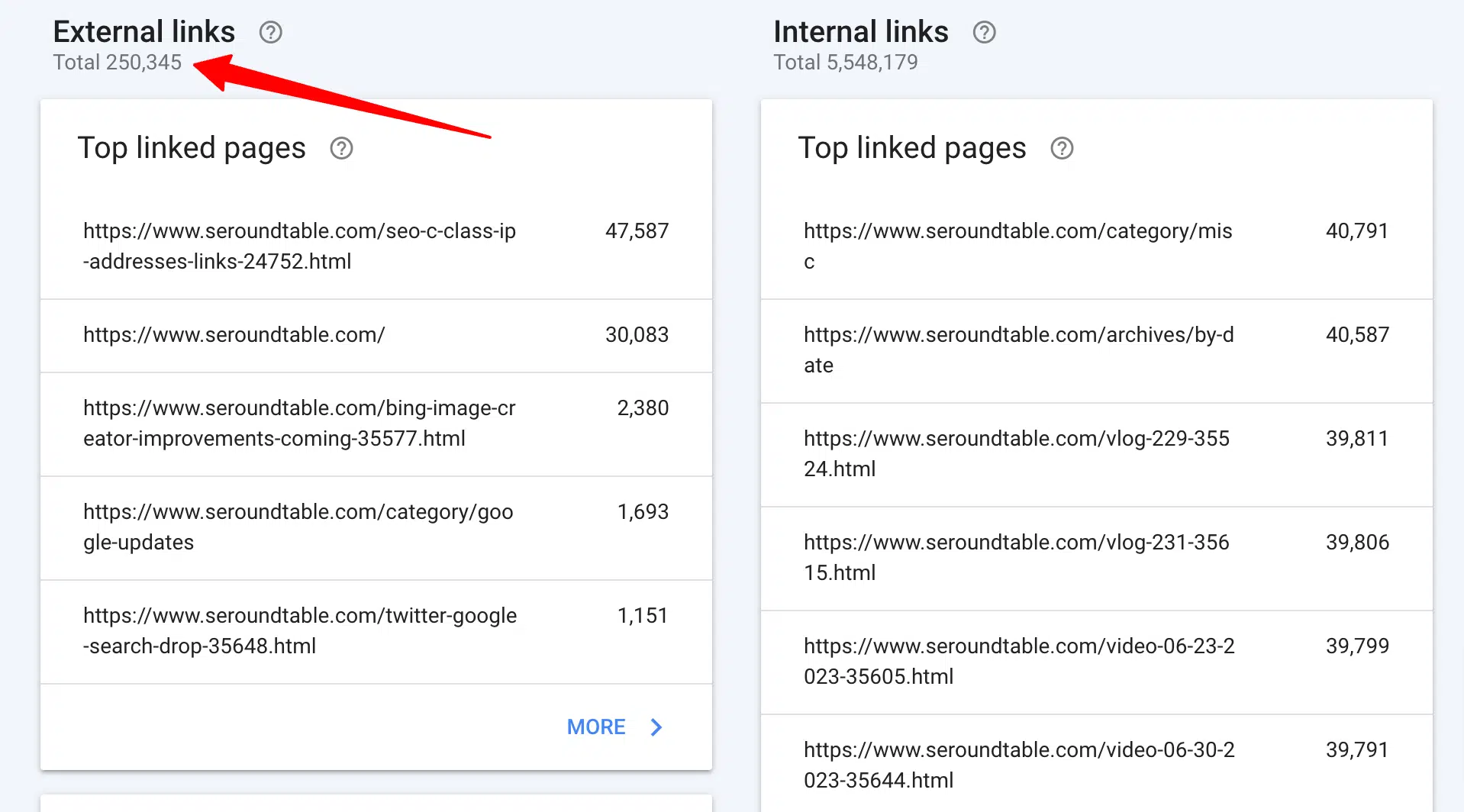
What it looks like. Here is a screenshot from my link report showing an increase in the number of links being reported by Google compared to the previous number. I should add the number is still very low compared to historical data for this site.
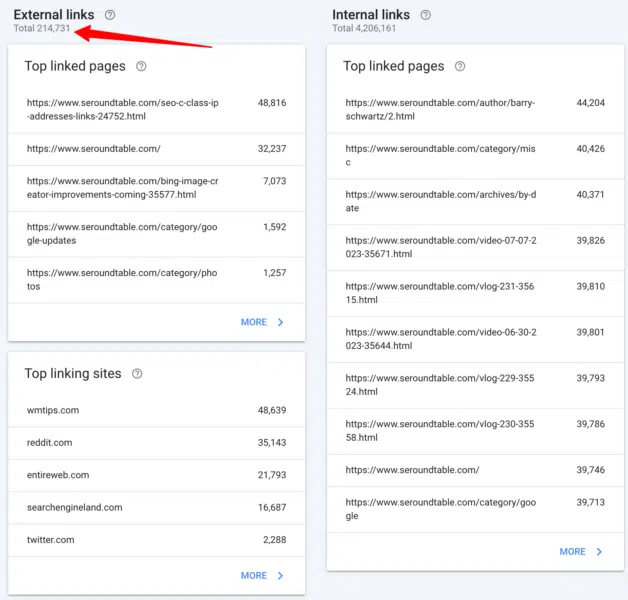
Here is the report from a couple of weeks ago:
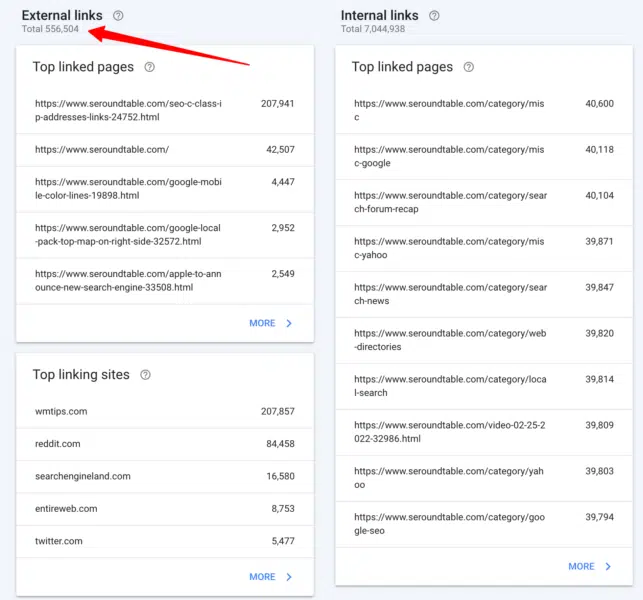
The screenshot above is from this week, but the screenshot below is from July 2022:
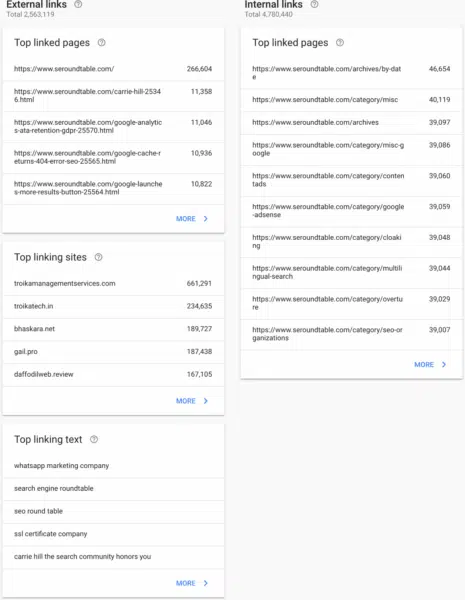
If we go back to August 2018, you can see it reported 2.5 million links:
Why we care. Again, this fix did not fix any specific ranking issues. It only fixed the link report in Google Search Console. Those of you who track links this way can go back into the report and hopefully they will find the number of links being reported more appealing.
@media screen and (min-width: 800px) { #div-gpt-ad-3191538-7 { display: flex !important; justify-content: center !important; align-items: center !important; min-width:770px; min-height:260px; }
}
@media screen and (min-width: 1279px) { #div-gpt-ad-3191538-7 { display: flex !important; justify-content: center !important; align-items: center !important; min-width:800px!important; min-height:440px!important; }
}
About the author
Barry Schwartz a Contributing Editor to Search Engine Land and a member of the programming team for SMX events. He owns RustyBrick, a NY based web consulting firm. He also runs Search Engine Roundtable, a popular search blog on very advanced SEM topics. Barry can be followed on Twitter here.
The AI tool explosion in the past year has dramatically impacted digital marketers, especially those in SEO.
Given content creation’s time-consuming and costly nature, marketers have turned to AI for assistance, yielding mixed results
Ethical issues notwithstanding, one question that repeatedly surfaces is, “Can search engines detect my AI content?”
The question is deemed particularly important because if the answer is “no,” it invalidates many other questions about whether and how AI should be used.
Breaking stories first is imperative for news websites, and they have long utilized data from various sources, such as stock markets and seismometers, to speed up content creation.
For instance, it’s factually correct to publish a robot article that says:
“A [magnitude] earthquake was detected in [location, city] at [time]/[date] this morning, the first earthquake since [date of last event]. More news to follow.”
Updates like this are also helpful to the end reader who need to get this information as quickly as possible.
At the other end of the spectrum, we’ve seen many “blackhat” implementations of machine-generated content.
Google has condemned using Markov chains to generate text to low-effort content spinning for many years, under the banner of “automatically generated pages that provide no added value.”
What is particularly interesting, and mostly a point of confusion or a gray area for some, is the meaning of “no added value.”
How can LLMs add value?
The popularity of AI content soared due to the attention garnered by GPTx large language models (LLMs) and the fine-tuned AI chatbot, ChatGPT, which improved conversational interaction.
Without delving into technical details, there are a couple of important points to consider about these tools:
The generated text is based on a probability distribution
For instance, if you write, “Being an SEO is fun because…,” the LLM is looking at all of the tokens and trying to calculate the next most likely word based on its training set. At a stretch, you can think of it as a really advanced version of your phone’s predictive text.
ChatGPT is a type of generative artificial intelligence
This means that the output is not predictable. There is a randomized element, and it may respond differently to the same prompt.
When you appreciate these two points, it becomes clear that tools like ChatGPT do not have any traditional knowledge or “know” anything. This shortcoming is the basis for all the errors, or “hallucinations” as they are called.
This raises serious doubts about the consistency of “adding value” with AI-written text, given the possibility of frequent hallucinations.
The root cause lies in how LLMs generate text, which won’t be easily resolved without a new approach.
This is a vital consideration, especially for Your Money, Your Life (YMYL) topics, which can materially harm people’s finances or life if inaccurate.
Major publications like Men’s Health and CNET were caught publishing factually incorrect AI-generated information this year, highlighting the concern.
Publishers are not alone with this issue, as Google has had difficulty reining in its Search Generative Experience (SGE) content with YMYL content.
Despite Google stating it would be careful with generated answers and going as far as to specifically give an example of “won’t show an answer to a question about giving a child Tylenol because it is in the medical space,” the SGE would demonstrably do this by simply asking it the question.
Get the daily newsletter search marketers rely on.
Google’s SGE and MUM
It’s clear Google believes there is a place for machine-generated content to answer users’ queries. Google has hinted at this since May 2021, when they announced MUM, their Multitask Unified Model.
In an initial query, the searcher will learn some additional information, prompting related searches and surfacing new webpages to answer those queries.
Google proposed: What if they could take the initial query, anticipate user follow-up questions, and generate the complete answer using their index knowledge?
If it worked, while this approach may be fantastic for the user, it essentially wipes out many “long-tail” or zero-volume keyword strategies that SEOs rely on to get a foothold within the SERPs.
Assuming Google can identify queries suitable for AI-generated answers, many questions could be considered “solved.”
This raises the question…
Why would Google show a searcher your webpage with a pre-generated answer when they can retain the user within their search ecosystem and generate the answer themselves?
Google has a financial incentive to keep users within its ecosystem. We’ve seen various approaches to achieve this, from featured snippets to letting people search for flights in the SERPs.
Suppose Google considers your generated text does not offer value over and above what it can already provide. In that case, it simply becomes a matter of cost vs. benefit for the search engine.
Can they generate more revenue in the long term by absorbing the expense of generation and making the user wait for an answer versus sending the user quickly and cheaply to a page they know already exists?
Detecting AI content
Along with the explosion of usage of ChatGPT came dozens of “AI content detectors” which allow you to input text content and will output a percentage score – which is where the problem lies.
Although there is some difference in how various detectors label this percentage score, they almost invariably give the same output: the percentage certainty that the entire provided text is AI-generated.
This leads to confusion when the percentage is labeled, for instance, “75% AI / 25% Human.”
Many people will misunderstand this to mean “the text was written 75% by an AI and 25% by a human,” when it means, “I am 75% certain that an AI wrote 100% of this text.”
This misunderstanding has led some to offer advice on how to tweak text input to make it “pass” an AI detector.
For instance, using a double exclamation mark (!!) is a very human characteristic, so adding this to some AI-generated text will result in an AI detector giving a “99%+ human” score.
This is then misinterpreted that you have “fooled” the detector.
But it is an example of the detector working perfectly because the provided passage is no longer 100% generated by AI.
Unfortunately, this misleading conclusion of being able to “fool” AI detectors is also commonly conflated with search engines such as Google not detecting AI content giving website owners a false sense of security.
Google policies and actions on AI content
Google’s statements around AI content have historically been vague enough to give them wiggle room regarding enforcement.
However, updated guidance was published this year in Google Search Central that says explicitly:
“Our focus is on the quality of content, rather than how content is produced.”
Even before this, Google Search Liaison Danny Sullivan jumped in on Twitter conservations to affirm that they “haven’t said AI content is bad”.
Google lists specific examples of how AI can generate helpful content, such as sports scores, weather forecasts, and transcripts.
It’s clear that Google is far more concerned with the output than the means of getting there, doubling down on “to generate content with the primary purpose of manipulating ranking in search results is a violation of our spam policies.”
Combatting SERP manipulation is something Google has many years of experience in, claiming that advances to their systems, such as SpamBrain have made 99% of searches “spam-free”, which would include UGC spam, scraping, cloaking and all various forms of content generation.
Many people have run tests to see how Google reacts to AI content and where they draw the line on quality.
Before the launch of ChatGPT, I created a website of 10,000 pages of content primarily generated by an unsupervised GPT3 model, answering People also ask questions about video games.
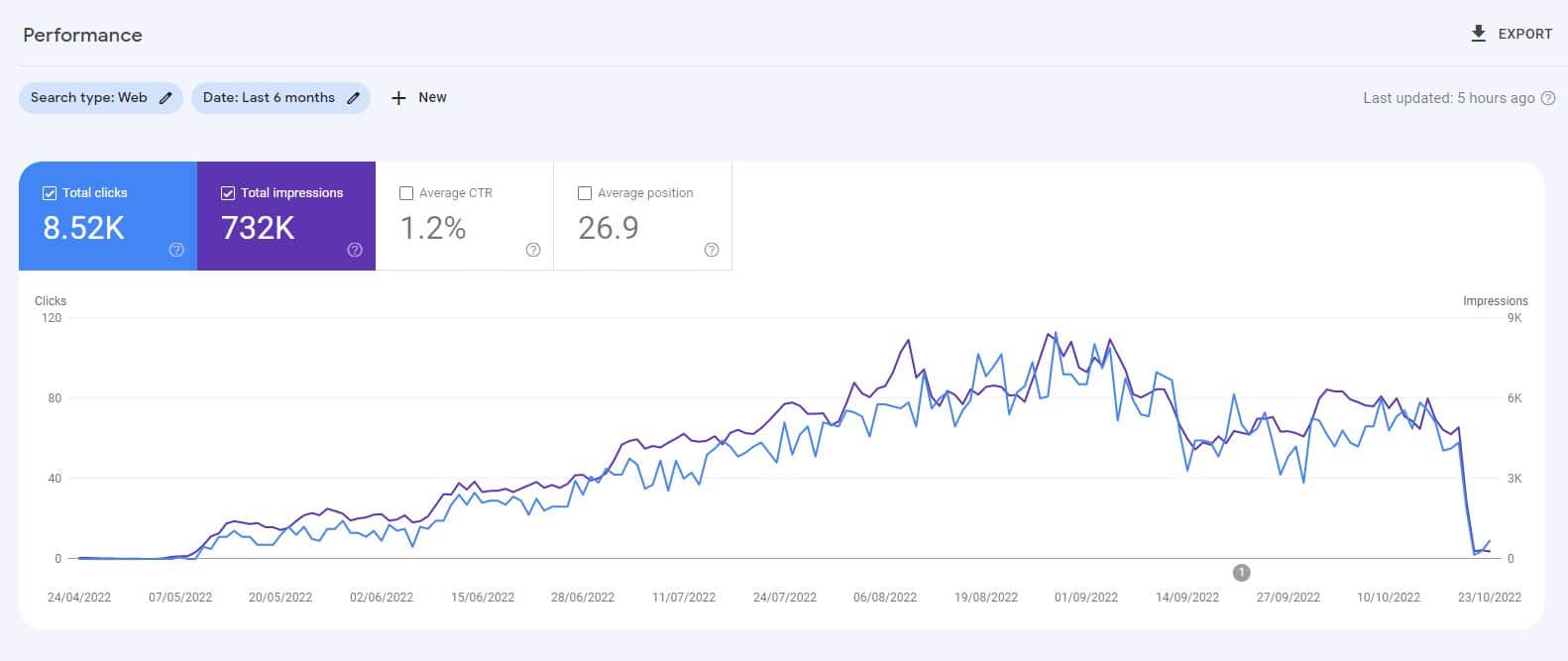
With minimal links, the site was quickly indexed and steadily grew, delivering thousands of monthly visitors.
During two Google system updates in 2022, the Helpful Content Update and the later Spam update, Google suddenly and almost completely suppressed the site.
Google Search Console data from AI test website
It would be wrong to conclude that “AI content does not work” from such an experiment.
However, this demonstrated to me that at that particular time, Google:
Was not classifying unsupervised GPT-3 content as “quality.”
Could detect and remove such results with a raft of other signals.
To get the ultimate answer, you need a better question
Based on Google’s guidelines, what we know about search systems, SEO experiments, and common sense, “Can search engines detect AI content?” is likely the wrong question.
At best, it is a very short-term view to take.
In most topics, LLMs struggle to consistently produce “high-quality” content in terms of factual accuracy and meeting Google’s E-E-A-T criteria, despite having live web access for information beyond their training data.
AI is making significant strides in generating answers for previously content-scarce queries. But as Google aims for loftier long-term goals with SGE, this trend may fade.
The focus is expected to return to longer-form expert content, with Google’s Knowledge systems providing answers to cater to many longtail queries instead of directing users to numerous small sites.
Opinions expressed in this article are those of the guest author and not necessarily Search Engine Land. Staff authors are listed here.
@media screen and (min-width: 800px) { #div-gpt-ad-3191538-7 { display: flex !important; justify-content: center !important; align-items: center !important; min-width:770px; min-height:260px; }
}
@media screen and (min-width: 1279px) { #div-gpt-ad-3191538-7 { display: flex !important; justify-content: center !important; align-items: center !important; min-width:800px!important; min-height:440px!important; }
}
About the author
Mark Williams-Cook has over 20 years of SEO experience and is co-owner of search agency Candour, the founder of AlsoAsked, and runs a pet category eCommerce business. Outside of speaking at conferences, Mark has trained over 3,000 SEOs with his Udemy course.
Why AI can’t replace authentic client relationships
Countless conversations are happening worldwide about how AI will infiltrate different parts of our lives and take over our jobs.
As an SEO professional, I believe in embracing technology and using it to support both my clients’ businesses and my own.
However, we need to clearly distinguish between AI supporting marketing work and AI replacing us and completing that work on our behalf.
This rings particularly true in the realm of sales and customer care.
Replacing humans
No matter how good AI is, it doesn’t replace the power of human connection, thought leadership or creativity.
For example, a great way to utilize AI technology might be having a chatbot on your website.
This can help web visitors to get any questions answered quickly and easily, without the need to speak to a real person.
The problem comes when the system is wholly reliant on this chatbot and it becomes almost impossible for someone to speak to a real person to help them resolve a query that AI simply cannot.
It’s like placing an intern on day one as head of customer service and expecting them to thrive.
Identify those areas of your business where AI technology can make a real positive impact rather than solely putting your focus on areas where it can save the business money.
Understand how the introduction of AI will affect your relationships with your customers and their perception of your business.
Rely on AI too much, you may be seen as inaccessible and, therefore, your customers may feel like they aren’t valued in a way they believe they should be.
Don’t use AI at all, you might lose out to your competitors.
Giving your customers a great experience while adopting AI to streamline and automate elements of your business requires the right balance.
Those that get this wrong could find themselves with disgruntled customers and client retention issues.
Get the daily newsletter search marketers rely on.
All the feelings
We humans are complicated creatures that display a wide array of emotions, from love to frustration to anger and happiness. Feelings are part of our everyday lives.
While AI can analyze patterns and understand words, it lacks the ability to truly comprehend the feelings of others in a deep and meaningful way.
It’s not only the words that we use but our facial expressions, tone of voice and body language that truly convey how we feel.
Email, messaging and social media have already removed our ability to take as many communication cues as possible from others.
There is concern that with AI, we will face further degradation. Will we find ourselves in a world of people struggling to communicate face to face?
I believe that we need to retain these skills in our businesses, particularly when it comes to customer relationships.
I also believe businesses that find the right balance between AI and technology and human connection will be the most successful over the next few years.
Trust
Trust is part of what makes strong relationships, which is no different for your customers.
They need to feel like:
You are acting in their best interests.
They are getting the best advice about how you can solve their problem or satisfy their desire through the products and services you offer.
That you are going to deliver on your promises.
AI alone will struggle to build loyalty and trust in the same way that a human can because it requires an emotional connection to do so.
Your customers want to see that you can empathize with their situation and develop a solution that meets their needs.
AI doesn’t display this ability, so a strong bond between business and customer will be much more difficult to achieve without human interaction.
Creative thinking
Another way AI cannot mimic human behavior is in its lack of creativity.
Yes, it can reform images and words from existing resources, but it can’t come up with new and unique ideas about the world in the same way that we can.
Dreaming up big ideas and sharing them with others is fundamental to being human.
Can you imagine a client meeting for a new marketing campaign created solely from AI. You could end up with a regurgitated version of a variety of marketing campaigns that have already been in existence before.
AI only knows what it knows right now – it can’t dream up new things or design something from scratch, at least not in the same way that humans can.
Some useful ways to use AI in your business
Several AI tools can significantly improve efficiency and enhance the overall customer experience.
These tools are a great way to help and support the activities of your real-life team (even if that’s just you).
1. Customer relationship management (CRM) systems
Every business should have a CRM system, it’s how you manage customers and analyze data.
The idea is to enable you to offer an engaging experience and ultimately create more sales for your business.
AI-driven CRM tools can analyze customer data quickly and easily, giving valuable insights into preferences and needs.
With this knowledge, businesses can personalize their communication and offerings.
2. Chatbots and virtual assistants
Chatbots and virtual assistants are great ways to use AI.
We touched on this earlier: they enable real-time communication, answer questions and deliver information quickly and seamlessly.
The best chatbots use natural language processing, meaning they can better understand customer questions and respond accurately.
They can cost-effectively deliver great customer service. This enhances the overall experience of those visiting your website (or app).
3. Feedback tools
These tools can analyze customer feedback, reviews, and social media interactions, working out the sentiment behind the words.
These AI-driven tools can discern whether customers exhibit positive, negative or neutral sentiments toward a product, service or brand.
This helps businesses address any issues and put measures in place to improve how they are perceived.
4. Predictive analytics
Predictive analytics uses AI algorithms to analyze historical data and identify patterns, trends and correlations.
The benefit: Businesses can proactively address customer concerns and offer personalized recommendations.
It can also help retain customers by offering products and services before they even know they need them, ultimately enhancing their experience while increasing sales.
5. Email marketing
AI-powered tools are highly effective in optimizing email marketing campaigns by personalizing content and delivery times based on customer behavior and preferences.
Segmenting email lists ensures that clients receive targeted and relevant content.
AI can also analyze customer responses to past emails and adjust content accordingly, increasing open rates and engagement.
6. Voice assistants
As voice-activated devices gain prominence, businesses can tap into the potential of voice assistants to enrich client interactions.
Voice assistants offer quick access to information, address common queries, and even facilitate ecommerce transactions.
Integrating voice assistants into customer service or sales processes streamlines interactions, offering clients a convenient and efficient means to engage with your business.
You can find an AI tool to help you with almost anything in your business. These were just a few examples
Whether summarizing meetings, breaking down big tasks or writing a proposal outline, AI will form a big part of our working lives.
The challenge will be to filter through the noise and use AI tools that will help your business improve efficiency. Doing so without damaging that all-important customer experience. It will be an interesting few years as we see how AI technology evolves.
Opinions expressed in this article are those of the guest author and not necessarily Search Engine Land. Staff authors are listed here.
@media screen and (min-width: 800px) { #div-gpt-ad-3191538-7 { display: flex !important; justify-content: center !important; align-items: center !important; min-width:770px; min-height:260px; }
}
@media screen and (min-width: 1279px) { #div-gpt-ad-3191538-7 { display: flex !important; justify-content: center !important; align-items: center !important; min-width:800px!important; min-height:440px!important; }
}
About the author
Claire Taylor co-founded her Digital Marketing Agency, TU Marketing, in 2007. What sets Claire apart is her holistic and flexible approach and she has helped countless clients achieve online growth and success in what is often a crowded and competitive space. Claire loves business but also love to spend time travelling and challenging herself physically and mentally. From running ultra-marathons, racing against horses in Wales, through to trekking across Peru. You’ll often find her out in the countryside running or hiking with her dog Darcy and day dreaming about her next adventure.
Amazon’s ad services revenue rises 22%, bringing in more than $10 billion in Q2
Amazon generated $10.68 billion from its ad services in the second quarter of 2023.
The figure marks a 22% increase from the same period in 2022, as the wider digital ad market begins to show signs of recovery from the economic downturn.
Why we care. Following a slump in the digital ad market amid the economic downturn, Google, Meta and Microsoft have all reported improvements in advertising revenue. However, none have achieved year-on-year percentage growth quite as strong as Amazon. The retail giant’s solid performance sends a clear message that the digital ad industry is rebounding which should offer reassurance to hesitant marketers. Restoring faith in the sector should help restore trust, leading to increased ad spend in Q3.
Leading the way with AI. Amazon partly attributed its strong performance to the introduction of more advanced machine learning models. The company explained that its new technology has been helping advertisers reach their target audiences with optimal cost-efficiency as the industry moves away from third-party cookies. Amazon reported that marketers benefited from increased click-through rates and ROAS, along with a fall in cost per impression.
Get the daily newsletter search marketers rely on.
What has Amazon said? Andy Jassy, Amazon CEO, described Q2 as “another strong quarter of progress”. He said:
“We continued lowering our cost to serve in our fulfillment network, while also providing Prime customers with the fastest delivery speeds we’ve ever recorded.”
“Our AWS growth stabilized as customers started shifting from cost optimization to new workload deployment, and AWS has continued to add to its meaningful leadership position in the cloud with a slew of generative AI releases that make it much easier and more cost-effective for companies to train and run models (Trainium and Inferentia chips), customize Large Language Models to build generative AI applications and agents (Bedrock), and write code much more efficiently with CodeWhisperer.”
“We’re continuing to see strong demand for our advertising services as the team keeps innovating for brands, including the ramp up for Thursday Night Football with the ability for advertisers to tailor their spots by audience and create interactive experiences for consumers.”
“We remain excited about what lies ahead for customers and the company.”
@media screen and (min-width: 800px) { #div-gpt-ad-3191538-7 { display: flex !important; justify-content: center !important; align-items: center !important; min-width:770px; min-height:260px; }
}
@media screen and (min-width: 1279px) { #div-gpt-ad-3191538-7 { display: flex !important; justify-content: center !important; align-items: center !important; min-width:800px!important; min-height:440px!important; }
}
About the author
Nicola Agius is Paid Media Editor of Search Engine Land after joining in 2023. She covers paid search, paid social, retail media and more. Prior to this, she was SEO Director at Jungle Creations (2020-2023), overseeing the company’s editorial strategy for multiple websites. She has over 15 years of experience in journalism and has previously worked at OK! Magazine (2010-2014), Mail Online (2014-2015), Mirror (2015-2017), Digital Spy (2017-2018) and The Sun (2018-2020). She also previously teamed up with SEO agency Blue Array to co-author Amazon bestselling book ‘Mastering In-House SEO’.
Walmart is launching targeted in-store ads at its checkouts
Walmart is expanding its digital advertising offering in stores.
The supermarket giant will soon show customers targeted ads from third parties on screens in self-checkout lanes.
Brands interested in purchasing this ad space will be able to choose regions or specific stores in which to promote their campaigns.
Why we care. Walmart is the biggest supermarket chain in the US with 4,700 stores across the country, and approximately 90% of Americans living within a 10-mile radius of one. This presents a huge opportunity for brands in terms of reach. Targeting potential customers while they are already shopping may also help improve conversions.
However, while there are clearly many advantages to this ad platform, marketers must be cautious as they do potentially run the risk of irritating or overwhelming shoppers. Bombarding potential customers with ads could harm a brand’s reputation and dissuade consumers from making a purchase.
More opportunities. Expanding its ad offering even further, Walmart has revealed it is going to start playing 30-second audio ads over the store’s radio later this year. The supermarket is also planning to host demo stations at weekends where shoppers can sample products. Consumers will be able to scan QR codes at these demo stations, which will trigger shopping options, seasonal information and meal idea pop-ups to appear on their phones.
Brands will be able to mix and match the different in-store ad offerings and run campaigns across different formats at the same time.
Get the daily newsletter search marketers rely on.
What has Walmart said? Walmart’s Senior VP of Retail Media, Ryan Mayward, has said the chain’s new ad offerings present a huge opportunity for both advertisers and shoppers. He told CNBC:
“It’s a complimentary advertising moment. It’s helping you make connections between two different products and decide that you maybe need that second thing.”
“When you think about our store, our store footprint and the percentage of Americans that we reach through our stores, we can deliver Super Bowl-sized audiences every week.”
Why now? The move comes after its supermarket rival, Kroger, announced it was rolling out in-store digital smart screen advertising along with a new self-service ad platform for marketers. Target also recently started trialling in-store demons at 200 of its stores across the US.
Deep dive. Read Walmart’s Q2 earnings report for more information on the company’s performance this year and its plans for the future.
@media screen and (min-width: 800px) { #div-gpt-ad-3191538-7 { display: flex !important; justify-content: center !important; align-items: center !important; min-width:770px; min-height:260px; }
}
@media screen and (min-width: 1279px) { #div-gpt-ad-3191538-7 { display: flex !important; justify-content: center !important; align-items: center !important; min-width:800px!important; min-height:440px!important; }
}
About the author
Nicola Agius is Paid Media Editor of Search Engine Land after joining in 2023. She covers paid search, paid social, retail media and more. Prior to this, she was SEO Director at Jungle Creations (2020-2023), overseeing the company’s editorial strategy for multiple websites. She has over 15 years of experience in journalism and has previously worked at OK! Magazine (2010-2014), Mail Online (2014-2015), Mirror (2015-2017), Digital Spy (2017-2018) and The Sun (2018-2020). She also previously teamed up with SEO agency Blue Array to co-author Amazon bestselling book ‘Mastering In-House SEO’.
Link building is a consistent and proactive practice that requires time, effort and resources.
It remains a fundamental aspect of SEO, but success doesn’t come easily.
As you fine-tune your SEO action plan for the rest of the year, consider ways to win – or fail – at link building.
Fails: Common link building mistakes
Fail: Ignoring personal connections
Start with who you know. You likely have personal connections in your industry who can help deliver valuable backlinks.
So many marketers overlook their own network as a resource, focusing solely on cold outreach and missing out on opportunities for more natural, relevant links.
Go through your LinkedIn connections, and ask.
Fail: Chasing low-quality links
This is not simply a game of volume. In highly competitive niches, the quality and quantity of links matter.
Getting a larger number of low-quality links is often easier, which will ultimately hurt your website’s SEO.
Instead, strategically approach your backlinking efforts to ensure you gain high-quality and highly relevant backlinks from authoritative websites.
Fail: Building links from irrelevant websites
When you go through the effort of building backlinks, one of the worst things you could do is select a domain that links back to completely unrelated websites.
Building links that are relevant to your niche is critical.
Getting links from irrelevant websites won’t help improve your search visibility or generate the readers and customers you seek.
Fail: Ignoring local SEO
Local SEO is a great opportunity to increase your backlinks, but many companies miss this step.
Especially for businesses with a local audience, geo-targeted link building will help you increase your website’s local search visibility and be more relevant to your target audience.
Work to obtain links from business listing websites, local blogs and local directories.
Fail: Sticking to outdated tactics
It was never right, but we all know it happened. Old school and outdated tactics to get backlinks, such as spammy directories and mass blog commenting will only hurt your website’s SEO.
Google still will take manual action on sites that engage in these practices, so it’s essential to stay up-to-date with the latest link building strategies and ensure your efforts align with Google’s guidelines.
Get the daily newsletter search marketers rely on.
Wins: Effective link building strategies
Win: Competitor backlink analysis
Evaluate your competitor’s ranking performance and backlink profile. This can help you understand your gaps and opportunities.
What lists are they on? What interviews and guest posts have they done?
If your competitors are appearing on specific domains, then there is an opportunity for you to be a fast follower.
Use tools such as Ahrefs or Moz, and identify potential targets for your own link building efforts.
Win: Capitalizing on unlinked mentions
You’ll often find that your website or brand was mentioned on a site, but no link was associated with it.
In these situations, reach out to the site operator and politely request they add a link to your site.
Brand monitoring tools like Talkwalker, Critical Mention or BuzzSumo can help you find unlinked mentions, providing opportunities for easy link building.
Win: Contributing to crowdsourced posts
Participate in crowdsourced posts by providing expertise to journalists or bloggers seeking input from industry professionals.
HARO is a great place to identify opportunities to contribute to content. This can lead to valuable backlinks from authoritative sources and increased visibility for your brand.
Win: Creating valuable data-driven content
Everyone loves visuals. Look for opportunities to create content from your valuable data, including infographics, research results, case studies and surveys.
Citing statistics and percentages is also important, so focus on creating content that showcases your expertise and provides rare, insightful data.
With the increasing use of Canva, it’s much easier to create compelling graphics for your website.
Win: Getting help
As you read this list of best practices, you’re likely asking, “How much time will this take?”
Link building is time-consuming, but reputable consultants and agencies can do the tough parts for you, helping you increase your backlinks effectively and efficiently.
Don’t be scared to ask for help.
Avoid common mistakes, embrace winning strategies
Focus on creating high-quality, link-worthy content and pursuing natural, relevant backlinks from authoritative sites.
Understand that link building is a long-term effort requiring consistent monitoring and effort.
Adopting these practices will improve your website’s visibility and boost its SEO performance in the long run.
Opinions expressed in this article are those of the guest author and not necessarily Search Engine Land. Staff authors are listed here.
@media screen and (min-width: 800px) { #div-gpt-ad-3191538-7 { display: flex !important; justify-content: center !important; align-items: center !important; min-width:770px; min-height:260px; }
}
@media screen and (min-width: 1279px) { #div-gpt-ad-3191538-7 { display: flex !important; justify-content: center !important; align-items: center !important; min-width:800px!important; min-height:440px!important; }
}
About the author
Laura Nguyen has 20 years of experience in digital marketing, advertising, and eCommerce. She is an experienced growth-focused marketing executive with an extensive background in data-driven marketing, demand generation and branding for DTC and B2B Fortune 500 companies, private equity and private businesses. She has led high-performing teams to achieve organizational growth and market share dominance. Laura is the founder of Solle Solution, a marketing consultancy. Visit sollesolutions.com to learn more.
Straight from the source: Search Engine Land Awards judges reveal what makes an application award-worthy
Since its inception in 2015, the Search Engine Land Awards have recognized exceptional marketers on an annual basis — showcasing outstanding work, providing well-earned exposure in coverage and interviews, and bestowing upon them the highest honor in search.
But the road between deciding to begin an application and winning the award can be a long one. Although the 2023 submission process is exceptionally streamlined — it’s never been faster or easier to apply — there’s still a story that has to be told.
The way you tell that story is entirely up to you… but why not bear in mind some first-hand advice from 2023 judges while you’re at it?
Keep reading for a roundup of fresh insights from some of our judges… and submit your entry before the September 1 deadline!
“Read the directions and reflect them in your answer. If it asks, ‘Tell us what KPIs were improved by doing X,’ ideally, your answer is, ‘By doing X, we increased organic traffic by Y%’.
“You’d be surprised how many entries don’t address the question directly and succinctly at the outset and then follow up with supporting points.”
– Holly Miller Anderson, Lead SEO Product Manager, Under Armour
“Include the strategy behind the tactics – what were the client objectives, and how did your work tie back to those objectives? Also, incorporating uncommon tactics that other search marketers might not think of will make your entry stand out.
“For example, using video and display campaigns to drive leads; or an innovative way to increase lead quality using Performance Max. Show us how you thought outside the box to achieve your goals!”
– Melissa Mackey, Director of Paid Search, Compound Growth Marketing
“Don’t just say ‘best practices’ for how something is managed – be specific. It’s the thoughts, creativity, problem-solving, and details of how you accomplished your results that matter.”
– Brad Geddes, Co-founder, Adalysis
“You really have to differentiate yourself. A lot of that, to me, is about showcasing your thinking. Really get into the diagnosis and then explicitly explain your strategy so that you can detail how it was innovative.
“Everyone can talk about keyword clustering, but what makes you stand out is in how you identified the problem and then uniquely used the tactic as a remedy! Context can really be everything.”
– Mordy Oberstein, Head of SEO Branding, Wix.com
“The biggest piece of advice I can give on writing a winning entry is to acknowledge that we judges are humans and respond well to entries that make it easy to read. Think bullet lists, screenshots, and specifically answering the part of the case study we’re asking you to address. A great way to sink an otherwise winning entry is to upload a deck that ignores the specific questions we ask because it’s your template case study.
“Bonus tip: Please submit the data we ask for. We won’t share it, and you’ll be throwing your entry fee away if you don’t tie your entry to data showing real performance results (not just percentage gains).
“We love celebrating amazing and innovative brands and hopefully this helps you avoid pitfalls in crafting your entry. Own your star power!”
– Navah Hopkins, Brand Evangelist, Optmyzr
“Ask yourself: ‘Does my submission highlight an issue or a goal and does my submission demonstrate and prove that we were able to reach said goal?’
“Yes, data can be impressive but the judges want to know what changes and innovations were implemented in order to drive performance.
“Be sure to review any guidelines provided to you! If the guidelines ask for something specific to be included in your submission and you fail to do so, that will work against you.”
There you have it! Remember: The final deadline to enter the 2023 Search Engine Land Awards is coming up fast… submit your entryby September 1 for your chance to take home the highest honor in search!
@media screen and (min-width: 800px) { #div-gpt-ad-3191538-7 { display: flex !important; justify-content: center !important; align-items: center !important; min-width:770px; min-height:260px; }
}
@media screen and (min-width: 1279px) { #div-gpt-ad-3191538-7 { display: flex !important; justify-content: center !important; align-items: center !important; min-width:800px!important; min-height:440px!important; }
}
About the author
Lauren Donovan has worked in online marketing since 2006, specializing in event marketing, content management, organic and paid social media, community and reputation management, and real-time journalism. She currently serves as Director of Marketing at Third Door Media — producer of the Search Marketing Expo and MarTech conference series and publishers of Search Engine Land and MarTech.
YouTube Shorts launches six new features to improve content creation
YouTube Shorts has rolled out a range of new tools to encourage and inspire content creation.
The six new features give creators a range of new capabilities on the platform, such as the ability to go live with Shorts, remix footage, add effects to videos and use stickers.
In addition, the social platform is trialling a new mobile-first vertical live experience that aims to improve reach by giving visibility to live creators in the Shorts feed.
Why we care. Brands will have the opportunity to get even more creative with their content output as they experiment with different features, which could help to improve engagement. The new mobile-first vertical pilot could also help brands to improve their reach by sharing live videos in the Shorts feed. Improved reach and engagement should in practice help brands to achieve more conversions and therefore a better ROI.
What’s new? The six new features rolled out on YouTube Shorts are:
Collab – This new feature allows creators to film a Short alongside other YouTube or Short videos in a side-by-side format. Multiple layout options are available.
Q&A stickers – Content creators can use this new feature to ask viewers questions. The audience can then leave their replies in the comments section, enabling creators to give them a shoutout as they can see who left the response.
Mobile-first vertical live – This new feature is what will allow live creators to get discovered in the Shorts feed. YouTube is hoping this will enable creators to connect live with a new audience and build communities in a more modern way.
Creation suggestions – YouTube can now automatically bundle the audio and effects from a Short you may be remixing. The platform can surface the same audio time stamp from the Short you just watched, and add the same effect as a creation suggestion. Content creators also have the option to mix and match.
Shorts playlist – Creators can now save Shorts to playlists directly onto YouTube.
Transform horizontal videos to Shorts – This new feature is being trialled in the coming weeks. Users will now be able to choose a video to remix and adjust the layout, zoom and crop to turn it into a Short.
Why now? YouTube Shorts are now viewed by more than 2 billion logged-in users a month. Given its sharp rise in popularity, it’s little surprise that Google is acting to improve the YouTube Shorts experience, as it seeks to make it a rival to TikTok and Instagram Reels – both of which recently launched new features to improve the user experience for its content creators.
Get the daily newsletter search marketers rely on.
What has YouTube said? YouTube posted a statement announcing the new tools on its official blog. A spokesperson said:
“We introduced Shorts to give creators a lightweight and fun way to create and share short-form videos on YouTube, and continue to expand on the ways that creators can easily tap into their creativity.”
“From remixing tools that help creators leverage content from across YouTube’s billions of videos worldwide in new, original content to expanding the YouTube Partner Program so creators can join and earn money from their Shorts, we want to make it easier for anyone to join in and create what they love.”
“YouTube Shorts are now being watched by over 2 billion logged-in users every month, and today we’re introducing new ways to spark imagination and creativity.”
Deep dive. Read YouTube’s blog post in full for more information about its new tools.
@media screen and (min-width: 800px) { #div-gpt-ad-3191538-7 { display: flex !important; justify-content: center !important; align-items: center !important; min-width:770px; min-height:260px; }
}
@media screen and (min-width: 1279px) { #div-gpt-ad-3191538-7 { display: flex !important; justify-content: center !important; align-items: center !important; min-width:800px!important; min-height:440px!important; }
}
About the author
Nicola Agius is Paid Media Editor of Search Engine Land after joining in 2023. She covers paid search, paid social, retail media and more. Prior to this, she was SEO Director at Jungle Creations (2020-2023), overseeing the company’s editorial strategy for multiple websites. She has over 15 years of experience in journalism and has previously worked at OK! Magazine (2010-2014), Mail Online (2014-2015), Mirror (2015-2017), Digital Spy (2017-2018) and The Sun (2018-2020). She also previously teamed up with SEO agency Blue Array to co-author Amazon bestselling book ‘Mastering In-House SEO’.
@media screen and (min-width: 800px) { #div-gpt-ad-3191538-7 { display: flex !important; justify-content: center !important; align-items: center !important; min-width:770px; min-height:260px; }
}
@media screen and (min-width: 1279px) { #div-gpt-ad-3191538-7 { display: flex !important; justify-content: center !important; align-items: center !important; min-width:800px!important; min-height:440px!important; }
}
About the author
Barry Schwartz a Contributing Editor to Search Engine Land and a member of the programming team for SMX events. He owns RustyBrick, a NY based web consulting firm. He also runs Search Engine Roundtable, a popular search blog on very advanced SEM topics. Barry can be followed on Twitter here.
Google Search Generative Experience adds videos to AI-generated answers
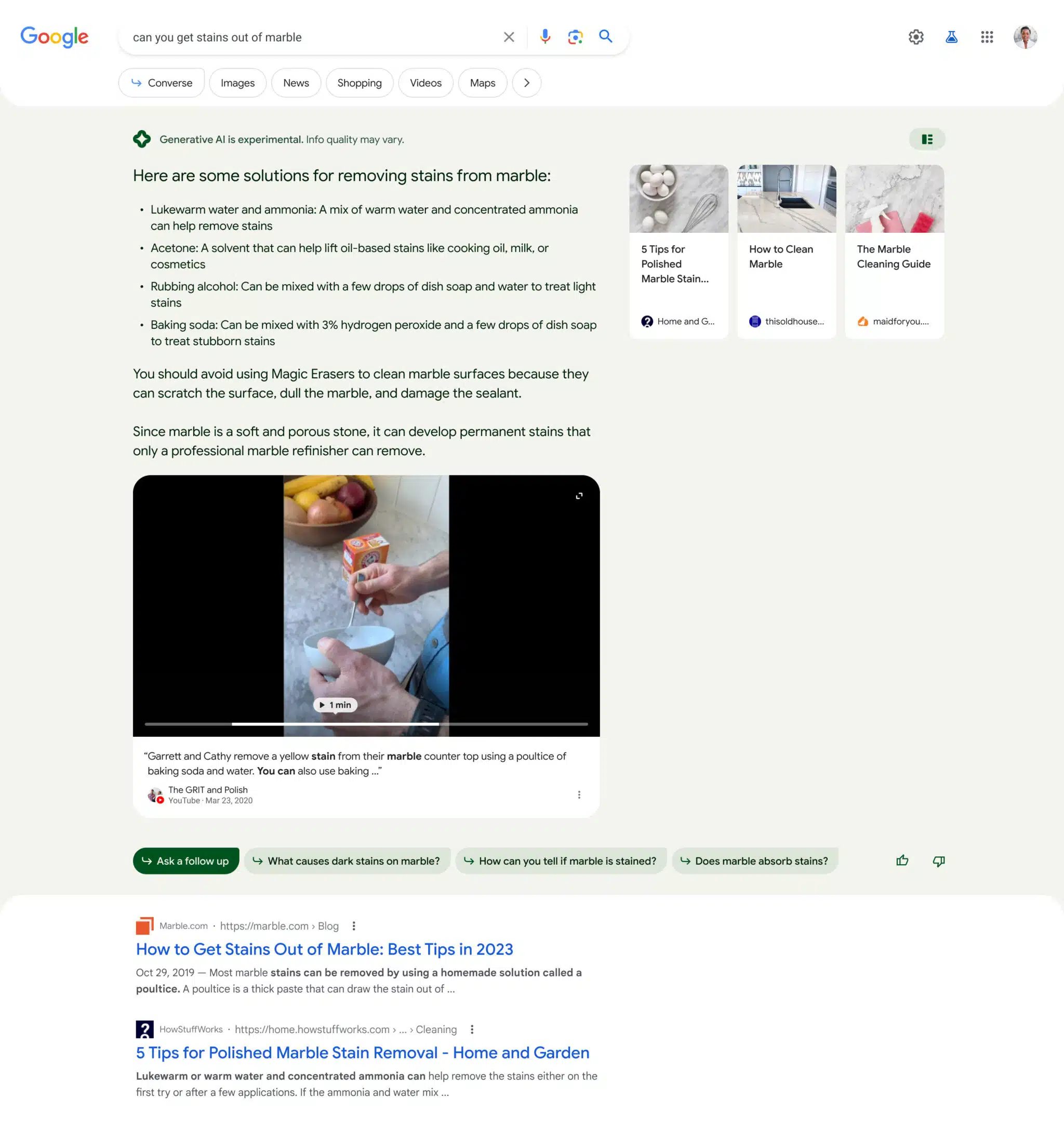
Google’s new Search Generative Experience now can not just show images in the AI-generated answer but also can show playable videos. “Over the next week, you’ll begin to see videos within some overviews where it’s helpful to see something in motion,” Google wrote.
What it looks like. Google sent us a screenshot for a query on [how to get stains out of marble type] that shows a video embedded directly in the AI-generated answer. You can click on the image to enlarge it:
More improvements. Google also confirmed rolling out links in the AI-generated answers, something we covered yesterday. “To help you better understand how recent the information is from these web pages, we recently added publish dates to each link,” Google wrote. Google added will continue “to experiment with new, easier ways for people to find web pages that support information in AI overviews.”
Google also said it will continue to make speed improvements to these AI-generated answers, after significantly improving the speed of the answers in early June. Google said, ” we’re continuing to experiment with new, easier ways for people to find web pages that support information in AI overviews.”
Why we care. If you create videos, your videos, in addition to images, can now show up in these AI-generated answer sections within the Search Generative Experience. Plus, as we said yesterday, having links directly in these answers can help generate more traffic to your site. Finally, faster answers means more searchers will consume these answers, instead of scrolling past them if they do not load fast enough.
@media screen and (min-width: 800px) { #div-gpt-ad-3191538-7 { display: flex !important; justify-content: center !important; align-items: center !important; min-width:770px; min-height:260px; }
}
@media screen and (min-width: 1279px) { #div-gpt-ad-3191538-7 { display: flex !important; justify-content: center !important; align-items: center !important; min-width:800px!important; min-height:440px!important; }
}
About the author
Barry Schwartz a Contributing Editor to Search Engine Land and a member of the programming team for SMX events. He owns RustyBrick, a NY based web consulting firm. He also runs Search Engine Roundtable, a popular search blog on very advanced SEM topics. Barry can be followed on Twitter here.