Schema usage up 4x among top ranking ecommerce sites
With SEO planning for the holiday season already underway, schema usage seems to be a top priority for ecommerce brands that own the top-ranking keyword positions.
Compared to 2022, schema adoption has increased 4x, according to data from SEO enterprise platform BrightEdge.
Why we care. Ecommerce is often a bellwether, where SEO strategies, tactics and techniques change before other sectors. So it’s always interesting to watch and see what’s trending among the leading ecommerce brands and what they prioritize in their holiday strategies.
Trending schema types. This year’s big focus is on images and products. Three types of schema are trending among ecommerce brands:
Image object
Organization
Offer
Last year, brands were more focused on articles and items.
Why the shift. There are at least two Google-related factors at play here:
Search Generative Experience (SGE). We know SGE is Google’s vision for the future of search, but we don’t know whether SGE will be fully deployed to all users before, during or after the holiday season.
“With SGE and HCU, providing proof of who you are and showing credibility through third-party confirmation is vital. Schema is becoming a necessity, not an option as shown by brands increasing usage. To stay ahead and succeed in AI-driven search, it is crucial for organizations to incorporate schema markup and focus on structuring the data on their websites,” said BrightEdge CEO Jim Yu.
Brands starting early in 2023. JCPenney is one brand that is starting earlier than ever.
“We just kicked off our back-to-school season and all the optimization that goes with that, but we’re also scoping out what we want to do for the holidays by researching our competition and content gaps to put our site and pages in the best positions possible. Starting earlier and planning with our other teams puts us in a really good position to be ready to pivot and adjust as needed,” said Timothy Huneycutt, JCPenney’s SEO manager, digital operations.
About the data. The insights from BrightEdge are based on tracking 6,000 ecommerce keywords in 10 categories, which the company has been doing for the past four years.
@media screen and (min-width: 800px) { #div-gpt-ad-3191538-7 { display: flex !important; justify-content: center !important; align-items: center !important; min-width:770px; min-height:260px; }
}
@media screen and (min-width: 1279px) { #div-gpt-ad-3191538-7 { display: flex !important; justify-content: center !important; align-items: center !important; min-width:800px!important; min-height:440px!important; }
}
About the author
Danny Goodwin has been Managing Editor of Search Engine Land & Search Marketing Expo – SMX since 2022. He joined Search Engine Land in 2022 as Senior Editor. In addition to reporting on the latest search marketing news, he manages Search Engine Land’s SME (Subject Matter Expert) program. He also helps program U.S. SMX events. Goodwin has been editing and writing about the latest developments and trends in search and digital marketing since 2007. He previously was Executive Editor of Search Engine Journal (from 2017 to 2022), managing editor of Momentology (from 2014-2016) and editor of Search Engine Watch (from 2007 to 2014). He has spoken at many major search conferences and virtual events, and has been sourced for his expertise by a wide range of publications and podcasts.
This information helps create a guiding policy that leads to coherent actions, adding value for content creators and encouraging them to share your content.
The ultimate goal is to build the reputation of your page, website and content creators.
This article examines what makes a “good strategy” and a simple method to map a situation analysis to a strategic framework.
Learn a method for applying helpful strategy and planning insights to your situation and turn it into actionable steps for your next link building campaign.
What is a strategy?
Before we jump into link building strategy, let’s take a quick step back to define what exactly we mean by “strategy.”
A strategy is how one organizes all available resources to navigate an environment to accomplish a goal or objective.
In “Good Strategy, Bad Strategy,” author Richard Rumelt argues that an effective strategy has three fundamental ingredients:
Diagnosis: Understanding the nature of the challenge.
Guiding policy: Overall approach selected to handle all obstacles to accomplish the goal.
Coherent actions: Coordinated steps to support the guiding policy.
Imagine snowboarding (or skiing) down a mountain.
The line you pick – to bypass obstacles or face them – is a strategy for reaching the mountain’s base fast or for other goals.
Yet, it’s common to consider a “tactic” a “strategy.”
For instance, “guest posting” is not a link building strategy. I would define guest posting as a tactic or technique to include in a strategy.
The guiding policy can either explore unique paths or follow behind the competitor and make something better, represented well by the “blue ocean” concept.
Blue ocean strategy: Spur demand in a fresh, unexplored market segment.
Red ocean strategy: Set your business apart from theme competitors in an already populated market.
While building a guiding policy, understand these areas to provide insights to evaluate for adjustment, enhancement, or complete reworking.
Budget: How much is being spent on the product? What does it cost the user?
Value creation: What problem does the software or product solve? What is that worth?
Internal workflows and resources: Create a competitive advantage by being more efficient.
Knowledge enhancement and growth: Are you smarter than the competition in a particular area?
Ethical considerations: Are there ethical factors limiting what can be built?
How to create a great link building strategy
Taking a cue from Rand Fishkin’s advice on creating a great marketing strategy, look into the following:
Content creators: Individuals, businesses or organizations that create and publish content with varying goals.
Content consumers: Individuals or entities that consume the content, including other content creators and search engine bots.
Platforms: Websites, social media networks, forums, and other online spaces where content is published and shared.
Content: Various forms of content (e.g., blog posts, videos, infographics) are valued based on quality, relevance, uniqueness, and creator authority. This is owned assets or independent assets.
Competition: High level of competition due to the abundance of content being created and shared daily.
Trends: Influences such as content format trends, platform preferences, consumer behavior, and SEO practices.
Link building: Secure a link so users can click and navigate.
To illustrate, let’s break down the Skyscraper technique and apply it to an HR software’s link building strategy.
Diagnosis
Skyscraper technique
Diagnose the current state of owned content assets, their consumers, and the creators that share them.
Identify existing content that has already generated a significant number of links. The creators who have linked to this content are potential consumers of your own content.
Understand the online asset-sharing marketplace, which is highly competitive and saturated with content
Specific application
For HR management software, the top content ranking in Google does not discuss generative AI for HR management. Still, it’s a highly significant technology impacting the HR manager’s role.
There’s other online content about HR and generative AI, but all that information can be aggregated into one page to create more value.
The top content also doesn’t provide examples, and it is difficult to scan to find helpful content quickly.
Guiding policy
Skyscraper technique
Navigate the online asset-sharing marketplace by creating superior content that provides value to content creators.
Create content that is superior to existing content. This superior content is expected to attract content creators who are looking for valuable content to share with their own audience.
Specific application
Blue ocean
Perform a study of HR professionals to uncovertheir unique processes.
Build 3 AI tools for each time-consuming step, then have them tested.
Identify 5+ MVP (minimum viable product) AI tools that can drastically improve the employee review process to improve quality and reduce time.
Red ocean
Create a guide to top HR recruiting software using AI.
Leverage the company’s unique application of ChatGPT in the HR recruitment process to create engaging content for HR and technology podcasts.
Coherent actions
Find link-worthy content
Skyscraper technique: Identify existing content that has already generated many links. This serves as the benchmark for creating your own content.
Specific application: Top-ranking content that generates links and doesn’t cover the topic thoroughly, excluding generative AI.
Make something even better
Skyscraper technique: Create content that is superior to the existing content by making a more thorough, up-to-date, and better-designed piece or creating something completelyunique.
Specific application: Create a data-driven article for “technology that will kill HR jobs in 5 years” from the study.
Reach out to the right people
Skyscraper technique: Identify and reach out to people who have already linked to similar content via email to get them to link to your superior content.
Specific application: Reach out to the sites that link to the top-ranking content and HR technology blogs to discuss the future of AI in HR technology.
Get the daily newsletter search marketers rely on.
You can also craft a unique approach with the fundamental elements of a good strategy.
For instance, I created a new technique and applied it to a hypothetical scenario for HR software.
“The Collective” is a win-win strategy. Contributors get visibility and recognition, while you get high-quality content and potential backlinks.
Plus, the collaborative nature of the content makes it more likely to be shared and linked to, as it represents the collective knowledge and insights of the community.
Diagnosis
Collective technique
Identify a topic relevant to your industry (i.e., a trending topic, a common challenge, or an area of interest) and has a large community of interested individuals or businesses.
Specific application
HR software focused on B2B audiences that reduce recruiting management time with AI automation.
A lot of content is being produced around generative AI. A small number of people on Reddit are discussing the negative impact AI might have on HR manager roles and taking jobs.
Guiding policy
Collective technique
Create a collaborative piece of content that involves contributions from various community members. This could be expert insights, case studies, personal experiences, or other valuable contributions.
Specific application
Blue ocean
Connect internal experts (SMEs) with the Reddit community to ask what technical questions have not been asked around the topic but are essential.
Create a list of top-engaged experts, then have internal SMEs create an article explaining the topic of discussion, sharing the Reddit comments.
Red ocean:
Create a listicle roundup from expert community members’ comments.
Ask them to expound their comments through an article or a more in-depth contribution for a quote or valuable insight.
Coherent actions
Identify contributors
Collective technique
Select a trending topic and reach out to potential contributors within the community (i.e., industry experts, influencers or other key individuals who have valuable insights to share).
Explain your project and invite them to contribute.
Specific application
A certain HR influencer on YouTube has HR professional followers discussing generative AI’s impact on their jobs. The influencer and followers examine the risks of losing their jobs from AI, with no examples of how it creates risk.
Create collaborative content
Collective technique
Compile the contributions into a comprehensive piece of content (i.e., a blog post, ebook or video).
Make sure to give proper credit to all contributors.
Specific application
Create content from internal SMEs community conversations in blog articles, screenshots from conversations, and listicles.
Compile unique insights that can be discussed.
Promote content
Collective technique
Encourage the contributors to share the content with their audience and the influencers they engage with.
Specific application
Share content in the original threads and directly with the community members, explaining that the insight was shared in the blog posts.
Engage with the community
Collective technique
Continue to engage with the community after the content has been published.
Respond to comments, participate in discussions and show appreciation for shares and links. Doing so helps build relationships that can lead to more link opportunities in the future.
Specific application
Start a discussion around new insights or critical points from the article and community members.
After the strategy framework is designed, apply it to your situation.
This method of mapping strategy can be applied to any link building technique.
Find broken links on other websites, suggest your own relevant content as a replacement, and ask the site owner to link to your content instead.
Podcast guest
A representative from your company appears as a guest on a podcast, and a link to your website is included in the show notes or podcast description.
Unlinked brand mentions
Find instances where your brand is mentioned online but not linked to, and you reach out to the site owner to request a link.
Resource page link building
Create high-quality, valuable content relevant to a specific topic, and then reach out to websites with resource pages on that topic to include a link to your content.
Linkable content (no sharing)
Create high-quality content on your own website that is so valuable and unique that other websites naturally want to link to it.
Linkable content (sharing)
Create high-quality content and actively promote it to other websites, influencers, or on social media to encourage others to link to it.
Listicle roundups
Create a listicle (a list-based article) featuring top resources, influencers, or trends in your industry, encouraging those featured to link back to it.
Competitor link building
Analyze where your competitors are getting their backlinks from, and then reach out to those websites to try and get them to link to your content.
Strategy development and planning processes
A strategy for link building can be broken down into a simple process of:
Selecting the technique.
Mapping to the strategy framework.
Mapping the framework to specific analysis, policy, and steps.
Step zero is to identify SEO goals and objectives, then use that direction as a guiding light for the policy to navigate toward.
Step 1: Analyze and diagnose issues
Prep work:
Identify your specific goals, objectives, and resources.
Analyze the content ecosystem in the targeted keyword cluster or niche.
Broad technique selection: Select the overarching strategy or technique that aligns with your identified goals and constraints.
Specific application: Use your understanding of the ecosystem to tailor the broad technique to your unique situation.
Step 2: Map technique to table of elements
Select ocean: Select the type of strategy to either create something completely new and disruptive or something better than the competition.
Create options: Create guiding policy options for each ocean.
Select the ocean based on the analysis and likelihood of success against risk tolerances.
Step 3: Develop steps
Identify people, processes and technology: Determine what you need to support your strategy.
Plan development: Develop the general steps incorporating these elements and detail how you’ll implement your strategy.
Documentation: Document the strategy in an SOP or process map.
Take action
Now you have the knowledge and tools to craft and implement effective link building strategies.
By understanding the distinction between tactics and strategies, and following the step-by-step guide, you can:
Diagnose your current situation.
Develop a guiding policy.
Execute coherent actions.
Whether you’re navigating a saturated market or exploring uncharted territories, these insights can help you create value for your customers, stand out from the competition and achieve your marketing objectives.
It’s your turn to apply these insights to your unique context. Happy strategizing!
Opinions expressed in this article are those of the guest author and not necessarily Search Engine Land. Staff authors are listed here.
@media screen and (min-width: 800px) { #div-gpt-ad-3191538-7 { display: flex !important; justify-content: center !important; align-items: center !important; min-width:770px; min-height:260px; }
}
@media screen and (min-width: 1279px) { #div-gpt-ad-3191538-7 { display: flex !important; justify-content: center !important; align-items: center !important; min-width:800px!important; min-height:440px!important; }
}
About the author
Kevin Rowe is the Founder of PureLinq, an enterprise link building solution, and an SEO Product Marketer. He has designed and implemented almost every type of link building technique over his 14 year stint in SEO. Since 2009, Kevin has worked on SEO, link building, and advanced analytics programs for enterprise clients like Hyatt Hotels, Kaplan University, Bullet Proof Coffee, VMware, Novartis, Coca Cola, and so much more. After studying at the Park School of Communications @ Ithaca College, he found a passion for content development and messaging which led him to publication in Forbes, Fast Company, Huffington Post, and Search Engine Land.
Below are key tips for retailers looking to optimize their free listings for search.
What are free product listings on Google?
Google Shopping search results have consisted primarily of free product listings since April 2020, marking a major shift for the formerly purely paid product.
This change, which initially took effect for U.S. merchants only, was mirrored worldwide later in 2020.
Free product listings have been a win-win-win situation for shoppers, sellers, and Google alike.
Consumers now enjoy improved access to a diverse range of products and convenient purchasing options.
Sellers benefit from an expanded organic reach without any additional costs on their end.
And for Google, the move allows them to better compete with other major players in the online shopping sphere.
While, as the name implies, participation in the program is free, retailers must ensure they follow SEO best practices to enhance their product listings.
Doing so is the best way to maximize your chances of reaching various potential buyers across various Google destinations.
Just as businesses don’t need to pay for inclusion in Google’s search index, displaying products online through Google is also a complimentary service.
Users traditionally access Google Shopping by clicking the “Shopping” tab on a results page.
But free product listings can also appear within:
Google Images, including Google Lens.
YouTube mobile or desktop.
Rich result types like popular products or shopping knowledge panels.
All retailers with a Merchant Center account are eligible for free listings regardless of their participation in Google Ads.
Simply opt in when creating an account. Ensure the Show your products in free product listings on Google option is selected within the Manage Programs menu.
Free product listing types
Free listings can have a standard or enhanced appearance depending on the amount of product data you provide.
Standard free listings
With only basic product data provided, Google’s standard free listings appear similar to a standard search result with some additional product-specific information.
This type of listing may include a product description, price, user ratings, reviews, and stock availability.
Google may source this information from your Merchant Center data feed or, if it is not present, from your website via structured data markup.
Enhanced free listings
These visually engaging and content-rich listings can appear across the Shopping tab and other Google destinations outside the results page.
They require retailers to upload additional attributes, such as high-quality images, but can also boost traffic and drive more sales than the basic standard listings.
Free local product listings
Local listings can promote your in-store inventory and drive traffic from searchers within your geographic region.
Free local listings help small businesses connect with shoppers in the area who are actively considering products within a relevant category.
This is an excellent way to drive traffic for products that shoppers might want to try on or view in person before purchasing.
Other than purchasing at a local store, shoppers can buy products from free listings by checking out on your website.
While shoppers can also purchase products directly on Google via the Buy on Google feature, this option will no longer be available starting September 26, 2023.
Instead, Google has announced plans to pilot a new streamlined buying journey for shoppers across Search and YouTube.
Free product listings requirements
Before we can optimize, merchants must meet several requirements to have their products eligible to display in any capacity.
For both standard and enhanced free listings, the following elements must be set up in Merchant Center:
Claimed website
Merchants must verify they have authorized ownership of their website by adding an HTML tag or verifying via Google Tag Manager or Google Analytics.
When a website is claimed in Merchant Center, already created feeds must be reset.
Website information
Google wants shoppers to have the most seamless experience when purchasing from a product listing.
They require sites to contain:
Contact and payment information.
Return and refund policies.
Billing terms and conditions.
A secure checkout process protected by a valid SSL certificate.
Approved product feed
This can be manually built or automatically synced via integration options with ecommerce platforms.
This list of all your products also includes the individual attributes of each product needed to generate free and paid listings.
Minimum product data
Standard listings require each product’s ID, title, price, description, availability, link, and image_link attributes.
For enhanced listings, the following information is also required:
Note that these can vary depending on the specific product type and category.
Shipping
Specify your products’ shipping method and associated fees and rates within Merchant Center or the feed itself.
Tax
Note the sales tax for each geographic region you serve in Merchant Center or your feed.
Get the daily newsletter search marketers rely on.
Optimizing your free listings for better search visibility
Google’s free product listings can boost the reach of your inventory and get your products in front of potential customers with demonstrated purchase intent for your category or brand.
Enhanced listings, in particular, are an excellent opportunity to display your offerings visually.
Like traditional SEO best practices, a Google shopping ecosystem optimization strategy begins with effective keyword research and competitor analysis.
Keyword research and competitor analysis
Start by identifying the most relevant and high-performing search terms used to find products similar to what your business offers.
Consider what product attributes and details are most commonly used by searchers to discover products within your category.
Let’s turn to the jewelry category.
You may discover volume around shoppers looking for items by color, material, brand, or specific item type.
How might a “diamond gold necklace” perform on impressions and clicks basis versus a “stone-cut gold classic diamond tennis necklace?”
Descriptors like “artisanal” or “handcrafted” could additionally help match your products with shoppers with higher purchase intent.
Overall, strategically integrating these keywords into the product titles and descriptions can increase the chances of your products appearing in relevant search results.
Competitor analysis complements keyword research by enhancing your insights with findings on what other businesses do in the same sector.
Analyze your competitor’s product listings to understand their keyword usage, pricing strategies, or other factors contributing to their success.
If you notice your competitors appearing in searches you’d like to be in, fine-tune your product listings, building on their strategies.
Optimizing feed data and product attributes are the most effective ways to positively impact SEO performance.
Think beyond the minimal amount of required information. Hhighlight any and alldifferentiators like color, material, technical specifications, or unique features.
Take advantage of the space Google offers, especially within the product description field, to offer an appealing sell to potential buyers.
Selecting and optimizing product images
High-quality and compelling images can also significantly impact your product listings’ click-through rate and overall performance.
Above all, ensure that your product images are of the highest quality possible while complying with Google’s size and formatting requirements.
Clear and well-lit photographs that showcase your products from different angles will give customers a better understanding of what they can expect.
Use descriptive file names and alt tags. Google extracts information about your images using these attributes, and including alt text is also a requirement for ADA compliance.
Google Images also supports structured data, such as product, video, recipe, and image metadata. Including this information makes your images eligible for Google’s rich results, as long as you include the “image” attribute.
Also, depending on your product category, consider incorporating lifestyle images to demonstrate your products in real-life scenarios.
For instance, if you’re selling outdoor camping gear, show images of people using the equipment in a camping setting.
This type of imagery helps differentiate you from your competitors. It also enables customers to envision themselves using the product and evoke emotions that drive them to make a purchase.
External optimizations: Landing page performance and customer reviews
Moving beyond your product listings, Google may also assess your landing page speed and experience to rank your products.
Regularly evaluate your product pages to improve user experience and consumer purchase journey.
A high bounce rate could indicate a mismatch between your product listings and your site’s offerings. This could also be a sign of poor or misleading descriptions on your listings, non-competitive pricing, or even a buggy or slow website experience.
Third-party reviews are a powerful strategy for ecommerce merchants looking to enhance their online presence and build trust with potential customers.
Customer reviews are crucial in the decision-making process of online shoppers, and their presence can increase the visibility of products in search results.
Star ratings can help you attract clicks as buyers look to make informed purchase decisions.
Google offers the ability to display both seller and individual product ratings.
Seller ratings are sourced from Google customer reviews (if the merchant opts in) and aggregated independent review websites.
Product ratings require a minimum of 50 reviews across all your products and can be submitted manually in Merchant Center or via a supported third-party review aggregator.
Reporting and insights for free product listings
Tracking the performance of your free product listings is essential to understanding the impact of your optimization efforts.
Fortunately, Google Merchant Center breaks down valuable metrics like clicks, impressions, and click-through rates in dedicated tabs for free and local listings.
You can also use Report Editor to compare metrics side by side across paid and free shopping activity, or segment traffic by product, brand, or category.
Listing your products for free alongside paid shopping ads is a powerful way to maximize visibility across Google platforms and add value to your brand.
Since the introduction of free listings, merchants using free listings and ads together saw a click increase of 50% and doubled impressions, according to Google internal data.
The insights obtained through tracking the performance of your free product listings directly impact your marketing reporting and inventory planning.
With a clear understanding of which products are gaining more visibility and engagement, you can fine-tune your free listing optimization and paid shopping campaigns to allocate resources more effectively.
The Google Shopping experience is evolving rapidly, as evidenced by the relatively recent introduction of free listings.
As consumer behavior shifts, with an increased willingness to purchase products online, look to the search giant to continue upgrading how users shop on Google.
Optimizing your free product listings is the best way to ensure success within Google’s shopping ecosystem and meet the challenges of a transforming marketplace.
Opinions expressed in this article are those of the guest author and not necessarily Search Engine Land. Staff authors are listed here.
@media screen and (min-width: 800px) { #div-gpt-ad-3191538-7 { display: flex !important; justify-content: center !important; align-items: center !important; min-width:770px; min-height:260px; }
}
@media screen and (min-width: 1279px) { #div-gpt-ad-3191538-7 { display: flex !important; justify-content: center !important; align-items: center !important; min-width:800px!important; min-height:440px!important; }
}
About the author
Alex Klugerman is a New York city-based SEO professional. He is currently an Analyst on the Enterprise SEO team at Direct Agents, optimizing the online presence of a diverse range of clients in the B2B, B2C, and retail domains. With a focus on enhancing technical SEO strategies and curating tailored content, Alex’s knowledge and areas of interest encompasses various aspects of digital marketing, particularly content creation and marketing, as well as the dynamic and evolving interplay between artificial intelligence and the SEO landscape.
Expanding your business internationally is a strategic move with tremendous potential.
But to succeed, it’s crucial to speak the language of your target audience.
Over 70% of consumers are more likely to choose a product if it’s in a language they understand.
That’s why preparing your website for localization and translation is key.
By adapting your code to support text expansion, multiple languages, and different text orientations, you create a seamless user experience.
Here’s how to make your website a welcoming space for global customers using AI translation tools and engines.
An AI translation tool or engine is a software application that leverages artificial intelligence (AI) and algorithms to perform automated translation of text or speech from one language to another.
These tools use machine learning, natural language processing, and neural networks to analyze and understand the meaning of the source text and generate an equivalent translation in the target language. In technical terms, this is called machine translation (MT).
AI translation tools have evolved significantly in recent years, particularly with the advancements in neural machine translation (NMT).
NMT models, powered by deep learning algorithms, can process and translate text using an encoder-decoder architecture that reads the source text and generates the target translation.
They can capture complex language patterns and produce more accurate and fluent translations than earlier rule-based or statistical machine translation approaches.
Machine translation has evolved significantly over the years due to AI advancements. But there are no absolute best tools, engines or providers.
Even the widely held belief that an NMT system guarantees the highest quality translations is only partially accurate, as it has limitations.
Considering quality and technological features, below are some of the best translation engines to help with your internationalization plan.
DeepL
Source: DeepL
DeepL, a German-based MT tool, is one of the standouts in the industry.
Leveraging the latest advancements in deep learning, DeepL’s engineers trained their models using data from the online dictionary/translation database Linguee resulting in cutting-edge machine translation software.
It offers a web-based platform and tools that integrate into multiple ecosystems and APIs for even better customization.
The web interface and standalone app can customize translations by “forcing” specific terminology for selected language pairs.
Even in the free version, users can toggle to incorporate preferred (corporate) terminology, addressing one of the challenges of machine translation: consistency.
The Pro version offers an expanded terminology function without limitations, allowing users to fine-tune translations further.
It also includes additional settings, such as adjusting the formality of the target text, which can significantly impact the tone of voice, especially in Latin languages such as Italian.
Unlike other MT providers, DeepL does not offer the option to customize the translation model using proprietary, pre-translated data for training the engine.
Pro subscribers can access a computer-assisted translation (CAT) tool integration to ensure end-to-end encryption for the translated data, prioritizing data security and privacy.
Google Cloud Translation
Source: Google Translation Tool
Translate by Google is the most famous and extensively used machine translation tool, offering instantaneous translation between multiple languages to individuals and businesses.
The Cloud Translation tool is specifically for businesses needing support for their translation needs.
The language library of Google Translate encompasses support for over 100 languages, making it remarkably versatile and valuable in various contexts.
The functioning is similar to the ones offered for free, but Google Cloud Translation offers APIs enabling businesses to integrate it into existing internal workflows easily.
It is possible to choose between Cloud Translation Basic and Advanced. Advanced has more business-friendly features, such as batch requests and glossaries, which are particularly interesting for SEO localization projects.
Google Cloud Translation charges on monthly usage, with the first 500,000 characters per month free to use.
It is possible to try Translation to see how it performs in real-world scenarios and get free credits to run, test, and deploy their first workload.
AWS Amazon Translate
Source: Amazon Translate
Amazon Translate is a powerful tool specifically designed for organizations requiring language translation for multi-lingual websites, applications, user-generated content, or real-time communication.
The tool:
Enables the localization of content for global users.
Facilitates cross-lingual communication.
Provides accurate and natural-sounding translations using deep learning algorithms.
The service offers a free tier, allowing translation of up to 2 million characters per month for the initial 12 months following the first translation request.
Accessible through the AWS Management Console, AWS CLI, or AWS SDK, Amazon Translate offers a range of features, including:
Neural machine translation.
Customization of machine learning-translated output.
Real-time translation capabilities.
Support for over 5,550 language combinations.
Developers can easily incorporate Amazon Translate into their applications using a single API call through batch translation or real-time translation integration.
The service auto-detects the source language, making translating content without manual language identification convenient.
With its cloud-based infrastructure and deep learning API, Amazon Translate can handle large volumes of text and provides developers with a robust solution for their translation needs.
Microsoft Translator for Business
Source: Microsoft Translate via Bing
Microsoft Translator is a versatile language translation tool that provides a range of features to translate text and documents into multiple target languages.
It’s an expansion of the consumer-oriented Translator offered by Bing. The business tool goes beyond basic translation capabilities by offering the option to customize translations using the Custom Translator feature.
This enables enterprises, app developers, and language service providers to construct neural translation systems tailored to their specific business and industry terminology.
This customization ensures accurate translation of their unique language, aligning with brand, industry terminology, and communication needs for consistent multilingual content.
Key features of Microsoft Translator include:
Text and document translation.
Support for multiple languages in applications, websites, and tools.
Translation through REST API calls.
The use of advanced neural machine translation techniques.
Seamless integration with customer support workflows.
Speech translation capabilities for real-time communication needs.
Translator Business by Microsoft is free for up to 2 million characters of any combination of standard translation and custom training free per month. Afterward, it works as a pay-as-you-go model.
Get the daily newsletter search marketers rely on.
Integrating translation AI engines into existing workflows is straightforward using the APIs provided.
But it’s even better to use a translation memory system (TMS), a software designed to facilitate the translation process and improve translation efficiency to scale expansion quickly.
A TMS operates by creating and managing a database known as translation memory.
This translation memory stores segments of the previously translated text, such as sentences, phrases, or paragraphs, along with their corresponding translations.
Nowadays, the majority of translation management systems integrate machine translation.
When integrated into a TMS, machine translation can be a valuable tool for:
Providing initial translations.
Generating draft translations.
Assisting human translators in their work.
When a translator works on a new project, the TMS compares the source text with the translation memory.
If a match is found, the TMS suggests the corresponding translation, allowing for content reuse and ensuring consistency.
This also helps train the machine for future translations, improving accuracy and SEO benefits.
To get the most out of an AI translation engine, I recommend using a TMS. These are four of the most versatile and complete TMS:
Smartling
Source: Smartling
Smartling is an advanced translation management platform that integrates different machine translation engines, enabling businesses to choose the one they prefer based on their industry and style.
It also offers a range of features and tools, including:
AI-driven content and workflow management.
Visual context for accurate translations.
Quality checks.
Flexible workflows.
Real-time reporting.
Companies can either use Smartling’s platform or in-house translation team.
In both cases, translators can access the brand’s style guide and glossary, ensuring consistency and adherence to brand guidelines.
Integration options, such as integrations, proxy, or API, enable automated content ingestion, while AI-created dynamic workflows and an optimized translation process further streamline operations.
Smartling has also just launched Smartling Translate, a GPT-enabled service allowing users to instantly select the best MT engine for their content to generate on-brand translations.
Phrase
Phrase, previously Memsource, offers a comprehensive solution by connecting to over 30 generic and custom machine translation engines, providing users with various machine translation options.
Phrase NextMT can:
Adapt and utilize your translation memories, resulting in higher-quality translations.
Automatically fill in the missing content whenever a partial match is identified, improving overall translation accuracy.
Go beyond the simple “search and replace” functionality many engines use, considering morphological inflection to reduce the need for post-editing.
For a fixed monthly fee, users gain unlimited access to machine translation services from NextMT and other leading engines, providing an efficient and cost-effective solution for post-editing.
Weglot
Source: Weglot
Weglot is a little different from a classical translation memory system.
It’s a one-stop solution to translate/localize an entire website in another language, also considering SEO.
It is easy to install and connects to Microsoft, DeepL, and Google to automatically translate a website in minutes.
At the same time, it allows translators to make human edits to the machine translations to customize the website at its best.
Companies can also add glossaries for consistency and review content translated from the dashboard.
One of the most interesting features of Weglot is the automatic implementation of hreflang tags to avoid content duplication and SEO issues between languages and automatic syncs with new content updates.
On top of this, Weglot acts as a middleman in implementing SEO for multilingual sites by automatically creating language subdirectories or subdomains.
Weglot can translate into more than 100 languages, including custom languages such as British English or Brazilian Portuguese.
Lokalise
Lokalise helps companies needing translation and localizing, keeping a closer look at how the different elements look once adapted for a different language.
Lokalise offers seamless integrations with design tools such as Figma and Adobe Illustrator, to facilitate smooth collaboration and efficient localization workflows.
Lokalise supports the major AI translation tools engines (Google Translate, DeepL and Microsoft Translator). Users can pick which parts of their project they want to be machine-translated.
Recently, Lokalise launched Lokalise AI (still in beta at the time of writing), which promises to be a “personal AI-based assistant.”
Interestingly, Lokalise AI also considers SEO, enabling users to select “Optimize for SEO” when requesting a translation.
While AI translation tools and TMS offer significant advantages in terms of efficiency and accuracy, it’s essential to recognize their limitations in the context of SEO.
AI translation tools have limitations in selecting appropriate keywords and understanding search intent, requiring further adjustments for SEO value. They may struggle with context, leading to reduced SEO potential for pages.
TMS may struggle with language nuances and cultural references, possibly leading to translation inaccuracies.
Human translators can help but need SEO expertise to preserve SEO value and incorporate relevant keywords in machine-translated content.
Relying only TMS can lead to content duplication and cannibalization when identical or similar translations are repeatedly used within a single or across multiple pieces of content.
TMS excels at translation workflows but needs to address internal linking directly. Translated content can indirectly impact internal linking.
SEO experts must manually verify and adjust translated content to maintain a proper linking structure.
TMS streamlines translation, but SEO professionals are needed for optimal internal linking and overall SEO relevancy.
On top of all these technical and practical considerations, one cannot be left out. The localization team usually manages a TMS, so a project management plan should be implemented to avoid pitfalls.
Crafting personalized and localized experiences is the secret to successful global expansion.
The AI translation tools and TMS above can help you produce precise translations for effective communication with a global audience.
However, human expertise is vital for resonance, SEO, and cultural relevance.
By balancing AI and human elements, businesses can expedite their global plans, successfully navigate the international market, and ultimately drive global growth and success.
Opinions expressed in this article are those of the guest author and not necessarily Search Engine Land. Staff authors are listed here.
@media screen and (min-width: 800px) { #div-gpt-ad-3191538-7 { display: flex !important; justify-content: center !important; align-items: center !important; min-width:770px; min-height:260px; }
}
@media screen and (min-width: 1279px) { #div-gpt-ad-3191538-7 { display: flex !important; justify-content: center !important; align-items: center !important; min-width:800px!important; min-height:440px!important; }
}
About the author
Veruska Anconitano is a Multilingual SEO and Localization Consultant with 20+ years of experience working with established brands that seek to enter non-English-speaking markets. Her work is at the intersection of SEO and Localization, where she manages workflows and processes to facilitate the collaboration of both teams to increase brand loyalty, visibility, and conversions in specific markets. She’s a polyglot and she follows a culturalized approach to SEO and Localization that merges sociology, neuroscience, and data. Aside from SEO and Localization, Veruska is also a food-travel writer, professional pizza eater, and smiler with a strong passion for everything Korean and Japanese.
Meta to get consent before collecting data for targeted advertising in Europe
Meta has offered to get consent from all users in Europe before collecting their data for targeted advertising purposes.
The company put forward the proposal in a bid to try and end a year-long dispute with the European Union over the legality of its targeted ad operations.
Although the changes could have a catastrophic impact on the effectiveness of its targeted ads, Meta has assured that marketers will still be able to promote personalised ad campaigns on the platform in Europe regardless.
Why we care. If a large number of people in Europe refuse to give permission for their data to be collected, Meta will receive fewer signals to identify their interests and behavioural patterns. Without this data, Meta won’t be able to build audiences for ads as effectively, making its targeted advertising operation weaker. This may result in marketers opting not to spend money to advertise on the platform, which may decrease the value of Meta’s ad space.
When is it happening? Meta has said that seeking consent would be a major obstacle and that the changes would take at least three months to implement. This means Meta could be required to ask permission to collect data from users in Europe from October.
However, Meta has also proposed waiting until early next to update its policy to coincide with changes to EU regulations.
An exact timeline is yet to be confirmed but we will keep you posted.
Get the daily newsletter search marketers rely on.
Why now? Meta suggested updating its policy after meeting with Ireland’s Data Protection Commission – its lead privacy regulator. Following lengthy discussions with the commission, during which substantial guidance was offered, Meta proposed updating its consent policy to ensure it adhered to EU laws.
Deep dive. Read Meta’s privacy policy for more information on how the company collects and stores data.
@media screen and (min-width: 800px) { #div-gpt-ad-3191538-7 { display: flex !important; justify-content: center !important; align-items: center !important; min-width:770px; min-height:260px; }
}
@media screen and (min-width: 1279px) { #div-gpt-ad-3191538-7 { display: flex !important; justify-content: center !important; align-items: center !important; min-width:800px!important; min-height:440px!important; }
}
About the author
Nicola Agius is Paid Media Editor of Search Engine Land after joining in 2023. She covers paid search, paid social, retail media and more. Prior to this, she was SEO Director at Jungle Creations (2020-2023), overseeing the company’s editorial strategy for multiple websites. She has over 15 years of experience in journalism and has previously worked at OK! Magazine (2010-2014), Mail Online (2014-2015), Mirror (2015-2017), Digital Spy (2017-2018) and The Sun (2018-2020). She also previously teamed up with SEO agency Blue Array to co-author Amazon bestselling book ‘Mastering In-House SEO’.
Why we care. While this is a limited, English-only experiment right now, if auto-generated summaries are rolled out it could impact whether someone decides whether to click on and watch your YouTube video.
What YouTube is testing. Users may now see a “quick summary” about a video. Summaries can appear on the page where you watch the video or on search results pages.
Unfortunately, YouTube didn’t share a screenshot showing exactly what the test looks like and we cannot see it yet.
@media screen and (min-width: 800px) { #div-gpt-ad-3191538-7 { display: flex !important; justify-content: center !important; align-items: center !important; min-width:770px; min-height:260px; }
}
@media screen and (min-width: 1279px) { #div-gpt-ad-3191538-7 { display: flex !important; justify-content: center !important; align-items: center !important; min-width:800px!important; min-height:440px!important; }
}
About the author
Danny Goodwin has been Managing Editor of Search Engine Land & Search Marketing Expo – SMX since 2022. He joined Search Engine Land in 2022 as Senior Editor. In addition to reporting on the latest search marketing news, he manages Search Engine Land’s SME (Subject Matter Expert) program. He also helps program U.S. SMX events. Goodwin has been editing and writing about the latest developments and trends in search and digital marketing since 2007. He previously was Executive Editor of Search Engine Journal (from 2017 to 2022), managing editor of Momentology (from 2014-2016) and editor of Search Engine Watch (from 2007 to 2014). He has spoken at many major search conferences and virtual events, and has been sourced for his expertise by a wide range of publications and podcasts.
How to build an SEO-forward culture in enterprise organizations
In my SEO career, I’ve worked with various enterprise organizations, including major CDNs, encrypted email providers, American insurance companies, and commercial passenger airlines.
One underlying challenge in these enterprise organizations is stakeholder management and the wider buy-in of SEO activities.
I’ve learned and worked with organizations with unique internal culture, communication and team interaction approaches.
This ranges from monthly town halls to recording and publicly sharing client meetings on the company’s YouTube channel – a total transparency consulting approach for a community-invested organization.
Below, I’ll share my insights and methods for fostering an SEO-forward culture and mindset among non-SEO stakeholders.
Additionally, I’ll cover how to assist other non-SEO marketing teams in achieving their website goals without compromising organic KPIs.
Understand the existing SEO knowledge and process
For most organizations, organic search has the potential to be a significant driver of traffic, brand visibility and revenue.
In mid-market to enterprise-level organizations, there is typically a history of SEO efforts, whether it’s during the website’s early development in terms of architecture or through content-related processes employed by teams.
Some organizations will have SEO practices documented internally or have established checklists and processes for team members to follow.
Your initial discovery meetings with different stakeholders and teams are a great opportunity to:
Establish any existing processes.
Gauge the level of SEO knowledge internally.
More importantly, assess the viewpoints on certain SEO practices and if they align with yours.
At this stage, you can grasp the varying SEO expectations among different business levels and stakeholders, enabling you to communicate and engage meaningfully with them.
Often overlooked at this stage is acknowledging and rewarding existing good practices.
Simple gestures like comments on project management tools, Slack channels, and highlighting in analysis can be effective and do not require grand gestures or overzealous comments on calls.
Align with business-level objectives
Aligning and reporting SEO impact against business-wide metrics, such as OKRs (objectives and key results) and shareholder or investor KPIs, is crucial.
Use the 7 Cs of communication and consistent reporting and information flow to your advantage, namely:
Clear
Concise
Concrete
Correct
Coherent
Complete
Courteous
Remember that the C-suite or VP-level stakeholders responsible for business-wide OKRs and KPIs are likely time-poor. Thus, ensuring communications achieve these seven criteria is vital in building effective relationships.
Align with team-level objectives
It’s vital to understand and collaborate with non-SEO stakeholders in the organization.
For instance, you may be required to work with brand and customer engagement in improving the website and conversions without impacting any SEO-associated variables.
This also flows the other way in offering insights into the organic user journey, potential pain points, and mismatches between query intent and the presented content.
SEO cannot be siloed within the marketing team for the best results. Collaboration must happen across content creators, developers, UX designers, sales (online and offline), customer success, and community managers.
When all teams recognize how their work influences SEO, they can better support each other through an integrated approach.
Communicate task-level objectives
Effectively communicating SEO-focused recommendations involves emphasizing their business impact and prioritization beyond just ranking.
This includes their influence on wider metrics like brand visibility for non-brand terms and the impact on site user experience.
Gain leadership buy-in
Executives and managers must understand the value of SEO and support initiatives to optimize content and technical aspects of the website.
This can be achieved through five key focus areas:
Explain that SEO focuses on creating a great user experience that also ranks well in search engines.
Discuss how SEO leads to increased organic traffic, conversions, and revenue. Provide case studies and statistics to demonstrate the impact.
Highlighting the business impact
Frame SEO in terms of achieving key business objectives like:
Increasing market share.
Boosting brand awareness.
Reducing the cost per acquisition.
Connect SEO best practices to revenue and ROI.
Proof of concept
Run a small-scale SEO initiative to prove the value before requesting major changes or resources.
Measure and share the results of the pilot to gain support for an expanded program.
Address concerns proactively
Anticipate leadership’s objections and questions about SEO and be prepared to respond to them.
Discuss risks and how to mitigate them.
Highlight how SEO complements other marketing channels.
Strategy feedback loops
Involve leadership in determining high-level SEO priorities and key performance indicators to:
Ensure alignment between SEO objectives and business goals.
Give leadership a sense of ownership in the program’s success.
Get the daily newsletter search marketers rely on.
Incorporate SEO into the organizational strategy
Optimizing internal processes is key to cultivating an SEO culture within a large company.
By streamlining how information is shared and tasks are completed, SEO best practices can become second nature.
Open communication pathways
Open communication is essential for implementing any new initiative in a large organization.
Regular cadences, internal newsletters, and presentations explaining SEO objectives and strategies help ensure all teams are on the same page.
Discuss how SEO impacts each department and share recent wins and key metrics to demonstrate its value. Solicit feedback to address any concerns early on.
Create documentation
Documenting SEO standards, guidelines and workflows provides a reference for employees to ensure consistency.
Create handbooks, cheat sheets, and checklists covering technical SEO audits, content optimization, internal linking, and more.
Store these in a shared portal where anyone in the company can access them. Standardized documentation helps avoid duplicated efforts and speeds up training new team members.
Storage should be in a centralized, accessible location, such as Confluence or Sharepoint, and maintained proactively.
Documentation is also a useful tool for the organization should they onboard new staff members, as the documentation repository can help with onboarding and bringing them up to speed on current and past initiatives.
Clear accountability and responsibilities
Designate SEO responsibilities and key performance indicators for each department and team to keep people accountable.
For example, make content writers responsible for optimizing a certain number of pages each month and web developers in charge of fixing a set amount of technical issues.
Accountability at all levels is necessary for real culture change.
This should be as transparent as possible across the organization and can easily be achieved through a RACI or RASCI chart.
Post is in a place where everyone can see their status on projects and create a self-governing culture of accountability.
Actively seek perspectives
One of the most effective collaboration techniques I’ve used in recent years is simply asking non-marketing teams for their perspectives.
While working with a DevOps platform, I reached out and held a call with one of their product teams.
This was not something they were used to, and it took a few minutes to get the conversation going, but asking the question:
“What would you change about the website, content, and how the products are presented?”
…opened up an hour-long conversation, feedback, and perspectives that helped inform and became content and template redesign initiatives.
Facilitate SEO education
Educate employees about SEO best practices through online courses, webinars and internal documentation.
Focus on how SEO relates to and supports their specific roles.
Teach content creators about keyword research and topic clustering.
Inform web developers about technical SEO.
Instruct product teams on optimizing product pages.
Raise awareness about the value of SEO for achieving business goals.
Create internal SEO champions
Look for employees who are passionate about SEO and digital marketing.
They should be excellent communicators who can explain SEO concepts in a simple, engaging way.
Consider individuals in positions able to influence others, such as managers, directors and team leaders. Offer additional SEO training to ensure they have a strong grasp of best practices.
Establishing an SEO culture within an enterprise takes time and patience.
By securing executive buy-in, offering educational resources, promoting collaboration, recognizing SEO wins, and fostering an experimental mindset, you can achieve an “SEO transformation” and integrate SEO into all activities.
Opinions expressed in this article are those of the guest author and not necessarily Search Engine Land. Staff authors are listed here.
@media screen and (min-width: 800px) { #div-gpt-ad-3191538-7 { display: flex !important; justify-content: center !important; align-items: center !important; min-width:770px; min-height:260px; }
}
@media screen and (min-width: 1279px) { #div-gpt-ad-3191538-7 { display: flex !important; justify-content: center !important; align-items: center !important; min-width:800px!important; min-height:440px!important; }
}
About the author
Dan Taylor is head of technical SEO at SALT.agency, a UK-based technical SEO specialist and winner of the 2022 Queens Award. Dan works with and oversees a team working with companies ranging from technology and SaaS companies to enterprise e-commerce.
Webinar: SEO reporting demystified by Cynthia Ramsaran
Marketing and SEO leaders are tasked with consistent reporting on SEO performance to the C-suite to convey current impact and increase SEO visibility. Yet, most execs don’t know what SEO is, how it really works, or how it impacts their core business objectives.
Join Conductor’s SEO experts as they break down how to report the right way to increase SEO visibility with this audience and turn execs into champions of SEO.
@media screen and (min-width: 800px) { #div-gpt-ad-3191538-7 { display: flex !important; justify-content: center !important; align-items: center !important; min-width:770px; min-height:260px; }
}
@media screen and (min-width: 1279px) { #div-gpt-ad-3191538-7 { display: flex !important; justify-content: center !important; align-items: center !important; min-width:800px!important; min-height:440px!important; }
}
About the author
Cynthia Ramsaran is director of custom content at Third Door Media, publishers of Search Engine Land and MarTech. A multi-channel storyteller with over two decades of editorial/content marketing experience, Cynthia’s expertise spans the marketing, technology, finance, manufacturing and gaming industries. She was a writer/producer for CNBC.com and produced thought leadership for KPMG. Cynthia hails from Queens, NY and earned her Bachelor’s and MBA from St. John’s University.
7 reports SEO and PPC can use to help each other succeed
Is anyone still creating artificial opposition between SEO and PPC (e.g., “We rank first organically, so we don’t need to pay for an ad”)?
How about hiring a PPC- or SEO-only agency or keeping in-house teams in silos?
I know you’re out there. I still encounter these situations more frequently than I’d like to admit.
The truth is, any brand or agency marketer not fully committed to using SEO and PPC to make each other stronger is doing their organization (or client) a disservice.
It can be as simple as looking at certain metrics and communicating the takeaways to your colleagues.
This article covers seven reports your paid and SEO teams can run – and how your colleagues on the other side can help act on the findings.
Paid reports and what they mean for SEO
1. Top-performing keywords
PPC teams have a list of top keywords that get extra-special love in the form of exact match, single or small keyword ad groups, custom landing pages, etc.
Your SEO team should be updated on that list, including new additions and drop-offs.
No matter how good paid performance is, many people still don’t trust ads (only 38% of people trusted ads on search engines, according to Statista). They will be looking for other relevant listings to click on.
And for many keywords, folks are looking for more awareness-based or educational information that direct-response ads won’t provide as reliably as SEO content.
In other words, top-performing keywords are fertile ground for SEOs to lean in and add incremental value.
The bonus is that folks with conversion intent for the keywords and going through the SEO listing to convert will help burnish SEO’s lower-funnel metrics.
2. Highest-CPC keywords
This one’s a key metric to share with SEO, especially if the costs prohibit PPC scale.
For keywords that are getting too expensive for competitive PPC campaigns, SEO teams can lean in and prioritize driving value in an otherwise inaccessible space.
3. Monthly drops in impression share and search top impression share
This can indicate increased competition for both parties. Increased competition will lead to higher costs on the PPC side.
While it might make it harder for SEO to compete in the short term, it’s an indicator that (for high-priority queries) it’s time to focus on new or optimized pages, content and metadata.
Get the daily newsletter search marketers rely on.
SEO reports and what they mean for PPC
4. Keyword performance dips
The same principle as above applies here, but in reverse: sharp dips in keyword performance are likely indicative of increased competition.
This should spark a conversation with the PPC team about whether they should prioritize those keywords in their campaigns.
It is also a signal for both teams to dig in and see who’s competing for that traffic and what kind of messaging they’re using.
5. High-priority keywords
Suppose SEOs are focused on a particular set of keywords. In that case, they’ll likely have valuable audience and behavioral data to share with the PPC team that can help refine messaging, targeting, CTAs and conversion types.
Note: Good SEO teams will be able to identify levels of intent for their priority keywords.
Are the keywords not focused on conversion or direct response but more on engagement and awareness?
PPC folks should consider creating keyword-based custom audiences for channels like GDN and YouTube to cast a wide net with lower costs.
6. Keyword difficulty
SEOs will often study a wishlist of high-priority keywords and find steep levels of competition and ranking difficulty.
This isn’t an indicator that SEOs should throw up their hands and look elsewhere, but it does mean any quick gains will be the provenance of the PPC team.
If the teams are aligned on a growth focus for certain keywords, this is where the PPC team can take a little liberty with budget and CPC caps and open the spigot for engagement.
7. Top-performing pages and content
Pages and pieces of content ranking well and driving significant traffic have a couple of common factors:
There’s a good amount of demand.
Google thinks the property is high quality.
For webpages, there may be good learnings from the page that PPC folks can use to optimize their own landing pages.
Successful pieces of content, meanwhile, can be assets for PPC teams to employ for gated content – or even for ungated content that can help build retargeting audiences.
Suppose SEOs are already driving traffic to pages that are getting conversion activity (i.e., blog subscriptions, demo sign-ups, click-throughs to product pages, etc.).
In that case, the PPC team should be all over this data to:
Drive their own traffic to those pages.
Or pull a short list of messaging elements and value propositions to test in their landing pages or ad copy.
The best way to ensure these insights get to the other teams, and to hold teammates accountable for the takeaways, is to set up a cadence of regular meetings and/or reports once you’ve built a framework of analysis.
At a minimum, each team should be aware of:
The other team’s top growth priorities.
The other team’s key campaigns.
Strategic content and landing page development in the pipeline.
The benefits of this level of communication can be surprising. We’ve had some great brainstorms between teams simply from being introduced to the other team’s initiatives.
And whether you’re at an agency or in-house, you can combine for some compelling storytelling for clients or your executive team when you understand the broader picture and the interplay between channels.
Opinions expressed in this article are those of the guest author and not necessarily Search Engine Land. Staff authors are listed here.
@media screen and (min-width: 800px) { #div-gpt-ad-3191538-7 { display: flex !important; justify-content: center !important; align-items: center !important; min-width:770px; min-height:260px; }
}
@media screen and (min-width: 1279px) { #div-gpt-ad-3191538-7 { display: flex !important; justify-content: center !important; align-items: center !important; min-width:800px!important; min-height:440px!important; }
}
About the author
Laura Schiele, Head of Paid Acquisition at Jordan Digital Marketing, has nearly a decade of experience in paid media strategy and execution in both agency and in-house accounts and uses advanced analytics skills to scale growth within efficiency goals across Google, LinkedIn, Facebook, and more. Laura manages a large team of paid media experts remotely from her home in Burlington, VT.
Andi Search today is launching a new semantic content engine, as well as better source attribution and a new user experience.
Concepts over keywords.Andi Search is now better at understanding concepts, according to company founder Angela Hoover. The goal is to better highlight content. Being able to rank content semantically helps Andi do that, Hoover said.
“What makes the web great is the high-quality content that producers spend hours researching, writing and creating. Fair content attribution, however, has been an issue in search from all the way back when Google started doing snippets, and now LLM search opens up a new paradigm for an experience that buries the original content producer even more.
“Our commitment is to showcase great content and useful information, not steal it. There’s a way to do GenAI search that benefits both the user and producers of media,” Hoover said.
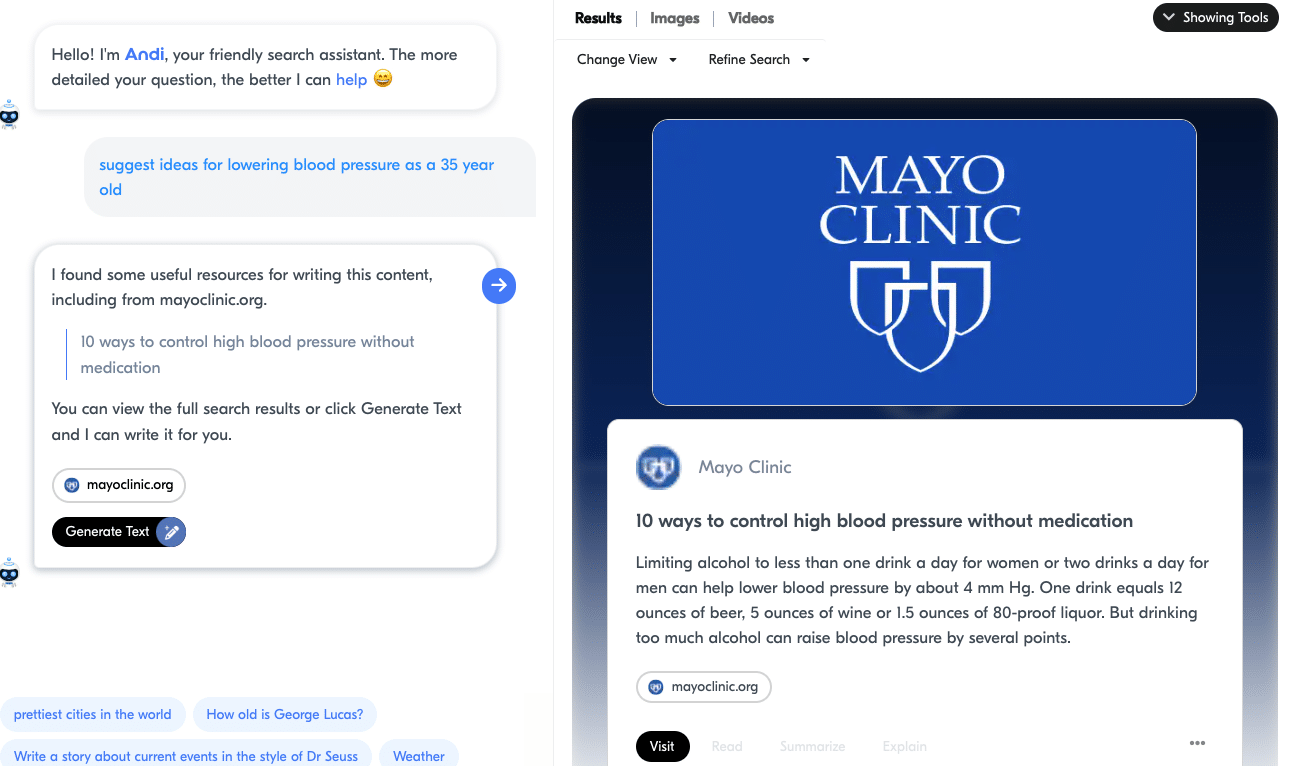
What it looks like. Here’s an example search for [suggest ideas for lowering blood pressure as a 35 year old]:
Visual updates. Andi now uses a “universal image discriminator,” which detects an image’s size and quality, then dynamically resizes it to display in its visual feed. Images are sourced from the webpages in Andi’s search results.
What is Andi. Andi is a startup search engine that was doing conversational, generative question answering before the new Bing and Google Search Generative Experience. It generates results from its index of 30,000 high-quality websites.
Why we care. Andi, recognizing the importance of citing its sources, is trying to set itself apart from the generative AI experiences from Google and Bing. While Andi is an alternative search engine with a tiny fraction of Google’s user base and isn’t on your SEO radar, watching the evolution of Andi’s visual, feed-based take on search results is interesting.
@media screen and (min-width: 800px) { #div-gpt-ad-3191538-7 { display: flex !important; justify-content: center !important; align-items: center !important; min-width:770px; min-height:260px; }
}
@media screen and (min-width: 1279px) { #div-gpt-ad-3191538-7 { display: flex !important; justify-content: center !important; align-items: center !important; min-width:800px!important; min-height:440px!important; }
}
About the author
Danny Goodwin has been Managing Editor of Search Engine Land & Search Marketing Expo – SMX since 2022. He joined Search Engine Land in 2022 as Senior Editor. In addition to reporting on the latest search marketing news, he manages Search Engine Land’s SME (Subject Matter Expert) program. He also helps program U.S. SMX events. Goodwin has been editing and writing about the latest developments and trends in search and digital marketing since 2007. He previously was Executive Editor of Search Engine Journal (from 2017 to 2022), managing editor of Momentology (from 2014-2016) and editor of Search Engine Watch (from 2007 to 2014). He has spoken at many major search conferences and virtual events, and has been sourced for his expertise by a wide range of publications and podcasts.