How long SEO takes to work

Online dating, two-day delivery, binge-watching a series on TV. 

SEO is like the slow-food movement in a fast-food world.

How long do you have to wait, though?

This article will discuss:

  • What are SEO “results.” 
  • The average timeframe to see results.
  • The factors that can impact how fast you can get results from SEO.

What are SEO ‘results’? 

First, let’s talk about what “results” mean before discussing how long it takes to get them. 

At the outset of your SEO program, you will want to set goals that outline what you want your SEO program to accomplish. Revenue may be one of them. 

SEO can drive many things, including revenue. 

However, for the purpose of this article, there is only one important metric to measure SEO success:

Organic traffic. 

So when I refer to the timeframe to see SEO results, I am referring to a significant uptick in organic traffic because that is how I have always measured SEO success.

Yes, you want to see organic traffic driving revenue. 

And the good news is that when SEO drives targeted traffic, that traffic can be one of the biggest revenue drivers for a website. 

But so many factors (many of which are outside of the scope of SEO) can contribute to whether you get a conversion on a website. For example, your price point, landing pages and sales process.

That is why I believe traffic is the best indicator that your SEO program is working.  


Get the daily newsletter search marketers rely on.


How long does it take to see SEO results?  

It typically takes several months up to a year to see measurable SEO results. Your mileage may vary.

This is a general consensus and what I typically see with clients.

Google suggested a similar timeframe in this video:

[embedded content]

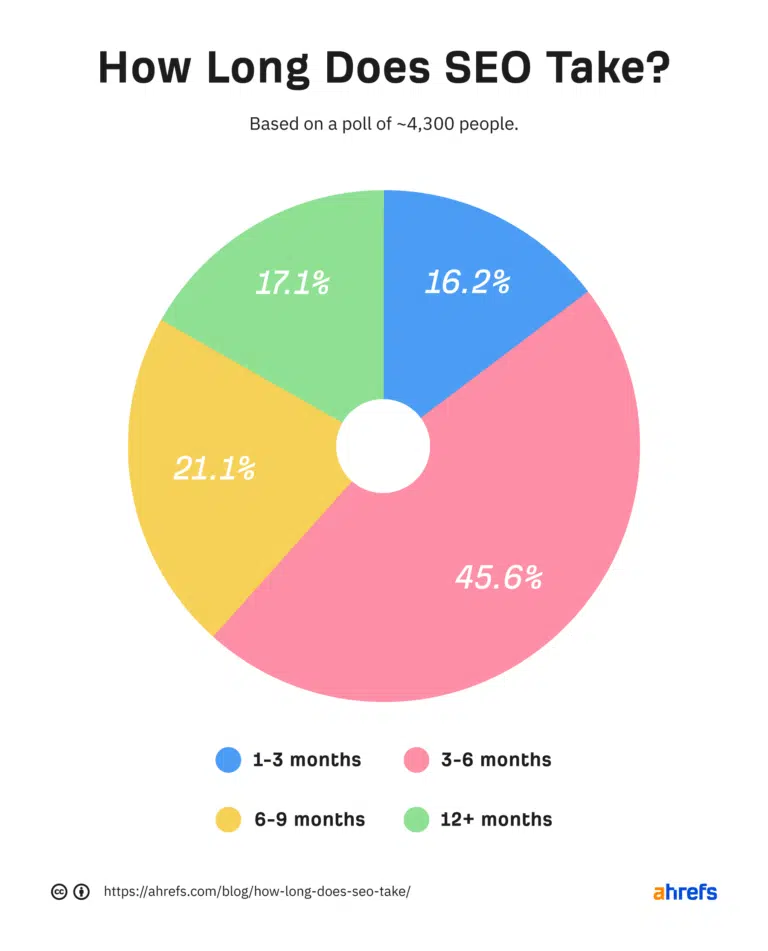
And research from Ahrefs supports this, too:

Ahrefs - How long does SEO take

Here are some real-world examples:

Ecommerce site

An ecommerce furniture business lost significant search rankings and traffic after launching a redesigned website.

We worked with them and identified the primary cause of the problem was a bloated index.

After implementing our recommendations, here is a timeline of the results:

  • After two months, we ranked 56 priority key phrases back onto Page 1.
  • Within three months, the client saw a return to previous traffic levels.
Ecommerce site - SEO results

B2B site

A manufacturer’s website suffered from lost rankings and dwindling organic search traffic; they didn’t know why. 

After an in-depth analysis, we recommended improving user experience, internal linking and content quality. 

After implementing our recommendations, here is a timeline of the results:

  • After four months, the client started to see traffic results. 
  • Within nine months, they received record levels of organic traffic.
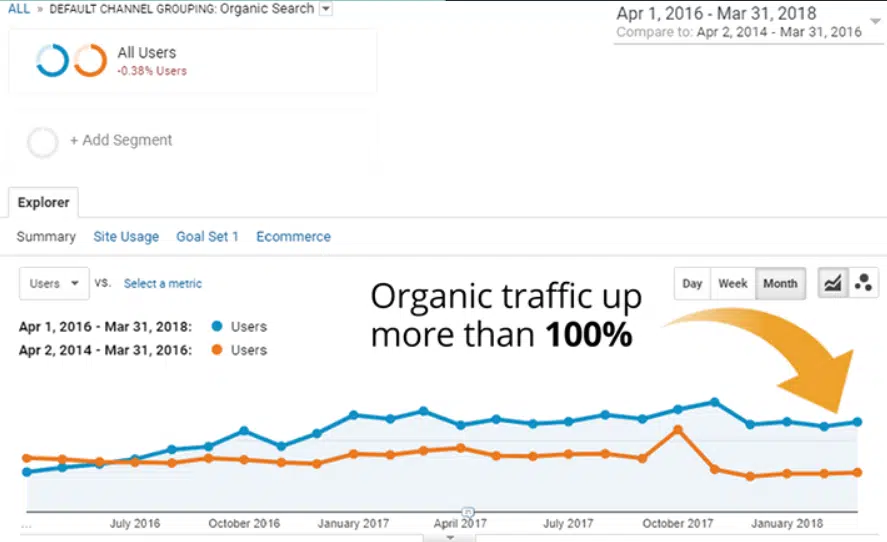
  • Within two years, they saw a 100% increase in organic traffic.
B2B site - SEO results

B2C site

A nationwide drug-screening company reached out to us to improve their underperforming website.

Our recommendations included on-page optimization, technical SEO, user experience and content improvements

After implementing our recommendations:

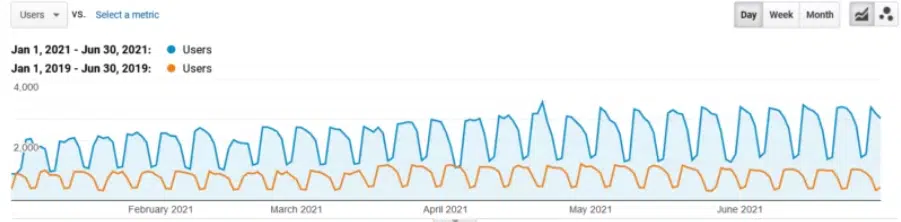
  • Within six months, traffic increased 166% compared to the same six-month period two years prior.
B2C site - SEO results

What factors impact time to SEO results?

Where any one website falls into the timeframe largely depends on several factors. 

Three of the most important are:

  • Your actions.
  • The website.
  • The competition.

1. Your actions

The “SEO results” clock starts ticking once you implement the program, not when you hire someone, and not during the time that strategies are being formulated. 

Many businesses have failed at SEO even after hiring SEO experts because of their inability to implement the recommendations. This is a significant cause of failures.

This can happen for many reasons, including SEO “buy-in” or if IT needs to make a technical change to the website. 

Regardless of the reason, for every month that is wasted not implementing SEO strategies, it’s a month that you can expect not to see results. 

2. The website

If you’ve got a really challenging website, digging yourself out of a hole will usually take longer before you are in good enough shape to compete in the search results. 

Maybe you:

Or you might have a new domain, which typically can take a little longer to see results than a more established site.

These are all reasons why it might take longer to see results, but what about quick fixes? These are more rare but they can happen. 

For example, it’s not unheard of for there to be a robots.txt file that’s accidentally blocking the search engines from accessing the site. Yes, this still happens.

Something like this can be resolved fairly quickly and produce fast SEO results.

3. The competition

I’ve always said that SEO should aim to beat the competition, not the algorithm. And depending on what space you’re playing in, the competition can be tough.

Sometimes your competition will have more resources than you, so they can work faster. (All is not lost in these situations, as long as you can stay nimble and creative.) 

Or maybe you are in a your-money-or-your-life industry where you will be held to a higher standard by Google and it might take more effort to compete.

Or maybe you’re after top rankings for million-dollar keywords. 

It took my company two years to get a client to Position 1 for a short-tail keyword. And to say it was worth the time and effort for the client is an understatement.

How to get better SEO results, faster

While you’ll probably never get faster results than the timeframe outlined in this article, there are ways to speed up the process.

  • Get an in-depth, technical SEO audit on your website. This can pinpoint exactly how to fix your site and how to beat the competition with prioritized recommendations on what actions will make the biggest impact.
  • Enlist the help of an expert SEO consultant or agency to help you implement an SEO program. Expert guidance is worth its weight in gold, and having that wisdom on your side as you enter the search battlefield will make all the difference.

Initial SEO results are good, but ongoing results are better

The SEO results you see within several months to a year are not necessarily the best results you will ever get. 

And because SEO is never done, you can expect better results as time goes on, so long as your SEO strategy is solid.


Opinions expressed in this article are those of the guest author and not necessarily Search Engine Land. Staff authors are listed here.


Related stories

New on Search Engine Land

@media screen and (min-width: 800px) { #div-gpt-ad-3191538-7 { display: flex !important; justify-content: center !important; align-items: center !important; min-width:770px; min-height:260px; } } @media screen and (min-width: 1279px) { #div-gpt-ad-3191538-7 { display: flex !important; justify-content: center !important; align-items: center !important; min-width:800px!important; min-height:440px!important; } }

About the author

Bruce Clay

Bruce Clay is the founder and president of Bruce Clay Inc., a global digital marketing optimization firm providing search engine optimization, PPC management, paid social media marketing, SEO-friendly site architecture, content development, and SEO tools and education.
Clay authored the book “Search Engine Optimization All-In-One For Dummies,” now in its fourth edition, and “Content Marketing Strategies for Professionals.” He wrote the first webpage-analysis tool, created the Search Engine Relationship Chart® and is credited with being the first to use the term search engine optimization. Bruce Clay’s renowned SEO training course is available online at SEOtraining.com.

https://searchengineland.com/how-long-seo-takes-429804


Naver, Korean search engine, now supports IndexNow

Naver, the 24-year-old South Korean search engine, now supports the IndexNow protocol. That makes four search engines that use IndexNow to discover and index content for their search engines. Those four search engines include Bing, Yandex, Seznam, Naver.

Naver and IndexNow. Naver announced this on their blog in Korean saying starting today, Naver Search supports IndexNow so that search engines can recognize the latest website content. Naver posted how this works in its webmaster portal (again in Korean language) over here.

They posted a disclaimer that all search engines have posted, “It should be noted that the IndexNow protocol notifies search engines of changes in the website quickly, but does not guarantee the indexing of the webpage.”

What is IndexNow. IndexNow provides a method for website owners to instantly inform search engines about the latest content changes on their websites. IndexNow is a simple ping protocol so that search engines know that a URL and its content have been added, updated, or deleted, allowing search engines to reflect this change in their search results quickly. The co-sharing of IndexNow went fully live in January 2022.

How it works. The protocol is very simple — all you need to do is create a key on your server, and then post a URL to the search engine to notify IndexNow-participating search engines of the change. The steps include:

  1. Generate a key supported by the protocol using the online key generation tool.
  2. Host the key in text file named with the value of the key at the root of your web site.
  3. Start submitting URLs when your URLs are added, updated, or deleted. You can submit one URL or a set of URLs per API call.

Submit one URL is easy as sending a simple HTTP request containing the URL changed and your key.
https://www.bing.com/IndexNow?url=url-changed&key=your-key and the same would work by using https://yandex.com/indexnow?url=url-changed&key=your-key. You can see the specific Naver documentation over here.

Google. Google was testing IndexNow but it is unclear if Google will ever adopt IndexNow. If they do, that should help increase adoption for this protocol.

Why we care. As more and more search engines, and more and more CMS platforms, adopt IndexNow, it should help reduce server load on your sites, while increasing search engine efficiency with finding new content.


Related stories

New on Search Engine Land

@media screen and (min-width: 800px) { #div-gpt-ad-3191538-7 { display: flex !important; justify-content: center !important; align-items: center !important; min-width:770px; min-height:260px; } } @media screen and (min-width: 1279px) { #div-gpt-ad-3191538-7 { display: flex !important; justify-content: center !important; align-items: center !important; min-width:800px!important; min-height:440px!important; } }

About the author

Barry Schwartz

Barry Schwartz a Contributing Editor to Search Engine Land and a member of the programming team for SMX events. He owns RustyBrick, a NY based web consulting firm. He also runs Search Engine Roundtable, a popular search blog on very advanced SEM topics. Barry can be followed on Twitter here.

https://searchengineland.com/naver-korean-search-engine-now-supports-indexnow-429880


SEO industry benchmark report by Digital Marketing Depot

Two Gauges Compare Your Company Competitors Benchmark Ss 1920 800x450

Identifying organic SEO KPIs and evaluating your organic traffic’s performance can be quite challenging. This difficulty arises from the lack of industry-wide organic benchmarks due to fluctuations in organic traffic caused by Google’s algorithm updates.

To address this challenge, Conductor undertook an extensive analysis of over 600 enterprise domains from renowned brands. Their aim was to identify industry-specific benchmarks for organic search in 2023, which will enable enterprise organizations to assess the effectiveness of their organic SEO efforts better.

See how your site compares! This comprehensive report includes an analysis of more than 82,000 searches, revealing:

  • Industry and subindustry organic traffic benchmarks.
  • The most frequent top result types.
  • The domains leading the conversation in each result type.

Visit Digital Marketing Depot to download the 2023 SEO Industry Benchmark reports from Conductor.


Related stories

New on Search Engine Land

@media screen and (min-width: 800px) { #div-gpt-ad-3191538-7 { display: flex !important; justify-content: center !important; align-items: center !important; min-width:770px; min-height:260px; } } @media screen and (min-width: 1279px) { #div-gpt-ad-3191538-7 { display: flex !important; justify-content: center !important; align-items: center !important; min-width:800px!important; min-height:440px!important; } }

About the author

Digital Marketing Depot

Digital Marketing Depot is the resource center for digital marketing strategies and tactics. Created by Third Door Media, Digital Marketing Depot features a robust library of hosted white papers, eBooks, original research, and webinars on a wide range of digital marketing topics- from advertising, analytics, data and content management, to email marketing, SEO and PPC campaign management, and much more. Visit us at http://digitalmarketingdepot.com.

https://searchengineland.com/organic-seo-industry-benchmark-report-429803


Information gain in SEO: What it is and why it matters

A Google patent on “information gain score” was granted in June 2022. I believe it’s no coincidence that several algorithm updates – including the helpful content update – followed. 

Is information gain score a key way for Google to prioritize valuable content that is “original, high-quality, people-first content demonstrating qualities E-E-A-T”?

My hypothesis: yes. Here’s why.

What is an information gain score? 

An information gain score is essentially a measure of how unique your content is from the rest of the corpus. Here, the corpus would be all the potential documents that Google analyses in ranking for the particular query searched. 

In the patent, most of the scenarios given to calculate information gain scores are done after subsequent queries or document views and search result views. It’s a learning process specific to the individual and/or to the topic they’re searching about.

The late Bill Slawski wrote a technical breakdown of this process when the patent was still in review in 2020. 

One of the interesting things I see in the patent language is this: 

Google is giving leeway for information gain scores to be calculated algorithmically and applied as training data across machine learning models. 

The need for a first set of documents to calculate the information gain score may become obsolete in the future: 

“[i]n some implementations, data from each of the documents of the second set of documents may be applied across a machine learning model as input.”

How does information gain affect search rankings? 

From a real-world perspective, this means Google:

  • Has a way of calculating how unique your content is from the rest of the content in that topic area.
  • Has a metric to actively promote or demote content based on that level of difference or sameness. 

The information gain score suggests a new algorithm element targeting AI-generated content and new content farms.

Consequently, content might be demoted if it lacks uniqueness, even if it consists of different words arranged differently.

Skyscraper content could be a part of this targeted demotion.

The information gain score and helpful content system are forcing innovation where there’s currently a sea of “perfectly optimized” content.


Get the daily newsletter search marketers rely on.


Can information gain improve your website visibility? 

Using information gain to create or update content is a two-fold process. 

  • Analyze the source of your data.
  • Identify market opportunities.

In an ideal scenario, it would be fascinating to see what an expert or sales manager could produce if asked to write about solving a client’s X problem without any “SEO requirements” or using Google. The result might be a surprisingly innovative and appropriate response.

Most of us don’t have the luxury of a shot in the dark like that and need a bit more structure to change, update and adapt how we create content.

So let’s break down how we can shift that approach. 

Where are you getting your information from? 

Dr Pete tweet

While it may feel like a step back, prepare to spend more time researching for content than you perhaps ever have.

If you’re getting your information solely from the web and the SERP you want to rank for, you may be a part of the problem. We all do it, but it’s kinda lazy, right?

Great, quality content takes time.

The content we publish that we’re amplifying and using as a way to promote our companies, our brands, and ourselves should be able to meet the “thought leadership” mark.

What does that take? The basis of thought leadership is essentially informed opinion. 

This requires you to take a stance, have a specific opinion, or come to a particular conclusion. 

And to do that, you need the information to substantiate that opinion, or you should.      

At any company, you will have unique data that’s just waiting for you to use in an article or tool for your clients and customers, like:

  • Feedback and logs from your customer service team.
  • Your reviews.
  • Feedback and sales calls from your sales team.
  • Your product usage data, if it can be aggregated and published.

These are all content sources that a competitor can’t easily duplicate. 

They can also be turned into rich media experiences that Google can’t create. 

It’s also informed by your actual customers and their actual experiences. 

A lot of the content the search results may be “telling” you to create may not actually be appropriate for your customers. 

Starting with your own data will naturally filter out a lot of content that’s written purely for search engines. 

What opportunities are there in the market? 

While it’s tempting to go to Google or Bing and follow the format of the top-ranking article in search results, remember that Google only ranks it the highest because it’s the best of what they have access to. 

They can’t create their own content (yet) to answer exactly what a person is searching for if it doesn’t already exist. 

So the content ranking could be absolute garbage for meeting actual expertise and providing a solid answer, but because it’s the best of the worst, it’s what ranks. 

So when creating new content, we should also look at topical relevance and areas related to the topic you’re writing about that perhaps other competitors aren’t taking advantage of. 

Tools that can help you see the existing topical relationships of your competitors include:

Tools you can use to help understand the semantic topic relationships of your primary topic (that may not be covered by your competitors) include: 

Each of these tools has its own trade-offs and considerations, and each should be weighed up with the data compromises your organization is making. 

Like everything else, they’re also an approximation of how Google’s search engine ranking system works. 

It’s also good to remember that the outpouring of recently published content from AI has real-world cost implications for Google. 

More content means incrementally more expensive electricity bills, so they have a vested interest in cutting out as much content as possible before it goes through all three crawlers. 

So find ways to create content that makes the cut for both your customers and Google. 


Opinions expressed in this article are those of the guest author and not necessarily Search Engine Land. Staff authors are listed here.


Related stories

New on Search Engine Land

@media screen and (min-width: 800px) { #div-gpt-ad-3191538-7 { display: flex !important; justify-content: center !important; align-items: center !important; min-width:770px; min-height:260px; } } @media screen and (min-width: 1279px) { #div-gpt-ad-3191538-7 { display: flex !important; justify-content: center !important; align-items: center !important; min-width:800px!important; min-height:440px!important; } }

About the author

Amanda King

Amanda King has been in the SEO industry over a decade, has worked across countries and industries, and is currently consulting through her business, FLOQ. She’s always been focused on the product, the user and the business. Along with a passion for solving puzzles, she’s incorporated data & analytics, user experience and CRO alongside SEO. Always happy to trade war stories, find her on Twitter or LinkedIn for intermittently shared advice and thoughts on the industry.

https://searchengineland.com/what-is-information-gain-seo-why-it-matters-429763


How to 10x rankings in competitive spaces using the ‘beachhead principle’

Normandy was the beachhead in 1944. 

D-Day was the culmination of a successful head fake, surprising the Germans and helping to establish a strong foothold for the Allies to eventually retake France (and the rest of Europe along with it). 

Clayton Christenson borrowed the military-inspired “beachhead principle” for his bestselling book, “Crossing the Chasm,” to explain how new products can eventually establish category dominance only after they successfully carve out a foothold with a narrow, well-defined group of early adopters. 

SEO is no different, especially today.

It’s never been more challenging, more complex or more competitive.

And to make matters worse, most sites – even established ones – face a Catch-22:

  • To rank for good keywords, you need a big site.
  • But before you can create a big site, you need to rank for good keywords. 

Therein lies the dilemma. Let’s talk about fixing that today.

Why you can’t compete head-on against giant competitors (and what to do instead)

SEO takes a long time.

It’s like a snowball that slowly gathers momentum before finally taking shape months (if not years) down the line.

That means it might look like nothing’s happening on the surface, despite traction slowly but surely building just beneath. 

Here’s why.

If ~70-80% of people click on the top ~5 SERP results, everyone outside the top five only sees a tiny sliver of traffic. If any.

But that doesn’t mean progress isn’t being made.

And it’s why your organic search traffic might look consistently flat for months, before leaping up and to the right, literally right off the edge of the page.

Pageview stats

The same principle applies to middling sites (think: ~DR 40-60) that compete against industry titans (think: ~DR 90+).

If you ain’t in the top five, you ain’t seeing any results!

So to reliably predict SEO success, you need to start by prioritizing keywords and topics and content pieces that can reliably break into the top five – within a reasonable amount of time. 

And for now, ignore or disregard the keywords or topics where reaching top five is difficult. 

This, in turn, will allow you to set your sights higher a few months (or years) from now to then go after much bigger categories filled with SEO giants. 

David ousted Goliath not by competing directly in a test of brute strength but indirectly – with asymmetric warfare. 

You need to do the same thing. Here’s how.

Why your ‘payback period’ should determine which keywords you prioritize

SEO is the best digital investment because results compound.

Done correctly, your investment doesn’t grow 10% per month or become 10% more cost-effective, like PPC ad optimization.

Instead, it 10x’s. Then, it 10x’s again.

The catch?

It takes a long time to get the snowball rolling.

That’s why the most important (yet least discussed) concept for SEO projects is the payback period.

Like any other capital investment, you:

  • Invest $X dollars/pesos/yen today, to 
  • Generate $Y dollars/pesos/yen tomorrow

But…

Instead of only taking days or weeks to produce results (like advertising), you’re looking at months or years. At a minimum. 

Mainly because most marketers (and their bosses holding the purse strings) are so busy focusing on lagging indicators – like traffic, leads, and sales – that they miss all the inputs or leading indicators bubbling beneath the surface.

SEO priorities

So you can define the payback period into a few easy groups:

  • 0-6 months
  • 6-12 months
  • 12-18 months 
  • 18-24 months
  • 24+ months

And by extension, you can prioritize the keywords/topics and content that you think will deliver short-term results (0-12 months) vs. long-term ones (18-24 months +).

Now, here’s the catch.

Most companies need to balance both at the same time:

Capitalizing on low-hanging fruit to generate some short-term results while laying the groundwork for the more difficult campaigns that will generate a substantial ROI two years from now.

Short-term and long-term SEO results

Why are we droning on and on and on about this?

Resource allocation! 

‘Cause it’s the single biggest determining factor behind your ability to generate results (or lack thereof).

If you don’t get the long-term vision, direction, budget, and patience to plot this long, winding road, you’ll almost never be able to compete with industry giants long-term. 

Meaning you need to:

  • Prioritize and establish a beachhead ASAP!
  • Leverage quick wins as evidence for proof of concept behind your idea.
  • Illustrate to your boss that you need a bigger budget and team to continue rolling the SEO snowball downhill.
  • Allow your boss to make a case to their boss that the ROI will be worth it 2+ years from now if you and they are given the time + money to sustain the required marathon.
  • Freedom to make autonomous, strategic, long-term decisions without allowing other HIPPOs (highest-paid person’s opinion) to squash your vision before it has a chance to take off.

But the payback period alone won’t determine how fast or slow you can move.

It’s also linked directly with topical authority. This means you will be able to move slowly or quickly.

  • Slow: Starting from scratch and need to create topical authority in a category.
  • Fast: Kinda/sorta have topical authority and need to continue doubling down to grow it.
  • Fastest: Already have topical authority and are ready to dominate.

So if next year’s SEO results depend on this year’s work, then it’s time to get cracking on establishing your beachhead right now.


Get the daily newsletter search marketers rely on.


How to establish your SEO beachhead by going deep and narrow (vs. broad and wide)

Let’s take a random SaaS keyword, like “customer churn.”

Volume looks pretty good, CPC indicates at least some buying intent, and the keyword difficulty looks hard but not impossible.

Customer churn - Keyword difficulty

Please note that keyword difficulty is often biased towards the number of referring domains pointing to each piece of content ranking, and doesn’t always indicate the overall domain strength of the sites ranking. 

So an “Easy” KD in your favorite SEO tool could actually be a lot harder to rank for in reality because all those DR 90 sites ranking only have ~10 referring domains each.

Let me illustrate this. 

The quantity of referring domains below don’t look that difficult to compete against in theory. However, take one glance over at the average DR of the top ten and you quickly realize this will be an uphill battle.

Customer churn - SERP overview

Yikes.

Seven out of the top ten are DR 90+ sites. Two are mid-to-high 80s, while the last is the only one in the 70s. 

So overall, from a domain-level perspective, this keyword is extremely competitive!

Now, let’s say your site’s DR is in the ~50s. Respectable! It’s pretty good. 

But not good enough to reliably outrank those competitors in the next few months alone.

That means a few things:

  • You can and should work on increasing your own DR…
  • Except that will take 12+ months at the absolute minimum to crack 80 or 90,
  • So right now, you need to set your sites on easier targets, in order to…
  • Eventually come back and rank for “customer churn” ~12-24 months from now.

Making sense so far?

Your near-term strategy, then, should be to create a “customer churn” pillar, with a surrounding cluster of child pages based on easier-to-rank, longer-variation “Terms match” and “Question”-based queries:

0VzyjBp9wvz5BJnI2fXhGJmvO Y5BfvvCQ6EIzsFMhr FSmK Zj YyCu AN5YbPXxyIf9rsNwWAZeP5ID4VDz7AsiqvFALzWqVIPwhCCOdZUE0sbCv3oGladkl9vS6A4rpRiCHKmLZPNjkNUrPYReSA

Still with me?

Digging into these lists a little more, we can uncover some excellent near-term (again: ~0-12 months) options, like these related keywords for “predicting customer churn.”

Customer churn - SERP overview, low KD

A little SERP analysis across all of these will help you quickly see a fair bit of content overlap. You can probably get away with creating one good, in-depth article vs. unique content for each slight variation.

You can further validate this last sentence by looking at the relationship between Traffic Potential and Volume in one of these keywords. 

The fact that Traffic Potential is ~2X your Volume typically means overlapping intent between a few closely-related keywords.

Plus, the Keyword Difficulty also looks more palatable on this long-tail variation (“customer churn prediction”).

Customer churn prediction - Keyword difficulty

We can’t stop there. We need to cross-reference the DR ranges again like before.

Customer churn prediction - SERP overview

Voila! 

While there’s still some heavyweights in there, you at least have a few competitors in the ~40 – 60 range – falling exactly within your own current weight class.

You can take them on especially if you continue to go deep and narrow, becoming the go-to resource on all things “customer churn” while repurposing or updating existing content to provide a 0-6 month payback period.

After exhausting one defined area, you should think about branching out into other adjacent pillars and clusters. 

Resource allocation

The reason is that you can leverage topical authority in one area – your beachhead! – to branch out and successfully start taking territory away from others.

Rinse and repeat for months, and those “hard” keywords that used to look difficult now become “much easier” to rank for based largely on your existing topical authority.

Agile methodology steps - difficulty

Don’t get me wrong. 

In most competitive spaces on the web (read: the one you’re probably working in if there’s a lot of money floating around), you’ll still need to create a link building engine in the background.

But the point is the point.

  • You establish a beachhead in one fruitful area that’s highly relevant to your core product or service.
  • You gain traction on less competitive yet still relevant keywords.
  • You slowly go from Page 2 to Position 2, increasing traffic 10X at least across each URL that makes this jump.
  • You move the goalposts back, now adjusting your sights on the top spots in the space.
  • Only when you have the existing topical authority and site size that make your payback period more palatable (and realistic).

It’s not easy per se.

The pros – the ones doing this repeatedly, over the long haul, proving success across categories or websites – just keep their heads down and continue plugging away.

A former client of mine scaled traffic by over 600% in two years.

No tricks or gimmicks. 

They just trusted the process, focusing exclusively on executing month after month, year after year. 

And the results took care of themselves.

Delivering SEO results for long-term success

There are often two primary reasons most SEO campaigns fail to deliver results:

  • You (or your boss) unrealistically set your sights too high on keywords completely out of your reach (in the near future).
  • You (or your boss) pull the plug too early, change direction, and don’t allow enough time to pass to bear fruit. 

That’s it! 

Simple at the end of the day. 

Either you set the wrong targets from the beginning or fail to execute over the long term.

Both are cardinal sins in SEO. Both will sabotage your efforts.

Like losing weight, they’re focusing on the inputs of food they eat, the number of steps they take, etc. 

Let compounding do its thing instead of focusing on the outputs, or lagging indicators, like the number of pounds lost on a scale. 

Weight loss, like SEO results, goes slowly. And then suddenly. 

Months become years. And only then comes success. 


Opinions expressed in this article are those of the guest author and not necessarily Search Engine Land. Staff authors are listed here.


Related stories

New on Search Engine Land

@media screen and (min-width: 800px) { #div-gpt-ad-3191538-7 { display: flex !important; justify-content: center !important; align-items: center !important; min-width:770px; min-height:260px; } } @media screen and (min-width: 1279px) { #div-gpt-ad-3191538-7 { display: flex !important; justify-content: center !important; align-items: center !important; min-width:800px!important; min-height:440px!important; } }

About the author

Brad Smith

Brad Smith owns three content marketing companies, and has been featured in publications like The New York Times, Forbes, Business Insider, and The Next Web. Each week, he shares first-hand experience and growth strategies behind some of the web’s fastest growing brands.

https://searchengineland.com/10x-rankings-competitive-spaces-beachhead-principle-429741


Bing Chat not yet available on Chrome or Safari browsers

After weeks of testing, Bing Chat is coming soon to Chrome and Safari browsers – leaving behind the requirement to install Edge, Microsoft’s browser, to use Bing Chat.

What we know. In the coming days, we expect Bing Chat to soon work on Chrome, Safari and other non-Edge browsers.

Right now, most people who go to Bing and click on Chat will see a message that says you need to download Edge to use the new Bing.

Bing Chat Safari Download Edge

Testing Bing Chat on other browsers. Bing has been testing Bing Chat on Chrome, Safari and other browsers since earlier this month.

  • Bing escalated its tests to a larger percentage of users late last week.

Misinformation. Some news organizations incorrectly reported that this is now live for all Chrome and Safari users. It is not. Some of these publishers have since updated their stories, but by that point, thousands of people had already read the incorrect information.

Testing is common. Search engines often test new features and changes to a subset of users. Like Google, Bing does this all the time. Some features roll out live to all users while others never do and quietly disappear.

What Microsoft said. Here are tweets from Mikhail Parakhin, the CEO of Bing, on this topic, where you can see Bing has been testing this for a while but it should be coming to more browsers soon.

First, here he just said yesterday that Bing is still testing Bing Chat on other browsers, but it should roll out soon to all users:

Last week, he said this feature should be live “in a week or two,” (which means it should be live soon for everyone):

Parakhin confirmed Bing was first testing “bringing [Bing Chat] to all the browsers soon” in May:

Other tests. Bing Chat:

Why we care. Bing Chat and these AI search solutions are rapidly changing. Both companies are frequently testing new features and expanding access to those features. What goes live and what remains a test is a waiting game.


Related stories

New on Search Engine Land

@media screen and (min-width: 800px) { #div-gpt-ad-3191538-7 { display: flex !important; justify-content: center !important; align-items: center !important; min-width:770px; min-height:260px; } } @media screen and (min-width: 1279px) { #div-gpt-ad-3191538-7 { display: flex !important; justify-content: center !important; align-items: center !important; min-width:800px!important; min-height:440px!important; } }

About the author

Barry Schwartz

Barry Schwartz a Contributing Editor to Search Engine Land and a member of the programming team for SMX events. He owns RustyBrick, a NY based web consulting firm. He also runs Search Engine Roundtable, a popular search blog on very advanced SEM topics. Barry can be followed on Twitter here.

https://searchengineland.com/bing-chat-not-yet-available-on-chrome-or-safari-browsers-429822


How to optimize your content strategy for Google SERP features

Want to know the most effective ways to harness the full potential of Google’s SERP features?

Learn how your brand can adopt a strategic approach to enhance visibility and secure inclusion within these vital result types.

Common Google SERP features today

When Google updates its search engine ranking algorithm or adds new features, its end goal is to help organize information better for users. 

SERP features accomplish this by visually highlighting answers above-the-fold that are most likely to match a user’s inquiry. 

Some of the most common SERP features include:

  • Highlighted information that is displayed at the top of the results page, providing bolded answers to user queries.

Knowledge panels

  • Panels that appear on the right side of the search results offer information about specific entities such as businesses, celebrities or landmarks.

Local packs

  • Listings of local businesses relevant to the user’s search query, including address, phone number, and reviews. These also appear on the right side of the result’s page on desktop or at the top of the page on mobile devices. 

Image packs and video carousels

  • Collections of images related to the query displayed prominently in the search results or horizontal lists of videos related to it, enabling users to preview and watch them directly from the search results page. These can appear anywhere on the results page.
  • Additional links to the same domains displayed beneath the main search result, directing users to specific sections or pages within a website.

People also ask

  • Expandable question boxes, with additional related questions and answers based on the user’s initial search query. Answers can link to the same, or different domains. 

Rich snippets

  • Also known as “rich results,” these appear similar to traditional search results but display additional information, such as star ratings, pricing, or availability, providing users with more context.

Reviews

  • Ratings and reviews displayed alongside business listings, offering users insights into how other members of the public rate the quality of products or services.

Remember that while these SERP features might appear to some users more often, their availability will vary depending on the user’s location, search query and device. 

Other result types, like job and event listings or flights and hotels, will only appear for a specific inquiry type. 


Get the daily newsletter search marketers rely on.


Featured snippets are among the most common and sought-after forms of SERP features. They typically consist of three main components:

  • Title.
  • Content snippet.
  • URL source. 

The title represents a concise summary of the information, while the content snippet provides a brief answer or solution to the user’s query. The URL source indicates the website from which the information is pulled. 

To optimize your content for featured snippets, it is vital to create concise, well-structured information that addresses common user queries.

For instance, if your website offers cooking recipes, you can structure your content by providing step-by-step instructions or bullet-pointed lists that succinctly answer queries. 

Optimizing specific on-page elements can significantly enhance your chances of getting featured in snippets. 

Start by optimizing your headings and subheadings to indicate the sections containing the answer to the query clearly. 

Consider question-based headings (“Can You Cook Salmon in an Air Fryer?”) and answer the question succinctly in the first sentence.

You might also consider generative AI tools like ChatGPT or Google Bard to assist you with crafting perfectly optimized content.

Additionally, implementing structured data markup via schema.org can provide search engines with valuable context and increase the visibility of your content for featured snippets.

To improve your chances of being featured in snippets, consider the following steps:

  • Identify common user queries in your industry or niche and create dedicated content to address them comprehensively.
  • Focus on long-tail keywords and questions that are more likely to trigger featured snippets.
  • Optimize your content for mobile devices, as featured snippets often receive high visibility on mobile search results.
  • Leverage visual elements like images, charts, or infographics to make your content more visually appealing and engaging.

Enhancing local SEO with Google’s local packs

Consider the last time you incorporated the phrase “near me” into a Google search. 

Regardless of whether you run a restaurant, retail store, or professional service, optimizing your online presence for local searches guarantees that you will be noticed by prospective customers who are actively looking for nearby options.

Many organizations tend to overlook the advantages of local SEO in their overall strategy, even though nearly 98% of people use Google to search for information about local businesses.

This highlights the importance of mastering the basics of Google’s Local Pack features.

At a minimum, you should create and fill out all the fields of your Google My Business profile to the greatest extent possible to secure visibility in Google’s local packs. 

Don’t forget to provide accurate and up-to-date information about your business, including address, phone number, hours of operation, and website link, as they are updated.

When it comes to on-page content, to effectively optimize your website for local search queries, start by conducting thorough keyword research that includes location-specific keywords. 

For example, if you run a coffee shop in Seattle, target keywords like “best coffee shops in Seattle” or “coffee near me.”

For searchers who allow location targeting, Google is likelier to serve up your business toward the top of the page.

Incorporate these keywords naturally within your meta tags, headings, content and URLs.

Build out location-specific landing pages or blog posts that provide information about your business in relation to the local area, such as highlighting nearby attractions or events. 

This is especially important for chains or brands with locations across multiple cities looking to target individual geographic regions. 

Leveraging knowledge panels and rich results

Knowledge panels and rich results are powerful SERP features that directly provide information about a person, brand, or topic on the search engine results page. 

They offer a snapshot of key details, such as an entity‘s description, website, social media profiles, and notable achievements. 

Appearing within these types of results can enhance your brand’s credibility by showcasing expertise, authority, and trustworthiness to users. 

To optimize your website content for knowledge panels and rich results, start by ensuring that you are providing comprehensive and accurate information about your entity or topic.

As of December 2022, E-A-T expanded to accommodate an additional “E” for experience.

This means content written from a first-hand perspective has a greater chance of ranking. Try to specialize in topics you or your team can write from a place of real-world experience. 

Just like featured snippets, entity descriptions that are concise, compelling and succinctly highlight your unique selling points and core expertise are likeliest to get featured.

Structured data markup also plays a pivotal role in enhancing your website content’s visibility for knowledge panels and rich results.

The additional context offered by this code allows search engines to understand and present your information in a more meaningful and visually appealing way.

Earning and maintaining knowledge panel inclusion requires a proactive approach and buy-in from your audience and customer base. Here are some strategies to consider:

  • Encourage reputable sources to mention and link to your entity to strengthen your online presence and increases the likelihood of knowledge panel inclusion.
  • Cultivate a strong online reputation by actively managing and responding to customer reviews and feedback.
  • Regularly update and expand your entity’s information to provide search engines with the most relevant and comprehensive details.
  • Monitor your knowledge panel regularly to ensure accuracy and make necessary corrections or updates.

Harnessing visual SERP features (image packs and video carousels)

When it comes to certain types of content, sometimes an article can only take you so far. 

It’s no wonder that Google is increasingly prioritizing the inclusion of image packs and video carousels for inquiries that benefit from more of a visual explanation. 

Elements such as images, videos, and carousels can significantly enhance your content’s visibility and click-through rates, while providing a more appealing experience for your visitors.

Incorporating high-quality images and videos relevant to your content encourages users to stay on your website longer. 

When optimizing this type of multimedia content for Google’s visual SERP features, it is essential to focus on the following aspects:

Images

Use descriptive file names, alt tags, and captions to provide context and improve the discoverability of your images and compress images to optimize loading speed without compromising quality.

Google advises that visual content should be relevant to the page’s topic and not contain any important text embedded within it.

Putting page headings and menu items inside images makes them inaccessible to some users and those using assistive reading devices.

Image alt text and image captions are also required to stay compliant with the Americans with Disabilities Act (ADA) Standards for Accessible Design.

Videos

Optimize video titles, descriptions, and tags with relevant keywords and provide a compelling video thumbnail, considering how it will appear within search results.

Hosting videos on reputable platforms like YouTube or Vimeo is another way to enhance visibility and reach.

Increase the likelihood of your video content being featured in rich snippets or video carousels by implementing structured data markup, such as VideoObject schema, to provide search engines with detailed information. 

Google Bard, AI and preparing for the future of SERP features

What will Google Search look like next year? In five years? Ten?

Alphabet CEO Sundar Pichai said the experience “will evolve substantively over the next decade,” which users already see with the introduction of Google Bard and the rapidly evolving world of large language models and generative AI.

Google has introduced the world to Bard, its conversational AI product launched to compete with ChatGPT.

While the experience remains distinct from search, Bard answers can show search and knowledge panels, maps, and even provide local results.

It’s nearly inevitable that the chatbot experience will make its way to Google Search. 

As it’s deployed, SEOs should continue to measure how much of an impact it will have on the amount of organic traffic Google sends to sites, and the potential ROI impact for brands and organizations who use Google Ads. 

Publishers reliant on ad-based and subscription revenue models have expressed concern about chatbots and AI’s ability to pull and summarize information without users needing to click through to their content.

Add in Bard’s shaky ability thus far to provide sourcing and citations to third-party content, and the ad-based revenue model is looking especially vulnerable.

Ultimately, the greater the number of questions that AI-powered platforms can directly answer using a vast array of sources, the less likely users will visit individual publisher websites, which may or may not provide the desired information.

At this point, Google has underscored its commitment to improving the consumer experience while supporting publishers relying on advertising revenue generated through search referrals.

Still, the long-term ramifications of AI remain to be seen. 

Keeping up with the evolution of the search experience and its effect on organic and paid channel performance is part of the course for SEO professionals.

Google has clarified that Bard is not Search, but the two experiences are becoming closer as more AI-powered features are introduced.

When it comes to the search engine results page, some of Google’s newest offerings include Perspectives, which allows searchers to take a deeper dive into creators’ personal experiences, and new markup for site owners to label their images as AI-generated.

Perhaps the biggest change coming to Google is the May 2023 introduction of the new Search Generative Experience (SGE).

Like existing SERP features, AI-powered answers from SGE appear above the first traditional organic result.

The boxed-in answer includes a link to the website source, which users can click, or several “expand” options, which display additional AI responses.

The generative experience also includes the ability for users to converse and provide additional information, with context carried over from question to question. 

Google SGE offers a distinctive search experience that builds on the familiar ways searchers are accustomed to interacting with the platform.

As the feature rolls out to the general public, SEOs should proactively monitor their performance to plan for positive or negative effects. 

While it’s possible that providing more information within the results page could reduce CTRs and traffic, the SGE could also increase site visits if optimized properly, similar to featured snippets.

The AI discussion parallels the debate that arose when featured snippets were initially introduced.

Publishers and brands should exercise caution when dealing with features that aim to keep users within Google’s ecosystem.

Nevertheless, given the current stage of technology’s development, it would be wise to consider testing the capabilities of appearing before new audiences.

This is particularly relevant for ecommerce businesses. Google’s SGE can aggregate 35 billion product listings from the Google Shopping Graph, offering a potentially powerful means to connect with fresh consumer bases.

Google SERP features today and beyond

SEO continues to evolve rapidly, alongside the increasing importance of SERP features for enhancing user experience.

We must adapt and optimize our strategies to leverage these features effectively, ensuring maximum visibility and reaching our target audience.

Planning a strategy now for existing SERP features is a great way to maximize your organic presence and the best strategy for staying ahead of future advancements in AI and conversational technology.

Keep a close eye on the impact of AI-powered answers on organic traffic and ROI.

As the search landscape continues to evolve, embracing the future of AI and conversational technology will be key to staying competitive and driving success in the digital space.


Opinions expressed in this article are those of the guest author and not necessarily Search Engine Land. Staff authors are listed here.


Related stories

New on Search Engine Land

@media screen and (min-width: 800px) { #div-gpt-ad-3191538-7 { display: flex !important; justify-content: center !important; align-items: center !important; min-width:770px; min-height:260px; } } @media screen and (min-width: 1279px) { #div-gpt-ad-3191538-7 { display: flex !important; justify-content: center !important; align-items: center !important; min-width:800px!important; min-height:440px!important; } }

About the author

Alex Klugerman

Alex Klugerman is a New York city-based SEO professional. He is currently an Analyst on the Enterprise SEO team at Direct Agents, optimizing the online presence of a diverse range of clients in the B2B, B2C, and retail domains. With a focus on enhancing technical SEO strategies and curating tailored content, Alex’s knowledge and areas of interest encompasses various aspects of digital marketing, particularly content creation and marketing, as well as the dynamic and evolving interplay between artificial intelligence and the SEO landscape.

https://searchengineland.com/optimize-content-strategy-google-serp-features-429776


Twitter is now brand X

Twitter is the past. X is the future.

The iconic blue bird icon has been removed from the desktop version of Twitter – replaced by a stark, monochromatic letter X. The same change will shortly be made on the mobile version, the company confirmed.

The change is also said to signal an evolution for the brand beyond social media, to an “everything app” best compared to WeChat:

  • “It’s an exceptionally rare thing – in life or in business – that you get a second chance to make another big impression. Twitter made one massive impression and changed the way we communicate. Now, X will go further, transforming the global town square,” tweeted Twitter CEO Linda Yaccarino – or rather “x’ed” Yaccarino, as we must learn to say.
  • “X is the future state of unlimited interactivity – centered in audio, video, messaging, payments/banking – creating a global marketplace for ideas, goods, services, and opportunities. Powered by AI, X will connect us all in ways we’re just beginning to imagine.”

Why we care. For users of X, the rebranding will indeed require sweeping changes to familiar vocabulary. People will “x” rather “tweet.” Presumably, on the mobile device, we will now see a list of users who recently “x’ed.” TweetDeck will surely become XDeck, although that has yet to be confirmed.

For marketers and advertisers, the change will underline questions already raised about brand safety. Last year, many sources noted a significant rise in hate speech on the platform. While Meta’s Zuckerberg has spoken about X competitor Threads as being “friendly,” the aesthetic of X inevitably comes across as minimalist, even brutalist — for example when the new logo is projected on the exterior of their headquarters like a sinister version of the Bat-signal.

Gone, advertisers, gone. Many big-spending advertisers abandoned or reduced spending on the platform since Musk bought it, resulting in an estimated 59% drop in Twitter’s U.S. ad revenue.

X. X.com now points to twitter.com, as Musk tweeted.

Musk has a long history with the letter X. He’s clearly fond of it; it remains to be seen whether a wider audience will find the name and logo relatable.

Breaking Twitter? Lots of speculation among the SEOs that this change could result in embedded tweets breaking – among other SEO impacts. Whether these things will actually happen remains to be seen. But here are a few embedded tweets (we’re living dangerously) discussing how Twitter/X may soon break (or not):


Related stories

New on Search Engine Land

@media screen and (min-width: 800px) { #div-gpt-ad-3191538-7 { display: flex !important; justify-content: center !important; align-items: center !important; min-width:770px; min-height:260px; } } @media screen and (min-width: 1279px) { #div-gpt-ad-3191538-7 { display: flex !important; justify-content: center !important; align-items: center !important; min-width:800px!important; min-height:440px!important; } }

About the author

Kim Davis

Kim Davis is the Editorial Director of MarTech Today. Born in London, but a New Yorker for over two decades, Kim started covering enterprise software ten years ago. His experience encompasses SaaS for the enterprise, digital- ad data-driven urban planning, and applications of SaaS, digital technology, and data in the marketing space. He first wrote about marketing technology as editor of Haymarket’s The Hub, a dedicated marketing tech website, which subsequently became a channel on the established direct marketing brand DMN. Kim joined DMN proper in 2016, as a senior editor, becoming Executive Editor, then Editor-in-Chief a position he held until January 2020. Prior to working in tech journalism, Kim was Associate Editor at a New York Times hyper-local news site, The Local: East Village, and has previously worked as an editor of an academic publication, and as a music journalist. He has written hundreds of New York restaurant reviews for a personal blog, and has been an occasional guest contributor to Eater.

https://searchengineland.com/twitter-is-now-brand-x-429760


Google Performance Max now lets you create product collections

A new Google Performance Max feature lets you combine products and create collections – for ads or free product listings.

Collections allow you to associate products with your creative assets – images, videos and text.

Why we care. The ability to associate different products and assets simplifies the product listing experience, saving you time and money. Collections can also enrich product data, which could result in enhanced product performance, increased engagement and a richer customer experience.

How it works. Collections can include up to 100 products. They are only available for local products sold within Performance Max for store goals.

Here’s how you can set up a collections feed in Merchant Center:

  • Sign into your Merchant Center account.
  • Select Products.
  • Click on Feeds.
  • Selection the Collections Feeds tab.
  • Click the + (plus) button.
  • Select the destinations in which you would like your collection to appear.
  • Give your collection feed a name.
  • Choose an upload method, then follow the instructions for the method you have selected.

Get the daily newsletter search marketers rely on.


Next steps. Google is yet to roll out its Collections feature for wider-scale or international promotions.

Google has yet to confirm its future plans for this feature. For now, it’s a great opportunity for local marketers to maximize their local outreach.


Related stories

New on Search Engine Land

@media screen and (min-width: 800px) { #div-gpt-ad-3191538-7 { display: flex !important; justify-content: center !important; align-items: center !important; min-width:770px; min-height:260px; } } @media screen and (min-width: 1279px) { #div-gpt-ad-3191538-7 { display: flex !important; justify-content: center !important; align-items: center !important; min-width:800px!important; min-height:440px!important; } }

About the author

Nicola Agius

Nicola Agius is Paid Media Editor of Search Engine Land after joining in 2023. She covers paid search, paid social, retail media and more. Prior to this, she was SEO Director at Jungle Creations (2020-2023), overseeing the company’s editorial strategy for multiple websites. She has over 15 years of experience in journalism and has previously worked at OK! Magazine (2010-2014), Mail Online (2014-2015), Mirror (2015-2017), Digital Spy (2017-2018) and The Sun (2018-2020). She also previously teamed up with SEO agency Blue Array to co-author Amazon bestselling book ‘Mastering In-House SEO’.

https://searchengineland.com/google-performance-max-product-collections-429728


Google to fix link report in Search Console

Google has confirmed an issue with the link report within Google Search Console. The issue seems to be impacting the number of links shown in that report.

John Mueller, a Google Search Advocate, said “To update here, we did find something” with the link report. He added, “Hopefully it’ll be resolved this week.”

Link report issues. Last week I covered how many are noticing huge drops in the number of links being reported by Google Search Console’s link report. Initially, John Mueller said there was nothing wrong with the report but then this morning, John apologized for the back and forth and said the team did find an issue.

Here are screenshots of my site showing a fraction of the number of links than it did a year ago and then years and years ago:

Google Links Report 2023 1689849235 628x600

The screenshot above is from this week, but the screenshot below is from July 2022:

Google Search Console Link Counts Drop 1656856705 643x600

If we go back to August 2018, you can see it reported 2.5 million links:

New Google Search Console Links Overview 1534861619 465x600

Some are reporting only a handful of links being reported by Google Search Console and some are reporting zero links being accounted for.

Google fixing the issue. John Mueller from Google said a fix should be out sometime this week. Will it bring back all of those missing links or just fix the issue for some users seeing a fraction of the number of links? It is unknown, but we will keep an eye on things.

Why we care. Truth is, counting the links you have in Search Console is not going to make much of a difference in terms of how much traffic you get from Google Search or how well you rank in Google Search. So I wouldn’t be concerned if Google is showing fewer links in these reports than you expect.

But it is good to know which sites are linking to you and for those reports to be accurate.


Related stories

New on Search Engine Land

@media screen and (min-width: 800px) { #div-gpt-ad-3191538-7 { display: flex !important; justify-content: center !important; align-items: center !important; min-width:770px; min-height:260px; } } @media screen and (min-width: 1279px) { #div-gpt-ad-3191538-7 { display: flex !important; justify-content: center !important; align-items: center !important; min-width:800px!important; min-height:440px!important; } }

About the author

Barry Schwartz

Barry Schwartz a Contributing Editor to Search Engine Land and a member of the programming team for SMX events. He owns RustyBrick, a NY based web consulting firm. He also runs Search Engine Roundtable, a popular search blog on very advanced SEM topics. Barry can be followed on Twitter here.

https://searchengineland.com/google-to-fix-link-report-in-search-console-429733