What we can learn from past and present Google algorithm updates

Disruptive algorithm updates have shaken up Google’s SERPs over the years. 

Remember Penguin, Panda, Caffeine and May Day? 

Google’s updates typically begin as a narrow attempt to solve an individual problem, then broaden and gain names before being absorbed into the core ranking algorithms. 

Despite the dynamic nature of search, Google’s commitment to tackling spammy web content remains unchanged. 

Understanding Google’s search psyche becomes crucial as AI revolutionizes search and our lives.

Let’s examine the common threads between Google’s past and present updates to understand the actions and content that Google values.

Google Search Generative Experience vs. Knowledge Panel

This is perhaps the most obvious comparison we can draw. These two updates are broadly similar in how those in the search community reacted to them. 

Recently, we have Google’s Search Generative Experience preview. We also have various articles from Google, bringing SGE and Bard (Google’s AI product) closer together.

Here is one of the animated previews which Google has shared:

SGE-eBike-GIF

The preview sparked panic among SEOs, as it indicated limited space for organic search links. 

Search marketers feared that SEO (and potentially paid search) would become obsolete without clickable elements.

It wasn’t long before language became apocalyptic, and people started declaring search to be dead again:

SEO is dead stories

A certain FAQ update started blowing up on Twitter, as Google documentation confirmed that Bard “rarely lists citations and links to content creators.” (More coverage from Barry Schwartz’s report) 

Search professionals were concerned that Google would effectively stop delivering traffic to the broader web with fewer organic link placements and a lack of direct citations.

To me, that seems unlikely. Google’s entire revenue model is based on pay-per-click advertising. 

That’s not to say that things couldn’t work differently. (i.e., Pay to have your brand referenced more often by an AI within more relevant chats – forget keywords!)

However, it takes time for such technology to spread globally.

Hence, I wouldn’t expect Google’s advertising model to change overnight.
We’ll undergo a period of adaptation to new technologies. 

Our roles may involve more prompt crafting and shifting ad approaches using AI recommendations instead of keywords and links. 

Despite changes, search will continue, albeit in a significantly different way.

Does this ring a bell? In 2012, Google launched knowledge panels.

This relied upon Google’s previously released Knowledge Graph (a behind-the-scenes system to contextualize information and group it into entity form) to extract specific information directly into search results instead of linking to the hosting webpage.

Since then, it has gone through many evolutions.

When the knowledge panel was first released, it looked roughly like this:

Knowledge Panels - then

So, there were still plenty of organic links. But it was a huge visual shift, giving more search real estate (especially within informational query spaces) to pure information. 

These days, knowledge panels can take a variety of forms:

Knowledge Panels - now

There’s no need to click the citational link in many cases as knowledge panels provide the required information directly. 

While knowledge panels may not always be as aggressive, they often nullify the need to click, especially for highly informational queries.

Knowledge panels were released in 2012, before AI became mainstream. Even then, there were many SEOs forecasting doom and gloom. 

But here we are, 11 years later, and search still exists. 

Google still delivers traffic to websites. 

SEO isn’t dead. 

So just as the knowledge panel, even in its more advanced form, failed to kill search, I suspect the same will hold true for Google’s SGE and Bard deployments. 

Still, that doesn’t guarantee a golden future.

We all need to adapt, and there might be a decrease in clicks that we must manage or find alternative advertising methods. 

However, AI isn’t a disastrous meteor ending our careers. 

Just as the era of information retrieval (IR) came before SEO, SEO will evolve into something else.


Get the daily newsletter search marketers rely on.


Google Helpful Content vs. Panda

Here, we can draw a very obvious comparison. 

In August 2022, Google began talking about a “Helpful Content” system, which had the following aims:

“The helpful content update aims to better reward content where visitors feel they’ve had a satisfying experience, while content that doesn’t meet a visitor’s expectations won’t perform as well.

How can you ensure you’re creating content that will be successful with our new update? By following our long-standing advice and guidelines to create content for people, not for search engines. People-first content creators focus first on creating satisfying content, while also utilizing SEO best practices to bring searchers additional value. Answering yes to the questions below means you’re probably on the right track with a people-first approach:

  • Do you have an existing or intended audience for your business or site that would find the content useful if they came directly to you?
  • Does your content clearly demonstrate first-hand expertise and a depth of knowledge (for example, expertise that comes from having actually used a product or service, or visiting a place)?
  • Does your site have a primary purpose or focus?
  • After reading your content, will someone leave feeling they’ve learned enough about a topic to help achieve their goal?
  • Will someone reading your content leave feeling like they’ve had a satisfying experience?
  • Are you keeping in mind our guidance for core updates and for product reviews?

Avoid creating content for search engines first

Our advice about having a people-first approach does not invalidate following SEO best practices, such as those covered in Google’s own SEO guide. SEO is a helpful activity when it’s applied to people-first content. However, content created primarily for search engine traffic is strongly correlated with content that searchers find unsatisfying.”

Many SEOs will recognize much of the above from Google’s legacy Panda updates. 

Google still often references the update by name. 

This 2011 blog post provides insights into the update’s initial release notes (even though Panda wasn’t referred to by its name then).

“Our goal is simple: to give people the most relevant answers to their queries as quickly as possible. This requires constant tuning of our algorithms, as new content—both good and bad—comes online all the time.

Many of the changes we make are so subtle that very few people notice them. But in the last day or so we launched a pretty big algorithmic improvement to our ranking—a change that noticeably impacts 11.8% of our queries—and we wanted to let people know what’s going on. This update is designed to reduce rankings for low-quality sites—sites which are low-value add for users, copy content from other websites or sites that are just not very useful. At the same time, it will provide better rankings for high-quality sites—sites with original content and information such as research, in-depth reports, thoughtful analysis and so on.

We can’t make a major improvement without affecting rankings for many sites. It has to be that some sites will go up and some will go down. Google depends on the high-quality content created by wonderful websites around the world, and we do have a responsibility to encourage a healthy web ecosystem. Therefore, it is important for high-quality sites to be rewarded, and that’s exactly what this change does.”

Google’s aim remains unchanged: they rely on a useful search engine for revenue. 

If “created for SEO” content dominates search results, users face more spam, leading to decreased usage and ad revenue loss.

It’s shocking how similar the rhetoric is between Panda’s original release and the Helpful Content update. 

The tone of voice has changed somewhat, but the key points remain the same:

  • Google is aware that a healthy web ecosystem benefits them. While you may not trust Google or any large corporation, it is in their best interests not to eat their own audience (something that will remain true as they deploy AI).
  • Produce helpful, useful content for end users. Don’t produce content for the sake of SEO (or search engines).
  • Google tries to keep an eye on how drastically individual updates impact their collective query spaces. Google tends to progress cautiously and incrementally, giving us time to adapt.
  • Users have tasks to complete when they are online. How does your content help users to complete their objectives? Focus on that when producing your content.
  • Even with AI’s power, Google needs human-produced content to learn from the web. Without it, there will be no new material for their AI to learn from and online information/news will stagnate, rendering Google’s search engine useless.

And if you think that AI will eventually learn from itself and eliminate the need for human-produced content, initial tests in that area have not been successful:

Degenerative AI

It seems that when AI feeds off itself, the integrity of the produced material rapidly degrades.

Examining common threads between the past and the present

When disruptive technologies like AI emerge, doom-sayers quickly gain traction declaring, “Search will be over, SEO is dead!” 

However, we can gain a more realistic interpretation by comparing the rhetoric around past and present Google updates. 

This approach helps us avoid panic and align with Google’s long-term vision for our sites, content, and links. 

It enables us to strategically plan and adapt our businesses amid years of disruption. 

Doom-sayer views about rapid technological permeation are often inaccurate, as history shows widespread adoption takes time. 

AI is simply another new frontier to explore, and with the global economy in such poor shape, one that is desperately needed.


Opinions expressed in this article are those of the guest author and not necessarily Search Engine Land. Staff authors are listed here.


Related stories

New on Search Engine Land

@media screen and (min-width: 800px) { #div-gpt-ad-3191538-7 { display: flex !important; justify-content: center !important; align-items: center !important; min-width:770px; min-height:260px; } } @media screen and (min-width: 1279px) { #div-gpt-ad-3191538-7 { display: flex !important; justify-content: center !important; align-items: center !important; min-width:800px!important; min-height:440px!important; } }

About the author

James Allen

Hailing from the Midlands of the United Kingdom; James Allen has been working in search since 2009. Specialising in technical SEO early in his career, he is an auditor who is capable of ascertaining his own data. With a solid knowledge of XPath and some working knowledge of Python, James also dabbles in AI scripting. James decided to split his career between then technical SEO, light API scripting and Analytics disciplines. Due to this, he also has high familiarity with Google Analytics, Google Tag Manager and managing custom events within the data layer. James currently works at Anicca in Leicester, where his time is spent auditing websites, exploring AI workflow integrations and implementing in-depth tracking on clients’ websites.

https://searchengineland.com/google-algorithm-search-updates-past-present-429716


Unleashing enterprise SEO superpowers: The 4 pillars for SEO success

In 2017, I crafted a comprehensive four-part system to structure SEO strategies and teams, which was covered in various publications and was reviewed on the “Best SEO Podcast” by Matt Bertram and Chris Burres. 

Drawing from my leadership experience with companies like Nordstrom, Groupon and GitHub, and my work with diverse consulting clients, I have refined this approach of emphasizing effective communication, collaborative teamwork, and harmonious synergy as the four pillars of success in enterprise SEO. 

Four-pillar-SEO-approach

By employing this refined four-pillar approach, teams can navigate the corporate landscape with expertise, forging a path to continued success in the ever-evolving world of SEO.

Pillar 1: Mitigation – Channeling the power of technical SEO

This pillar focuses on error management and technical SEO. As an SEO manager, a significant portion of the team’s time is spent identifying issues after launching a project. 

From the beginning, the technical SEO team can save time, effort and money by working closely with engineering teams, project managers, and product managers. 

Education is vital, ensuring everyone understands SEO nuances and can make informed decisions.

Imagine embarking on an epic quest through the digital landscape, where technical SEO reigns supreme. 

Equipped with our SEO superpowers, we bravely crawl through websites, identifying hidden issues that demand immediate attention. 

The technical SEO team forms alliances with engineering teams, empowering them with SEO knowledge to make intelligent decisions that eliminate the need for future fixes. 

From conquering accessibility challenges to optimizing page speed, they confront server codes and errors, engaging in front-end and back-end engineering. 

They aim to ensure a flawless online experience from search to results.

SEO reporting

Pillar 2: Analysis and reporting – Unmasking SEO insights

Within this foundational pillar, the SEO team engages in calculating assumptions and presenting reports on achievements. 

Recognizing the influence of SEO on vital performance indicators such as traffic and revenue is paramount for any company. 

However, reporting can prove intricate due to the requirement of tracking keywords from Google organic search. 

To address this, having a dedicated SEO expert or team handling reporting fulfills the necessity of gathering data from Google Search Console and other analytics reporting tools, facilitating the creation of a holistic overview. 

By precisely measuring and reporting SEO performance, the entire SEO team and relevant stakeholders can discern successful strategies, areas that warrant enhancement, and novel prospects.

In SEO, analysis becomes our trusty sidekick, guiding our every move with unwavering precision. 

Equipped with the transformative powers of data, the SEO reporting team embarks on a profound expedition into its enigmatic realms. 

Their odyssey begins within the realms of Google Keyword Planner or other similar keyword analysis tools, where they unveil the latent growth potential by intertwining it with click-through and conversion rates. 

Through this amalgamation, they can discern and predict the impact of our SEO endeavors with remarkable precision. 

Regular reports become their secret weapon, allowing stakeholders to compare estimations with actual results and reveal their success. 

The SEO team can set clear goals for every fiscal year, quarter, and month, ensuring their path is paved with measurable success. 

Equipped with analysis and reporting power, the SEO team fears no uncertainty in their heroic quest for SEO glory.


Get the daily newsletter search marketers rely on.


Pillar 3: Growth – Igniting the flames of SEO triumph

This pillar involves determining growth and managing projects for SEO. 

While addressing and reporting on existing SEO work is essential, the team must also identify upward search trends and fill any gaps in their current efforts. 

A project manager (or product manager) in SEO plays a vital role here, overseeing initiatives that impact significant portions of the website. 

This can involve overhauling design and content on specific pages or driving an internal linking plan affecting various site aspects. An effective SEO product manager will lead to substantial revenue growth from SEO.

This is where the SEO super-team unleashes its true might. 

Through meticulous analysis, they discover hidden opportunities that serve as stepping stones to victory. 

The team will embark on daring projects, wielding power to increase impressions, clicks (traffic), and the ultimate treasure: revenue. 

Their journey takes them to keywords hungering for content improvement and new keywords yearning for attention.

The SEO product manager synergizes with other teams to conquer the ever-evolving SEO landscape. 

Even in technical SEO, they seize positions, click-through rates, and revenue with unrivaled skills. 

With growth as their guiding star, the SEO team will emerge as the mighty heroes of the digital realm.

Pillar 4: Championing – Building strong relationships through communication for SEO

The final pillar revolves around championing SEO to stakeholders and other teams. 

Building relationships across the organization is crucial to SEO success. Once initiated with the first three pillars and the team works well, the SEO team can focus on relationship-building. 

This can be done by the SEO team’s manager or director or by instilling this mindset in each SEO team member. 

The goal is to engage with engineering, creative, legal, and public relations teams and other areas to gain support and buy-in for SEO initiatives, leading to overall SEO and company growth.

The pinnacle of triumph, where relationships are forged and bonds are unbreakable. The SEO dream team rises above the rest by building alliances with other teams. 

The team communicates openly, extending their unwavering support, for they understand that unity is the key to victory. 

The SEO lead (manager or director) cultivates connections with stakeholders, leadership, and engineering, laying the foundation for a harmonious existence. 

These relationships garner support for SEO initiatives and amplify the team’s efficiency. 

Liberated from the chains of constant persuasion, they devote more time to collaboration, working hand in hand with others. 

Together, they form an unstoppable force, an SEO dream team like no other!

Overall, the industry has seen a shift in how corporate structures visualize SEO. 

Some companies are moving toward subject matter expert (SME) or individual contributor (IC) roles within engineering, content/creative, reporting, and marketing teams. They then come together periodically to communicate updates for SEO. 

This new structure allows for better revenue reporting, project prioritization, and effective communication up the chain.

The changes in corporate structure and visualization for SEO benefit both the companies and the industry as a whole. 

Adopting these four pillars of enterprise SEO into your SEO strategy and adapting them to your organization’s needs can create a solid approach and build a successful team.

Embracing the four pillars of SEO success

Organizations should embrace the four pillars as the map to SEO success. 

Through the power of mitigation, analysis, growth, and relationship building, enterprise SEO teams will conquer new frontiers and ascend to unprecedented heights. 

Just as superheroes unite to save the day, so shall your team unite to triumph in SEO.

SEO heroes

Opinions expressed in this article are those of the guest author and not necessarily Search Engine Land. Staff authors are listed here.


Related stories

New on Search Engine Land

@media screen and (min-width: 800px) { #div-gpt-ad-3191538-7 { display: flex !important; justify-content: center !important; align-items: center !important; min-width:770px; min-height:260px; } } @media screen and (min-width: 1279px) { #div-gpt-ad-3191538-7 { display: flex !important; justify-content: center !important; align-items: center !important; min-width:800px!important; min-height:440px!important; } }

About the author

Jenn Mathews

Jenn Mathews, also known as the SEOGoddess since 2004, is a renowned expert in Enterprise SEO with over 20 years of experience in search engine optimization. Her impressive background includes serving as GitHub’s only SEO Manager, directing SEO across Groupon’s global organization, managing the SEO team at Nordstrom, and working with several fortune 500 companies. Jenn’s expertise in technical SEO and her ability to develop overall strategy while advocating for SEO within large organizations has made her an authority in the industry. Today, Jenn shares her knowledge as a mentor and author for Search Engine Land, as well as through various speaking events. Trust in Jenn Mathews to help your enterprise achieve its SEO goals.

https://searchengineland.com/enterprise-seo-pillars-success-429698


Top AI tips and prompts to supercharge your content marketing

Content marketing is crucial for brand awareness and engagement in the digital landscape. 

Generating compelling ideas consistently can be daunting, but generative AI like ChatGPT offers solutions. 

This article explores top AI tips to boost your content marketing efforts.

What is an AI prompt?

AI prompts are any type of text, data, or question that tells the AI the desired response you seek. These prompts can inspire and generate ideas for limitless content marketing concepts.

Before diving into AI-generated prompts, define your content marketing goals. Are you aiming to educate your audience, generate leads or increase brand visibility? 

By having clear objectives in mind, you can better tailor your AI prompts to deliver the desired outcomes.

Dig deeper: 8 important content strategy goals to consider

Leverage AI-powered platforms

Want to access the full potential of AI prompts? Use platforms that provide advanced language models. 

These platforms allow you to generate high-quality prompts by providing relevant instructions and context. 

Experiment with different platforms to find the one that aligns with your needs and offers the best results.

Image AI platforms:

  • DALL-E 2
  • Midjourney
  • Dream by WOMBO
  • NightCafe
  • Canva
  • Stable Diffusion

Text AI platforms:

  • Copy.AI
  • Jasper AI
  • Frase
  • WriterSonic

AI music platforms:

  • Aiva
  • Beatbot
  • Beatoven
  • Mubert
  • Soundful

AI movie generator platforms:

  • Colossyan
  • DeepbrainAI
  • HeyGen
  • InVideo
  • Pictory
  • Synthesia
  • Synthesys
  • Veed.io

Craft thought-provoking questions

Use AI prompts effectively to pose thought-provoking questions about your industry or niche. 

These questions can be excellent starting points for blog posts, social media content or videos.

For example, if you are in the fitness industry, an AI-generated prompt like “What are the latest trends in high-intensity interval training?” can inspire a comprehensive article that engages your audience.

  • Include relevant examples or desired output formats to guide the AI’s understanding.
  • Showcase the desired structure or style of the response to improve the AI’s content generation capability.
  • Creating thought-provoking prompts for marketers can help stimulate creativity, encourage critical thinking, and generate innovative ideas.

Prompt ideas:

  • How will advancements in technology shape the future of marketing?
  • What role will artificial intelligence (AI) play in marketing strategies?
  • How will virtual reality (VR) and augmented reality (AR) impact consumer behavior and marketing tactics?
  • In an increasingly digital world, what will be the future of traditional advertising mediums like print and television?
  • How will privacy concerns and data protection regulations affect how marketers collect and utilize consumer information?
  • What ethical considerations should marketers take into account when leveraging personal data for targeted advertising?
  • Will influencer marketing continue to be an effective strategy or will it evolve into something else?
  • How will changing demographics and cultural shifts influence marketing strategies and messaging in the future?
  • What impact will voice search and smart assistants have on how consumers discover and engage with brands?

Generate unique perspectives

AI prompts can help you think outside the box and generate unique perspectives on a given topic. 

Instead of relying solely on your own expertise, use AI-generated prompts to explore different angles and viewpoints. 

This can add depth and diversity to your content, making it more engaging and valuable for your audience.

  • Frame your questions or prompts creatively: When interacting with ChatGPT, try to ask open-ended questions or provide prompts that encourage creative thinking. Avoid yes/no questions and instead ask for opinions, predictions, or alternative viewpoints.
  • Experiment with different settings: Adjust the “temperature” parameter to influence the randomness of the generated responses. Higher values like 0.8 or 0.9 can lead to more creative, but potentially less focused, outputs. Lower values like 0.2 or 0.3 will yield more deterministic responses.
  • Use priming effectively: Provide relevant context or information in your initial message to guide ChatGPT toward a specific perspective. Priming can help shape its responses and ensure they align with your desired angle.

Prompt ideas:

  • As a [role/person], I need assistance with [topic/issue] because…
  • Imagine you are a [profession/occupation] facing [challenge/situation]. How would you approach it?
  • From the perspective of [a specific group or individual], explain…
  • Considering the current [industry/event/trend], discuss the impact on [specific area/aspect].
  • Help me understand the advantages and disadvantages of [technology/practice] from the viewpoint of [group/person].
  • Provide insights on [topic/subject] from a [historical/cultural/political] standpoint.
  • As an expert in [field/subject], explain the significance of [concept/phenomenon].
  • Imagine you are an [ethical framework/policy] advocate discussing the implications of [issue] on society.”
  • From a scientific perspective, analyze the relationship between [two variables/factors].
  • As a [nationality/cultural background], explain the cultural significance of [custom/tradition].

Dig deeper: Elevate your PPC with ChatGPT: The art of asking disconfirming questions

Iterate and refine

ChatGPT’s responses may not always be perfect or exactly what you’re looking for on the first try. 

Experiment with different phrasing or approaches to refine your interaction and get closer to your desired unique perspective.

Engage in dialogue

Instead of asking a single question, engage in a back-and-forth conversation with ChatGPT. 

Ask follow-up questions and request elaboration to deepen the exploration of ideas. This iterative approach can help generate more nuanced and diverse perspectives.

Incorporate real-world examples

Provide relevant examples or scenarios to ground the conversation in real-life contexts. 

This can help ChatGPT draw connections and generate unique perspectives based on its understanding of the world.

Use your creativity

Stuck in a creative rut? AI prompts can act as creative catalysts, sparking new ideas and fresh content concepts. 

Experiment with different prompts and instructions to see how AI-generated suggestions can inspire you to think differently. 

For instance, a prompt like “Write a futuristic scenario envisioning the impact of AI on Medicare Enrollment” could lead to an imaginative and thought-provoking piece.


Get the daily newsletter search marketers rely on.


Develop your style guide

ChatGPT can comprehend different styles and tones. Here are some styles and examples to help curate your content to get a more specific result.

Professional

A formal and authoritative tone suitable for business-related queries or professional discussions.

Example: “Based on extensive research, it can be concluded that…”

Use cases:

  • Emails
  • Reports
  • Resume
  • Cover letters

Friendly

A conversational and approachable tone that fosters a casual atmosphere.

Example: “Hey there! I’m here to help you out. What can I assist you with today?”

Use cases:

  • Social media posts
  • Blog posts
  • Product descriptions
  • Newsletters – if your brand has more of a casual tone when speaking to your customers

Informative

An objective and informative tone that provides accurate and detailed explanations.

Example: “The process of photosynthesis involves the conversion of sunlight, water, and carbon dioxide into glucose and oxygen.”

Playful

A lighthearted and fun tone that adds a touch of humor to the conversation.

Example: “Hold on to your hat, because I’ve got an amazing answer coming your way!”

Use cases

  • Social media posts and ads
  • Customer service
  • Marketing

A humorous writing style can make the information more engaging and shareable or even put a fun spin on a conversation with a customer. 

Empathetic

A compassionate and understanding tone suitable for discussing sensitive topics or offering emotional support.

Example: “I understand that this situation can be challenging. I’m here to listen and help you through it.”

Use cases

  • Customer support: Providing an empathetic tone can help diffuse a situation or bring a state of calm to a potentially combative situation.
  • Industries that may discuss sensitive information, such as healthcare.

30 prompt ideas to get you started

Here’s a list of prompts that can help you or your team create great ideas:

  1. You’re a CEO with an MBA. You’ve spent 10 years learning from experts in finance. You’re writing a blog post on Navigating Economic Uncertainty. Give me 3 case studies of Navigating Economic Uncertainty in action. Please find real companies and describe the results they got with the strategy. INDUSTRY: Corporate finance TOPIC: Navigating Economic Uncertainty
  2. Write a minute-long advertisement script about a fitness app that tracks your progress and provides personalized workout routines.
  3. Create an advertising campaign about a health food delivery service targeting busy professionals. Include key messages and slogans and choose the best media channels for promotions.
  4. Write a press release about our upcoming event “TechExpo 2023” on August 15, 2023, in San Francisco. The event aims to showcase the latest technological innovations and provide networking opportunities for industry professionals.
  5. [Format your response using markdown. Use headings, subheadings, and bold to organize the information] Write a guide on top benefits of using AI for search engine optimization
  6. Generate 7 viral TikTok ideas about a luxury travel agency specializing in unique destinations.
  7. List ways to market my brand on TikTok for a flower shop.
  8. Generate questions for a Facebook poll about preferred vacation destinations.
  9. What marketing tactics should I leverage to reach seniors interested in eco-friendly products?
  10. What marketing channels have the lowest ROI for the healthcare industry? 
  11. What is a good title for healthy habits for people turning 65
  12. List common challenges faced by small business owners in the hospitality industry.
  13. List the key marketing segments in the beauty industry. Which segment has the biggest opportunity for our cosmetics company?
  14. List 10 ideas for blog posts about sustainable gardening techniques.
  15. Create 3 call-to-action button ideas based on the contents of this blog post URL: [Insert URL].
  16. Write marketing copy to make my marketing emails more engaging. The copy must be about our new line of organic skincare products.
  17. Write an email subject line convincing potential customers to switch to our energy-saving appliances.
  18. What are the 10 main points that are crucial to marketers trying to acquire new customers?
  19. Generate an AIDA for a new productivity app.
  20. Write 5 tweets to generate interest in our upcoming tech conference.
  21. Write a promotional LinkedIn post about our consulting services for startups.
  22. Write a three-second Facebook Ad copy about our limited-time discount on fitness equipment.
  23. Generate 5 different YouTube descriptions for our video about DIY home improvement tips.
  24. Create a 3-month social media campaign calendar for our product with the goal to increase brand awareness and mention the channels we should focus on.
  25. Write 5 Google Ad headlines from [https://www.exampleblogpost.com](https://www.exampleblogpost.com), a blog post about effective time management techniques.
  26. List 5 viral Instagram Reels ideas about a new line of eco-friendly fashion products.
  27. List ways to reduce cost and increase profitability.
  28. Using a formal tone, write detailed how to guide on using AI for Productivity
  29. Create a blog post about digital marketing. Write it in a professional tone. Use transition words. Use active voice. Write 1500 words. The blog post should be in a how to guide style [Format your response using markdown. Use headings, subheadings, and bold to organize the information]. It should have a minimum of 8 sections. Include the following keywords: ai, marketing, search engine optimization, social media. Create a good slug for this post and a meta description with a maximum of 100 words. and add it to the end of the blog post
  30. Create an article about Threads vs. Twitter. Write it in a way that is both educational and fun. Format your response using markdown. Use headings, subheadings, and bold to organize the information]. The blog post should discuss pros and cons of each. Include the following keywords: Twitter, Threads, social media, community. Write 2000 words.

Pushing boundaries with AI-powered content

AI prompts empower content marketers to enhance their creativity and deliver impactful messages that resonate with their audience.

As technology advances, embracing AI in content marketing will become increasingly essential for businesses seeking to stay ahead in the digital landscape.


Opinions expressed in this article are those of the guest author and not necessarily Search Engine Land. Staff authors are listed here.


Related stories

New on Search Engine Land

@media screen and (min-width: 800px) { #div-gpt-ad-3191538-7 { display: flex !important; justify-content: center !important; align-items: center !important; min-width:770px; min-height:260px; } } @media screen and (min-width: 1279px) { #div-gpt-ad-3191538-7 { display: flex !important; justify-content: center !important; align-items: center !important; min-width:800px!important; min-height:440px!important; } }

About the author

Victoria Shepherd

Victoria Shepherd has been working in digital marketing for the past fourteen years, focusing on industries such as e-commerce, healthcare, fitness, SaaS, and eLearning. She is currently the vice president of marketing at Insurety Capital, a specialty finance and consulting company, driving growth for Medicare agencies by buying their future commissions upfront for cash every week.

https://searchengineland.com/top-ai-tips-prompts-supercharge-content-marketing-429708


The most underrated SEO factor by valantic

The Most Underrated 800x450

SEO is a profession with intangible aspects, making it challenging to find concrete evidence of impact. Our work with Van der Garde revealed a strong correlation between brand interest and SEO performance on highly competitive queries.

Coincidentally, Google’s John Mueller’s perspective differs from ours, and we will explore this further in the article.

The interface between branding and known SEO factors

As mentioned, there are many intangible things within SEO, including branding. Both share many similarities. They:

  • Seem unclear and intangible to many.
  • Require a long-term vision.
  • Have a path to success.
  • Will become some of your strongest assets.

And they can reinforce each other:

  • Increased SEO visibility throughout the customer journey increases brand visibility.
  • A stronger brand can contribute to SEO.

That being said, there are plenty of known SEO factors, some having common ground with branding:

  1. E-E-A-T
    1. Authoritativeness (the A of E-E-A-T)
    1. Trustworthiness (the T of E-E-A-T)
  2. Search intents

The Quality Rater Guidelines

By analyzing Google updates and documentation, we can understand its vision.

Google’s Search Quality Rater Guidelines (SQRG) is a document of more than 176 pages that offers a handle to Search Quality Raters (SQR). The SQR provides feedback to the output of the Google algorithms in order to improve the overall user experience within the search engine, as can be seen on page six of the SQRG.

We see that Google has over 16,000 external SQR at its disposal. 16,000 real people worldwide who continuously feed the algorithm with feedback based on manual checks they do on search results and web pages based on the publicly available guidelines.

Not every SEO professional knows these guidelines, but knowing them and monitoring changes contributes to developing a good long-term SEO vision.

E-E-A-T

One of the most important concepts within the guidelines is the E-E-A-T concept (Experience, Expertise, Authoritativeness and Trustworthiness). The SQRG mentions the E-E-A-T abbreviation 126 times.

Trustworthiness and Authoritativeness, in particular, have a great deal in common with branding and will therefore be discussed.

Trust

According to the guidelines, Trust is the most important factor because untrustworthy pages have low E-E-A-T regardless of how Experienced, Expert, or Authoritative they may seem. The example given in the guidelines is a financial scam. It is completely untrustworthy even if the content is authoritative or the scammer is an expert in running scams.

The assessment of Trust is done by looking carefully at the information on the website of the company itself and everything else that can be found on the internet about the website and the authors. Examples are your About Us section, media sentiment and public complaints and reviews.

The SQR seems to use a mix of qualitative and quantitative data. Search volumes are a quantitative expression of (brand) interest. A website labeled as “Trustworthy” will not necessarily enjoy great brand awareness. But the chances that a strong, well-known brand is considered Trustworthy by people are far greater than a brand that is just entering the market, and enjoys the same perception.

Therefore, theoretically, when there is a relatively large search for a specific brand, this could be a signal of Trust for Google’s algorithm.

Authoritativeness

Google tries to present the most relevant answers (search results) to each query. For Google (and probably most people), the more you are an authority in your industry, the more likely you are to be a relevant answer.

Google can measure your degree of Authority based on numerous factors such as content quality, link profile, mentions and other data.

If brand interest can be linked to Trust, then brand interest in a specific niche is a quantitative expression of Authority in that niche.

Search intents

Changes in search intent

The guidelines consist of four chapters, of which understanding users and the intentions behind their search terms is one. On page 87 of the SQRG, Google clearly explains that search intents can change over time.

Valantic2 800x439

Search intents can change rapidly, and search results adapt equally fast. A perfect example is the search intent for countries and cities during COVID. The intent behind very specific search terms such as “Holiday Barcelona” and “Holiday Spain” could change lightning fast whenever there was COVID turmoil. When a country received negative travel advice or the destination hit the news due to rising infections, the search results changed from travel websites to government pages almost immediately and changed back equally fast when things returned to normal.

An example of changing search behavior is the search market for health insurance in the Netherlands. In the Netherlands, health insurance is mandatory, and you can only switch healthcare providers around November and December.

Between January and September, the primary search intent of “health insurance” is more focused on information about health insurance in general. Because people have to make their choice in Q4 whether they switch from health insurance or not, you see that the search intention changes to “Compare health insurance” in Q4.

Valantic3 800x369

This has a clear impact on the search results. In the example below, you can see the fluctuations of a Dutch health insurer “CZ” and healthcare comparator ‘Zorgkiezer’ on the generic term “Health insurance”

Valantic4 800x292

We see that ‘Zorgkiezer’ starts at position nine during the beginning of Q4 and climbs to position two in the last days that people can switch, then drops back after that.

In summary

So we know that:

  1. Google’s search results are created by the most advanced machine learning algorithms, of which RankBrain is an algorithm that has been active since 2015 (more than eight years) and is specifically intended to understand our search intents.
  2. A change in search intent has a direct impact on search results.
  3. The algorithms are assessed by more than 16,000 human search quality raters, who are specifically briefed to check whether the website behind a search result is trustworthy and authoritative.

When a brand becomes increasingly popular in a niche, the search intent within that niche can change so much (because users want to buy a product in a specific category from the website) that Google’s algorithms will consider the website as more relevant within that niche.

Measuring the impact of branded searches in SEO

In our experience, branding definitely impacts SEO, at least to some degree. During our work at Van der Garde it became undeniably clear that the highly competitive queries were very sensitive to this: The short-tail dropped towards the high season, the mid-long-tail did not.

Impact on short-tail terms

Valantic5

Impact on mid-long-tail terms

Valantic6

We were able to perform this analysis because we have excellent GSC data retention and segmentation via Rytes’ Search Success (check out our other tips for daily use of Search Success).

Change of (branded) search intents

The demand increase between low and high seasons is extreme in this market, so we probably see more impact here than in other industries.

To map the change in search behavior within the outdoor furniture industry, we benchmarked brand interest towards Van der Garde against 15 competitors and the non-branded search market. The benchmark concerns the development of the average monthly search query between February – May (high season) compared to October – January (off-season)

We have distinguished between outdoor furniture specialists that sell nothing but outdoor furniture and companies that do not necessarily have outdoor furniture as their core business.

  1. Outdoor furniture specialists (core business)
    • Van der Garde
    • Tuinmeubelshop
    • Tuinmeubelland
    • AVH Outdoor
    • Buitenhof Tuinmeubelen
    • Kees Smit
  1. Home furnishing store chains
    • Leen Bakker
  1. Hardware stores
  1. Garden store chains

For the furniture store chains, DIY stores, and garden chains, we only used the keyword combinations between brand and outdoor furniture-related search terms (Karwei outdoor furniture, Karwei parasol 300 cm, etc.).

We used all queries with the outdoor furniture specialists because the entire brand has an outdoor furniture search intention.

Valantic7 800x553

By definition, the specialists should have more Expertise and Authoritativeness within their industry than many of the much larger national chains with a broader focus.

Additionally, they often have much lower budgets than the larger companies. As a result, they see a much more significant increase in search demand for outdoor furniture than the “real” outdoor furniture specialists and the non-branded search market itself.

So, given our theory, search intent is shifting more towards these companies in this period.

Example A

Valantic8 800x292

Outdoor furniture specialist Van der Garde drops annually on “tuinset” (Outdoor furniture set) toward the high season and rises towards the off-season. Simultaneously, hardware store Praxis performs the opposite. Their search demand increases over 665% towards the high season, whereas Van der Garde’s increase is “only” 200%. It’s not inconceivable that:

  1. Google concludes that people who search for “tuinset” are more likely intending to visit Praxis than Van der Garde.
  2. Van der Garde, therefore gradually drops from the top three to position 12 while praxis rises from position seven to the top three.
  3. This returns to “normal” when the difference in brand interest decreases.

Example B

Again, when comparing outdoor furniture specialist Tuinmeubelshop and home furnishing chain Jysk, the specialists’ brand demand “only” increases 300% while Jysks’ increases 717%. What’s more extreme is that on the query “loungeset.” Jysk never had top 10 positions during the off-season in the past two years. But during peak season, when brand demand peaks, they even tap the top three.

Valantic9 800x212

Conclusion

Can branded searches influence SEO results? Absolutely. It is logical, and our data shows it.

Does that mean companies should shift their SEO budget to branding? Definitely not. Branding impacts SEO but is still a smaller factor than an SEO-optimized website.

However, the lower your brand interest is in a competitive industry, the harder you’ll have to work on your SEO. But with Van der Garde, we showed proof that even then, David can beat Goliath.

Want to work with our SEO team? Contact [email protected] Want to work in our SEO team? See our SEO Consultant vacancies.


Related stories

New on Search Engine Land

About the author

valantic

valantic is the top digital transformation company, experiencing rapid growth in digital solutions, consulting, and software. With a blend of technological expertise, industry knowledge, and a personal approach, valantic serves over 500 prestigious clients, including 32 of the 40 DAX companies and other global leaders. With 3,500 specialized consultants and developers and approximately EUR 500 million in net sales for 2023, valantic operates in Germany, Austria, Switzerland, Belgium, the Netherlands, Portugal, and other international locations. Their unique structure comprises divisions, competence centers, and expert teams, tailored to meet each company’s digitalization requirements. Visit www.valantic.com for more information.

https://searchengineland.com/the-most-underrated-seo-factor-429593


Google updates Misrepresentation policy with key information on building trust

Google has updated its Misrepresentation policy with detailed information on how marketers can build trust.

The document advises what steps and precautions brands should take to make sure their products and offers are eligible to be served in Search.

Why we care. The updated policy provides specific criteria for brands. This level of detail will also prove useful for anyone struggling with a misrepresentation suspension or warning.

Building trust. In its updated policy, Google explained that there are four issues you need to address to build trust. For each issue specified, Google provided specific instructions that brands should follow:

  • Business Identity
    • Ensure that the official business name is provided and that there is consistency across the registered business name and domain name.
    • Make sure a brand’s website features an ‘About Us’ page as this establishes authenticity and helps customers to understand their unique journey.
    • Link out to the brand’s social media profiles from the website so that customers can follow those accounts should they so wish.
  • Transparency
    • Make sure website content and messaging is completely clear and include details regarding shipping, returns and privacy policies.
    • Ensure honesty and transparency about the brand’s business model and how the company operates.
  • Online reputation
    • Display honest reviews and testimonials about a brand’s products and services to help customers understand how to use them.
    • Feature any badges or seals of approval from official third-party sources.
    • Clearly display how customers can get in touch.
    • Be sure to tell customers if the brand publishes a blog post.
    • Make sure customers know if the brand was mentioned in a third-party article.
  • Professional design
    • Make sure that the brand’s website has an SSL certificate to reassure customers that their sensitive data is stored securely.
    • The brand’s website should be easy to navigate and shouldn’t contain any unnecessary redirects or redirects to broken links.
    • Try to avoid placeholders where possible as this gives Google and the customer the impression that the website is still under construction and not yet ready for SERPs.

Assisting Google. Google explained that there are several steps brands can take to help it to understand their business faster and more accurately:

  • Create and verify a Google Business Profile.
  • Share up-to-date information in the Merchant Center under the Business information settings.
  • Link relevant third-party platforms to Merchant Center.
  • Follow Google’s SEO guidelines to ensure a strong customer experience is provided.
  • Opt into the Google Customer Reviews or other third-party review services to improve eligibility for seller ratings.
  • Match product data in the product feed with your website to make sure that customers are seeing the same information across both platforms.

What has Google said? Google said via a statement posted on its Merchant Center:

  • “We want Google to be a safe and trustworthy place for both our customers and retailers.”
  • “Customers should feel confident about the offers they are browsing and the businesses they are purchasing from.”
  • “Sometimes it can take some time before a sufficient level of trust is established and before we consider it safe to display your offers to customers.”
  • “This assessment is an ongoing process and since we know that customers are likely to do research about your products and business, we may review multiple signals from across the web.”
  • “The more we know about your business, the better we are able to represent you.”

Deep dive. Read Google’s Building Trust with your Customers guide for more information on its Misrepresentation policy.


Related stories

New on Search Engine Land

@media screen and (min-width: 800px) { #div-gpt-ad-3191538-7 { display: flex !important; justify-content: center !important; align-items: center !important; min-width:770px; min-height:260px; } } @media screen and (min-width: 1279px) { #div-gpt-ad-3191538-7 { display: flex !important; justify-content: center !important; align-items: center !important; min-width:800px!important; min-height:440px!important; } }

About the author

Nicola Agius

Nicola Agius is Paid Media Editor of Search Engine Land after joining in 2023. She covers paid search, paid social, retail media and more. Prior to this, she was SEO Director at Jungle Creations (2020-2023), overseeing the company’s editorial strategy for multiple websites. She has over 15 years of experience in journalism and has previously worked at OK! Magazine (2010-2014), Mail Online (2014-2015), Mirror (2015-2017), Digital Spy (2017-2018) and The Sun (2018-2020). She also previously teamed up with SEO agency Blue Array to co-author Amazon bestselling book ‘Mastering In-House SEO’.

https://searchengineland.com/google-misrepresentation-policy-update-building-trust-429706


An SEO guide to understanding user intent

User intent is the foundational piece of strategic SEO efforts. It’s the tool that can help your brands move beyond chasing consumers to delighting them with your content. 

This article what exactly user intent is, why it plays such a pivotal role in search, and how you can incorporate it into your SEO strategy. 

Understanding user intent 

In the context of SEO, user intent refers to the goal or objective a user has when they type a query into a search engine. In simpler terms, it’s the “why” behind the “what.”

This is the pain, need, want or desire driving the user to take that first key action, entering a query into the search bar, no matter the platform.

There are distinct ways to approach user intent.

Leverage a user’s journey stage position

Understanding the user’s search journey stage is vital for effective SEO. 

Aligning your content to meet their expectations creates positive experiences and meaningful audience engagement.

Spotting journey stages isn’t easy, but users provide signals through their search behavior. As a content strategist or SEO, identifying these signals is crucial. 

Here’s an example use case to help spot funnel position signals.

Pain conscious

A user is likely conducting a wide search that is quite short-tail and very top-level. 

The user is aware of their pain, need, want or desire but isn’t necessarily aware of what or who will get them to a solution, and they search accordingly.

Gain conscious

A user has now moved on to having a general understanding or awareness of the solution they seek or need in order to ease their pain.

Their searches begin to narrow down, although they are still relatively open and remain top-level. 

They are now aware of what is required but remain unconvinced or unaware of who can get them toward the desired solution. 

Product conscious

As a user continues to explore, looking to ease their identified “pain.” 

A user will become aware of product gains/solutions. 

These represent a shift in search behavior as the user moves toward solving their initial issue, researching the product solution they believe can assist them in easing their pain. 

Typically, searches become narrow, represented by the specificity and long-tail nature of the query that facilitates their search. 

Dollar conscious

Dollar consciousness applies when a longer tail query is accompanied by considerations around the cost, price or financial implications of their “product conscious” query. 

This stage indicates that a user is continuing to explore the options available as they search to discover a solution that correlates with their available budget for investment.  

This is the first step in understanding the potential impact of leveraging user intent when developing your content strategies. 

Tailoring content to user journey stages fosters connections and builds relationships, converting potential customers into loyal ones.

Dig deeper: How to create and execute a buyer journey-based content strategy

Get better at spotting user signals that could drive your strategy forward

So how do we confirm where users are in their search journey? 

Users send clear signals through:

  • The way they conduct searches.
  • The language choices they make when they search. 

Recognizing and acting on these signals within your SEO strategies is crucial. Simply acknowledging journey stages isn’t enough.

We must understand users’ content expectations in how they want to receive information. Leveraging these signals is vital for creating valuable content at each stage.

When a search includes phrases such as “who,” “what,” “learn,” and ideas,” users are telling us they want to learn more.

Therefore, your content should focus on sharing knowledge and educating your audience about their problems. 

These signals are typical of pain-conscious users looking to learn about an issue they are experiencing.

Users commonly adapt their searches as they move toward being gain or product-conscious.

“Who”, “what,” and “why” are replaced by “best,” “compare,” and “for” queries. 

Users are looking for brands to display their expertise as they seek help with the pain they now acknowledge they have.

As the journey progresses, users’ product-conscious searches begin to feature specific products and categories.

Brand terms and product names will emerge within queries at this stage, so this needs to be reflected in your content. 

When users search for specific products, brands and categories, highlight them in your content. This helps users at this stage, especially as searches become more focused and specific.

And finally, as users reach the end of the search journey and look to spend their money on a solution to their pain, expect searches to become focused on that purchase. 

At this stage, key drivers are “buy,” “discount,” and “price.” Content should focus on these signals, guiding users to product, comparison, and other “money” pages.


Get the daily newsletter search marketers rely on.


User intent and keyword research: An inextricable bond

Keyword research has typically informed strategic SEO decisions.

But it should no longer be seen as a standalone solution. SEOs can’t depend on keywords alone to rank on a SERP, never mind ranking effectively. 

Keywords need to be used in the context of user intent to be truly effective.

Historically, it seems that SEOs focused on terms with significant search volume or favorable seasonality. However, we must dig deeper into the “why,” as discussed above.

When conducting keyword research, prioritize delivering value to your audience and addressing brand needs in the search journey.

Focus on pain-conscious and dollar-conscious content. 

Go after intent-based strategies rather than a random collection of terms with favorable search volume.

This will enable you to deliver a more focused content strategy and develop a more effective web of knowledge for a brand. 

Some brands may opt to focus the entirety of a strategy on an identified weakness in product-conscious content. 

A different brand may notice a need for more pain-conscious content.

Another brand may notice gaps across the entire journey. 

By adopting this user intent focus as a foundational piece of the puzzle, strategists will be able to see a wider landscape for their brands to inform strategy.

An example: Canva’s ‘color palette’ ranking strategy

Canva, the design tool, leveraged user intent to improve their image rankings on Google.

Instead of solely focusing on keywords and search volume, they recognized that users searching for “color palette” sought inspiration and ideas. 

By creating inspirational content aligned with this intent, their page now ranks favorably at the top of Google’s search results. 

This shows that understanding and matching user intent can lead to higher SERP rankings.

How to unearth user intent: Top tips

Identify your audience

Knowing your target audience will give you an idea of what they might be searching for. 

Demographics is the basic start, but dive much deeper here and get into the nitty gritty of psychographics for the best results. 

The more you understand your target audience’s behaviors, habits, interests, and lifestyle, the more effective your SEO strategy can be.

Analyze the keywords

Once you grasp your audience’s psychographics and tendencies, you can use this knowledge to assess whether a keyword is relevant to them. 

Compile a list of keywords and analyze them in relation to your target consumers and the stages we’ve discussed (i.e., pain, gain, product and dollar conscious). 

This will help you understand how your audience searches specifically.

Understand the search journey

Next, you can understand the user’s search journey, potential deviations, and the different stages they might be in. 

This helps you identify the most critical stages to focus on for your brand.

Study the SERPs

Analyze the SERPs for your target keywords. Well-ranking content can provide insights into the platform’s understanding of the current user intent. 

Monitor the SERPs if rankings change, as intent might evolve over time. Studying the SERPs helps you grasp the broader landscape, which is always beneficial.

Learn from your competitors

Look at your competitors’ well-ranking content. How do they address user intent?

Consider how you can improve upon it. 

SEO is a race to the top, where brands strive to create better results and compete for SERP ranking supremacy. 

Learn from creators

For many brands, content creators are closer to your audience than you. Leverage this! 

Explore if a creator has created content that could assist your brand and develop relationships with them to benefit your SEO content. 

Often, content creators have valuable insights and expertise in speaking to your target audience, making it a perfect match.

Use the right tools

Here are essential tool recommendations that I rely on, with user intent as the foundation of my strategies:

Google Trends

This tool gauges term/topic popularity over time, offers related queries and reveals user intent and community trends. 

It helps you identify emerging trends before changes in search volume occur, allowing for more effective content iteration. I call this “proactive reactivity.” 

Google Analytics

Use Google Analytics to analyze your site’s traffic, identify driving keywords, and pinpoint areas of struggle. 

By mapping this data to user intent, you can prioritize your efforts and allocate resources effectively.

Answer the Public

This tool generates keyword-related questions, revealing user queries. Many tools now do this. 

Even SERP’s People also ask feature offers quick insights into users’ questions.

Semrush and Ahrefs

Ah! The OGs. 

These SEO tools offer detailed keyword analysis, showing top-ranking pages for specific keywords and providing insights into user intent.

Optimizing content based on user intent

Now that you’ve learned how to get into the minds of your users, it’s time to use this knowledge to optimize your content. Here are some techniques to consider:

Craft content to match intent

If the intent is pain or gain-conscious, provide comprehensive and valuable information. 

If it’s product or dollar-conscious, ensure that your product descriptions, images, and CTA are persuasive and clear.

Prioritize user experience

Content experiences are crucial in your SEO strategies. 

Use internal links to relevant content, not just product pages, to move people through the journey. 

Focus on guiding users through your available web of knowledge on a topic and strategically link to product or dollar-conscious pages when appropriate. (This is an art form in itself!)

Use intent-specific keywords

Include long-tail keywords that match the user’s intent. 

For example, if the intent is dollar-conscious, phrases like “buy online” or “free shipping” could be useful to include, but they wouldn’t be effective uses at the pain-conscious stage. 

Update and leverage old content

To improve underperforming content, identify user intent and update the content accordingly.

Stay updated on recurring trends to optimize older content that becomes a key point of discussion for your audience.

User intent pitfalls to avoid

Don’t make these common mistakes that brands and marketers make when incorporating user intent into their SEO strategies.

Not recognizing the variability of user intent

It’s not enough to assume that all users have the same intent when they use similar search terms. 

User intent can be incredibly varied and context-specific, with the same query sometimes implying different intent based on subtle variations in phrasing or the context in which it’s used.

How? 

  • Make a habit of conducting deep, ongoing keyword research and trend analysis to fully understand the nuances of search behavior and user intent. 

Ignoring the user’s journey

Sometimes, brands focus too much on attracting users to their sites and fail to consider the different stages of the user’s journey. 

This tunnel vision approach can lead to a mismatch between the user’s intent and the content they find on your site. 

As a result, you could get lots of traffic but no conversions, for example. 

How? 

  • Always consider the user’s journey when creating and optimizing content. Tailor your content to meet users’ needs at each stage of their journey.

Assuming high traffic equals high intent

Just because a keyword brings in a lot of traffic doesn’t necessarily mean it aligns well with the intent of your target audience. 

High-traffic keywords can sometimes be too broad or vague, leading to lower conversion rates because they’re not attracting the right audience.

How? 

  • Focus on identifying and using high-intent keywords that are more likely to attract users who are interested in your specific product or service. Although these might bring in less traffic, they can often lead to higher conversion rates because they’re more targeted.

Overlooking long-tail keywords

There’s a tendency to aim for those short, popular keywords that seem to bring in the most traffic. 

But these often overlook the value of long-tail keywords, which are typically more specific and often more aligned with a user’s specific intent and journey stage.

How? 

  • Incorporate long-tail keywords into your content strategy. These keywords might bring in less traffic, but they’re often more targeted and can bring in an audience that’s more likely to convert. This should always be a key consideration when developing a strategy.

SEO is a marathon, not a sprint

Incorporating user intent into your SEO strategy isn’t just about getting more users to your site.

You want to attract the right ones – people who will engage with your content, buy your products or use your services. 

The focus is on developing an engaged community of ideal customers from your target audience. Intent is a fantastic way to ensure this. 


Opinions expressed in this article are those of the guest author and not necessarily Search Engine Land. Staff authors are listed here.


Related stories

New on Search Engine Land

@media screen and (min-width: 800px) { #div-gpt-ad-3191538-7 { display: flex !important; justify-content: center !important; align-items: center !important; min-width:770px; min-height:260px; } } @media screen and (min-width: 1279px) { #div-gpt-ad-3191538-7 { display: flex !important; justify-content: center !important; align-items: center !important; min-width:800px!important; min-height:440px!important; } }

About the author

Ashley Liddell

Ashley is an aspiring content and brand marketer with a focus on putting ‘search’ at the heart of marketing efforts by brands across varying industries. Working as an SEO Content Strategist, Ashley is responsible for assisting global brands in developing and better leveraging strategic efforts around on-site content as part of wider marketing strategies – all designed to deliver the best marketing approach possible.

https://searchengineland.com/seo-guide-user-intent-429687


How to use ChatGPT to uncover keyword variations other tools miss (prompts included)

ChatGPT has a massive database of words and phrases that we can leverage for SEO with the right prompts. 

This article will show you how to use ChatGPT to uncover keyword variations people use when searching or describing a page topic. 

These words and phrases are often not found using traditional keyword tools, so this could be your new secret keyword weapon.

Adding variations of your page’s main keywords

I like using ChatGPT to generate variations of a page’s primary keyword phrase or targeted query.

Adding these variations helps the page reach more people looking for the same information but searching differently. It also increases an article’s semantic relevance. Almost every time I do this process, I see a bump in search rankings and traffic.

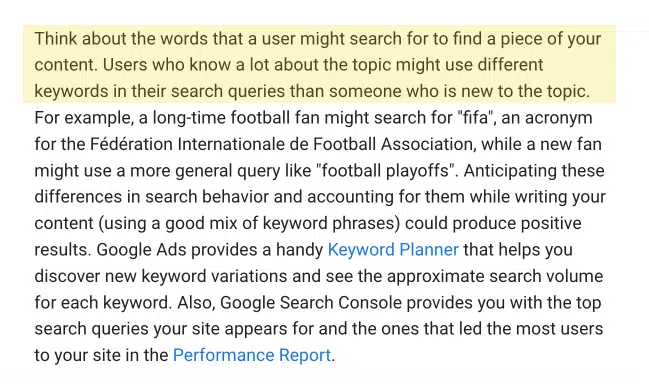
This approach is encouraged in Google’s SEO Starter Guide :

Different keywords

I was delighted that Google suggested using Google Ads Keyword Planner and Search Console here. I’ve used both for years with really great results. 

But as good as these free keyword tools are, they don’t reveal every possible variation or alternative for each word in a keyword phrase.


Get the daily newsletter search marketers rely on.


How I prompt ChatGPT for keyword variations

Here’s an example of this multi-prompt process so you can better understand how to implement this for your pages. (Experiment with refining these prompts to see if you can get a better output!) 

Example keyword phrase: ‘drones for beginners’

First, break down your search phrase one word at a time. 

Then ask ChatGPT for variations or alternative words people commonly use to describe the same thing. 

I’ll walk you through the very first word in detail.

Keyword variation: ‘drones’

Step 1: ChatGPT prompt: 

  • List 20 common ways people refer to something as “drones.”

Step 2: Copy the list to your preferred note-taking tool. 

Step 3: Go through the list and use your human brain to remove any words or phrases that wouldn’t make sense to use in the context of the topic. 

I often cut out around 10 to 20% from this list. If there’s not enough, I’ll sometimes prompt ChatGPT to list 20 more ideas.

Step 4: Pull up the article to be improved and perform a search. Copy and paste the first word or phrase from the list to see if it’s on the page. 

Side note: I recognize this step can be a bit laborious. This is why I built my own internal tool that enables me to paste a body of text in one box and a list of words and phrases in another and upon submission, it will highlight which words and phrases are found within the text and which are not. Unfortunately, I can’t find a simple tool online that does this. If you do, let me know.

Step 5: Add the missing words and phrases within the page. 

Keyword variation: ‘beginners’

Step 1: ChatGPT prompt: 

  • List 20 common words and phrases people use to describe someone who’s a “beginner.”

Steps 2–5: Repeat the instructions above. 

The full keyword phrase variation: ‘best drones for beginners’

You can also take the primary concept from the main keyword phrase and ask ChatGPT to generate some words and phrases people may use to describe it. 

In this example, the prompt for this would be:

  • List 20 common ways people refer to someone who’s a “beginner at flying a drone”

Then add the best words and phrases we’re missing from the page.

Identify words and phrases the searching demographic may use

This next prompt depends on the specific keyword phrase a page is targeting. 

The goal here is to identify the demographic or user persona of the searcher and get a list of words and phrases they may use to describe the main topic.

In the example, the demographic is a “beginner.” This will be different for most topics.

A page might target other demographics such as age, gender, location, disability, stage of life, parent, etc.

More practically, this could be a 50-year-old man, iPhone owner, boater, skier, new mom, first-time homeowner, college graduate, expert, doctor, gardener, etc.

For this example, the prompt is:

  • List 20 ways a beginner at flying drones may describe a drone and being a beginner at it.

The best results from this example

Here are some great unique words and phrases ChatGPT generated for me going through this example:

  • newbie
  • greenhorn
  • first timer
  • beginner-level
  • starting out
  • no prior experience
  • first-time pilots
  • easiest
  • easiest drone to fly
  • drones for newbies
  • entry-level
  • most forgiving
  • user-friendly

I was curious to see if any of the top 3 ranking pages in Google include any of these words and phrases. After checking all three, the top-ranking page included the most from this list. 

I don’t think they’re ranking solely because they’re including more of these words. But I believe it combines that plus many other little factors. 

Best practice for adding missing word variations

Do not just randomly add these missing word variations anywhere. Consider adding them to existing sentences that might be a bit vague. It’s a perfect opportunity to boost its contextual relevance. Other times I write a new sentence, often with the help of ChatGPT.

For this example, a vague sentence could be:

  • In order to make it onto this list, each of these had to be equipped with a productive feature portfolio and solid construction.

A better sentence that includes a variation of one of the words within the main keyword could be:

  • In order for a drone to make it onto this list, it had to be durable and user-friendly for our novice tester.

There are two things I want to point out about the new sentence:

  • I added the word “drone” to it, boosting its relevancy and making it more NLP-friendly. The subject of the sentence is clearer.
  • I added two words or entities that are related to a beginner: “durability” and “user-friendly.” As you can imagine, someone who’s never flown a drone before will likely crash it a lot. But maybe a lot less if it’s user-friendly.

I believe sites that include several variations of the main keyword tend to have higher rankings in search. 

Whether doing this intentionally or naturally, including these variations will result in an article that’s more comprehensive, helpful and relevant to the searcher.


Opinions expressed in this article are those of the guest author and not necessarily Search Engine Land. Staff authors are listed here.


Related stories

New on Search Engine Land

@media screen and (min-width: 800px) { #div-gpt-ad-3191538-7 { display: flex !important; justify-content: center !important; align-items: center !important; min-width:770px; min-height:260px; } } @media screen and (min-width: 1279px) { #div-gpt-ad-3191538-7 { display: flex !important; justify-content: center !important; align-items: center !important; min-width:800px!important; min-height:440px!important; } }

About the author

Tony Hill

Tony Hill is an entrepreneur who has been operating several niche websites since 2005. His expertise and passion is at the intersection of SEO and AI. You can connect with him on Twitter @tonythill

https://searchengineland.com/chatgpt-keyword-variations-tools-miss-prompts-429665


Why using AI to create YMYL experts is a REALLY bad idea

Last year something odd happened.

I was working on a project for a client and needed some expert insight from a sports science expert. 

I put out a request on Response Source, a popular platform where journalists and PRs seek out expert comments to add to their stories and campaigns (a bit like a premium version of HARO).

The idea is that this is a win-win for both parties. Those working on the story or campaign get access to valuable expert insight, and the experts get a plug (or, better yet, a link) to their business.

I hoped I would get some comments from a nutritionist, coach, personal trainer, or someone with similar qualifications. 

Often underqualified people would send quotes, but getting someone overqualified is rare. This is why it was a surprise when one of the responses was from a doctor, a British general practitioner (GP) working in London. 

The responses to the question themselves about how athletes cope in high temperatures were unremarkable:

“Risks of Heat Stress Disorders among players High temperature invokes physiological responses in the body that hinder the players’ health and performance. The players may suffer from the heat-stress disorder. The condition is characterized by heat cramps, heat exhaustion and heat strokes.”

Neither too vague nor too salesy, and would’ve fit quite nicely in the campaign – an adequate pitch, in other words. 

I thought it was quite odd that a GP had taken the time to respond, though. Perhaps she was trying to promote a private practice?

I clicked the link in her profile and it did not lead to a home page for a private GP practice. 

Instead, it was the About Us page of an ecommerce website selling… sex toys. 

Reverse image search - headshot

Doctor who?

A quick Google search led me to her name on half a dozen websites selling everything from CBD oils to vapes, gummies and vitamins. 

I did a reverse image search of the (suspiciously AI-looking) headshot she had supplied and it came up on a website exposing female romance scammers and the aforementioned CBD websites. 

In all likelihood, the image had been taken from someone’s Tumblr account once upon a time and was now being used by the dregs of the internet for fraud. 

UK General Medicine Council

In the UK, all practicing GPs must be on the General Medical Council’s GP Registry. It is publicly searchable, and her name was not listed.

Impersonating a doctor is not the first thing that comes to mind as a winning SEO strategy, so why is this happening?

First and foremost: links. They hold significant value in SEO. This is what keeps digital PR professionals like me working. 

They can be especially important trust signals for “Your Money or Your Life” (YMYL) websites, including those selling, for example, vitamins or CBD oils. 

And unfortunately, in the very limited scope of link acquisition, it seems to be working.

The fake doctor has landed a handful of mentions and links in some national British publications talking about, among other things, leukemia.

Fake ddoctor - mentions

Get the daily newsletter search marketers rely on.


The ethics of E-E-A-T for YMYL

This entirely fictional GP is now advising readers on how they can check themselves for early signs of leukemia. 

This strikes me as a genuine YMYL concern. Morally, it’s not a good idea to advise leukemia patients unless you’re medically trained.

“High E-A-T medical advice should be written or produced by people or organizations with appropriate medical expertise or accreditation. High E-A-T medical advice or information should be written or produced in a professional style and should be edited, reviewed, and updated on a regular basis.”

You see, this isn’t just about links, it is also about expertise, experience, authority and trust.. 

When it comes to YMYL sites, Google expects the very highest standard of E-E-A-T.

You want it to be clear on an About Us page who your experts are, why they are an expert and what part they play within the company, brand or website. 

If all this is present on the page, then offsite trust signals are the next obvious step. 

If you have a medical expert on your website, one who is also quoted in multiple publications and other reputable websites, this is one of the best things you can do to build the E-E-A-T required to rank your YMYL website. 

Google’s Search Quality Rater Guidelines state that: 

“For YMYL informational topics, the reputation of a website or content creator should be judged by what experts in the field have to say. Recommendations from expert sources, such as professional societies, are strong evidence of a very positive reputation.”

Google, ironically, is even more explicit about this in its 2019 paper on how Google fights disinformation which states: 

“For these “YMYL” pages, we assume that users expect us to operate with our strictest standards of trustworthiness and safety. As such, where our algorithms detect that a user’s query relates to a “YMYL” topic, we will give more weight in our ranking systems to factors like our understanding of the authoritativeness, expertise, or trustworthiness of the pages we present in response.”

I reached out to the journalist Mason Quah who wrote the story on leukemia, to find out more about what happened and how a fake doctor made national news: 

“Almost all of the contacts we used were via email exclusively. I was told to use response source, or a tool similar, to find leads. That is the most likely source.

I’m entirely unsurprised that an AI could fill out the responses since most of the time we knew what our story was going to be and just needed a rubber stamp from somebody who put doctor before their name.”

Fake doctor, meet fake patient

It’s not just fake experts causing problems.

The first “E” in E-E-A-T – experience also has its share of scammers.

Google now recognizes that you don’t need to be an expert in something if you have firsthand experience and understand that this may be valuable. 

Although, I don’t suspect this was the motivation behind the deeply bleak story of Insider Journalist Julia Pugachevsky being tricked into interviewing an AI-generated source. Not a fake doctor, but a fake cancer patient. 

Fake patient

This was perhaps the most immoral example of black hat link building, with little thought given to anything beyond that desired follow link. 

Pugachesky went on to write about her experience where we learn that the source contacted her via HARO. She explained:  

“In exchange for her story, she hoped I would mention her role as the founder of an online-gaming page. Ideally, I could link to them, too.”

Once Pugachevsky realized she had been scammed, she contacted HARO, which assured her that it had already banned the account. 

As for my fake GP, though, it would seem she is still out there. At the time of writing, she was last quoted in the press three weeks ago. 

Unsurprisingly for Pugachesky, the trust has been damaged.

Just as Google runs on trust signals, trust between digital PRs and journalists is crucial for digital PR to take place on platforms such as HARO and Response Source.

Pugachesky ended her piece by explaining what she would do to avoid falling victim to a similar scheme in future: 

“I put together a document about my experience for the entire Insider newsroom. We’re sharpening our protocols and becoming more vigilant than ever about researching sources in advance, insisting on phone interviews, and running email communications through a text checker.”

Those of us who contact Insider on behalf of our clients may now find that where before an email interview would have sufficed, that same journalist may now want to speak to a source directly on the phone to ensure they’ve not been AI-generated.

What can SEO and digital PR professionals do about this?

It’s important for us in the industry to call out this bad practice for what it is. This isn’t “grey hat SEO,” but outright fraud. 

It paints our industry as not just shady but rotten to the core. After all, do we really want SEO to be associated with impersonating cancer victims? 

If you’re outsourcing your link building effort, make sure you know exactly what those you’re paying to build links are doing to earn them. 

Unfortunately, when these tactics slip through the net, they may have short-term benefits, but we’ve been here before. 

It’s been over a decade ago now since Google launched the Penguin algorithm and took a firm stance on manipulative link building practices. 

According to Google’s own data, it impacted around 3% of all search results. So we know Google is more than willing to penalize inappropriate behavior when uncovered and to do this en masse.  

As Google states itself:

“Tackling the propagation of false or misleading information is core to Google’s mission and to ensuring our products remain useful to the billions of users and partners who utilize our services every day. 

“While we have always fought against malicious actors’ efforts to manipulate our systems and deceive our users, it’s never been more important to thwart them and to ensure we provide our users with information worthy of the trust they have in our services.”

In this instance, it makes far more sense to clean up our act as an industry instead of waiting for the wrath of a Penguin 2.0-style devastating Google update. 

What should publications be doing?

As for news publications and the journalists who write for them, there may be a case for ongoing education as AI evolves. I’ll leave you with this quote from Quah:

“There is a lot of value in teaching people how to conduct research that dodges AI bots or whatever the next innovation is to occupy the top slot of most Google search queries. 

“I’d say it’s something you need to actively keep on top of, it’s like how there’s a half life of medical knowledge, a doctor doesn’t just keep what they know from school but spends most of their career continuing to follow the field and staying up to date on new techniques and methods. Journalists need to keep retraining themselves as the field changes.”


Opinions expressed in this article are those of the guest author and not necessarily Search Engine Land. Staff authors are listed here.


Related stories

New on Search Engine Land

@media screen and (min-width: 800px) { #div-gpt-ad-3191538-7 { display: flex !important; justify-content: center !important; align-items: center !important; min-width:770px; min-height:260px; } } @media screen and (min-width: 1279px) { #div-gpt-ad-3191538-7 { display: flex !important; justify-content: center !important; align-items: center !important; min-width:800px!important; min-height:440px!important; } }

About the author

Jo OReilly

Jo O’Reilly is Freelance Digital PR Consultant based in North West England. She has been working in Digital PR for 6 years both in-house and agency side, before that she was a journalist. She is fascinated with all things digital pr, especially reactive pr and newsjacking.

https://searchengineland.com/using-ai-create-ymyl-experts-bad-idea-429673


Washington Post shares SEO and web performance guidelines

The Washington Post has published a document outlining its internal SEO and web performance best practices that anybody in news SEO will want to read.

The document, Web Performance and SEO Best Practices and Guidelines, outlines what the Post calls “proven strategies and guidelines for optimizing web performance and search engine optimization (SEO).”

SEO and web performance best practices. The Post’s document breaks down all of its guidelines into what is essentially a checklist, consisting of four buckets: on-page SEO, content optimization, technical SEO and off-page SEO.

The web performance guidelines focus on loading, rendering and responsiveness. It also shares many of the tools it uses to monitor performance – including Lighthouse, WebPageTest, Google Search Console and Google Analytics.

The purpose of the guidelines. The Post wants to make sure it:

  • Provides a positive user experience.
  • Increases website visibility.
  • Drives organic traffic.
  • Improves the site’s overall success.

What they’re saying. The document was officially announced today, although it appears the document was published May 31. The Post said it is publicly sharing its guidelines and tools to help others ensure their “own site practices are optimal”:

  • “We identified a need for a Web Performance and SEO engineering team to build technical solutions that support the discovery of our journalism, as the majority of news consumers today read the news digitally. Without proper SEO and web performance, our stories aren’t as accessible to our readers,” according to Arturo Silva, engineering lead.

Read the document. Web Performance and SEO Best Practices and Guidelines


Related stories

New on Search Engine Land

@media screen and (min-width: 800px) { #div-gpt-ad-3191538-7 { display: flex !important; justify-content: center !important; align-items: center !important; min-width:770px; min-height:260px; } } @media screen and (min-width: 1279px) { #div-gpt-ad-3191538-7 { display: flex !important; justify-content: center !important; align-items: center !important; min-width:800px!important; min-height:440px!important; } }

About the author

Danny Goodwin

Danny Goodwin has been Managing Editor of Search Engine Land & Search Marketing Expo – SMX since 2022. He joined Search Engine Land in 2022 as Senior Editor. In addition to reporting on the latest search marketing news, he manages Search Engine Land’s SME (Subject Matter Expert) program. He also helps program U.S. SMX events. Goodwin has been editing and writing about the latest developments and trends in search and digital marketing since 2007. He previously was Executive Editor of Search Engine Journal (from 2017 to 2022), managing editor of Momentology (from 2014-2016) and editor of Search Engine Watch (from 2007 to 2014). He has spoken at many major search conferences and virtual events, and has been sourced for his expertise by a wide range of publications and podcasts.

https://searchengineland.com/washington-post-seo-web-performance-guidelines-429658


How to use AI and Chrome extensions for quick SEO wins

In a fast-paced industry like SEO, quick wins are a constant challenge. How can you efficiently enhance rankings and drive growth for your website or clients?

This article covers seven actionable, quick SEO wins achieved by combining AI-powered tools (like ChatGPT and Google Bard) with Chrome extensions. 

1. Optimize titles and descriptions for improved click-through rates

Optimizing your title tags for target keywords is one of the quickest ways to improve your rankings in Google.

Getting to the top of the SERP is only half the battle. Your title and meta description must also entice visitors to click through to your site.

While visibility and effectiveness carry equal importance, SEOs often focus entirely on the former. While the two objectives may intersect, they have distinct tactics.

ChatGPT shines when it comes to writing meta tags for conversion.

  • Utilize a Chrome extension like Conductor, Detailed SEO, or SEOquake to grab the title and description.
  • Feed the title and description into ChatGPT with this prompt:

    Rewrite the provided title and meta description to optimize for maximum click-through-rate from the SERP, while also ensuring optimization for the highest organic ranking position for the designated keyword. Maximum character count for the title is 60 characters and 160 characters for the meta description.

    TITLE:
    DESCRIPTION:
    KEYWORD:

  • If the provided tags don’t meet your expectations, ask ChatGPT to regenerate or tweak your prompt to get the desired results. 

Here is an example:

Before

Old meta description

After

New meta description from ChatGPT

2. Summarize ranking competitor pages for quick content prompts

Your competitor’s top-ranking pages can be your biggest source of quick wins.

AI SEO platforms like Surfer take competitor page analysis to the next level, but a simpler workflow does exist to generate insights and content quickly.

Simply combine the Summarize Chrome extension with ChatGPT to generate new, unique, and optimized content based on the foundation of pages that are already ranking. 

  • Enter your target keyword phrase in the SERP. Navigate to the top-ranking competitor pages. Choose a page that has content most similar to what you are looking to produce.
  • Activate the Summarize Chrome extension. This will provide a ChatGPT-generated summary of the full web page content.
  • Hop back over to ChatGPT and use this prompt to generate unique, optimized content:

    Write a 100% unique article for [insert business name] optimized for top ranking for the keyword – [insert keyword]. Article should be [tone/other notes]. This article should contain content similar to this summary of a page that is already ranking high for the target keyword. The generated content should not duplicate any of the summarized content below.

    SUMMARIZED CONTENT: 

ChatGPT content is only as good as its human editor.

While this strategy can help you start your article, you will likely need to regenerate several sections and have a heavy hand in editing the content.

Summarize competitor pages

3. Identify long-tail keywords for existing content optimization

Long-tail keywords are a stand-out quick win.

These keywords are longer and more detailed, lending them to be used when customers are closer to the point of purchase. Competition is low, greatly increasing your likelihood of ranking.

While their relative volume is low, optimizing a piece of content for various long-tail keywords can still drive volume to your site. 

Existing content on your site presents a prime opportunity for optimization with long-tail keywords.

This content is already indexed and may already rank for similar keywords. Additionally, revisiting your older content allows you to update and enhance it, providing fresh content to search engines and site visitors. 

The Keywords Everywhere Chrome extension quickly identifies new long-tail keywords for your content. 

  • Navigate to the page on your site you are looking to optimize. Click on the Keyword Everywhere Chrome extension and select “Organic Ranking Keywords (URL)”.
  • Take your top keyword (either by volume or most relevant) and enter it into Google.
  • Keywords Everywhere runs anytime you use Google to identify keyword trends, related keywords, and long-tail keywords. Copy or export the list of long-tail keywords. Repeat these steps if you’d like to check more than one seed keyword.
  • Review your existing content to identify where you can naturally add the long-tail keywords. You can also use ChatGPT to assist with optimization by inputting your article and the list of keywords that need to be injected. 
Keywords Everywhere

Get the daily newsletter search marketers rely on.


4. Identify new content opportunities: High volume, low competition

The Keywords Everywhere tool can also be a valuable tool when it comes to identifying keywords for new content opportunities.

Specifically, high-volume keywords with low competition are a sweet spot for new content.

These keywords are likely easier to rank for but still have the opportunity to bring significant organic traffic to your site. 

Identifying these keywords isn’t quite as straightforward, but the payoff can be big. 

  • Start in Google with seed keywords relevant to your website/brand or the page you are looking to publish.
  • Analyze and interpret keyword data. On the right side of the SERP, you’ll see Trend Data, Related Keywords, and Long Tail Keywords in boxes provided by Keywords Everywhere. Look for keywords with higher volume (greater than 1,000 searches per month) and lower competition (sub 0.5).
  • Build and expand your keyword list for the new content. Pull the keywords you find into a spreadsheet where you can track and categorize them. You can click on any keyword in the Keywords Everywhere output and it will run that Google search. Continue searching for new keywords and building out your keyword set.

This activity can be as quick or as in-depth as you make it. You may find that the process yields keywords for several new content pieces. 

While this may not be our fastest quick win, it has the greatest potential for long-term growth. Building new content means new ranking opportunities for your site.

New content opportunities

5. Validate and generate structured data using Schema Builder and Google Bard

Schema markup, or structured data, enhances your website’s visibility to search engines.

It can also lead to higher click-through rates by enabling rich snippets in the SERP – like you see here for the search term “things to do near me in Boston.”

Rich snippets

Adding schema markup to your site’s code provides search engines with context to your website’s content.

But, it’s important to showcase the correct schema for your business, website and webpage. Here are some of the top types of schema to consider:

  • Organization schema: Helps search engines understand more information about a business. 
  • LocalBusiness schema: More specific form of Organization schema for businesses that operate in a specific local area. 
  • Product schema: Ecommerce sites and online retailers can use product schema to make product information available for rich results, like product snippets. 
  • BlogPosting schema: Enhances the visibility of blog posts. 
  • FAQ schema: Ideal for use on pages with a list of questions and corresponding answers, FAQ schema can help websites rank for answer box results and other rich snippets that show questions/answers. 
  • Breadcrumbs schema: Indicates a page’s position to help search engine’s understand the relationship of pages within a website. 
  • WebSite or WebPage schema: WebSite schema provides general data about an entire website, while WebPage schema provides data for a single webpage. WebPage schema can include breadcrumbs or it can be listed as its own separate schema code.

Generating and deploying schema varies in difficulty depending on the platform your website is on. WordPress sites can install plugins that automatically add schema and keep it updated. 

Larger enterprise sites, HTML sites, and other custom-coded solutions may need to generate the schema manually and serve that up in the site’s code. You can lean on the Schema Builder Chrome extension and Google Bard. 

Note: ChatGPT does a great job of creating the raw format for a site’s schema, but its limitation is that it currently runs off data from 2021. This pitfall of ChatGPT is where Google’s Bard steps up to the plate, with its ability to pull from the live Google index. 

To get started, validate any existing schema and then utilize AI to generate the correct schema. 

  • Navigate to your website and select the Schema Builder Chrome extension.
  • Select the Tester tab to identify the schema types present on your site. In the case of a local bookstore, the most important schema type is LocalBusiness. WebSite, WebPage, or Breadcrumbs schema may also be present. 
In our example, you’ll see that we’ve only found WebSite schema.
  • Navigate to Google Bard and enter this prompt:

    Generate [schema type] schema for [webpageurl].

  • Implement this schema in the backend of your website or work with your IT team to deploy it across the site. 
LocalBusiness schema

Internal linking boosts a search engine’s understanding of your website’s structure and the significance of each page.

Many Chrome extensions can tackle internal linking audits. We’ll explore Conductor, but SEOquake and Detailed SEO provide equivalent linking insights. 

  • Navigate to the page on your site that you wish to work on and select the Conductor Chrome extension.
  • Click on the Links tab. Here are four different activities you can complete to improve internal linking on this page:
    • Identify links missing anchor text. Anchor text provides additional context to search engines on what a page is about. 
    • Analyze the present anchor text. After resolving missing anchor text, analyze the present anchor text to ensure it is relevant to the page you are linking to.
    • Identify if there are any new link opportunities. Does your site not have any internal links on the page? Consider adding some within your content to maximize your page-to-page relationship building.
    • Avoid excess linking. Too much internal linking can be counterproductive. It’s important to find balance. 

What makes this a quick win is your focus on a single page. 

Take one of your pages with keywords in striking distance and complete this audit/implementation. 

You’ll see how implementing a solid internal linking strategy can have a positive impact, even on a single page.

Internal links

7. Use ChatGPT Chrome extensions to expedite all your SEO initiatives

After delving into specific tactics for bolstering your website’s visibility, we now focus on a strategic game-changer. 

AIPRM and similar Chrome extensions provide a comprehensive library of predefined ChatGPT prompts tailored for SEO activities. This enables you to turn even the most challenging SEO tasks into quick wins.

With AIPRM’s extensive library already comprising 807 prompts for SEO, you have the power to undertake a wide range of activities, including:

  • Generating captivating product descriptions for ecommerce SEO.
  • Clustering keywords to build complete content plans.
  • Creating detailed content outlines and producing 100% unique, optimized content.
  • Generating optimized titles and meta descriptions in bulk.
  • Crafting optimized scripts for engaging YouTube videos.
AIPRM

We’ve only scratched the surface

The quick wins we’ve discussed are just the tip of the iceberg. The synergy of AI tools and Chrome extensions offers so much potential.

Leveraging these tools unlocks opportunities to accelerate your website’s organic growth.


Opinions expressed in this article are those of the guest author and not necessarily Search Engine Land. Staff authors are listed here.


Related stories

New on Search Engine Land

@media screen and (min-width: 800px) { #div-gpt-ad-3191538-7 { display: flex !important; justify-content: center !important; align-items: center !important; min-width:770px; min-height:260px; } } @media screen and (min-width: 1279px) { #div-gpt-ad-3191538-7 { display: flex !important; justify-content: center !important; align-items: center !important; min-width:800px!important; min-height:440px!important; } }

About the author

Lauren Busby

Lauren Busby is the Co-Founder of Trebletree, a boutique SEO and web design agency, where she leads the SEO/web teams in building websites for SEO success. She has worked in the SEO field since 2009, driving organic growth for a range of medium-sized to enterprise-level brands, including Carpet One and Urban Air. Lauren specializes in keyword strategy, technical SEO, and large-scale franchise/enterprise SEO.

https://searchengineland.com/ai-chrome-extensions-quick-seo-wins-429599