Study: TikTok loses popularity as ecommerce search engine

Fewer U.S. adults are beginning their product searches on TikTok than a year ago, according to a CivicScience study.

Why we care. This is the latest evidence that Amazon is a platform that retail brands must pay attention to. While TikTok intends to build a $20 billion ecommerce business, the U.S. won’t be a big factor yet – and may never be. Regardless, marketing and advertising budgets will continue to follow users. But ultimately it comes down to whether TikTok is an effective platform for your brand.

Product Search Starting Point Survey

Amazon and Google reign. Overall, the starting point for product searches among online shoppers is Amazon (49%, up from 46% in 2022), followed by Google (34%, down from 35% in 2022).

Amazon also increased its popularity among younger age groups, compared to last year:

  • 18- to 24-year-olds: Up 45%
  • 25- to 34-year-olds: Up 44%.

Additional context. These results are similar to another U.S. survey we reported on in Amazon beats Google as starting point for product search. That survey found 38% of shoppers began product searches on Amazon, while 35% started searching on Google.

TikTok’s YoY decline. After hitting a new high in 2022, CivicScience noted a “steep decline” for TikTok among younger generations this year:

  • “Usage fell from 18% to 11% among Gen Z (18-24) and from 10% to 5% among young Millennials (25-34) from August 2022 to June 2023.”

Most people who start their product searches on TikTok, Instagram or Reddit are between the ages of 18-34, CivicScience noted.

About the study. The CivicScience study asked U.S. online shoppers: “When shopping for a product online, where do you typically start for product searches and research?” It then compared 5,638 responses received between June 6 and 26 to 4,643 responses from August 2022.


Related stories

New on Search Engine Land

@media screen and (min-width: 800px) { #div-gpt-ad-3191538-7 { display: flex !important; justify-content: center !important; align-items: center !important; min-width:770px; min-height:260px; } } @media screen and (min-width: 1279px) { #div-gpt-ad-3191538-7 { display: flex !important; justify-content: center !important; align-items: center !important; min-width:800px!important; min-height:440px!important; } }

About the author

Danny Goodwin

Danny Goodwin has been Managing Editor of Search Engine Land & Search Marketing Expo – SMX since 2022. He joined Search Engine Land in 2022 as Senior Editor. In addition to reporting on the latest search marketing news, he manages Search Engine Land’s SME (Subject Matter Expert) program. He also helps program U.S. SMX events. Goodwin has been editing and writing about the latest developments and trends in search and digital marketing since 2007. He previously was Executive Editor of Search Engine Journal (from 2017 to 2022), managing editor of Momentology (from 2014-2016) and editor of Search Engine Watch (from 2007 to 2014). He has spoken at many major search conferences and virtual events, and has been sourced for his expertise by a wide range of publications and podcasts.

https://searchengineland.com/tiktok-product-search-popularity-decline-429036


Threads, Meta’s Twitter alternative, to launch July 6

Meta is expected to launch Threads, a “text-based conversation app,” under the Instagram brand, tomorrow (July 6).

What is Threads. According to the download page:

“Threads is where communities come together to discuss everything from the topics you care about today to what’ll be trending tomorrow. Whatever it is you’re interested in, you can follow and connect directly with your favorite creators and others who love the same things – or build a loyal following of your own to share your ideas, opinions and creativity with the world.”

Why we care. Since Elon Musk bought the platform, Twitter has found new and exciting ways to upset many of its users and lose advertising revenue. Threads may be a platform for marketers and advertisers to watch – but ultimately wherever users go, the budgets and marketing investments will follow.

Admit one. You can sign up for the app already. To do so, go to Instagram search, type in “Threads” and you’ll see an “Admit One” ticket in the right side of the search box.

Threads Instagram Search 800x267

Clicking on that will take generate your ticket, which you can then click on to be notified when the app is available to download.

Get Threads

Not available in EU. One region where Threads won’t be launching is the EU. Meta has received multiple fines in the EU for violating the General Data Protection Regulation (GDPR).

According to the Independent:

“Sources close to Meta said that the tech giant has refrained from rolling the service out in the EU because of what the company believes is a lack of clarity contained in the EU’s Digital Markets Act. Under the Act, companies such as Meta become “gatekeepers”, with restrictions on how they mingle users’ personal data.”

No Instagram Threads app in the EU: Irish DPC says Meta’s new Twitter rival won’t be launched here, The Irish Independent

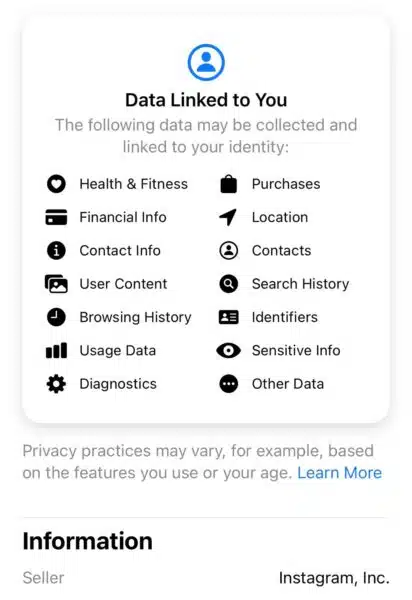
Extensive data collection. Meta will be collecting a lot of user data, including search history, browsing history and much more:

Threads Data Linked to You

Postscript: Threads is now live. See coverage on Techmeme.

Update, July 6: Just before 11 am ET, Threads had 30 million signups, according to a thread by CEO Mark Zuckerberg.


Related stories

New on Search Engine Land

@media screen and (min-width: 800px) { #div-gpt-ad-3191538-7 { display: flex !important; justify-content: center !important; align-items: center !important; min-width:770px; min-height:260px; } } @media screen and (min-width: 1279px) { #div-gpt-ad-3191538-7 { display: flex !important; justify-content: center !important; align-items: center !important; min-width:800px!important; min-height:440px!important; } }

About the author

Danny Goodwin

Danny Goodwin has been Managing Editor of Search Engine Land & Search Marketing Expo – SMX since 2022. He joined Search Engine Land in 2022 as Senior Editor. In addition to reporting on the latest search marketing news, he manages Search Engine Land’s SME (Subject Matter Expert) program. He also helps program U.S. SMX events. Goodwin has been editing and writing about the latest developments and trends in search and digital marketing since 2007. He previously was Executive Editor of Search Engine Journal (from 2017 to 2022), managing editor of Momentology (from 2014-2016) and editor of Search Engine Watch (from 2007 to 2014). He has spoken at many major search conferences and virtual events, and has been sourced for his expertise by a wide range of publications and podcasts.

https://searchengineland.com/threads-meta-launch-july-6-429017


Build authority and dominate organic search like a boss by Cynthia Ramsaran

Seo Organic Search Ss 1920 800x450

It’s time to challenge the belief that the market for organic traffic around any given topic is unknowable. It is actually quite objective and, when measured properly, can provide the context that’s glaringly missing from modern SEO strategies and make organic content part of a winning go-to-market strategy.

Join Ryan Brock, Chief Solution Officer at DemandJump, as he reveals how to revolutionize your SEO approach using Pillar-Based Marketing as a unifying methodology that allows you to include SEO in your go-to-market strategy confidently.

Register and attend “Build Authority and Dominate Organic Search Like A Boss,” presented by DemandJump.


Click here to view more Search Engine Land webinars.


Related stories

New on Search Engine Land

@media screen and (min-width: 800px) { #div-gpt-ad-3191538-7 { display: flex !important; justify-content: center !important; align-items: center !important; min-width:770px; min-height:260px; } } @media screen and (min-width: 1279px) { #div-gpt-ad-3191538-7 { display: flex !important; justify-content: center !important; align-items: center !important; min-width:800px!important; min-height:440px!important; } }

About the author

Cynthia Ramsaran

Cynthia Ramsaran is director of custom content at Third Door Media, publishers of Search Engine Land and MarTech. A multi-channel storyteller with over two decades of editorial/content marketing experience, Cynthia’s expertise spans the marketing, technology, finance, manufacturing and gaming industries. She was a writer/producer for CNBC.com and produced thought leadership for KPMG. Cynthia hails from Queens, NY and earned her Bachelor’s and MBA from St. John’s University.

https://searchengineland.com/build-authority-and-dominate-organic-search-like-a-boss-429016


10 things we hate about Google Analytics 4

Google Analytics 4 hasn’t exactly got off to the best start with marketers.

In fact, it’s getting pretty awkward – some advertisers are so disappointed with the new program that they’ve even been hosting funerals for its predecessor, Universal Analytics.

But what is it about GA4 that’s got the world of digital marketing so riled up?

We decided to ask our readers in a GA4 readiness poll to find out. Below, we’ve put together a list of the most common complaints. Let us know if you and your team can relate…

1. User interface

GA4’s user interface was hands-down the biggest issue our readers reported.

The UI was described as “slow”, “laughable” and a few other adjectives we’re opting not to publish.

Independent sales and marketing contractor, John Erikson, told us:

  • “When on selecting segments/dimensions in GA4, instead of the ability in Universal to select/deselect one or more segments in a single list and click ‘apply’, you have to open customization or add comparison, click add filter, select a dimension from a long dropdown, then select dimension value from another dropdown, then apply (and you can only select one).
  • “Granted it is only a few seconds difference, but when you look at many different patterns every day, it becomes frustrating to repeat those excess UI moves over and over when you used to do it faster.”
  • “That same dropdown structure is used in creating/editing GA4 reports. The dropdown lists are long and it is hard to find what you are looking for. You can type in partial names and more quickly find them once you know them, but initially it is very hard to scroll through them all and find what you want.
  • “Also, you can only select one so it is hard to look at multiple dimensions/values. I don’t know the answer to fixing this, but I do find it clumsy to use.”

2. Data lag

Another major concern for marketers has been the delay of same day data on GA4.

Advertisers have stressed that they need the ability to monitor performance constantly and are confused as to why the new analytics platform doesn’t appear to have this function.

Ron Weber, Sr Director at Actian, explained:

  • “The data latency is a joke, taking 12-24 hours to report on what is happening prevents this from being an actionable tool.”
  • “I wish I wasn’t backlogged for the past few years and thus could/would have realized this before.”
  • “Maybe Google will just move the computing power from UA -> GA4 so that this will change? [praying]!”

3. Data discrepancies

Marketers raised concerns about discrepancies on GA4 too.

Differences in information had resulted in some worrying that the data being served therefore couldn’t possibly be accurate, resulting in people questioning if they can trust GA4.

Sabine Walton, Senior SEO Manager at Handlerbund Marketplace, told us:

  • “What I find problematic is the discrepancy between GA4 API and the respective Looker Studio Connector. Dimensions that are present in the API and even per default in the GA4 reporting interface are apparently missing in the Looker Studio connector, e.g. Landing Page dimension.”
  • “The Google Team seems to work on that, because at least the landing page dimension is now present. But that also means that I have to minus two days before UA data collection comes to an end – then adjust and check my numerous reports again and again.
  • “I am as ready as the tool is, but I certainly do not look forward to working solely with GA4. I am also thinking about looking for alternative tools to GA4.“

4. Hard to use

Marketers across the board have been reporting that GA4 is incredibly difficult to use.

Even seasoned advertisers are finding it challenging trying to navigate their way around the new platform.

SEO and marketing consultant Jason McDonald told Search Engine Land:

  • “GA4 is a disaster. It is so much harder to use than UA, and completely non-intuitive.”
  • “It is nearly impossible to drill down by clicking as was possible than UA.
  • “It is the Windows Vista of Google Analytics, and all the cognoscenti are afraid to say publicly that it is garbage. But everyone knows it is garbage.”

5. Lack of resources

With so many marketers struggling as they try to figure out GA4, many are questioning why Google hasn’t provided more educational resources explaining how the new tool works.

The marketing team at Storis told us:

  • “I found most of the answers that I was stuck on from taking private courses through SMX or finally getting to a knowledgeable Google team member.
  • “Their documentation really lacked especially where there were major functional changes or gaps. I kept trying to figure out how to replicate things that weren’t brought over.
  • “Also, many of the people on Google’s own team aren’t up to speed making support calls confusing.”

6. No basic option

Some advertisers explained that marketing doesn’t wear a one size fits all hat.

While some of the more complex settings may suit some, other professionals, such as bloggers, would just like access to basic tools on GA4 and are wasting time and money trying to understand features they don’t need to use.

Eb Gargano from Productive Blogging told us:

  • “One of the things I have observed is that many bloggers and online businesses have been totally losing their minds over GA4 – wasting days (and in some cases weeks) stressing over this, when their time could have been much better spent elsewhere.”
  • “The truth is most bloggers and online businesses need only a simple setup and an understanding of the basic reports. But no one is saying that, and online business owners are being scared into believing they need to spend lots of money on expensive courses and a lot of time creating multiple custom reports.”
  • “I think it’s a real shame there isn’t a ‘GA4 Lite’ for users who only need basic data.”

7. Lack of features

Another common complaint from marketers responding to our poll was the lack of features GA4 has to offer in comparison to Universal Analytics.

Marketers seemed particularly bothered by the removal of attribution features.

Elizabeth Rule, account manager and local SEO analyst for Sterling Sky, told us:

  • “I’ve been using GA4 as much as possible the past month to get used to it, but honestly it just feels like a clunkier version of GA3 with fewer features that I actually want to use.
  • “I find myself wanting to go back to GA3 every time I use GA4 – and it’s not because I’m just too used to it. Some of the features I use every day are missing or extremely complicated to find in GA4.”

Get the daily newsletter search marketers rely on.


8. Difficulty recreating reports

Clients and marketers alike have desperately been trying to recreate reports in GA4 that they previously relied upon when using Universal Analytics.

Unfortunately, it seems for many that this task has proved far more difficult than it should have been.

Tom Demers, co-founder and managing partner of SEO and PPC agency Measured SEM, told us:

  • “Clients are frustrated with recreating their existing reports in GA4, particularly for specific edge cases, recreating dashboards in third-party reporting tools – including Looker Studio.”
  • “There is also a lot of work around recreating events / goals within GA4 (and confusion around not seeing those events in certain reports).”

9. Reports

Marketers also complained that they were struggling to simply create reports in GA4 – an issue that didn’t impact them when they were working with UA.

According to many marketers who took part in our poll, Google has made many unnecessary changes when it comes to building reports, making their workload more difficult.

Eric Bushaw, search engine optimization manager at G5, told us:

  • “In time, I think GA4 will enable greater insights than UA did.”
  • “With that said, some of the seemingly arbitrary changes to how reporting can be done are frustrating.
  • “Eliminating views, restrictions around how custom segments can be used, and other seemingly unnecessary changes are going to make life difficult for us once UA is really gone.”

10. Bugs

Several marketers contacted Search Engine Land to report bugs within GA4, claiming many features weren’t working as intended. Issues being flagged included syncing issues with Looker Studio Dashboard and AMP new script not working.

SEO consultant John McAlpin told us:

  • “The platform still has a lot of bugs, and we find ourselves spending more time figuring out why attribution is not properly labeled and why the data is inconsistent.”

Let’s not panic

Marketers have found the enforced migration from Universal Analytics to GA4 tough, so it can be reassuring to know this challenge is being felt across the industry.

But regardless of how difficult the adjustment has been, search marketing expert and SMX Advanced speaker Kayle Larkin told Search Engine Land it’s important marketers get on board with Google’s latest analytics program as it will likely be around for a long time. She said:

  • “There’s an age-old saying that the grass isn’t always greener on the other side.”
  • “People use the internet in completely different ways than in 2012, and I see GA4 as Google’s answer for future-proofing website analytics. The industry needs a free option.”
  • “Marketers need to pause for a moment and think about what information is really useful and helpful – what they need to know.”
  • “Himanshu Sharma said it well on LinkedIn: ‘It is important to remember that we are not in the business of data retrieval. We are in the business of data analysis to improve ROI.'”
  • “Either way, you need to understand your data and how that supports your marketing initiatives.”

Larkin went on to explain that change within any platform and any industry can cause people to panic. But as time passes, confidence and familiarity increases, causing attitudes to change. She concluded:

  • “Everyone was mad when Facebook updated their interface and ‘couldn’t find anything’. It was ‘horrible’ and ‘the end of Facebook.'”
  • “Because we use Facebook daily, that was quickly forgotten, and no one even remembers what the old interface looked like.”
  • “The response to the GA4’s interface – you see the same reaction when any platform changes its interface. People do not like change.”
  • “But GA4 is so customizable, and with LookerStudio – there are a lot of options for getting the reports to visualize information and insights in a meaningful way.”

Did deeper

If you’re struggling to navigate GA4, why not sign up for a GA4 training course?

Alternatively, for free information and resources on how to use GA4, read the Google Analytics 4 account training guide and support guide


Related stories

New on Search Engine Land

@media screen and (min-width: 800px) { #div-gpt-ad-3191538-7 { display: flex !important; justify-content: center !important; align-items: center !important; min-width:770px; min-height:260px; } } @media screen and (min-width: 1279px) { #div-gpt-ad-3191538-7 { display: flex !important; justify-content: center !important; align-items: center !important; min-width:800px!important; min-height:440px!important; } }

About the author

Nicola Agius

Nicola Agius is Paid Media Editor of Search Engine Land after joining in 2023. She covers paid search, paid social, retail media and more. Prior to this, she was SEO Director at Jungle Creations (2020-2023), overseeing the company’s editorial strategy for multiple websites. She has over 15 years of experience in journalism and has previously worked at OK! Magazine (2010-2014), Mail Online (2014-2015), Mirror (2015-2017), Digital Spy (2017-2018) and The Sun (2018-2020). She also previously teamed up with SEO agency Blue Array to co-author Amazon bestselling book ‘Mastering In-House SEO’.

https://searchengineland.com/google-analytics-4-we-hate-428942


How to create link building OKRs for SEO (with examples)

Objectives and key results (OKRs) are great tools for shaping SEO initiatives to align with the company’s goals.

This article explores how OKRs can influence your SEO efforts, highlighting the connection between overarching business objectives and SEO-centric targets. 

Understanding OKRs in SEO

One of my favorite books is “Measure What Matters” by John Doerr. It presents the idea of OKRs, which stands for “objectives and key results.”

Doerr provides examples of how companies like Google adopt and implement the OKR planning and accountability framework to accomplish outrageous growth goals.

The OKR approach is fairly straightforward and works by defining clear, measurable, and achievable objectives alongside key results that gauge the achievement of each objective.

Objectives

These are the clearly defined goals you want to achieve. They should be significant, actionable, and inspiring. In the context of SEO and link building, an objective could be something like:

  • “Improve our website’s search engine visibility in X keyword cluster” or “Increase the site’s contextual relevancy of X category.”

Key results

These are the measurable indicators that show you’ve achieved your objective. They should be quantifiable, time-bound, and directly impacted by the team’s efforts. 

For an SEO-focused objective, key results might include: 

  • “Achieve X increase in organic visibility of our targeted keywords.”
  • “Generate 30 links in articles topically relevancy to X keyword category.”

The importance of OKRs in SEO

Are you working on the right SEO initiative to push your company’s goals forward? How does SEO align with your marketing objectives?

These questions are important but not always easy to answer.

OKRs ensure that you can answer these questions. Its benefits include:

  • Clarity of focus: By defining the objectives and key results, every member understands the team’s priorities and how their actions contribute to these goals.
  • Alignment with larger business goals: Key results (KRs) in SEO ensure that efforts align with the company’s broader business objectives.
  • Accountability: When objectives and key results are clearly defined and assigned, it is easy to track who is responsible for what, fostering a sense of ownership and accountability.
  • Trackable progress: This tracking enables regular check-ins to assess if the team is on track and make necessary adjustments, enhancing agility and responsiveness.

How OKRs work in an SEO context

OKRs in SEO connect the SEO’s actions and the company’s marketing or business quarterly, annual, or long-term goals.

The director, VP, or leader will set the overall goals and the SEO, digital marketer, or product manager will build the OKRs and assign deadlines to the KRs. Thus the person accountable to the OKRs are the one that identifies the scope, results, and timelines.

The relationship between SEO OKRs and marketing goals isn’t always clear or direct. However, keep the planning focused on SEO, link, and content to ensure alignment.

  • Objective setting in SEO: SEO objectives have traditionally been to increase organic visibility or keyword ranking for a specific keyword. However, the objective can be any goal that aligns with the broader business objectives and goals. These objectives can be for SEO, content, or link building in nature.
  • Identifying key results in SEO: Key results can be time-bound link building results. The results can be a specific deliverable, like a number of links or impact-based results like organic visibility.
  • Role of OKRs in SEO strategy: A strategy is a considerate way to accomplish key results.
  • Ongoing analysis and optimization: During and after the implementation of the OKRs, analyze the results and their impact on the objective. If the key results were missed… why? Did you accomplish KRs, but it didn’t move the objective forward?

However, setting SEO objectives can be much more creative and strategic than ranking improvements.

SEO is a more powerful strategic tool than many of us SEOs understand. 

A marketing leader can leverage SEO to manage reputation, support scale, or build brand awareness.

Strategic

A strategic OKR is informed by analyzing the product/service offering position, competition, market landscape, and audience. This is in contrast to a tactical OKR that is based on individual actions.

The OKR below accounts for the audience’s changing use of terminology to segment and define an important concept that describes a company’s product.

Objective: Establish {company} as a thought leader that defines the new industry term {term}, by increasing the organic visibility of internal leaders of these concepts.

Key results:

  • Build 10 guest posts for {company} team members about {industry term} in Q3.
  • Establish {company} leadership as sources for topics on X category, to secure HARO (Help a Reporter Out) request monthly.
  • Create and rank 3+ though-leadership articles across {industry term} keywords on top industry websites in Q3.

Growth

Growth-driving OKRs focus on sales, demo requests, leads, or other metrics that have a direct impact on the business goals.

Objective: Build an SEO initiative that generates monthly demo request.

Key result:

  • Generate 5 demo requests per month after 6 months.
  • Generate top 5 rankings for money terms in X keyword clusters in 6 months.
  • Create 10 pieces of content for both top- and bottom-of-funnel keywords per quarter.
  • Build 10 links per month to informational content around X cluster.

Innovation

SEO can be innovative. These OKRs may focus on innovating the SEO process or support the company’s innovation goals.

The objective below, although is not currently possible, is an example of how an SEO can work toward finding innovative solutions to showing company information when a customer is searching for it.

Objective: Optimize recipes for voice search on the home smart displays in the kitchen.

Key results:

  • Design wildly popular recipe content all around X category in 2024.
  • Generate 100 earned links across new recipe pages per quarter.
  • Use PR to secure links and mentions of new recipes on 10 high-authority cooking websites in Q3.

Operational

An operational OKR focuses on the efficiency of daily operations and scalability.

Objective: Increase the scalability of the SEO program to drive traffic growth.

Key results:

  • Implement ChatGPT into outreach and list building to streamline repetitive tasks, saving at least 10 hours of manual work per week, and reallocating that time toward strategic growth initiatives.
  • Establish a link building training program to enhance the SEO capabilities of the content and marketing team, aiming to have 100% of the team complete the program within the next two months.
  • 3 attempts to build 50 links from a trained team, leveraging ChatGPT to create tailored email templates for a website’s audience.

Beyond these categories, you can also create OKRs for:

  • People and culture: Foster company-wide understanding of the long-term potential and focus of SEO.
  • Customer-focused: Rank knowledge center content for branded keywords to simplify the customer’s ability to find product support.
  • Social impact: Increase awareness of the company’s social impact by ranking relevant content for branded keywords.

However, not all objectives are right for every business. The following steps will guide selecting the right objective and setting the correct KRs.


Get the daily newsletter search marketers rely on.


Creating OKRs is a critical process that can significantly shape your organization’s strategic SEO direction and operational efficiency. The following steps will help you create your own set of OKRs.

Step 1: Setup

The setup phase lays the groundwork for your link building OKRs. The setup should include, but is not limited to:

  • Business goals: Identify your company’s annual and quarterly business goals, as these will guide your SEO and link building objectives.
  • Ecosystem analysis: Conduct a thorough analysis of your current SEO performance, competitor SEO strategies, and the overall online ecosystem within your industry.
  • Set overall direction with three horizons: Develop short, medium, and long-term SEO objectives. This three-horizon approach ensures you have a cohesive plan that caters to immediate and future needs.
  • Organize an idea contest: Engage your team in brainstorming innovative link building ideas and strategies. This promotes creativity and encourages team involvement in goal setting.
  • Design-thinking pilot program: Adopt a design-thinking approach to your link building strategy, encouraging experimentation and adaptation.

The output of this analysis is a list of proven SEO initiatives. Identify a range of proven SEO strategies and techniques, with a particular focus on link building, that you have the resources to implement.

Tips:

  • From the ecosystem analysis, identify techniques that other’s have successfully implemented and replicate or innovate against those. Then log these in a list of potential SEO initiatives.
  • For the design-thinking process, test link building techniques like the skyscraper or high-authority guest posting.

Potential OKRs will become clear during research and testing, requiring iterations. Thus, establish some potential OKRs before step 2.

Step 2: Establish OKRs

Once the setup is complete, it’s time to establish your link building OKRs:

  • Defining SEO objectives: Based on your business goals and insights from your ecosystem analysis, define what you want to achieve with link building. 
  • Identifying strategies and key results: For each objective, identify the strategies you will employ and the key results that will indicate progress. Key results should be quantifiable outcomes that align directly with your objectives.

Tips: 

  • Identify a long list of objectives and KRs for each. Then take the large list and whittle it down to a list of 3-5 objectives and 3-5 KRs per objective.

Step 3: Take action

With your OKRs defined, it’s time to put them into action:

  • Setting realistic timelines: Guide on how to set achievable timelines for each objective and key result.
  • Assigning responsibilities: Tips on assigning OKRs to appropriate team members or outsourcing to ensure accountability and progress.
  • Documentation: Document each OKR in an area where all team members have easy access.

Tip:

  • Setting timelines are difficult. Analyze the time horizon for each KR after implementation. Many projects fail in SEO because they are not given the time needed to see the results.

Step 4: Analyze and optimize

The first time implementing an OKR, the viability and impact of the efforts may not live up to expectations. However, analyzing the initiatives during and after execution will certainly improve the OKR owner’s future planning.

  • Survey team about progress and results.
  • Ask leadership for feedback.
  • Determine the root cause of the failure, but also the success.

Questions to ask during the post-mortem:

  • Did the strategies deliver the desired results?
  • Did you have enough resources to accomplish the KRs?
  • Did the KRs truly accomplish the objectives?
  • Was the timeline adequate for how aggressive the goal was?
  • Were the OKRs to ambitious or not ambitious enough?

 Tip:

  • You will not likely be successful with OKRs on your first try. That’s acceptable and expected. 
  • Aim for accomplishing 80% of OKRs. A 100% success rate could mean the Os or KRs were not aggressive enough.

Establishing your own OKRs

SEO OKRs form an effective framework to align SEO initiatives with overarching business objectives, offering clear, measurable goals and enhancing accountability. 

By embracing the OKR methodology, SEO work can become more strategic and consequential to business growth.

With a focus that could be strategic, growth-oriented, innovative, or operational, SEO OKRs can be tailored to suit your specific objectives. This guide provided a step-by-step approach to creating such OKRs, beginning with understanding business goals, and ecosystem analysis, to set the objectives, strategies, and key results.

Whether you meet your goals or not, remember that OKRs are a continual learning and progress tool. The insights gleaned can enhance your subsequent round of OKRs, facilitating constant improvement and impacting your business’s success.


Opinions expressed in this article are those of the guest author and not necessarily Search Engine Land. Staff authors are listed here.


Related stories

New on Search Engine Land

@media screen and (min-width: 800px) { #div-gpt-ad-3191538-7 { display: flex !important; justify-content: center !important; align-items: center !important; min-width:770px; min-height:260px; } } @media screen and (min-width: 1279px) { #div-gpt-ad-3191538-7 { display: flex !important; justify-content: center !important; align-items: center !important; min-width:800px!important; min-height:440px!important; } }

About the author

Kevin Rowe

Kevin Rowe is the Founder of PureLinq, an enterprise link building solution, and an SEO Product Marketer. He has designed and implemented almost every type of link building technique over his 14 year stint in SEO. Since 2009, Kevin has worked on SEO, link building, and advanced analytics programs for enterprise clients like Hyatt Hotels, Kaplan University, Bullet Proof Coffee, VMware, Novartis, Coca Cola, and so much more. After studying at the Park School of Communications @ Ithaca College, he found a passion for content development and messaging which led him to publication in Forbes, Fast Company, Huffington Post, and Search Engine Land.

https://searchengineland.com/link-building-okrs-seo-examples-428971


How to say ‘no’ as a digital marketer

If you say “yes” to one thing, then you are saying “no” to something else. 

Our time is finite, so when you accept to take on a project, task or experiment, you are declining many other activities you could be doing instead. 

It is critical to be intentional about when to say “yes” and “no.” 

As digital marketers, we should challenge ourselves to say “no” more often to: 

  • SEO campaigns doomed to fail due to a lack of holistic planning.
  • Marketing technology that is below budget but does not meet our needs.
  • Unnecessary meetings where nothing is accomplished. 

Saying “no” is powerful.

Here are some strategies for saying “no” as a digital marketer.

1. Use data

We use data to make convincing arguments and gain client buy-in. 

Since you already use data to gain buy-in, why not use it to justify your “no”? 

Data is abundant in digital marketing, so it is critical to wield it wisely. It is imperative to use relevant, timely and concise data.

Relevant data

Consider all relevant data sources, even those less obvious. 

For example, if you are advising against launching a new campaign on Google Ads, then, use Google Ads data. 

Also, pull any relevant data from other paid channels to paint a holistic picture (i.e., lead and revenue data from your CRM, among other sources).

Timely data

Use timely data to ensure your decision is aligned with market trends and recent performance. 

Making your case using data from two years ago will not be as effective as using data from the last quarter. 

Your audience will most likely agree with your argument if you use the most recent data available.

Concise data

You need to present a persuasive narrative now that you have relevant and timely data. 

One key to convincing arguments is being concise and not sharing unnecessary, distracting details. 

If you have a strong argument, then brevity is your friend.

However, data may not support your argument if you do not have relevant, timely, or can be conveyed concisely.

Instead, lean into your digital marketing expertise and trust your gut to rationalize your “no.” Remember your decisions should be data-informed, not data-dependent.


Get the daily newsletter search marketers rely on.


2. Use your expertise

You were hired based on your skills and experience, so lean into your expertise and trust your gut when explaining your “no.” 

That said, be sure to make your argument calm, rational, and compelling. Be willing to listen and understand alternative ideas.

This will be easier said than done, depending on the audience and your relationship to that audience. 

If you have a mature working relationship with a client based on mutual trust and respect, then how you say “no” can be as easy as a five-minute conversation that uses anecdotal stories to paint a convincing narrative. 

However, conversations may require more finesse if the relationship is in its infancy or on rocky waters.

Trusting your gut may be pragmatic if time is short and an answer is needed immediately. 

The further you are into your career as a digital marketer then, the more experience and knowledge you have built up to empower yourself to trust your gut when deciding. 

If you are more junior, consider asking for help and advice from a seasoned practitioner.  

3. Use goals and prioritization

Clear goals and priorities benefit any professional relationship. 

Without such a foundation, you may jump from one project to another without any direction or connection to a larger purpose. 

Relatedly, goals and prioritization can be utilized to justify your “no.”

Goals

When a request comes your way that does not work toward or accomplish one of the agreed-upon goals, saying “no” can be as simple as pointing to your goals and showing how the request does not align. 

This can open the door for disagreement and “scope creep” if the requestor rejects your argument. 

Your relationship with the requestor should determine how much you push back. The importance of the request within larger business goals should also be a consideration. 

For example, if a request serves no larger business purpose, then “no” may be appropriate. 

On the other hand, if the request serves a larger business purpose, that may justify saying “yes.” 

That said, disagree until you have understood the request in the context of its prioritization relative to all other outstanding and planned requests. 

Understanding prioritization is essential to making an informed decision. 

Prioritization

Without prioritization, nothing is a priority. Prioritization is critical to ensuring we spend our time efficiently. 

Agreed-upon goals are a great start, and prioritizing them will clarify which ones are more urgent and which can wait until later. 

Experienced digital marketers should always encourage clients to agree upon prioritizing goals. 

Using prioritization to say “no” can be as straightforward as first identifying the goal that the request aligns with (if it does not align, then consider saying “no”) and prioritization of the goal relative to your current work. 

If the request relates to a lower-priority goal, then say “no” and explain that you are currently focusing on requests related to higher-priority goals.

Goals and their importance change over time and must be flexible to evolving business environments. 

While changing goals and prioritization is not uncommon, constantly changing them makes creating them pointless and leaves your resources and people confused and frustrated.

Saying ‘no’ gracefully

There is no right or wrong way to say no. Your approach for declining a request lies within the context of the time, place and people involved.

But using the data, leaning into your expertise (trusting your gut), and understanding the alignment with goals and prioritization will enable you to present the most cogent “no” possible.            


Opinions expressed in this article are those of the guest author and not necessarily Search Engine Land. Staff authors are listed here.


Related stories

New on Search Engine Land

@media screen and (min-width: 800px) { #div-gpt-ad-3191538-7 { display: flex !important; justify-content: center !important; align-items: center !important; min-width:770px; min-height:260px; } } @media screen and (min-width: 1279px) { #div-gpt-ad-3191538-7 { display: flex !important; justify-content: center !important; align-items: center !important; min-width:800px!important; min-height:440px!important; } }
About the author

Scott Garrett

Scott is a digital marketing leader with more than a decade of experience developing and executing multi-channel marketing programs to build brands and drive growth. Scott currently serves as the Director of Digital Marketing at Aprio, a premier CPA and business advisory firm. Prior to Aprio, Scott spent time in various digital marketing roles both agency-side and client-side working for small businesses to multinational corporations. Scott is a graduate of James Madison University (BBA, Marketing) and the University of Denver (MBA).

https://searchengineland.com/how-to-say-no-digital-marketer-428974


ChatGPT Browse with Bing temporarily disabled

Open AI has disabled the Bing search feature it has added to its ChatGPT AI service. “We’ve disabled the Browse with Bing beta feature out of an abundance of caution while we fix this in order to do right by content owners,” Open AI posted.

Open AI said it is working on bringing the feature back but for now it had to disable the feature because it reportedly allowed access to paywalled content.

Browse with Bing. Open AI added Bing Search to ChatGPT as a premium service in May. Doing so added to ChatGPT more up-to-date information and timely information powered by Bing Search. ChatGPT has a data set from 2021 or earlier, which is why using Bing Chat provided a better experience for more timely questions. With Bing Search in ChatGPT, the service can “provide timelier and more up-to-date answers with access from the web,” the company wrote.

The service was for ChatGPT Plus subscribers.

Disabled on July 3rd. On July 3, 2023, Open AI disabled the Browse with Bing feature on ChatGPT. It was disabled “out of an abundance of caution,” the company wrote. “Ww are working to bring the beta back as quickly as possible,” the AI company added.

Paywalled content loophole. Last week, many noticed that ChatGPT’s Browse with Bing feature was able to access content behind a paywall. Here is a tweet I spotted back then:

Mikhail Parakhin from Microsoft replied to that on Twitter, saying, “In Bing Chat we have a mechanism to prevent paywalled content from leaking into answers (if publisher set up the “paywall” flag).” “I will let OpenAI know they should double-check this,” he said back then. I guess Microsoft Bing is working with Open AI’s ChatGPT team to resolve the issue on Open AI’s side. I do not believe this impacts Bing Chat.

What it looks like. Here is a screenshot showing how it is enabled for Plus subscribers:

Chatgpt Bing Search 673x600

Why we care. The Browse with Bing feature in ChatGPT made the service even more useful to searchers and people with questions. It is unclear when the feature will return but I suspect it will return soon.


Related stories

New on Search Engine Land

@media screen and (min-width: 800px) { #div-gpt-ad-3191538-7 { display: flex !important; justify-content: center !important; align-items: center !important; min-width:770px; min-height:260px; } } @media screen and (min-width: 1279px) { #div-gpt-ad-3191538-7 { display: flex !important; justify-content: center !important; align-items: center !important; min-width:800px!important; min-height:440px!important; } }

About the author

Barry Schwartz

Barry Schwartz a Contributing Editor to Search Engine Land and a member of the programming team for SMX events. He owns RustyBrick, a NY based web consulting firm. He also runs Search Engine Roundtable, a popular search blog on very advanced SEM topics. Barry can be followed on Twitter here.

https://searchengineland.com/chatgpt-browse-with-bing-temporarily-disabled-428996


Authority management: A new discipline in the era of SGE and E-E-A-T

With the rise of large language models (LLMs), mass-produced AI content is becoming more prevalent and the risk of incorrect information spreading also grows.

Thus, it is increasingly important for search engines and answer machines to identify trustworthy and authoritative sources and weed out all others.

This recent evolution in SEO requires new tasks, skills and roles.

This article explores a new potential marketing discipline called “digital authority management” and the role of E-E-A-T in a new search environment like Google’s Search Generative Experience (SGE).

Quality verification for Google search: E-E-A-T’s influence and role

The huge influence of E-E-A-T in today’s Google search can no longer be ignored.

An author’s general authority and credibility become more significant at a time when mass-produced, identical AI content and disinformation are rampant.

Below is a summary of possible areas of influence of E-E-A-T in Google search:

Rankings in the classic Google search results

At least since the documentation of the Google Core Updates, the importance of E-E-A-T as a ranking influence has been confirmed since 2018.

Display in Google Discover and Google News

According to Google, E-E-A-T is used for playout on Google News and Discover one of the three most important factors.

Helpful content system

E-E-A-T plays an important role here. According to the Helpful Content System documentation:

“Google’s automated systems are designed to use many different factors to rank great content. After identifying relevant content, our systems aim to prioritize those that seem most helpful. To do this, they identify a mix of factors that can help determine which content demonstrates aspects of experience, expertise, authoritativeness, and trustworthiness, or what we call E-E-A-T.”

Rich snippet elements are not displayed for every result, even though they have implemented the necessary structured data. 

From my observation, there must be a sitewide factor that may or may not show these items depending on the topic. E-E-A-T would be a suitable standard for choosing results that are getting rich snippets.

Indexing

One of the big challenges for Google is the cost-effective crawling and indexing of URLs and content. In times of mass content created with AI, this challenge increases exponentially. 

Google’s Gary Illyes recently commented on indexing in the Search Off the Record podcast. He pointed out that proportionately less content will be indexed in the future and that website owners should pay more attention to the quality of their content so that it is indexed. 

E-E-A-T would be a way to exclude entire website areas from indexing in a scalable way without having to crawl every single URL.


Get the daily newsletter search marketers rely on.


When it comes to E-E-A-T, I often read that one should optimize at the document level, but it is quickly forgotten that, in addition to the main content (MC), it is primarily about the evaluation of the author or the content creator. I call them “source entities.”

The search quality rater guidelines clearly state that the main focus should be on the reputation of the website and the content creator in the page quality rating.

Reputation of the website
Source: Google search quality rater guidelines

Reputation can be used analogously to trust, which is the focus of E-E-A-T.

Here, we need to distinguish between the source entity (publisher or author) and the website (domain).

Websites are to be understood as digital representations of source entities, so they are closely related to each other.

An E-E-A-T evaluation takes place primarily on a meta level for the website, source entity, or content creator. 

Source: Google Quality Rater Guidelines

The reputation of a website should be checked based on the information published there and, above all, by researching independent sources such as:

  • Reviews.
  • References.
  • Recommendations by independent experts.
  • Forum discussions.
  • Wikipedia.
Reputation of the website - QRG

Off-page sources provide information about the source entity on About Us pages and comments on the main content.

It is about evaluating a consistent and qualitative overall picture of the source entity or content creator.

In my article “14 ways Google may evaluate E-A-T,” I have identified over 14 measurable signals that may play a role in E-E-A-T.

Possible factors for E-E-A-T evaluation

Google has made it clear several times that E-E-A-T is not a direct ranking factor and that there is no uniform E-E-A-T score. Rather, E-E-A-T is a mix of factors that gives an overall picture of experience, expertise, authoritativeness and trustworthiness in content and the source entity.

E-E-A-T can be understood as a quality classifier that provides content with a ranking bonus after document scoring. This ranking bonus is higher for YMYL topics than other topics and searches.

E-E-A-T quality classifier

Possible ranking process including E-E-A-T at Google

Websites can be divided into different quality levels, described in the Google patent, “Website Representation Vector to Generate Search Results and Classify Website.”

Website Representation Vector to Generate Search Results and Classify Website

Depending on the level, the ranking bonus can vary.

As we can see, building a reputation, authority and credibility that can be measured by Google plays an increasingly important role in Google rankings.

In How Google may identify and evaluate authors through E-E-A-T, I explain in more detail how Google can evaluate source entities at this meta level.

The possible role of E-E-A-T on generative AI applications like Bard

LLMs such as GPT, BARD or PaLM learn using training data from selected sources. This process takes place as part of natural language understanding. 

We have seen LLM-based outputs through ChatGPT and will see more in the future through the AI ​​snapshot box and conversational mode on Google SGE.

For the training data to be as valid as possible, providers of generative AI applications must ensure that the underlying data corpus comes from trustworthy sources.

Google could also use the E-E-A-T concept to select these sources and only access those that belong to a certain quality class. 

This would enable Google to update the data corpus for training the LLMs on a big scale. The facts from the Knowledge Graph could be used for fact-checking. 

Pretrained and finetuned LLM

The link boxes in the snapshot box refer to results related to the AI-generated response, according to Google.

Because the links’ positions are highly visible, Google will have to pay attention to particularly trustworthy sources. Here, too, E-E-A-T can play an important role.

SGE links demonstrate E-E-A-T

The author’s experience and expertise, the delivery in the new perspective feed should play an important role, according to Google, which suggests the reference to the double E in E-E-A-T.

Google tweet

Future product or solution searches could look like this:

Screenshot From Bing Chat 800x580

Aim for your products and solutions to be included in topically relevant AI-generated responses by leveraging relevant sources selected as training data for LLMs.

This is the only way to create the necessary co-occurrences of product or company plus topic/product group.

This also turns you into an authoritative brand with a solid reputation for the algorithms.

The role of digital authority management

Building a brand and reputation are originally the task of brand management, marketing and PR – basically, beyond classic SEO.

However, those responsible for brands rarely concern themselves with the effects of their efforts on generating algorithmically measurable signals.

In many companies, SEO and brand management are far apart and don’t often talk to each other. So there is a gap that brand managers and SEOs in most companies have yet to close. I believe digital authority management is the answer.

Digital authority management involves SEO and branding and is responsible for building digital brand to improve visibility in search engines and generative AI-controlled output applications.

A digital authority manager plans and promotes efforts to generate algorithmically measurable signals of topic leadership and brand positioning. In addition, this role is responsible for the consistency of the signals and the digital sentiment around the company.

Here are some approaches to the tasks of a digital authority manager:

  • Positioning of authors or companies as experts.
  • Establishing a digitally recognizable themed tour.
  • Ensuring the consistency of author and company descriptions in online media.
  • Earning and controlling links from authoritative media.
  • Designing marketing and PR campaigns that influence brand searches/
  • Identifying resources used (by Google) for training LLMs.
  • Controlling sentiment-related signals such as ratings.
  • Controlling brand-related online samples.
  • Managing influencer relations and influencer marketing.
  • Closing exchanges with social media, SEO, link building, content creation, PR, marketing and brand management.

Rethinking your digital branding and organizational structure

The significance of building digital brands is growing in the era of generative AI. Digital brand building involves generating signals that work for people and the algorithms of digital gatekeepers such as search engines.

It is time to rethink your corporate structure, break down silos and work toward a user-centric organization. 

User-centric companies do not structure themselves according to channels but to user needs. They are also up to speed with technological developments. 

Interface disciplines such as digital authority management become more vital to create bridges between departments and make the silos penetrable.

The role of digital authority management in modern companies

Opinions expressed in this article are those of the guest author and not necessarily Search Engine Land. Staff authors are listed here.


Related stories

New on Search Engine Land

@media screen and (min-width: 800px) { #div-gpt-ad-3191538-7 { display: flex !important; justify-content: center !important; align-items: center !important; min-width:770px; min-height:260px; } } @media screen and (min-width: 1279px) { #div-gpt-ad-3191538-7 { display: flex !important; justify-content: center !important; align-items: center !important; min-width:800px!important; min-height:440px!important; } }

About the author

Olaf Kopp

Olaf Kopp is an online marketing professional with over 15 years of experience in Google Ads, SEO and content marketing. He is the co-founder, chief business development officer and head of SEO at the German online marketing agency Aufgesang GmbH. Olaf Kopp is an author, podcaster and internationally recognized industry expert for semantic SEO, E-A-T, content marketing strategies, customer journey management and digital brand building. He is co-organizer of the PPC-Event SEAcamp and host of the podcasts OM Cafe and Content-Kompass (German language).

https://searchengineland.com/authority-management-new-discipline-428948


Twitter didn’t just block unregistered users, it blocked Google Search

In the past few days, Google Search has dropped over half of the indexed URLs from Twitter from the Google Search index. This was done after Twitter added a “feature” on Friday afternoon only to display tweets to signed-in and registered users; also, the throttling going on at Twitter right now is probably not helping.

Last I checked, it looks like Twitter went from 471 million tweets indexed by Google to 180 million tweets indexed by Google. That is a 62% drop in index saturation by Google of Twitter.com.

Index count dropping. On Friday, right shortly after Twitter blocked unregistered users from seeing public tweets, I took a screenshot of a site command in Google Search for Twitter. While we all know Google site commands are by far not accurate, the downward trend of indexed URLs is very clear.

Here is that screenshot showing 471 million results in Google’s index from Twitter.com:

Fz4vHYoXwAMv4Mf

I did the same site command right before writing this story and I now see 180 million results in Google’s index from Twitter.com:

Twitter Site Commend Google 10am

Don’t trust the site command? Glenn Gabe shared a screenshot on Twitter of third-party tool, Semrush, showing Twitter’s visibility dropping in Google Search:

Semrush Google Twitter

Firehose. Let’s not forget that Google Search can still show new tweets from Twitter in Google Search. Google has a long-standing deal with Twitter for its firehose. That is why when you do some Google Searches, you can still see the Twitter carousel for some queries.

Here is what that can look like:

Twitter Google Carousel

Old tweets. But the old tweets seem to be dropping out and gradually finding its way out of the core Google web search index. So that means less visibility for Twitter in Google Search, it means less access to searchers and journalists finding content on Twitter and I guess overall less ad impressions for Twitter’s platform.

Why we care. If you have a brand that relies a lot on Twitter and the visibility those tweets get in Google Search, that may be impacted, especially if that visibility is from older tweets. Also, some older tweets that may have ranked well in Google Search, may no longer be ranking too well right now.

It is unclear if Twitter will reverse course on this decision or decide to use the supported markup for paywalled content, which should help the content stay indexed by Google Search.

Right now, Twitter seems to be a bit of a mess, for many reasons.


Related stories

New on Search Engine Land

@media screen and (min-width: 800px) { #div-gpt-ad-3191538-7 { display: flex !important; justify-content: center !important; align-items: center !important; min-width:770px; min-height:260px; } } @media screen and (min-width: 1279px) { #div-gpt-ad-3191538-7 { display: flex !important; justify-content: center !important; align-items: center !important; min-width:800px!important; min-height:440px!important; } }

About the author

Barry Schwartz

Barry Schwartz a Contributing Editor to Search Engine Land and a member of the programming team for SMX events. He owns RustyBrick, a NY based web consulting firm. He also runs Search Engine Roundtable, a popular search blog on very advanced SEM topics. Barry can be followed on Twitter here.

https://searchengineland.com/twitter-didnt-just-block-unregistered-users-it-blocked-google-search-428943


Enterprise SEO: Why ‘best practices’ won’t cut it and what to do instead 

Many SEO professionals lean on “best practices” in their SEO efforts. 

But when optimizing JavaScript-based enterprise websites for site speed, you need more than “best practice.” 

Here’s why standard solutions don’t always apply to enterprise sites and what you can do instead.

Improving site speed: Migrating to server-side rendering isn’t always the right answer

Imagine going to the CEO (or anyone in senior leadership) and advising them, “We need to change our website to server-side rendering (SSR).” 

They ask you, “Why?” and the only answer you can give them is, “Because it’s best practice to improve site speed.” You would, likely literally be laughed out of the room. 

The business implications and costs associated with SSR migration are not worth the high effort and low impact.

Unless an enterprise website is built from the ground up to be server-side rendered or is going through a website migration already, there’s rarely a reason to migrate to SSR. 

Think about some of the soft and hard costs that would come it: 

  • Reviewing all systems and APIs to confirm compatibility, which probably isn’t all documented (likely in the hundreds, if not the thousands).
  • Thousands of man-hours to refactor, QA and review accessibility for the entire website.
  • Training existing staff on the new framework (dozens, if not hundreds, of folks across the org).
  • Hiring or firing developers and engineers who either aren’t willing or aren’t up to spec on the new framework.
  • More money spent on server fees.

Rather than enduring such a time-consuming and resource-intensive process, there are other, more successful ways to improve the speed of enterprise websites. 

In a previous enterprise role, I talked out this very scenario with one of our senior systems engineers for fun. 

We estimated it would take the company a year and a half, a dedicated agile tribe (usually about 70 people), and at least $2 million (AUD) to do. And that was probably a conservative estimate. 

So what do we do instead to make headway? 

Get to know your other teams and help them

At an enterprise level, the SEO needs to be a chameleon because you’re relying on other teams to prioritize and get your work done for you. 

There’s a good reason you don’t have the keys to the kingdom to make changes on the website live. So SEO isn’t just SEO. 

SEO is “this will improve our site speed/help us meet accessibility requirements/etc.” SEO is everything but SEO. 

Tom Critchlow has said this in his SEO MBA course and on my podcast, Engage: On Enterprise SEO. 

It summarizes life as an enterprise SEO really well. 

You must spend a lot of time listening and paying attention to what other people are doing and then show them how what they’re doing has improved the website’s organic visibility. 

Create advocates, and these folks will keep coming back to you with a steady report of what they’re doing and changing on the website. That’s half the battle there. 

The second half involves working with developers, designers and analysts to get things done. This is usually much smoother when you realize people are people with their own thoughts, feelings and goals.

Being a curious person who wants to help them make their lives easier is a lot more appealing than working with a bull in a china shop who comes into their life every few weeks and makes demands without compromise. 

Working with developers and producers

At many enterprises these days, site speed is a known factor that helps (or hinders) conversion rates. 

Many development teams in-house probably have site speed as a KPI. Tap into that. 

You’re both after the same thing, and your developers will know the codebase better than you will. And if done well, you may both come out of it with a bonus. 

Some of the common site speed opportunities I’ve found that developers can help you with include: 

Size/weight of code

If your teams have tech debt sprints or allocations, keeping across when they typically do this work can help you understand the impacts of their refactoring. 

Reflect it back at them and acknowledge their hard work. 

Image loading and cumulative layout shift (CLS)

CLS can be a big factor in the perceived load time of large, enterprise, JS-based websites. Depending on how this is implemented, using a placeholder JS library to effectively “hold” the position of images can reduce the perceived load time of the page by not shifting the page when images are loaded.

Redirect management

This wasn’t something I could make ground on because our redirect management was massively fragmented. 

If your system is a bit more centralized, though, managing redirects, removing the hops, consolidating rules into regex, and improving that technical debt could help quite a bit. 

With some server deployments, each redirect rule needs to be read before the page can load, and that can add a decent amount of time (more than milliseconds) to the initial load time.

<button> in place of <a href>

This one is a bit more nuanced, but I often found JS developers defaulting to including ahref links as buttons. 

This is usually because they’re time-poor, and it’s a native default of the framework they’re working in. 

When I was QA’ing new page templates, I would often flag this to get updated to <a href>.  


Get the daily newsletter search marketers rely on.


Working with designers

One of the biggest site speed opportunities on enterprise websites is image size and weight.

Internal standards can be mistranslated or lost over time, particularly when teams are agile and somewhat decentralized.

When I started enterprise-side, I remember seeing images that were 10MB on product pages for some of our flagship products. It blew my mind. 

No image needs to be 10MB on the web. Full stop. 

So I had some delicate conversations with our designers and worked with them to reduce our image sizes over the course of about 8 months. 

100KB was not a hill I was willing to die on, so if I told a designer 100KB for a heading banner or a-frame, and they got it to 300KB, it’s still an improvement. 

Enterprise SEO is often about incremental wins. 

Working with analysts

Analysts come into the conversation because they’ll probably be managing your tagging systems and all the third-party tags on your website. 

They’re the entry point into having conversations with the tag owners about whether or not this particular tag is critical or if there’s an alternative. 

Because, boy, third-party scripts can cause massive bloat on the website. 

So while you’re having conversations about the 250+ advertising scripts on the site and if we need them all, you may be able to find some short-term compromises, like: 

  • Only firing HotJar, Fullstory or another user experience monitoring script on pages that are actively being heatmapped or tracked.
  • Auditing your implementations for duplicates (it happens more than you’d imagine).
  • Seeing what chatbot or customer service tags can be launched onClick rather than when the page loads.

Working with the QA team

This partnership could very well be a secret weapon for you. SEO in general, but also JavaScript SEO, have a lot of binary yes/no requirements or best practices, like: 

  • Meta data must be the same between the page source and client-side rendered page
  • Canonical must be present on the client-side rendered page
  • Links should be formatted as <a href=””> rather than <button>
  • Preload fonts
  • Pre-connect to large resources

Get in the good books with your QA team, and work with them (including training) to include these as a part of their general, everyday QA process. You’ll have eyes everywhere and a potentially massive network of micro-advocates. 

While there are a lot of other teams you could work with to improve your website’s SEO overall, these are likely the ones you’ll be working with the most when it comes to the more technical side of the implementation. 

Advocating for other teams you work with

Remember what I said earlier about how working with people happens when you remember they’re people? You want to put that into action. 

There are two really strong ways to do that at an enterprise level. 

Respect their time

Let’s say you have a big idea, like “we should migrate to server-side rendering.” 

In this case, rather than going to the PO and saying, “Hey, can we do all of this?,” work with them to create a proof of concept that they’ve validated falls in the “easy” bucket and track its impact.

If it doesn’t work, they haven’t essentially wasted 20 sprints to get this massive project done.

If it does work, you have a business case to take to the finance team to fund and prioritize the rest of the project to take it across the entire website and get that dedicated tribe, $2M and a year and a half to get it done. 

Amplify their effort

Something SEOs are notoriously bad at is communicating and sharing success. 

It may be a bit easier if, rather than saying, “hey look at this fabulous thing I’ve done,” you position it as, “hey look at this amazing thing this other team I worked closely with has done and this is how much it’s improved our site experience.” 

You, the SEO, are no longer the center of attention. The team who did the actual work is. 

Collaboration, advocacy and incremental wins

You may notice that I didn’t actually speak too much about the nuance of JavaScript and site speed in this article. 

That’s because, at enterprise companies, you’ll likely have some really smart people working with you who you can go to with a problem and the shape of the solution.

They can help you get there better than an article in an SEO publication could. 

Getting things done at an enterprise level is less about the “what” and more about the “how.”

So use these guidelines to get your “how” for improving the site speed of your JavaScript-based website, and the “what” will come much more smoothly. 


Opinions expressed in this article are those of the guest author and not necessarily Search Engine Land. Staff authors are listed here.


Related stories

New on Search Engine Land

@media screen and (min-width: 800px) { #div-gpt-ad-3191538-7 { display: flex !important; justify-content: center !important; align-items: center !important; min-width:770px; min-height:260px; } } @media screen and (min-width: 1279px) { #div-gpt-ad-3191538-7 { display: flex !important; justify-content: center !important; align-items: center !important; min-width:800px!important; min-height:440px!important; } }

About the author

Amanda King

Amanda King has been in the SEO industry over a decade, has worked across countries and industries, and is currently consulting through her business, FLOQ. She’s always been focused on the product, the user and the business. Along with a passion for solving puzzles, she’s incorporated data & analytics, user experience and CRO alongside SEO. Always happy to trade war stories, find her on Twitter or LinkedIn for intermittently shared advice and thoughts on the industry.

https://searchengineland.com/enterprise-seo-best-practices-wont-cut-it-428908