Google to deprecate Sitemaps ping endpoint later this year

Google will be deprecating support for sitemaps ping and the endpoint will stop working by the end of this year. Google said it is announcing the “deprecation of the sitemaps “ping” endpoint.” This means that HTTP ping requests will result in a 404 error.

What is Sitemap ping. Google said the sitemap protocol defines an unauthenticated REST method for submitting sitemaps to search engines. It is a way of “pinging,” or notifying search engines that the sitemap was updated.

Why is Google ending support. Google said that its “internal studies” as well as “other search engines such as Bing” say “that at this point these unauthenticated sitemap submissions are not very useful.” Google said that “the vast majority of the submissions lead to spam.”

What are the alternatives. Google said you can still submit your sitemaps through both Google Search Console and also through your robots.txt files. Google said you should also use the lastmod element in your sitemap file when you are confident that the date you list is when the page actually changed.

Google added, “If your CMS changed an insignificant piece of text in the sidebar or footer, you don’t have to update the lastmod value for that page. However if you changed the primary text, added or changed structured data, or updated some links, do update the lastmod value.”

Google still does not use changefreq or priority elements for sitemaps.

SEO consequences. Google said “Any existing code or plugins which use this endpoint will not cause problems for Google Search; you don’t need to make any changes (but using the endpoint will also not do anything useful).”

Your content may, or may not, get picked up a tad slower without ping support but Google is not worried about that.

Why we care. This is just a heads up that the ping sitemap endpoint support is going away later this year. So if you have custom coded or use a CMS that pings Google with these updates, you may decide to remove those pings at the end of this year. You will also want to ensure your lastmod data is accurate and useful.


Related stories

New on Search Engine Land

@media screen and (min-width: 800px) { #div-gpt-ad-3191538-7 { display: flex !important; justify-content: center !important; align-items: center !important; min-width:770px; min-height:260px; } } @media screen and (min-width: 1279px) { #div-gpt-ad-3191538-7 { display: flex !important; justify-content: center !important; align-items: center !important; min-width:800px!important; min-height:440px!important; } }

About the author

Barry Schwartz

Barry Schwartz a Contributing Editor to Search Engine Land and a member of the programming team for SMX events. He owns RustyBrick, a NY based web consulting firm. He also runs Search Engine Roundtable, a popular search blog on very advanced SEM topics. Barry can be followed on Twitter here.

https://searchengineland.com/google-to-deprecate-sitemaps-ping-endpoint-later-this-year-428661


How to use entities in schema to improve Google’s understanding of your content

Adding schema markup on your website is a great way to help search engines like Google to understand your content more quickly and accurately.

One of the lesser-known ways of utilizing schema markup is by including “entities” within it. Adding entities into schema can help Google better understand the key topics of your content.

In this article, I’ll walk you through a step-by-step process of using entities in schema markup.

Why use entities in schema markup?

So why go through the trouble of adding entities in your schema markup when Google’s natural language processing capabilities (such as BERT and MUM) already help the search engine understand the content of your article? 

The answer is that both writers and AI sometimes fail to accurately communicate and identify the meaning, context, and importance of the topics within an article.

Imagine going to your favorite local restaurant and seeing a delicious-looking burrito on the menu, but it doesn’t say what kind it is and what’s in it. 

So you order it and when it comes, you have to figure out using your senses to pick up on all the contextual clues of what makes up the dish. 

You’ll likely figure out most of the ingredients if you have enough culinary experience, but likely not all of them, especially if it has blended spices!

Using entity schema is like giving Google all the main ingredients for your article, making it inherently easier for them to identify and understand your article’s most important topics without any confusion.

Doing that takes the pressure off of ensuring the words are perfectly used within the article and its sentences to convey their meaning and importance.

Adding entities to your article’s schema

The following process gives me much control and less reliance on third-party plugins. However, if you want to go the plugin route, check out WordLift.

Either way, reading this guide will help you better understand how Google and NLP tools see your most important topics.

Let’s say you have an article titled “The 10 Best Toys for Small Adult Dogs.”

Here are the steps for identifying the most relevant entities for this article and adding them to the schema markup. 

Step 1: Analyze your article using TextRazor

Start by copying and pasting your article’s text into the TextRazor demo and clicking the “Analyze” button. 

(For this guide, I’m using the article text from DogLab.)

Analyze your article using TextRazor

Step 2: Identify relevant entities

On the results page, you’ll see a list of top entities or topics ranked by relevance in the right sidebar.

Identify relevant entities

The higher the score for a topic, the more relevant it is to the article.

The key here is to review this entire list and see how well it’s scoring the relevance of the topics.

If there’s a core topic, such as “frisbee,” and it doesn’t have a high relevance score, then it’s even more important to add this to your schema.

Plus, you may want to consider rewriting sentences containing the word “frisbee” to get a higher salience or relevance score.

For this example, we’ll select the following topics or entities for which you’ll then get their schema data.

Primary entities:

  • Dog
  • Dog toy

Secondary entities:

  • Chihuahua
  • Yorkshire Terrier
  • Pomeranian
  • Shih Tzus
  • Pugs
  • Frisbee
  • Chew toy
  • Squeaky toy
  • Tennis ball

Not every topic on the sidebar represents a known entity within Wikipedia, Wikidata or Google.

So it’s important to review all the bolded and underlined words within each sentence that’s broken down on the left side of the page. 


Get the daily newsletter search marketers rely on.


Step 3: Retrieve entity URLs from TextRazor

Next, locate a sentence on the left side of the results page that contains your first entity.

Retrieve entity URLs from TextRazor

In this example, let’s choose “dog” as the entity.

Next, click on the Entities tab beneath the sentence that contains the word dog. This will display a list of all the entities within that particular sentence.

We’ll want to copy all the entity URLs for this entity and temporarily store it in a document or spreadsheet.

Right-click on the first entity in the list and copy its Wikipedia link. In this case, it’s:

Then, locate the corresponding Google entity (which should start with “/m/“) and copy the ID. In this case, it’s (/m/0bt9lr)

Add the Google entity ID to the end of this Google search URL: 

So it looks like:

Go ahead and click on this to verify that the search result page shows results for the query “dog.” Cool, right?

Lastly, find the Wikidata entity (usually starting with the letter Q) and copy its link (e.g., http://wikidata.org/wiki/Q144).

You’ll want to repeat this exact process for each entity on your list. If you find that this is something you want to automate more, TextRazor does have an API you can work with.

Step 4: Incorporate entity URLs into schema

Now that you have collected the Wikipedia, Google, and Wikidata URLs for each entity, you can integrate them into a JSON schema called “about,” which should be nested under the main schema, such as “Article.”

Follow this structure for each entity:

"about": [ { "@type": "Thing", "name": "Dog", "sameAs": "https://google.com/search?&kgmid=/m/0bt9lr" }, { "@type": "Thing", "name": "Dog", "sameAs": "http://en.wikipedia.org/wiki/Dog" }, { "@type": "Thing", "name": "Dog", "sameAs": "http://wikidata.org/wiki/Q144" }
]

If you validate with Schema.org, it should look like this:

Incorporate entity URLs into schema

Repeat this process for all your entities.

Step 5: Add schema to your WordPress theme

This is where things can get a little more technical and you may need the help of a programmer or try ChatGPT.

Next, we’ll need to add PHP code that will store all of these entities and their schema markup.

The good news is that once you generate the schema for an entity, you won’t have to do it again.

The way I’ve coded it for my WordPress site is to associate a WordPress “tag” to each entity. 

For example, I have a WordPress tag called “Dog” and any article about a dog gets this tag assigned to it. 

When that happens, the WordPress code automatically shows the dog entity schema. 

The cool part is that you can add as many tags as you want to a WordPress post or page, so you can load as many relevant entities as you want to a post with a click of a button. 

Here’s a good ChatGPT prompt to start with for generating this code:

ChatGPT prompt for generating code

If you use a plugin like Yoast SEO, you’ll want to adjust the prompt to incorporate it in their JSON format. 

Step 6: Assign tags to your article

Once you’ve got your PHP code in place, you can add tags to your articles. 

Assign tags to your article

Head to your WordPress dashboard and ensure that your article (in this case, “Best Toys for Small Adult Dogs”) has the appropriate tags (e.g., “dog”) assigned to it.

The cool part in this example is that once I tag any existing article with “dog,” all those articles will instantly be updated.

Step 7: Rinse and repeat

Repeat this process for any additional entity (e.g., “toy,” “Chihuahua,” “Yorkshire Terrier,” etc.) that you’d like to include in your schema markup.

Incorporating entities in schema markup

Integrating entities into your schema markup isn’t necessary to rank first in organic search. However, it can help you hedge your long-term SEO bets. 

Writers and AI aren’t perfect. Writing and interpreting the text on the page isn’t always done perfectly. This means there’s a chance that the relevance and importance of the primary topics of an article could be lessened or missed.

If you’re on the fence about it, test it out to see how it works for your site. Find four articles on your site that are topically related and add at least 5 to 10 entities to each. 

You can probably manually edit the schema just for the test articles. If it works well, you can integrate it more deeply into your site’s code or try WordLift.


Opinions expressed in this article are those of the guest author and not necessarily Search Engine Land. Staff authors are listed here.


Related stories

New on Search Engine Land

@media screen and (min-width: 800px) { #div-gpt-ad-3191538-7 { display: flex !important; justify-content: center !important; align-items: center !important; min-width:770px; min-height:260px; } } @media screen and (min-width: 1279px) { #div-gpt-ad-3191538-7 { display: flex !important; justify-content: center !important; align-items: center !important; min-width:800px!important; min-height:440px!important; } }

About the author

Tony Hill

Tony Hill is an entrepreneur who has been operating several niche websites since 2005. His expertise and passion is at the intersection of SEO and AI. You can connect with him on Twitter @tonythill

https://searchengineland.com/entities-seo-schema-google-content-428602


How to master the enterprise SEO procurement process

What many SEOs underestimate when they get into working for an enterprise company is that there is more to the job than just optimizing the website.

Most corporations have strict procurement processes that could be easier to navigate. However, if you, as an SEO, understand this process and are prepared, then it can go smoother. 

While my team evaluated some of the top SEO tools used in enterprises, I put in the efforts needed to make the procurement process go as smoothly as possible.

I have been through this process for five different enterprise companies, and I have to say that it’s never easy. While I have been told that I hold the record for the quickest procurement process for one of those companies, that process still took some finessing. 

I’m going to take you through the basics and the process enough to give you a leg up when you are ready to bring on the vendors you have chosen.

What is procurement for SEO in simple terms?

Procurement is the fancy term for getting stuff your company needs from outside sources. Regarding technology, as it pertains to SEO, it’s all about snagging the right services that support your SEO to keep your operations running smoothly. 

Large corporations adopt lengthy procurement processes because it helps them align their tech purchases with business strategy, save money, handle vendors, manage risks like overlap and security issues, and stay on the cutting edge of technology.

Think about it this way: by nailing the technology procurement game, companies can ensure they’re getting the gadgets, software, and IT support that fit like a glove. 

They can score the best deals, keep tech vendors in check, avoid any major mishaps, and bring innovation to the table. 

If you go into this process to understand where the business is coming from, you should have the patience to navigate it. 

SEO needs leadership support

SEOs know the value of getting buy-in and support from the upper-level executives within the enterprise organization to execute the changes needed to be successful. 

SEO tools are yet another tick on that support list. In the dynamic world of SEO, obtaining support from leadership before implementing SEO tools is paramount. 

Here’s what you should consider:

1. Aligning business goals

Leadership support ensures strategic alignment of SEO tools with broader business objectives, integrating SEO efforts into the overall business strategy from the start.

2. Resource allocation

Seeking leadership support secures the necessary budget and resources for effectively implementing and leveraging SEO tools, overcoming potential budget constraints, and ensuring long-term commitment.

3. Organizational buy-in

Leadership support fosters buy-in from stakeholders, facilitating smoother adoption and collaboration across teams, overcoming resistance, streamlining decision-making, and ensuring a unified approach to SEO tool implementation.

4. Overcoming resistance to change

Leadership support communicates the importance and benefits of SEO tools to the organization, encouraging a positive attitude towards embracing innovation, facilitating change management, and navigating resistance or skepticism.

5. Influencing decision-making

Leadership support facilitates decision-making processes, obtaining approvals, securing partnerships, negotiating contracts, prioritizing SEO initiatives, and leveraging leadership influence to drive successful implementation and maximize SEO tool impact.

I will always find one or more people at the executive level, including someone I report up to (either directly or up a level or two), and try to get support from other teams (it could be the Director or VP responsible for content, engineering, growth or digital marketing). 

I started the procurement process with the support of an executive to find that person either quit or was laid off during that process. Not to mention that the more support you have, the harder it is for the CFO to say “no” at the last minute. 

Understanding the procurement process and how it pertains to SEO

Suppose you find yourself in a position where a tool like Botify, Conductor, Brightedge, or seoClarity or onboarding an agency will help your SEO. In that case, it’s time for you to get involved with the procurement process. 

The process evaluates potential SEO service providers based on their expertise, track record, pricing, and contractual terms. 

The organization may negotiate service-level agreements (SLAs) and establish specific terms related to SEO deliverables, performance metrics, reporting, and ongoing optimization activities. The steps found during this process include:

  • Identification of needs: Define the goods, services, or resources the organization requires.
  • Vendor identification and evaluation: Research and assess potential vendors based on cost, quality, and reliability criteria.
  • Request for proposal (RFP) or request for quotation (RFQ): Solicit detailed proposals or quotations from selected vendors.
  • Proposal evaluation and selection: Evaluate received proposals and choose the most suitable vendor(s) for further negotiation.
  • Contract negotiation: Negotiate terms and conditions, including pricing, payment terms, and warranties.
  • Contract award and implementation: Award the contract to the selected vendor(s) and initiate the agreed-upon goods or services.
  • Supplier relationship management: Manage vendor performance, address issues, and ensure compliance with contractual obligations.
  • Contract renewal or termination: Evaluate contract performance and decide whether to renew, renegotiate, or terminate the contract.

These steps don’t always have to happen one after the other, and there are essential things to check off while going through each level of the procurement process. 

For example, once you have identified the tools or agency you would like to evaluate, it’s time to request a demo or walk-through of their services. 

Before any such conversations begin, I ask them to sign a non-disclosure (NDA) agreement. There is usually someone on my team or someone in legal that knows where to get access to the agreements. 

In some cases, I have found that there is already an NDA in place. (Microsoft is one such company. Since it is so large, there is a good chance that someone in the organization has spoken with the tool or vendor I’m working with.) 

This is also an excellent time to look for a master service agreement on file on the off-chance that someone has already worked with the vendor.

Kicking things off with a non-disclosure agreement

To sign an NDA with a vendor before starting procurement and reviewing SEO tools, there are a few steps to consider:

  • Identify the need for an NDA to protect sensitive information.
  • Draft or obtain an NDA document with terms and conditions.
  • Share the NDA with the vendor and negotiate any necessary changes.
  • Once both parties agree, sign the NDA.
  • Securely store a copy of the signed NDA for future reference.

Initiating the procurement process for SEO tools and engaging with vendors requires these steps. Identifying the need for an NDA, obtaining or drafting the appropriate document, and negotiating terms if necessary is crucial.

By ensuring both parties agree and sign the NDA, the confidentiality of sensitive information is safeguarded, and the procurement team will appreciate that you have respect and understanding of their process. 

Navigating the master service agreement

Master service agreements (MSAs) solve the time-consuming nature of contract negotiations. 

I like to start this process when the team is confident they would like to bring on the tool or vendor, even if they are still evaluating other tools. 

These agreements establish fundamental terms between vendors and clients, saving time and money while enhancing efficiency and productivity. 

An MSA outlines the scope of work, confidentiality, geography (if applicable), product delivery requirements, work standards, intellectual property rights, payment terms, taxes and fees, limitations of liability, legal venue, warranties, indemnification, insurance requirements, and termination clauses. 

MSAs also provide a framework for future contracts, streamlining the negotiation process and allowing parties to focus on project-specific issues. 

To get a an MSA approved through legal and the vendor, I like to consider these steps:

  • Obtain a draft of the MSA from the vendor or your legal/procurement team.
  • Engage in negotiations with the vendor to reach a mutually acceptable agreement.
  • Iterate and refine the MSA based on feedback.
  • Obtain final approvals from legal and the vendor.
  • Execute the MSA and securely store a copy for reference.

With huge enterprise companies like Microsoft or Google, you can check if there is an MSA already in place, potentially saving time and effort in contract negotiations. 

Without the MSA, contract management could prove to be lengthy and frustrating. The MSA reinforces the protection of both parties rights and obligations, so it’s well worth getting it started at the beginning of your procurement process.

This part of the procurement process starts after you have identified which tools and/or agencies fit your needs well. Ideally, you would identify your needs first and then gather a list of vendors that appear to fit those needs. 

I will usually have my team provide feedback on their struggles that might slow them down or any frustrations with other teams asking them for support.

Tasks that take time, time availability, or even knowledge level can be solved with tools and/or agencies. 

I have a good handle on what tools are available in the SEO industry so I can bring those tools to the team based on that list. However, I still spend time researching any new vendors that might have popped up. 

The key is carefully evaluating each tool’s features, scalability, integration capabilities, data accuracy, and user experience. Some things to consider while evaluating the tools:

  • Features: Ensure the tool offers comprehensive capabilities aligned with your SEO objectives and requirements.
  • Scalability: The tool should be able to handle the size and complexity of an enterprise-level website, including a large number of pages, domains, or campaigns, and ensure the vendor can provide adequate support.
  • Integration: What are the capabilities of the SEO tool? Ensure that there is compatibility with your existing technology stack to enable seamless data synchronization and streamlined workflows.
  • Accuracy of data: Examine the methodology and data sources used, prioritizing tools with a proven track record of delivering accurate and up-to-date information.
  • Usability: Consider the team’s experience and ease of use of the SEO tool, looking for a user-friendly interface, intuitive navigation, and available support to maximize productivity and minimize the learning curve for your team.

In short, when evaluating tools and agencies during the procurement process, it is crucial to consider these factors to ensure they align with your SEO objectives and requirements and can effectively support your team’s needs.

The art of negotiating pricing to fit your budget

Negotiating contract pricing for an Enterprise SaaS tool is critical to securing the right solution for your organization while ensuring value for your budget. 

The trick is understanding your budget before evaluating the tools and clarifying to the vendor that they must fit within that budget. Some things to consider when it comes to pricing:

  • Conduct thorough research and compare pricing models and features of similar SaaS tools, considering your budget and the exact needs of the SaaS tool.
  • Clearly outline your specific requirements and prioritize critical features, emphasizing their importance during negotiation discussions.
  • Highlight the potential for a long-term partnership and express interest in extended contracts or volume-based pricing to secure more favorable pricing terms.
  • Discuss customization options to ensure the SaaS tool meets your needs without unnecessary costs.
  • Explore alternative pricing structures, competitive offers, and bundled services while engaging in open dialogue to find a mutually beneficial pricing arrangement that aligns with your budget and requirements.

There have been told at one company that I have authority over a $1 million yearly budget. I have been told at another company that we only have the budget for one tool, and I have to get approval from my director. 

Every company and every SEO’s role is entirely different. For example, let’s use a tool that comes in at $250,000 up to $300,000 for a one-year contract. 

Prices can be negotiated down, but be ready to lose features. When I clearly understand what the team needs from the tool, I will list that out with the vendor and negotiate a tool with the features I know we need that fall in a budget that makes sense. 

Contract terms are also helpful when negotiating. Some vendors will consider lowering pricing if there is a 3-4 year or more commitment. 

I have been able to negotiate contracts to cut $600,000 off the yearly budget, and I’ve been known to negotiate a single tool from a $240,000 one-year contract to $80,000 for a very streamlined version with a three-year contract. 

This skill of mine has been precious to employers, so I recommend that enterprise SEOs learn the skill of negotiating. 


Get the daily newsletter search marketers rely on.


Getting buy-in from IT

Most SEO tools for enterprise companies are software as a service (SaaS). When implementing an enterprise SaaS tool for SEO, the IT department is crucial in ensuring seamless integration and optimal performance. 

The IT team can effectively leverage the SaaS tool to enhance SEO efforts while prioritizing data security and system compatibility by considering key factors such as technical requirements, security, and data privacy.

  • Technical requirements: Ensure the SaaS tool aligns with existing IT infrastructure, such as operating systems, databases, and web servers. Verify compatibility and integration capabilities for seamless implementation.
  • Security and data privacy: Verify that the tool has robust security measures to protect sensitive SEO data. Additionally, confirm that the SaaS tool for SEO does not collect user data and solely focuses on analyzing public-facing content.
  • Data integration and migration: Assess how the SaaS tool will integrate with existing systems and processes. Determine the ease of data migration, potential transformations, or mapping required, and ensure smooth data flow between the SaaS tool and other IT systems.
  • Performance and reliability: Evaluate the SaaS provider’s track record regarding uptime, service availability, and overall performance. Consider server redundancy, load balancing, and disaster recovery mechanisms to ensure reliable operation.
  • IT support and training: Understand the level of technical support provided by the SaaS provider and the availability of training resources for IT staff. Ensure that there are channels for assistance, prompt response times, and access to documentation or user forums to effectively utilize the SaaS tool for SEO.

Considering these points, the IT department can successfully integrate and leverage the enterprise SaaS tool for SEO while prioritizing data security, system compatibility, and reliable performance. 

Additionally, they can ensure that the tool focuses solely on public-facing content analysis and does not involve collecting user data.

At this point, you should have the NDA on file, the MSA approved and finalized, the pricing and contract terms solidified (or 1-3 options available), and IT approval. 

While the contract itself is similar to the MSA, the one difference between the two is that the MSA establishes the overall legal framework for the business relationship, especially for long-term partnerships or ongoing service delivery. 

In contrast, the contract for the SaaS tool specifically governs the terms and conditions of using the software.

The MSA covers general terms such as confidentiality, warranties, and liability limitations. Meanwhile, the SaaS contract focuses on the specific terms related to the usage of the SaaS tool, such as pricing, subscription duration, data protection, and support provisions. 

When signing a contract for a SaaS tool for SEO in an enterprise company, there are several important considerations to remember. 

First, carefully review the contract terms and duration, ensuring they align with your organization’s long-term goals and allow flexibility for adjustments if needed. 

I have found that some companies will only allow for one-year contracts, so it’s good to work with the vendor to have a few options ready to avoid further negotiations. 

SEOs should pay attention to the contract’s SLAs, understanding the performance guarantees, uptime commitments, and support response times. 

It’s also good to consider the scalability of the SaaS tool, assessing if it can accommodate growing needs and if customization options are available, especially if you negotiated a streamlined version at a lower budget. 

You want to be sure there is room for add-ons with a simple amendment without renegotiating a new contract. Evaluate the level of vendor support, available training resources, and the process for terminating the contract and data retrieval. 

Work with your legal team to ensure compliance with legal requirements and industry standards and help them address specific clauses through negotiation if necessary. 

I will usually review the contract before sending it to my company’s legal team. Chances are, the legal team is very busy and won’t have time to get to the contract.

Having a complete understanding of those critical points and summarizing that I checked them to the legal team helps the process go faster. 

Procurement isn’t finished with the signing of the contract

After signing a contract, there are several important considerations for an SEO professional to keep in mind. 

While the contract is under review and negotiations are wrapping up, I will start conversations with the vendor about the implementation and onboarding of the tool.

Developing a clear plan to integrate the SaaS tool into existing systems and workflows seamlessly helps my team feel supported, and the leadership team that supported the decision feels at ease that things are going smoothly. 

This is the time to coordinate with relevant stakeholders and establish timelines to ensure a smooth transition. 

Next, invest time training and familiarizing yourself and your team with the tool’s features and functionalities. 

When I run into situations where there is data around team efficiencies before we onboard the tool, I will track relevant metrics, analyze data, and make informed decisions based on reports and dashboards wither provided by the tool or using the ticketing system (like GitHub, Jira or AirTable). 

When I was the marketing director at Smartsheet, one of our biggest struggles was not getting new users to sign up but keeping them engaged and using the tool. 

I carry this knowledge over to the tools I onboard for my SEO teams to this day. I keep communication open with the SaaS provider by providing feedback, addressing issues, and exploring opportunities for customization or enhancements. 

Most of the SEO tools available include account managers and support services that virtually replace the need for any consultants or agencies. 

I encourage my teams to utilize these services by asking them to perform simple tasks or allowing them to offer up recommendations for growth opportunities. 

Vendor management also requires regularly reviewing the contract terms and conditions, ensuring compliance, and staying aware of any updates or changes communicated by the vendor. 

Lastly, I regularly evaluate the return on investment (ROI) of the SaaS tool by assessing its impact on SEO performance and overall business goals. 

I schedule time on my calendar every 6-12 months to make adjustments or reassess the tool’s fit if necessary to drive continued success. 

By considering these post-contract considerations, SEOsl can effectively manage the implementation, utilization, and optimization of the SaaS tool to drive impactful SEO outcomes.

Mastering the enterprise SEO procurement process

While the procurement process is challenging and time-consuming, it is a crucial step in obtaining the right services and tools that support SEO efforts. 

No matter how many times I have been through the process, I am always surprised at how it can be so different with each company. 

When I feel like the procurement wiz, I am surprised by yet another challenge to navigate. Nonetheless, it’s a necessity to master, and I am glad that I have the experience in my skillset. 

By effectively managing the aspects of procurement, SEOs can enhance their strategies, maintain confidentiality, streamline contractual agreements, maximize ROI, and achieve impactful SEO outcomes.


Opinions expressed in this article are those of the guest author and not necessarily Search Engine Land. Staff authors are listed here.


Related stories

New on Search Engine Land

@media screen and (min-width: 800px) { #div-gpt-ad-3191538-7 { display: flex !important; justify-content: center !important; align-items: center !important; min-width:770px; min-height:260px; } } @media screen and (min-width: 1279px) { #div-gpt-ad-3191538-7 { display: flex !important; justify-content: center !important; align-items: center !important; min-width:800px!important; min-height:440px!important; } }

About the author

Jenn Mathews

Jenn Mathews, also known as the SEOGoddess since 2004, is a renowned expert in Enterprise SEO with over 20 years of experience in search engine optimization. Her impressive background includes serving as GitHub’s only SEO Manager, directing SEO across Groupon’s global organization, managing the SEO team at Nordstrom, and working with several fortune 500 companies. Jenn’s expertise in technical SEO and her ability to develop overall strategy while advocating for SEO within large organizations has made her an authority in the industry. Today, Jenn shares her knowledge as a mentor and author for Search Engine Land, as well as through various speaking events. Trust in Jenn Mathews to help your enterprise achieve its SEO goals.

https://searchengineland.com/enterprise-seo-tech-procurement-process-428621


10 types of data that should be on your keyword clustering wish list by Nozzle

Nozzle Advanced Topic Clusters 800x450

Everybody is talking about keyword clusters. At the core, it’s pretty simple – group related keywords together. Sounds easy, right?

Some free tools walk you through some basic Natural Language Processing (NLP) that help deduplicate and find semantic similarities between keywords. There’s nothing wrong with starting there, but those are inevitably limited. Google, on the other hand, has infinitely more data to feed into its algorithms, including on-page data and links to provide more context than just basic keyword manipulation.

To truly understand how Google sees the world, you must collect SERP data to see which pages rank for which terms. At scale, by comparing how many URLs overlap in the top 10 results, you get a very clear picture of which SERPs are related. This method has been recently popularized by Keyword Insights, also available from Nozzle, Cluster AI, and others.

I am continually surprised when I find keywords that I would have manually grouped together, but Google shows zero overlapping URLs, and vice versa. Whether or not Google is “right” in these cases is irrelevant – it’s Google’s world, and we just live in it.

Here are the results when you search for “SEO agencies” and “SEO companies” side by side with ads removed, and you can see that eight of the top 10 are the same!

Nozzle Google Side By Side

Manually finding these overlapping pages is nearly impossible to do at scale but trivial for good tooling. For years now, there have been various tools that help curate keyword lists but fail to dig deeper. There’s even a big new kid on the block offering basic clustering, but their 2,000 keyword limit is disappointing.

Automatically clustering your keywords is great, but this is where most tools end – a list of keywords, maybe search volume and/or rank. Here is a wishlist of 10 types of data that would be invaluable in the context of keyword clusters, most of which have been unavailable to date.

  1. Ranking URLs
  2. Refine by
  3. PAA
  4. FAQ
  5. SERP features
  6. Search intent
  7. Ranking position
  8. Share of voice
  9. Entities
  10. Categories

1. Ranking URLs/pages

Existing tools are not showing you exactly which pages are shared between all the keywords in the cluster, which makes it very difficult to learn what Google is rewarding. Additionally, knowing the number of URLs gives significant insight into the strength/tightness of the cluster. Like in the example above, sharing eight out of 10 URLs is a very tight cluster, where only 3-4 overlapping pages are moderately tight.

Most tools also force you to decide before you get started about how many overlapping URLs to count, which is hard to know before you see the data. You should be able to dynamically change this value as you explore and without having to pay to run the clustering process again.

If you have any experience with content writing tools, they will often scrape the top results for a single keyword for you to see. It is much more effective to scrape the URLs ranking for ALL THE KEYWORDS in the cluster!

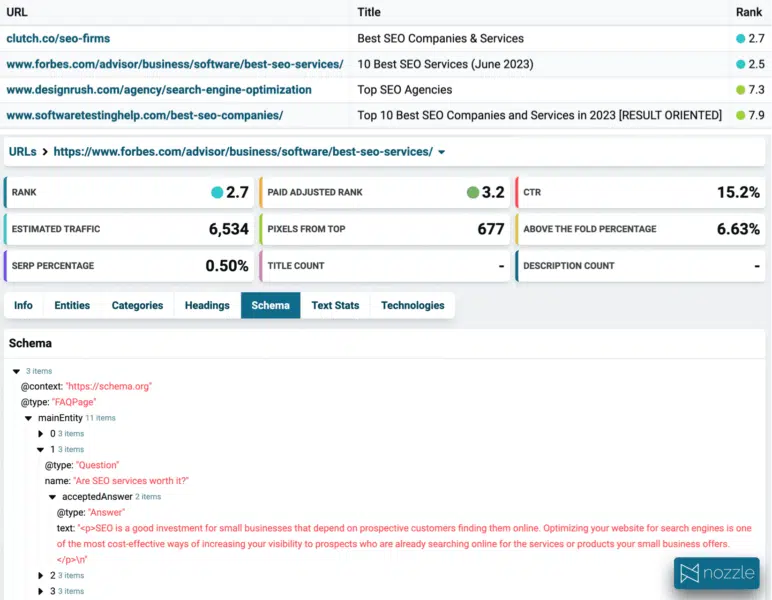
Seeing detailed information about their headings, schema, and text stats like word count/grade level can be a helpful guide.

Nozzle Cluster Urls 772x600

2. Refine by

One criminally overlooked source for relevant topic information is hidden right at the top of every SERP, helpfully labeled with the hidden H1 tag, “Filters and Topics”.

After a few traditional tabs like Images, News, Maps (changes from search to search), Google links to related topics, typically prepending or appending the topic to the current keyword phrase. These are generally easy to identify manually and can also be differentiated by HTML markup/CSS classes.

Nozzle Clusters Refine By 800x345

3 and 4. People Also Ask (PAA) and frequently asked questions (FAQ)

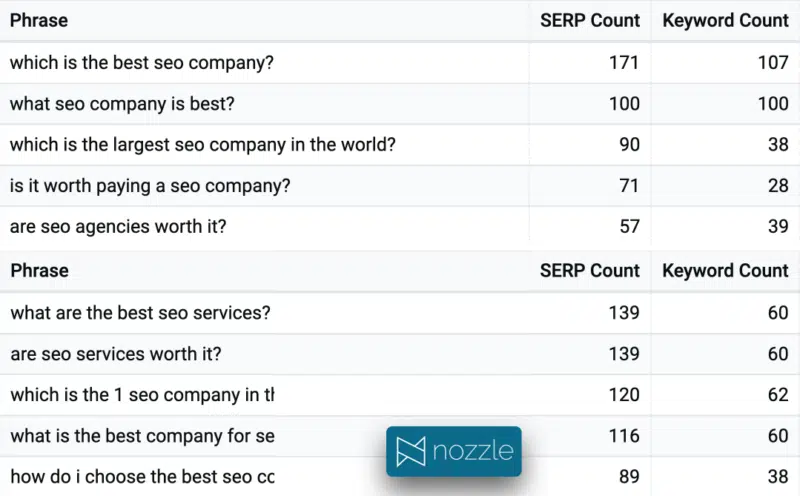
People Also Ask questions are a goldmine for content creators, as Google gives you the blueprint for what to answer in your content. PAAs are also much more volatile than traditional search results, so by aggregating them over time rather than a one-time scrape that most tools use, you can identify which questions appear the most often. In our example above, even though the SERPs were nearly identical, there were zero overlapping questions.

First, we have the top 10 questions for this specific cluster over the last 30 days. SERP count is the total number of SERPs they appeared on, and keyword count is the number of unique keywords that showed the question.

Very similar to PAA, below are the questions that Google deemed relevant enough to the topic to provide significantly more visual real estate to the site by implementing correct schema.org markup.

Nozzle Cluster Paa Faq 800x496

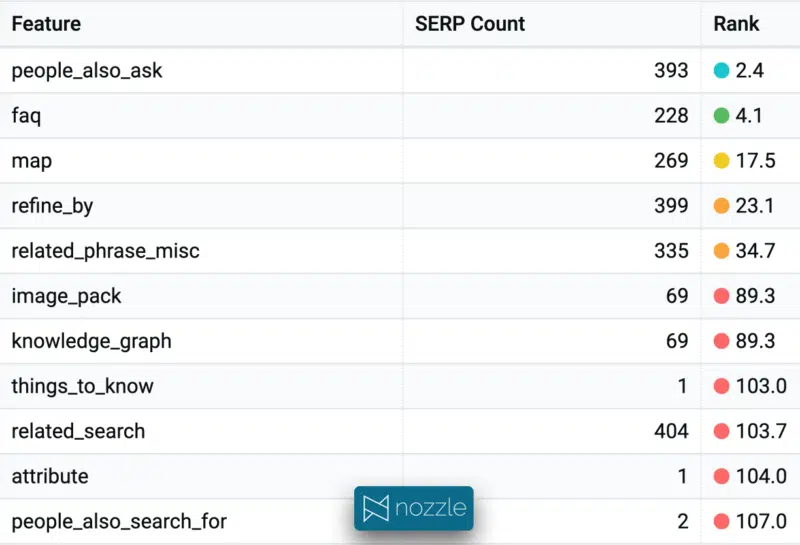
5. SERP features

The presence or absence of specific SERP features for a cluster will impact your content strategy. PAA and FAQ typically get very high visibility on the SERP – for this cluster, ranking position 2.5 and 4.2, respectively – so adding the correct markup and answering the right questions can drive significant traffic if you can capture it. Maps show 65% of the time, which signals some fractured intent. Things_to_know is only visible on a single SERP but might represent a growth opportunity if you optimize.

Nozzle Cluster Serp Features 800x545

6. Search intent

Search intent influences your entire strategy, so knowing the overall cluster intent, including mixed intent, is crucial to a great strategy. Search intent should also be available per result, in addition to an overall aggregate score, to help identify opportunities to rank multiple pages on a single SERP. Having data that informs that intent, like Google Ads metrics, is also useful.

7. Ranking positions

Reporting your current ranking position is vital. If you don’t currently rank at all, there might be some low-hanging fruit where you simply have a content gap, and with sufficient topical authority, you could rank just by publishing. Similarly, if you rank 8-15, you might be able to 10x your traffic with just some extra optimization.

Bonus points if you can see more than just rank, including newer metrics like pixel depth and above-the-fold %.

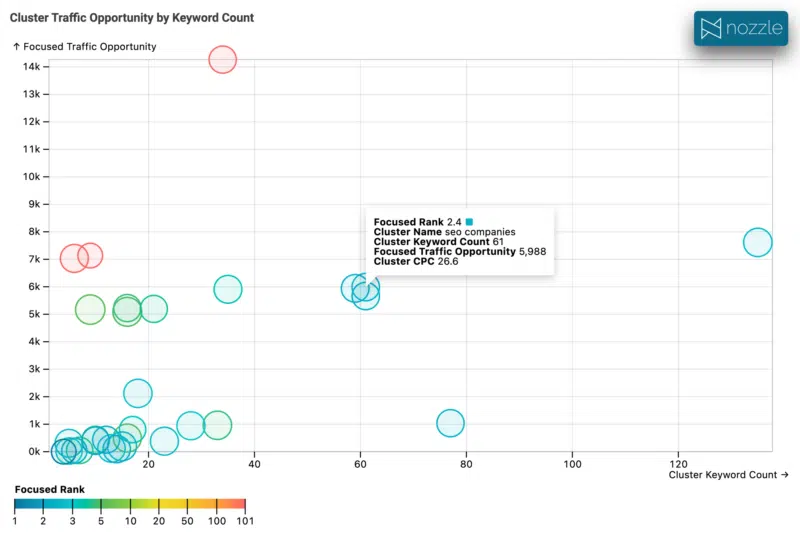
Nozzle Clusters Scatterplot Traffic Opportunity 800x536

Having the rank available doesn’t mean much if you can’t meaningfully visualize it to identify opportunities.

This shows the number of keywords in a cluster against search volume, with CPC as the bubble radius and rank as the bubble color. It’s easy to quickly identify clusters matching your criteria to drill into for more detail.

8. Competitive overview/Share of voice

Seeing your own rank is great, but it’s even better if you can spy on your competitors with the same data. Switching between domains gives you god-like powers to dominate your competition.

Since every cluster is different, there might be a different set of competitors in each one, so make sure you can report on the share of voice per cluster.

9. Entities

Google has long since stopped seeing the web via exact-match keywords. It’s more about semantic similarities, which can be represented by entities extracted from page content using natural language processing (NLP).

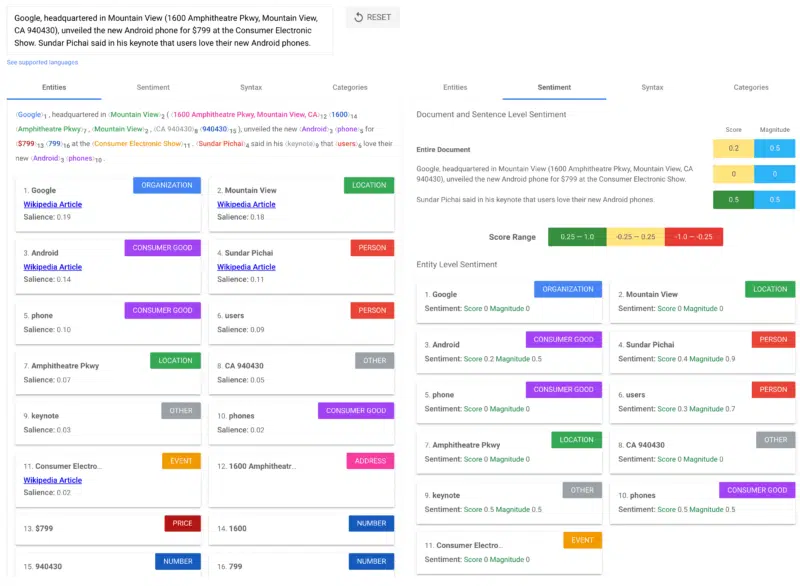
To learn more, I highly recommend reading Timothy Warren’s article on SEL, “Entity SEO: The definitive guide.” While there are many APIs and open-source tools like spaCy to extract data from text, I prefer to use Google’s API, and they have a demo, as shown below, identifying important parts of the text.

  • Salience: the importance of the entity to the text.
  • Sentiment Score: from -1 to 1, with -1 being the most negative, 0 neutral, and 1 being the most positive.
  • Sentiment Magnitude: indicates how much emotional content is present within the document.
Gcp Nlp Demo 800x586

As a content writer targeting a keyword cluster, hopefully, you’ve evolved past keyword density. However, it’s still important to ensure you correctly target entities that Google knows and cares about.

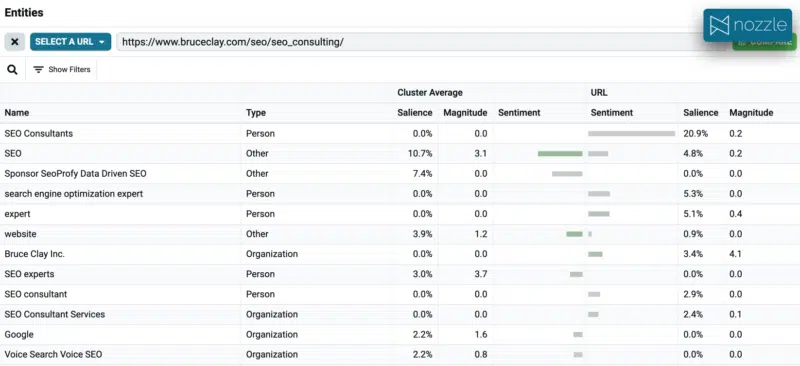
Now let’s say that we’re writing for Bruce Clay, and we have decided to target this “SEO companies” cluster example. Normally the workflow would involve the writer scanning a few important pages, then updating an existing page. With entities, we have a new way to approach content optimization. We can use the same NLP to extract entities from our mapped page, then compare them with the cluster entities.

Nozzle Cluster Entity Comparison 800x366

In this case, it is very clear that there is a total mismatch. Assuming the page you are comparing already ranks for other clusters, this is a strong signal that you need to create new content to target this cluster.

10. Content categorization

Similar to our approach to entities, we can also categorize our content, and by comparing that to the cluster, we can identify mismatches.

Google has a classification API with nearly 1,100 categories that work across multiple languages. Unsurprisingly, SEO is the leading category for this cluster’s matching URLs, but category #4 is “Product Reviews & Price Comparisons.”

At that confidence level, that doesn’t mean you need to run and add a comparison table to your page, but it’s worth considering if that would add value to your audience.

Nozzle Clusters Category Comparison 800x367

Conclusion

Until now, you’ve had to stitch together different tools to see even a fraction of this data. Today, Nozzle is launching our keyword clustering tool on Product Hunt, with all this data at your fingertips. Come and try it out on your own keywords for free!

[embedded content]

Related stories

New on Search Engine Land

About the author

Nozzle

Nozzle is a full SERP monitoring tool that provides more SERP data than any other tool on the market. You get access to the full SERP, not just your results, and you can view historical SERPs forever. We know that not every keyword is created equal, so you can schedule data retrieval at frequencies that match your budget. With over 1,000 fields available, direct access to BigQuery, and support for every BI tool on the market, you can build in-depth dashboards for your teams, joining to internal data to get deep insights across your entire marketing stack. To learn more, visit: https://nozzle.io.

https://searchengineland.com/types-of-data-that-should-be-on-your-keyword-clustering-wish-list-428506


How to use ChatGPT to generate product descriptions at scale

We want more quality content for our websites, but it’s difficult to produce enough. So how can we scale the content creation process, especially for ecommerce sites with plenty of products?

If you were to pay for a copywriter to produce thousands of product snippets from scratch, you’d likely be out of pocket pretty quickly.

What if you pay for 1,000 new product descriptions, but only half of those products live one month later? Clearly, you need a faster, more cost-effective approach. This is where ChatGPT can help.

ChatGPT’s native web interface is really helpful and a great time-saver. 

But if we have hundreds or thousands of product descriptions to create, there’s a more efficient way of using ChatGPT without copying and pasting prompts. Here’s how.

Mass production of content snippets: Scaling the output

If you have an ecommerce website, you might wish to produce product snippets using data from a product information management (PIM) system. 

Let’s say you have the data on a spreadsheet.

Product data spreadsheet

We can use Excel formulas to concatenate (or join, using the “&” operator) data into rich prompts, ready for ChatGPT. For example:

Data Concatenate 800x395

Note that your formula may require one or multiple “IF” statements. That’s because your data may have holes in some areas. 

For example, some products may not have certain parameters (data within certain columns) specified. You need your formula to be flexible, and you can always ask ChatGPT to help you write the formula.

Product description prompt
Product description prompt 1

Once your formula is returning a prompt for each row (in this case, for each product), you can copy and paste a few of the generated prompts into a word processor, even notepad. 

It’s good to spot-check a few to ensure the text makes sense, even when some data items were missing.

Spot check prompts

Once you have verified that your Excel (or Google Sheets) formula is generating the types of prompts that you want, you can send a few of them to ChatGPT (manually, using the web interface) to see if you like the results.

The generated snippet(s) will likely require human editorial oversight, though you want to get the AI to do as much of the work as possible. That’s why we engaged in such a deep “prompt-crafting” process.

Happy with your initial prompts and responses? Good, then it’s time to move on.


Get the daily newsletter search marketers rely on.


Fetching your new product content snippets from OpenAI

So, you now have a list of products (or other types of webpages) which you’d like to generate content for. 

In this example, we’re going with a fictitious sample of 100 products. You now have a list of all your products (either separated by URL, SKU or some other unique identifier). 

These products also have assigned rich prompts which you have generated. But ChatGPT’s web UI is limited. So how can you send these across all at once?

For this, you’re going to have to get comfortable with basic scripting and with handling API requests. You can create an OpenAI API account to access the ChatGPT web interface. 

I put together a basic Python script for my agency. While I can’t share the script, I can review some of the processes and documentation needed.

Should I wish to syndicate this script later, building it on marketing-accessible endpoints and technologies would be best. As such, I first produced an Excel sheet:

ChatGPT checker

The sheet simply provides an area to dump items for processing (identified by some unique identifier in the “Item Name” column, in this case, product name). In addition, the prompts to be processed can also be placed here. 

Another tab contains parameter settings for the request. (You can learn about all these via OpenAI’s documentation.) 

Some of these settings fine-tune content creativity allowance, unusual wording deployment, max token spend per request and even content redundancy. This is also where the OpenAI API key is saved.

Once a certain button within the spreadsheet is clicked, the Python script launches automatically and handles the rest:

Python script

First, the script defines the request / endpoint URL. After this, the script sends the request headers and the request data. 

Most parameters for the request header / data, can be tweaked within the spreadsheet pictured previously. 

Finally, the response text is received from OpenAI and logged within the “data dump,” another separate spreadsheet. 

I have three scripts for this deployment, though only one needs to run. I also have two separate spreadsheets, both of which are needed.

Once the script resolves all of the queries, all of the snippets of text are saved here:

Final output

Looking at the above output, you may have some content uniqueness concerns. 

While all of the snippets begin with the exact phrase (“Introducing the [product name]”), the produced content gets more diverse across the generated paragraphs. So, it’s not as bad as it looks. 

Also, there are things you can do to attempt to make each generated snippet even more unique, such as categorically asking the AI to generate unique content (though you have to be quite firm and repetitive in this regard to get anywhere). 

You can also tweak the temperature and frequency parameters to adjust content creativity and avoid redundant language.

Weaving these technologies together (OpenAI’s API, Excel, Python), we can quickly ascertain generated text snippets for all input prompts. 

From here, it’s up to you what you want to do with that newly processed data. 

I highly recommend moving it into a format your editorial team can understand. 

We have somewhat mitigated much of this by crafting very rich prompts. However, you can never be certain until you check the output.

ChatGPT output notes

Assuming that you’re happy to work with ChatGPT, there are a few things to keep in mind:

  • Let’s talk about the cost. It’s tough to give a cost breakdown for using OpenAI’s GPT-4 model of ChatGPT via their API. It’s not just the input word count of the prompt or the output word count. Pricing revolves around the AI’s “thinking time.” More complex requests will use more tokens and cost more (even if the input / output word count is reduced).
  • Our test batch of 100 prompts from sample data cost us only $1.74 to run and return. We generated 22,482 words of content overall. 22,482 words of content for $1.74 seems good, but there’s much more to consider.
  • Due to AI’s propensity to infer, a human editorial process is still fundamentally required (in our opinion).
  • However, using this technology does transform a costly from-scratch content creation task into a much more cost-effective content editing task.
  • The data / AI specialist’s time for prompt crafting and running scripts must also be factored in.
  • On top of inferring where data is lacking, AI can also “creatively infer” things. In our sample data set, the AI decided to infer the existence of a sizing guide (clothing) within the produced product content. If no sizing guide existed, that would look pretty silly.
  • Always send AI content through a human editorial review process for fact-checking, accuracy and (most importantly) additional creative flair.
  • You can further automate ChatGPT by plugging in projects like Auto-GPT. Those AI ‘agents’ add more active processing and tasking power to ChatGPT. However, projects like this still need your OpenAI API key. And due to their infancy, they can chew up a lot of credits before they learn to perform tasks to standard.

Scaling your content creation process with AI

AI can scalably produce diverse snippets of content that are fit for purpose with minimum intervention.

For long-form content, it’s probably still better to use the interface and iterate the AI’s responses.


Opinions expressed in this article are those of the guest author and not necessarily Search Engine Land. Staff authors are listed here.


Related stories

New on Search Engine Land

@media screen and (min-width: 800px) { #div-gpt-ad-3191538-7 { display: flex !important; justify-content: center !important; align-items: center !important; min-width:770px; min-height:260px; } } @media screen and (min-width: 1279px) { #div-gpt-ad-3191538-7 { display: flex !important; justify-content: center !important; align-items: center !important; min-width:800px!important; min-height:440px!important; } }

About the author

James Allen

Hailing from the Midlands of the United Kingdom; James Allen has been working in search since 2009. Specialising in technical SEO early in his career, he is an auditor who is capable of ascertaining his own data. With a solid knowledge of XPath and some working knowledge of Python, James also dabbles in AI scripting. James decided to split his career between then technical SEO, light API scripting and Analytics disciplines. Due to this, he also has high familiarity with Google Analytics, Google Tag Manager and managing custom events within the data layer. James currently works at Anicca in Leicester, where his time is spent auditing websites, exploring AI workflow integrations and implementing in-depth tracking on clients’ websites.

https://searchengineland.com/chatgpt-generate-product-descriptions-428546


How to manage crawl depth for better SEO performance

One often overlooked aspect of website management is managing crawl depth, the level at which search engine bots explore and index a site’s pages. 

Understanding how to control and optimize crawl depth can significantly impact your website performance and search rankings.

This article will provide you with valuable guidance and actionable SEO tips to optimize crawl depth effectively. 

Crawl depth: What is it and why does it matter?

Crawl depth refers to the level or distance of a webpage within a website’s architecture from the starting point or root. 

It indicates the number of clicks or steps required for a search engine crawler to reach a specific page from the homepage or any other starting point.

The crawl depth of a page is determined by the number of links it takes to navigate from the homepage to that particular page. 

For example, a page that can be accessed directly from the homepage without any intermediary clicks is considered to have a shallow crawl depth. 

On the other hand, a page that requires multiple clicks or traversing through several intermediary pages to reach it is considered to have a deeper crawl depth.

The crawl depth of a page is significant because it affects how search engine bots discover and index web content. 

Pages with shallow crawl depth are more easily and frequently crawled by search engine crawlers, leading to faster indexing and improved visibility in search results. 

Conversely, pages with deeper crawl depth may experience delayed or limited crawling, potentially affecting their visibility and ranking in search engine results.

It is important to note that crawl depth is not the same as the depth of a website structure or the depth of a URL. 

Crawl depth specifically refers to the distance of a page from the starting point in terms of clicks or links required to reach it during the crawling process.

In comparison, website depth refers to the hierarchical structure and organization of content within a website. It represents the levels of pages or sections a user must navigate to reach a particular piece of content. 

Why should you manage crawl depth?

Improved indexing and visibility

Ensuring that important pages have a shallow crawl depth increases the likelihood of their timely discovery and inclusion in search engine indexes. 

A shallow crawl depth enables search engine bots to efficiently traverse a website, indexing pages and making them visible to potential visitors.

Better user experience and navigation 

A shallow crawl depth facilitates a user-friendly experience, allowing visitors to find relevant content quickly. 

Easy navigation enhances user engagement and reduces the likelihood of users abandoning the website due to difficulties locating desired information.


Get the daily newsletter search marketers rely on.


How to influence crawl depth

Optimizing crawl depth involves ensuring that important pages, such as cornerstone content or high-priority landing pages, have a shallow crawl depth. 

This can be achieved through the following:

Streamline your internal linking structure

The organization and hierarchy of internal links significantly impact crawl depth. 

Well-structured internal linking, with clear and logical navigation paths, can reduce crawl depth and help search engine bots discover and index pages more efficiently.

You can improve crawl efficiency by strategically linking relevant pages and creating a logical hierarchy. 

Distribute internal links throughout your website to ensure all pages receive sufficient link equity. 

Avoid situations where certain pages are isolated or receive limited internal linking, hindering their discovery and indexing.

Prioritize important pages

Pages that are considered important, such as the homepage, cornerstone content, or frequently updated content, should have a shallow crawl depth. 

This ensures that search engine bots can easily access and index these crucial pages.

Consider your website’s size and complexity

Larger websites with a complex hierarchy may naturally have deeper crawl depths. 

It is important to strike a balance between organizing content effectively and minimizing crawl depth for essential pages.

Implement XML sitemaps

Utilizing XML sitemaps can help search engines understand the structure and hierarchy of a website. 

Including important pages in the sitemap can increase their visibility to search engine crawlers.

Optimize your URL structure

A well-optimized URL structure can contribute to a more efficient crawl process. 

Clear and descriptive URLs that reflect the content and hierarchy of a page can aid search engine crawlers in understanding the website structure.

Regularly check for broken links and fix them promptly. 

Broken links can hinder search engine bots from efficiently crawling your website, resulting in incomplete indexing.

Improve site speed

A fast-loading website enhances user experience and improves crawl efficiency. 

Learn more tips for making your website faster in “Page speed and experience in SEO: 9 ways to eliminate issues.”

Monitor and resolve crawl errors

Use Google Search Console to monitor crawl errors. Investigate and resolve these errors by fixing broken links, redirecting pages, or resolving server issues.

Minimizing crawl depth for crucial webpages

By following the tips above, you can improve how search engines crawl your website and increase the visibility of your content. 

Doing your part in making the crawling process more efficient improves the chances of your webpages being indexed and appearing in search results.


Opinions expressed in this article are those of the guest author and not necessarily Search Engine Land. Staff authors are listed here.


Related stories

New on Search Engine Land

@media screen and (min-width: 800px) { #div-gpt-ad-3191538-7 { display: flex !important; justify-content: center !important; align-items: center !important; min-width:770px; min-height:260px; } } @media screen and (min-width: 1279px) { #div-gpt-ad-3191538-7 { display: flex !important; justify-content: center !important; align-items: center !important; min-width:800px!important; min-height:440px!important; } }

About the author

Gaetano Romeo

Gaetano Romeo is an accomplished SEO specialist with a career spanning over two decades. Since 2003, he has been actively involved in the field of search engine optimization, leveraging his expertise to help businesses improve their online visibility and drive organic traffic.
Gaetano’s passion for SEO has led him to collaborate with various universities across Italy, where he shares his knowledge and teaches courses on SEO, growth hacking, and inbound marketing. His dedication to education and mentorship has empowered numerous students and professionals to excel in the digital marketing industry.
Throughout his career, Gaetano has worked with renowned brands in Germany, Switzerland, and Italy. His international experience has given him a unique perspective on global SEO strategies and the ability to adapt to diverse markets and industries. Gaetano’s contributions have been instrumental in driving successful digital marketing campaigns and achieving measurable results for his clients.
Today, Gaetano holds the esteemed position of Chief Operating Officer and partner at Bruce Clay Europe. In this role, he oversees the day-to-day operations of the company and plays a vital role in shaping its strategic direction. Gaetano’s extensive knowledge and expertise in SEO have made him an invaluable asset to the organization, enabling him to deliver exceptional services and drive business growth for clients across Europe.
With his deep understanding of SEO, growth hacking, and inbound marketing, Gaetano Romeo continues to make a significant impact in the digital marketing industry. His passion for innovation, commitment to excellence, and strong leadership skills position him as a trusted authority in the field, inspiring others to push the boundaries of SEO and achieve outstanding results in the ever-evolving digital landscape.

https://searchengineland.com/manage-crawl-depth-better-seo-performance-428542


Google SGE snapshot carousel: 4 winning SEO strategies in B2C, B2B

Google introduced its new AI-powered Search Generative Experience (SGE) on May 25. Search Engine Land’s Barry Schwartz was among the first to test the experience and highlight the clickability of its results.

Our team at Eyeful Media has been actively testing the generative AI search environment. We believe it will provide publishers value and create SEO opportunities for B2B and B2C brands.

The most significant B2B and B2C SEO opportunity is an AI snapshot carousel position earned with subject matter expert content. 

Here’s what you need to know about this feature and four strategies to drive SEO results. 

Capturing organic traffic on snapshot carousels with SME content

Snapshot carousels capture the most organic clicks based on the current construction of the AI-powered SERP in Google’s SGE. 

Subject matter expert (SME) content featuring E-E-A-T (experience, expertise, authority, and trust) principles provides value today. This SME content is also ranking prominently in the futuristic carousel. 

Here is an example of the generative AI result and snapshots carousel.

Smart goals for fleet managers

SME content strategies that drive results currently – and projects to do the same in the future – should be part of your SEO program. The example above is of the search query SMART goals for fleet managers.

The generative AI result provides a list of goals. The AI snapshot carousel features clickable cards with SME content from fleet industry leaders. One of those subject matter experts is Azuga, who also owns the traditional Position 1 ranking for this query. 

There is yet to be a definitive timeline on how, if, or when generative AI will become part of our everyday search.

But if you are not creating subject matter expert content that helps your audience and earns valuable organic rankings now, Google’s latest beta should provide more incentive to do so.

Here is another example of SME content with a top-ranking and clickable AI snapshot position.

Post purchase behavior

Reverse Logix currently owns the top position for post-purchase behavior. As a trusted industry authority in logistics, the additional context they provide about the query is earning valuable rankings.

This top-ranking SME content is also being served in the carousel to complement the AI-generated result for this query in the beta. Further analysis of the SERP box featured above the fold highlights why this carousel position would be critical for SEO.

With follow-up prompts, a multiple-card carousel, and generative AI results, hoping users will navigate below the fold may be wishful thinking. The carousel could represent the Top 1, Top 2, or Top 3 most valuable places to rank in this single-search environment.

But while AI-powered search may seem scary, the same SME content strategies winning now will also help SEOs win carousel rankings in this unpredictable future.

Here is an example of the query API rate-limiting, where the top-ranking result is also in the carousel.

API Rate Limiting

This API rate-limiting search query example is a top-ranking industry leader Axway currently owns in traditional search. This article also captures a valuable AI snapshot position in the beta.

Experience, expertise, authority, and trust are essential quality signals today.

These factors will also be important in the future. SEO strategies that lean into SME content that features these principles set their brands up for success.

Here’s one more example of top-ranking SME content featured in the carousel. 

Growth capital investment

Sumeru Equity Partners owns top keyword rankings for growth capital investment-related queries. 

This growth capital investment article they published amplifies a podcast hosted by their SME. The article drives traffic and captures a carousel ranking in Google’s generative AI search experience.

The expertise and depth provided by Sumeru on this query build on the definition offered by the AI-generated result.

The content is valuable today and in this beta because it delivers perspective beyond what an AI can create. 


Get the daily newsletter search marketers rely on.


1. Scale SME content

Use podcasts, webinars, training, and demo videos to develop SME content at scale. Create evergreen webinar or podcast landing pages.

Scale this content by repurposing it into explainer videos, blog articles, or checklists. This will maximize your SME’s time creating the original asset while amplifying the message.

2. Leverage outside SMEs

Content that features subject matter experts from your company is excellent. But tapping into the insights of outside influencers can also fuel SEO wins.

Interview SMEs to build content around their analysis. Create resources like how-to demos, product reviews, or articles that leverage their insights.

3. Complement AI-generated results

Google features SME content that goes beyond the AI-generated result in the snapshot carousel. This content is also ranking now.

Including an SME’s perspectives, like how or why an AI-generated result is important, is critical. Trusted brands can earn valuable rankings by adding depth and perspective to AI-generated results.

4. Elevate SME content strategies

Authentic content has always been the goal of SEO. In an AI-powered environment, there is even more incentive to produce helpful content that stands out among automated responses.

Subject matter expert content that follows E-E-A-T principles is a winning formula. 

Doubling down on SME content now is a way to navigate an uncertain SEO future with a proven strategy for success.


Opinions expressed in this article are those of the guest author and not necessarily Search Engine Land. Staff authors are listed here.


Related stories

New on Search Engine Land

@media screen and (min-width: 800px) { #div-gpt-ad-3191538-7 { display: flex !important; justify-content: center !important; align-items: center !important; min-width:770px; min-height:260px; } } @media screen and (min-width: 1279px) { #div-gpt-ad-3191538-7 { display: flex !important; justify-content: center !important; align-items: center !important; min-width:800px!important; min-height:440px!important; } }

About the author

Brendan Bowers

Brendan is an SEO and content director with Eyeful Media. He is also a New York Times Best-Selling Author of the book Cleveland is King. He has 15 years of digital marketing experience working in-house and in an agency environment. Brendan ran his first marathon in May and enjoys kayaking in the summer wife his wife, Kate.

https://searchengineland.com/google-sge-snapshot-carousel-strategies-b2c-b2b-seo-428490


How to use location-specific authority content for SEO

People do business with brands they know, like and trust. The larger the investment, the more important these factors are.

Building relationships and earning trust are key to earning lasting relationships with customers. Here’s how to achieve these with great location-specific SEO content.

(While the studies referenced in this article focus primarily on real estate brands, this information will help location-based businesses.)

What type of local content is worth your time and effort?

Everyone knows at least five local real estate agents or brands. Just ask a real estate question on a local Facebook group or Twitter, and you’ll be bombarded with agents offering their services.

How often are those agents annoying in their marketing efforts, pushing content but not engaging in conversations with potential clients, actually earning those relationships? How many of them are trustworthy?

Typically, real estate (and many home service brands) websites are sources of OK content, offering generic and regurgitated information.

Users get the same property, product or service listings and calls to action as every other site in the SERP.

Real estate has always been incredibly competitive. Recent changes to interest rates and housing prices have made this even more complex. 

We spend a lot of time testing campaigns at our agency to know what works and help keep our clients’ phones ringing without wasting time on strategies that don’t convert. One thing we know for sure, you need to be where your customers are.

One of the best ways to stand out and get the attention of both customers and Google is to have content that sets you apart from the competition.

Our first challenge: What content is worth your time and effort, and what doesn’t really matter?

Two of our top performers are location pages and blog posts. 

People often overlook the value of the distinct differences between the two. They are not the same, and you want to utilize both for their unique benefits

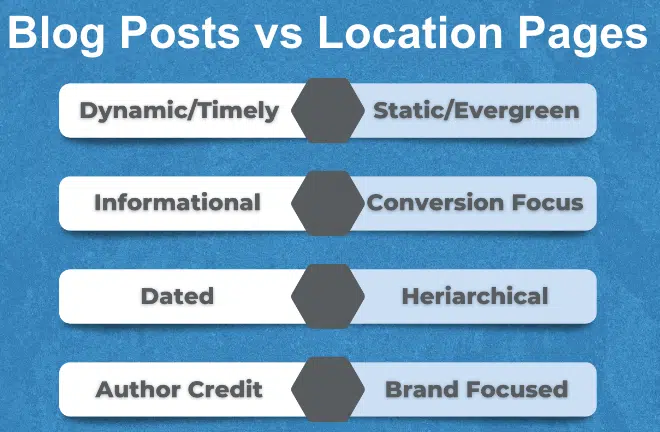
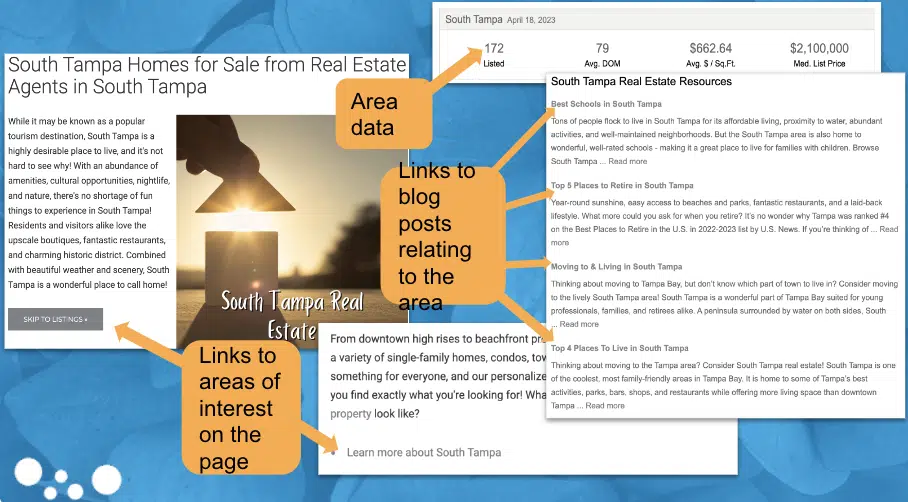
  • Location page: Lasting, informative content about the area, including general information, top destinations, activities, points of interest, and popular neighborhoods – anything that shows you as an authority in that area.
  • Blog post: Unlike location page content, blog posts must be specific, timely, and relevant. Write for the audience you want to sell to. Show your audience that you’re the local authority on what’s happening in the area and which hot topics matter. Provide immediate value to locals and visitors alike.
Blog posts vs. location pages

Most real estate website location pages are simply automated listings for that area, just like every other location page on every other real estate site. You can do better. 

Creating outstanding location pages

A great location page offers valuable evergreen information about an area. You’re selling the community here, not just one house. 

Add demographic info, area schools, amenities, cultural opportunities, and anything else people researching the area might be interested in. 

Let them know if it’s urban or rural, and talk about the town or community’s unique personality. What sets this location apart from the others? 

Location pages offer you an opportunity to become an authority in that area. 

This helps build trust with your audience when it is time to choose their location and move forward with purchasing a home (or whatever service you’re providing in the area).

It also keeps them from leaving your site to find that info elsewhere. 

Helping your buyers narrow down where they do and do not want to live saves you time when you get ready to show them properties.

Bonus benefit: You can also link to your blog posts focused on specific area information pages to provide additional value to site visitors.

Location pages

Writing great blog posts

Great blog posts do well in search and with site traffic/conversion assists. 

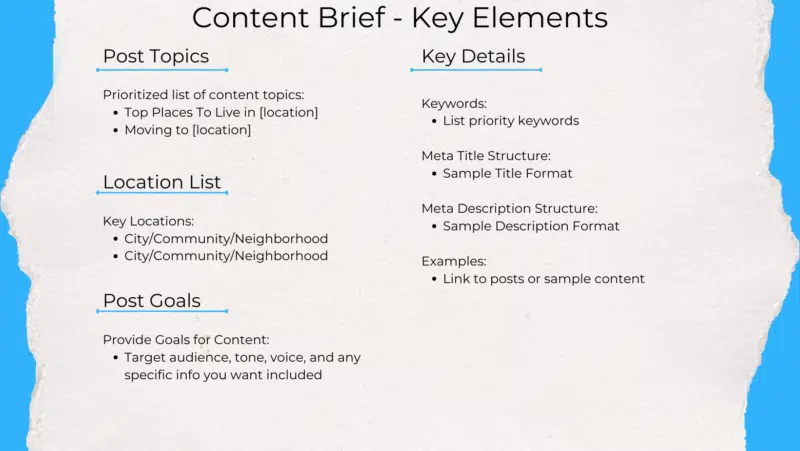
We’ve found value in creating content briefs before creating new content to ensure we stick to our original goals for the content and cover all of our bases.

Look at location-based queries in Search Console and use that data to map out a strategy for blog content. 

We’ve seen success with “best of” and “top” lists for neighborhoods and communities, area guides that review restaurants or fun area activities, and timely information like festivals and holiday events. 

Make sure to utilize great images and current SEO best practices.

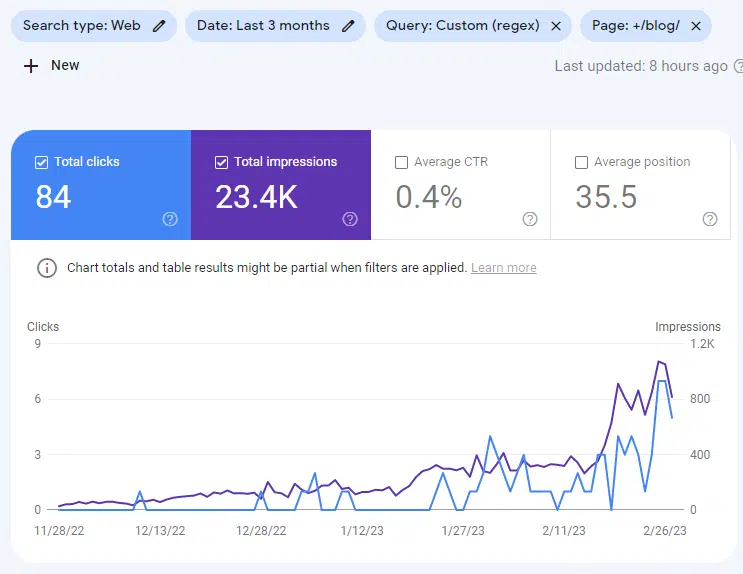
We started creating blog content for a client at the end of last year. Here are the results so far.

GSC performance - 1

Non-branded location-based queries increased substantially when we started increasing local area blog content. How is this relevant to their real estate business? 

It’s helping their audience get to know the brand, they like the content they’re being served, and they trust this brand as a reputable source of information in the local community. 

Who do you think they’ll call when it’s time to help them find the perfect buyer for their home?


Get the daily newsletter search marketers rely on.


Work with existing content

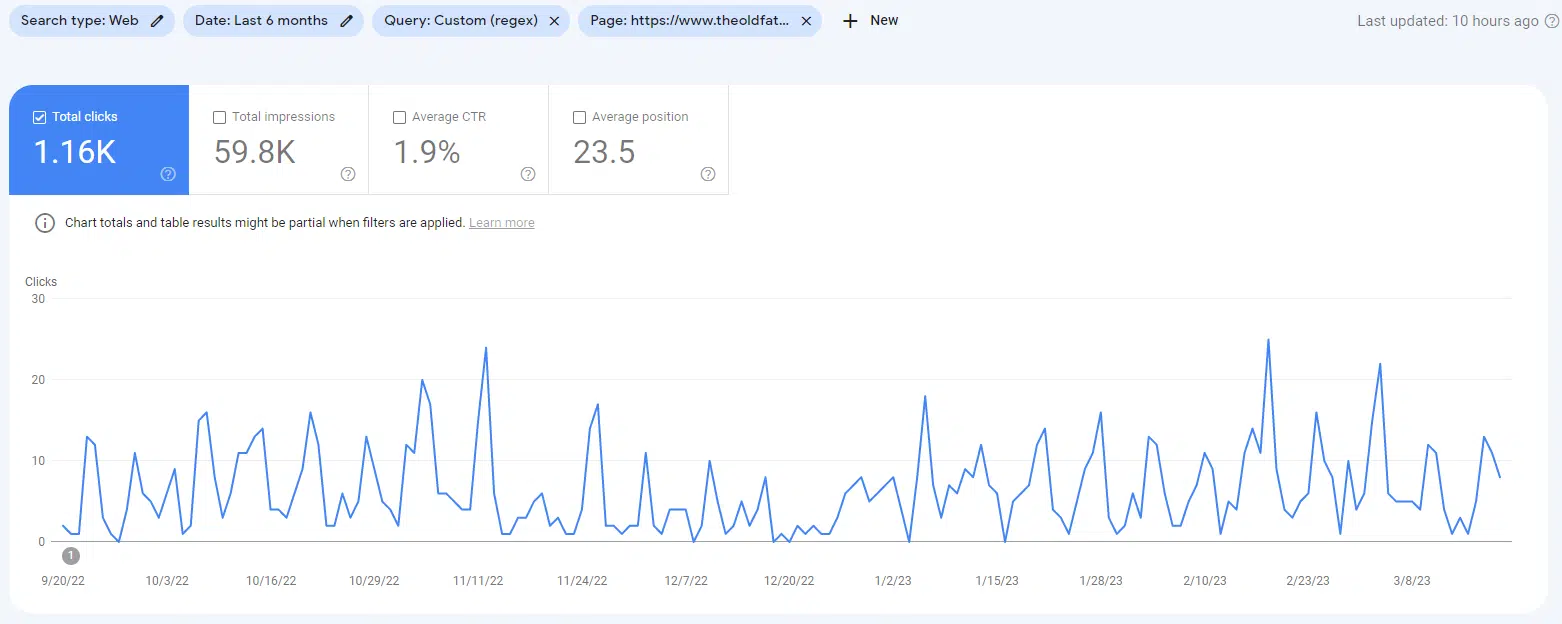
Instead of publishing a new blog post every week that will lose relevance almost immediately and end up in the blogroll graveyard, a client utilizes an evergreen article with an interactive map about local events updated weekly for their specific city. 

This appeals to everyone in the local community, further building the brand’s know, like, and trust factor. 

GSC performance - 2

This blog post is currently the top-performing URL on their site. It ranks well, performs consistently, and has become a local authority on “things to do in” for that town.

Is it leading to direct real estate conversions? No. 

But neither is the first visit to your home page, that one Facebook post, or your generic listings feed. 

Investments as large as real estate and many home service offerings rarely convert on the first click. 

Take time to nurture your audience and build a strong authoritative reputation in your community.

In time, you’ll earn personal referrals from community members, carrying far more weight with potential buyers.

Wait to build new pages

Before you freak out, I’m not saying don’t ever create new content. I’m saying you may not be ready for that yet. 

If you have the website equivalent of a 1980s bathroom badly in need of a remodel, new pages will help you about as much as new hand towels will help this bathroom.

Creating new content is a waste of time if your house isn’t in order. There’s no point in putting an awesome kitchen in if there’s no walkway to your front door. 

Build strong, reliable pathways so the content you create is actually accessible, usable, and helpful.

Make those structural repairs and ensure your existing real estate is where you want it to be. Clean up the existing content on your site before you worry about new content. 

Utilize analytics to see what is performing well on your site and what you can improve upon. 

Don’t be afraid to update, edit, merge, unpublish, or remove posts or pages to ensure the content that is working for you gets the attention it deserves. 

This freaks people out until rankings and traffic to their site increase. Just like staging a home, don’t be afraid to declutter!

Update, measure, evaluate, adjust, measure, repeat

The only constant in SEO is change. Expect to adjust your site structure and content as things change, just as you would update or redecorate a home. 

Remember the dusty blue and rose color scheme that was so hot 30 years ago? Or how it seemed like nearly every kitchen in America had geese as their primary source of decor? 

What worked in 1993 will not hit the same way in 2023.

Website content will never be “set it and forget it”. You need to track and measure the results of your efforts continually. 

Evaluate success, make changes, track, and measure. This cycle will ensure success both in the SERPs and in your conversion rates

Now, you’re ready for new content

Make sure you have a plan mapped out. Create a content brief for each page or post to ensure you prioritize efficiently and not leave anything out. 

  • Where are the gaps? 
  • What can you create to add value and complement your existing work? 
  • Where is your competition outperforming you? 
  • Where do you have a competitive advantage? 

You want to be everywhere they are and also where they’re not.

This is similar to our agency’s framework for planning new pages and blog posts. Create a content brief outline that best suits your brand’s individual needs and skillsets.

Content Brief 800x451

Incorporate videos

Adding videos to both pages and posts is a great way to boost visibility and increase conversions. 

GSC Performance 3 800x252

Video is a great way to get an edge on the competition. This is not where you want to be cheap and cut corners.

Stay in touch 

Don’t forget to stay top of mind for your past clients. 

Only 53% of home sellers used the same agent to purchase their next home after a previous sale, according to the National Association of Realtors. 

The biggest gap? 

Aging demographics moving farther away from their agents, not realizing they can still provide great service from a distance.

Stay in touch and foster strong relationships by utilizing email marketing, a great CRM, and social media to stay top of mind with your clients. 

Get multiple benefits from your content by repurposing it for blog posts, emails, and social profiles. 

What not to do

Don’t lean too heavily on AI. Let AI tools assist you in content creation, but don’t hand them the keys. 

Remember, AI is only as smart as the information it is fed. ChatGPT and other AI platforms are not always accurate. 

We have seen instances where ChatGPT completely fabricated information to fill in the blanks on queries.

Always verify the information before you publish it. Make sure to remove erroneous verbiage, inaccurate information, or anything else that doesn’t serve your audience. 

Remember, your competitors are being served the same information. What you do with this information is where you will stand out or fall behind.


Opinions expressed in this article are those of the guest author and not necessarily Search Engine Land. Staff authors are listed here.


Related stories

New on Search Engine Land

@media screen and (min-width: 800px) { #div-gpt-ad-3191538-7 { display: flex !important; justify-content: center !important; align-items: center !important; min-width:770px; min-height:260px; } } @media screen and (min-width: 1279px) { #div-gpt-ad-3191538-7 { display: flex !important; justify-content: center !important; align-items: center !important; min-width:800px!important; min-height:440px!important; } }

About the author

Erin Jones

Erin Jones has been working in digital marketing and SEO since 2005. She specializes in local SEO, social media, and brand reputation. She works at Sterling Sky and is also a Local University faculty member. Erin is passionate about community and loves helping brands connect with their ideal audiences both online and in person.

https://searchengineland.com/location-specific-authority-content-seo-428469


SEO during website development and post-launch: Key considerations

Building a website or changing platforms involves plenty of moving parts. One crucial step is setting the site up for success in search engines. 

But after their new website goes live, some brands make a costly mistake – neglecting to develop an ongoing SEO strategy. 

“We integrated SEO into our site during development, so we don’t need an ongoing program” is a common misconception. 

They assume the initial setup was enough and rely on the content or social media team to handle the rest. However, this approach is similar to having a new lawn.

While it may look great initially, it will gradually lose its appeal without regular maintenance like mowing and fertilizing. Moreover, if your neighbor (i.e., a competitor) tends to their lawn properly, it will look even better.

This article breaks down some key steps during the website development (or replatform) phase and why the SEO process needs to be ongoing. 

SEO during website development/redesign

Prior to building or redesigning your website, ensure that your SEO fundamentals are set up.

Below are critical steps to prioritize.

Building the site structure

During this project phase, ensure the website’s architecture is aligned with the business strategy. 

Let’s say you sell “jeans” but the marketing director prefers to call it “denim.” In this case, discuss and make decisions based on keyword research. 

Not every aspect of the business can be highlighted in the top navigation, so it’s crucial to have a strategic and data-driven conversation about what is important. 

Use this discussion to drive other elements of site structure, such as URL structure and taxonomy.

Technical best practices

During this phase, ensure that everything is properly set up and search engines can easily locate your content. This involves implementing redirects, 404 pages, and canonical tags. 

Neglecting these aspects can result in search engine blockages or significant traffic gaps when large pages are not redirected. 

Content creation and migration

In this step, ensure you have appropriate content for the new site. For redesigns, plan for any existing content you want to keep. 

Create a content/URL map to organize this. Similarly, address inbound links to ensure they direct to the correct location and remain relevant. 

Remember, content remains crucial, even in an AI-driven world.


Get the daily newsletter search marketers rely on.


Ongoing SEO activities

Fresh and relevant content

Your site needs to stay current and relevant. You should write new blogs and evergreen content that reflects your current customer demand. 

This could be as simple as creating and updating a FAQ page as new questions are asked. Relevant and consumer-focused content is crucial for success.

Technical cleanup

Even if you try to stay on top of every change on your website, things can still break without your knowledge. 

Conducting a monthly or quarterly technical site audit helps you step back and identify any changes requiring cleanup. 

Offsite promotion

Building a strong site is great, but don’t forget about the value of how the rest of the internet views your site. 

This is often best measured by your inbound links and link quality. Your link profile is always changing and should be worked on consistently to maximize offsite promotion opportunities. 

Don’t stop your SEO efforts after launch

You might think that if your website doesn’t change much and you already have a good ranking, you don’t need to worry about ongoing SEO. However, that’s a surefire way to be outperformed in the market. 

Even if your business remains the same, the environment around you is dynamic, with constant changes. 

Competitors are always striving to surpass you. 

Search engines continuously evolve, introducing new algorithms and features to deliver accurate results and stay up-to-date with technology. 

This is especially relevant with the current introduction and testing of generative AI without clear expectations of its impact. 

The best approach is to test and comprehend how these changes affect your business. Slowing down between launches or redesigns will put you at a disadvantage.


Opinions expressed in this article are those of the guest author and not necessarily Search Engine Land. Staff authors are listed here.


Related stories

New on Search Engine Land

@media screen and (min-width: 800px) { #div-gpt-ad-3191538-7 { display: flex !important; justify-content: center !important; align-items: center !important; min-width:770px; min-height:260px; } } @media screen and (min-width: 1279px) { #div-gpt-ad-3191538-7 { display: flex !important; justify-content: center !important; align-items: center !important; min-width:800px!important; min-height:440px!important; } }

About the author

Jason Tabeling

Jason Tabeling is the CEO of Airtank and is an accomplished marketing executive and proven leader with over 20 years of experience growing strong and profitable teams, working for and with Fortune 500 companies in a variety of industries.
Prior to AirTank, Jason served as Executive Vice President of Product for BrandMuscle, an enterprise software and services company focused on Fortune 1,000 brands, where he led product innovation and strategy. He earned the company a Leadership Ranking in the Forrester 2020 Through-Channel Marketing Automation Wave. He also spent 16 years working with Rosetta, Razorfish and Progressive Insurance, leading Paid, Earned and Owned media teams across health care, financial services and retail verticals. He was named a “40 under 40” by Direct Marketing News, has been a judge for the AMA Reggie Awards, and has been published in Forbes and many other publications as a subject matter expert.

https://searchengineland.com/seo-during-website-development-and-post-launch-key-considerations-428482


Essential guide to Google Reviews by Digital Marketing Depot

5 Star Review 1920x1080 1 800x450

Every business owner wants to get positive reviews. But apart from their feel-good potential, reviews serve another important function that’s sometimes easy to overlook: they can actually help boost your business in search engine rankings.

The “New Business Guide to Google Reviews” by GatherUp is an essential resource for growing businesses looking to attract more customers through the power of Google search.

This comprehensive guide provides step-by-step instructions on how to claim and optimize your Google My Business profile, how to solicit and respond to customer reviews, and how to deal with Google and their overall review process.

Visit Digital Marketing Depot to download your copy today.


Related stories

New on Search Engine Land

@media screen and (min-width: 800px) { #div-gpt-ad-3191538-7 { display: flex !important; justify-content: center !important; align-items: center !important; min-width:770px; min-height:260px; } } @media screen and (min-width: 1279px) { #div-gpt-ad-3191538-7 { display: flex !important; justify-content: center !important; align-items: center !important; min-width:800px!important; min-height:440px!important; } }

About the author

Digital Marketing Depot

Digital Marketing Depot is the resource center for digital marketing strategies and tactics. Created by Third Door Media, Digital Marketing Depot features a robust library of hosted white papers, eBooks, original research, and webinars on a wide range of digital marketing topics- from advertising, analytics, data and content management, to email marketing, SEO and PPC campaign management, and much more. Visit us at http://digitalmarketingdepot.com.

https://searchengineland.com/essential-guide-to-google-reviews-428453