Google adds INP report to Search Console

Google has launched a new report within Google Search Console to see how well you perform with the INP, Interaction to Next Paint, Core Web Vital metric. As a reminder, Interaction to Next Paint (INP) will replace First Input Delay (FID) as a metric for Core Web Vitals in March 2024.

Google launched this new report today to allow site owners to prepare for the upcoming change.

What the report looks like. Here is a screenshot of the report:

Google Inp Report 1 1687346143 800x325

INP (Interaction to Next Paint) is a new metric that will replace FID (First Input Delay) as a Core Web Vital in March 2024. “Until then, INP is not a part of Core Web Vitals. Search Console reports INP data to help you prepare,” Google explained.

How to access the report. The report is within Search Console can be accessed by clicking this link and selecting a property.

More details. Google wrote in its help documentation:

  • INP (interaction to next paint): A metric that assesses a page’s overall responsiveness to user interactions by observing the time that it takes for the page to respond to all click, tap, and keyboard interactions that occur throughout the lifespan of a user’s visit to a page. The final INP value is the longest interaction observed, ignoring outliers.
    • Group INP shown in the report means that 75% of visits to a URL in this group had this value or better.

Here are the performance ranges for each status; notice the INP range says to be marked as “good” you need to be less than 200ms.

Cwv Ranges 800x539

What is Interaction to Next Paint? INP is a metric that uses data from the Event Timing API. It assesses the responsiveness of a webpage.

An interaction that causes a page to become unresponsive results in a poor user experience, Google said. INP observes the latency of all interactions a user has made with the page and reports a single value which all (or nearly all) interactions were below.

Google provided the following example of what poor versus good responsiveness looks like:

Inp Visual

On the left, long tasks block the accordion from opening. This causes the user to click multiple times, thinking the experience is broken. When the main thread catches up, it processes the delayed inputs, resulting in the accordion opening and closing unexpectedly.

Rankings impact. Google reiterated that Core Web Vitals do not guarantee good rankings in Google Search, wrote Martin Splitt, Developer Relations Engineer at Google.

  • “Great page experience involves more than Core Web Vitals. Good stats within the Core Web Vitals report in Search Console or third-party Core Web Vitals reports don’t guarantee good rankings,” according to Splitt.

A good page experience is part of Google’s overall core ranking system. Core Web Vitals – while maybe not a direct ranking signal – is one way you can try to understand whether you’re achieving a good page experience.

However, Google uses other signals as part of its core ranking system to determine what makes a good page experience, outside of Core Web Vitals.

“There are many aspects to page experience, including some listed on this page,” Danny Sullivan, Google’s Search Liaison, told Search Engine Land. “While not all aspects may be directly used to inform ranking, they do generally align with success in search ranking and are worth attention.”

Why we care. So now you can see how Google will judge your pages based on this new INP core web vital metric. You have several months to prepare before this goes live in March 2024. Until then, I would not panic about this metric, it will probably be a very minor, if any, ranking signal. But it is another performance metric you can use to try to make your site better for users, so show it to your developers and see if they can improve it, that is, if it is not good now.

This is what a good result looks like to Google:

Google Inp Report No Issues 1687346143 800x210


Related stories

New on Search Engine Land

@media screen and (min-width: 800px) { #div-gpt-ad-3191538-7 { display: flex !important; justify-content: center !important; align-items: center !important; min-width:770px; min-height:260px; } } @media screen and (min-width: 1279px) { #div-gpt-ad-3191538-7 { display: flex !important; justify-content: center !important; align-items: center !important; min-width:800px!important; min-height:440px!important; } }

About the author

Barry Schwartz

Barry Schwartz a Contributing Editor to Search Engine Land and a member of the programming team for SMX events. He owns RustyBrick, a NY based web consulting firm. He also runs Search Engine Roundtable, a popular search blog on very advanced SEM topics. Barry can be followed on Twitter here.

https://searchengineland.com/google-adds-inp-report-to-search-console-428456


Link intent: How to combine great content with strategic outreach

AI is sure to have fundamental ripple effects in SEO, but I’m predicting that the importance of establishing authority won’t be diminished. 

Your content will now be battling with even more competition: AI results in the SERP and AI-produced content from other publishers.

Delivering signals of authority and value will be more vital than ever. As long as organizations and individuals are still publishing content, backlinks will be an important part of that authority.

If you’ve been in the SEO field as long as I have, I’m sure you also get 10 or more LinkedIn messages daily from “link building agencies” promising you a set number of links.

It’s not just super-annoying. It’s the wrong way to approach getting links to your content. 

Link building is important. Establishing external authority matters.

So let’s talk about a way to do it better (and turn off fewer people in the process): building content that naturally generates links, or what I call writing content with link intent.

In this article, I’ll break down how to approach link intent, including:

  • The philosophy behind content that generates links.
  • The business significance of effective link intent.
  • Practical steps to plan content with link intent.

Link building and content creation should be part of the same process (although I’ve found that to be rare). Link building as a separate initiative makes it likely that you’re making the mistake of optimizing for links alone without regard for down-funnel effects.

Instead, start by thinking about who in your community cares – or should care – about what you’re writing and why. 

Content generated from this mindset, not a quantity-based “must get links” attitude, has a far better chance of passively gaining links over time. 

If you do the work of writing strong, relevant content that makes people want to share it, and you’ve provided value, the links will come (without the need to send spammy emails or InMails). 

If you’re working in content and link building silos, your resources are likely working toward a goal number of links and asking for link swaps. 

In my experience, this strategy tends to ignore whether the content being pushed is relevant or useful and would actually reflect well on your brand, which is the opposite of what good content should achieve.

Content that’s written with a nod toward Google’s helpful content guidelines – providing value and geared toward the user experience – will actually appeal to the people who write about the same concepts and are looking for fellow experts to validate their positions. 

If you can produce content good enough to contribute to the topic’s discourse, it will attract links, and Google will come to recognize its relevance. It’s a much deeper and more integrated approach than sheer link building numbers.


Get the daily newsletter search marketers rely on.


I can confidently tell you that I’ve won several clients for my agency thanks to the content I’ve written (thanks, Search Engine Land!). Chances are that many B2B businesses can make similar claims. 

Content good enough to generate passive links gives you a great chance of getting shared and driving referral traffic, which is generally undervalued in SEO.

Valuable content produced with link intent will naturally drive links and equity over time, producing a built-in snowball effect. 

That does more than save you time with link outreach. It ideally creates a network of related sites and publishers for referral traffic that can provide tons of value over time.

Think of it as an organic version of affiliate marketing, which is a huge channel (and gathering steam). 

Ready for a checklist to get you on your way? 

You’ll notice an outreach component, but it comes near the end after the heavy lifting of relevance is done.

  • Research keywords where bloggers and journalists are searching for references (these keywords often include “statistics” or “reports”). Use Reddit, Quora, Twitter, Ahrefs (Matching terms report) and Exploding Topics among your references.
  • From those keywords, build a list of topics around which your team can share valuable insights and perspectives. 
  • Research a list of writers and journalists who cover those topics.
  • Find expert resources (either internal or closely connected), and interview them for resources to build a cache of content.
  • Refine and develop that content into contemporary insights using Google Trends and social listening, using timing and a list of audience modifiers to heighten relevance.
    • Example: Get a list of tips from an expert targeted to help hay fever sufferers (niche audience/modifier) get a better night’s sleep (core topic/target) during a particularly bad high pollen count period (relevance).
  • Pitch a group of writers and journalists who cover your theme and/or sub-theme on why this matters right now and how it’s different from other content they might find to reference.
  • If (or even before) those writers and journalists link to your content, follow them on their social channels to deepen your connection for future opportunities. 

Does this work? Consider Todoist, whose unique presentation of productivity methods has generated hundreds of referring domains – a number that’s grown 50% year over year and contributed mightily to the brand’s growth.

I talk to many SEOs these days who put less emphasis on link building than they did years ago.

In my opinion, this is less about links losing importance than it is about old link building tactics becoming irrelevant. 

A link-intent approach combining great content with strategic outreach is more effective, evergreen, and efficient than siloed content and link initiatives.

It burnishes your brand’s reputation at the same time, which, along with driving incremental traffic, influences your users’ experience for the better.


Opinions expressed in this article are those of the guest author and not necessarily Search Engine Land. Staff authors are listed here.


Related stories

New on Search Engine Land

@media screen and (min-width: 800px) { #div-gpt-ad-3191538-7 { display: flex !important; justify-content: center !important; align-items: center !important; min-width:770px; min-height:260px; } } @media screen and (min-width: 1279px) { #div-gpt-ad-3191538-7 { display: flex !important; justify-content: center !important; align-items: center !important; min-width:800px!important; min-height:440px!important; } }

About the author

Adam Tanguay

Adam Tanguay is Head of SEO and Content at Jordan Digital Marketing, which he joined in Feb. 2019. Formerly Head of Marketing at Webflow and Head of Organic Growth at Weebly, Adam has developed successful growth programs with a mix of content strategy, copywriting, technical know-how, and analytics acumen across a range of organic channels.

https://searchengineland.com/link-intent-great-content-strategic-outreach-428370


Local SEO in 2023: 5 simple ways to dominate local search

When it comes to local SEO, it’s more important than ever that you optimize your on-site and off-site SEO strategies for clients and customers searching for your local business.

Local competition is hotter than ever, and if you’re not on top of your rankings, you can bet your competitors are.

Here are five local SEO tactics you can use to help your business rank higher for local search terms.

Title and description tags are HTML elements that you can customize to reflect the content of your web pages. The text of your title and description tags is displayed in search results.

Think of this text as a “mini-ad” that you need to craft carefully.

Title and description

Your title and description are your one shot at grabbing a searcher’s attention and getting them to click on your links to go to your website – so put careful thought into what you put in these areas on your web pages.

If your title and description tags are missing or Google thinks they’re not good enough, Google often makes something up or “rewrites” them.

Both should describe the contents of the page and should include keywords so they stand out on the search result pages. 

The generally acceptable length for title tags is approximately 50 to 60 characters, and description tags can be approximately 160 to 200 characters. Take advantage of this space and use it wisely.

If you’re not sure how your title and meta description tags will look or how many characters you can get away with, try using an emulator like Yoast’s SEO Plugin for WordPress, where you can see what your title and description will look like on both a mobile device and desktop:

Yoast title description

Writing titles and descriptions is considered an art in the SEO world.

In a sea of competing search results, if this text isn’t unique, compelling and descriptive, your click-through rate will suffer (which can hurt your rankings).

Additionally, extra words or characters could cut off your text with ellipses (…). 

Now, this may not be a true tragedy. Some SEOs even encourage you to go over the recommended max character count. But I think this looks unprofessional, especially when it appears in the middle of a sentence, cutting off your thoughts mid-sentence.

Truncated

The lesson? This space is precious, and every character counts. Here are some tips:

  • Never waste space on page names or words that don’t provide helpful information to the searcher about what your web page – or business – is about.
Do Not Use Page Names In Titles
  • If you want to stand out to local customers, include the name of the city your business is in and/or the area your business serves (e.g., “Serving Iowa City and Cedar Rapids”).
  • Focus on using one targeted keyword and carefully place that keyword as close to the beginning of the tag as possible.

Remember, if your business shows up in the search results, you have one shot at getting that person to click on your link.

Don’t blow it by wasting characters that won’t help convince a searcher your site is worth visiting.

2. Google Business Profile: Claim and optimize

Google Business Profile (GBP) is one of the best local SEO strategies for local businesses that meet with customers face to face.

If your business qualifies for a GBP listing, you need to claim and optimize your Google Business Profile. (It’s one of the best ways to get your company to rank high on Google!)

google-business-profile

Google Business Profile is free, and your business can get incredible exposure if you’re optimized enough to show up in Google’s local three-pack:

google-local-3-pack

To claim your Google Business Profile listing, visit google.com/business. There’s a claiming and verification process you’ll need to go through. 

This verification process is necessary because Google wants to confirm that your business is a legitimate, real company. The business owner should claim the GBP listing.

If you’re working with a digital marketing agency on your SEO efforts, you can grant them permission to be a manager of your Business Profile. That way, you remain in control of your profile if you end your relationship with the agency.

The next step is to optimize – and continue to improve – your GBP listing by:

  • Selecting categories.
  • Adding business hours.
  • Writing a solid description.
  • Uploading photos and videos.
  • Creating posts.
  • Answering questions potential customers ask.
  • Replying to reviews you receive and so on.
  • Include any products or services you sell.

Google Business Profiles/Knowledge Panels are full of information about your business, so make sure you fully populate every relevant section to complete your Google Business Profile. 

Gbp-listing

Get the daily newsletter search marketers rely on.


3. Online reviews matter

Up to 84% of people trust online reviews as much as personal recommendations, according to BrightLocal’s 2023 Local Consumer Review Survey,.

Online reviews are like gold to a business – especially when they are 5-star reviews. Generally, you want at least ten 5-star reviews on your Google Business Profile. But your goal is not to stop there.

You want to continually ask your happy customers to leave reviews. Why? Online reviews are a known ranking factor – so getting great reviews should be one of your top priorities!

“High-quality, positive reviews from your customers can improve your business visibility and increase the likelihood that a shopper will visit your location,” Google states.

Two places where you should focus on getting reviews are your Facebook page and your Google Business Profile. These are big ones.

Many people turn to social media to see what their friends and family think about a business, so having good feedback on your business’ Facebook page can help draw prospective customers.

Getting positive reviews on your Google Business Profile is crucial because these reviews show up on Google when someone searches for your business.

Facebook-reviews

Whenever a review is left about your business, positive or negative, be sure to respond to it. That shows other people reading the reviews that you, the business owner, care what your customers think.

You can use several reputation marketing software and tool options to track, manage and proactively try to get reviews. Here are some to check out:

  • GatherUp
  • TrustPilot
  • Vendasta

4. Build out separate service pages

If you run a service-based business, one of the best things you can do is build out individual pages for each service you offer instead of just putting a list of your services on one page.

Create-service-page

Creating service pages allows you to optimize for the location you’re targeting and for keywords associated with the specific service you offer in a much more targeted way.

Individual-service-pages

Instead of a line list or only having a short paragraph on a “Services” page, you have an entire page to talk about each service that you offer which means you have more content and ways to optimize the text to serve better your readers and Google (for SEO purposes).

So spend some time creating individual pages for each service that you offer – even if you only have time to create the pages one at a time. It will be worth it in the end. I promise!

5. Online directories and citations

It’s important that you get your business listed correctly and consistently on top online business directories (a.k.a.; citations), like Yelp, Facebook, Merchant Circle, Citysearch and others.

Why? Because online directories often show up high in organic search results.

If your business isn’t listed on these directories, when a potential customer clicks on those links in search results, they won’t find your business’ information.

Online-directories

You will also want to try and find high-quality local directories to get your business listed.

Check with your local newspaper’s website and your Chamber of Commerce to see if they have a local business directory you can get listed on.

You can also search for keywords like “[your city] directory” to find other local citation sites or directories.

It’s also essential to get your business’s name, address and phone number (NAP) on the major citation data aggregators like Foursquare, Data Axle and Neustar Localeze.

Data aggregators take your company’s information and distribute it to hundreds of other online directories!

Always ensure your company’s NAP is consistent on as many of these directories and citation sites as possible.

These five local SEO strategies are just the tip of the iceberg regarding local SEO. Implementing the five local search tactics above will give you a head start on your competition. Get started today!


Opinions expressed in this article are those of the guest author and not necessarily Search Engine Land. Staff authors are listed here.


Related stories

New on Search Engine Land

@media screen and (min-width: 800px) { #div-gpt-ad-3191538-7 { display: flex !important; justify-content: center !important; align-items: center !important; min-width:770px; min-height:260px; } } @media screen and (min-width: 1279px) { #div-gpt-ad-3191538-7 { display: flex !important; justify-content: center !important; align-items: center !important; min-width:800px!important; min-height:440px!important; } }

About the author

Sherry Bonelli

Sherry Bonelli is a search engine optimization (SEO) and digital marketing professional with 25+ years of experience. She is the owner of early bird digital marketing, a digital marketing agency that serves clients all over the U.S. Bonelli is a Google Business Profile Platinum Product Expert and columnist for leading marketing websites. She received Search Engine Land’s SEO Contributor of the Year Award in 2018. A recognized presenter and speaker at leading digital marketing conferences, Bonelli holds a Master’s Degree in Internet Marketing. She is also a LinkedIn Learning Instructor, Adjunct Instructor at several colleges and universities and is the host of The Marketing Plan Podcast.

https://searchengineland.com/local-seo-dominate-local-search-this-year-428339


How to create and execute a buyer journey-based content strategy

Few buyer journeys start and end with clicking a giant “buy now” button at the top of a homepage or product page. A great blog alone won’t be enough to turn subscribers into buyers if the benefits of what is being sold aren’t crystal clear. 

The average user spends most of their journey in the messy middle of the consideration stage, making it the trickiest stage to get right and often the most neglected.

Follow the tips below to create and execute a symmetrical buyer journey-based content strategy.

What makes a winning content strategy?

A winning content strategy relies on an honest assessment and comprehensive understanding of four interdependent components:

  • Your end goal
  • Your audience
  • Your product
  • Your resources

Your editorial and content calendars should combine these four components to guide users through all stages of their decision-making process.

Know your end goal

You might be writing into the void without knowing what you hope to achieve. Up to 80% of successful content marketers say they have a documented content strategy. 

You may have several goals, but setting a single overarching SMART goal linked to a specific buyer journey stage will pull your ideas together during the keyword research phase and prevent your team from writing in circles. 

Keep your smaller goals close at hand, though, because they will often ladder up to your larger goal. Content marketing is one of the best investments your business can make because a successful content hub is a gift that keeps giving.

Some content goals you might want to consider include:

  • Increasing online visibility (awareness)
  • Driving more organic traffic (awareness)
  • Increasing engagement rate (consideration)
  • Improving lead quality (consideration)
  • Increasing conversion rate (decision)
  • Generating more revenue (decision)

The goals outlined above are Specific, Measurable, and Attainable. How Realistic they are depends on your target result (i.e., the percent or number you’re using to define success) and your Timeline. 

Your timeline will vary based on your initiative (goals related to product launches and seasonal trends will have shorter timelines), but always remember that content marketing – especially SEO – is a long-term strategy, not a short-term sprint. 

Quarterly goals might be appropriate for paid advertising, but 6-12 months is a more realistic timeline for SEO.

Know your audience

The most important qualifier of your content’s popularity will always be your audience, which is why creating buyer personas is essential to any marketing strategy. 

A well-crafted buyer persona should include:

  • Basic demographic information like profession, age range, location, and gender.
  • Personal values and sociopolitical motivators.
  • Hobbies, interests, and lifestyle choices.
  • Research habits and preferred sources of information.
  • Motivations and pain points.
  • Paths to purchase and potential deterrents.

Basic demographic information can probably be gleaned from your sales data, but connecting all the puzzle pieces that make up your buyer personas will likely require additional research. 

Look for trends in customer survey answers, social media replies, industry forum discussions, and comments left on review aggregator websites.

Resist the urge to use competitor data in this stage. Tools like Semrush or Ahrefs provide valuable insight into user search behavior but make it too easy to overlook the user needs your competitors aren’t meeting.

Don’t assume your competitors have all the answers. You might notice some overlap between your target audience and your nearest rival’s, but your buyer personas should never be exact replicas of a competitor’s.

Know your product

Connecting the unique features of your brand, product or service to your audience’s unique challenges, goals, and values is the crux of a successful content marketing strategy. 

Theoretically, knowing your product should be the easiest part of the equation, but you’d be surprised how easy it is to leave an important stone or two unturned, such as how your product aligns with your audience’s values. 

In a market where 50% of Gen-Zers and 40% of millennials say they’re more likely to purchase from companies who take a stance on social issues like racial justice, LGBTQ+ rights, gender inequality, and climate change.

Something as small as how you package your product or the causes you support on social media can influence buyers to choose you over your competitors.

To ensure you realize your brand’s full potential, collaborate with your team on a “features and benefits” list. 

Highlight any features that set your solution or brand apart from other potential solutions or brands. This exercise might uncover previously unconsidered aspects of your buyer persona. 

Your keyword research process will run a lot smoother if you approach it with a firm grasp of what makes your product special.


Get the daily newsletter search marketers rely on.


Keyword research tips for connecting your product with your audience

If you’re using a tool like Semrush or Ahrefs for keyword research, you might find the list of suggested keywords overwhelming and struggle with keyword mapping. 

The majority of digital marketing teams work from a single source of truth via a giant keyword master list. 

This method is great for topic ideation and brainstorming, but I find doing separate keyword research for each stage of the buyer journey makes it easier to eliminate irrelevant keywords and narrow the strategic focus. 

Alternatively, you can filter your existing master list using the suggestions outlined below.

Awareness stage: ‘I want to learn’

Awareness stage user behavior and research needs

In the awareness stage, users are seeking educational content. They have a question, and if you provide the best, most relevant answer, they’ll consider you and your business a potential solution. 

To reach users in the awareness stage, speak to their pain points, help them understand their experiences, and connect your brand story to their values.

Using your chosen keyword research tool, filter your keywords by informational intent for a broad overview of potential user issues and questions. 

If you have a hefty keyword list and simply filtering by informational intent isn’t getting you the results you’re hoping for, try narrowing your keywords based on the type of solution-seeking language you’ve assigned to the buyer persona you want to target. 

Keyword research for the awareness stage

Some popular user queries in this stage might include words like:

  • How to
  • Issue
  • Troubleshoot
  • Resolve
  • Improve
  • Prevent
  • Learn
  • Examples
  • How
  • Why
  • Guide
  • Tips
  • Ideas
  • Tutorial
  • Resource

Best content formats for the awareness stage

  • Blog posts
  • Social media posts
  • Thought leadership content
  • Infographics
  • Videos
  • Ebooks
  • Any format likely to be shared on social media 

KPIs for an awareness stage strategy

  • Pageviews
  • Referral traffic

CTAs for the awareness stage

  • Social media share requests
  • Invitations to subscribe

Consideration stage: ‘I want to solve’

Consideration stage user behavior and research needs

By the time a user reaches your consideration stage, they’ve already identified their problem but are weighing the pros and cons of various solutions, yours being a potential option. 

In this stage, your objective is to leverage what you’ve already learned about your users during the awareness stage to simplify their research process with personalized, brand-specific content proving your solution is the best.

The consideration stage is often the make-or-break stage for brands. Hopefully, you’ve already convinced your audience of your expertise, authority, and trustworthiness. 

Now, you need to convince them your product best fits their budget, needs, and values. 

Filtering your keywords by commercial intent will help you identify consideration stage keyword themes and topics. 

Looking into navigational intent keywords, or keywords related to your brand name or specific pages of your site, might also uncover some truths about what users think they know about you as well as pages they’d like to see that may not exist yet.

Keyword research for the consideration stage

Queries in this stage might include modifiers like:

  • Solution
  • Software
  • Providers
  • Service
  • Tools
  • Best
  • Top
  • Comparison
  • Pros and cons
  • Strengths and weaknesses
  • Benefits
  • Features
  • Risks
  • Reviews
  • Affordable
  • Cheap

Best content formats for the consideration stage

  • Case studies
  • Newsletters
  • Podcasts
  • Webinars
  • Whitepapers
  • Product reviews
  • Comparison guides
  • Assessments
  • Video tutorials
  • Any data-based proof or live demonstration of product features and benefits

KPIs for a consideration stage strategy

  • Pricing page clicks
  • Demo requests

CTAs for the consideration stage

  • Sign up for a free trial or request a demo
  • Any CTA that exchanges valuable content for customer information (e.g., “Fill out this form to get your free eBook”)

Decision stage: ‘I want to buy’

Decision stage user behavior and research needs

Users in this stage are aware of their problem, have researched potential solutions, and have (hopefully) added your product to their short list of options. Thus, your objective is to seal the deal. 

You might notice a slight overlap between consideration and decision-stage content. This overlap is normal as, technically, users in the decision stage are still considering a few different products or service providers.

To find decision-stage keywords, you’ll want to filter by transactional intent.

Keyword research for the decision stage

Some queries to try for this stage might include words like:

  • Purchase
  • Buy
  • Coupon
  • Pricing
  • Price
  • Shipping cost
  • Specific product and model numbers
  • Sale
  • Clearance
  • Near me

Best content formats for the decision stage

  • Vendor comparisons
  • Customer ratings and reviews
  • Case studies
  • Product FAQs
  • Pricing pages
  • Buyer guides and how-tos
  • Promotional offers

KPIs for a decision stage strategy

CTAs for the decision stage

  • Get a coupon or discount code
  • Get an estimate or quote

Know your resources

As you can see, your content options are endless. However, assessing your options, choosing the right formats and distribution channels for your audience, and assigning responsible parties for each step in your workflow are all vital parts of content strategy. 

Realistically, a small content team might not have the required skills, time, and resources to successfully cover every format on the list. No matter how big your team is, you should look to your buyer personas for answers about what distribution channels to focus your energy on.

Once you’ve picked your channels, a winning formula for your editorial calendar might look something like this:

  • Daily: Share something on your social media platform of choice – customer testimonials, upcoming events, industry news, photos from a company event, etc. 
  • Weekly: Create a new short- to medium-length blog post, video, or other type of low-lift content. Alternatively, you can recycle evergreen content.
  • Monthly: Create a longer blog post, webinar, or podcast.
  • Quarterly: Add a whitepaper, case study, research paper, or ebook to your website.
  • Annually: Share a broadcast of an industry conference, a roundtable discussion with your executives, a longer video about product or subscription benefits, or a “state of the industry” report.

Your content strategy may be on the leaner side than what I’ve outlined above. Regardless of how you approach creating a content calendar, you should always try to plan your content at least a month in advance.

Be open to making changes based on performance or current events, and publish on a regular cadence so users know what to expect.

Putting it all together: A content calendar for the buyer journey

Lopsided content strategies are common in both the B2B and B2C verticals. 

B2B brands tend to focus too much on decision-stage content without letting users get to know their story and values. 

B2C brands tend to rely heavily on reaching users in the awareness stage but struggle to keep their audience interested as they move from researching answers to researching solutions.

Consistency is the easiest way to streamline your content calendar and ensure you hit users at each touchpoint in their journeys.

For example, maybe you decide to focus on blog posts, videos, and podcasts. You’ll want to write a new blog post every Monday, launch a new podcast every Tuesday, and upload a new video every Friday. 

You know your primary user base exists on LinkedIn and Facebook, but you’ve also had some success reaching them on Instagram and YouTube. You figure Instagram and YouTube might be good places to share coupons and promo codes with the potential to also grow your user base.

To keep users engaged, you should plan to share different content formats tailored to different buyer journey stages on different distribution channels around the same time each week. 

Following this format, a business week in your content calendar might look something like this:

  • Monday: Share awareness stage blog post on LinkedIn.
  • Tuesday: Share consideration stage podcast on Facebook.
  • Wednesday: Share decision stage promo code on Facebook, Instagram, and LinkedIn.
  • Thursday: Share awareness stage blog post on Facebook and consideration stage podcast on LinkedIn.
  • Friday: Share awareness stage video (with included decision stage promo code) on YouTube and Facebook.

Content strategy isn’t an exact science. Monitoring and tweaking yours over time will ultimately be the key to growing your brand. 

For more tips and tricks on crafting a balanced content strategy, check out this content mapping guide.


Opinions expressed in this article are those of the guest author and not necessarily Search Engine Land. Staff authors are listed here.


Related stories

New on Search Engine Land

@media screen and (min-width: 800px) { #div-gpt-ad-3191538-7 { display: flex !important; justify-content: center !important; align-items: center !important; min-width:770px; min-height:260px; } } @media screen and (min-width: 1279px) { #div-gpt-ad-3191538-7 { display: flex !important; justify-content: center !important; align-items: center !important; min-width:800px!important; min-height:440px!important; } }

About the author

Daryl Fanelli

Daryl Fanelli is an SEO professional, creative content writer, and published poet from Scranton, PA. When she’s not jamming big ideas into 160 characters or less, Daryl can be found dancing, painting, or curled up on the couch watching horror movies with her husband and cat.

https://searchengineland.com/buyer-journey-based-content-strategy-428331


Microsoft on the future of advertising and conversational AI

Microsoft is reviewing different ways to implement conversational AI within the Microsoft advertising platform, Kya Sainsbury-Carter, corporate vice president of Microsoft advertising, told Greg Finn yesterday at SMX Advanced.

That’s one thing we learned yesterday from the keynote, which explored how conversational AI might radically change search marketing.

From higher CTRs to increased ROIs to conversational AI making an appearance in ads for the first time, Bing Chat has been specifically designed to tackle universal problems experienced with traditional search, according to Sainsbury-Carter.

Here’s a recap of the wide-ranging SMX Advanced keynote interview.

Tackling traditional search issues

The new Bing, unveiled in February, was designed to succeed where traditional search results can sometimes fail.

  • “The universal problem with traditional search is that billions of searches fall short of the mark. It can be hard at times to find the information that people are seeking, and so we launched Bing Chat to bring better search results and answers to complex questions,” Sainsbury-Carter said.

Microsoft has worked on solving historic search issues by combining the power of large language models like open AIs with its own search index.

  • “This is to ensure we’re delivering results that are current, that are cited and, as I said, that are conversational,” Sainsbury-Carter said.

The new Bing for advertisers: ‘so far, so good’

While it may be early days, Microsoft has confirmed that there have already been more than half a billion Bing Chat conversations since its launch, with more than 70% thumbs up for the answers it serves.

In addition, people have created more than 200 million pictures with Bing Image Creator.

Early data indicates great news for advertisers too, as Microsoft’s conversational AI is driving a higher click-through rate than traditional search, which is subsequently leading to increased conversions.

  • “It’s because the user journey is shortened, so there is a faster path to conversions. So far, so good, would be the summary here,” Sainsbury-Carter said.

Sainsbury-Carter did not reveal any specific numbers. But she did reveal that increased CTR applies to both search results and ads, which is promising news for search marketers.

In more good news for advertisers: Microsoft is working on more opportunities for advertisers to further boost user engagement, which could again result in an uplift in conversions.

Conversational AI comes to Microsoft Ads

Sainsbury-Carter stressed that the company was committed to investing in integrating chat AI, noting that Bing Chat is “stronger than ever”. She added:

  • “We’re doing a lot of work to understand how we can use Chat to drive internal efficiencies to make sure our people are working on the highest valued, most complex work. So you know there’s the platform aspect of it and there’s the internal aspect of it – both of which we think are very meaningful.”

Get the daily newsletter search marketers rely on.


From keywords to topics

Microsoft has suggested that advertisers can expect traditional keyword targeting to shift towards a topic-centric approach with conversational AI. Explaining the change, Sainsbury-Carter said:

  • “If I’m trying to find a dress for a wedding in Chicago in July and I type in a traditional search query, I’m likely to get results for dresses for weddings – and for Chicago. But if I put that same query into Chat, Chat can put together something that says, OK, it’s hot and humid in July in that part of the country and therefore show me a sleeveless flowy dress and a lightweight fabric.
  • “What’s happening is we’re expanding our understanding of intent…rather than just matching answers to keywords and so it definitely turns the idea of keyword bids on its head. We think this offers a tremendous opportunity for ads to match the conversation better and will lead to better ROI.”

Rethinking traditional ads

Sainsbury-Carter explained that Microsoft is taking a new approach when it comes to ads, the user experience and ROI scenarios:

  • “We’re being more thoughtful about monetization within the experience. So, for example, in Chat mode, when you see sources cited, those citations will be a mix of algorithmic results, like you would see in traditional search, as well as some ad placements.”

Visual ads

Visual ads are another major newer feature that should be of interest to marketers, according to visual ads.

  • “The ads we’re running in the new Bing Chat experience include both text ads that appear upon hover, and then more visual ads served in line with the conversation, such as a multimedia vertical pr product ad.”

Microsoft is making visual ads a huge priority and has already been trialing this feature for hotel ads. Next, it’s planning to roll out this experience for travel and real estate verticals.

Although the spotlight is currently on conversational AI, Sainsbury-Carter said this isn’t the end of traditional search:

  • “Traditional search isn’t going away and there are good reasons to continue using it. That’s why we’re also focusing on delivering more visual and immersive experiences, as well as new vertical ad experience that you can’t find on any other platform.”

Ads quality over quantity

Bing Chat launched with ads and the plan is to ensure that they remain an integrated part of the chat experience – just as they are with traditional search. However, Microsoft is focusing on improving the ad experience by making sure that ads served are relevant and meet user intent.

  • “It’s less about how many people are seeing the ads and more about the questions people are asking the new Bing, and how we respond to those queries. That’s how we’re thinking about it – not so much about numbers but in terms of matching queries,” added Sainsbury-Carter.
Screenshot 2023 06 14 At 20.19.23 800x441

Huge opportunities for small businesses

Conversational AI is resulting in people running queries 3x the length seen on average in traditional search, meaning that they are giving more details. This extra information is helping bots to better understand user intent and so they are able to serve more detailed responses.

  • “We do see a big opportunity here for small businesses. They need that extra details because they’re not looking to cover the entire world…so that opportunity to get more detailed is key.”

Small local businesses looking to improve their SERP rankings have also been advised to ensure they have Bing maps on their website. “It’s not required for ads,” said Sainsbury-Carter. “But it does help!”

Driving traffic to news publishers

Microsoft has introduced a chat API, which is going to be made available to news publishers that want to implement chatbot technology in their websites.

Whether publishers source their AI chat experiences from Microsoft or not, Microsoft Advertising can help them to monetize their services by serving relevant ads designed specifically for the chat experience.

  • “This solution gives publishers and app companies flexibility and control over the user experience – because nobody knows their audience better than they do,” added Sainsbury-Carter. “They can choose the ad formats they believe are best for their audience and integrate that in a way that feels most natural to their native experience. We’re super excited about bringing that out into the market more broadly.”

Dig deeper: Microsoft’s vision for a prosperous content ecosystem in a generative AI world

Bing Chat isn’t perfect – but Microsoft is learning ‘very quickly’

Sainsbury-Carter acknowledged that safety and privacy concerns have been a huge talking point for search marketers. She stressed that addressing these issues has been a priority for Microsoft.

She pointed out that Bing Chat has been designed in partnership with AI experts and is in line with Microsoft’s Responsible AI Principles.

  • “We made sure we were leveraging the expertise of Microsoft to ensure that we weren’t reinventing the wheel with this. And we are continuing to learn lessons from real world experiences and real world testing,” Sainsbury-Carter said.

Microsoft has taken many steps to prevent the abuse of its technology, such as limiting the number of sequential chats per session and limiting the total number of chats per day.

However, while Bing Chat has been developed to Microsoft’s highest standards, Carter admitted that they are expecting teething issues.

  • “We didn’t bring the product out and say it’s perfect or that you should use it in every instantiation of every interaction and it is going to be perfect. We are learning, but we’re learning very quickly so that we can continue to evolve our approach.”

Related stories

New on Search Engine Land

@media screen and (min-width: 800px) { #div-gpt-ad-3191538-7 { display: flex !important; justify-content: center !important; align-items: center !important; min-width:770px; min-height:260px; } } @media screen and (min-width: 1279px) { #div-gpt-ad-3191538-7 { display: flex !important; justify-content: center !important; align-items: center !important; min-width:800px!important; min-height:440px!important; } }

About the author

Nicola Agius

Nicola Agius is Paid Media Editor of Search Engine Land after joining in 2023. She covers paid search, paid social, retail media and more. Prior to this, she was SEO Director at Jungle Creations (2020-2023), overseeing the company’s editorial strategy for multiple websites. She has over 15 years of experience in journalism and has previously worked at OK! Magazine (2010-2014), Mail Online (2014-2015), Mirror (2015-2017), Digital Spy (2017-2018) and The Sun (2018-2020). She also previously teamed up with SEO agency Blue Array to co-author Amazon bestselling book ‘Mastering In-House SEO’.

https://searchengineland.com/microsoft-conversational-ai-advertising-428289


How higher education is failing at SEO

As academic institutions continue to focus on providing quality education and research, their online visibility is often neglected.

This means that potential students may be unable to find them easily on search engines, leading to missed opportunities for growth and impact.

In the fall of 2022, Search Influence commissioned a study with the research team at UPCEA, the preeminent trade organization for professional, continuing and online (PCO) education. Here’s what we found.

With the millions of dollars spent in higher education digital marketing and advertising, there is very little understanding of search engine optimization and its role in attracting new learners.

With this belief, we commissioned a multi-part study which:

  • Reviewed 100 websites of university professional and continuing education departments.
  • Surveyed marketing leaders and institutional leaders.

In this mini-audit, the UPCEA team reviewed several factors we call SEO readiness. These include common SEO and user experience metrics, such as:

  • Number of unique pages (titles).
  • Unique meta descriptions.
  • Number of inbound links.
  • Domain and page authority.
  • Accessibility.

The UPCEA team surveyed both marketing teams and institutional leadership to understand their perceptions of – and alignment around – their own readiness.

At the risk of telegraphing the punchline, there are some big disparities.

In his introduction to the published research study, Jim Fong, Chief Research Officer at UPCEA, emphasizes the need for innovative practices, models, and credentials tailored to nontraditional and professional audiences, such as stackable degrees, non-credit programs, and micro-credentialing, among others.

Fong points out that reaching new adult learners requires precision, planning, and better prospect and student interfaces. These learners are savvier than previous generations, relying on various sources of information and influencing others through their outcomes.

One critical area of improvement lies in optimizing the degree programs’ “storefront” – the institution’s website – for better user experiences.

While Fong is cautious not to create panic, he believes a greater sense of urgency is needed to address the impending challenges in higher education.

With the labor shortage and a decline in the population of college-age students, universities need to do more to stay relevant to all learners, not just recent high school graduates.

It’s not unusual for individual PCO units in major universities to spend a million dollars or more on digital advertising.

And as we see in the research, those same departments are not even sure their teams are doing SEO.

The state of SEO in higher education

The UPCEA/Search Influence research highlights the perceptions and comprehension of SEO among institutional and marketing leaders. It also points to the potential impact on the SEO preparedness of the institutions involved.

Some key findings from the study:

  • Marketers and institutional leaders see SEO as foundational but admit their units lack an SEO strategy.
  • Institutional leadership often lacks reporting.
  • UPCEA members performed poorly in an SEO audit.

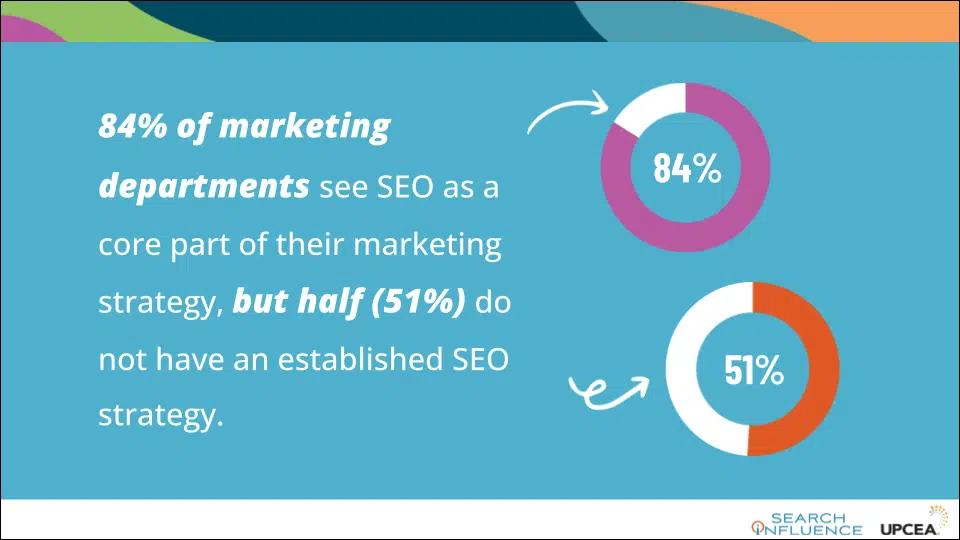
84% of marketing departments see SEO as a core part of their marketing strategy, but half (51%) do not have an established SEO strategy 

The disconnect is pretty striking. When so many see it as valuable, but so few have a strategy, we have to ask ourselves, “Why?”

Some possible reasons are:

  • SEO seems too complex.
  • Digital advertising (and its return) is easier to understand.
  • The ROI of SEO isn’t clear to decision-makers.
Higher ed SEO - Stat 1

I’m often asked when talking to leaders, both academic deans and directors of marketing, if we have case studies on the ROI of SEO.

We do, of course, but it’s still surprising that these senior professionals don’t make the connection.

If they’re willing to pay to be at the top of Google rankings, earning their way, there is imminently more valuable.

The difference between Page 5 (essentially nonexistent) and Page 1 can mean hundreds of additional visits and thousands of dollars in revenue.

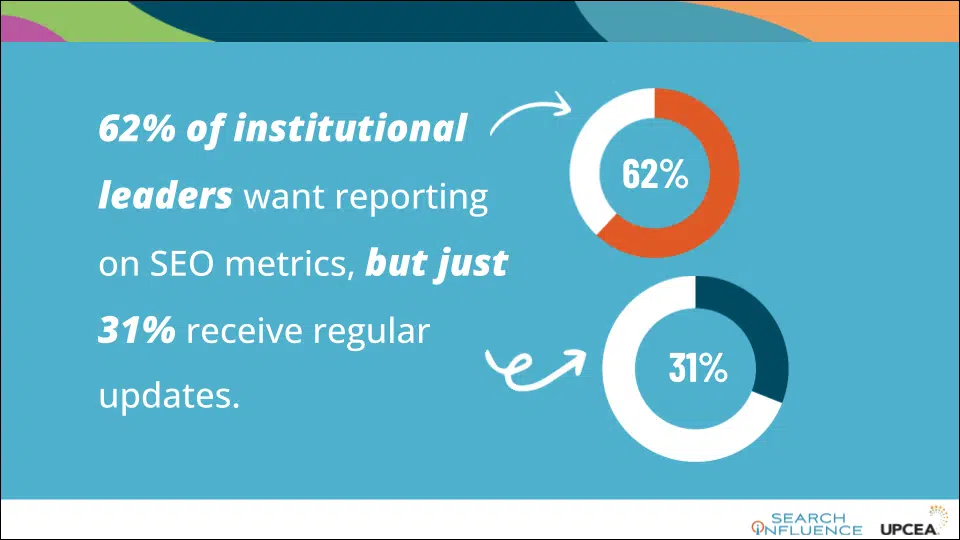
Institutional leadership often lacks reporting

Despite the indication that institutional leaders want reporting, a few of them are getting it. 

Higher ed SEO - Stat 2

It’s possible that marketing teams don’t know how to quantify their SEO efforts, or perhaps worse, they don’t know what efforts are being made.

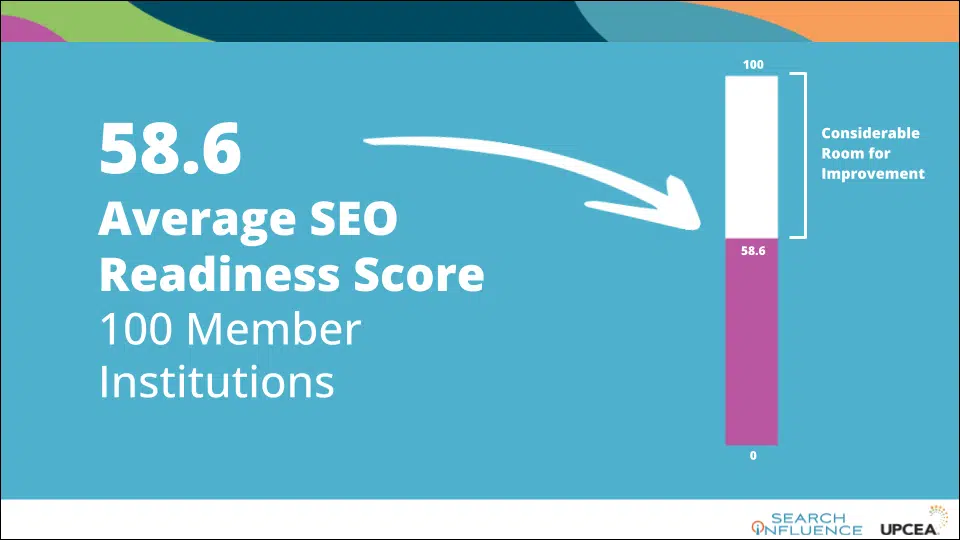
‘SEO readiness’ has room for improvement

Among the more surprising revelations was the number of sites that were not 100% accessibility compliant.

Our testing tool for accessibility, accessiBe’s accessScan, evaluates whether a website is non-compliant, semi-compliant, or compliant. 

A vast majority of institutions (81%) were just semi-compliant. Our clients report this is a hot-button issue for their administrations.

Furthermore, there are several lawyers who perceive it as an area of opportunity for trolling as well.

Higher ed SEO - Stat 3

SEO is essential to drive organic traffic from potential students.

A weak SEO foundation can negatively impact ranking factors and significantly hinder a website’s ability to attract potential students.

We often hear from higher education institutions that they are “doing SEO.” But we wonder – is it being done strategically?

From our experience, a comprehensive digital marketing strategy is critical for schools that want to meet their enrollment goals.

The results of this research demonstrate that SEO is an area of opportunity for many universities.


Get the daily newsletter search marketers rely on.


Overcoming challenges and embracing innovation

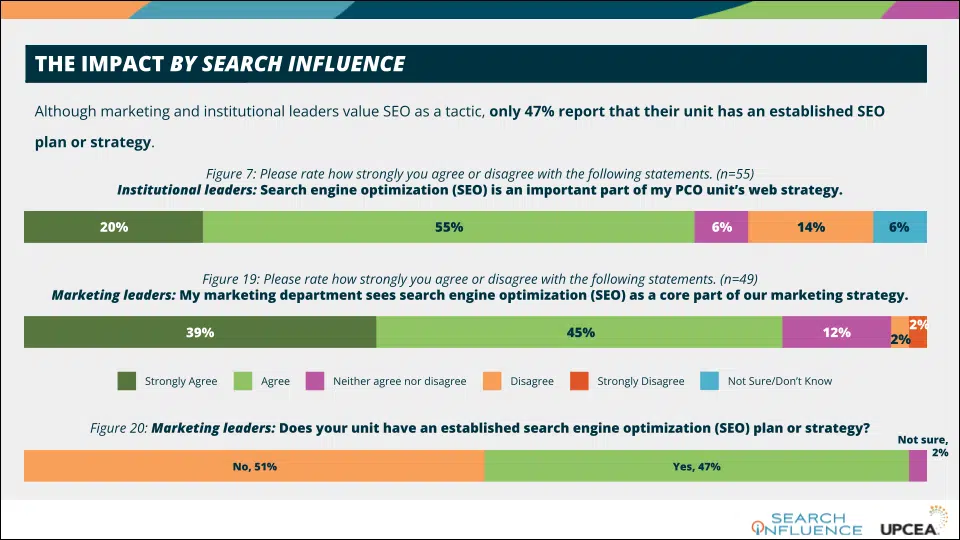
Although marketing and institutional leaders value SEO as a tactic, only 47% report that their unit has an established SEO plan or strategy. 

Higher ed SEO - Stat 4

This disconnect suggests that, while marketers know SEO’s critical role, they may not have the skills, staff, or resources to develop a strategy. 

Most web traffic comes through organic search, i.e., utilizing popular search engines such as Google.

This means regardless of where prospects are in their student journey, they expect a search engine to answer their questions about the availability of programs, applying, and even enrollment. 

Common challenges for educational institutions implementing SEO strategies

Centralized control of marketing and ‘webcomms’

In many higher education institutions, centralized departments are responsible for many functions.

Like facilities and food service, IT, communications, and marketing often reside at or are directed from the university level rather than in the individual departments.

In some cases, there are individuals or teams charged with marketing at the department level. Often, they are constrained by the brand guides, templates, and technology choices made at the institutional level.

In a minimal number of cases, we have seen individual departments or units allowed to make their own technology choices as long as they stay within the general guidelines of the parent organization. 

Institutional support for IT, marketing and SEO

These centralized teams are beholden not to the individual department but to the university or college. 

While they intend to serve all departments equally, what we have seen is typically one of two conditions: favored programs get more institutional resources, or all programs get basic support. 

With this as the reality, the most likely scenario is that there are not enough human and financial resources in an area (like SEO) that isn’t as tangible as email marketing or advertising.

When an individual department is in control of their marketing and their website, we see it as a great advantage. While they have less institutional support, they also have less institutional oversight and control.

Maintaining and growing knowledge of SEO 

In cases where there are department-specific web support or marketing teams, they are charged with many functions. They are updating faculty bios, course descriptions, social media and more.

They are often generalists without deep knowledge of the technologies they manage. 

It is challenging enough to establish a foundational understanding of SEO, digital ads, email marketing, social media, and website technologies – even more to maintain up-to-date best practices in an ever-changing field.

Most marketing leaders recognize that there is room for improvement in the SEO capabilities of their unit, scoring their knowledge with an average rating of 3.5 out of 5.

Higher education CMS issues

In addition to the institutional challenges to good management of the websites, there are CMS challenges as well.

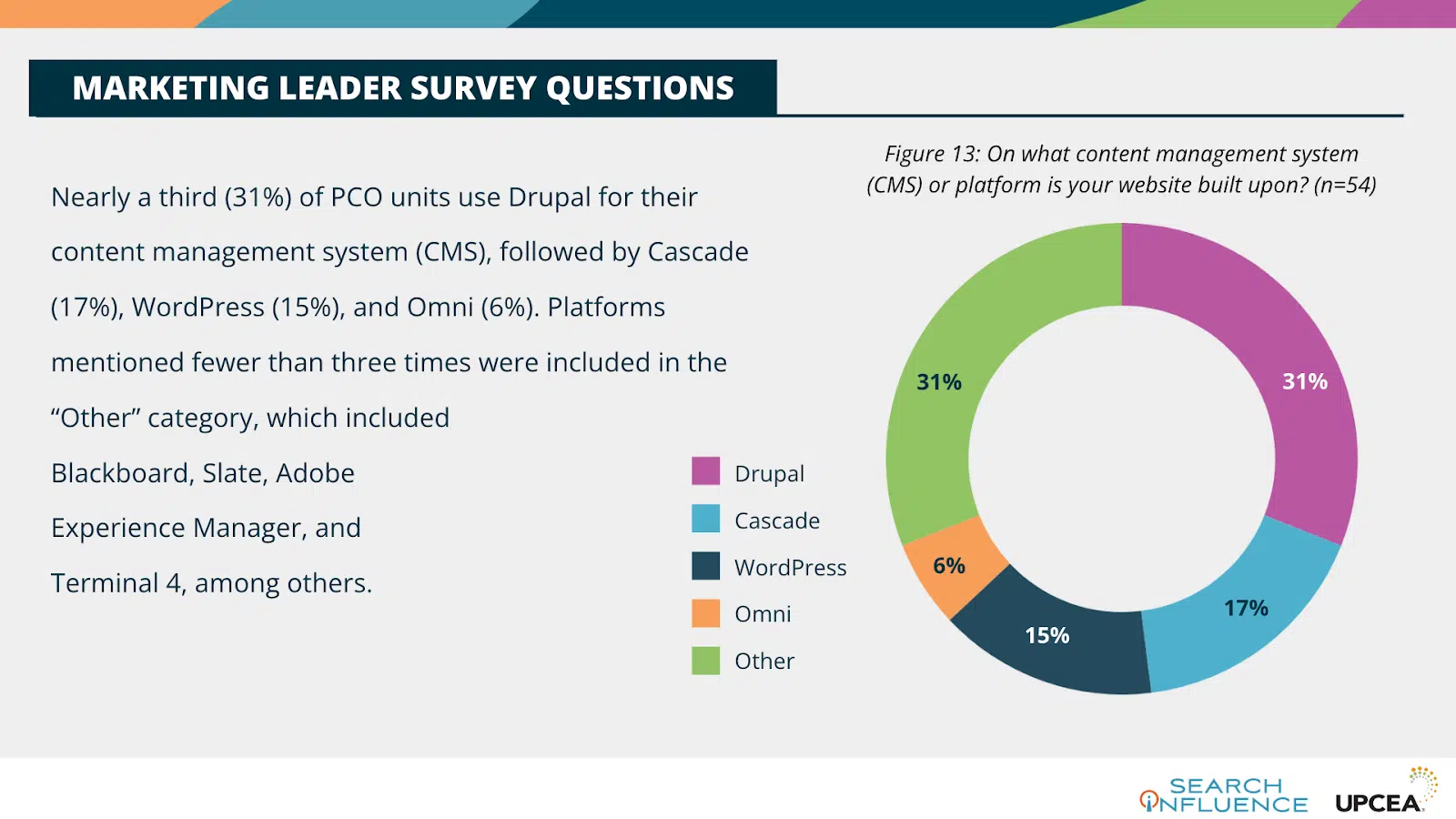
In our study, the most-used CMS platforms for university websites are: 

  • Drupal (31%).
  • Cascade (17%).
  • WordPress (15%)
  • Omni (6%). 

Other platforms mentioned included Blackboard, Slate, Adobe Experience Manager, and Terminal 4, among others.

Higher ed SEO - Stat 4

With so many CMS platforms within these PCO units, content management likely requires more training and support than in more commonly used systems, such as WordPress.

The challenge is pretty clear. Inconsistent support, teams with many roles, centralized command and control, and hard-to-manage systems mean not much will get done, even with the best intentions.

Is there a silver bullet for higher education SEO?

Sadly, there’s none.

In the best case, administrative leadership would come to understand the importance of SEO for higher education. 

Unfortunately, it doesn’t seem those administrators are making the connection between their important work – growth, fund-raising, enrollment, research – and SEO.

For most departments in higher education, SEO is an afterthought.

Best practices for higher education SEO

SEO basics

Without doing a deep dive into the basics of SEO, there are a few things that we know to be true.

Relevance + Authority = Winning in search engines

The shortest version of what good SEO looks like is:

In other words, are you saying the things people are searching for on your pages? 

Do search engines understand that yours is a trustworthy and respected website deserving of their traffic?

Higher ed SEO has an unfair competitive advantage

Given the importance of relevance and trust (surely you’ve heard of E-E-A-T), there are few more trusted websites than those associated with educational institutions.

In Maslow’s Hierarchy of link building, .edu links are right up there with self-actualization. They are the definition of what makes a good backlink. 

They have authority, relevance, trust, and lots and lots of actual user traffic. In academic research, this would be considered an authoritative citation.

Think about it, they publish constantly and much of their content is research people are interested in. 

They get tons of branded searches from prospective students. And they’re responsible for significant contributions to their local economy.

So as an academic unit within a university, your ability to appear for relevant searches is amplified. All you need is great content.

In higher education, content optimization is critical

The great news is that individual units are responsible for one of the most critical factors in university SEO: content.

If I control the content, I can control how it’s optimized. I can often control the formatting, including the use of headings and other on-page optimization elements. I can also likely control what is being linked to from within the content.

So, from our perspective, focusing on content is one of the most important – and realistic – things that any unit within a higher education institution can do for SEO success.

This is not to say they don’t need to be thinking about technical SEO. If there are critical failings within their technical infrastructure, they will have a harder time reaching prospective students.

But, if they can build relevant content and get good links, they’ll be a lot more likely to rank well in search than another site might, given the inherent authority of their university website.

Understanding what good content looks like becomes critical for those marketers working within those university units trying to attract new learners.

Getting started with higher education SEO content

Temet Nosce. As the Greek maxim states, it is important to know oneself.

One of the most important tools a higher education marketer can have is Google Search Console. Obviously, one has to take anything Google says with a grain of salt, but there are some good reasons to start with Search Console.

  • It’s free.
  • The information is pretty easy to understand compared to other tools.
  • It shows you Google’s point of view.

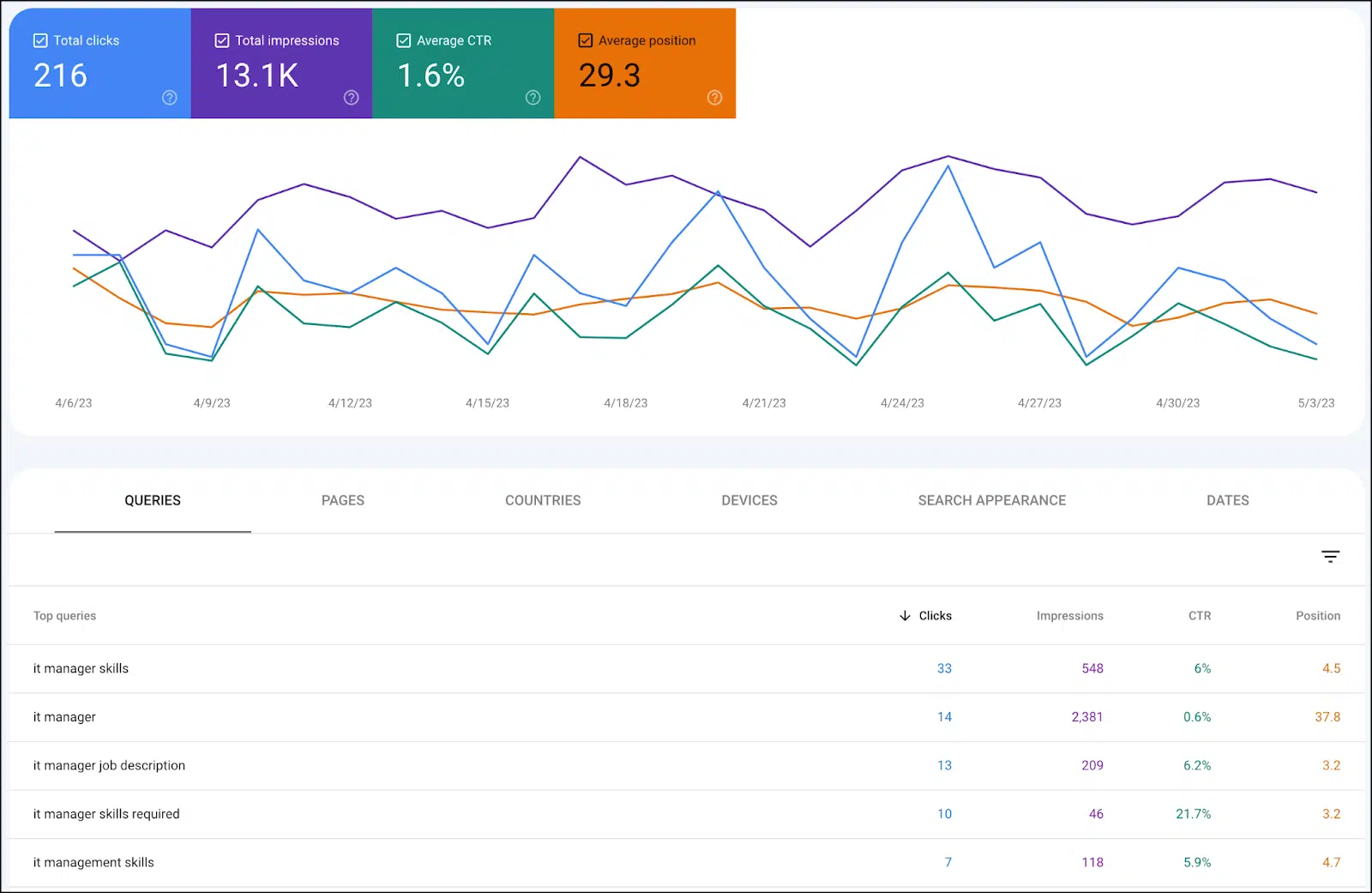
A good starting point for higher ed marketers is to look at what queries their pages already show up for.

GSC-top queries

With Google Search Console, you can see what phrases Google already thinks your website contact is relevant for.

Starting with those queries you’re already doing well for. You can start to think competitively. 

A review of competitive sites can give you some good clues about what you must do to get over the top.

  • Do they have more content?
  • What are the features of that content?
    • More images, more headers, more text, video?
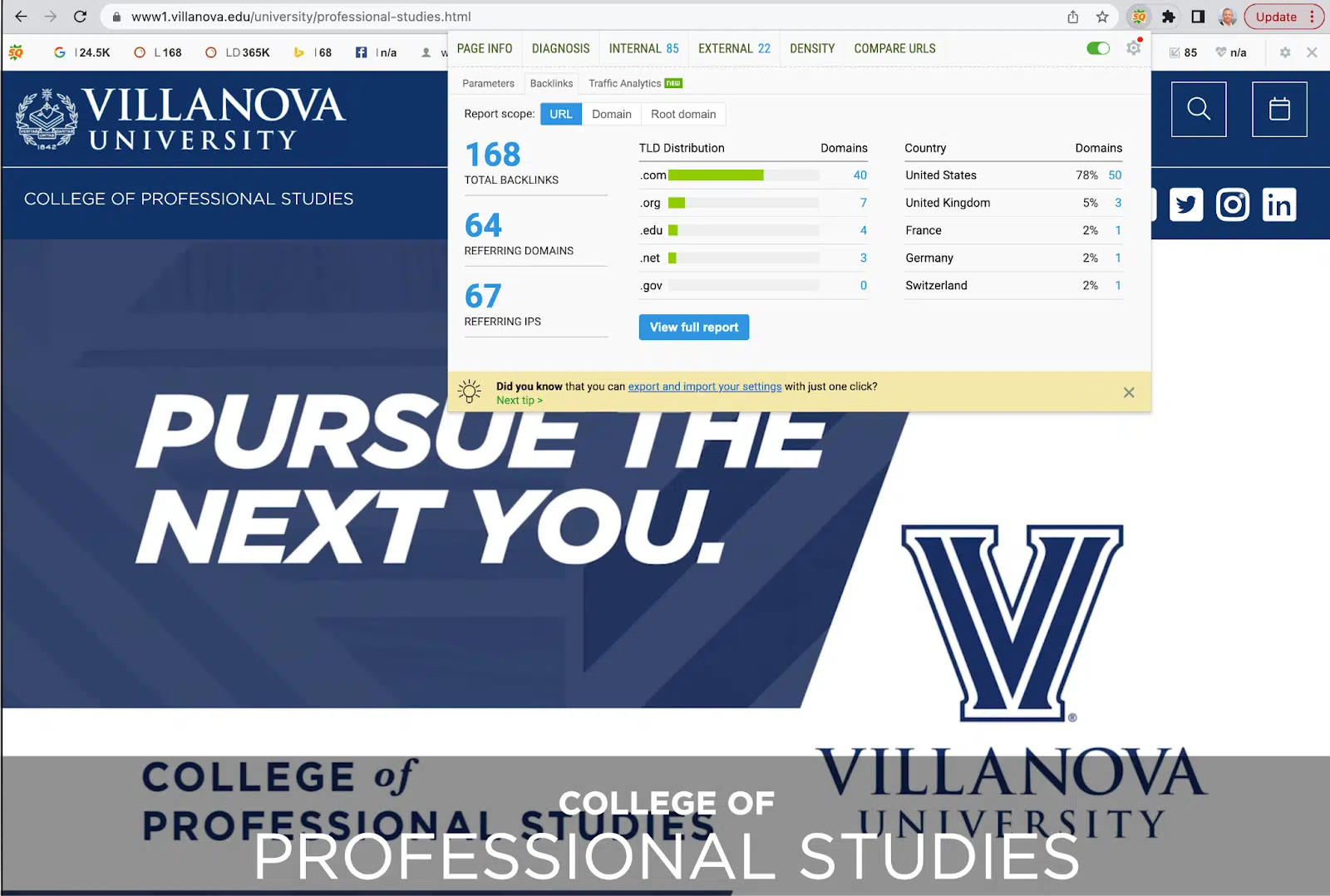
  • Do they have more links?
    • You may need tools for this one.
    • A good free option is the SEOquake extension. You’ll need a free Semrush account that gives you access to many SEO metrics.
Sample edu website audit

With the data from the above investigation, you’re now able to start outlining content.

The best web content is like a persuasive essay. Present the important information and then bring it home with a strong call to action.

In any industry, and especially in higher ed, it’s less about the words and more about the journey.

Just because people are searching for a phrase doesn’t mean that those people are prospective students.

Educating stakeholders on the value of SEO

It’s easy for us to look at a problem and see a marketing solution.

SEO is a foreign language to many, and as this study proves it is still not understood as a great way to drive ROI for higher education.

In the review of your own site, analysis of competing sites, and optimization of your content, you are never done. The key is to develop a system and cadence that work for you.

Whether due to complexity, lack of knowledge, or institutional inertia, SEO is not getting its due in higher ed. There are a lot of considerations outside the control of the folks executing the strategies within higher education marketing.

Our job is to support them. We must provide the best knowledge we can, meet them where they are, and ensure we are not asking them to do things that, in their situations, are “impossible.”

The UPCEA study shows much room for improvement in higher ed SEO. There are some winners in the analysis who still have opportunities for improvement.

By focusing on function and form, higher education marketers can start where they are within their current constraints: 

  • Create great content.
  • Build links, even if they’re just internal.
  • Get better placement in organic search so they will be less dependent on paid advertising.

Opinions expressed in this article are those of the guest author and not necessarily Search Engine Land. Staff authors are listed here.


Related stories

New on Search Engine Land

@media screen and (min-width: 800px) { #div-gpt-ad-3191538-7 { display: flex !important; justify-content: center !important; align-items: center !important; min-width:770px; min-height:260px; } } @media screen and (min-width: 1279px) { #div-gpt-ad-3191538-7 { display: flex !important; justify-content: center !important; align-items: center !important; min-width:800px!important; min-height:440px!important; } }

About the author

Will Scott

Will Scott is a recognized leader in digital marketing, known for coining the phrase “barnacle SEO” in 2008. Will is frequently invited to present at marketing and other industry conferences. Will founded Search Influence in 2006 with his wife, Angie Scott. Since putting his first website online in 1994, Will has led teams responsible for creating thousands of websites for business, building hundreds of thousands of pages in online directories, and delivering millions of visits from search. At Search Influence, Will directs the teams of dedicated professionals who optimize your potential! Outside of work, Will is a father to two boys, husband to Angie, his co-founder and COO in Search Influence. He is active in local non-profit and civic causes, an Ironman athlete, and a recovering heart patient.

https://searchengineland.com/higher-education-failing-seo-428273


Google SGE now uses photos and reviews from Google Business Profile listings

Google’s new Search Generative Experience, which began rolling out a few weeks ago, now can use Google Business Profile data to help it create its AI-generated snapshot answer. SGE also uses data “from the reviews, photos and Business Profile details that people have submitted to Google for more than 200 million places in the real world,” Google wrote.

What it looks like. Here is a video showing how Google pulls reviews and photo data from Google Business Profiles and displays them in the AI-generated snapshot answer in the new Search Generative Experience.

I was even able to replicate it for my own Google Business listing for my company. I asked [who is RustyBrick], and it returns photos directly from my Google Business Profile listing. The images below the text pull directly from the photos I uploaded to my Business Profile in Google.

Google Sge Business Profile Data

Here are more examples I found on Twitter of this in action:

What Google said. Google wrote:

“We’ve added new capabilities to SGE for local and travel searches, so if you ask detailed questions about a place or destination in Search, you’ll see an AI-powered snapshot that brings together the most helpful information available — not only from across the web, but also from the reviews, photos and Business Profile details that people have submitted to Google for more than 200 million places in the real world. And with all these links and resources right at your fingertips, it’s easy to dive deeper on relevant sites and hear perspectives from a wide range of creators.

For example, you might ask if a certain restaurant is good for large groups or whether they’re vegetarian-friendly. Or maybe you want to know when people recommend visiting a particular landmark, so you can avoid the crowds. With this improved experience in SGE, you’ll get useful insights to guide you along the way, so you can spend less time planning and more time enjoying the plans you’ve made.”

Why we care. This gives you yet another reason, if you didn’t have enough reasons, to ensure your photos on your Google Business Profile listings are complete, good quality and representative of what your customers and prospects want to see of your business and organization. Also, ensuring you have good reviews, since SGE can use those, is also important.

This also shows that Google is ready and able to use more and more data sources it has at its disposal within its SGE AI-generates snapshots.


Related stories

New on Search Engine Land

@media screen and (min-width: 800px) { #div-gpt-ad-3191538-7 { display: flex !important; justify-content: center !important; align-items: center !important; min-width:770px; min-height:260px; } } @media screen and (min-width: 1279px) { #div-gpt-ad-3191538-7 { display: flex !important; justify-content: center !important; align-items: center !important; min-width:800px!important; min-height:440px!important; } }

About the author

Barry Schwartz

Barry Schwartz a Contributing Editor to Search Engine Land and a member of the programming team for SMX events. He owns RustyBrick, a NY based web consulting firm. He also runs Search Engine Roundtable, a popular search blog on very advanced SEM topics. Barry can be followed on Twitter here.

https://searchengineland.com/google-sge-now-uses-photos-and-reviews-from-google-business-profile-listings-428320


What do SEO platforms do? Do you need one?

MIR 1512 SEOPlatfrm 2023 Cover 1920x1080 800x450

Of all the tactics for driving traffic on the web, search engine optimization (SEO) is perhaps the most powerful, given that 53% of a website’s traffic can typically be attributed to organic search, according to a BrightEdge study. But the practice of SEO has become more complex and it involves more considerations than SEOs enjoyed in the “ten blue links” era.

SEO is not just about content creation and promotion anymore. It also involves improving the user experience and adapting to the evolving ways that search engines display and deliver results across different platforms like voice assistants. However, traditional SEO practices are still relevant. Keyword research, page-level analysis, backlink tracking and acquisition and rank tracking, are still essential for success even in a changing landscape.

SEO platforms offer numerous capabilities that include all of those, as well as competitive intelligence, social signal integration and workflow rights and roles. They also provide more extensive link and site audits or analytics that include predictive scoring systems to identify potential opportunities to improve page performance or link authority. 

MarTech’s “Enterprise SEO Platforms: A Marketer’s Guide” examines the market for SEO platforms and the considerations involved in implementing this software into your business. This free 76-page report includes profiles of 19 leading SEO tools, vendors, pricing information, capabilities comparisons and recommended steps for evaluating and purchasing.

Visit Digital Marketing Depot today and download your copy.


Related stories

New on Search Engine Land

@media screen and (min-width: 800px) { #div-gpt-ad-3191538-7 { display: flex !important; justify-content: center !important; align-items: center !important; min-width:770px; min-height:260px; } } @media screen and (min-width: 1279px) { #div-gpt-ad-3191538-7 { display: flex !important; justify-content: center !important; align-items: center !important; min-width:800px!important; min-height:440px!important; } }

About the author

Digital Marketing Depot

Digital Marketing Depot is the resource center for digital marketing strategies and tactics. Created by Third Door Media, Digital Marketing Depot features a robust library of hosted white papers, eBooks, original research, and webinars on a wide range of digital marketing topics- from advertising, analytics, data and content management, to email marketing, SEO and PPC campaign management, and much more. Visit us at http://digitalmarketingdepot.com.

https://searchengineland.com/what-do-seo-platforms-do-do-you-need-one-428318


How to build your own SEO ‘second brain’ (and why you need it)

Whether you’re an internal SEO whiz or a digital agency pro, chances are you’ve experienced one or more of these all-too-familiar problems:

  • Feeling drowned in an ocean of ever-evolving industry trends.
  • Spending forever in the set-up phase, building deliverable trackers, audit sheets, keyword map templates, content briefs, and backlog grooming can feel like you’re on a never-ending treadmill.

Yes, I’ve been there too. I felt the relentless churn and knew that something had to shift dramatically if I wanted to continue growing as an SEO. 

This realization led me to discover the game-changing concept of building a “second brain,” an idea popularized by Tiago Forte. 

I’ve since applied this concept to my own SEO practices. Below, I’ll cover how you can build your own SEO second brain.

Why you should consider building an SEO second brain 

Before building a second brain, let’s examine what an organic brain excels at and where it falls short. Here’s a quick snapshot:

Our brains are great at:

  • Generating original ideas.
  • Interconnecting ideas and spinning compelling narratives.
  • Fostering empathy with others.

But terrible at:

  • Retaining information over a prolonged period.
  • Segmenting and categorizing stored data.
  • Retrieving and applying stored information.

By delegating the latter tasks to an external database or a “second brain,” you can better store and retrieve crucial documentation, templates, and key learnings between websites.

Most importantly, never again will you forget crucial information when you most need it.

How to start building your own SEO second brain

Building your second brain may seem daunting initially, but take it one step at a time, and you’ll get there. Start with the following steps and tips:

  • Selecting the right tools to suit the way you work
  • Structuring your second brain with the PARA system
  • Operating your second brain: Start with idea capturing
  • A quick walkthrough of my own SEO second brain

You can use plenty of systems and platforms to build a second brain. It all comes down to your preference and which platform you’re most comfortable with. 

I use Notion to build my SEO second brain (and operate most of my SEO projects), so I’ll use examples from Notion throughout this article.

A great way to identify which tool to use for building your SEO second brain is to get to know your style of information organization. Here are some examples Forte mentions:

Information organization
  • The architect: Prefers systematizing information in a hierarchical manner, focusing on large-scale projects and using a systems mindset. They have to be careful not to force information into their system when it doesn’t fit. Apps like Notion and Craft are well-suited to this style.
  • The gardener: Thrives on cultivating many ideas at the same time, favoring relationships and connections. They must beware of getting easily distracted by new, unrelated information. Apps like Obsidian and Roam are well-suited to this style.
  • The librarian: Practical and project-oriented, they like to capture information from diverse sources and curate a collection of knowledge. Their pitfall might be amassing content without using it. Apps like Evernote and Microsoft OneNote are well-suited to this style.
  • The student: Usually new to knowledge management or focusing on a specific part of their life. They favor ease of use and avoid complexity. Apps like Apple Notes or Google Keep are well-suited to this style.

Structuring your second brain with the PARA system 

The PARA system stands for:

  • Projects: Specific tasks linked to a goal or deadline.
  • Areas: Responsibilities that need to be maintained over time.
  • Resources: A topic or theme of ongoing interest.
  • Archives: Inactive items from the other three categories.
PARA system

Here are some examples of which SEO tasks suit each category.

Projects: Your most important and time-sensitive tasks.

  • Example: Optimize the internal linking structure for a core landing page by the end of the week.

Areas: Your ongoing optimization efforts and routine tasks.

  • Example: Create monthly performance reports.

Resources: Shared credentials and background information.

  • Example: CMS logins and target personas.

Archives: Completed tasks and documentation

  • Example: Title tags updated over the past 24 months.

I’ve adopted some version of the PARA framework to manage SEO campaigns for 35+ websites. 

It’s a game-changer to help me get the most impactful tasks done first and still deliver on smaller issues.

But how does this help me better manage SEO projects?

Traditionally, SEOs tend to structure our work into static categories like keyword research, technical audit, link building, and content production. However, this doesn’t mirror the dynamic nature of SEO projects.

This conventional and static way of organizing information is like categorizing your kitchen by individual ingredients rather than usage and priority (a fun analogy credited to Forte). 

Wouldn’t it be odd to organize your kitchen by carrots, potatoes, and fruits rather than stovetop items, pantry goods, and fridge contents?

Like kitchens, static file structures can lead to “cross-contamination” between outdated and fresh documents, making it challenging to locate the most relevant information quickly.

Enter the PARA framework – a dynamic solution reflecting the shifting priorities of an SEO project:

  • Immediate concerns reside in the Project folder.
  • Ongoing work belongs to the Area folder.
  • Thematic and research material is kept in the Resources folder.
  • Completed tasks and old data go into the Archives folder.

This way, PARA keeps your SEO project fluid, organized, and current.

Operating your second brain: Start with idea capturing

Let’s say you’ve built an SEO second brain of your own. How do you go about using it in the best way possible?

For me, it’s all about idea capturing. This is the act of quickly and effortlessly storing information you’ve encountered throughout the day in a temporary repository.

It’s the single most important mechanism to master in operating a second brain.

SEO Second Brain Idea Capturing 800x450

That’s because it enables me to quickly and passively store new information in a temporary space of my second brain so that I can later revisit and move it to relevant sections of the brain.

These can include:

  • Important algorithm or industry updates.
  • Interesting articles on new tactics I can apply to my own websites.
  • Add meeting notes and recordings throughout the day.
  • Insightful conversations I’ve had with my colleagues.

I’ve built an empty page in my second brain called the Idea Capturing Station, meant to do just this, keeping it immediately accessible to me at all times on both desktop and mobile.

Here’s an example of how I quickly capture an interesting article on desktop:

Idea Capturing Station - desktop

And here’s how I quickly capture a new idea on mobile:

Idea Capturing Station - mobile

A quick walkthrough of my own SEO second brain

Here’s a quick snapshot of what my SEO second brain dashboard looks like.

quick walkthrough of my own SEO second brain

Each of these individual areas, like Project Timeline, is then linked to separate databases where I store and organize information hierarchically. That’s right. I’m a classic architect when it comes to information organization.

In reality, however, I rarely use this dashboard. I use the tool’s internal search function to find specific areas of my second brain I want to navigate to. 

For instance, if I’d like to find one of my project timelines, I can search for it and hop straight to it like so.

Building reusable templates

One of the most useful “powers” of this second brain is its ability to create reusable templates, giving me an almost instant set-up each time we onboard a new client at my agency.

Reusable template

With just a few clicks, I am able to populate a full SEO roadmap timeline, each broken into tickets with specified templates to be delegated to team members and shared with clients. Here are a few examples:

Keyword mapping

K4ymSikkodhpJ67SJYAH2Lno0SByUoKb0Ysdt3r8VDdg NzafNNdPdcpX8gIS5MULHO4RxoSNSr6h N0yb0K 2qgL5cCRNdcmsVFdIrWnjsw43sFMA1xnsn0MBeuJ3JTopQrPdSvzZsbF1zEObf Ve0

Content production

AEAlZSY1x3Q7ROSRS31Mcwk4GkRdpBmc4HM Mr0cnY6AyFAzmgxjMmVlv5hguhTA0RG8LXxyOZ0lV WLOXXA3KZLbLZCNDS7wwRwPPjCqlLO8cps T0tVBRsxZFSpb4QiqltgEFk04 Tjzj 3DLA B4

Documentation at hand

What about that time you forgot a key piece of information or statistic while meeting with stakeholders?

I have a database called the Knowledge Bank that allows me to pull up key information to reference at all times.

KewTWRMfRLU8GLcsKFwlEdiovBVvp2HXRCKjNiAwsYIg StGb YT5ZrIPg7RibWFNtE68w MX93mOlWsowdad2dPSzRLeL2hbvQ2tyvLvPgvBdjKxaEgh4SXWFMdK4vQXxAA7iQKoD0ABJTwRoiCVbQ

Let’s say I’m trying to convince some stakeholders that it can be worthwhile pursuing keywords with “zero search volume.” 

In the middle of the conversation, I vaguely recall having read an article by Steve Toff on discovering zero search volume keywords, showing strong evidence of their ROI potential.

In this case, I can quickly search for the article on my second brain and reference the article almost instantly.

3kCccQcd691 NhdFDOaCmf1XIWdrD57CXldTnd TgXl R8bUgkotGXEfRAFSZuzOs CDRQ9LohRVbNqolV Q Z4gdenZx3nhu9WRyayKXF8o0dcFopb3DvYMys5veICdy 3yr6rVGvdwq WIQB4alQQ

How to make the most of your second brain? Exercise it! 

My second brain is far from complete and probably always will be (very much like our organic brains!). 

The key here is to exercise our SEO second brain regularly so that we get better at using it to store, retrieve and synthesize information.

Once you’re familiar, extend your second brain to other domains of life!

Our second brain goes far beyond SEO at Criclabs, the digital agency I’m running. We use it to track new hires, document company processes, run employee portals and more.

The good news is many of us already have an SEO second brain in the works, whether we know it or not. If you have a shared drive to store information or occasionally take notes on your phone, your SEO second brain is already on its way. 

What you can do now is what we SEOs know best, optimize it!


Opinions expressed in this article are those of the guest author and not necessarily Search Engine Land. Staff authors are listed here.


Related stories

New on Search Engine Land

@media screen and (min-width: 800px) { #div-gpt-ad-3191538-7 { display: flex !important; justify-content: center !important; align-items: center !important; min-width:770px; min-height:260px; } } @media screen and (min-width: 1279px) { #div-gpt-ad-3191538-7 { display: flex !important; justify-content: center !important; align-items: center !important; min-width:800px!important; min-height:440px!important; } }

About the author

Toon Limivphuwat

Toon is an organic growth expert and co-founder of Criclabs, a digital agency based in Bangkok. He’s worked with global brands like Electrolux, Greenpeace, and a multitude of startups deliver organic growth to their digital products.

https://searchengineland.com/seo-second-brain-428290


Google releases new search spam report form

Google has updated its form to submit search spam to the Google Search team. The types of spam you can submit with this form include spam, paid links, malicious behavior, low quality, and other search quality issues, Google said.

Plus, Google added the ability to submit complaints in bulk.

The new form. Google said it is “expanding the scope of user feedback we want to collect,” to include more types of feedback. “Now, you can report spam, paid links, malicious behavior, low quality, and other search quality issues, all in one improved form,” Google added.

Bulk submission. Google also added the ability to submit feedback in bulk with a bulk submission feature. Google said you “can submit up to five pages that violate the same policy in one report.”

What it looks like. Here is a screenshot from Google:

Search Quality Feedback Report 575x600

More details. The form will also give you feedback and information that links to its help documentation. It will let you pick the main category and then subcategory, to help you submit the feedback to the right department. Plus, it will disregard identical reports submitted by the same user to prevent spam.

Google will also send you a confirmation email after you submit the form. The email contains help links to external resources that cover our quality policy and our forum for personalized support, Google added.

Why we care. Sometimes you find spammy or invalid information in Google Search. If you want to report those issues, you can using this new form. The form can be accessed over here.


Related stories

New on Search Engine Land

@media screen and (min-width: 800px) { #div-gpt-ad-3191538-7 { display: flex !important; justify-content: center !important; align-items: center !important; min-width:770px; min-height:260px; } } @media screen and (min-width: 1279px) { #div-gpt-ad-3191538-7 { display: flex !important; justify-content: center !important; align-items: center !important; min-width:800px!important; min-height:440px!important; } }

About the author

Barry Schwartz

Barry Schwartz a Contributing Editor to Search Engine Land and a member of the programming team for SMX events. He owns RustyBrick, a NY based web consulting firm. He also runs Search Engine Roundtable, a popular search blog on very advanced SEM topics. Barry can be followed on Twitter here.

https://searchengineland.com/google-releases-new-search-spam-report-form-428285